
In this article
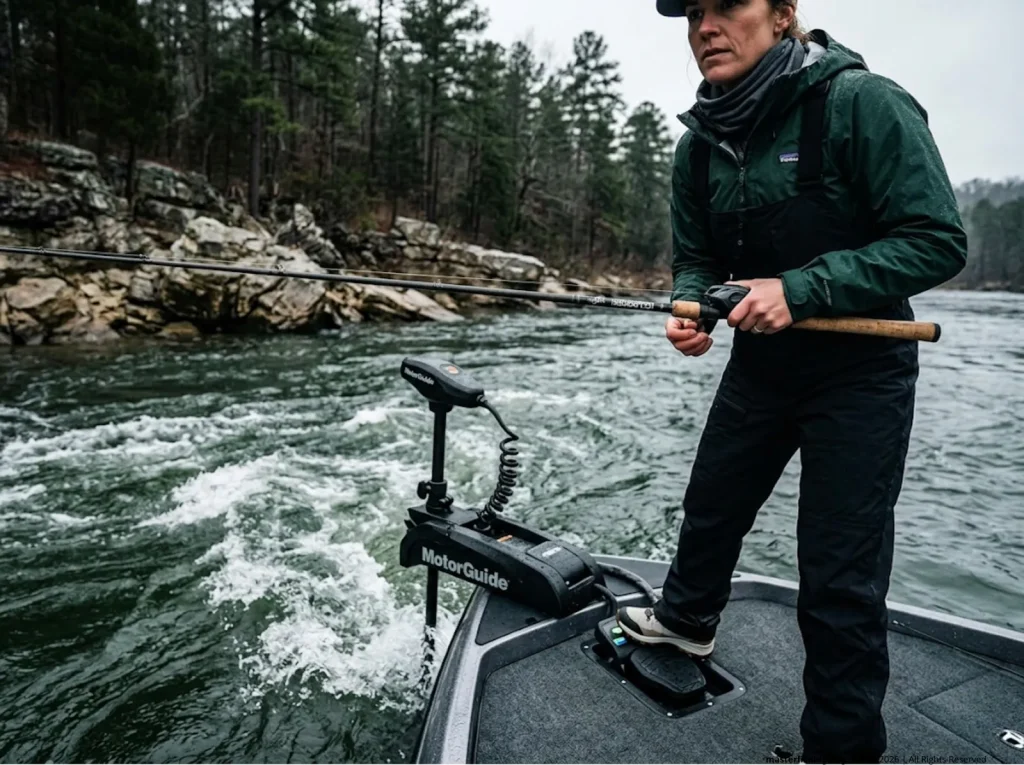
The bow of my bass boat was spinning sideways in 15 mph current before I even had a chance to hit Spot-Lock. The motor was pulling over 20 amps per battery, the voltage at the plug had sagged to 22.1 volts, and 80 pounds of trolling motor thrust had become 65 pounds of wishful thinking — all because I grabbed 8-gauge SAE wire instead of 6-gauge AWG marine cable to save $28. That one decision cost me the best position I’d found on the river all year.
After fifteen years rigging bass boats and center consoles, I’ve seen this mistake more times than I can count — and I’ve made it myself. The good news: a properly wired 24V trolling motor system is one of the most reliable setups you can put on a boat. The bad news: almost every corner-cut in the wiring chain shows up as stolen thrust, failing batteries, or a fire in the bilge.
Here’s exactly how to do it right, from wire gauge selection to the loaded voltage test that tells you whether your system is actually delivering what you paid for.
⚡ Quick Answer: To wire a 24V trolling motor system, connect the positive terminal of Battery A to the negative terminal of Battery B using a jumper wire the same gauge as your main leads — this creates series wiring that doubles the voltage without cutting amp-hour capacity. Use tinned copper marine cable (UL 1426 BC-5W2) sized to your actual routed distance, not the optimistic chart in your motor manual. Mount a 60-amp marine breaker within 7 inches of the positive battery terminal, and match its AIC rating to your battery chemistry — at least 10,000A AIC if you’re running LiFePO4 batteries. Run a loaded voltage test at full throttle before you ever launch to confirm voltage drop stays below 0.72 volts across the full run.
The Physics Case for 24 Volts
Here’s where people go wrong before they ever touch a wire: they treat the jump from 12V to 24V as a performance upgrade instead of a wiring decision.
When you double the voltage on a 24V trolling motor, the current required to produce the same power gets cut in half. That means a standard 80lb thrust motor that pulls 110–120 amps at 12V draws only 50–60 amps at 24V. Half the current, same thrust. What that means for your wiring: halving the current cuts heat generated in the wire by a factor of four — not two. Your wiring runs cooler, your motor commutators wear slower, and you can reach full thrust with conductors a fraction of the weight.
The weight thing surprised me more than the efficiency numbers. On a 17-foot bass boat, dropping from 2 AWG to 8 AWG wire on a 50-foot run takes you from roughly 14 pounds of copper down to 3.5 pounds. That’s a real shift in how the boat sits at rest and how it comes off the hole. The bow on my rebuilt rig came up a measurable half-inch after the rewire.
If you’re still not convinced 24V is the right system for your setup, you’ll find a thorough comparison of the best 24V trolling motors available today that walks through thrust, voltage, and motor selection from Minn Kota and MotorGuide alongside each other.
Pro tip: Before you buy a single foot of wire, sit down and run the numbers first. A 24V system doesn’t just give you a more powerful motor — it gives you a system that can actually deliver that power to the prop. The motor manual assumes a clean, short run. Your boat is not a manufacturer spec sheet.
ABYC E-11 — The Standard Behind Every Decision
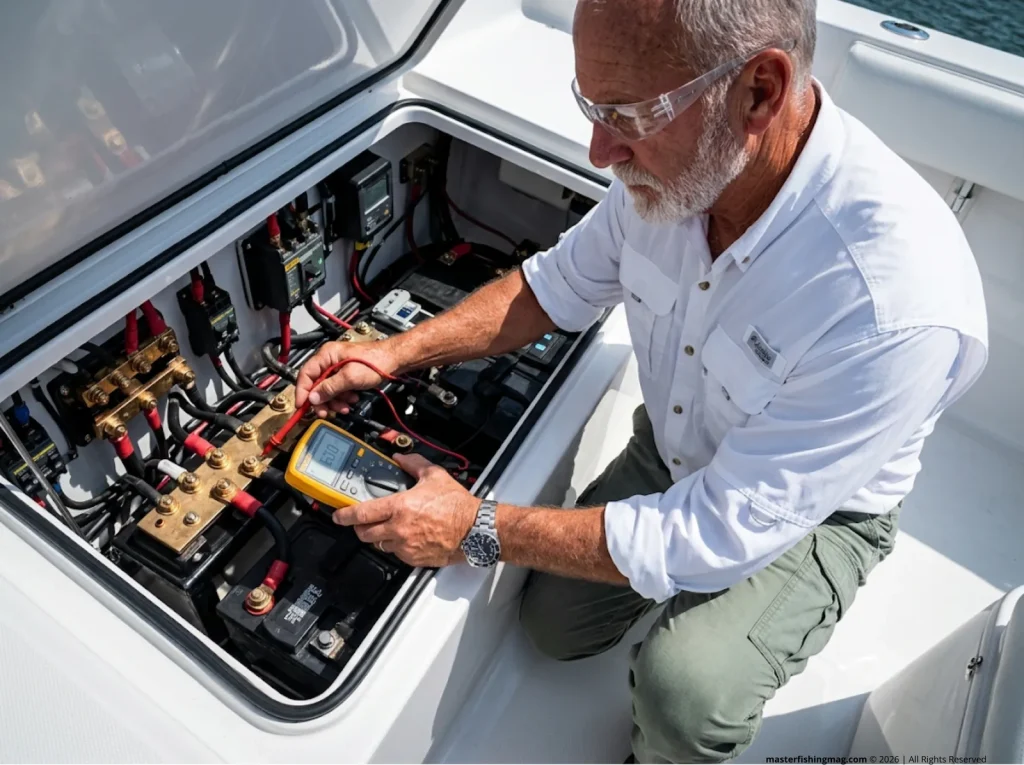
ABYC E-11 is technically voluntary for recreational boaters. Tell that to your insurance adjuster when a wiring fault burns down your hull.
The ABYC (American Boat and Yacht Council) standard forms the basis of USCG regulations under 33 CFR Part 183, and it’s what every marine surveyor turns to when they’re looking for deficiencies. Electrical faults in DC systems account for approximately 55% of all onboard fire claims — electrical work is where boats catch fire, and E-11 is the standard that tells you where the line is. You can review the USCG electrical compliance guidelines for small vessels directly if you want to see how the regulatory chain connects back to E-11.
For 24V systems, the standard that matters most on propulsion circuits is the 3% voltage drop limit. In a 24V system, that’s a maximum allowable drop of 0.72 volts under peak load. Fall below that threshold and your trolling motor’s PWM controller starts fighting undervoltage — you lose thrust, Spot-Lock gets erratic in current, and the motor runs hotter than it should.
Every surveyor I’ve watched work a damage claim starts at the battery terminals. Non-compliant wiring doesn’t just put a red mark on an inspection report — it can void your marine insurance entirely, and you won’t find that out until after the claim. That connection to fire risk makes solid compliance work on the electrical side directly relevant to the USCG fire safety requirements that share a regulatory shelf with ABYC E-11.
Marine Wire Science — Why Automotive Grade Fails
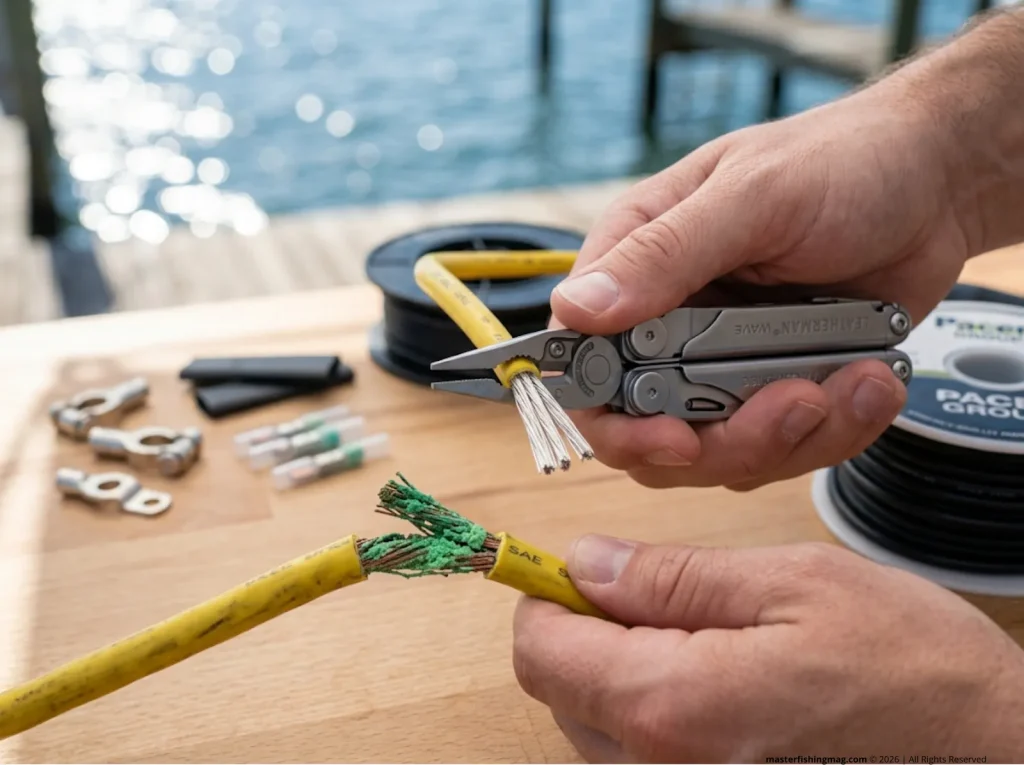
The single most common shortcut that kills 24V systems is automotive wire. SAE wire looks almost identical to marine AWG cable on the shelf. Pull them off the rack and feel them side by side — the marine cable should feel noticeably heavier and stiffer. If it doesn’t, something is wrong.
The Wicking Phenomenon and Tinning (BC-5W2)
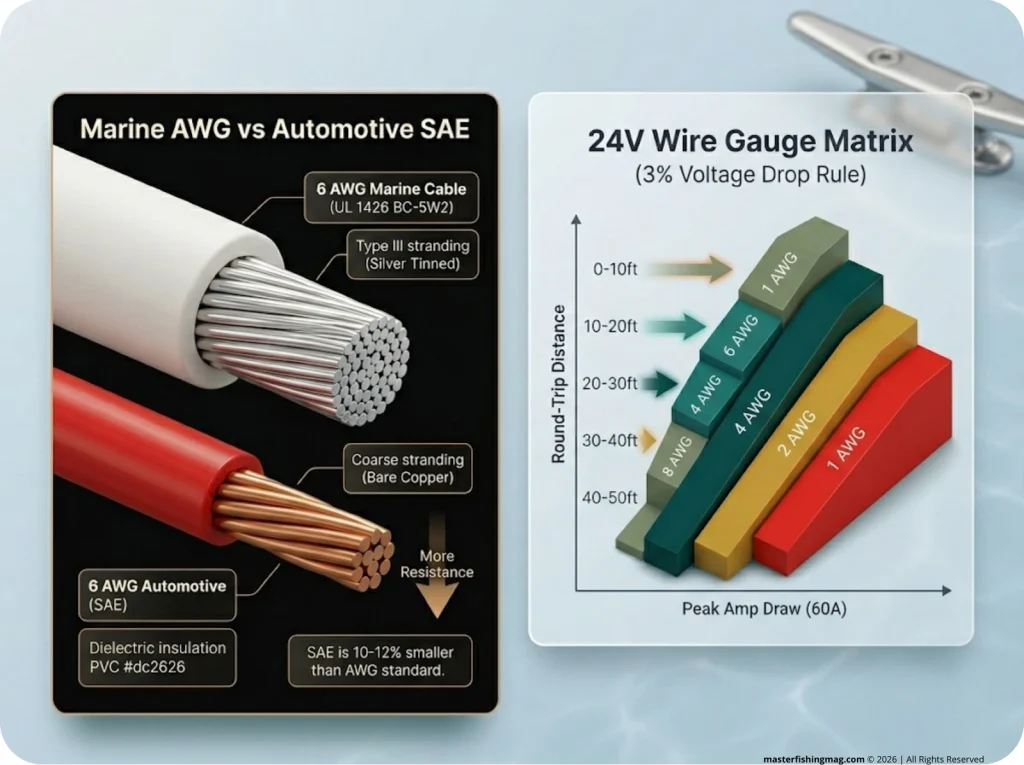
Bare copper oxidizes in salt air, forming cupric oxide — an insulator, not a conductor. Tinned copper wire uses a tin or tin-lead alloy electroplated over each strand as a sacrificial barrier against corrosion. More critically, marine cable built to UL 1426 BC-5W2 uses Type III stranding: dozens of fine 30 AWG strands inside every 6 AWG cable, which lets the wire flex through tight hull radii without cracking and gives corrosion nowhere to get a running start.
The failure mode you’re protecting against is called the wicking effect — moisture enters the insulation at a terminal and travels up the cable by capillary action, corroding the strand bundle from the inside out while the outside looks fine. You won’t see it coming until you clip a meter on and realize you’ve dropped 15% of your voltage at a connection you haven’t touched in two years.
When you strip the end of good marine wire, the strands should be shiny silver. Orange-brown means the tinning is compromised. Cut past it until you find clean metal.
Pro tip: Copper-Clad Aluminum (CCA) wire has 40% higher resistance than pure tinned copper and corrodes to white aluminum oxide powder within 12 months of saltwater exposure. It’s never ABYC-compliant for propulsion. If the wire price seems too good to be true, it’s CCA.
Insulation Ratings and the SAE Trap
ABYC E-11 requires insulation rated 105°C in dry environments and 75°C in environments exposed to bilge water or moisture — and for any wire routed through engine compartments or bilges, it must be BC-5W2-marked as oil-resistant, moisture-resistant, and UV-resistant.
Here’s the one that catches people: 6-gauge SAE wire is physically smaller than 6-gauge AWG. The sizing standards are different. Swap SAE for AWG on a trolling motor run and you’ve already pushed resistance up 10–12% before you even start routing wire. That alone can put a borderline installation into ABYC violation before you’ve flipped a switch.
Never route your trolling motor power leads through the same conduit as your transducer or VHF antenna cables. High-current leads at 50–60 amps generate an electromagnetic field that puts noise on fish finder screens and can corrupt NMEA data. If leads must cross, do it at 90 degrees. This is especially worth understanding if you’re building or expanding your NMEA 2000 marine electronics network.
Sizing the Conductors — The Math Behind the Manual

Your trolling motor manual has a wire gauge chart. That chart assumes an optimistic, direct run. Real boats have rigging tubes, vertical drops, bulkhead penetrations, and turns that add 50% or more to your actual wire length before a single amp flows.
The 24V Wire Gauge Matrix (3% Rule)
The matrix below gives you minimum AWG for a 60-amp peak draw — standard for most high-thrust 24V motors — to stay within the ABYC 3% voltage drop limit at 24V (0.72V max):
- 0–10 ft round-trip → 8 AWG
- 10–20 ft → 6 AWG
- 20–30 ft → 4 AWG
- 30–40 ft → 2 AWG
- 40–50 ft → 1 AWG
Measure your actual routed path before you order wire. Run a pull string from battery to motor head and measure the string, not the boat. Add four feet minimum for turns, drops, and penetrations on any center console with batteries under the console.
The plug and receptacle are the hidden failure point most people ignore. A standard 12V plug is rated for 30–40 amps. A 24V system pulling 50–60 amps at full draw needs a high-current marine plug — the Minn Kota MKR-28 or equivalent. Drop a standard 12V plug onto a 24V draw and you’ll melt the pins before the season is over.
Pro tip: Never size down to save money. A $3,000 trolling motor is only as capable as the $50 of copper feeding it. Dropping from 6 AWG to 8 AWG on a 20-foot run puts 10–15 lbs of thrust directly in the garbage. You’re not saving $30 — you’re throwing away a third of your Spot-Lock authority in heavy current.
Practical Routing — Fishing Wire Through the Hull
When pulling 4–6 AWG through rigging tubes, use a pull string or fish tape with wire-pulling lubricant. Never share a tube with high-frequency transducer cables or VHF antenna leads. Maintain a minimum bend radius of 5× the cable outer diameter to prevent insulation stress at tight corners. Secure cables in looms with UV-resistant cable ties at maximum 18-inch intervals to stop chafe.
All hull penetrations need watertight cable glands or grommets with marine sealant. An open penetration is a direct path for bilge water and salt spray to reach your wire insulation — and that’s where the wicking starts.
Circuit Protection — The 7-Inch Rule Explained
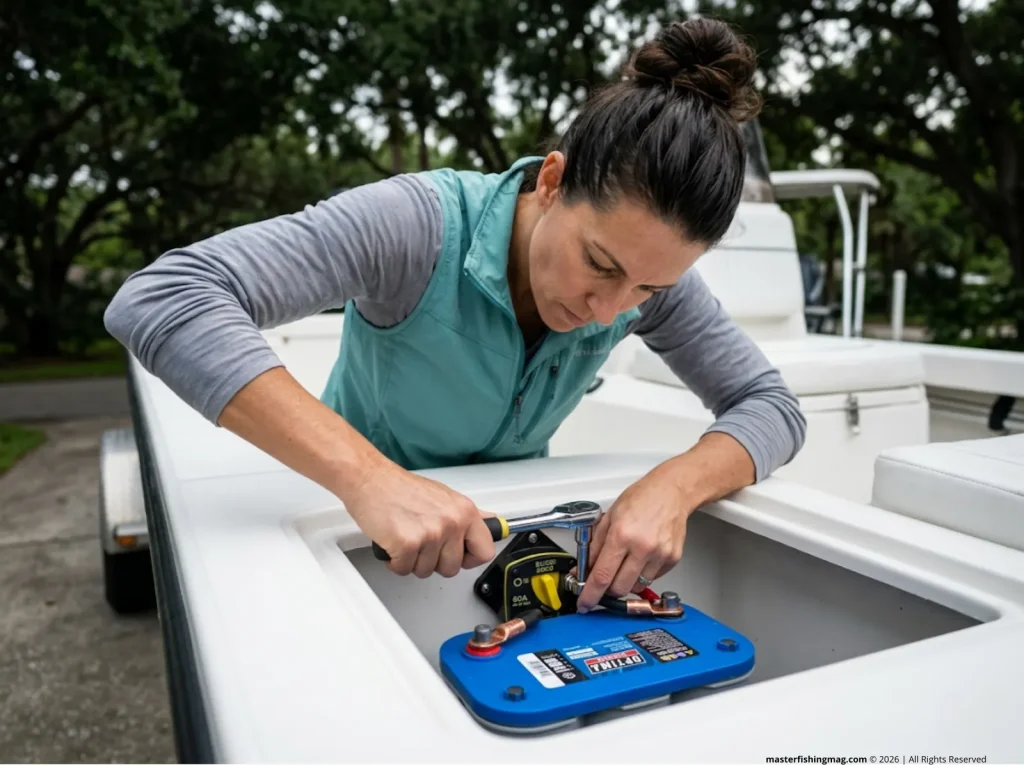
The circuit breaker on a trolling motor system doesn’t protect the motor. It protects the boat by preventing the wiring from reaching ignition temperature in a short circuit. Get that distinction right and every other decision in this section makes sense.
Why the Breaker Doesn’t Protect the Motor — It Protects the Boat
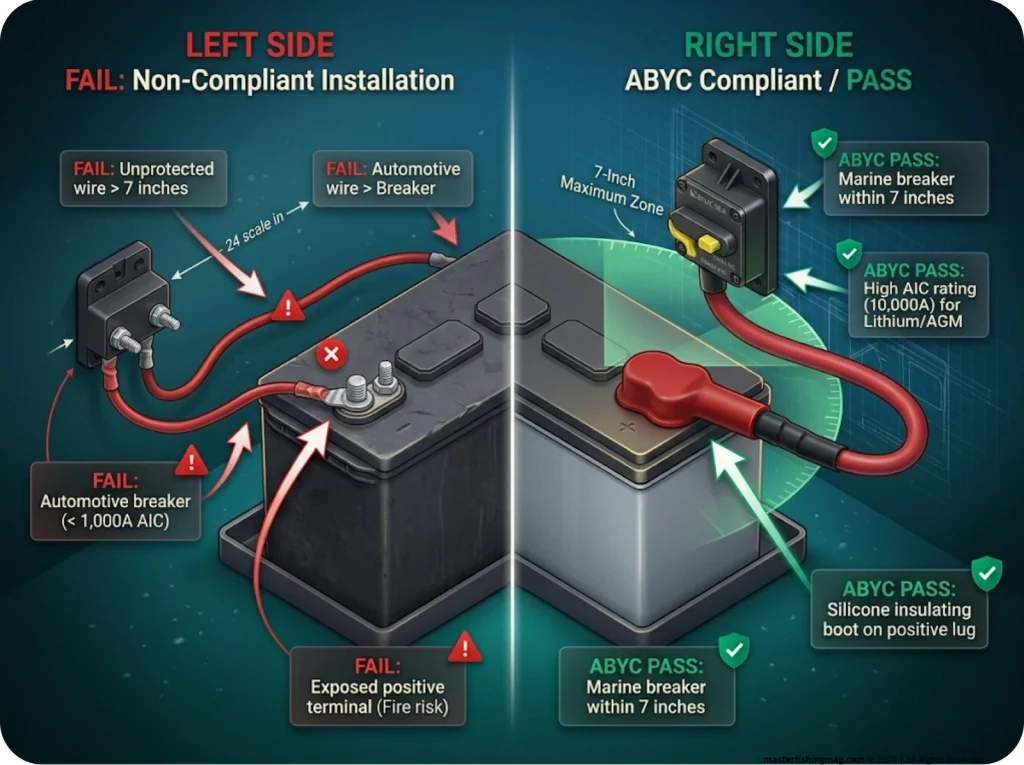
ABYC E-11 mandates that overcurrent protection (OCP) sits within 7 inches of the positive battery terminal, measured along the wire path — not through air. Every unprotected inch of wire between battery and breaker is a potential fuse waiting to arc against a fiberglass panel or fuel tank.
Exceptions exist: the 40-inch rule applies if the conductor is fully enclosed in a conduit or sheath the entire distance, and the 72-inch rule covers specific locker applications — but neither of those scenarios applies to a typical trolling motor installation. Your breaker goes on the Battery B positive lead, within 7 inches of the terminal.
All positive connections need insulating boots or terminal caps. A dropped wrench across a 24V terminal bank can vaporize the metal and start a fire. This is not theoretical. Read the over-current protection requirements for marine DC systems if you want the engineering detail behind why that 7-inch rule matters.
Choosing the Right Breaker — AIC Ratings and Chemistry
Here’s what no other wiring guide in this space bothers to tell you: the Amperage Interrupting Capacity (AIC) rating is not a detail you can ignore.
Standard automotive circuit breakers are rated under 1,000A AIC — meaning under a fault load, they can safely interrupt up to 1,000 amps before their contacts weld shut. LiFePO4 batteries have extremely low internal resistance and can deliver fault currents exceeding 10,000 amps. Put an automotive breaker in series with a lithium bank and it doesn’t interrupt the fault — it welds shut and lets the fire continue.
Match your OCP device to your battery chemistry:
- AGM/Lead-Acid: Blue Sea 187-Series (5,000A AIC @ 32V) for most 24V installations
- Lithium standard: MRBF Battery Mount fuse (10,000A AIC)
- Large offshore lithium: Class T Fuse (20,000A AIC @ 125V)
Size the breaker to the wire’s ampacity, not the motor’s rated draw. A 6 AWG UL 1426 cable runs at approximately 75 amps continuous — the breaker should not exceed that. If you haven’t decided yet on whether LiFePO4 or AGM chemistry makes sense for your setup, settle that question before you buy your OCP device — the answer changes your spec.
Battery Configuration — Series Wiring and the Weakest-Link Rule
The Mechanics of Series Wiring
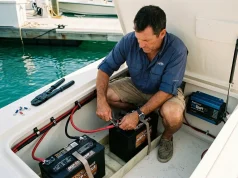
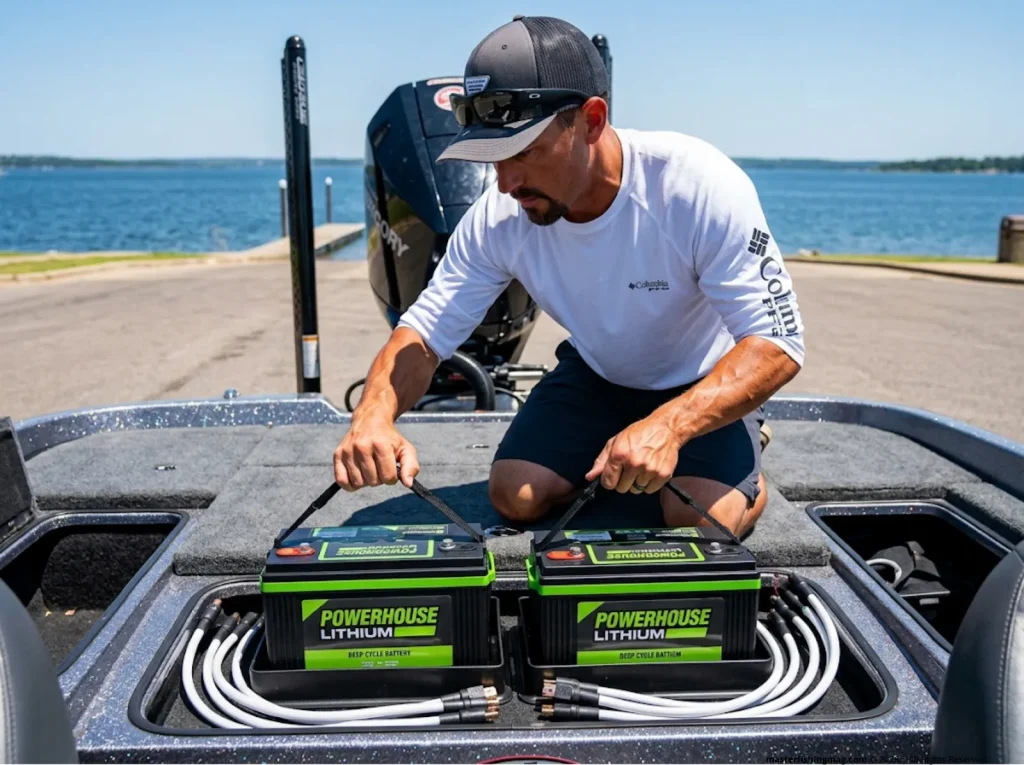
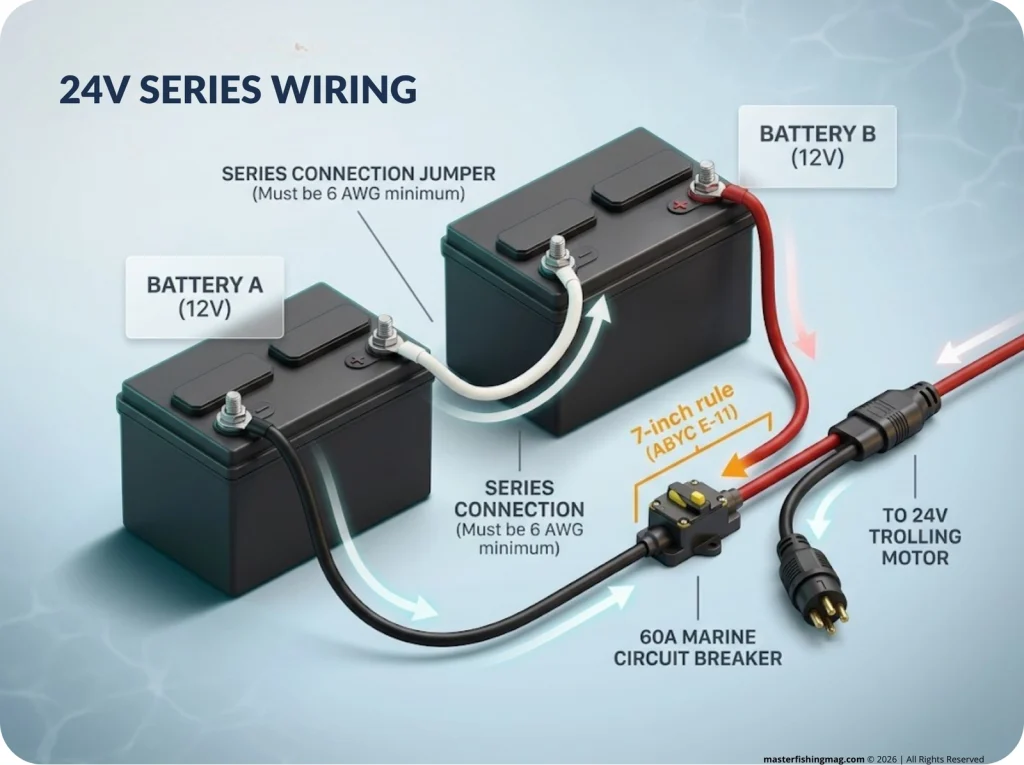
To get 24V from two 12-volt batteries: connect the positive (+) terminal of Battery A to the negative (−) terminal of Battery B with a jumper wire. Then connect your motor’s positive lead to the remaining positive on Battery B and your negative lead to the remaining negative on Battery A. That’s series wiring — voltages add, amp-hour capacity stays the same as a single battery.
The jumper between batteries is the most frequently undersized wire in DIY installations. If your main leads are 6 AWG, the jumper must also be 6 AWG — it carries the full motor current. The 10 AWG “battery interconnect” that came in the kit is not a substitute.
Internal Resistance Matching — The Weakest-Link Theory
This is the section that separates people who understand 24V systems from people who wonder why their expensive setup underperforms.
In a series circuit, the same current flows through every component. The battery with the highest internal resistance experiences the greatest voltage drop and generates the most heat — it throttles the performance of the entire bank. Minn Kota and MotorGuide both mandate that batteries in a 24V series string must match on four criteria: chemistry (never mix LiFePO4 with AGM), amp-hour capacity, age and cycle count, and manufacturer.
Mixing a 100Ah and an 80Ah battery causes the 80Ah unit to over-discharge and fail early — even if both batteries read “full” on a basic voltmeter. Two batteries can show the same static voltage with dramatically different internal resistance. A proper battery analyzer like a Midtronics unit reads internal resistance directly; a voltmeter doesn’t.
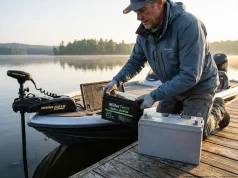
I replaced one battery mid-season once. By the end of summer the new one had failed. The old battery’s higher resistance was forcing the new one to work harder and dissipate more heat every time I hit full throttle. Match your batteries before you wire them, or replace both at once. For guidance on selecting matched batteries for your 24V bank, start with your battery chemistry decision and build from there.
LiFePO4 vs. Lead-Acid — Voltage Curve and Real-World Thrust
Lead-acid batteries sag. A fully charged 24V AGM bank starts around 25.4V but can drop to 23.0V after just two hours of moderate use — that’s a 15–20% thrust loss by midday. A standard 80lb thrust motor at 22.0V is delivering closer to 65 lbs and your Spot-Lock starts failing in any real wind.
LiFePO4 batteries hold a flat voltage curve around 25.6V until roughly 95% depletion. The thrust you have at 6 AM is the thrust you have at 4 PM. Two 100Ah AGM batteries weigh around 120 lbs total. Two 100Ah LiFePO4 batteries weigh about 52 lbs — 68 lbs off the bow that shows up directly in trim and hole-shot performance.
One critical spec that often gets missed: your LiFePO4 battery management system (BMS) must be rated for peak motor current or it will cut power during hard acceleration. Check that number against your motor’s peak draw before you buy. And once you have lithium installed, keep how to properly store and maintain your trolling motor batteries through winter in mind — the off-season requirements for lithium are different than AGM.
Mechanical Integrity — Terminals, Crimps, and Corrosion Control
The Hex Crimp Standard vs. Soldering
ABYC E-11 explicitly discourages solder as the sole means of mechanical connection. Solder creates a rigid wicking zone where the wire becomes a solid bar at the connection point. Where the solder ends and the flexible stranded wire begins, vibration creates a stress point that eventually fractures the strands — usually offshore, usually when you need the motor most.
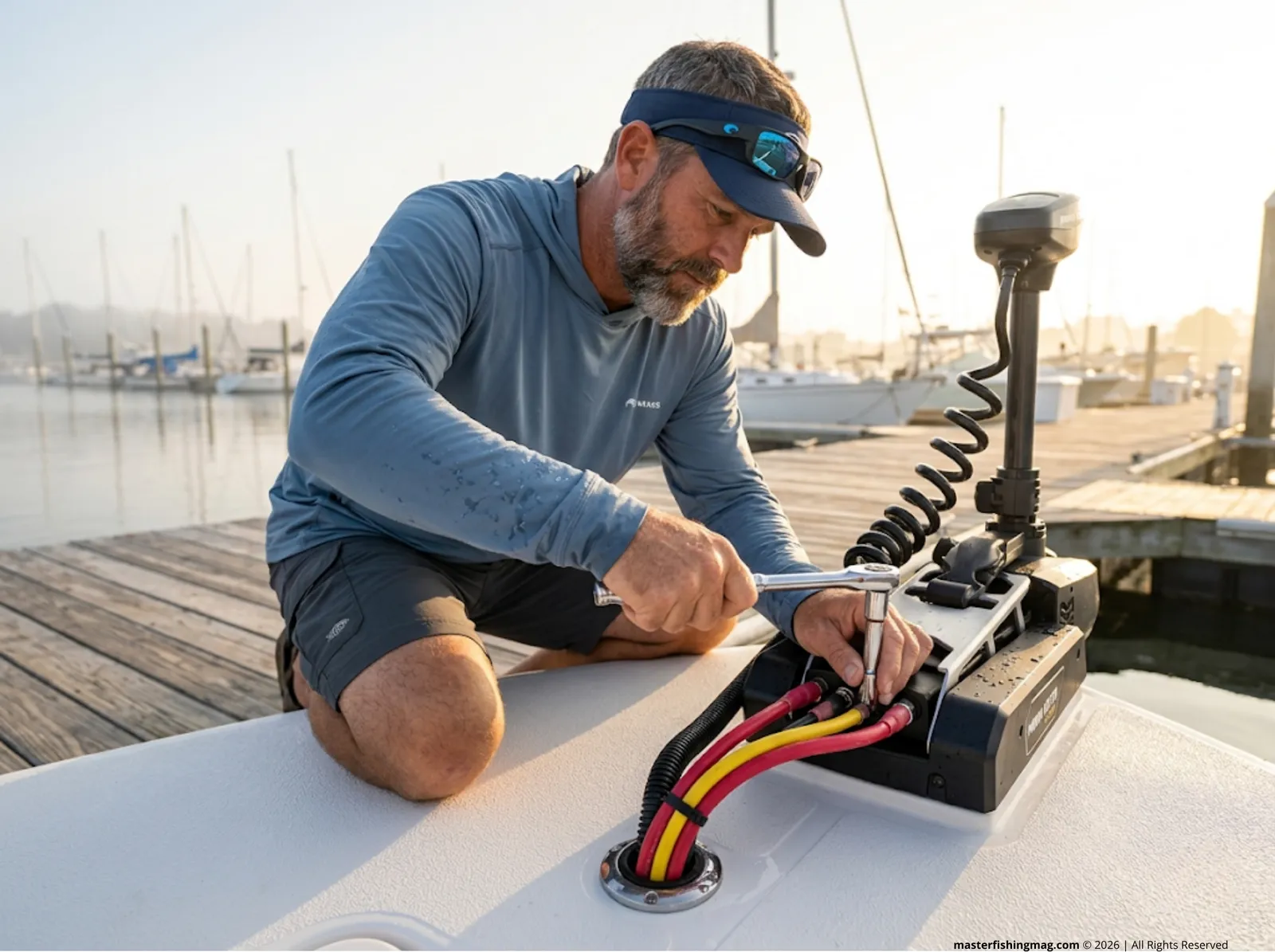
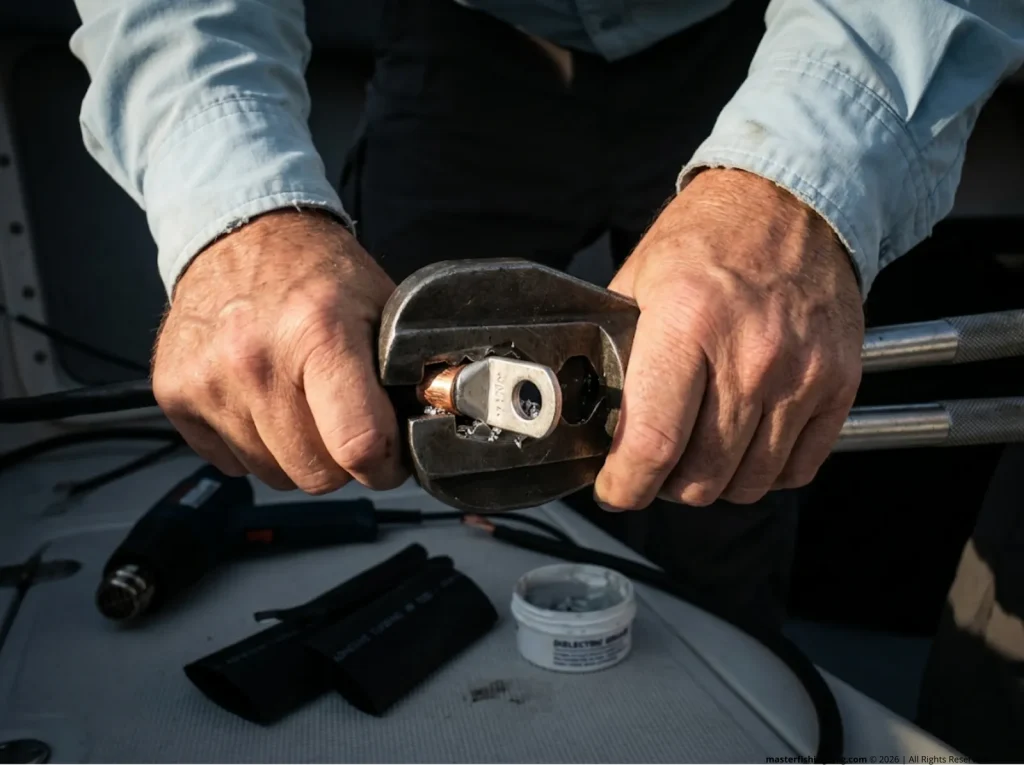
The professional standard is a high-pressure hex crimp using tinned copper ring terminals. A proper hex crimp achieves “gas-tight” integrity — the copper strands and the lug barrel cold-weld into a single metallic mass with zero air gaps. You need a dedicated hex-die crimp tool for this; the plier-type hand crimpers that “look right” leave micro-gaps that corrode and resist within a season. Follow the crimp with adhesive-lined heat shrink tubing for moisture sealing and mechanical strain relief.
After crimping, grab the wire with both hands and pull with your full weight. If the terminal moves even 1mm, the crimp is defective. Do it again.
Torque Specifications, Terminal Protection, and the Tug Test
Loose connections are the leading cause of “mysterious” power loss and melted battery posts in trolling motor systems. A customer brought me a 24V rig that was dying on the water — the motor terminals were hand-tight. The positive lug turned freely on the post. Twenty minutes of intermittent arcing had deposited carbon char inside the motor plug. New plug, proper torque, problem solved.
Lead-acid posts torque to 120–150 in-lbs per manufacturer spec. LiFePO4 terminals typically spec 15–20 N·m — check your battery manual before touching a torque wrench, because lithium terminals are thinner and sustain damage at automotive torque values. After torquing, coat every connection with dielectric grease or dedicated marine terminal protectant to stop copper carbonate (green corrosion) and lead sulfate (white corrosion) from building resistance back into the system.
Run the tug test: grasp each ring terminal and try to rotate it by hand. Any movement means the bolt is undertorqued. No movement means the mechanical connection is good. For a complete system approach to keeping corrosion out of your entire electrical system, the principles in a system-level approach to saltwater corrosion prevention across all onboard electronics apply directly to the terminal work here.
Diagnosing Phantom Voltage Loss — The Loaded Test Protocol
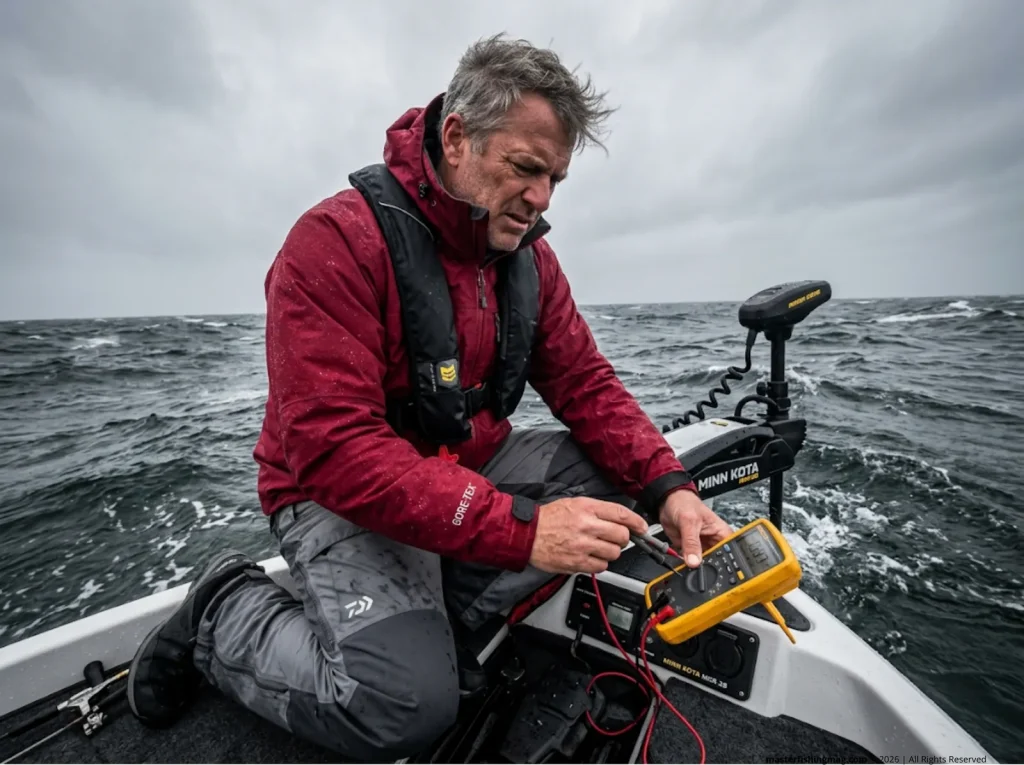
Here’s where most guides stop: “check your connections.” That’s not a diagnostic — that’s a guess. The loaded voltage test tells you exactly where resistance is hiding.
The Loaded Voltage Test — Step by Step
No competitor explains this procedure with actual probe placement. Follow it exactly.
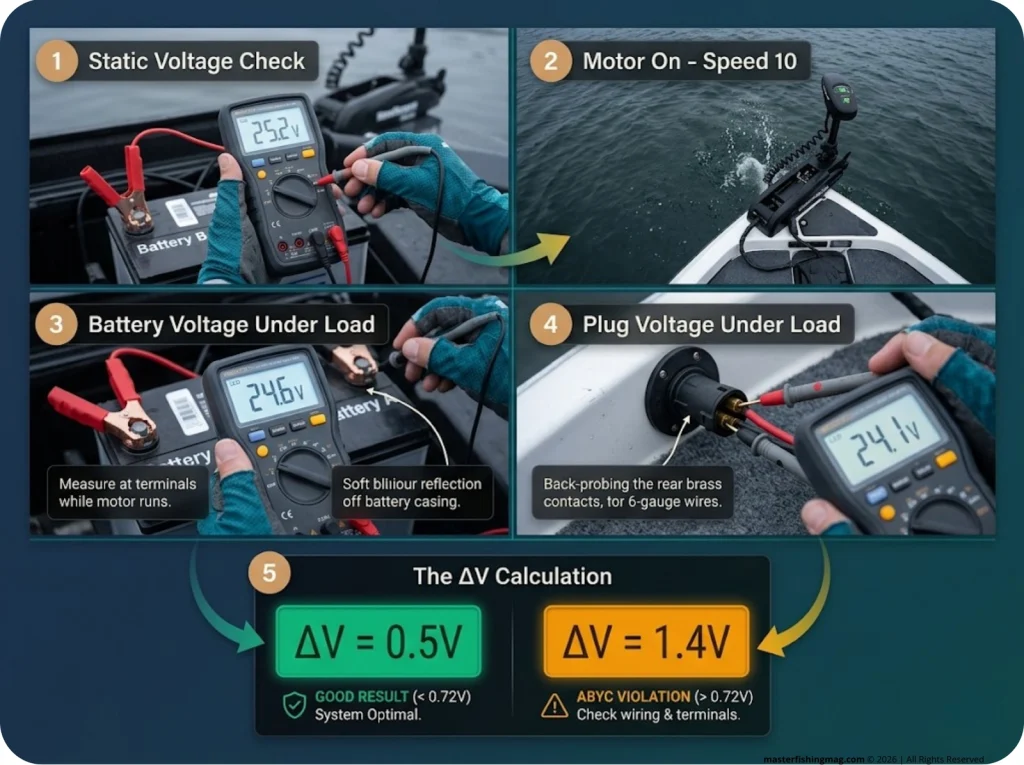
- Measure voltage across both batteries with the motor off. Lithium should read 25.6V–26.4V, fully charged AGM should read 25.0V–25.4V.
- Deploy the motor and run to Speed 10 (full throttle).
- Measure voltage at the battery terminals while the motor is running. If it drops more than 0.5V from static, a battery is failing or has elevated internal resistance.
- Measure voltage at the trolling motor plug while still on Speed 10.
- Calculate the difference (ΔV) between battery terminal voltage and plug voltage. If ΔV exceeds 0.72V, the wiring between batteries and plug has more resistance than ABYC allows.
Use alligator clip probes for this test — holding probes by hand while 60 amps is flowing is unnecessary and sloppy. Use a meter in proper voltage mode, not auto-range.
Locating Hidden Resistance — The Voltage Map
If your ΔV fails the test, the fault is somewhere between batteries and plug. Here’s the frequency order for hidden resistance locations: corroded inline fuse holder, loose crimp inside the motor plug, a circuit breaker that’s tripped repeatedly and developed elevated internal resistance, corroded terminal at the series jumper between batteries, and undersized AWG from a previous owner.
The voltage map method: take readings at each connection point in sequence — from battery to breaker to jumper to plug — while the motor runs at Speed 10. The connection where voltage drops more than 0.3V between readings is the fault location.
I spent three hours hunting a weak battery before a technician showed me this process. The entire drop was across one corroded MRBF fuse holder that looked clean on the outside. Repair cost: $12 and 15 minutes. The voltage map took four minutes to run.
Pro tip: A circuit breaker that has tripped repeatedly from overload develops elevated internal resistance — even if it passes and closes normally, it may add 0.2–0.5V of drop under load. Before you condemn wiring or batteries, check if your breaker has a recessed trip indicator. Some Blue Sea breakers have a small button that protrudes when the unit has tripped internally, even if the switch looks closed from outside.
Conclusion
Three things will tell you whether your 24V system is actually performing or just consuming batteries:
First, size the wire to your actual routed distance — measure the string, not the boat. Add 20% for turns and drops. Choose tinned marine-grade conductor that keeps voltage drop under 0.72V at 60A. Second, place the breaker within 7 inches and match its AIC rating to your battery chemistry — if you’re on lithium, nothing less than 10,000A AIC is acceptable. Third, match your batteries and run the loaded voltage test before you ever launch — internal resistance mismatch and hidden connection resistance steal thrust silently, and you won’t find them by eyeballing the battery posts.
The next time you put the trolling motor in the water, run the loaded voltage test before you leave the ramp. It takes four minutes, costs nothing, and will tell you exactly how much thrust your wiring is leaving on the table. Fix it once. Fish harder.
FAQ
How do I wire two 12V batteries for 24 volts?
Connect the positive (+) terminal of Battery A to the negative (−) terminal of Battery B using a jumper wire the same gauge as your main leads. Then connect your trolling motor’s positive lead to the remaining positive terminal on Battery B, and the negative lead to the remaining negative terminal on Battery A. The result is a series wiring configuration that combines both 12V potentials into a single 24V system while keeping the same amp-hour capacity as a single battery.
What size wire do I need for a 24V trolling motor?
It depends entirely on your actual round-trip wire run, not your motor’s thrust rating. For runs under 20 feet, 6 AWG UL 1426 marine wire stays within the ABYC 3% voltage drop limit at 60A peak draw. Runs from 20–30 feet require 4 AWG; 30–40 feet require 2 AWG. Always use tinned copper wire — 6-gauge SAE automotive wire produces 10–12% more resistance than 6-gauge AWG marine cable at the same nominal size, which can push you into ABYC violation before you’ve run the motor once.
Do I need a circuit breaker for a 24V trolling motor system?
Yes. ABYC E-11 requires a 60A circuit breaker or appropriately rated fuse on every ungrounded positive conductor, mounted within 7 inches of the positive battery terminal. For LiFePO4 batteries, choose an OCP device with at least 10,000A AIC — standard automotive breakers rated under 1,000A AIC can weld their contacts shut during a lithium fault and fail to protect the wiring. The breaker exists to protect the boat, not the motor.
Can I use one charger to charge both batteries in a 24V series bank?
You need either a dedicated 24V charger that charges the series bank as a unit, or a dual-bank 12V charger that charges each battery independently. Never use a single 12V charger on a series-connected bank — it will charge only one battery, leaving the other depleted and creating an internal resistance mismatch that accelerates failure in both. LiFePO4 batteries also require a charger specifically programmed for lithium chemistry; a lead-acid charge profile reaches the wrong voltage ceiling and degrades the cells over time.
Why does my trolling motor feel weak even after charging both batteries?
The three most common causes are: undersized wire gauge creating excessive voltage sag under load — the motor receives less than 24V at the plug; loose or corroded terminal connections hiding significant resistance at a connection you can’t see from the outside; and mismatched batteries with different internal resistance — the weaker battery is throttling total output. Run the loaded voltage test: measure at the batteries under full throttle, then at the motor plug. If the difference exceeds 0.72V, the problem is in the wiring or connections, not the batteries themselves.
Risk Disclaimer: Fishing, boating, and all related outdoor activities involve inherent risks that
can lead to injury. The information provided on Master Fishing Mag is for educational and informational purposes
only. While we strive for accuracy, the information, techniques, and advice on gear and safety are not a substitute
for your own best judgment, local knowledge, and adherence to official regulations. Fishing regulations, including
seasons, size limits, and species restrictions, change frequently and vary by location. Always consult the latest
official regulations from your local fish and wildlife agency before heading out. Proper handling of hooks, knives,
and other sharp equipment is essential for safety. Furthermore, be aware of local fish consumption advisories. By
using this website, you agree that you are solely responsible for your own safety and for complying with all
applicable laws. Any reliance you place on our content is strictly at your own risk. Master Fishing Mag and its
authors will not be held liable for any injury, damage, or loss sustained in connection with the use of the
information herein.
Affiliate Disclosure: We are a participant in the Amazon Services LLC Associates Program, an
affiliate advertising program designed to provide a means for us to earn advertising fees by advertising and linking
to Amazon.com. As an Amazon Associate, we earn from qualifying purchases. We also participate in other affiliate
programs and may receive a commission on products purchased through our links, at no extra cost to you. Additional
terms are found in the terms of service.