

In this article
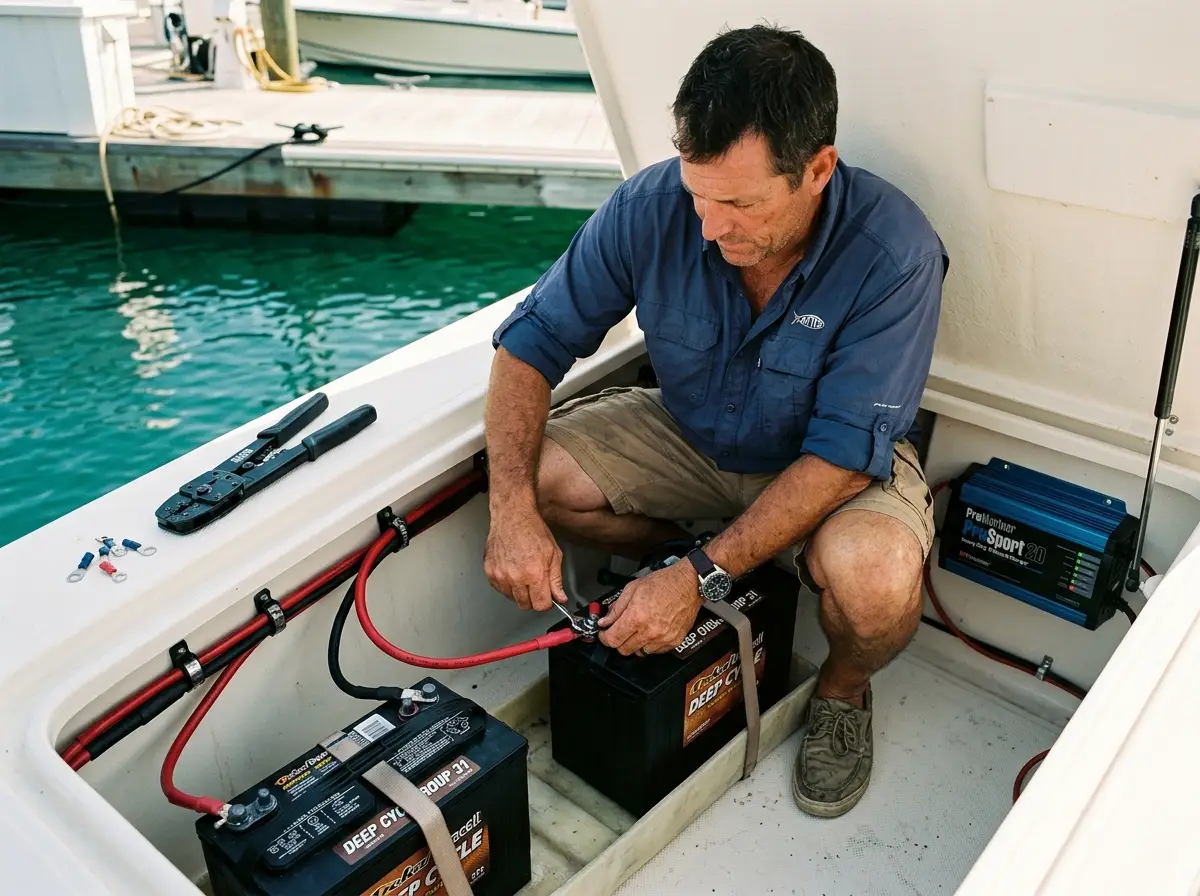
Last spring I pulled my boat out of storage to find both batteries stone-flat. The trickle charger I’d left connected all winter had tripped its internal breaker sometime in January and never recovered. Five hours of waiting at the ramp while the portable did its thing. That was the weekend I decided to install a proper onboard marine battery charger — hardwired, multi-bank, and smart enough to manage the batteries without me babysitting.
Here’s what I learned wiring it in, what almost went wrong, and how to do this install correctly the first time.
Quick Answer: To install an onboard marine battery charger correctly:
- Choose a UL 1236 marine-rated charger sized at 10% of your bank’s Ah capacity
- Mount on a hard surface with ventilation — never directly above batteries
- Run DC wiring with tinned marine cable and an inline fuse within 7 inches of each battery
- Connect AC wiring from shore power through a dedicated breaker
- Set the charging profile to match your battery manufacturer’s exact voltage specs
- Test with a multimeter before leaving the dock
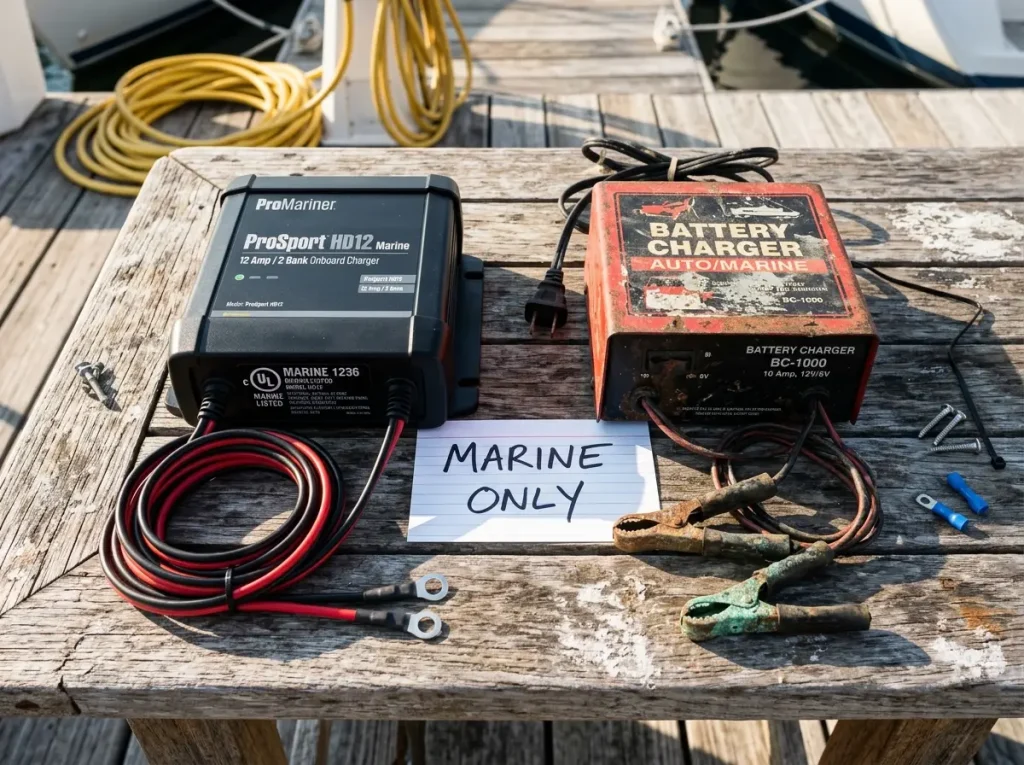
Why a Marine-Specific Charger (Not Your Garage Unit)
The Autoformer Problem That Creates Stray Current
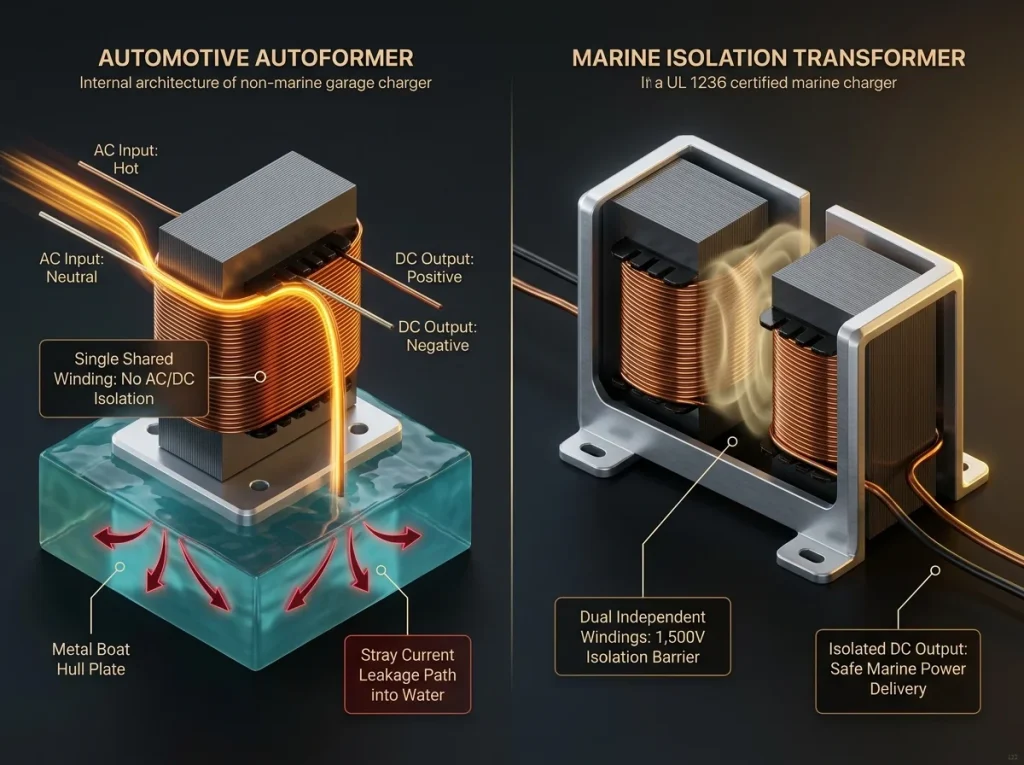
That old red automotive charger in your garage has a single-winding transformer called an autoformer. One winding handles both the AC input and DC output sides, which means they share a common electrical path internally. On land, in your driveway, this works fine. On a boat sitting in water, it creates a direct path for AC current to leak through your DC system, through the water, and into anything nearby — including swimmers.
Marine chargers built to UL 1236 standards use a double-wound isolation transformer. AC stays completely separated from DC. If something fails internally, the AC can’t reach the DC system. This isn’t marketing — it’s the engineering difference between a safe boat and one leaking voltage into the marina.
A corrosion survey published by the BoatUS Foundation found that nearly a third of surveyed boats in one marina were leaking AC current directly into the water. DIY wiring mistakes with non-marine chargers were a major contributor.
What UL 1236 and ABYC Compliance Actually Mean
UL 1236 means the charger passed a 1,500-volt isolation test between AC and DC sides. That’s the test that ensures no AC current bleeds through to your boat’s DC system even under fault conditions. ABYC A-31 covers the installation requirements — proper wire sizing, fuse placement, ventilation, and temperature compensation.
If your charger doesn’t carry one of these certifications, it has no business being permanently wired into a boat. Period. The USCG regulations for marine fire safety require proper electrical installations for good reason — batteries generate hydrogen gas, and a single spark from a non-isolated charger can ignite it.
Two-Prong Plugs and Reversed Polarity
Older automotive chargers often have two-prong plugs with no ground pin. If the outlet’s hot and neutral wires are reversed (common in older boats with aging AC outlets), the boat’s entire DC negative bus can become energized at 120V AC. You won’t know until someone touches the water or a grounded fitting. This is the mechanism behind electric shock incidents in marinas.
If you take one thing from this section: never install an automotive charger on a boat. Not temporarily, not “just for the weekend,” not with a GFCI outlet protecting it. The internal architecture makes it fundamentally unsafe in a marine environment.
Pro tip: Check any charger’s UL listing number on UL’s online certification directory before buying. Counterfeit UL marks exist on cheap imports — the listing number confirms it actually passed testing.
Sizing Your Charger: The Math Nobody Shows You
The 10% Rule (And Why It’s Only the Starting Point)
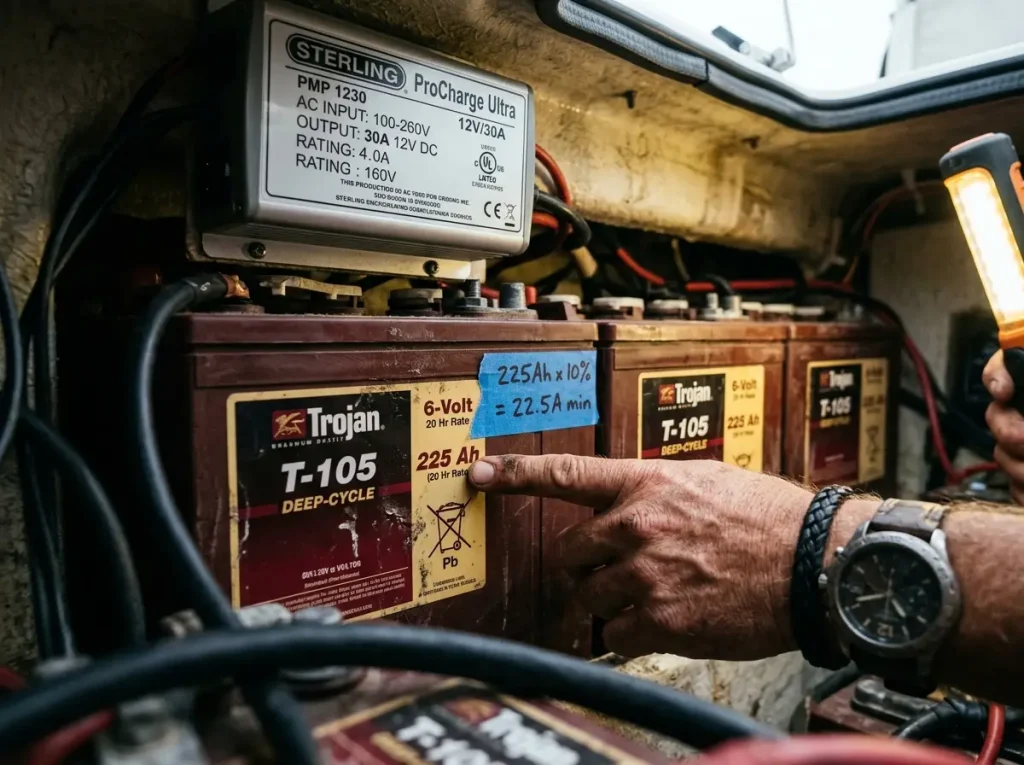
The baseline recommendation: size your charger at 10% of your battery bank’s amp-hour capacity. A 200Ah bank gets a 20A charger. A 400Ah bank gets a 40A charger. This gives you a full charge from 50% state of charge in roughly 5-6 hours — reasonable for overnight dock charging.
But here’s where most guides stop and real life complicates things.
Subtracting Your Dockside DC Loads
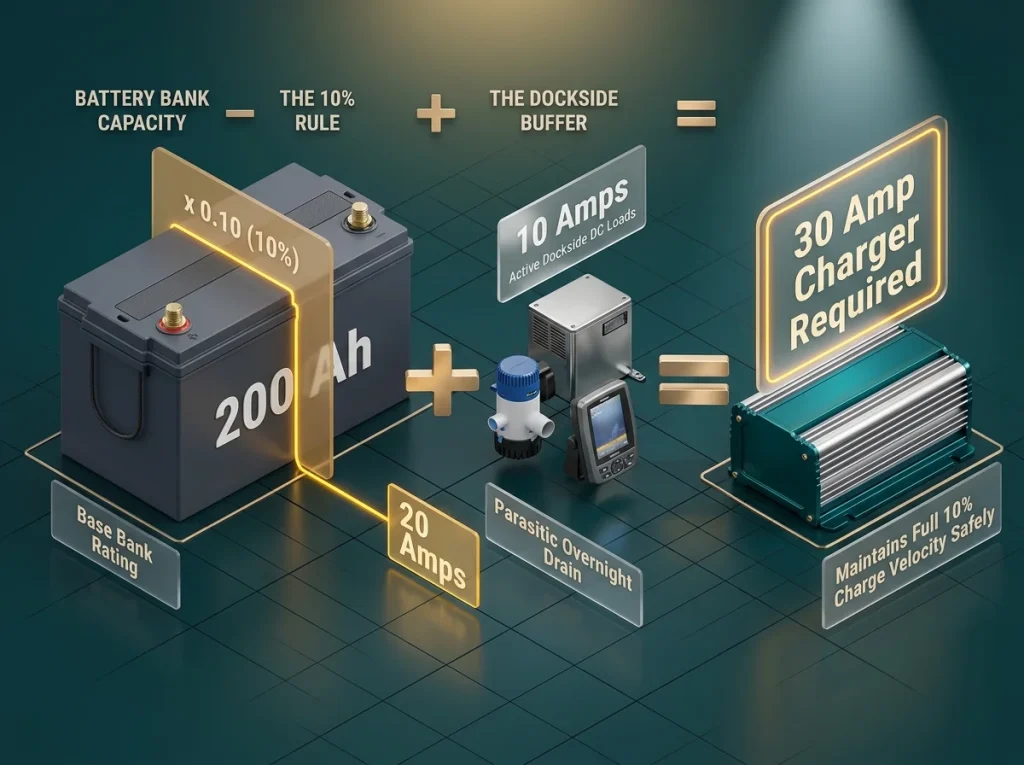
Your boat consumes DC power while sitting at the dock. Bilge pump cycling, refrigeration, stereo on standby, LED courtesy lights, fish finder in sleep mode — these loads rob current from what the charger can feed the batteries. If you have 10A of dockside loads with a 20A charger, only 10A actually reaches the bank for charging. Your effective charge rate drops to 5% of capacity, not 10%.
The real formula: Charger amps needed = (Bank Ah × 10%) + average dockside DC load
For that 200Ah bank with a 10A dockside draw, you need a 30A charger to maintain actual 10% charging speed. Size carefully. If you’ve already wired a 24V trolling motor system the ABYC way, you know how current math compounds — this is the same principle applied to shore charging.
Special Battery Types That Demand More
Not every battery charges at 10%. Odyssey TPPL AGM and Northstar TPPL AGM batteries recommend charging at 40% of installed Ah capacity for optimal cycle life. Lifeline AGMs recommend a minimum of 20%. Ignoring these minimums means shorter battery life — you’re paying for premium chemistry and then starving it during charging.
Check your battery manufacturer’s documentation before sizing. The charger can always be larger than the minimum — a bigger charger runs its cooling fan less, stays cooler, and lasts longer because it spends less time at full output. Your trolling motor battery investment depends on proper charging to deliver the cycle life you paid for.
Pro tip: If you power your charger from a generator while away from the dock, oversize by 50%. You want maximum current flowing to minimize generator run time and fuel burn. A 60A charger on a Honda EU2000i suitcase generator still leaves 700W available for other loads.
Where to Mount the Charger (And Where Not To)
The Ventilation Rule
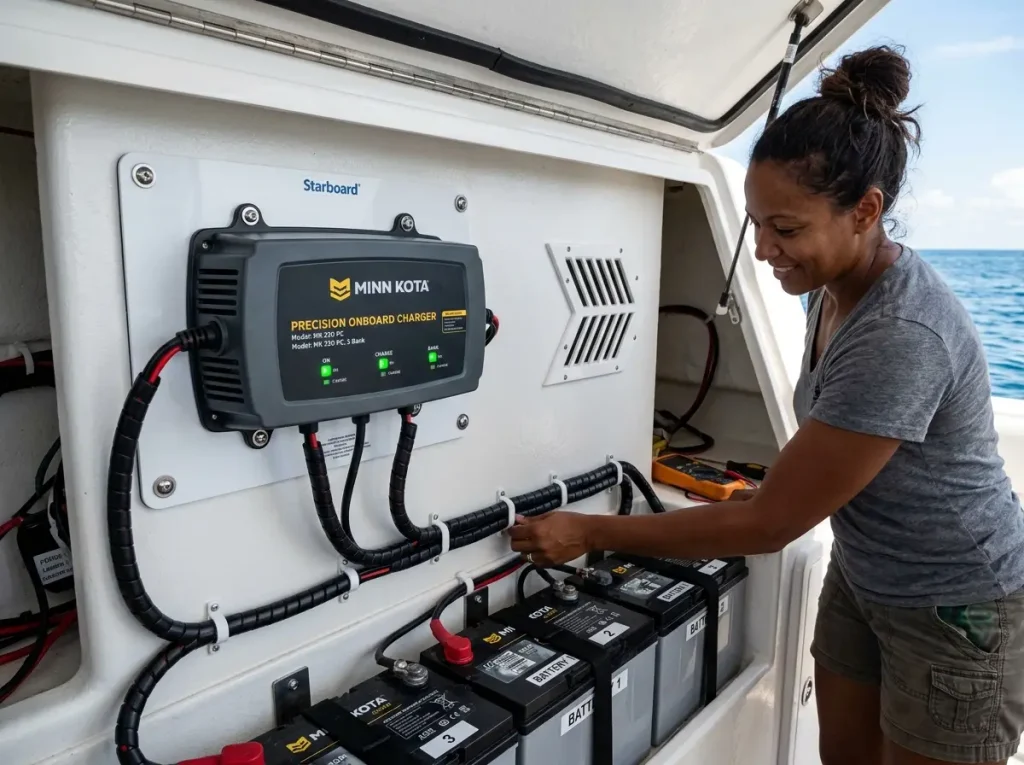
Batteries produce hydrogen gas during charging — especially flooded lead-acid batteries during the bulk and absorption phases. Mounting your charger directly above the batteries puts an electrical device with potential spark sources right where hydrogen accumulates. ABYC standards require charger mounting in a ventilated area, and the charger itself needs airflow for cooling.
Mount the charger on a fiberglass panel or starboard backing plate on the compartment wall, at least 12-18 inches offset from the battery tops. The compartment needs ventilation — either a passive louvre or active blower that moves air through the space. If your boat’s electrical compartment doesn’t have ventilation, add a vent before installing the charger.
Surface and Orientation
Mount on a hard, non-insulating surface: fiberglass, starboard, aluminum, or marine-grade plywood. Never mount on carpet, foam, or upholstery — these trap heat against the charger housing and dramatically shorten its life. Most chargers have specific orientation requirements (usually upright with cables exiting downward) — check the manual.
Use stainless steel mounting hardware with a backing plate or fender washers on the inside of thin fiberglass panels. The charger vibrates slightly during operation, and without proper backing, the screws will work loose over a season of trailer bouncing.
Accessibility for the Remote Panel
Quality marine chargers from Sterling, Victron, and ProMariner offer remote display panels that show charging status, voltage, current output, and battery temperature without opening the compartment. If your charger supports a remote, plan the cable routing during installation — adding it later means pulling panels and fishing wire through tight spaces.
DC Wiring: Charger to Batteries Done Right
Wire Gauge, Material, and Terminal Selection
All DC wiring between charger and batteries must be stranded tinned copper marine cable. Never solid conductor, never untinned. Tinned copper resists corrosion in the salt-air environment where solid copper turns green and develops resistance at every connection point.
Wire gauge depends on charger amperage and cable run length. A 30A charger with a 6-foot run to the batteries typically needs 8-gauge wire. For longer runs or higher amperages, step up to 6-gauge. Use the ABYC voltage drop tables — you want less than 3% drop on the charging circuit.
Terminate every connection with marine-grade ring terminals crimped using a ratcheting crimper (not the cheap squeeze-type hardware store crimpers that leave loose connections). Cover every crimp joint with adhesive-lined heat-shrink tubing. No wire nuts. No alligator clips. No exceptions.
Fuse Placement: The 7-Inch Rule
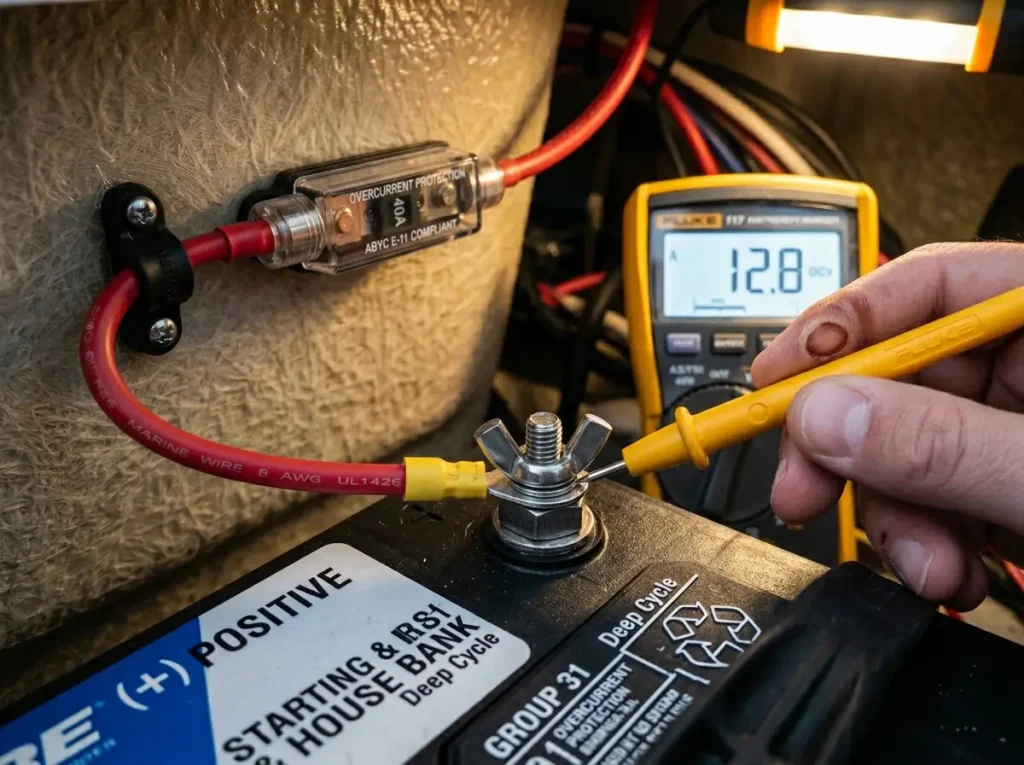
ABYC E-11 requires overcurrent protection within 7 inches of the battery positive terminal. This means an inline fuse or circuit breaker on the positive wire, measured from where it connects to the battery post. Not 12 inches. Not “close enough.” Seven inches maximum.
The fuse protects against a dead short if the positive wire chafes through its insulation against the hull, a bolt, or another wire anywhere along its run. Without that fuse within 7 inches, the entire length of wire between the battery and charger becomes an unprotected fire source.
Size the fuse at 125-150% of the charger’s maximum output current. A 30A charger gets a 40A fuse. This prevents nuisance tripping during bulk charge while still protecting against real faults.
Multi-Bank Wiring for Separate Battery Systems
Most fishing boats run at least two batteries — a cranking battery and a trolling/house bank. Multi-bank chargers have independent charging outputs, each with their own positive wire running to a separate battery. Each bank gets its own fuse within 7 inches.
The negative (ground) wires from all banks connect to a common negative bus bar, which then connects to the boat’s main DC ground. If your boat already has a proper ground bus from when you installed your trolling motor system, tie into that same bus.
Pro tip: Label every wire at both ends with permanent heat-shrink labels. When you’re troubleshooting at 5am before a tournament, “CHARGER BANK 1 POS” beats tracing unlabeled red wires with a multimeter.
AC Wiring and Shore Power Connection
Shore Power Inlet to Charger
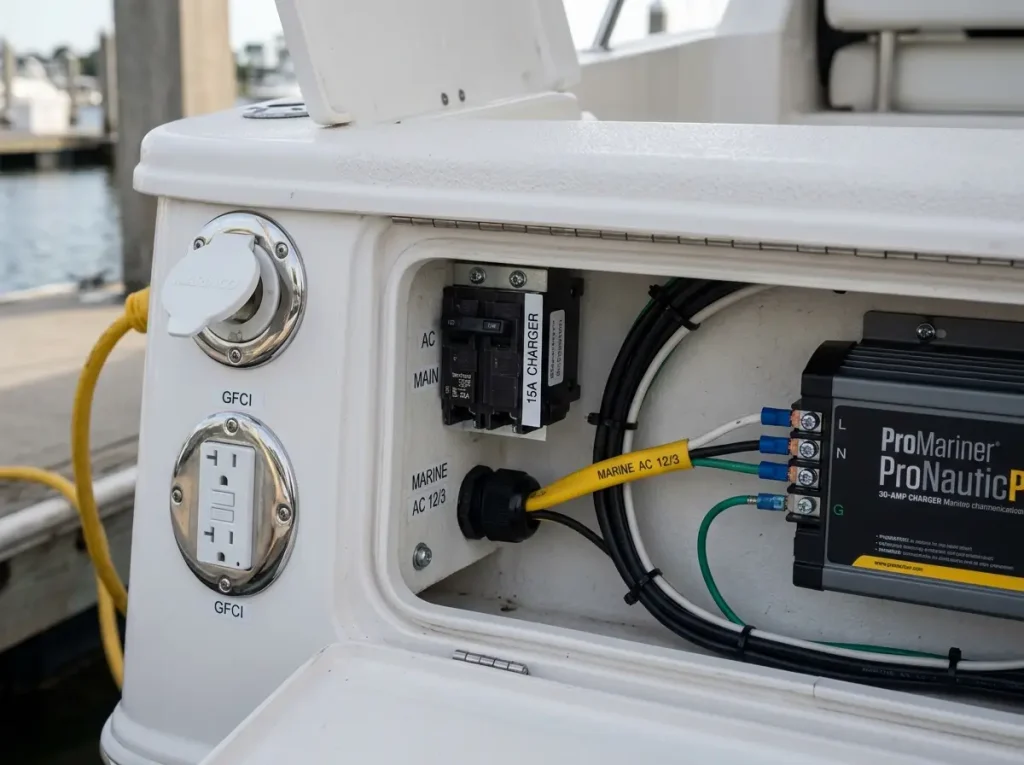
The AC side connects your boat’s shore power inlet to the charger’s AC input terminals. This wiring carries 120V AC and must follow marine AC standards — which are more stringent than residential electrical work.
Run marine-grade 12/3 AC cable (three conductors: hot, neutral, ground) from a dedicated circuit breaker on your boat’s AC distribution panel to the charger. The breaker should be sized per the charger manufacturer’s specification — typically 15A for chargers under 40A DC output. The green ground wire connects to the boat’s AC safety ground bus, which ultimately ties to the shore power cord’s ground pin.
When to Hire a Marine Electrician
If your boat doesn’t already have a shore power inlet and AC distribution panel, this installation crosses into territory where mistakes create life-threatening hazards. AC systems on boats involve galvanic isolators, GFCI protection, proper grounding to prevent corrosion, and specific cable routing requirements that differ from house wiring.
A marine-certified electrician (ABYC certified) can install the shore power inlet, panel, and charger AC feed in 2-3 hours. The cost ($200-400 in labor) is trivial compared to the liability of an AC fault that energizes your boat hull or creates an electric shock hazard in the marina. The marine fire safety equipment on your boat won’t help if the electrical fire starts inside the walls.
GFCI Protection
ABYC standards now require GFCI protection on boat AC circuits. If your charger isn’t on a GFCI-protected circuit, add a GFCI breaker at the panel. This trips if any current leaks from hot to ground — the exact fault that causes stray current corrosion and swimmer hazards.
Charging Profiles: Why “AGM” on the Dial Means Nothing
The Voltage Behind the Label
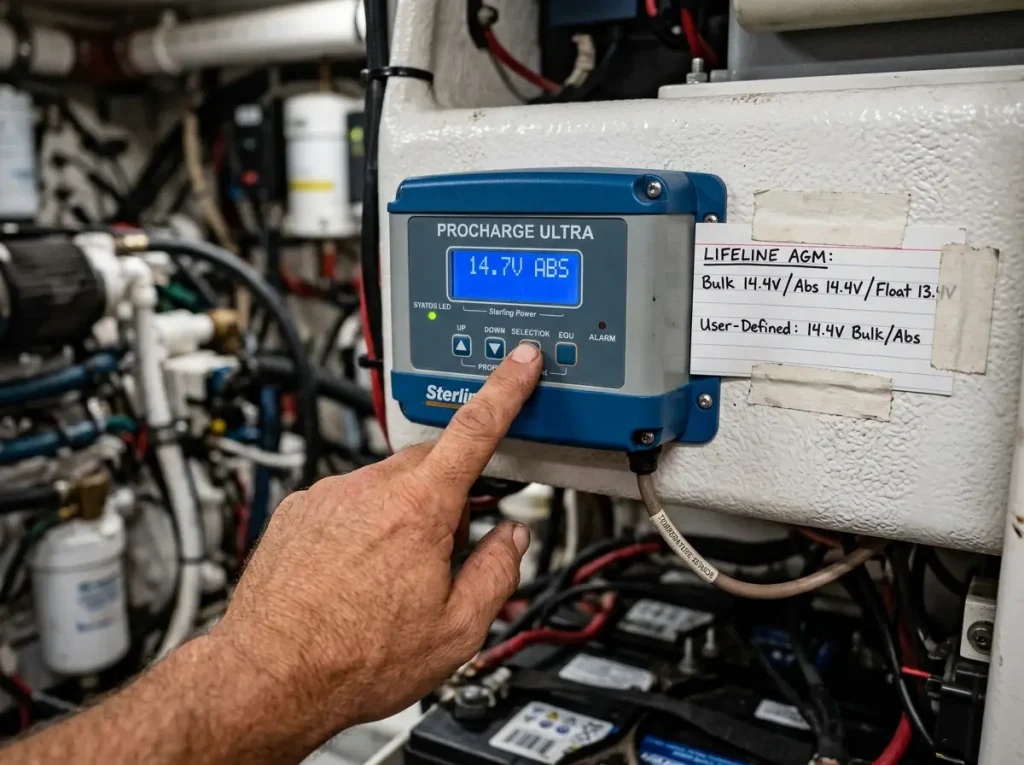
Most chargers have a rotary switch or dip switches labeled “Flooded / AGM / Gel.” These labels are dangerously generic. One manufacturer’s “AGM” setting might charge at 14.4V absorption. Another might use 14.8V. Your specific AGM battery might need 14.7V. A 0.3V mismatch either undercharges the battery (shortening life through sulfation) or overcharges it (drying out the electrolyte and potentially causing thermal runaway).
The only numbers that matter are the actual voltages the charger applies at each stage — bulk, absorption, float, and equalization — and whether those match your battery manufacturer’s published specifications.
How to Match Voltages to Your Batteries
Pull your battery’s technical data sheet. Find the recommended charging voltages for each stage (bulk/absorption/float). Then verify what your charger actually outputs at each setting. If the charger shows its voltages in the manual, compare them directly. If it only shows “AGM” with no voltage listed — that’s a red flag. Walk away from chargers that hide their voltage settings behind generic labels.
The ideal charger offers a user-programmable custom profile where you enter the exact absorption voltage, float voltage, and equalization voltage your batteries need. Sterling, Victron, and Mastervolt all offer full custom programming. This is worth the price premium — you’ll get 20-40% more cycle life from batteries charged at their exact specified voltages versus a “close enough” preset.
Temperature Compensation Matters
Battery chemistry is temperature-dependent. A battery that charges optimally at 14.7V at 77°F needs 14.9V at 60°F and only 14.5V at 95°F. Without temperature compensation, summer charging in a closed boat compartment (which can hit 120°F) overcharges the battery with every cycle.
Quality chargers include a temperature sensor — a small probe you mount directly on the battery case. The charger reads battery temperature in real-time and adjusts voltage automatically. If your charger has a temp sensor port, use it. If it doesn’t have one, make sure the charger at least has internal temperature compensation based on ambient conditions.
If you’ve invested in premium lithium trolling motor batteries, proper charging profiles are non-negotiable — LiFePO4 batteries require tighter voltage tolerances than lead-acid and will trigger their BMS protection if overcharged.
Pro tip: Tape a card with your battery’s exact charging voltages to the bulkhead next to the charger. When you replace batteries in three years, you’ll remember to reprogram the profile — most people forget and charge new batteries on old settings.
Testing and Commissioning Your New Charger
Pre-Power Checks
Before plugging in shore power for the first time:
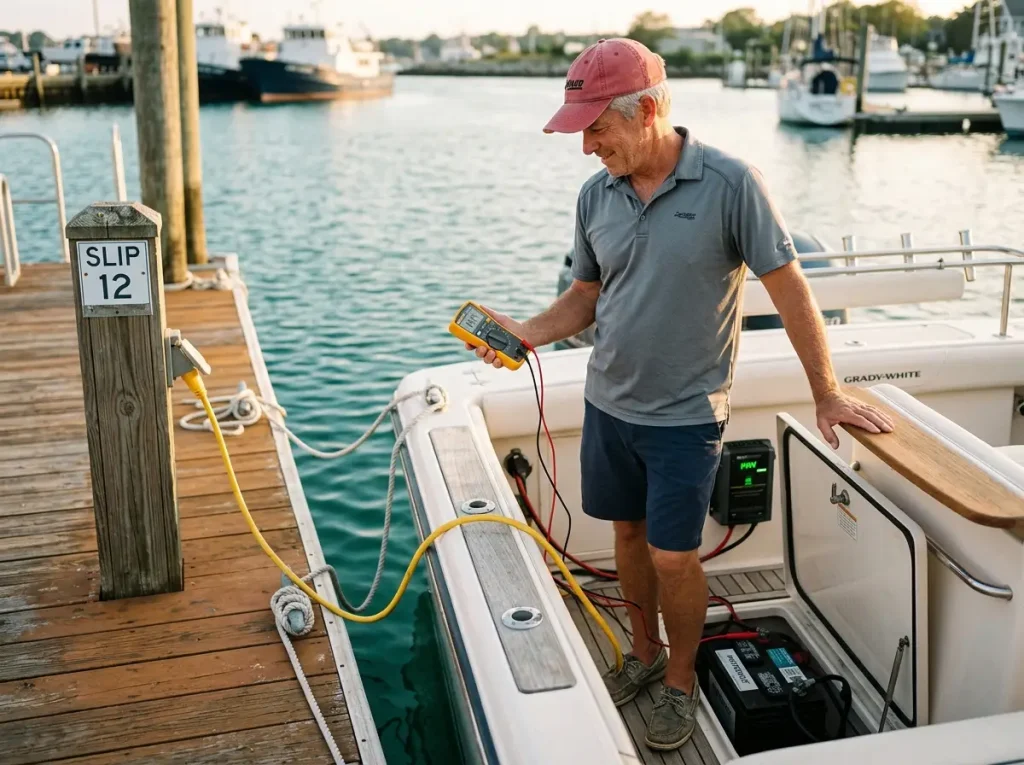
Confirm all connections are tight — tug-test every ring terminal. Verify positive and negative aren’t reversed on any bank (a reversed connection will instantly destroy the charger or blow the fuse). Check that fuses are installed in every positive lead. Confirm the charger is set to the correct battery type and voltage profile.
First Power-Up Procedure
Plug in shore power. The charger should immediately recognize the batteries and enter bulk charge mode. Use a multimeter at the battery terminals to verify voltage is rising — you should see 14.2-14.8V depending on battery type and charge profile. If you see 12V or below with the charger “on,” something is wrong — likely a blown fuse, reversed connection, or the charger defaulted to a standby mode waiting for configuration.
Let it run for 30 minutes, then check:
- Charger housing temperature (warm is normal, too-hot-to-touch means ventilation problems)
- Battery terminal temperature (should be ambient — hot terminals indicate resistance from loose connections)
- Voltage matches expected absorption/bulk voltage for your battery type
The Float Test
Leave the charger connected for 24-48 hours. After batteries reach full charge, the charger should drop to float mode — typically 13.2-13.8V depending on battery chemistry. If it never leaves bulk/absorption, either the batteries are damaged or the charger can’t determine state of charge correctly (common with chargers that lack a temperature sensor in hot environments).
Once float is confirmed, your installation is complete. That dead battery situation from winter storage won’t happen again — the charger maintains optimal charge any time you’re plugged into shore power.
Maintenance Schedule That Prevents Dead Batteries
Monthly Checks While In-Season
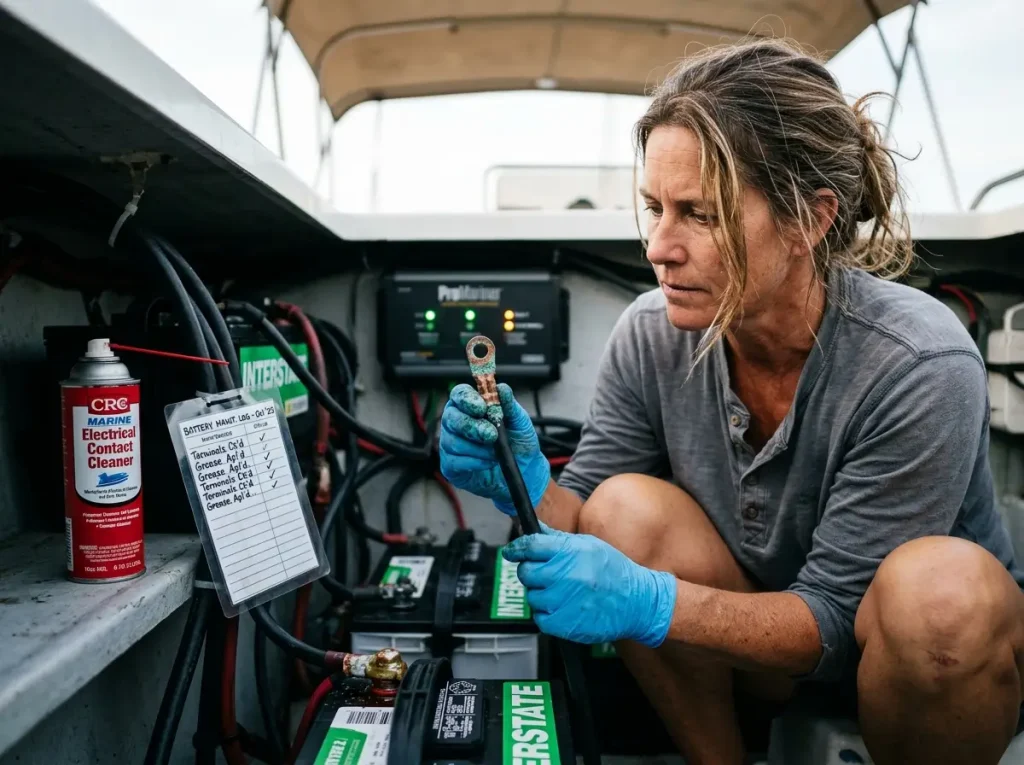
Inspect cable connections for green corrosion at terminals — especially if you’re in saltwater. A light coat of dielectric grease on every battery terminal connection prevents oxidation without insulating the electrical contact. Check that the charger’s LED indicators show normal operation. Listen for the cooling fan — it should cycle on and off, not run continuously (continuous fan means heat buildup from poor ventilation or oversized loads).
Seasonal Service Before Winter Storage
Before winterizing, fully charge all batteries with the onboard charger (confirm float mode is reached). Then decide: leave the charger connected on shore power all winter, or disconnect batteries and use a standalone maintenance charger at home.
If leaving connected at the dock: verify the shore power connection is secure, the GFCI hasn’t tripped, and the charger will hold float mode indefinitely. Most quality marine chargers are designed for this — they’ll condition the batteries monthly with a brief absorption cycle to prevent electrolyte stratification in flooded cells.
If disconnecting: physically disconnect negative cables from all batteries. This eliminates parasitic drain from the boat’s DC system. Store batteries somewhere above freezing and connect to a standalone maintenance charger. Your winterizing routine should include this step.
Annual Inspection
Once a year, inspect the charger’s output cables for chafing where they pass through bulkheads or near sharp edges. Check fuse condition (even if they haven’t blown — corrosion on fuse contacts creates resistance). Verify the temperature sensor is still adhered to the battery case and hasn’t fallen off. Test actual voltage at the battery terminals with a multimeter versus what the charger’s display claims — a drift of more than 0.2V means the charger needs calibration or replacement.
Pro tip: Put a reminder in your phone for October 1st — “Check charger float voltage before winter.” The ten minutes it takes to verify saves the five hours of ramp-day waiting when spring arrives and your batteries are flat.
Conclusion
Three things make an onboard marine battery charger installation safe and effective: use only a UL 1236 marine-rated charger (never automotive), size it to cover both your battery bank and your dockside loads, and install that inline fuse within 7 inches of every battery positive terminal.
The wiring itself is straightforward if you follow ABYC standards — tinned marine cable, ratcheting crimps, ring terminals, and proper routing. The charging profile is where most installations silently fail — set your voltages to match the battery manufacturer’s specs, not the generic label on the charger’s dial.
Do this once, do it right, and you’ll launch next spring with full batteries every single time.
Q1 Can I install an onboard battery charger myself?
Yes, if your boat already has a shore power inlet and AC panel. The DC side (charger to batteries) is straightforward DIY with marine-grade materials and ABYC fuse placement. The AC side requires marine electrical knowledge — hire an ABYC-certified tech if you’re adding shore power from scratch.
Q2 Where should I mount a marine battery charger on my boat?
Mount on a hard fiberglass or starboard surface with at least 12 inches of clearance from battery tops. The compartment needs ventilation to dissipate both charger heat and hydrogen gas. Never mount above batteries, on carpet, or in a sealed unventilated space.
Q3 What size onboard charger do I need for my boat batteries?
Calculate: battery bank Ah × 10%, then add your average dockside DC load in amps. A 200Ah bank with 8A of dockside loads needs a 28A charger minimum. For AGM batteries like Odyssey or Lifeline, check the manufacturer’s minimum charge rate — some need 20-40% of Ah capacity.
Q4 Do I need a fuse between the battery charger and battery?
Absolutely. ABYC E-11 requires overcurrent protection within 7 inches of every battery positive terminal. Use an inline fuse or breaker rated at 125-150% of the charger’s maximum output per bank. This prevents wire fires if the positive cable shorts anywhere along its run.
Q5 What is the difference between a marine charger and a car charger?
A marine charger uses a double-wound isolation transformer that completely separates AC from DC circuits (tested to 1,500V). A car charger uses a single-winding autoformer where AC and DC share a common path — creating stray current corrosion or electric shock risk when used on boats sitting in water.
Risk Disclaimer: Fishing, boating, and all related outdoor activities involve inherent risks that
can lead to injury. The information provided on Master Fishing Mag is for educational and informational purposes
only. While we strive for accuracy, the information, techniques, and advice on gear and safety are not a substitute
for your own best judgment, local knowledge, and adherence to official regulations. Fishing regulations, including
seasons, size limits, and species restrictions, change frequently and vary by location. Always consult the latest
official regulations from your local fish and wildlife agency before heading out. Proper handling of hooks, knives,
and other sharp equipment is essential for safety. Furthermore, be aware of local fish consumption advisories. By
using this website, you agree that you are solely responsible for your own safety and for complying with all
applicable laws. Any reliance you place on our content is strictly at your own risk. Master Fishing Mag and its
authors will not be held liable for any injury, damage, or loss sustained in connection with the use of the
information herein.
Affiliate Disclosure: We are a participant in the Amazon Services LLC Associates Program, an
affiliate advertising program designed to provide a means for us to earn advertising fees by advertising and linking
to Amazon.com. As an Amazon Associate, we earn from qualifying purchases. We also participate in other affiliate
programs and may receive a commission on products purchased through our links, at no extra cost to you. Additional
terms are found in the terms of service.