
In this article
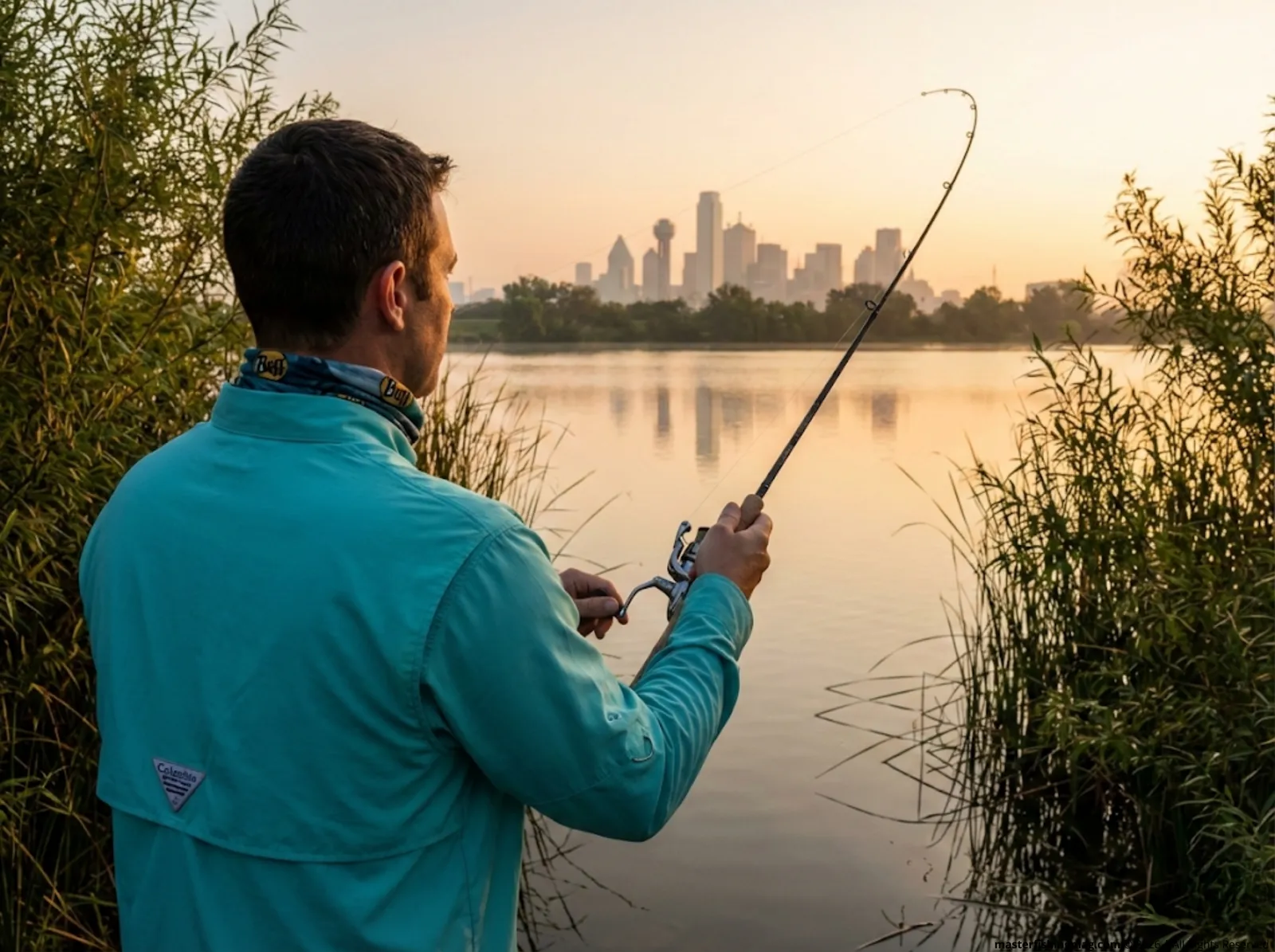
The parking lot at Winfrey Point was empty at 6 a.m. on a Saturday in April. I walked past the paved trail, ducked through a gap in the water willows, and dropped a 1/16-oz jig into a pocket of submerged aquatic vegetation that most joggers never notice. Third cast, a white crappie folded the rod — that familiar thump through the cork grip. Fourth cast, another. By the time the dog walkers showed up around eight, I had a dozen slabs and the entire shoreline to myself. That pocket sits 12 minutes from downtown Dallas.
After years of walking these banks across the DFW metro, I’ve built a list of spots that most anglers blow past on their way to the boat ramp. This guide maps the specific bank-accessible shoreline points, seasonal species windows, and structures that produce fish — backed by TPWD stocking data, USACE park records, and a lot of muddy boots.
⚡ Quick Answer: Dallas sits within casting distance of seven major reservoirs and dozens of stocked urban ponds with excellent bank access. The top spots — White Rock Lake, Bachman Lake, Lewisville Lake, and Lake Ray Roberts — hold largemouth bass, crappie, and channel catfish year-round. The Neighborhood Fishin’ Program ponds offer free access and scheduled stockings of rainbow trout and catfish. Most of these spots have parking, walking trails, restrooms, and fishing piers within a short walk. The fish are there. The crowds aren’t.
Why Most DFW Anglers Walk Past the Best Shoreline
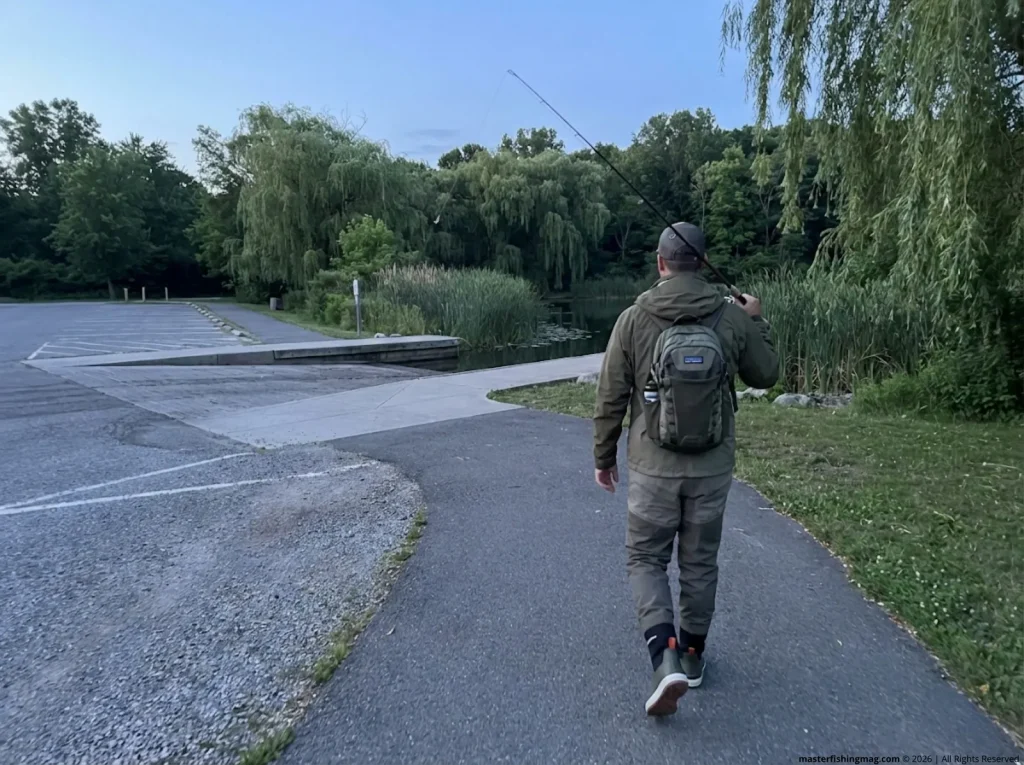
The Boat-Ramp Bias That Costs You Fish
Every weekend, DFW anglers haul boats past shoreline structure that holds more fish per square yard than anything they’ll find in open water. The assumption is simple: bigger lake, bigger boat, bigger fish. But that math doesn’t hold on the bank.
The castable radius from shore — roughly 30 to 50 yards — covers the same shallow zones where largemouth bass, crappie, and catfish stack up during spring spawning and fall feed-ups. TPWD rates 23 locations in the Dallas area with “abundant bank access” or “excellent bank access,” and most local anglers have never opened that document. They’re too busy launching the boat.
The secrecy culture doesn’t help. As one Reddit thread put it, DFW anglers “care more about their fishing holes than their actual jobs.” Fair enough. But if you walk the banks before dawn while everyone else waits in line at the ramp, you’ll have productive structure all to yourself.
What Makes a Bank Spot Worth the Walk
Three variables separate a productive bank fishing spot from a wasted afternoon: submerged structure within your cast from shore range, seasonal species presence, and basic logistics like parking, trail access, and safety.
Structure types that hold fish from shore include riprap walls, submerged road beds, creek mouths, concrete slabs, and bulrushes — all of which you’ll find along DFW reservoir shorelines. What most anglers miss is that water levels are a bank angler’s best tool. Benbrook Lake at −3.03 ft below conservation pool exposes timber and rock piles normally out of reach. White Rock Lake at full pool level pushes bass into shoreline vegetation.
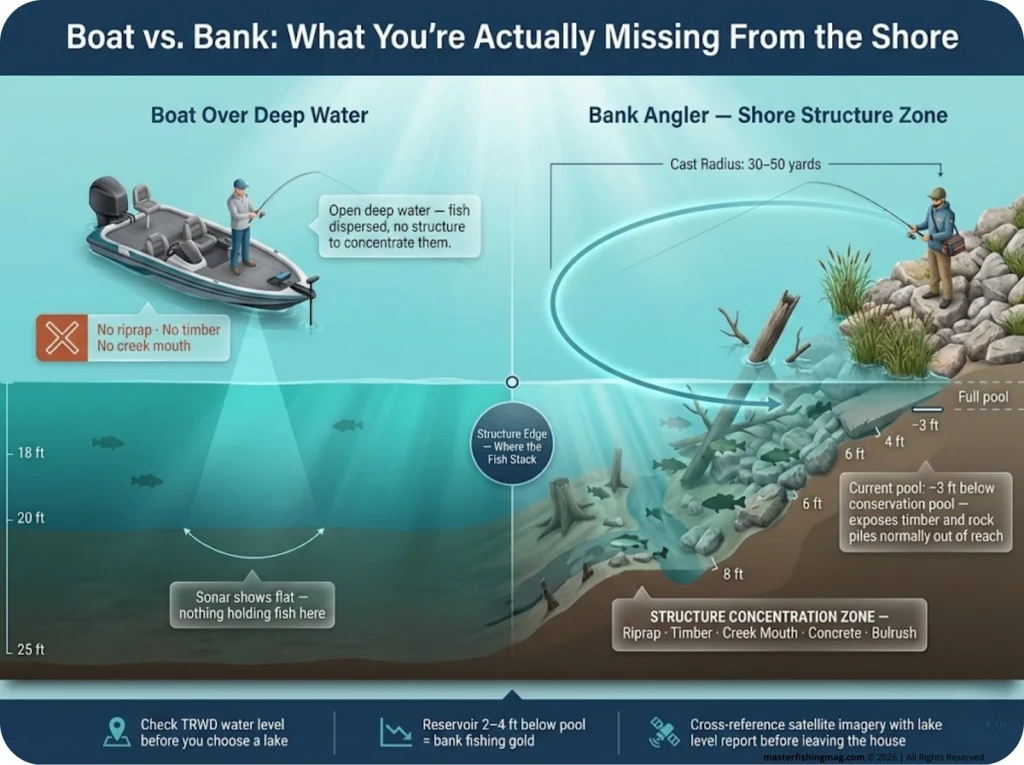
Pro tip: Check TRWD water level data before you pick a lake. A reservoir 2–4 feet below pool level creates bank-fishing gold — exposed points, visible structure, and fish that can’t spread out. That’s when you load the truck.
If you’re serious about scouting a fishing spot from satellite imagery before you leave the house, cross-reference aerial views with the current lake level report. Spots that look unreachable at full pool become prime when the water drops. The TPWD Easy Access Fishing Spots guide for the DFW area gives you facility ratings for every public fishing spot in the metro.
The Urban Stocked Ponds Nobody Fishes Hard Enough
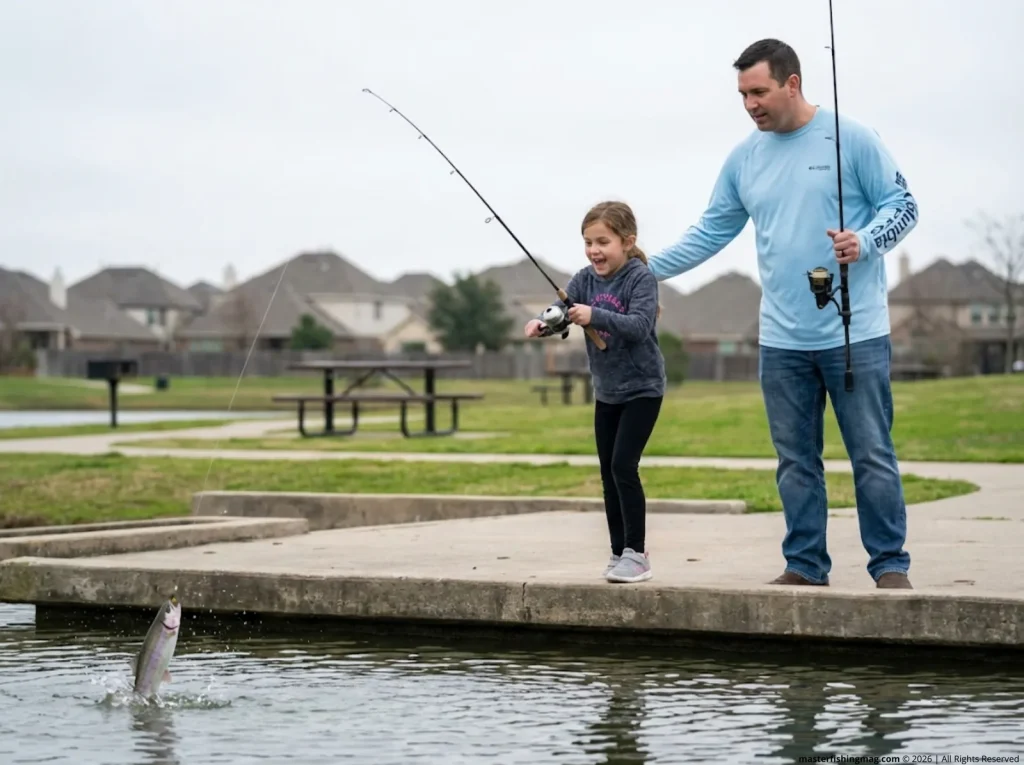
Neighborhood Fishin’ Program — Stocking Dates and Numbers
The Neighborhood Fishin’ Program is TPWD’s answer to a simple problem: not everyone owns a boat, and not everyone wants to drive an hour for a fishing trip. The program stocks channel catfish bi-weekly from late April through early November and stocked rainbow trout from late November through March at designated Community Fishing Lakes across the Dallas area and Fort Worth.
The harvest rules are tight: two poles per angler, five trout daily bag limit, no minimum length limit on trout. And the numbers are real. Greenbriar Park in Fort Worth received 1,896 rainbow trout per stocking event during the 2025-2026 season. Frontier Park Pond got 2,969 in a single drop. Ablon Park Pond — 2,000.
Most anglers hit these ponds in the first 48 hours after stocking, when shoulder-to-shoulder pressure kills the bite. The smarter play is waiting 3–5 days when the crowds thin out but the fish are still concentrated and feeding hard.
Pro tip: TPWD publishes its current catfish and trout stocking schedule publicly. Set a calendar reminder for your closest NFP pond and fish it on a Tuesday morning — not the Saturday after stocking weekend. You’ll have the whole bank to yourself.
Bachman Lake — The 10-Minute Sleeper
Bachman Lake sits 10 minutes from downtown Dallas with a full walking trail, parking, and restrooms. It holds largemouth bass, crappie, catfish, and stocked trout in winter. Bank access is “abundant” per TPWD, with the trail circling the entire lake and offering multiple fishing piers and casting positions along the shoreline.
The north shoreline near the dam face holds channel catfish year-round due to the concrete structure and deeper water access. Most visitors treat Bachman as a jogging destination. The handful of bank anglers who fish the quiet eastern coves before dawn consistently pull crappie in the 10–12 inch range — proof that some of the best spots are the ones people jog past every morning.
Other NFP Sleepers Worth the Drive
Mesquite City Lake and Greenbriar Park offer similar stocking density with even lower fishing pressure. Samuel Farm in East Dallas covers 400 acres with four ponds and routinely has only a handful of anglers present — a “giant fan favorite” among locals who keep it quiet. Joe Pool Lake also deserves a look for summer catfish from the bank, with abundant park shoreline and picnic areas for family outings.
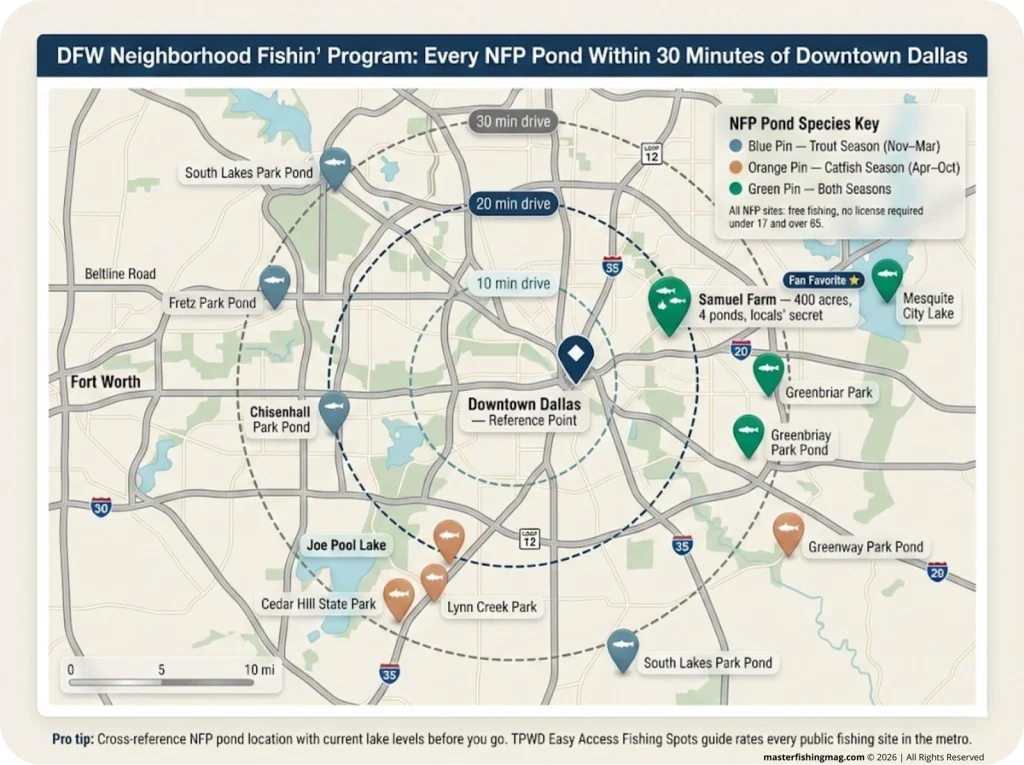
If you’re interested in transitioning from stocked trout ponds to wild water, these NFP sites are an ideal training ground with near-guaranteed action.
White Rock Lake — What the Trail Runners Miss
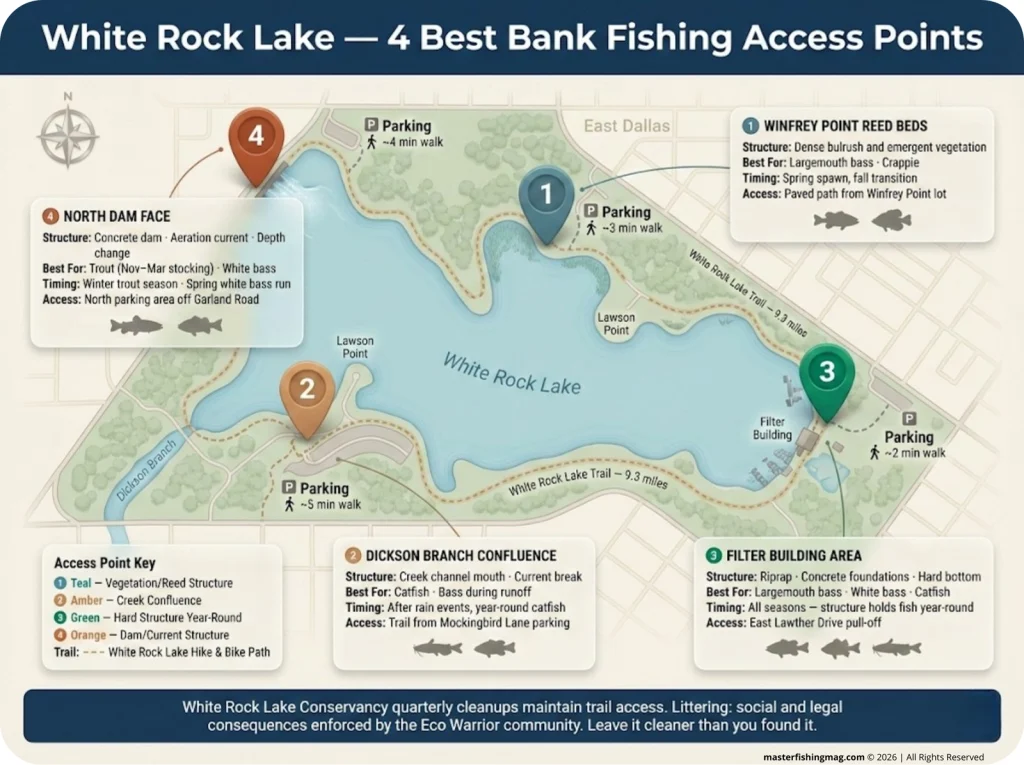
Winfrey Point and the Reed Bed Pockets
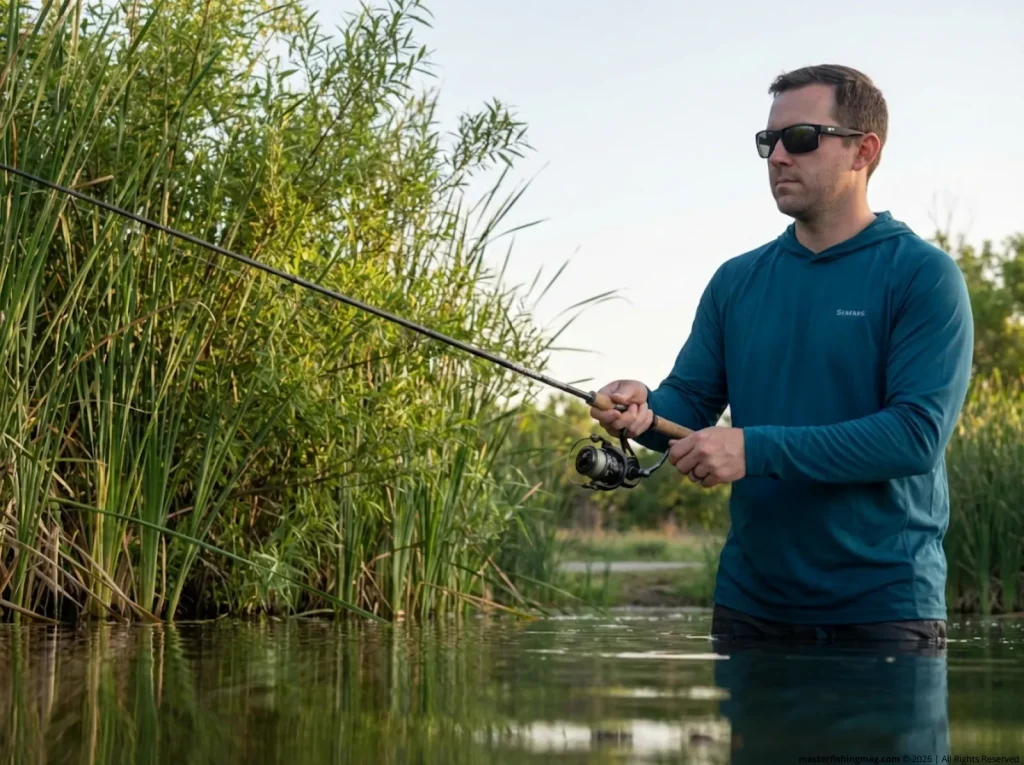
White Rock Lake spans over 1,000 acres and sits 5–10 minutes from downtown Dallas. It’s the most fished lake in the metro — and still the most underestimated from the bank. This is a legitimate bass fishing area that most people treat as a running trail.
The reed beds and water willow stands near Winfrey Point are prime structure for largemouth bass from March through June. During spring spawning, bass push into those shallow pockets along the shoreline where they’re reachable with a 1/8-oz jig thrown parallel to the vegetation line. The Civilian Conservation Corps-era structures along the shore create concrete and stone holdovers that attract catfish year-round.
And the Dickson Branch confluence? That’s the “sure bet” spot for spring crappie — the creek structure funnels fish into a predictable, bank-castable zone. You’ll feel that signature thump through the rod when a slab hits your jig along those edges.
Walk past the Filter Building area on the southeast shore. The old dam maintenance sites provide buried concrete that holds channel catfish in 4–8 feet of water, reachable with a bottom rig from the bank. Understanding how largemouth bass use suction feeding in shallow cover helps you position your jig in the right pocket — right where the bass expects prey to be trapped against the reeds.
Water Clarity, Lure Selection, and the Stained-Water Factor
White Rock typically runs stained water — moderate visibility that favors dark or high-contrast lure colors. Black/blue jigs and chartreuse crankbaits outproduce natural patterns here nine sessions out of ten. These are among the best baits for this lake year-round.
At full conservation pool (458 ft), vegetation-based patterns dominate; bass hold tight to water willow edges. When the pool drops even six inches, exposed mud flats near Winfrey Point concentrate bait and create predictable bank-fishing lanes.
If you want precision crappie tactics for structure-oriented fish, the Dickson Branch reed line is your classroom. Set a slip bobber at 5 feet and work it parallel. The slabs are there.
Conservation and Community at White Rock
White Rock has a strong “Eco Warrior” volunteer presence. Littering draws social and legal consequences. The White Rock Lake Conservancy organizes quarterly cleanups that directly benefit bank access by clearing trail obstructions and invasive vegetation. TPWD’s White Rock Lake species and access report confirms the current species mix and facility status.
The Reservoir Circuit — Lewisville, Ray Roberts, and Benbrook
Lewisville Lake — The Cut and the Cemetery Road Beds
Lewisville Lake covers nearly 30,000 acres, and almost everyone treats it as a boat lake. That’s a mistake.
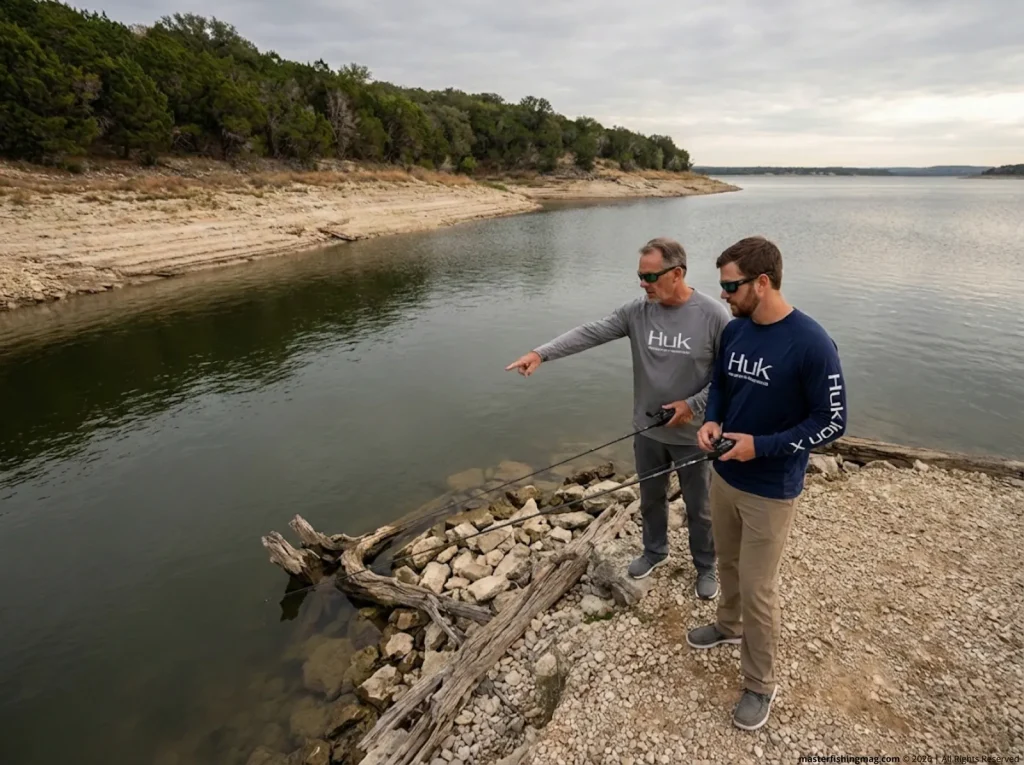
“The Cut” at the end of Garza Lane offers free parking and a secluded bank fishing environment with riprap and standing timber within casting range. But the real prize sits just past the main access points. The submerged road beds near the Little Elm Cemetery access are legendary among local crappie anglers — and they appear on zero official maps. That old asphalt runs parallel to shore at about 8 feet deep, and crappie suspend along that edge from October through March.
Stewart Creek Park is the go-to during the run — the annual spring migration when sand bass, hybrids, and white bass push into the creek mouth and stack up within bank-casting range. Target it during the spring spawning window and you’ll see why locals clear their calendars. The Elm Fork of the Trinity also feeds this system, and the wadeable sections near LLELA provide bank and wade access for anglers who want to work creek mouths with lighter tackle.
Lake Ray Roberts — The Greenbelt Nobody Walks
Lake Ray Roberts offers the most “wilderness” feel within 60 minutes of Dallas, with 10.5 miles of heavily wooded riverbank along the Greenbelt Corridor. State Park status means no fishing license is required when fishing from shore within park boundaries — the lowest barrier to entry in the entire DFW system.
The Overlook Cove area holds hollow cypress trees and secluded pools accessible only by foot trails past the main dam. Ray Roberts also holds the current largemouth bass record at 15.18 lbs, confirming its trophy potential for bank anglers willing to put in the walk.
Pro tip: Walk south from the Overlook Cove parking area. Cross the small tree line to the left and you’ll hit a series of gravel bars where bass stage during the pre-spawn. Almost nobody fishes there because it’s a 10-minute walk from the truck. That walk is worth it.
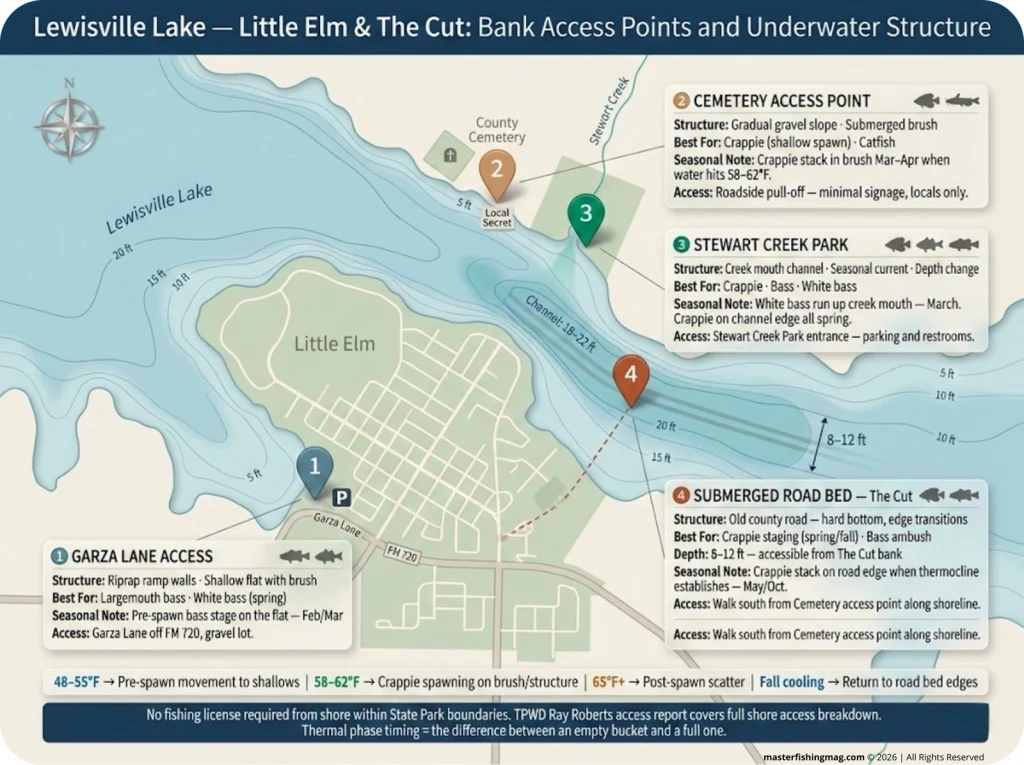
Understanding the thermal phases that trigger crappie to stack in shallow structure helps you time the Lewisville and Ray Roberts runs down to the week. The TPWD access points and species report for Ray Roberts covers the full shore access breakdown.
Benbrook Lake — Low Water, High Reward
Benbrook Lake is running −3.03 ft below conservation pool right now, exposing significant riprap, submerged timber, and rocky points that are normally under 6+ feet of water. That makes it a primary target for bank anglers this season. Rocky Creek and Mustang Park provide the best bank access, with parking within 100 yards of productive shoreline.
Species focus: excellent for channel catfish and carp from the bank year-round. Bass and crappie move into exposed structure during spring and fall transitions. But here’s the part most guides skip: Benbrook carries a DSHS consumption advisory. Fishing is excellent. Keeping fish is not recommended. Practice catch and release here.
Bank Gear and Tactics That Actually Work in DFW
The Longer Rod Advantage
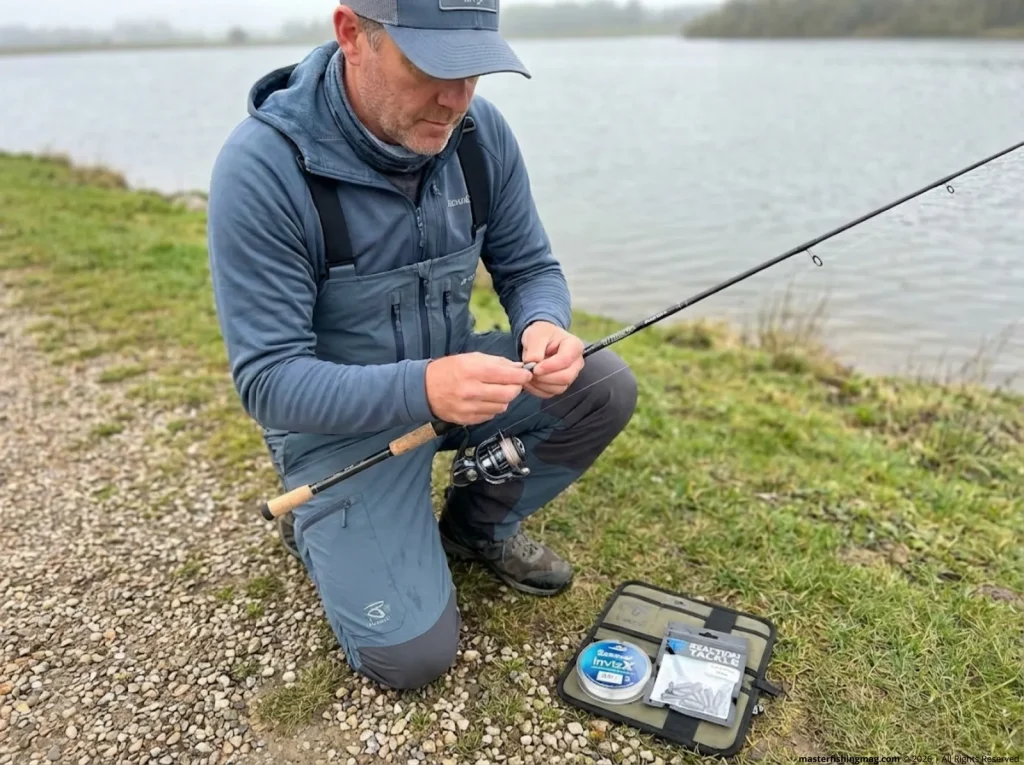
Standard 6’6″ to 7′ rods limit your cast from shore distance. Stepping up to an 8-foot medium-light spinning rod with a quality fishing reel adds 15–20% casting range, which means you reach structure at 40–50 yards that shorter rods can’t touch. That extra distance is the difference between fishing dead water and hitting creek mouths, riprap walls, and reed beds where fish actually hold.
Pair an 8-footer with 8-lb fluorocarbon fishing line and a 1/16-oz jig for crappie work along submerged road beds. The extra length lets you keep your rod tip high and walk fish around underwater snags without breaking off.
Rigs and Presentations for Shore Casting
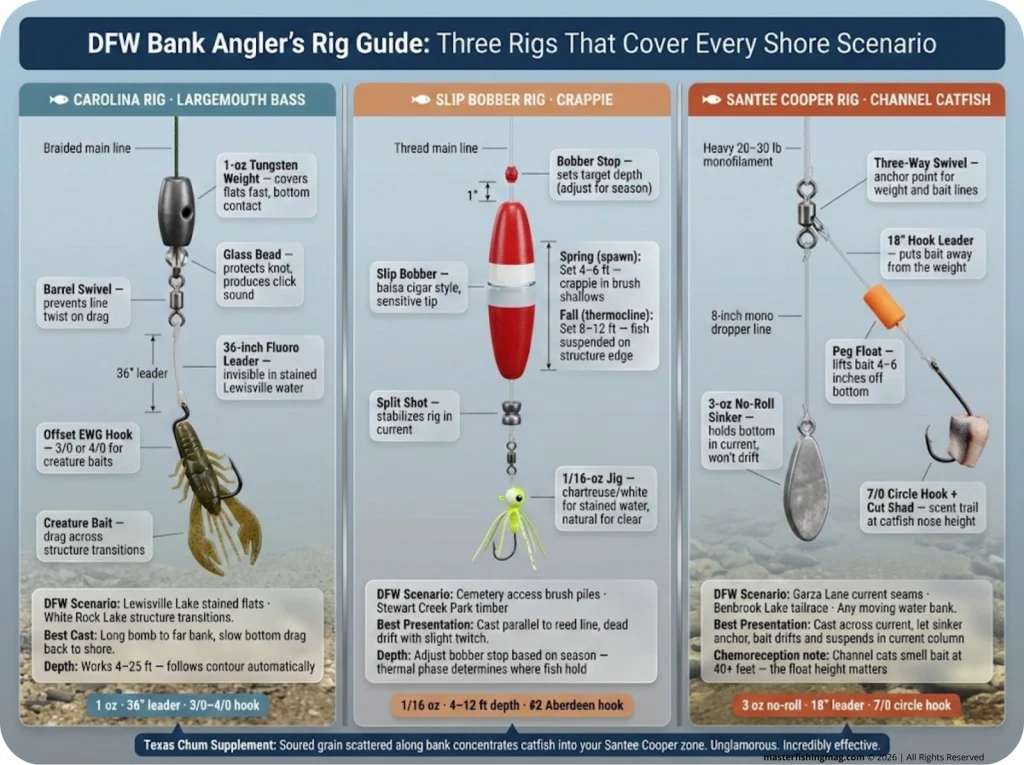
The Carolina rig covers the most ground from the bank. A 1-oz tungsten weight with a 3-foot leader lets you drag creature baits across flats and structure transitions in stained water — ideal for Lewisville and White Rock.
For suspending crappie along reed lines and submerged timber, a slip bobber and 1/16-oz jig is hard to beat. Set depth at 4–6 feet in spring, 8–12 feet in fall. The Santee Cooper rig is the DFW catfish standard: a 3-oz no-roll weight with a peg float lifts your bait off the bottom where channel cats detect it through chemoreception.
Old-school Texas chumming — soured grain scattered along the bank — still works for pulling whisker fish into a specific shore spot. Most guides won’t mention it because it’s unglamorous. It’s also incredibly effective.
For a deeper breakdown of shore-based casting mechanics, the full tactical playbook for shore-based casting covers distance optimization, stealth, and extraction from tight spaces.
Portable Electronics for Bank Anglers
Castable fish finders like the Deeper Pro+ 2 and Garmin Striker Cast let you map structure within your casting radius — a serious advantage at reservoirs where submerged road beds and creek channels are invisible from shore. Check out our field test of the top portable fish finders for bank anglers for model-specific recommendations.
Pair the castable sonar with the TPWD stocking schedule for NFP ponds: confirm the fish are there, then find their depth and position before making a cast.
Safety, Access, and the Rules Most Guides Skip
Fish Consumption Advisories You Need to Know
This is the section most “Top 10 Best Spots” articles leave out — and it’s the one that matters most if you’re planning to keep fish from the Dallas area.
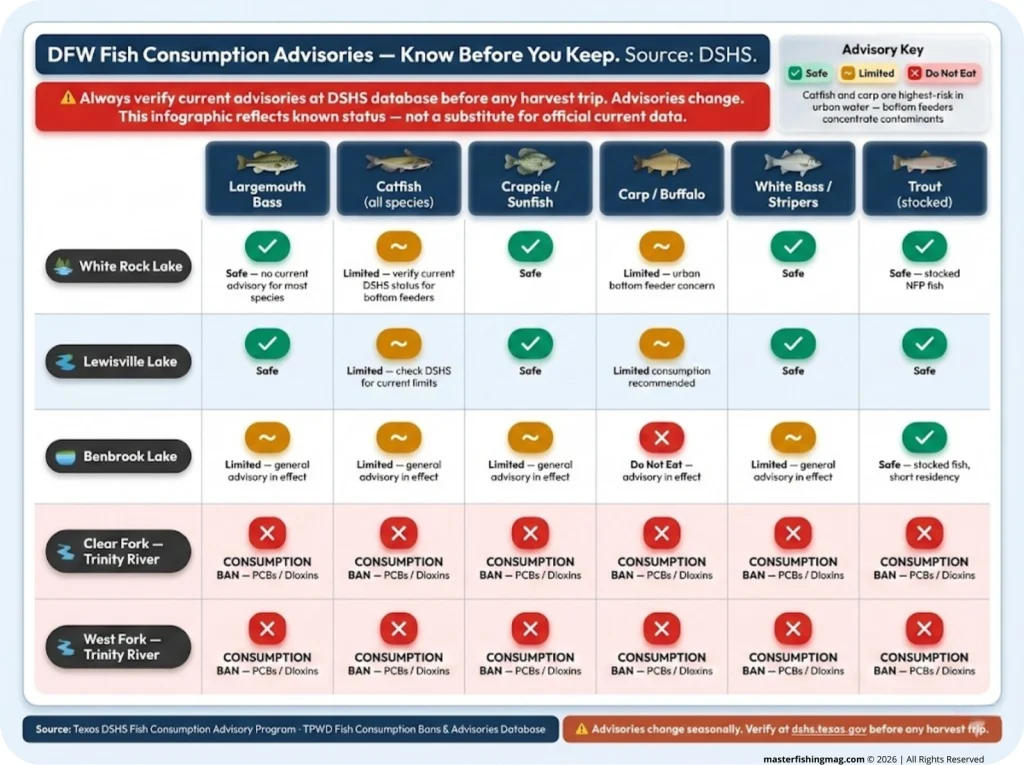
DSHS maintains active consumption advisories for several DFW water bodies. The Clear Fork and West Fork of the Trinity River carry total fish consumption bans due to PCBs and dioxins. Benbrook Lake carries a general advisory recommending limited consumption of all species. White Rock Lake proper is not currently under advisory for most species, but always verify the current list before keeping anything from urban water. The TPWD fish consumption bans and advisories database gives you the full rundown by water body and species.
We include this because responsible guides don’t pretend urban fishing is risk-free. Check the advisory database before planning any harvest trip.
Licensing, Fees, and Free Fishing Days
A standard Texas freshwater fishing license costs approximately $30 for residents and $58 for non-residents (annual). Texas Free Fishing Days — typically the first Saturday in June — waive fishing licenses requirements statewide. Lake Ray Roberts State Park exempts anglers fishing from shore within park boundaries from needing a valid fishing license, making it the only major reservoir in DFW with that perk.
USACE parks like Lewisville and Benbrook charge separate day-use fees of $4–$8 or accept the America the Beautiful pass. For a full breakdown, see understanding fishing license costs and digital options.
Invasive Species and Leave No Trace for Bank Anglers
Zebra mussels have colonized multiple North Texas reservoirs and can destroy native fish habitats if left unchecked. The “Clean, Drain, Dry” protocol isn’t just for boats — it applies to bait buckets, wading boots, and bank rod holders. A mandatory 7-day dry time or hot water wash at 140°F is required for any equipment moving between DFW lakes. For a deeper look at the species threatening North Texas waters, read identifying and stopping invasive species as an angler.
Leave No Trace for bank anglers means entering the water at gravel bars or low banks to prevent riparian erosion, disposing of monofilament fishing line properly, and using lead-free sinkers where possible. Carry a small mesh bag for unused bait packaging and cut line. Urban parks have foot traffic, and discarded mono wraps around wildlife. It also destroys the community’s willingness to let anglers keep using these good spots.
Pro tip: Carry a 1-gallon ziplock in your back pocket. Everything that came out of your tackle bag goes back in. It takes five seconds and keeps your access intact for next season.
Conclusion
The best bank fishing in DFW isn’t hidden. It’s ignored. Anglers drive past productive shoreline structure every weekend because they assume these reservoirs require a boat. They don’t.
Timing matters more than location. Pair TPWD stocking schedules and TRWD water levels with seasonal species movements, and you’ll fish the right bank at the right time. The NFP ponds give you near-guaranteed action on a Tuesday morning. The reservoirs give you trophy-class fish if you’re willing to walk 10 minutes past the parking lot.
Responsibility separates a good bank angler from a liability. Know the consumption advisories. Practice Clean-Drain-Dry. Leave the bank cleaner than you found it. The fish don’t care about your fancy boat. They care about structure, timing, and whether the angler on shore knows where to cast. Now you do.
Pick one spot from this guide that’s within 20 minutes of your house. Go before sunrise on a weekday. Walk past the obvious access point and look for the structure nobody else is casting to. That’s where they’re waiting.
FAQ
Do you need a fishing license to bank fish in Dallas parks?
Yes, a valid fishing license is required at most DFW locations. The exception is Ray Roberts State Park, where fishing from shore within park boundaries does not require a license. Texas also offers statewide Free Fishing Days, typically the first Saturday in June.
What fish can you catch from the bank at White Rock Lake?
White Rock Lake holds largemouth bass, crappie, channel catfish, and sunfish year-round. During winter months, TPWD stocks nearby Neighborhood Fishin’ ponds with rainbow trout. The Dickson Branch area is the top shoreline spot for crappie during the spring spawning season.
Is it safe to eat fish caught from Dallas-area lakes?
It depends on the water body. The Clear Fork and West Fork of the Trinity River have total consumption bans due to PCBs and dioxins. Benbrook Lake carries a general advisory. White Rock Lake is not under current advisory for most species. Always verify the DSHS advisory database before keeping fish from any urban water.
Where is the best free bank fishing near Dallas?
The Neighborhood Fishin’ Program ponds — Bachman Lake, Greenbriar Park, Samuel Farm — offer free access and TPWD-scheduled stockings. For larger reservoirs, Lewisville Lake’s The Cut at Garza Lane provides free parking and excellent shoreline structure. Ray Roberts State Park waives the fishing license requirement from shore.
What gear do I need for bank fishing in DFW?
An 8-foot medium-light spinning rod paired with 8-lb fluorocarbon fishing line covers most bank situations. Carry a slip bobber rig for crappie, a Carolina rig for bass, and a Santee Cooper rig for catfish. A screw-in bank rod holder and a castable fish finder are the two upgrades that matter most for shore anglers.
Risk Disclaimer: Fishing, boating, and all related outdoor activities involve inherent risks that
can lead to injury. The information provided on Master Fishing Mag is for educational and informational purposes
only. While we strive for accuracy, the information, techniques, and advice on gear and safety are not a substitute
for your own best judgment, local knowledge, and adherence to official regulations. Fishing regulations, including
seasons, size limits, and species restrictions, change frequently and vary by location. Always consult the latest
official regulations from your local fish and wildlife agency before heading out. Proper handling of hooks, knives,
and other sharp equipment is essential for safety. Furthermore, be aware of local fish consumption advisories. By
using this website, you agree that you are solely responsible for your own safety and for complying with all
applicable laws. Any reliance you place on our content is strictly at your own risk. Master Fishing Mag and its
authors will not be held liable for any injury, damage, or loss sustained in connection with the use of the
information herein.
Affiliate Disclosure: We are a participant in the Amazon Services LLC Associates Program, an
affiliate advertising program designed to provide a means for us to earn advertising fees by advertising and linking
to Amazon.com. As an Amazon Associate, we earn from qualifying purchases. We also participate in other affiliate
programs and may receive a commission on products purchased through our links, at no extra cost to you. Additional
terms are found in the terms of service.