
In this article
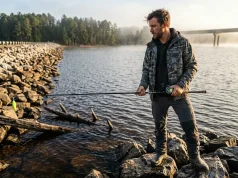
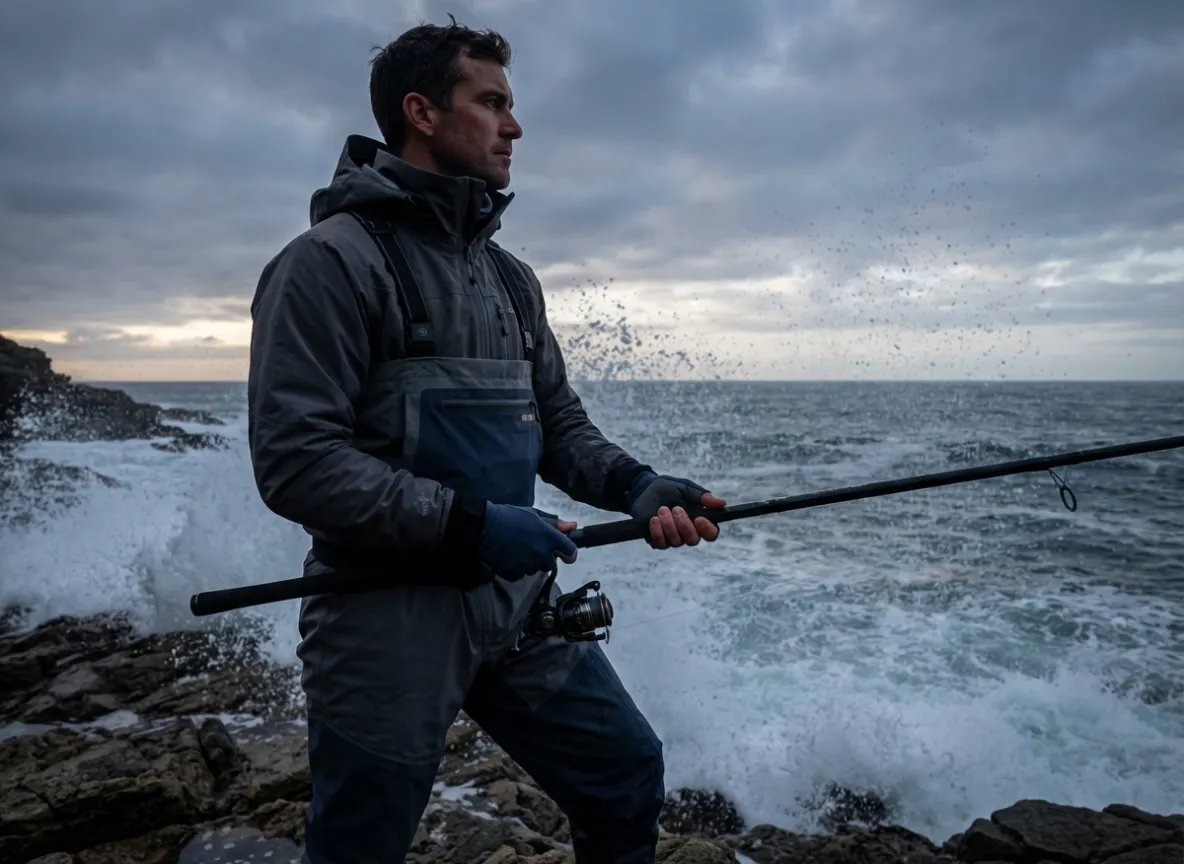
The salt spray hits your face not because you are speeding through it, but because you are standing firm against it. Land-based angling is often misunderstood as a compromise for those lacking boats, but that view misses the point entirely. It is a tactical discipline requiring stealth, geometry, and grit.
While the boat fishing crowd relies on horsepower and sonar to locate biomass, the mobile shoreline angler relies on biological literacy and the ability to read the invisible language of the water’s surface. This guide dismantles the passive “sit-and-wait” mentality. Instead, we replace it with a systems-engineering approach to becoming an apex predator on the bank.
Here is the roadmap to shifting your mobile strategy:
- Hydrographic Forensics: Decoding wave breaks, sandbars, and seams to map structure.
- Bio-Acoustic Stealth: Mitigating ground vibration to defeat the fish’s lateral line.
- Geometric Efficiency: Using fan casting and parallel vectors to maximize strike zone time.
- Expeditionary Logistics: Optimizing mobility with rod slings and tactical loadouts.
- Terminal Extraction: Landing game fish safely from disadvantaged positions like piers or jetties.
Phase 1: Hydrographic Forensics (The Detection System)
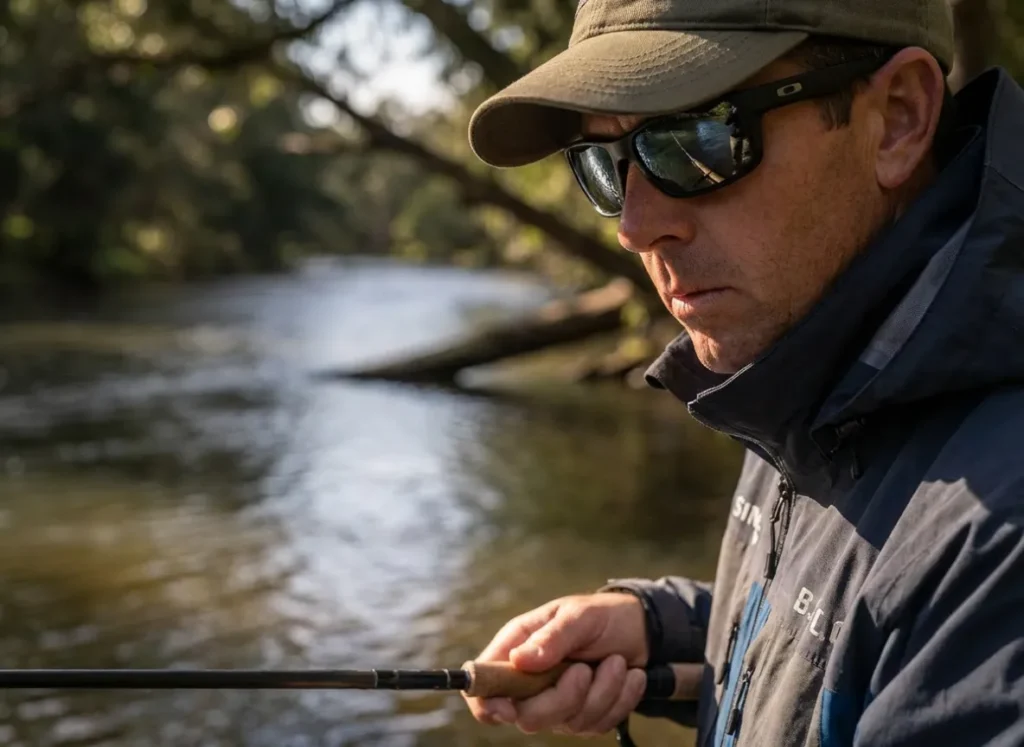
This section establishes the foundational skill of interpreting fluid dynamics to locate high-percentage holding spots in both saltwater coastline and freshwater environments. You cannot catch what you cannot find.
How do I read the surf to identify invisible structure?
To find saltwater fish in the surf, you must understand the high-energy physics of the water column. Waves break when the water depth is roughly 1.3 times the wave height. Therefore, a line of white water breaking offshore indicates a sandbar, while the water reforming into rolling swells closer to shore reveals a deep trough. This deep channel, or “slough,” between the beach and the first bar is the primary highway for cruising predators like Redfish, Snook, and Pompano.
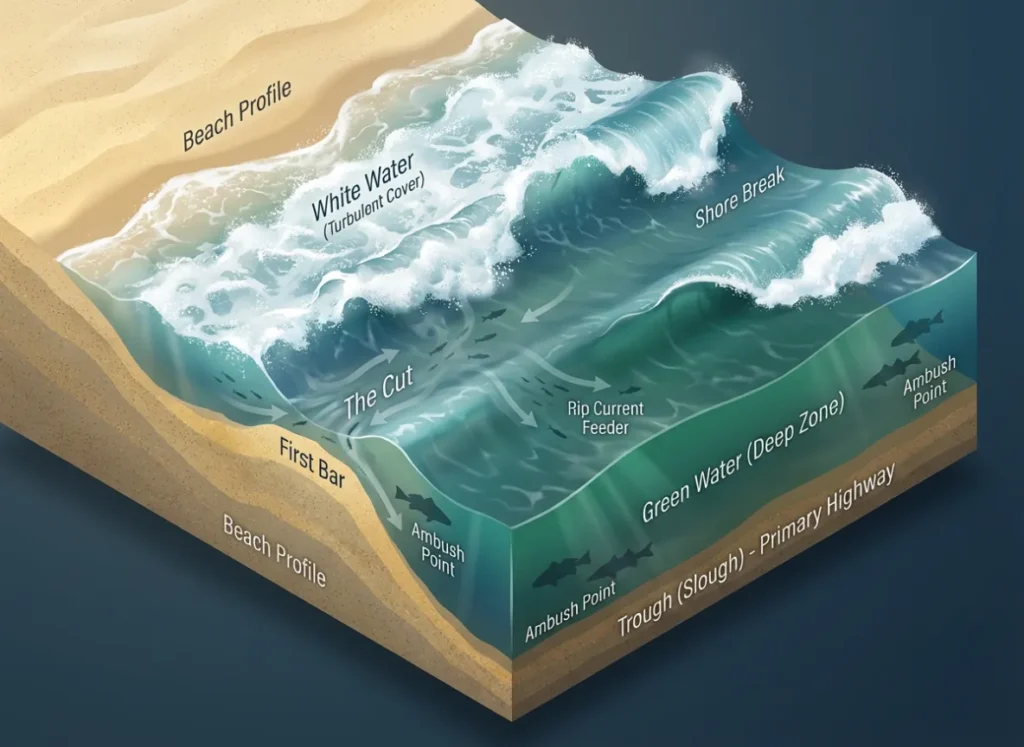
You must also identify rip currents, which appear as deceptive “calm” gaps in the breaker line. This is where water exits seaward, creating a conveyor belt of food. Understanding the fluid dynamics of nearshore wave patterns allows you to predict where predators will sit to ambush this flushed baitfish.
Pro-Tip: Don’t ignore the “Cut.” These breaks in the sandbar are specific ambush points where predatory fish wait to intercept bait.
Advanced detection requires distinguishing color. Use polarized sunglasses to spot the difference between “white water” (highly oxygenated, turbulent cover) and “green water” (deeper holding zones). Additionally, mastering fishing in current helps you understand how tide timing affects these features; low tide exposes the topography you must memorize for fishing the high tide.
How do I identify productive cover in low-energy freshwater environments?
In freshwater, structure analysis is more static but equally nuanced. When approaching a laydown (fallen tree), you must distinguish between the “fluff” (outer branches) and the “meat” (the main trunk or fork). The biggest largemouth bass invariably hold in the meat, where the cover is densest and most stable.
You should also look for current seams, the visible lines separating fast-moving river water from the slack water of an eddy behind obstructions. Vegetation lines offer another clue; target the “crisp” edges of green, oxygen-producing weeds rather than casting blindly into the center of dying brown mats.
For a deeper understanding of these environments, a step-by-step field guide to reading a river is essential.
Variables like shade can be decisive. Bass fishing often revolves around shadow; fish lack eyelids and seek relief from solar glare, so prioritize the darkest shadow pockets under docks. You can also use “terrestrial mirroring”—using the slope of the visible bank to predict the underwater depth profile. Steep banks usually indicate deep water, while flat banks suggest a shallow shelf.
Finally, feel for hard-to-soft transitions. Research on the impact of riparian cover on fish distribution suggests that the intersection of rock and mud is a key migration route for crayfish, catfish, and bottom feeders.
Phase 2: The Physics of Stealth (The Approach System)
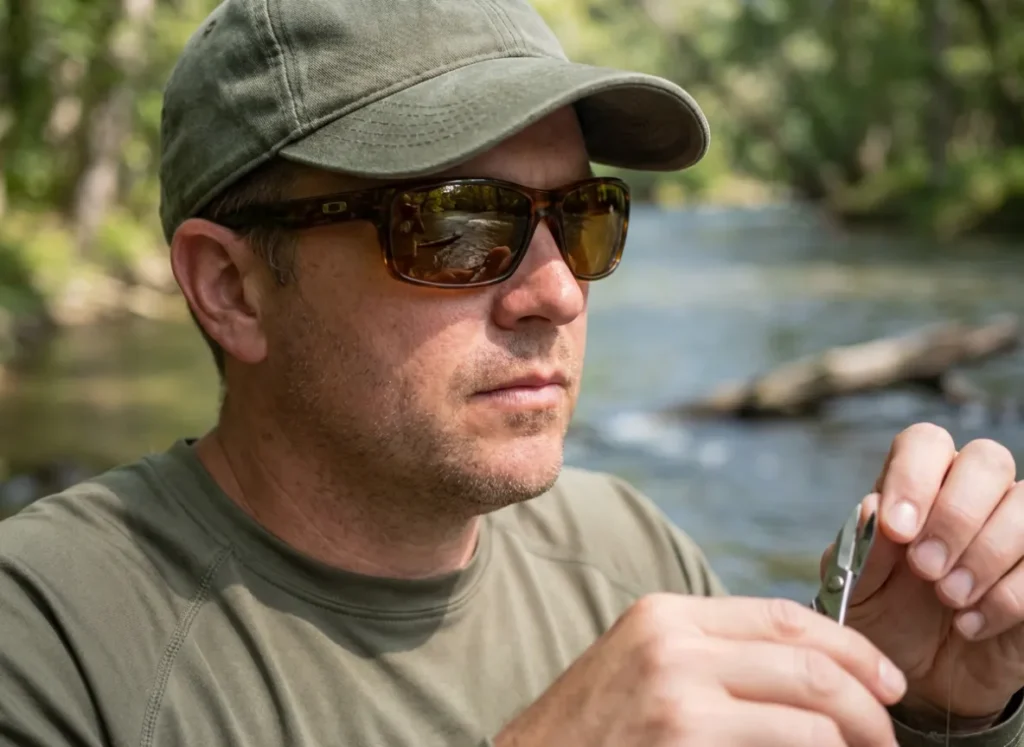
Identifying the target is useless if the target identifies you first. This section explains the biological mechanisms of fish sensing and how to mitigate your acoustic and optical footprint to avoid spooking fish.
Why does walking on the bank spook fish more than talking?
Fish possess a “sixth sense” known as the Lateral Line System, a series of canal neuromasts capable of detecting minute pressure gradients and low-frequency vibrations. When you walk heavily on the bank during bank fishing, your footfalls act as a dipole source, creating pressure waves that travel through the soil and couple directly into the water.
Because sound and vibration travel approximately 4.5 times faster in water and solids than in air, your ground noise is an immediate alert signal. An engineering analysis of lateral line sensing confirms that these pressure gradients are often detected long before a fish sees a lure.
Pro-Tip: Utilize the “Heavy Foot” Protocol. Stop 4 to 7 feet back from the water’s edge to let the soil dampen your vibration.
Substrate matters. Wooden fishing piers create a “drum effect” that amplifies noise, whereas soft mud absorbs it. To mitigate this, adopt a rolling heel-to-toe walk to minimize the impact spikes associated with stomping. Once you have managed your acoustic signature, you must consider the visual science of fish vision to remain unseen.
How do I manage my shadow and profile to defeat Snell’s Window?
Fish view the terrestrial world through “Snell’s Window,” a 97-degree cone of vision. Outside this cone, the surface acts as a mirror. If you stand tall at the water’s edge, you place yourself directly in this window, often silhouetted against a bright sky. Shadows cast onto the water are a primal threat, mimicking the overhead approach of avian predators like herons.
The mechanisms of predator avoidance in fish trigger immediate flight responses when sudden shadows appear. To counter this, master shadow management. Keep the sun in your face or at your side to cast your shadow behind you, away from the water.
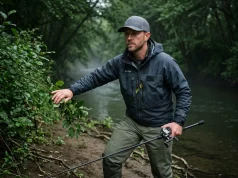
Reduce your profile by crouching or kneeling. This lowers your angle of incidence, effectively removing yourself from the fish’s window of view. Wear drab apparel—earth tones like greens and browns—to blend with the riparian background. Finally, equip yourself with the best polarized sunglasses for your specific water type so you can spot the fish without them spotting you.
Phase 3: Tactical Execution (The Delivery System)
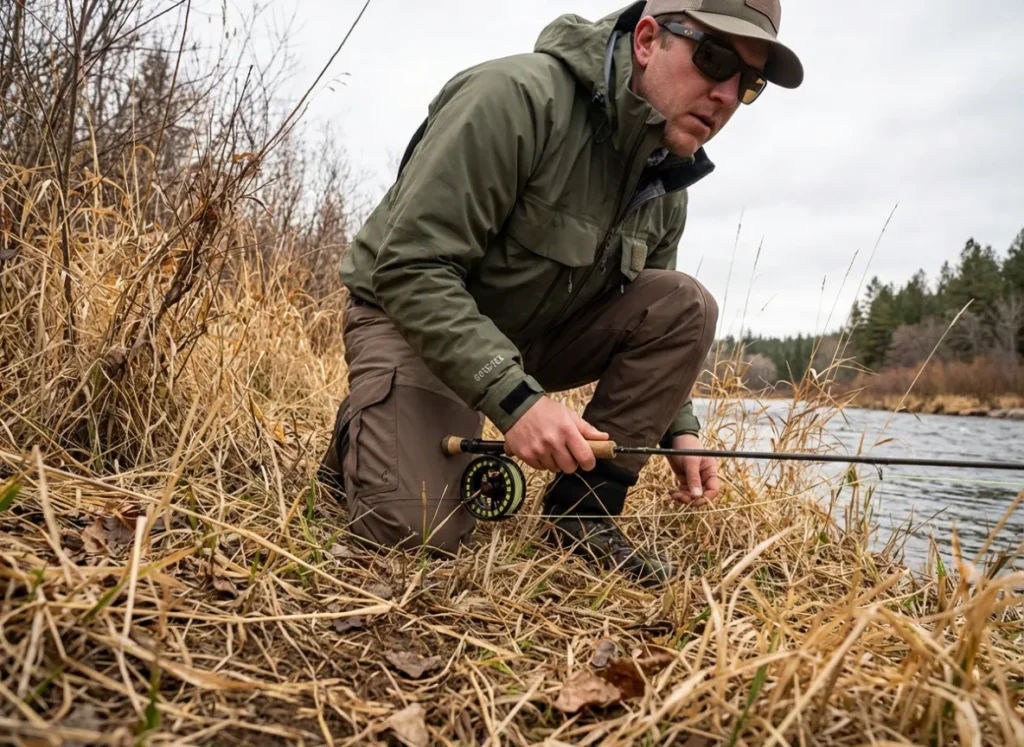
With your presence concealed, you are in position to execute the delivery. This section replaces luck with mathematics, using casting geometries like fan casting to maximize lure exposure.
Why is the “Clock Face” Fan Casting system mathematically superior?
Many anglers make the mistake of only casting “straight out” (12 o’clock), missing 80% of the accessible water. The “Clock Face” methodology visualizes the casting area as a semi-circle, requiring you to systematically place casts from 9 o’clock to 3 o’clock.
This fan pattern builds a mental 3D bathymetric map. By interpreting the feedback from your lure—the “tick” of the rod tip—you can identify bottom transitions within the arc. Understanding search theory in foraging ecology supports this systematic approach; random casting is inefficient compared to a grid search.
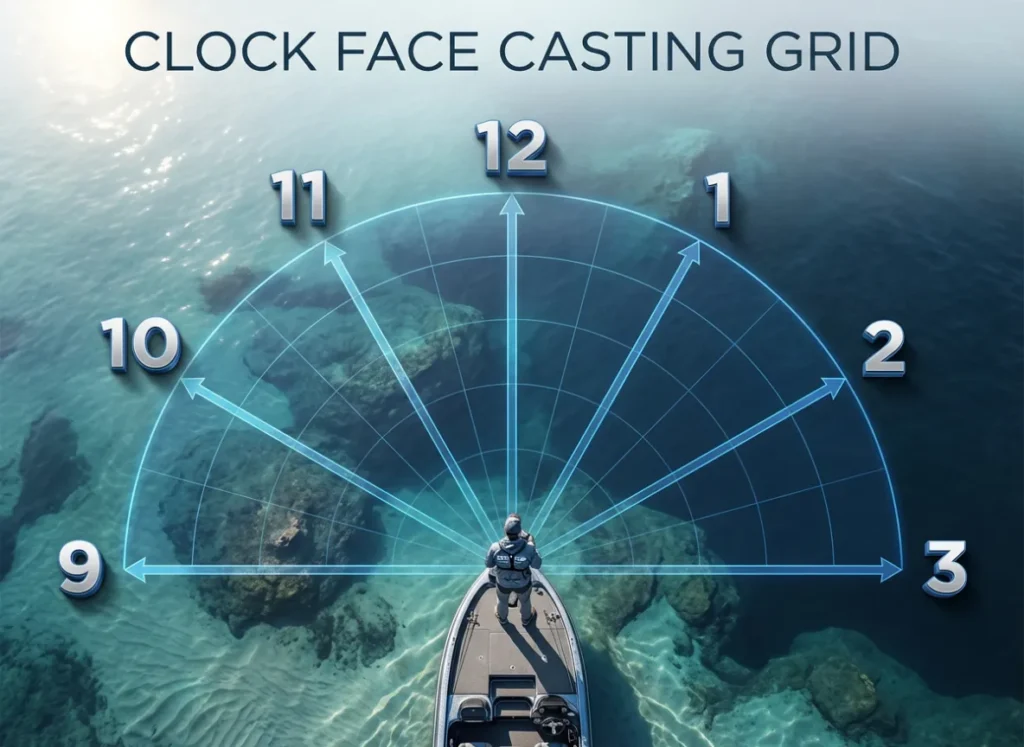
If bites occur consistently at the “10 o’clock” angle, you have isolated a specific piece of structure or a rock bar. To execute this with precision, you must understand rod power vs action decoded, as the right rod mechanics are critical for accurate grid searching with soft plastics or crankbaits.
How does the Parallel Cast maximize “Time in Zone”?
The geometry of efficiency is dictated by the Littoral Zone Rule. Approximately 90% of biological activity occurs within 10 feet of the shoreline. A cast made perpendicular to the bank intersects this productive zone for only about 10% of the retrieve.
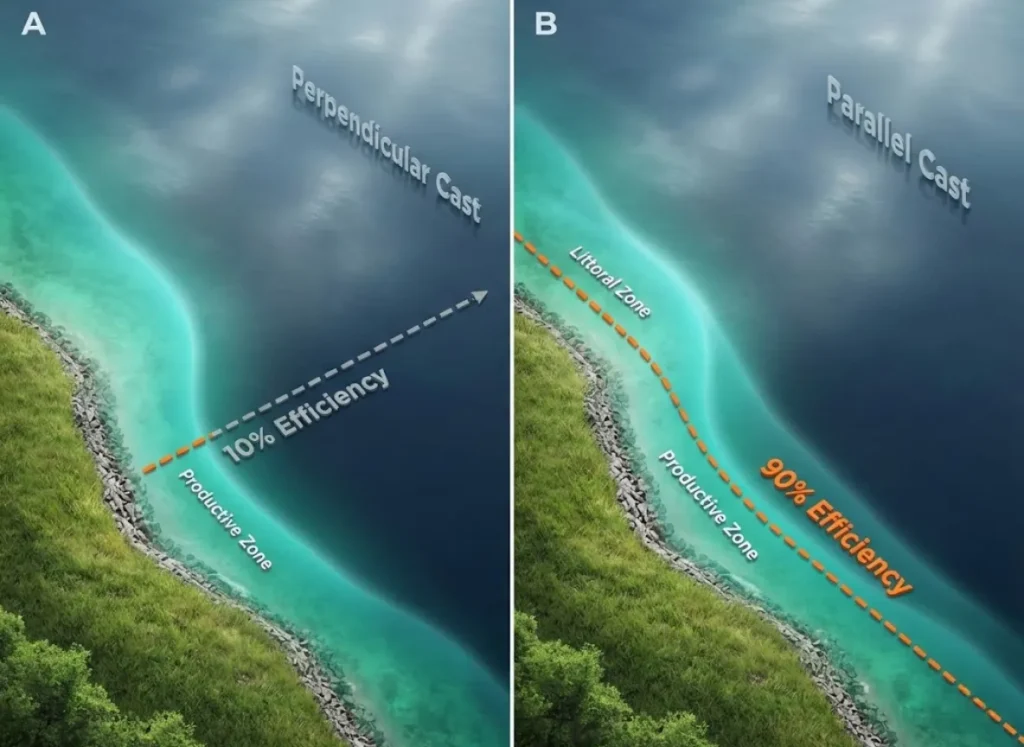
By casting parallel to the shore, you keep the lure in the parallel strike zone for nearly 100% of the retrieve. This aligns your presentation with structure like weed lines, drop-offs, and rip-rap. Studies on littoral zone productivity confirm that this margin is where the food chain is most active.
This technique requires you to stand back from the edge to avoid spooking the game fish you are targeting. Short, precise pitches with swim jigs or topwater poppers are often more effective here than long-distance bombs. However, before you can cast parallel, you must apply a data-backed method for choosing a fishing spot to ensure you are standing on productive ground.
Phase 4: Expeditionary Logistics (The Logistics System)
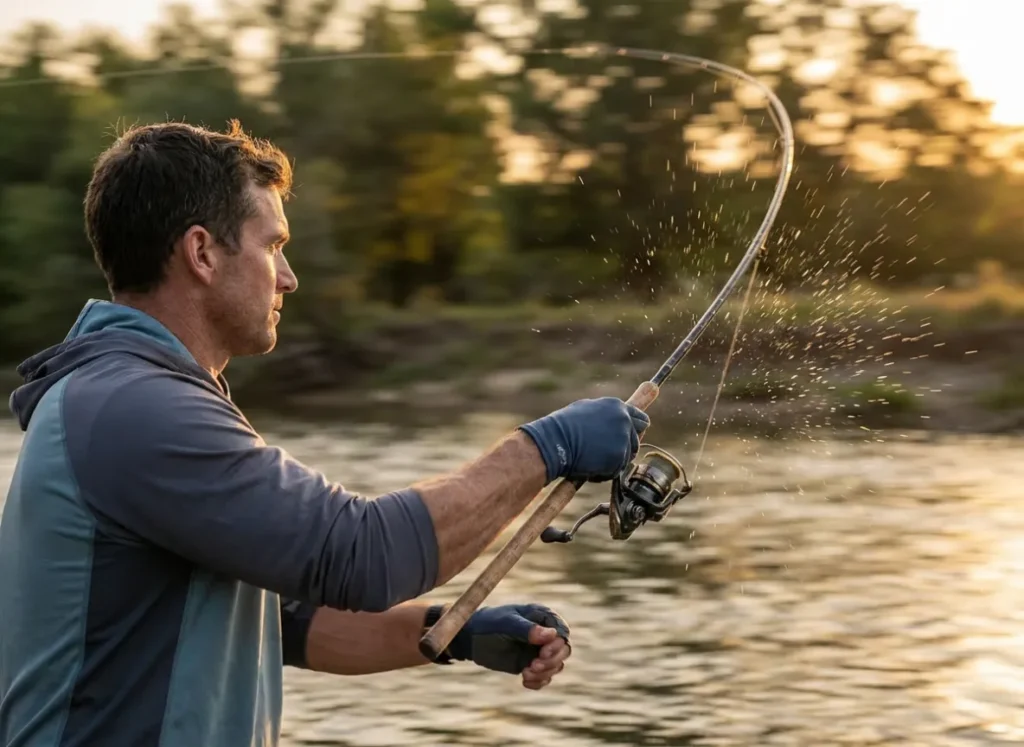
To execute these tactics, you cannot be burdened by a heavy fishing cart or clumsy box. This section treats gear selection as “systems engineering” for mobility.
What is the optimal “Mobile Loadout” for the shore angler?
The savvy shoreline angler must transition from hand-carried tackle boxes to tactical backpacks. This keeps both hands free for climbing, wading, and casting. Backpacks offer stability and endurance, adhering to basic ergonomics of load carriage.
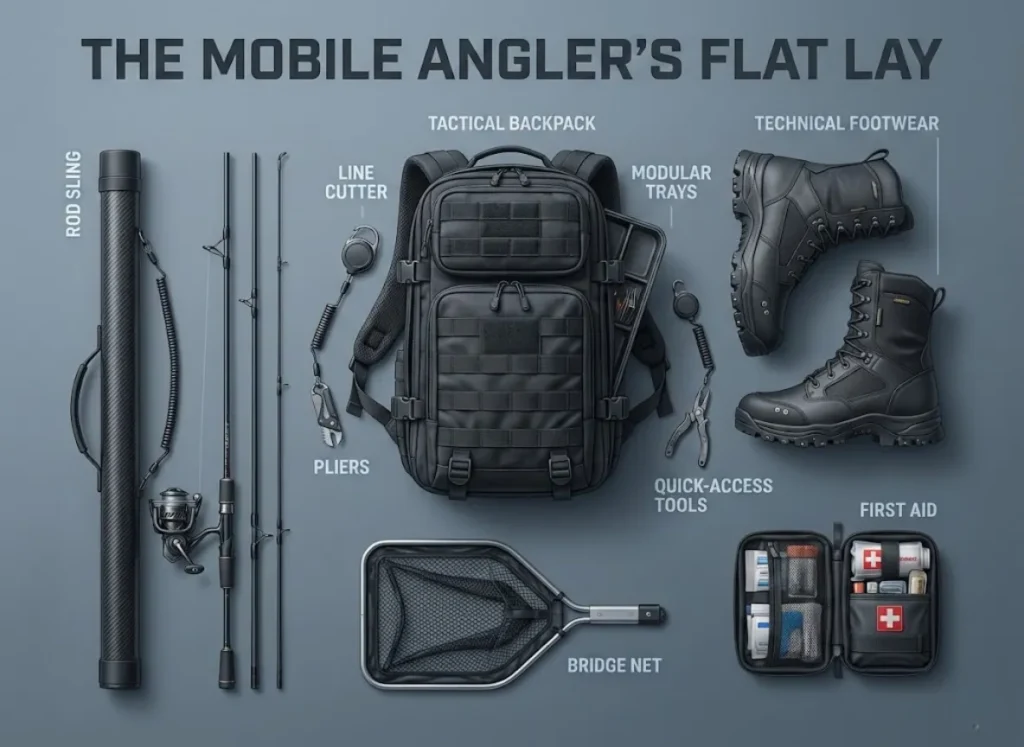
Utilize rod slings or hip holsters to carry a second combo—perhaps a spinning rod rigged with a finesse presentation like a drop-shot rig—without it hindering movement. Internally, use modular trays. This allows you to swap “missions”—trading a bass fishing tray for a catfish tray—without repacking the entire bag. For specific recommendations, refer to our guide on selecting the best fishing tackle box systems.
View footwear as gear. Traction (felt or cleats for rocky streams) and waterproofing are critical safety tools. Finally, position your pliers, lip grippers, and line cutters on external lanyards. When a fish is thrashing, you need tools accessible instantly, not buried in a zipper pocket.
Phase 5: The Terminal Phase (The Extraction System)
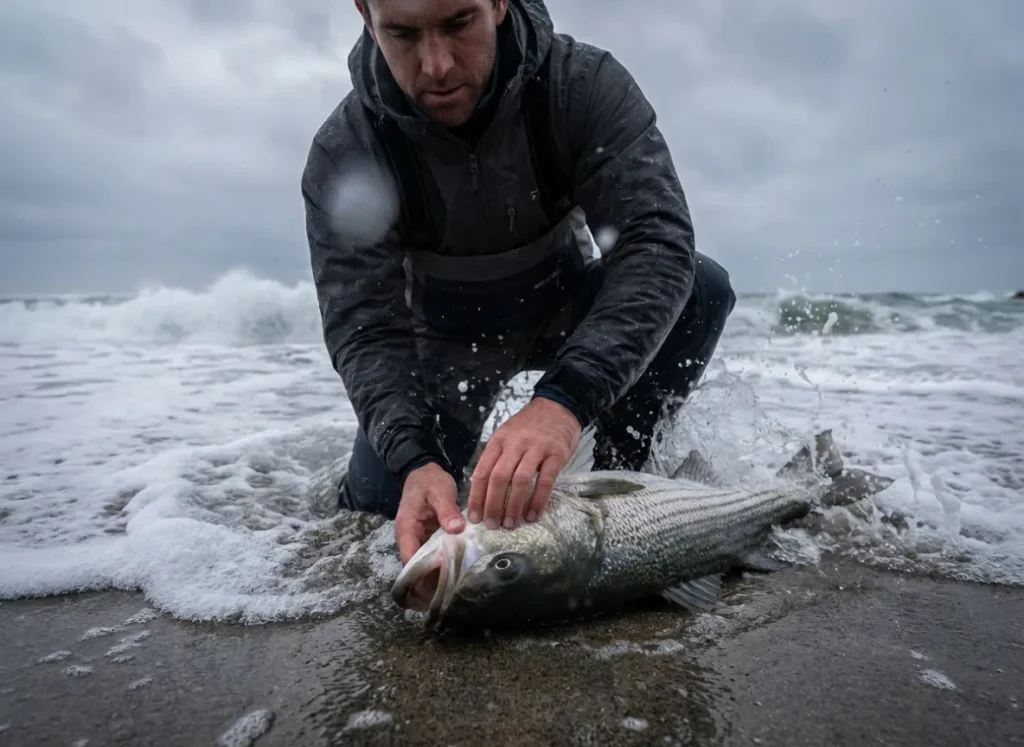
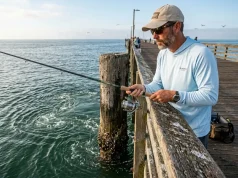
The ultimate test is not the hike or the cast, but the landing. This section provides protocols for vertical extraction (like pier fishing) and horizontal extraction to ensure safety and survival.
How do I land a fish from a high pier or bridge (Vertical Extraction)?
Lifting a heavy sport fish by the line or rod tip is a recipe for broken gear and injured fish. For any elevated platform, a “Drop Net” or “Bridge Net” (a 32-inch weighted hoop) is mandatory. You must lower the net before the fish is exhausted, positioning it up-current to allow the water to open the bag.
Use the “Guide-In” technique. Your rod is only for steering the fish’s head over the net. Once the fish is centered, drop the rod (or place it in a holder/armpit) and pull the net rope hand-over-hand. Specialized weighted rims are necessary because standard nets will collapse in the moving water.
To ensure you have the right tool for this critical moment, review our guide on choosing fish-safe landing nets. Always ask a bystander for assistance before the hookup; solo netting from a bridge is logistically difficult and risky.
How do I safely beach a fish in the surf (Horizontal Extraction)?
On the beach, gravity is less of an enemy, but kinetic energy is a threat. Use the “Surf” technique by timing your landing with an incoming wave. Let the water lift and push the fish onto the wet sand. Never pull against a receding wave (backwash); this is when braided line snaps and hooks tear.
Adhere to the “Honorable Foot” rule: keep the fish in at least a foot of water whenever possible to support its internal organs. Avoid dragging the fish onto dry, hot sand, which strips the protective slime coat and invites infection. Following catch and release best practices minimizes air exposure—aim for under 60 seconds.
Use a lip gripper or wet hands to secure the fish immediately as the wave recedes. For a comprehensive understanding of why these steps matter, read about the science of catch and release techniques. Always check local recreational fisheries landing guidelines to ensure you are compliant with state laws.
Conclusion
Shore fishing is not a game of chance; it is a system of variables you can control.
- Success begins with Hydrographic Forensics, reading the tides and water to map the invisible bottom.
- Stealth is a function of physics; managing ground vibration is as important as lure selection.
- Geometry dictates efficiency; parallel casting increases your “Time in Zone” from 10% to 90%.
- Vertical Extraction protocols are mandatory for safety on elevated structures.
Stop waiting for a boat to make you an angler. Assemble your mobile angler’s loadout, head to the nearest shoreline, and apply these systems to turn that bank into your hunting ground. Share your fishing success stories in the comments below.
FAQ – Frequently Asked Questions
What is the best rod length for shore fishing?
For surf fishing, a 10-12ft rod is ideal to clear breaking waves and achieve casting distance. For general freshwater bank fishing, a 7ft Medium-Heavy rod offers the best versatility for casting accuracy and leverage.
How can I cast further from the shore?
Increase distance by using thinner braided line (15-20lb) to reduce air resistance. Match your lure weight to the rod’s optimal rating, and utilize a longer rod to increase tip speed during the cast.
Why do I keep getting snagged on the bottom?
You are likely using exposed hooks in heavy cover. Switch to weedless rigging presentations like a Texas Rig or use lighter weights that drift over rocks rather than wedging into them. Casting parallel to structure rather than across it also reduces snagging.
Do I need a different license for shore fishing?
Regulations vary by state. For example, Florida offers a free shoreline-only fishing license for residents, while other states require a standard all-water license. Always check your local Department of Fish and Wildlife regulations before casting.
Risk Disclaimer: Fishing, boating, and all related outdoor activities involve inherent risks that
can lead to injury. The information provided on Master Fishing Mag is for educational and informational purposes
only. While we strive for accuracy, the information, techniques, and advice on gear and safety are not a substitute
for your own best judgment, local knowledge, and adherence to official regulations. Fishing regulations, including
seasons, size limits, and species restrictions, change frequently and vary by location. Always consult the latest
official regulations from your local fish and wildlife agency before heading out. Proper handling of hooks, knives,
and other sharp equipment is essential for safety. Furthermore, be aware of local fish consumption advisories. By
using this website, you agree that you are solely responsible for your own safety and for complying with all
applicable laws. Any reliance you place on our content is strictly at your own risk. Master Fishing Mag and its
authors will not be held liable for any injury, damage, or loss sustained in connection with the use of the
information herein.
Affiliate Disclosure: We are a participant in the Amazon Services LLC Associates Program, an
affiliate advertising program designed to provide a means for us to earn advertising fees by advertising and linking
to Amazon.com. As an Amazon Associate, we earn from qualifying purchases. We also participate in other affiliate
programs and may receive a commission on products purchased through our links, at no extra cost to you. Additional
terms are found in the terms of service.