
In this article
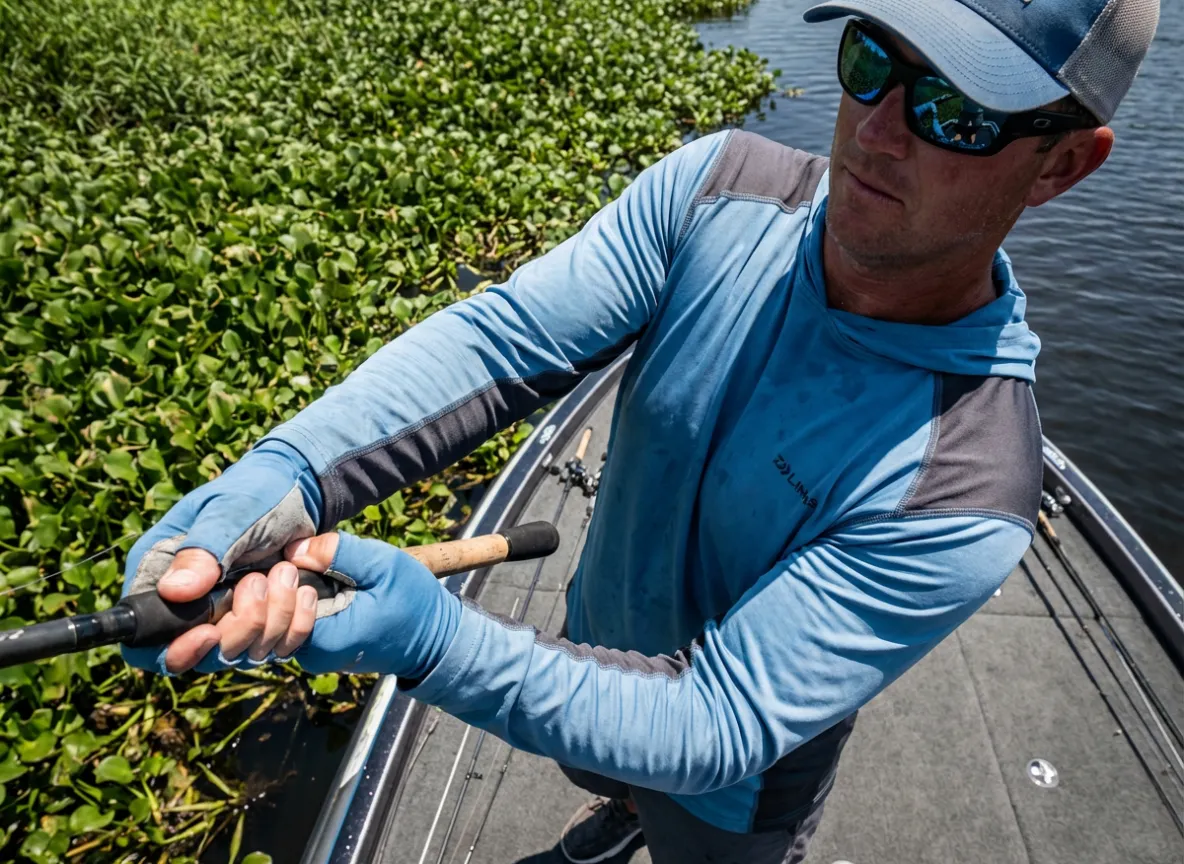
You are staring at a solid wall of vegetation. It looks more like a putting green than a lake, a dense canopy of hyacinth, milfoil, or matted hydrilla that stretches for acres. To the average bank walker, this is a dead end. But to an experienced bass angler, that locked door is hiding the biggest fish in the system.
I spent years avoiding these mats, tossing spinnerbaits along the edges, hoping a straggler would wander out. It wasn’t until I committed to the mechanics of the punching technique—understanding that I wasn’t just casting, but breaching a fortress—that my catch rate for trophy fish spiked.
Punching is a tactical siege. It requires a specialized punching system of physics and biology designed to penetrate a solid roof and extract a predator from the dark. This is heavy cover power fishing at its most extreme.
What is the “Anatomy” of a Productive Mat?

A productive mat is defined by its ability to provide overhead cover while maintaining sufficient oxygen levels and maneuverable space underneath. Not all grass is created equal; successful mat anatomy analysis starts with reading the vegetation like a map to eliminate dead water before you ever pick up a rod.
Why do bass inhabit hypoxic, dense vegetation zones?
Bass utilize dense vegetation like Hydrilla and Water Hyacinth primarily for overhead cover and ambush leverage, creating a “roof-over-head” ecosystem. The “Canopy Theory” suggests that while the surface looks impenetrable, the water column underneath—the fish’s “living room”—is often open and navigable. Solar positioning dictates their depth. During high noon, summer heat, or bluebird skies, bass bury deep into the thickest cover to maximize shade.
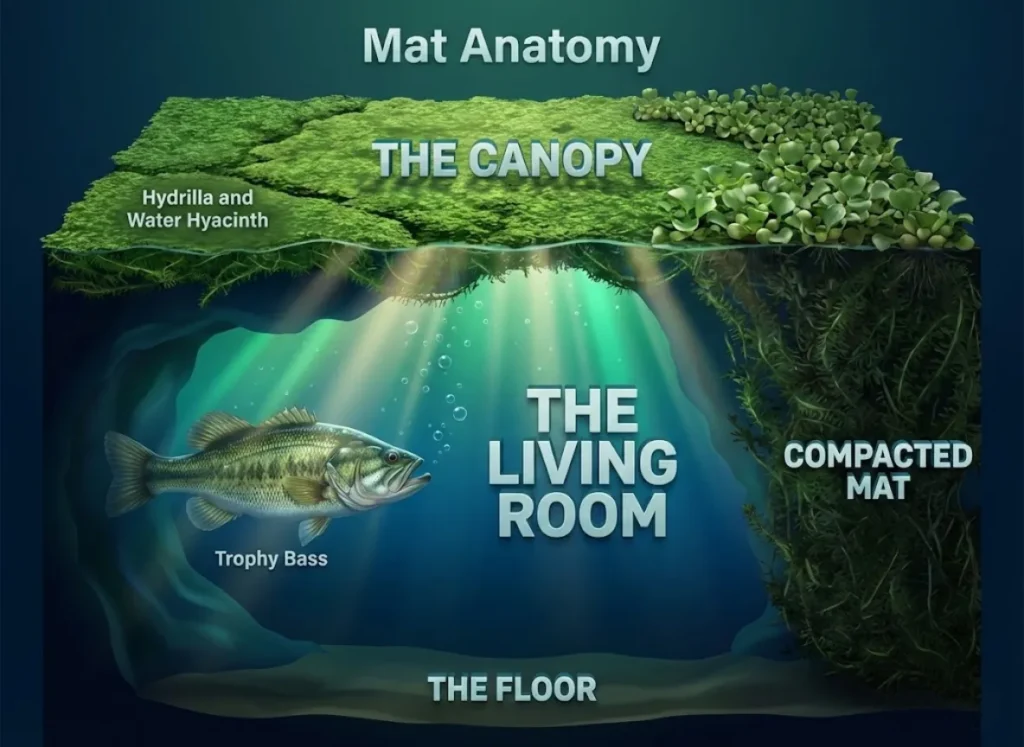
The critical limiting factor here is Dissolved Oxygen (DO). Dense mats can become hypoxic, especially at night due to plant respiration, driving fish away. You must look for mats with active water exchange, such as those near creek channels, or “crispy” green vegetation that indicates active photosynthesis.
This survival instinct aligns with the impact of hypoxia on fish habitat quality, which confirms that bass will avoid dead zones despite the cover they offer. They tolerate lower oxygen levels only when the thermal refuge of the shade outweighs the cost, a core part of the biological blueprint behind trophy bass behavior.
How do you distinguish between “Hollow” and “Compacted” mats?
“Hollow” mats feature a canopy that tops out at the surface with open water beneath, whereas “compacted” mats are solid blocks of debris pressed deep into the water column. Identifying the difference tells you whether the fish are suspended high or pinned to the bottom.
“Hollow” mats occur when vegetation grows vertically. “Compacted” mats are often formed by wind or current compressing debris, like cut grass, pine straw, duckweed, or old hyacinth, into a dense wedge known as cheese mats. Your visual cues for a productive zone include life at the surface—bluegill popping is a dead giveaway—and vibrant green color.
Be wary of the “Slime Factor.” Yellowing grass or bubbling surface slime indicates decomposition and methane production. These are often dead zones. Effective reading mats skills require identifying the “life cycle” of the grass, and utilizing resources for identifying non-native aquatic plant species can help you predict how specific structures like Hydrilla will form. This knowledge is essential when identifying aquatic invasive species that form the roofs we are trying to breach.
Pro-Tip: Listen to your weight. If your punch rig falls through the mat and hits bottom instantly, it’s hollow. If you have to shake it down through layers of muck to find bottom, it’s compacted. Bass in compacted mats are usually lethargic and require a precise delivery right on their nose.
Why is Specific “System” Gear Mandatory for Punching?
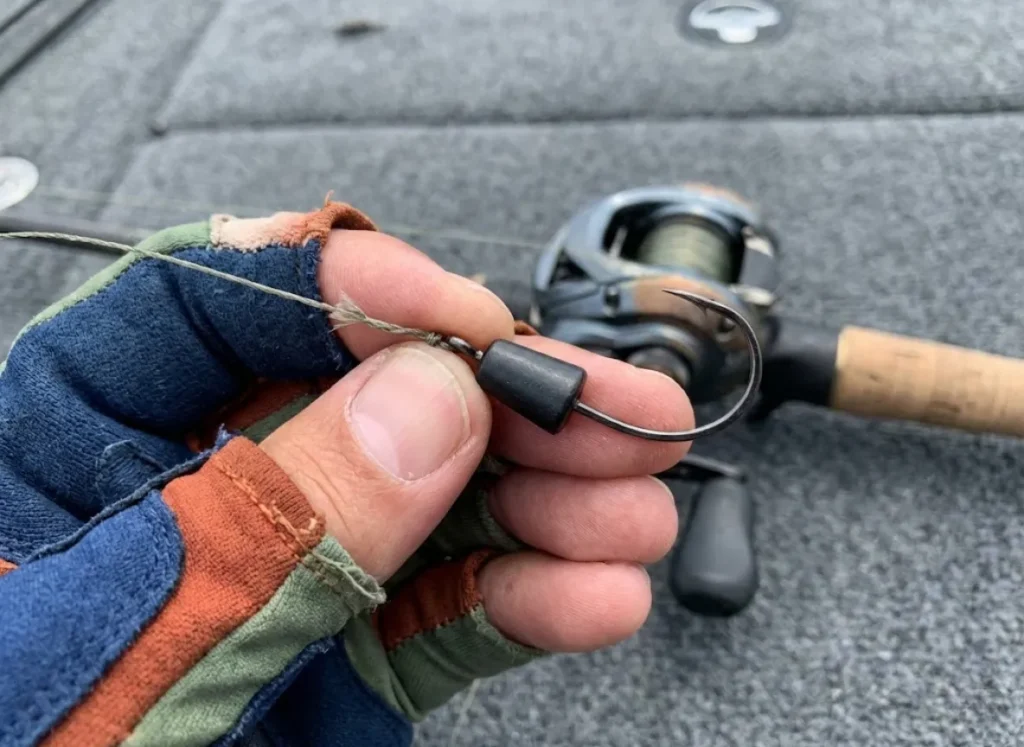
Punching demands a specific gear system breakdown because standard tackle lacks the density to penetrate the cover and the leverage to extract the fish. This isn’t about brand loyalty; it is about the physics of drag, friction, and fulcrums.
Why is Tungsten superior to Lead for heavy cover penetration?
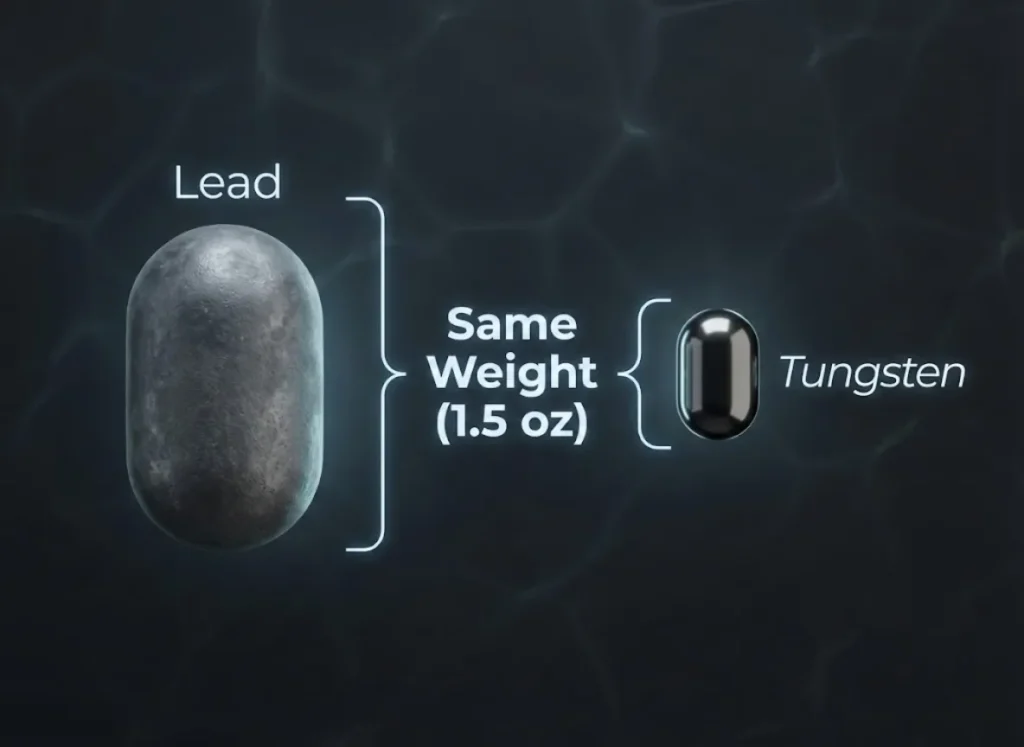
Tungsten is roughly 1.7 times denser than lead, allowing for a 50-60% reduction in volume for the same weight. This tungsten density advantage drastically lowers hydrodynamic drag, allowing a 1.5oz tungsten weight to slip through small canopy holes that would stop a bulky lead weight dead in its tracks.
Depending on the cover density, you might scale from 1oz tungsten up to a massive 2.5oz tungsten bomb. Beyond penetration, tungsten’s extreme hardness creates superior sensitivity transfer. You can feel the difference between a mud bottom, a rock, or the subtle intake of a bass. There is also the “Click Factor”—the hard metal striking a glass bead creates a high-frequency sound mimicking crayfish, which lead cannot replicate.
To keep this package tight, bobber stops (or punch stops) are essential for pegging the weight securely against the hook. Many anglers also add punch skirts between the weight and hook to add bulk and flair without hindering the fall.
From a stewardship perspective, the ecological risks of lead fishing weights are significant. Using tungsten aligns with the benefits of lead-free fishing tackle, ensuring we aren’t leaving toxic heavy metals in the habitats we prize.
How does the Snell Knot create a mechanical advantage?
The Snell knot creates a mechanical advantage by acting as a lever system that drives the hook point upward and outward upon impact. It attaches directly to the shank of a straight shank hook rather than the eye, fundamentally changing the snell knot mechanics of the hookset.
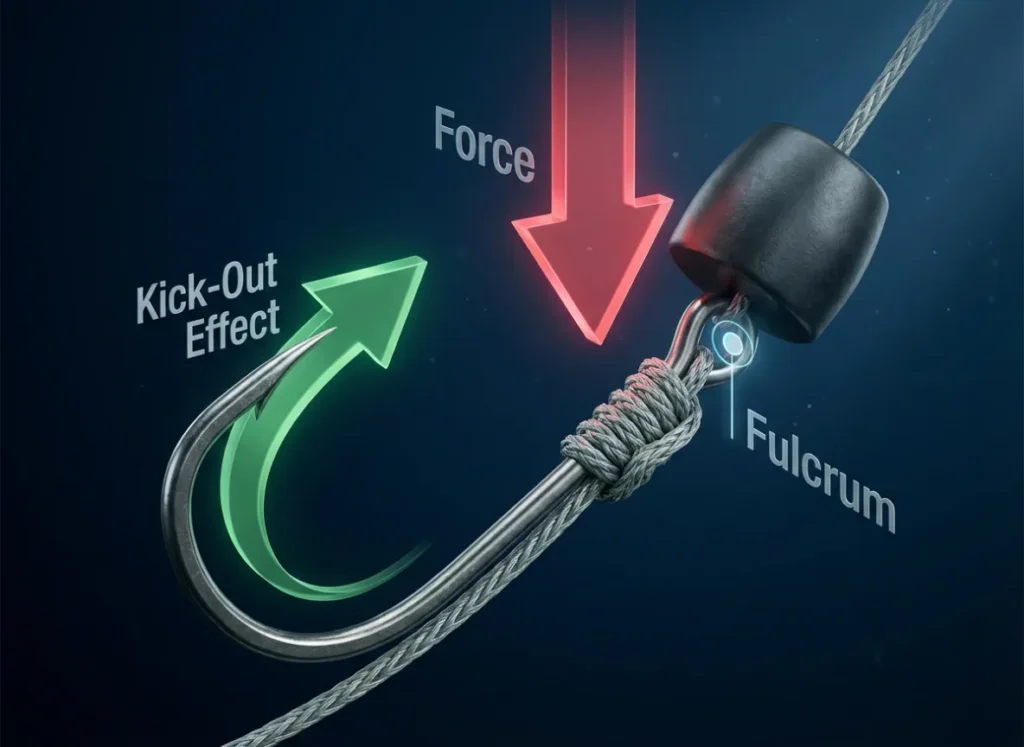
When you set the hook, the heavy tungsten weight crashes down onto the hook eye. This acts as a fulcrum. The force levers the hook point out—the “kick-out” effect—driving it into the roof of the bass’s mouth. Standard knots like the Palomar knot pull from the eye, which can cause the hook to fold flat against the fish’s mouth, resulting in missed fish in heavy cover.
For this application, an offset hook is a liability. You need a heavy-wire, straight shank flipping hook—typically a 4/0 hook or 3/0 hook depending on your creature baits—that won’t flex. This utilizes the basic physics of lever systems to turn the heavy weight into an asset rather than a hindrance. Mastering this system for tying the best fishing knots is not optional for this technique; it is a mechanical necessity.
How do you execute the Punching Technique?
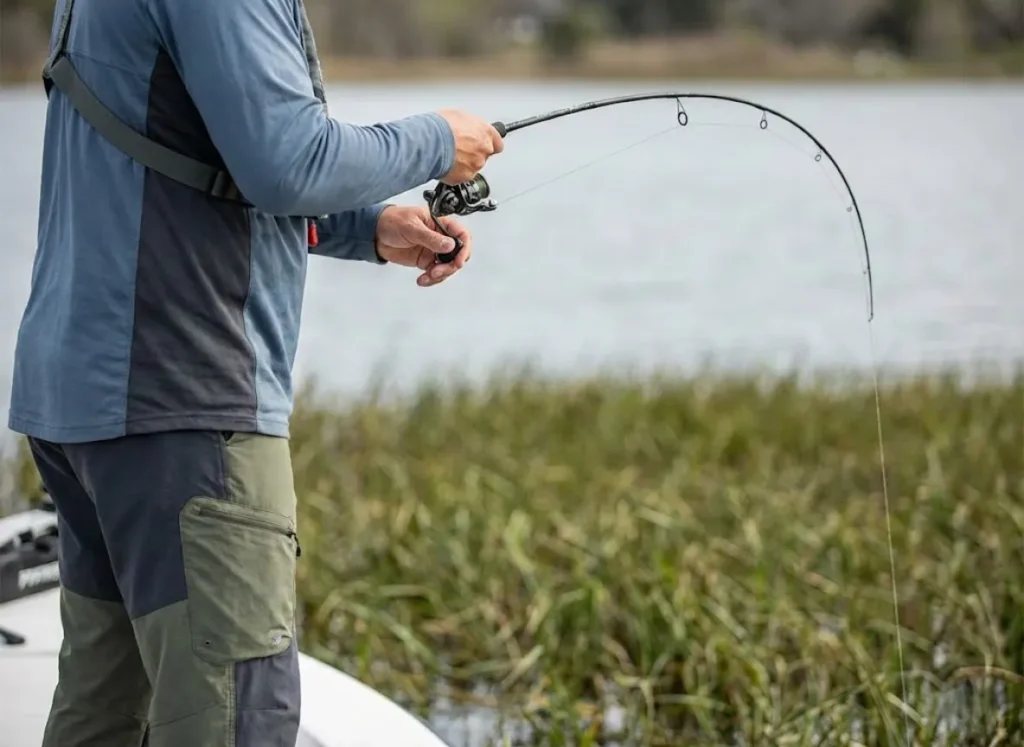
Execution relies on a vertical entry, a controlled “shearing” manipulation of the bait, and a violent, immediate extraction. The goal is to drop a specialized intruder into the fish’s living room without spooking them, then trigger a reaction strike in close quarters.
What is the “Shearing” technique vs. “Hopping”?
“Shearing” involves sawing the line against the vegetation to create subtle vibration, whereas “hopping” lifts the bait off the bottom. In dense mats, aggressive hopping often snags the weight on the canopy roof or pulls the bait entirely out of the strike zone.
To shear, let the weight settle on the bottom or suspend it midway. Keep the rod tip position high—around the 10 o’clock position—and saw it side-to-side. The rough texture of the braided line acts like a serrated blade against the plant stems. This cuts a small pocket while sending a subtle vibration down to the lure.
This action mimics the natural rustle of a crayfish burying itself. Bass often detect this via their lateral line sensory system long before they see the bait in the dark water. Because you are essentially sawing through the cover, selecting high-performance braided fishing line—specifically 65lb braid made of Spectra or Dyneema—is critical for its cutting ability and abrasion resistance.
Pro-Tip: The “One-Pump” Rule. In hypoxic, hot conditions, fish are lazy. Punch the bait in, hop it once, then deadstick it (hold it perfectly still) for three seconds. If you don’t get bit, punch the next hole. Don’t overwork dead water.
What defines the optimal Punching Rod and Reel setup?
An optimal punching setup consists of a heavy-power rod with a moderate-fast (parabolic) action and a high-speed reel. While it seems counter-intuitive, a flipping stick with some bend is superior to a stiff “broomstick” for this specific application.
Because you are using braid with zero stretch at close range, a rod with a Mod-Fast action acts as a shock absorber. It keeps the fish pinned without tearing the hook out of their mouth. However, the rod power must still be Extra Heavy power to lift the combined mass of the fish and 5-10 lbs of wet weeds.
You need to understand decoding rod power vs action to find this balance. A heavy flipping stick between 7’6″ and 8’0″ (rod length) provides the leverage needed. The reel should be one of the modern high-speed reels—8.3:1 gear ratio or at least 7.1:1 gear ratio—to pick up slack immediately once the canopy is breached. The drag must be locked down. Quick extraction is also vital for conservation; following the principles of catch and release survival, minimizing the fight time in high-stress environments reduces exhaustion and mortality.
Conclusion
Punching is not a finesse game; it is a mechanical system designed to break through the cover. The “mat” is a locked door, and underneath lies a world governed by dissolved oxygen and shade. A 2-ounce weight crashing through that canopy doesn’t just startle the ecosystem; it rings the dinner bell for the apex predator lurking in the dark.
Success in this arena requires more than just bravery. It demands the density of tungsten, the lever mechanics of a Snell knot, and the discipline to read the “life” in the grass. Next time you face the intimidation factor of impenetrable vegetation, don’t pass it by. Tie on a punch rig, look for the greenest canopy, and start grinding for a bite.
FAQ – Frequently Asked Questions
What is the difference between flipping, pitching, and punching?
Flipping and pitching target the edges or visible holes in cover, while punching forcibly breaches a solid overhead canopy. Punching requires significantly heavier weights (1oz+) to penetrate the roof that standard flipping baits cannot break.
Do I really need tungsten weights, or can I use lead?
Tungsten is virtually mandatory for true punching because it is 50% smaller than lead of the same weight. A bulky lead weight will snag on the mat’s surface, while the compact profile of tungsten slips through the vegetation to reach the fish.
What is the best hook for punching mats?
A heavy-wire Straight Shank flipping hook (like a VMC heavy duty flipping hook) is superior to an Extra Wide Gap (EWG) hook. The straight shank offers a better hook-up ratio and doesn’t flex or fail under the extreme pressure of close-quarters hooksets and heavy braid.
Why do I keep losing fish when punching?
You may be using a rod that is too stiff (Fast Action) or a knot that doesn’t leverage the hook. Switch to a Moderate-Fast action rod to absorb the shock and ensure you are using a Snell knot to drive the hook point upward into the fish’s mouth.
Risk Disclaimer: Fishing, boating, and all related outdoor activities involve inherent risks that
can lead to injury. The information provided on Master Fishing Mag is for educational and informational purposes
only. While we strive for accuracy, the information, techniques, and advice on gear and safety are not a substitute
for your own best judgment, local knowledge, and adherence to official regulations. Fishing regulations, including
seasons, size limits, and species restrictions, change frequently and vary by location. Always consult the latest
official regulations from your local fish and wildlife agency before heading out. Proper handling of hooks, knives,
and other sharp equipment is essential for safety. Furthermore, be aware of local fish consumption advisories. By
using this website, you agree that you are solely responsible for your own safety and for complying with all
applicable laws. Any reliance you place on our content is strictly at your own risk. Master Fishing Mag and its
authors will not be held liable for any injury, damage, or loss sustained in connection with the use of the
information herein.
Affiliate Disclosure: We are a participant in the Amazon Services LLC Associates Program, an
affiliate advertising program designed to provide a means for us to earn advertising fees by advertising and linking
to Amazon.com. As an Amazon Associate, we earn from qualifying purchases. We also participate in other affiliate
programs and may receive a commission on products purchased through our links, at no extra cost to you. Additional
terms are found in the terms of service.