In this article
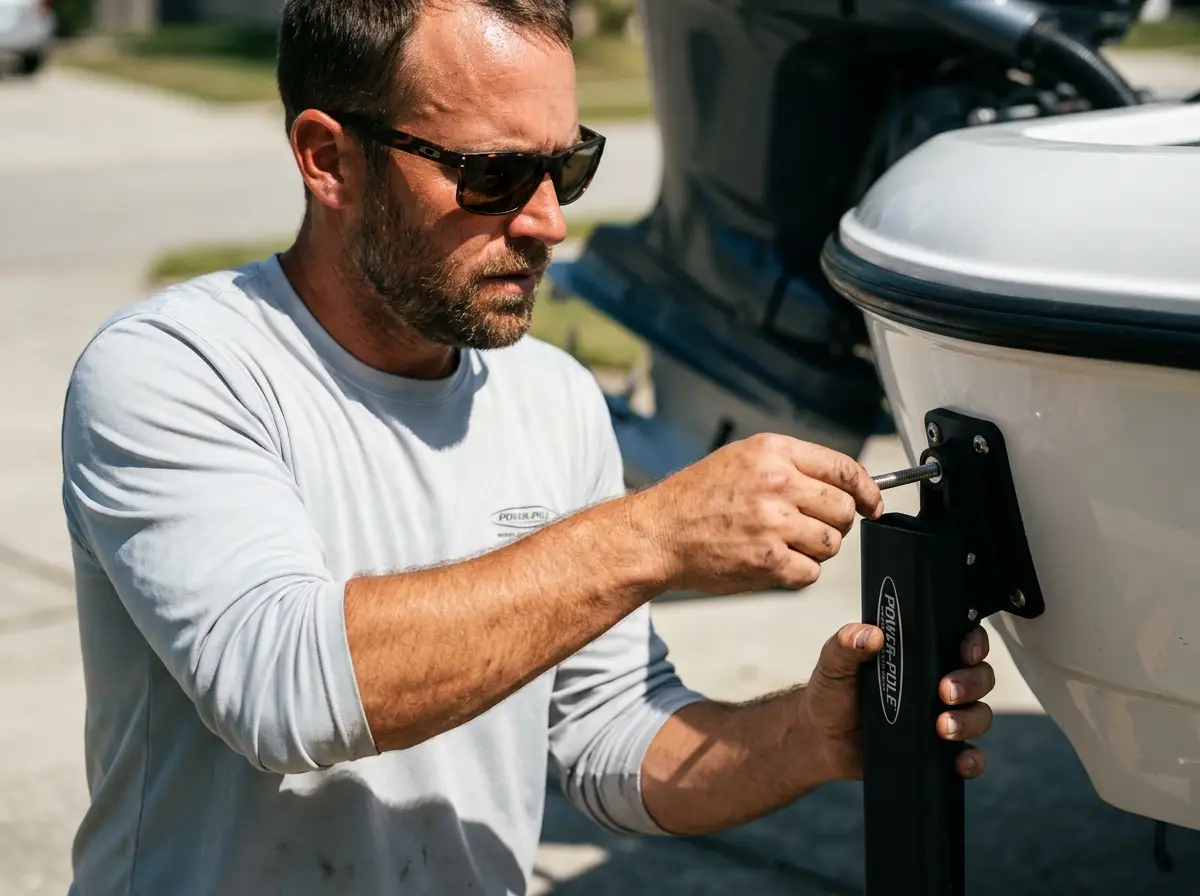
The 5/16-inch drill bit whining as it bites into the transom’s pristine gelcoat makes even veteran riggers hold their breath. The margin for error here isn’t measured in inches. It is measured in thousands of dollars of potential hull damage. Attempting to install a power-pole isn’t about slapping a flashy accessory on the back of your skiff. You are actively modifying a stressed composite sandwich while managing extreme torque loads and manipulating the strict hydrodynamic flow past your outboard. After decades of rigging offshore center consoles and repairing the disasters weekend dabblers create, I guarantee that understanding the physics of the hull separates a permanent installation from a rotting transom. Here is exactly how to execute a fail-safe, leak-proof job on your boat.
| Technical Specifications | |
|---|---|
| Requirement | Specification |
| Minimum Hull Clearance: | 4.0″ (Above hull bottom) |
| Bolt Spec: | 5/16″ and 3/8″ Grade 316 Stainless |
| Pilot Drill Size: | 9/64″ |
| Required Hydraulic Fluid: | ISO 32 Biodegradable |
⚡ Quick Answer: To successfully mount the bracket without causing damage, set a minimum four-inch clearance above the hull bottom to maintain clean water flow. Use the reverse-drill method to cut through brittle gelcoat, chamfer every hole to stop spider cracking, and seal the exposed fiberglass core with removable marine polyurethane rather than a permanent adhesive. Before you launch, purge all compressible air from the high-pressure lines by aggressively cycling the anchor up and down.
The Physics of the Transom: Why Mounting Location Matters
The moment you push the button and bury the spike into a hard sand bottom, your anchoring system acts as a massive lever arm working against your boat. Wind slamming against the bow or heavy tidal current sweeping past the broadside translates instantly into mechanical torque. The first question a professional asks is where to define the mounting location so the fiberglass survives the twisting force and the outboard lower unit still receives undisturbed water.
Hydrodynamic Clearances and the “4-Inch Rule”
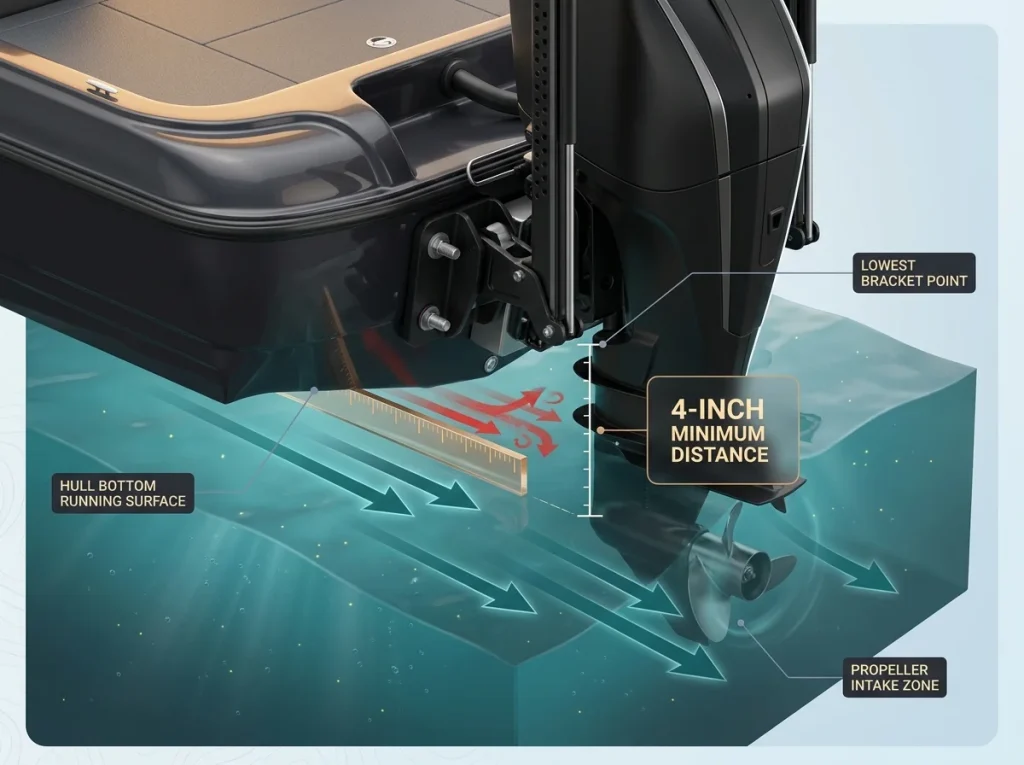
Factory specifications dictate strict geometry, establishing the 4-inch rule. You must position the absolute lowest edge of the metal mounting bracket at least four inches above the bottom running surface of the hull. A lower configuration forces the bracket down into the active water stream, violently disrupting the intake path to your engine. Engineering texts refer to this Manning’s n drag rating. Increasing this number spikes your hull drag, forcing your engine to burn more fuel to maintain identical speeds.
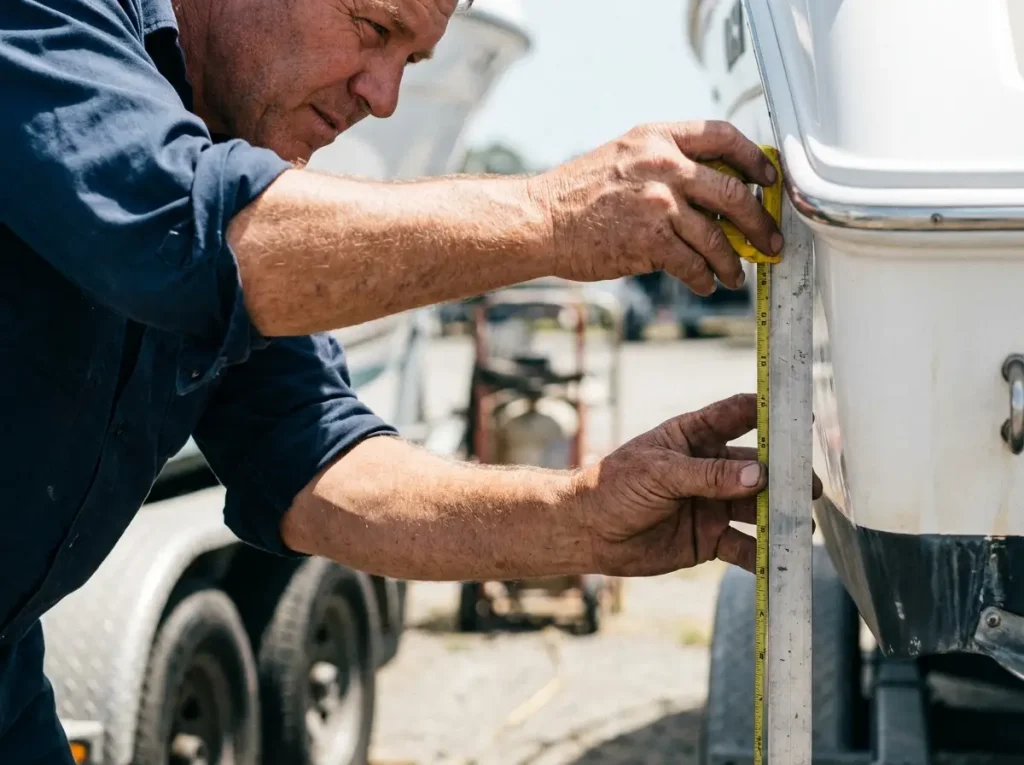
Worse than fuel loss, turbulent water hitting a spinning propeller directly causes cavitation. Your blades lose their bite, your RPMs spike dangerously, and thrust collapses. The physics governing water resistance explain why viscous drag and hull disturbances punish boats rigged carelessly. You verify this hull clearance metric by taping a four-foot straight edge flat against the hull bottom and measuring up vertically. Do not guess. You also have to check the tilt path. Turn your outboard completely to starboard, then hard to port, tilting it to maximum height in both positions. You establish the correct power-pole height by ensuring the cowling clears the bracket in all configurations.
Leverage, Torque, and Structural Mechanics
When you engage a high-end power-pole blade or the robust power-pole pro series ii in a stiff crosswind, that system functions like a catastrophic pry bar against your transom. A fifty-pound lateral force pushing on the tip of a ten-foot pole generates over four hundred foot-pounds of torque directly on the stern bracket. That massive pressure concentrates on exactly four stainless bolts threading through the fiberglass.
Without adequate distribution, that pressure exceeds the crushing point of the resin, causing fiberglass crush. Water immediately follows the crushed fibers inside the stringers. You prevent this by fabricating a thick custom backing plate out of heavy-gauge aluminum for the inside of the transom. Do not trust standard washers to distribute a heavy load. You must also adhere to the strict torque specifications published in the official Power-Pole Transom Mount Instructions to keep the assembly from walking under vibration.
Pro tip: Always execute the tape trick. Cover the entire transom drilling area with two layers of heavy-duty blue painter’s tape before drawing a single layout line. The tape stops your drill from skating on the slick finish, provides a bright canvas for sharpie marks, and catches the stubborn chemical sealant drips that will otherwise permanently mar your gelcoat.
With your hull clearance verified and structural loads calculated, the method you choose to mount the bracket becomes your next major decision.
Direct Mount vs. Jack Plate Adapter (The Anti-Sell)
When you plan to mount a power-pole, you select between drilling the hull or isolating the unit. A direct transom mount saves cash initially, but demands punching four holes below the waterline in the most brutally stressed section of the skiff. I never recommend drilling the hull if a mechanical alternative exists.
A jack plate mount offers structural superiority. A specialized adapter plate bolts the anchor system directly to the side of your aluminum engine bracket. This creates a sandwich mount configuration, shifting the twisting and prying stresses entirely off the fragile fiberglass and onto a rigid block of extruded aluminum. Buying the bracket hurts the wallet today, but it ensures you never lay awake worrying about transom rot during a rainy winter. With your mounting architecture chosen, you face the single most nerve-wracking step: drilling clean through the hull without shattering the exterior.
Structural Preparation: Drilling Without Gelcoat Spidering
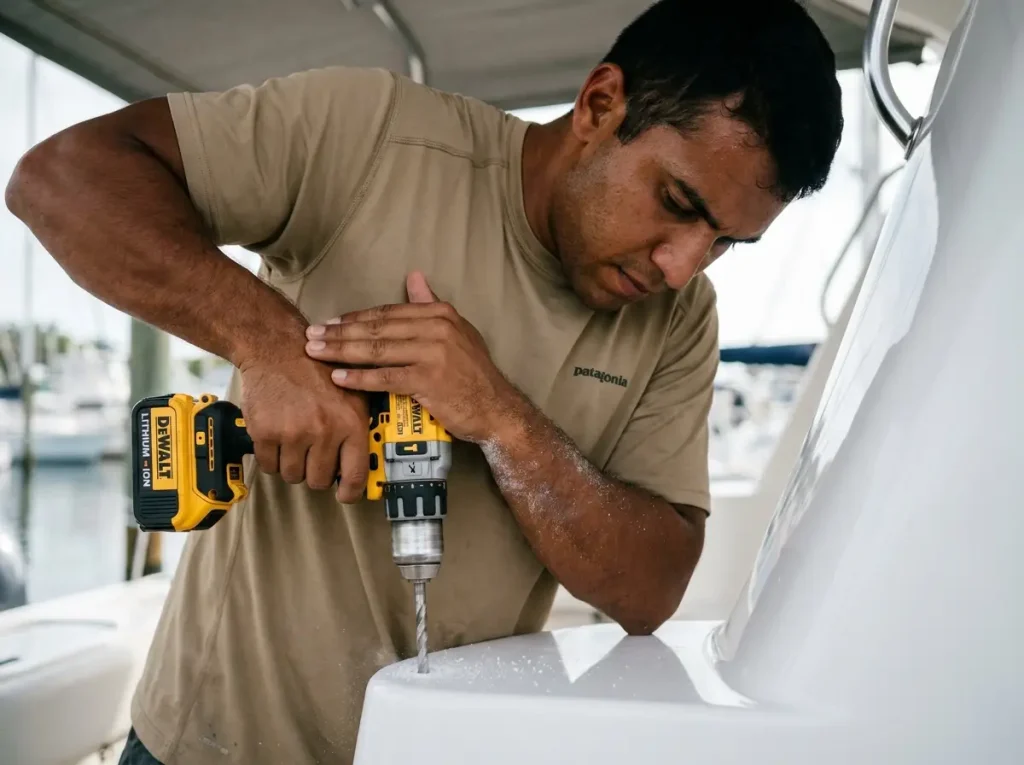
If hull geometry dictates that you must penetrate the transom, you need flawless technique. A factory transom consists of an outer finishing gelcoat layer, structural fiberglass matrices, and an inner wood or dense foam core. The bright gelcoat looks bulletproof, but it is actually a non-reinforced, brittle layer of hardened resin. Grabbing a dull bit and bearing down on the handle guarantees catastrophic surface shattering.
Establishing Pilot Holes and Geometry
Achieving a clean bore requires sequence and patience. Start by drilling pilot holes precisely on your marks with a fresh, sharp 9/64-inch cobalt bit. Laying down a pilot hole guarantees the larger subsequent bits stay perfectly true. When drilling into fiberglass, let the sharp tool perform the cutting without overwhelming downward pressure.
You must hold the drill absolutely perpendicular to the transom face. Allowing the drill body to sag creates an oval tunnel. If the hardware passes through an angled tunnel, the nut tightens at an awkward cant, crushing the rubber washer unevenly on one side while leaving a dangerous gap on the other. Precision drilling prevents a massive headache, demonstrating the exact mechanical discipline seen during proper hull stability planning.
The Reverse-Drill and Chamfer Technique
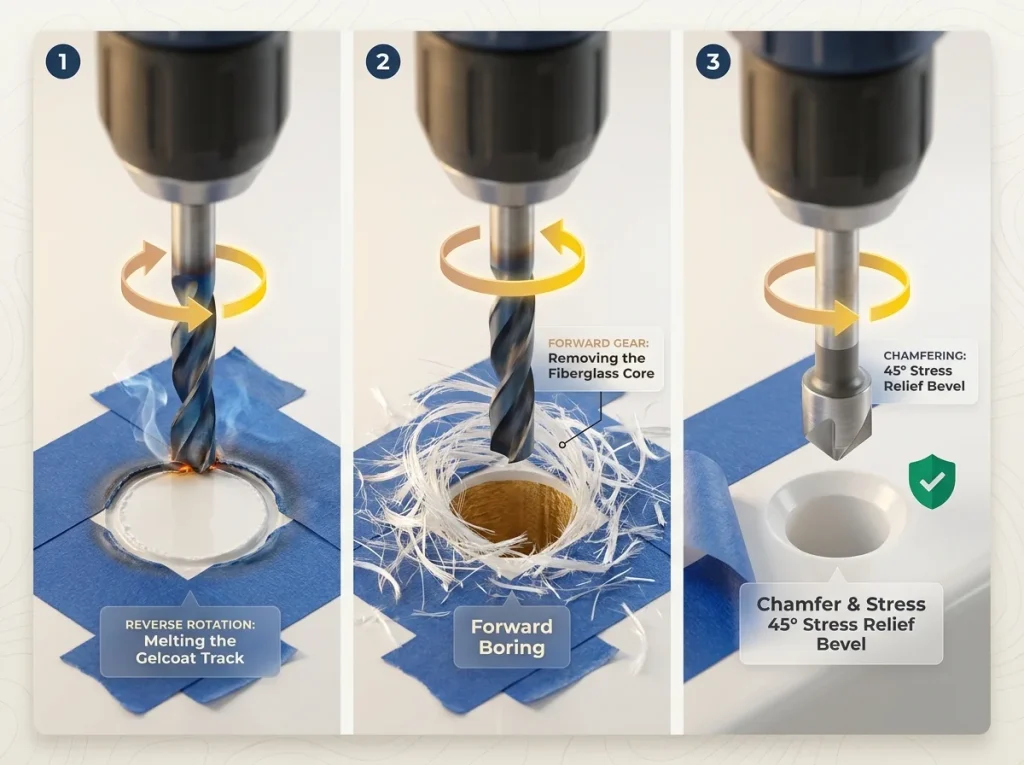
Here is the exact step where DIYers destroy their boats. They lock a 5/16-inch flute bit into the chuck and smash the trigger in forward gear. The aggressive cutting edge catches the brittle gelcoat lip and rips jagged chunks out of the hull.
Instead, switch your drill into reverse. Press the spinning bit firmly against the taped mark. You generate localized friction, essentially melting a perfectly round track through the delicate finishing resin. The second you push past the colored gelcoat and hit the stringy white fiberglass, stop. Switch back to standard forward rotation and cut cleanly through the core. This effectively bypasses the shattering phase.
The single most critical step in preventing gelcoat spidering comes next. You must utilize a specialized cutting tool for countersinking holes. The chamfer bit shaves down the sharp ninety-degree upper edge of the new hole, leaving a tiny, sloped crater. The microscopic sharp edges of a raw drilled hole function as brutal stress risers. The heavy vibration of the main outboard travels through the transom and pulls at those sharp edges until they fracture outward in an ugly starburst pattern. Tapering the edge delivers critical gelcoat stress relief that actively complies with strict ABYC H-27 standards regarding marine structural integrity.
Getting the holes perfectly round and sloped is only half the battle. Now that you have exposed the raw fiberglass laminate to the air, waterproofing the tunnel becomes your top priority.
Potting the Core to Prevent Moisture Intrusion
Creating a clean hole exposes the sensitive wooden or composite core matrix to damp air and potential rot. Professional riggers execute a technique called potting to establish a localized barrier. First, aggressively vacuum the tunnel. Pushing chemical sealants into a hole caked with fine fiberglass dust guarantees the adhesive falls out, as it bonds only to the powder and never to the solid laminate wall.
Squirt marine adhesive deeply inside the cleaned channel, completely painting the internal walls. You are casting a custom rubber sleeve inside the wood. If your exterior bolt sealing fails three years from now, the water hits this potted barrier instead of soaking into your transom stringers. Once the composite core is armored from the inside, you must select the exact marine adhesive to lock water out from the outside.
Chemical Bedding and Torque Specifications
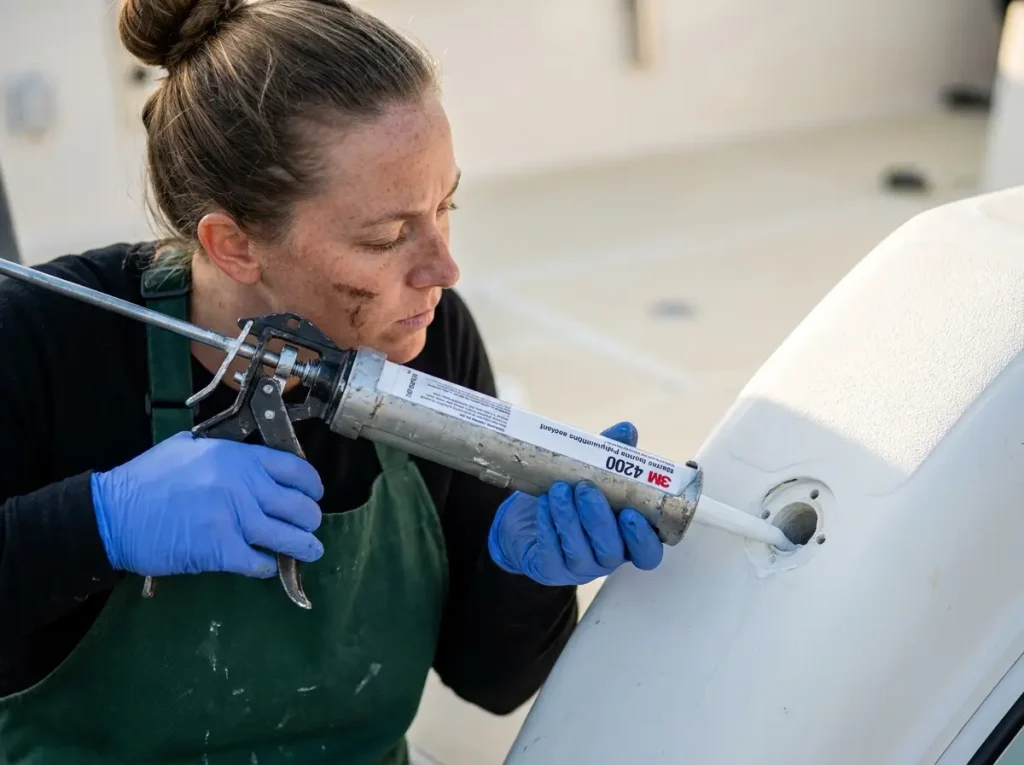
The integrity of your bracket depends heavily on polymer chemistry. Selecting the appropriate marine adhesive dictates whether your hardware holds watertight through ten seasons of heavy chop, or rots out your back end by Thanksgiving.
3M 4200 vs 5200: Tensile Strength and Removability
Ask any random fisherman what to apply to a bracket, and they reflexively shout out 3M 5200. They are passing along deeply flawed advice. While that permanent adhesive performs brilliantly for hull-to-deck joints that factory technicians never want to separate, it creates an absolute nightmare for mounting accessories.
Instead, professional standard operating procedure demands 3M 4200. Both are marine-grade options, but the latter is a highly specialized polyurethane sealant. It provides an impressive 335 PSI of holding strength, tightly locking down brackets against severe vibration. The difference lies in future serviceability. Perhaps you scrape a bridge piling, or maybe you sell your rig and want to transfer your power-pole micro to the new skiff. Using 4200 means you can mechanically remove the hardware without ripping actual sheets of fiberglass off your vessel. Choosing a cheap polysulfide sealant to save five bucks ends poorly because it degrades quickly under harsh ultraviolet light, guaranteeing serious water intrusion down the road.
Hardware Installation and Compression Tolerance
Pushing the bolts through your customized hole requires a precise tightening strategy. The factory supplies specific Neo-Bond washers—heavy metal rims backed by thick, pliable rubber. Position them on the exterior against the bracket face.
Run the locknuts down on the inner transom threads in an alternating cross pattern. Keep tightening until you see the black rubber edge bulge slightly past the metal rim. Then drop the wrench. Inexperienced guys lean their full weight against the breaker bar, operating under the mistaken belief that tighter equals waterproof. Severe over-torquing crushes the rubber flat, destroying its elasticity. Worse, it violently forces every drop of sealant completely out from under the hardware, leaving a dry structural joint. Extreme wrenching initiates irreversible structural failure, ruining the transom reinforcement you worked so hard to establish.
I learned this the hard way on a 2018 Pathfinder. Squeezed my 4200 completely out by over-torquing the bottom bolts, then spent a long December weekend dealing with a waterlogged fiberglass core. Trust the rubber compression on those Neo-Bond washers.
Securing the hardware with the right torque confirms physical strength, but you still have to deal with chemical reactions. Dropping fresh metal parts into a marine environment starts the clock on corrosion immediately.
Galvanic Corrosion Prevention on Saltwater Rigs
Bringing your rig into the coastal marsh requires advanced chemistry management. You are bolting stainless hardware against massive aluminum brackets. When you submerge dissimilar metals into a highly conductive electrolyte bath like saltwater, you construct a functional battery. The less noble aluminum acts as a sacrificial anode, giving up its electrons to the stainless steel. Salt builds up, and the threads essentially weld themselves together.
The mechanical physics dictating galvanic corrosion principles are ruthless. To execute effective galvanic corrosion prevention, you coat every single stainless thread with an isolative barrier paste like Tef-Gel before slipping the nut on. This thick grease intercepts the electrical reaction, stops cold welding dead, and keeps you compliant with long-term ISO and ABYC materials compatibility guidelines. Without it, you will need a grinder to remove those nuts in two years. With the stern bracket locked down tight, it’s time to shift your focus inward to the fluid circuit that gives the anchor its actual holding power.
Hydraulic Engineering and Fluid Dynamics
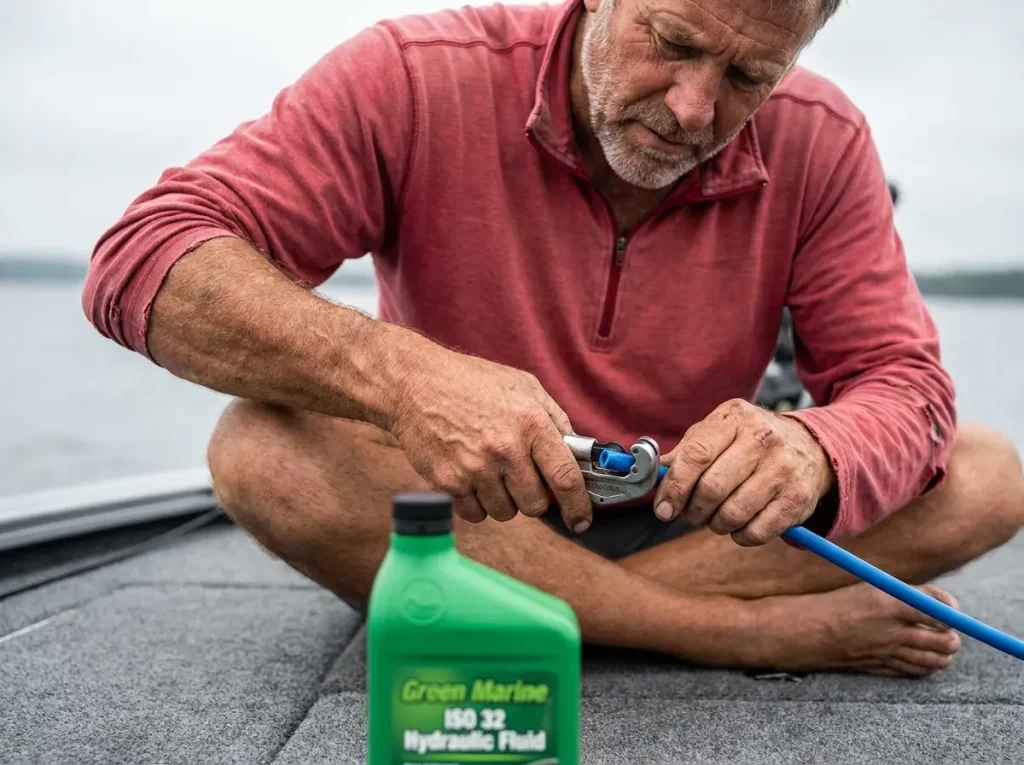
Once the bracket locks down the anchor, you focus entirely on the fluid circuit. The deployment speed, the holding pressure, and the retrieval strength rely entirely on your ability to configure a leak-free high-pressure loop.
Routine Blue/Black Tubing for Minimal Resistance
Routing the thick blue/black hydraulic tubing demands respect for pressure restrictions. When handling hydraulic line routing, your absolute priority involves eliminating tight, ninety-degree corners. Bending plastic tubing drastically spikes the fluid resistance, builds unwanted heat in the pump motor, and causes sluggish performance on the water. Run the twin lines in long, sweeping, gentle curves from the pump location to the stern bracket.
As you feed those lines into the compression fittings at the base of the pump, you need perfectly square edges. Grabbing dull diag-cutters and snipping the line leaves a crushed, jagged plastic rim. A jagged edge fails to sit flush against the brass ferrule inside the nut. High pressure seeks out the slightest gap, leaving a persistent, messy puddle of oil in your bilge. Use a fresh razor blade strictly to ensure absolute, flat cuts.
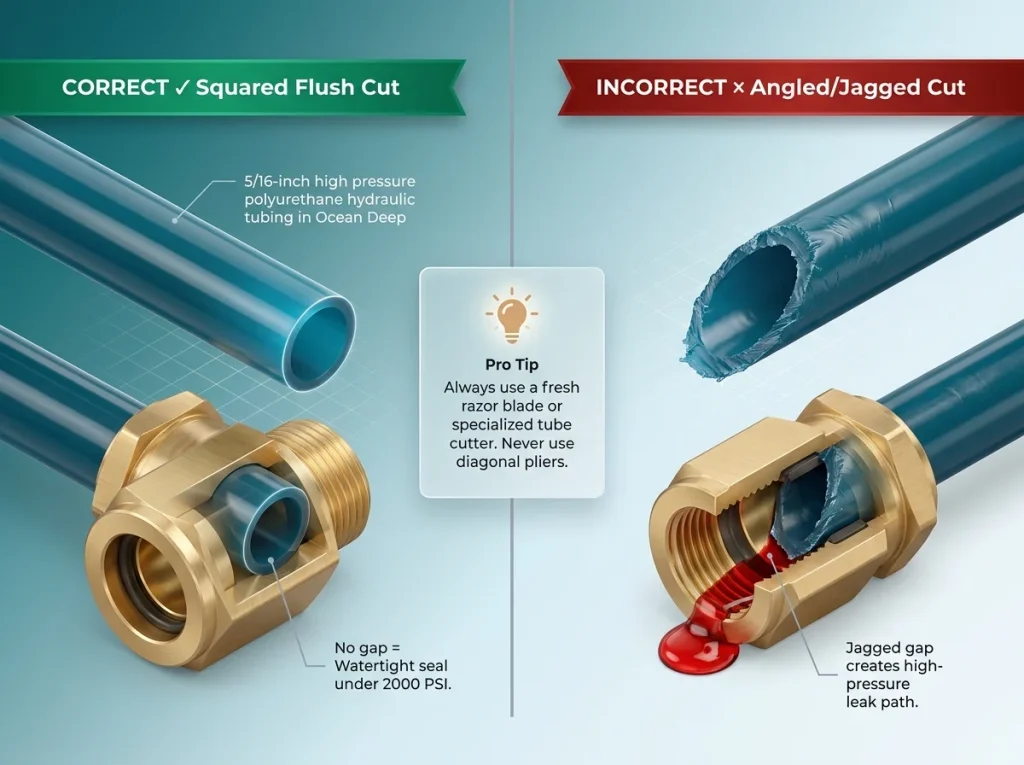
Pro tip: Keep the original red plastic dust caps jammed firmly onto the extreme tips of your hydraulic lines as you wrestle them through the dark recesses of your bilge. If a single grain of grit enters the line during routing, the pump will shove it directly into the precision cylinder seals, causing horrific internal scoring.
ISO 32 “Green Marine” Viscosity Rules
Your hydraulic pump unit requires specialized chemistry. JL Marine engineers mandate the use of explicitly labeled ISO 32 hydraulic fluid, often branded as Green Marine oil. Ignore the guy at the boat ramp telling you to pour cheap automatic transmission fluid inside the reservoir.
The number 32 represents the precise fluid thickness when the pump runs hot. Your high-pressure gear pump relies on that exact thickness to function. Running a heavier fluid forces the pump to scream and cavitate during cold winter mornings because it cannot physically pull the thick slurry through the intake. Using an incorrectly thin fluid in blazing summer heat causes the internal pressure relief valves to bleed by, so your pole slowly drifts downward while you blast across the bay. Following established fluid dynamics and resistance guidelines guarantees you maintain holding power in strong tides.
Guides out of Venice, Louisiana will laugh you off the dock if you show up with ATF in your pump. I’ve watched a buddy’s anchor slowly drift down at 45 mph because the thin fluid blew straight past his relief valves in the August heat.
Running the correct fluid protects the gear pump, but the system won’t hold the boat until you stabilize the pressure. Every pocket of trapped air limits the raw holding power of the spike on the bottom.
Bleeding the Lines: The 20-Second Purge Protocol
A brand-new system contains pockets of trapped atmosphere. Hydraulic oil operates perfectly because liquids do not compress under pressure. Air, however, compresses easily. If bubbles sit in your newly run lines, the heavy anchor will feel soft and springy. The fiberglass spike will bounce and skip violently across rocky bottoms rather than planting hard, ruining the actual energy efficiency of hydraulic anchoring.
You fix the bounce with aggressive hydraulic line bleeding. The factory procedure requires executing strict pump priming protocols. You command the spike down until it hits the driveway. Then, you continue to hold the switch down for twenty long, painful seconds. The pump will shriek as it bypasses fluid across the relief valve. Then, retract the anchor completely and hold the up switch for twenty seconds. By executing this severe cycle up to ten times, the intense pressure forces microscopic air voids back through the return line where they escape harmlessly out the vented cap on the reservoir. You rarely need to consult a hydraulic troubleshooting flowchart if you purge thoroughly on day one. A perfectly bled fluid circuit still relies entirely on the command signal sent from your dashboard, making the electrical setup the final critical link.
Electrical Commissioning and C-Monster Configuration
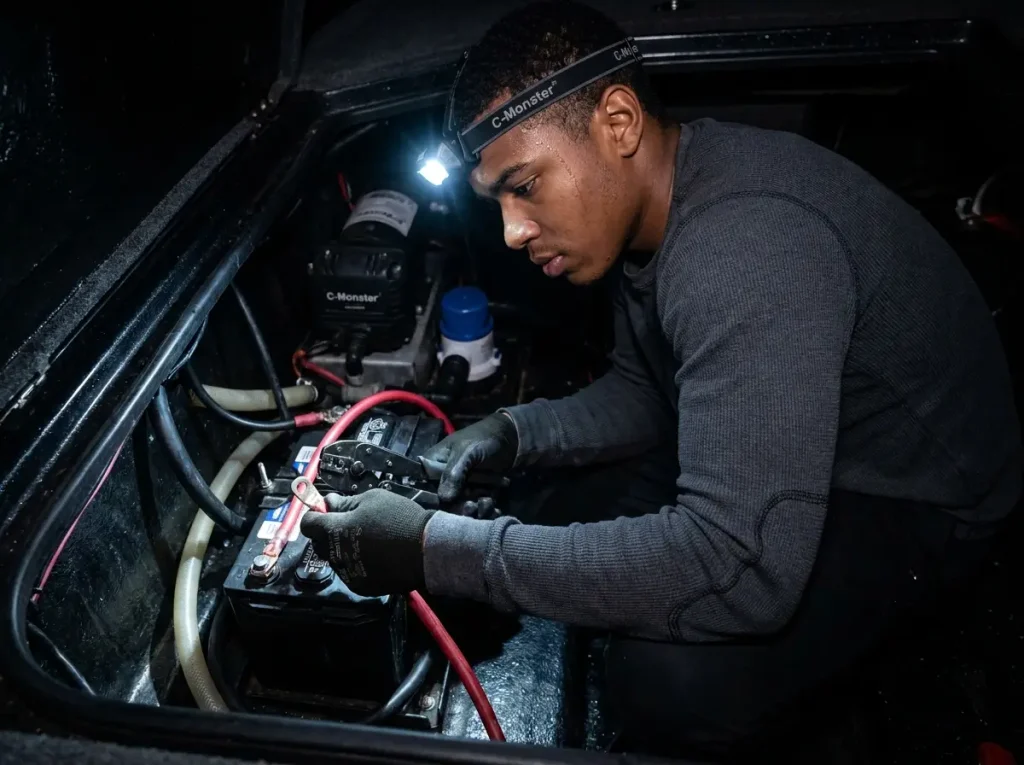
A flawless mechanical mount and clean fluid lines mean nothing if the pump lacks reliable voltage. The central control board requires robust, clean electricity to actuate the logic gates and fire the heavy deployment motor.
Isolating Power to Prevent Sonar Interference
Every HPU requires massive amperage during a heavy lift. Determining the best HPU placement usually involves finding a high, dry locker on the starboard side, keeping the power run short. You wire the main positive lead directly to the cranking battery via a heavy-duty 12v power connection. You must shield the system with a 30-amp or 40-amp inline fuse located intimately close to the positive battery post to prevent catastrophic electrical fires if the line chafes.
Just as critically, you must keep the electrical ground completely isolated from your sensitive fishing electronics. Big electric motors generate intense magnetic fields and throw dirty voltage spikes back through the ground loop. Tying your pump ground to the same bus bar that runs your side-imaging modules guarantees thick bands of static interference across your screens every time you drop the spike. Avoid this clean water interference equivalent for data by isolating the pump, preserving the integrity of the clean data networks across the vessel.
Pro tip: Put a heavy-duty physical battery cutoff switch on the positive cable running to your pump array. Even when the unit sits quiet in the driveway, the internal circuit maintains a continuous, quiet parasitic draw searching for remote signals. Leaving it connected during a winter layup will deeply discharge and ruin an expensive lithium battery.
Wireless Pairing Sequences and Limits
Hardwired dash switches are historical artifacts. Now, the C-Monster control system dictates the action. The onboard computer utilizes a heavily encrypted 2.4GHz mesh network to execute commands from foot pedals, key fobs, and dash panels.
Establishing the initial wireless pairing is straightforward. You press and hold the internal board button until the green LEDs flash, then tap your chosen remote. This creates a locked digital handshake compliant with published FCC certified wireless guidelines. That specific digital signature prevents bluetooth signal interference. Without the encryption, a guy dropping his anchor on a neighboring boat at a busy tournament launch could accidentally fire your pole down into the concrete ramp. Once paired, the smart logic takes over, automatically timing out the high-pressure relief valves so you never fry the motor while trying to bury the tough Everflex spike into solid shell bottom.
Final Check from the Boat Ramp
Installing a premium shallow water anchor proves that understanding core marine physics separates master riggers from weekend amateurs. By religiously honoring hydrodynamic hull clearances, mechanically adapting the gelcoat to reject stress, and methodically purging your hydraulic lines of compressible air, you modify the vessel without compromising its lifespan. Get in the habit of retightening the bracket nuts after your first twenty hours on the water to counter the micro-compression of the fiberglass. Keep your connections tight, check the reservoir levels occasionally, and you will lock down on fishing spots with total confidence.
FAQ
Why do I need to mount my Power-Pole at least 4 inches above the hull bottom?
A 4-inch clearance prevents the bracket from disrupting the clean water flow reaching your outboard propeller. Mounting it lower increases viscous drag, heavily reducing your fuel efficiency and potentially causing prop cavitation at cruising speeds.
Should I use 3M 5200 or 4200 when sealing the Power-Pole transom bracket?
You should exclusively use 3M 4200 for a transom bracket constraint. While 5200 is an incredibly strong, permanent adhesive, 4200 provides more than enough tensile strength (335 PSI) while allowing you to subsequently remove the bracket for repairs without tearing off the hull’s gelcoat.
How do I stop the gelcoat from spider cracking when drilling holes in the boat transom?
You must run your pilot drill bit in reverse first and then chamfer (countersink) the edge of the fully drilled hole. This critical step removes the microscopic sharp edges—known as stress risers—that expand into ugly spider cracks caused by the vibration of your running outboard.
Why does my Power-Pole feel spongy and bounce when I’m running in rough water?
A spongy Power-Pole signifies compressible air trapped within your hydraulic circuit. You must complete the 20-second purge protocol, which repeatedly cycles the pole under constant pressure to bleed the air voids back into the HPU reservoir.
Risk Disclaimer: Fishing, boating, and all related outdoor activities involve inherent risks that
can lead to injury. The information provided on Master Fishing Mag is for educational and informational purposes
only. While we strive for accuracy, the information, techniques, and advice on gear and safety are not a substitute
for your own best judgment, local knowledge, and adherence to official regulations. Fishing regulations, including
seasons, size limits, and species restrictions, change frequently and vary by location. Always consult the latest
official regulations from your local fish and wildlife agency before heading out. Proper handling of hooks, knives,
and other sharp equipment is essential for safety. Furthermore, be aware of local fish consumption advisories. By
using this website, you agree that you are solely responsible for your own safety and for complying with all
applicable laws. Any reliance you place on our content is strictly at your own risk. Master Fishing Mag and its
authors will not be held liable for any injury, damage, or loss sustained in connection with the use of the
information herein.
Affiliate Disclosure: We are a participant in the Amazon Services LLC Associates Program, an
affiliate advertising program designed to provide a means for us to earn advertising fees by advertising and linking
to Amazon.com. As an Amazon Associate, we earn from qualifying purchases. We also participate in other affiliate
programs and may receive a commission on products purchased through our links, at no extra cost to you. Additional
terms are found in the terms of service.