In this article
The five bass in the livewell looked fine at two o’clock. By three-thirty, two were belly-up, one was piping at the surface with flared gills, and the aerator pump was spinning bone-dry. Nobody noticed the airlock until it was too late. After twenty years rigging jon boats for tournament and recreational fishing, I’ve watched this exact scenario play out at more boat ramps and weigh-ins than I can count.
The ugly truth is that most DIY jon boat livewell setups are engineered to fail from the moment the first hole is drilled. This guide breaks down exactly why—the biology, the plumbing, the wiring, and the hull physics that nobody else covers—and gives you the precise specifications to build a system that actually keeps your catch alive.
⚡ Quick Answer: Most jon boat livewells kill fish because of three compounding failures: dissolved oxygen drops below lethal thresholds within 15–30 minutes without continuous aeration, plumbing layout errors cause pump airlocks that go unnoticed, and improper livewell placement adds 166+ lbs that compromise hull stability. Fix these by running a minimum 500 GPH pump continuously, routing all hoses upward with zero sags, and mounting the well near the center of the hull floor.
The Biology That Turns Your Livewell Into a Death Trap
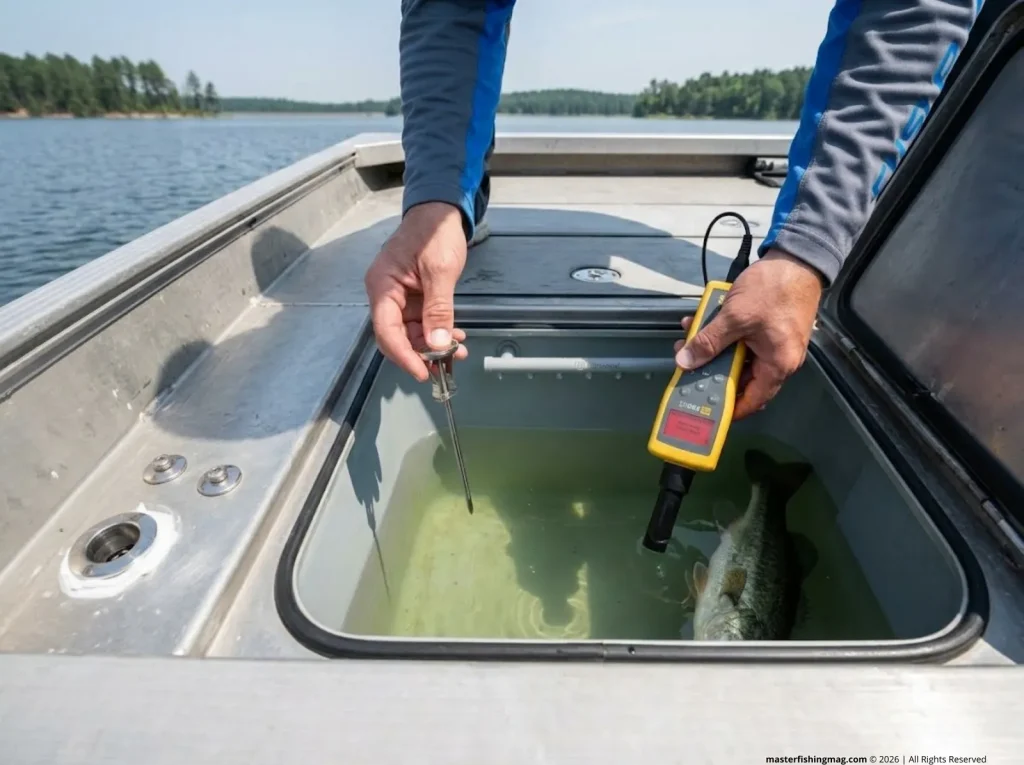
The Oxygen-Temperature Death Loop
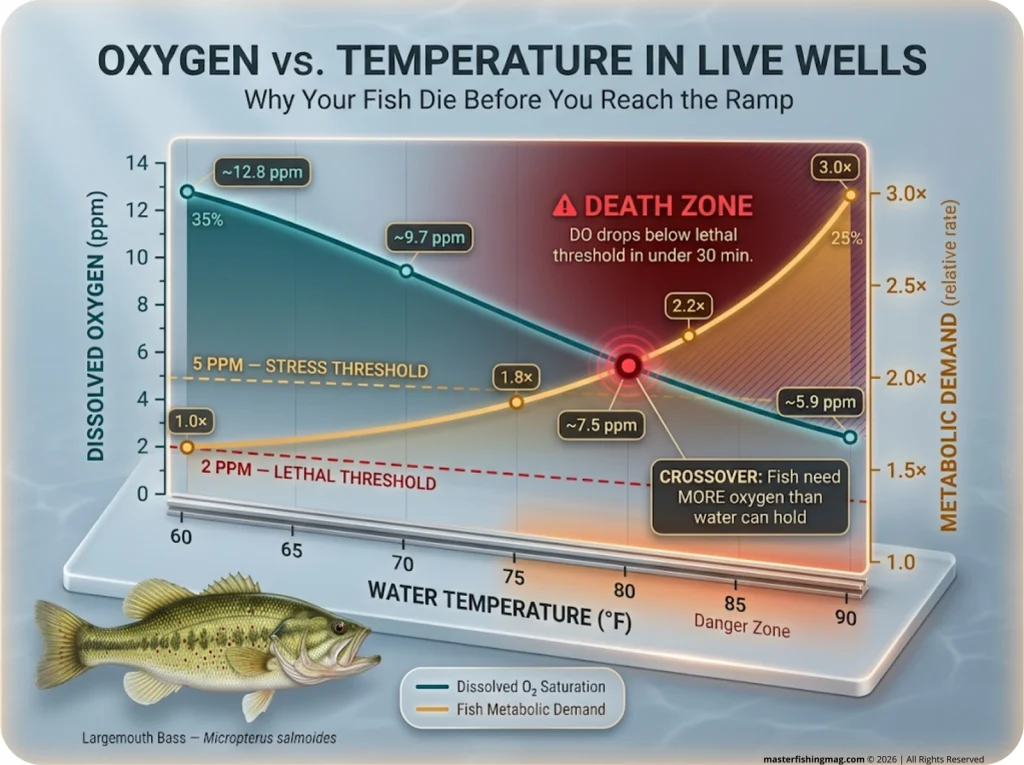
Here’s the hard reality about dissolved oxygen levels in a confined space: as water temperature climbs, the water holds less oxygen while the fish trapped inside it demand more. Water at 52°F carries roughly 40% more oxygen than water at 80°F. But your bass doesn’t slow down in the heat—its metabolism accelerates, burning through what little oxygen remains at nearly double the usual rate.
Texas Parks and Wildlife livewell management research backs this up with hard numbers. In livewells holding 14 to 17 pounds of largemouth bass with no active aeration, oxygen dropped below the 5 ppm stress threshold within 12 to 15 minutes. In under 30 minutes, levels crashed below 2 ppm—a concentration that kills most warm-water species outright.
During high-heat summer months, mortality rates in confined bass exceed 50% when water passes 80°F without supplemental water oxygenation. That’s not hours. That’s minutes. A timer that cycles your pump on for ten minutes and off for five is a death sentence on a hot tournament day.
To understand more about how dissolved oxygen governs where fish hold and whether they survive, the relationship works the same whether the fish is in open water or a 20-gallon box.
Pro tip: When summer water temps push past 75°F, forget the livewell timer entirely. Run continuous flow. The extra amp draw is nothing compared to the fish you’ll lose.
The Ammonia Time Bomb You Can’t See
While you’re watching oxygen levels, ammonia is building behind your back. Every fish in that livewell excretes ammonia through its gills, and in a closed system with no biological filter, it accumulates fast.
The dangerous part is that ammonia toxicity depends heavily on pH. At a neutral pH of 7.0, most ammonia stays in its harmless form. At pH 8.0, the toxic fraction jumps roughly 70 times higher.
Here’s the paradox most anglers miss: aggressive surface aeration strips carbon dioxide from the water, which pushes pH upward and can actually spike toxic ammonia—the exact opposite of what you’d expect. Even low concentrations cause gill damage, weaken immune response, and set the stage for infections that kill fish days after release.
Adding ClorAM-X at one tablespoon per ten gallons neutralizes ammonia directly, as documented by the New Mexico State University water quality parameters guide. It’s the cheapest insurance against the silent killer in your well.
Thermal Stress and Delayed Mortality
A fish can look perfectly healthy at the weigh-in and die 24 to 48 hours later. This delayed mortality happens because the fight, the handling, and the confinement create a massive energy debt—depleting muscle fuel and disrupting the fish’s ability to regulate its body chemistry.
Stressed fish lose critical minerals through their gills, forcing the body to spend energy it doesn’t have trying to restore balance. Adding uniodized salt at one cup per 15 gallons reduces that strain and helps fish conserve energy for recovery. It’s a simple step that dramatically improves fish stress reduction outcomes in any confined holding system.
Drop frozen water bottles into the livewell instead of loose ice. A gradual temperature decrease keeps stress hormones in check. Dump ice directly and you’ll shock a fish that’s already on the edge. Understanding the cortisol cascade that determines whether a released fish lives or dies is the difference between a successful release and a dead bass floating belly-up the next morning.
The Mechanical Failures That Starve Your Catch
Airlocks — The #1 Pump Killer in DIY Setups
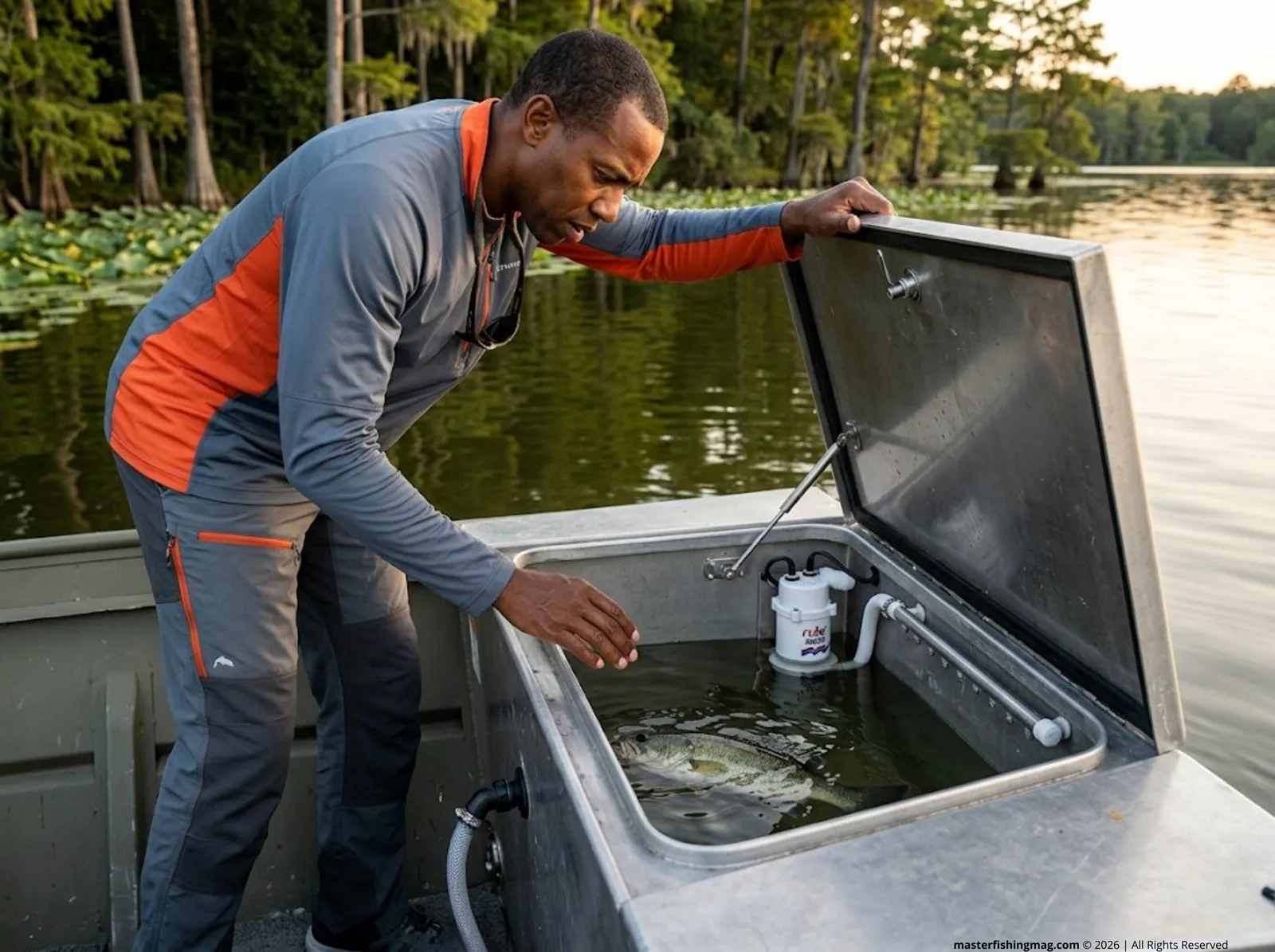
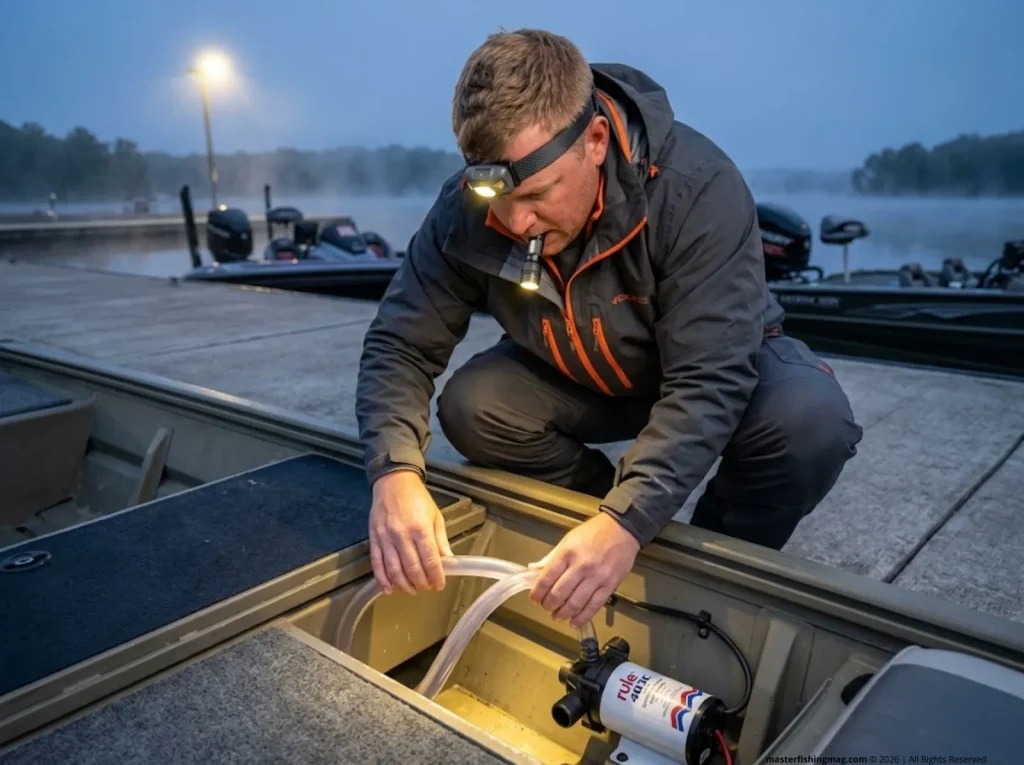
The most common mechanical failure in a DIY jon boat livewell is the airlock, and it kills silently. Most livewell pumps—including popular models from Rule pumps and Attwood—are centrifugal and non-self-priming. If air gets trapped in the housing or intake hose, the pump impeller spins dry and zero water moves. Your fish suffocate while the motor hums away like everything’s fine.
The root cause is almost always plumbing layout. If the discharge hose has any dip, sag, or valley between the pump and the tank, water pools in the low point and traps an air pocket on both sides. When the pump restarts, it can’t push that air pocket through against the weight of the water above.
Manufacturer guidelines from SHURFLO and Rule are clear: all jon boat livewell plumbing must run continuously upward from the pump to the tank. No horizontal loops, no downward dips, ever. Mount the pump as low in the hull as possible—ideally below the waterline. If your pump sits high on the transom, it loses prime every time the boat planes or hits a wake.
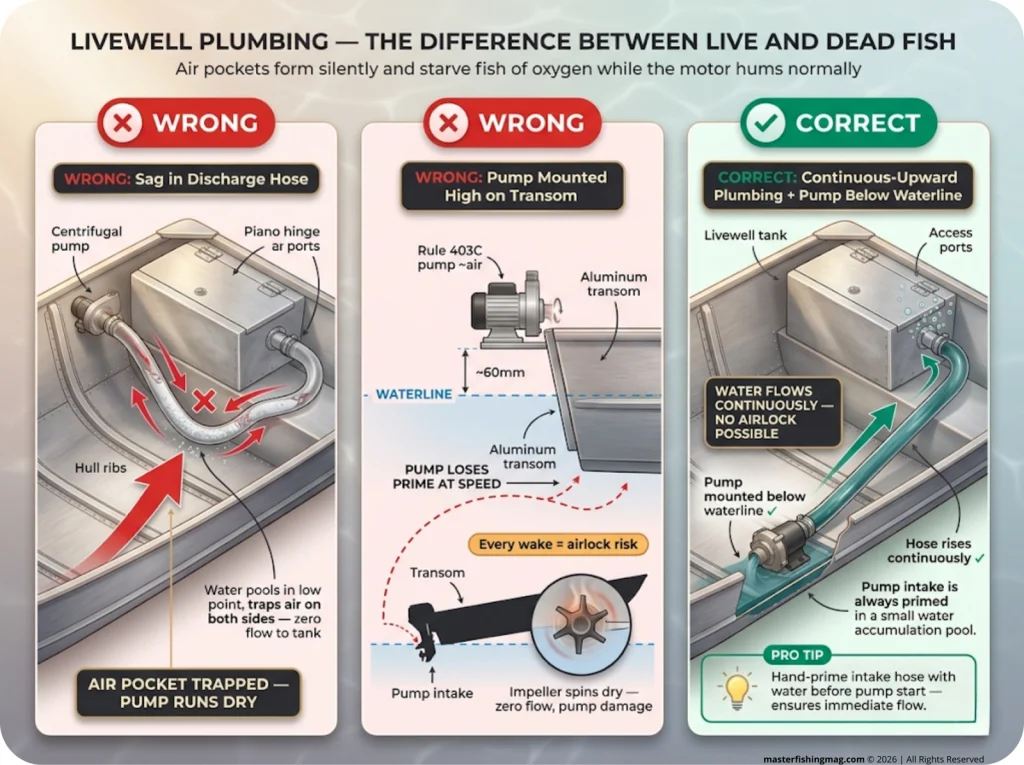
Pro tip: Before every trip, hand-prime the system by filling the intake hose with water before turning on the pump. If it takes more than three seconds to produce flow, you’ve got a sag somewhere in your plumbing run. Find it and fix it before you launch.
Choosing the Right Pump — GPH, Amps, and Port Size
The rule of thumb is simple: your pump must replace the entire tank volume every six to ten minutes. For a standard 20-gallon livewell, that means a minimum GPH rating of 500. An 800 GPH pump is the sweet spot for most tournament fishing scenarios.
The Rule 403C delivers 800 GPH at 2.8 amps with a 3/4-inch port—it handles the vast majority of bass fishing and crappie fishing tournament loads on a single 12V battery. The Attwood Tsunami matches the flow rate but draws a heavier 4.0 amps, which matters during an eight-hour day. Undersized port fittings create back-pressure that tanks your effective flow regardless of what the sticker says. Match hose diameter to discharge port size exactly—tighten connections with stainless steel hose clamps rated for marine use.
Recirculating vs. freshwater intake isn’t just a preference—it’s a biological decision. Freshwater intake pulls oxygenated lake water and flushes ammonia. Recirculation keeps reheating and recontaminating the same water. Install a Y-valve so you can switch between modes. Run freshwater intake when stationary and recirculate only while running between spots to reduce amperage draw.
Spray Bar vs. Standard Discharge — Aeration Efficiency
A single-point return dumps water into one corner of the livewell and creates dead zones where oxygen drops well below the tank average. Fish crowd the outlet and compete for oxygenated water while the far side of the tank slowly goes hypoxic.
A spray bar distributes returning water across the full surface as an atomized sheet, massively increasing the oxygen transfer rate. For heavy tournament loads in warm water, pairing a spray bar with pure oxygen injection maintains oxygen at levels no standard aerator can match—a setup we’ll cover next.
The Hull Problem Nobody Talks About — Weight, Stability, and Where to Mount
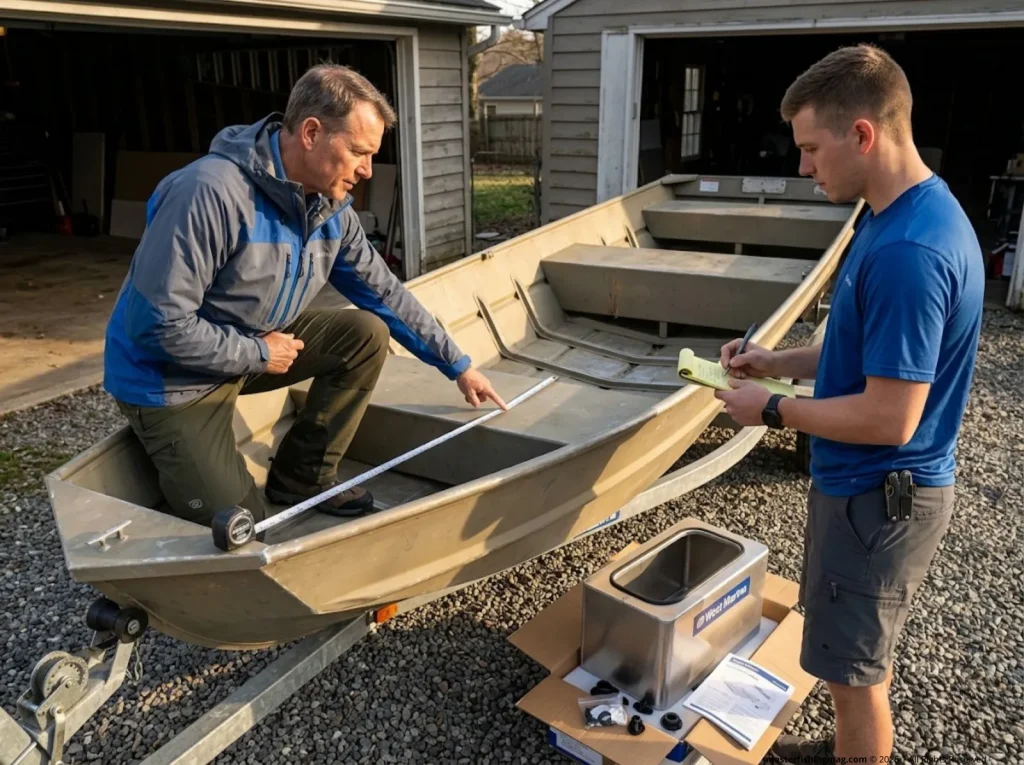
The 166-Pound Problem — Water Weight and Carrying Capacity
Water weighs 8.34 pounds per gallon. Fill a 20-gallon livewell and you’ve just added 166 pounds to an aluminum boat that might only be rated for 400 to 500 pounds total. That’s 30% to 50% of your carrying capacity gone in one small craft modification.
Most DIY builders mount the livewell at the stern—it’s close to the engine, close to the bilge pump, and the plumbing run is short. But concentrating 166 pounds at the rear causes the bow to ride high, a condition called squatting. The boat burns more fuel, planes poorly, and sits dangerously low at the transom.
One following wave rolling over that low stern can swamp you. For optimal hull stability, the center of gravity should sit roughly 60% to 65% aft of the bow. That means moving the livewell toward the center of the hull floor and running longer PVC piping or clear vinyl tubing to compensate.
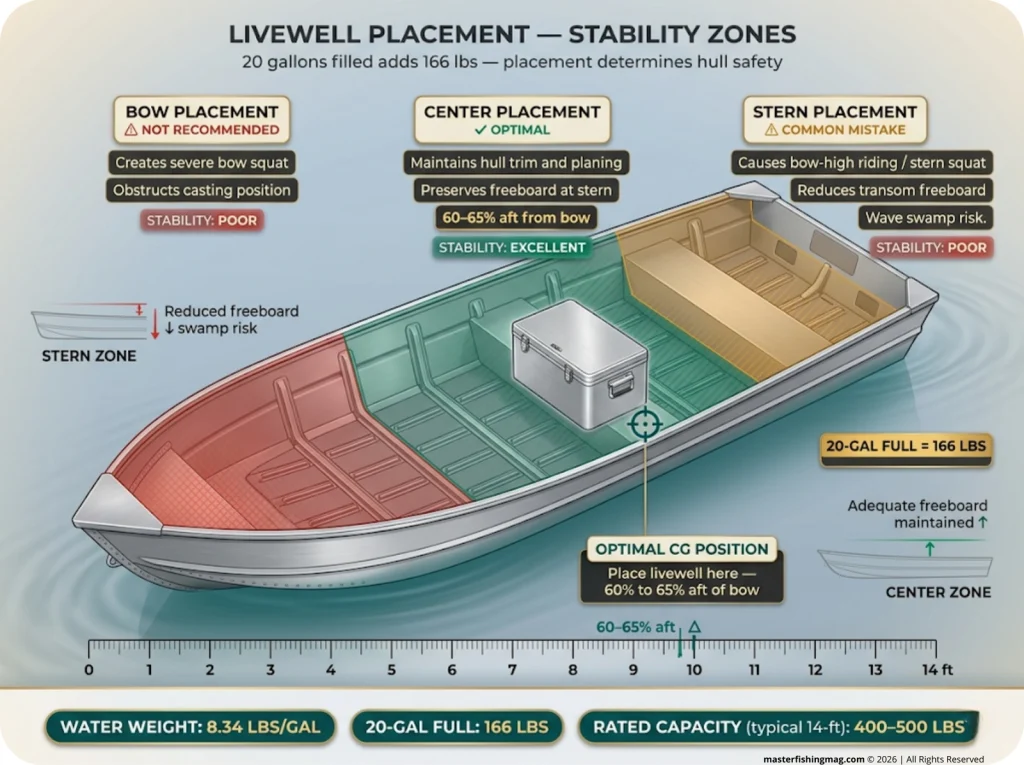
When thinking about understanding hull geometry and its impact on load placement, the same principles apply whether you’re selecting a new hull or modifying the one you’ve got.
The Free Surface Effect — Why Half-Full Tanks Capsize Boats
When a livewell is partially filled, water shifts toward the low side during every turn and wave. This moving mass shifts your center of gravity and reduces the boat’s ability to right itself—a phenomenon called the free surface effect.
On a light jon boat, this can turn a stable craft into a tender, tippy platform that rolls dangerously in boat wakes. The USCG best practices guide to vessel stability recommends baffles inside the tank to slow water movement, or keeping the tank completely full to eliminate the shifting surface. Mounting the livewell high on a raised deck makes everything worse—keep heavy loads as low to the hull floor as possible for maximum boat stability.
Pro tip: Before drilling a single hole, fill a five-gallon bucket with water and place it at your planned livewell location. Sit in your fishing position and have a partner push the boat side-to-side. If the roll feels tender, move the bucket lower in the hull and try again.
Electrical Mistakes That Kill Your Pump (and Risk a Fire)
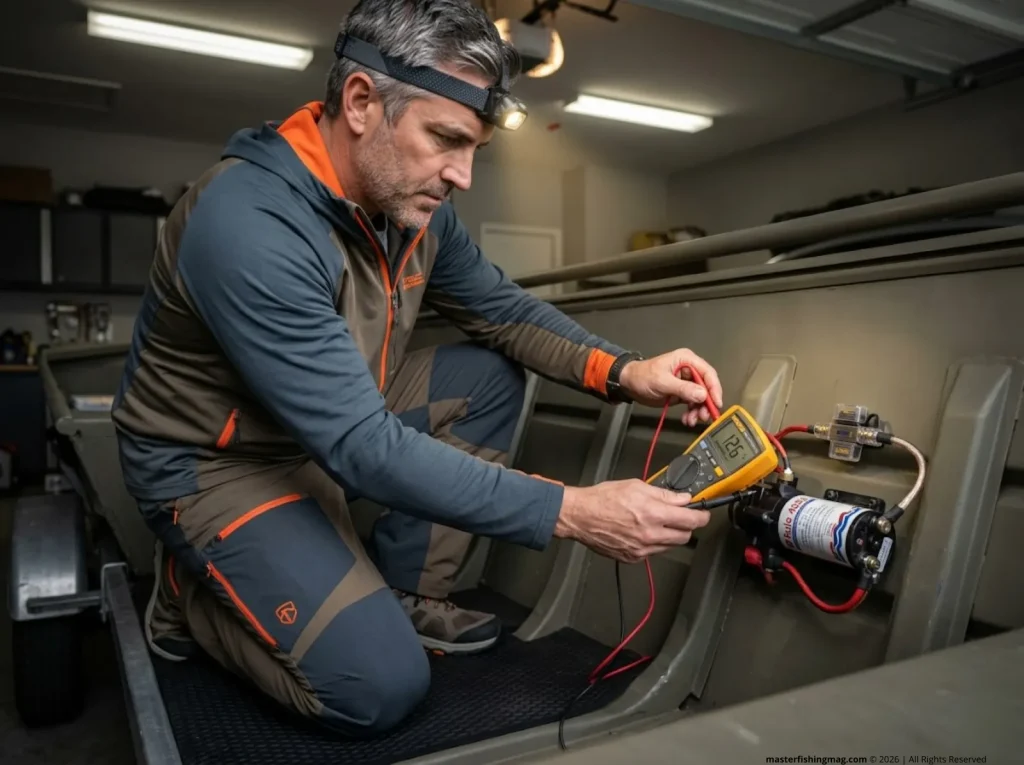
Wire Gauge, Voltage Drop, and the ABYC 3% Rule
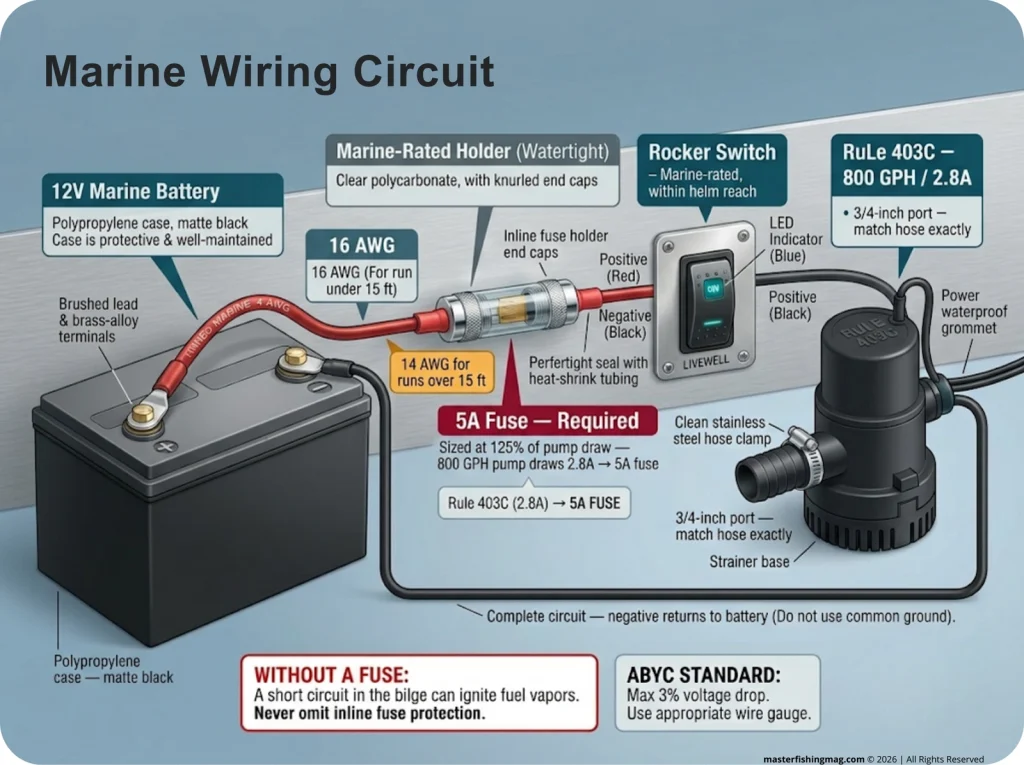
Voltage drop happens when wire resistance reduces electrical pressure between the battery and the pump. Too much drop and the pump spins slower, cutting GPH below survival thresholds—even though it still sounds like it’s running fine. The ABYC standard for critical circuits like livewell pumps is no more than 3% voltage drop.
For a typical 12V system with a pump drawing 2.8 amps located ten feet from the battery, 16 AWG marine-grade wire handles the job. Push past 15 feet and you need to step up to 14 AWG. Wire gauge safety matters more than most anglers realize on a boat modification this critical.
All marine wiring must be tinned copper—not bare copper, which corrodes in humid bilge environments and increases resistance over time. And every pump circuit needs an inline safety fuse. An 800 GPH pump should be fused at 5 amps. Without it, a short circuit in the bilge can ignite fuel vapors—the number one cause of boat fires. That’s why you need to know what marine fire extinguishers you should carry aboard.
Wire your rocker switch within easy reach of the helm so you can kill the pump instantly if something goes wrong. Label the circuit clearly.
Battery Capacity — Will Your Pump Survive an 8-Hour Day?
An 800 GPH pump drawing 2.8 amps continuously for eight hours consumes 22.4 amp-hours. Add a fish finder and a trolling motor, and total draw can blow past 40 amp-hours before noon.
Standard lead-acid batteries shouldn’t be discharged below 50%—so a 100 amp-hour battery gives you only 50 usable. LiFePO₄ batteries deliver 80% to 90% of their rated capacity and hold steady voltage under load. If you’re running a single starting battery for both the engine and the livewell, you’re gambling that you’ll have enough juice left to crank the motor at the end of the day.
Dedicate a second battery exclusively for the livewell and electronics. Anglers who’ve compared the real-world differences between lithium and lead-acid marine batteries rarely go back to lead-acid once they’ve experienced what stable voltage does for pump performance over a full tournament fishing day.
Advanced Survival Tactics — Oxygen Injection and Chemical Support
Pure Oxygen Injection — Beyond Atmospheric Aeration
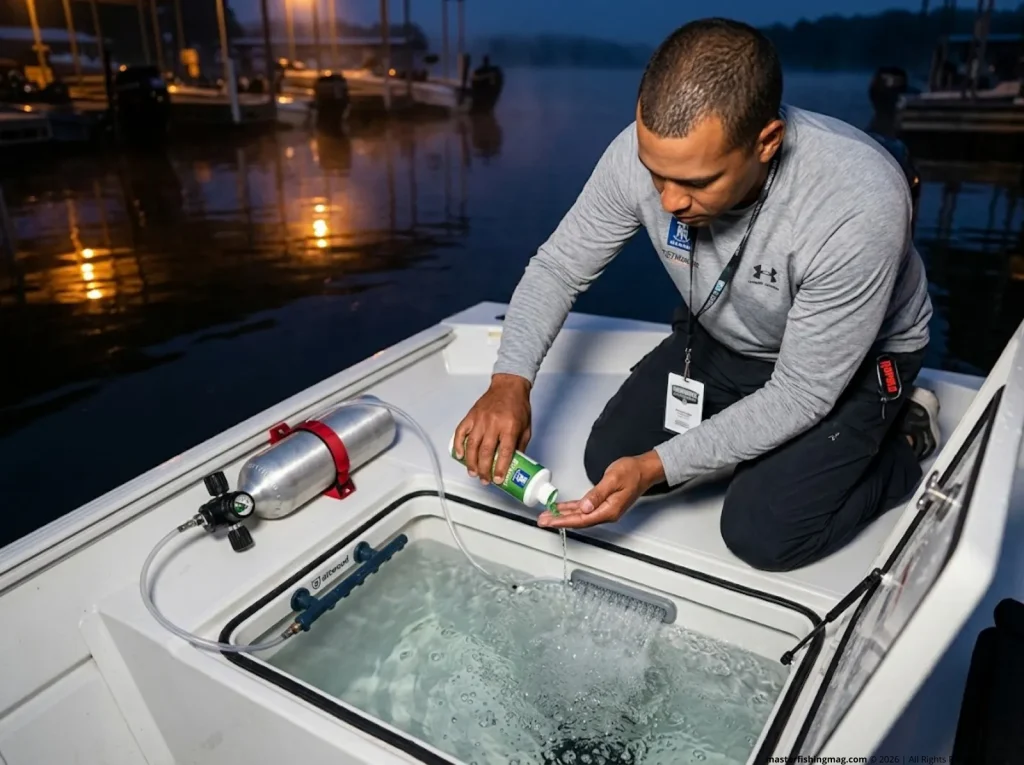
Atmospheric air is only 21% oxygen. In extreme conditions—water temps over 80°F with a heavy tournament prep load—a standard aerator simply can’t diffuse enough oxygen to keep pace with what the fish are burning. Compressed O₂ systems solve this entirely.
A small cylinder, a single-stage regulator, and a micro-bubble diffuser deliver pure oxygen directly into the water. Texas Parks and Wildlife recommends a flow rate of 0.25 liters per minute, which can maintain oxygenation levels at 14 to 22 ppm even at 85°F. These rigs are compact enough for a jon boat console and run about $150 to $250—far less than the penalty for dead fish at weigh-in.
That’s the same approach detailed in the tournament fish care protocol that separates pros from amateurs.
Livewell Additives — Salt, Slime Coat, and Ammonia Control
T-H Marine G-Juice at one ounce per 60 gallons repairs slime coat damage from handling and carpet contact while adding electrolytes. Uniodized salt at one cup per 15 gallons helps stressed fish conserve energy. ClorAM-X neutralizes ammonia directly—critical in recirculating systems where waste builds fast.
The slime coat is your fish’s immune barrier. When it’s scraped off by a dry hand, rough net, or scratchy boat carpet, bacterial and fungal infections set in within hours and cause death one to two days after release. Following science-based catch and release techniques that maximize survival starts in the livewell, not at the boat ramp.
Livewell Hygiene — Biosecurity Starts in Your Bilge
Clean, Drain, Dry — The Federal Mandate
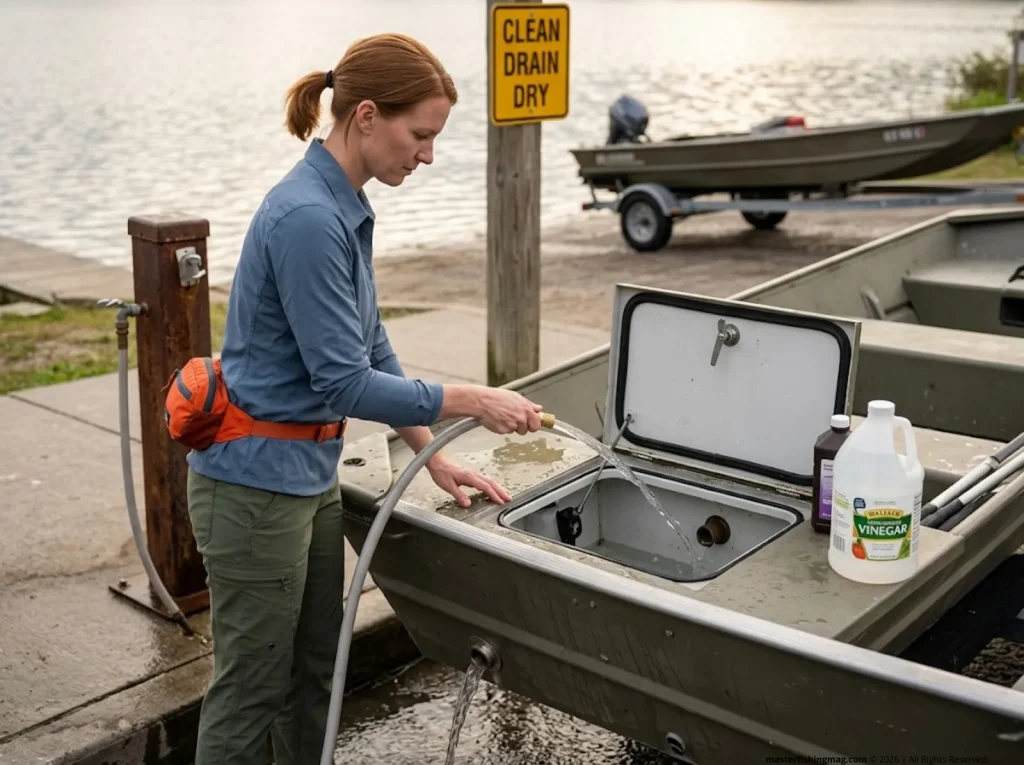
Your livewell isn’t just a holding tank. It’s a potential vector for invasive species transfer and viral pathogens like Largemouth Bass Virus. Zebra mussel larvae—called veligers—are microscopic and survive in residual water left inside pumps, hoses, and drains. Move between lakes without proper disinfection and you’re carrying invasive biology from one fishery to the next.
The U.S. Fish & Wildlife Service Clean, Drain, Dry protocol is law for good reason: thorough drainage followed by a minimum of five days of complete drying kills veligers. For faster turnaround, hot water rinsing at 140°F for ten seconds or a 2% bleach solution works—but rinse thoroughly afterward. For a deeper look at what you’re fighting, check the complete angler’s field guide to aquatic invasive species.
The Vinegar-Peroxide Flush — Seasonal Deep Clean
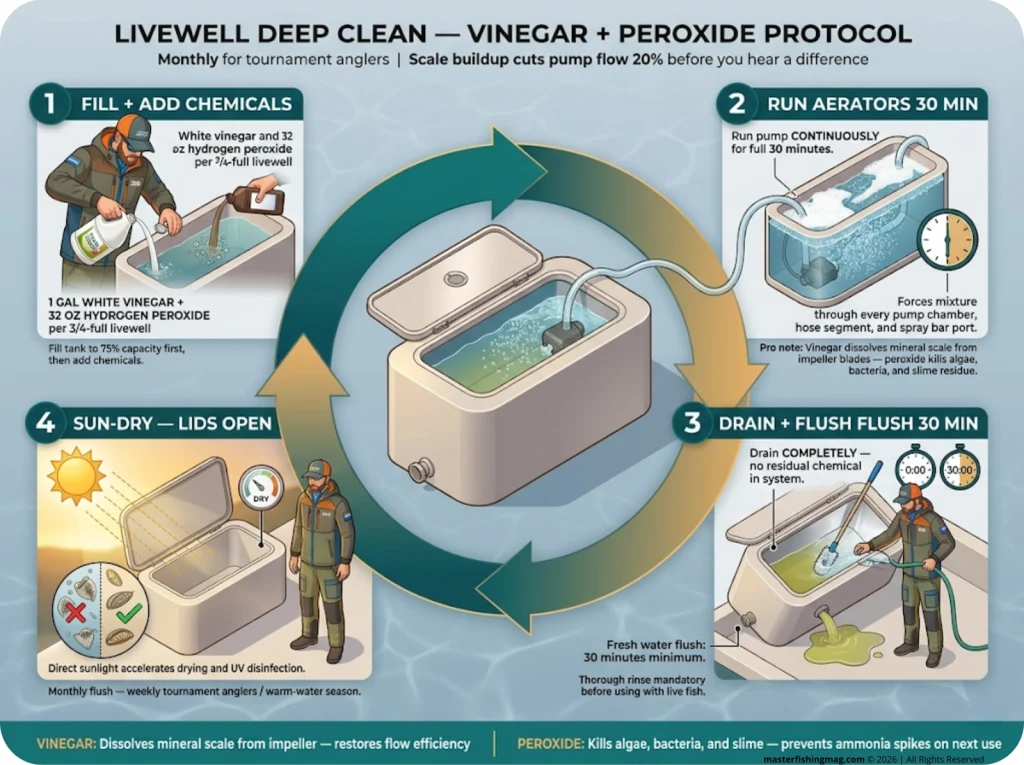
Fill the livewell three-quarters full with fresh water, add one gallon of white vinegar and 32 ounces of hydrogen peroxide. Run the aerators for 30 minutes to push the mixture through every pump, hose, and spray bar. The vinegar dissolves mineral scale from the pump impeller, while the peroxide kills algae, bacteria, and old slime residue that causes ammonia spikes on your next trip.
Drain completely, flush with clean water for 30 minutes, and air-dry in direct sunlight with the lids open. Anglers who fish warm-water tournaments weekly should run this flush monthly—part of any serious livewell hygiene and boat maintenance routine. Scale buildup on impellers can cut pump flow by 20% before you notice any difference in the sound of the motor.
Conclusion
Biology comes first. Temperature, dissolved oxygen, and ammonia interact to create lethal cascades in minutes—not hours. Understand the thresholds or you’re building a coffin, not a livewell.
Engineering prevents failure. Plumb continuously upward, fuse every circuit, and size your wire for the ABYC 3% voltage drop standard. Those three rules eliminate 90% of mechanical livewell deaths.
Placement determines safety. A 20-gallon livewell adds 166 pounds. Put it in the wrong spot on a 12-foot aluminum hull, and you compromise both fish health and your own safety on the water.
Build your livewell like the fish’s life depends on it—because it does. Fill the tank, check the pump, and verify flow before you make your first cast. That’s the difference between stewardship and negligence.
FAQ
Where is the best place to put a livewell in a jon boat?
Mount the livewell as close to the longitudinal center as possible—roughly 60% to 65% aft of the bow—and keep it low on the hull floor. Stern-mounted wells cause the boat to squat, reduce freeboard, and increase capsize risk from the free surface effect. Center placement improves both boat handling and fish survival.
Do I need a pump for a livewell?
Yes—without a pump delivering at least 500 GPH for a 20-gallon tank, dissolved oxygen drops below lethal levels in under 30 minutes. Passive air stones alone cannot sustain fish in a confined volume during warm weather. A quality aerator pump is non-negotiable.
How do you keep fish alive in a jon boat?
Continuous aeration at 500+ GPH, temperature management with frozen water bottles, uniodized salt for osmotic support, and ClorAM-X for ammonia neutralization. In water above 80°F, a pure oxygen injection system is the only reliable way to keep fish alive at survival-grade oxygenation.
What size livewell for a 14ft jon boat?
A 15 to 20 gallon livewell is the practical maximum. At 20 gallons filled, you’ve added 166 pounds—roughly 30% of a typical 14ft jon boat’s rated carrying capacity. Factor in passengers, gear, fuel, and your own weight before committing to the larger size.
Can I use a cooler as a livewell on a jon boat?
A quality insulated cooler works well as a budget DIY livewell container. The insulation slows the warming that kills fish—a major advantage over bare aluminum. You’ll still need a 500+ GPH pump, thru-hull fittings, and an overflow drain to make it functional.
Risk Disclaimer: Fishing, boating, and all related outdoor activities involve inherent risks that
can lead to injury. The information provided on Master Fishing Mag is for educational and informational purposes
only. While we strive for accuracy, the information, techniques, and advice on gear and safety are not a substitute
for your own best judgment, local knowledge, and adherence to official regulations. Fishing regulations, including
seasons, size limits, and species restrictions, change frequently and vary by location. Always consult the latest
official regulations from your local fish and wildlife agency before heading out. Proper handling of hooks, knives,
and other sharp equipment is essential for safety. Furthermore, be aware of local fish consumption advisories. By
using this website, you agree that you are solely responsible for your own safety and for complying with all
applicable laws. Any reliance you place on our content is strictly at your own risk. Master Fishing Mag and its
authors will not be held liable for any injury, damage, or loss sustained in connection with the use of the
information herein.
Affiliate Disclosure: We are a participant in the Amazon Services LLC Associates Program, an
affiliate advertising program designed to provide a means for us to earn advertising fees by advertising and linking
to Amazon.com. As an Amazon Associate, we earn from qualifying purchases. We also participate in other affiliate
programs and may receive a commission on products purchased through our links, at no extra cost to you. Additional
terms are found in the terms of service.