
In this article
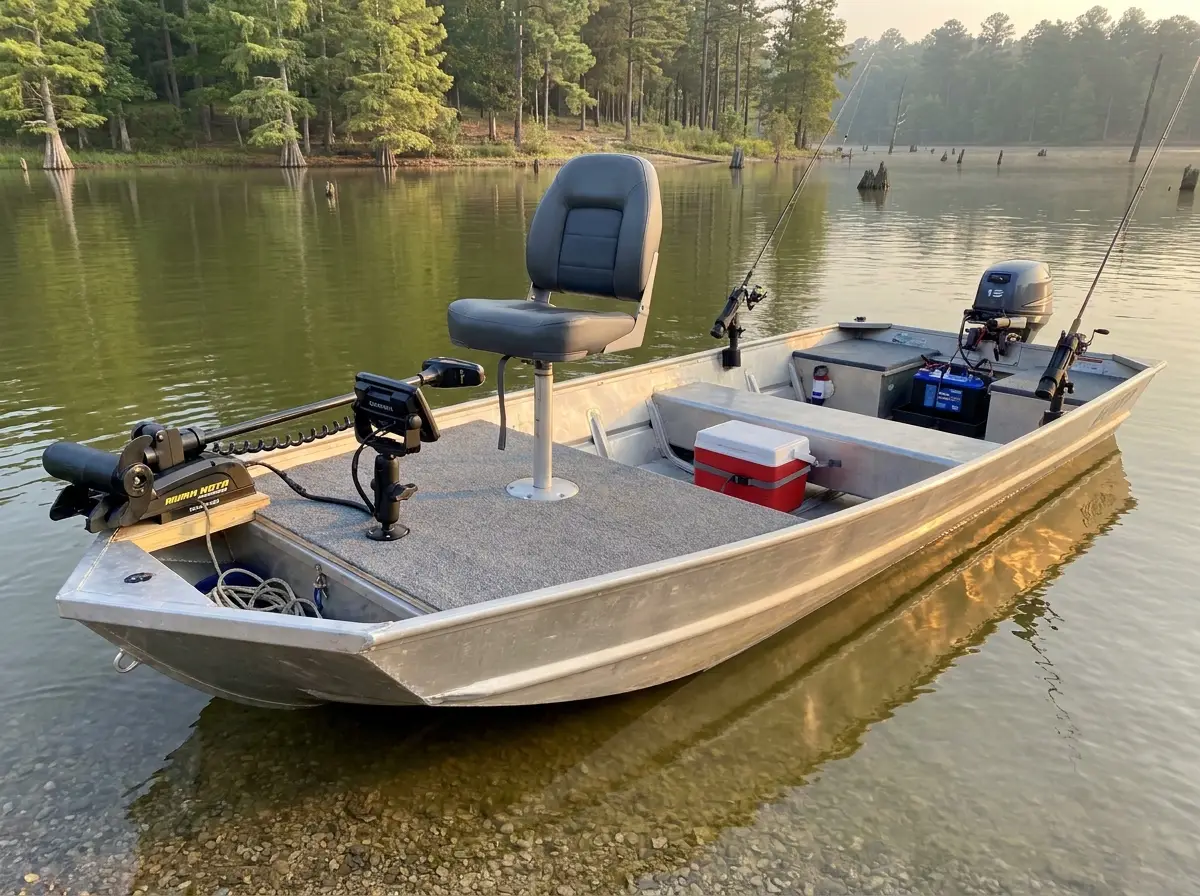
My first jon boat build started with the fun stuff — a pedestal seat, two flush-mount rod holders, and a Minn Kota trolling motor I bolted to the bow on a Saturday afternoon. By Tuesday, the bow was sitting three inches lower than the stern, the fish finder cable was trapped under the deck I’d already screwed down, and I had to rip out half my work to fix a wiring mistake that would’ve taken ten minutes if I’d just planned the electrical first.
That $400 lesson taught me something every jon boat forum buries under mod photos: the order you build matters more than the parts you pick. Here’s the sequence that saves you time, money, and a second trip to the hardware store.
Quick Answer: The right order for jon boat modifications starts with these steps:
- Calculate your total weight budget based on hull capacity
- Plan the electrical system and run all wiring first
- Build the casting deck and flooring framework
- Mount pedestal seats and test stability on the water
- Install rod holders, storage, and accessories last
- Add safety gear to meet Coast Guard minimums before launch
Plan Your Weight Budget Before You Cut Anything
Why Weight Comes First
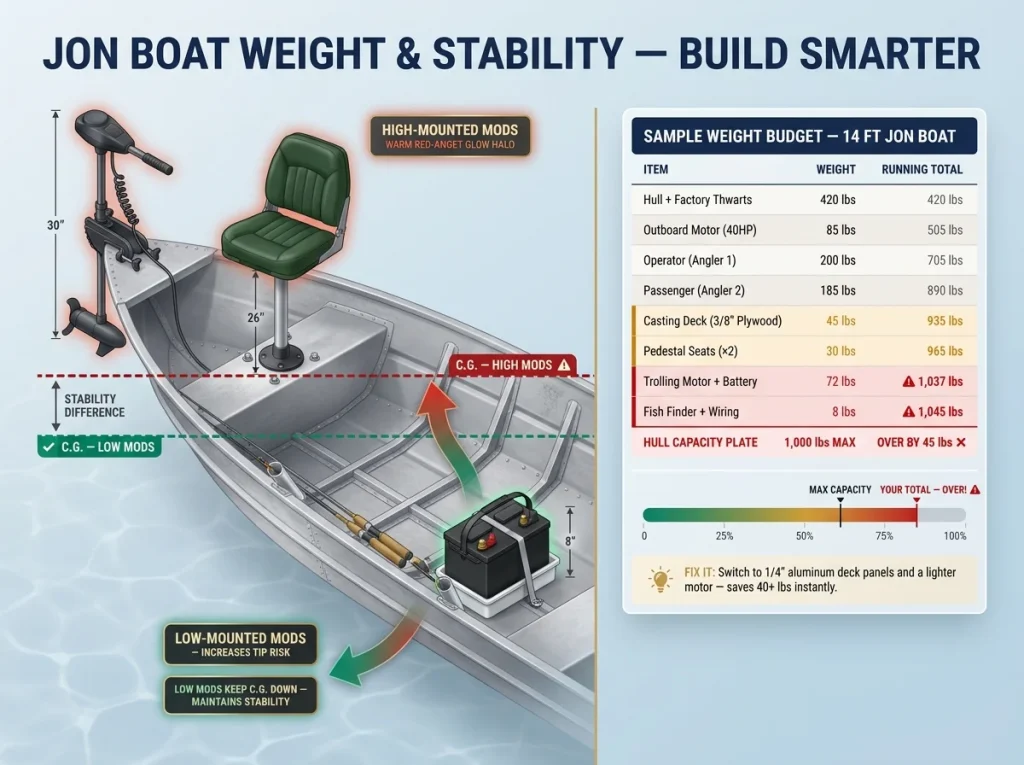
Every mod you bolt onto a jon boat adds pounds to a hull that wasn’t designed for them. A bare 14-foot aluminum jon boat weighs around 350 to 450 pounds with the motor. The typical hull plate rates that boat for 800 to 1,000 pounds total — including passengers, gear, fuel, and every modification you add.
That sounds like plenty until you start stacking: a plywood casting deck (40-60 lbs), two pedestal seats (15 lbs each), a trolling motor with battery (60-80 lbs), a fish finder and wiring (5-10 lbs), plus your cooler, tackle, and the 200-pound person sitting on the bow. You’re at 400 pounds of added weight before your fishing buddy even steps aboard.
How to Calculate Your Real Capacity
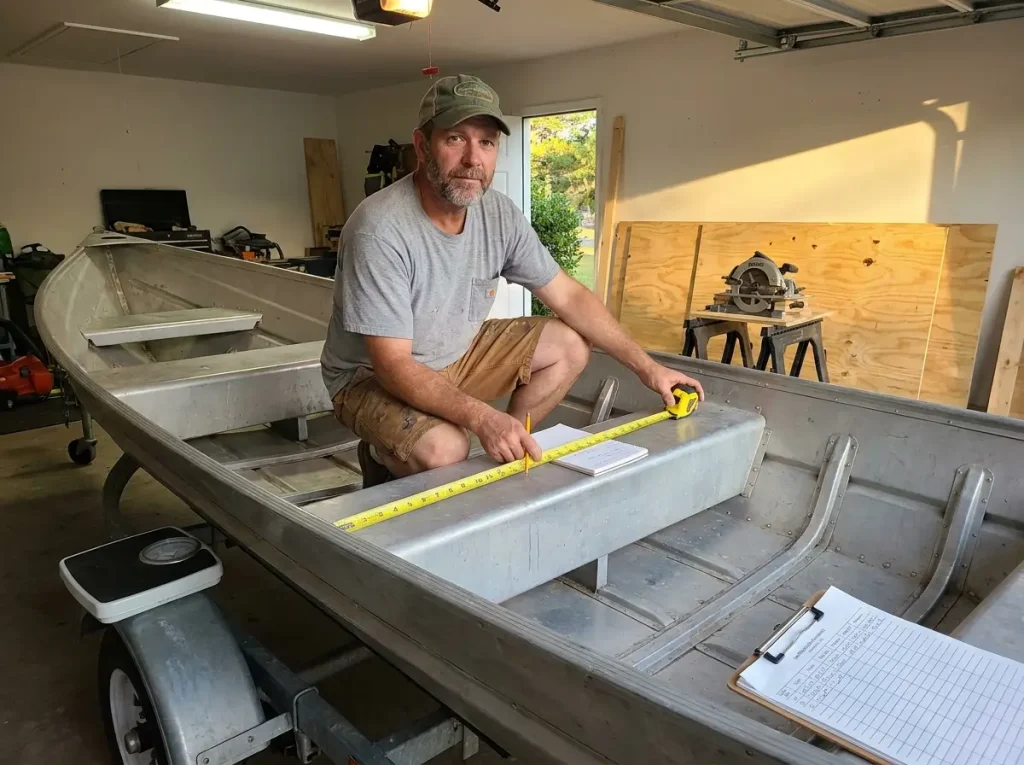
Find the capacity plate riveted to the transom or inside the hull near the stern. Subtract the motor weight and your own weight. What’s left is your modification budget plus passenger weight plus gear.
A 1,000-pound rated 14-foot jon boat with a 75-pound outboard and a 200-pound operator leaves 725 pounds. Subtract 200 for a second person and 50 for tackle and cooler — you have 475 pounds for modifications. That number drives every decision from here.
The Stability Tax
Weight above the gunwale line — like tall pedestal seats and bow-mounted trolling motors — raises the center of gravity and makes the boat tippy. Weight below the gunwale — like batteries on the floor and flush-mount hardware — keeps the center of gravity low. Every pound you mount high costs more stability than a pound mounted low. Plan accordingly, or you’ll learn this lesson standing up in a rocking boat.
Pro tip: Before you spend a dollar on materials, weigh everything you plan to install on a bathroom scale. Write the number on a sticky note and add them up. If the total exceeds your modification budget, start cutting — the plywood deck thickness is usually the first place to save weight without losing function.
Casting Deck and Flooring That Won’t Sink You
Material Choices and Their Weight
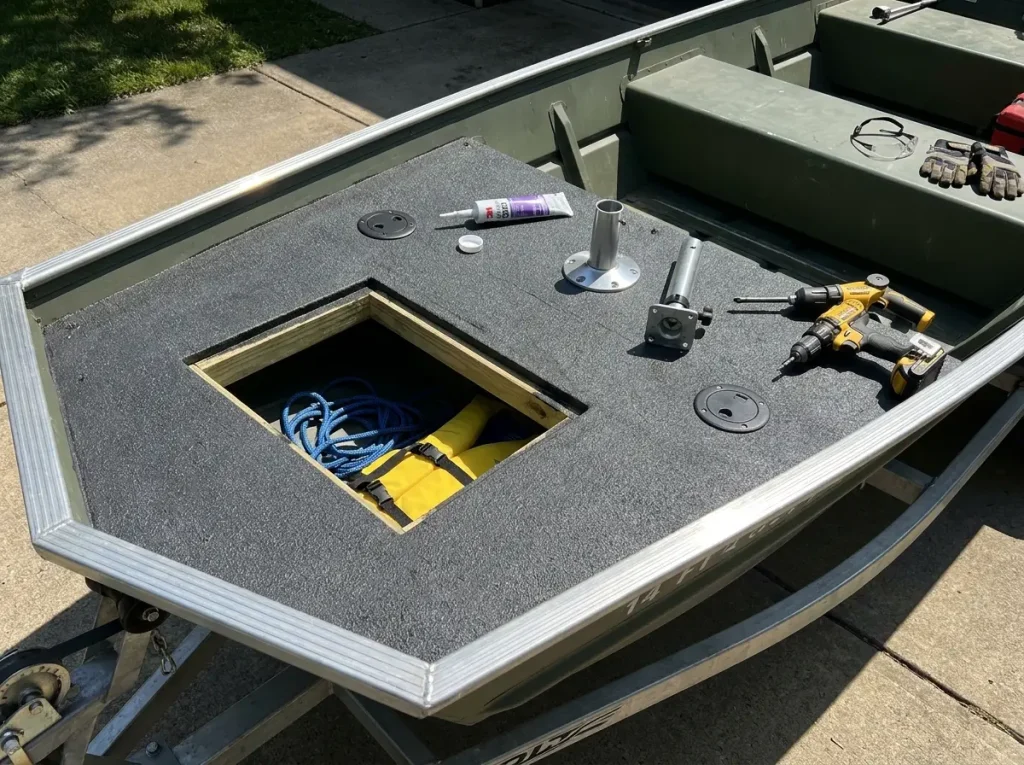
The casting deck is the biggest single modification by weight, so the material choice matters. Marine-grade plywood in 3/8-inch thickness is the sweet spot — thick enough to stand on without flex, light enough to keep the weight budget in check. Half-inch plywood adds rigidity but costs 8 to 12 extra pounds per sheet, and on a 12-foot hull, that difference adds up fast.
Skip the marine carpet. It holds water, adds weight when wet, traps fish slime, and takes forever to dry. Spray-on truck bed liner like Raptor or Durabak gives you better grip, cleans with a hose, and weighs almost nothing. EVA foam pads are another option — lighter than bed liner and softer underfoot on long days, though they wear faster.
Framing and Fastening Without Drilling the Hull
The deck frame sits on the existing bench thwarts and hull ribs. Use 2×2 pressure-treated lumber or 1/8-inch aluminum angle stock for the runners. The frame supports the plywood panels without permanent attachment to the hull — you want the deck to be removable for maintenance and to access under-deck storage.
Rivnuts are the best fastener for anything that does attach to the aluminum hull. A rivnut is a threaded insert you install from one side — it pulls up into a flange against the hull without needing access to the other side. Drill, insert, set with the mandrel tool, and you have a clean threaded mount that won’t leak. Seal every rivnut hole with 3M Marine 5200 or a marine-grade silicone to prevent water intrusion.
Deck Layout for Fishing Function
Build the bow deck large enough to stand and cast from comfortably — about 4 feet from the bow to the front edge of the first bench thwart. Leave a hatch or removable panel for access to the trolling motor battery and anchor storage underneath.
The stern platform, if you build one, should be smaller and lower. Most anglers make the mistake of building identical front and rear decks on a 14-foot hull, which eats floor space and makes moving around the boat cramped. A simple raised stern platform just wide enough for a pedestal seat base gives you the height advantage without stealing every inch of working room.
Pro tip: Cut your deck panels from cardboard first and lay them in the boat. Sit in each position, stand up, move between seats. Live with the cardboard for a weekend trip before you cut plywood — it’s free to adjust a template and painful to re-cut wood.
Seating and Pedestal Placement for Stability
Where You Mount the Seat Changes How the Boat Rides
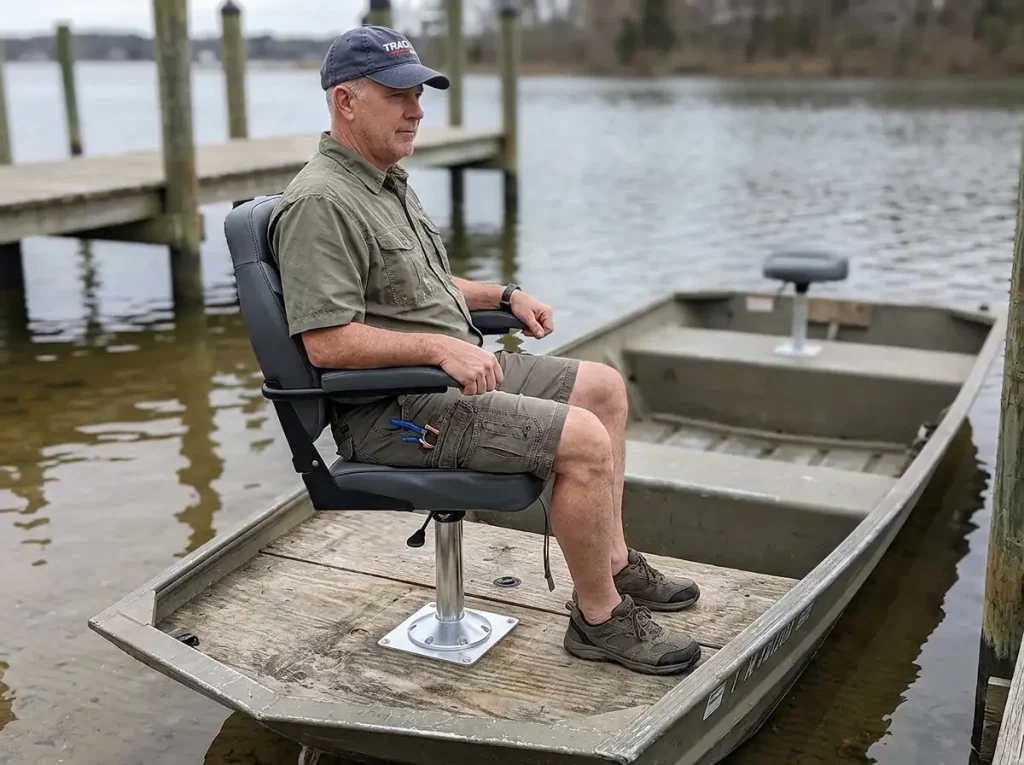
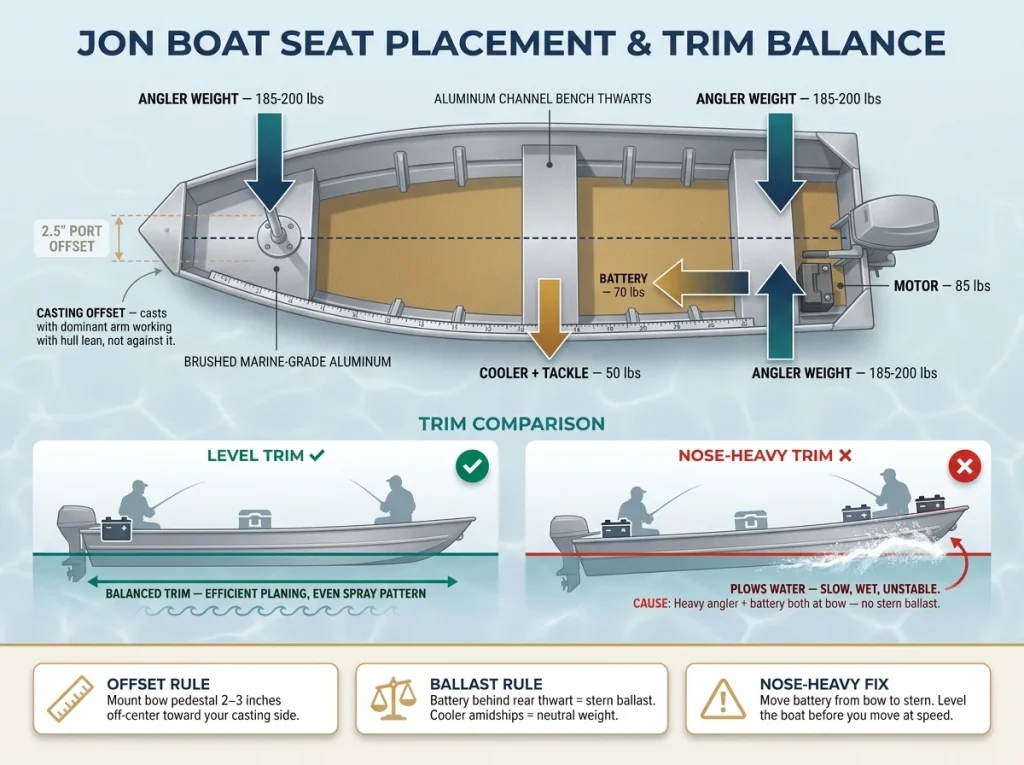
Bolt the bow pedestal dead center on the hull’s beam and you’ll rock side to side every time you shift weight. Offset it 2 to 3 inches toward the port or starboard side — whichever side you cast from — and the boat tracks more naturally because your casting motion works with the offset rather than against it.
The pedestal seat base needs to bolt through the deck AND into the hull rib or a reinforcement plate below. A seat mounted only to the plywood deck will pull free the first time someone leans hard or loses balance. Use a 6-inch by 6-inch aluminum plate on the underside of the deck as a load spreader, with stainless steel carriage bolts through both the plate and the deck into the pedestal base above.
Height Matters More Than Comfort
A standard pedestal post puts the seat 24 to 28 inches above the deck. That’s great for visibility — you can see structure, read the water, and spot fish. But it raises your center of gravity by two feet compared to sitting on the bench thwart. On a narrow 48-inch beam jon boat, that height makes standing up feel like balancing on a log.
If your hull is under 54 inches wide, drop to a low-profile pedestal — 18 to 20 inches — or use a seat that clamps directly to the bench thwart. You’ll lose some visibility but gain the stability that keeps you fishing instead of swimming.
The Two-Person Trim Problem
With two anglers on pedestal seats, the bow person outweighs the stern person’s influence on trim because the bow seat is farther from the hull’s center of buoyancy. If the bow angler is heavier, the boat plows nose-down. Solution: mount the bow battery behind the rear seat and position the cooler mid-ship. Adjust ballast until the hull rides level at rest with both anglers seated.
Rod Holders and Storage That Stay Out of Your Way
Vertical vs. Flush-Mount Rod Holders
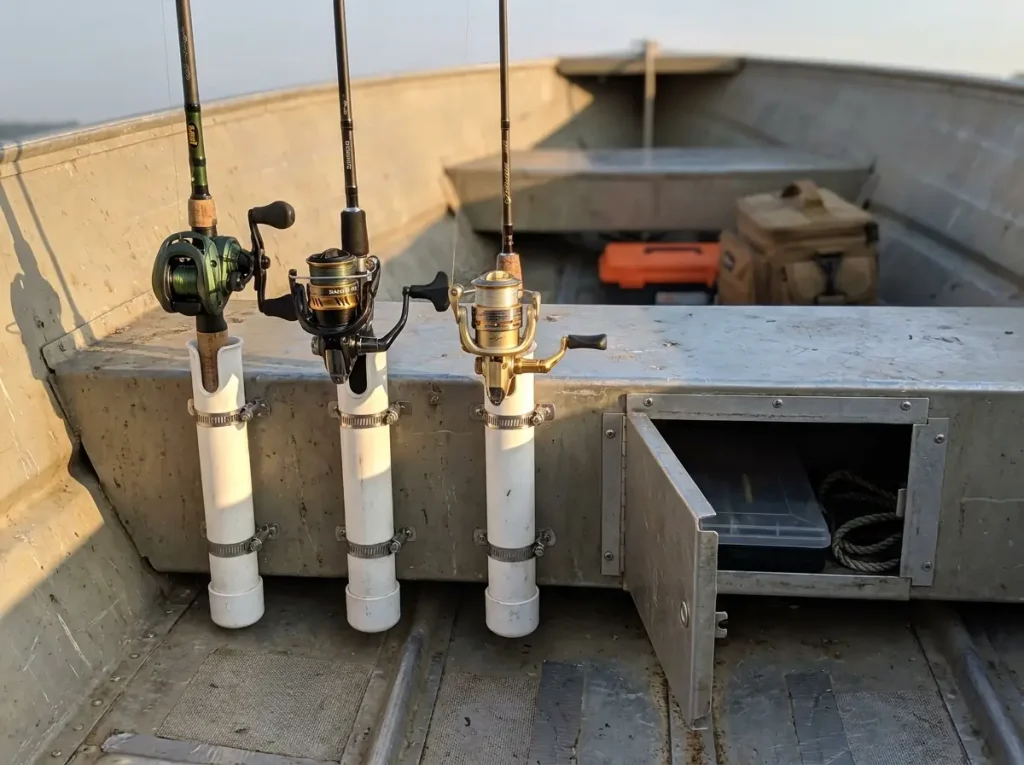
Vertical rod holders bolt to the bench thwart or gunwale and hold rods upright. They’re cheap (a PVC pipe, a cap, and a hose clamp costs under $5), easy to install, and keep rods visible and accessible. The downside: vertical rods catch your line when you cast across the boat, and rod tips extend above the gunwale where branches and low bridges can snap them.
Flush-mount rod holders sit in the gunwale rail at a 15-degree angle and hold rods nearly horizontal. They look cleaner, don’t snag anything, and keep tips below the gunwale line. But they require drilling larger holes in the hull, they’re harder to install without cracking the aluminum, and horizontal rods are slower to grab when a fish hits.
Pick based on how you fish. If you troll or drift — flush mounts keep rods in the ready position. If you cast and move between spots — verticals let you grab and go. Most anglers who fish both styles end up with two verticals on the thwart and two flush mounts on the gunwale — total cost under $40 if you build the verticals from PVC.
Using Thwart Storage You Already Have
The bench thwarts on a factory jon boat are hollow metal tubes. That’s free storage most builders ignore. Cut a small access hatch in the top or side of the thwart with a jigsaw and a metal-cutting blade, smooth the edges with a file, and hinge a cover plate over it. Inside that thwart you can stash anchor line, PFDs, a first aid kit, or anything else that takes up floor space.
The floor itself is storage too. A simple plywood tray on the ribs between the thwarts holds a tackle bag flat and low. Strap it down with a bungee cord and it stays put in chop.
The “Clean Floor” Rule
Everything on the floor of a jon boat is something you’ll step on, trip over, or kick into the water. The goal of any storage modification is a clear floor from bow to stern — rods in holders, tackle in thwart cavities or under-deck compartments, loose gear in a secured dry box. If you can walk from the stern to the bow without looking down, your storage plan is working.
Pro tip: Bolt a small cooler to the center thwart with a strap. It doubles as a seat for a third person, keeps drinks cold, and stores your catch at the end of the day. One piece of gear, three jobs.
Trolling Motor Mounting and Electrical System Done Right
Run the Wires Before You Build the Deck
This is the number one sequencing mistake in jon boat builds. Anglers install the deck, mount the seat, screw down the rod holders — then realize the fish finder power cable needs to run from the stern battery to the bow, under the deck they just sealed shut.
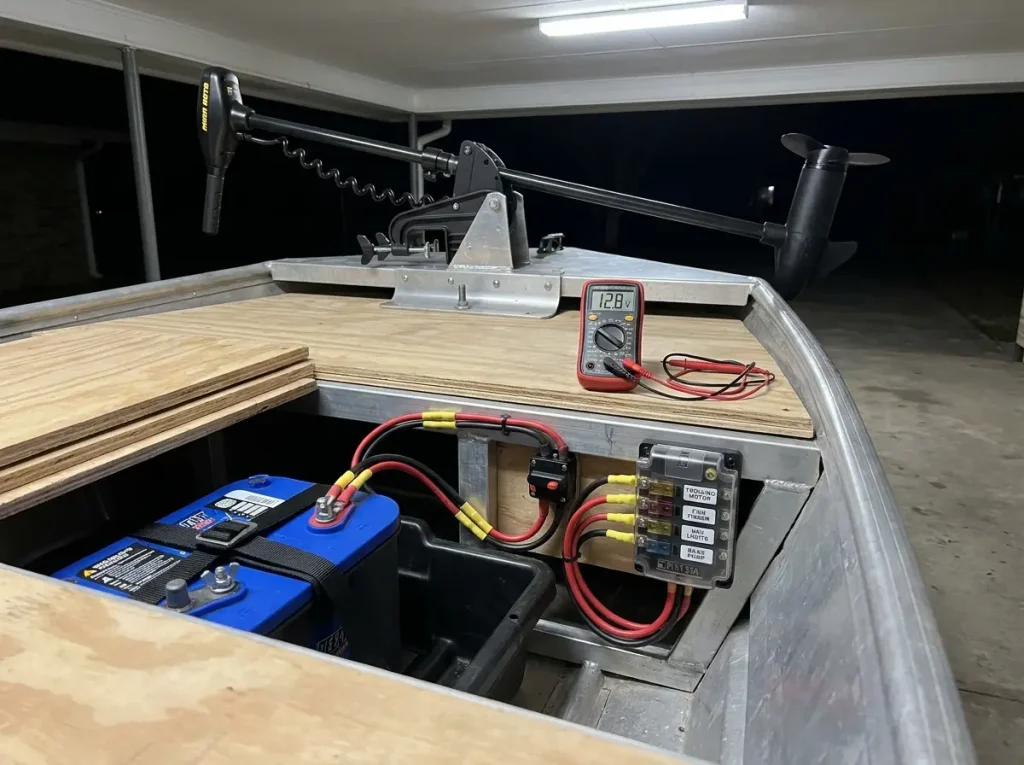
Run all wiring first. Before the deck goes on, lay the trolling motor cable, the fish finder power wire, navigation light wires, and the bilge pump wire along the hull ribs. Secure them with adhesive cable clips every 8 to 10 inches. Use marine-grade tinned copper wire — not automotive wire, which corrodes in months on the water. Then build the deck over the wiring with access panels at each end.
Battery Placement and the Fuse Block
Mount the deep cycle marine battery low in the hull, behind the rear bench thwart where it acts as stern ballast. Use a molded battery tray and a hold-down strap with a wing nut — no exceptions. A loose battery in a boat is a hazard in every direction, from acid spill to electrical short.
Wire the battery to a central fuse block — a small panel with individual circuits for each electrical load. A Blue Sea Systems ST Blade fuse block with 6 circuits handles a typical jon boat setup: trolling motor, fish finder, navigation lights, bilge pump, livewell pump, and one spare. Each circuit gets its own fuse rating based on the wire gauge and load. This is the ABYC E-11 standard — the same wiring code professional marine electricians follow.
Circuit Protection Is Not Optional
Every circuit from battery to load must have overcurrent protection — a fuse or a manual-reset circuit breaker. The trolling motor gets a dedicated breaker at the battery, sized to the motor’s maximum draw (typically 30 to 60 amps depending on thrust). The fish finder and lights run through the fuse block at much lower ratings (3 to 5 amps each).
Never use an automatic-reset breaker. If a short circuit trips it, an auto-reset breaker immediately re-energizes the fault — over and over, potentially starting a fire. Manual-reset breakers require you to physically flip them back on, which means you’ll investigate the problem first.
Fish Finder Installation Without the Headaches
Choosing the Right Unit for a Jon Boat
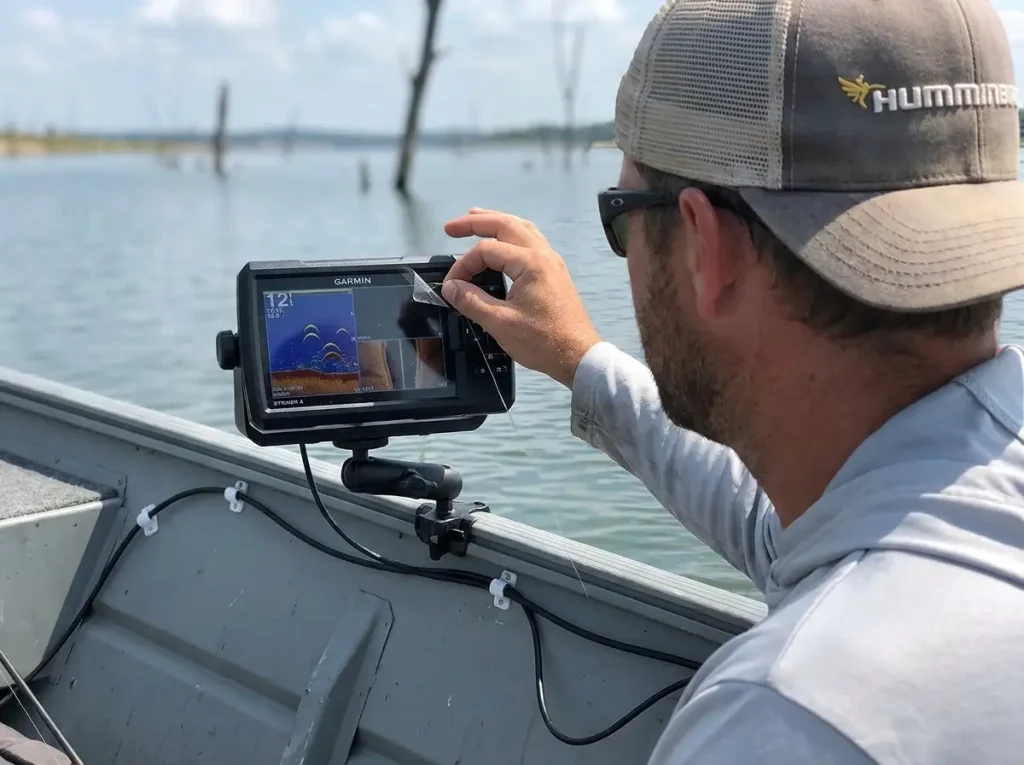
A fish finder on a jon boat doesn’t need to be a $2,000 side-imaging unit. A basic CHIRP sonar like the Garmin Striker 4 or the Humminbird HELIX 5 gives you bottom contour, depth, water temperature, and fish arches — which is everything you need to locate structure and find where fish are holding.
Mount the display unit on a RAM ball mount bolted to the gunwale rail. The RAM system lets you swivel, tilt, and remove the unit without tools — which matters because jon boats live outdoors and electronics should come off between trips to avoid theft and sun damage.
Transducer Mounting: The Part Everyone Struggles With
The transducer is the part that hangs in the water and sends the sonar signal. On a jon boat, you have two options: a transom mount that bolts to the stern, or a shoot-through-hull mount that epoxies inside the hull.
Transom mounts are easier to install and give a clean signal. But on a jon boat, the flat transom creates turbulence at speed that can disrupt the sonar reading. Position the transducer on the starboard side of the transom, below the waterline, with the bottom edge flush with or slightly below the hull bottom. Run the cable along the inside of the hull — never on the outside where it catches on docks and trailer bunks.
If your fish finder shows no bottom reading after installation, the transducer angle is almost always the problem. A 2-degree tilt forward or backward changes everything. Adjust in small increments and test at the ramp before heading out.
Keeping the Screen Readable
Direct sunlight washes out fish finder screens on open boats with no T-top or console shade. The cheap fix: a sunlight visor cut from black foam board and held with Velcro strips. The better fix: turn the screen brightness to maximum and wear polarized sunglasses that cut the glare angle. Both together and you can read the screen at noon in July.
Pro tip: Back up your waypoints to an SD card after every trip. One dead battery or one electrical short and every GPS mark you’ve saved is gone. The backup takes 30 seconds and it’s the cheapest insurance you’ll ever buy.
Safety Gear and Coast Guard Requirements You Can’t Skip
What the Law Requires on Every Jon Boat
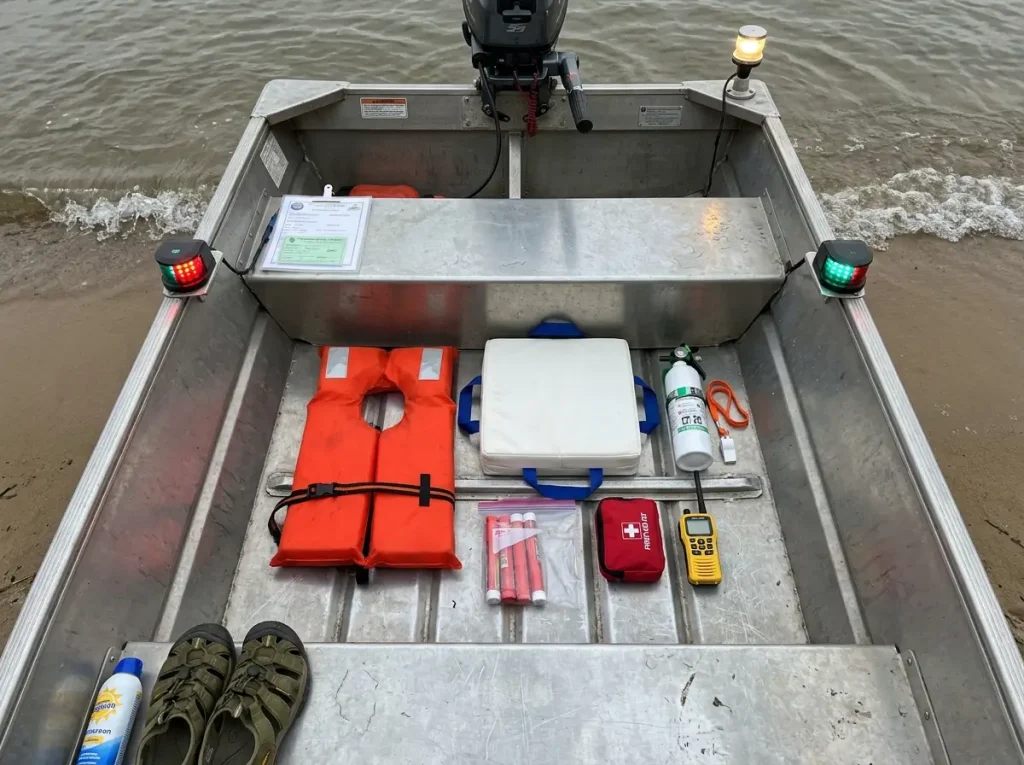
The U.S. Coast Guard requires specific safety equipment on all motorized recreational boats, including jon boats. For vessels under 16 feet — which covers most fishing jon boats — the minimums are:
One wearable PFD (Type I, II, III, or V) per person aboard. Type III fishing PFDs are the most comfortable for all-day wear and have pockets for small tackle items. A Type IV throwable device (a seat cushion or ring buoy) is also required on boats 16 feet and over, but smart anglers carry one on smaller boats too — tossing a cushion to someone in the water is faster than swimming to them.
A sound-producing device — a whistle or horn — is required for boats under 40 feet. A $3 plastic whistle on a lanyard tied to the console or thwart satisfies this requirement.
Navigation lights are required if you operate between sunset and sunrise or in reduced visibility. A jon boat needs a combination bow light (red and green) and a stern white light visible for two miles. LED versions draw minimal power and last years on a single wiring connection to your fuse block.
A fire extinguisher (B-1 rated) is required if the boat has enclosed compartments where fuel vapors can accumulate. Most open jon boats with portable fuel tanks are exempt, but if you’ve built enclosed storage compartments or an enclosed battery box, you need one aboard.
What the Law Doesn’t Require But You Should Carry Anyway
A wading belt if anyone is stepping out of the boat to wade. A first aid kit with waterproof bandages, antiseptic, and a compression wrap. A handheld VHF radio if you fish water large enough that a cell phone won’t reach help. Sunscreen and water — dehydration ends more fishing trips than engine problems.
The Registration and Capacity Plate
Every motorized boat must be registered with the state and display registration numbers on the hull. The capacity plate — that small metal tag riveted near the stern — shows the maximum weight and horsepower rating. Exceeding either is a citation-worthy offense, and more importantly, it’s the fastest way to end up swimming.
If your modifications have pushed the boat close to its capacity plate limit, you’ve built too heavy. Go back to the weight budget and start cutting.
Conclusion
The difference between a jon boat that fishes well and one that fights you all day is the build sequence. Weight budget first, wiring second, structural mods third, accessories last. Every shortcut in that order creates a problem that costs more to fix than it would’ve cost to do right.
Start simple. A casting deck, one pedestal seat, a trolling motor, and a basic fish finder will cover 90% of the fishing you’ll do from a jon boat. Add the rest after you’ve spent a season learning what you actually need — not what the forum photos made you want.
The best jon boat build is the one that gets you on the water fishing instead of in the garage building.
Q1 What are the best modifications for a jon boat?
A casting deck with a pedestal seat, a bow-mount trolling motor, a basic fish finder, and vertical rod holders cover most fishing needs. Start with these four and add storage or electronics after a season of use tells you what’s missing.
Q2 How much does it cost to modify a jon boat for fishing?
A functional fishing setup runs $500 to $1,500 depending on material choices. Plywood decking with bed liner costs $100 to $200, a trolling motor $150 to $400, a fish finder $100 to $300, and seats plus rod holders $100 to $200.
Q3 Can you put a trolling motor on a jon boat?
Yes, and most anglers consider it the single most useful modification. A 30 to 55-pound thrust 12V trolling motor handles any jon boat up to 16 feet. Bow-mount gives better control for fishing; transom-mount is simpler to install.
Q4 What size jon boat is best for fishing?
A 14-foot jon boat hits the sweet spot for most anglers — wide enough for two people, stable enough for standing and casting, and light enough to tow with a small vehicle. Twelve-foot boats work for solo anglers on small water.
Q5 How do you wire a fish finder on a jon boat?
Run dedicated 18-gauge tinned marine wire from the fuse block to the fish finder mount location. Never tap into the trolling motor circuit — the voltage fluctuations cause screen interference. Use a 3-amp fuse and heat-shrink all connections.
Risk Disclaimer: Fishing, boating, and all related outdoor activities involve inherent risks that
can lead to injury. The information provided on Master Fishing Mag is for educational and informational purposes
only. While we strive for accuracy, the information, techniques, and advice on gear and safety are not a substitute
for your own best judgment, local knowledge, and adherence to official regulations. Fishing regulations, including
seasons, size limits, and species restrictions, change frequently and vary by location. Always consult the latest
official regulations from your local fish and wildlife agency before heading out. Proper handling of hooks, knives,
and other sharp equipment is essential for safety. Furthermore, be aware of local fish consumption advisories. By
using this website, you agree that you are solely responsible for your own safety and for complying with all
applicable laws. Any reliance you place on our content is strictly at your own risk. Master Fishing Mag and its
authors will not be held liable for any injury, damage, or loss sustained in connection with the use of the
information herein.
Affiliate Disclosure: We are a participant in the Amazon Services LLC Associates Program, an
affiliate advertising program designed to provide a means for us to earn advertising fees by advertising and linking
to Amazon.com. As an Amazon Associate, we earn from qualifying purchases. We also participate in other affiliate
programs and may receive a commission on products purchased through our links, at no extra cost to you. Additional
terms are found in the terms of service.