
In this article
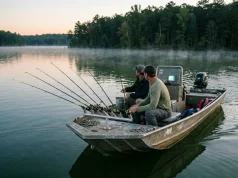
The sonar screen showed a tight cluster of returns locked to the bottom of a submerged stump at 22 feet. Nobody in the boat thought “redear.” We’d been chasing bluegill in the weed line all morning, pulling one after another from three feet below the surface. Then my drop shot slid past the school and ticked something hard. A shell bed. The rod loaded sideways, not down, and the fight felt nothing like a bluegill. That 2-pound shellcracker rewired everything I thought I knew about sunfish.
After 15 years of chasing panfish across Florida, North Carolina, and the reservoir systems of the Southwest, I’ve learned that most anglers walk right past the best-eating, hardest-fighting sunfish in North America because they don’t know what they’re looking at. They confuse it with a bluegill, fish for it wrong, and then claim it vanished.
This guide covers what separates the redear sunfish from every other panfish on the continent. The anatomy that earned them the “shellcracker” name. The acoustic spawning signals that competitors ignore. The seasonal depth patterns that make them vanish. And the precision rigging required to consistently put trophy-class specimens in the net.
⚡ Quick Answer: The redear sunfish (Lepomis microlophus), commonly called the shellcracker, is a bottom-oriented sunfish found across the southeastern U.S. that feeds primarily on snails and mussels using specialized crushing teeth in its throat. The world record stands at 6.30 lbs (Thomas Farchione, Lake Havasu, 2021). Target them with a drop shot rig, fine-wire Aberdeen hooks, 4-6 lb fluorocarbon, and tungsten weights fished tight to hard bottom structure at 6-25 feet. The spawn window (70°F+) is your best shot at trophy fish.
Redear Sunfish vs Bluegill — The ID Markers That Actually Matter
The Ear Flap Test — Red Margin vs Solid Black
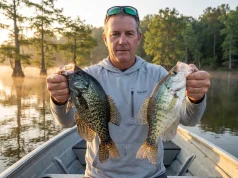
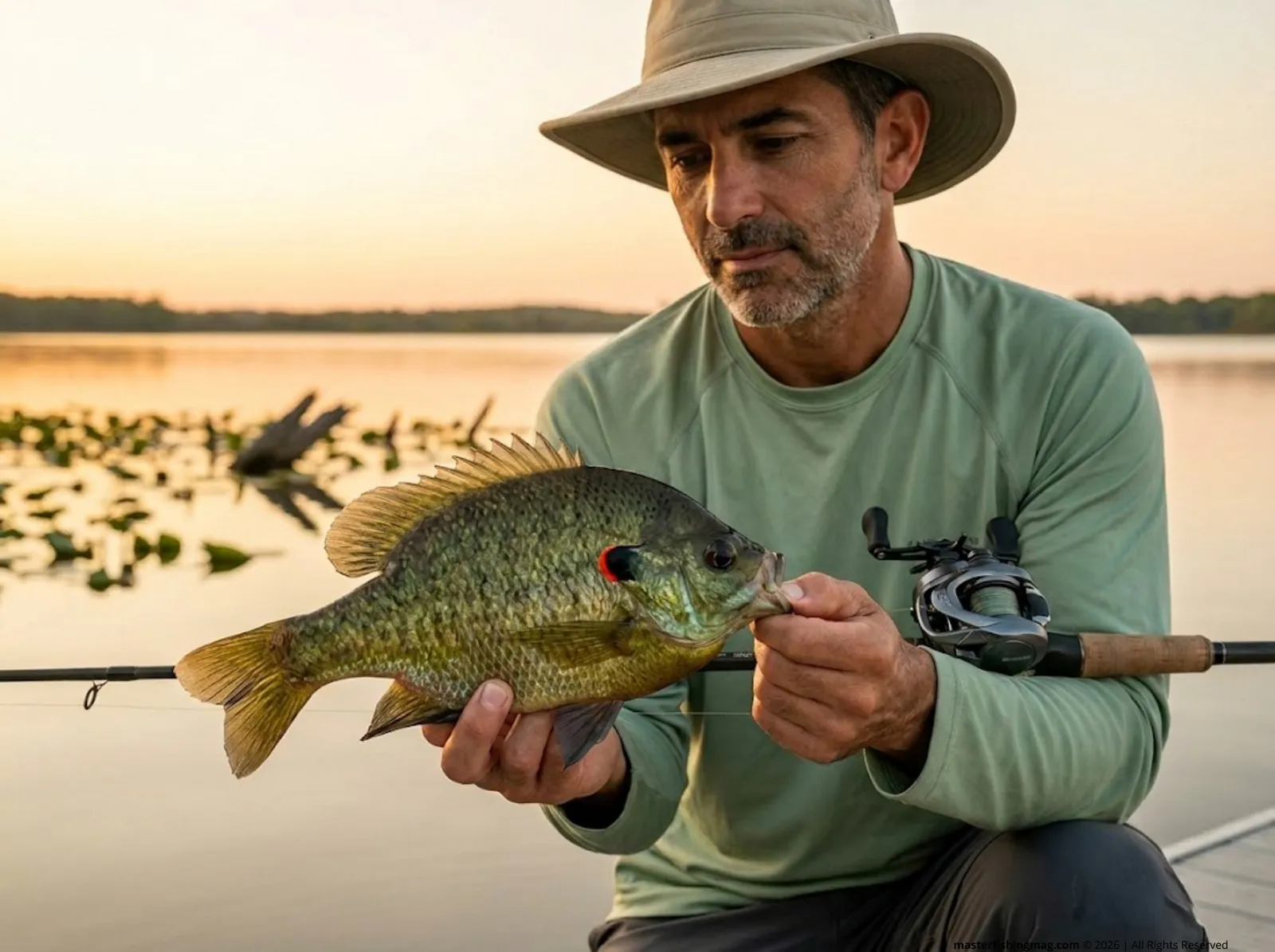
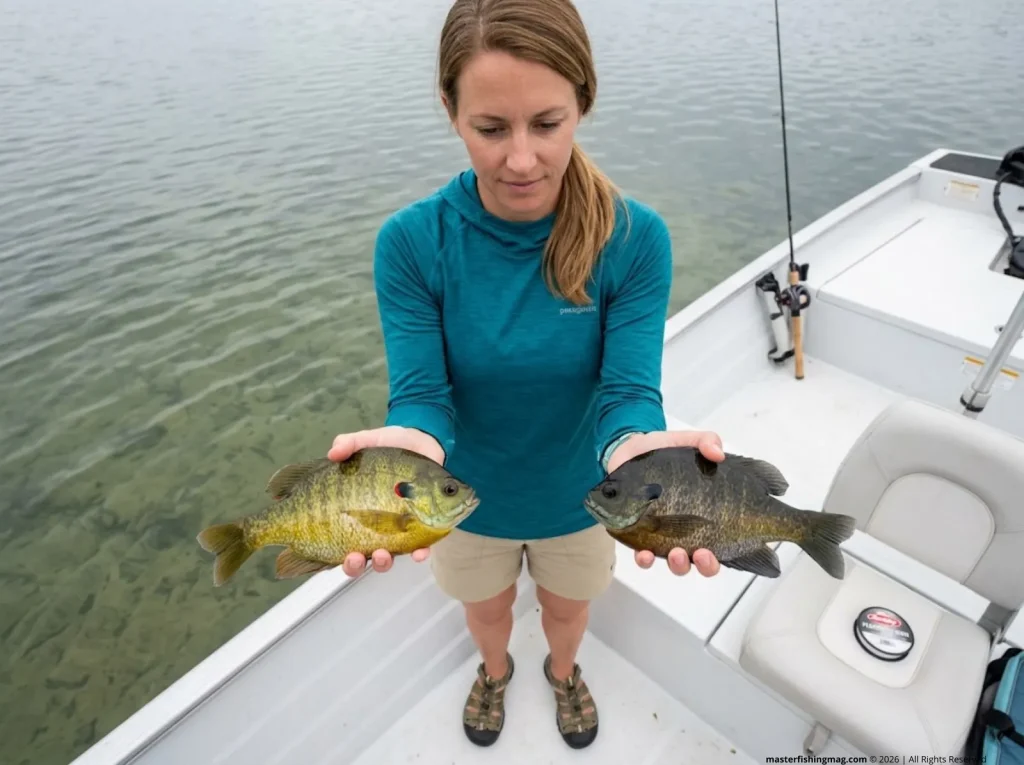
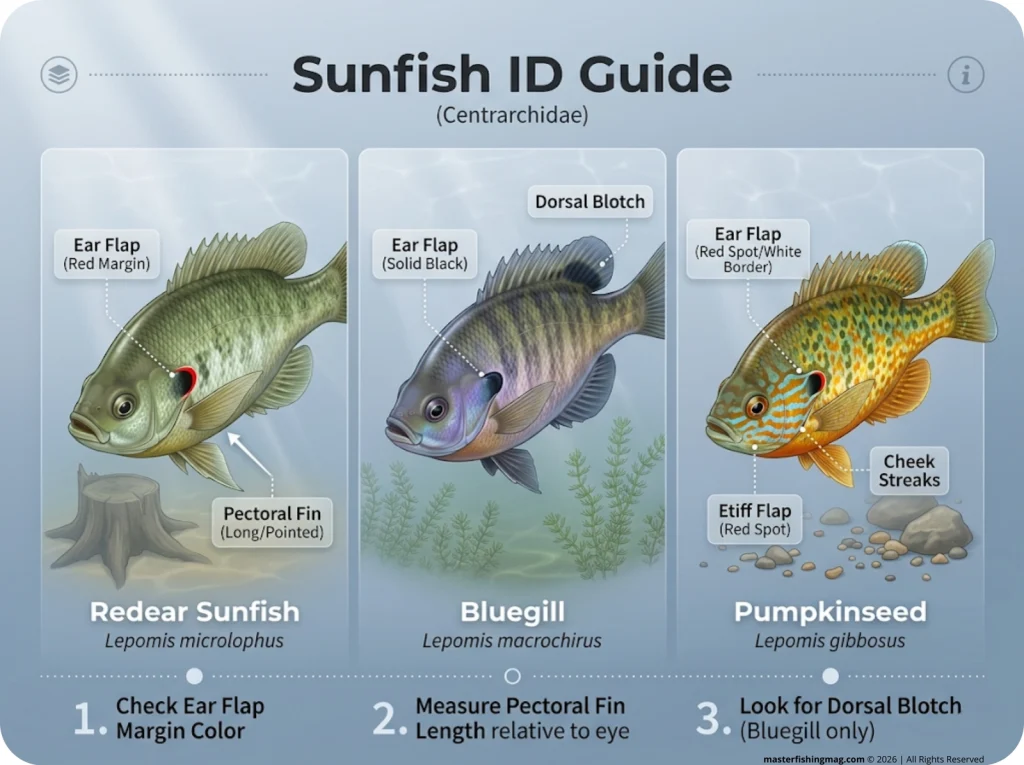
The fastest way to separate a redear sunfish from a bluegill sits right behind the eye. Look at the opercular flap — that stiff tab of cartilage anglers call the “ear.” On a redear, you’ll see a black center bordered by a scarlet (males) or orange (females) crescent at the edge. On a bluegill, that same flap is flexible and solid dark blue or black, with no colored margin at all.
Here’s what will burn you, though: on trophy-class fish over 10 inches, that red ear margin can fade to almost nothing. I’ve caught 12-inch shellcrackers in Lake Havasu where the ear looked plain black until I held it up to direct sunlight. So color alone is not enough. You need a backup test.
The pumpkinseed (L. gibbosus) throws another curveball because it also shows a red crescent on the ear. But pumpkinseeds carry vivid blue-orange cheek streaks that redear sunfish lack entirely. Once you know that difference, you won’t mix them up again.
Pectoral Fins and Dorsal Spot — The Secondary Confirmations
Here’s the single most reliable structural test for redear identification, and it works in any light, any water color, any fish size. Fold the pectoral fin forward toward the head. On a redear, that fin reaches past the eye. On a bluegill, it stops well short.
Then check the dorsal fin. Bluegill carry a distinct dark blotch at the rear base. Redear do not. If you see that spot on the dorsal fin, you’re holding a bluegill, full stop.
Pro-Tip: When handling a fish in stained water or low light, skip the color check entirely. The “fin fold” test works regardless of water clarity or the fish’s age. Fold it forward, check the eye line, and you’ll know in two seconds.
Once you’ve confirmed it’s not a bluegill — or if you’re specifically targeting big bluegill in deep water — the next question is what’s happening inside the redear’s throat.
When Hybrids Muddy the Water
Where redear and bluegill share the same spawning colonies — and they’re community spawners, so it happens often — natural hybrids show up. These fish display intermediate features: a semi-colored ear flap, medium-length pectorals, and a physical shape that splits the difference between the two species.
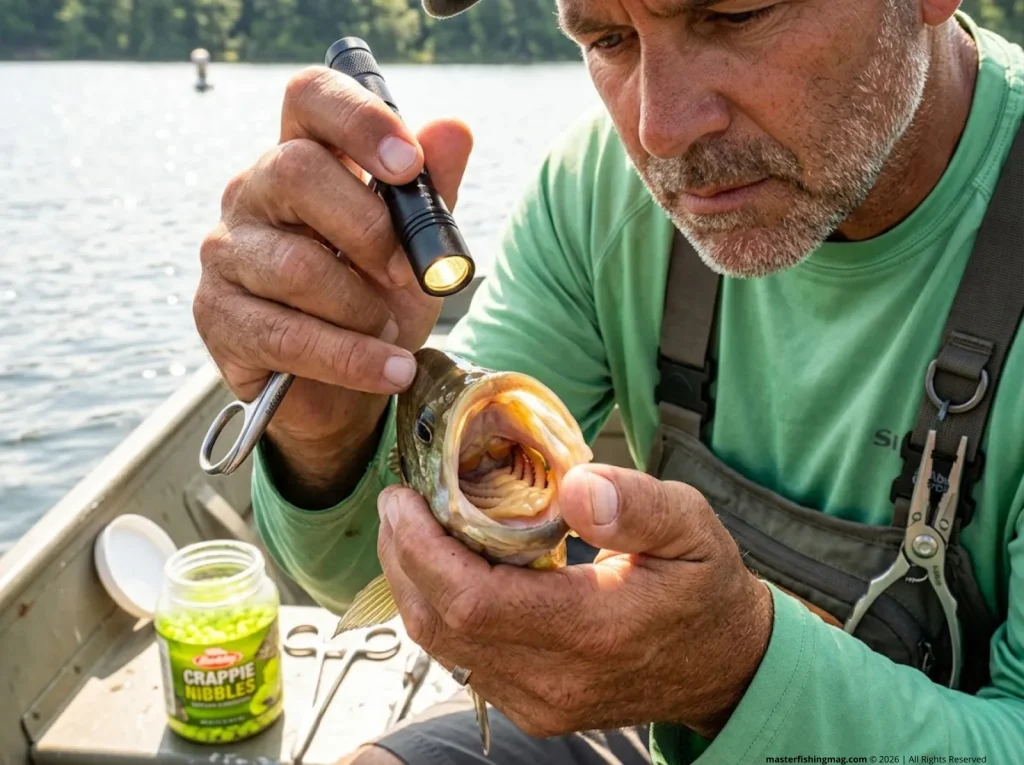
Hybrids are especially common in stocked ponds across Florida and North Carolina, where both species get dropped in together for pond management. If you catch a fish that “almost” passes both the ear and the fin test, grab a penlight and a pair of forceps. Redear hybrids retain partial molariform plates in the throat, even when external markers fail. That’s the final confirmation, and it also explains why the fish bit your worm instead of your spinner — those teeth are built for crushing, not chasing.
The Pharyngeal Teeth — Why “Shellcracker” Isn’t Just a Nickname
Molariform Plates — Built for Compression, Not Capture
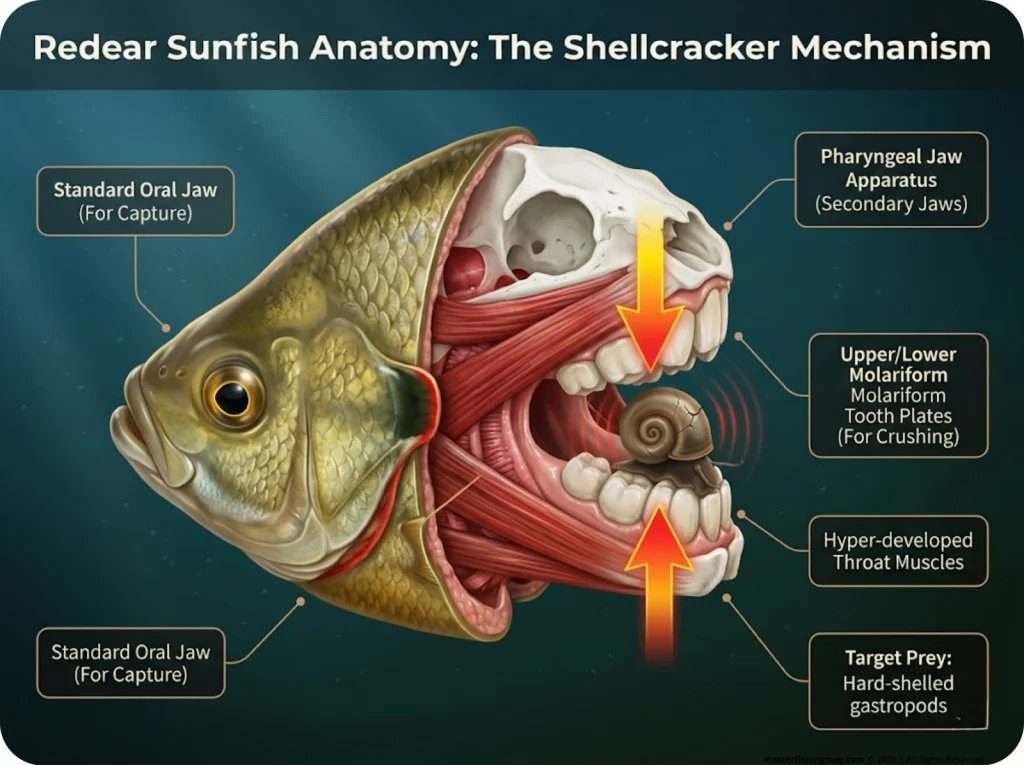
The name “shellcracker” isn’t marketing. It’s anatomy. Redear sunfish carry a secondary set of jaws in the throat called the pharyngeal jaw apparatus — upper and lower arches lined with broad, rounded, pavement-like teeth designed for one purpose: sustained crushing force.
These aren’t the needle-like teeth you’d find on a bass or the brush-like ones on a standard bluegill. Redear pharyngeal teeth are flat, mineralized pads connected deep into the bone. Specialized throat muscles contract in a rhythmic pattern to crack open the hard shells of snails and mussels. According to the University of Michigan Animal Diversity Web profile on Lepomis microlophus, this crushing system succeeds on hard-shelled prey roughly 85% of the time.
No other freshwater sunfish species comes close to that efficiency. It’s the single biological trait that explains where redear live, what they eat, why they bite the way they do, and why most anglers lose them before they even know they had one.
What the Crushing Mechanism Means for Your Hookset
Here’s where the biology hits your tackle box. A redear doesn’t just inhale bait and swim off. It picks up the offering, positions it against those pharyngeal plates, and tests it before committing to the crush. If your terminal tackle creates even slight unnatural resistance — heavy lead, stiff 10-lb monofilament, an oversized hook — the fish’s oral cavity detects the discrepancy during the positioning phase and spits everything out.
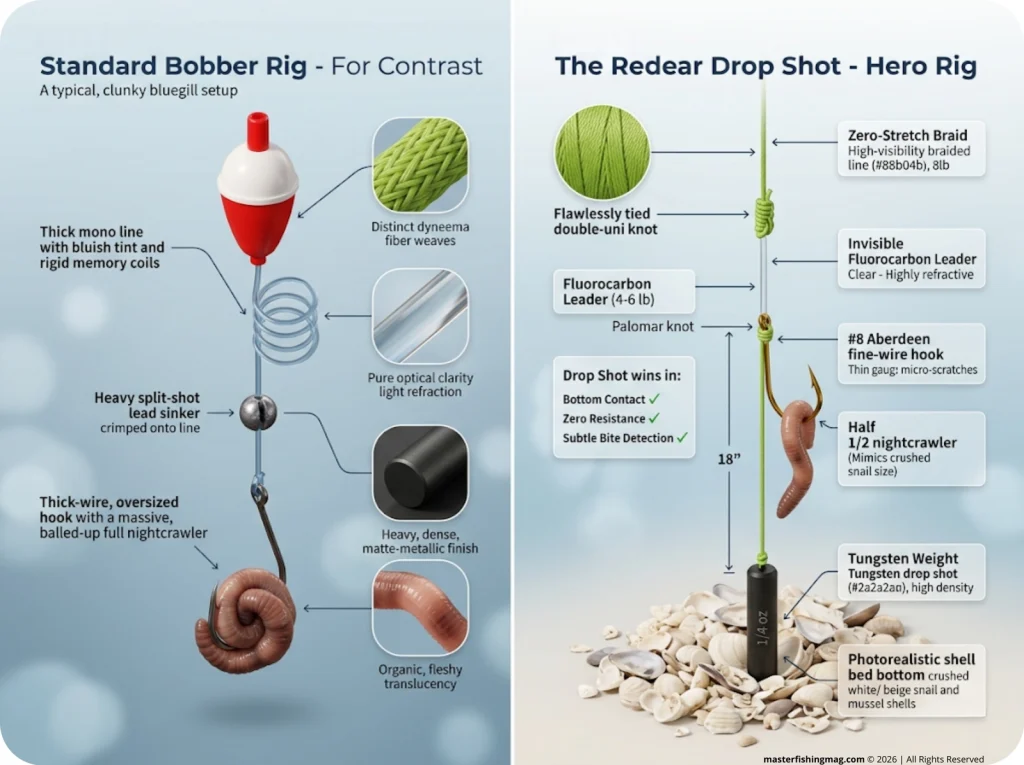
That legendary “subtle bite” everyone complains about with shellcrackers? It’s not timidity. It’s a biological test. The fish is deciding whether your offering will crack like a snail or resist like a piece of metal. Match the mechanism: fine-wire hooks in sizes #6 to #10 (Aberdeen style), 4-6 lb fluorocarbon leader, and tungsten weights that give you bottom contact without bulk.
Pro-Tip: Getting short strikes on nightcrawlers? Shorten the worm. A full crawler creates interference during the alignment phase in the throat. Half a nightcrawler threaded on a #8 hook converts at a significantly higher rate because it mimics the compact size of a freshly crushed snail.
Where Redear Live — Depth, Structure, and the Post-Spawn Vanishing Act
Bottom-Oriented by Design — 6 to 25 Feet Year-Round
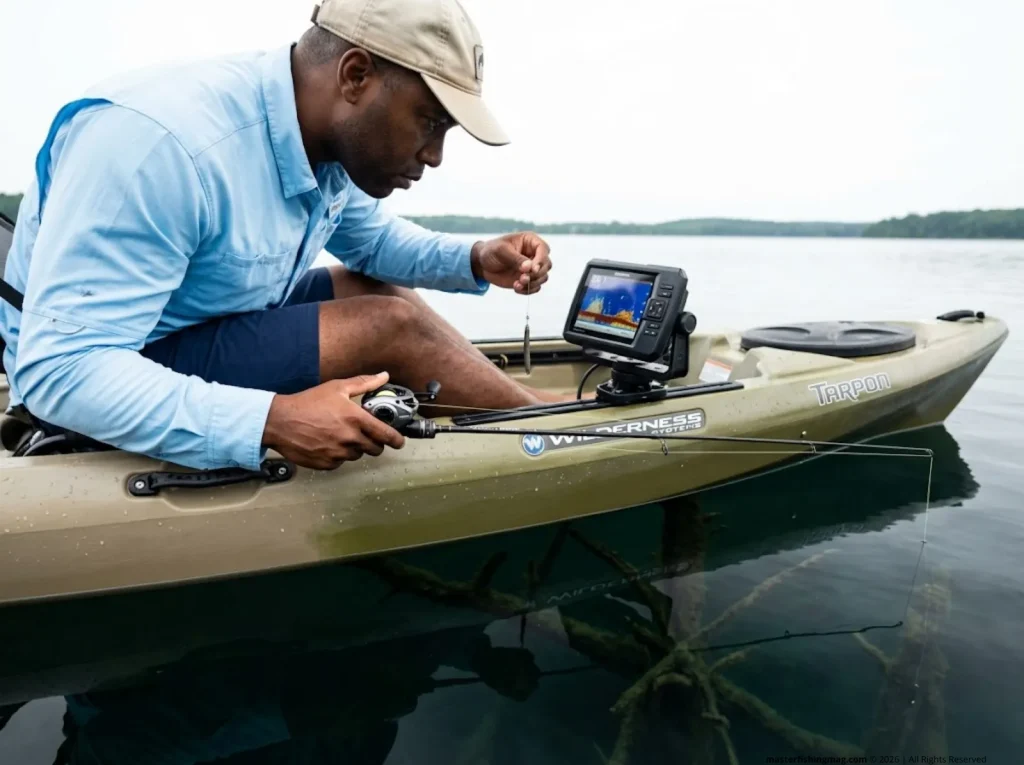
Every habitat decision a redear makes comes back to diet. Their prey — snails, mussels, aquatic insect larvae — lives on or within the bottom substrate. So that’s where the fish lives. Redear occupy a lower vertical stratum than bluegill and are rarely, if ever, seen at the surface. They don’t chase topwater. They don’t suspend in weeds. They sit tight on sand, gravel, or hard mud bottoms with gastropod populations.
Their optimal temperature window runs 70-75°F, but they handle 60 to 89°F without problems. Even more unusual: redear handle salinity up to 12 parts per thousand, which is far more than any other sunfish species. That tolerance makes them viable in brackish coastal ponds where bluegill won’t thrive. They also handle low-oxygen water better than largemouth bass, which lets them retreat into deeper, stagnant structure during the dead of summer and the dead of winter — periods when they become invisible to standard angling pressure.
The “Disappearing Act” — Summer Humps and Cold-Water Transition Zones
“I caught them in April and now they’re gone.” I hear that complaint every year. The fish didn’t leave. They moved.
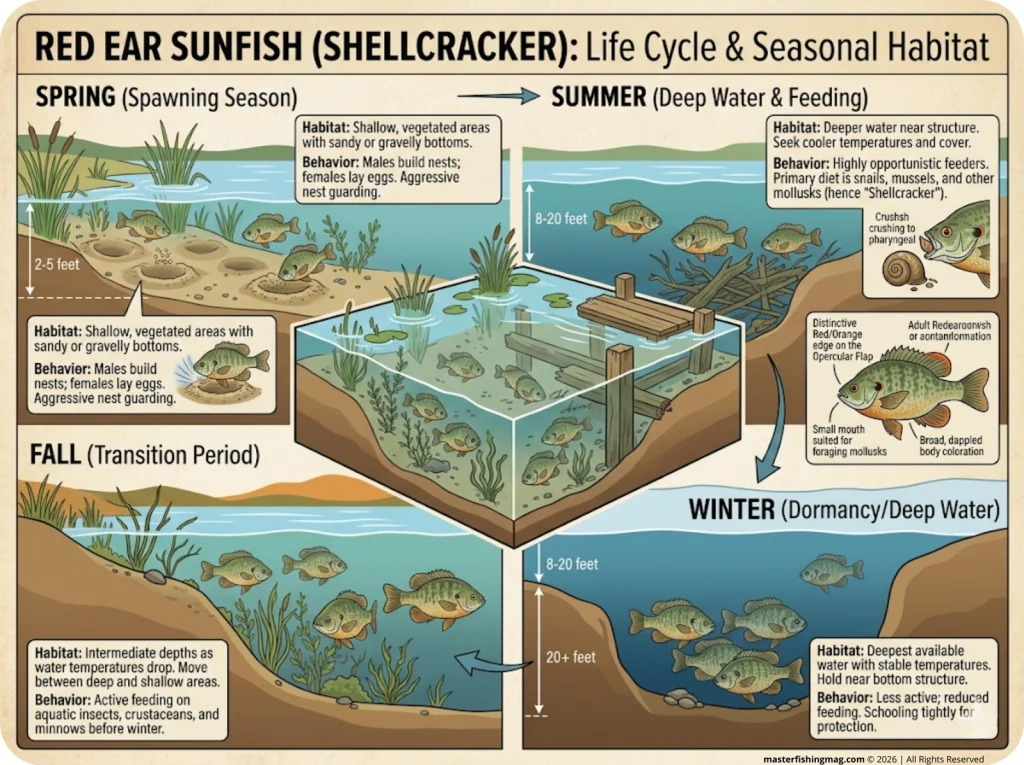
After the spawn, redear relocate to offshore humps with submerged stumps in 15 to 25 feet of water. They often hold near schools of bluegill but sit at the very bottom of that school, right in the cold-water transition zone. If you’re fishing above the primary bluegill school, you’re fishing over the top of every trophy shellcracker in the area.
In Lake Havasu-type reservoirs, quagga mussel colonies on deep-water rock piles create year-round “feeding stations” that operate completely independently of spawn cycles. The 2007 quagga invasion created an unlimited high-protein food source that only the redear’s throat jaws could exploit. Fish that normally reach 1 lb in 6 years are hitting 5 to 6 lbs in the same lifespan. The U.S. Fish and Wildlife Service redear sunfish profile confirms the native range and conservation status of a species whose growth trajectory has been completely rewritten by this invasive synergy.
The 2021 world record — Thomas Farchione’s 6.30-lb fish from Havasu — measured 17 inches long with a 20-inch girth. Girth exceeding length. That’s what happens when a specialized crusher meets an unlimited food source.
Pro-Tip: Mark every stump deeper than 15 feet with a GPS waypoint during spring when water clarity peaks. Those are your summer redear spots. When the weeds wither in October, fish those same waypoints. That fall window is when the biggest shellcrackers reappear.
Reaching these summer spots demands light line finesse techniques for deep structure — especially when targeting a fish that rejects heavy tackle by design.
Spawning Season — Acoustic Signals, Bed Depth, and the Window That Opens Once
The Popping Sound — The Courtship Call Nobody Writes About
Male redear produce a distinct “popping” sound during courtship by rapidly clapping their oral jaws shut. It’s an acoustic spawning signal meant to attract females and trigger egg-laying, and you won’t find it mentioned in most fishing content because almost nobody knows about it.
Research shows these calls produce a distinct deep hum that carries well underwater. This “chorusing” behavior maintains colony integrity in vegetated or turbid water where visual cues fail. A group of spawning males on a colony produces a sustained pulsing rhythm that can, in theory, be picked up by passive sonar or underwater microphones.
There’s also a scent component. Experienced anglers report detecting an “over-ripe watermelon” scent near active beds. That smell is likely the result of increased biological activity during the spawn. High-scent baits like Berkley Crappie Nibbles or Gulp! in natural scent profiles mimic these chemical triggers and can spark an instinctual bite that plain plastics miss entirely.
This sound production is part of a broader sensory world. Understanding how the lateral line system detects vibration underwater explains why boat noise shuts down spawning activity almost instantly.
Bed Depth and Architecture — Deeper Than You Think
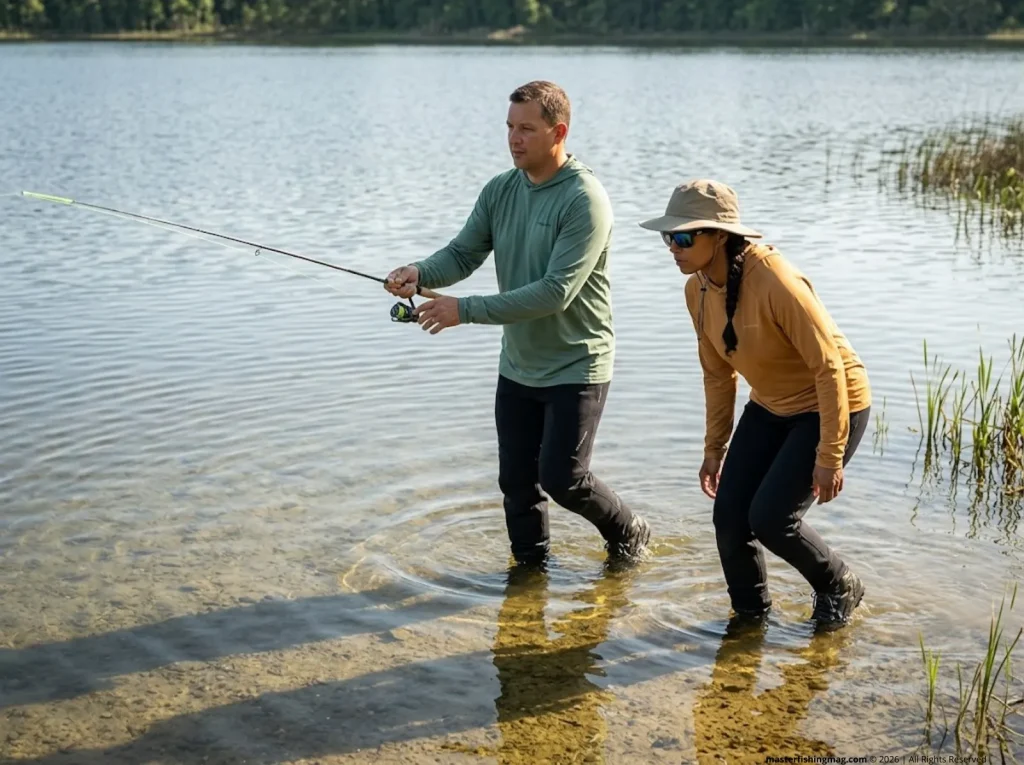
Redear nests sit deeper than most anglers expect. While bluegill beds show up in 2 to 4 feet, shellcracker nests are saucer-shaped depressions, 25 to 61 cm wide, located at depths of 1 to 6 meters. They’re colonial breeders — nests packed so close they nearly touch. Males guard and fan the eggs for 6 to 10 days after fertilization. A single female can deposit 9,000 to 80,000 eggs per season distributed across multiple nests.
On Garmin LiveScope in Perspective Mode, redear beds appear as larger, deeper depressions compared to the shallower bluegill saucers. That visual difference is subtle on screen but meaningful once you know what to look for.
Pro-Tip: Do not anchor over a spawning colony. Position your boat at least 50 feet away and use a long cast or extended drop shot to reach the beds. The acoustic disturbance from an anchor chain hitting bottom will shut down the “chorus” and push guarding males off the nests.
Engineering the Redear Drop Shot — Terminal Tackle for a Subtle Bite
The Component Breakdown — Line, Leader, Hook, Weight
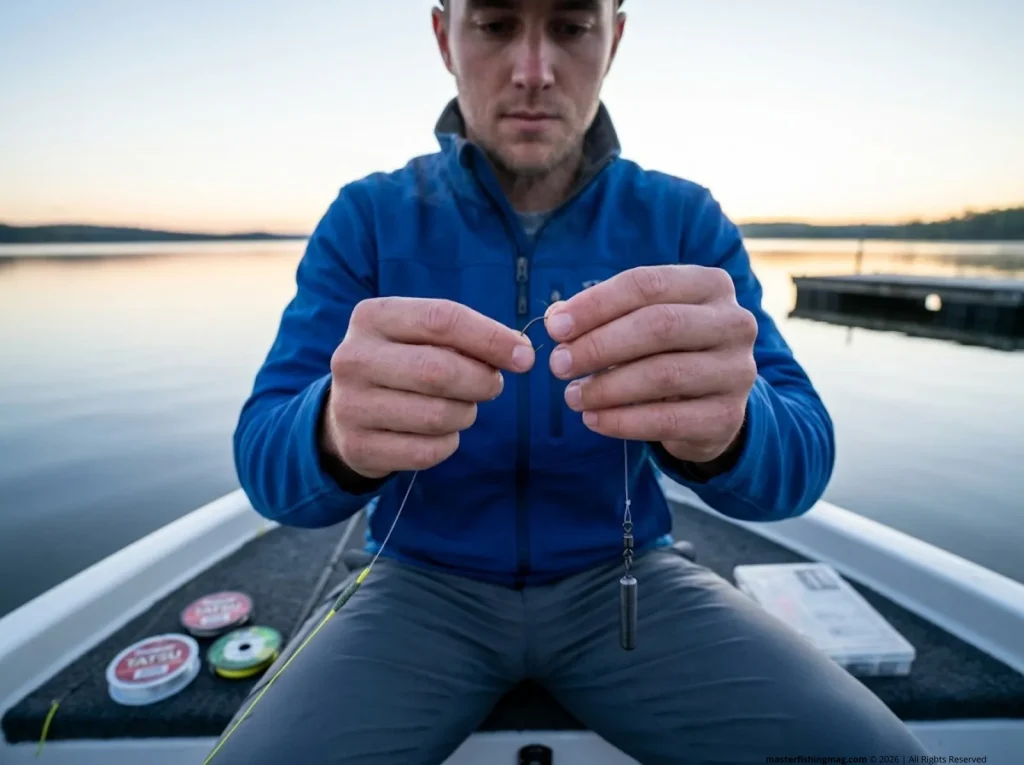
The redear drop shot is built around one principle: eliminate every source of resistance that the fish’s throat system can detect. Here’s the setup, component by component.
Start with 4-8 lb braided mainline like Power Pro. Zero stretch means you feel the gentle pick-up that defines a redear bite. Tie on 18 to 36 inches of 4-6 lb fluorocarbon leader. Fluorocarbon sinks naturally and bends light the same way water does, making it close to invisible in clear conditions.
Your hook should be a size #6 to #10 Aberdeen or Owner fine-wire. Fine wire is non-negotiable. It penetrates easily and lets live bait like nightcrawlers move naturally, avoiding the resistance that triggers rejection during the positioning phase. Finish with a 1/8 to 3/8 oz tungsten drop shot weight. Tungsten is much denser than lead. That means a smaller profile on the bottom (less spooking) and a crisper “tick” when you contact shell beds or rock.
For the full mechanics of tying and fishing a drop shot — including the Palomar knot and leader length decisions — see our complete drop shot rigging and tactical guide.
BFS Gear — The Japanese Innovation Shellcrackers Deserve
Bait Finesse System (BFS) reels built with ultra-shallow spools can cast lures as light as 1/32 oz with pinpoint accuracy. The advantage over spinning tackle for shellcrackers is a “direct-drive” feel that transmits vibrations better than a bail-and-spool system. You feel the tick of a redear testing the bait before the swallow.
Top BFS reel benchmarks include the Shimano Aldebaran BFS, which is the lightest option on the market. The Shimano Curado BFS gives you better durability at a lower price. The KastKing Kestrel Air wins the value-to-weight category. Pair any of these with a 6’6″ to 7′ medium-light rod with a moderate-fast tip. The soft tip absorbs the head-shaking fight. The moderate backbone pulls a 2-lb fish out of stumps.
Bait Selection — What the Pharyngeal Jaw Tells You About Presentation
Half a nightcrawler threaded on a #8 hook is the single most consistent bait for redear sunfish. Red worms and crickets both produce well. All three mimic the soft-tissue prey the fish expects after crushing a shell.
One critical mistake that transfers from bluegill tactics: throwing a live shiner. Redear sunfish do not eat other fish and will ignore live shiners that bluegill attack readily. If you’re fishing the same bait you’d use for bluegill and getting nothing, that’s likely why.
For scent, dip your terminal knot in Pro-Cure “Shrimp” scent. The high protein-leaching profile mimics crushed mollusk and accelerates commitment from the “test” phase to the full take.
Reading Redear on LiveScope and Forward-Facing Sonar
Behavioral Signatures — Bottom-Locked vs Suspended
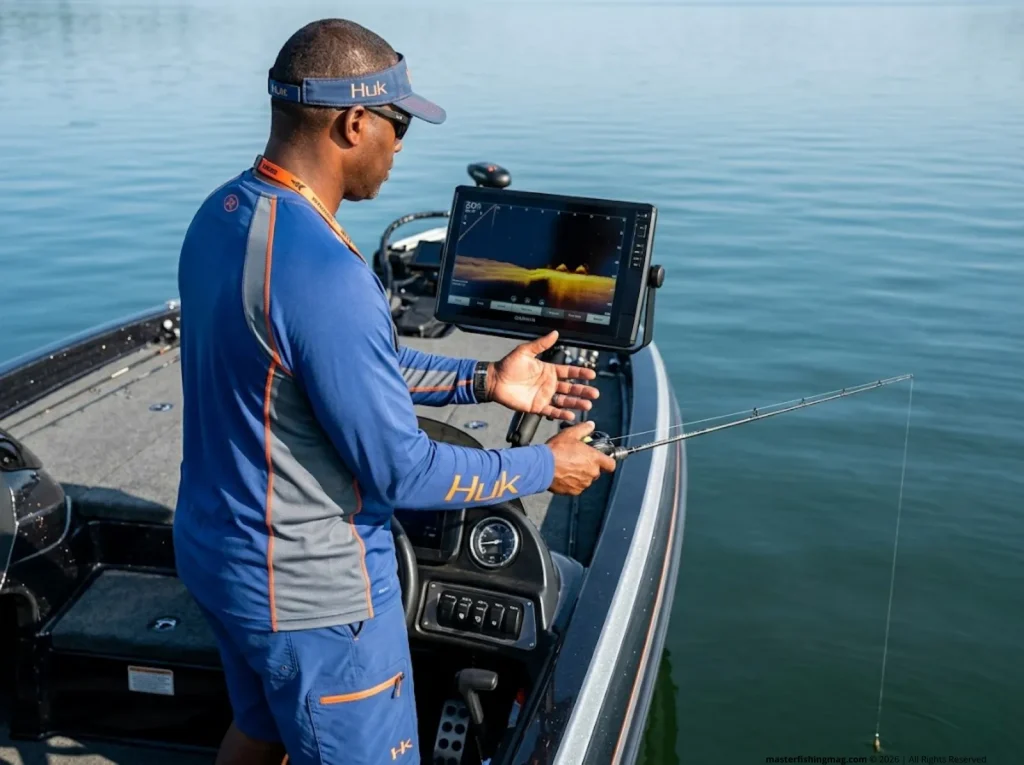
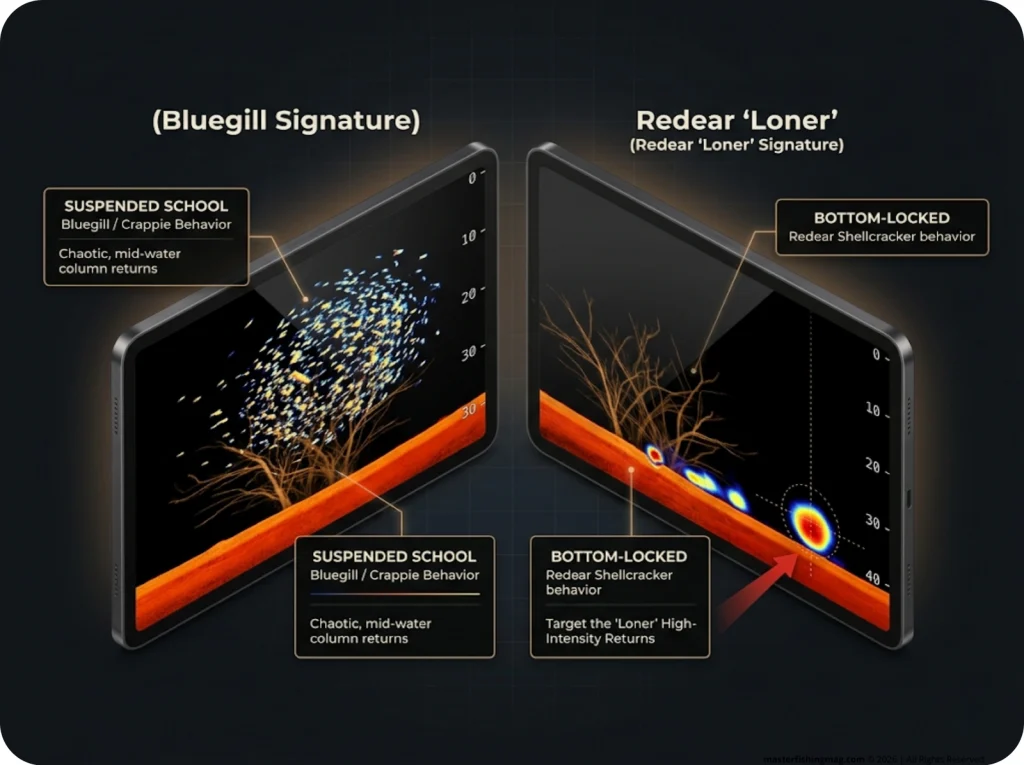
On forward-facing sonar, a school of fish suspended 3 feet off a brush pile is almost always bluegill or crappie. Redear returns sit locked to the bottom or pressed flat against structure. That vertical positioning is the single biggest differentiator on any Garmin LiveScope screen.
Large redear produce a “crisp,” bright signal because of their overall mass and large swim bladders. Bluegill typically swim in darting, circular patterns when agitated. Shellcrackers hold stationary over specific shell beds or stumps for long periods — more lateral drift, less vertical bounce.
Watch for what I call the “loner” signature: a single high-intensity return sitting alone on a hard-bottom point, separated from any visible school. Evidence from multiple guides and record-chasers suggests that world-record-size redear break away from colonies and become solitary. That lone bright dot on clean hard bottom is your fish. Once you’ve isolated that single bottom-hugging return, you need tackle sensitive enough to detect the bite — start with one of these field-tested ultralight spinning combos.
Perspective Mode for Bed Fishing During the Spawn
Switch LiveScope to Perspective Mode and you get a topographic view of the bottom. Redear nests look like larger, deeper depressions compared to the shallow saucers bluegill dig. By watching the fish’s reaction to your bait in real-time, you can read its mood: nudging means cautious (slow your presentation), and inhaling means committed (set the hook immediately).
For pre-spawn scouting, scan hard-bottom flats at 4 to 15 feet with Down Imaging first. When you mark concentrations, switch to LiveScope Forward to confirm species behavior before you commit to an anchor position.
Conservation and Sustainable Harvest — Protecting the Colony
The Parasite Control Role — Why Redear Improve Entire Fisheries
Redear earn their spot in a pond through more than sport value. Snails are intermediate hosts for “yellow grub” and other fish parasites. By eating snails, redear disrupt the parasite’s life cycle, producing healthier populations across every species in the same lake or pond — bass, crappie, bluegill, all of them.
Pond managers stock redear specifically for this biological control function. Harvest too many from a small pond and you’ll see parasite outbreaks that affect everything else swimming in it. The South Carolina DNR redear sunfish species profile documents this ecological role alongside stocking recommendations for lake managers.
Selective Harvest — Who to Keep and Who to Release
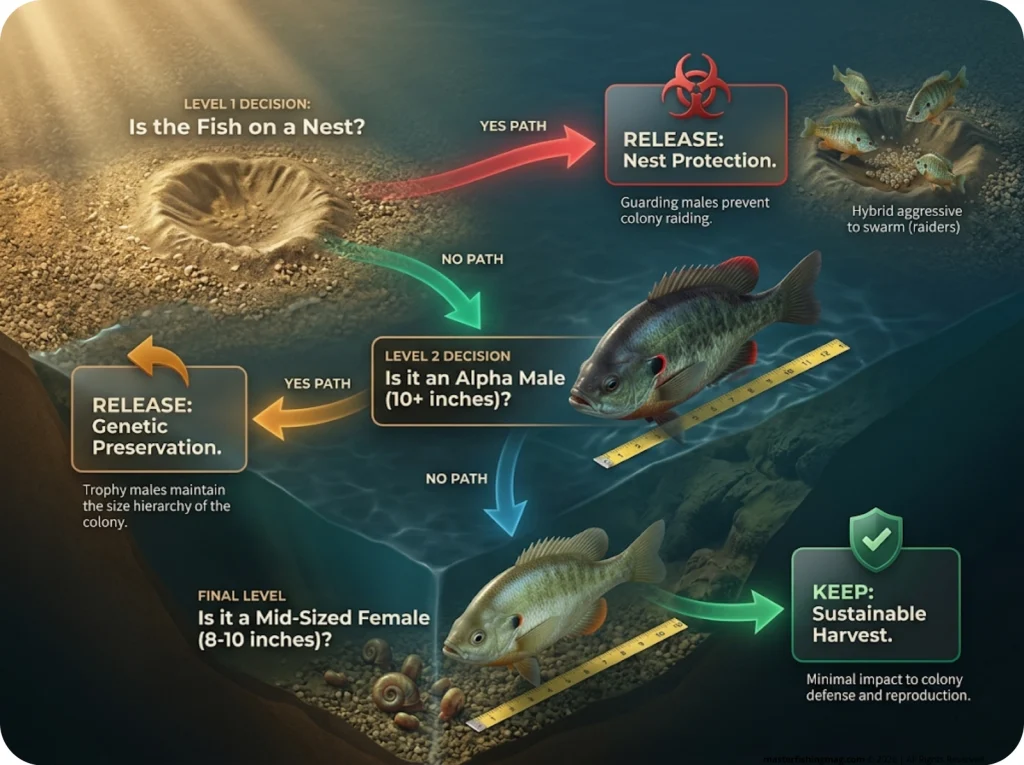
In colonial spawning species, the largest, most aggressive males guard the nests. Pull those “Alpha” males during the spawn and you open the door for raiders — smaller bluegill and hybrids — to eat the eggs. That one decision collapses recruitment of the next trophy generation.
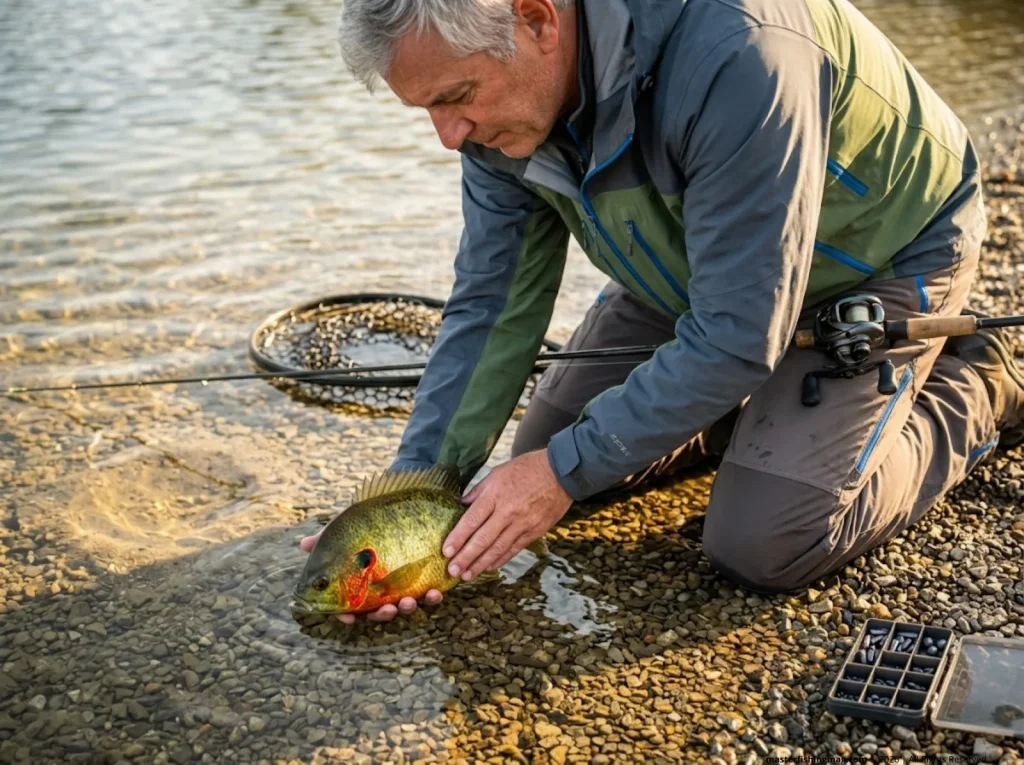
The better approach: target mid-sized females in the 8 to 10-inch range for table fare. Their removal has less impact on colony defense than pulling a guarding male. It’s a small change in habit that produces outsized results over three to five years of managed harvest.
Use tungsten instead of lead for all bottom presentations. Given the redear’s bottom-feeding habit, lost lead weights sit in the exact zone where shellcrackers forage. That’s a direct ingestion pathway for a fish designed to pick up and crush small hard objects. It’s not just a tackle preference — read about the hidden danger of lead sinkers to waterfowl and wildlife before making your next weight purchase.
For fish pulled from 20 feet or deeper, pressure shock is a real concern. Use a descending device or proper venting for deep-water releases. A failed release isn’t a release.
Conclusion
Three things to carry with you.
Identify before you fish. The pectoral fin fold test beats color every time, especially on large fish where the red ear margin fades. If the fin reaches past the eye, you’re in shellcracker territory.
Think bottom, think pharyngeal. Every decision about your rig, weight, leader, and bait size stems from the fact that this fish feeds by positioning prey for a crush. Minimize resistance or accept rejection. Half a nightcrawler, fine-wire hook, fluorocarbon leader, tungsten weight. That’s the system.
Respect the colony. Release the big guarding males during the spawn. Keep the mid-sized females for the table. That single choice decides whether your pond produces 2-pounders or half-pounders in three years.
Next time you mark a tight cluster of returns on hard bottom and assume they’re bass, drop a half nightcrawler on a #8 Aberdeen into the school. You might find the most technical, hardest-fighting panfish in North America has been living right beneath the fish everyone else was targeting.
FAQ
What is the best bait for redear sunfish?
Half a nightcrawler on a #6-#8 fine-wire Aberdeen hook fished on a drop shot is the most consistent producer. Red worms and crickets are close alternatives. Avoid minnows entirely — redear sunfish do not eat other fish and will ignore live shiners that bluegill attack readily.
How can you tell a bluegill from a redear sunfish?
Fold the pectoral fin forward: on a redear, it reaches past the eye; on a bluegill, it stops short. Also check the dorsal fin — bluegill have a dark blotch at the rear base that redear lack. The red or orange margin on the ear flap is the most visible cue but fades on trophy-sized fish.
Where do redear sunfish live?
Redear are bottom-oriented fish found over sand, gravel, or hard mud substrates in 6 to 25 feet of water. They move shallow (1-6 meters) only during the spawn when water temperatures hit 70°F. Post-spawn, they retreat to offshore humps and deep stumps in the 15 to 25-foot range.
What is the world record redear sunfish?
The current IGFA world record is 6.30 lbs, caught by Thomas Farchione at Lake Havasu, Arizona in May 2021. The fish measured 17 inches long with a 20-inch girth — a proportion driven by the unlimited protein provided by invasive quagga mussels.
Do redear sunfish eat snails?
Yes — snails are their primary food source and the reason they’re called shellcrackers. Specialized pharyngeal teeth in the throat function as crushing plates, allowing redear to fracture the hard shells of snails, mussels, and other mollusks that no other sunfish species can process.
Risk Disclaimer: Fishing, boating, and all related outdoor activities involve inherent risks that
can lead to injury. The information provided on Master Fishing Mag is for educational and informational purposes
only. While we strive for accuracy, the information, techniques, and advice on gear and safety are not a substitute
for your own best judgment, local knowledge, and adherence to official regulations. Fishing regulations, including
seasons, size limits, and species restrictions, change frequently and vary by location. Always consult the latest
official regulations from your local fish and wildlife agency before heading out. Proper handling of hooks, knives,
and other sharp equipment is essential for safety. Furthermore, be aware of local fish consumption advisories. By
using this website, you agree that you are solely responsible for your own safety and for complying with all
applicable laws. Any reliance you place on our content is strictly at your own risk. Master Fishing Mag and its
authors will not be held liable for any injury, damage, or loss sustained in connection with the use of the
information herein.
Affiliate Disclosure: We are a participant in the Amazon Services LLC Associates Program, an
affiliate advertising program designed to provide a means for us to earn advertising fees by advertising and linking
to Amazon.com. As an Amazon Associate, we earn from qualifying purchases. We also participate in other affiliate
programs and may receive a commission on products purchased through our links, at no extra cost to you. Additional
terms are found in the terms of service.