
In this article
Two guys at the cleaning station were already arguing before I could set my fish down. “That’s a white crappie.” “No way — look at the spots.” I’ve watched this exact scene play out at boat ramps from Tennessee to Mississippi for the better part of fifteen years. And every single time, the argument comes down to coloration. Which tells you almost nothing.
The real answer takes three seconds and zero debate. Count the dorsal spines. That single check settles the black crappie vs white crappie question every time, regardless of season, water color, or how dark the fish turned during the spawn.
This guide gives you three definitive field identification methods, then shows how those biological differences change where each crappie species lives, how it feeds, and what tactics actually put it in the net. We’ll also cover the Magnolia crappie — a lab-engineered hybrid most anglers have never heard of — and settle the taste debate once and for all.
⚡ Quick Answer: Black crappie have 7-8 dorsal spines and irregular mottled blotches; white crappie have 5-6 dorsal spines and distinct vertical bars. Black crappie prefer clear water with vegetation; white crappie tolerate turbid, muddy lakes. Count the spines — it works every time, even when spawning colors make both species look identical.
The 3-Step Field Identification Method
Step 1: Count the Dorsal Spines
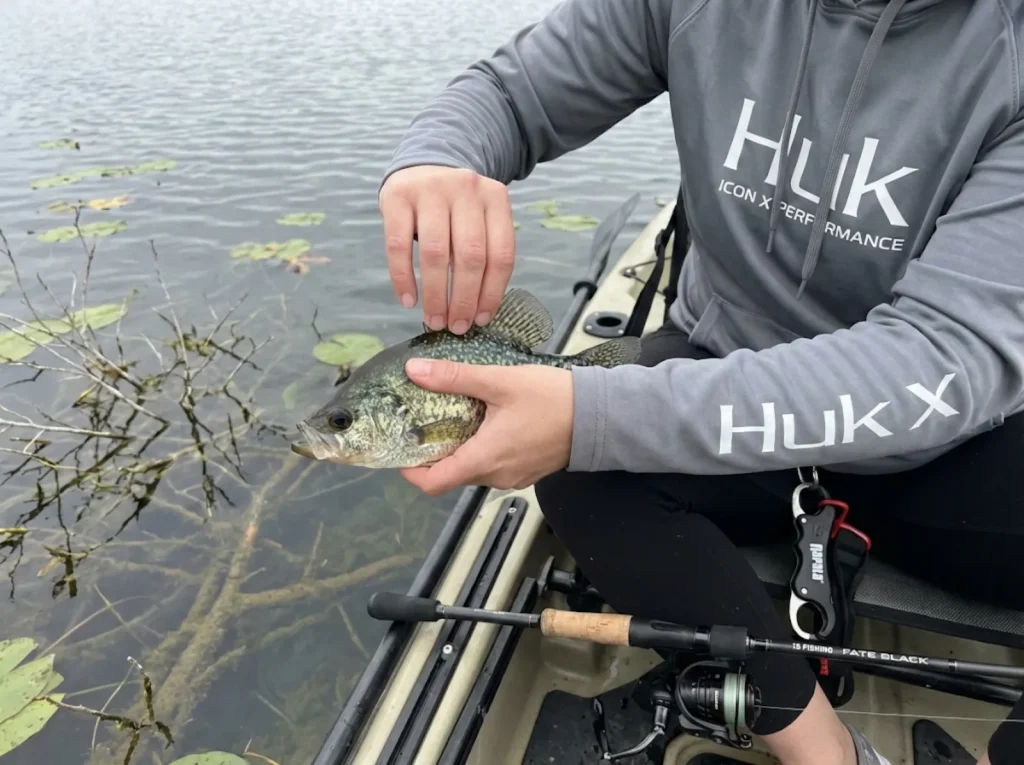
Forget the color. Forget the spots. Fold the dorsal fin forward gently and count the rigid spines from front to back. When they stop feeling stiff and start flexing, you’ve hit the soft rays. Stop counting.
Black crappie have 7-8 spines. White crappie have 5-6 dorsal spines. That’s it. That’s the whole test. Taxonomically, we’re talking about Pomoxis nigromaculatus (black) versus Pomoxis annularis (white) — but nobody at the dock cares about Latin names. They care about spine count.
This matters more than you’d think, because male white crappie turn nearly black during the spring spawn. I’ve seen experienced anglers misidentify spawning whites as blacks based on nothing but color — and those are the same anglers who get confused about size limits in states with species-specific regulations. If you’re making common fish identification mistakes based on color alone, the dorsal spine count fixes that permanently.
The U.S. Fish & Wildlife species profile for black crappie confirms this as the primary separator between the two members of the Pomoxis genus.
Pro tip: Count from front to back. The moment the fin rays feel soft and flexible instead of rigid, stop. It takes three seconds and settles every argument at the dock.
Step 2: Read the Marking Pattern
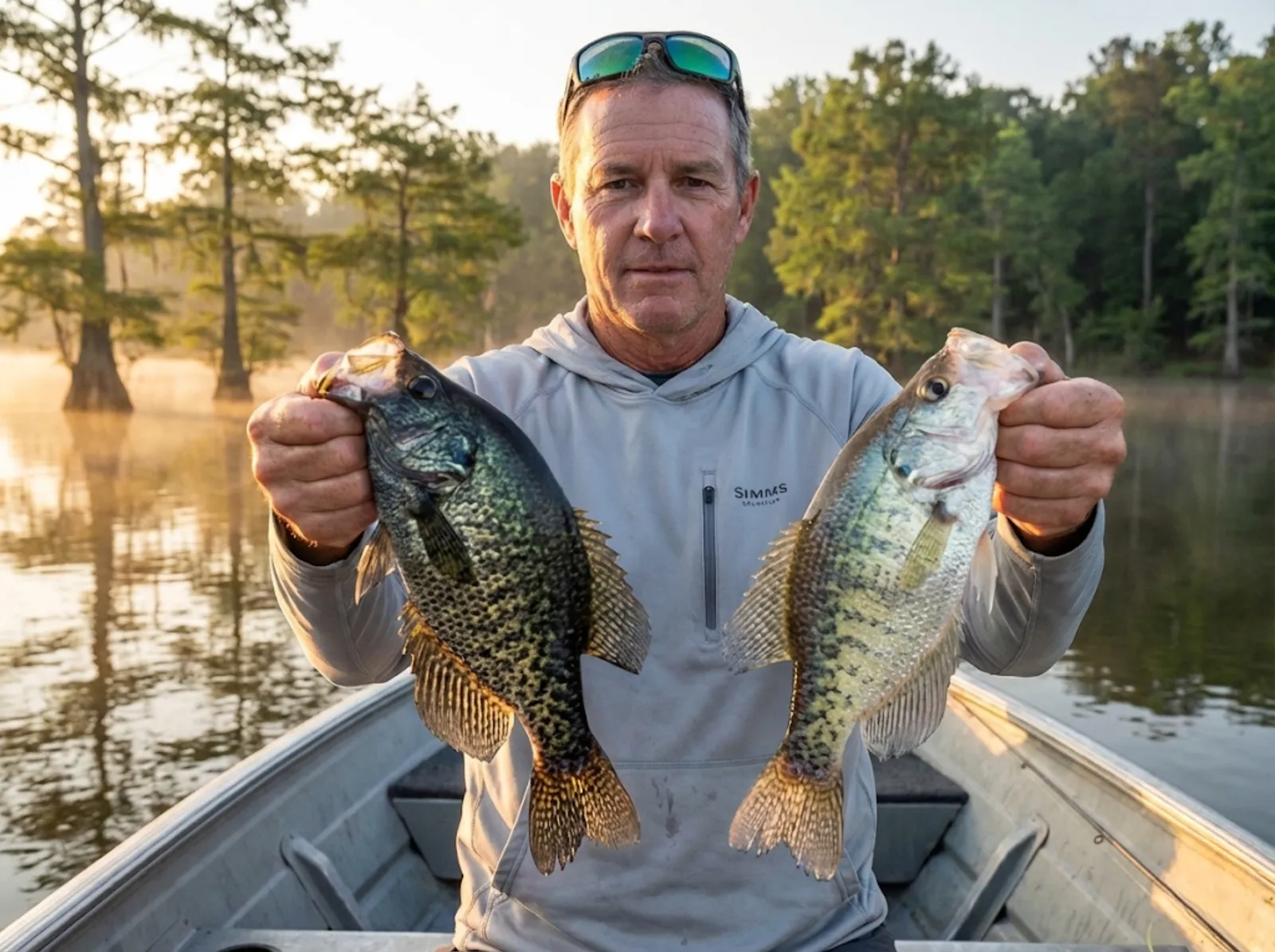
Once you’ve confirmed the spine count, check the body markings as a secondary verification. Black crappies display irregular dark blotches scattered across their flanks — no pattern, no organization. Think splattered paint.
White crappies carry distinct vertical bars running from the dorsal area down the sides — typically seven to nine dark bands. Think prison stripes. The contrast is obvious when you see both fish side by side.
But here’s the catch: in deeply stained or turbid water, markings wash out on both species. A pale black crappie pulled from twenty feet of muddy water looks nothing like one caught shallow over sand. That’s why markings are a supporting check, not your primary tool. The spines don’t lie.
Step 3: Assess Body Profile and Eye-to-Dorsal Distance
The third check is body shape. Black crappie have a deeper, rounder profile — the “frying pan” silhouette that old-timers talk about. White crappie are more elongated and streamlined — more football than frying pan.
There’s an advanced method that only a handful of anglers use: measure the distance from the eye to the front of the dorsal fin, then compare it to the length of the dorsal fin base. On a black crappie, those two distances are roughly equal. On a white crappie, the eye-to-dorsal distance is noticeably longer — the fin sits farther back on the body.
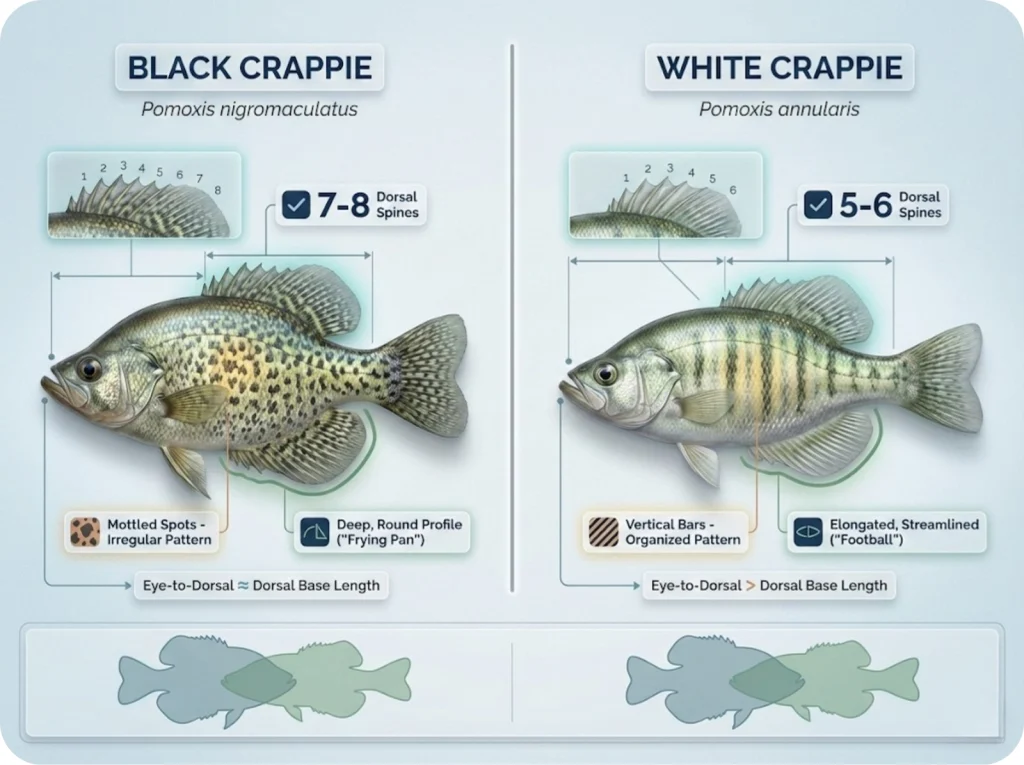
This technique is useful when you’re handling a fish with ambiguous markings during the spawn transition. Combined with the spine count, it eliminates any remaining doubt.
Where Each Species Lives (And Why It Matters for Finding Them)
Water Clarity: The Defining Split
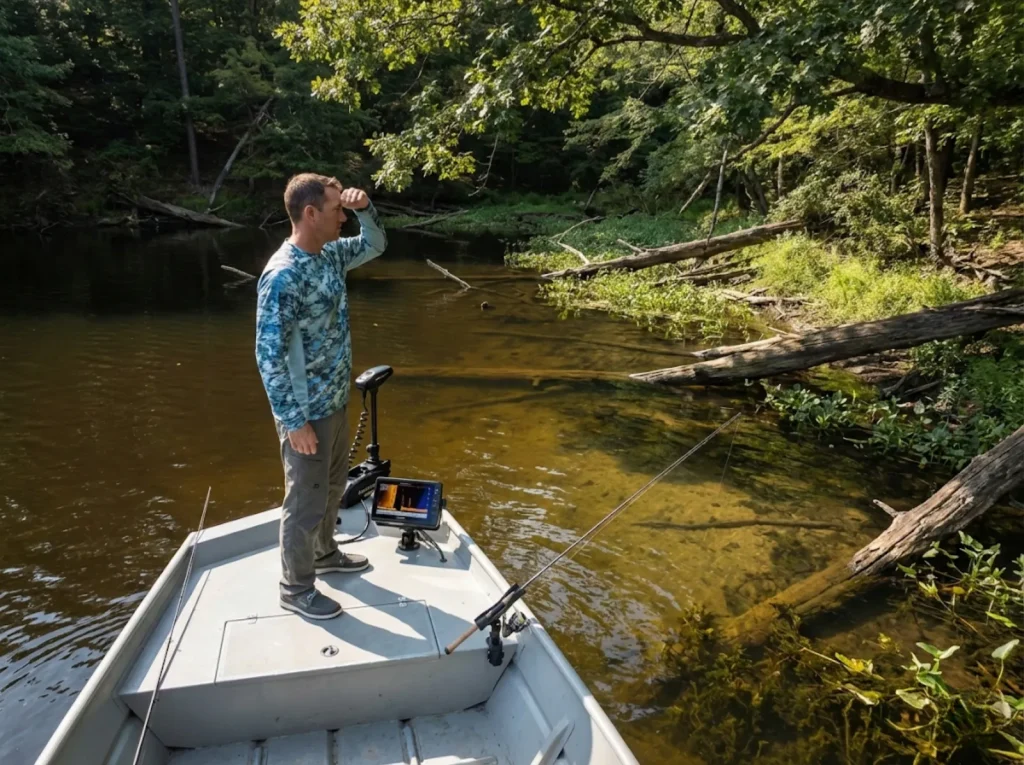
The single biggest predictor of which crappie species you’ll encounter is water clarity. Black crappie are clear-water specialists. They thrive in lakes with high visibility, abundant submerged vegetation, and stable conditions. Their mottled pattern works as camouflage among plant shadows and dappled light.
White crappie tolerate turbid, stained, and murky water — conditions that would push black crappie populations into decline. That’s why whites dominate the big river-fed reservoirs across the South and Midwest, while blacks hold the clearer natural lakes and spring-fed impoundments from the Great Lakes region up through the St. Lawrence River drainage.
Black crappie also show higher salinity tolerance than whites. That explains their presence in coastal and brackish river systems from Florida northward where white crappie simply can’t survive.
Pro tip: If you catch ten blacks under one dock, the whites are usually under a dock three doors down — they rarely mix in the same spot. John Harrison, who guides on Grenada Lake, told me that’s the fastest way to double your fishing coverage.
Depth and Structure Preferences
Black crappie are intensely structure oriented. They hold tight against submerged timber, brush piles, and dock pilings, typically between five and nine feet deep year-round. If your sonar marks a tight cluster of fish glued to a brush pile, you’re almost certainly looking at blacks.
White crappie behave differently. They’re more pelagic — comfortable suspending over open water, following baitfish schools. In summer, expect them fourteen to twenty-five feet deep, often well away from any visible structure. If you’re learning how thermoclines dictate where fish hold in the water column, that knowledge matters most when chasing summer whites.
Forward-facing sonar like Garmin LiveScope or Lowrance ActiveTarget makes this split obvious on screen. Blacks show as tight, stationary clusters hugging cover. Whites appear as scattered, mobile returns drifting through the water column. Understanding these seasonal fishing considerations for each species is what separates a good day from a frustrating one.
Regional Distribution
Both crappie species are native to eastern North America and have been widely introduced across the continent. According to the Florida Museum species profile for black crappie, the maximum reported lifespan for blacks is fifteen years, though seven years is average in managed fisheries.
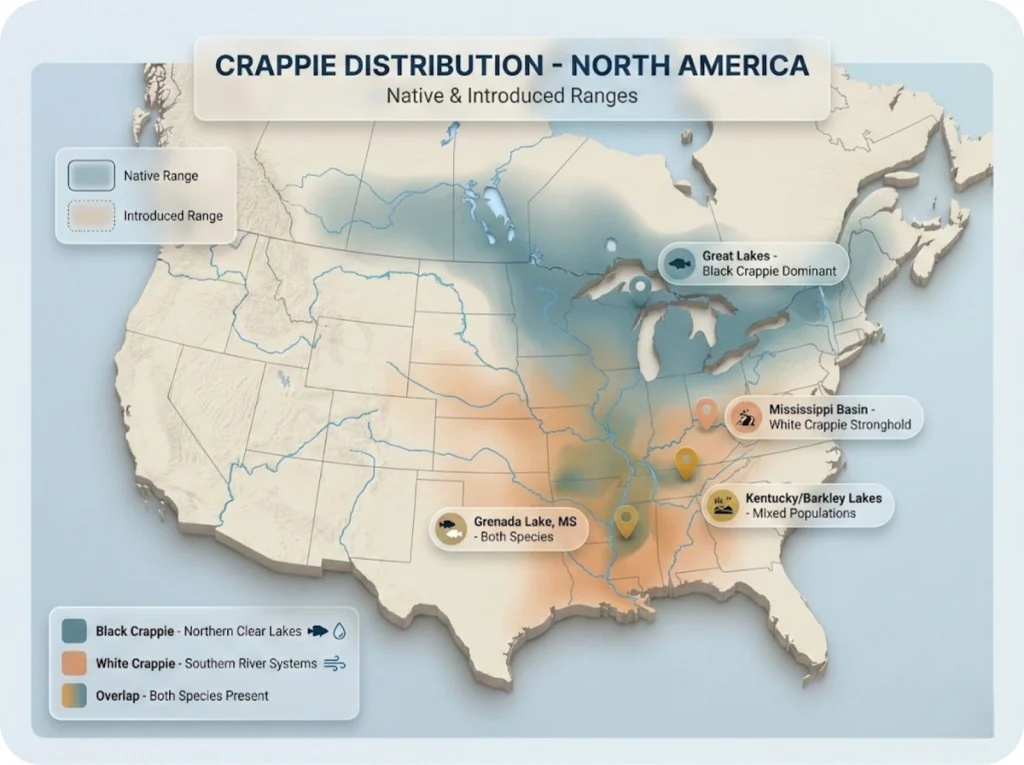
In many southern reservoirs — Kentucky Lake, Grenada Lake, Lake Fork — anglers encounter both species in the same water body but in different zones. The Ozark Region holds strong populations of both. Understanding that split is the notable difference between fishing all day and fishing smart.
How They Feed (And What It Means for Bait Selection)
Diet and Prey Preferences
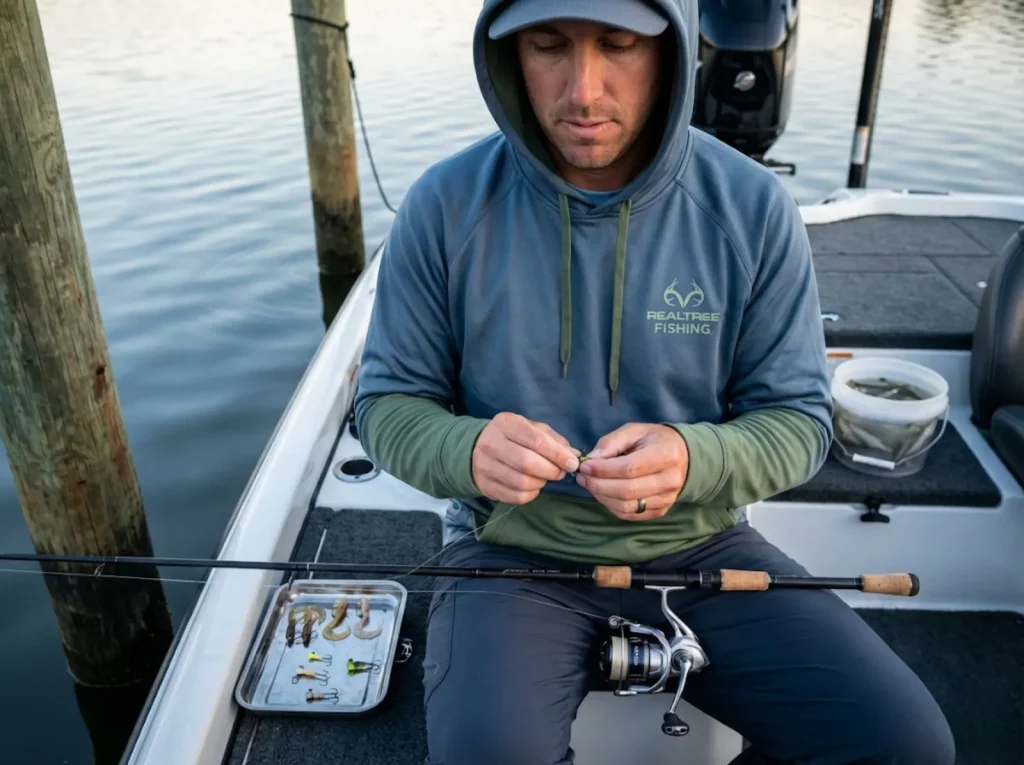
This is where gear selection starts. White crappie shift to piscivory — eating fish — earlier in life than blacks. As adults, they’re aggressive predators targeting gizzard shad, threadfin shad, and minnows. Their larger mouth size is built for engulfing bigger prey.
Black crappie diets stay more varied into adulthood. They keep eating invertebrates, crustaceans, and insect larvae even as adults. Their smaller, more precise mouth is designed for picking off individual prey rather than swallowing baitfish whole.
What does this mean at the tackle box? White crappie generally respond better to larger jigs (1/8 oz), swimmer-style presentations, and properly rigged live minnows. Black crappie often prefer smaller profiles — micro jigs in the 1/32 to 1/16 oz range, inline spinners, and finesse soft plastics. In deeper water, small crankbaits and spinnerbaits can get the attention of scattered blacks holding off secondary structure.
The Finicky Factor: Why Black Crappie Shut Down
Professional angler Andrew Nordbye puts it plainly: “Black crappie are among the most finicky fish out there. I normally catch one on the first cast and you can hardly catch another one.” They lock up tight when pressured by boat noise, shadows, or repeated presentations.
White crappie are more forgiving. They feed aggressively through the day and respond well to spider rigging — multi-rod trolling setups that cover water fast. Expert Whitey Outlaw warns that in clear water, “even the shadow of an angler standing in the boat can spook a school of black crappies.” Boat control and stealth become the deciding factor.
Pro tip: When blacks shut down after the first fish, move your boat fifteen feet away from the brush pile and wait five full minutes before your next cast. That short reset is often enough to get a second bite.
Spawning Behavior: Timing the Spring Run by Species
Temperature Windows and Spawn Sequence
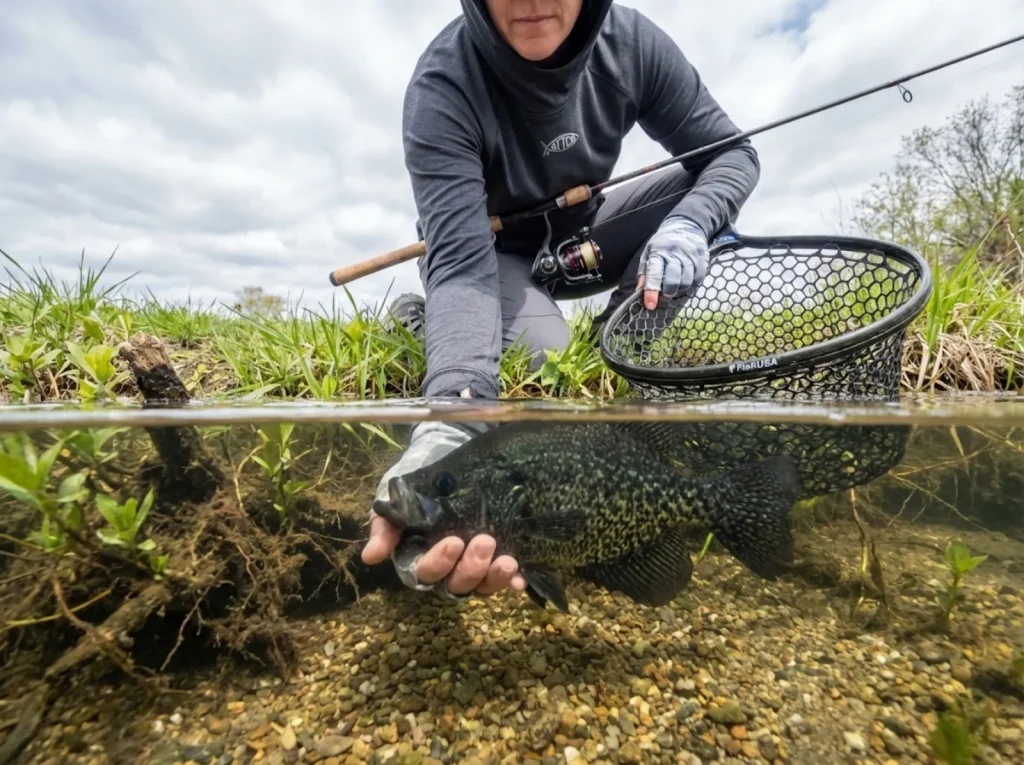
The spring crappie spawn doesn’t hit both species at the same time. Black crappie initiate spawning at 60-64°F water temperature, typically triggering first. White crappie follow at 62-68°F water temperature, creating a staggered window that can stretch one to three weeks apart.
In mixed-species lakes, that sequence is your tactical advantage. Target the early-spawn blacks holding tight to shallow gravel and root wads first. Then transition to whites as water temperatures push past sixty-five degrees. For a complete temperature-phase breakdown, see the degree-by-degree guide to spring crappie spawning tactics.
Male black crappie build and guard colonial nesting sites, usually over hard substrate. They get darker during this phase — which is exactly when the misidentification problem peaks. White crappie need light penetration for egg production and development, so spawning whites in murky water position their nests in extremely shallow water, sometimes under two feet. Most anglers walk right past them.
Post-Spawn Behavior and Egg Production
White crappie migrate to deeper water quickly after spawning, chasing baitfish schools into mid-depth suspended positions. Black crappie tend to linger near the same shallow structure they used for nesting, making them accessible to bank anglers and dock fishermen for weeks after the spawn winds down.
Here’s a number that explains why your state biologist cares which crappie specie you’re catching: white crappie produce approximately 150,000 eggs per pound of body weight — nearly triple the roughly 50,000 per pound that black crappie produce. That extreme fecundity is the reason biologists warn against stocking whites in ponds under 200 acres. Overpopulation leads to stunting — a lake full of five-inch fish and no slabs.
The Kentucky Department of Fish & Wildlife crappie habitat data confirms these spawning differences and their management implications.
Magnolia Crappie and Hybrid Variants: The Third Species
Why Biologists Built a Better Crappie
For decades, state agencies avoided stocking crappie in small ponds because white crappie reproduction overwhelmed the water. Too many mouths, not enough food, and every fish in the lake stays stunted at five inches forever.
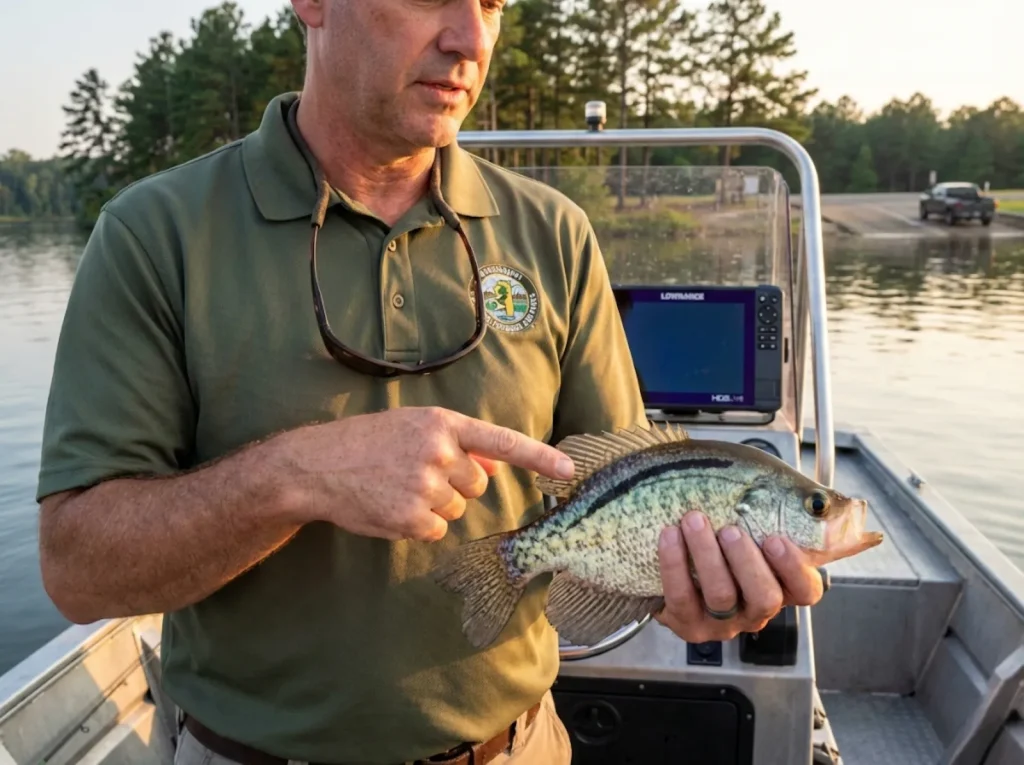
The Mississippi Department of Wildlife, Fisheries, and Parks solved this with the Magnolia crappie — a sterile triploid hybrid with three sets of chromosomes instead of the usual two. The creation process is worth knowing: female white crappie eggs are fertilized by male black stripe crappie sperm — a naturally occurring recessive variant found in roughly ten percent or less of wild black crappie populations. Within minutes, those fertilized eggs enter a pressure chamber at approximately 8,000 psi for five minutes. That pressure shock disrupts normal cell division, producing a fish that grows fast but never reproduces.
Field Identification of Magnolia Crappie
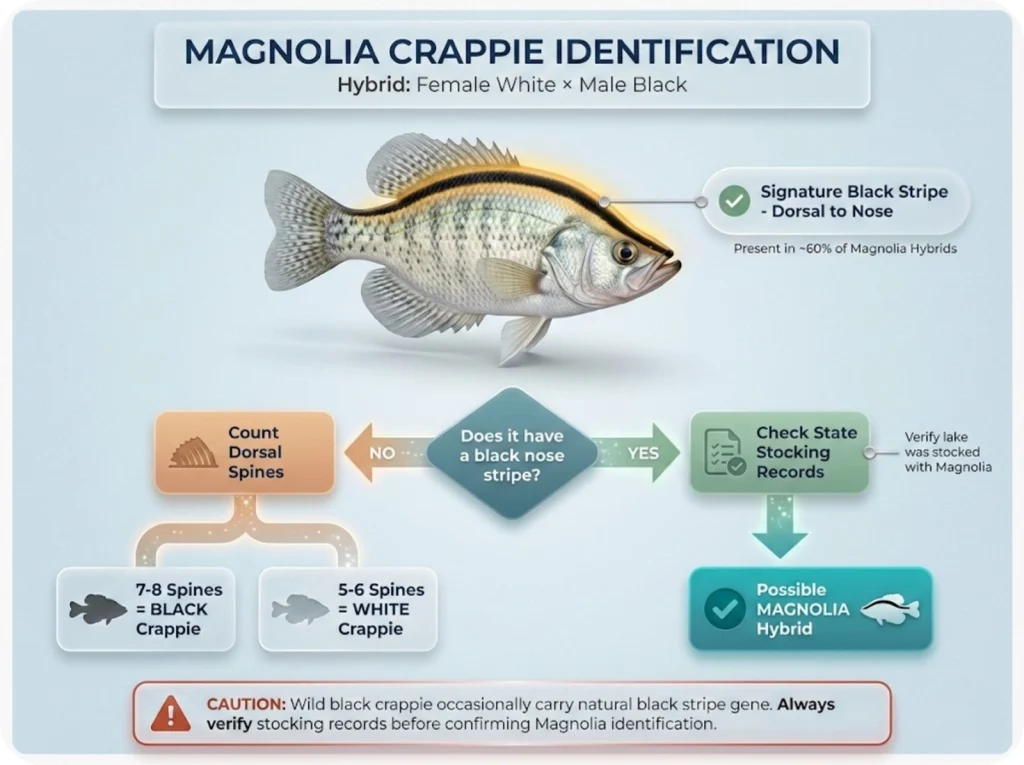
About sixty percent of Magnolia crappie retain the signature identifier: a black stripe running from the dorsal fin, over the head, to the nose. That trait comes directly from the male parent.
Because they never spend energy on spawning, Magnolia crappie channel everything into growth rates that outpace either parent species in the same water — a phenomenon called hybrid vigor.
One caution: wild black crappie occasionally carry the naturally occurring black stripe gene. Catching one of these variants in a non-stocked lake doesn’t mean you’ve found a Magnolia hybrid. Check your state’s stocking records before making assumptions. The Mississippi Department of Wildlife official Magnolia crappie guide has the current stocking list.
For context on how other engineered hybrids are identified in the field, see our guide to identifying other hybrid gamefish like wipers and tiger musky.
Taste Test: Which Crappie Eats Better?
Fillet Yield and Meat Profile
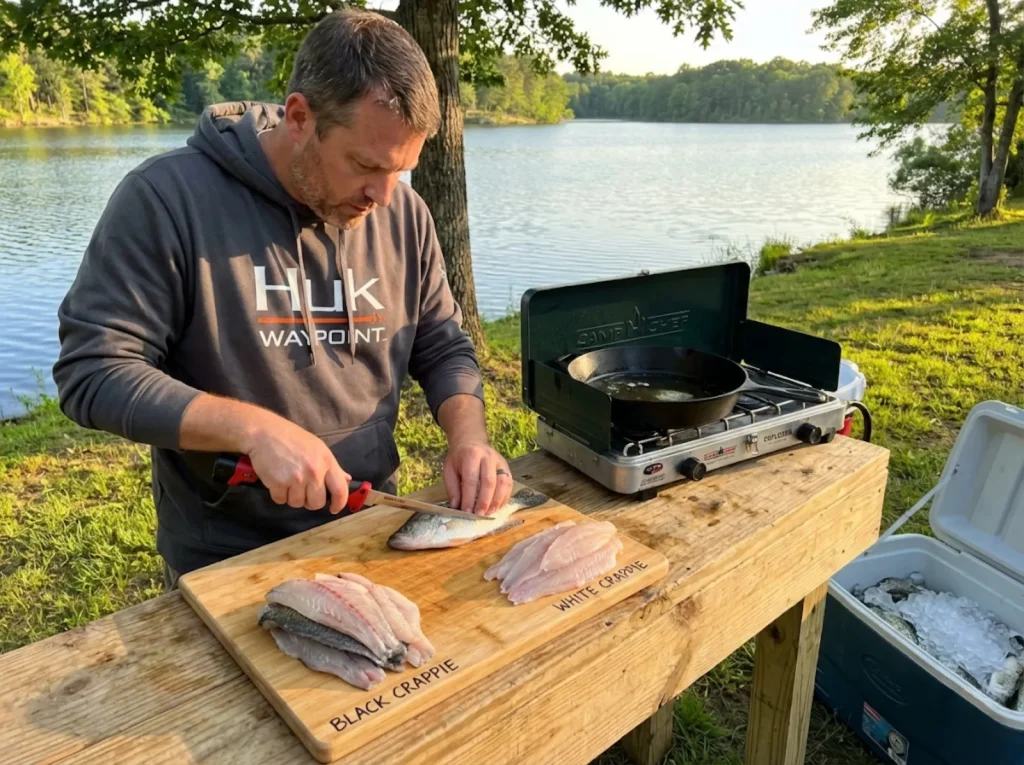
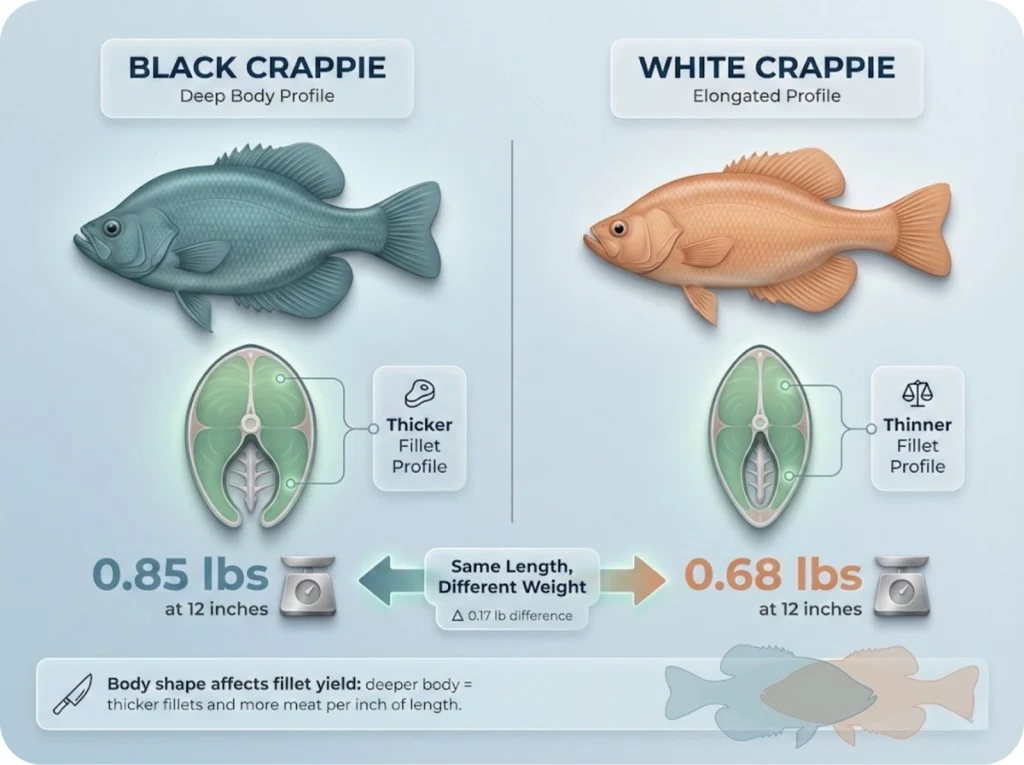
The taste debate between the two species is real, but it starts at the cutting board, not the plate. Black crappie produce thicker, meatier fillets because of their deeper body profile. That frying pan shape translates directly to fillet yield. White crappie fillets are thinner and more elongated — you get length but less cross-section.
Fish fry cook Toby Bean is blunt about it: “White crappie fillets are always thinner. Black crappie are thicker and meatier.” There’s also a weight difference at equal lengths — black crappie weigh more per inch than whites. For tournament fishing, that means a limit bag of blacks from shallow structure often outweighs the same count of whites pulled from open water.
The Flavor Debate
Tournament pro Ronnie Capps argues that “because they eat more fish, the meat of a white crappie is sweeter than that of a black crappie.” The logic tracks — whites shift to piscivory earlier in life, while blacks continue eating invertebrates, which subtly affects the flesh.
But here’s the honest answer: in a blind taste test with cornmeal batter and hot oil, most anglers can’t tell the difference. Both species are among the finest-eating freshwater panfish in North America. The preparation method overwhelms whatever subtle flavor difference exists. The old saying among local crappie fishermen is that the best-tasting crappie is the one you caught twenty minutes ago. Hard to argue with that.
World Records and the Future of Trophy Crappie
Current Records and Where Giants Live
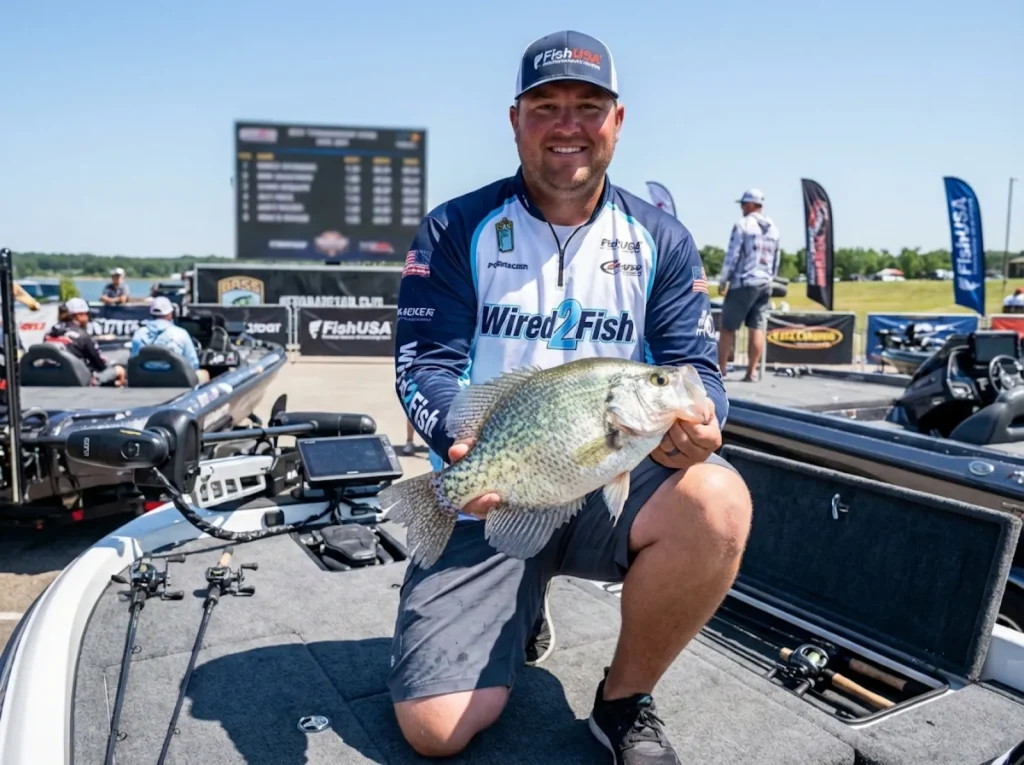
The all-tackle world record for black crappie is 5 lbs 7 oz, caught by Lionel “Jam” Ferguson in Tennessee in 2018 on a Kalin’s Triple Threat Grub. That fish dethroned the decades-old assumption that whites were the bigger species.
The white crappie record stands at 5 lbs 3 oz, caught by Fred Bright in Enid Reservoir, Mississippi, in 1957 — a record that has survived for nearly seventy years. A 2025 Virginia black crappie from Occoquan Reservoir technically exceeded world-record weight, but the angler used a tape measure instead of a certified board. That technicality cost him the record.
Trophy black crappie tend to come from small, deep, weedy ponds and spring-fed lakes with limited pressure. Trophy whites are more likely from large southern reservoirs loaded with shad. Multiple state black crappie records have fallen in recent crappie fishing seasons — West Virginia, Illinois — suggesting expanding populations or improved habitat management across the northern range.
For everything else you want to know about the genus — physiology, feeding habits, visual identification details — check our full guide to deeper crappie biology, myths, and tactical facts.
Pro tip: If you’re chasing a personal best, focus your first crappie trip of the year on shallow structure during the early spawn window (60-64°F). That’s when the biggest, oldest black crappie are most vulnerable and most concentrated.
Conclusion
Three things to carry away from this.
First, stop arguing about color. Count the dorsal spines — 7-8 means black, 5-6 means white. Three seconds, zero debate.
Second, the species you identify determines where you fish. Black crappie hold tight to shallow structure in clear water. White crappie suspend over open water in turbid lakes. Fishing the wrong zone for the wrong species wastes half your day.
Third, the Magnolia crappie is not a rumor. It’s an engineered, sterile triploid hybrid created at 8,000 psi of pressure. If you find one with that signature nose stripe in a Mississippi state lake, now you know exactly what you’re holding.
Next time you pull a slab off a brush pile, flip it over and count those spines before it goes in the cooler. Once you see the difference, you’ll start reading species-specific patterns everywhere — and your catch rate will follow.
FAQ
How many dorsal spines does a black crappie have?
Black crappie have 7 to 8 rigid spines at the front of the dorsal fin. White crappie have 5 to 6. This dorsal spine count is the single most reliable way to distinguish the two crappie species, regardless of coloration or seasonal changes.
Can black and white crappie hybridize?
Yes. Natural hybridization occurs where both species overlap, producing offspring with intermediate characteristics. The Magnolia crappie is an intentionally engineered sterile triploid created by Mississippi’s DWFP, using pressure shock on fertilized eggs to prevent reproduction and promote faster growth rates.
Which crappie tastes better — black or white?
Most anglers cannot reliably distinguish them in a blind test. Tournament pro Ronnie Capps argues white crappie taste sweeter due to their earlier shift to a fish-based diet, while black crappie produce thicker, meatier fillets. Both rank among the best-tasting freshwater panfish in North America.
Do black crappie get bigger than white crappie?
The current world record black crappie (5 lbs 7 oz, Tennessee, 2018) outweighs the white crappie record (5 lbs 3 oz, Mississippi, 1957). Black crappie also weigh more per inch of length, making them heavier at the same measured size.
What is the best bait for catching crappie?
It depends on the species. White crappie respond well to live minnows and larger jigs (1/8 oz) because of their bigger mouths and aggressive feeding habits. Black crappie often prefer smaller presentations — micro jigs (1/32-1/16 oz), inline spinners, and finesse soft plastics — matched to their smaller mouth size and more cautious feeding behavior.
Risk Disclaimer: Fishing, boating, and all related outdoor activities involve inherent risks that
can lead to injury. The information provided on Master Fishing Mag is for educational and informational purposes
only. While we strive for accuracy, the information, techniques, and advice on gear and safety are not a substitute
for your own best judgment, local knowledge, and adherence to official regulations. Fishing regulations, including
seasons, size limits, and species restrictions, change frequently and vary by location. Always consult the latest
official regulations from your local fish and wildlife agency before heading out. Proper handling of hooks, knives,
and other sharp equipment is essential for safety. Furthermore, be aware of local fish consumption advisories. By
using this website, you agree that you are solely responsible for your own safety and for complying with all
applicable laws. Any reliance you place on our content is strictly at your own risk. Master Fishing Mag and its
authors will not be held liable for any injury, damage, or loss sustained in connection with the use of the
information herein.
Affiliate Disclosure: We are a participant in the Amazon Services LLC Associates Program, an
affiliate advertising program designed to provide a means for us to earn advertising fees by advertising and linking
to Amazon.com. As an Amazon Associate, we earn from qualifying purchases. We also participate in other affiliate
programs and may receive a commission on products purchased through our links, at no extra cost to you. Additional
terms are found in the terms of service.