
In this article
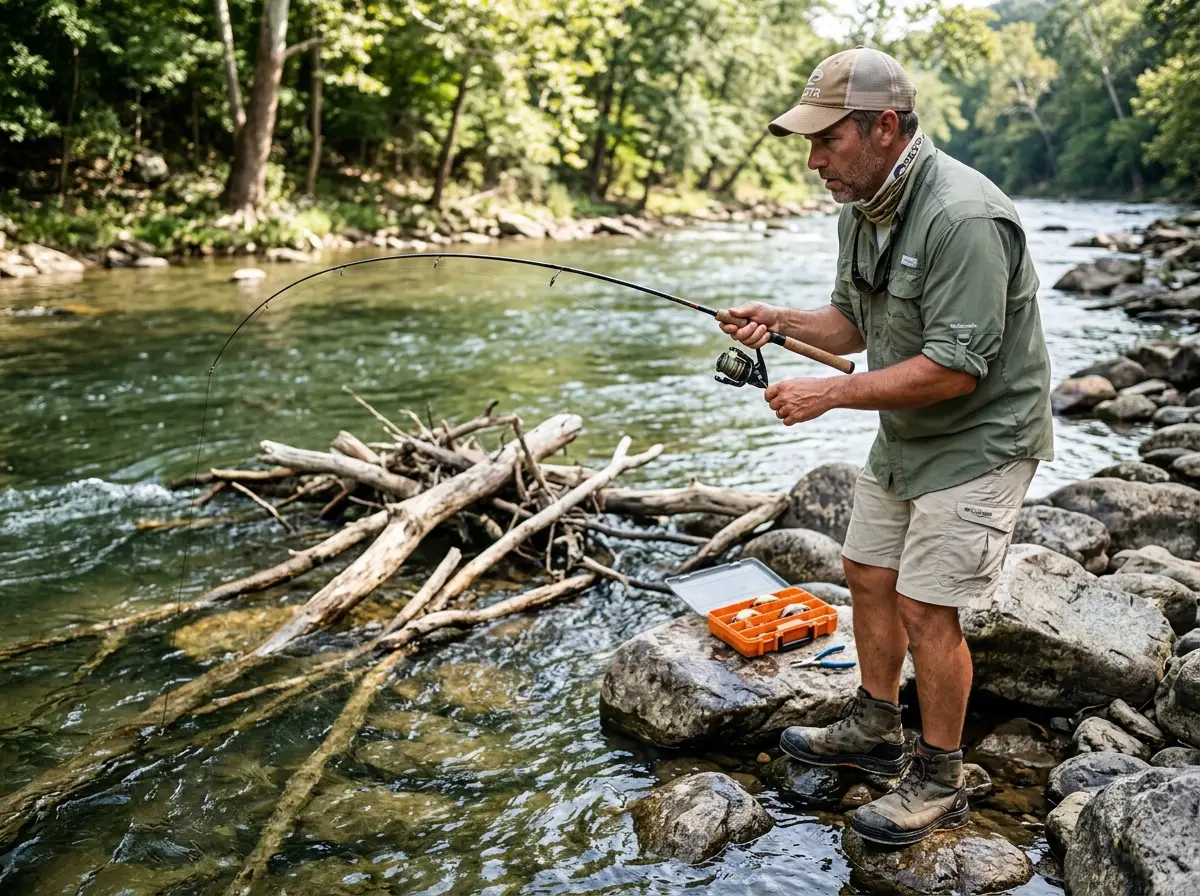
You felt it — that dead stop mid-retrieve where your rod loads up and nothing moves. Your hands already know what to do. They want to rear back and rip. I’ve done it hundreds of times, and I can tell you exactly what happens next: the hook buries deeper, the line frays against whatever you’re stuck on, and you walk away minus a lure and plus a bad mood. After losing more baits than I care to count, I figured out that the first three seconds after a snag decide whether you get your lure back or watch it disappear.
Here’s how to recover a snagged lure step by step, starting from the moment you feel the hang-up through the last-resort break-off — plus the prevention and post-recovery checks that nobody talks about.
Quick Answer: When you snag a lure, follow this order before pulling hard:
- Stop reeling immediately — slack saves lures
- Point your rod tip straight at the snag
- Pop the line with the trigger method to jolt it free
- Walk the bank or motor over to change your pull angle
- Try the bow-and-arrow snap to kick the lure backward
- Use a plug knocker if you’re directly above the snag
Why Your First Reaction Makes It Worse
The Physics of a Deeper Hang-Up
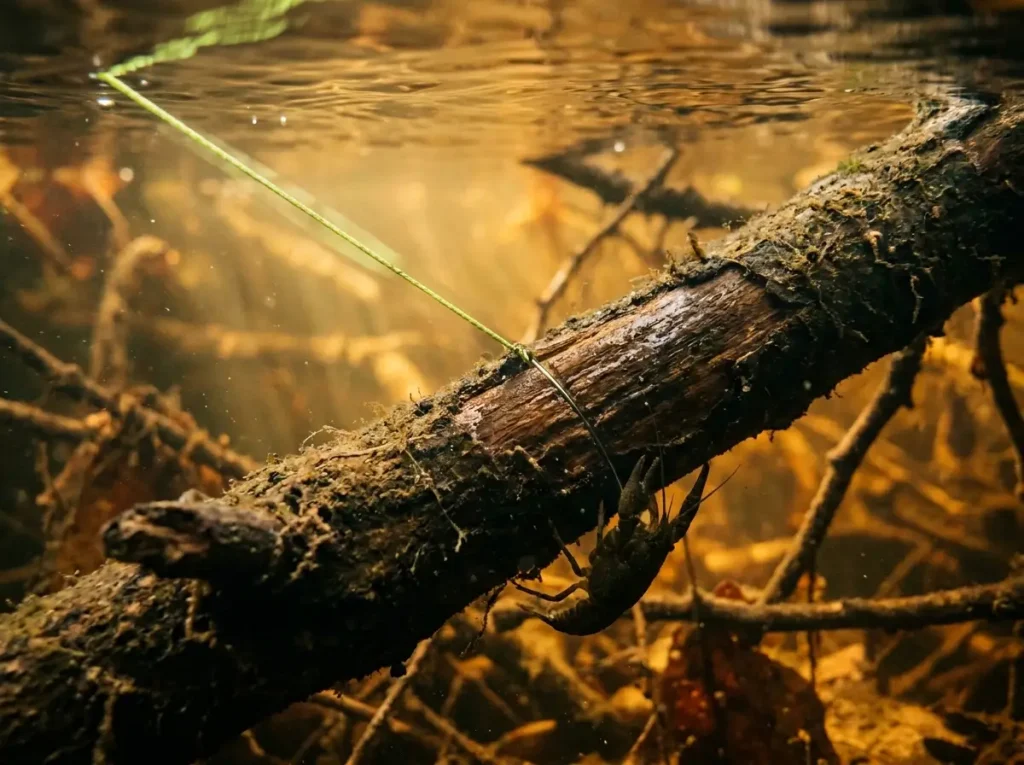
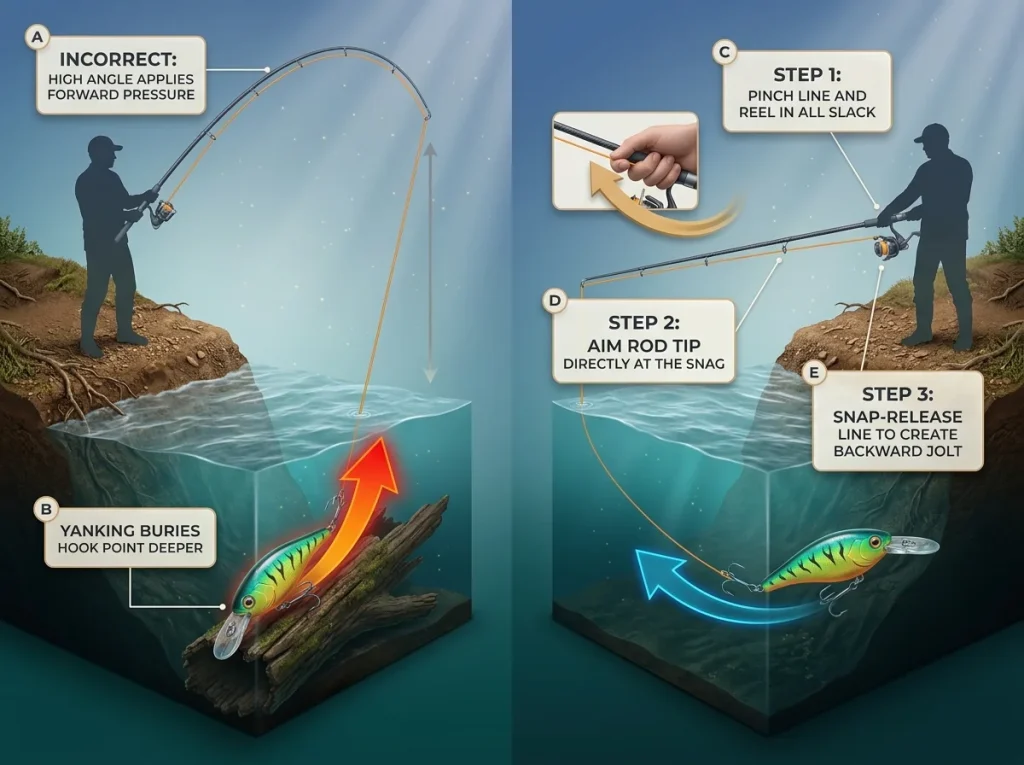
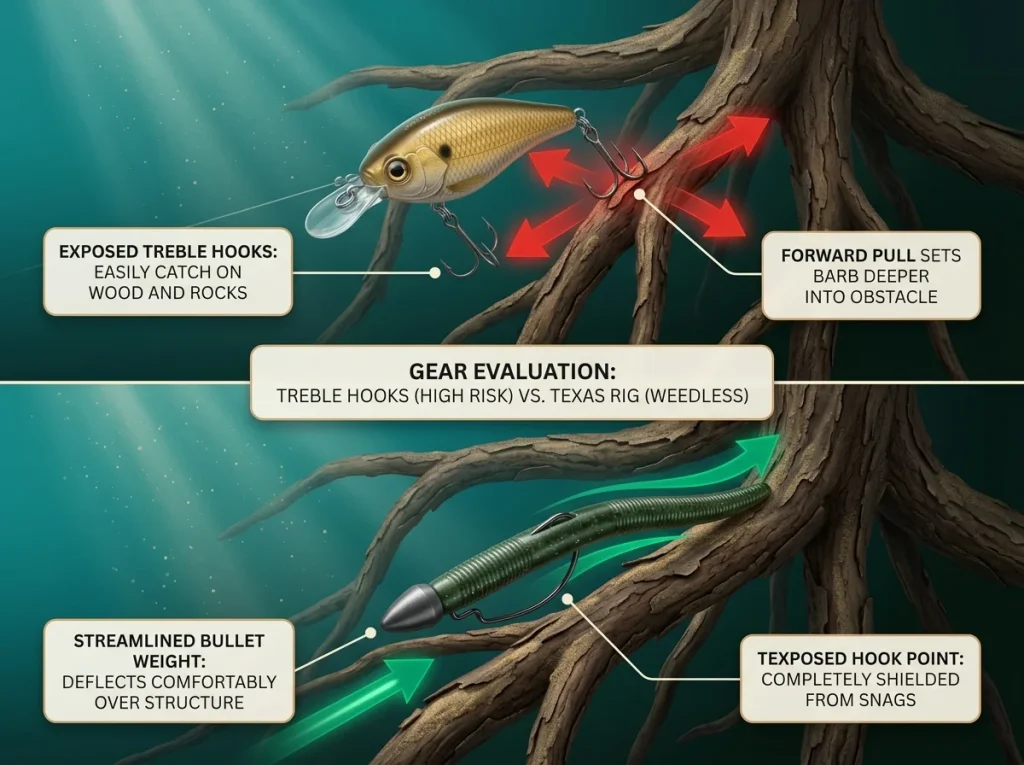
When you yank a stuck lure, you’re pulling the hook point in the same direction it entered. That’s the worst possible angle. A treble hook caught on wood digs in like a fishhook in skin — forward pressure just sets it harder. The barb catches, the shank pivots, and now you’re not stuck on a branch. You’re stuck through it.
Rocks are even less forgiving. A crankbait wedged between two stones gets tighter with every pound of force. I’ve pulled lures out of rock crevices that came back with the diving lip snapped clean off because I didn’t stop to think before I started hauling.
The 3-Second Rule That Saves Lures
The moment you feel that dead stop, freeze. Don’t reel. Don’t pull. Most lures are barely snagged in the first second — a hook point resting against wood, a treble hook lightly caught in vegetation, a lip brushing a rock shelf. That contact is loose enough to reverse if you don’t compound it with force.
Give yourself three seconds of nothing. Then start the recovery sequence below.
Pro tip: Train your hands to open the bail or thumb the spool the instant you feel a hang-up. Removing all tension in that first moment is worth more than any retrieval technique you’ll learn.
What Brute Force Actually Costs You
Even when yanking works, it bends hooks, frays line, and loosens split rings. The lure you get back might look fine from three feet away but miss the next hookset because the gap is blown open. And if the yank doesn’t work, you break off at the worst possible spot — usually right at the knot — losing line, leader, and lure all at once.
The Trigger Method That Actually Works
Setup: Rod Angle and Line Tension
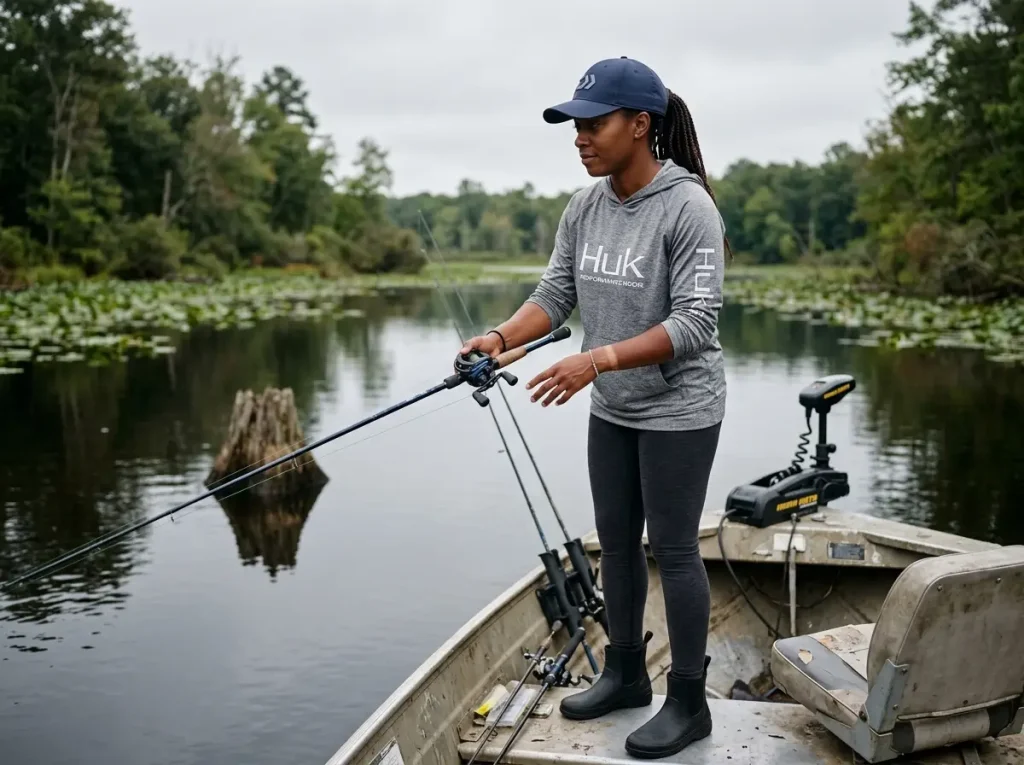
Reel in the slack until your line is snug to the lure, but do not apply heavy pressure. Now point your rod tip directly at the snag — straight down the line, not up at an angle. You want zero shock absorption from the rod. The rod’s job here is to be a pointer, not a lever.
The Pop
With your rod aimed at the snag, pinch the line between your thumb and forefinger just above the reel. Pull it back about six inches to build a small amount of tension, then snap-release it. That quick jolt travels down the line and kicks the lure backward — the exact opposite direction of the hang-up.
Try it 10 to 12 times before moving on. Each pop has a chance of nudging the hook point off whatever it’s caught on. You’ll feel it the moment it breaks free — the rod tip springs back and the line goes slack.
Pro tip: On spinning reels, open the bail and hold the line against the rod with one finger. Release the finger for the pop — same energy transfer, less fumbling.
Change Your Angle Before You Change Your Approach
Why the Casting Angle Is the Problem
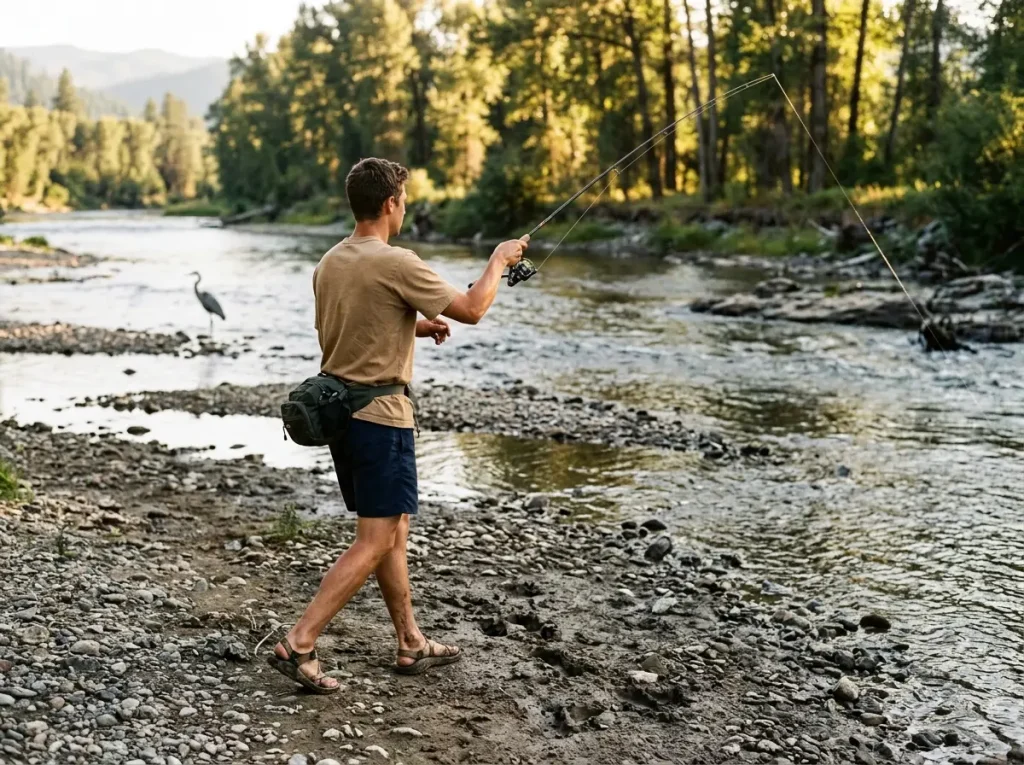
Your lure went in from the direction you cast. The hook set in that direction. Pulling from the same angle is like trying to back a car out of a parking spot by pushing it forward harder. You need to come at it from the other side.
Shore Anglers: Walk the Bank
Before you try anything aggressive, walk 20 to 30 yards down the bank and pull from a new angle. This changes the force vector on the hook and often pops it free on the first gentle pull. If the snag is in current, walk upstream of it — pulling with the current adds force you didn’t have from downstream.
Boat Anglers: Motor Over the Snag
If you’re in a boat, use your trolling motor to position yourself directly over or past the snag point. A vertical or reverse-angle pull is the single most effective retrieval method from a boat. It works roughly 80 percent of the time when nothing else has.
The Bow-and-Arrow Trick Most Anglers Skip
How to Load and Release
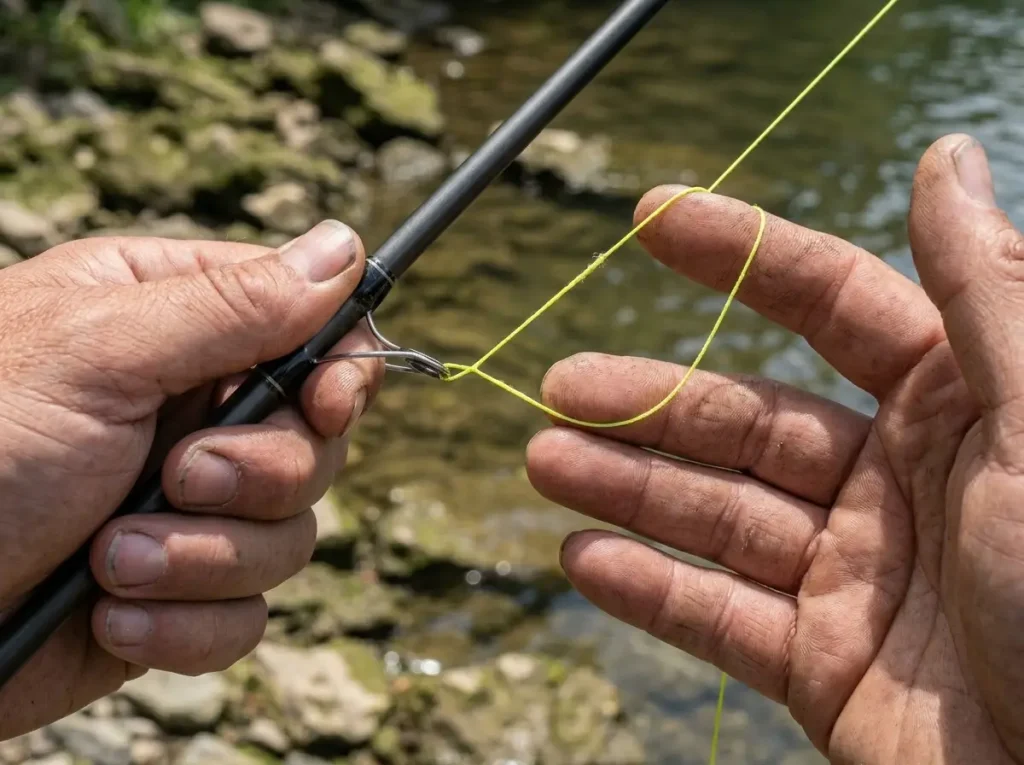
Open your bail or put your reel in free spool. Grab the line about 18 inches above your reel with your off hand and pull it back toward the rod butt, creating a triangle of tension between your hand, the first guide, and the water. Hold it for a beat, then release sharply.
That snap sends a wave of energy racing down the line to the lure, kicking it backward off whatever it’s hung on. Think of it like flicking a rubber band — the stored energy reverses direction at the contact point.
When This Method Shines
The bow-and-arrow technique works best on soft snags — branches, root wads, submerged brush — where the hook is caught but not wedged. It’s less effective on rocks because there’s no give in the structure. Combine it with an angle change for maximum effect: walk to a new position, then snap the line.
Pro tip: Wear a glove or wrap the line around your finger pad. Braided line under snap tension will slice skin faster than you’d think.
When to Use a Plug Knocker (And How to Build One for a Dollar)
What a Plug Knocker Does
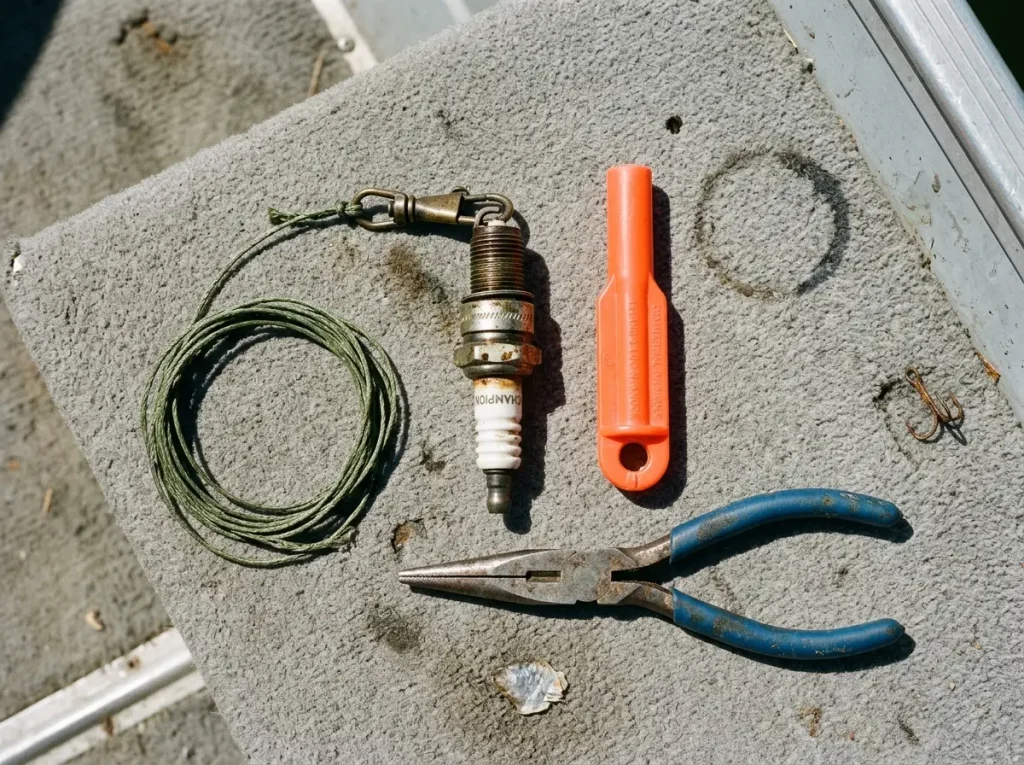
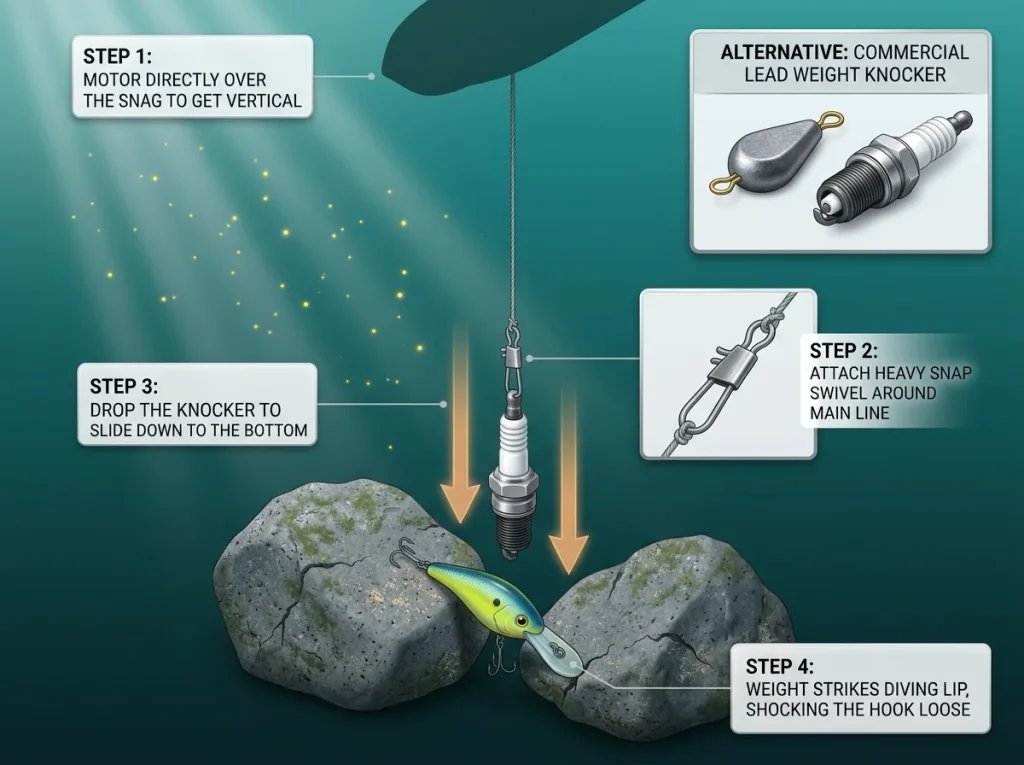
A plug knocker is a weight you clip onto your line and let slide down to the snagged lure. On impact, the weight drives the hook point backward — the opposite direction it entered. Commercial models like the Leland’s Loc-N-Knock run $5 to $8, but the physics are simple enough to replicate.
The DIY Spark Plug Version
Take an old spark plug, thread a heavy-duty snap swivel through the electrode gap, and clip it to your line. Total cost: about a dollar if you already have a snap swivel. The porcelain body gives you enough weight to reach bottom, and the snap swivel lets you attach and detach without cutting line.
The Catch: You Need to Be Over the Snag
Plug knockers only work when you can get nearly vertical above the stuck lure. From shore at a shallow angle, the weight slides down the line and stops well short of the lure — then you’ve got a snag AND a plug knocker to deal with. This is strictly a boat technique, or at best, a bridge or dock technique.
Rig Smarter to Lose Less
Weedless Setups That Actually Fish
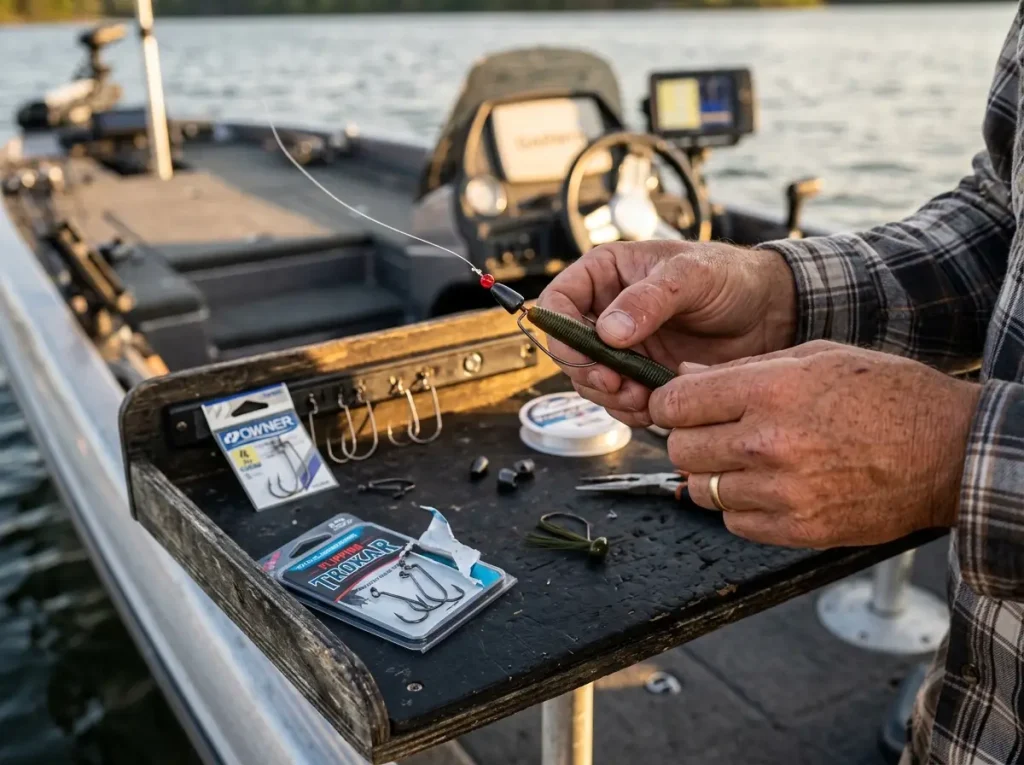
A Texas rig with the hook point buried in the soft plastic body slides through wood, rock, and vegetation like it’s not there. If you’re fishing heavy cover and losing lures, switching to an offset worm hook with a tungsten bullet weight and a pegged bead eliminates 90 percent of your snag problem. Weed guards on jig heads do the same job for finesse presentations.
The tradeoff is real, though. Weedless rigs reduce hookup ratio slightly because the hook has to punch through the soft plastic before it penetrates. That’s a fair trade when the alternative is leaving $10 in the rocks every cast.
Line and Leader Choices for Snag Country
Braided line as your main line gives you the strength to pull a lure free from moderate snags without breaking off. Pair it with a fluorocarbon leader that’s lighter than your braid — say, 15-pound fluoro on 30-pound braid. This creates a weak link at the leader knot, so if you absolutely must break off, you lose the leader and lure but save your main line. You reel in, retie, and keep fishing instead of re-spooling.
Read the Water Before You Cast
Snags don’t appear out of nowhere. Dark patches in clear water mean submerged wood. A line of disturbed surface current signals a rock shelf underneath. If your lure ticks something hard on the first retrieve, note the spot and adjust your casting angle or swap to a weedless presentation. The best snag prevention is knowing what’s down there before your lure finds out the hard way.
Pro tip: On unfamiliar water, make your first few casts with a cheap soft plastic on a Texas rig. Map the structure with something you can afford to lose, then switch to the crankbaits once you know the layout.
Check Your Lure Before You Cast It Again
The Bent Hook Problem
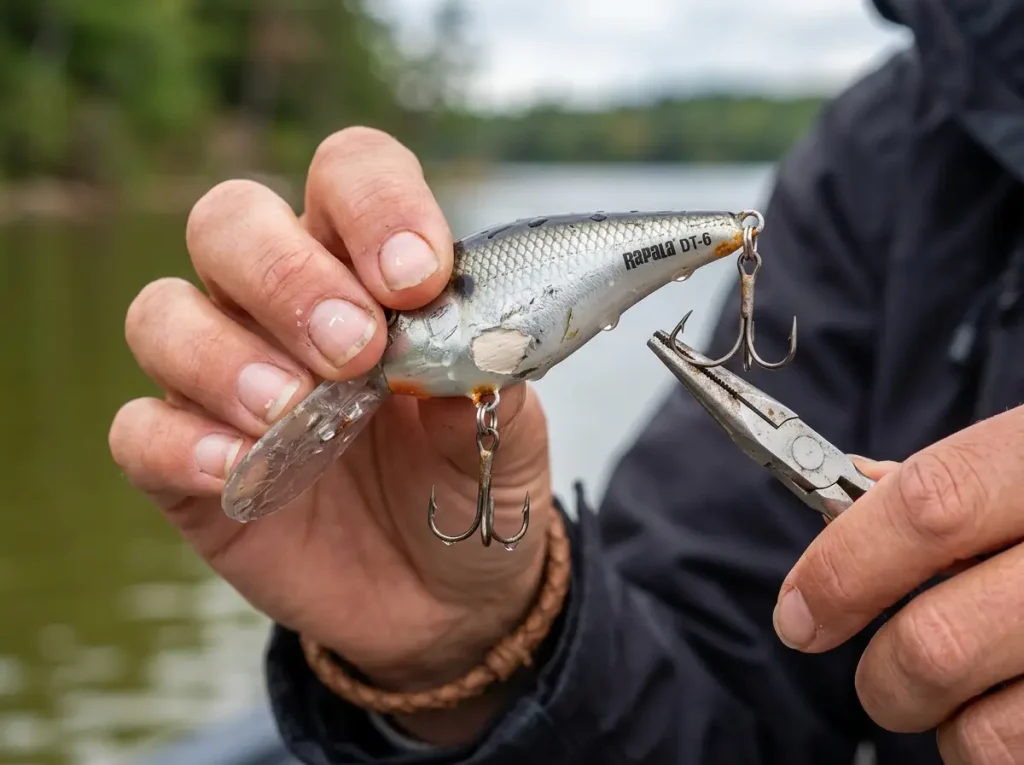
You freed your lure. You’re feeling good. But before you cast it back out, look at the hooks. A bent treble hook from a hard retrieval won’t set properly on the next fish. One prong bent outward by even a few degrees changes the hook gap enough to lose bites you should have landed. If the hook points aren’t aligned with each other, either bend them back with pliers or swap the hook entirely.
Lip Damage and Split Ring Wear
Crankbaits and jerkbaits rely on their diving lip to run at the right depth and wobble correctly. A cracked or chipped lip from a rock snag changes the action entirely — the lure tracks to one side, runs shallow, or wobbles erratically. Check the lip for chips, cracks, and scuff marks. A scuffed lip still works. A cracked lip is done.
While you’re at it, spin every split ring with your fingernail. If one has opened up or feels loose, replace it before you lose the lure to a fish instead of a rock. That would be worse.
Line Check: The Part Everyone Forgets
Run your fingers along the last three feet of line above the lure. If you feel any roughness, nicks, or flat spots, cut that section and retie. Fighting a snag abrades line against rock and wood in exactly the spot where your next fish will apply maximum force. I’ve lost more fish to weakened line after a snag than I’ve lost to snags themselves.
Conclusion
The sequence matters more than any single technique. Stop reeling the instant you feel a hang-up, try the trigger pop first, change your angle second, and save the aggressive stuff for last. Rig weedless when the bottom is ugly, build a dollar plug knocker for the boat, and always inspect your lure after you free it.
There’s an environmental angle too. Research from the University of Illinois found soft plastic lures accumulating at rates of roughly 80 per kilometer of shoreline per year, and those plastics don’t break down — they swell inside fish stomachs and leach chemicals into the water. Every lure you recover is one less piece of tackle polluting the fishery.
Most of all, accept that losing lures is part of fishing. The fish live in the structure, and if you’re not casting near the stuff that snags you, you’re probably not casting where the fish are. The goal isn’t zero lost lures — it’s fewer lost lures and more of them coming back ready to fish again.
Every lure you save is a lure that was already in the right spot. That’s worth the extra three seconds.
Q1 How do you get a snagged lure unstuck?
Stop reeling immediately, point your rod straight at the snag, and use the trigger pop method — pinch and snap-release the line 10 to 12 times to jolt the lure backward. If that fails, change your angle by walking the bank or motoring past the snag before attempting the bow-and-arrow snap or a plug knocker.
Q2 Is it worth carrying a plug knocker?
A plug knocker pays for itself the first time you save a $10 crankbait from a stump. You can build one from an old spark plug and a snap swivel for under a dollar. The only limitation is you need to be nearly vertical above the snag, so it is a boat tool — not practical from shore.
Q3 Should you use heavier line to avoid losing lures?
Heavier braided line with a lighter fluorocarbon leader creates a weak-link system that protects your main line during break-offs. You will still lose the lure and leader, but you keep your braid and only need to retie instead of re-spool. That setup also gives you more pulling power to free moderate snags.
Q4 What is the best way to break off a snagged lure?
Point your rod directly at the snag so the rod absorbs zero force. Tighten your drag or wrap the line around your hand with a cloth, then walk straight back. The line should break at the weakest point — ideally the leader knot, not somewhere random on your main line. Never break off with the rod loaded at an angle — that is how rod tips snap.
Q5 How do you prevent losing lures on rocks and wood?
Switch to weedless rigs like a Texas rig or a jig with a weed guard when fishing heavy structure. Make your first casts with cheap soft plastics to map the bottom, then bring in the more expensive lures once you know the layout. Reading the water — dark patches, surface disturbance, bottom composition changes — prevents more snags than any retrieval technique.
Risk Disclaimer: Fishing, boating, and all related outdoor activities involve inherent risks that
can lead to injury. The information provided on Master Fishing Mag is for educational and informational purposes
only. While we strive for accuracy, the information, techniques, and advice on gear and safety are not a substitute
for your own best judgment, local knowledge, and adherence to official regulations. Fishing regulations, including
seasons, size limits, and species restrictions, change frequently and vary by location. Always consult the latest
official regulations from your local fish and wildlife agency before heading out. Proper handling of hooks, knives,
and other sharp equipment is essential for safety. Furthermore, be aware of local fish consumption advisories. By
using this website, you agree that you are solely responsible for your own safety and for complying with all
applicable laws. Any reliance you place on our content is strictly at your own risk. Master Fishing Mag and its
authors will not be held liable for any injury, damage, or loss sustained in connection with the use of the
information herein.
Affiliate Disclosure: We are a participant in the Amazon Services LLC Associates Program, an
affiliate advertising program designed to provide a means for us to earn advertising fees by advertising and linking
to Amazon.com. As an Amazon Associate, we earn from qualifying purchases. We also participate in other affiliate
programs and may receive a commission on products purchased through our links, at no extra cost to you. Additional
terms are found in the terms of service.