In this article
Walk into any tackle shop and watch what people reach for. It’s the longest rod on the rack, almost every time, because longer means farther and farther means more fish. That instinct is wrong often enough to cost you a season of casts, and the anglers who figure it out usually figure it out the hard way: the guy who bought the eleven-footer for maximum reach, then got out-cast on the same beach by someone running a 7’6″.
Rod length is not a ranking, it’s a job description. Here is how the length matches the fishing you actually do, from technique and species down to the water under your boots.
Start here, then read on for why each row lands where it does.
| Situation | Rod Length | Why |
|---|---|---|
| Bank or first rod | 5′ to 6′ | Light fish, short casts, a rod you can work one-handed all day |
| All-around freshwater | 7′ | The balance point where distance and control both still work |
| Finesse, panfish, tight cover | 6’6″ to 6’9″ | Feel and accuracy beat reach when the fish is ten feet away |
| Kayak | Seat-to-bow plus about a foot | The hull sets the ceiling, not the chart on the wall |
| Surf or open beach | 10′ | Real distance need, and you carry every extra foot all day |
What Rod Length Actually Changes on Every Cast
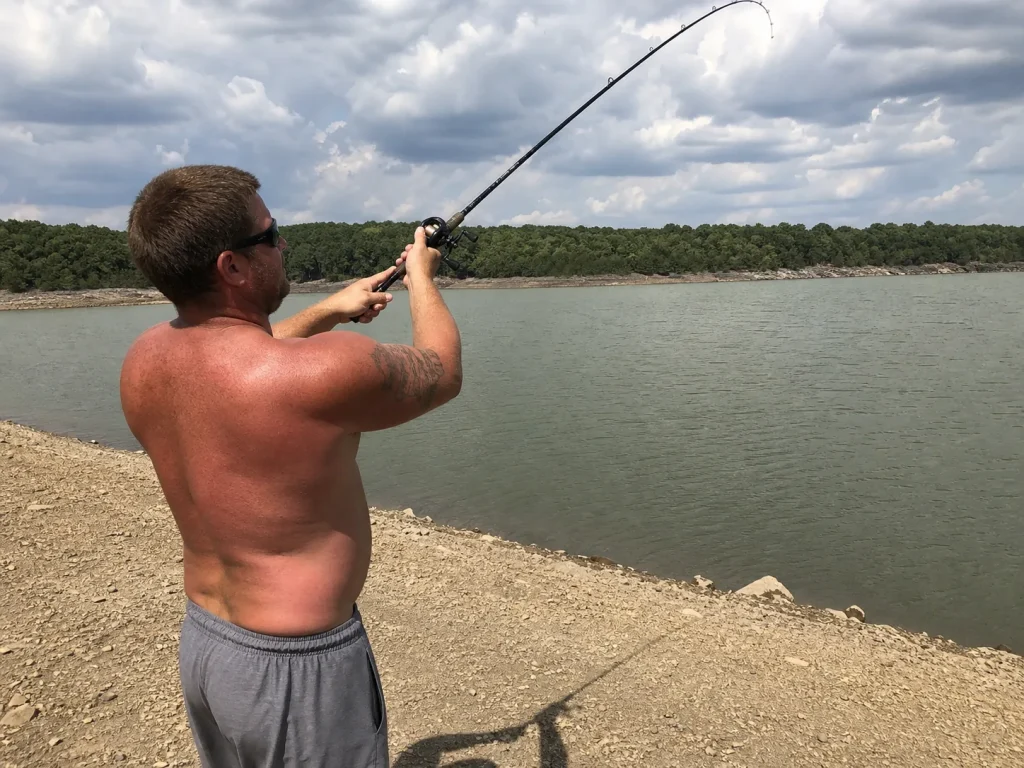
The rod is a lever. Your hand is the fulcrum, your forearm is the effort, the lure is the load. Nobody at the boat ramp says “lever arm,” but every angler has felt it work: a longer rod widens the casting arc the tip sweeps through on the same wrist rotation, and a wider arc means more tip speed at release.
That’s the whole distance mechanism. No magic, no marketing.
The same lever that buys you casting distance charges you for it. An eight-footer takes noticeably more forearm and shoulder work to swing at speed than a six-footer, and that bill comes due somewhere around hour three. Length also buys hookset leverage and line pickup, which is why a long rod moves so much more slack out of the water when you set from forty feet away.
Accuracy runs the other direction entirely, and so does sensitivity. A shorter blank puts the tip closer to your hand, so small corrections land where you aimed and a light tap actually reaches your fingers instead of dying somewhere in the middle of the rod. Long rods amplify your error right along with your reach.
Anglers have a word for the cost side of this trade: swing weight, meaning how tiring a rod feels in motion rather than on a scale. Two rods can weigh the same on paper and feel like different tools after two hundred casts.
Everything below is that trade-off applied to a specific situation. If you want the wider view of every spec that goes into picking a stick, the full rod-buying picture covers the ground this article narrows down.
Length Only Makes Sense Next to Power and Action
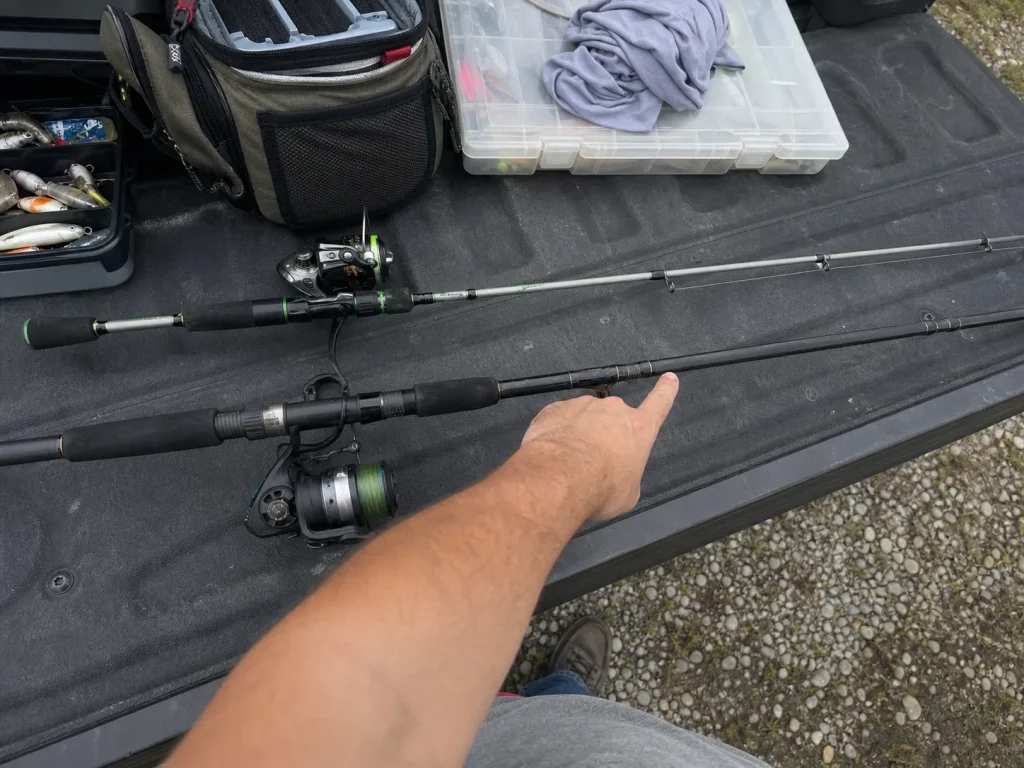
This is the section that saves people from the most expensive mistake in the article. Someone reads “seven feet is the all-around length,” buys a 7′ heavy, then wonders why every panfish bite registers as nothing at all. The length was right. The rod was wrong.
Length, rod power and rod action are three separate specs doing three separate jobs. Length sets the arc and the leverage. Power sets how much load the blank will carry. Action sets where the blank bends.
A 7′ medium-light and a 7′ medium-heavy are not remotely the same tool, and a 7′ fast action is not the same tool as a 7′ medium action. Same number on the blank, different fishing entirely. Worth understanding what power and action actually control before you let a length chart make the decision for you.
The material underneath changes how all of that behaves, too. Fiberglass bends slower and more forgivingly than graphite, which is why a slow action glass rod and a fast graphite rod of the same length fish like different species. Neither one is better. They just fail differently, and the failure you can live with depends on what you’re throwing.
Then there’s the part the charts never admit: brands run their own scales. One company’s medium is another company’s medium-light, so the printed rating is a starting point rather than a verdict. Learning to read what’s printed above the grip is the difference between buying a spec and buying a rod.
Stated flatly, the ledger looks like this. Long buys distance, hookset leverage and line control. Short buys accuracy, control in tight quarters, and a rod you can still swing at hour six.
Neither column is the winner. The water decides.
The 7-Foot Default and Who It Actually Fits
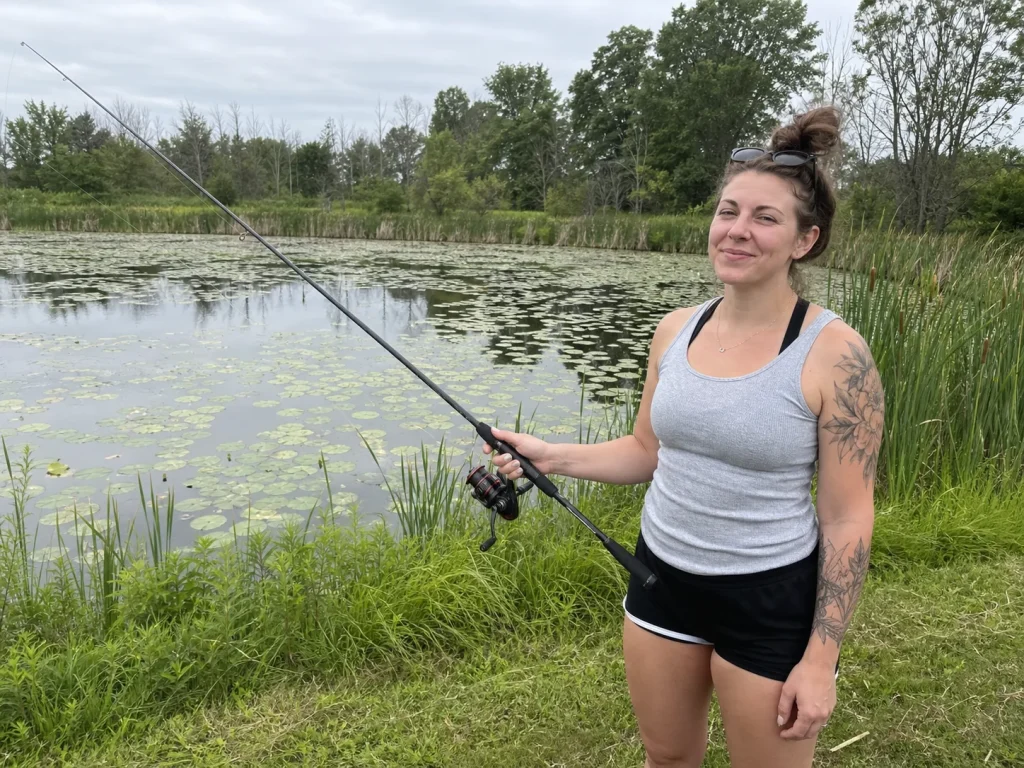
Every guide on the internet lands on roughly seven feet, and they’re not wrong. The working range runs 6’6″ to 7’4″, centered on 7′, and it covers more freshwater fishing than any other single number. It works because 7′ sits at the point where you still get usable casting distance and hookset leverage without carrying a rod that fights you in a boat, on a bank, or in a bush.
But “all-around” is a category, not a promise, and the useful version of this advice names who should ignore it. Interestingly, the U.S. Fish & Wildlife Service’s guide for first-time anglers skips the number entirely and gives a better test: pick a rod you can hold comfortably in one hand. If you can’t one-hand it through a full cast, it’s the wrong rod no matter what any chart says.
If the 7′ default is your starting point, the KastKing Centron Spinning Combo is the honest, budget-friendly expression of it: a 7′ medium/fast spinning rod sold as a combo, so a first rod doesn’t immediately turn into a second decision about which spinning reel to bolt onto it. If you want the wider shortlist, the beginner spinning rods worth starting on go deeper on the category.
Who should ignore the 7′ default: shoreline first-timers, kayak anglers, and anyone whose technique carries a real length requirement. All three get covered below.
Matching Rod Length to Your Technique
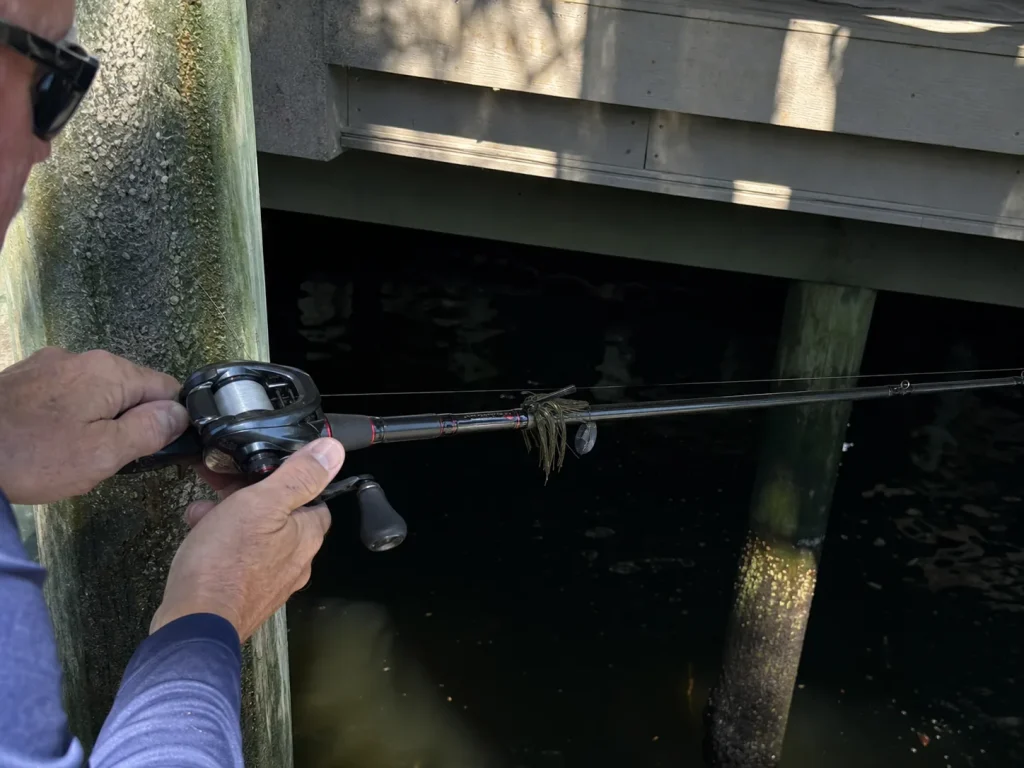
Technique is the variable most anglers skip past. They pick a length by species, then wonder why finesse fishing feels clumsy on the rod that flips beautifully. Every presentation has a physical requirement, and length is how you meet it.
Finesse, Dropshot and Light Presentations
Short and softer. The presentation is about feel and small corrections, not reach, and a shorter blank puts the tip near your hand where a subtle drop actually registers. The working zone is 6’6″ to 6’9″. Go to a full seven-footer for dropshot work and you start steering a canoe with the paddle held at the tip.
Crankbaits, Jerkbaits and Moving Baits
Moderate action wants a rod that loads and stays loaded, because length here is about keeping treble-hooked fish pinned rather than about reach. Jerkbait work specifically rewards going shorter, around 6’10”. You’re working the bait down at the water, and a long tip slaps the surface on every sweep.
The same logic runs through the rest of the moving-bait family. Spinnerbait and topwater work both sit comfortably at 7′, because you’re covering water on a steady retrieve and the fish essentially hooks itself against the rod rather than against your wrist. Swimbait is the exception that proves the rule: heavier baits need more blank to move them, and that’s one of the few honest reasons to step past 7′ in freshwater. What none of them want is a fast tip, which rips trebles free on the hookset instead of letting the fish load the blank.
Flipping, Punching and Heavy Cover
Here’s the technique that proves the whole thesis. Heavy cover does not need a longer rod. It needs a stronger one. The Shimano Zodias CST-70-MH is exactly that answer: 7′, medium-heavy, fast, delivering the backbone and hookset leverage that flipping and punching demand without adding a foot you can’t swing under a dock.
Anglers use “backbone” for the stiffer lower and mid section that does the fighting, as opposed to the softer tip that does the feeling. Pitching technique lives in the same zone for the same reason: short underhand deliveries into a target, where length past 7′ costs accuracy and buys nothing back. The baitcasting reel most cover anglers run is already doing the line-control work a longer rod would be asked for.
The mistake is reading a technique’s power requirement as a length requirement. If jig work is your thing, casting rods built for jig work break the category down further.
Matching Rod Length to the Fish You Chase
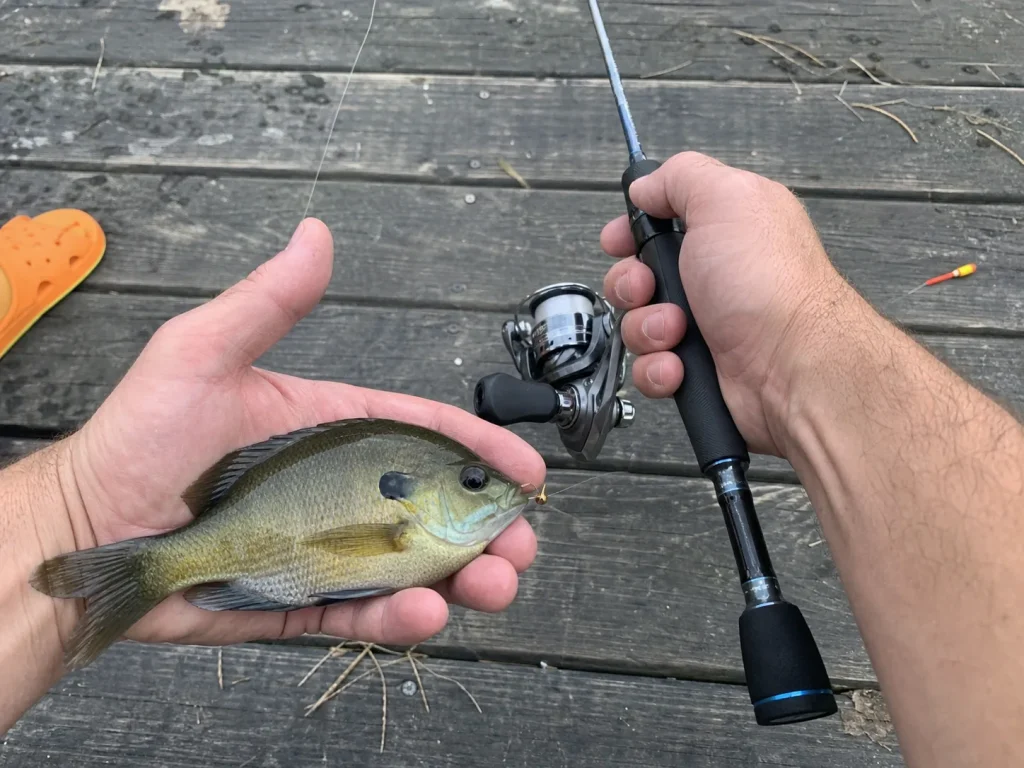
Species is where most length advice starts, and honestly it’s the weakest of the three axes. A “bass rod” isn’t one length. What species does give you is the outer bounds: what you’re lifting, and what the fish is going to do the second it feels the hook.
On the short end sit panfish, bluegill, crappie, yellow perch and trout. Light fish, light line, close-in presentation. Two state agencies land on nearly the same number from opposite directions: Idaho Fish and Game’s beginner shoreline rod recommendation puts first-timers on a 5 to 6 ft combo with 4 to 8 lb mono, and Utah’s wildlife agency frames 5 to 8 ft spinning combos as general-purpose for kids and adult beginners alike. For bluegill off a bank, that is plenty of rod.
On the long end sit bass, pike, catfish, salmon and carp. Bigger fish, heavier line, more slack to pick up on a hookset, more reason to want leverage.
The honest caveat: species sets the range, technique picks the number inside it. A bass rod spans 6’9″ to 7’11” depending entirely on what you’re throwing.
And the common mistake here is reaching for length simply because the fish is big. A big fish on a short rod is a fight. A big fish on a rod you can’t swing is a fight you lose slowly.
Matching Rod Length to the Water You Fish
Water type is the axis you can’t argue with. A creek you can jump across does not care what rod you wanted to bring, because the overhang has already decided. This is where the longest-rod-on-the-rack instinct dies fastest.
Small Streams, Creeks and Ponds
Tight quarters, overhanging cover, short casts. Every inch of rod is an inch closer to a branch, and short wins by a mile. Bank fishing compounds it: you’re casting from a fixed spot with brush behind you, not from an open deck with room to sweep.
Skinny water adds the other half of the problem. In shallow creeks the fish feel you coming, so the cast that catches them is a short accurate one made from farther back, which is precisely what a shorter rod does well and a long one does badly.
Open Lakes and Reservoirs
Room to swing, room to cast, and the 7′ default earns its reputation. Open water is exactly what the all-around rod number was built for, and boat fishing here is the one setting where nothing physical argues back. That’s the point worth noticing: this is the easy case, and it’s the case most length advice quietly assumes you’re in.
Surf and Open Beach
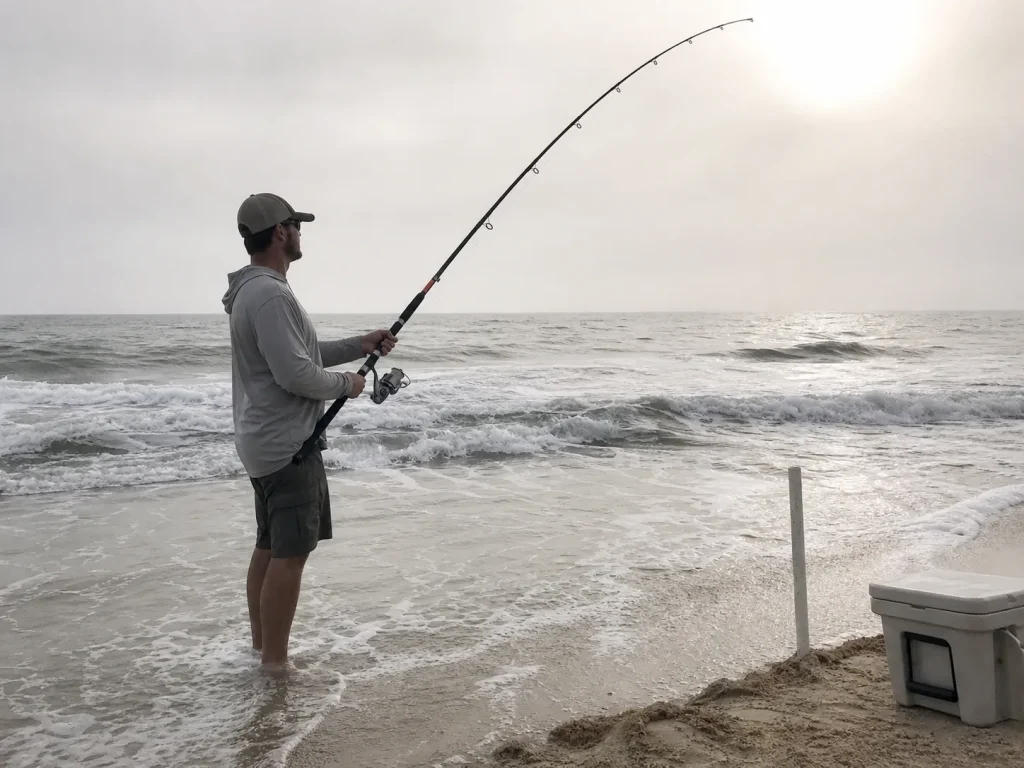
Surf fishing rods run 9 to 13 ft, and the tiers are real. Nine feet suits backwater and beach-walking. Ten feet with moderate action is the honest starting point for 2 to 5 oz lures. Eleven-plus is for when you genuinely need maximum distance or heavy structure, not for when you want to feel serious in the parking lot.
The Ugly Stik Bigwater Spinning Rod sits right on that 10′ starting tier at a price that doesn’t pretend surf fishing is a luxury sport.
Here’s the fatigue math nobody prints: the jump from 9′ to 11′ measurably raises shoulder and lower-back strain across a full session. You carry every extra foot all day, every cast. Grabbing the rack’s maximum for “distance” instead of the length your actual cast requires is how a good beach day turns into a sore one. Worth checking surf rods that actually reach before you size up on principle.
The Rod Length Matrix in One Table
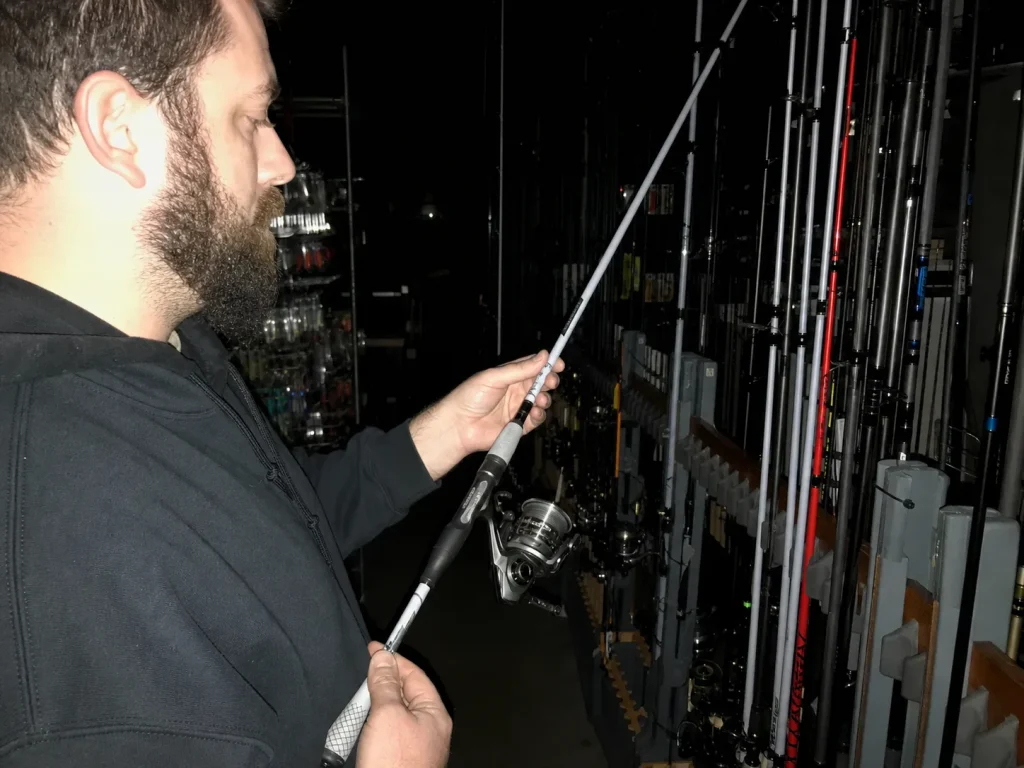
Everything above explains the reasoning. This is the part you screenshot and pull up in the tackle aisle. The sections before this teach you to fish. This one gets you out of the store with the right rod.
| Technique | Length | Power | Why |
|---|---|---|---|
| Finesse / dropshot | 6’6″ to 6’9″ | Medium-light | Feel over reach; the tip stays near your hand |
| Jerkbait | ~6’10” | Medium | Keeps the tip off the water on every sweep |
| Crankbait / moving baits | 7′ | Medium, moderate | Loads and stays loaded so trebles stay pinned |
| All-around freshwater | 7′ | Medium | The default; distance and control both usable |
| Flipping / punching | 7′ | Medium-heavy | Backbone, not length, moves fish out of cover |
| Shoreline / panfish | 5′ to 6′ | Light | One-hand comfort beats every chart |
| Wading / inshore | 7’6″ | Medium, fast | Six extra inches keep the backcast off the water |
| Surf | 10′ | Heavy, moderate | Genuine distance need, paid for in fatigue |
Read down the Length column and notice what it does not do: it does not sort from small to big by importance. It sorts by job. The 7′ rows outnumber everything else, and the two of them sitting side by side (medium for cranking, medium-heavy for punching) are the same length doing completely different work. That’s the article in one glance.
The Power column is the one nobody else prints, and it’s the one that makes the table usable. Every competitor guide will hand you a length for a technique. None of them tell you that the length is meaningless until you pair it with the power, which is exactly how people end up with a technically correct 7-footer that fishes wrong. Read the two columns together or don’t read them at all.
Use it in this order. Name your presentation first, find the row, take both the length and the power from it, and only then walk to the rack. Doing it backwards, walking to the rack with a number in your head and picking a technique to justify it, is the single most common way anglers buy the wrong rod while following good advice.
If your technique isn’t on the table, you don’t need a bigger table. You need the physics from the top of this article: does the presentation need feel or reach? Does it need a tip that gives, or a backbone that doesn’t? Answer those two and you’ve built your own row.
What the table is not is a substitute for holding the rod. The number gets you to the right rack. Your hand picks the rod off it.
Know your technique before you know your number. Anglers who walk into the shop with a length in their head walk out with the wrong rod far more often than the ones who walk in with a presentation in their head. The rack is organized by length because that is easy to hang, not because that is how you should choose.
The Platform Limits Nobody Measures
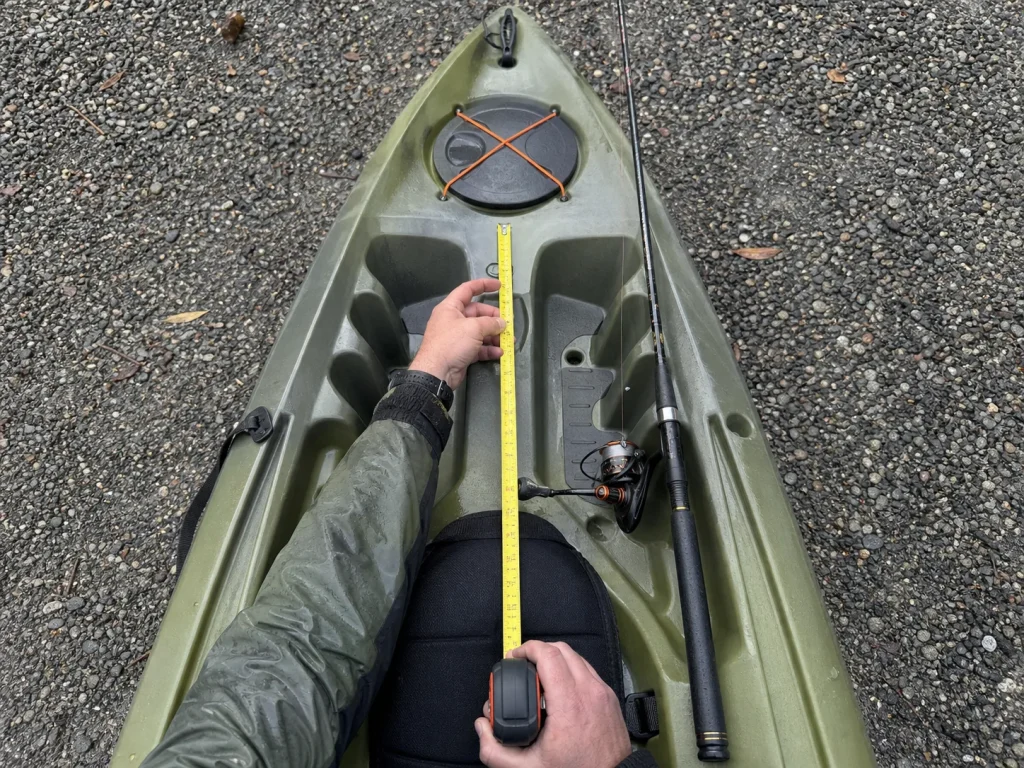
This is the section that pays for the article. Every guide out there tells you what length to want. None of them mention that your kayak, your boat’s rod locker, or the water sitting at your knees has already made the decision for you. These are numbers you take with a tape measure, not opinions you argue about on a forum.
Kayak Clearance, Seat to Bow Plus a Foot
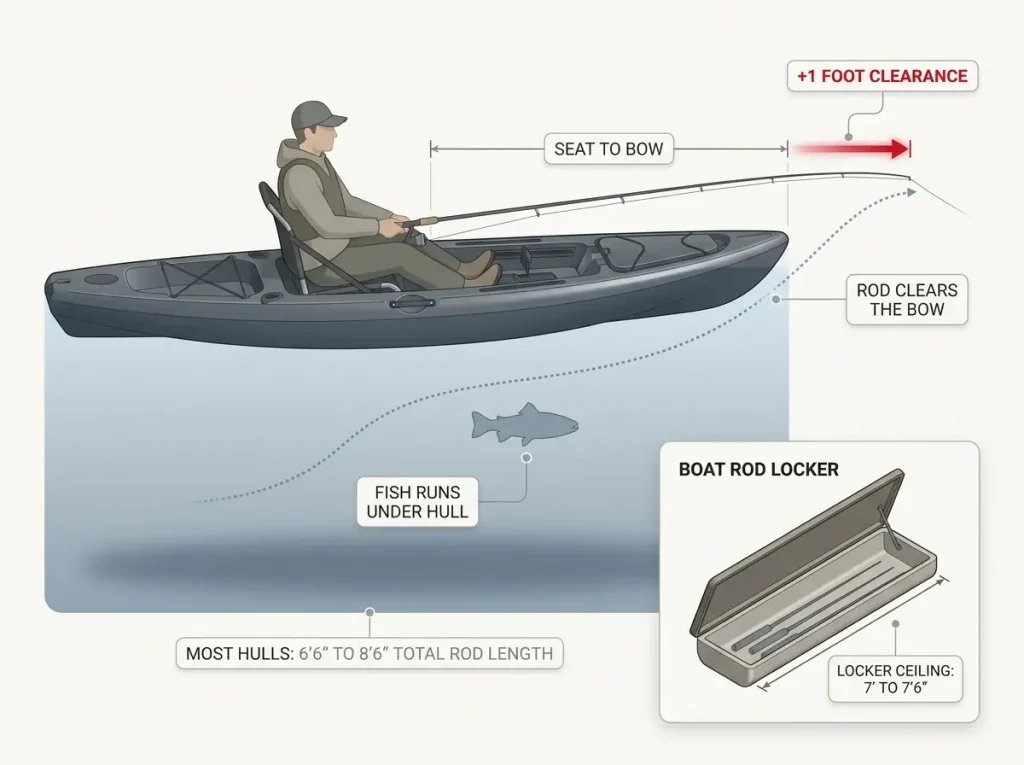
The rule is simple: your rod should exceed your seat-to-bow distance by about a foot. Most paddlers land between 6’6″ and 8’6″ depending on hull length, and kayak fishing is the one platform where the chart on the shop wall is genuinely useless, because it doesn’t know your boat.
Why the rule exists, stated plainly: too short and the rod can’t clear the bow when a fish runs under the hull. Every kayak thread has the same story in it, the angler who undersized the rod, hooked a decent fish that ran straight under the boat, and had to half-rise out of the seat to work the tip around the bow.
That’s how a fish turns into a stability problem, and a stability problem turns into a swim. The seat-to-bow distance rule exists to keep you sitting down. If you’re setting up a boat from scratch, the rest of the kayak-fishing setup is worth reading before you buy anything.
Measure your own hull before you buy, not after. Seat front to bow tip, add twelve inches, and that number outranks every recommendation in this article including the table above. Nobody’s chart knows your kayak.
Boats, Open the Rod Locker First
Smaller in-floor and console lockers commonly cap out around 7′ to 7’6″. Go longer than that and you need dedicated rod boxes or a rack system, which is a purchase nobody budgets for when they’re standing in the aisle holding a rod they already love.
The consequence is unglamorous and completely real. A rod that doesn’t fit rides loose on the deck, gets stepped on, or quietly stays home every trip. Take a tape to the locker before you buy anything over 7’6″. Two minutes at the dock saves a rod.
Wading, Size Up to Keep the Backcast Off the Water
Wade and inshore work rewards the 7’6″ end over a flat 7′ for one specific reason: keeping the backcast up off the surface when you happen to be standing in that surface. Wading deeper pushes the requirement further, because the waterline moves up your legs and the rod still has to clear it.
That extra six inches is the cheapest fix in this whole article, and it’s the one wade anglers most often skip. Since you’re going to be standing in moving water anyway, how to wade current without getting pushed around covers the footing side of the same problem.
Wind Rewrites the Length Rule
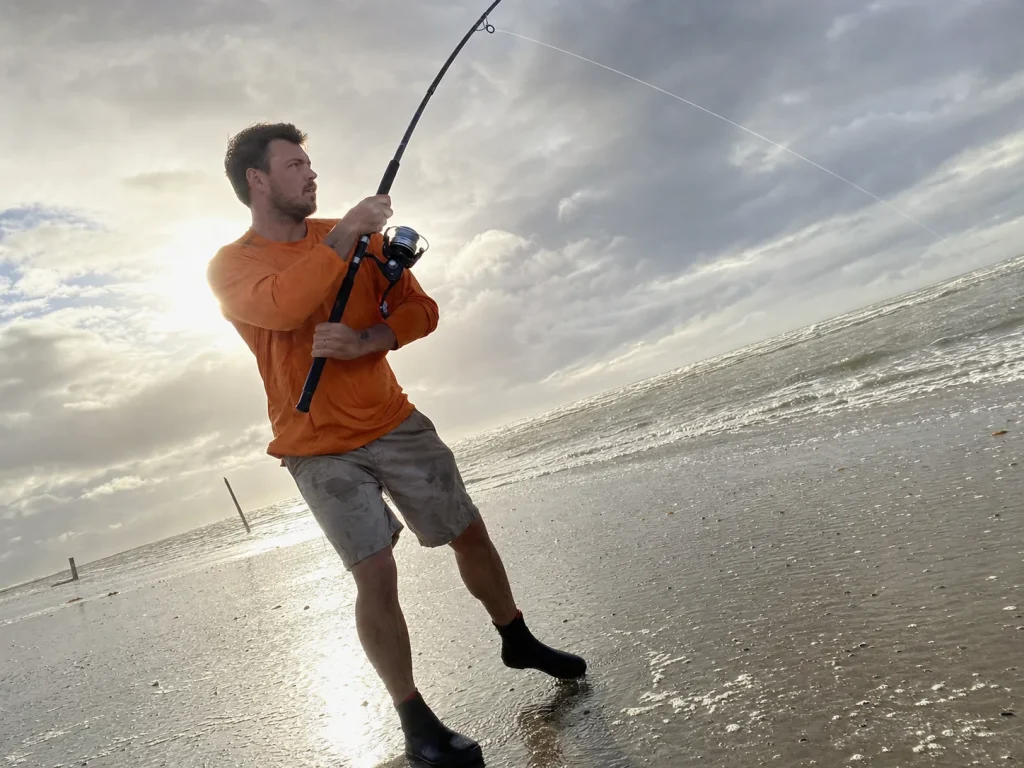
Here is the paragraph that makes the title true. Wind is the variable that turns “longer is farther” into a lie you can watch happen in real time on a beach, and almost nobody writes it down.
With light lures in the 1/8 to 1/2 oz range in a crosswind, 7′ to 7’6″ spinning rods hold up better than longer blanks. The longer rod presents more wind resistance through the casting stroke, so the cast that was supposed to go farther goes sideways instead. That’s the whole mechanism, and it’s why the guy with the shorter rod out-casts the guy who paid more for reach.
Loading compounds it. A long rod in wind is harder to load properly through the stroke, so you end up fighting the blank and the air at the same time, and the cast never gets the energy it needed. Meanwhile the shorter rod loads clean and goes where you pointed it.
Notice that this stacks with everything else the wind is already doing to you. A light lure has almost no mass to punch through moving air, which is why the effect shows up hardest in the 1/8 to 1/2 oz range and mostly disappears once you’re throwing something heavy enough to ignore the breeze. The rod isn’t the only variable. It’s just the one you chose in a shop three months ago and can’t change on the beach.
The honest half of the trade: the longer rod still gives you more line control after the cast lands. It loses during the cast and wins after it. Which half matters depends entirely on the day, which is exactly why this is a decision rather than a rule.
It also means the “right” rod changes with the forecast rather than with the water, and that’s the part most anglers never internalize. The same 10-footer that was the correct call on Tuesday’s flat morning is the wrong call on Thursday’s blow, on the identical beach, for the identical fish. Nothing about the situation changed except the air.
That anecdote from the top of the article, the angler who bought the longest surf rod on the rack for maximum distance and got out-cast in a stiff onshore wind by someone running a 7’6″ fast-action rod, keeps surfacing in surf threads because it keeps happening. The practical takeaway: check the forecast before you decide the rack’s longest rod is your distance rod. On a gusty day, the seven-footer you almost walked past is the one that reaches.
Handle Length, Your Frame, and Transition Fatigue
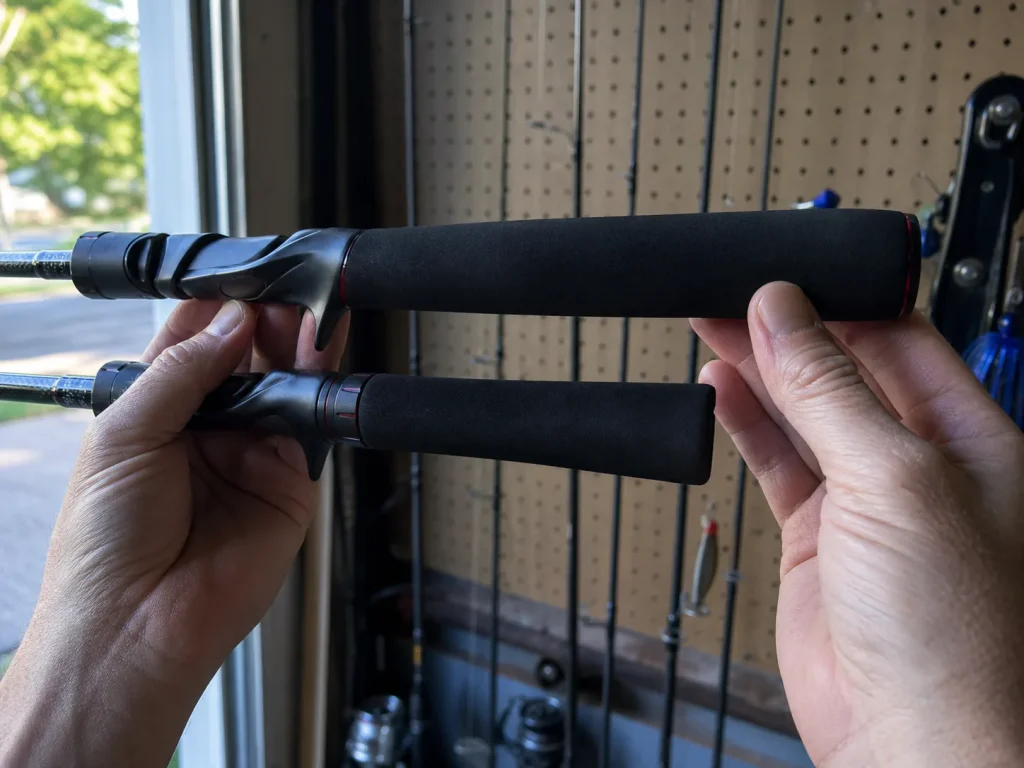
Two rods can share a length, a power rating and a price and still feel like completely different tools in your hands. Everyone notices this. Almost nobody explains it. The grip is doing half the work your spec sheet never mentions.
Handle length and grip diameter vary meaningfully across rod lines at the same blank length, and the variation is wide enough that rod storage hardware gets built to accommodate handles up to roughly 1¾” in diameter. That’s a proxy for how much room the category leaves itself, and it’s a number you’ll never see on a rod label.
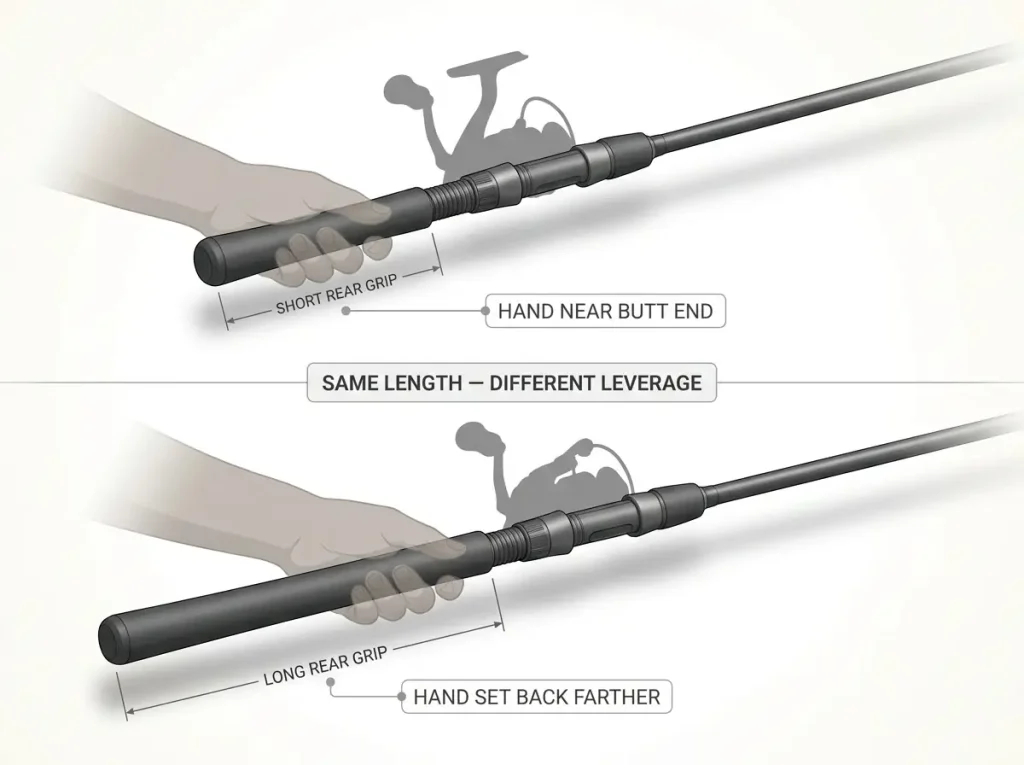
Why it matters mechanically: the handle is where your lower hand applies effort to the lever. A rear grip that’s too short for your reach shortens your leverage on every cast and every hookset, regardless of what the blank says. A 7′ rod with a long rear grip fishes differently for a long-armed angler than it does for someone who has to choke up just to reach it. Reach and build are real variables that the charts skip entirely, including the chart in this article.
Then there’s transition fatigue, which is the one that sneaks up on people. Carrying a 6’9″ finesse rod and a 10′ surf rod on the same trip taxes different muscle groups, and switching between them mid-session tires you out faster than either rod would alone. Your arm never settles into one rhythm. If you’re feeling that more than you should, how a balanced rod and reel changes how heavy it feels addresses the other half of the equation, and what all-day leverage does to your elbow covers where this goes if you ignore it for a few seasons.
The two-rod test at the shop: pick up both candidates, mimic the cast and then the hookset, and notice which one your lower hand has to reach for. That’s the tell no spec sheet will ever give you, and it takes about fifteen seconds.
Honest Rod Picks by Length Tier
You know your tier by now. Here’s a real rod in it, plus permission not to buy one.
The Anti-Sell First
If the rod you already own is within about six inches of your tier, fish it. A length mismatch of half a foot costs you far less than most anglers assume, and the power or action mismatch from earlier costs you considerably more. Nobody’s catch rate collapsed over six inches of graphite.
A budget rod in the right tier out-fishes a premium rod in the wrong one, every time, and that’s not a motivational line. It’s just where the leverage actually is.
The upgrade worth paying for is the one that fixes a platform problem (the kayak clearance, the locker ceiling) or a technique problem. The upgrade that adds a foot for its own sake is the one you’ll regret by hour three.
There’s a decent test for this. Write down the actual reason you want the new rod. If the sentence names a situation, “my rod can’t clear the kayak bow” or “I can’t get under the dock,” that’s a real purchase.
If the sentence names a feeling, “I want more distance” or “mine seems short,” you’re about to buy a foot of graphite to solve a problem you haven’t diagnosed. The rack has never once talked anyone out of that.
The Short Tier for Finesse, Panfish and Tight Cover (6’6″ to 6’9″)
The Lew’s Mach Crush Spinning Combo at 6’9″ medium light fast is the short-tier combo that doesn’t feel like a compromise, and the medium-light power is the entire point rather than a downgrade. If it’s out of stock, the HANDING M1 Trout Fishing Rod, a 2-piece 7′ ultralight, covers the same trout and panfish work and tends to stay available.
Worth noting that Utah Division of Wildlife Resources’ general-purpose spinning-rod guidance frames 5 to 8 ft spinning combos as the general-purpose range for kids and adult beginners alike. The short tier isn’t a specialist purchase. It’s where a lot of anglers should have started.
The All-Around and Technique Tiers (7′)
The 7′ medium/fast default and the 7′ medium-heavy for heavy cover are the same length doing two different jobs. You met both already, and the point of naming them together is this: seven feet covers two tiers at once because power separates them, not length. That single fact undoes most of the length anxiety people bring to the shop, and it’s why a 7′ entry-level rod buys more versatility than any other length you can spend the same money on.
The Long Tier for Surf and Distance (9’+)
The 10′ starting point holds. Go past it only when the beach genuinely demands it, and go in knowing you’re buying fatigue along with the reach. That’s not a reason to avoid it. It’s a reason to be sure.
And be honest about how often you’ll use it. The long tier is the one anglers buy for the trip they take twice a year, then leave in the garage for the other fifty weekends. If that’s the shape of your fishing, the rod is still worth owning. Just don’t let it be the rod you learn on, because everything it teaches you is wrong for the water you actually fish most.
Conclusion
Length is a job, not a ranking. The rack’s longest rod is the right answer for exactly one situation, an open beach on a calm day, and the wrong answer for most of the rest.
Measure before you shop. Your kayak’s seat-to-bow, your boat’s locker, the height of the water at your knees: those numbers beat any chart, including the one in this article.
And length is only one third of the spec. Power and action decide whether the correct length feels right in your hands or feels wrong all day long.
Before your next trip, take a tape to the one thing you’ve never measured, whether that’s the locker, the hull, or your own rear grip, and find out whether the rod you already own was in the right tier the whole time.
Frequently Asked Questions
01What is the best all-around fishing rod length?
Seven feet, for most freshwater fishing. The working range runs 6-foot-6 to 7-foot-4, and 7 feet sits where you still get usable casting distance and hookset leverage without a rod that fights you in tight quarters. With no reason to go shorter or longer, start there.
02Is a longer or shorter fishing rod better?
Neither. They trade. Longer buys casting distance, hookset leverage and line pickup. Shorter buys accuracy, control in tight cover, and a rod you can still swing at hour six. In a crosswind with light lures, the shorter rod often out-casts the longer one outright.
03What length rod should I use for a kayak?
Measure your seat-to-bow distance and add about a foot. Most paddlers land between 6-foot-6 and 8-foot-6 depending on hull length. Too short and the rod cannot clear the bow when a fish runs under the hull, which turns a stability problem into a swim.
04Does rod length affect casting distance?
Yes, but not the way most anglers assume. A longer rod widens the arc the tip travels through on the same wrist rotation, raising tip speed at release. That distance costs forearm and shoulder effort on every cast, and in wind a longer blank gives much of it back.
05What rod length is best for bass fishing?
There is not one. A bass rod spans roughly 6-foot-9 to 7-foot-11 depending on the presentation. Finesse and dropshot work wants 6-foot-6 to 6-foot-9. Flipping and punching heavy cover wants a 7-foot medium-heavy, where the answer is backbone rather than extra length.
Risk Disclaimer: Fishing, boating, and all related outdoor activities involve inherent risks that
can lead to injury. The information provided on Master Fishing Mag is for educational and informational purposes
only. While we strive for accuracy, the information, techniques, and advice on gear and safety are not a substitute
for your own best judgment, local knowledge, and adherence to official regulations. Fishing regulations, including
seasons, size limits, and species restrictions, change frequently and vary by location. Always consult the latest
official regulations from your local fish and wildlife agency before heading out. Proper handling of hooks, knives,
and other sharp equipment is essential for safety. Furthermore, be aware of local fish consumption advisories. By
using this website, you agree that you are solely responsible for your own safety and for complying with all
applicable laws. Any reliance you place on our content is strictly at your own risk. Master Fishing Mag and its
authors will not be held liable for any injury, damage, or loss sustained in connection with the use of the
information herein.
Affiliate Disclosure: We are a participant in the Amazon Services LLC Associates Program, an
affiliate advertising program designed to provide a means for us to earn advertising fees by advertising and linking
to Amazon.com. As an Amazon Associate, we earn from qualifying purchases. We also participate in other affiliate
programs and may receive a commission on products purchased through our links, at no extra cost to you. Additional
terms are found in the terms of service.