
In this article
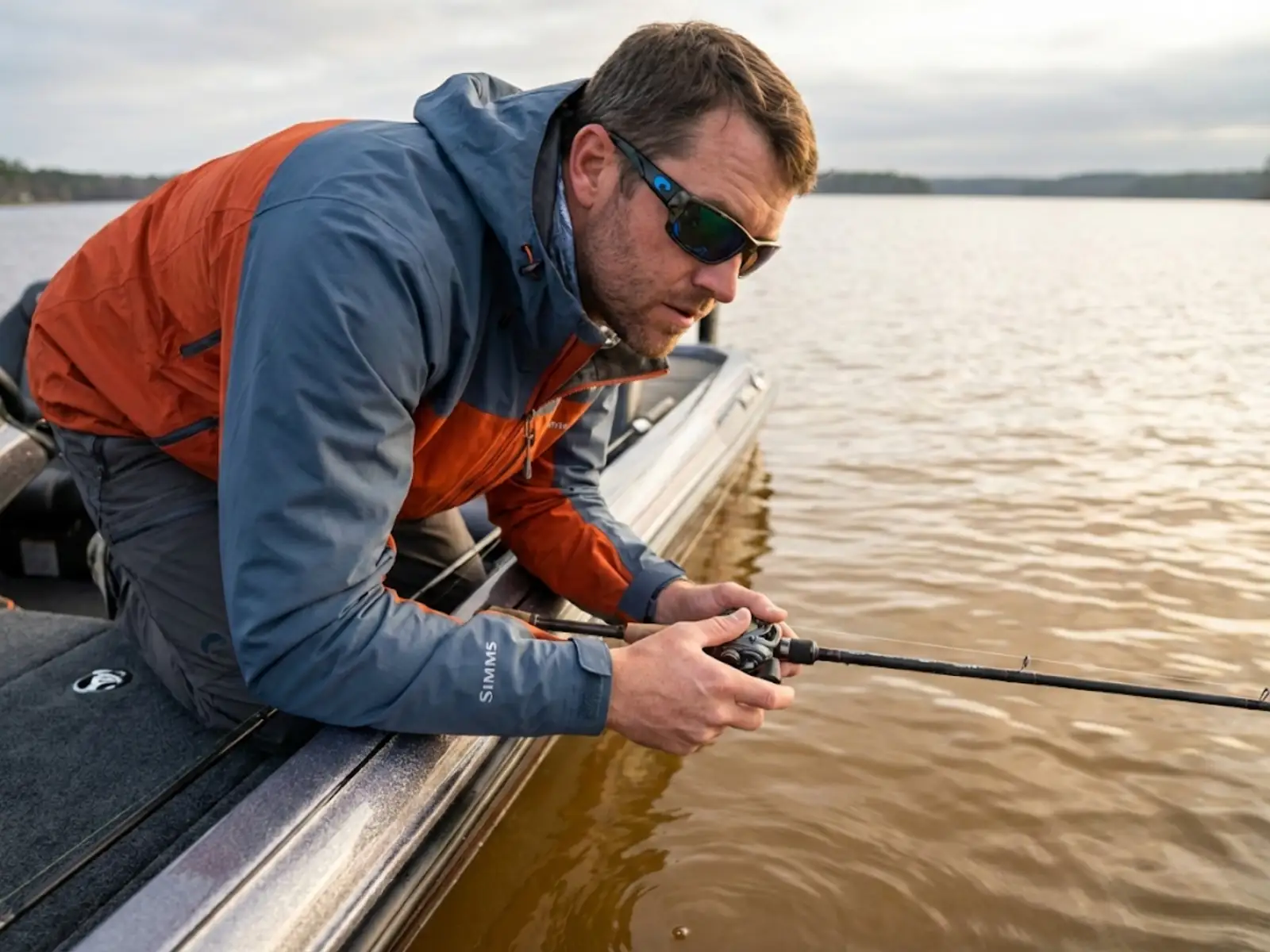
You’ve been casting that double willow in white and chartreuse for three hours straight. Not a bump. The water isn’t muddy exactly, but it has that amber, tea-colored stain from last week’s rain. You assume the fish just aren’t biting. Then a guy in a beat-up jon boat slides past you and starts putting fish in the boat on nearly every cast. Same stretch of bank. Same time of day. His spinnerbait looks identical to yours—except for one thing. His blades are gold, not silver.
That’s not luck. That’s physics. He understands that in tannic water, your silver blades are reflecting blue sky and disappearing into the brown background, while his gold ones are catching what little light penetrates that stained column and glowing like a torch. The difference between a skunk and a limit often comes down to matching your blade selection to what the water demands. After two decades of slinging these things across every shade of water you can imagine, I can tell you this: water clarity is the single most important variable most anglers ignore.
Here’s exactly how to stop guessing and start choosing blades that fish can actually find.
⚡ Quick Answer: In clear water, use Willow Leaf blades for maximum flash and high-speed retrieves. In muddy water, switch to Colorado blades for their strong “thump” that fish detect with their lateral line. In stained or transitional conditions, tandem setups (Willow + Colorado) or Indiana blades give you the best of both worlds.
1. The Physics of Attraction: Why Blades Work
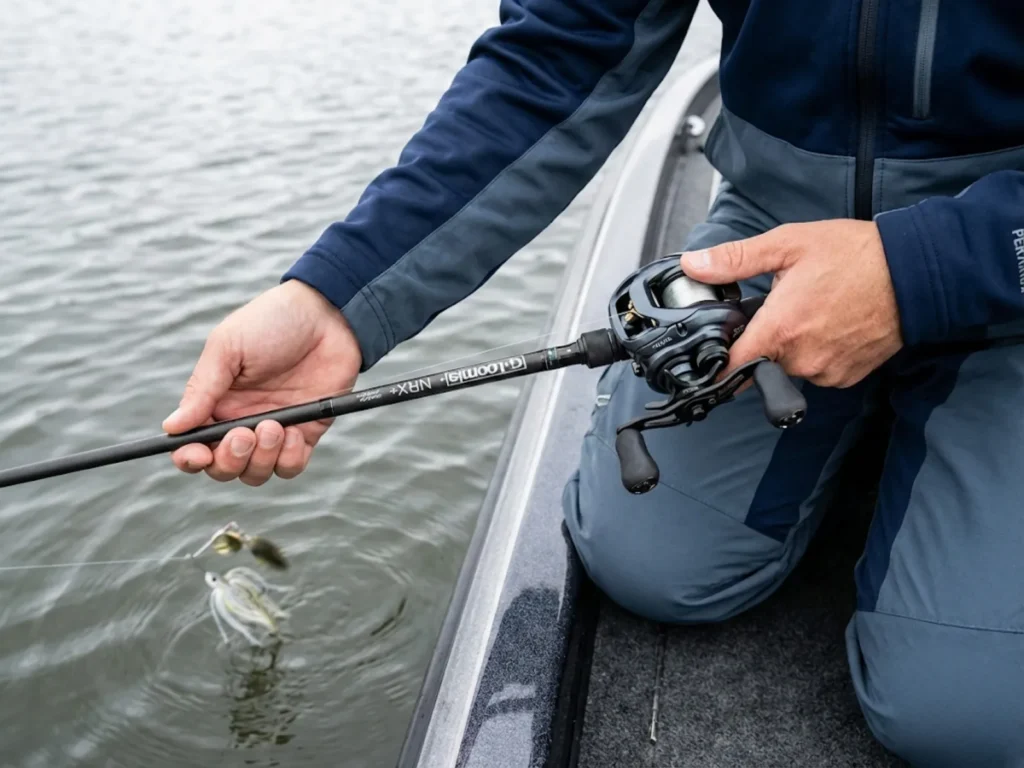
A spinnerbait blade is a simple piece of metal designed to do two things at once: create optical flash and generate physical vibration. The trick is that you can’t maximize both simultaneously. As one goes up, the other comes down. This trade-off is the key to everything that follows.
The Trade-Off: Flash vs. Vibration
Flash is what fish see. The blade catches sunlight and reflects it like a signal mirror, creating that erratic, flashing effect that mimics a school of fleeing baitfish. Willow Leaf blades are built for this—their narrow, elongated shape rotates tight to the body and creates intense optical flash with minimal water resistance.
Vibration is what fish feel. All bass possess a sensory organ called the lateral line, a row of nerve-rich pores running down each side of the body that detects low-frequency pressure waves in the water. This is how fish “hear” your lure from distances where they can’t see a thing. Understanding how fish use the lateral line system to detect vibration explains why the right blade can call fish from 20 feet away in zero visibility.
Colorado blades are the thump machines. Their round, deeply cupped shape pushes massive amounts of water with every rotation, creating low-frequency vibrations in that 10-20 Hz sweet spot where bass lateral lines are most sensitive. Research from the National Institutes of Health on fish mechanosensory systems confirms that these pressure-detecting neuromasts are optimized for exactly this frequency range.
Pro tip: If you can’t feel the blade pulsing through your rod handle on a slow retrieve, the fish probably can’t feel it either. Test your lure next to the boat before committing to a pattern.
The “Ceiling Fan” Effect
Here’s something most guides won’t tell you: a rotating blade creates the visual illusion of a larger solid object. Just like a spinning ceiling fan appears as a translucent disc, your spinnerbait blade looks much bigger underwater than its actual size. This “virtual volume” is how a single lure can imitate a substantial baitfish or even a small school.
The quality of this illusion depends on rotation speed and the blade’s angle of lift. Wider, slower-spinning blades (like Colorados) create more “virtual size,” while narrow, fast-spinning blades (like Willows) appear sleeker and more realistic at speed. If you want to learn more about how fish see underwater and detect lures, it starts with grasping how these pieces work together.
2. The Big Three: Blade Shapes and Their Hydrodynamics
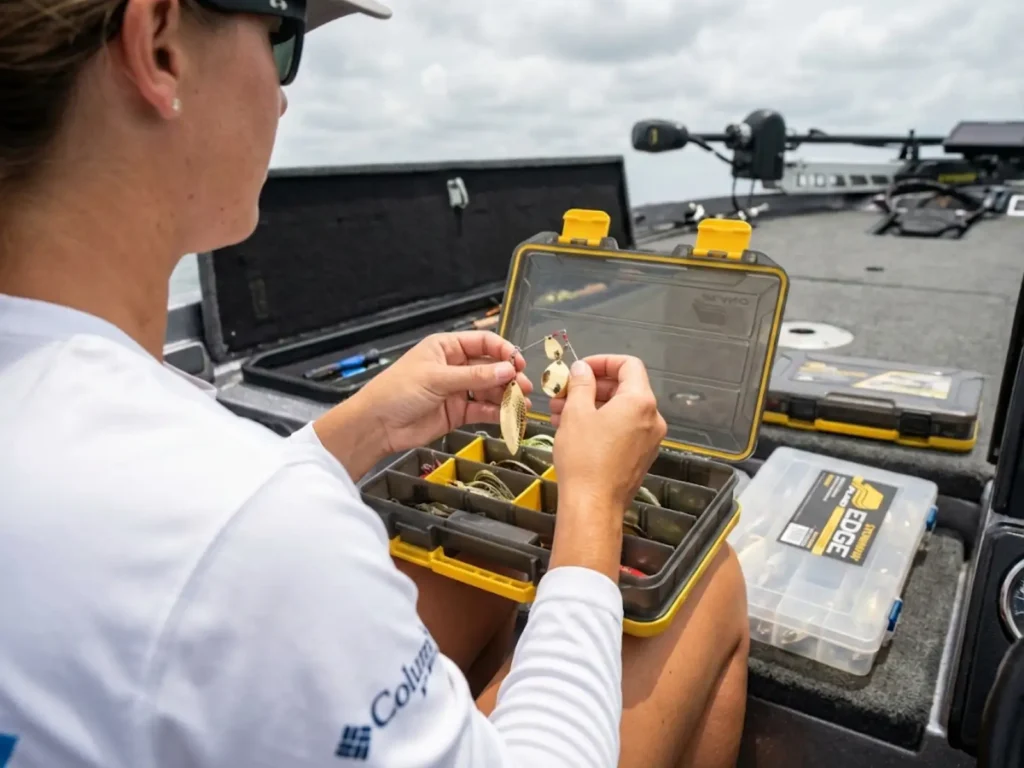
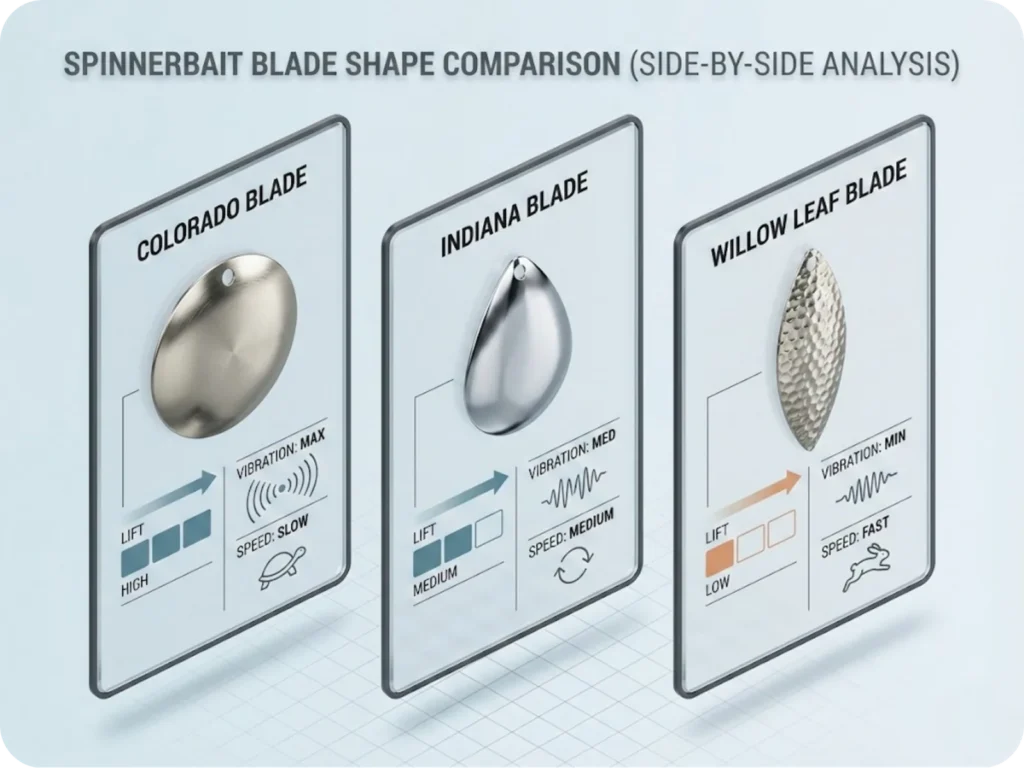
Three blade shapes dominate the spinnerbait world. Each one represents a different point on the flash-vibration spectrum.
The Colorado: The Thump Machine
The Colorado blade is round and heavily cupped. It rotates at roughly a 45-degree angle from the wire arm, pushing maximum water and generating the strongest vibration of any common blade shape. This is your go-to for off-colored water, low-light conditions, and any situation where fish are relying more on feel than sight.
The trade-off? Colorados create the most “lift” during the retrieve, meaning they’ll force your bait higher in the water column unless you slow down or use a heavier head. Tournament pros often pair a large Colorado with a heavy head (3/4 oz or more) for deep slow rolling along the bottom.
The Willow Leaf: The Speed Demon
The Willow Leaf blade is the opposite end of the spectrum. Its long, narrow shape offers almost no water resistance, allowing it to rotate tight to the body at around 20 degrees. This creates minimal lift—perfect for high-speed “burning the bait” just below the surface or running through submerged vegetation without fouling.
The primary output is flash, not vibration. A double-willow setup can look like a small school of shad flickering through clear water, triggering reaction strikes from fish that might reject a slower-moving lure they have time to inspect. As Mike Iaconelli puts it, “The tandem consists of two different blades. It’s the best of all worlds, the workhorse of spinnerbait fishing.”
The Indiana: The Forgotten Moderate
Shaped like a teardrop, the Indiana blade sits mechanically between the Colorado and the Willow. It rotates at around 30 degrees, producing moderate flash and moderate vibration—a “jack of all trades” that works when you’re not sure what the fish want.
Hank Parker calls this the “unsure blade.” When conditions are in transition—maybe the water is clearing after a storm or you’re fishing in stained conditions with variable cloud cover—the Indiana gives you enough of both outputs to stay in the game.
The Rare Blades: Oklahoma and French
In heavily pressured lakes, bass can develop an associative learning response to the familiar “thump” of standard blades. That’s where niche shapes like the Oklahoma (Turtle Back) and French blade come in. They offer unique sonic signatures that the fish haven’t learned to associate with danger. Consider them your secret weapons when the standard options stop producing.
3. Matching Blades to Water Clarity
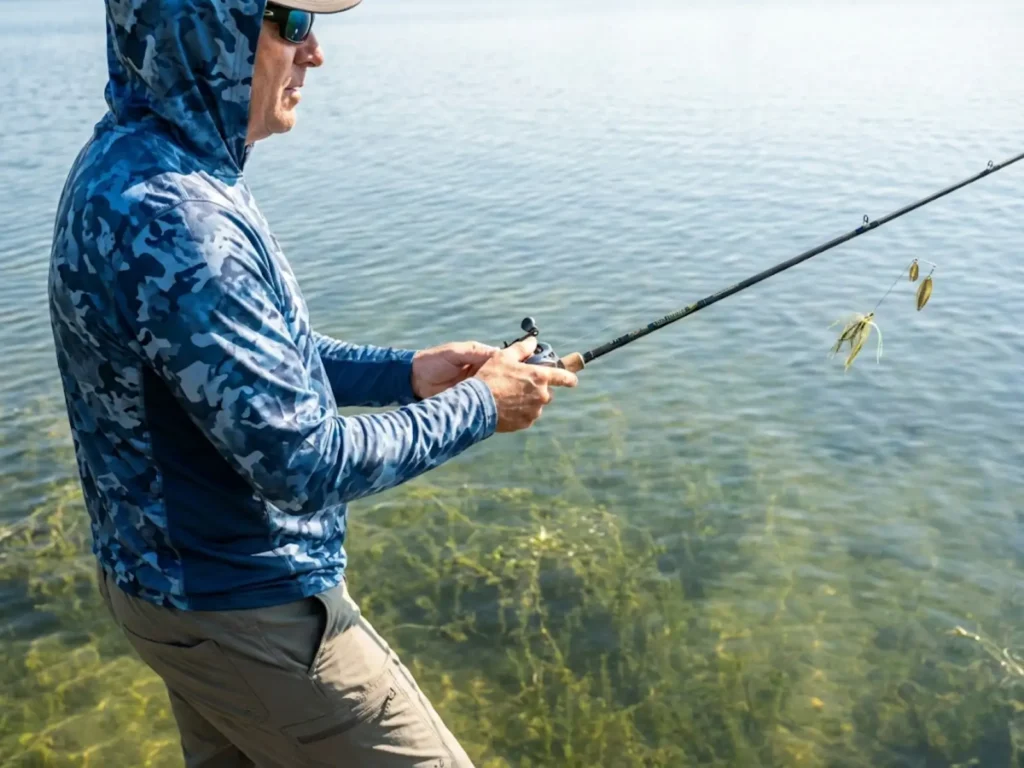
This is the core of intelligent spinnerbait selection. Water clarity dictates which sense the fish is primarily using, which tells you exactly which blade to throw.
Crystal Clear Water (>8 ft Visibility)
In gin-clear lakes, fish can see everything—including the imperfections in your lure. Speed is your camouflage. A double Willow Leaf setup in silver allows you to burn the bait so fast that fish react before they can analyze. The intense flash mimics fleeing baitfish, and the high speed triggers pure instinct.
Slow down, and you give them time to refuse. Keep your retrieve fast and erratic, bouncing the lure off structure to trigger reaction strikes. For more on how water turbidity affects lure visibility, the principle holds: visibility up, speed up.
Stained Water (3-6 ft Visibility)
This is the most common real-world condition, and it’s where tandem setups shine. A small Colorado or Indiana in the front position adds vibration, while a larger Willow in the rear provides flash. Fish can see, but not far, so they’re using both senses to track your lure.
One overlooked detail: in tannic water (that tea-colored stain from decaying vegetation), switch from silver to gold blades. Silver reflects blue sky, which looks unnatural against a brown background. Gold reflects the ambient amber light, appearing more natural and visible.
Pro tip: In stained water, gold blades with a black skirt is a deadly combination. The flash cuts through the murk while the silhouette stands out against the lighter surface above.
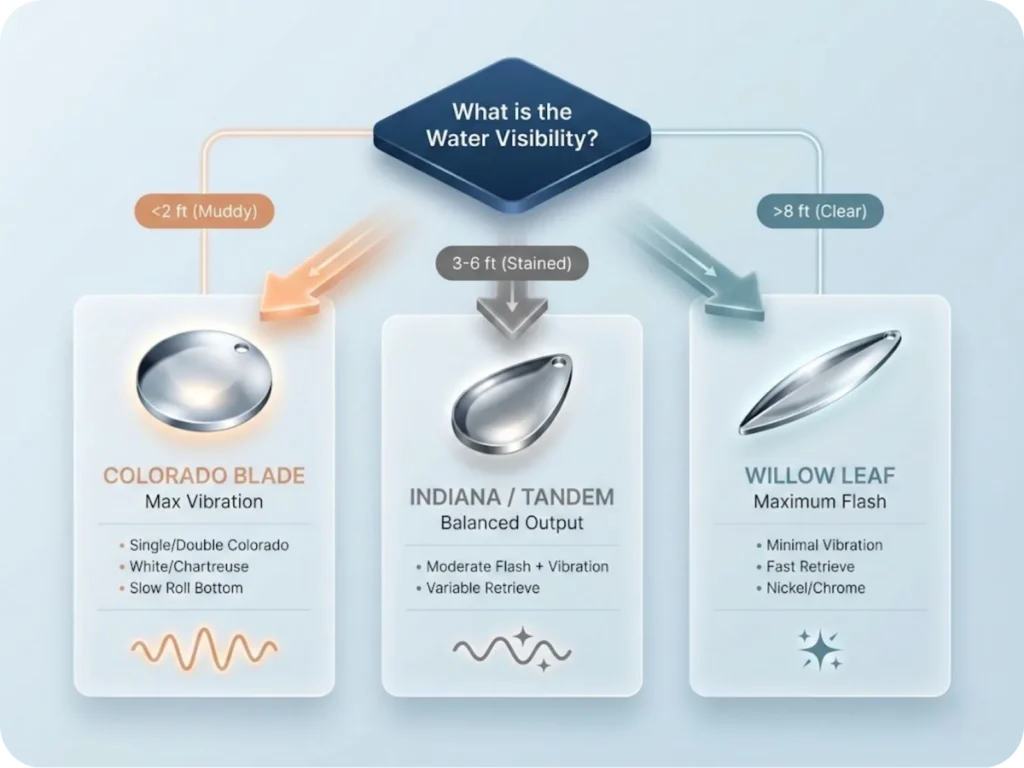
Muddy Water (<2 ft Visibility)
When visibility drops below a couple feet, forget about flash entirely. Fish are effectively blind. You’re fishing by remote control, using the blade’s pressure waves to guide them in.
A single or double Colorado blade in the largest size your head weight can handle is the answer. Painted blades in white, chartreuse, or orange add a solid silhouette that fish can track even when they’re right on top of the lure. According to research on turbidity and fish vision, when visibility drops below 2 feet, predatory fish shift almost entirely to lateral line detection. Slow roll it along the bottom, keeping contact with the substrate, and give them time to find you.
4. Light Conditions: The Second Variable
Water clarity isn’t the only factor. The amount of available light changes how your blades perform.
Sunny vs. Cloudy Rules
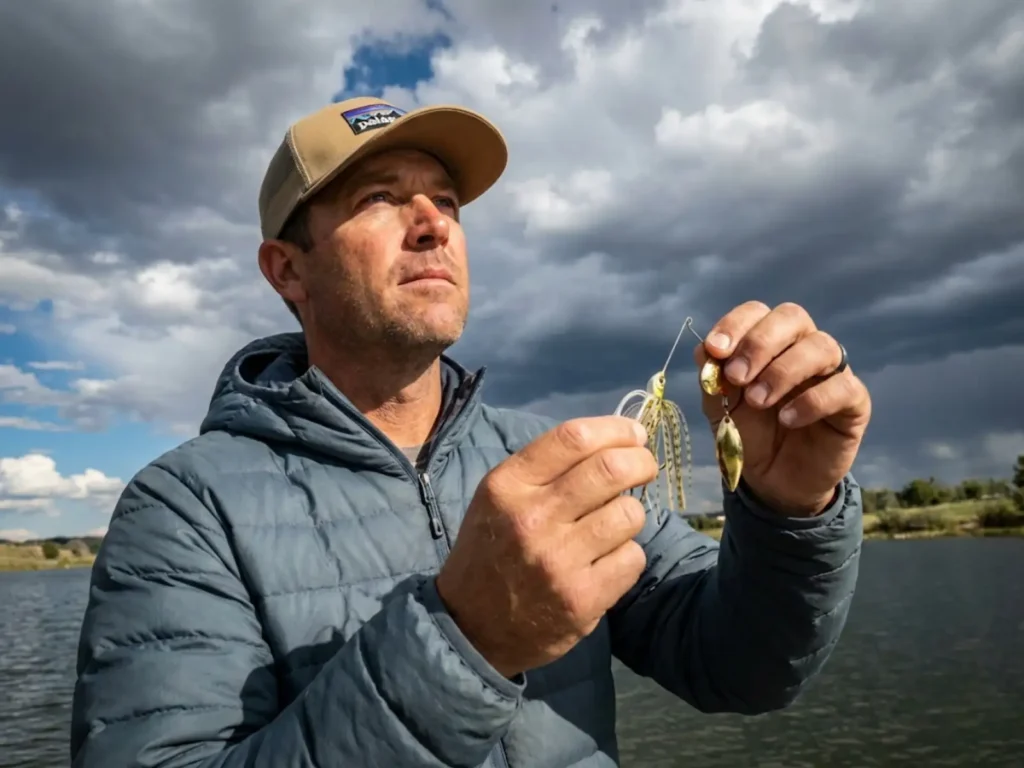
A silver blade works like a mirror—it needs direct sunlight to create that intense flash. On overcast days, that same silver blade looks like a dull grey spoon, generating almost no visual attraction. This is when you switch to gold or copper finishes, which catch and reflect ambient light more effectively.
In deep overcast or low-light conditions, consider painted blades (white or chartreuse). They offer a consistent solid silhouette rather than relying on failed reflections. When fishing barometric pressure changes, light conditions often matter as much as water temperature.
The “Police Car Strobe” Effect
In bright sun and clear water, a smooth silver blade creates an intense, rhythmic flash that can attract fish from long distances. But in shallow water, this can actually spook wary fish—it’s just too much.
The fix is a hammered or diamond-cut finish. These textures scatter the light into multiple smaller beams rather than one blinding spotlight, creating a softer, more natural shimmer that draws fish in without triggering their alarm response.
5. Advanced Tuning: The Expert-Engineer Adjustments
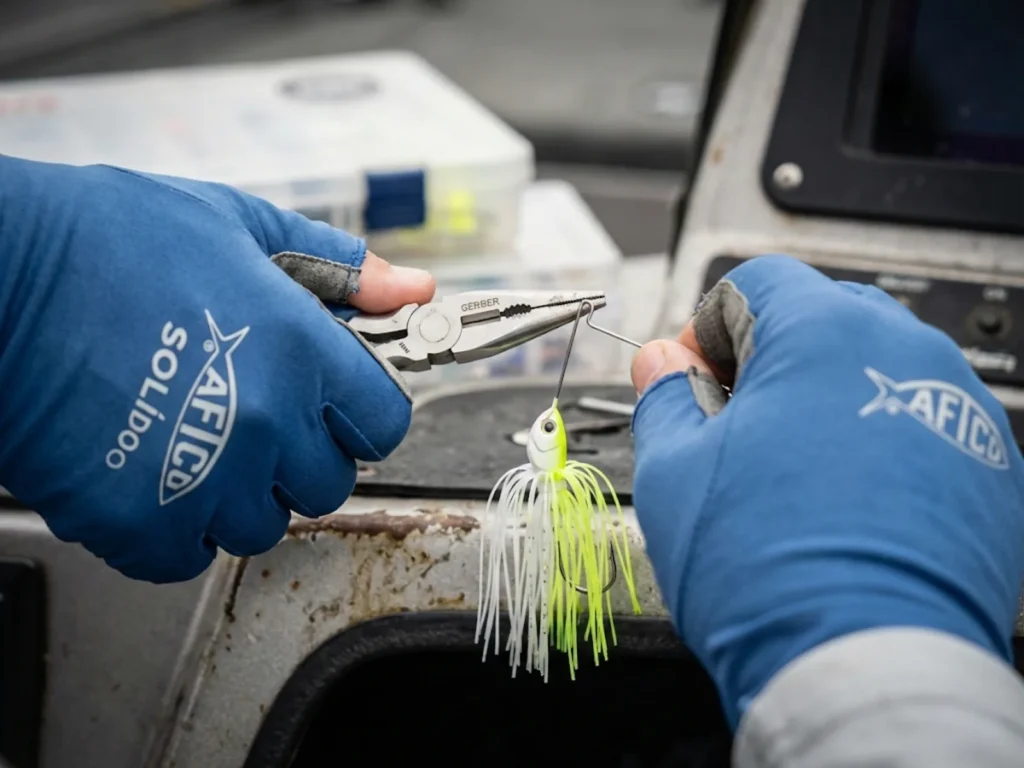
Once you understand the basics, you can start making professional-grade modifications that generic articles never mention.
Wire Diameter Nuances
Most anglers ignore wire gauge, but it matters. Thinner wire (.032″) is less rigid and vibrates more intensely, transferring the blade’s thump directly through the rod to your hand—and to the fish. Thicker wire (.040″) mutes vibration but survives more abuse in heavy cover.
For finesse situations or pressured fish, thin wire. For flipping into laydowns where you need the lure to survive multiple big fish, thick wire.
Blade Spacing and “Clackers”
On tandem rigs, the spacing between blades affects performance. If they’re too close, they steal each other’s water (cavitation), reducing the vibration output. Adjusting the beads to increase separation often improves the lure’s thump.
Some pros intentionally rig their blades to collide during rotation—a setup sometimes called a “clacker.” The metallic clicking sound adds another layer of auditory attraction, mimicking crayfish or feeding noise that can trigger bites when standard presentations fail. Experimentation with blade spacing is key to finding what works in your conditions.
Pro tip: Keep a small polishing cloth in your tackle box. In clear water, even minor tarnish on a silver blade can cut its flash output significantly. That mirror finish should be mirror-bright.
6. Common Mistakes to Avoid
Mistake 1: The “One Speed” Retrieve
Casting and reeling at a steady pace is the biggest mistake beginners make. Fish often follow a spinnerbait without committing—they’re waiting for something to change. Kevin VanDam says, “I almost never just cast a spinnerbait out and reel it with a steady retrieve. I’m always stopping it, starting it, twitching it.”
That pause makes the blades flutter and the skirt flare out, imitating a dying baitfish. That’s usually when the strike comes.
Mistake 2: Ignoring Oxidation
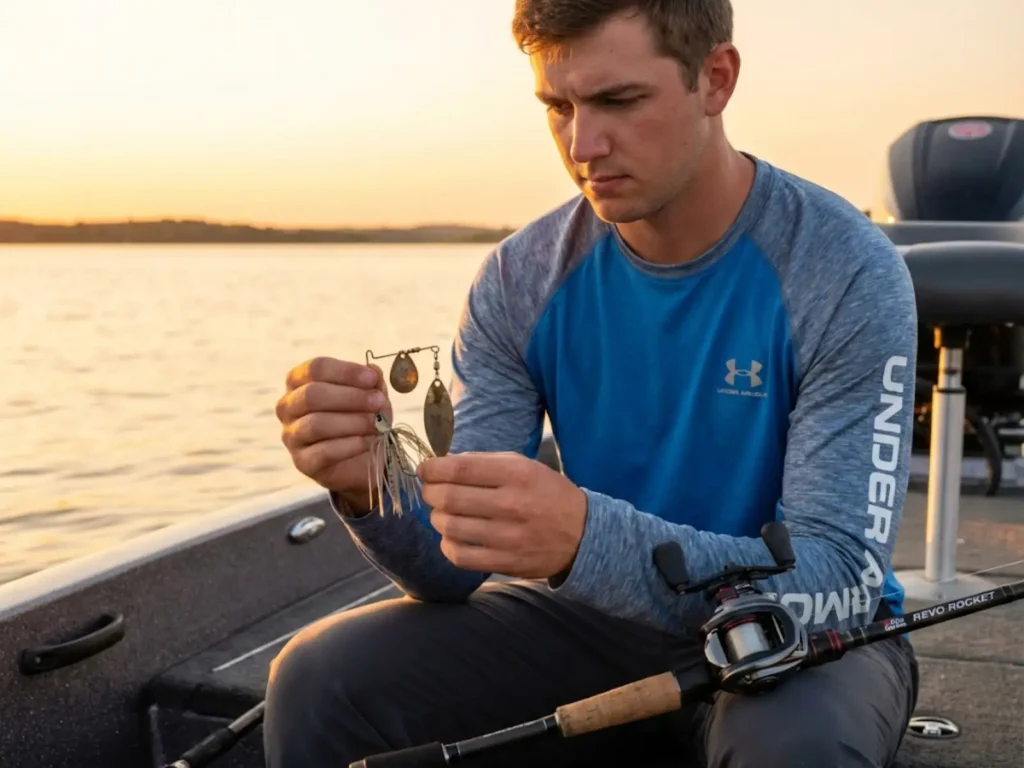
A dull, tarnished blade reflects far less light than a clean one. In clear water, this can cut your effectiveness dramatically. Take a minute to polish your blades before fishing, especially if they’ve been sitting in a box for months.
Mistake 3: Over-Blading
Using blades that are too large for your head weight causes the lure to roll on its side during the retrieve. The “torque” from the blade’s lift overpowers the keel (the head acting as ballast), and the spinnerbait spins in a useless circle.
Match blade size to head weight. A 3/8 oz head pairs well with #4-#5 blades. A 1/2 oz head can handle #6-#7. Going bigger without adding weight is a recipe for a spinnerbait that doesn’t track true.
Conclusion
The next time you look at the water and wonder which spinnerbait to throw, stop asking “is it clean or dirty?” Ask yourself what the physics of that water demands. Clear water demands flash and speed—tie on a double Willow. Muddy water demands displacement and thump—grab a Colorado. And that tricky in-between stained water is where the subtle art of the Indiana or a gold-bladed tandem rig really shines.
Open your tackle box right now. If all you see are silver Willow blades, you’re fishing with one hand behind your back. Add some Colorados, some gold finishes, maybe a painted blade or two. Then let the water tell you which one to throw.
FAQ
Do spinnerbait blade colors really matter?
Yes, but mainly for contrast and light conditions. Silver creates the most flash in direct sunlight. Gold or copper reflects better in stained water or low-light conditions. In muddy water, painted blades provide a solid silhouette that fish can track when metal finishes fail.
What is the best all-around spinnerbait blade?
A tandem setup with a small Colorado and a medium Willow is the workhorse. You get moderate flash from the Willow and detectable thump from the Colorado, covering about 70% of typical fishing situations.
Why does my spinnerbait roll over on its side?
You’re either retrieving too fast for the blade type, or the blades are too large for the head weight. Large Colorado blades create massive lift—reel them fast, and they overpower the lead head’s gravity. Slow down or switch to a heavier head.
Can I catch bass on spinnerbaits at night?
Absolutely. At night, bass rely entirely on their lateral line. Use a large single Colorado blade (#5 or #6) in a dark color like black or purple. The goal is maximum vibration so they can find it in zero visibility.
Risk Disclaimer: Fishing, boating, and all related outdoor activities involve inherent risks that
can lead to injury. The information provided on Master Fishing Mag is for educational and informational purposes
only. While we strive for accuracy, the information, techniques, and advice on gear and safety are not a substitute
for your own best judgment, local knowledge, and adherence to official regulations. Fishing regulations, including
seasons, size limits, and species restrictions, change frequently and vary by location. Always consult the latest
official regulations from your local fish and wildlife agency before heading out. Proper handling of hooks, knives,
and other sharp equipment is essential for safety. Furthermore, be aware of local fish consumption advisories. By
using this website, you agree that you are solely responsible for your own safety and for complying with all
applicable laws. Any reliance you place on our content is strictly at your own risk. Master Fishing Mag and its
authors will not be held liable for any injury, damage, or loss sustained in connection with the use of the
information herein.
Affiliate Disclosure: We are a participant in the Amazon Services LLC Associates Program, an
affiliate advertising program designed to provide a means for us to earn advertising fees by advertising and linking
to Amazon.com. As an Amazon Associate, we earn from qualifying purchases. We also participate in other affiliate
programs and may receive a commission on products purchased through our links, at no extra cost to you. Additional
terms are found in the terms of service.