In this article
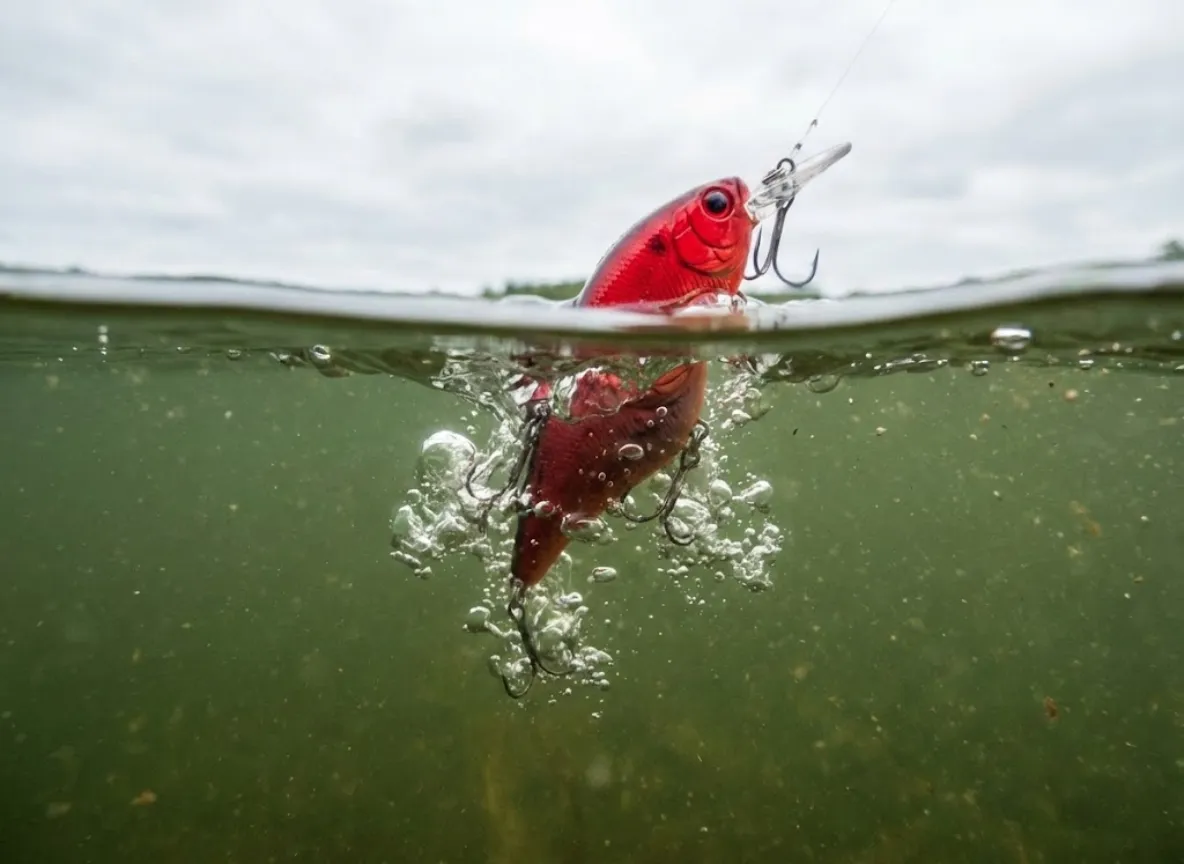
The moment your lure breaks the surface tension, it leaves the predictable optical physics of the atmosphere and enters an environment of severe distortion. I still recall the first time I dropped a camera down on a downrigger while trolling for salmon. The bright red spoon I had tied on—vibrant and flashing in the boat—turned into a dull, black silhouette within twenty feet of descent.
Light in the water column is aggressively scattered, absorbed, and filtered. To consistently trigger a predatory response, we must stop viewing our tackle boxes through human eyes and begin understanding the biological and visual mechanics that govern the predator’s perspective. It isn’t just about picking a “pretty” color; it is about selecting the wavelength that survives the journey to the fish.
This guide breaks down the ichthyology and physics of the aquatic environment, the anatomical differences between our eyes and those of a bass or walleye, and how to apply this data to catch more fish.
The Hydro-Optical Environment: How Does Water Alter Light?

Why do certain colors disappear as they go deeper?
As sunlight enters the water column, water molecules act as a spectral filter, stripping away warm colors rapidly while allowing cool colors to penetrate into the depths.
This process is known as attenuation. Solar radiation hits the water, and the molecules selectively absorb light energy based on wavelength across the electromagnetic spectrum. Long-wavelength light—specifically red (approx. 620–750 nm)—possesses the lowest energy in the visible light spectrum. Consequently, it is absorbed rapidly, often converting to heat energy within the first 15 to 20 feet of the water column. This is why NOAA data on spectral attenuation consistently shows red light vanishing first in oceanic waters.
However, “disappearance” is a misleading term. A red lure at 30 feet does not become invisible; it loses its chromatic identity. Because there is no red light at that depth to reflect off the paint, the lure appears as a dark grey or black silhouette. This phenomenon largely debunks the “bleeding bait” hypothesis in deep water. Red hooks or accents function primarily as contrast generators rather than blood mimics once you get below shallow depths.
Anglers must also recognize that vertical depth is not the only factor. Horizontal distance attenuates light exactly the same way. If you are mastering deep diving crankbait strategies, remember that a fish viewing a red lure from 20 feet away—even in shallow water—will experience similar color loss.
How does water chemistry and turbidity change color visibility?
While pure water filters red light first, the dissolved chemistry of a lake or river can flip this rule on its head, making “clear water” logic useless in stained environments.
Tannic water, often stained the color of tea by decaying vegetation, acts as a powerful short-wave filter. It absorbs blue and violet light almost immediately. In these “blackwater” systems, the red-orange-yellow spectrum actually penetrates the furthest. This makes these warm colors the most visible options, contradicting standard depth attenuation charts.
Conversely, eutrophic waters rich in phytoplankton (algal blooms) act as a monochromator. They filter out most light except for the green wavelengths reflected by spectral absorption of chlorophyll a, washing everything in a green hue.
Pro-Tip: In heavy algal blooms, use a lure with a “fire tiger” or bright orange belly. This contrasts sharply against the overwhelming green background, whereas a green pumpkin lure would disappear.
In turbid water dominated by suspended sediment—common when fishing rivers after heavy rain—light is scattered rather than just absorbed. This creates a diffuse “milky” glow that degrades visual acuity. Under these conditions, the specific hue of a lure becomes secondary to its luminance contrast against the background. Dark colors like black or purple often provide a sharper silhouette than white or chartreuse because they absorb the scattered light rather than reflecting it.
Biological Frameworks: How Do Fish Process Visual Signals?
How does the fish eye differ structurally from the human eye?
Fish eyes are evolved for a medium where light refraction behaves differently than in air, relying on a spherical lens rather than the cornea for focus.
Terrestrial eyes rely on the cornea for the majority of their refractive power. However, because water has a similar density to corneal tissue, a fish’s cornea provides almost no focusing ability. Teleost fish compensate with a perfectly spherical lens of high refractive index that protrudes through the pupil. It functions much like a super-wide-angle “fisheye” camera lens found in deep-sea creatures.
Unlike mammals that deform the lens to focus, the accommodation process in fish involves using the retractor lentis muscle to physically move the rigid lens backward or forward relative to the retina.
This anatomical difference has massive implications for how you present a bait. Most predatory fish are myopic (nearsighted) at rest. This biological default prioritizes the close-range inspection of prey immediately before a strike. The spherical lens creates a massive monocular field of view, often exceeding 180 degrees per eye.
This allows for exceptional peripheral motion detection, but binocular depth perception is limited to a narrow forward zone. This comparative morphology of the vertebrate eye dictates that lures moving across the peripheral field trigger an alert response. However, the lure must enter that frontal binocular zone to trigger the strike calculation. This is particularly relevant when attempting to induce explosive topwater strikes, where the fish is looking upward into a bright background.
What is the role of the Tapetum Lucidum in low-light predators?
The tapetum lucidum is a reflective layer of guanine crystals located behind the retina, functioning as a biological light amplifier for species like Walleye.
This structure reflects photons that passed through the photoreceptor layer back through the retina for a “second chance” at capture. This mechanism is responsible for the “eye shine” seen when a light beam hits a Walleye or Snook at night. It allows them to hunt in starlight conditions, known as scotopic vision. However, there is a trade-off. While the tapetum doubles sensitivity, it degrades visual acuity because the reflected light scatters slightly, blurring the image compared to the sharp photopic vision of diurnal species.
Pro-Tip: Because tapetal fish see a slightly “fuzzier” image in low light, avoid subtle, photorealistic patterns at night. Stick to high-profile lures with strong vibration to help them hone in on the target.
This creates a tactical distinction. Tapetal fish are superior at detecting silhouettes and motion in darkness but may struggle with fine detail resolution compared to non-tapetal fish like Bass or Pike in bright light. This is why retinal structure of Sander vitreus (Walleye) research supports the use of larger profiles during the “twilight niche.” When following a step-by-step night fishing blueprint, rely on this biological adaptation by keeping lures high in the water column to maximize the silhouette against the night sky.
Species-Specific Visual Profiles: How Do Predators See the World?
How does the dichromatic vision of Bass impact lure selection?
Largemouth and Smallmouth Bass are dichromats, meaning their eyes possess cone cells sensitive to red and green, but they lack specific blue-sensitive cones.
This biological limitation implies that bass likely perceive blue and black as similar dark tones. However, they retain high discrimination capability in the red, orange, and green spectrums. The popular color “Chartreuse” (yellow-green) falls squarely in their peak sensitivity range. To a bass, this likely appears as a high-luminance, pale tone that contrasts sharply against dark backgrounds.
Because Bass lack blue cones, the effectiveness of “Black and Blue” jigs in deep or muddy water is driven by silhouette contrast rather than color recognition. The spectral sensitivity in centrarchid fishes confirms that their visual world is dominated by red/green contrast.
Bass also possess specific blind spots directly behind and below them. This dictates that lure presentations are most effective when kept above the fish’s eye level to utilize the skylight background. In clear water, natural patterns like Green Pumpkin are effective because they match the background signal of vegetation. This forces the bass to use motion detection rather than color shock to find the bait, a key concept in our trophy-rated analysis of the best bass lures.
Why are Salmon and Trout sensitive to UV light?
Salmonids (Trout/Salmon) are often tetrachromatic, possessing a fourth class of cone cells sensitive to ultraviolet (UV) light, particularly in their juvenile stages.
This adaptation allows them to detect zooplankton and other small prey that absorb UV radiation. These prey items appear as distinct black specks against the UV-bright background of the water. While humans cannot see this spectrum, UV-reflective finishes on lures create a visual “haze” or brightness that stimulates these predatory instincts. Research on the ontogeny of UV photosensitivity in salmonids suggests that while some species lose this as adults, many retain enough sensitivity to make UV finishes highly effective.
Trout are specialized drift feeders that rely on “Snell’s Window,” a cone of vision looking up at the surface. Fluorescent pink is a dominant color for Steelhead because it absorbs the available UV light and re-emits it as visible red/orange light. This triggers their red-shifted sensitivity in stained river water. When consulting a trout lure matrix for every condition, prioritizing UV-active paints for overcast days or deep pools can often trigger strikes from fish that ignore standard finishes.
Material Science and Strategy: The Decision Matrix
What is the difference between Fluorescence and Phosphorescence?
Fluorescence absorbs non-visible UV light and re-emits it as visible color immediately, while phosphorescence stores light energy to emit it slowly over time.
Fluorescence (Day-Glo) occurs when a pigment absorbs high-energy light (UV or Blue) and instantly converts it to lower-energy visible light. It requires an external light source to function. Tactically, fluorescent lures are most effective in shallow to mid-depth water where UV penetrates clouds or stain, turning invisible energy into visible brightness.
Phosphorescence (Glow-in-the-dark) involves pigments like strontium aluminate that store photon energy in electron traps. These are essential for deep water (>50ft), night fishing, or situations with heavy ice cover where ambient light is near zero in the aphotic zone. The visual ecology of fluorescent prey suggests these lures mimic the bioluminescence of deep-sea organisms or benthic predators.
Anglers often confuse these technologies. A fluorescent lure fished in total darkness appears black. A glow lure must be “charged” with a flash or UV torch to be effective. This is particularly vital when reviewing safety and tactics for first ice, where snow cover cuts off light, making glow lures a primary tool for Walleye and Crappie.
How does polarization and flash influence the strike?
Metallic finishes rely on specular reflection to create a directional flash, mimicking the guanine platelets found on baitfish scales.
Specular reflection (Chrome/Silver) creates a intense “flash” that triggers reaction strikes from a distance in clear water. However, diffuse reflection (Matte/Paint) scatters light to create a solid silhouette. Matte is often superior in high-pressure waters where the unnatural harshness of chrome might deter cautious fish. In open water, many prey species utilize polarocrypsis in open ocean fish—a form of camouflage or counter-shading that matches the background polarization.
Lures with hammered or faceted metallic finishes scatter the flash in multiple directions. This breaks up the polarization signal, making the lure visible from more angles than a flat mirror finish. This is why “Copper Killer” spoons are effective in deep salmon trolling; copper reflects longer wavelengths that may match the reddish hue of deep zooplankton blooms.
When consulting a freshwater trolling success guide, remember that flash relies on the angle of incidence. Metallic lures lose their primary advantage on overcast days or deep in the aphotic zone where there is no directional light to reflect.
Conclusion
The science of underwater vision proves that there is no single “magic color.” Instead, there is a constant interplay between physics and biology.
- Water acts as a filter, not a blindfold: Red light vanishes first (~15ft), but water chemistry (tannins/algae) can reverse the rules.
- Biology dictates detection: Bass hunt via contrast and red/green discrimination, while Walleye utilize biological night-vision to exploit low-light windows.
- Material matters: Use fluorescence to convert UV light in shallow/stained water, and phosphorescence (glow) to create light in deep/dark water.
- Contrast is King: In turbid water or low light, the silhouette is always more reliable than the chromatic hue.
Next time you open your tackle box, look past the marketing paint jobs. Assess the water clarity, the depth, and the species, and choose the lure that the fish is biologically engineered to see. Share your most successful “unconventional” lure color choice in the comments below.
FAQ – Frequently Asked Questions
What color lure is best for muddy water?
Solid Black or Dark Blue. In muddy water, light is scattered, and color discrimination is poor. Dark colors absorb the available light to create the strongest possible silhouette against the milky background, aiding the fish in targeting the lure.
Do red hooks actually look like blood to fish?
Only in shallow water (<5-10 feet). Red light is absorbed quickly by water; below roughly 15 feet, a red hook appears black. However, in shallow water, red hooks provide a high-contrast strike point that may mimic the gill flare of a distressed baitfish.
Can fish see fluorocarbon line?
They can see it less than monofilament, but it is not invisible. Fluorocarbon has a refractive index (~1.42) closer to water (1.33) than nylon monofilament (~1.53). This means it bends light less and blends better, but it still has a physical presence that line-shy fish can detect.
Why do bass anglers use chartreuse if bass can’t see many colors?
It appears as a high-contrast, bright tone. While bass may not perceive yellow-green the way humans do, chartreuse reflects a high volume of light in the wavelengths bass are sensitive to. This makes it appear exceptionally bright (possibly white or pale yellow) against dark aquatic backgrounds.
Risk Disclaimer: Fishing, boating, and all related outdoor activities involve inherent risks that can lead to injury. The information provided on Master Fishing Mag is for educational and informational purposes only. While we strive for accuracy, the information, techniques, and advice on gear and safety are not a substitute for your own best judgment, local knowledge, and adherence to official regulations. Fishing regulations, including seasons, size limits, and species restrictions, change frequently and vary by location. Always consult the latest official regulations from your local fish and wildlife agency before heading out. Proper handling of hooks, knives, and other sharp equipment is essential for safety. Furthermore, be aware of local fish consumption advisories. By using this website, you agree that you are solely responsible for your own safety and for complying with all applicable laws. Any reliance you place on our content is strictly at your own risk. Master Fishing Mag and its authors will not be held liable for any injury, damage, or loss sustained in connection with the use of the information herein.
Affiliate Disclosure: We are a participant in the Amazon Services LLC Associates Program, an affiliate advertising program designed to provide a means for us to earn advertising fees by advertising and linking to Amazon.com. As an Amazon Associate, we earn from qualifying purchases. We also participate in other affiliate programs and may receive a commission on products purchased through our links, at no extra cost to you. Additional terms are found in the terms of service.