


In this article
The game warden’s truck is parked at the top of the boat ramp, and he is walking down the dock checking coolers. For many, this moment triggers a spike of anxiety. But for the informed angler holding a valid fishing license, the piece of paper in your pocket—or the pixelated QR code on your phone—is a source of pride, not fear.
In my years guiding clients, I’ve seen that legal permit transform from a minor administrative errand into the most critical piece of gear on the boat. It is more than a permission slip issued by the Department of Fish and Wildlife; it is the financial engine of the resources we cherish. It is also your only shield against strict liability laws enforced by conservation officers who do not care about “good intentions.”
This guide will walk you through the logic of the “User-Pay” model, help you decode the matrix of resident license versus non-resident license options, and explain why your smartphone battery life is now a legal liability.
Why Is a Fishing License More Than Just a Tax?
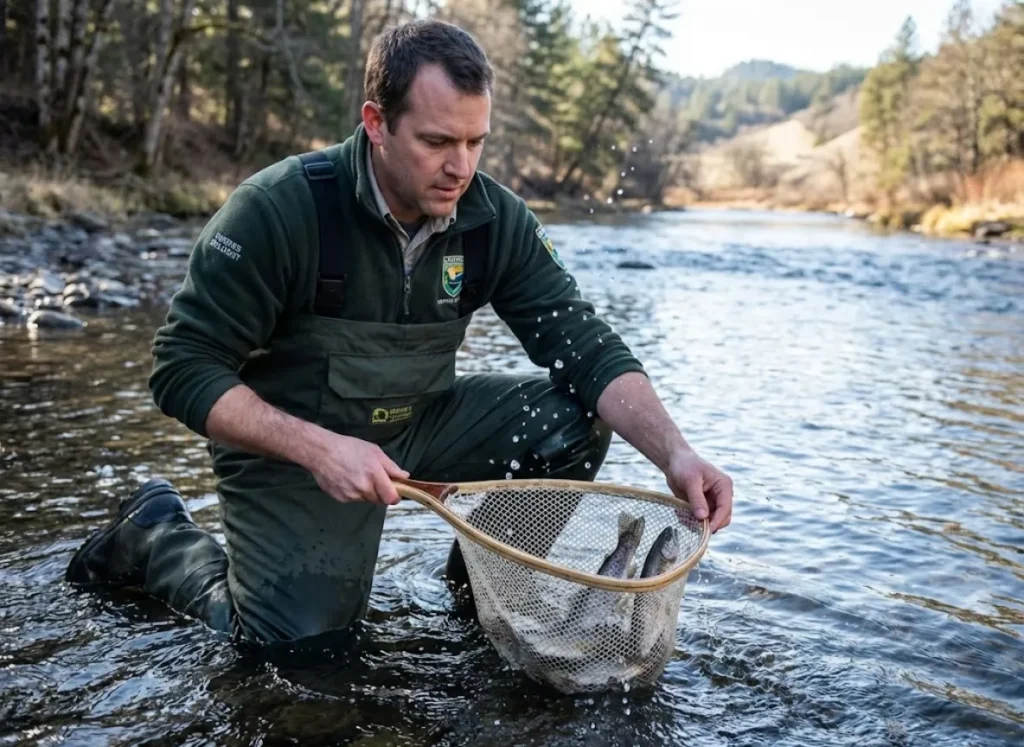
We often grumble about license fees, but it is vital to reframe the cost from a “government tax” to a conservation contribution. This shift in perspective aligns with the Public Trust Doctrine, which holds that wildlife belongs to the people and is managed by the state for our benefit through responsible fishing practices.
How does the “User-Pay” model fund the resources you use?
Unlike general income or sales taxes that disappear into a massive pot for roads, schools, or administrative salaries, fishing license revenue is unique. Legally, these funds are “ring-fenced” for state wildlife agencies. This structure creates a closed loop where the angler’s expenditure directly finances the management of the fishery they are exploiting. In many states, wildlife divisions function essentially as non-profits funded entirely by customers—us anglers—receiving zero dollars from the state’s general tax fund.
The system gets a massive boost from the Dingell-Johnson Sport Fish Restoration Act. This legislation places a federal excise tax on tackle and boat fuel, collecting money at the manufacturing level. These federal funds are distributed to State Wildlife Agencies based on land area and the number of paid license holders.
This formula creates a powerful multiplier effect. When you buy even a cheap short-term license, you trigger federal matching dollars. That transaction amplifies your financial contribution to the infrastructure we rely on, such as boat ramps, fish stocking programs, and habitat restoration vital for healthy aquatic ecosystems. This funding is the backbone of fish conservation for anglers.
Pro-Tip: If you are debating between a 1-day license or an annual pass, remember that purchasing an annual license counts you as a “paid license holder” for federal matching funds, bringing significantly more conservation dollars to your state than a short-term pass.
Which License Type Is Right for Your Trip?
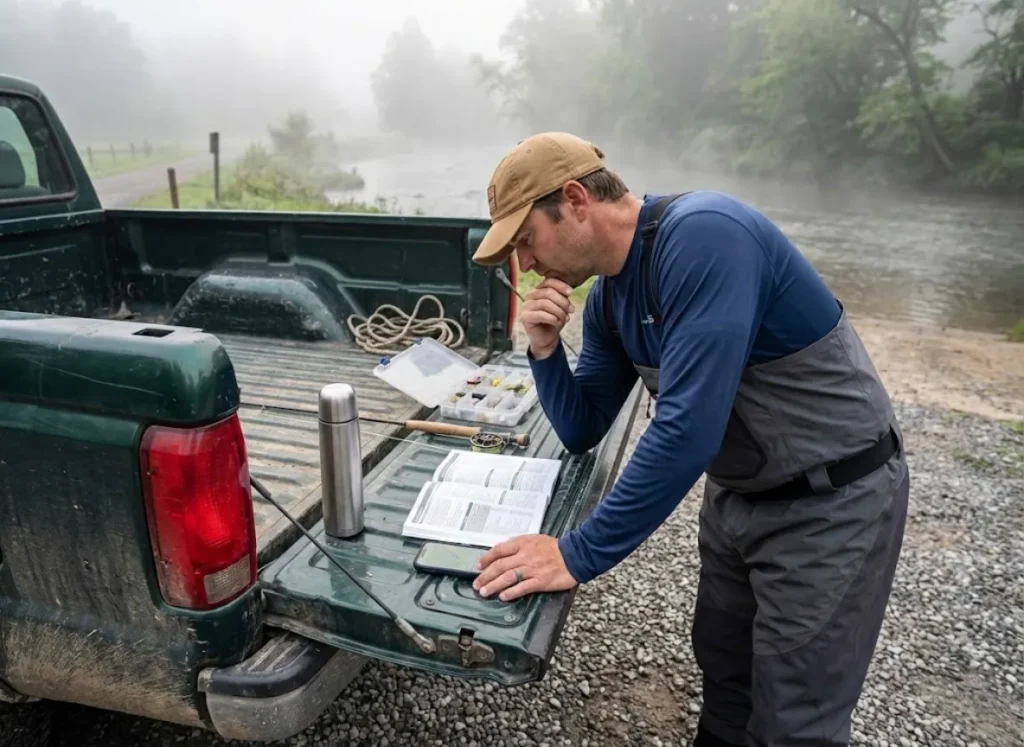
Once you accept that your money builds the fisheries, the next challenge is determining exactly which “product” you need. Navigating the taxonomy of license options—Resident licenses, short-term licenses, and specialty licenses—is the key to contributing effectively without overspending.
Fishing License Cost Comparison
Resident vs. Non-Resident Fees, Markup Ratios, and Validity Rules by State.
Price Markup: 2.7x
Non-residents pay nearly triple the resident rate. This is a significant premium compared to national averages.
Validity & Notes
365-Day Validity. Ocean Enhancement Validation ($7.05+) is required for Southern CA saltwater fishing.
Price Markup: 1.0x (None)
Parity pricing treats the single day as a commodity regardless of residency.
Price Markup: 1.9x
Moderate markup for non-residents. Includes freshwater endorsement.
Validity & Notes
Expires Aug 31. Texas operates on a fiscal year model, not 365 days from purchase.
Price Markup: 1.8x
Includes Red Drum tag.
Price Markup: 1.7x
Lowest markup ratio in Texas. Best option for versatile anglers.
Price Markup: 2.7x
Very affordable entry cost for residents ($17).
Validity & Notes
Significant add-ons: Snook ($10) and Lobster ($5) permits are often required.
Resident Exclusive
Special 5-year rate offers huge value for committed resident anglers.
Price Markup: 2.0x
Standard doubling of price for non-residents.
Validity & Notes
365-Day Validity. Includes freshwater/marine registry.
Price Markup: 2.0x
Very accessible entry point for tourists at $10.
Price Markup: 2.9x
Nearly 3x markup for non-residents. Includes trout and salmon privileges.
Flexibility
User-selected start time offers 24-hour flexibility. Price is equal for all ($10).
Price Markup: 4.8x
Highest Markup. Conservation License ($10) + AIS Pass ($7.50) also required for non-residents.
Price Markup: 5.0x
Significant premium for tourists (5x resident cost).
Price Markup: 2.3x
Requires Annual Habitat Stamp ($12.47) in addition to license fee.
Visitor Special
Tailored specifically for the week-long vacation market.
How do residency and duration impact the cost?
States strictly bifurcate pricing. If you are traveling, expect to pay a premium for a non-resident license; the non-resident pricing disparity serves as a tourism tax, with markups often exceeding 200% to 500%. Proof of residency is rigorous. Agencies generally require a valid driver’s license or homestead tax documents. Owning a vacation cabin or a plot of land does not usually qualify you as a resident if your primary domicile is elsewhere.
Modern licensing has luckily shifted in some states from a “Calendar Year” expiration (Dec 31st) to a “365-Day” validity. This offers better value for mid-year purchases. However, short-term licenses (like a 1-day license, 3-day pass, or 7-day pass) still act as high-yield products for tourists. While they are convenient, careful planning of family fishing vacations might reveal that an annual license is cheaper if you plan to fish for more than five days.
Anglers should also perform a “Break-Even Analysis” on Lifetime Licenses. While they hedge against future inflation, they are essentially an actuarial bet on your longevity and your continued residence in that state. If you move away, that lifetime resident pass may not be recognized the same way.
What are stamps, endorsements, and validations?
The base sport fishing license often serves only as an entry fee. To target certain species or fish in specific waters, you must navigate the “add-on economy” of Stamps or Endorsements. Common examples include a trout stamp, salmon stamp, or a saltwater stamp. These additional fees fund the intensive management required for high-pressure resources.
For example, specialized validations like California’s Ocean Enhancement Validation or a Florida snook permit direct funds to specific projects. It is critical to note that “Harvest Tags” are distinct from licenses. They act as inventory control for sensitive species like Salmon, Sturgeon, or Spiny Lobster and must be physically or digitally notched immediately upon catch.
Failing to meet the purchase requirements for licenses, endorsements, and tags is a major violation. Freshwater fishing for trout with only a general license is legally equivalent to fishing without a license. Many states offer Sportsman’s license or “Super Combo” packages that bundle these stamps. While the upfront fishing license cost is higher, this usually represents the best value for versatile anglers who want to explore different state fishing regulations without worrying about missing a specific permit.
How Do You Navigate the Purchase and Compliance Logistics?
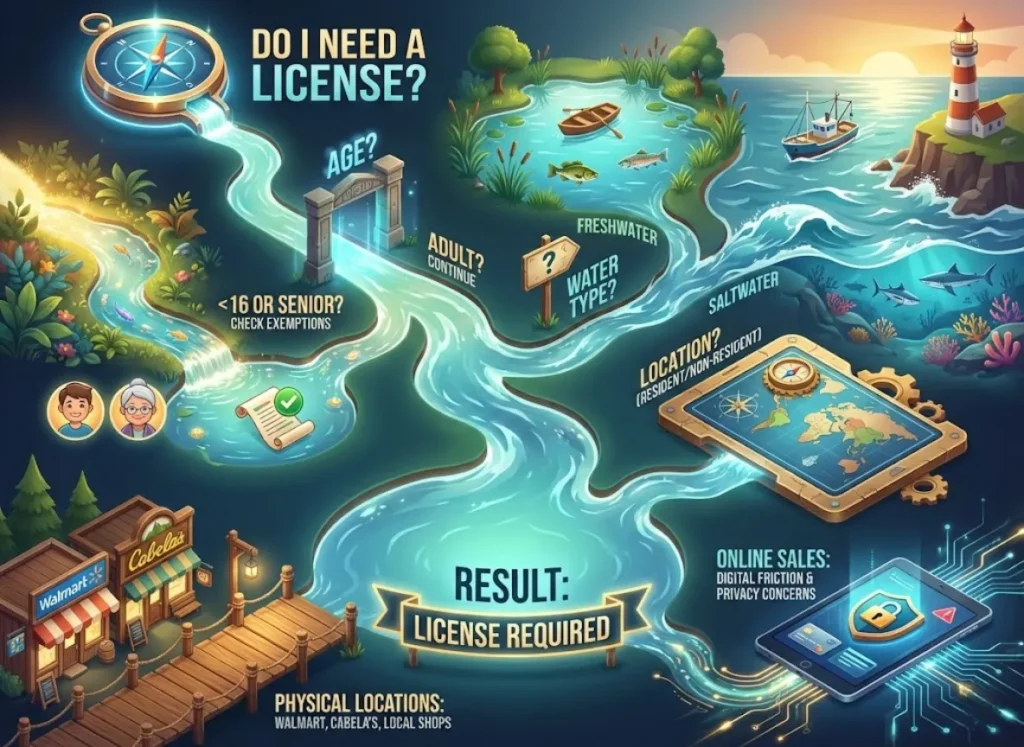
With the correct products identified, you must now navigate the purchase process itself. You can still visit physical locations like Walmart, Cabela’s, county clerk offices, or local bait & tackle shops. However, most anglers now opt for online license sales, which introduces digital friction points and data privacy concerns.
Why is your Social Security Number required?
A major friction point for new anglers is the mandatory disclosure of their Social Security Number (SSN) at the point of sale. This often raises hackles, but it is not a state-level privacy intrusion. It is a federal mandate under Title IV-D of the Social Security Act (Welfare Reform Act of 1996).
The federal requirement to collect social security numbers for recreational licenses is used exclusively to cross-reference applicants against Child Support Enforcement databases. If an applicant is in arrears, the system automatically blocks the license issuance. State laws generally classify this data as “private,” prohibiting its use for public records or general government tracking beyond the specific child support check.
Pro-Tip: Scam websites often mimic official state portals to harvest data. Always verify you are on a .gov site or an authorized vendor (like gooutdoors[state].com) before entering your SSN. This simple check is the first step in building your essential fishing starter kit.
Digital wallets vs. paper: What counts as valid proof?
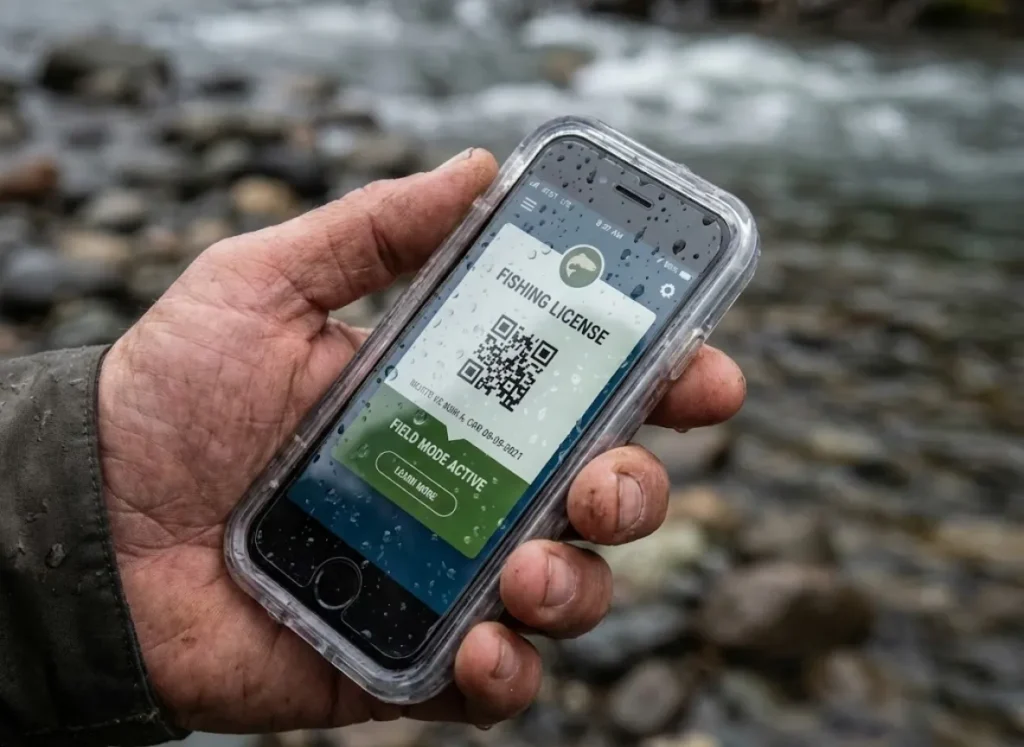
Most states now offer proprietary mobile fishing apps, such as HuntFishNY, Outdoor AL, or MyODFW, that serve as legal digital wallets. These apps are incredibly convenient and often include “Field Mode” or offline capabilities. This allows users to access electronic licensing system (ELS) updates and digital tagging options even without cellular service, syncing the data once you return to civilization.
However, the legal burden of proof remains on you. If your phone battery dies, you are technically fishing without a valid sport fishing permit in the eyes of a warden. While some officers may be lenient, the letter of the law is strict. Prudent anglers treat a portable power bank as one of their essential fishing tools, or carry a printed paper license sealed in a waterproof bag to mitigate this liability.
Where Does Your License Actually Work?
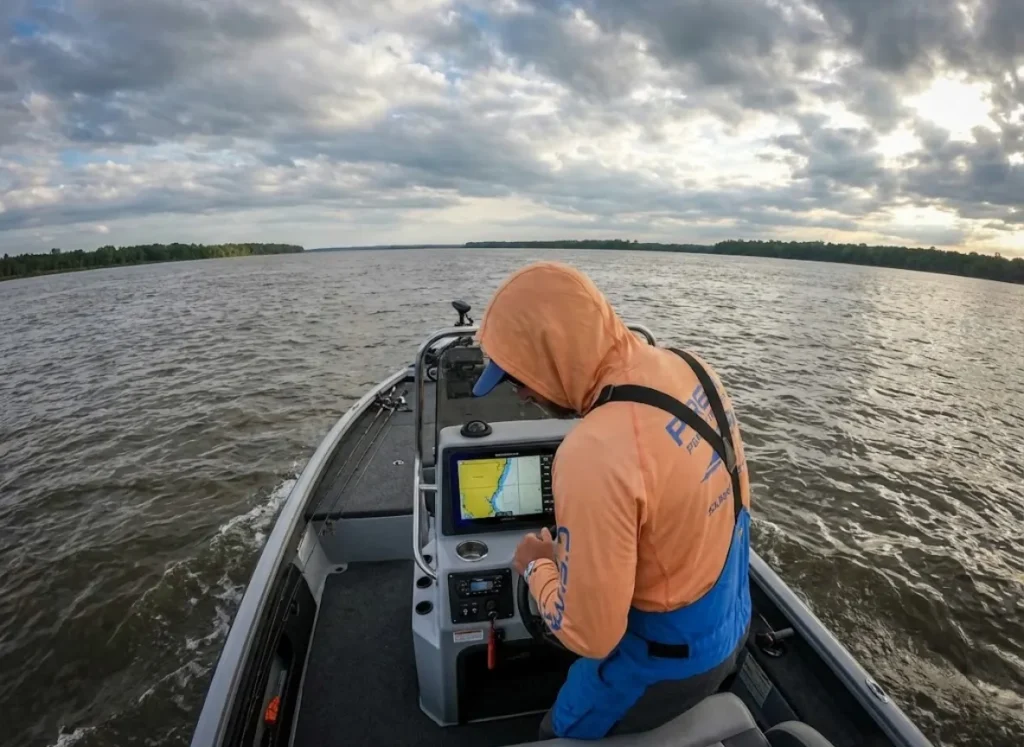
Possessing a valid license is essential, but knowing where that license is valid is equally critical. This is especially true when the water itself forms the border between two jurisdictions, creating complex border waters scenarios.
How do reciprocity agreements work on border waters?
License reciprocity allows a license from one state to be valid in the “concurrent waters” of a border river. For instance, an Oregon license is valid on the Washington side of the Columbia River, and vice versa. Similarly, a Lake Texoma license covers the water shared by Texas and Oklahoma. However, there is a catch. This reciprocity usually applies only to the mainstem of the river or lake body.
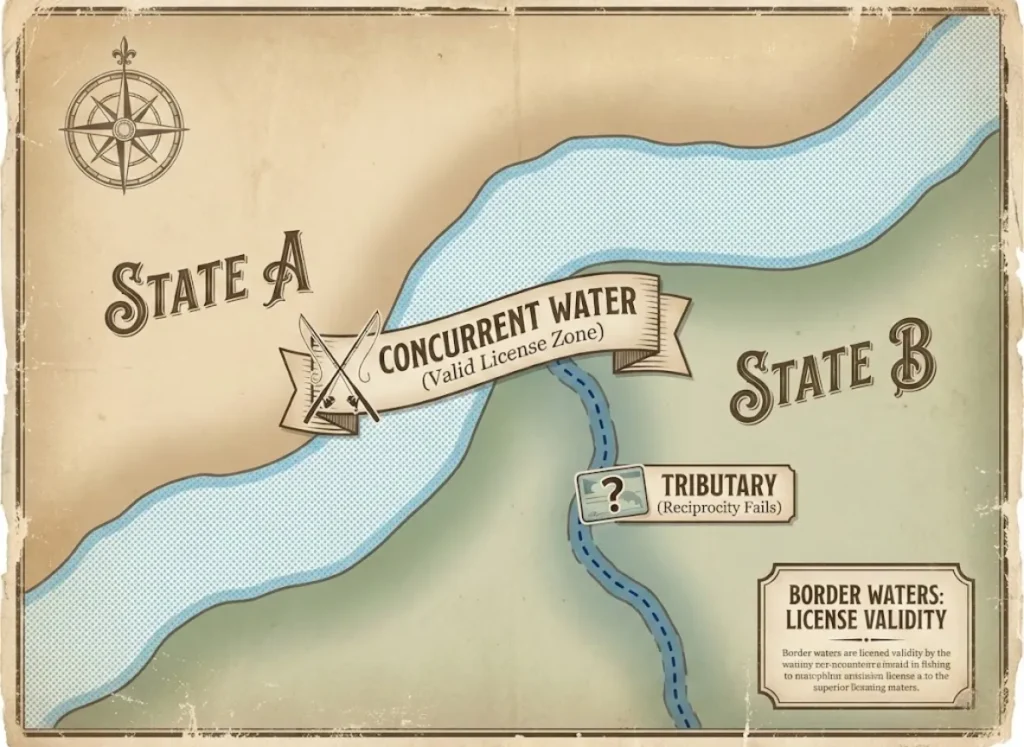
Navigating into a tributary, slough, or backwater often reverts jurisdiction to that specific state. If you chase fish up a creek mouth, you may inadvertently need a different non-resident license. License reciprocity on the Columbia River and its tributaries is strictly defined by geographic markers. Likewise, “Invisible Lines” on reservoirs—like the Eastport Line on Pickwick Lake—require strict GPS monitoring.
These distinctions are vital for those interested in great lakes tributary fishing, where crossing an invisible line at a river mouth can turn a legal fishing trip into a poaching incident.
What are the consequences of non-compliance?
Wildlife offenses are typically crimes of Strict Liability. This legal concept means that “I didn’t know” or “I didn’t mean to” are not valid defenses in court. The act of “fishing” is defined by the attempt—placing a line in the water—not the success of catching a fish.
Fishing fines can range from nominal fees to substantial poaching penalties, but the risks go higher. Statutes in many states provide the authority to seize equipment and vehicles used in wildlife violations. This means a serious violation could result in gear confiscation, costing you your rod, your tackle box, and potentially your boat.
Additionally, the Interstate Wildlife Violator Compact ensures that a suspension of fishing privileges in one member state is reciprocated by your home state. Ignoring a citation received during a vacation in Colorado can result in the suspension of your license back home in Texas. Compliance is the baseline of ethical angling and angler habitat restoration, ensuring we protect the sport for the future.
Conclusion
A fishing license is far more than a receipt. It is a social contract where your money is legally ring-fenced for conservation. Whether you are navigating residency rules, selecting the right trout stamp, or managing your phone’s battery life for a digital license check, the goal is compliance and stewardship.
Reciprocity on border waters offers freedom but demands attention to detail. Remember that strict liability laws mean ignorance is never a defense. Before your next trip, download your state’s official app, verify your endorsements, and view your license fee as a direct investment in the waters you love.
Frequently Asked Questions about Fishing Licenses
Do I need a fishing license if I strictly practice catch and release?
Yes. The legal definition of fishing typically includes the act of attempting to take fish, regardless of whether you keep them. Catch and release still requires a valid permit.
Can I show a picture of my license on my phone to a game warden?
Usually, yes, provided the QR code is legible and the state allows digital proof. However, a screenshot is often insufficient compared to the official mobile fishing apps or a PDF, and a dead battery is not a valid excuse.
At what age does a child need a fishing license?
This varies by state, but the most common threshold is 16 or 17 years old. The under 16 exemption allows children to fish for free, but they must still follow all catch limits and regulations.
Does a fishing license cover private ponds?
Generally, no license is needed for private ponds entirely contained within land you own. However, if the water connects to a public waterway (creek or stream), state licensing rules usually apply.
Risk Disclaimer: Fishing, boating, and all related outdoor activities involve inherent risks that
can lead to injury. The information provided on Master Fishing Mag is for educational and informational purposes
only. While we strive for accuracy, the information, techniques, and advice on gear and safety are not a substitute
for your own best judgment, local knowledge, and adherence to official regulations. Fishing regulations, including
seasons, size limits, and species restrictions, change frequently and vary by location. Always consult the latest
official regulations from your local fish and wildlife agency before heading out. Proper handling of hooks, knives,
and other sharp equipment is essential for safety. Furthermore, be aware of local fish consumption advisories. By
using this website, you agree that you are solely responsible for your own safety and for complying with all
applicable laws. Any reliance you place on our content is strictly at your own risk. Master Fishing Mag and its
authors will not be held liable for any injury, damage, or loss sustained in connection with the use of the
information herein.
Affiliate Disclosure: We are a participant in the Amazon Services LLC Associates Program, an
affiliate advertising program designed to provide a means for us to earn advertising fees by advertising and linking
to Amazon.com. As an Amazon Associate, we earn from qualifying purchases. We also participate in other affiliate
programs and may receive a commission on products purchased through our links, at no extra cost to you. Additional
terms are found in the terms of service.