
In this article
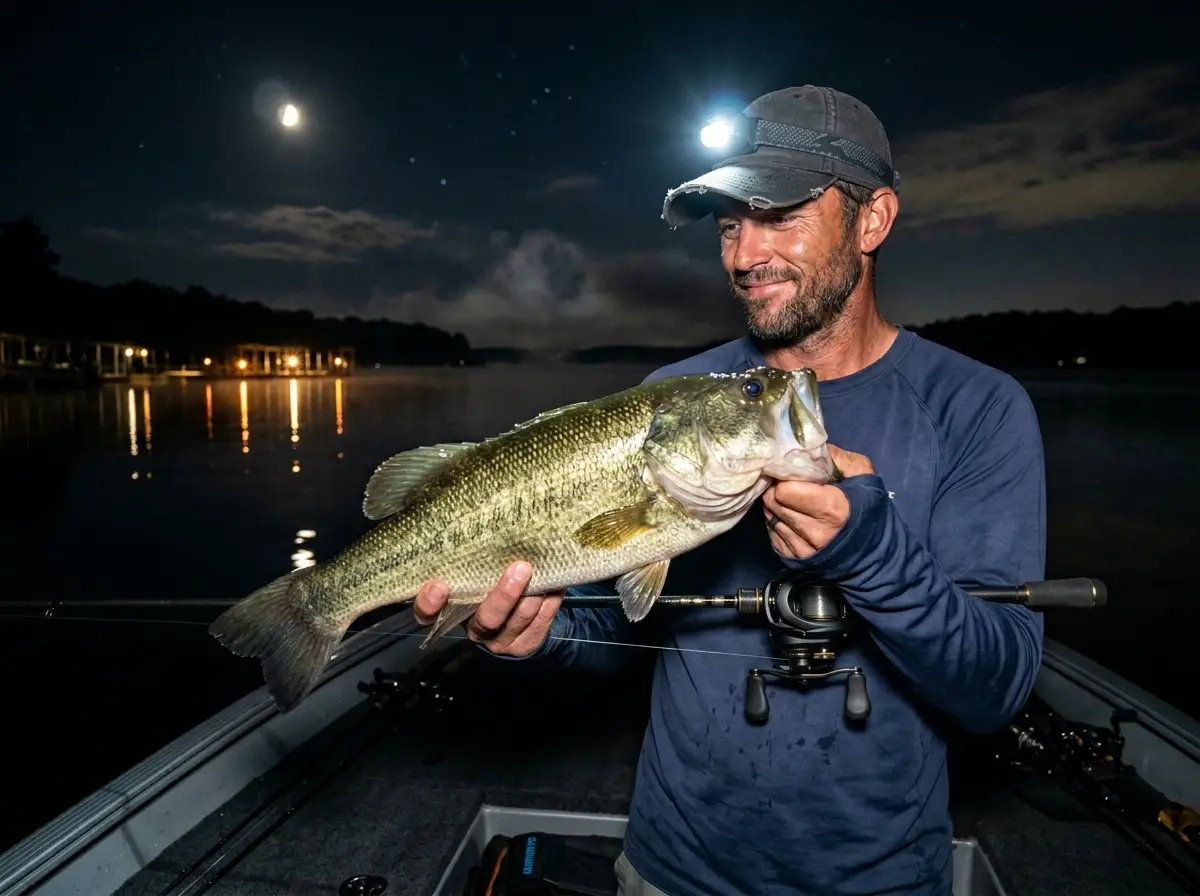
You drove to the lake at dawn, fished hard through the afternoon heat, and had maybe one honest bite by 4pm. You were ready to trailer the boat and call it a loss. Here’s what I wish someone had told me five summers ago — if you’d stayed until midnight, you would have had a completely different day. Night fishing for largemouth bass isn’t a backup plan. On most summer lakes, especially pressured ones, it’s the first option you should reach for.
Quick Answer: Here’s how to catch largemouth bass at night in six steps.
- Fish summer nights when water temperature stays above 70°F
- Target weedline edges, structure breaks, and lighted docks
- Use high-vibration lures — spinnerbaits, buzzbaits, and large soft plastics
- Slow your retrieve to half your normal daytime speed
- Match lure color to moon brightness — dark on new moons, natural on full moons
- Stay quiet — approach spots with the trolling motor at the lowest setting or drift in silent
Why Largemouth Bass Feed at Night
How Bass Behavior Changes After Dark
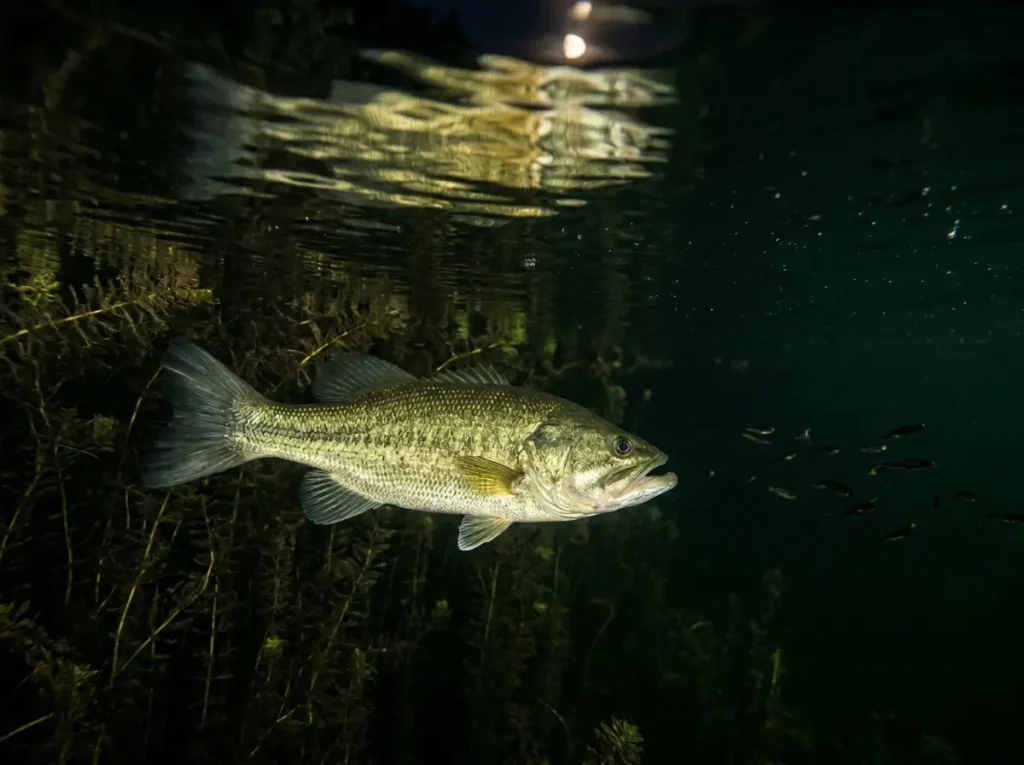
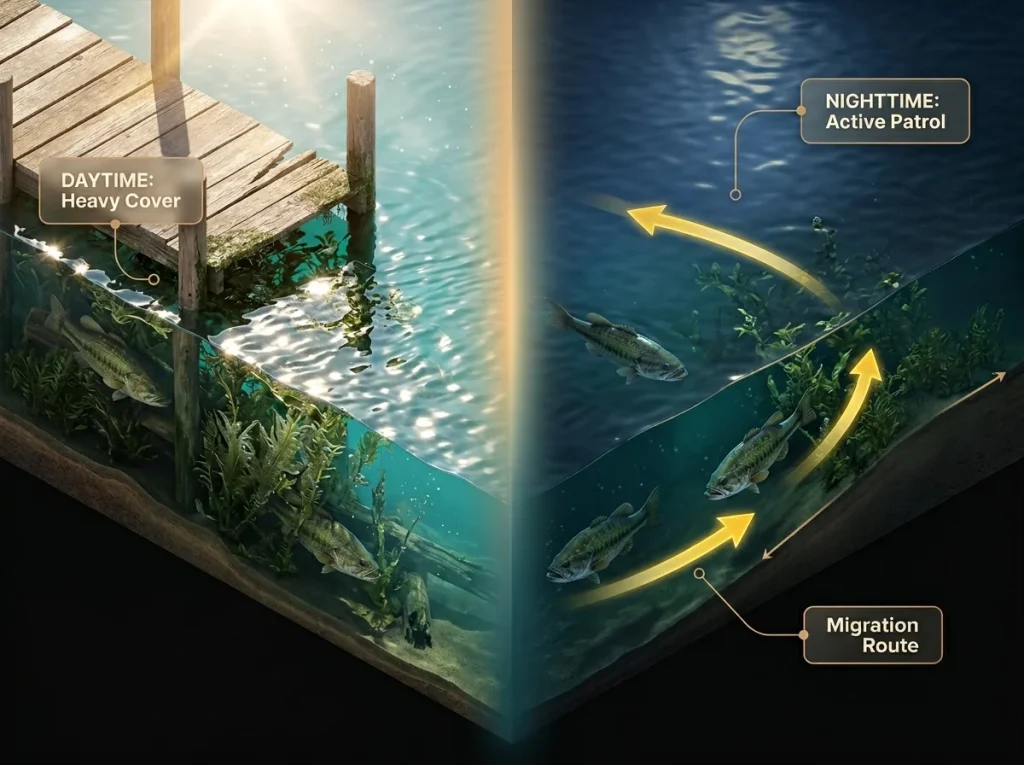
During the day, a big largemouth bass sits in the thickest cover it can find — buried under a dock, wedged into a laydown, tucked against a weed mat. It’s not there because it likes the shade. It’s hiding from you, from boats, from every noise and shadow that screams predator.
After dark, the whole program flips. Bass move out of that heavy cover and start actively patrolling weedline edges and open flats. They’re not ambushing anymore — they’re hunting. That fish you couldn’t pull out of a dock shadow at 2pm is now cruising the same flat you’re sitting on at 10pm, and it’s looking for anything that moves.
According to documented largemouth bass habitat use and movement patterns, this behavioral reversal is consistent across healthy bass populations. The cover they hold during the day is safety. The open water they patrol at night is where the food is.
Why Night Means Fewer Pressured Fish
Here’s the thing most people don’t think about. The biggest bass in any lake didn’t get that big by being easy to catch. Those fish are conditioned — they’ve seen thousands of lures pass by during daylight hours and they’ve learned to ignore most of them. At night, that conditioning loosens. There’s no boat traffic, no jet skis, no shadows falling across the water to put them on edge.
Mitch Looper, an Arkansas night-fishing specialist, pulled a 14½-pound largemouth at night. That fish didn’t survive long enough to weigh 14 pounds by being careless during the day. Night fishing self-selects for the biggest, smartest fish in the system because those are exactly the fish that learn to ignore daytime lures under consistent pressure.
The Water Temperature Trigger
Not every night produces. The switch flips when water temperature climbs above 70°F — typically May through August across most of the US. Once that threshold holds, bass concentrate as much as 90% of their feeding activity in the nighttime hours.
Below 70°F, their metabolism slows enough that nighttime feeding loses its edge. You can catch bass at night during prespawn in clear water — January through May in warmer climates — but the summer window is when night fishing goes from productive to the best option available. If your lake feels like a dog-days summer slump during the day, that’s your signal to come back after sunset.
When Night Bass Fishing Is Worth the Trip
The Summer Prime Window
The prime window is dead simple: May through August, water above 70°F, after a hot calm day. The most productive nights typically follow still, sunny, high-pressure days — the kind of days where daytime fishing is miserable. All that heat energy builds up in the surface layer, and when the sun drops, everything in the food chain starts moving shallow. Shad push toward shore. Frogs start calling from the lily pads. Bugs skate across the surface. Every forage item a bass eats is heading toward the bank, and the bass follow.
Moon Phase and the Six Feeding Windows
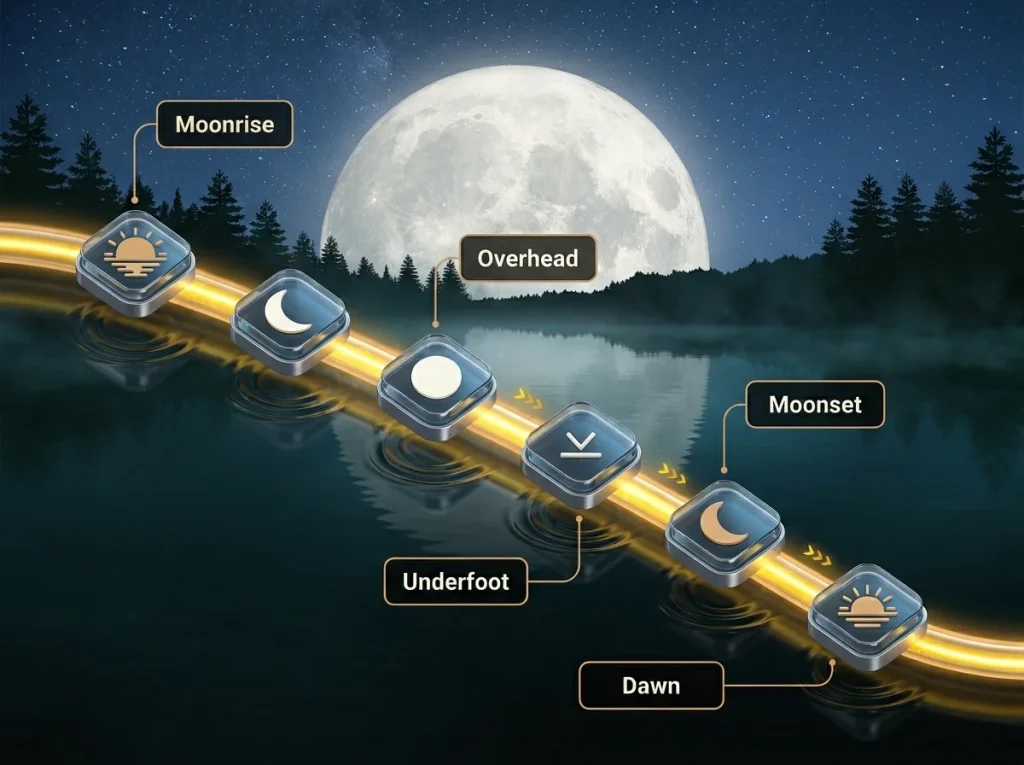
Moon phase matters, but not the way most articles explain it. It’s not about “full moon = good, new moon = bad.” Both produce fish. What the moon gives you is a schedule of feeding activation windows throughout the night.
There are six key moments: sundown, moonrise, moon overhead, moon underfoot, moonset, and dawn. Each one triggers a burst of feeding activity. Fish the moonrise window with the same focus you’d give a sunrise bite — it’s that reliable. On nights with a full moon, you get more ambient light and bass can use vision to hunt, which changes your lure selection (more on that later). On a new moon, you get complete darkness and the fish rely entirely on their lateral line to find food.
Pro tip: Check the solunar tables before the trip. If moonrise falls between 9pm and midnight, you’re set up for the best window of the night landing during prime fishing hours. If moonrise is at 3am, you might want to fish the sundown-to-midnight window and call it.
Weather That Makes or Breaks a Night Bite
A hot, windless day followed by a calm night is the gold standard. Nights after fronts — cold or warm — are usually slower. Sustained wind during the day that carries into the evening creates chop on the surface, which doesn’t stop bass from feeding but makes your boat control harder and your topwater game less effective.
Overcast nights with no moon at all can be outstanding for vibration-heavy lures like spinnerbaits and buzzbaits, because bass can’t rely on any visual input and commit harder to anything they can feel on the lateral line. Light rain doesn’t hurt and can actually help — it adds surface noise that masks your approach.
Where to Find Largemouth Bass After Dark
Weedline Edges and Structure Breaks
The number-one night location is the weedline edge — the transition zone where submerged vegetation meets open water. Bass patrol these edges actively at night, moving along them the way a cop walks a beat. Your job is to cast parallel to the weedline, not perpendicular into the weeds. Parallel casting keeps the lure inside the strike zone for the entire retrieve. A perpendicular cast crosses through the zone and exits it in a few feet.
Structure breaks — submerged roadbeds, rock piles, brush piles — also hold fish that are feeding but less mobile. Football jigs dragged slowly along these hardspot transitions excel here. If you know where the structure is from daytime fishing, those are your night starting points.
Main-Lake Points and Creek Channel Mouths
Look for areas where deep water is closest to shallow feeding flats. Main-lake points where the bottom drops quickly from 3 feet to 12 feet are transit lanes that bass use moving between safety and food. Creek channel mouths funnel baitfish and create current breaks that concentrate feeding activity.
The dual-anchor setup — one off the bow, one off the stern — is worth the extra minute it takes to deploy. Lake Fork guide Richie White, who’s night-fished that lake for 15 years, locks his boat with two anchors and then waits 10 to 15 minutes before casting. Bass that flushed during the setup filter back in.
Lighted Docks and the Shadow Line
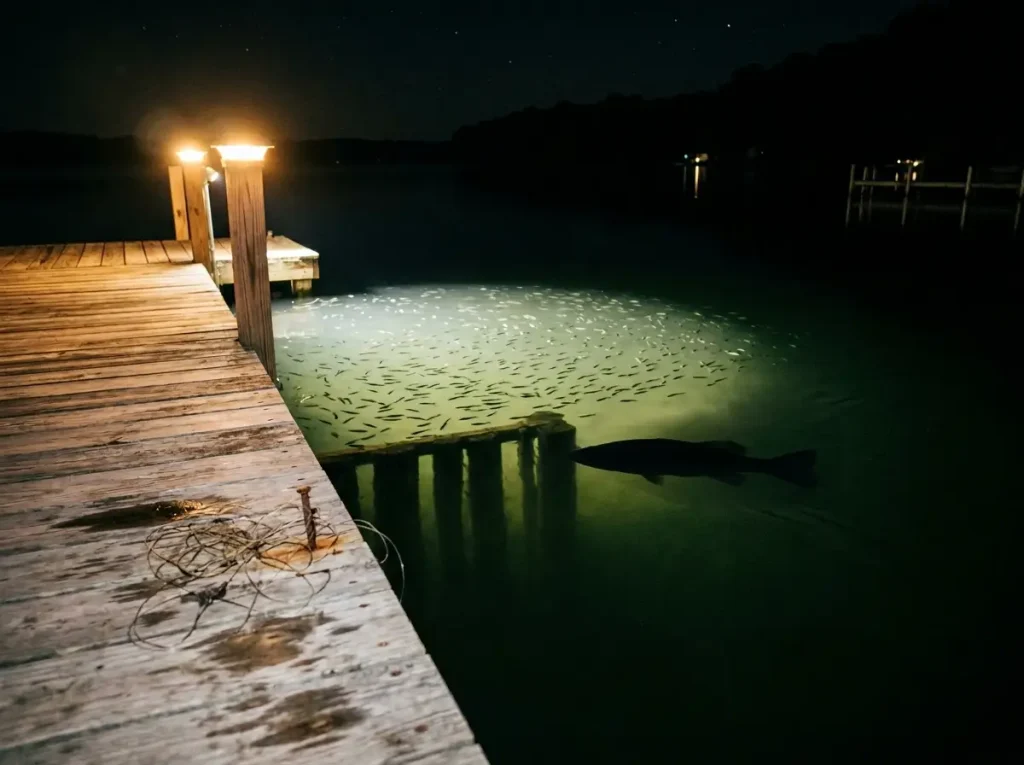
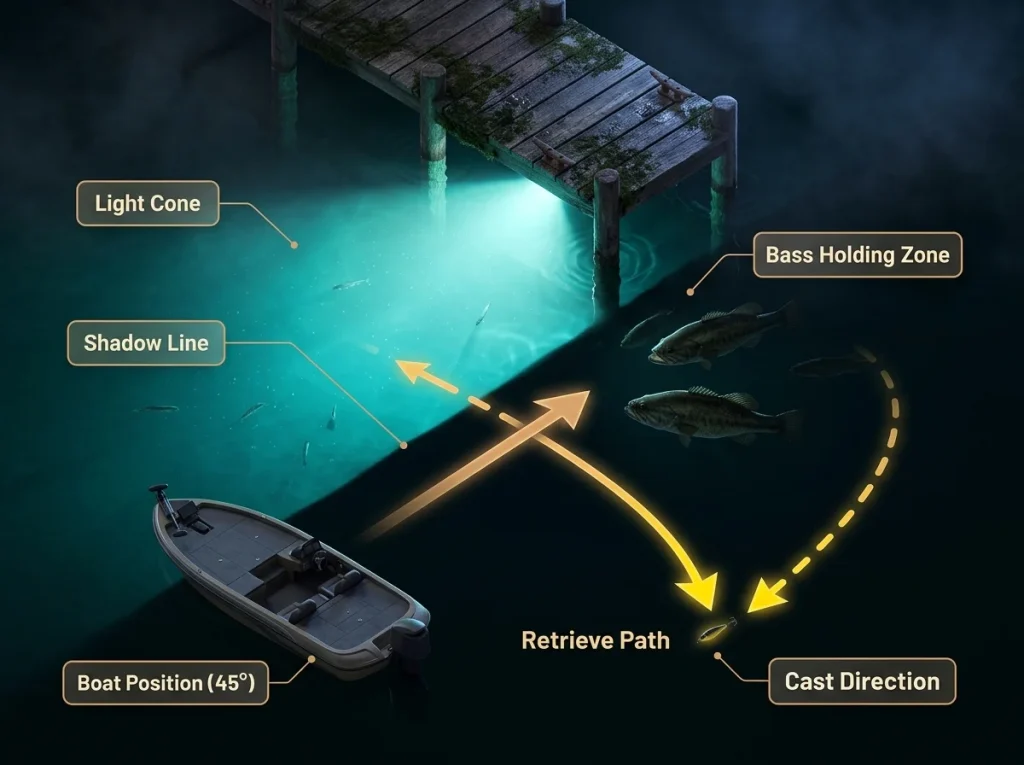
Lighted docks are the most misunderstood night spots on any lake. The dock light attracts minnows and shad. The baitfish attract bass. So far, everyone knows that part. Here’s the part most anglers get wrong for years before someone shows them: the bass aren’t inside the lit water. They’re holding at the shadow line — the hard edge where light meets dark.
Bass face into the light so they can see baitfish silhouetted against it. They sit right at the interface, in the dark, waiting. Your cast should land 3 to 4 feet past the shadow line, into the dark zone, and retrieve slowly through the light-dark interface. The strike almost always happens as the lure crosses from shadow into lit water.
Position your boat outside the light cone at a 45-degree angle. Never motor through the lit area. Never cast toward the light source — that puts the lure behind where the fish is sitting. This one adjustment — casting into dark and retrieving through the edge — is the difference between avoiding common night bass fishing mistakes and repeating them every trip.
Pro tip: Scout your target docks during the last hour of daylight. Note which ones have lights that actually illuminate the water surface vs. decorative lights that point at the house. Only the ones that light the water create a shadow line worth fishing.
Best Lures for Night Bass Fishing
Spinnerbaits With a Colorado Blade
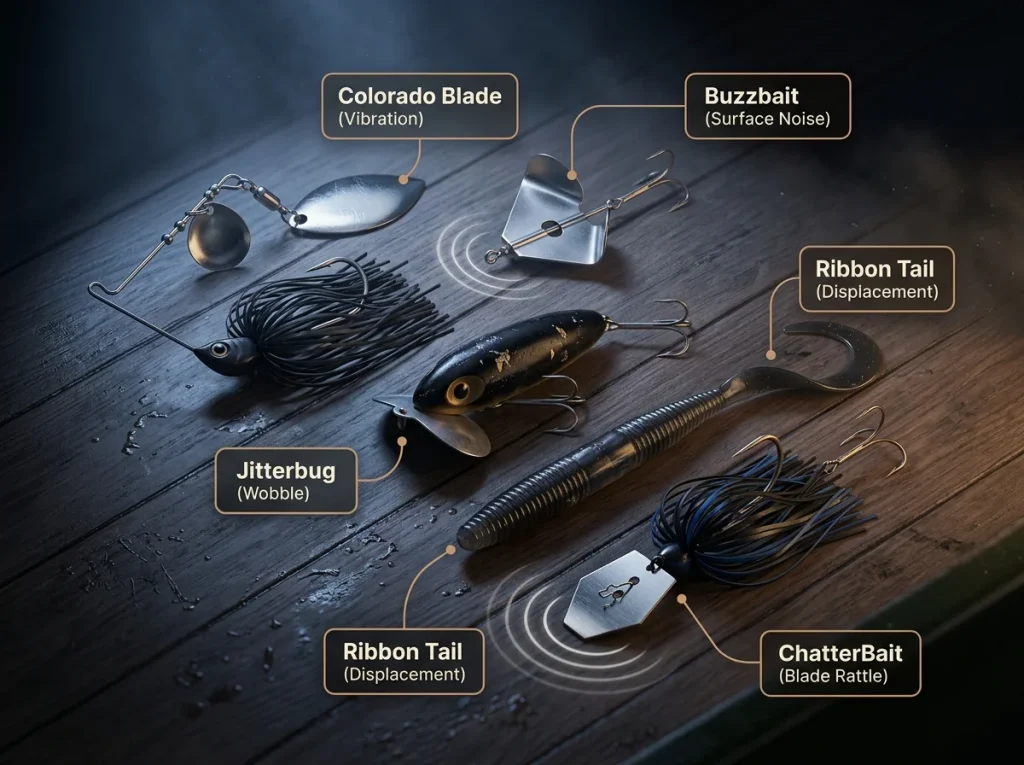
The spinnerbait is the workhorse of night fishing, but the blade configuration makes or breaks it. A single large Colorado blade creates more low-frequency thump per rotation than tandem or willow-blade setups. That thump is what bass detect through their lateral line from 10 feet or more in complete darkness. A tandem willow setup looks great in daylight — at night, a big single Colorado is what actually gets found.
The War Eagle Night Baits Spinnerbait ($8–$10) in ⅜ to ¾ oz was designed specifically for after-dark fishing. Heavier wire frame, oversized Colorado blade, and a black or chartreuse skirt. Slow-roll it parallel to structure, keeping the blade barely thumping. If you feel the blade stop spinning, you’re going too slow — but just barely too slow. That edge between turning and stalling is where most night fish hit.
Buzzbaits and Topwater Walking Baits
Buzzbaits fished on the surface at the absolute minimum speed that keeps them in contact with the water draw explosive strikes after dark. The buzzbait blade tuning and modification techniques that change a buzzbait’s sound signature become even more relevant at night, when sound is the only way a bass locates the lure from distance.
The Arbogast Jitterbug ($8–$12) in black has been a night-fishing standard since the 1930s. Its concave metal lip creates a gurgling wobble that works at near-zero speed — slower than any other topwater lure can maintain. Retrieve it slower than feels productive. Then go slower.
For the dusk-to-two-hours-after-sunset window when bass are actively feeding on top, the Heddon Super Spook ($9–$12) in “Black Shiner Shad” puts out a wider walking action. Fish it 30 to 40% slower than you would during the day. Bass miss topwater lures more often at night — that slower cadence gives them time to lock on.
Jigs, ChatterBaits, and Large Soft Plastics
For bottom contact, a ⅜ to ½-oz jig in brown or black with muted orange skirt strands is a proven producer. Drag it along points and structure breaks with pauses long enough that a bass cruising the area has time to find it.
The Z-Man Original ChatterBait ($9–$11) in ½ oz Black/Blue generates aggressive blade vibration even when slow-rolled a foot above the bottom. Pair it with a bulky crawfish trailer for maximum water displacement at low speed. For matching ChatterBait trailer bulk to vibration output, the Z-Craw is the go-to pairing.
Large soft plastics are the sleeper pick for the biggest fish. A Zoom Trick Worm ($5–$7) in 6.75-inch black on a Texas rig with a 3/16-oz tungsten slip weight eliminates small-fish interference entirely. A 10-inch worm fished dead slow along a weedline edge will catch fish that ignored every other presentation that night.
Pro tip: Bring two rods rigged and ready — one with a spinnerbait for covering water, one with a large soft plastic for slowing down on productive structure. Changing rigs in the dark costs time and creates noise.
How to Present Lures When Bass Can’t See Them
Why Slow Retrieves Are Physically Necessary
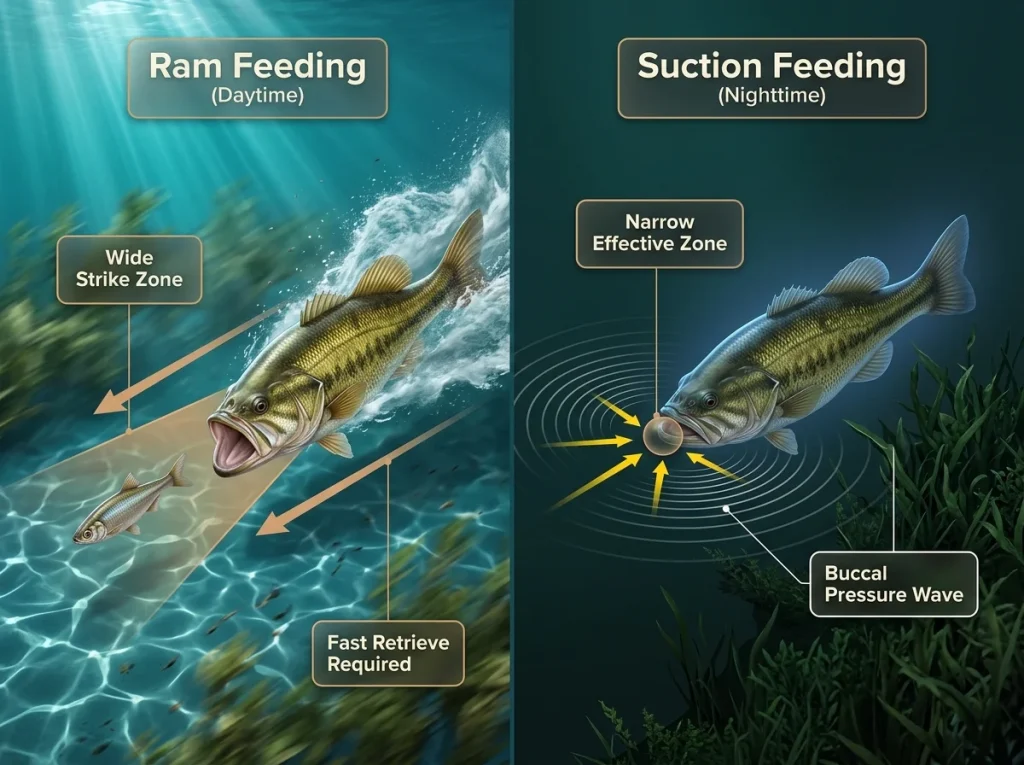
Everyone says slow down at night. Nobody explains why. Here’s the mechanism: research on largemouth bass feeding modalities in low visibility confirmed that when bass lose visual input, they switch from ram feeding — chasing prey down and grabbing it — to suction-based feeding. In suction mode, the bass opens its mouth faster and generates greater buccal pressure to draw prey inward.
That suction mechanism has a physical range limit — roughly one fish-length. A lure moving through that zone at normal daytime speed exits before the suction can complete the strike. Slow it down, and the lure stays within reach long enough for the feeding mechanism to work.
This is why parallel casting matters so much at night. A parallel cast along a weedline keeps the lure inside the suction strike zone for the entire retrieve. A perpendicular cast crosses through it and exits in a fraction of the distance. You’re not just covering more water — you’re giving every bass along that edge a real chance to complete the strike.
The first time I fished a 10-inch worm at what I thought was impossibly slow along a milfoil edge at midnight, I caught four bass in 45 minutes. Same spot I’d fished at normal speed two nights before and caught nothing. The lure was the same. The zone was the same. The speed was the only variable.
Color Selection by Moon Brightness
Lure color at night is a function of ambient light, not a blanket rule. On a bright full moon night, bass can partially see — natural tones like green pumpkin with a touch of chartreuse work because there’s enough light for the fish to pick up color contrast. Professional angler Cody Huff actively switches to natural colorways on moonlit nights.
On a new moon or heavy overcast, it’s pure silhouette fishing. Black, dark blue, or junebug creates the hardest contrast against what little sky glow exists above the surface. Fishery scientist Ralph Manns found that in clear water, white spinnerbaits actually outperform black at night 99% of the time — because white creates maximum contrast against the dark water below. The common advice to always go dark is incomplete at best.
For a deeper look at how water clarity changes which colors bass can actually perceive, the same principles that govern daytime color selection apply at night — just shifted toward lower light thresholds.
Hookset Timing on Night Strikes
Bass miss more at night. That’s not a guess — it’s a consequence of the suction-feeding switch. When a bass can’t see the lure precisely, its first attempt may pull the bait close without getting it in the mouth. If you set the hook the instant you hear a surface strike, you yank the lure away before the fish can reacquire.
Wait for the surge. On topwater and buzzbait strikes, resist the flinch and let the rod load with actual weight before you drive the hook home. On subsurface lures like spinnerbaits and jigs, the bite feels the same as daytime — you’ll feel the thump through the rod. But on soft plastics, especially deadsticked presentations, the bite at night can feel like nothing more than the line going slightly slack. That subtle weight change is the strike. Knowing how to detect soft-plastic bites where the bass barely moves the line is worth practicing in daylight first.
Boat Setup and Noise Discipline for Night Fishing
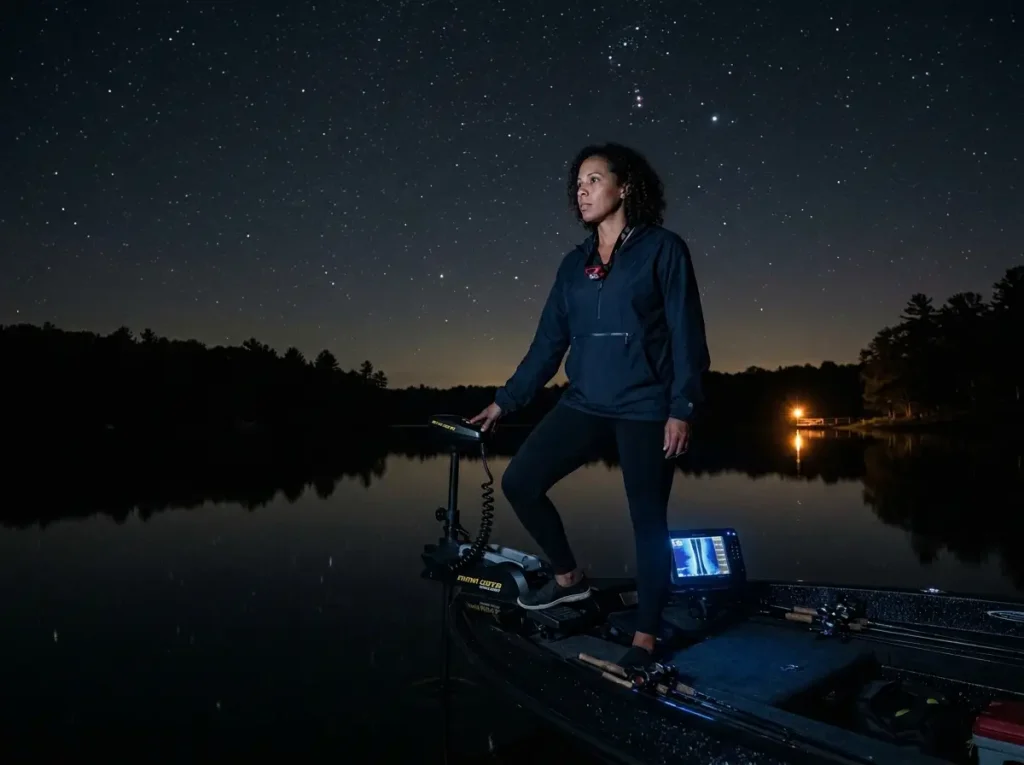
The Pre-Launch Noise Audit
Sound travels roughly four times faster in water than in air. On a calm, thermally stratified summer night, vibrations carry farther with less attenuation than during choppy daytime conditions. A trolling motor at medium speed is detectable to bass 30 feet or more away on a glassy night. That’s the invisible trip wire that clears a productive flat before you throw your first cast.
Before leaving the dock, do a full noise audit. Sit in every seat. Open and close every rod locker and tackle box. Find every rattle — a loose rod butt against the hull, a tackle tray that clicks when the boat rocks, a hatch that doesn’t close flush. Fix them at the dock. Rod tips clanking against each other send vibration through the hull and into the water. Separate them or use rod sleeves. This takes 10 minutes and saves hours of fishing over a spooked zone.
If you fish pressured waters where bass have learned to associate boat noise with threat, the noise audit isn’t optional. It’s the reason some anglers catch fish and others can’t buy a bite on the same water.
Approaching Your Spot Without Spooking It
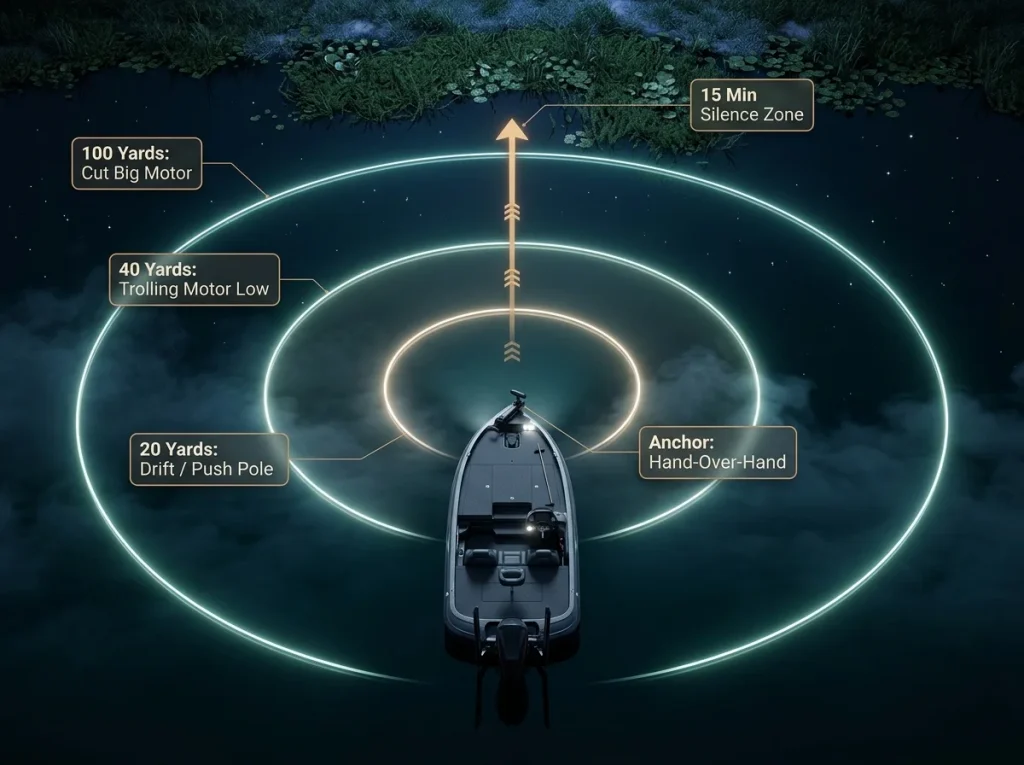
Cut the trolling motor 40 yards from the target and drift in. If the wind doesn’t cooperate, use the lowest effective trolling motor setting and approach at an angle rather than directly toward the structure. Point the motor away from the zone you plan to fish — the prop wash carries vibration directly behind it.
Turn the motor off completely within casting distance. If you need to reposition, use a paddle or push pole. On a glassy night, even the lowest trolling motor setting creates a low-frequency hum that pressured bass recognize.
When anchoring, ease the anchor down hand over hand. Never drop it. If you’re fishing a spot worth staying on, set two anchors — one off the front, one off the back — to hold position with zero swing. Then wait. A full 10 to 15 minutes of silence after anchoring lets bass that flushed during the setup filter back in. That waiting period is where patience turns into fish.
Pro tip: Fish the last 45 minutes of daylight on the same water you plan to night-fish. Note the weedline edges, dock lights, and brush piles while you can see them. After dark, those mental waypoints are worth their weight in fish. Trying to find structure in the dark without daytime reconnaissance is guesswork.
Rod and Gear Setup for Night Fishing
Run a heavy-action rod with a quality baitcasting reel and 17 to 20-lb fluorocarbon or heavy line. Night fish are often hooked near cover — weeds, brush, dock pilings — and you need the backbone to pull them clear before they wrap you up. A medium-heavy rod that felt fine during the day becomes a liability when a 5-pound bass runs a spinnerbait into a dock piling at 11pm.
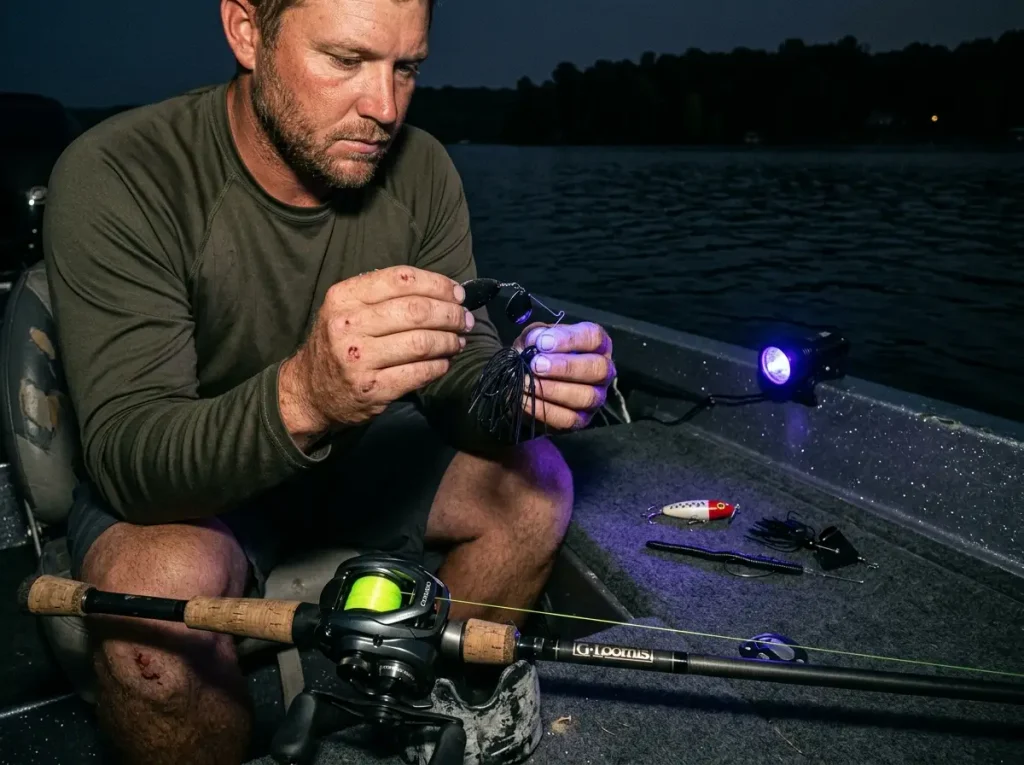
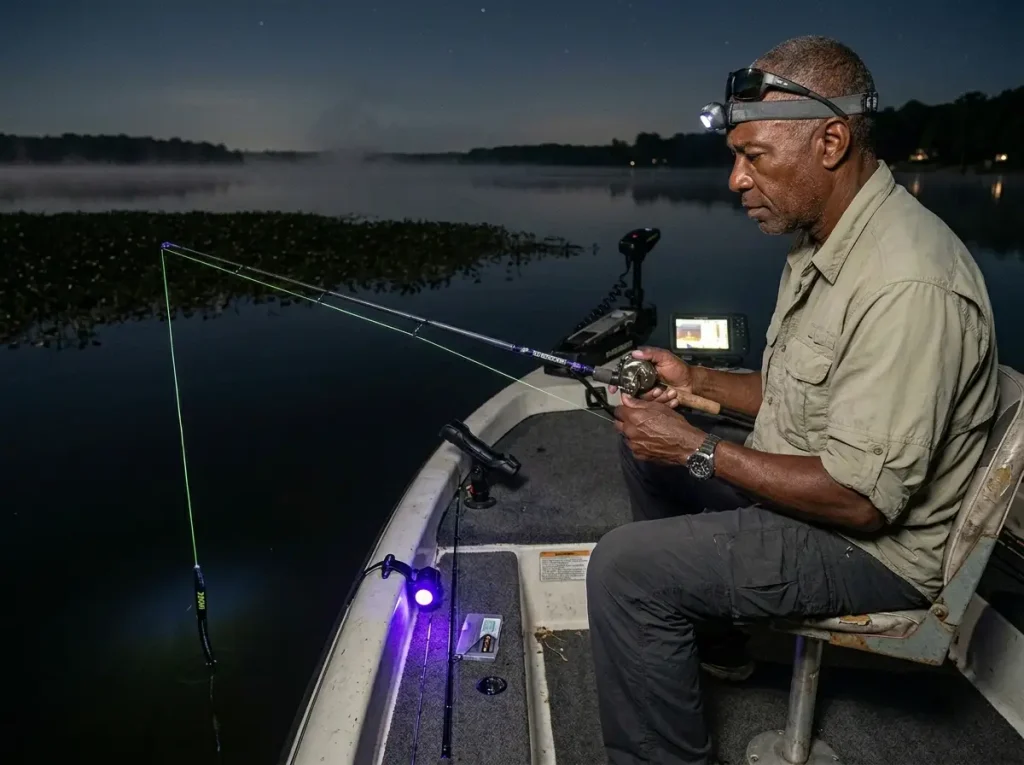
Fluorescent line paired with a small clip-on blacklight is a genuine night-fishing advantage. The line glows under UV, so you can see your cast arc, your line angle, and detect subtle bites visually even in complete darkness. It’s not a gimmick — it’s standard equipment for serious night anglers.
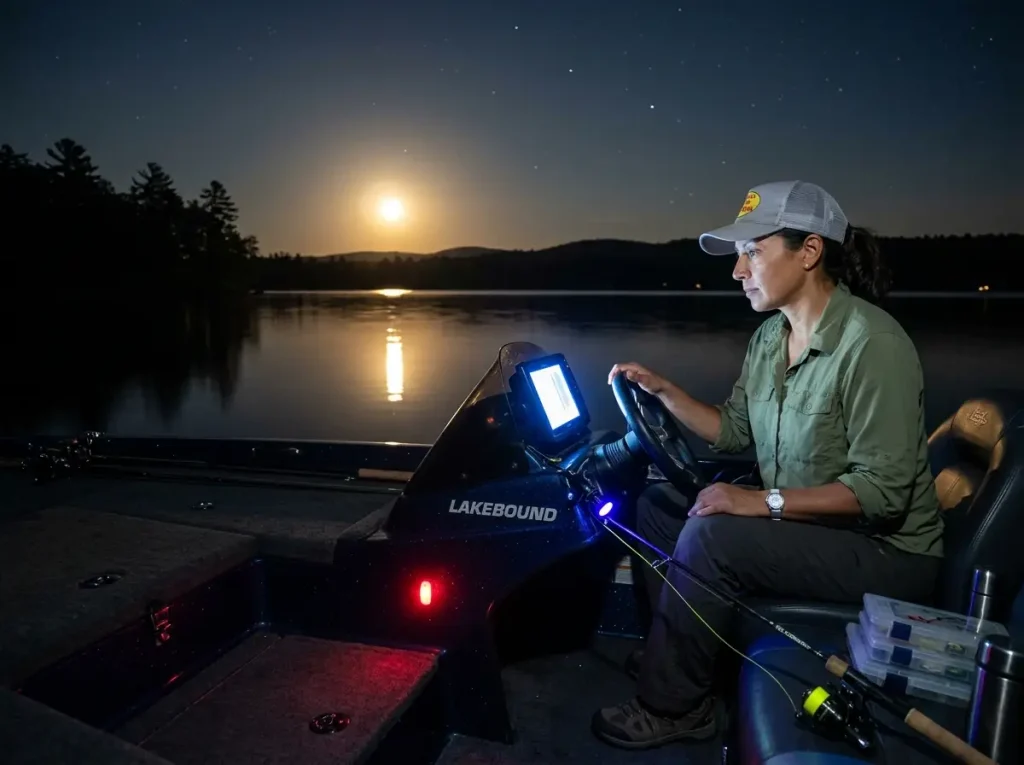
Keep a headlamp with a red-light mode around your neck. White light ruins your night vision for 15 to 20 minutes and can spook shallow fish. Red light preserves your vision and is far less visible from below the surface. Only flip to white when you’re handling a fish or retying.
Conclusion
Night fishing for largemouth bass in summer is not a fallback plan — it’s prime time, especially when water temperature sits above 70°F and daytime pressure has every fish in the lake conditioned to hide. Slow your retrieve to match the suction-feeding biology, pick lures with enough vibration to register on the lateral line from distance, and treat boat noise like the invisible fish-repellent it is.
The anglers who catch consistently at night aren’t doing anything complicated. They’re fishing slower, staying quieter, and reading the water before dark so they don’t waste the first hour of the night figuring out where to go. Scout your spots during the last light of the day — lock the weedline edges, dock shadow lines, and structure into your mental map. That 30-minute investment changes every night trip that follows.
Q1 What is the best bait for largemouth bass at night?
A spinnerbait with a single large Colorado blade is the most reliable night bass lure across all conditions. The Colorado blade generates low-frequency vibration that bass detect through their lateral line in complete darkness. Pair it with a slow, parallel-to-structure retrieve for the best results.
Q2 Do largemouth bass feed at night?
Yes — largemouth bass are active nocturnal feeders, especially when water temperature exceeds 70°F. During summer months, bass may concentrate up to 90% of their feeding activity at night, moving from heavy daytime cover to open weedline edges and shallow flats to actively hunt.
Q3 What time at night is best for bass fishing?
The window from dusk to midnight consistently produces the most action, with moonrise triggering a strong feeding burst whenever it falls. Bass activity spikes at six points: sundown, moonrise, moon overhead, moon underfoot, moonset, and dawn. Plan your trip around the moonrise window for the highest odds.
Q4 What color lures work best for night bass fishing?
It depends on ambient light. On bright full-moon nights, natural tones like green pumpkin with chartreuse work because bass can partially see. On new-moon or overcast nights, black and dark blue create the strongest silhouettes. In clear water, white spinnerbaits often outperform dark colors because white creates maximum contrast against dark water below.
Q5 Is night fishing for bass better in summer or spring?
Summer is the prime window — water above 70°F pushes the majority of bass feeding into nighttime hours. Prespawn spring (January through May in warmer climates) also produces, particularly in clear-water lakes where bass stage near spawning flats. Summer nights after still, hot days are the most consistently productive conditions.
Risk Disclaimer: Fishing, boating, and all related outdoor activities involve inherent risks that
can lead to injury. The information provided on Master Fishing Mag is for educational and informational purposes
only. While we strive for accuracy, the information, techniques, and advice on gear and safety are not a substitute
for your own best judgment, local knowledge, and adherence to official regulations. Fishing regulations, including
seasons, size limits, and species restrictions, change frequently and vary by location. Always consult the latest
official regulations from your local fish and wildlife agency before heading out. Proper handling of hooks, knives,
and other sharp equipment is essential for safety. Furthermore, be aware of local fish consumption advisories. By
using this website, you agree that you are solely responsible for your own safety and for complying with all
applicable laws. Any reliance you place on our content is strictly at your own risk. Master Fishing Mag and its
authors will not be held liable for any injury, damage, or loss sustained in connection with the use of the
information herein.
Affiliate Disclosure: We are a participant in the Amazon Services LLC Associates Program, an
affiliate advertising program designed to provide a means for us to earn advertising fees by advertising and linking
to Amazon.com. As an Amazon Associate, we earn from qualifying purchases. We also participate in other affiliate
programs and may receive a commission on products purchased through our links, at no extra cost to you. Additional
terms are found in the terms of service.