
In this article
The shaky head barely touched the rockpile before the rod loaded. Not a tap — a full commit, rod bending toward the water like something angry lived down there. Twenty minutes on the Coosa River chain and I’d already lost two fish by setting the hook like they were largemouth. Spotted bass don’t do that slow inhale. They hit like they’re late for something.
If you’ve spent years dragging Texas rigs through grass waiting for a mushy thump, you’ve been fishing the wrong species with the wrong playbook. Spotted bass are a completely different animal — different mouth, different habitat, different behavior, and they punish every lazy habit largemouth let you get away with.
After years of chasing bass across reservoirs from Lake Lanier to Pine Flat Reservoir, I can tell you the anglers who struggle with spots are almost always the ones treating them like a smaller version of their largemouth bass cousin. They’re not. And once you understand why, everything changes.
This article breaks down what makes spotted bass a fundamentally different fish — from their biology and behavior patterns to where they live, what they eat, and the seasonal tactics breakdown that actually put them in the net.
⚡ Quick Answer: Spotted bass (Micropterus punctulatus) are current-oriented black bass that prefer hard cover like rocks, wood, and bluff walls over the shallow vegetation largemouth favor. They respond aggressively to small baits — shaky heads and drop shots outperform big presentations — and they school in deep open water where forward-facing sonar is critical. Target them on main lake points, current breaks, and channel swings from 8-100+ ft depending on season.
Not a Largemouth Subspecies — A Different Fish Entirely
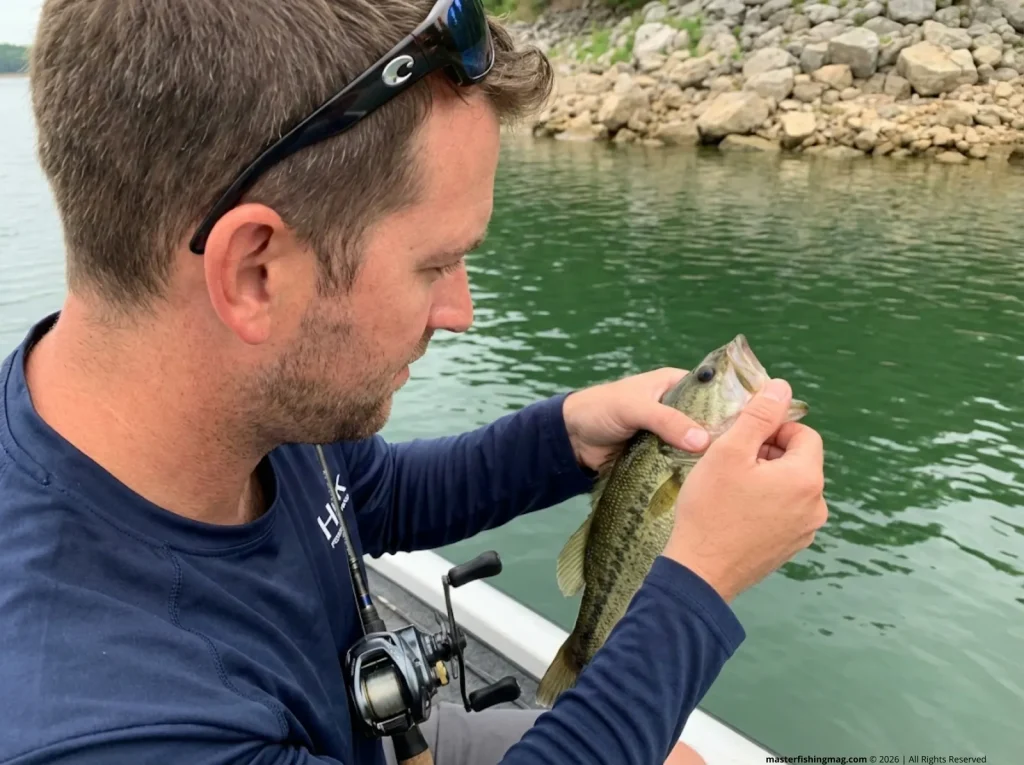
Let’s kill the biggest misconception first. Spotted bass are not a sub-category of largemouth. They’re a distinct actual bass species — Micropterus punctulatus — with their own anatomy, habits, and temperament. Fishing them like a largemouth is like hunting quail with a deer rifle. You might get lucky, but you’re working against yourself.
The Jaw Test, Tongue Patch, and Spot Pattern
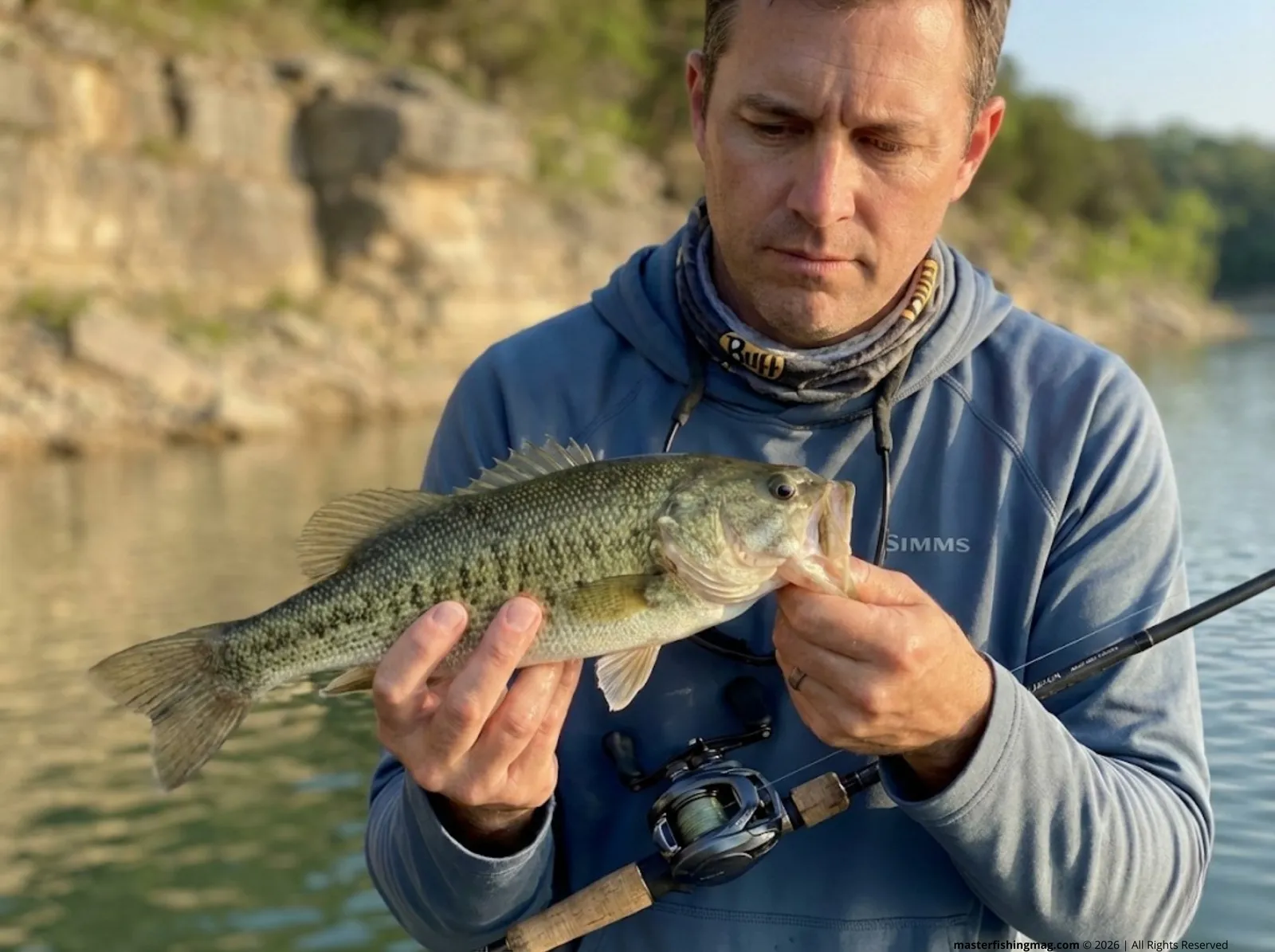
The fastest field identification starts with the mouth. A spotted bass’s upper jaw does NOT extend past the rear margin of the eye — that’s the smaller mouth not past eye rule you need to remember. Hold the mouth closed and look. If the jawline stops short of the eye’s back edge, you’re holding a spot. A largemouth bass jaw extends well past it.
Next, run your thumb across the tongue. Spotted bass have a coarse, rectangular tongue tooth patch you can feel immediately. Largemouth tongues are smooth. This one test settles 90% of identification arguments on the water.
Then look at the body. Spots below the lateral line form distinct rows of dark dots on the lower flanks. Largemouth display a solid dark band — a lateral stripe — not individual blotches. The dorsal fins tell a story too. On a spotted bass, the two dorsal fins are connected or barely separated. On a largemouth, there’s a clear gap between them.
When records are on the line, count lateral line scales. Northern spotted bass carry 55-71 lateral line scales. That number matters if you’re trying to separate a true spotted bass from its close relative, the Alabama bass.
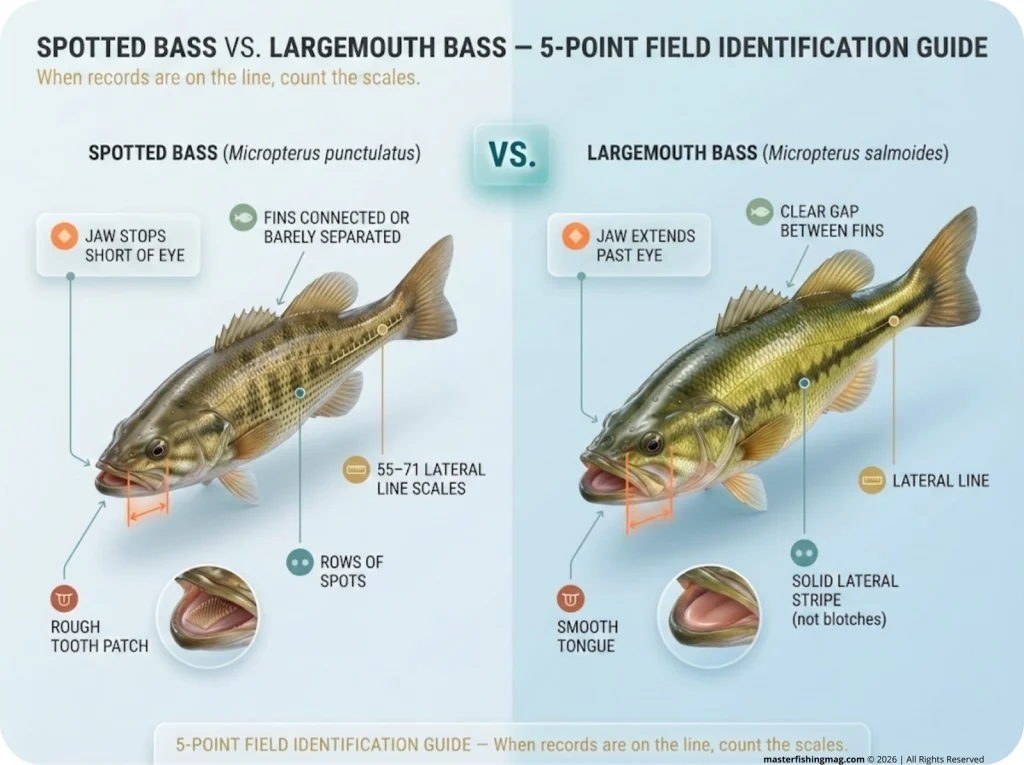
Pro tip: Keep a pocket magnifier in your tackle bag. When tournament weigh-in ID disputes happen — and they do — a quick lateral line scale count separates spotted bass from Alabama bass faster than any argument.
Subspecies You Didn’t Know Existed
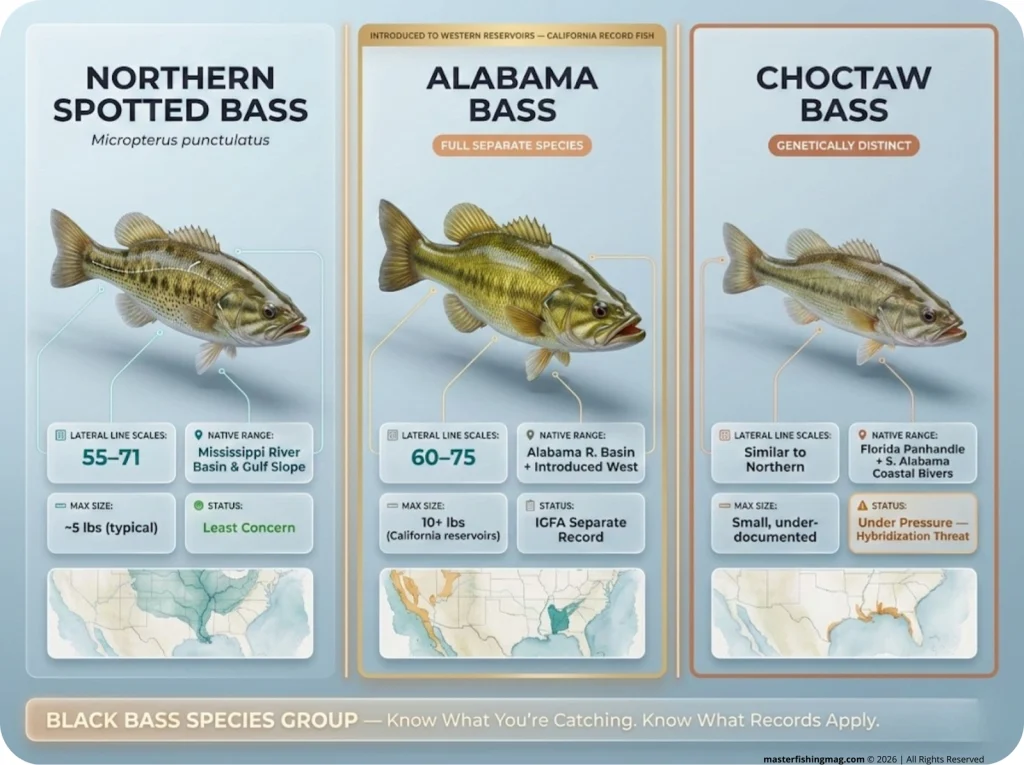
Here’s where it gets interesting. The black bass family has three recognized forms in the “spotted” group: Northern spotted bass (M. punctulatus), Alabama bass (Micropterus henshalli), and the lesser-known Choctaw bass (M. sp. cf. punctulatus).
Alabama bass used to be classified as a spotted bass subspecies. Not anymore. They’re a full separate species — often larger, more aggressive, and dominant in clearer western deep channel bends like those in California. The Alabama bass introduction into western reservoirs has produced fish over 10 pounds, and most of those “world record bass” catches from California are actually Alabama bass. The IGFA now separates the records.
The Choctaw bass is even more obscure — genetically distinct but limited to Florida panhandle and southern Alabama coastal rivers. Their small natural range plus hybridization threats from introduced spotted and Alabama bass put them under real pressure.
If you’re fishing Pine Flat Reservoir or New Bullards Bar in California, you’re almost certainly targeting Alabama bass. The tactics overlap, but the biology and the records don’t. Understanding this matters for how largemouth bass biology compares to what you’re actually catching.
Where Spotted Bass Actually Live — Range, Water, and Structure
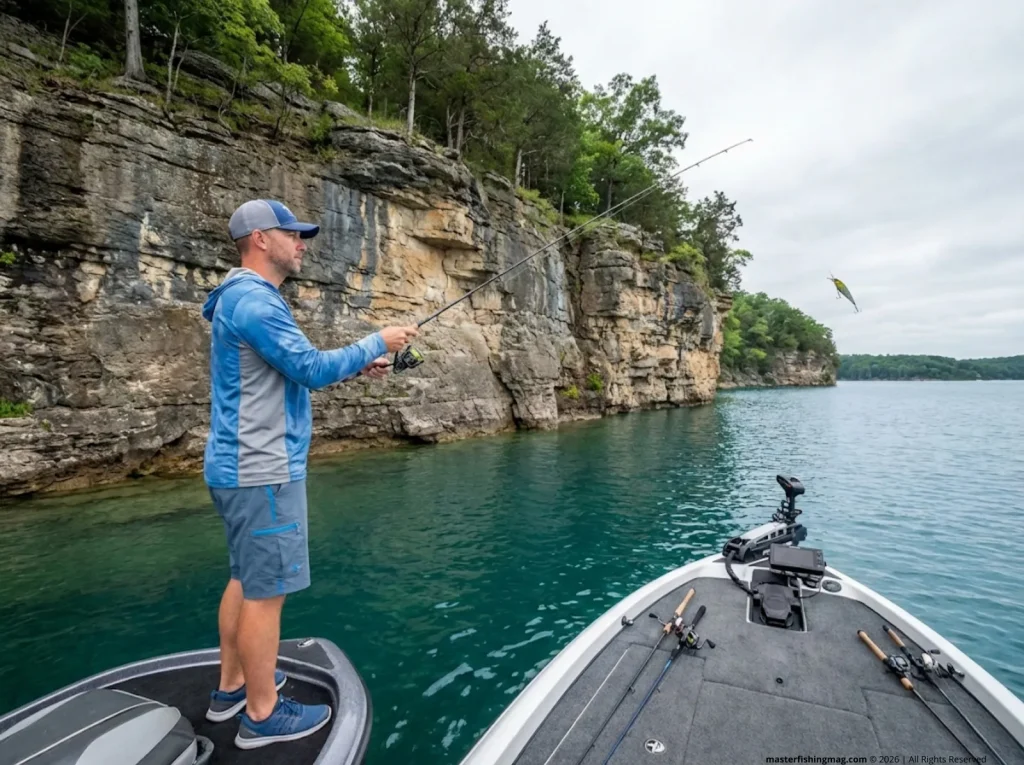
Finding spotted bass starts with forgetting everything you know about finding largemouth. Different water, different structure, different depth.
Native Range vs. Introduced Waters
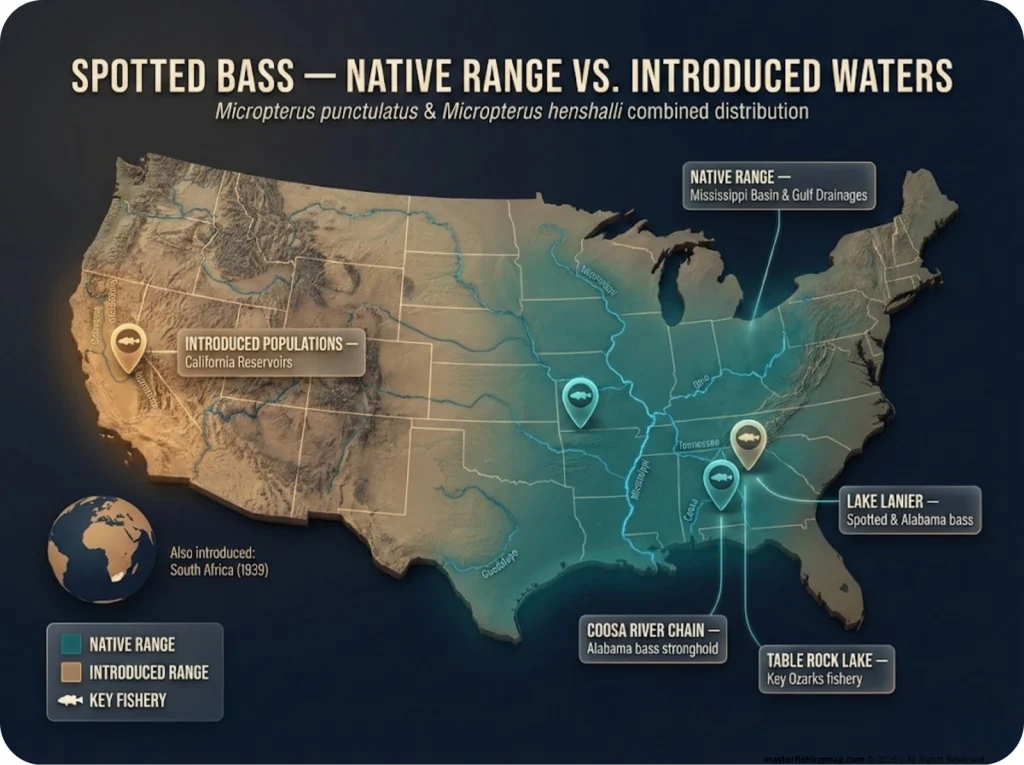
Spotted bass distribution covers the Mississippi River basin from southern Ohio and West Virginia down through southeastern Kansas to the Gulf. Their natural range extends across Gulf states drainages from the Chattahoochee River in Georgia to the Guadalupe River in Texas. That’s their homeland — and it’s a wide range compared to most black bass species.
But they’ve been introduced far beyond it. Alabama bass now thrive in California reservoirs, and spotted bass were even introduced to South Africa in 1939 — where some bass populations were later eradicated through gillnets and electrofishing. Key fisheries today include the Coosa River chain, Lake Lanier, Pine Flat Reservoir, and Table Rock Lake. Each of these represents a different fishery with its own structure and depth patterns.
Hard Cover, Current Breaks, and Why Grass Doesn’t Matter
Greg Vinson, a Bassmaster Elite pro who grew up on the Coosa River, puts it bluntly: “They seem to prefer hard cover — rocks or wood — where typically you’ll find largemouth in grass and vegetation.” That single observation saves you hours of wasted casts.
Spotted bass congregate around hard cover — rockpiles, wood laydowns, bluff walls, docks, and main lake points. They are deeply current-oriented, positioning themselves on eddies and current breaks where energy cost is low and prey gets funneled past. Think of them as structure-oriented ambush predatory fish that let the river do the work.
They also prefer clearer, deeper water than largemouth with rock bottom — not mud, not sand, not grass. Depth varies wildly by region. Ozarks rocky banks run 8-15 feet. Southern dock-suspended fish hang 25-40 feet down. Western deep channel bends hold spotted bass from 20 to 100+ feet. Wherever you are, find the hardest structure near the deepest water, and you’re in the neighborhood.
Understanding how current seams create ambush points will change how you approach any piece of spotted bass water. Current isn’t just a feature — it’s the reason they’re there.
Pro tip: If you’re fishing a reservoir that holds both largemouth and spotted bass, start shallow and grassy for largemouth. Then work the main lake — rocky points, channel swings, and bluff walls — for spots. They rarely overlap.
Feeding Behavior and Why Small Baits Win
This is where spotted bass break every largemouth bass habit you’ve built. The “big bait, big fish” rule doesn’t apply here.
Diet Progression and Prey Preference
Juvenile fish start on zooplankton and aquatic insects. As they grow, their spotted bass diet shifts to small minnows and then to the adult staples: crawfish, threadfin and gizzard shad, and terrestrial insects. In rocky habitat, length crawfish — especially those in crawfish hues — dominate the menu. In open-water reservoir angling settings, baitfish take over as the preferred prey.
What separates spotted bass from largemouth is aggression. Spotted bass tend to be aggressive voracious feeders that will leave cover to chase fast-moving baits. They don’t sit in the grass waiting for something to swim past their face. They hunt. Reaction strikes — spinnerbaits, topwater walkers, ripped jerkbaits — are a legitimate primary pattern, not just a desperation move.
The Small-Bait Paradox
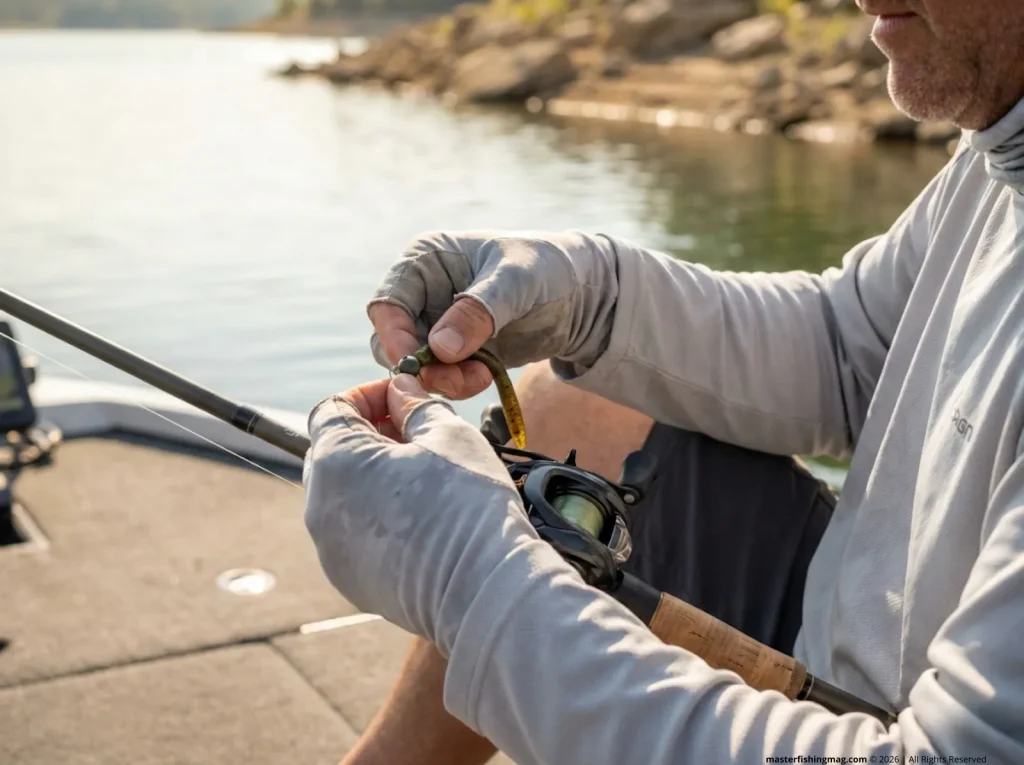
Here’s what throws bass anglers off: quality fish in the 3-5 lb range consistently eat small baits. Drop shot rigs with 3-4 inch worms, shaky head worms, finesse jigs — these little baits outproduce big swimbaits for spotted bass almost every time.
Greg Vinson calls the shaky head “crack cocaine for a spotted bass.” That’s not hyperbole. On the Coosa River chain, he’s stacked 20-lb stringers on a simple 3-inch Roboworm shaky head worm while anglers throwing 8-inch swimbaits caught nothing.
The lesson is simple. Downsize everything. If I’m targeting spots, my largest bait is a 5-inch Senko. Most days, a 3-inch worm on a shaky head outproduces everything else. This is closer to light-line finesse fishing than it is to power bass fishing tactics, and understanding effective tactics for this species makes all the difference.
Seasonal Tactics — From 70-Foot Winter Verticals to Summer Topwater
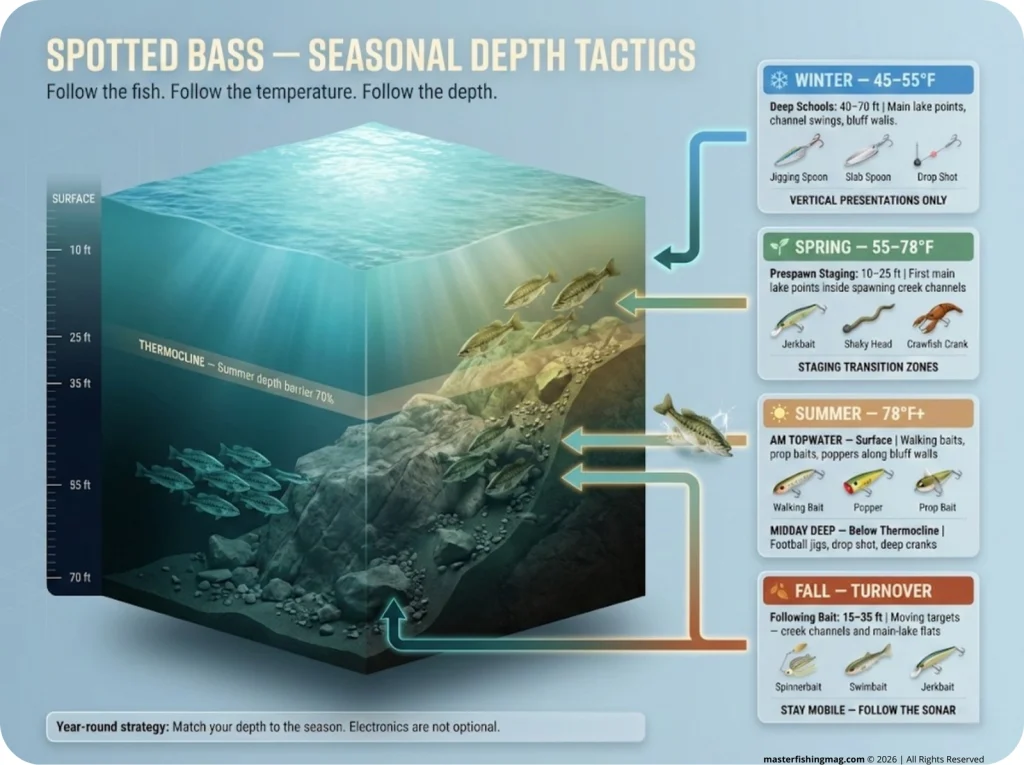
Spotted bass don’t sit in the same spot all year. They make dramatic depth shifts that will leave you staring at empty water if you fish the wrong zone. Here’s the year-round seasonal tactics breakdown.
Winter (45-55°F) — Deep Schools and Vertical Presentations
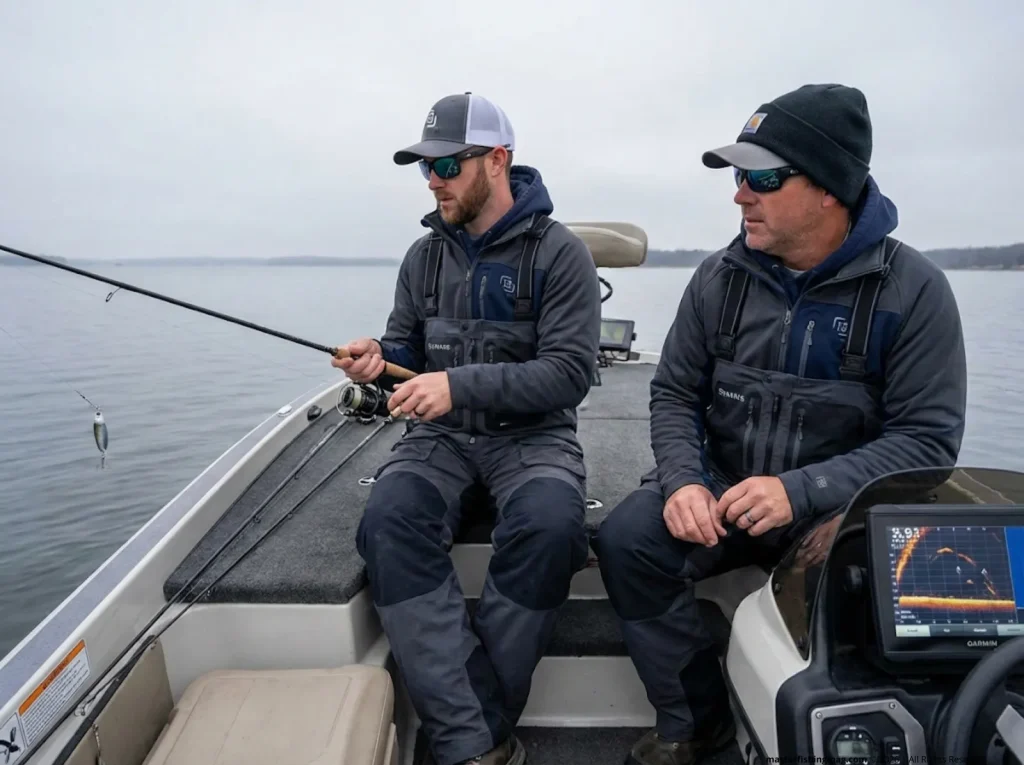
When water temperatures drop, winter schooling spotted bass pack tight in deep water — 40 to 70+ feet on main lake points, channel swings, and deep bluff walls. This is where wolfpack strategies become essential. On forward-facing sonar, you’ll see groups of 10-30 fish suspended at specific depths, moving laterally and vertically as a unit.
Deep verticals are mandatory. Casting and retrieving won’t reach them. Jigging spoons, slab spoons, drop shot rigs with small plastics, and blade baits worked straight below the boat are the primary vertical baits. Without quality electronics — LiveScope, Active Target, or at minimum solid down-imaging — you are guessing. When bass move deeper in cold water, the only answer is to follow them down.
Spring (55-78°F) — Prespawn Migration and Spawning Flats
As water warms, spring bass push up from their winter holds toward secondary points and staging areas at 10-25 feet. They stack on the first main lake points inside spawning creek channels — that transition zone where deep water meets gravel flats.
Spotted bass spawning happens when males build nests on rock and gravel at spawning temps 63-78°F. Females can deposit 3,000-40,000 per nest depending on her size. Males guard nests aggressively, which makes bed fishing effective — but ethically questionable during this vulnerable period. Jerkbaits like the Yo-Zuri 3DB 110, shaky head worms, small crawfish-color crankbaits, and Carolina rigs all produce during spring prespawn staging.
Pro tip: During prespawn, fish the first main lake point inside a spawning creek channel. That’s where spotted bass stage before committing shallow. If you’re blind-casting banks, you’re probably fishing behind them.
Summer (78°F+) — Topwater and Nomadic Roaming
Summer nomadic spotted bass follow shad schools along main-lake structure, and the morning topwater tactics bite can be extraordinary. Walking baits like the Zara Spook, prop baits, and poppers worked along bluff walls and points draw explosive striking lures responses.
By midday, the pattern shifts deep. Football jigs dragged on main-lake humps, deep cranks, and drop shot rigs pick off fish deeper that have pushed below the thermocline. Current breaks become even more important — spotted bass stack on anything that funnels water.
Fall (Turnover) — Following the Bait Migration
Fall turnover disrupts the thermocline and scatters baitfish migrations toward creek channels and main-lake flats. This is often the best period for numbers. Bass become aggressive and spread across multiple depth zones, chasing shad wherever they find them.
Spinnerbaits, swimbaits, and jerkbaits cover water efficiently. The key is mobility — don’t commit to one spot. Keep moving until the sonar shows activity. Understanding the physics behind lake turnover helps you predict where baitfish redistribute and where the bass follow.
Sonar, LiveScope, and Reading the Wolfpacks
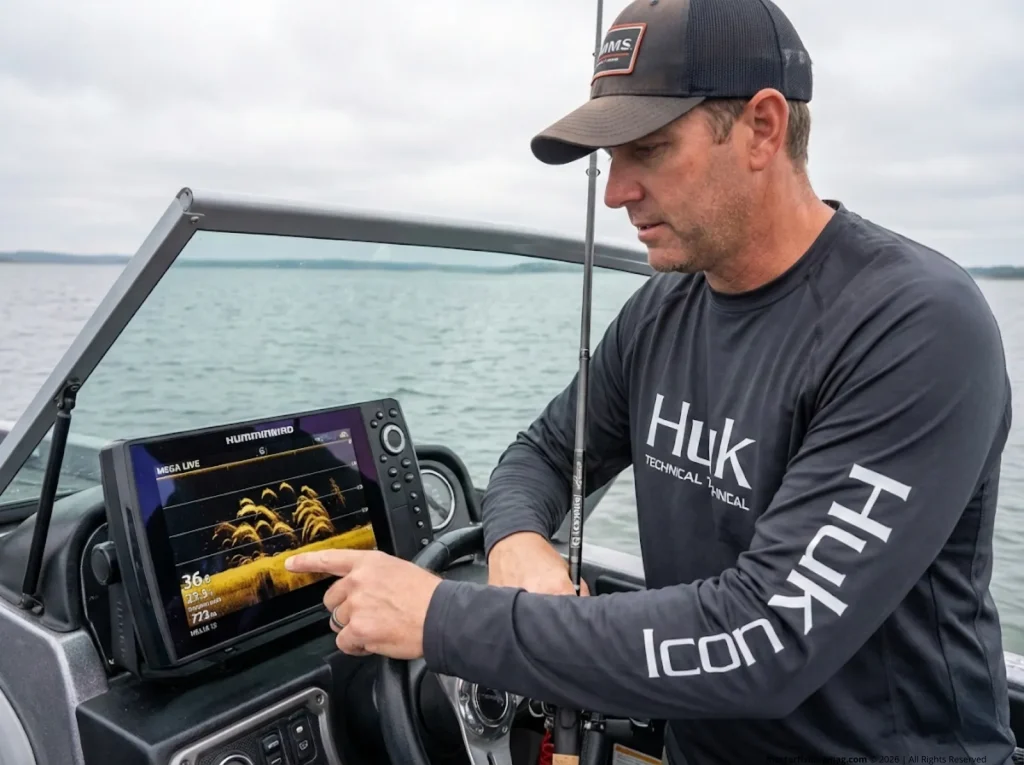
You can catch spotted bass without electronics. But you’ll catch three times more with them. Unlike largemouth — which you can often sight-fish shallow or target on visible cover — spotted bass suspend in open water at specific depths. They’re invisible without sonar, and front-facing sonar has completely changed the game for reservoir angling.
Why Spotted Bass Demand Better Electronics
Forward-facing sonar — LiveScope, Active Target, MEGA Live — changed spotted bass fishing permanently. These systems let you see individual fish and cast directly to suspended bass wolfpacks. Traditional side-imaging and down-imaging still work for marking deep fish and identifying bottom structure, but forward-facing sonar turns guessing into reading sonar for suspended fish with precision.
Reading Suspended Schools and Adjusting in Real Time
Wolfpacks are groups of 10 to 30+ spotted bass hanging 15-50 feet over deep structure. They move laterally and vertically throughout the day. Watch them on the screen and match your bait presentations to the school’s mood. Aggressive wolfpacks respond to jigging spoons and blade baits ripped through the school. Neutral schools need a slow drop shot — a bottom-bouncing bait floated gently through the zone.
Pro tip: When you find a wolfpack on LiveScope, don’t cast into the middle of the school. Drop your bait 3-5 feet above or below them and let it fall through. Casting directly at them scatters the group. Patience here is worth more than speed.
Conservation — Because Spotted Bass Need Stewards, Not Just Anglers
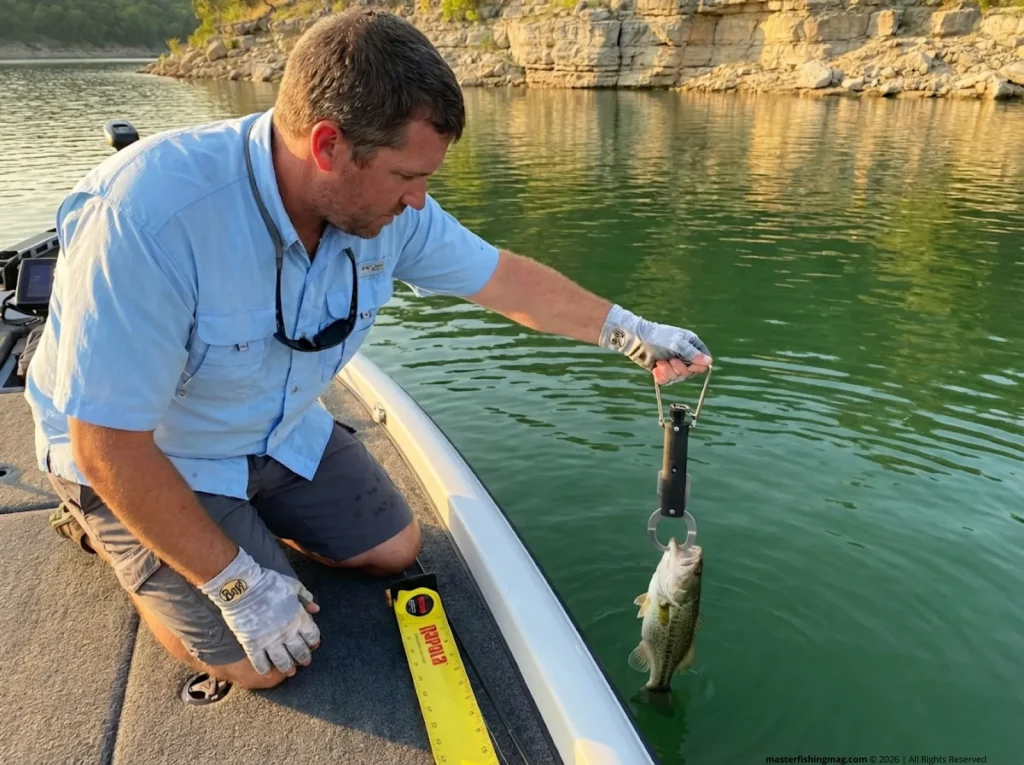
If you’re pulling fish from 40-70 feet of water and tossing them back on the surface, you’re killing them. I’ve watched spotted bass float belly-up at tournaments because anglers didn’t carry the one tool that changes survival from 30% to over 90%. This section isn’t optional reading.
Barotrauma and the Descending Device Protocol
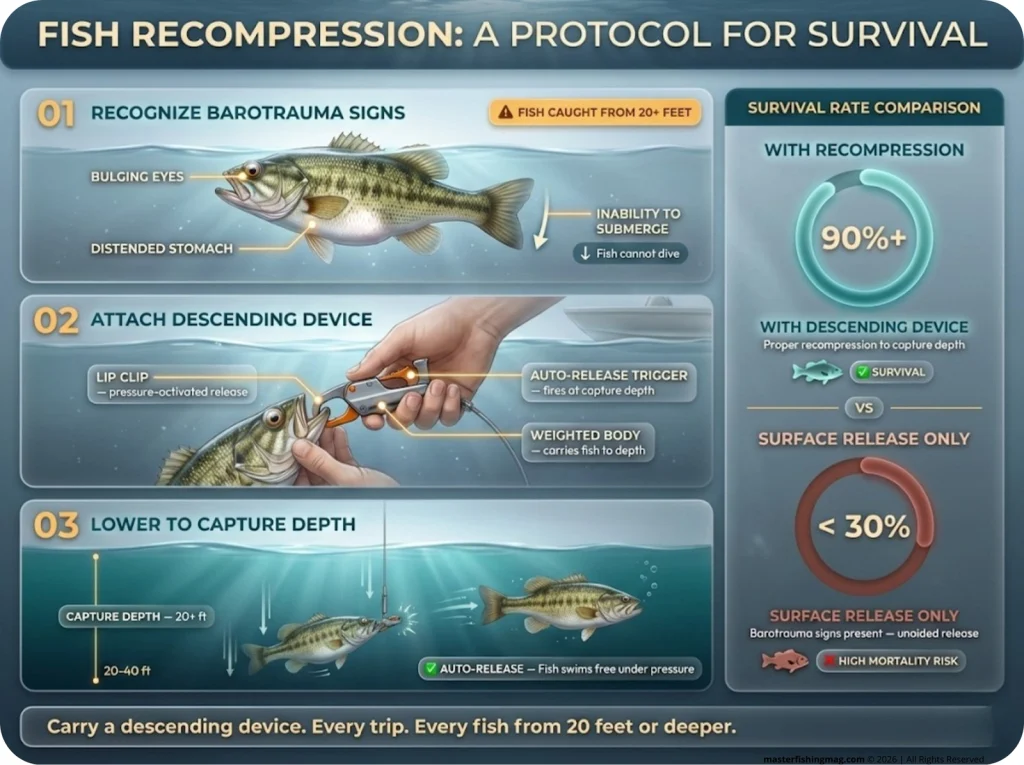
Any spotted bass caught from 20+ feet risks barotrauma — swim bladder expansion, organ displacement, and gas embolism. The signs are obvious: bulging eyes, distended stomach, inability to submerge. The fix is simple: carry a descending device.
A SeaQualizer or Fishsaverpro clips to the fish’s lip, takes it back to capture depth, and releases automatically. Survival rates with proper recompression exceed 90%. Surface-released fish with barotrauma signs die at rates below 30%. That’s not a rounding error. That’s the difference between catch and release and catch and kill. Learn the complete science behind fish barotrauma and carry the tool every time you fish deeper than 20 feet.
Stunting, Harvest, and Why Small Fish Aren’t Always Young
Bass mature early. Spotted bass can reach sexual maturity at just 9.5-10 inches and under two years of age. In waters with limited forage, this early maturity leads to population stunting — you’ll catch small fish after small fish, all 10-12 inches, because they’re reproducing before they grow. Their 6-10 years lifespan means a stunted fish might be older than it looks.
The counterintuitive solution is ethical harvest. Keeping a few smaller fish reduces competition for forage and lets the remaining bass populations push past that stunting threshold. Check your state’s harvest recommendations — population management through selective harvest isn’t just allowed, it’s encouraged by most fisheries agencies.
Hybridization and Protecting Native Populations
Alabama bass introductions into southeastern waters threaten native spotted bass through genetic hybridization. The offspring — sometimes called meanmouth bass — compromise the genetic integrity of native black bass fisheries. Choctaw bass, trapped in their tiny Florida panhandle range, are especially vulnerable.
The practical takeaway for anglers: never transport live bass between water bodies. Support your state wildlife agency’s efforts to manage invasive bass introductions. Respecting these boundaries — as Texas Parks and Wildlife notes about spotted bass habitat and regulation — protects the different fisheries we all depend on.
Conclusion
Three things separate anglers who catch spotted bass from those who don’t.
First, spotted bass are a different fish with different rules. Hard cover, current, and finesse presentations beat grass and power fishing every time. Stop fishing them like a smaller largemouth.
Second, seasonal tactics matter enormously. The same fish sitting at 70 feet in January is slamming topwater in July. Learn the depth shifts. Invest in good electronics.
Third, every deep-caught spotted bass deserves a descending device. If you’re fishing 20+ feet and you don’t carry one, you’re not practicing catch and release. You’re practicing catch and hope.
Next time you’re on a clear reservoir and the largemouth pattern dies, point the trolling motor toward the nearest main lake point, tie on a shaky head, and let the rockpile tell you who really lives there.
FAQ
What is the difference between spotted bass and largemouth bass?
The fastest field check is the jaw — a spotted bass’s upper jaw does NOT extend past the rear margin of the eye, while a largemouth’s jaw extends well past it. Spotted bass also have rows of dark spots below the lateral line and a rough tongue tooth patch that largemouth lack. The dorsal fin on a spotted bass is connected, while largemouth show a clear separation.
Where do spotted bass live?
Spotted bass are native to the Mississippi River basin and Gulf states drainages from Georgia to Texas. They’ve been introduced into California and Oregon reservoirs and prefer clearer, deeper water with hard cover like rocks, wood, and bluff walls — not the shallow vegetated coves largemouth favor. Key fisheries include the Coosa River chain, Lake Lanier, and Pine Flat Reservoir.
What do spotted bass eat?
Adults feed primarily on crawfish, threadfin shad, minnows, and terrestrial insects. They’re aggressive ambush feeders that orient to current breaks. Despite their aggression, quality spotted bass consistently respond to small baits — shaky head worms and drop shot rigs outperform big swimbaits for this species.
How big do spotted bass get?
Northern spotted bass average 12-17 inches and 1-3 pounds, with exceptional fish reaching 5+ pounds. Alabama bass grow larger — the IGFA-certified bass record is 11 pounds 4 ounces from a California reservoir. Most spotted bass records from western waters are actually Alabama bass.
How to catch spotted bass in winter?
Winter schooling spotted bass hold in deep water (40-70+ ft) around main lake points and channel swings. Vertical jigging with jigging spoons, blade baits, and drop shot rigs is mandatory. Forward-facing sonar helps locate suspended bass wolfpacks. Always carry a descending device for ethical release from deep water to avoid barotrauma.
Risk Disclaimer: Fishing, boating, and all related outdoor activities involve inherent risks that
can lead to injury. The information provided on Master Fishing Mag is for educational and informational purposes
only. While we strive for accuracy, the information, techniques, and advice on gear and safety are not a substitute
for your own best judgment, local knowledge, and adherence to official regulations. Fishing regulations, including
seasons, size limits, and species restrictions, change frequently and vary by location. Always consult the latest
official regulations from your local fish and wildlife agency before heading out. Proper handling of hooks, knives,
and other sharp equipment is essential for safety. Furthermore, be aware of local fish consumption advisories. By
using this website, you agree that you are solely responsible for your own safety and for complying with all
applicable laws. Any reliance you place on our content is strictly at your own risk. Master Fishing Mag and its
authors will not be held liable for any injury, damage, or loss sustained in connection with the use of the
information herein.
Affiliate Disclosure: We are a participant in the Amazon Services LLC Associates Program, an
affiliate advertising program designed to provide a means for us to earn advertising fees by advertising and linking
to Amazon.com. As an Amazon Associate, we earn from qualifying purchases. We also participate in other affiliate
programs and may receive a commission on products purchased through our links, at no extra cost to you. Additional
terms are found in the terms of service.