
In this article
The 4-pound fluorocarbon went tight, and for exactly one second everything felt right. Rod loaded, fish committed, drag singing. Then the line popped like a dry twig. I stood there watching a 5-pound smallmouth bass thrash on the surface 30 feet out, my shaky head still pinned in its jaw, while my rod tip bounced to nothing.
That fish taught me more about finesse fishing than any article or YouTube video ever could. Because light line finesse isn’t about throwing a small bait. It’s about understanding why thin line, light weights, and calibrated drag turn pressured fish into willing biters—and what happens when you get any part of that equation wrong.
After 200 trips across clear-water reservoirs, pressured tournament lakes, and rocky smallmouth rivers, I’ve broken more line, re-tied more knots, and lost more fish than I’d like to admit. But every break-off taught me something the gear catalogs never mention. Here’s the system that actually works—and why it catches fish when nothing else will.
⚡ Quick Answer: Light line finesse fishing uses 4–10 lb test line with small lures (1/32–1/4 oz) on medium-light, fast-action spinning rods to present baits naturally to pressured bass. The key isn’t just line invisibility—it’s reducing fluid drag so your lure falls vertically instead of swinging horizontally. Set your drag to 20–30% of line strength, use a braid-to-fluorocarbon leader system, and master the sweep hookset instead of a power snap.
Why Light Line Gets More Bites (It’s Not Just Visibility)
The Fluid Drag No One Talks About
Most anglers assume light line catches more fish because it’s harder for bass to see. That’s part of it, but the bigger reason has nothing to do with visibility.
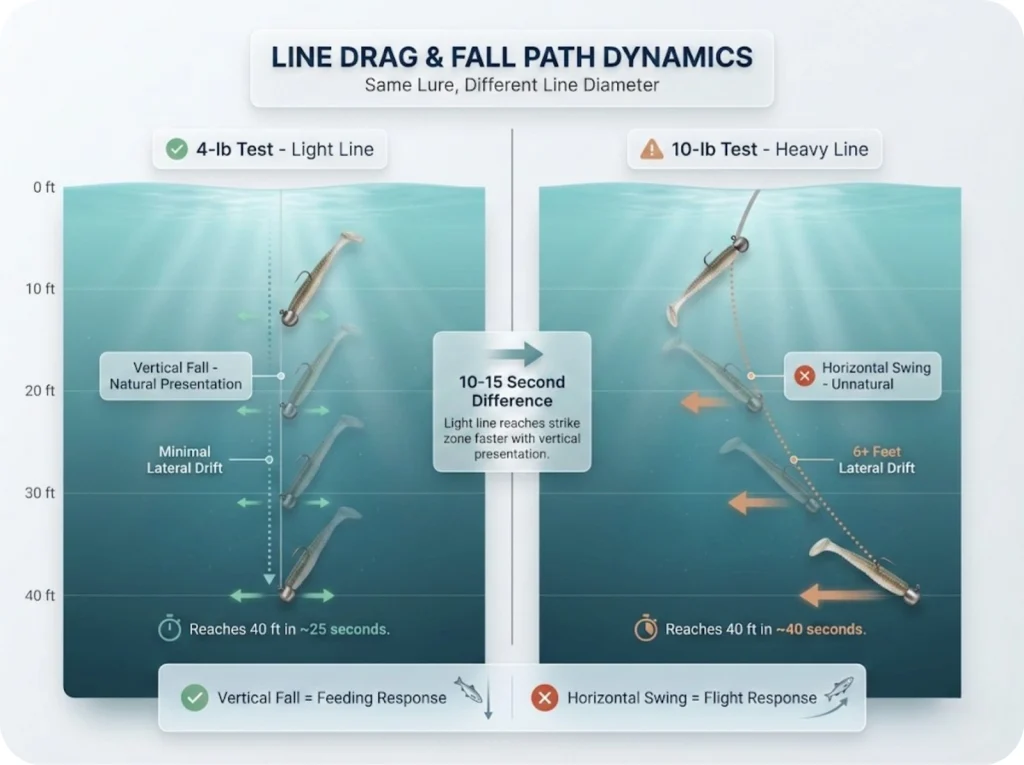
Line diameter creates drag against the water as your lure sinks. Thicker line has more surface area, which means more resistance. That resistance pulls your lure sideways during the fall instead of letting it drop straight down. On a 1/8 oz jig head in 40 feet of water, the difference is dramatic.
Aaron Martens—three-time Bassmaster Angler of the Year and the godfather of light-line finesse technique—documented that 4–6 lb test reaches the bottom 10 to 15 seconds faster than 7–8 lb line with the same weight. That’s not a rounding error. That’s the difference between your bait landing in the strike zone and your bait swinging six feet past it.
A vertical fall triggers a feeding response. A horizontal swing triggers a flight response. Pressured fish that have seen a hundred lures already know what an unnatural swing looks like. Drop your line weight, and the lure suddenly falls like a dying baitfish instead of a weighted pendulum.
Pro tip: If the water is glass-calm, drop your leader size by one pound. One pound lighter makes a measurable difference in both fall rate and visibility. Aaron Martens swore by this adjustment on tournament days.
Refractive Index and What Bass Actually See
Fluorocarbon line has a refractive index of 1.42, which sits close to water’s 1.33. Monofilament comes in at 1.58—noticeably farther from water—and braided line is effectively opaque. That gap matters more than most anglers realize, especially in clear water conditions.
Fluorocarbon also sinks roughly 2.5 times faster than mono because of its higher density and zero water absorption. That’s why fluorocarbon leader systems dominate finesse fishing—you get the invisibility and the sink rate in one package. If you want to understand the optics behind fluorocarbon visibility, the science runs deeper than just refractive index, but the practical takeaway is straightforward: fluoro disappears in water better than anything else, and it gets your bait down faster.
According to state fisheries guidelines on line material selection, matching your line type to water conditions is one of the highest-impact adjustments an angler can make.
The Sink Rate Equation
The specific gravity numbers tell the story. Braid floats (specific gravity below 1.0). Mono barely sinks (about 1.15). Fluorocarbon drops like it means it (roughly 1.78).
Lighter line lets you use lighter weights—1/16 oz instead of 1/4 oz—which keeps your lure in the strike zone longer. When you compensate for thick line’s drag by adding heavier weights, the lure plummets past the fish. As Brent Ehrler put it: “Using seven or eight pound doesn’t feel right. It just sinks slower. Six pound and five pound are just so much different” when you’re fishing 50 feet of deep water.
Building the Finesse System (Rod, Reel, Line, and Drag)
Matching Rod Taper to Line Strength
Finesse fishing isn’t a bait choice—it’s a system. Every component has to match, and the rod is where it starts.
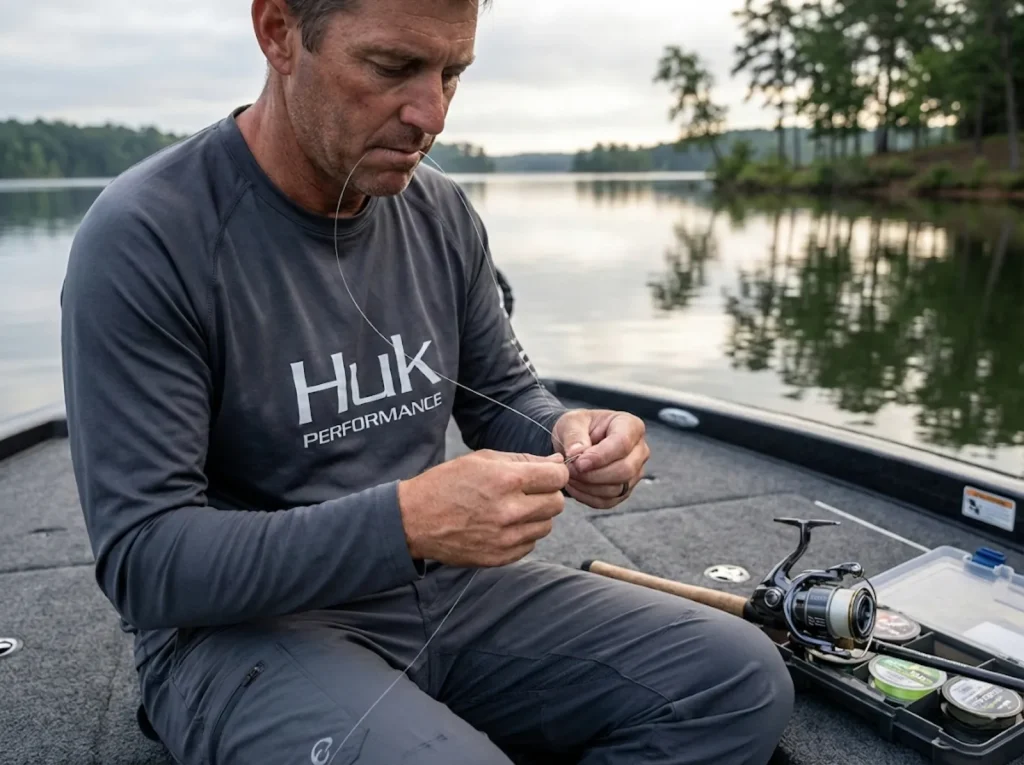
A medium-light, fast-action spinning rod gives you two things at once: the fast tip detects subtle bites that feel like nothing more than a slight weight change. The medium-light backbone flexes enough to absorb shock without snapping 6-lb test on the hookset. Martens famously used fast-tip rods designed for trout when he dropped to 3-lb test, because a bass rod’s stiffer spine would instantly break that line.
The most common mistake I see on the water is anglers ripping a power hookset on light tackle. If you’re setting the hook like you’re punching a jig through a mat, you’re going to snap off. Every single time. The finesse hookset is a smooth sideways sweep—let the rod load, let the drag breathe, and let the fish turn before you add pressure. If you need a refresher on how rod action and power work together, the short answer for finesse is: fast tip, soft spine, spinning platform.
Why Your Reel’s Drag Matters More Than Its Price Tag
Set your drag to 20–30% of your weakest line’s breaking strength. For 6-lb test, that’s about 1.2 to 1.8 lbs of drag pressure. Use a small fish scale to calibrate it—don’t guess.
But the number isn’t the whole story. What kills light line is startup inertia—the initial resistance your drag washers need to overcome before they start rolling. Cheap reels have sticky washers that grab before they slip. When a bass lunges and your drag hesitates for even a fraction of a second, that spike of resistance snaps 4-lb test like thread.
High-end carbon-fiber drag systems in reels like the Shimano Vanford, Daiwa Tatula, or the Shimano Stella release line with near-zero delay. That instant responsiveness is why tournament finesse guys invest in their spinning reels more than almost any other component. We’ve broken down the physics behind drag system performance if you want to understand why material science matters inside the drag stack.
Pro tip: Test your drag from a dead stop, not under steady pull. Tie your line to a fence post, walk 30 feet away, and make a sharp sweep. If the drag stutters before releasing, it’s too sticky for light line work.
The Braid-to-Fluorocarbon Connection That Changed Everything
Modern finesse fishing runs on a hybrid system: 10–15 lb braid as mainline for zero line memory and maximum sensitivity, connected to a 6–10 foot fluorocarbon leader for invisibility and abrasion resistance.
The connection point is everything. The FG Knot tests at nearly 100% of rated line strength because it builds a friction ramp of braided wraps around the leader—no sharp bends, no stress points. Compare that to a Double Uni at roughly 80% or even a Palomar at 85–90%. When you’re fishing 4-lb leader, that 15–20% difference is the fish you land versus the fish you lose.
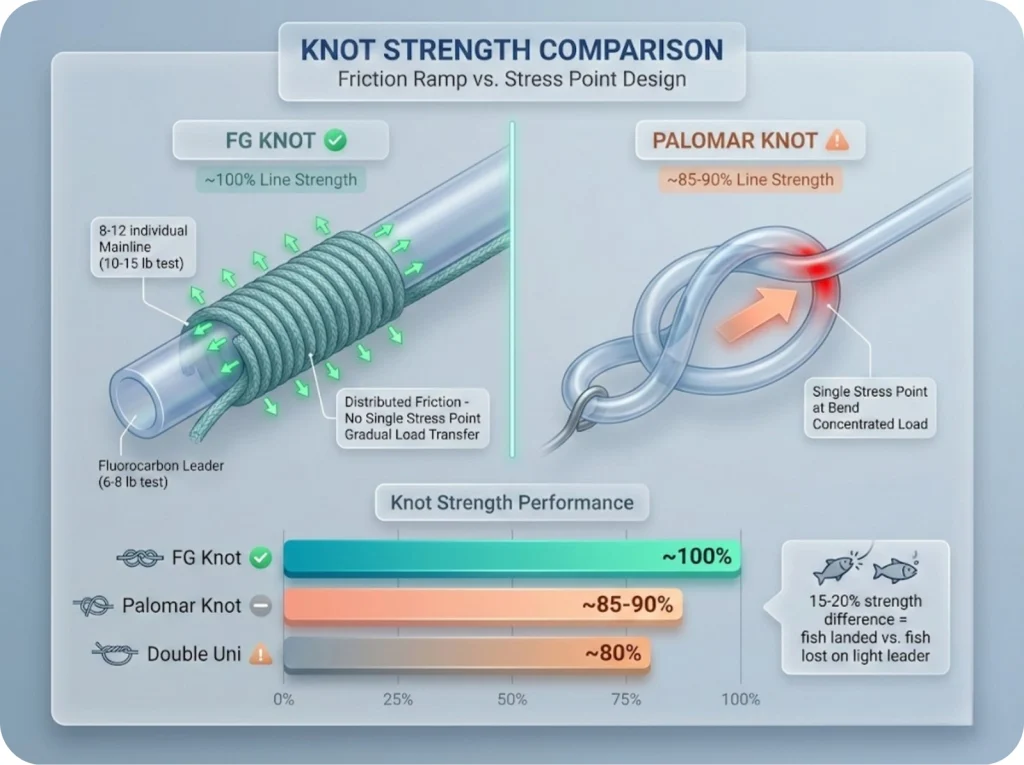
One non-negotiable rule: wet your knots before cinching. Fluorocarbon is a PVDF polymer, and cinching it dry generates enough friction heat to weaken the material’s internal structure. The line turns milky white at the knot—and that’s failure waiting for the next hookset. Always wet it with saliva or water, then apply slow, steady pressure. For a step-by-step reference, the three line-to-leader connections I trust covers the FG, Double Uni, and Loop-to-Loop in detail.
The 5 Rigs That Covered 90% of My Finesse Situations
Ned Rig (The One I Reach for First)
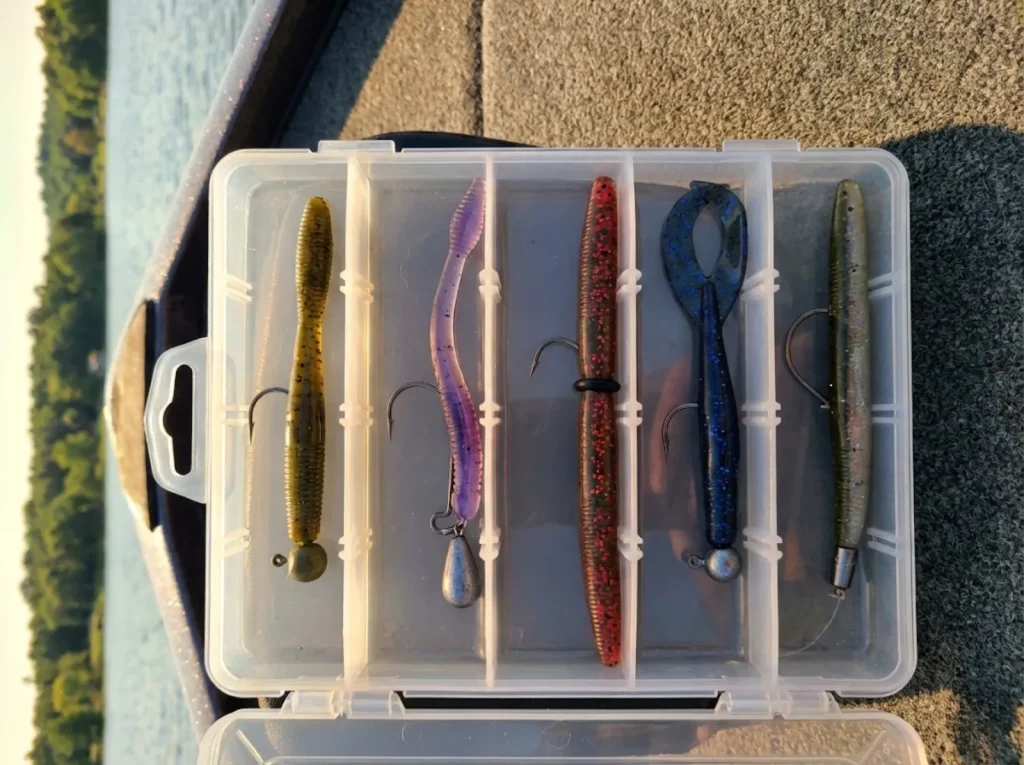
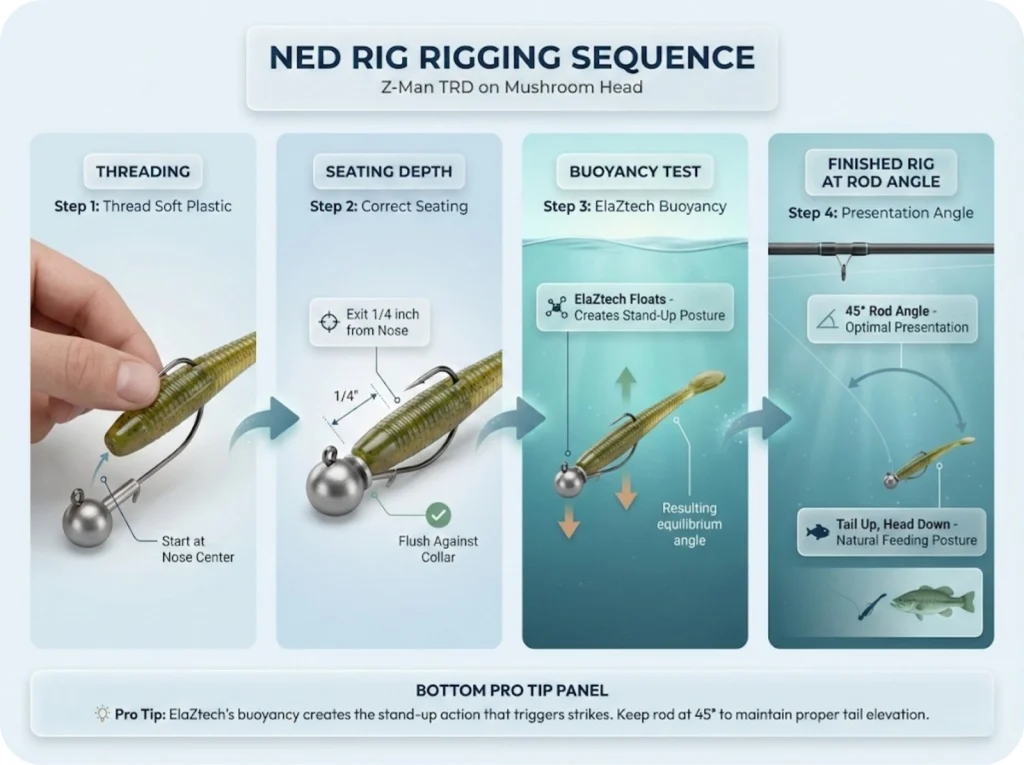
The Ned Rig pairs a small mushroom-head jig head (1/16 oz) with a buoyant soft plastic like the Z-Man Finesse TRD. The ElaZtech material stands up off the bottom at a slight angle, creating a nose-down stance that bass can’t ignore.
The retrieval cadence is dead simple: slow crawl with 5-second pauses. Let the buoyant plastic do the work. In cold front conditions with high pressure and clear water, this is the bait that still gets bit when everything else goes silent. Ned Kehde pioneered this as Midwest Finesse in Kansas, and it’s been quietly winning tournaments ever since.
Use a red glass bead on the tungsten jig head. The clacking sound against the weight triggers reaction bites in stained water—a trick most finesse anglers overlook.
Drop Shot (When Fish Won’t Come to You)
The drop shot rig gives you pinpoint depth control: 7-lb fluorocarbon leader, #1 hook, 18-inch tag end, 3/16 oz tungsten weight. Vertical shaking on a semi-slack line keeps the weight on the bottom while your bait dances at whatever height the fish want. When bass are suspended at specific depths on docks or ledges, nothing else matches this rig’s precision.
Wacky Rig, Shaky Head, and Neko Rig
The wacky rig is pure flutter—a 5-inch Yamamoto Senko hooked through the middle with an O-ring drops with an irresistible shimmy that mimics a dying baitfish. Weightless on 8-lb test near cover, it’s one of the most effective finesse baits ever designed. For rigging details and the science behind that flutter, check out our full wacky rig breakdown and flutter physics.
The shaky head lives on the bottom—10-lb leader, 1/8 oz ball head, constant shaking without moving the weight. Think of it as a panic signal from a crawfish that can’t escape. The Neko rig flips the script: a nail weight in the tail creates a unique nose-down posture that bass haven’t learned to ignore yet. Both are money on deep ledges and gravel transitions where largemouth and smallmouth hold during summer.
Reading Conditions Like a Finesse Fisherman
Water Clarity and Temperature Triggers
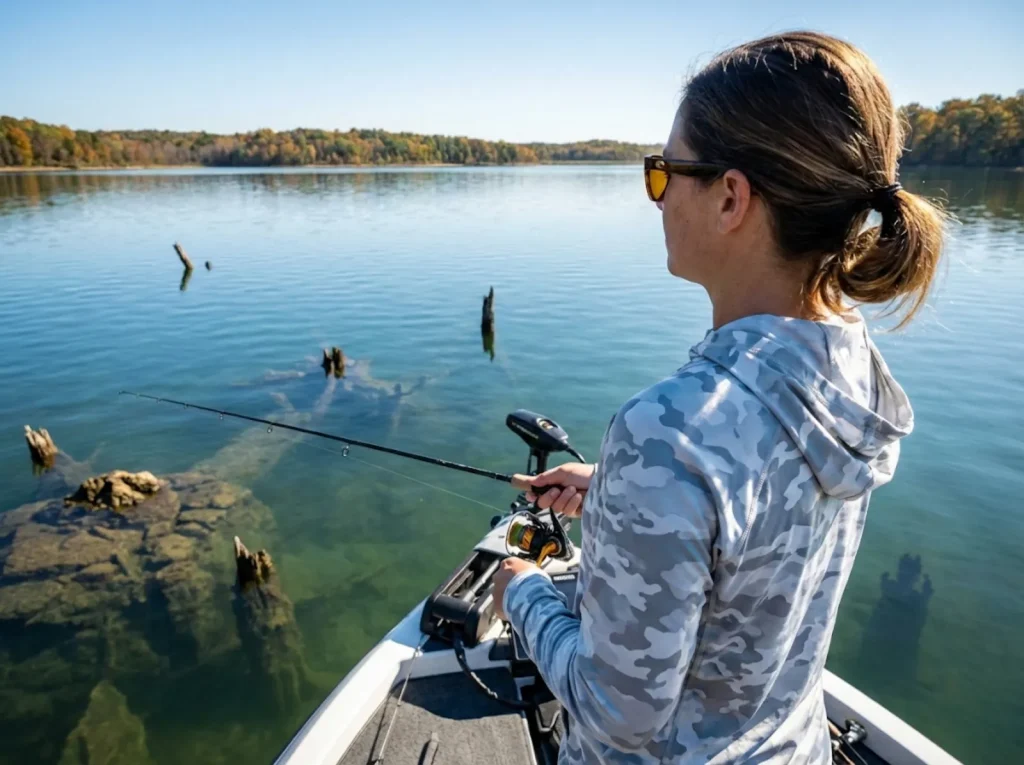
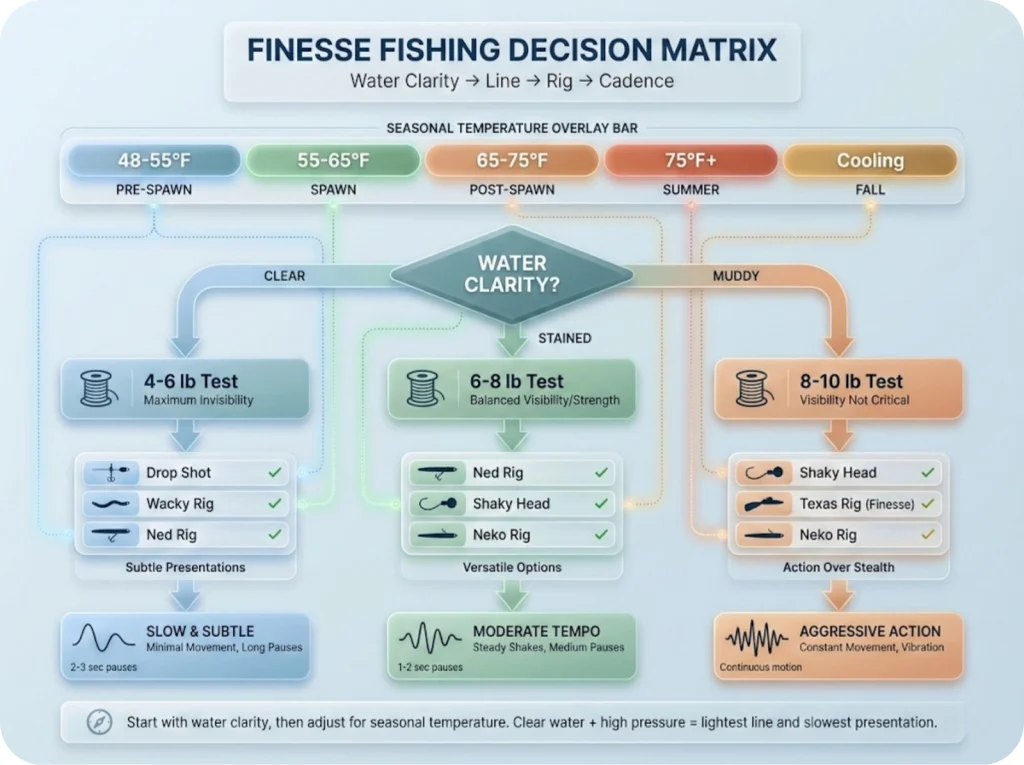
Water clarity dictates your entire approach. In clear water with more than 3 feet of visibility, you’re in finesse territory—drop to 4–6 lb fluorocarbon and downsize everything. In stained water, bump to 8–10 lb. Bass in dirty water rely more on their lateral line than their eyes, so visibility matters less than vibration.
Temperature is the other trigger. Below 55°F, fish metabolism drops hard. Slow your cadence by half and commit to deadsticking—leaving your bait motionless for minutes at a time. As Matt Straw wrote in In-Fisherman: “Instead of working a spot for 10 minutes and moving on, stick around for an hour or more, soaking a lure on every key spot.” That kind of patience feels wrong, but on cold front days, it’s the only play that works.
Pressure History and the “Line-Shy” Threshold
Tournament-pressured lakes demand dropping at least one line size from your default. Fish learn. A largemouth that’s been caught and released three times this season develops a visual suspicion of anything that looks unnatural. Tuesday fish bite 6-lb test without hesitation. Saturday fish, after a week of fishing pressure, may need 4-lb.
Live sonar has confirmed what experienced finesse anglers always suspected: bass actively inspect and reject lures on visible line during inactive periods. The conditioned bass concept is real—repeated exposure creates fish that respond only to the most subtle bait presentation.
Pro tip: After a tournament weekend on your home lake, wait two days, then target the same spots with 4-lb fluorocarbon and a Ned rig. The fish that were “not biting” will eat. They were there the whole time—they just needed the line to disappear.
The Seasonal Transition Map
Match your rig to the calendar: pre-spawn (48–55°F), throw a shaky head on secondary points. During the spawn (55–65°F), wacky rig and drop shot near beds. Post-spawn, switch to Ned and Neko rig on main lake structure. Summer deep (75°F+), drop shot at 20–40 feet on ledges. Fall means following the shad migration—alternate between shallow Ned presentations and deep drop shots as baitfish shift depth.
According to American Fisheries Society research on fish behavior and lure interaction, understanding how fish respond to artificial presentations at different temperatures helps explain why finesse outperforms power tactics under high pressure.
The 4 Mistakes That Cost Me the Most Fish
Burning the Knot (Thermal Glazing)
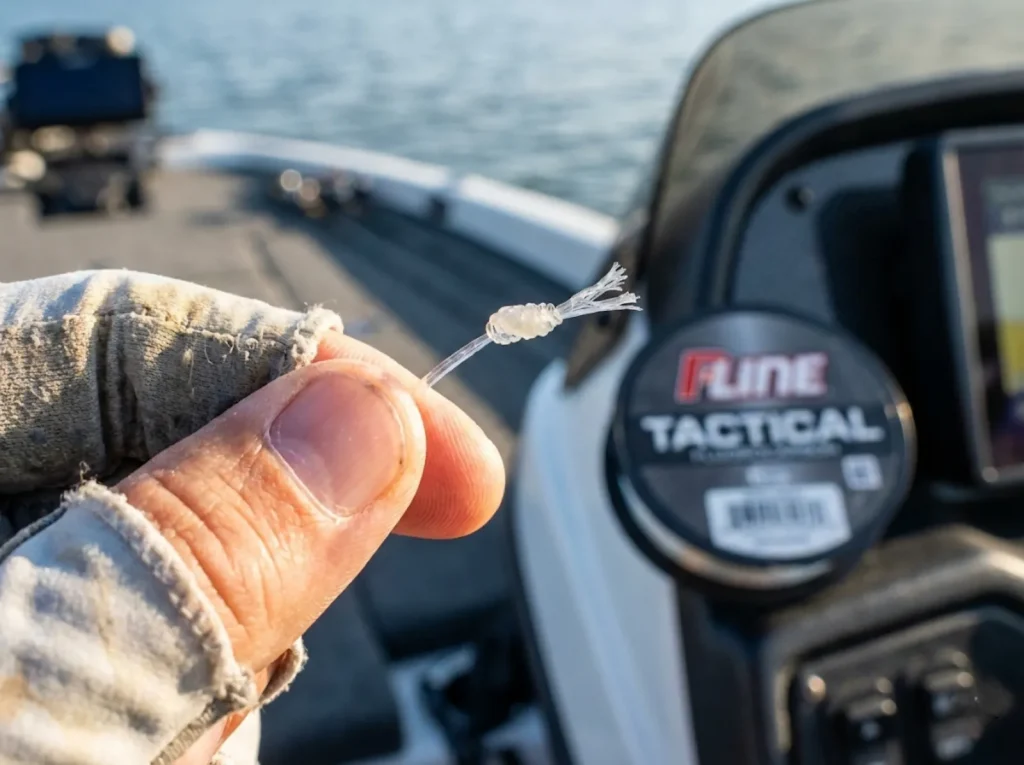
Fluorocarbon is sensitive to heat. Cinch a knot dry, and the friction generates enough warmth to weaken the polymer’s structure. The telltale sign: the line turns milky white right at the knot. That’s not cosmetic—that’s failure waiting to happen.
The fix is simple but non-negotiable: wet the knot with saliva before the final cinch, and apply pressure slowly. Aaron Martens himself said the uni knot and the Snell outperform the popular Palomar for fluorocarbon and braid because they distribute stress more evenly. For a deeper look at the friction mechanics behind knot failure, the data explains why certain knots handle shock loads better than others.
Setting the Hook Like You’re Flipping (You’re Not)
The power hookset that works on 50-lb braid will instantly snap 6-lb fluorocarbon. I learned this the expensive way—multiple times. The finesse hookset is a smooth sideways sweep. Let the rod tip load, let the drag absorb the initial surge, and let the fish turn before you increase pressure. For deadstick bites, reel down until you feel weight, then lift. Never jerk.
Ignoring Line Memory on Cold Mornings
Fluorocarbon line memory gets worse below 40°F. Coils spring off the spool and create slack that masks bites and causes wind knots—and each wind knot is a stress point that weakens the line. The quick field fix: strip 30 feet of line, hold it in warm hands for a minute, and re-spool under tension. The long-term solution is a braid-to-fluorocarbon leader system, because braid has zero memory at any temperature.
Using the Wrong Weight for the Depth
An overly heavy weight in shallow water kills the natural action that makes finesse work. An overly light weight in deep water means you never reach the bottom and lose contact with your lure entirely. My rule of thumb: match weight to depth at roughly 1/16 oz per 10 feet, then adjust for wind and current.
Tungsten is 1.7 times denser than lead, which means smaller profiles with the same weight. That density advantage also transmits better bottom contact sensitivity—when your weight hits a rock, tungsten sends a clear “clack” up the line instead of lead’s dull “thud.” That clack is a known smallmouth bass attractant, and it tells you exactly what you’re dragging across.
Conservation and the Hidden Cost of Lost Lures
What Happens to the Plastics You Leave Behind
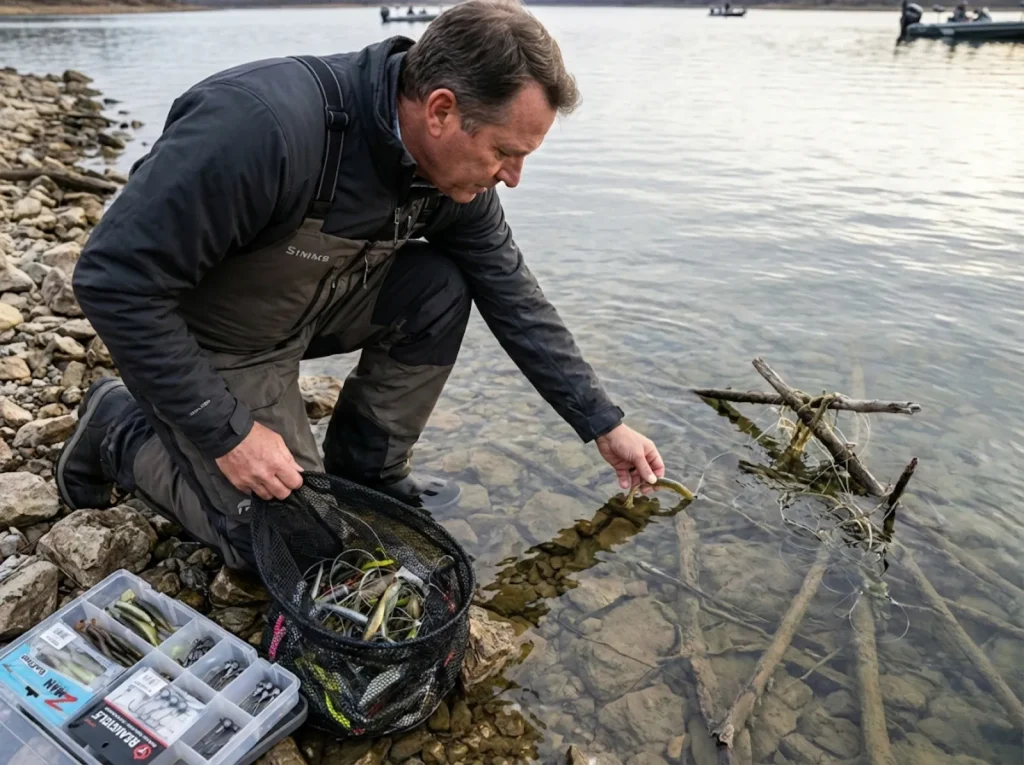
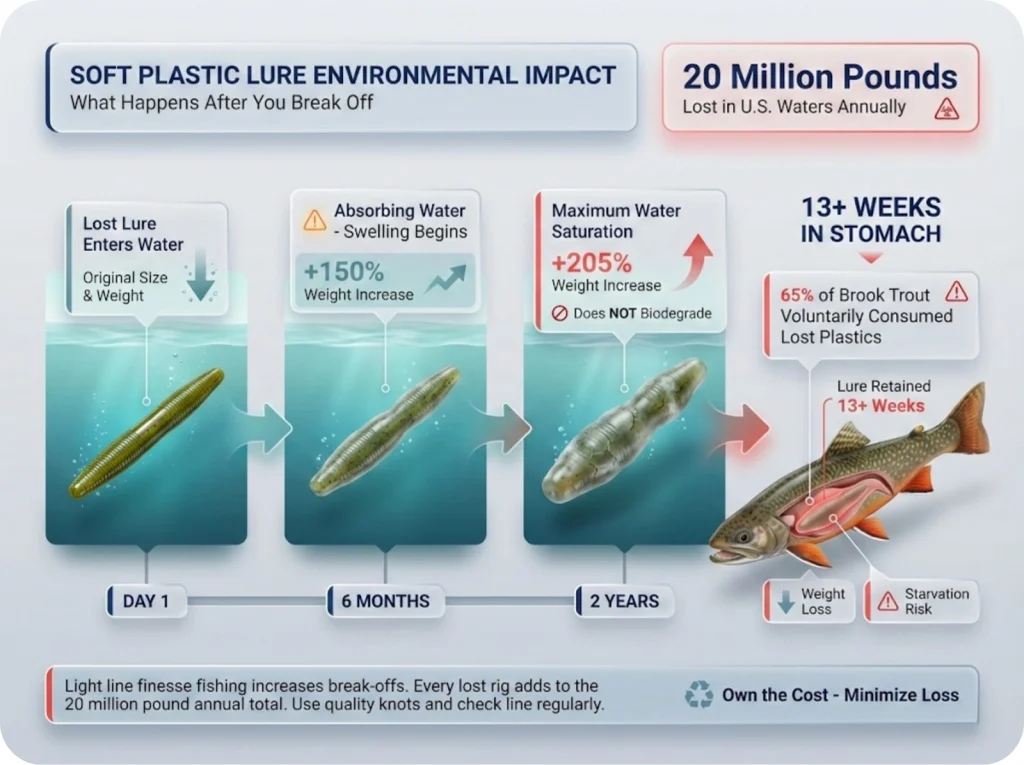
An estimated 20 million pounds of soft plastic lures enter U.S. surface waters every year. They don’t break down. A peer-reviewed study on soft plastic lure environmental impacts found that in warm water, lost plastic baits swell by 205% in weight over two years. Fish eat them—65% of brook trout voluntarily consumed lost soft plastics in lab testing, and those lures stayed in their stomachs for over 13 weeks, causing weight loss and starvation.
Light line anglers break off more frequently than power fishing anglers, period. Every snagged Ned rig or lost drop shot weight adds to that 20-million-pound number. That’s a cost we need to own.
The Gear Choices That Reduce Your Footprint
The solution starts with durability. Z-Man ElaZtech baits are roughly 10 times tougher than standard plastisol. They rarely tear off the hook, which means dramatically fewer soft plastics left in the water. Tungsten weights replace lead—which is lethal to loons and waterfowl—with a material that actually performs better. The density advantage gives you superior sensitivity in a smaller, non-toxic package. For more on why lead tackle kills wildlife and what to use instead, the data on waterfowl mortality is sobering.
Every time you break off, try to retrieve the lure. If you can’t, count it as a cost to the fishery—not just your tackle budget.
Pro tip: Never pull a snagged braided line by hand. High-test braid can lacerate fingers to the bone. Wrap it around a smooth stick or cleat, or use a dedicated line retriever. Your hands are worth more than a 50-cent jig head.
Conclusion
Two hundred trips didn’t make me a finesse expert overnight. They broke me down first—snapped lines, lost fish, tangled knots on freezing mornings when my hands couldn’t feel the spool. But every failure pointed back to the same three lessons.
First, finesse fishing is a system, not a bait size. Your line, rod, reel, drag, and knot all have to talk to each other. Get one wrong and the weakest link snaps when the fish of the day loads up your rod.
Second, the physics matter more than the brand name. Understanding how line diameter affects fall rate, how refractive index controls visibility, and how cinching a dry knot destroys fluorocarbon—that knowledge catches more fish than any rod upgrade.
Third, every soft plastic you lose stays in the water. Build your finesse system around durability and responsibility. Choose ElaZtech over standard plastics. Choose tungsten over lead. The fishery you protect today feeds the trips you’ll take for the next 200.
Pick one rig from this article—whichever matches where you fish most. Spool 6-lb fluorocarbon on a spare spinning reel, set the drag at 1.5 lbs, and commit to it for five trips straight. The bites will come. And when that first stubborn, line-shy bass loads up your rod on light line, you’ll understand why I’ll never go back.
FAQ
What pound test line is best for finesse fishing?
Start with 6-lb fluorocarbon as your baseline—it handles about 80% of finesse fishing situations. Drop to 4-lb test in ultra-clear water or when targeting heavily pressured fish, and bump to 8–10 lb near abrasive structure like rocks or docks.
What is the best knot for braid to fluorocarbon leader?
The FG Knot is the strongest braid-to-fluorocarbon connection, testing at nearly 100% of rated line strength. It builds a friction ramp that distributes load without sharp bends. Wet the wraps before cinching to prevent thermal damage to the fluorocarbon leader.
What is a Ned Rig and when should I use it?
A Ned Rig pairs a small mushroom-head jig head (1/16–1/8 oz) with a buoyant soft plastic like the Z-Man Finesse TRD. Use it when bass are inactive—cold front, high-pressure days in clear water. Its subtle horizontal fall and nose-down stance trigger strikes from fish that ignore larger presentations.
Can you use spinning reels for finesse fishing?
Spinning reels are essential for finesse fishing because they handle light line (4–10 lb) without the backlash problems that plague baitcasting setups at these weights. A 2500-size reel with smooth carbon-fiber drag and minimal startup inertia is the standard.
How do I set the drag for light line fishing?
Set your drag to 20–30% of your line’s breaking strength—for 6-lb test, that’s about 1.2–1.8 lbs. Use a fish scale to calibrate. The critical test is startup smoothness: your drag should release line instantly from a dead stop, not jerk before slipping.
Risk Disclaimer: Fishing, boating, and all related outdoor activities involve inherent risks that
can lead to injury. The information provided on Master Fishing Mag is for educational and informational purposes
only. While we strive for accuracy, the information, techniques, and advice on gear and safety are not a substitute
for your own best judgment, local knowledge, and adherence to official regulations. Fishing regulations, including
seasons, size limits, and species restrictions, change frequently and vary by location. Always consult the latest
official regulations from your local fish and wildlife agency before heading out. Proper handling of hooks, knives,
and other sharp equipment is essential for safety. Furthermore, be aware of local fish consumption advisories. By
using this website, you agree that you are solely responsible for your own safety and for complying with all
applicable laws. Any reliance you place on our content is strictly at your own risk. Master Fishing Mag and its
authors will not be held liable for any injury, damage, or loss sustained in connection with the use of the
information herein.
Affiliate Disclosure: We are a participant in the Amazon Services LLC Associates Program, an
affiliate advertising program designed to provide a means for us to earn advertising fees by advertising and linking
to Amazon.com. As an Amazon Associate, we earn from qualifying purchases. We also participate in other affiliate
programs and may receive a commission on products purchased through our links, at no extra cost to you. Additional
terms are found in the terms of service.