
In this article
The barb was buried deep in my thumb, blood pooling in my palm, and the nearest clinic was three hours by boat. But that wasn’t the worst part. The worst part was the curly “pig tail” of braid still attached to my rod—the unmistakable signature of a slipped FG knot. The 40-pound redfish I’d just lost wasn’t a victim of bad luck. It was a victim of bad knot-tying. And I’d made the same mistake thousands of anglers make every season: I assumed “strong” meant “reliable.”
After twenty years of guiding on saltwater flats and freshwater rivers, I’ve learned one painful truth. Your connection is only as good as your weakest link—and that link is almost always the knot. Not the line. Not the hook. The knot.
This guide will teach you not just how to tie line-to-leader connections, but which connection to choose for your specific fishing scenario, why knots fail (and how to diagnose the failure), and the rare technical variables—like diameter ratios and friction physics—that separate bombproof connections from catastrophic break-offs.
⚡ Quick Answer: The three most reliable fishing line to leader connection methods are the FG Knot (maximum strength, slim profile for micro-guides), the Double Uni Knot (fastest to tie in tough conditions), and the Loop-to-Loop connection (modular leader exchange for fly fishing). Choose based on your fishing scenario, not just knot strength—the “strongest” knot is useless if you can’t tie it properly on a rocking boat.
The Physics of Knot Failure: Why “Strong” Doesn’t Mean “Reliable”
Let’s get one thing straight: the “100% knot” is essentially a myth. As Salt Strong puts it, “pretty much all knots will create a weak point on the line.” The goal isn’t to find a perfect knot—it’s to minimize weakness and maximize reliability for your specific situation.
Here’s what actually causes fishing knots to fail, and it’s not what most anglers think.
Friction burn is real. When you cinch a knot without wetting it first, the rapid friction generates heat. That heat chemically alters and weakens monofilament and fluorocarbon at the molecular level. This isn’t superstition—it’s thermodynamics. Spit on your line. Every single time.
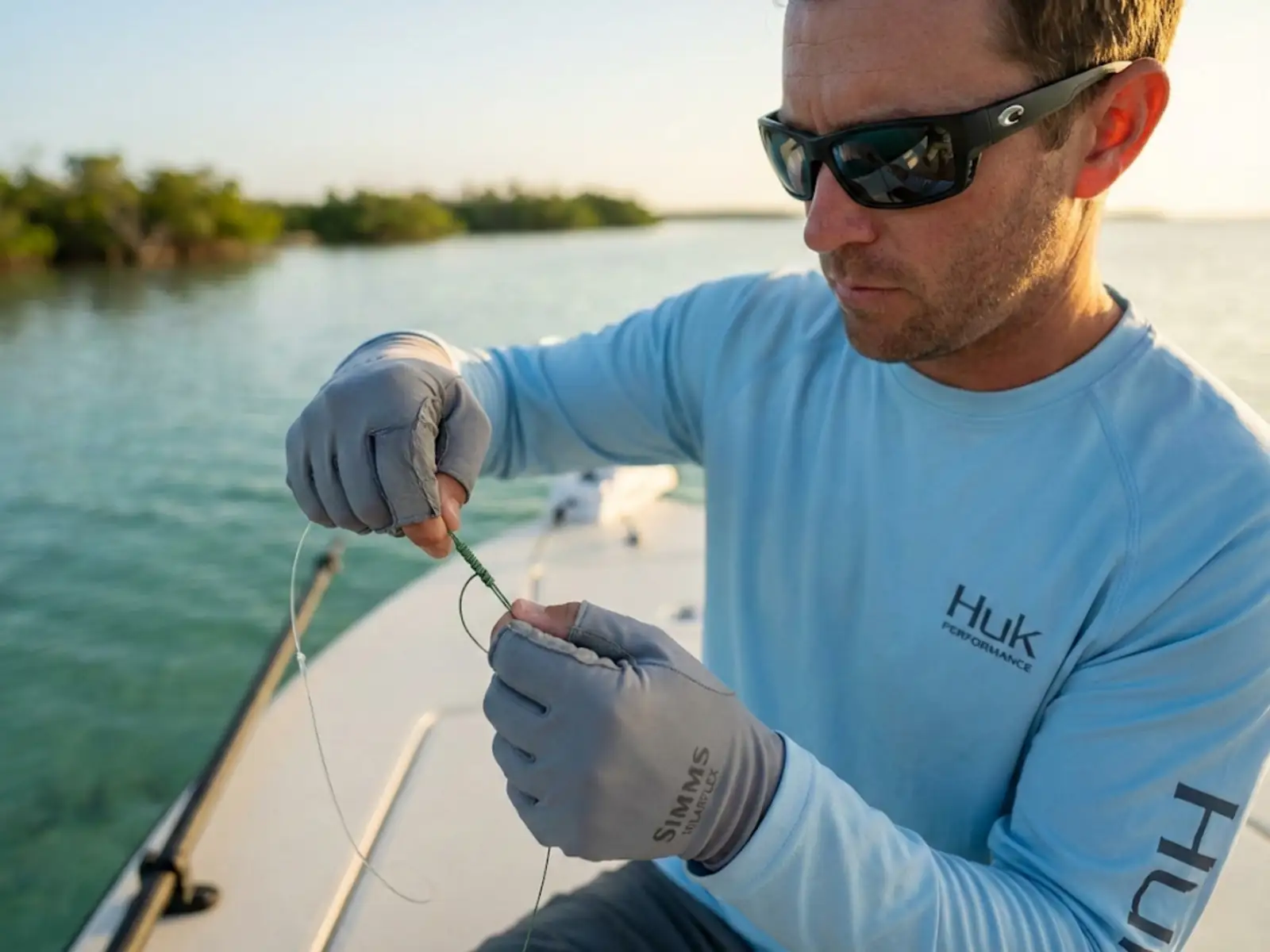
Seating the knot is the critical phase. Applying steady, heavy tension to all strands simultaneously forces the line coils to nest properly. Skip this step, and you’ll leave microscopic gaps that allow the knot to slip under the sudden shock load of a strike. When properly seated, braided fishing line should turn translucent or darker—that color change is your visual confirmation that the coils are biting.
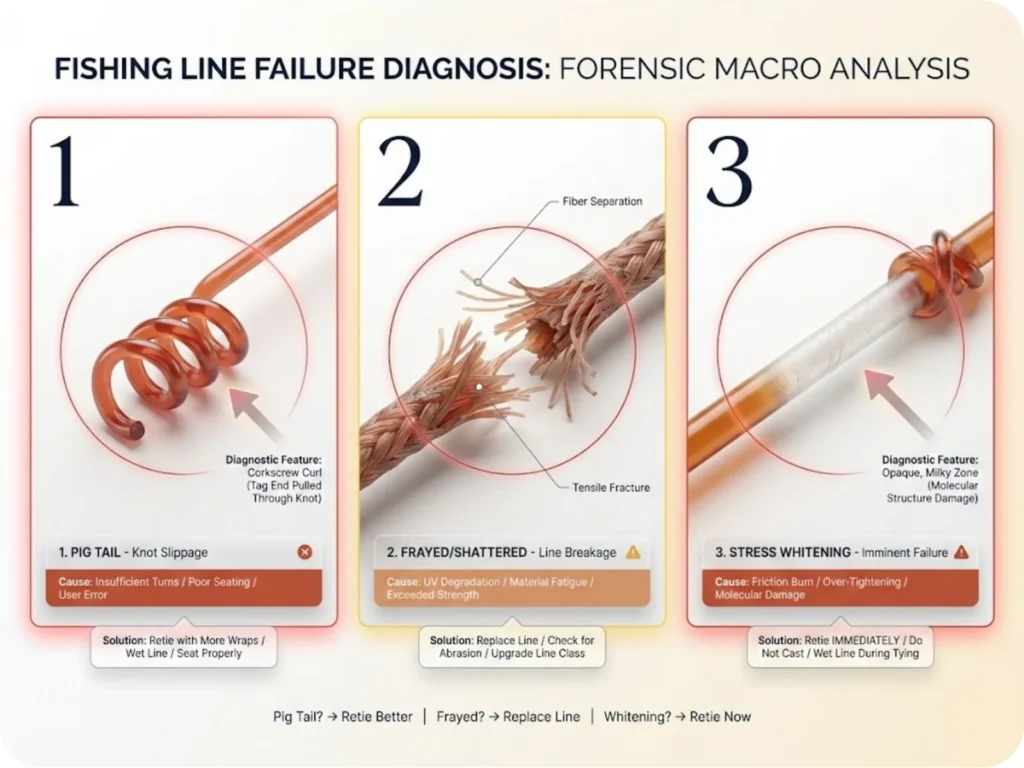
Pro tip: If you see any fraying near the knot or if the line looks opaque or milky (stress whitening), retie immediately. Do not risk the “one more cast” syndrome.
How to Diagnose Knot Failure: The Forensics Guide
Most anglers curse their luck when a fish breaks off. Smart anglers examine the evidence.
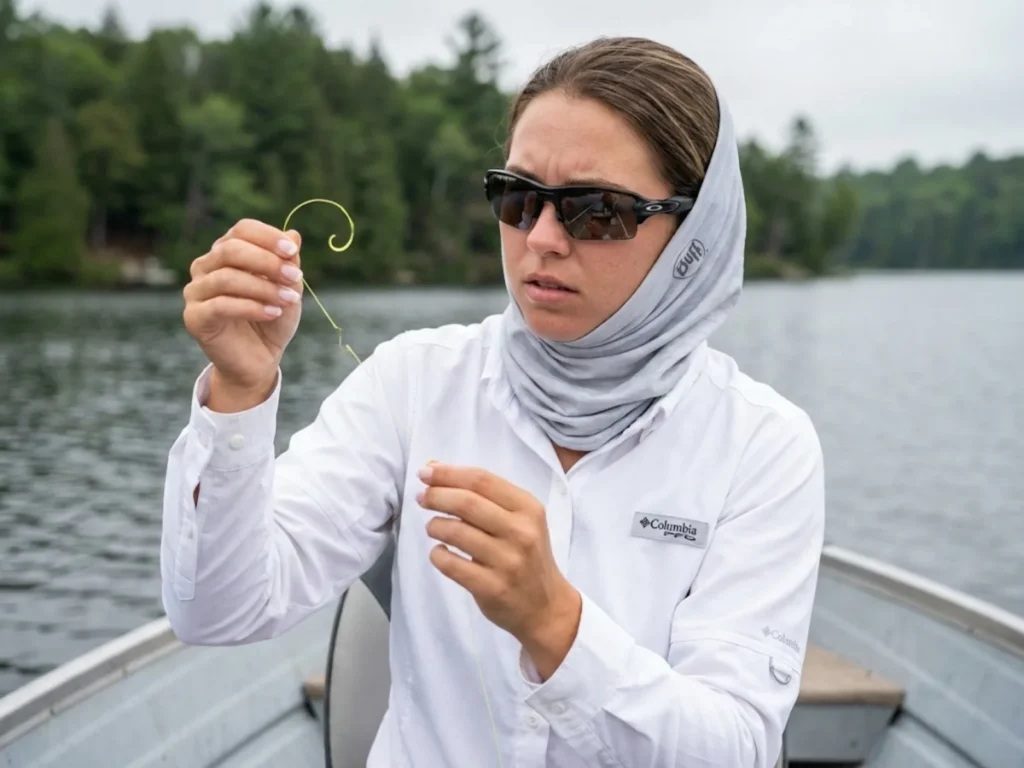
A “pig tail”—that curly, corkscrew shape at the end of your broken line—proves the knot slipped. The tag end pulled back through the knot structure due to insufficient turns, lack of tension during tying, or improper seating. This is user error, not bad luck.
A frayed or shattered end indicates the line broke under tensile stress. The knot held, but the line failed. This could be UV degradation, fishing line memory and material fatigue, or simply exceeding the line’s rated strength.
The difference matters. One means retie better. The other means replace your line.
The Diameter Ratio Nobody Talks About
Here’s a secret that most tutorials miss completely: the FG knot fails when braid-to-leader diameters are too similar. This isn’t about tying technique—it’s physics.
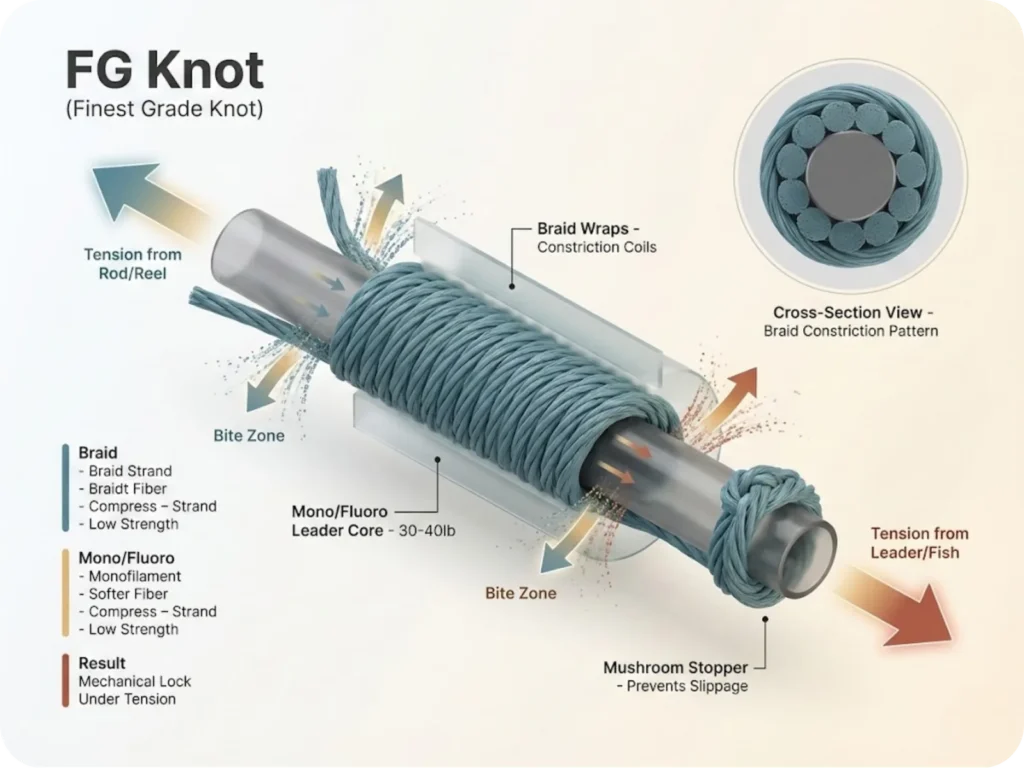
The FG relies on a Chinese finger trap mechanism. The braided coils need to contract and bite into a thicker leader material surface. If the leader is too thin relative to the braid, there’s nothing to grip. The knot will slip every time, no matter how perfectly you tie it.
The rule is simple: leader diameter must be greater than braid diameter. If you’re using 30lb braid with 8lb leader, the FG will fail. That’s too thin for the friction mechanism to work.
The Only 3 Connections You Need (And When to Use Each)
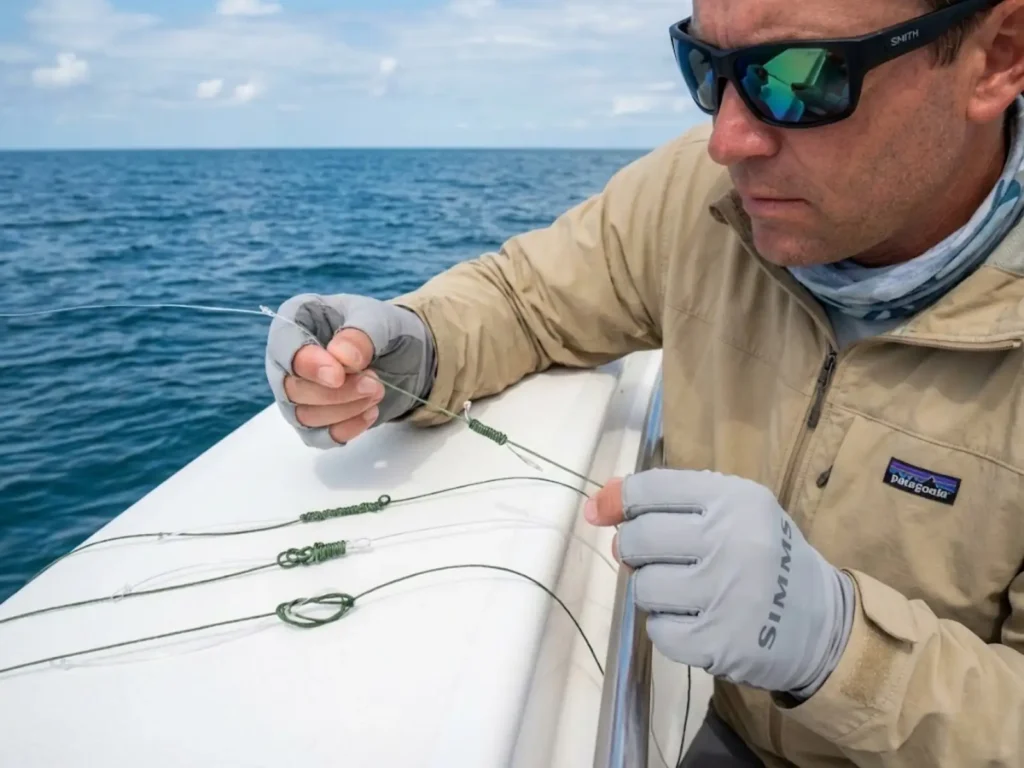
Instead of drowning you in a dozen line-to-leader knots, let’s focus on a system. Three connections will cover 99% of your fishing applications. The key is knowing when to use each one.
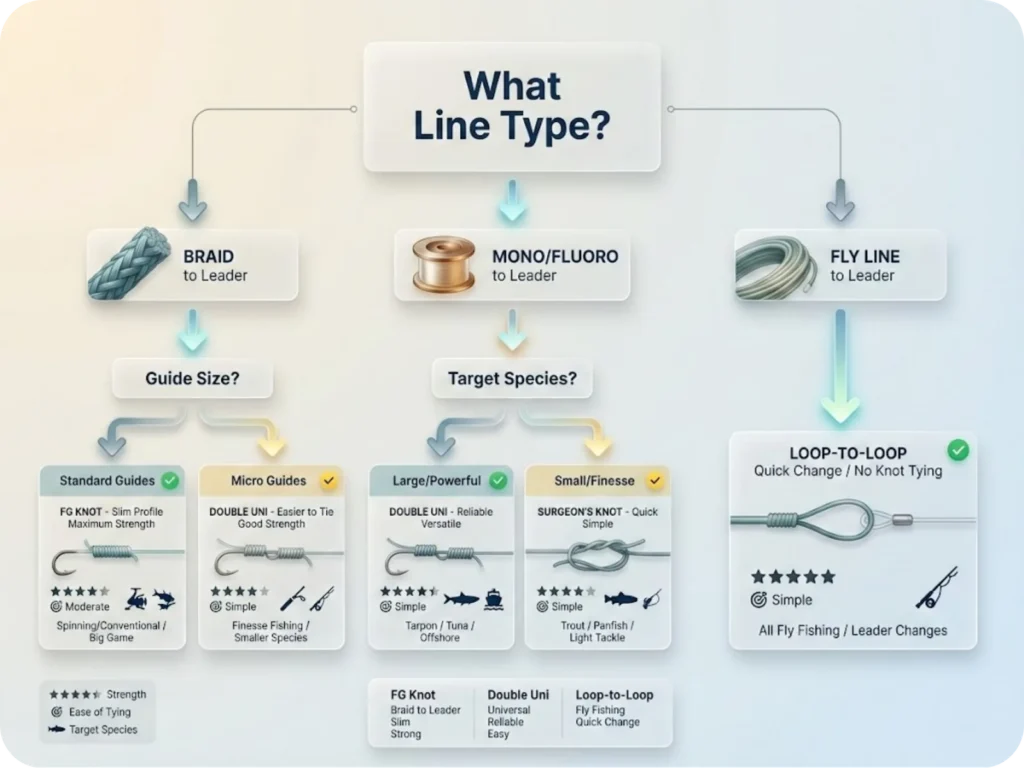
Connection #1: The FG Knot (Maximum Strength, Micro-Guide Compatible)
The FG Knot is the gold standard for braid-to-leader connections. Salt Strong testing showed it averaged 18.37 lbs breaking strength on 10lb braid—compared to just 10.09 lbs for the GT Knot. That’s nearly double the reliability.
But strength isn’t the only advantage. The FG creates an incredibly slim profile that passes through rod guides without catching or damaging ceramic inserts. If you’re using a bass rod, inshore spinning setup, or anything with small guides, this is your knot.
When to use the FG:
- Long leaders that must reel inside the rod tip (surf fishing, kayak fishing)
- Micro-guide rods where bulky knots cause problems
- Any heavy-cover fishing scenario where maximum strength is non-negotiable
When NOT to use the FG:
- Cold weather when your fingers are numb
- Rocking boat conditions during big game fishing
- When you need to tie quickly in low light
- When the leader diameter is too close to the braid diameter
The critical detail: 16 to 20 wraps (cross-overs) is optimal. Fewer wraps increase slippage risk. Significantly more wraps add bulk without meaningful strength gains.
Pro tip: Mushroom the tag end of your mono leader with a lighter before finishing the FG knot. It acts as a physical stopper so the braid can’t slide off.
Connection #2: The Double Uni Knot (Speed Over Strength)
The Double Uni Knot is the workhorse connection for anglers who value reliability and speed over maximum strength. It retains 67-80% of line strength—less than the FG—but it’s the knot you can tie with cold hands, in the dark, or on a rocking boat.
As charter captain Ryan Moody puts it: “Strength isn’t everything… speed is the most critical factor.” When a fish breaks you off and there’s a feeding frenzy happening, you need a strong short-leader connection you can tie in under 60 seconds.
When to use the Double Uni:
- Cold-weather fishing when fingers are numb
- Night fishing when visibility is poor
- Quick leader changes on the water
- Beginners learning fishing knots fundamentals
- Any situation where you need a reliable connection fast
When NOT to use the Double Uni:
- Micro-guide rods (too bulky, will catch and cause damage)
- Long leaders that enter the reel spool
- Trophy fish scenarios where maximum strength is critical
The trick is balancing the wraps: 8 wraps on the braid side and only 5 on the mono side. This accounts for braid’s thinner diameter and keeps the finished knot compact.
Pro tip: For the Double Uni, use 8 wraps on the braid side and only 5 on the mono side. This balances the knot bulk since braid is thinner.
Connection #3: Loop-to-Loop (Modular Leader System for Fly Fishing)
The Loop-to-Loop connection enables the fastest leader exchanges for fly fishing. You can swap from a 9-foot 5X leader to a 12-foot 3X leader in under 30 seconds without retying—a massive advantage when conditions change quickly.
There’s a common myth that Loop-to-Loop creates a “hinge point” that ruins your casting. Research indicates this is physically caused by a drastic change in material stiffness—stiff fly line meeting limp leader—not by the connection method itself. A properly seated loop-to-loop is mechanically stable.
When to use Loop-to-Loop:
- Fly fishing with frequent leader changes
- European nymphing when combined with tippet rings
- Any situation where you need to swap leaders without retying
When NOT to use Loop-to-Loop:
- When you need the smoothest possible guide-passing ability (Nail Knot is superior)
- When targeting spooky trout in clear water (the loop creates a visible “bump”)
- When maximum casting distance is critical (the loop adds wind resistance)
Expert fly angler Devin Olsen, a Team USA competitor, takes a different approach: “I’ve seen lots of fish broken off with light tippet when a loop to loop connection has caught a guide… the first thing I do when I get a new fly line is cut the loop off straightaway.”
If you’re doing float fishing for steelhead with long leaders, consider his advice: cut the welded loop, attach a section of 20lb Amnesia mono with a Nail Knot, then add a tippet ring. It slides through the guides like butter.
Advanced Techniques: When the “Big 3” Aren’t Enough
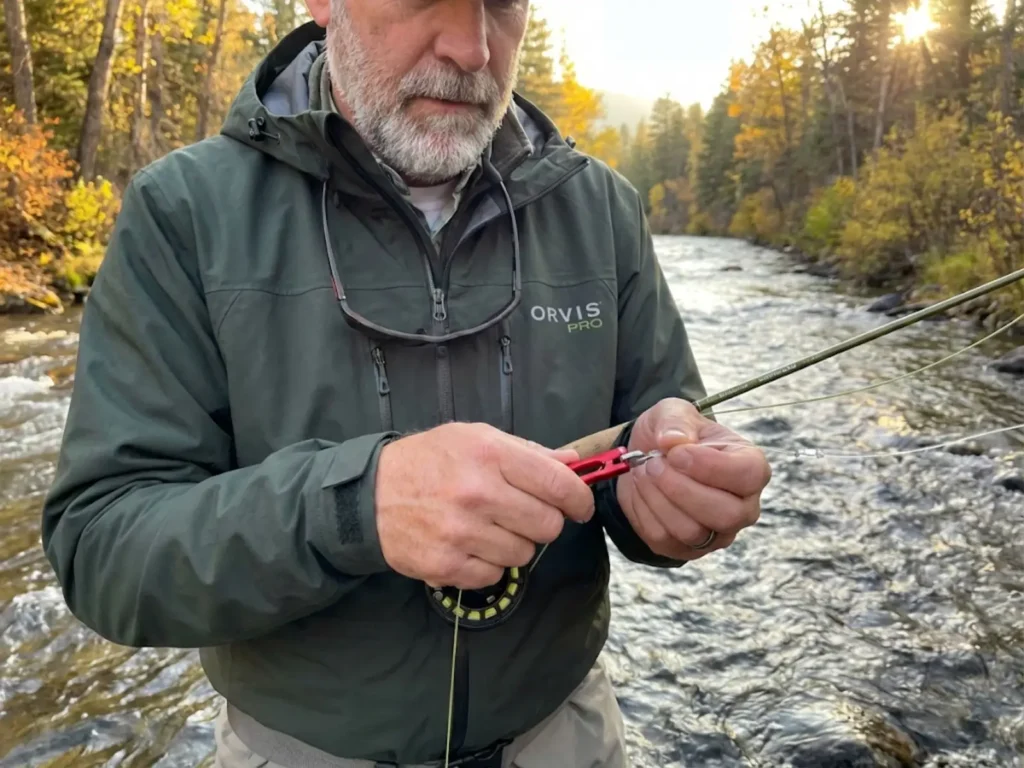
Sometimes the standard three connections don’t quite fit your fishing scenarios. Here are the specialty knots worth knowing.
The Nail Knot: Stealth Connection for Fly Lines
The Nail Knot attaches the leader directly to the fly line core, creating the smoothest possible transition through guides. It’s the gold standard for European nymphing and long-leader applications where the connection must enter the rod tip without snagging.
The challenge? It’s nearly impossible to tie with cold fingers. That’s why most guides carry a “cheater” tool—the Tie-Fast nail knot tool has reportedly been used “17,000 times a day” by guides who value consistency over machismo.
The Alberto Knot: When You Need the Albright’s Strength, Improved
The Alberto Knot (also known as the “Crazy Alberto” after its creator, Alberto Knie) improves on the standard Albright Knot by adding a locking sequence: 7 wraps down the loop, then 7 wraps back up. This prevents slippage under heavy loads.
It’s bulkier than the FG but easier to tie in rough conditions during saltwater fishing or big game fishing. Think of it as the middle ground between the FG’s strength and the Double Uni’s simplicity. Salt Strong testing shows it outperforms the standard Albright in break strength.
The Bimini Twist: Shock Leader for Big-Game Fishing
The Bimini Twist creates a doubled section of line that acts as a shock leader—absorbing the high-impact stress of casting heavy lures or the explosive strike of a powerful fish during game fishing. This is critical for kite-fishing, popping for giant trevally, or any scenario with extreme shock loads.
Fair warning: it takes 2-3 minutes to tie and requires practice to master. Ryan Moody claims he can tie one blindfolded after 35 years as a charter captain. You don’t need that level of skill, but don’t try learning this knot on a moving boat.
Common Mistakes That Cost You Fish (And How to Fix Them)
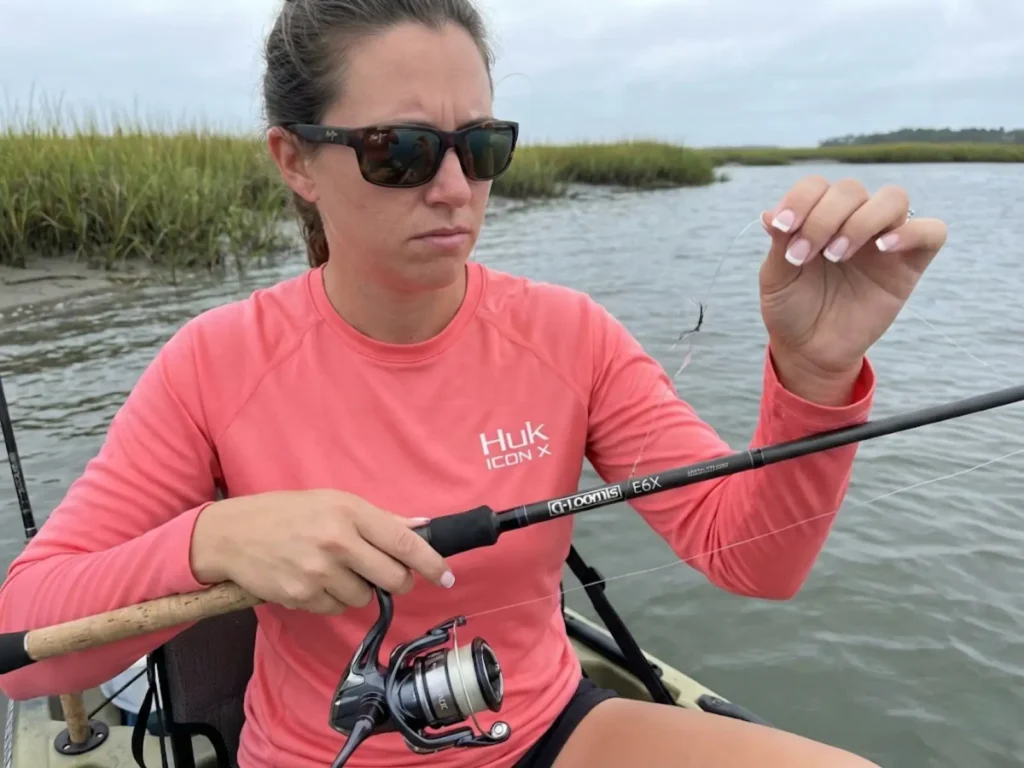
Let’s diagnose the most common failures I see on the water with line/leader connections.
Mistake #1: Not wetting the knot. “My fluorocarbon broke while tying.” That’s friction burn. You didn’t lubricate it before cinching. The polymer structure is permanently compromised before the first cast.
Mistake #2: Insufficient seating tension. “My FG knot slips immediately.” You’re not tightening the braid coils hard enough to change their color. They should turn translucent or darker. If they still look bright, keep pulling.
Mistake #3: Wrong diameter ratio. “My FG knot keeps slipping even when I tie it perfectly.” The leader length and diameter are wrong relative to the braid. The Chinese finger trap can’t grip. Use a thicker leader.
Mistake #4: Leaving tag ends too long. “The Double Uni catches in my guides.” Trim those tags flush. Long tag ends are snag magnets.
Mistake #5: Skipping the mushroom stopper. “The knot unraveled after a few casts.” On the FG, melting the mono tag end creates a physical bulb that prevents catastrophic pull-through. Don’t skip this step.
The worst feeling in fishing isn’t losing a fish—it’s reeling in a perfectly curled “pig tail” and knowing you could have prevented it. Just as proper fish handling techniques protect the fish, proper knot-tying protects your connection.
The Cold-Weather Knot Problem (And the Simple Solution)
Here’s a perspective most tutorials ignore: cold weather makes friction knots like the FG nearly impossible to tie. Fluorocarbon becomes brittle. Braid becomes stiff. And your fingers? They don’t work right.
The solution is simple: carry a cheater tool, or switch to simpler connections like the Double Uni or Triple Surgeon. These can be tied with numb fingers. The FG cannot.
There’s also a gap in the outdoor content world for “best knots for stiff or shaky hands.” Most tutorials show young, dexterous fingers. If that’s not you—whether due to age, injury, or cold—tool-assisted knots are your answer. The Hook-Eze and Tie-Fast tool exist for a reason.
Pro tip: Carry a cheater tool. I use the Tie-Fast tool for nail knots because trying to tie one with freezing fingers is a recipe for disaster.
Conclusion
The difference between a trophy photo and a story about the one that got away often comes down to three things: choosing the right connection for your scenario, understanding why knots fail, and diagnosing failure modes so you can fix the problem before the next cast.
The FG Knot gives you maximum knot strength retention and a slim profile for micro-guides. The Double Uni Knot gives you speed and simplicity when conditions get rough. The Loop-to-Loop connection gives you modular flexibility for fly fishing.
The next time you tie a line-to-leader connection, don’t just follow the steps—understand the mechanics. Wet the knot. Seat it hard enough to change the braid’s color. Check the anatomy of fishing knot failure modes when something goes wrong. And if you reel in a pig tail, don’t curse your luck—analyze what failed, fix it, and get back out there.
The fish are waiting.
FAQ
What is the strongest knot for tying braid to leader?
The FG Knot is widely considered the strongest braid-to-leader connection, often retaining 100% of the main fishing line’s rated strength. However, it requires a thicker leader relative to the braid diameter for the friction mechanism to work. If the leader is too thin, the knot will slip regardless of tying technique.
Why does my FG knot keep slipping?
The most common cause is a diameter mismatch—the nylon leader material is too thin relative to the braid. The FG physically requires a thicker leader to bite into. Other causes include insufficient seating tension (the braid should change color when properly cinched) or skipping the mushroom stopper on the mono tag end.
Can I use the Double Uni Knot for micro-guide rods?
No. The Double Uni’s bulk makes it too large to pass through rod guides on micro-guide setups without catching or damaging the ceramic inserts. For micro-guide rods, use the FG Knot or Nail Knot (for fly fishing applications).
What’s the best knot for cold-weather fishing?
The Double Uni Knot or Triple Surgeon’s Knot. Friction knots like the FG are nearly impossible to tie with cold, numb fingers due to dexterity loss and material compatibility issues with stiff line. Alternatively, carry a tool-assisted knot tying device like the Tie-Fast or Hook-Eze.
Does UV resin make knots stronger?
No. UV resin coating does not increase the breaking strength of a knot. Its primary function is creating a hard shell ramp that smooths the profile slimness, reduces guide friction, and prevents structural wear from repeated casting. If resin gets inside the braid, it can actually weaken the knot by acting as a lubricant.
Risk Disclaimer: Fishing, boating, and all related outdoor activities involve inherent risks that
can lead to injury. The information provided on Master Fishing Mag is for educational and informational purposes
only. While we strive for accuracy, the information, techniques, and advice on gear and safety are not a substitute
for your own best judgment, local knowledge, and adherence to official regulations. Fishing regulations, including
seasons, size limits, and species restrictions, change frequently and vary by location. Always consult the latest
official regulations from your local fish and wildlife agency before heading out. Proper handling of hooks, knives,
and other sharp equipment is essential for safety. Furthermore, be aware of local fish consumption advisories. By
using this website, you agree that you are solely responsible for your own safety and for complying with all
applicable laws. Any reliance you place on our content is strictly at your own risk. Master Fishing Mag and its
authors will not be held liable for any injury, damage, or loss sustained in connection with the use of the
information herein.
Affiliate Disclosure: We are a participant in the Amazon Services LLC Associates Program, an
affiliate advertising program designed to provide a means for us to earn advertising fees by advertising and linking
to Amazon.com. As an Amazon Associate, we earn from qualifying purchases. We also participate in other affiliate
programs and may receive a commission on products purchased through our links, at no extra cost to you. Additional
terms are found in the terms of service.