
In this article
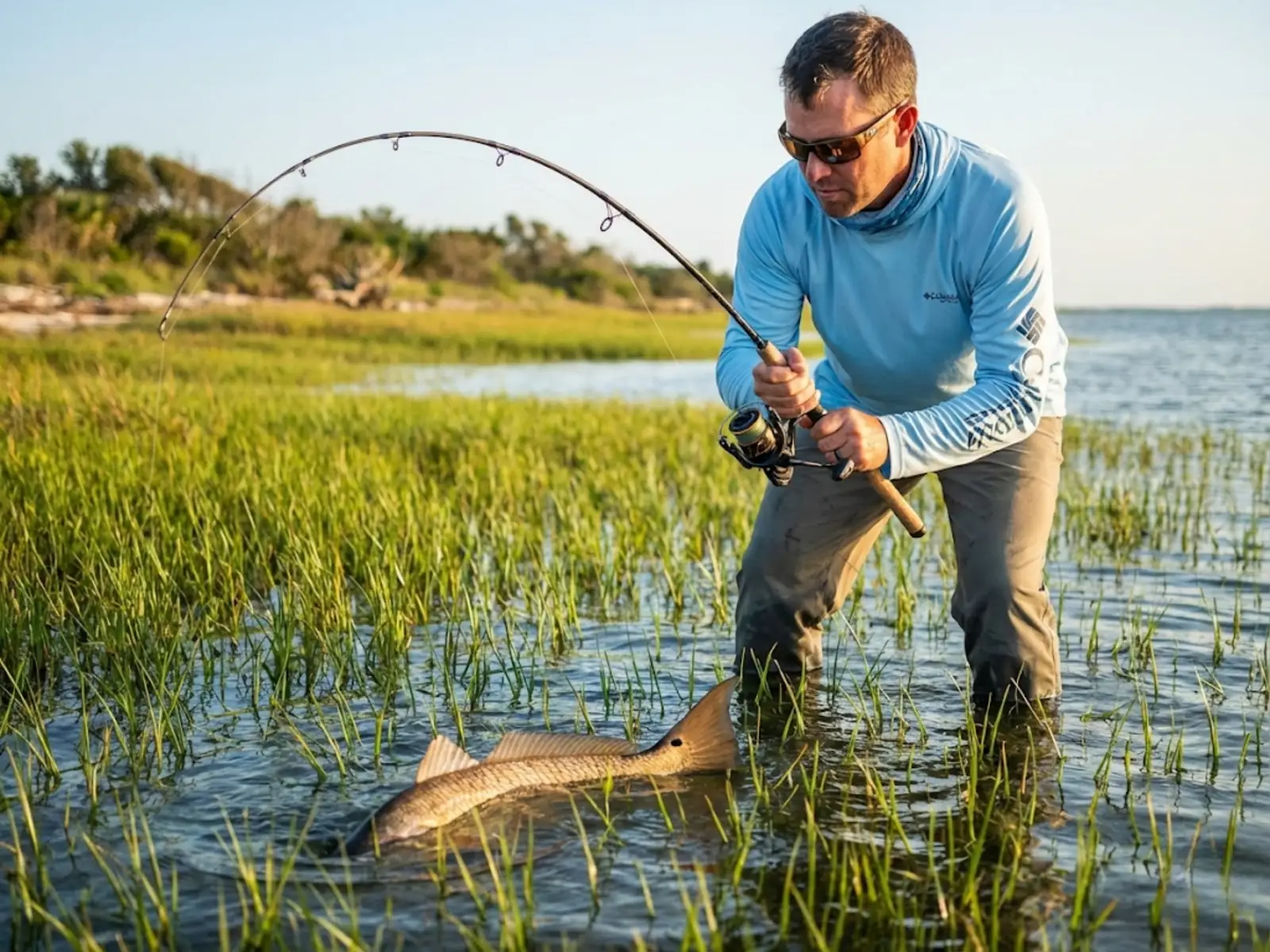
The gold spoon wobbled three feet above the grass canopy, then I stopped reeling. As it fluttered down into that green maze, a bronze shadow materialized from nowhere—tail up, head buried in the sand—completely oblivious to everything except the crab it was rooting for. That’s when I finally understood. Thick turtle grass isn’t an obstacle. It’s the entire reason the fish are there.
After fifteen years chasing redfish across Gulf Coast flats, I’ve learned that the anglers who catch consistently aren’t the ones avoiding vegetation. They’re the ones who’ve figured out how to work it. This guide covers the specific gear configurations, retrieval techniques, and biological understanding you need to catch redfish where they actually live—in the thick stuff that sends most anglers running to open water.
⚡ Quick Answer: The most effective approach for catching redfish in thick turtle grass combines a gold weedless spoon (Johnson Silver Minnow, 1/4 to 1/2 oz) with a medium-heavy rod, 20-30lb braided line, and a wobble-and-drop retrieve that mimics crustacean movement. For extremely dense grass, switch to a Texas-rigged ElaZtech soft plastic on a screw-lock weighted hook. Both rigs work because they’re mechanically designed to shed vegetation rather than snag it.
The Biological Fortress: Why Redfish Choose Thick Turtle Grass
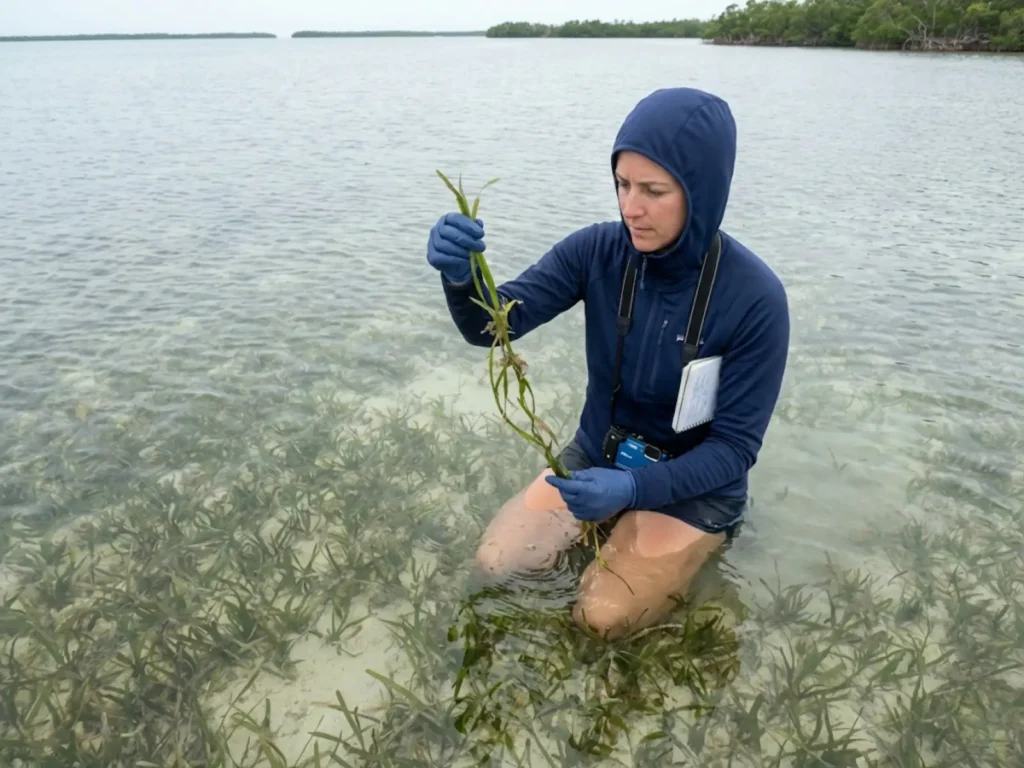
Turtle grass (Thalassia testudinum) is the heavyweight of Gulf seagrass. Unlike the thin, wire-like shoal grass or cylindrical manatee grass, turtle grass has broad, flat blades that form a dense canopy—exactly the kind of structure that fouls standard tackle within seconds.
But that dense structure is precisely what draws redfish into these areas. The thick vegetation serves two purposes for them: an unlimited supply of prey and protection from predators that can’t follow them in.
The prey buffet hiding in turtle grass meadows includes blue crabs, mud crabs, and arrow shrimp—all species that have adapted to this specific habitat. Arrow shrimp are particularly interesting. They align their bodies vertically with the grass blades and can actually change color to match the surrounding vegetation. Redfish can’t see them, but they can feel and smell them.
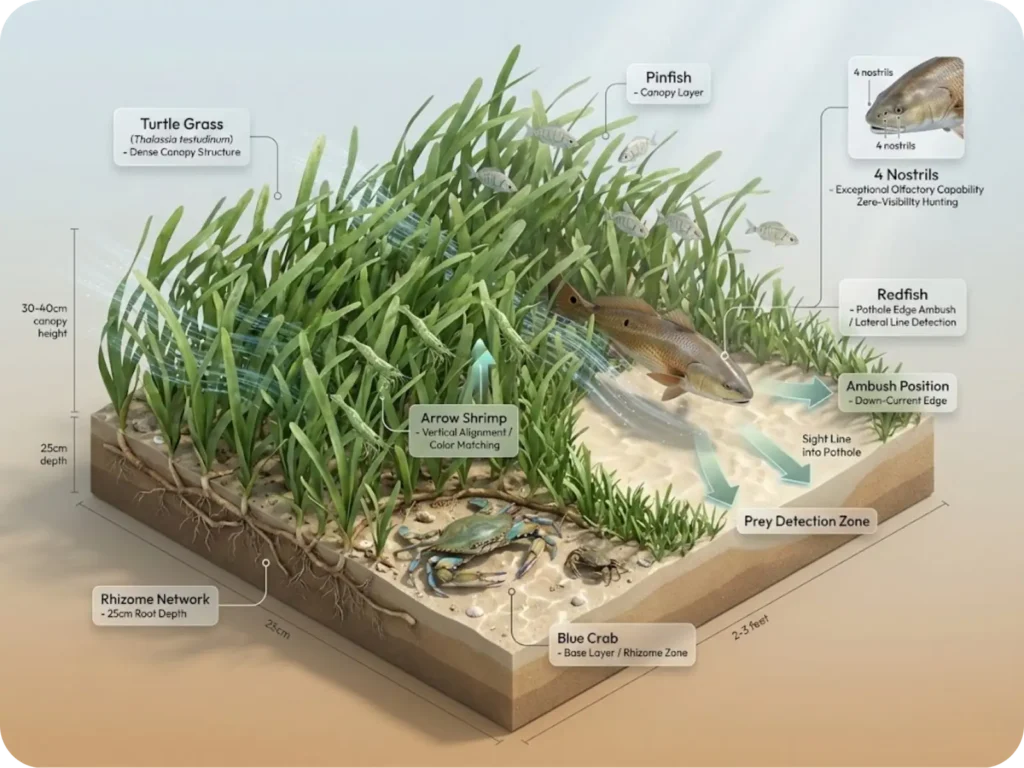
This gets to a point most anglers miss: in thick grass, redfish aren’t hunting with their eyes. The canopy blocks sight lines beyond a few feet. Instead, they rely on their lateral line system to detect pressure waves from prey movement, combined with an exceptional sense of smell. A redfish has four nostrils—two on each side of its snout—giving it impressive olfactory capability even in zero-visibility conditions.
Pro tip: When you see “potholes” (sandy clearings in the grass), focus on the down-current edge. Redfish position themselves in the grass watching the open sand—a bait dropping into that pothole lands right on their dinner table.
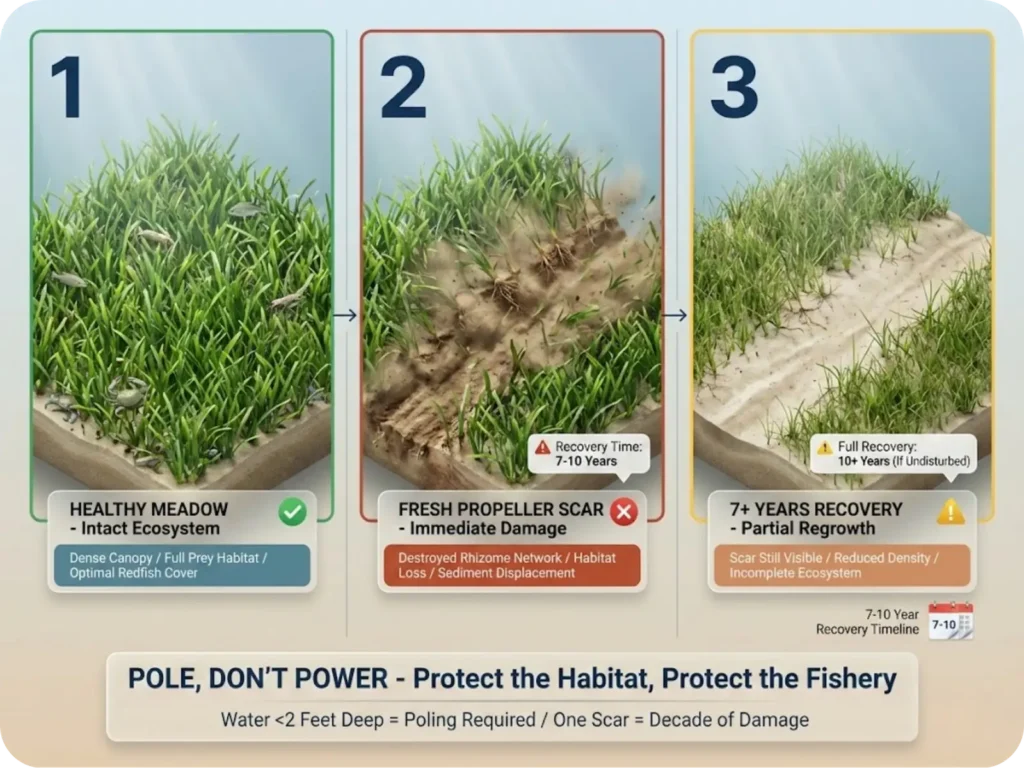
The conservation angle matters here too. Propeller scars in turtle grass take 7-10 years to heal. If you’re targeting these grass flat ecosystems, you’re obligated to pole rather than power through water less than two feet deep. Damage the habitat and you damage the fishery.
The “Only Way” Gear System: Mechanical Solutions to Biological Problems
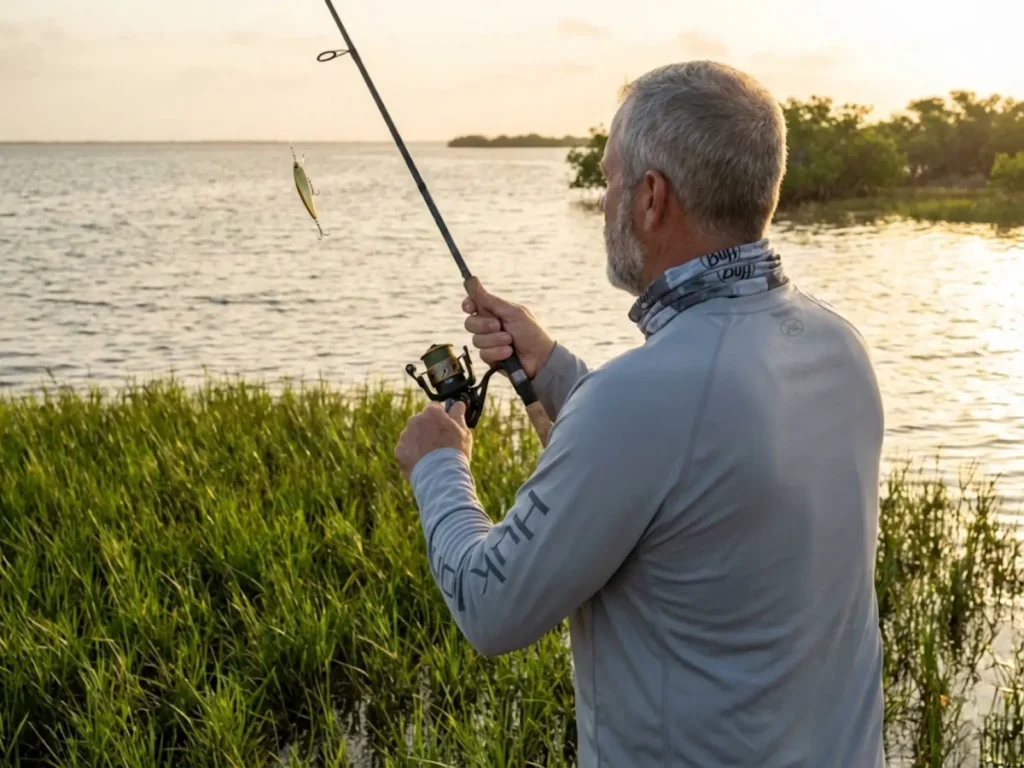
Standard tackle fails in turtle grass for a simple reason: physics. Those broad, flat blades create enormous surface area that wraps around treble hooks, j-hooks, and exposed barbs the instant they contact vegetation. The solution isn’t fighting the grass—it’s designing around it.
The Gold Weedless Spoon
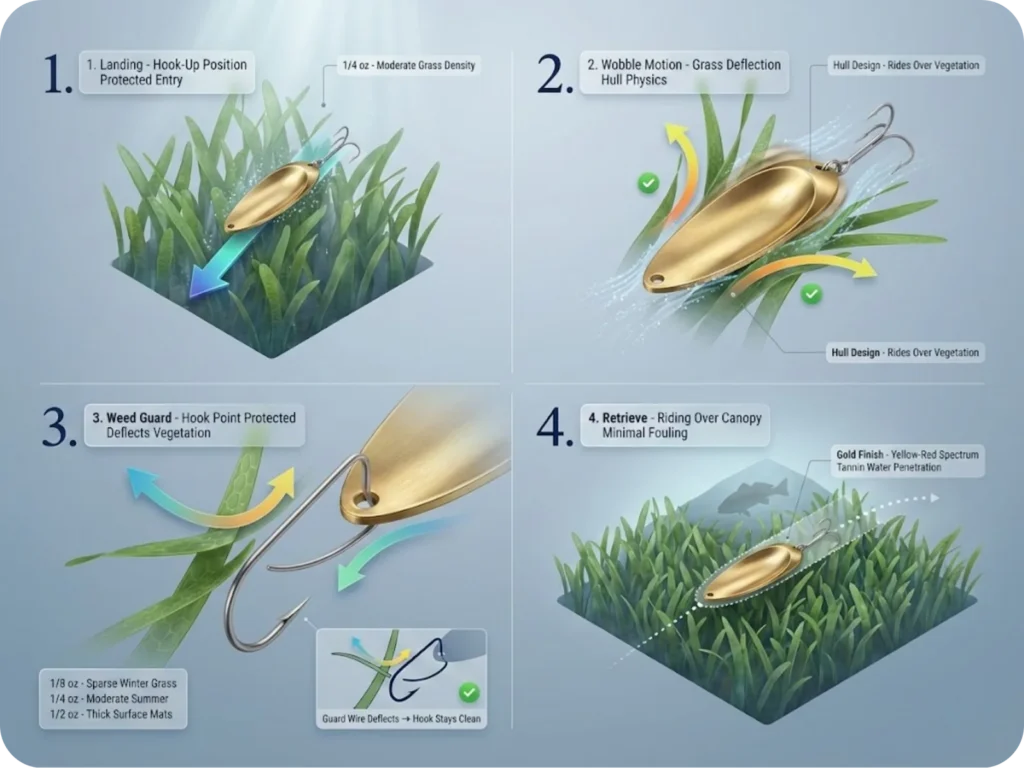
The Johnson Silver Minnow in gold (1/4 to 1/2 oz) remains the most effective lure for this environment because of its mechanical design. The spoon body acts like a boat hull, riding over grass blades rather than plowing through them. The single inline hook sits protected behind a metal weed guard that deflects vegetation before it can snag.
Weight selection depends on grass density. Use 1/8 oz for sparse winter grass, 1/4 oz for moderate summer conditions, and 1/2 oz when you need to punch through thick surface mats. Gold outperforms silver in these tannin-stained waters because it reflects light in the yellow-red spectrum, which penetrates murky water better than blue-white silver reflections.
If you want to improve hookup ratios and fish survival rates, consider replacing the factory treble with a single inline hook. It reduces grass fouling by roughly half and makes hook removal faster, reducing handling time for caught fish.
The Texas-Rigged Soft Plastic
When grass gets so thick that even a spoon fouls every few casts, or when fish are lethargic after a cold front, the Texas rig becomes mandatory. But the configuration matters.
Use a 3/0 or 4/0 wide gap worm hook with a screw-lock keeper (Owner Twistlock or Z-Man HeadlockZ). That screw secures the plastic’s nose, preventing it from sliding down the shank when you drag the rig through heavy vegetation. Standard Texas rigs fail in thick grass because the bait slides and exposes the hook point.
Your weight needs to be tungsten, not lead—tungsten is denser, creating a smaller profile that slips through grass more easily. And it must be pegged against the hook eye with a bobber stop. An unpegged weight separates from the bait, causing your line to loop over grass blades and creating tangles.
For the plastic itself, ElaZtech materials (Z-Man DieZel MinnowZ, Scented PaddlerZ) outperform standard PVC for two reasons. First, they’re roughly ten times more durable—they won’t tear apart after being ripped through saw-grass repeatedly. Second, ElaZtech floats. When your weighted hook rests on bottom, the plastic tail floats upward, mimicking a crab’s defensive posture or a feeding shrimp.
Pro tip: If you’re getting bites but missing hooksets, check your hook point. Turtle grass is abrasive (high silica content). Sharpen your hooks every 10-15 casts or swap in fresh ones. A dull hook won’t penetrate a redfish’s tough mouth.
Rod, Reel, and Line Configuration
The delivery system matters as much as the lure. A medium power rod is too soft for this work. Once a redfish dives into the rhizome mat after being hooked, you need the backbone of a medium-heavy rod to physically turn the fish’s head before it tangles. This isn’t about casting distance—it’s about extraction force.
Pair that with a fast action (tip-flex) rod for instant hookset power. Weedless rigs require force to drive the hook point through the plastic and into the fish’s jaw. A slow-action rod absorbs that energy instead of transferring it.
Your main line should be 20-30lb braided (PowerPro, Daiwa J-Braid). Braid offers zero stretch for instant hooksets, and its textured surface actually cuts through grass stems during the fight. Attach a 3-4 foot fluorocarbon leader (25-30lb) for abrasion resistance against oyster shells hidden in the grass and the sandpaper-like mouth of a redfish.
Understanding how rod power and action affect lure presentation will help you match tackle to conditions. But the basic formula for thick grass holds: medium-heavy power, fast action, braided main line.
Tactical Execution: Techniques That Trigger Strikes
Having the right gear means nothing if you can’t animate it properly. Redfish in thick vegetation are ambush predators, not chasers. Your presentation needs to mimic the prey they’re actually hunting.
The Retrieval Cadence
For spoons, use the “wobble and drop” pattern. Cast, then reel immediately to keep the spoon above the grass canopy. Every 3-4 turns of the handle, stop reeling. Let the spoon flutter down for 1-2 seconds. This drop is when most strikes happen—it mimics a crab settling back to the bottom or a wounded baitfish losing momentum.
When your spoon snags grass (the vibration stops), don’t slow down. Snap the rod tip sharply upward to rip it free. That sudden burst of speed, combined with the debris cloud, often triggers reaction strikes from fish that were following but hadn’t committed.
For Texas rigs, the pattern shifts to “hop-pause-settle.” After the rig hits bottom, hop it once with a sharp rod twitch. Pause for 3-5 seconds. Let it settle. Repeat. The pause is critical—give ambush predators time to locate and commit.
In cold water or post-frontal conditions when fish won’t chase, slow down further. Drag the rig along the bottom at about 6 inches per second. The scent trail builds, and that slow movement mimics a crab crawling rather than fleeing.
Pro tip: If you’re getting short strikes—fish bumping the lure without hooking up—slow your retrieve by half. The fish is interested but suspicious. A “crab” that’s escaping too fast triggers caution. One that’s “injured” triggers aggression.
Stealth and Approach
Sight fishing in thick grass requires getting close without spooking your targets. Trolling motors, even electric ones, create prop noise that transmits through shallow water. Redfish in 1-3 feet of water will spook from motor noise 50+ yards away.
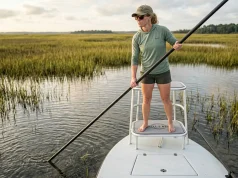
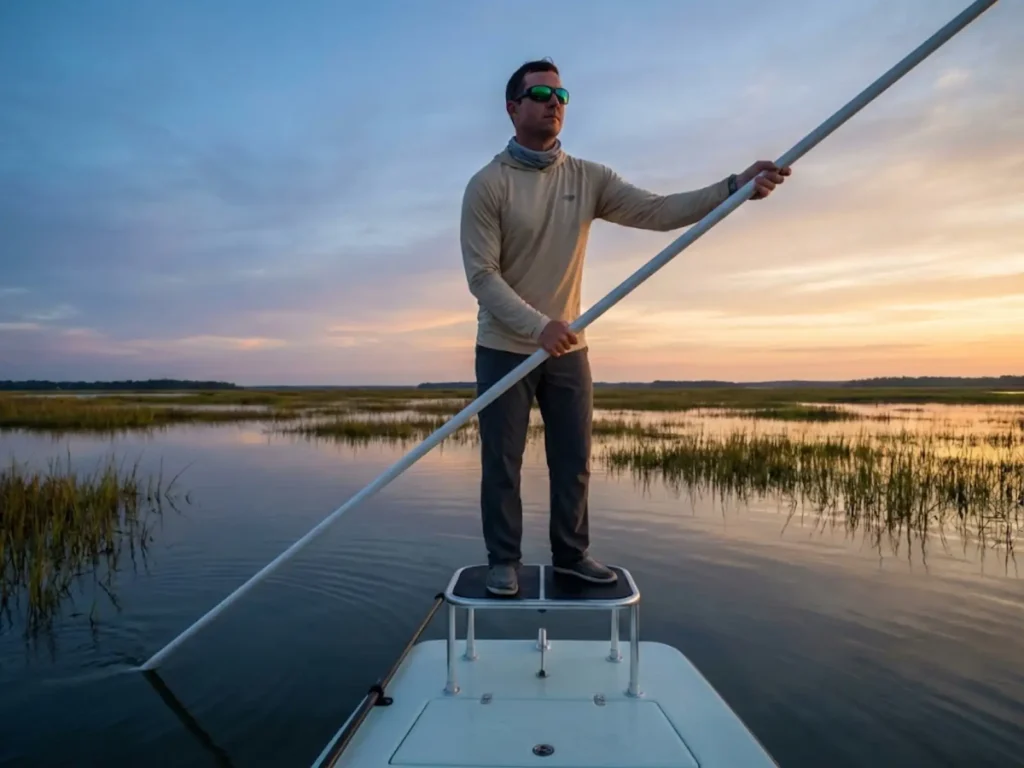
Pole or wade. A push pole is silent and prevents propeller damage to seagrass. If you’re wading, move slowly and avoid dragging your feet. Every step you take sends vibrations through the flat.
Use wind to your advantage. Wind creates “false tides”—water movement independent of lunar tides—that masks your approach noise and positions fish predictably. Fish face into the current, waiting for prey to drift to them. Cast up-current and let your lure drift into the strike zone naturally.
Polarized sunglasses aren’t optional for this work. Copper or rose lenses for dirty water (cuts glare, enhances contrast). Gray or blue for clear water. Without them, you’re fishing blind—you can’t spot tailing fish, potholes, or grass edges.
The best fishing happens on the incoming flood tide, particularly the first two hours. As water rises, redfish push out of deeper channels onto the grass flats to hunt. They’ll push as shallow as their bodies allow, often with their backs exposed.
Size-Class and Seasonal Adjustments
Understanding the difference between juvenile “rat reds” (under 20 inches) and adult “bull reds” (over 30 inches) changes your approach.
Rats stay in seagrass year-round for protection. They school in packs and compete aggressively for food. Faster retrieves often trigger the whole school. Use smaller lures—1/4 oz spoons, 3-inch plastics.
Bulls are transient visitors. They push onto the flats during high water to hunt large blue crabs, then leave before getting stranded. They’re spookier and require slower, more deliberate presentations. Target them during the last hour of incoming and first hour of outgoing tide. Use larger lures—1/2 oz spoons, 5-inch plastics.
Seasonal grass biomass also matters. Turtle grass peaks May through September, creating the thickest conditions. Heavier weights and aggressive ripping techniques work best. In winter, the grass thins, water clears, and fish metabolism slows. Lighter spoons (1/8 oz) and longer pauses between movements become more effective.
Conservation and Stewardship: Protecting the Habitat
The thick turtle grass that frustrates your casting is the reason these fish exist here. Protecting it isn’t optional—it’s the price of admission.
Preventing Propeller Scarring
A single propeller scar takes nearly a decade to recover. In water less than two feet deep, shut down the combustion engine. Pole, use an electric trolling motor on the lowest setting, or wade. If you run aground, lift the motor and push the boat off manually. Powering off the bottom creates blowholes that may never heal.
If you’re serious about grass flat fishing from a kayak, you eliminate propeller damage entirely while gaining access to areas boats can’t reach.
Responsible Fish Handling
Single hooks (weedless spoons, Texas rigs) significantly reduce mortality compared to trebles. They cause less tissue damage and are faster to remove, reducing air exposure.
Crushing the barb makes extraction nearly instantaneous. This matters most in summer when water temperatures exceed 80°F and oxygen levels drop. A fish handled for 30 seconds with a barbless hook survives at higher rates than one handled for two minutes with a barbed hook.
Keep air exposure under 60 seconds. Redfish are heavy-bodied—extended air exposure causes internal organ stress similar to barotrauma in deep-water fish. Have your camera ready before lifting the fish.
Never hold a redfish vertically by the jaw. Unlike bass, their skeletal structure doesn’t support vertical holds—you risk dislocating the jaw or damaging the spine. Support the fish horizontally with one hand under the belly and one gripping the lower jaw.
Conclusion
The “only way” to catch redfish in thick turtle grass isn’t a single lure or magic trick. It’s a system of mechanical adaptation—accepting the constraints of the environment and selecting tools that turn those constraints into advantages.
The gold weedless spoon functions as a hull, surfing the green waves of grass. The Texas-rigged ElaZtech plastic functions as a penetrator, punching through the canopy. Both mimic the crustacean prey that draws redfish into the shallows in the first place.
But the system only works if the habitat stays intact. Pole, don’t power. Use single hooks. Minimize handling time. The thick turtle grass that frustrates you today is the reason the fish will be there tomorrow.
Next time you’re on a grass flat with your gold spoon, try the wobble-and-drop. Count the seconds on the flutter. Watch for the hit. You’ll understand why the grass isn’t the problem—it’s the entire point.
FAQ
What is the best lure for redfish in thick turtle grass?
The gold Johnson Silver Minnow (1/4 to 1/2 oz) is most mechanically effective because its hull design rides over grass blades and the metal weed guard deflects vegetation. For extremely thick grass or lethargic fish, switch to a Texas-rigged ElaZtech soft plastic on a screw-lock weighted hook.
Why do redfish prefer turtle grass over other seagrass types?
Turtle grass forms the densest, most structurally complex meadows in the Gulf. This provides two critical resources: abundant cryptic prey (crabs, shrimp) and refuge from larger predators like bottlenose dolphins that can’t navigate the thick canopy.
How do I avoid snagging grass when retrieving a spoon?
Use the wobble-and-drop retrieve—reel 3-4 turns, then pause and let the spoon flutter down for 1-2 seconds. This keeps it in the strike zone above the grass without constant fouling. If it does snag, snap the rod tip sharply upward to rip it free rather than slowly pulling (which sets the snag deeper).
What water temperature is best for redfish on grass flats?
Redfish are most active on grass flats between 65°F and 85°F, with optimal activity in the 70-80°F range. Below 60°F, they move to deeper channels and become lethargic. Above 85°F, oxygen levels drop and activity shifts to dawn and dusk.
Should I use braid or monofilament for grass flat fishing?
Use 20-30lb braided line as your main line—it has zero stretch for instant hooksets and its textured surface cuts through grass stems during the fight. Attach a 3-4 foot fluorocarbon leader (25-30lb) for abrasion resistance against shells and the fish’s rough mouth.
Risk Disclaimer: Fishing, boating, and all related outdoor activities involve inherent risks that
can lead to injury. The information provided on Master Fishing Mag is for educational and informational purposes
only. While we strive for accuracy, the information, techniques, and advice on gear and safety are not a substitute
for your own best judgment, local knowledge, and adherence to official regulations. Fishing regulations, including
seasons, size limits, and species restrictions, change frequently and vary by location. Always consult the latest
official regulations from your local fish and wildlife agency before heading out. Proper handling of hooks, knives,
and other sharp equipment is essential for safety. Furthermore, be aware of local fish consumption advisories. By
using this website, you agree that you are solely responsible for your own safety and for complying with all
applicable laws. Any reliance you place on our content is strictly at your own risk. Master Fishing Mag and its
authors will not be held liable for any injury, damage, or loss sustained in connection with the use of the
information herein.
Affiliate Disclosure: We are a participant in the Amazon Services LLC Associates Program, an
affiliate advertising program designed to provide a means for us to earn advertising fees by advertising and linking
to Amazon.com. As an Amazon Associate, we earn from qualifying purchases. We also participate in other affiliate
programs and may receive a commission on products purchased through our links, at no extra cost to you. Additional
terms are found in the terms of service.