
In this article
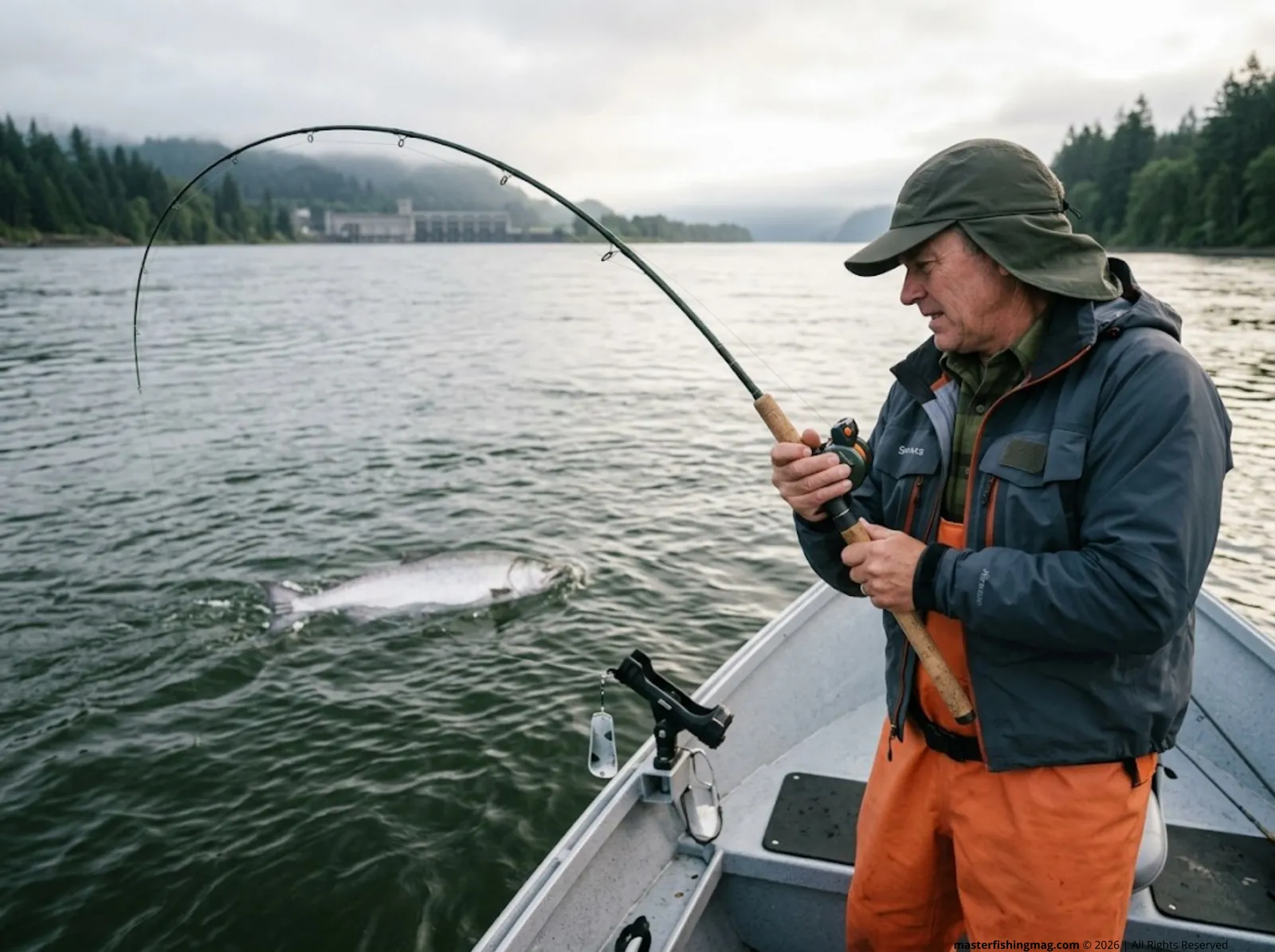
You’re anchored above Bonneville at first light. The rod tip loads, dips twice, and the line counter starts screaming backward from 35 feet. You set the hook into something heavy and angry — a spring Chinook that has been running this same river corridor since before the dams existed. In the next 90 seconds, every decision you made about leader length, flasher setup, and scent profile is about to be tested against 25 pounds of muscle and instinct. This is Columbia River salmon fishing at its most honest, and it rewards preparation over luck every single time.
I’ve spent two decades guiding the Columbia from Buoy 10 to the Hanford Reach, and the lesson I keep learning is the same one every season. The anglers who catch fish consistently aren’t the ones with the most expensive boat. They’re the ones who understand what’s happening beneath the surface — the biology, the physics, and the regulations that govern each Pacific Northwest fishing season on this massive piece of water.
This guide covers the complete system for fishing the Columbia River for salmon and steelhead: run timing by species, reading the river’s hydrodynamics, the 360 flasher revolution that changed trolling, coon shrimp curing, plunking from the bank, the full 2026 regulatory framework, and the conservation ethics that keep these runs viable for the next generation.
⚡ Quick Answer: The Columbia River’s salmon and steelhead runs follow a strict seasonal calendar. Spring Chinook peak at Bonneville Dam around May 11, fall Chinook dominate August through November, and summer steelhead enter from May through December. Success requires matching your method — trolling with 360 flashers, plunking with Spin-N-Glos, or back-bouncing — to the specific run, river section, and current conditions. All fishing operates under mark-selective fishery rules: hatchery salmon (clipped adipose fin) may be kept; wild fish must be released.
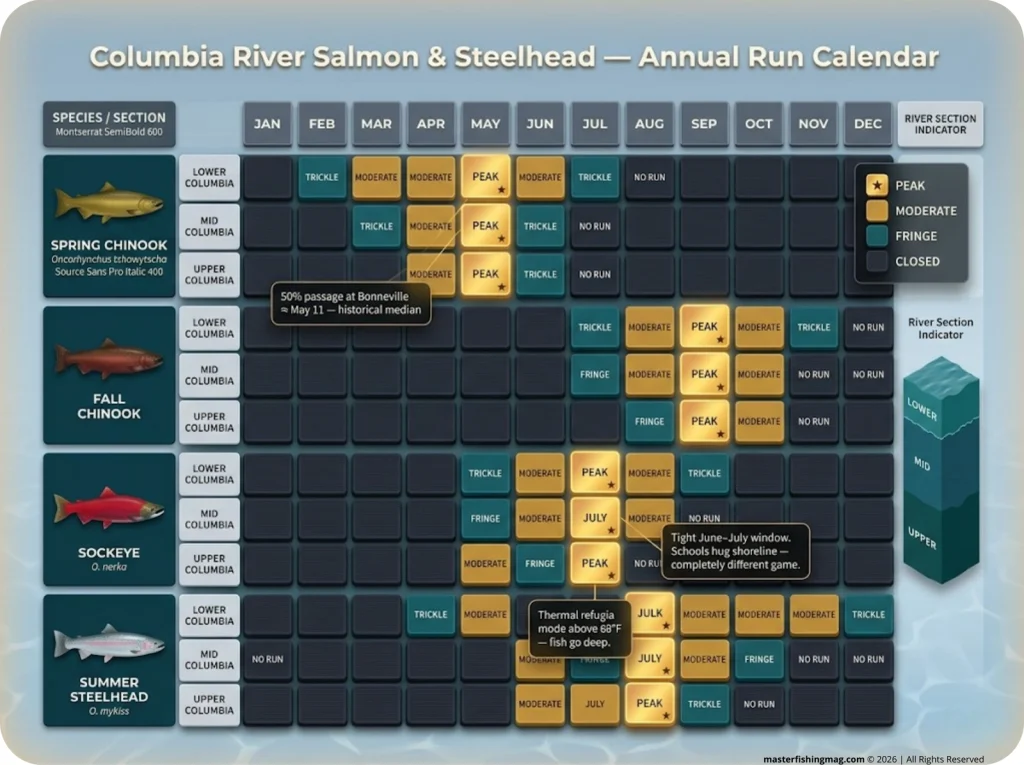
The Columbia River Run Calendar — What Moves and When
Spring Chinook — The Most Prized Run on the River
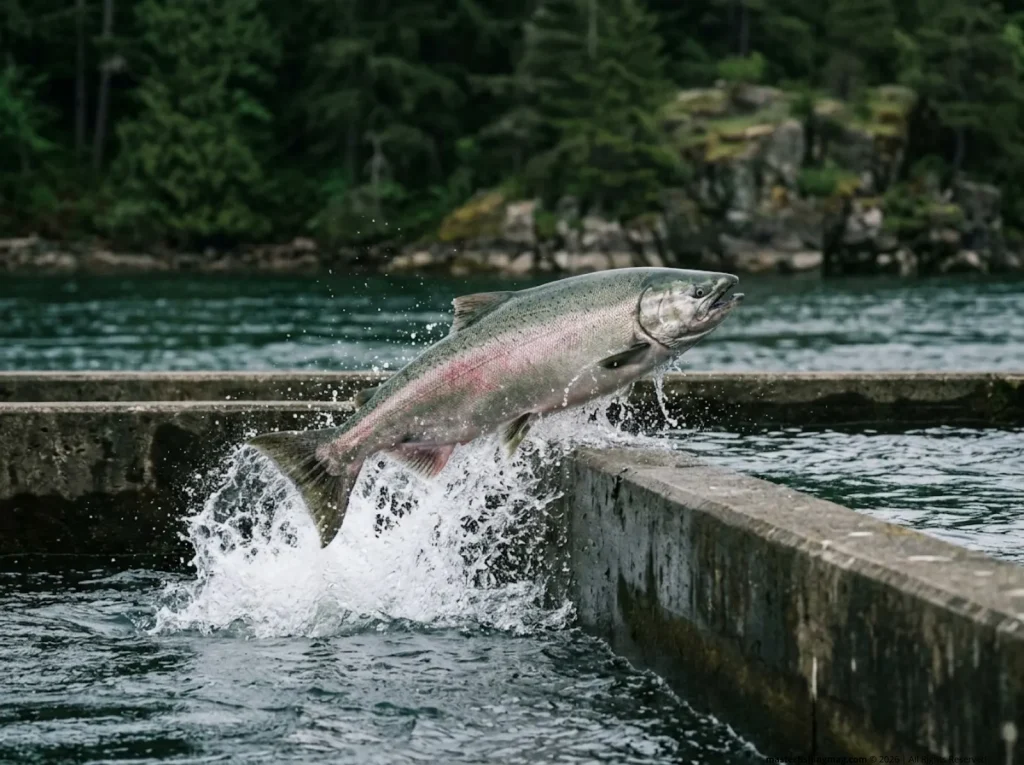
Every serious Columbia season starts with springers. Spring Chinook begin showing at Bonneville Dam in small numbers as early as February — these are the “trickle fish,” scouts running ahead of the main body. The run accelerates through March and April as water temperature climbs, and the historical 50% passage date — the moment half the run has cleared the dam — falls right around May 11.
The 2026 salmon fishing season looks solid. The preseason forecast projects 147,300 upriver spring Chinook adults, which sits above the 10-year average of 126,248 fish. That’s enough to support expanded early-season retention in the lower river.
But the window is tight. Based on a decade of Bonneville Dam passage data tracked by Columbia Basin Research, the first 5% of the run typically passes by April 26 and the 95% completion point hits by June 12. That leaves roughly six weeks of peak Columbia River fishing — and the fish don’t wait.
Pro tip: Track the dam fish counts daily on the Fish Passage Center’s DART database. When the 24-hour count jumps above 1,000 springers on two consecutive days, the bite is on. That pattern has preceded the best fishing weeks in eight of the last ten seasons.
Fall Chinook, Sockeye, and the Steelhead Overlap
Fall Chinook are a different animal. They enter the lower river in August and peak in September — bigger, more aggressive, and far more responsive to 360 degree rotation flashers than their spring cousins. These are the fish that put Buoy 10 on the map and the ones that justify a 10-foot-6 heavy-power rod.
Coho salmon overlap with the fall Chinook run in many sections, adding another anadromous fish species to the mix. They respond well to smaller spinners and Kwikfish plugs — different presentations than what works for kings.
Sockeye run a narrow June–July window, peaking in early July. They school tightly and hug the shoreline — a completely different game from the deep-water trolling that takes Chinook.
Summer steelhead are the wild card. They enter from May through December with peak numbers between July and September. These fish are acrobatic, unpredictable, and will stack in thermal refugia — deep pools or cold-water tributary mouths — when the mainstem hits 68°F. They can hold in these refugia for months.
Here’s what most guides won’t tell you: during the July–August overlap, salmon and steelhead share the same 20-to-30-foot depth band. Adjusting a salmon spread to simultaneously target steelhead — what a few locals call “transition tactics” — is the mark of an experienced Columbia angler. It’s also the biggest content gap on every other guide you’ll find. If you understand how fish metabolism shifts with water temperature, you already have the framework for reading this overlap.
Reading the River — The Physics of Where Fish Hold
Travel Lanes, Ledges, and the Energy-Saving Highway
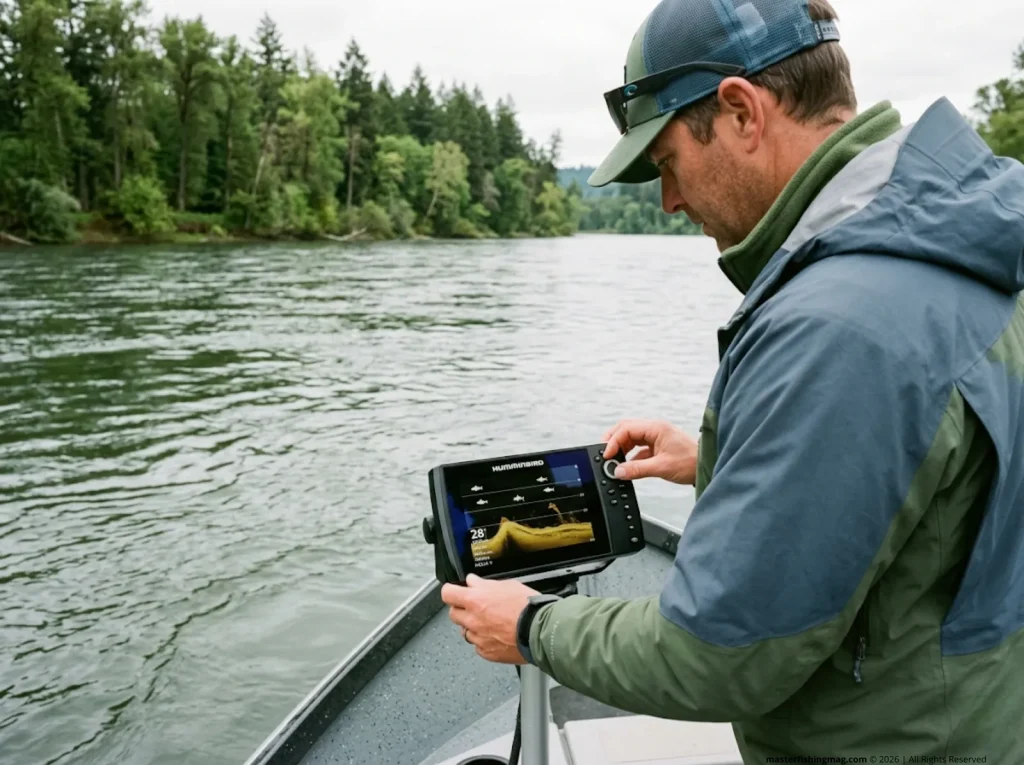
Salmon don’t swim up the middle of the Columbia River fighting maximum current. They’re energy-efficient migrants that follow “travel lanes” — low-velocity seams along the bottom where friction from the riverbed slows the water.
The principle is straightforward. Rougher bottom means more friction. More friction means slower current. Slower current means fish. The spots that hold the most salmon are ledges and benches — underwater plateaus where the bottom transitions from deep to shallow. These breaks create a band of reduced current that fish ride like a highway.
In high-water years, these lanes shift closer to the bank, putting fish in 6 to 10 feet of water. In low-water years, the productive zone moves to deeper terraces at 18 to 30 feet. The anglers who get skunked are the ones fishing the same depth every trip regardless of river conditions.
The real skill isn’t just “fishing the seams” — every fishing website says that. It’s reading the substrate transition. A gravel-to-boulder break is a predictable fish highway. If you understand how current seam hydrodynamics create holding zones, the same physics apply at an even larger scale on the Columbia.
Pro tip: Drop a waypoint every time you hook a fish and note the depth. After a season, your sonar will show a clear pattern — fish stack on the same ledges year after year. The river changes, but the geology doesn’t.
Thermal Refugia and the 68°F Shutdown
Water temperature above 68°F puts salmon and steelhead under serious stress. Above 70°F, summer steelhead migration halts entirely. The fish find cold water — usually deep pools or the mouths of tributaries like the Cowlitz or Willamette — and they park there. These delays can last months.
Research published by NOAA and the National Marine Fisheries Service on mid-Columbia steelhead confirms that these temperature-driven “holding” behaviors represent an adaptive survival strategy — the fish are literally waiting for the river to cool before continuing their migration.
When you’re fishing during summer heat, you must target 30 to 50 feet of depth or the seams where cold tributary plumes enter the mainstem. And here’s the ethical line: when temps exceed the stress threshold, responsible anglers stop fishing. A hooked steelhead in 72°F water doesn’t have the energy reserves to recover from the fight. That’s not a guideline — it’s the science of surface temps versus depth.
Barometer bite windows also play a role on the Columbia. A rapidly falling barometer often triggers aggressive pre-front feeding, while low, stable pressure pushes fish deep and lethargic. Watch for changes greater than 0.15 inHg over three hours — that rate of change is what triggers the feeding windows that experienced guides build their days around.
The 360 Flasher Revolution — Rigging That Actually Works
 pro-troll-360-flasher-rigging-leader-coon-shrimp-columbia-river-1024×765.webp” alt=”Close-up of a Pro-Troll 360 rotating flasher with cured coon shrimp on a 28-inch leader being lowered into a Columbia River trolling setup” class=”wp-image-11349″/>
Why 360s Beat Triangle Flashers (And When They Don’t)
The 360 flasher changed Columbia River salmon fishing more than any single piece of tackle in the last decade. Models from Pro-Troll and Shortbus use an “agitator fin” that forces the device into aggressive rotation even at slow trolling speeds. The visual strobe and heavy vibration they produce draw fish from a much larger radius than a traditional triangle flasher like the Fish Flash.
But the 360 comes with a cost that most tackle shop salespeople won’t mention: drag. When a fish is hooked and moving perpendicular to your line, that spinning flasher acts like a sea anchor. Even expert anglers only land about 60% of hooked fish with a standard 360 setup.
The solution is a breakaway system. These rigs release the rear end of the flasher the moment a fish strikes, allowing it to plane straight and removing the leverage the fish would use to pull the hook. It’s not optional gear on the Columbia. It’s the difference between that screaming reel ending in a fish on the deck or an empty hook coming back.
Leader Length, Bumpers, and the “Thump” Test
Leader length is the single most critical variable in a flasher setup. Get it wrong and the flasher’s kick either disappears or turns your lure into an erratic mess.
The numbers, based on thousands of trolled miles: a 3.5 spinner runs best on a 24-to-28-inch leader — that length maximizes the “skip-beat” action. A Brad’s Super Bait cut-plug needs 30 to 36 inches so the internal scent cavity has room to “leak” without being whipped around. Coon shrimp require 30 to 40 inches because shorter leaders tear the delicate bait. And herring cut-plugs demand 4 to 6 feet for a natural roll.
Between the mainline and the flasher, you need a bumper — a heavy section of 50 to 65-pound monofilament that prevents the flasher from tangling with the dropper weight during descent. This is the piece that beginners forget and experts never skip.
The final check is the “thump.” With the rig in the water and the boat at trolling speed, the 360 flasher should create a steady, rhythmic one-second pulse at the rod tip. Too fast and the flasher is spinning too tightly. Too slow and it’s not rotating at all — just dragging like a dead weight.
When you learn to read that thump, you can adjust rod length and speed to dial in the action without ever looking at your GPS. For this kind of trolling, a 10-foot-6 heavy-power casting rod like the G.Loomis Salmon Series SAMR 1265 C is the standard — and if you’re choosing between the right rod length for trolling vs bank work, the extra reach on the 360 setup is non-negotiable. Spool it with 30 to 65-pound braid backed by a line counter reel, and you can replicate a hot depth across every rod on the boat.
Pro tip: Mark your bumper length with a permanent marker every 6 inches. When you find a fish at a specific depth, you can replicate the entire leader-bumper-weight geometry on your other rods in under a minute. The fastest boat to a limit is the one that adjusts all rods to the hot setup immediately after the first hookup.
Bait Preparation — The Science of Scent and the Cure
 Pautzke Red Nectar brine with anise oil and krill powder in a white plastic container at a boat launch” class=”wp-image-11351″/>
The Pautzke Coon Shrimp Recipe — Step by Step
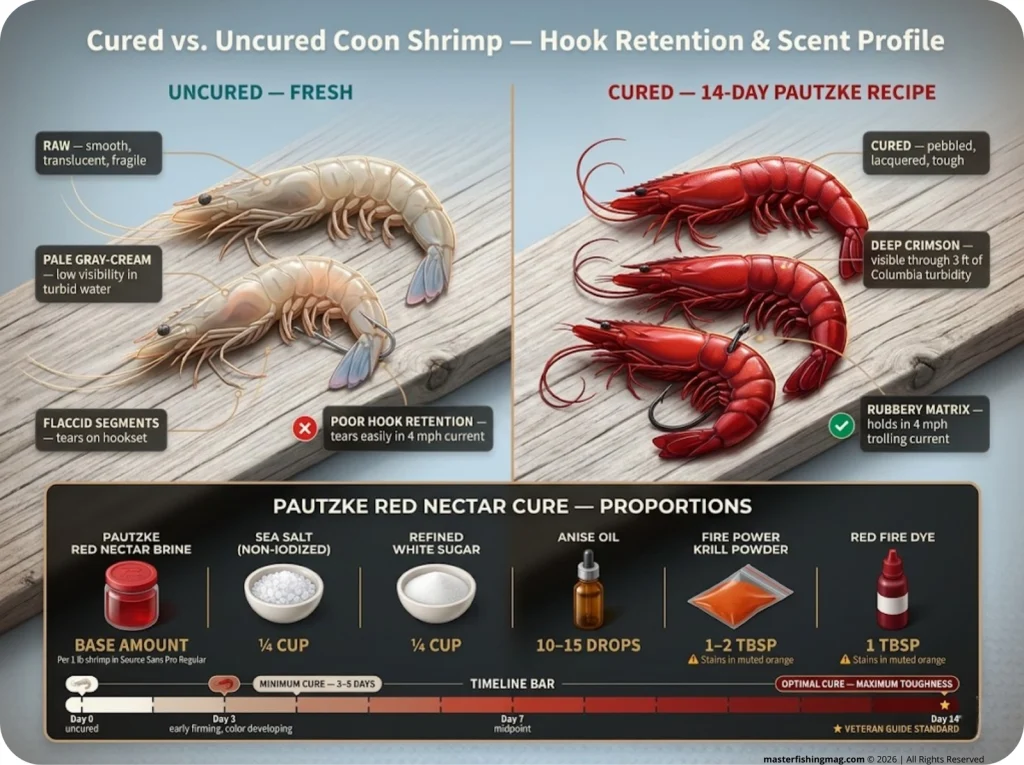
In the dark, turbid waters of the Columbia, scent attractants often decide whether a salmon commits to a strike. And no bait outperforms a properly cured coon shrimp for spring Chinook. This is the detail most online guides skip entirely — the actual recipe with real proportions.
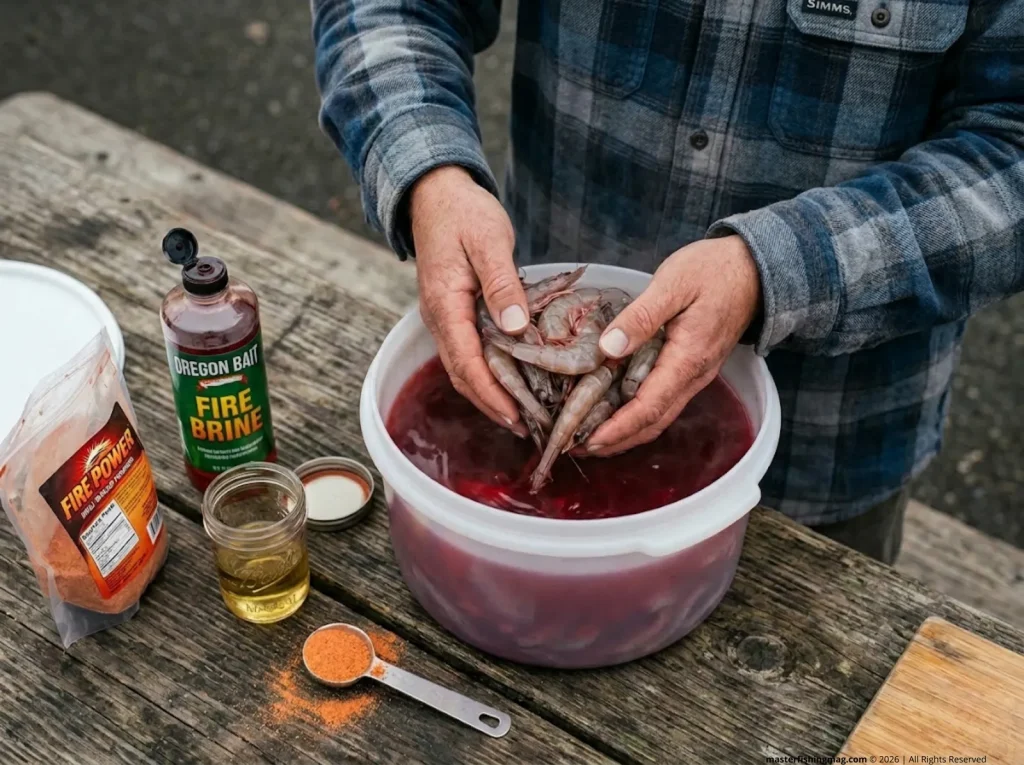
Start with Pautzke Red Nectar or Red Fire Brine as your base. Add a quarter cup of non-iodized sea salt and a quarter cup of refined white sugar. Drop in 10 to 15 drops of pure anise oil and 1 to 2 tablespoons of Fire Power krill powder. Finish with a tablespoon of Red Fire Dye — fair warning, this dye will stain your skin and your boat deck.
Submerge the shrimp for a minimum of 3 to 5 days in the refrigerator. Many veteran guides prefer a 14-day cure to achieve maximum toughness. The goal is threefold: vibrant color that’s visible in murky water, a pungent scent trail that carries downstream, and a “rubbery” texture tough enough to stay on the hook in 4-mph current. Adding rock salt toward the end of the process further toughens the carapace for high-speed trolling.
If you’ve ever worked through the science of curing salmon eggs, the same principles apply. Salt and sugar draw moisture out of the protein, firming it up while the dye and scent absorb in. Salmon roe curing and shrimp curing are two sides of the same coin.
Scent Profiles — Attractors vs. Triggers
Professional guides split scents into two categories. Attractors — garlic and anise — help a fish locate the lure from a distance. Triggers — squid oil, bloody tuna, shrimp gel — are applied directly to the lure to provoke the actual bite.
For spring Chinook, garlic is the top attractor. Salmon Slammer Super Gel is the most common delivery system. Anise is the go-to for sockeye and steelhead — it also masks human odors like gasoline residue and tobacco that can repel fish. Krill works as a universal high-protein scent that mimics the ocean forage all four species were feeding on before they entered the river.
One detail that separates serious anglers from tourists: apply gel to the tubing of a spinner or the painted side of a wobbler. This protects the shine of the chrome side while the “pocket” of slower water behind the blade prevents the scent from washing off too quickly. Lure color selection also matters in the Columbia’s variable turbidity — brighter chartreuse and red in muddy water, chrome and silver when it clears up. For more on how scent triggers strikes from inactive fish, the science carries across species.
Plunking and Bank Fishing — The Columbia Without a Boat
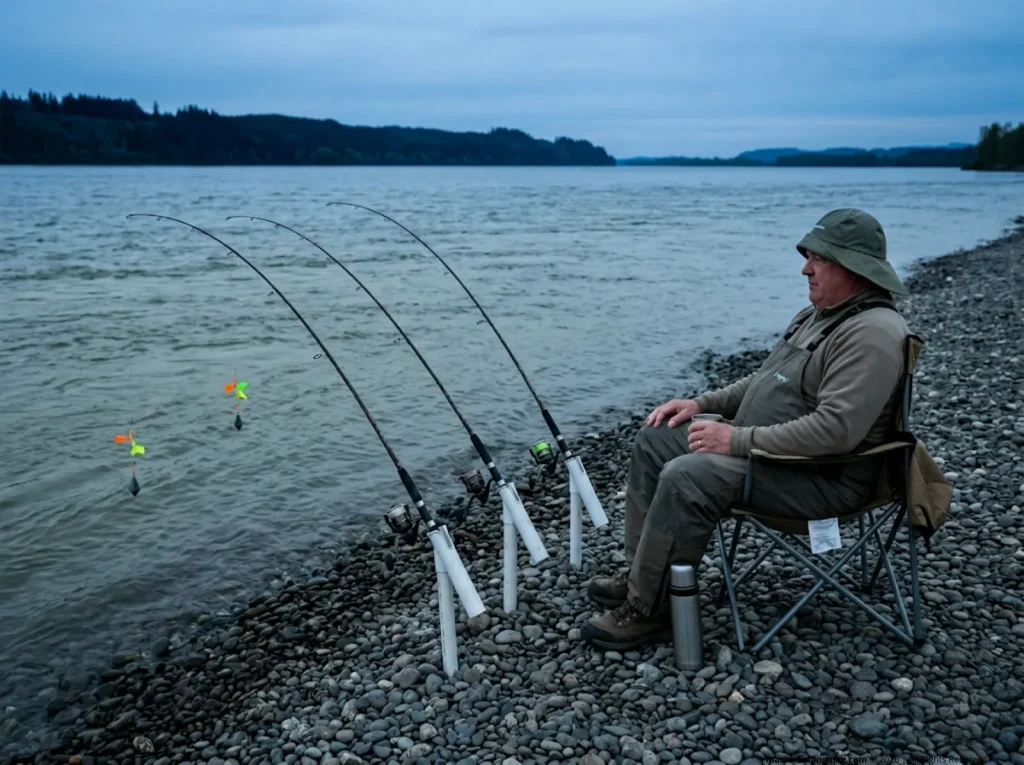
The Triple Rig Setup
Not everyone has a $60,000 jet sled. Plunking is the Columbia’s great equalizer — a bank fishing method that has put more salmon on the stringer than any boat technique in the river’s history.
The standard “triple rig” uses 5-foot bumpers of 50-pound mono between three-way swivels to space three Spin-N-Glos at different depths. The bottom lure targets Chinook salmon — they travel the deepest. The middle and top lures are positioned for steelhead or sockeye. A heavy pyramid weight — 8 to 14 ounces depending on current — anchors the entire rig to the bottom.
Smart anglers attach the weight via a “dropper” of lighter 20-pound line test. If the lead wedges between rocks, the dropper snaps and you lose only the sinker, not the entire rig. It’s a $0.50 piece of insurance on a $15 setup.
The technique is patience. You set the rig, park it in a PVC rod holder driven into the cobble, sit in your camp chair, and watch the rod tips. The fish come to you. Focus on areas where the current slows over gravel-to-boulder transitions — those substrate breaks are the same travel lanes the trollers are targeting from their boats.
Trolling Direction, Tides, and “On Anchor” Fishing
Trolling direction matters more than most anglers realize. In the lower river around Buoy 10, the standard is to troll with the tide. This covers more ground and keeps the lure action consistent. Further upriver, “downhill” trolling — running with the current — is the default for springers because it slows your effective speed through the fish’s holding zone.
For summer runs, many experienced guides switch to “anchor fishing” — dropping the hook and letting the current do the work. The river pushes your lure downstream into the fish’s face without any motor noise. It’s deadly for steelhead that have been pressured by boat traffic all day. Side drifting — drifting a bait rig along the bottom while the boat moves with the current — is another productive approach that falls between trolling and anchoring.
If you want to understand the drift speed principles that control river hookups, the physics are the same whether you’re drifting, anchored, or letting the Columbia’s current deliver the presentation.
The 2026 Rules — What You Need Before You Launch
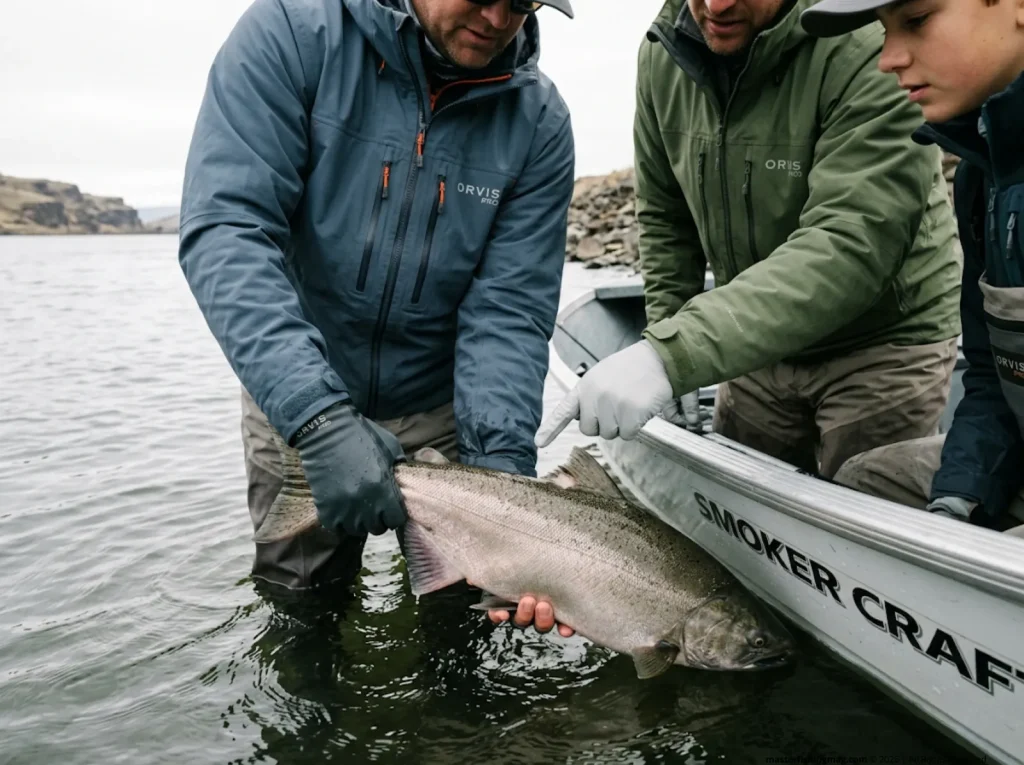
Mark-Selective Fishery Rules and the 2026 Season Windows
Every Columbia River fishing trip starts at the same place: the regulations. The Columbia operates under a mark-selective fishery model. Hatchery salmon — identified by a clipped adipose fin — may be harvested. Wild fish must be released. No exceptions. Getting this wrong isn’t just an ethics issue. It’s a $500 fine and potential loss of your fishing privileges.
The 2026 spring Chinook season windows set by ODFW break down by area. Area 1, covering the mouth to Beacon Rock, allows retention from March 1 through April 8. Area 2, from Tower Island to the WA/OR border, opens April 1 through April 26 and again briefly on May 2.
The daily bag limit is six salmonids total, with no more than two adults and only one adult Chinook. Every wild steelhead goes back — period. That includes kelt steelhead — spawned-out fish heading back downstream — which are especially vulnerable and must be handled with extreme care.
The Columbia River Salmon and Steelhead Endorsement (CRSSE)
The big regulatory change for 2026 is the reinstatement of the Columbia River Basin Endorsement. If you’re 16 or older and fishing for salmonids anywhere in the Columbia system — including tributaries — you need this endorsement on your Washington license. The cost is $8.75 for adults, $7.10 for seniors and youth. Oregon has its own tag requirements.
The revenue from the CRSSE is legally set aside for recreational fishery enhancement — enforcement, habitat, monitoring. And here’s the practical reality: seasons on the Columbia can close with 24 hours’ notice based on dam fish counts. The Fish Washington® app pushes real-time emergency rule changes to your phone. If you’re not running it, you risk fishing an area that closed at midnight while you were sleeping.
For context on how bag limits and selective harvest interact with population management, the difference between slot limits and bag limits spells out the biology behind these numbers.
Conservation on the Columbia — Fishing the Right Way
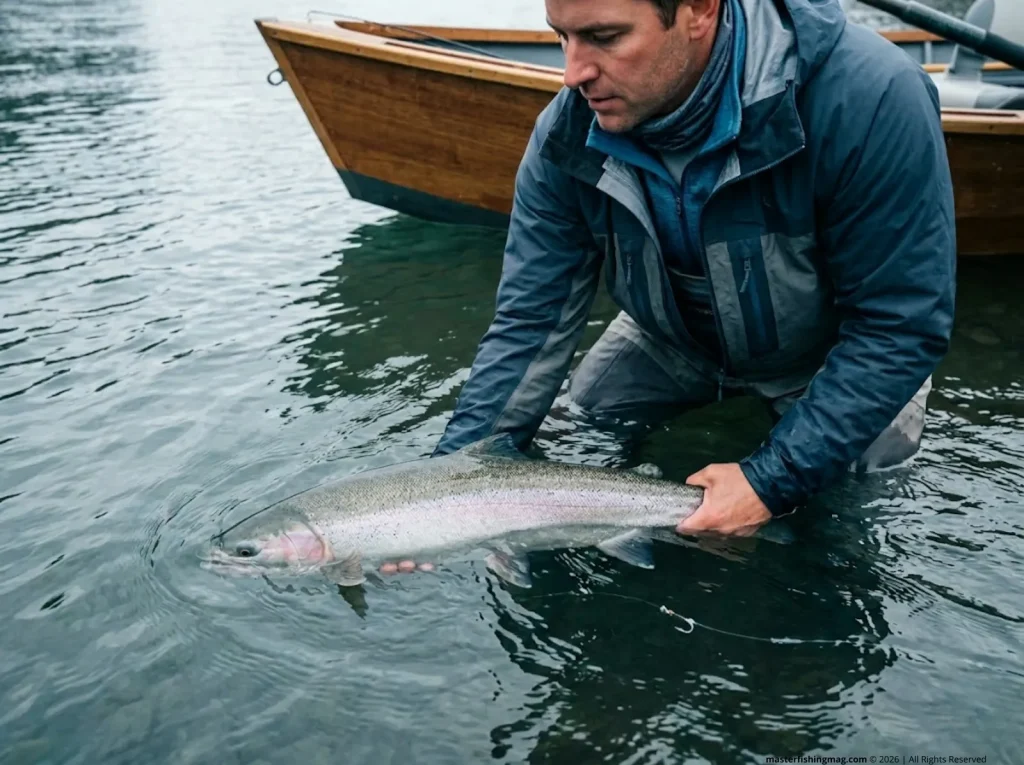
Catch-and-Release Ethics and the “Keep ‘Em Wet” Standard
The phrase “catch and release” gets thrown around like it’s automatically harmless. It’s not. Research on Columbia River Coho salmon released from commercial tangle nets — published in Oxford Academic — shows a 23.6% mortality rate. Recreational release mortality is lower, but it isn’t zero, especially in warm water or with deeply hooked fish.
The protocols that push that number toward zero: use barbless hooks to speed up removal. Use rubber mesh nets only — no knotted nylon that tangles gills. Minimize air exposure to less than 10 seconds. Cradle the fish horizontally underwater, facing into the current, until it kicks away under its own power. This is the keep ’em wet standard, and it’s not optional on the Columbia.
If you need to understand how hook location determines whether a fish survives, the data is straightforward — jaw-hooked fish live. Gill-hooked fish often don’t.
When you harvest a hatchery salmon, don’t toss the head. Agency samplers collect snouts to recover Coded Wire Tags — tiny metal markers implanted in the fish’s nose at the hatchery. Each tag encodes the fish’s origin, age, and release location. Every tag you submit helps determine next year’s season lengths. You’re not just fishing — you’re part of the science.
The Dam Debate and the Future of Columbia River Runs
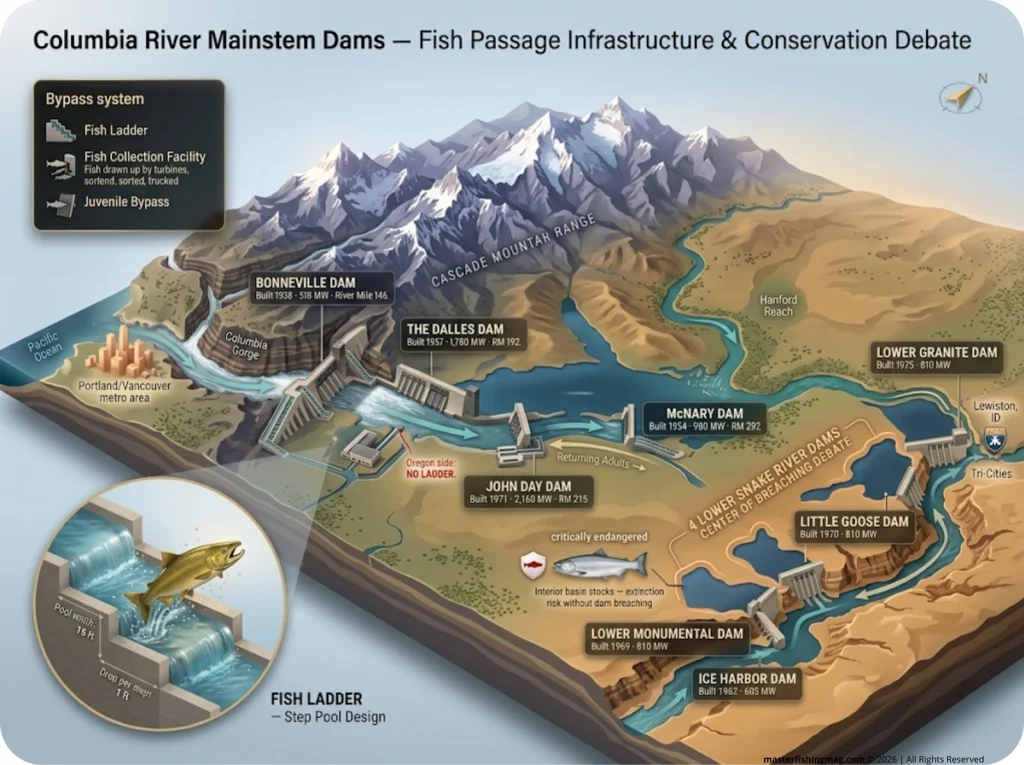
Eight major dams on the mainstem Columbia and Snake Rivers have reshaped the path of every anadromous fish in the basin. The runs that once numbered an estimated 16 million returning adults now survive as managed fractions of their historical abundance.
The concept most anglers don’t hear about is “latent mortality.” Fish that survive the immediate passage through a dam often die weeks later in the ocean from accumulated stress. The Comparative Survival Study has shown that fish transported around dams via barges sometimes return at lower rates as adults than fish that migrated in-river — likely because the stress of crowding and the loss of natural imprinting outweigh the benefit of avoiding turbines.
This data sits at the center of the Lower Snake River dam breaching debate. Many fisheries scientists and tribal fisheries leaders argue that removing those four dams is the only action strong enough to prevent the extinction of interior basin stocks. For anglers who care about why certain waters are restricted to catch-and-release only, the Columbia basin is the ultimate case study.
Pro tip: Before each trip, pull up the DART database and check the 24-hour adult passage counts at Bonneville. Those numbers tell you exactly where you stand in the run. If counts are climbing, fish hard. If they’ve plateaued, the tail end is approaching — and the season closure won’t be far behind.
Conclusion
Three things separate the anglers who fill tags on the Columbia from the ones who tow an empty boat home.
Time it right. The Columbia River run calendar is the only spreadsheet that matters. Spring Chinook peak at Bonneville around May 11. Fall Chinook own September. Summer steelhead hide in thermal refugia until the river cools. Miss the window and you’re fighting math, not fish.
Rig for the river, not the lake. A 360 flasher with a 26-inch leader, a properly cured coon shrimp soaked for two weeks in Pautzke Red Nectar, and the right read on the “thump” at the rod tip — this is what fills a cooler instead of wasting a tank of gas.
Carry the river forward. Every wild steelhead you release correctly, every CWT snout you hand to a sampler, every season you buy the CRSSE endorsement — that’s fishing “the right way.” The Columbia was built for multitudes. Whether it stays that way depends on what we do with the fish we catch today.
Check the 2026 fishing season dates on ODFW and WDFW before you launch. Download the Fish Washington® app. And the next time you’re anchored above Bonneville Dam with a 360 flasher thumping against the current, remember that the 147,300 fish heading your way are the product of decades of science, selective management, and an entire river system fighting to survive. Fish the right way, or don’t fish at all.
Columbia River Fishing FAQ
What is the best month to fish the Columbia River for salmon?
For spring Chinook, late April through mid-May is the peak window based on 10 years of Bonneville Dam passage data — the median 50% date falls around May 11. For fall Chinook, September is consistently the strongest month. Always check current ODFW and WDFW season dates, as retention windows shift based on real-time dam fish counts.
Can you fish the Columbia River from the bank?
Yes — plunking is the primary bank method. A triple rig uses three Spin-N-Glos spaced on 5-foot bumpers of 50-pound mono, anchored by an 8-to-14-ounce pyramid weight. Focus on areas where current slows over gravel-to-boulder transitions — those are the same travel lanes boat anglers target.
Do I need a special permit to fish the Columbia River in 2026?
Yes. Washington reinstated the Columbia River Salmon and Steelhead Endorsement (CRSSE) for 2026, costing $8.75 for adults 16–69. This is in addition to a standard fishing permit. Both states enforce mark-selective fishery rules — only hatchery salmon with clipped adipose fins may be kept.
What is a 360 flasher and why does everyone use one?
A 360 degree rotation flasher is a trolling attractor that spins via an agitator fin, producing heavy vibration and a strobing pattern that mimics a feeding frenzy. Pro-Troll and Shortbus are the dominant brands on the Columbia. The tradeoff is significant drag — even experts land only about 60% of hooked fish. A breakaway system that releases the rear of the flasher on a strike is the fix.
What is the best bait for Columbia River spring Chinook?
Cured coon shrimp is the standard for springers. The Pautzke recipe uses Red Nectar brine, sea salt, sugar, anise oil, and krill powder, with a minimum 3-to-5-day cure. The goal is a rubbery texture that holds the hook in 4-mph current. Garlic-based scent gels are the most effective attractor for spring fish.
Risk Disclaimer: Fishing, boating, and all related outdoor activities involve inherent risks that
can lead to injury. The information provided on Master Fishing Mag is for educational and informational purposes
only. While we strive for accuracy, the information, techniques, and advice on gear and safety are not a substitute
for your own best judgment, local knowledge, and adherence to official regulations. Fishing regulations, including
seasons, size limits, and species restrictions, change frequently and vary by location. Always consult the latest
official regulations from your local fish and wildlife agency before heading out. Proper handling of hooks, knives,
and other sharp equipment is essential for safety. Furthermore, be aware of local fish consumption advisories. By
using this website, you agree that you are solely responsible for your own safety and for complying with all
applicable laws. Any reliance you place on our content is strictly at your own risk. Master Fishing Mag and its
authors will not be held liable for any injury, damage, or loss sustained in connection with the use of the
information herein.
Affiliate Disclosure: We are a participant in the Amazon Services LLC Associates Program, an
affiliate advertising program designed to provide a means for us to earn advertising fees by advertising and linking
to Amazon.com. As an Amazon Associate, we earn from qualifying purchases. We also participate in other affiliate
programs and may receive a commission on products purchased through our links, at no extra cost to you. Additional
terms are found in the terms of service.