In this article
The difference between a strike and a refusal often boils down to molecular engineering. Standing on a riverbank during the height of salmon fishing season, you might see two anglers fishing the exact same drift. One is consistently hooking up with silver salmon, while the other watches their float drift by untouched. A raw skein of salmon roe represents biological potential, but a cured egg is a weaponized food source, chemically altered to trigger a predation response in salmonid angling.
Mastering the cure is not about following a brine recipe blindly. In my years running a bait lab and field-testing on the river, I’ve learned that you must think like a field biochemist. You are manipulating osmosis, modifying protein structures, and adjusting pH levels to match the specific water velocity and water temperature you are fishing.
This guide moves beyond basic egg cure recipes. We will examine the ichthulokeratin shell, the mechanics of the “juice-out/juice-in cycle,” and the critical balance between scent release and structural integrity in piscatorial baits.
What Are We Working With? The Biological Substrate
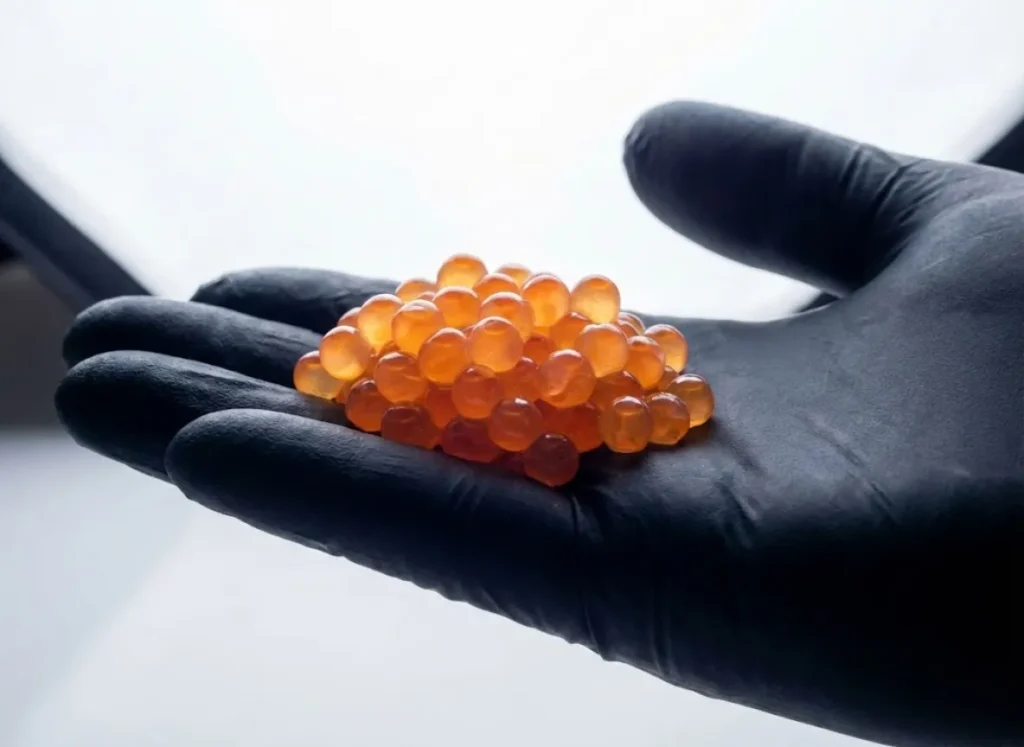
Before we start mixing ingredients like sodium sulfite or sea salt, we need to deconstruct the anatomy of the salmon egg. We need to understand the physical barriers and chemical payloads we are manipulating.
What is the chorion and how does it regulate diffusion?
The chorion is not just a skin; it is a complex, semipermeable membrane composed of glycoproteins and fish keratins, known as ichthulokeratins. This egg membrane contains thousands of microscopic pore canals (0.5–0.8 µm) that act as the primary highways for osmotic exchange. In a live egg, these pores are highly selective, allowing only water and nutrients to pass while blocking larger macromolecules found in fertilization fluid or milt.
The goal of the cure is to “hack” this selectivity. We use hypertonic solutions to dehydrate the pore proteins, forcing them open to allow larger cure chemicals to enter.
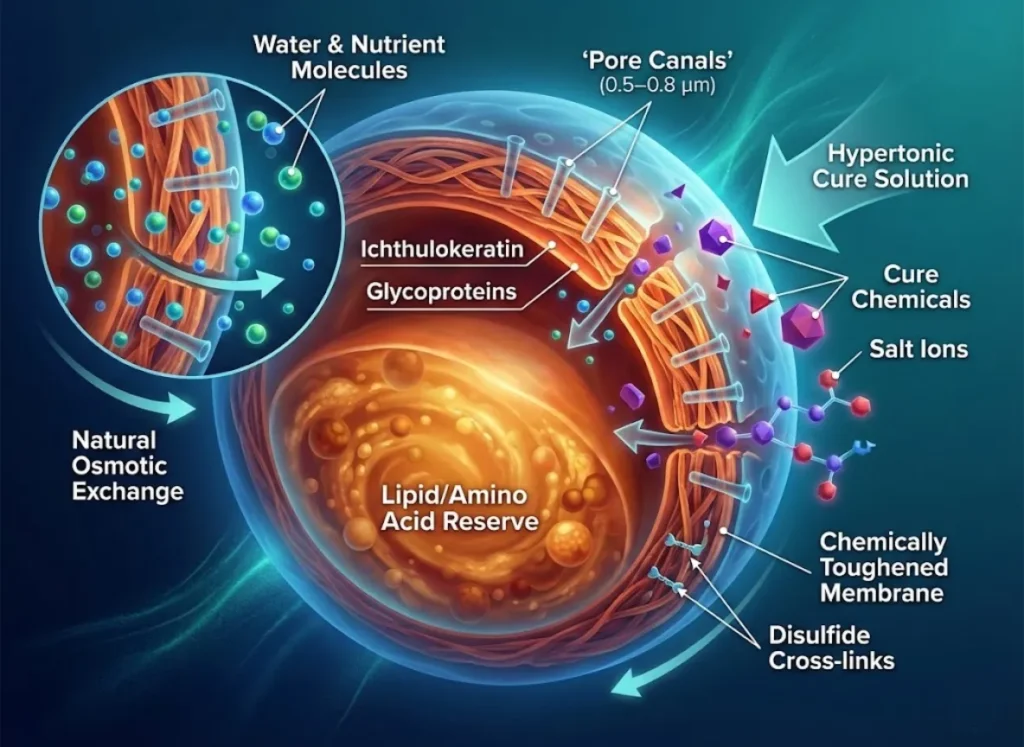
The durability of your baits depends entirely on the density of disulfide cross-links within these chorion proteins. While natural hardening occurs after fertilization, our curing process artificially induces this membrane toughening through chemical tanning agents. Existing research on the characterization of Oncorhynchus mykiss egg chorion validates that the specific molecular weight of these proteins requires targeted biochemistry to modify.
Without this modification, the egg remains fragile. It becomes susceptible to mechanical rupture, especially when casting single-egg roe bags into the heavy currents typical of the Pacific Northwest salmon run.
What attractants are hidden inside the yolk?
The yolk is an emulsion of lipids, phosphoproteins, and free amino acids that serves as your primary scent source. Specifically, L-Lysine and L-Threonine are the dominant free amino acids in salmonid ovarian fluid. These specific compounds act as powerful bite stimulants and a biological trigger. To be effective, these molecules must be released from the egg interior into the water column, a process anglers call “milking.”
Pro-Tip: Never pop your eggs to get the scent out. A proper cure creates a slow-release mechanism where the scent leaks out over 10 to 15 minutes, creating a distinct trail rather than a one-time burst.
However, the yolk is also rich in unsaturated fatty acids, which are highly prone to oxidation. This rancidity leads to the “yellowing” of eggs and the production of off-putting odors. Recent analysis of amino acid cues in salmon ovarian fluid highlights how specific these chemical drivers are, and why oxidation can ruin the signal.
This instability necessitates the use of antioxidants like sodium sulfite or sodium metabisulfite in the cure to preserve the “fresh” scent profile. Many commercial formulas, like Pautzke Fire Cure or Pro-Cure, supplement this with krill powder (Euphausiacea), sand shrimp oil, or anise. While visual cues are important—and understanding the science of fish vision helps with rhodamine B or UV flash dye selection—the chemical signal is what seals the deal in low visibility.
How Does the Curing Process Actually Work?
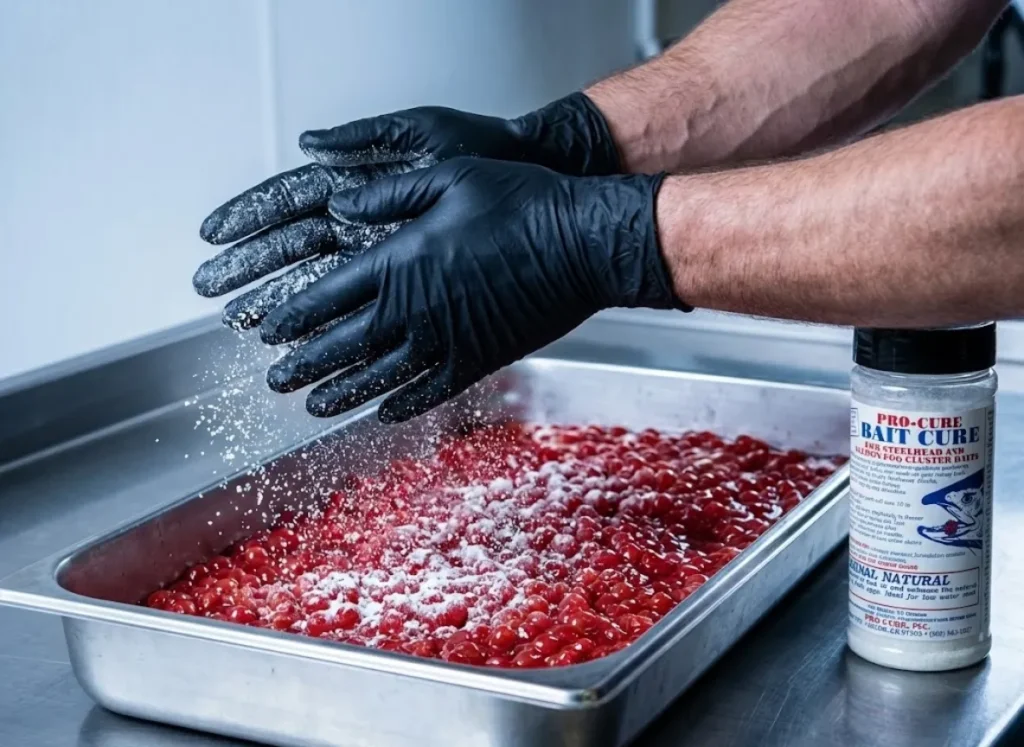
This section explains the thermodynamics of the “juice-out/juice-in cycle.” This is the fundamental mechanism of food preservation where salt, sugar, and cure chemicals pull juice out of the egg.
What drives the ‘Juice-Out’ and ‘Juice-In’ cycle?
The process begins by creating a hypertonic environment on the egg surface using a high concentration of sodium chloride (salt) and sucrose (sugar). Water naturally moves from the area of low solute concentration (inside the egg) to high concentration (outside) to equilibrate the gradient. This osmotic pressure causes the egg to collapse physically.
This extracted water dissolves the dry ingredients, creating a supersaturated brine solution rich in sulfites, sodium borate, and dyes. Anglers must never drain this liquid; it is the solvent vehicle required for the second phase of the reaction.
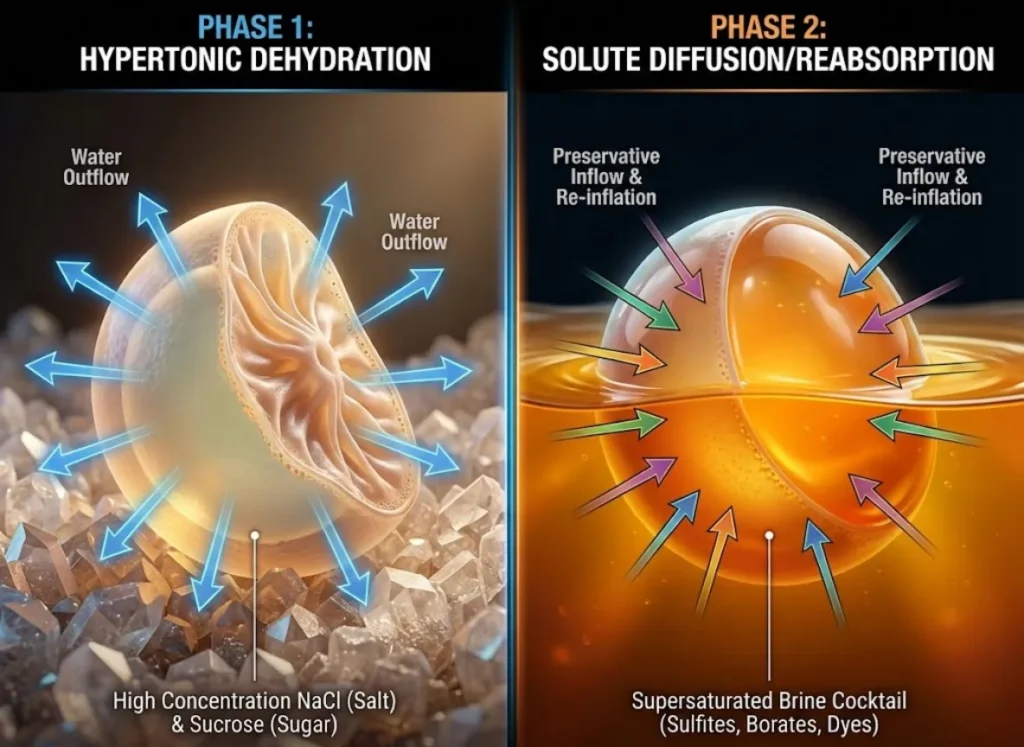
As the external salt crystals dissolve, the solute/solvent equilibrium shifts. This allows the now-dissolved chemical preservative to diffuse back into the egg through the pore canals. This “Juice-In” phase re-inflates the egg, making it turgid and replacing the original cytosol with your preservative cocktail.
This process is governed by fundamental physics. According to food preservation principles regarding water activity and osmosis, small ions penetrate first, followed by larger sulfite and borate molecules. Stopping the process prematurely results in dehydrated bait that lacks the internal pressure to release scent. This is distinct from how to keep bait alive, which focuses on biological maintenance rather than chemical replacement.
How do sulfites and borates compete for the egg’s structure?
Sodium Sulfite acts as a reducing agent. It cleaves disulfide bonds in the protein matrix through a process called sulfitolysis. This bond-breaking “relaxes” the protein structure, causing the egg to soften and release its amino acid payload more aggressively, increasing the milking rate and scent leaching.
Conversely, Borax (Sodium Tetraborate) acts as a cross-linking agent. It binds with hydroxyl groups to form a 3D lattice. This cross-linking “gels” the membrane and mucus, increasing structural rigidity for hook retention and creating that characteristic tacky membrane.
The “Hot Cure” vs. “Structural Cure” debate is essentially a chemical balancing act. A study on the cleavage of disulfide bonds by sulfites details how sulfites break down structures, which explains why high-sulfite cures, often called hot cures, turn to mush if left too long—a process known as denaturation. Borax serves a dual purpose: it toughens the egg and acts as an alkaline buffer (pH ~9.2) to counteract the acidity of decomposition.
Sodium Metabisulfite is frequently used for “hot” cures but is acidic. Without buffering agents like borax or baking soda, it can “burn” eggs, turning them opaque white and rubbery. You need the right essential fishing tools—like precise scales and nitrile gloves—to manage these potent chemicals safely.
How Do We Apply This Chemistry in the Field?
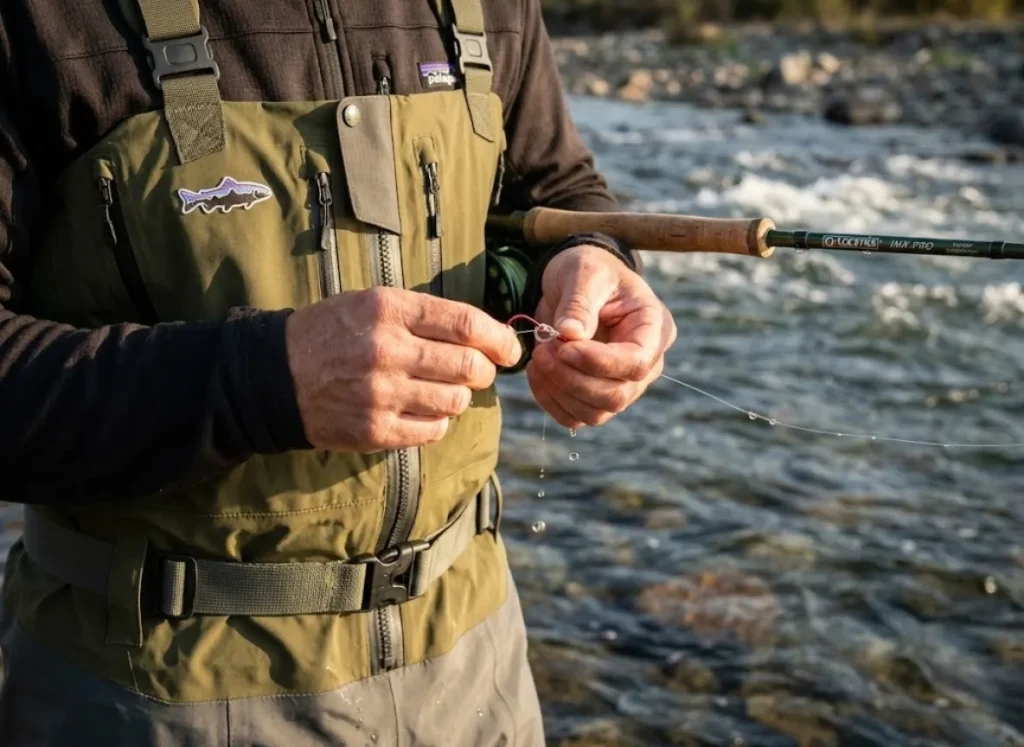
Biochemical theory must eventually translate into a decision on the riverbank. This section focuses on environmental variables and conservation ethics.
How should water conditions dictate your chemical selection?
In cold water (below 40°F), borax solubility drops significantly. According to solubility data for borax, it struggles to dissolve at low temperatures. This chemistry of solubility means heavy borax-based cures may leave a white, undissolved powder on the bait that looks unnatural. For winter steelhead fishing, a “wet brine” (dissolving borax in hot water first) ensures penetration.
In warm water (above 55°F), enzymatic autolysis accelerates. Here, a heavy borax cure is required to provide mold inhibition and prevent the good quality eggs from softening into “soup.”
| Egg Curing Chemical Recommendations | ||
|---|---|---|
| Condition | Recommended Chemical Dominance | Rationale |
| Cold Water (<40°F) | Sulfite + Sugar | Borax solubility is poor in freezing water; sulfites dissolve readily. Sugar acts as an antifreeze agent to prevent ice crystal damage to the membrane. |
| Warm Water (>55°F) | Borax (High) | Warm water accelerates enzymatic decay (autolysis). Borax inhibits bacteria and cross-links proteins to prevent eggs from turning to “mush.” |
| High Velocity Current | Borax (Heavy) | High shear forces require maximum structural integrity. Borax provides a “rubbery, tough egg” that stays on the hook. |
High-flow water demands high structural integrity (borax), while slow tidewater demands maximum scent dispersion (sulfite-based cures). Anglers targeting Great Lakes tributary fishing often encounter these extremes, requiring a switch from sugar-heavy cures (antifreeze effect and freezer burn resistance) to heavy sulfite cures depending on the flow.
What are the risks of sulfite toxicity to juvenile fish?
We must address a critical issue. Research by the Oregon Department of Fish and Wildlife (ODFW) confirmed that juvenile salmonids consuming eggs cured with high levels of sodium sulfite suffer significant mortality. The toxicity mechanism involves the overwhelming of the juvenile fish’s sulfite oxidase detoxification pathways.
This presents an ethical dilemma. The chemical that makes bait effective for active fish is lethal to the next generation of smolts. Industry standards now suggest limiting sodium sulfite content to 12 grams per kilogram of cured salmon.
Pro-Tip: If you mix your own cures, use a digital gram scale. “Eyeballing” technical-grade sulfites almost always results in toxic levels that can kill smolts in your drift.
The ODFW guidelines on fishing with cured eggs provide essential reading on this topic. Responsible stewardship involves using the minimum effective dose. Dispose of old bait properly—never dump it into the river. This practice aligns with broader fish conservation for anglers, ensuring the resource remains for years to come.
Summary of Key Propositions
Successful curing is the management of osmotic pressure to replace water with preservatives, not just drying the eggs out. Sulfites cleave protein bonds to release scent, while Borates cross-link proteins to provide durability. Most importantly, pH factor is critical; acidic scent trails can trigger avoidance behaviors, whereas alkaline scent trails often attract.
Next time you approach the curing bench, treat it as a lab. Experiment with your ratios, whether you are creating a 3-2-1 cure or a custom formula. Document your results and share your findings in the comments below to help us build a community of smarter anglers.
FAQ – Frequently Asked Questions
What is the main difference between using Borax and Sodium Sulfite?
Borax is a structural agent that cross-links proteins to make a well-cured egg tough and durable, while Sodium Sulfite is a bond-breaking agent that softens eggs to maximize scent release. Borax is for holding on the hook; Sulfite is for smelling in the water.
Why do my cured eggs turn into mush?
Mushy eggs are usually the result of burning eggs from high acidity (using unbuffered Sodium Metabisulfite) or enzymatic decay caused by insufficient saline concentration or sugar penetration during the osmosis phase.
How long does the Juice-In phase take?
The reabsorption phase typically takes 12 to 24 hours depending on temperature in your curing jar or plastic curing container. Stopping the process before the eggs re-inflate results in shriveled, dehydrated bait that won’t fish effectively.
Can I use sugar instead of salt for curing?
Sugar acts as a humectant and antifreeze, but it is less effective than salt at lowering water activity to prevent bacteria. Sugar-only cures are best for short-term use in freezing conditions, while salt is needed for long-term shelf stability.
Risk Disclaimer: Fishing, boating, and all related outdoor activities involve inherent risks that
can lead to injury. The information provided on Master Fishing Mag is for educational and informational purposes
only. While we strive for accuracy, the information, techniques, and advice on gear and safety are not a substitute
for your own best judgment, local knowledge, and adherence to official regulations. Fishing regulations, including
seasons, size limits, and species restrictions, change frequently and vary by location. Always consult the latest
official regulations from your local fish and wildlife agency before heading out. Proper handling of hooks, knives,
and other sharp equipment is essential for safety. Furthermore, be aware of local fish consumption advisories. By
using this website, you agree that you are solely responsible for your own safety and for complying with all
applicable laws. Any reliance you place on our content is strictly at your own risk. Master Fishing Mag and its
authors will not be held liable for any injury, damage, or loss sustained in connection with the use of the
information herein.
Affiliate Disclosure: We are a participant in the Amazon Services LLC Associates Program, an
affiliate advertising program designed to provide a means for us to earn advertising fees by advertising and linking
to Amazon.com. As an Amazon Associate, we earn from qualifying purchases. We also participate in other affiliate
programs and may receive a commission on products purchased through our links, at no extra cost to you. Additional
terms are found in the terms of service.