
In this article
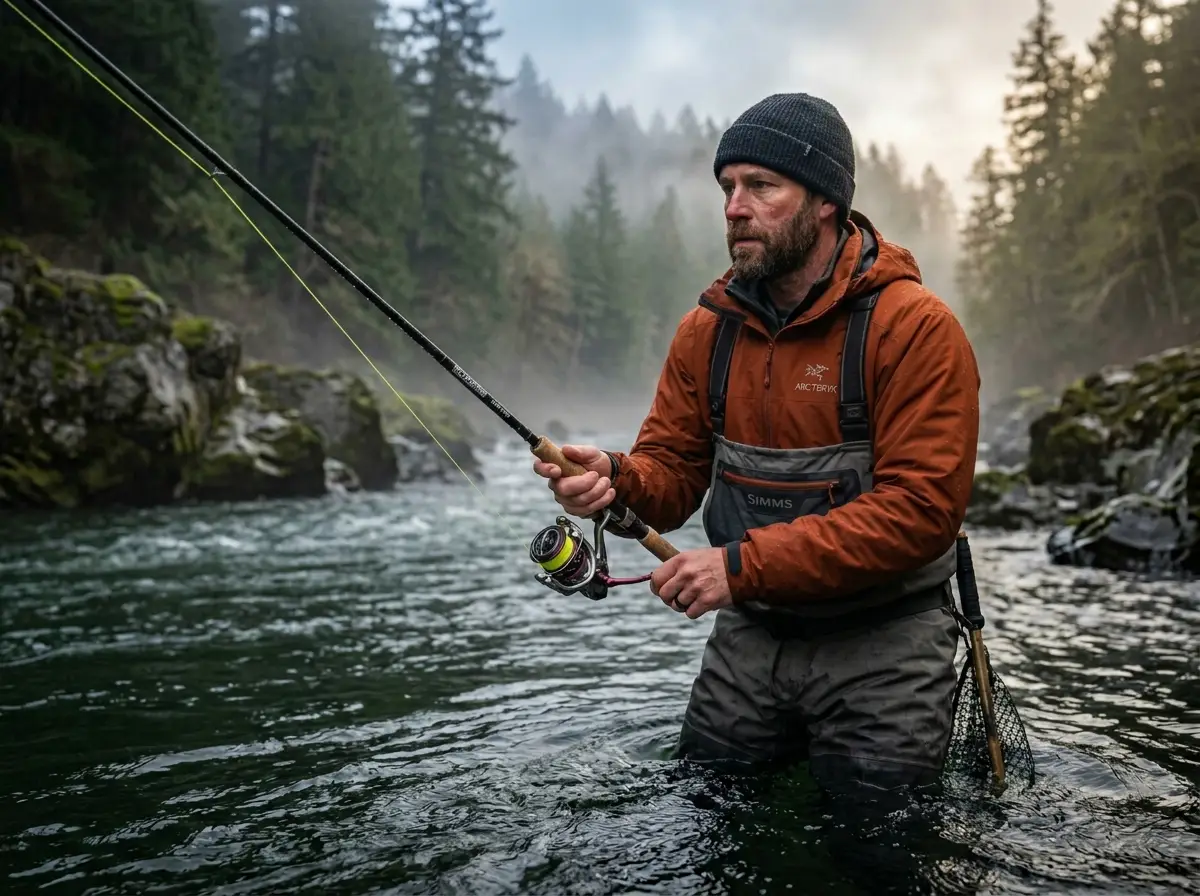
The line went dead for half a second — barely a heartbeat. Not a rock. Rocks don’t hesitate. I closed the bail on instinct, reeled straight and tight, and the river erupted. A chrome winter buck, 12 pounds, running upstream like a freight train. I had almost missed it. I almost always almost miss it.
That’s the reality of drift fishing for steelhead: the strike you’re chasing isn’t an explosion — it’s a whisper. A hesitation in the rhythm of the drift. And if you don’t understand why it feels that way, you’ll keep losing fish to ghosts.
After years of guiding on winter runs and chasing these fish through every temperature range the Pacific Northwest throws at you, I can tell you: most missed bites aren’t bad luck. They’re the result of not understanding what’s actually happening at the end of your line. This guide deconstructs the drift — from the physics of the cast to the biology of the take — so you stop guessing and start converting.
⚡ Quick Answer: Drift fishing for steelhead means getting your bait into the bottom foot of the water column and staying there, while maintaining enough line sensitivity to detect a strike that often feels like nothing more than a momentary pause. Use a Slinky weight (1/4–3/4 oz) on 30 lb hi-vis braid, an 8–12 lb fluorocarbon leader, and a size 2 or 4 Gamakatsu hook. Cast 45 degrees upstream, mend immediately, and hold the High Alert state during the entire drift — set the hook on any deviation from the rhythmic tick of the substrate, every time.
The River as a Physics Problem — Understanding Current and the Drift Zone
Here’s where most anglers go wrong before they even make a cast: they don’t understand what the river is doing to their line. Water doesn’t move uniformly through a channel. It’s fastest at the surface and in the center — slowest along the boundary layer near the riverbed. That’s where steelhead hold. They sit in that zone of reduced current because it costs them the least energy. Your bait needs to live there too.
The problem is that the faster surface current grabs your mainline the moment it hits the water and starts pulling it into a bow — what anglers call a line catenary or belly. That belly is your enemy. It dampens vibration transmission by 40–60%, meaning your haptic connection to the bottom goes soft right when you need it most. You’re effectively fishing blind.
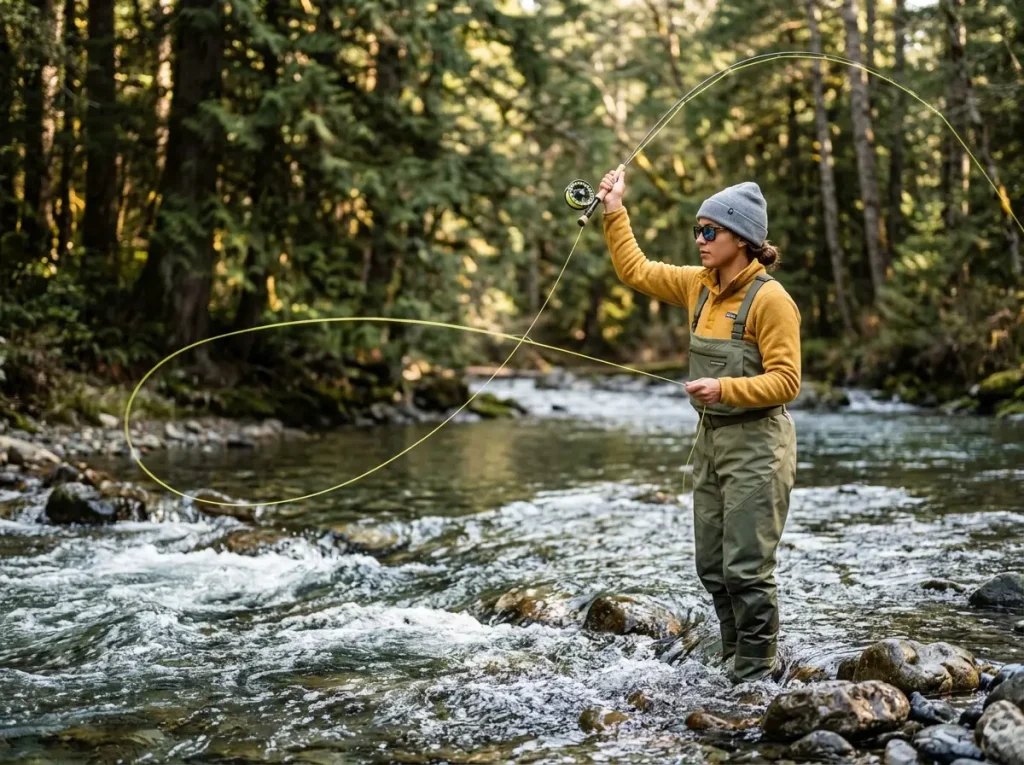
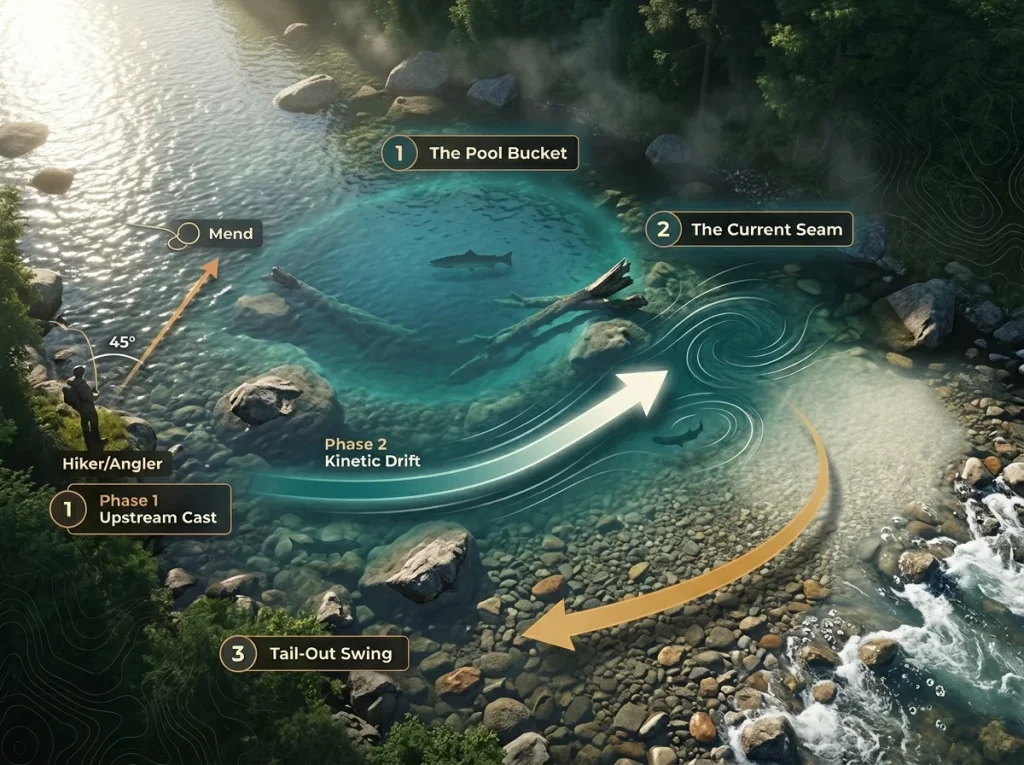
The fix is mending. Cast at 45 degrees upstream, then immediately lift your rod and throw a loop of line upstream. A decisive mend counteracts the surface current pulling your line into that horseshoe shape. A late mend barely helps. Get in the habit of mending the instant your rig hits the water — not after you’ve watched it drag for three seconds.
For matching your drift speed to subsurface current, the standard is weight adjustment: you should feel the bottom ticking every few yards, not dragging constantly. If the rig drags, you’re over-weighted. If you feel nothing, you’re above the strike zone.
Manning’s n — Reading the Riverbed Through Your Rod Tip
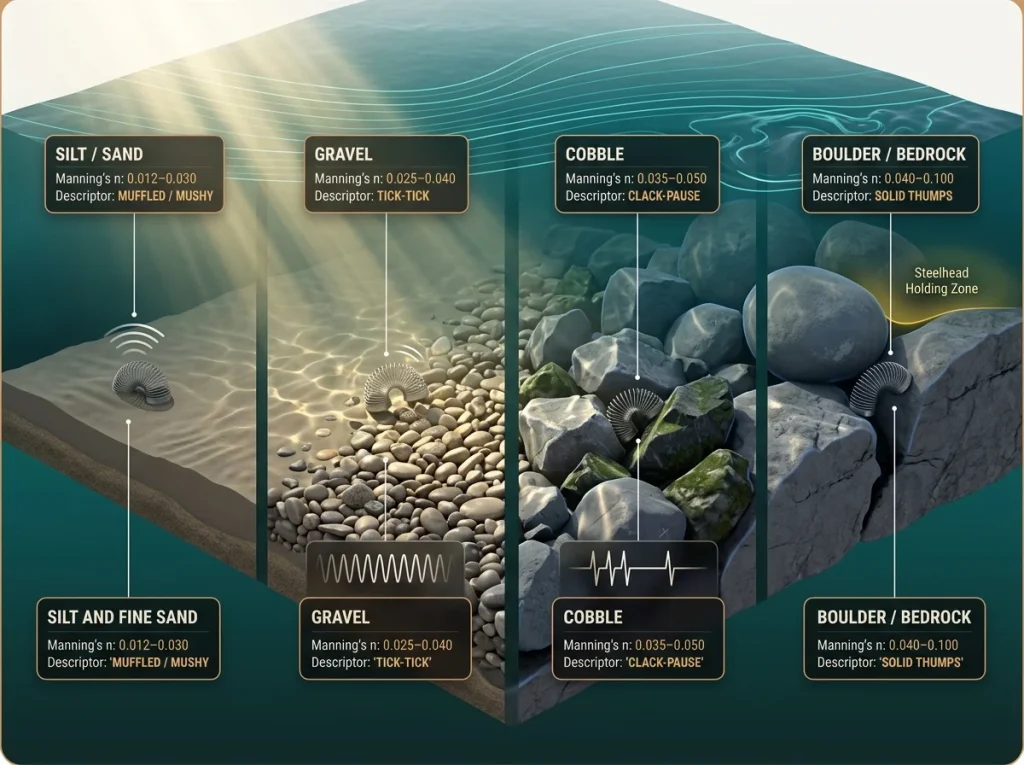
Manning’s n is a roughness coefficient used in hydraulic engineering to quantify substrate resistance. For an angler, it’s the calibration key that tells you what you’re feeling through the rod. Here’s the practical breakdown:
- Silt and fine sand (n = 0.012–0.030): muffled, mushy, low-vibration signal — you can barely distinguish anything
- Gravel (n = 0.025–0.040): consistent tick-tick, high-frequency signal — the ideal drift substrate
- Cobble and basalt (n = 0.035–0.050): sharp clacks with erratic pauses — high snag risk
- Boulders and bedrock (n = 0.040–0.100): solid thumps with frequent snags — requires constant weight adjustment
A steelhead strike cuts through these patterns as what Bill Herzog calls a “soft, spongy stop” — a momentary interruption that doesn’t continue the tick sequence. In cobble runs, counterintuitively, use lighter weight than you think you need. Too-heavy lead turns the cobble clacking into continuous noise, and the biological signal disappears into it completely.
Where Steelhead Hold — Pools, Seams, and Tail-Outs
Steelhead choose holding water based on one thing: minimizing energy expenditure. The bucket of a deep pool, where depth and reduced current let them rest. The current seam — that junction between fast and slow water — where migrating fish and baitfish concentrate. The tail-out, where the pool shallows before a rapid, is an aggressive feeding zone because bait appears to be escaping.
A practical read: where you see foam lines form on the surface, a current seam runs directly below. That’s your first target. For the deeper mechanics behind why seams hold fish, the physics of current seams and Kármán vortex streets explains the sub-surface fluid dynamics that make these zones so productive.
Pro tip: Start your coverage in Close–Middle–Far lanes within each run. Begin with 10–15 foot casts to avoid spooking nearshore fish, then extend to mid-river, then the far bank. After covering all three lanes, take 5 large steps downriver and reset. Systematic coverage beats random wandering every time.
The Biology of the Cold-Water Strike — Why Steelhead Hits Feel Like Nothing
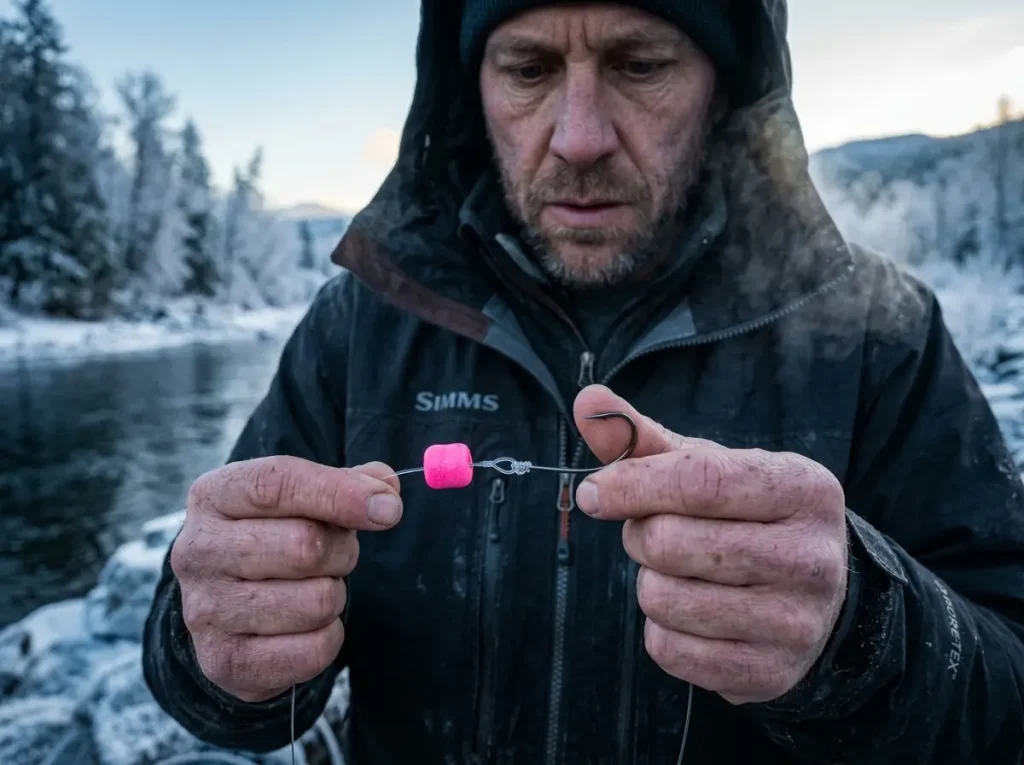
Steelhead are ectotherms. Their internal temperature and metabolic rate mirror ambient water temperature exactly. This isn’t just biology trivia — it’s the reason your strike detection has to change depending on the day.
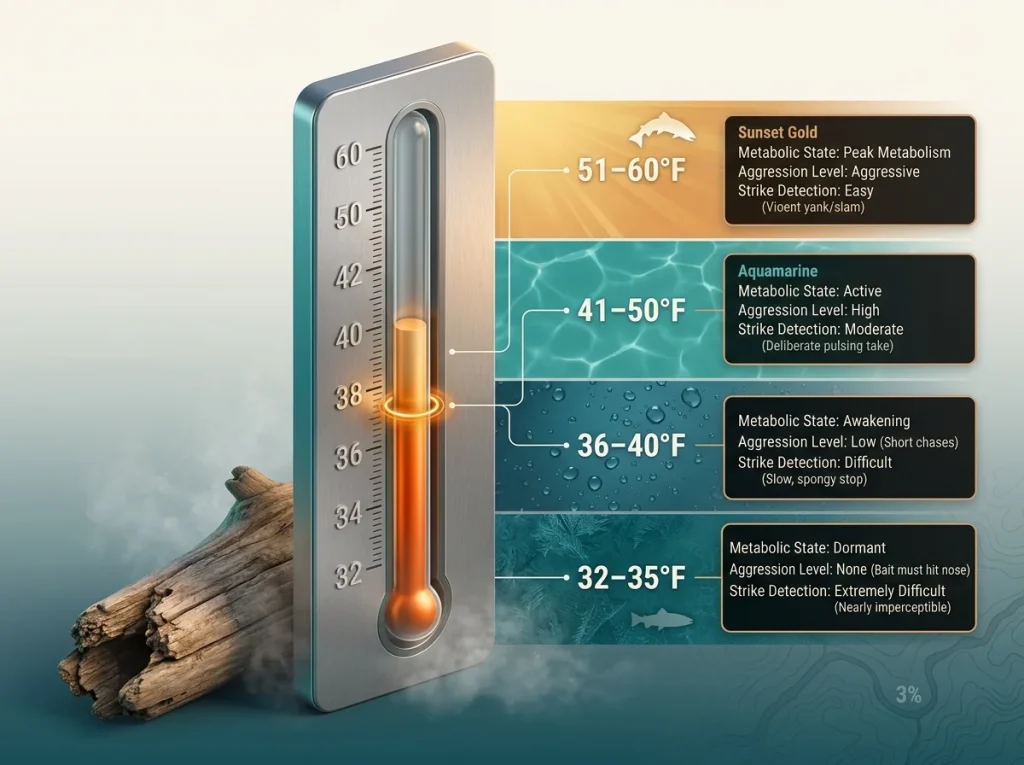
The Q10 principle in practical terms: for every 10°C drop in water temperature, metabolic rate roughly halves. What that means at the end of your line:
| Fish Activity & Metabolism Guide | ||
|---|---|---|
| Water Temp | Metabolic State | What You’ll Feel |
| 32–35°F | Dormant | Barely an interruption of the tick — nearly imperceptible |
| 36–40°F | Awakening | Slow “stop” — easily mistaken for a snag |
| 41–50°F | Active | Deliberate, pulsing take — the sweet spot |
| 51–60°F | Peak metabolism | Aggressive yank — almost impossible to miss |
At sub-40°F water, steelhead won’t chase. The bait must be delivered directly into the fish’s face. Drift placement becomes more critical than any other variable. Take a water temperature reading before you make your first cast. It tells you exactly how sensitive your detection needs to be.
Buzz Ramsey stated it plainly: “Always stay on high alert. Keep your eyes on the rod, never waver. Be always at the ready to set the hook.” In 36°F water, that advice isn’t motivational — it’s mechanical necessity.
According to the California State Water Resources Control Board’s report on temperature effects on steelhead trout biology and function, metabolic response to cold water is dramatic by life stage — fish in the 36–40°F range show significantly suppressed burst swimming capacity, which directly explains why strikes feel like nothing more than a pause.
For a deeper look at the mechanisms behind this, how water temperature controls fish metabolism and lure cadence bridges the steelhead-specific data to the broader biology of cold-blooded predators.
Rheotaxis and the Lateral Line — How Steelhead Detect Your Bait
Steelhead exhibit innate rheotaxis — they orient nose-directly into current all the time. This isn’t preference, it’s neurological. That orientation means the fish’s primary sensory organ, the lateral line, is pointed upstream, reading it for pressure changes and vibrations created by anything moving in the water.
The lateral line’s mechanoreceptors (neuromasts) detect what researchers call a “vortex dipole” pressure signature — the disturbance a drifting bait creates in the current. Peer-reviewed research on hydrodynamic fish orientation and lateral line mechanics in channel flow confirms that fish can perform rheotaxis without visual cues, as long as flow velocity activates those receptors.
For you, that means you don’t need gin-clear water. You need accurate drift placement and a bait with a vibration signature the lateral line can read — a Lil Corky or Spin-N-Glo buoyancy element does this by generating a spinning, pulsing movement that broadcasts through the water column ahead of the hook.
The “Soft, Spongy Stop” — Recognizing the Take
Bill Herzog’s classification of steelhead takes is the most useful framework for this problem. Three categories:
- Instant slack — the fish charges upstream toward you; the line goes dead because it moved faster than the current. This is the most frequently missed take. Anglers read it as a snag, when the fish has already eaten.
- Spongy stop — the fish mouths the bait and holds. There’s a momentary softening of tension, often followed by a secondary pulse.
- Pulsing chew — the fish is actively working the bait. Most detectable of the three.
The rule for distinguishing fish from rocks: rocks don’t release. A snag maintains constant tension. A steelhead, even a lethargic winter fish in 36°F water, generates at least one pulse or direction change within 1–2 seconds. On any stop or pause in the tick sequence — close the bail and reel straight and tight. Don’t swing, don’t yank. Reel tight.
Engineering the Perfect Rig — Terminal Tackle from Physics to Practice
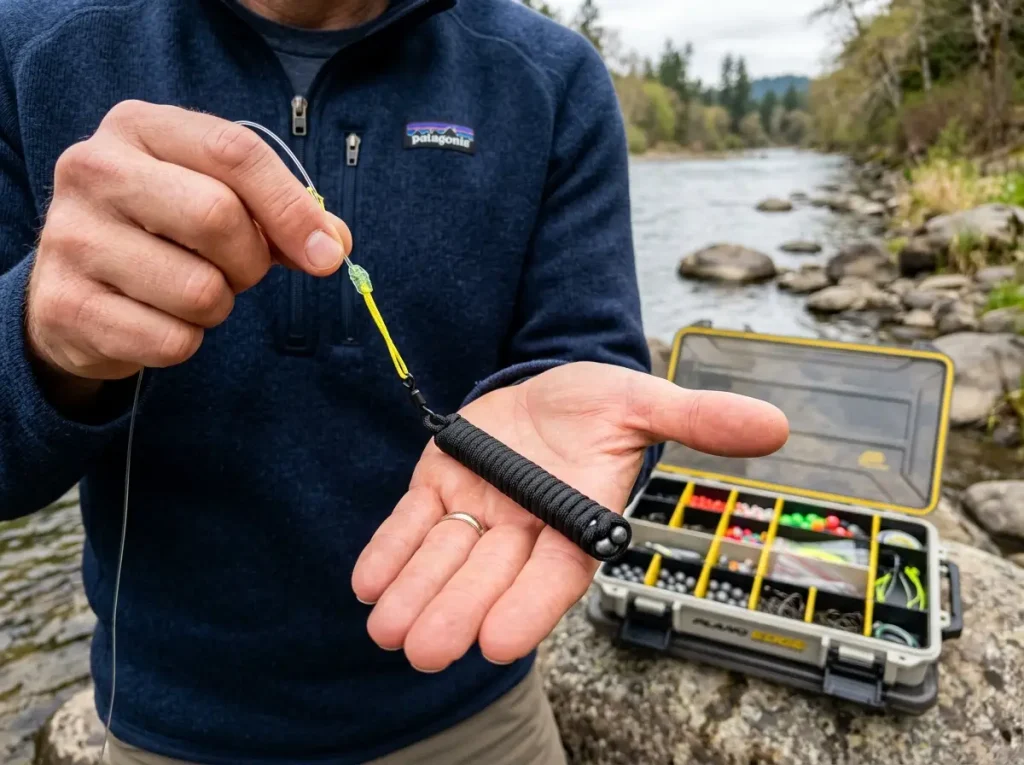
The rig isn’t gear — it’s a sensing instrument. Every component choice either improves or degrades your ability to detect what’s happening 20 feet away on the riverbed.
30 lb Hi-Vis Braid on the mainline: zero stretch means hookset energy transfers instantly, and the high-visibility color lets you watch the line for visual take detection. The limitation — and most guides won’t tell you this — is that braid absorbs water. In sub-32°F air temperatures, that water freezes on the guides and the reel spool, causing catastrophic bird’s nests on the cast. The solution is a 15-lb Maxima Ultra Green mono bumper section joined to the braid via Alberto knot. The mono won’t absorb water or freeze, and in ultra-clear low-water conditions it eliminates what anglers call the “shadow line” effect that spooks fish in the top few inches of the water column.
8–12 lb fluorocarbon leader: low refractive index makes it nearly invisible to fish; high abrasion resistance stands up to cobble. The leader-to-mainline junction is set at the first guide when fishing.
1/4–3/4 oz Slinky weight (buckshot in nylon cord): the flexible body walks over rocks that trap rigid lead. You lose dramatically fewer rigs in cobble fields. Build your own from 17mm nylon paracord and #7 shot — roughly $0.12 each. Losing three in a session becomes irrelevant.
For how fluorocarbon and braid perform differently in cold water, the performance difference between a frozen braid and a functioning mono bumper can be the difference between fishing and restringing.
Pro tip: Add a Lil Corky or Spin-N-Glo buoyancy element to lift the hook 2–4 inches off the substrate debris. It also amplifies the lateral line vibration signature. This is not optional on rivers with significant leaf and organic debris on the bottom.
Slinky Weight vs. Pencil Lead — The Anti-Snag Mechanics
This is a preference debate among drift anglers, but the mechanics aren’t equal. The Slinky weight — buckshot inside a mesh nylon tube — is flexible by design. It conforms to irregular substrate and walks over the cobble and basalt that trap rigid weights. In a typical cobble run (Manning’s n 0.035–0.050), Slinkies reduce snag-related losses by an estimated 60–70% compared to bell sinkers.
Pencil lead has its defenders, and they’re not wrong: it’s easy to clip or add segments for precise weight adjustment. In a slower pool with a cleaner gravel bottom, pencil lead gives you finer control. In boulder fields, you’ll lose it constantly.
The inline rig architecture matters here too. Concentrating the rig’s weight on a single axis eliminates the helicopter-spin during casting that tangles traditional rigs — and gets you 20–30% farther to those mid-river current seams where the fish hold.
The Anti-Sell of Hi-Vis Braid in Steelhead Conditions
The fishing industry sells hi-vis braid as the obvious answer for drift detection. It often is. But for anglers targeting winter steelhead specifically, there are two failure modes that almost no guide mentions.
The freezing threshold hits in sub-32°F air: braid fibers absorb water, that water freezes on the spool and guides, and your next cast goes nowhere. The mono bumper fixes this completely.
The shadow line problem shows up in ultra-clear, low-water conditions — the kind of thin, spooky tailouts you find after a week of no rain. Hi-vis pigment casts a visible line shadow that wary fish can see from below. The technique of visual line-watching as a secondary bite detection system in clear water covers how to read the line itself for visual takes, but the shadow problem requires the mono bumper to solve.
The Three Phases of a Productive Drift — A Kinetic Blueprint
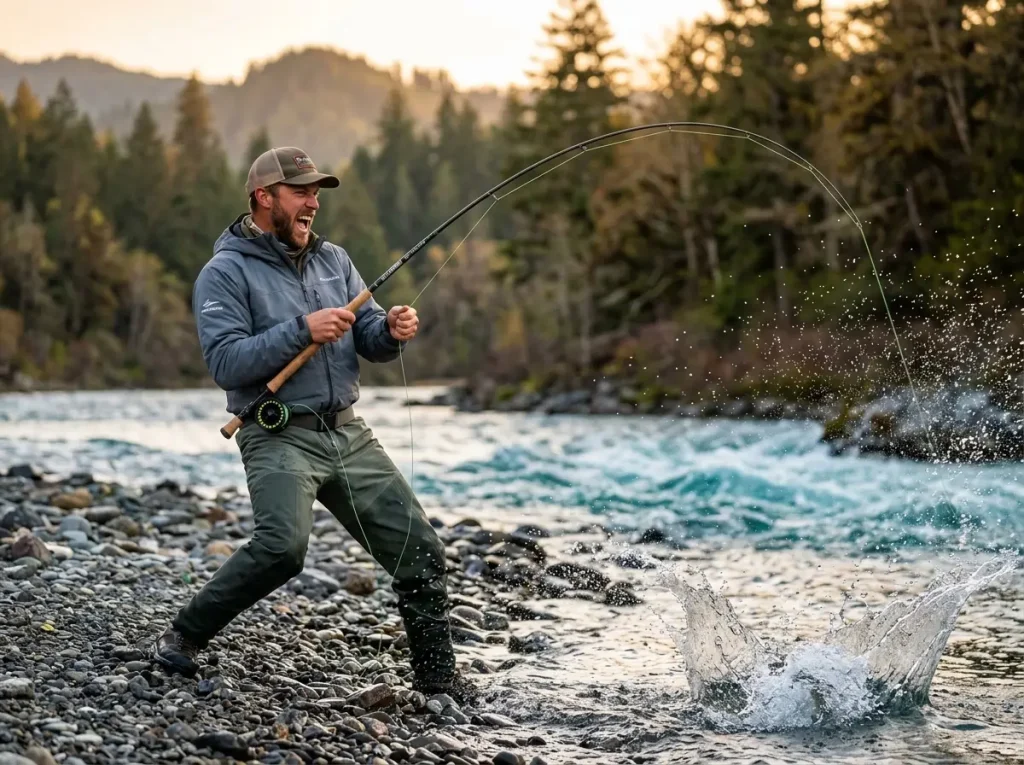
A productive drift is not a cast-and-wait. It’s a 3-phase kinetic sequence, and your attention and body position change at each phase.
Phase 1: Upstream entry and the mend. Cast at 45 degrees upstream. Let the weight sink. The moment the line lands, mend — lift the rod and throw a loop of line upstream. This prevents the faster surface current from pulling the rig into a horseshoe that drags the bait at an unnatural speed through the strike zone. In deep, fast water, a single mend is consumed in 3–4 seconds — you may need a double mend. In slow pools, over-mending can actually hurt the drift. Read the water first.
Phase 2: The kinetic drift — the “High Alert” state. Follow the line downstream with the rod tip, maintaining just enough tension to feel the substrate. The tip should nod occasionally — that’s the Slinky ticking the bottom. Counting those ticks builds a baseline rhythm for the substrate. Any deviation — hesitation, softness, sudden pressure — is your signal.
This is the phase where most bites get missed. People get comfortable during the drift and their attention wanders. Don’t. Every tick is a Manning’s n data point you’re processing in real time.
Phase 3: The tail-out swing and the reaction strike. As the rig passes your position, tension increases and the bait begins swinging toward the near bank. Steelhead hold in tail-outs — the shallow transition before a rapid — where bait appears to be escaping the pool. Strikes here are often more aggressive than kinetic drift strikes. But anglers relax at the end of the drift. Keep the bail ready, the rod loaded. Let the rig hang at the end of the swing for 3–5 seconds before reeling — fish sometimes follow and take on the pause.
For context on why float fishing handles this differently, how float fishing for steelhead compares to bottom-bounce mechanics explains the tradeoff: floats trade haptic feedback for visual bite detection, which is why the two methods suit different conditions.
The Haptic Differentiation System — Rocks vs. Fish at Your Fingertips
This is the skill that separates consistent steelhead anglers from everyone else. The taxonomy of what you feel:
Gravel tick: high-frequency, low-amplitude vibration — repeating, rhythmic, predictable.
Cobble clack: sharp, irregular, erratic — high amplitude spikes with pauses.
Boulder thump: low-frequency, high-amplitude — the rod loads briefly.
Steelhead “spongy stop”: a momentary softening of tension, often followed by a secondary pulse.
Steelhead “instant slack”: complete loss of tension — the fish charged upstream.
The key rule: rocks don’t release. A snag maintains constant tension. A fish, even a lethargic winter steelhead, generates at least one pulse or direction change within 1–2 seconds of the take.
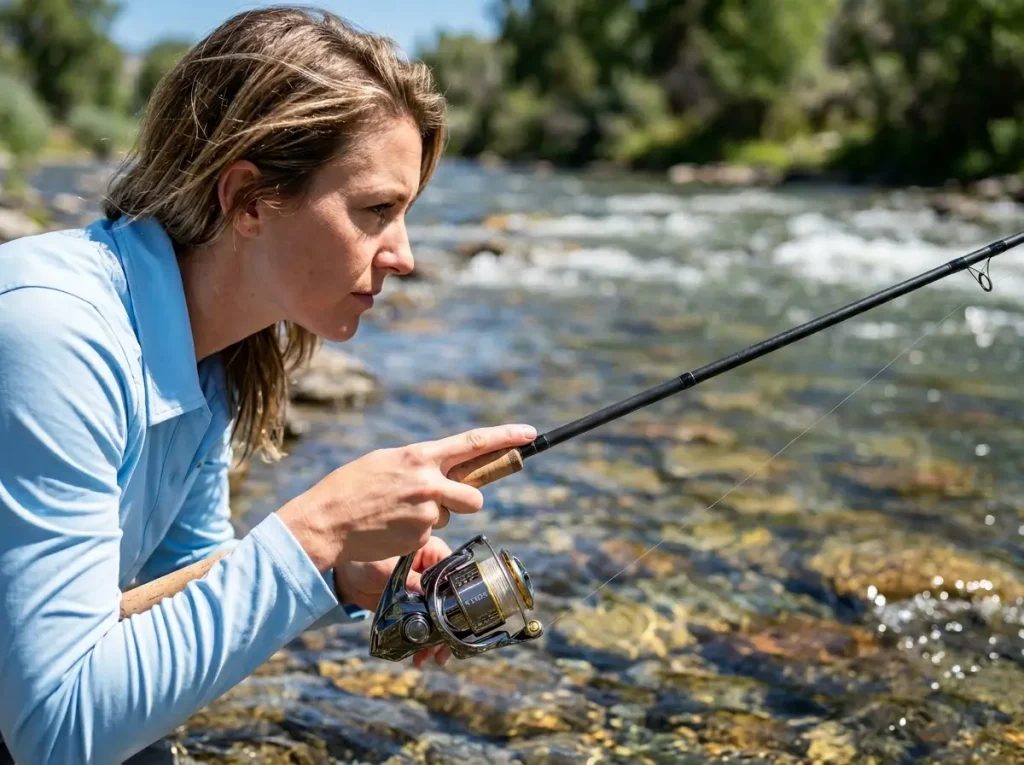
Here’s where most guides stop explaining and start just telling you to “feel for it.” But there’s a mechanical reason you can develop this sensitivity faster with the right rod angle. Hold the rod at 10–11 o’clock: enough reach for a full drift swing, enough tip travel to absorb the initial surge when a fish runs. Drop below 9 o’clock and you lose shock absorption — a charging fish rips the rod down before you can respond. Rise above 12 o’clock and you create drag on the bait. Ten to eleven is the zone, every time.
For the mechanics behind making this sensing system work, the mechanics of detecting subtle bites through high-modulus graphite covers the rod modulus science that makes haptic detection possible in the first place.
Pro tip: Count the ticks. Seriously — count them. When you establish a rhythm for the substrate you’re fishing, any break in that rhythm becomes impossible to ignore. This is what Buzz Ramsey means by “High Alert.” It’s not a mindset suggestion, it’s a counting exercise.
High-Modulus Graphite — Engineering Your Haptic Receiver
Rod modulus is the stiffness-to-weight ratio of the carbon fibers in the blank. Higher modulus = lighter tip = faster vibration transmission to your hand. Weight at the tip dissipates the energy before it reaches you — which is exactly what you can’t afford when a 36°F steelhead barely twitches the line.
Practically speaking:
- G. Loomis NRX+ (aerospace graphite + nano-resin): maximum sensitivity, 15% lighter than GLX — best for low-flow, subtle cold-water takes in the 36–40°F range
- G. Loomis GLX (proprietary graphite): high power-to-weight — versatile across varying depth and current speeds; the classic steelhead drift rod
- G. Loomis IMX-PRO (high-modulus graphite): 18% weight reduction over E6X — professional durability at a lower price point
- St. Croix Legend Elite (SCVI carbon + IPC technology): refined taper and sensitivity; strong choice for bank anglers who cover a lot of water on foot
Rod length: 8’6″–10’6″. Longer rods give you mend reach and downstream leverage. Shorter rods are more precise in tight, timbered stretches. Default to 9’6″ if you fish varied water.
The “Friction Circle” of Rod Angle and Line Tension
Adapted from vehicle dynamics engineering, the friction circle concept describes the maximum force available in any direction before control is lost. In drift fishing, it translates directly to rod angle management.
Rod at 10–11 o’clock balances two competing needs: enough “reach” to allow the full drift swing without creating line drag, and enough “recovery” travel in the tip to absorb the initial surge when a fish runs. Go lower than 9 o’clock and you have reach but no shock absorption — a charging fish rips the rod flat before you can set. Go higher than 12 o’clock and you have shock absorption but you’re pulling the bait off the bottom unnaturally.
The “optimal zone” is maintaining just enough line tension to feel the tick-tick sequence without creating drag that pulls the bait at a speed the fish won’t touch. In fast water, lower the rod slightly to prevent surface current from bellying the line. In slow pools, raise it to maintain tick contact. Adjust constantly — the river doesn’t stay still.
Conservation Ethics and Steelhead Stewardship — Why It Matters More Than Your Catch Rate
Steelhead are in trouble. As of July 2024, NOAA Fisheries has listed 28 steelhead population groups on the West Coast as threatened or endangered under the Endangered Species Act. The most recent 5-year population data (2015–2019) shows an average 43% decline across 16 evaluated populations in the Middle Columbia River, according to the NOAA Fisheries 2024 Middle Columbia River steelhead status report. Over 80% of tidal wetlands in the Puget Sound have been lost.
That context changes what ethical angling means for this species specifically.
Water temperature matters for conservation too, not just detection. The Maximum Weekly Maximum Temperature (MWMT) threshold of 68°F (20°C) triggers migration blockage and lethal thermal stress. In summer months on rivers approaching that threshold, consider whether it’s appropriate to fish at all.
For the regulatory framework on the Columbia River system, the Columbia River system and mark-selective steelhead regulations covers which fish you can retain, when, and where — and it changes annually.
Barbless Hooks and the Science of Fast Release
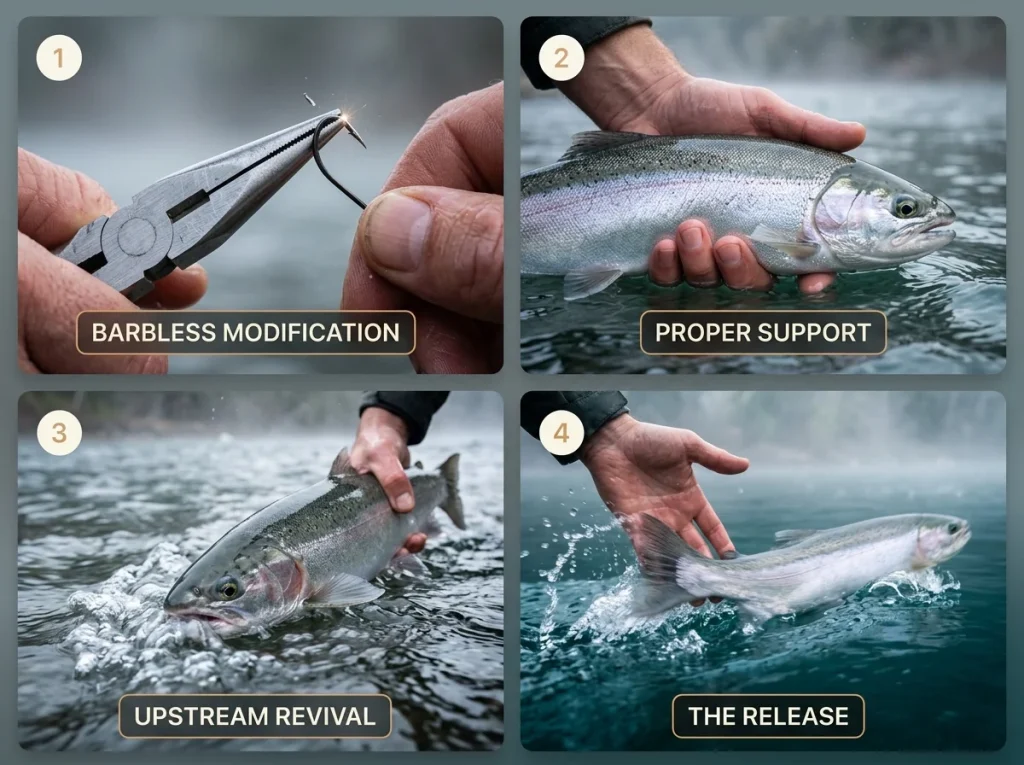
Barbless hooks require 30–50% less force to remove from tissue. Less handling time, less cortisol spike, higher post-release survival. This matters for wild steelhead specifically — fish already carrying the metabolic cost of a migration and a cold-water fight.
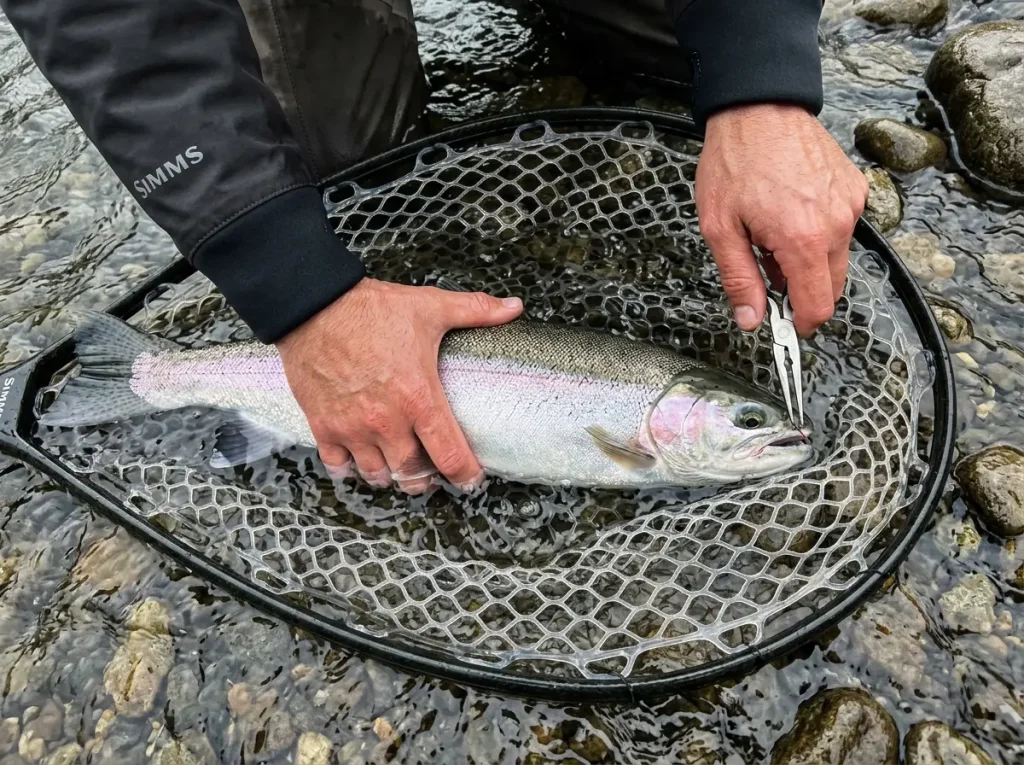
Clinch the barb on your Gamakatsu Octopus hook with needle-nose pliers. It takes 10 seconds and costs nothing. Legal under most barbless regulations.
The “wet your hands” advice is real but often misunderstood. Wetting your hands before handling the fish protects the slime coat. But that protection is meaningless if you then hold the fish in the air for a 90-second photo. The hold-your-breath rule is more honest: never hold the fish out of water longer than you can hold your breath. Use a rubber-mesh net and keep the fish submerged whenever possible.
Pro tip: Revive the fish facing upstream in fast current. Hold it gently by the tail wrist until it pulls away from your hand on its own power. Don’t “launch” it. A fish that hasn’t recovered will roll immediately after release — go back and revive it properly.
Hatchery vs. Wild — The Mark-Selective Decision
Most steelhead rivers operate under mark-selective regulations: only adipose fin-clipped hatchery fish may be retained; wild unclipped fish must be released immediately. This is not optional.
Make the identification before the fish leaves the water. The adipose fin — the small, fleshy fin between the dorsal and the tail — is clipped on hatchery fish during the smolt stage. A damaged or irregular fin is not the same as a clean clip. Confirm the clip, then decide retain or release.
Some rivers require both a clipped adipose and a healed scar at the clip site. Check your specific river regulations annually — they change.
Putting It Together
Three things that actually move the needle for steelhead detection:
First, physics of the drift: match weight to current speed, mend immediately, and keep the bait in the bottom foot of the water column. Not near it — in it. Every element of rigging flows from this constraint.
Second, cold water means soft takes: calibrate your expectations to the thermometer before you make a cast. A steelhead in 36–40°F water will produce barely a hesitation on the line. Set the hook on any deviation from the tick rhythm, every time, without exception.
Third, your rod is a sensing instrument: a high-modulus graphite blank isn’t a luxury — it’s the primary transducer in your detection system. The money you save on a cheap rod is paid in missed fish. That’s the physics.
Take your water temperature gauge next trip. Check the reading before the first cast. If the water is 38°F, you’re looking for a whisper. Maintain the “High Alert” state Buzz Ramsey describes — because the fish are still out there, holding in the current seam you just waded through, waiting for a bait that reaches them correctly. The river tells you exactly what’s happening. You just need to know how to listen.
FAQ
What is the best weight for drift fishing steelhead?
A Slinky weight between 1/4 and 3/4 ounce handles most steelhead rivers well. The Slinky — buckshot inside a nylon cord — walks over irregular substrate without hanging up, keeping your bait in the strike zone longer than rigid sinkers. Adjust weight until you’re ticking the bottom every few yards; constant dragging means over-weighted.
How do you tell the difference between a rock and a steelhead bite?
Rocks maintain constant tension and don’t pulse. A steelhead bite — even in lethargic cold water — produces either a spongy stop (momentary softening followed by a secondary pulse) or instant slack (line goes dead because the fish charged upstream). Any deviation from the rhythmic tick-tick pattern of the substrate warrants a hookset: close the bail and reel straight and tight.
What size hook should I use for steelhead drift fishing?
Size 2 or 4 Gamakatsu Octopus, chemically sharpened. Hook size should match bait size: a size 4 for a small cluster of eggs or sand shrimp, a size 2 for a larger offering. Pinch the barb flat for quick, clean releases that comply with barbless regulations on most steelhead rivers.
Does line color matter in steelhead drift fishing?
Yes — conditionally. High-vis braid (30 lb) is ideal for tracking the drift in typical conditions. In ultra-clear, low-water conditions, the hi-vis pigment can create a visible shadow line that spooks fish. The fix is a 15-lb Maxima Ultra Green mono bumper joined to the braid at the first guide — provides stealth and cold-weather freeze resistance.
What water temperature is best for steelhead drift fishing?
The active zone (41–50°F) produces the most consistent hookup rates — fish are metabolically active enough to intentionally take a bait, but still cold enough to need a precise, low-energy presentation. Below 40°F, strikes become extremely subtle; the drift must land directly in the fish’s lie. Above 55°F, even a competent drift over the right water will produce results.
Risk Disclaimer: Fishing, boating, and all related outdoor activities involve inherent risks that
can lead to injury. The information provided on Master Fishing Mag is for educational and informational purposes
only. While we strive for accuracy, the information, techniques, and advice on gear and safety are not a substitute
for your own best judgment, local knowledge, and adherence to official regulations. Fishing regulations, including
seasons, size limits, and species restrictions, change frequently and vary by location. Always consult the latest
official regulations from your local fish and wildlife agency before heading out. Proper handling of hooks, knives,
and other sharp equipment is essential for safety. Furthermore, be aware of local fish consumption advisories. By
using this website, you agree that you are solely responsible for your own safety and for complying with all
applicable laws. Any reliance you place on our content is strictly at your own risk. Master Fishing Mag and its
authors will not be held liable for any injury, damage, or loss sustained in connection with the use of the
information herein.
Affiliate Disclosure: We are a participant in the Amazon Services LLC Associates Program, an
affiliate advertising program designed to provide a means for us to earn advertising fees by advertising and linking
to Amazon.com. As an Amazon Associate, we earn from qualifying purchases. We also participate in other affiliate
programs and may receive a commission on products purchased through our links, at no extra cost to you. Additional
terms are found in the terms of service.