In this article
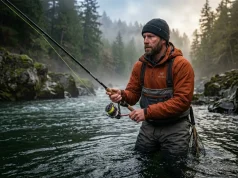
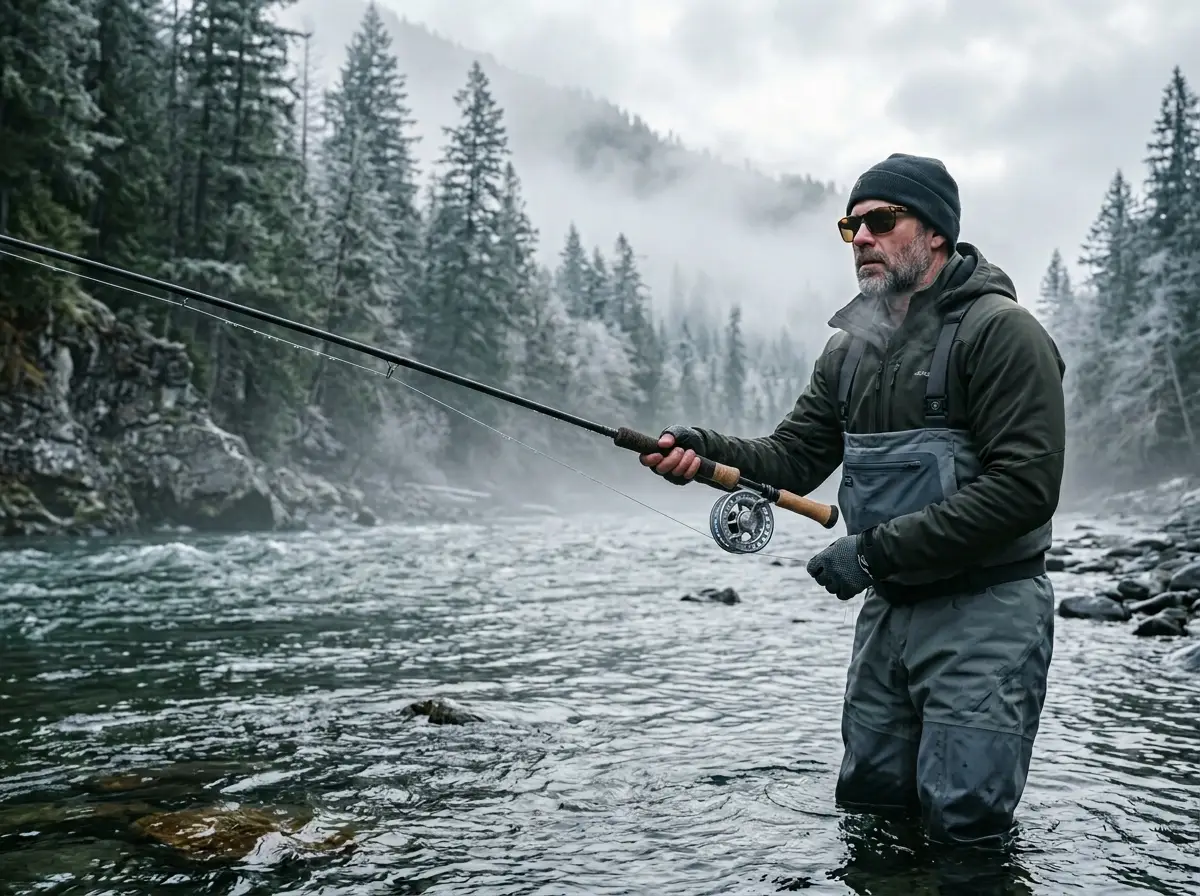
The thermometer clipped to my wading staff read 37°F when I stripped my seventh fly change through the tailout. The guide upstream was hollering “chrome in!” — but the fish had been sitting there for twenty minutes without moving an inch. He blamed the sun. He was wrong. The water temperature was the answer. It always is.
I’ve spent enough time on steelhead rivers to know that most of what gets passed down guide-to-client is either half-right or completely backwards. Not because guides are bad at their jobs — but because fisheries science moves faster than river gossip. The data on metabolic activity, smoltification, redd location, and drag startup inertia has been around for years. It just hasn’t made it to the drift boat yet.
This article bridges that gap. Biology to boat. Six hard truths most guides get wrong — backed by the data, explained in plain language you can use on the water tomorrow.
⚡ Quick Answer: Steelhead and rainbow trout are the same species — Oncorhynchus mykiss — separated by life-history strategy, not taxonomy. Behavior is almost entirely driven by water temperature: fish are aggressive between 42–58°F, nearly comatose below 36°F, and in serious thermal stress above 68°F. Active fish hold in seams and tail-outs, not deep pools. Set your reel drag at 25–33% of tippet strength using a hand scale — not by feel — and re-verify it after the reel has been sitting in cold air for 30 minutes.
The Biology Guides Get Wrong — Steelhead Are Not a Species
Ask most guides what makes a steelhead different from a rainbow trout and you’ll hear something like “it goes to the ocean.” That’s technically accurate and completely misses the point. Both fish are Oncorhynchus mykiss. Same species. The differentiation isn’t taxonomic — it’s a life-history decision regulated by genetics and environment. The anadromous life-history and federal listing status of Oncorhynchus mykiss through NOAA Fisheries makes this clear: steelhead are managed as a distinct conservation unit not because they’re a different fish, but because the migratory life-history itself is what’s at risk.
The mechanism is the Omy5 chromosome, a specific genetic marker that influences whether a juvenile will undergo smoltification and migrate to the ocean or stay put as a resident rainbow. What’s genuinely surprising — and what I’ve never heard a guide mention — is that the same brood can produce both outcomes. One sibling ends up in the Pacific; the other stays in the same 200-yard run for six years. This is called facultative anadromy, and it’s why NOAA treats steelhead as a separate management concern rather than simply a different flavor of trout.
The practical implication? Dams don’t harvest steelhead directly. They kill the selection pressure for anadromy — slowly pushing a population toward residency across generations. Museum DNA analysis has confirmed this in multiple Pacific drainages. The fish “chose” residency because the migratory option was removed. When clients ask me why the resident bows are so thick in certain tailwaters below blocked dams, that’s the answer. It’s Omy5 frequency in the drainage, not fish preference.
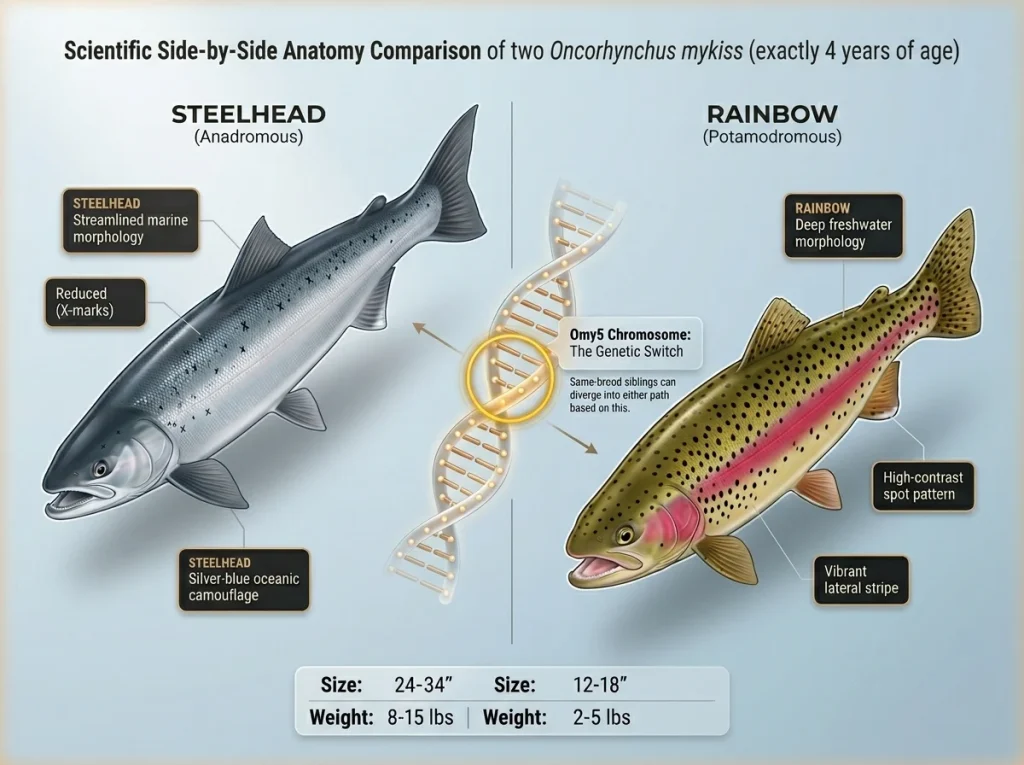
For a deeper look at the biology separating migratory and resident O. mykiss, the rainbow trout biology and what separates a resident from a migratory fish breakdown covers the full species architecture before and after smoltification. Worth reading before your next trip to a managed tailwater.
Smoltification — The Physiological Transformation
Smoltification isn’t triggered by a calendar date. It’s a response to photoperiod and water temperature cues converging in spring — and the hormonal cascade that follows is significant. Cortisol, growth hormone, and thyroid hormones restructure the fish’s osmoregulatory systems from scratch. The kidneys reverse function: freshwater kidneys excrete dilute urine; saltwater kidneys conserve water aggressively. The fish that enters the ocean in May is functionally a different animal than the one that left your home run in March.
Pro Tip: Smolts in peak transformation are the most vulnerable to water temperature spikes. A warm April is a biological trap for outmigrating juveniles — increased metabolic demand with no food resource to match. When you see steelhead in distress during spring outmigration, temperature is the first thing to check, not disease.
Iteroparity — Why Steelhead Come Back
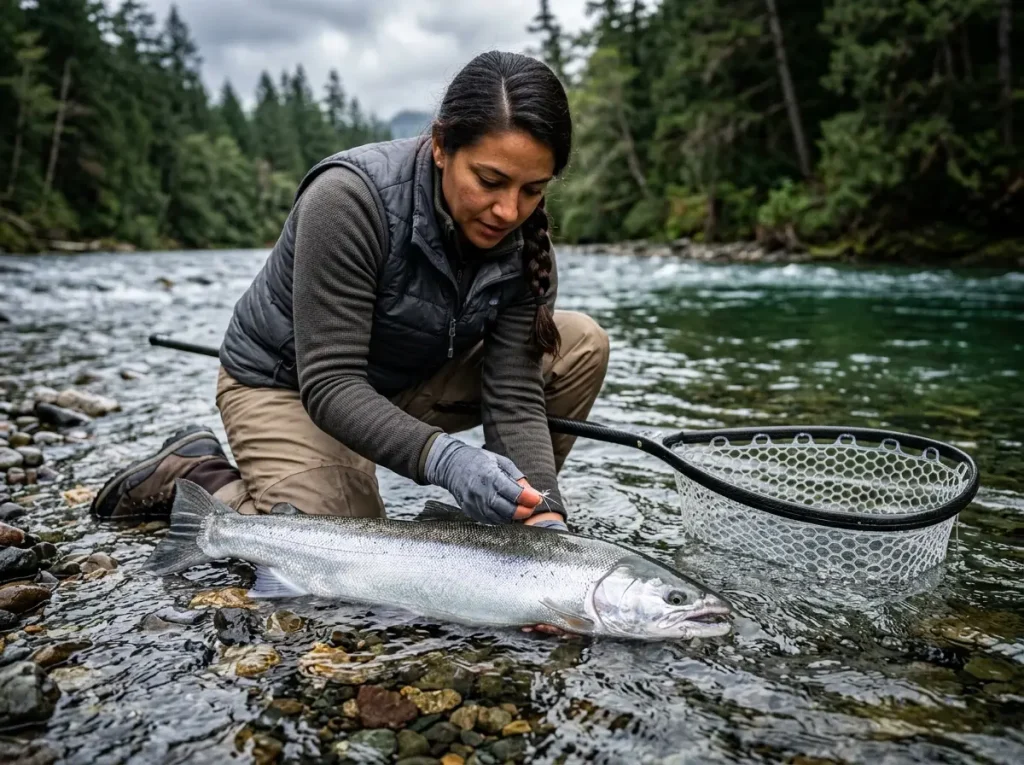
This is the one biologists know cold and guides consistently botch. Unlike Chinook, Coho, or Sockeye — which spawn once and are finished (semelparous) — steelhead are iteroparous. Post-spawn fish, called kelts, can survive, drift back to the ocean, recondition, and run again.
Kelt survival is basin-dependent: up to 30% in short coastal streams, 1.6–17% in the Columbia River system, and as low as 0.69–2% in the Snake River, where eight hydroelectric dams take their toll on every downstream migration. Winter-run fish enter rivers with higher energy reserves and survive at higher rates than summer-run fish, which must hold in freshwater far longer before spawning and arrive at the kelt stage running on empty.
Metabolism as the Master Variable — The Thermal Truth
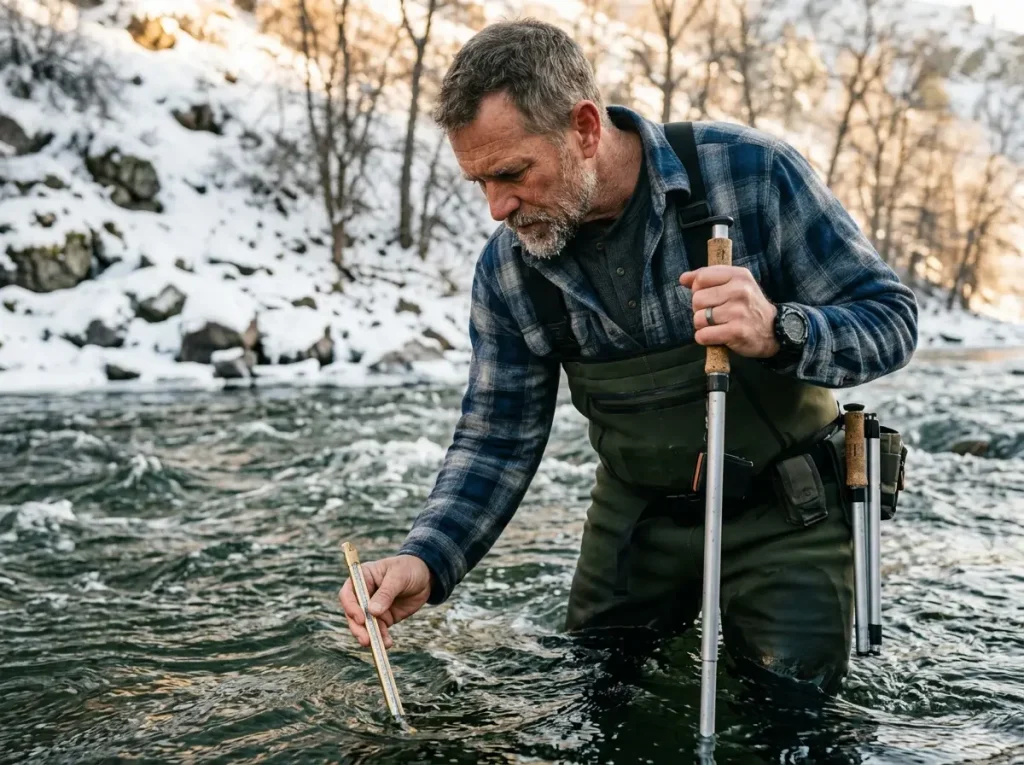
Here’s where most guides get it categorically wrong. When the bite shuts down, they blame the sun. They blame pressure. They switch flies. They move clients to new runs. Almost none of them check the thermometer.
Steelhead are poikilotherms — their metabolic rate is entirely set by ambient water temperature. Their whole biological reality flows from that single number. And not just the number itself: the direction of change matters as much as the reading.
The critical concept is “scope for activity” — the difference between a fish’s basal metabolic rate and its maximum aerobic capacity. As temperature drops away from the optimum window, that scope collapses. At 32–36°F, the fish has almost no energy available for anything beyond breathing. It will not chase. A dead-drift, presented directly in its eye-line, is the only legitimate tactic at that temperature — not because it looks natural, but because it removes the metabolic cost for the fish to intercept it.
At 42–58°F, scope is wide open. That’s the aggressive window. The swing works here because the fish has the energy to move laterally, accelerate across current seams, and hit something hard. At 50–55°F specifically, you’re at peak performance — the fish is as athletic as it gets. Above 68°F, targeting steelhead is unethical. The steelhead metabolism and temperature science for anglers breakdown from Wild Steelheaders United puts it plainly: it’s not just behavior that changes — it’s survivability. Fight stress plus thermal stress above 68°F produces metabolic failure that doesn’t reverse on release.
Pro Tip: Check water temp at dawn, then again at 10am. If it rose 3°F, expect fish to be moving into seams and feeding windows to open. If it dropped — cold front overnight, or snowmelt pulse — fish deep and slow. Forget the swing.
Watch the direction, not just the number. A rising 48°F is a different fish than a falling 48°F. At 42.8°F, a steelhead burns through roughly twice the oxygen it does at lower temperatures. At 53.6°F, that’s nearly double again. At 59°F, nearly three times the baseline. The fish that barely moved at dawn is a completely different animal by 11am if the river warmed four degrees. Knowing how water temperature controls fish metabolism and lure cadence turns that thermometer reading from trivia into a tactical decision.
The 7-DADM (Seven-Day Average of Daily Maximums) is the regulatory metric fisheries managers use to assess stream temperature suitability. When that number climbs, voluntary or mandatory closures follow. Know it. Respect it.
Hydrodynamics — Reading the River Like a Friction Map
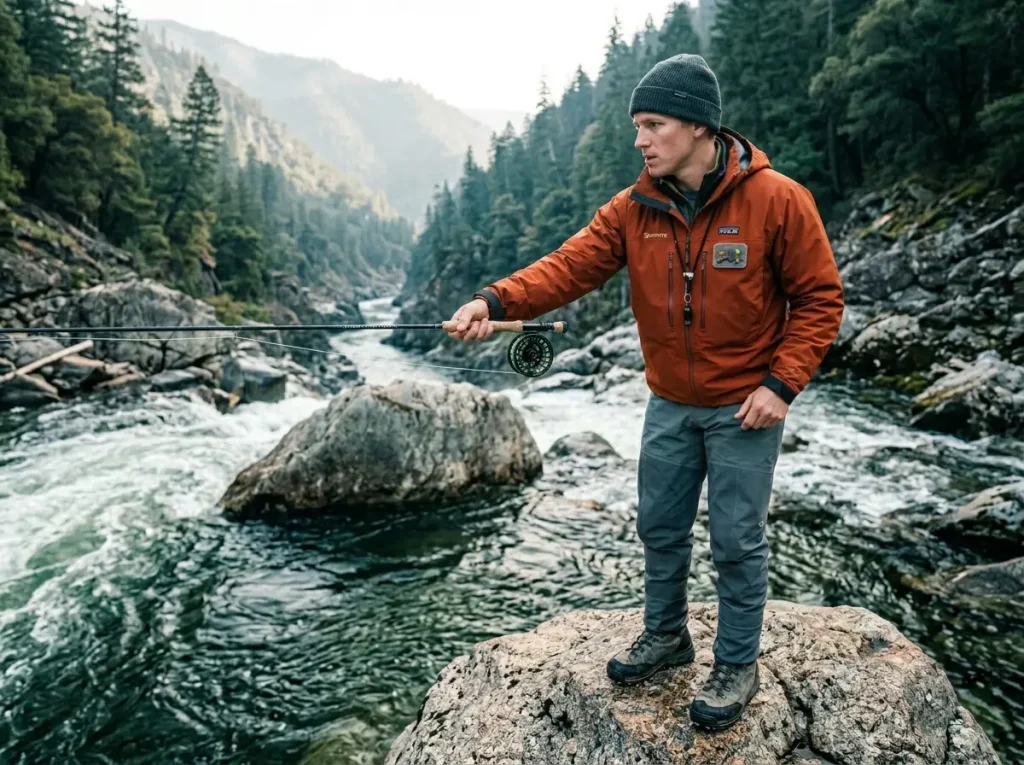
The most consistent mistake I’ve watched guides make is sending clients to the deepest pool on a run and leaving them there for four hours. The pool is safe water — rest water. That’s where fish go when they’re not active. The fish that ate that morning were in 18 inches of water at the top of the riffle, doing nothing but breathing and waiting.
The river isn’t just “water.” It’s a series of flow vectors shaped by depth, gradient, and substrate roughness. Manning’s n (the roughness coefficient) is a number that describes how much friction the riverbed applies to the flow. Higher n means more turbulence at the substrate — and more turbulence means a deeper gap between surface speed and bottom speed, which creates more low-energy holding space for fish.
Smooth gravel beds run around n = 0.025 — consistent flow, few pockets. Boulder fields run 0.040–0.070 — high turbulence, distinct cushions of near-still water on the downstream face of every rock. Weedy, stony bottoms hit 0.035–0.080. The current seam physics and how Kármán vortices create holding pockets article maps this out fully. Short version: a fish sitting behind a boulder with n around 0.050 is sitting in nearly still water while inches away from a high-velocity conveyor of oxygen and food. That’s optimal holding. That’s where the fish are.
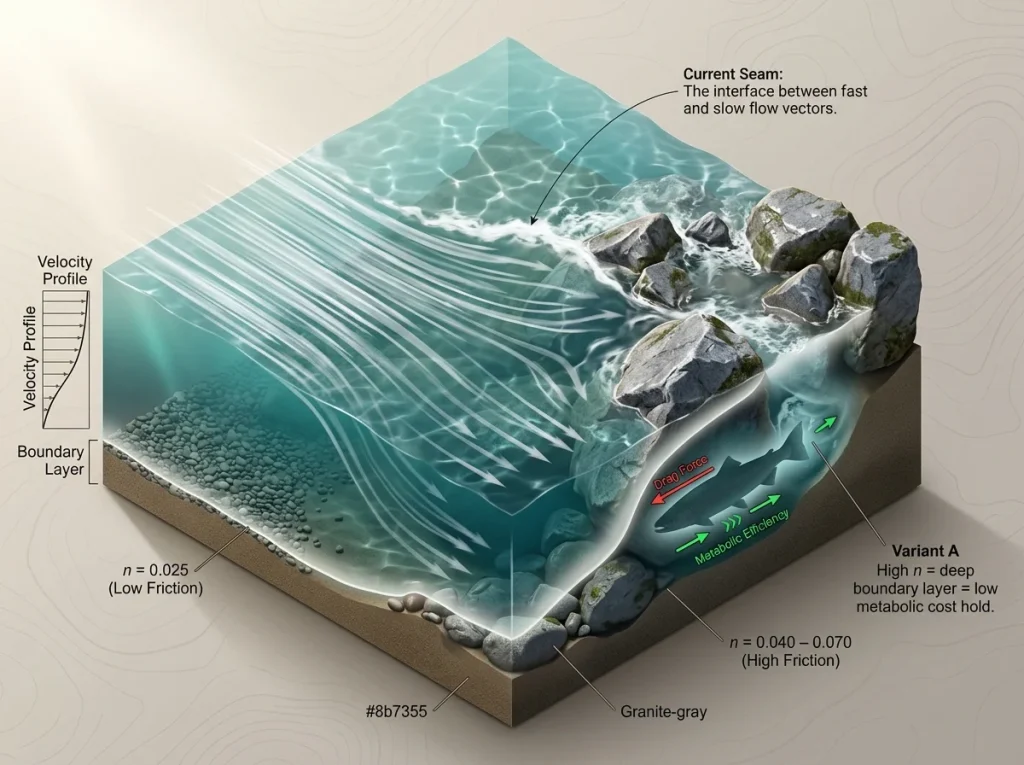
Active, aggressive fish hold in transition zones — tail-outs, seams, current boundaries — not in the deep hole. “Walking speed” water, roughly 1.5–3.0 ft/sec, is the metabolic sweet spot: enough current to bring food through, enough substrate roughness to hold without burning energy.
A seam is the visible boundary between fast and slow water — the foam line, the shear zone, the color change where water goes from green to white. The fish doesn’t hold in the fast current. It holds in the slow water adjacent to it, positioned to intercept whatever the current sweeps through. Land your fly in the fast thread and let it cross over the boundary layer where the fish is waiting. The first cast that puts the fly into the seam at 45° is the one that gets the take. Most anglers systematically cast too far into the slow water and miss the zone completely.
Pro Tip: When scouting unfamiliar water, read surface turbulence over a boulder field. High boiling turbulence at the surface means high n below — look for fish at midwater on the downstream face of those rocks, not on the gravel flat downstream.
The Science of Vision and Color Selection
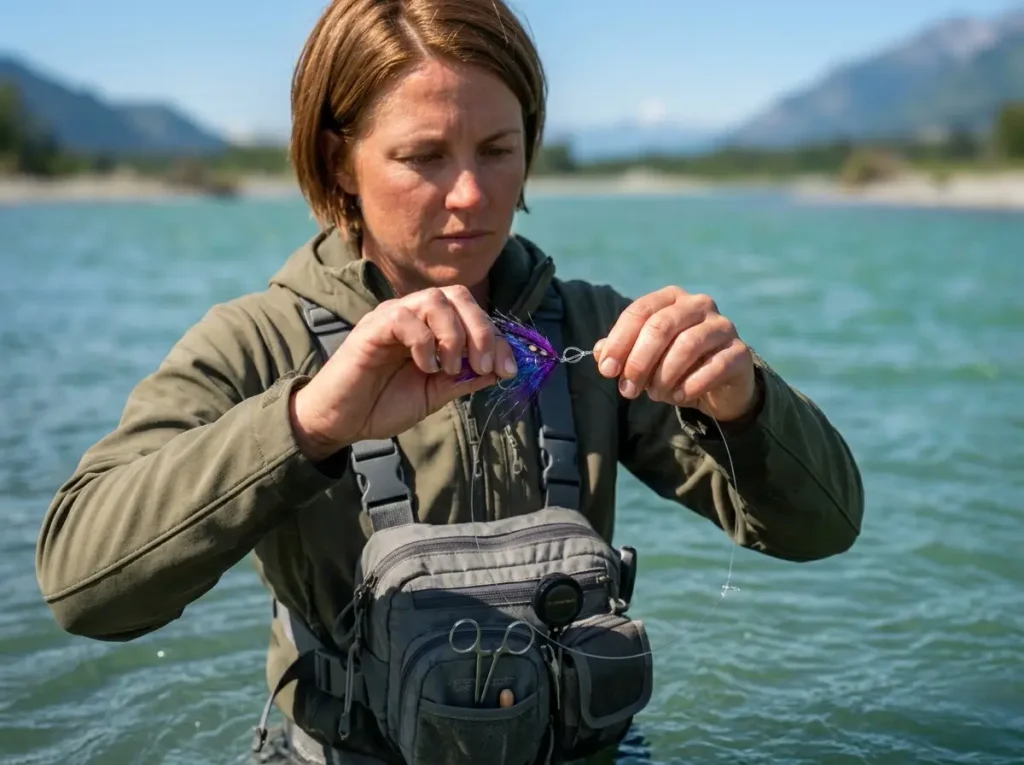
Most guides recommend “Red” for winter steelhead. This is physically incoherent advice. Red light is absorbed within the first 3–10 feet of water depending on turbidity. In a typical winter run, a red fly at depth looks like charcoal. It’s not a bad color — it’s an invisible one.
Steelhead are tetrachromatic: they possess UV-sensitive cones, especially prominent in juveniles and chrome fish fresh from the ocean. Blue and green wavelengths travel furthest and retain their color in deep or turbid conditions. “Steelhead Green” water — that characteristic 18–24″ visibility teal tint — is the reference condition for color selection in most winter fisheries.
UV-reflective synthetic materials produce a “halo” effect at low light angles (dawn, dusk, overcast afternoons) that standard materials cannot replicate. This is why attractor patterns like Intruders and Egg Sucking Leeches with UV flash work disproportionately well in low-light conditions — and why fishing the same pattern at noon in direct sun often doesn’t match those results. UV sensitivity appears to decrease as fish spend more time in freshwater and begin to color up, so chrome fish likely respond to UV more strongly than fish that have been in the river for weeks.
The practical framework: in water with less than 12″ water clarity, abandon natural imitations entirely. High-contrast black/chartreuse or white/purple is the only reliable color regime. In “Steelhead Green” conditions, size 6–8 nymphs or small intruder-style patterns get the most looks. The fish’s lateral line and visual acuity work together as a dual detection system in those conditions — your fly needs to produce both visual and vibrational signatures. For color selection built on real optics, how fish see underwater and matching lure color to water depth and clarity maps light attenuation at specific depths directly to wavelength-specific presentation.
I carry a small dive light to test flies streamside. Red materials in 4 feet of green-tinted water look like charcoal. I switched to chartreuse/blue rigs in winter years ago and haven’t looked back.
Reel Drag Physics and the Anti-Sell
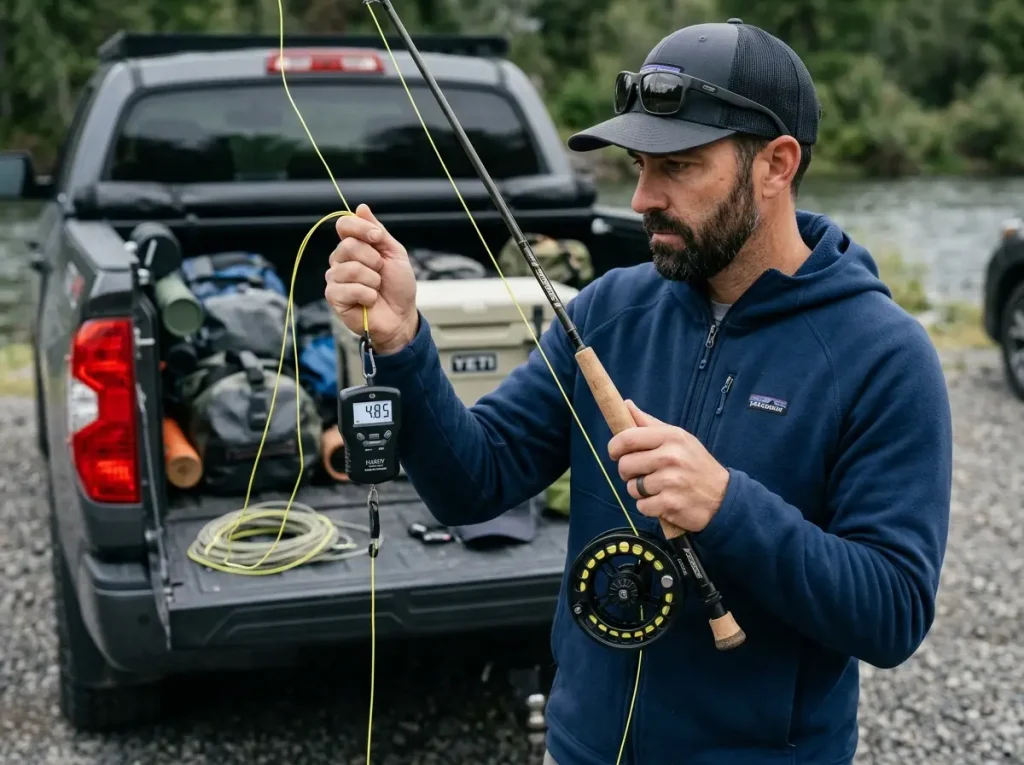
The industry markets “30 lbs of stopping power.” Every guide who buys into that metric doesn’t understand the physics of the problem. A steelhead angler fishing 10 lb tippet should never use more than 3 lbs of drag. The stopping power number is irrelevant. The number that matters is startup inertia.
When a fish bolts from a standing start, the reel must overcome its own internal friction before the spool begins to spin. In a reel with poor tolerances, that drag startup inertia can spike to 6–7 lbs before any line pays out — even if the drag is set at 3 lbs. As Marshall Cutchin documented for MidCurrent, “A drag that ‘sticks’ even briefly when a fish bolts sends a shock through the leader that can snap 3X tippet (about 8 lbs) before you react.” That’s not a fish problem. That’s a reel problem.
Cold temperatures make this worse. Cork drag washers are hygroscopic — they absorb moisture from the air. When that moisture freezes, the cork expands, dramatically increasing drag tension beyond the calibrated setting. This is why breakoffs concentrate in the first 2–3 seconds of a fish’s run in cold air — before the spool warms and the cork conforms back to its normal profile. A $200 reel with a sticky cork will break more fish on a 38°F morning than a $50 click-and-pawl with zero startup inertia. The full materials analysis is in our reel drag physics and thermal expansion of drag materials breakdown.
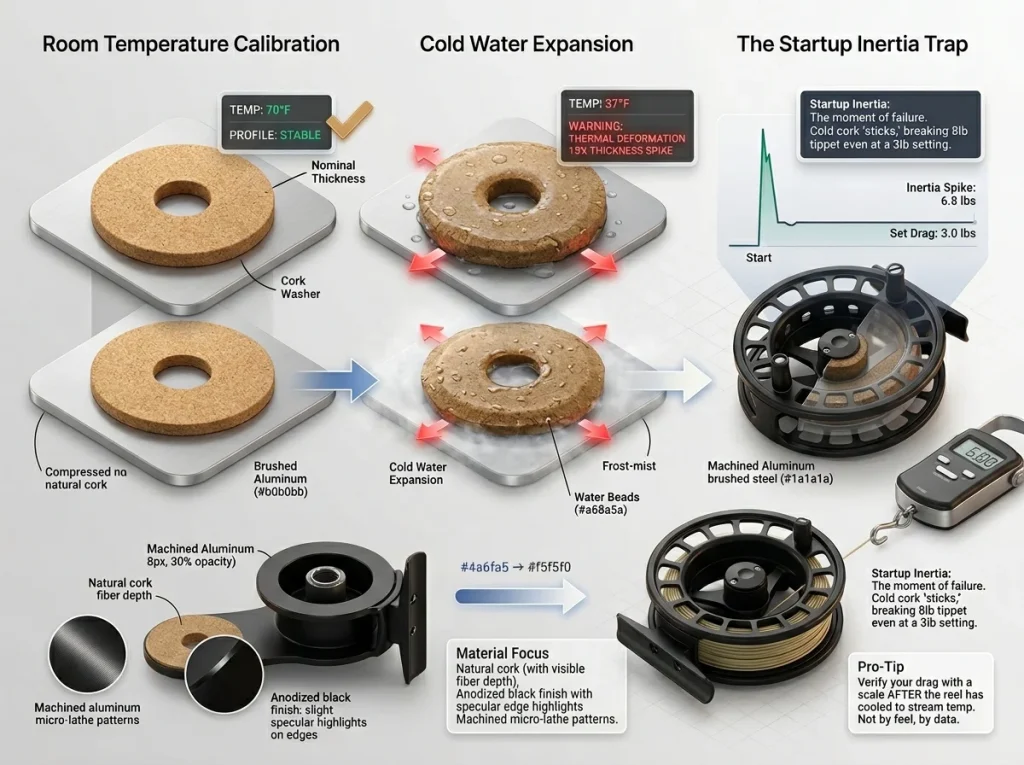
The correct method: set drag at room temperature using a hand scale at 25–33% of tippet breaking strength. Re-verify after the reel has been sitting in cold conditions for 30+ minutes. Not by feel. By scale. Drag setting “by feel” is calibrated to a warm hand and room temperature — it means nothing on the water at 38°F. If you’re running 8 lb fluorocarbon, your drag should be set at 2.0–2.6 lbs, confirmed cold. Note that cold-water fluorocarbon also stiffens below 40°F — its effective breaking strength can drop 10–15% — so adjust your setting downward accordingly.
Migration Navigation — The Chemistry of Coming Home
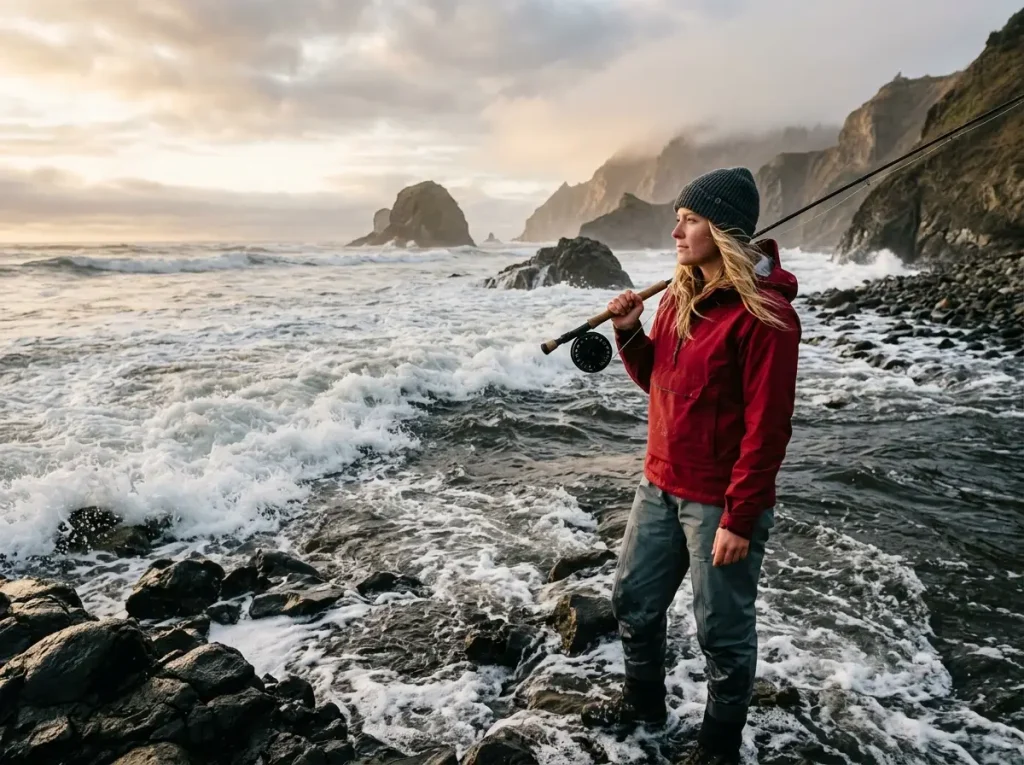
Every steelhead in your river has been navigating by systems you can’t see, from hundreds of miles offshore, to that specific run. This isn’t mystical — it’s magnetite and olfaction.
Steelhead use two distinct navigation systems at different migration stages. In the open ocean, magnetoreception takes over: tiny magnetite crystals embedded in the ethmoid region of the snout — connected directly to the trigeminal nerve — detect both the intensity and the inclination of Earth’s magnetic field. Together, these two data points give the fish a bicoordinate position fix. The fish “locks in” the magnetic coordinates of its home river mouth before departing for the ocean. The Oregon State research on magnetic navigation in Pacific salmonids confirmed this by showing that applying controlled magnetic pulses to salmonids alters their orientation in predictable, map-consistent ways. This isn’t compass orientation — it’s map-and-compass orientation. That’s why steelhead straying rates in undisturbed systems typically run under 5%.
As the fish re-enters coastal and freshwater influence, natal stream imprinting takes over. During smoltification, juvenile steelhead record the precise chemical fingerprint of their home watershed — dissolved minerals, organic compounds, microbial biofilm signatures, possibly pheromones from juvenile conspecifics. The fish stores this chemical signature and uses it to navigate back to its natal redd with meter-level accuracy on the return migration.
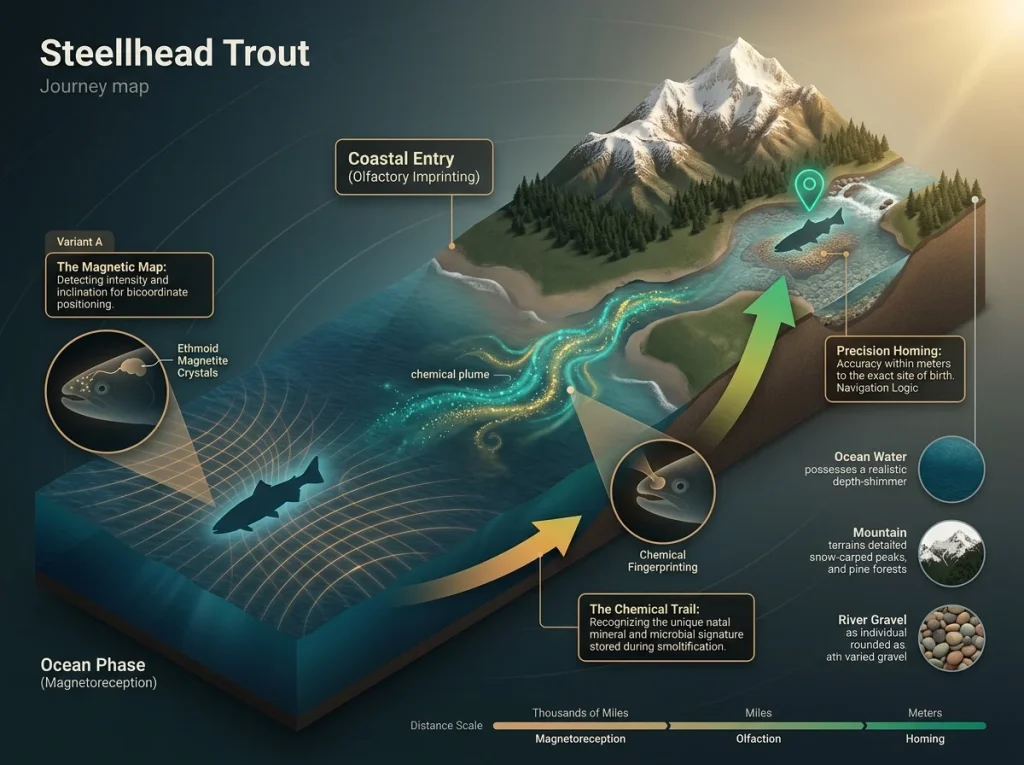
Hatchery fish imprinted on concrete raceways return to the hatchery outlet, not the river reach — displacing wild fish from prime holding water without contributing to the wild population. River restoration projects must pair structural habitat work with smolt releases from the restored reach itself, or the fish won’t come back to the rehabilitated water. Understanding how run timing and river navigation affect Columbia River steelhead and salmon tactics translates this biology directly to timing strategy on big-water systems.
Run timing follows from this biology. Winter-run steelhead enter rivers November through April, typically with developed gonads, shorter holding periods, and higher energy reserves — which is why kelt survival is higher in winter-run fish. Summer-run steelhead enter May through November while gonads are still immature. They must hold in freshwater for months before spawning, burning energy reserves daily. By August, a summer-run fish has been in the river for 60–90 days. It is not lazy. It is running on fumes. It will not chase anything. Dead-drift, metabolic presentation. Period.
What This Means on the Water
Three things you can apply immediately — no gear purchase required.
Clip a thermometer to your wading staff and check it every hour. Note the direction of change. A rising 48°F is a feeding window opening; a falling 48°F is a shutdown warning. Match your presentation to the fish’s metabolic state, not to the fly you’re most confident in.
Stop fishing the deep pool as a first choice. Find the seam at the tail of the pool, the current boundary where fast meets slow. That’s where active fish hold. The pool is where they go when they’re done being aggressive. If the drift speed rule that doubled hookups on moving water taught me anything, it’s that most anglers fish the wrong depth at the wrong speed — in the wrong part of the run.
Verify your drag with a hand scale before every trip when temperatures are below 40°F. Confirm it in cold conditions, not in your living room. If you’re running cork drags and your reel has been sitting in a cold drift boat for an hour, that calibration is gone.
The next time a guide tells you the fish are off because of blue sky, hand them the thermometer. Ask him what the water temp was at 7am and what it is now. If he doesn’t know — that’s the entire conversation right there.
FAQ
What is the difference between a steelhead and a rainbow trout?
They are the same species — Oncorhynchus mykiss — separated by life-history strategy, not genetics. A steelhead undergoes smoltification and migrates to the ocean; a resident rainbow stays in freshwater. Specific genetic markers on the Omy5 chromosome regulate this tendency, but the home stream’s productivity also plays a decisive role.
When do steelhead migrate?
Migration timing depends on ecotype. Winter-run fish enter rivers November through April; summer-run fish enter May through November but don’t spawn until the following spring. Timing is driven by temperature cues, photoperiod, and flow levels — not fixed calendar dates. A cold, wet October can advance a winter run by weeks.
Do steelhead die after spawning?
No — and this is one of the most common wrong answers on the riverbank. Unlike semelparous Pacific salmon (Chinook, Coho), steelhead are iteroparous and can survive spawning, return to the ocean as kelts, recondition, and run again. Survival rates are basin-dependent: up to 30% in short coastal streams, as low as 0.69% in the heavily dammed Snake River.
What is the best water temperature to fish for steelhead?
The biological optimum activity window is 42–58°F, with peak aggression at 50–55°F. Below 36°F, the fish’s scope for activity approaches zero — switch to dead-drift presentations only. Above 68°F, steelhead are in thermal stress; targeting them causes preventable harm. Know your river’s temperature and act accordingly.
Why do steelhead strike flies if they’re not feeding in freshwater?
This is the hunger fallacy. Steelhead digestive systems atrophy in freshwater — they are not feeding in the traditional sense. Strikes are primarily metabolic reflexes (small nymphs or eggs triggering an instinctive parr-phase response) or aggression takes (territorial intrusion by large, confrontational patterns). Understanding which mode the fish is in dictates fly selection: subtle imitations for reflex mode; large Intruders or articulated streamers for aggression mode.
Risk Disclaimer: Fishing, boating, and all related outdoor activities involve inherent risks that
can lead to injury. The information provided on Master Fishing Mag is for educational and informational purposes
only. While we strive for accuracy, the information, techniques, and advice on gear and safety are not a substitute
for your own best judgment, local knowledge, and adherence to official regulations. Fishing regulations, including
seasons, size limits, and species restrictions, change frequently and vary by location. Always consult the latest
official regulations from your local fish and wildlife agency before heading out. Proper handling of hooks, knives,
and other sharp equipment is essential for safety. Furthermore, be aware of local fish consumption advisories. By
using this website, you agree that you are solely responsible for your own safety and for complying with all
applicable laws. Any reliance you place on our content is strictly at your own risk. Master Fishing Mag and its
authors will not be held liable for any injury, damage, or loss sustained in connection with the use of the
information herein.
Affiliate Disclosure: We are a participant in the Amazon Services LLC Associates Program, an
affiliate advertising program designed to provide a means for us to earn advertising fees by advertising and linking
to Amazon.com. As an Amazon Associate, we earn from qualifying purchases. We also participate in other affiliate
programs and may receive a commission on products purchased through our links, at no extra cost to you. Additional
terms are found in the terms of service.