
In this article
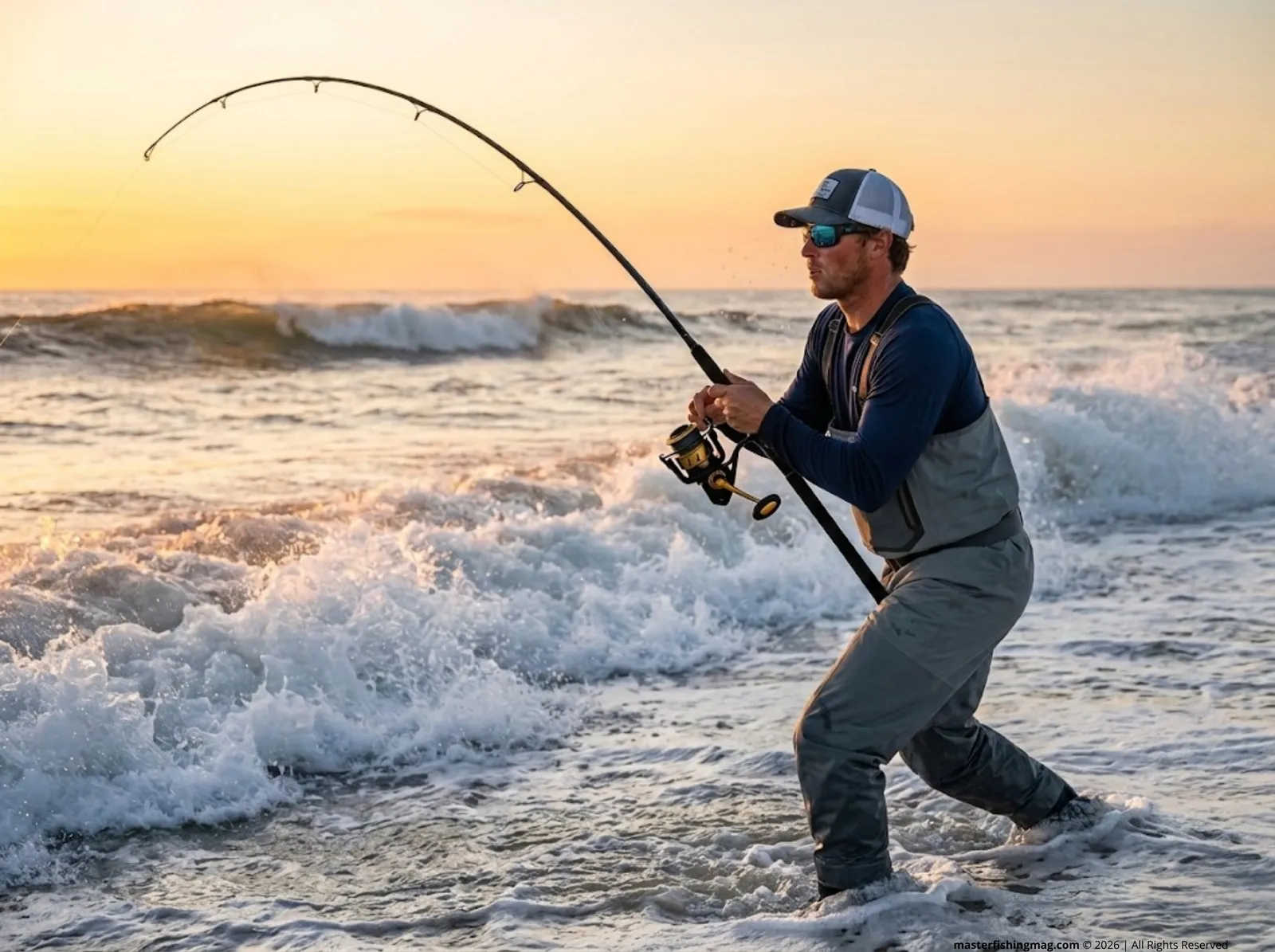
The first time the pounding surf hit my waders, a 15-knot onshore wind was driving the salt spray so hard it felt like sandblasting, and I had absolutely no idea where to cast. I spent hours lobbing lead into dead water, watching experienced anglers 50 yards down the beach pull in fish after fish. After two decades of guiding on these coasts, I have seen this identical frustration on the faces of countless new anglers. Surf fishing is not just about throwing a heavy weight into the ocean; it is an energy equation. Here is exactly how to solve it—no wasted casts, no corroded reels, and no guessing.
⚡ Quick Answer: Successful surf fishing requires reading the water to locate sandy troughs and rip currents where predators wait for bait. You need a 10 to 12-foot rod paired with an IPX6-sealed reel to cast heavy weights past the breakers and survive the salt spray. Terminal gear must grip the bottom using sputnik or pyramid sinkers on fish finder rigs, and you must use braided line to cut through heavy current drag.
| Specifications | |
|---|---|
| Feature | Specification |
| Optimal Rod Length | 10 – 12 feet |
| Minimum Reel Sealing | IPX6 |
| Braid Stretch Limit | < 3% |
| Fight Threshold | Under 2 minutes |
Reading the Surf Zone: Fluid Dynamics for Anglers
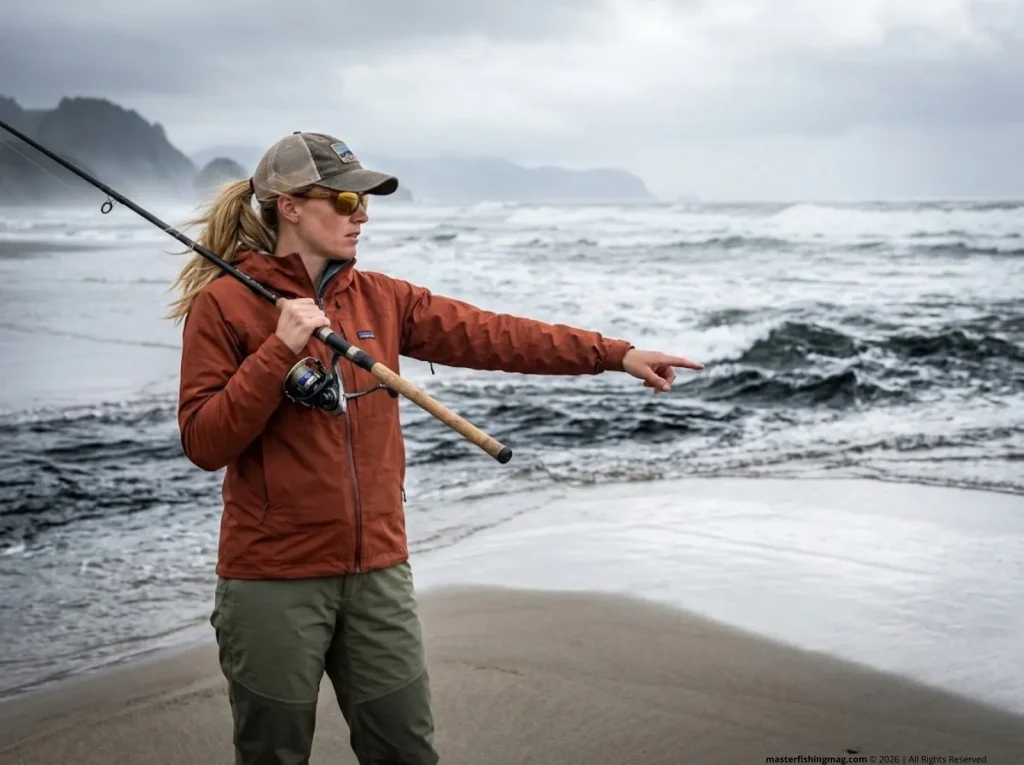
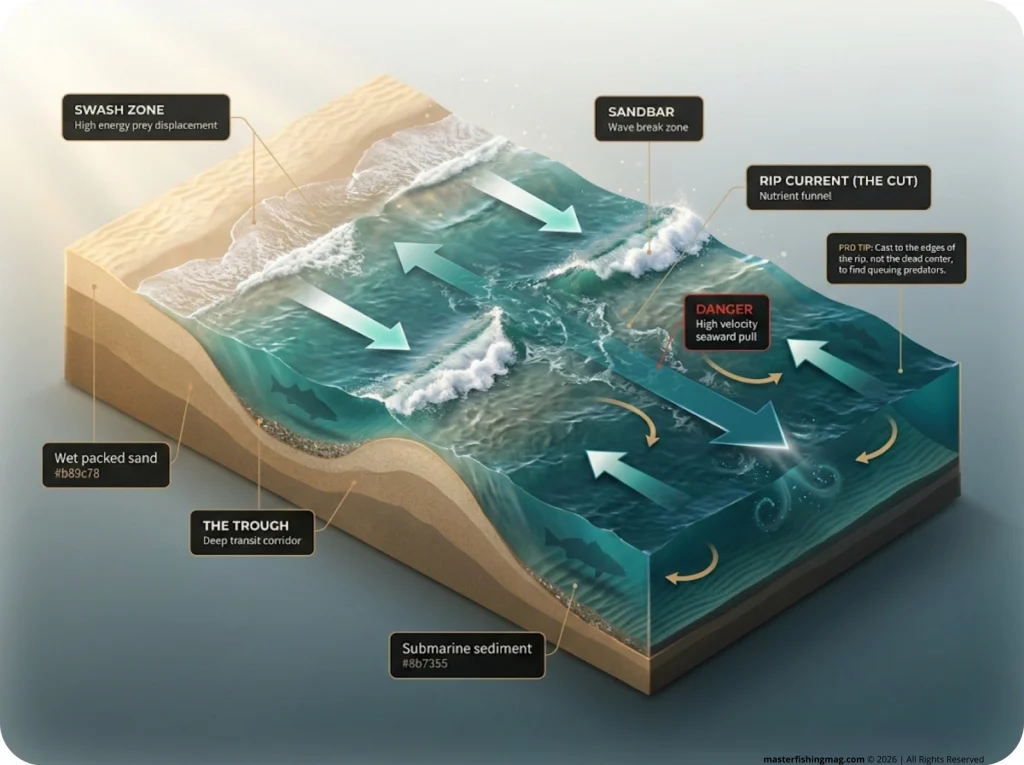
The swash zone is an incredibly active water environment where incoming wave momentum and tidal pressure dictate exactly where fish hunt. To effectively begin surf fishing for beginners, you must stop looking at the ocean as a flat sheet of blue. Sandbars function as active feeding zones where the crashing wave energy stirs up prey, forcing crabs and small fish into the open. The deeper troughs that run parallel between these bars act as transit corridors for predators like striped bass or red drum.
A “cut” or rip current is a narrow gap in a sandbar where water escapes seaward, acting as a high-velocity nutrient tunnel where big fish wait in ambush. Understanding these water movements is a crucial part of reading the nuances of wave action and trough systems to locate your target species. According to researchers quantifying wave-averaged currents, the visual flow separation along the coast tells you exactly where water slows down enough for fish to rest.
Identifying Troughs, Sandbars, and the “Fish Highway”
Troughs almost always appear as darker, calmer strips of water running parallel to the beach between the foaming breaking waves. Predators navigate these deep corridors—sometimes within five to ten feet of the dry sand—to aggressively ambush forage that gets swept off the shallow areas. You can spot the sandy bars by looking for the lighter-colored water where waves prematurely crest and break before reaching the shore.
Pro tip: Do not automatically cast as far as you physically can on your first drop. You will frequently cast entirely over the feeding fish that are actively hunting the first trough right at your feet.
How Manning’s n and Bottom Friction Concentrate Forage
The overall resistance to water flow across the beach bottom is quantified by a metric known as Manning’s n, which simply measures bottom roughness. A beach with fine sand allows for smooth water flow that results in predictable, uniform channels.
When you encounter coarse gravel, shell hash, or submerged boulders, this significantly increases the bottom friction and forms turbulence that completely disorients baitfish. Predators actively seek out these rough patches because the chaotic water does the hard work of confusing their prey for them. Find the rough bottom patches, and you will find the ambush points.
Rip Currents and Micro-Tides: Wind-Driven Feeding Windows
Relying strictly on your lunar tide charts provides only a baseline for your shore-based ocean fishing. A stiff 15-knot onshore wind can easily create micro-tides by holding water forcefully against the beach structure.
This wind-driven setup forces artificial tides that can activate intense feeding windows regardless of what the published low tide schedule claims. Rip currents present themselves as chaotic, structureless visual zones without clean breaking waves, but they serve as the highest-concentration feeding funnels on any beach. Targeting the edges of these rips is how you pull heavy strikes out of otherwise challenging conditions.
Surfcasting Gear That Survives the Salt (The Anti-Sell)
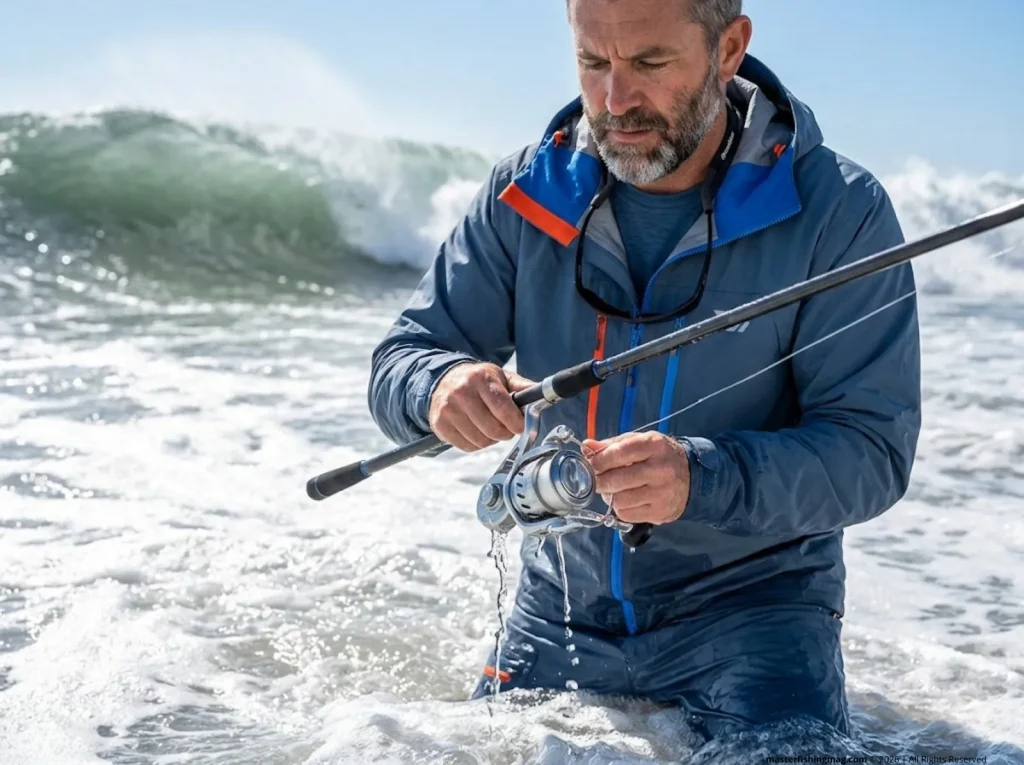
Saltwater acts as a wildly powerful corrosive agent, relentlessly promoting rust between mismatched reel metals like cast aluminum and stainless steel. Saltwater corrosion is the fastest way to destroy an entry-level gear setup, turning a smooth showroom purchase into a grinding coffee grinder after a single trip in heavy spray.
A longer rod generates higher swing speed, which means faster tip speed and significantly longer casting distances to reach the outer bar. Thin line type like braided line cuts down the profile exposed to the sweeping current, drastically slashing water drag and requiring far less lead weight to hold bottom. Mastering the mechanical logic of your gear starts by understanding failure points in saltwater environments so you do not waste money on marketing hype.
Rod Mechanics: Why You Need 10+ Feet of Carbon Fiber
The perfect cast relies purely on rotation, where tip speed equals your swing speed multiplied by your rod length. Transitioning from a general-purpose 7-foot stick to a dedicated 10-foot or 12-foot rod exponentially increases your casting leverage against onshore sustained winds.
Premium Tsunami rods or similar high-end carbon blanks allow for incredibly fast recovery times after the rod flexes. This stiffness ensures your heavy terminal tackle punches right through the headwind.
The Truth About Reel Sealing and IPX Ratings
Salt crystals pull humidity out of the air and attract atmospheric moisture long after you dry your reel, continually fueling rust. An IPX5 rating survives a light rinse with a garden hose, but taking heavy surf spray directly on the housing mandates an IPX6 standard like a Penn Spinfisher or Shimano Stradic.
If you plan on wading deep where your reel goes fully under the surface, you must invest in expensive IPX7 or IPX8 gear sealing, such as a Van Staal. Otherwise, microscopic saltwater breaches the oscillation gears instantly and ruins the internal components.
Braided Line vs. Monofilament: Beating Heavy Drag
Heavy cross-currents exert massive drag forces on your line, depending on current speed and the line’s overall thickness. In the debate of braid vs mono, braided line offers a fraction of the diameter of monofilament for the exact same breaking strength.
This narrow profile prevents the crashing waves from pulling your rig out of the strike zone. Braid’s near-zero stretch (under 3%) also ensures immediate power transfer during a heavy hookset, even when your bait sits 80 yards out.
Pro tip: Before leaving the beach, back off your reel’s drag completely. Storing a reel with a tightened drag compresses the washers, destroying their smooth stopping power over a single season.
Tactical Rigging: Matching Terminal Tackle to the Bottom
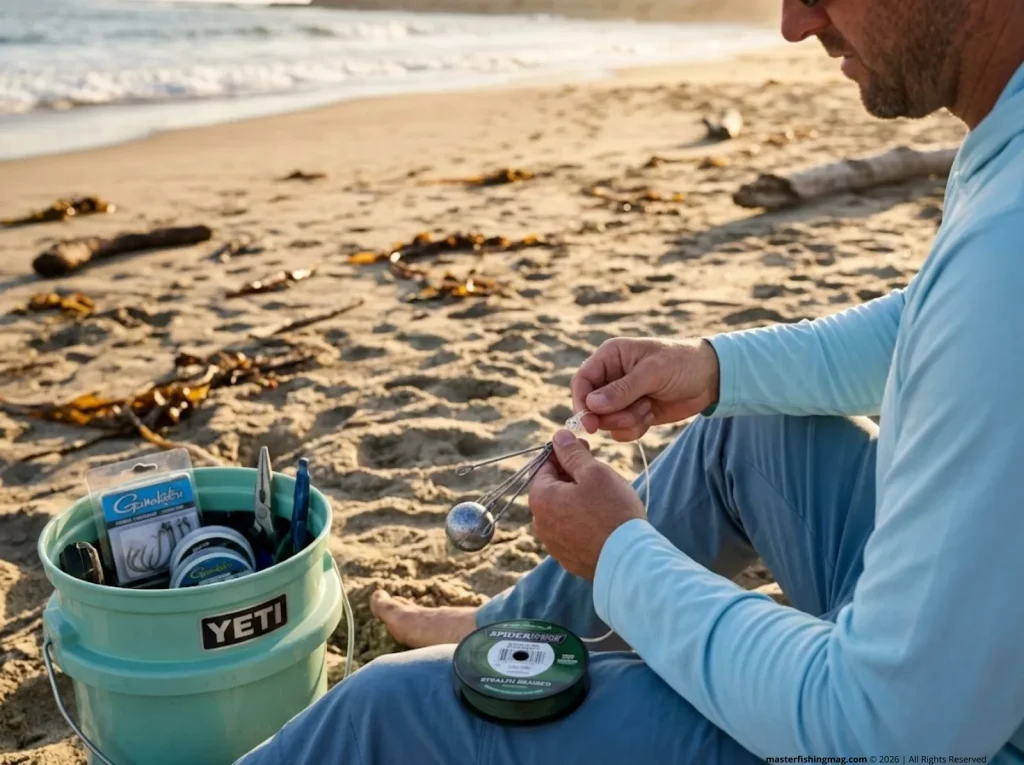
Surfcasting terminal tackle must reliably deliver your bait right through the breaking waves and anchor it without twisting during heavy lateral sweeps. Different sinker types are heavily engineered to grip specifically with varying sea floor types, whether you are casting onto packed sand in Florida or rocky outcrops in California.
Effective line management in the turbulent wash requires specialized setups to keep your fresh bait suspended safely above aggressive scavenging shore crabs. Using a standard bank sinker on a smooth sand beach in a rip tide guarantees your bait will helplessly roll a mile down the shore. Match the lead perfectly to the terrain by learning the engineered logic behind terminal tackle selection.
The High-Low Rig: Keeping Bait Above Bottom Debris
A high-low rig utilizes two snelled dropper loops tied vertically above a heavy terminal sinker to confidently suspend two baits at slightly different depths. This layout is absolutely ideal for keeping soft presentations like delicate sand fleas away from bottom-dwelling scavengers and crabs.
The vertical presentation maximizes your bait’s visibility in muddy water. It effectively covers more of the active water column as schools of fish blindly cruise the trough looking for an easy meal.
The Fish Finder Rig: Fooling Pressure-Sensitive Predators
A fish finder rig features a sliding sinker sleeve threaded directly onto the main line above a sturdy barrel swivel and a heavy fluorocarbon leader. When a targeted predator inhales the bait, the main line slips freely through the plastic sinker sleeve.
This mechanical separation allows the fish to swim off entirely without feeling the resistance of your heavy lead. This setup is mandatory for cautious feeders like pompano or large bass negotiating the shallow, clear breakers during the daytime.
Sinker Geometry: When to Use Pyramid vs. Sputnik Weights
A standard pyramid sinker uses its sharp, angular flat sides to dig firmly into fine or coarse sand when the current runs at a moderate pace.
A sputnik sinker, often called a grapple weight, deploys rigid wire legs to aggressively anchor the entire rig precisely in extreme rips or heavy, chaotic surf. The thin wire legs act as a reliable break-away system under the sudden pressure of your retrieve or a violent strike, instantly freeing the lead from the sand so you can fight the fish cleanly.
The Metabolic Cost of the Fight: Landing Fish Responsibly
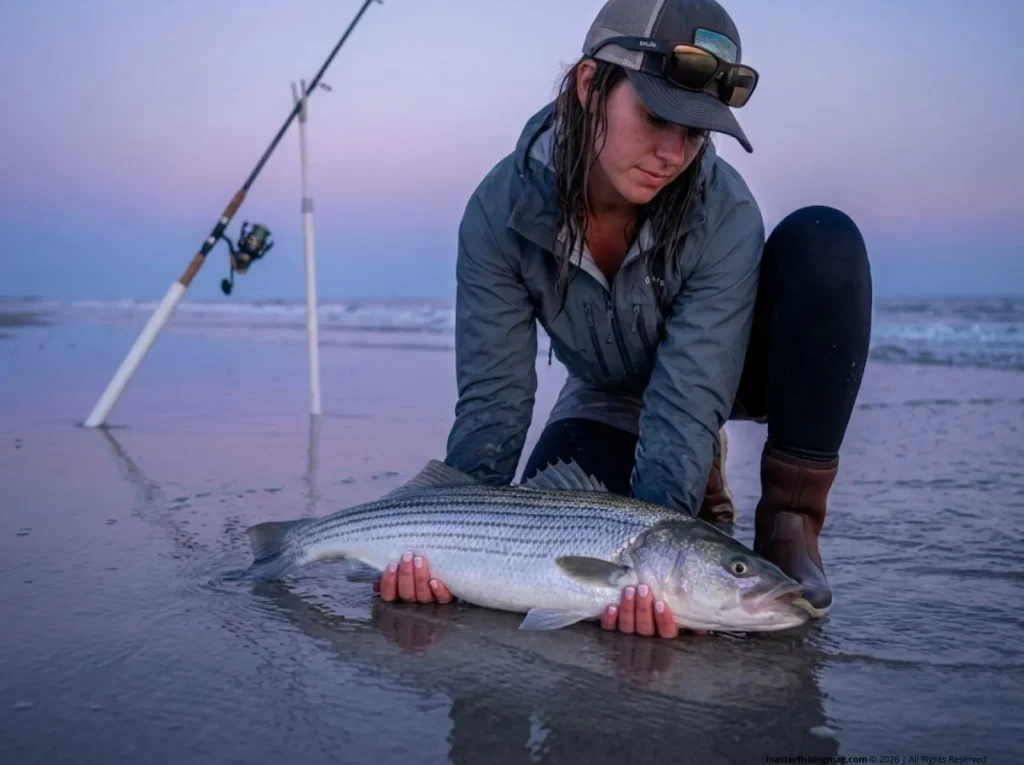
Hooking a wild fish forces a traumatic, immediate shift into exhaustion mode, rapidly spiking dangerous lactic acid and stress hormone levels. The resulting oxygen debt consumes the fish’s core energy reserves.
Dragging a heavy catch across dry, extremely abrasive sand violently strips away the protective slime coat, almost certainly guaranteeing a fatal bacterial or fungal infection weeks later. Fighting an oversized fish on light gear just for the sport of it drastically reduces the animal’s chances of survival. We use appropriately heavy tackle to winch them quickly out of the hazard zone while adhering to science-based release techniques. Professional guides operate on strict protocol because minimizing physiological stress during recreational fishing directly protects the future of our coastal fisheries.
The 2-Minute Threshold: Avoiding Fatal Lactic Acid Buildup
Prolonged fights completely exhaust a fish’s available energy limits, severely impairing its ability to outswim apex predators or navigate brutal rips right after release. Landing a fish efficiently in under two minutes prevents irreversible acid buildup.
Appropriately heavy mainline and stiff rod blanks are ethical requirements for sustainable catch and release, not just distance casting aids. Stop playing with the fish on the edge of the wash and focus on immediate extraction.
Why the Lip Grip Harms Soft-Tissue Species
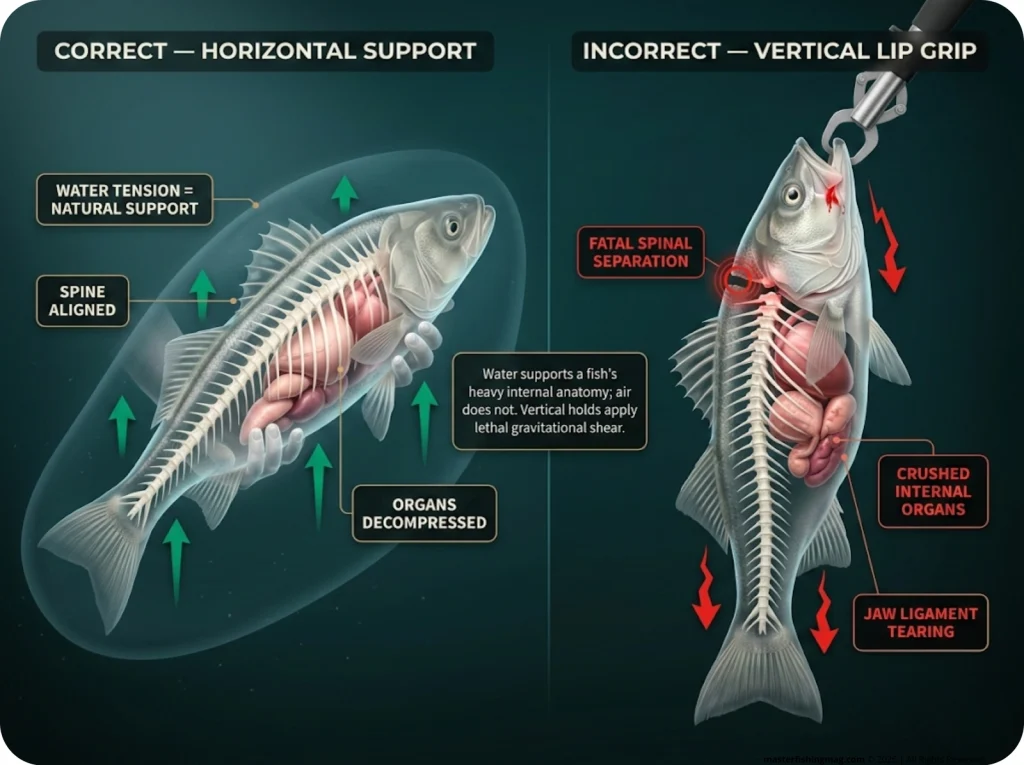
Vertically lifting heavy fish cleanly out of the water by the jaw instantly misaligns the spinal column. It violently crushes soft internal organs under the sheer force of gravity.
Water naturally supports a fish’s heavy internal anatomy; the air does not. A firm, horizontal hold that fully supports the belly with heavily wet hands is the only professionally acceptable lifting method if removal from the water is strictly necessary.
In-Water Unhooking and Proper Revitalization
The surf’s active wash zone is incredibly dense with suspended tumbling sand. Exposing sensitive red gills to the air in this exact area causes catastrophic granular damage to the delicate gills.
Always unhook the fish while it remains horizontally submerged in the moving water whenever possible. Never grab the tail and saw a fish backward and forward to revive it; simply hold it facing securely into the natural incoming current to allow fresh, oxygenated water to flow correctly.
Beach Etiquette and Angler Stewardship
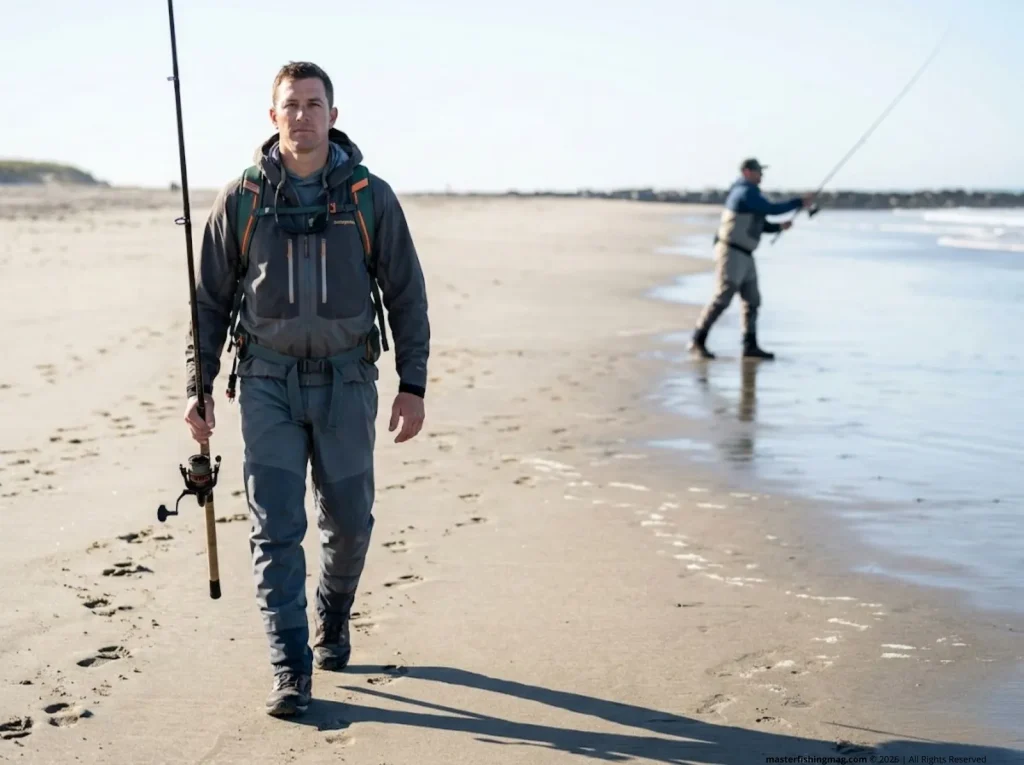
Public access beaches require a rigid but often unspoken code of conduct regarding safe casting angles, heavy lead, and the physical spacing strictly known amongst the veterans. The mandatory use of non-offset circle hooks drastically alters your catch and release success rate for the better.
Recreational anglers act as the absolute front-line data collectors for state agencies; executing proper fish handling directly affects the data that sets our bag limits. Ignoring basic beach etiquette reflects poorly on all of us. As the national park services continually highlight, ethical angling and responsible hook selection maintain both access and fish populations. Trust me—if you blindly cast your rig squarely over a local’s tight line because you decided to set up five yards away, you will hear about it loudly.
The 50-Yard Rule and the Physics of “Mugging”
The widely accepted 50-yard rule firmly dictates the minimum acceptable distance between working surfcasters on any open beach. This isn’t just about friendly manners; powerful surf currents push heavy sinker rigs laterally down the trough, demanding wide geographical margins to prevent massive tangles of expensive braid.
Setting your sand spike directly next to a successful angler—a move known as “mugging”—forces both parties to abandon their natural drift entirely just to avoid line collisions.
Pro tip: Take ten minutes to observe the exact direction the current is pulling everyone’s line before you claim your spot. Set up up-current or down-current with enough drift room so your bait never crosses their target zone.
Why Circle Hooks Are Mandatory for Surf Sustainability
A true circle hook’s razor point arches 90 degrees straight back toward the heavy shank, mechanically preventing the hook from accidentally snagging soft internal throat tissue if swallowed.
When the released fish confidently swims away, the steady line tension safely drags the hook smoothly out of the gut until it seats securely in the tough corner of the jaw. Standard J-hooks swallowed deep in the wash inevitably cause severe, unstoppable organ damage upon clumsy removal. Always understand how to select the right hook size and style to protect your target species.
Your Role in NOAA Fisheries Data Collection
The Marine Recreational Information Program relies heavily on accurate catch estimates sourced from the angling public. Poor, sloppy handling causing post-release fatalities silently compromises the precise data sets used to mathematically dictate bag limits and mandatory seasonal closures.
Utilizing responsible lead-free weights and practicing aggressive, sustainable release guarantees the continuous, vibrant health of our nearshore fisheries. Every fish you safely release today ensures the action stays hot for decades.
Conclusion
Translating the visual chaos of crashing breaking waves into a calculated, successful catch requires far more than blind, hopeful casts with a heavy fiberglass stick. By correctly identifying the water flows that form the natural fish highways, flawlessly matching your sealed gear to the punishing salt, and upholding rigorous ethical handling standards in the wash, you transform from an average beachgoer into a highly skilled saltwater angler. Strip the flashy marketing fiction away from your tackle selection, trust the actual mechanics of your rig, and feel the raw difference on your very next trip out to the salt.
FAQ
Do I really need a 12-foot rod to catch fish from the surf?
Not necessarily, as many hungry fish actively feed right in the very first trough just a few feet from the dry sand. However, a 10 to 12-foot rod gives you the required heavy leverage and massive tip speed to confidently punch through harsh headwinds and cleanly clear the towering breaking waves during a high tide window.
Can I use an unsealed freshwater reel if I don’t wade into the water?
It will function properly for a temporary period, but microscopic salt mist and violent windblown sand will eventually compromise the internal aluminum gears. If a strict budget restricts you, meticulously clean and re-lubricate your standard freshwater reel after every single saltwater exposure to proactively prevent catastrophic rust inside the housing.
What is the best tide for surf fishing?
The most universally productive feeding window is a strong rising tide, specifically targeting the two hours leading directly up to the high peak. This heavy incoming water effectively floods the shallow exterior sandbars, allowing highly aggressive predatory fish to successfully push deeper directly into the surf zone to safely hunt previously inaccessible forage.
Why do my pyramid sinkers keep rolling down the beach in heavy surf?
Pyramid sinkers are specifically designed for holding in moderate currents and digging into soft sand; in severe lateral sweeps, the flat sides catch water and act as tiny sails. Switch immediately to a Sputnik style grapple weight, whose extended wire legs actively lock deep into the substrate to confidently hold your rig exactly in the targeted strike zone.
Risk Disclaimer: Fishing, boating, and all related outdoor activities involve inherent risks that
can lead to injury. The information provided on Master Fishing Mag is for educational and informational purposes
only. While we strive for accuracy, the information, techniques, and advice on gear and safety are not a substitute
for your own best judgment, local knowledge, and adherence to official regulations. Fishing regulations, including
seasons, size limits, and species restrictions, change frequently and vary by location. Always consult the latest
official regulations from your local fish and wildlife agency before heading out. Proper handling of hooks, knives,
and other sharp equipment is essential for safety. Furthermore, be aware of local fish consumption advisories. By
using this website, you agree that you are solely responsible for your own safety and for complying with all
applicable laws. Any reliance you place on our content is strictly at your own risk. Master Fishing Mag and its
authors will not be held liable for any injury, damage, or loss sustained in connection with the use of the
information herein.
Affiliate Disclosure: We are a participant in the Amazon Services LLC Associates Program, an
affiliate advertising program designed to provide a means for us to earn advertising fees by advertising and linking
to Amazon.com. As an Amazon Associate, we earn from qualifying purchases. We also participate in other affiliate
programs and may receive a commission on products purchased through our links, at no extra cost to you. Additional
terms are found in the terms of service.