
In this article
The rod tip barely twitched at 11:47 PM. One slow, deliberate pull that felt nothing like the channel cats slapping bait all evening. Then the line started peeling. That flathead had been lying motionless under the same log jam since noon, mouth open, waiting for exactly this moment. It knew my bluegill was there before I ever felt the bite.
After years of chasing flatheads on rivers across the South, I’ve learned one thing most anglers figure out too late. You don’t find flatheads. You predict where they’ll be, based on how they see, hunt, and move through the dark. This article breaks down the biological machinery behind flathead catfish nocturnal behavior so you can stop guessing and start intercepting.
⚡ Quick Answer: Flathead catfish are primarily nocturnal ambush predators that rely on their lateral line system to detect vibrations from live prey, combined with low-light vision to strike upward at silhouettes. They follow predictable diel movement patterns, leaving deep daytime cover at sunset and traveling circular routes through shallower feeding areas during two peak power hours (dusk to midnight, then 2–4 AM). Live bait on suspended rigs set 2–6 feet off bottom outperforms bottom presentations by exploiting every sensory advantage the flathead uses to hunt.
Why Flathead Catfish Are Built for Darkness
The Nocturnal Advantage Over Daytime Predators
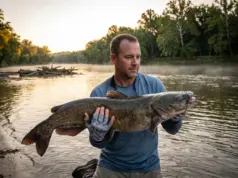
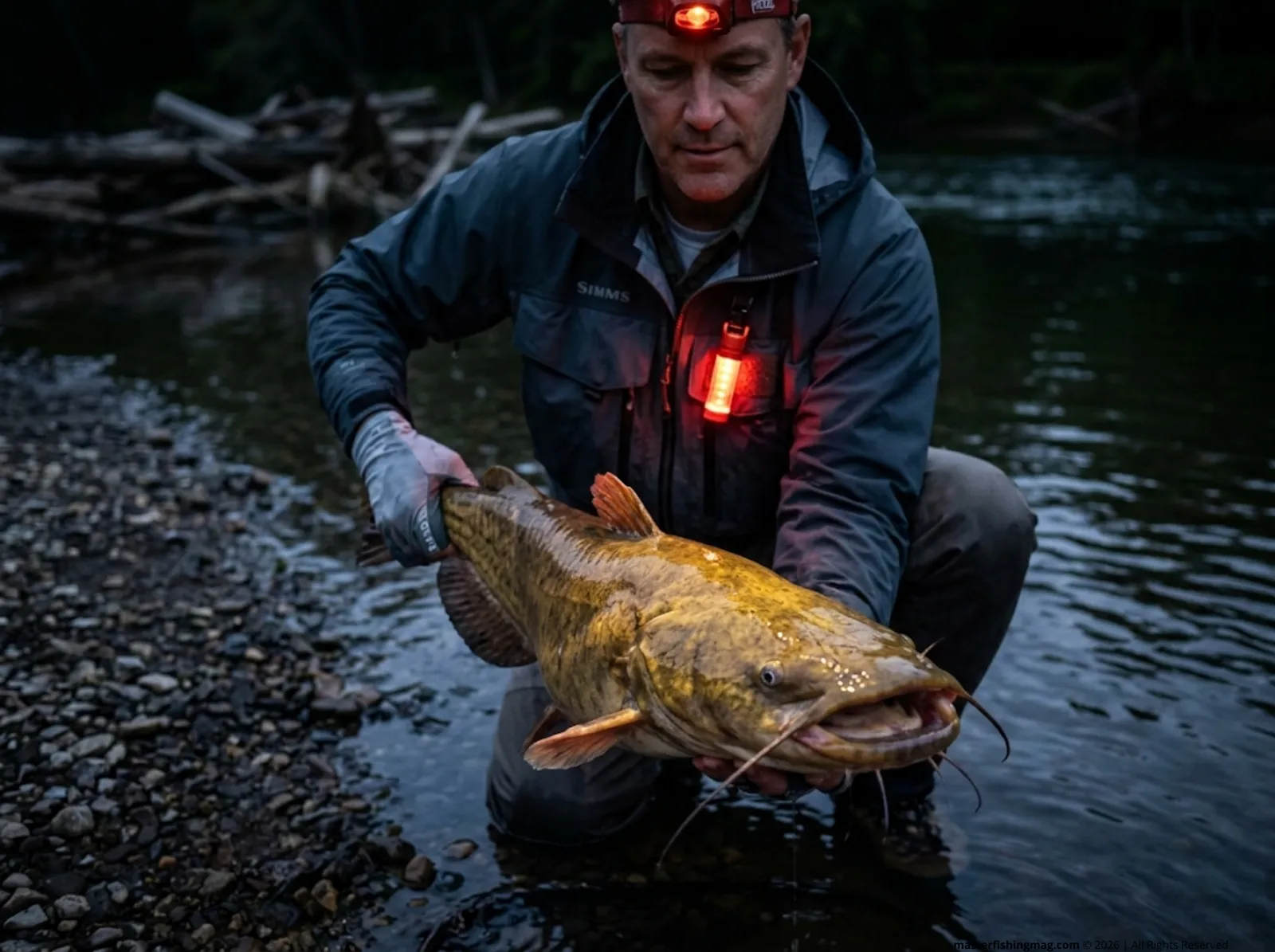
Flathead catfish (Pylodictis olivaris), sometimes called shovelheads or mud cats by river anglers, are the largest catfish in North America. The IGFA all-tackle world record stands at 123 pounds, caught by Ken Paulie at Elk City Reservoir, Kansas, in 1998. But size alone doesn’t explain why these fish own the night.
Unlike channel catfish that scavenge day and night on dead or cut bait, flatheads feed almost exclusively on live fish. That preference gives them an edge after dark, when their ambush-and-wait strategy works best against disoriented prey. Their skin shifts in color to match the surrounding substrate, blending into log jams, mud bottoms, and root wads with chameleon-like background matching.
Adults are fiercely solitary. Only one large flathead occupies a given piece of prime cover, whether that’s a single log pile, an undercut bank, or a brush tangle. According to the University of Michigan’s Animal Diversity Web, this territorial exclusivity intensifies after dark when feeding begins. If you’re catching multiple catfish from the same spot at night, they’re almost certainly channels. A flathead hole holds one fish. Find the right structure and you’ve found the biggest predator in the river.
Understanding how blue catfish hunting methods differ from flatheads helps clarify why bait selection and timing matter so much for targeting one species over the other.
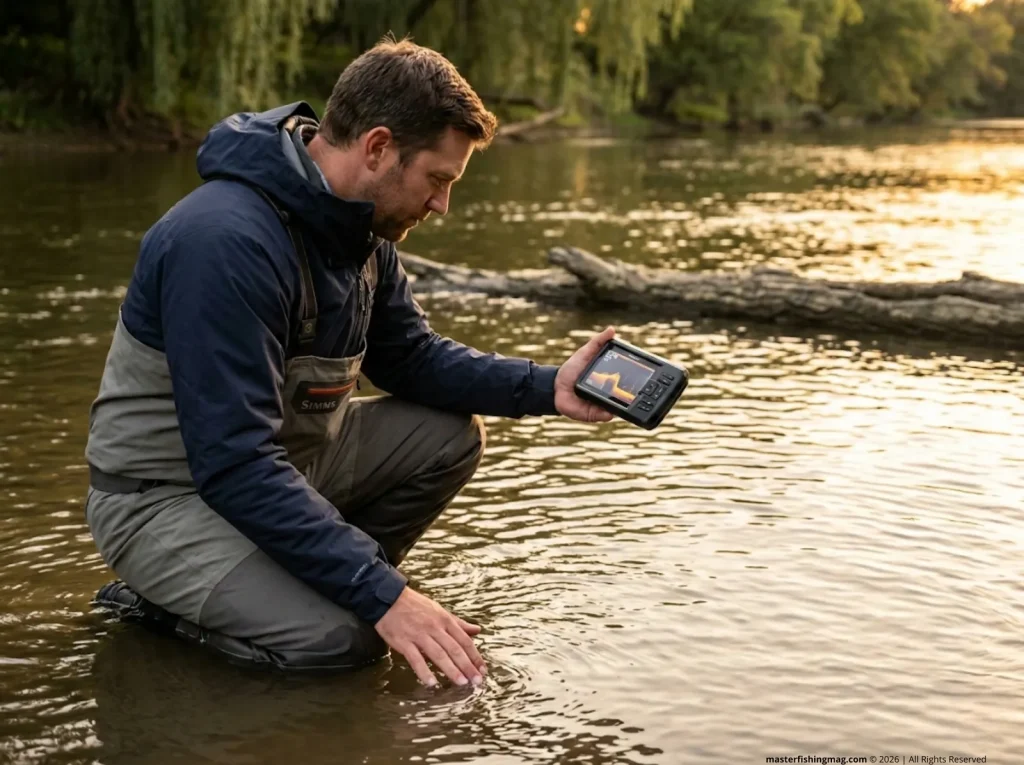
Pro tip: Scout structure during the day with sonar. Mark the biggest, most isolated cover on GPS. That single log pile with one large return on the screen is your flathead spot after sunset.
Low-Light Vision and Silhouette Detection
Flatheads have evolved extraordinary low-light vision. Even in turbid water, they can detect the dark outline of prey above them against whatever ambient light reaches the surface. This means they strike upward at suspended silhouettes, combining visual targeting with lateral-line confirmation in a dual-sense attack that’s unique among North American catfish.
This upward-strike behavior is the single biggest reason suspended live baits set 2–6 feet above bottom consistently outperform traditional bottom rigs at night. The fish is literally looking up and waiting for a silhouette to cross its field of view.
One Meal, Then Done
Here’s what most anglers miss. Flatheads eat roughly one large meal per 24-hour cycle, then retreat to digest. They may be actively hunting for only an hour out of every day. Miss the feeding window and you’re sitting over a fish that already ate.
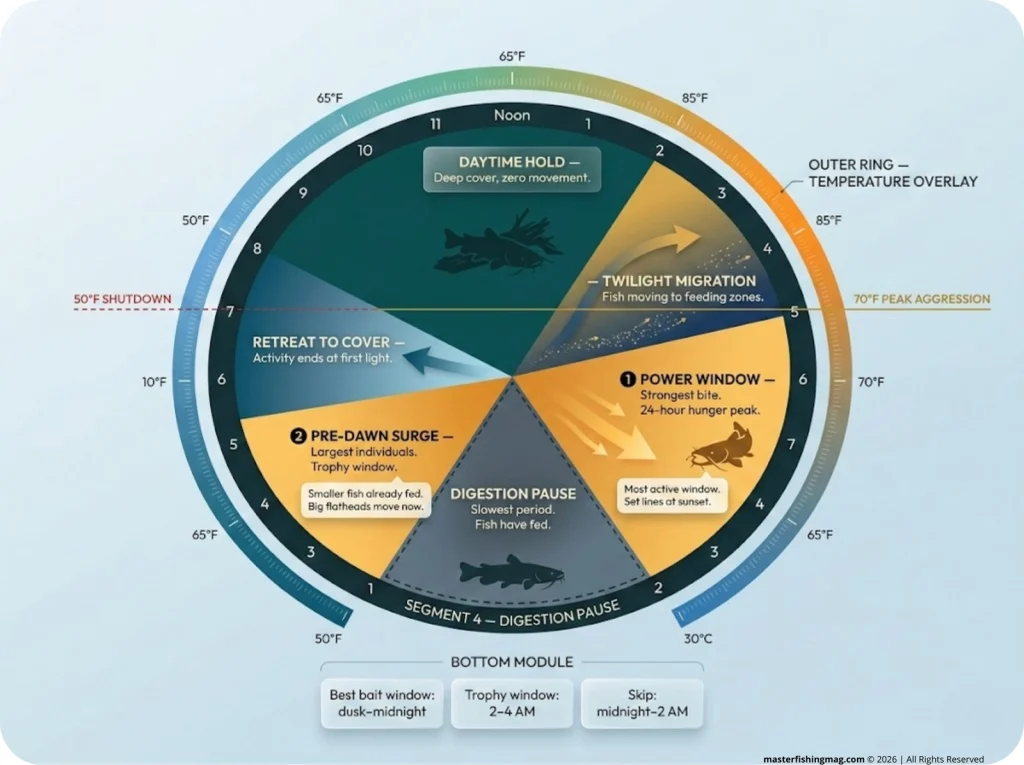
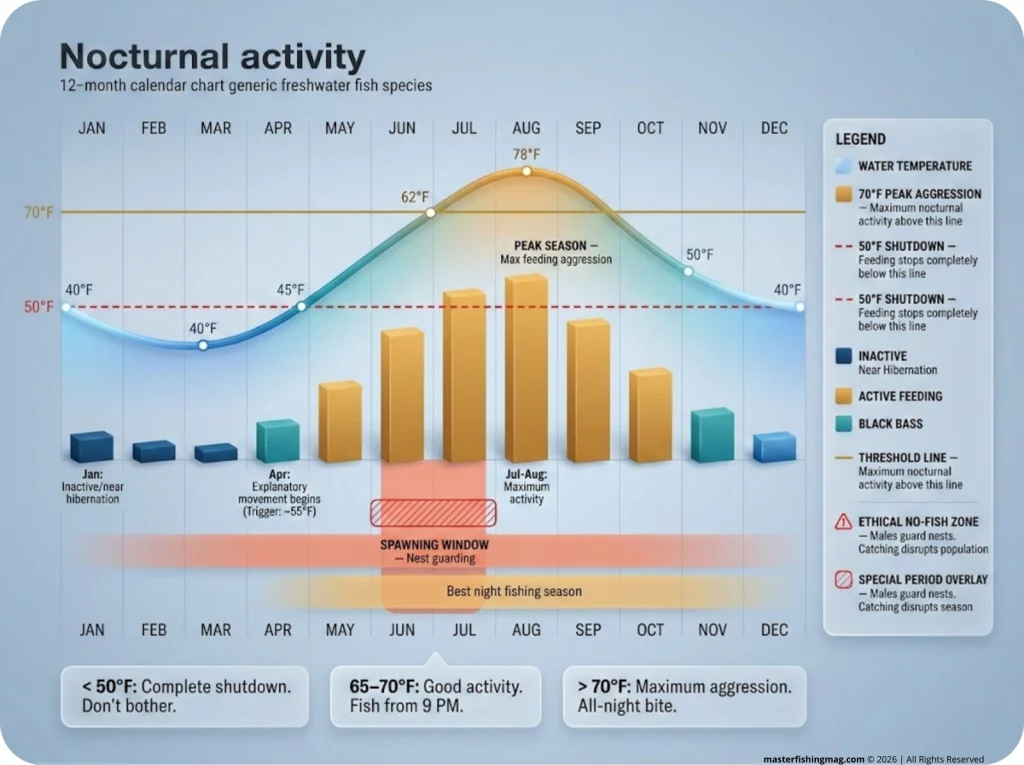
Water temperature drives the entire equation. Below 50°F (10°C), flatheads become nearly inactive, entering a state where feeding stops completely. Peak activity happens between 65°F and 85°F, with the strongest feeding aggression above 70°F.
The 24-Hour Movement Cycle
Daytime: Deep Structure and Total Stillness
During daylight, adult flatheads at night staging areas start forming during the day. They tuck into deep water between 10 and 20 feet, hiding inside log jams, under ledge rock, in undercut banks, or wedged beneath root wads. Some adopt a mouth-open sit-and-wait posture on the bottom, a passive trap that costs zero energy until prey wanders too close.
Telemetry research tracking flatheads with ultrasonic transmitters documented seasonal home ranges averaging over 1,500 meters of stream length in spring and contracting to about 596 meters in summer. Those numbers, compiled by peer-reviewed telemetry data from the University of Michigan, give you actual distances to predict how far a flathead will roam on any given night.
Pro tip: Find their daytime holes on sonar during the afternoon. Mark the GPS. Come back two hours after sunset and set up 50–100 yards downstream on the nearest shallow flat. That’s where they’ll be heading.
The Twilight Trigger
The setting sun is the starting gun. Flatheads begin moving from deep holes to shallows almost exactly at full dark. Light intensity is the primary driver, not clock time. Heavy cloud cover, rain, and new moon phases can trigger earlier movement.
They travel predictable circular nightly movement patterns, covering several miles while feeding, then returning to the same daytime cover by first light. This loop is so consistent that experienced guides call it “clockwork.”
Power Hours
Two distinct feeding windows dominate every night. The first, from sunset to midnight, is the twilight bite. The second runs from 2 to 4 AM, the pre-dawn surge. The gap between midnight and 2 AM is frequently the slowest period, a digestion pause observed by multiple guides across different river systems.
The twilight window is typically stronger because the fish haven’t eaten in nearly 24 hours. But the pre-dawn window often produces the largest individuals, possibly because smaller flatheads have already fed and returned to deep cover daytime holding spots.
For a deeper breakdown of how these windows shift with seasonal water temperatures, check summer night catfish timing patterns we documented over 127 hours.
How Flatheads Find Prey in Total Darkness
The Lateral Line: Vibration as a Primary Weapon
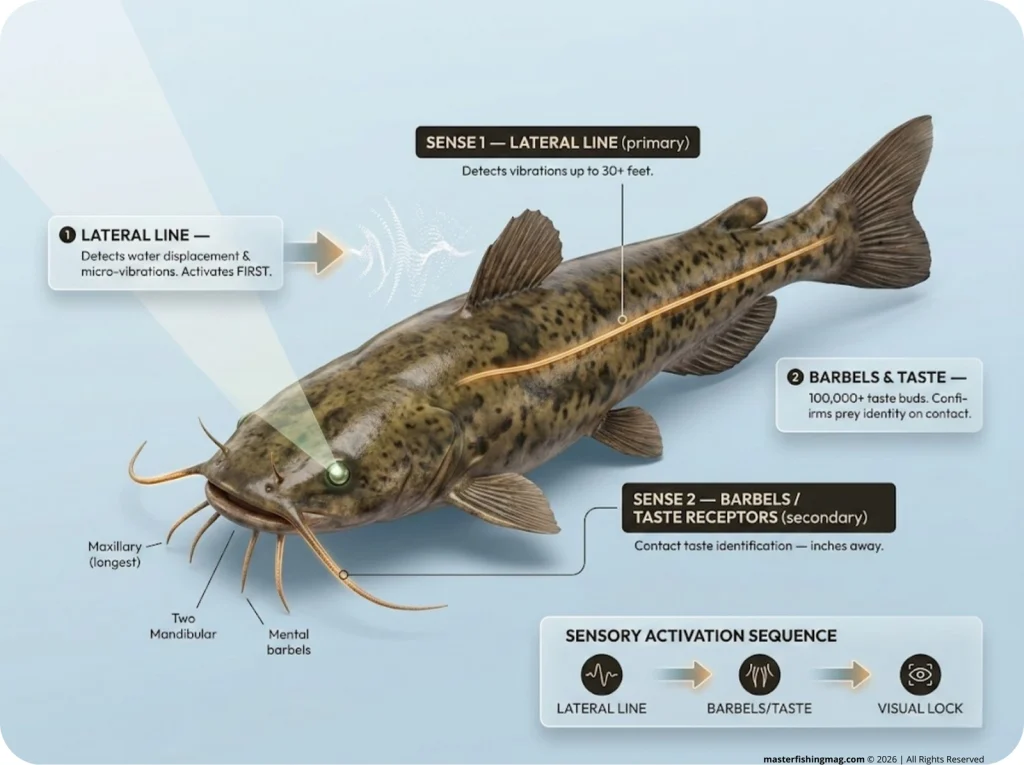
The lateral line is a sensory organ running along the body and head that detects water movements, pressure changes, and hydrodynamic wakes produced by swimming prey. It’s the flathead’s most important hunting tool after dark.
A 2004 study published in the Journal of Experimental Biology (Pohlmann et al.) showed that catfish can track the wake left by prey that has already passed. They’re following a “trail” made of water disturbance rather than chemicals. For anglers, this means a lively, swimming bait generates a vibration signature that flatheads detect from significant distances. A dead or cut bait produces zero vibration signal and relies entirely on chemical detection, which works for channel cats and blues but falls flat for flatheads that prioritize vibration over smell.
For more detail on how fish use this organ to locate prey, read our deep guide to the fish lateral line system.
Pro tip: Hook a live ‘gill through the nose so it swims frantically against the current. That panicked flutter is exactly the vibration a flathead is listening for.
Barbels, Taste Buds, and Chemical Cues
Eight barbels surrounding the mouth are densely packed with taste receptors and chemoreceptors that detect amino acids dissolved in water. The Weberian apparatus, a chain of small bones connecting the swim bladder to the inner ear, amplifies underwater sounds and pressure changes, giving flatheads enhanced hearing beyond what the lateral line alone provides.
Despite this chemical sensing ability, flatheads rank vibration above scent in their hunting hierarchy. Scent confirms what vibration detected first. That’s why live bait outperforms stink bait, punch bait, and cut bait every time you’re specifically targeting flatheads.
The Upward Strike
Flatheads lying near the bottom look upward. A bait silhouetted against the faintly lighter surface, even at night, is easier to detect than one lying on the substrate. Suspended baits holding live fish 2–6 feet off bottom consistently outperform bottom presentations because they exploit this upward-strike behavior.
The combination of vibration from a swimming bait plus the visual silhouette of a suspended rig triggers a commitment bite that bottom-lying dead baits cannot replicate. This is backed by a 2004 study in the Journal of Experimental Biology on lateral-line function and confirmed by thousands of hours of on-water testing across the catfishing community.

Rigging for the Nocturnal Flathead Bite
Live Bait Selection and Preparation
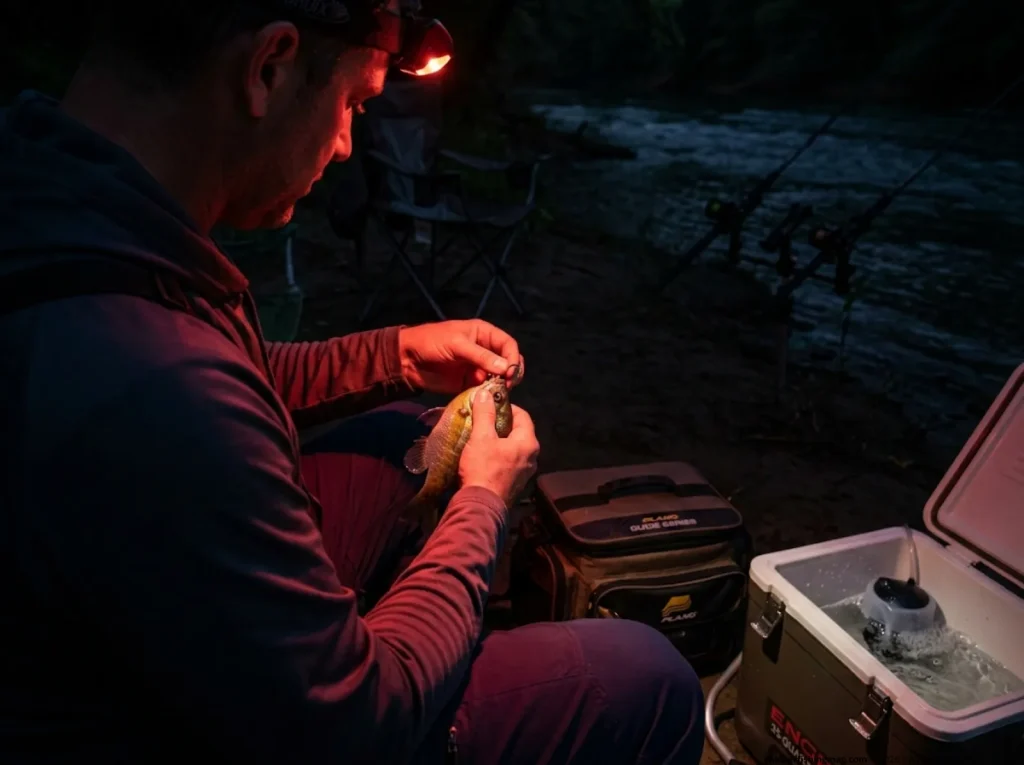
Adult flatheads are almost exclusively piscivorous above about 10 inches total length. Live sunfish in the 4–8 inch range are the undisputed top bait, with bluegill and green sunfish leading the list. Live shad work but die faster on the hook and produce a different vibration profile. Fresh creek chubs and live bullheads are solid alternatives in rivers where sunfish are scarce.
The bait must be lively. A dying bait loses its vibration signature, cutting your detection radius dramatically. As Texas Parks and Wildlife Department biologists detail, flatheads undergo an ontogenetic diet shift from invertebrates to live fish at roughly 250 mm, meaning your bait needs to match what they’re wired to eat. Keeping that bait swimming strong all night takes planning, and keeping bait alive through a full night session is a skill worth mastering before you ever set a hook.
Suspended Rig Setup vs. Traditional Bottom Rigs
Traditional bottom rigs like the Santee Cooper or slip sinker place bait on or near the substrate. These catch channels and blues reliably, but they underperform for flatheads that strike upward.
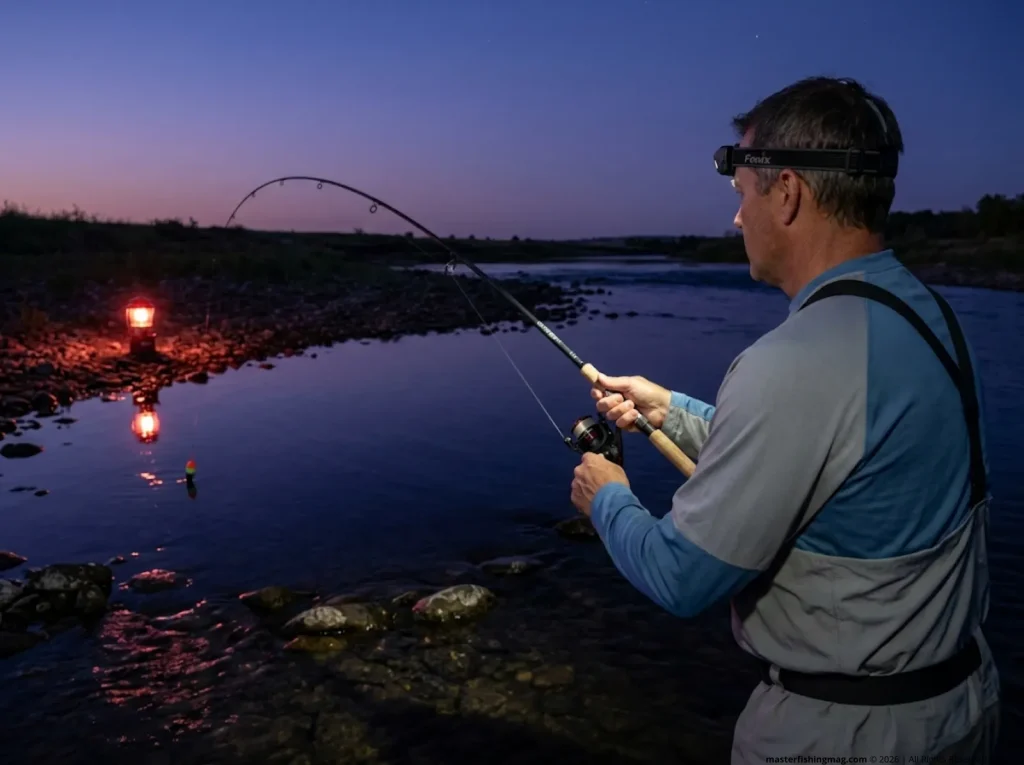
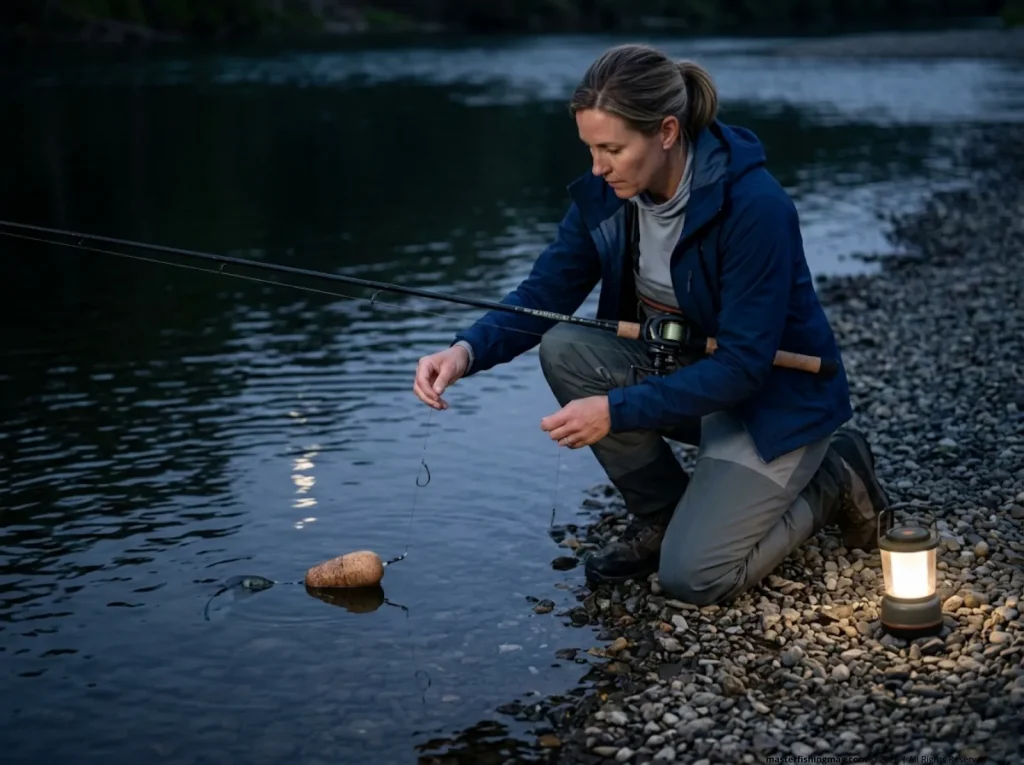
Suspended rigs use a float or balloon to hold suspended live bait 2–6 feet above bottom, directly in the flathead’s upward strike zone. Use enough weight to keep the bait in the target depth but not so much that it restricts the bait’s natural swimming motion. You want that bluegill panicking and pulling against the float. That struggle is what the flathead feels through the water.
Circle Hooks and Conservation-Minded Rigging
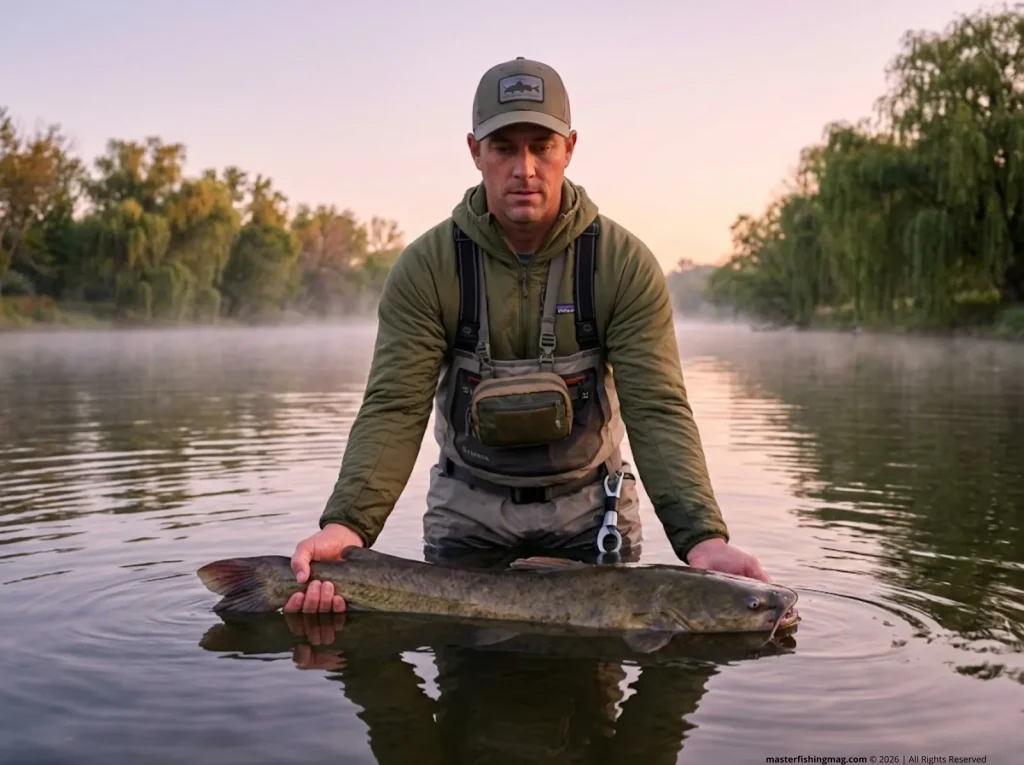
Circle hooks are strongly recommended for flatheads. They self-set in the corner of the jaw, reducing gut-hooking rates dramatically compared to J-hooks. Cooler nighttime water temperatures mean lower metabolic stress on hooked fish, making night catches inherently more survivable than midsummer daytime fights.
Use barbless or crimped-barb circles for faster releases and reduced tissue damage. Flatheads grow slowly and live long. A 30-pound fish might be 15–20 years old. Protecting that investment in wild genetics matters. For specific models that hold up to big fish, check our tested picks for catfish circle hooks.
Pro tip: Run-and-gun multiple spots during the first two hours after dark rather than sitting one hole all night. Set suspended rigs at the transition from deep cover to shallow flats and give each spot 30–45 minutes before moving.
Post-Spawn Aggression and Seasonal Behavior Shifts
Spawning Season: When the Rules Change
Flatheads spawn in late spring and early summer when water temperatures reach 75–80°F. They select cavities under banks, logs, or rock ledges. Males construct and guard the nest, and during this period the male’s nocturnal movement shrinks to almost nothing. He stays on the nest 24 hours a day for roughly 7 days after the eggs hatch.
Here’s the part most fishing guides won’t mention. Males aggressively defend the nest and may attack or kill a returning female. That level of parental investment is rare in freshwater fish, and it comes with a conservation warning. Removing a nest-guarding male during this window eliminates protection for the entire brood. Missouri Department of Conservation field observations confirm this behavior, and ethical anglers avoid targeting cavity-dwelling flatheads during peak spawn weeks.
Fry Dispersal and Juvenile Behavior
After about a week of male guarding, the male flushes fry from the nest. Juveniles school briefly, then disperse and become solitary at approximately 4 inches. Young flatheads feed primarily on invertebrates and crayfish before transitioning to their piscivorous adult diet around 10 inches.
This dispersal timing explains why very small flatheads almost never show up on rod and reel. They’re too small to take angler-sized baits and haven’t yet adopted the ambush-from-cover strategy that makes adults so catchable at night.
Temperature Thresholds
Below 50°F, flatheads enter near-hibernation. Feeding stops, movement stops, and they may stack in deep wintering holes. The annual startup begins when water temperatures consistently reach 55–60°F in spring, triggering the first exploratory nocturnal trips.
They can tolerate brackish water up to 11 ppt salinity, which explains their presence in coastal rivers and tidal freshwater zones. Peak nocturnal activity correlates with water temperatures between 65°F and 85°F, with the strongest aggression above 70°F. Before your first spring night session, review our night fishing safety protocol and gear checklist to make sure your setup is ready for changing water levels and low visibility.
Conclusion
Flatheads are built for darkness. Their lateral line, low-light vision, and upward-strike mechanics make night the only serious window for consistent catches. The 24-hour cycle is predictable once you understand it. Deep cover at dawn, total stillness until sunset, then circular foraging runs along shallow flats during two distinct power windows.
Live bait on suspended rigs exploits every biological advantage the flathead uses to hunt. Vibration signature, upward silhouette detection, commitment strikes. Match those three factors and you’ve stacked the odds in your favor.
Mark a flathead’s daytime structure on your sonar this weekend. Come back two hours after sunset with live bluegill suspended 3 feet off bottom. You’ll learn more about this fish in one night than most anglers figure out in a season.
FAQ
Are flathead catfish nocturnal?
Yes. Flathead catfish are primarily nocturnal ambush predators. They shelter in deep structure during daylight and move to shallower feeding areas after dark, relying on lateral-line vibration and low-light vision to hunt live fish.
What time of night do flathead catfish bite best?
The two strongest feeding windows are sunset to midnight (the twilight bite) and 2–4 AM (the pre-dawn surge). The midnight-to-2-AM window is typically the slowest period as fish pause to digest.
Where do flathead catfish hide during the day?
Adults occupy deep water between 10 and 20 feet inside heavy cover like log jams, undercut banks, root wads, and brush piles. They remain motionless, sometimes with mouth open in a sit-and-wait posture, conserving energy until nightfall.
What is the best bait for flathead catfish at night?
Live sunfish (bluegill or green sunfish) in the 4–8 inch range, hooked through the nose and suspended 2–6 feet off bottom. The panicked swimming generates a vibration signature that flatheads detect through their lateral line.
Do flathead catfish eat other catfish?
Yes. Adult flatheads are opportunistic piscivores and will eat smaller catfish, including young channel cats and bullheads, along with sunfish, shad, and other live fish.
Risk Disclaimer: Fishing, boating, and all related outdoor activities involve inherent risks that
can lead to injury. The information provided on Master Fishing Mag is for educational and informational purposes
only. While we strive for accuracy, the information, techniques, and advice on gear and safety are not a substitute
for your own best judgment, local knowledge, and adherence to official regulations. Fishing regulations, including
seasons, size limits, and species restrictions, change frequently and vary by location. Always consult the latest
official regulations from your local fish and wildlife agency before heading out. Proper handling of hooks, knives,
and other sharp equipment is essential for safety. Furthermore, be aware of local fish consumption advisories. By
using this website, you agree that you are solely responsible for your own safety and for complying with all
applicable laws. Any reliance you place on our content is strictly at your own risk. Master Fishing Mag and its
authors will not be held liable for any injury, damage, or loss sustained in connection with the use of the
information herein.
Affiliate Disclosure: We are a participant in the Amazon Services LLC Associates Program, an
affiliate advertising program designed to provide a means for us to earn advertising fees by advertising and linking
to Amazon.com. As an Amazon Associate, we earn from qualifying purchases. We also participate in other affiliate
programs and may receive a commission on products purchased through our links, at no extra cost to you. Additional
terms are found in the terms of service.