
In this article
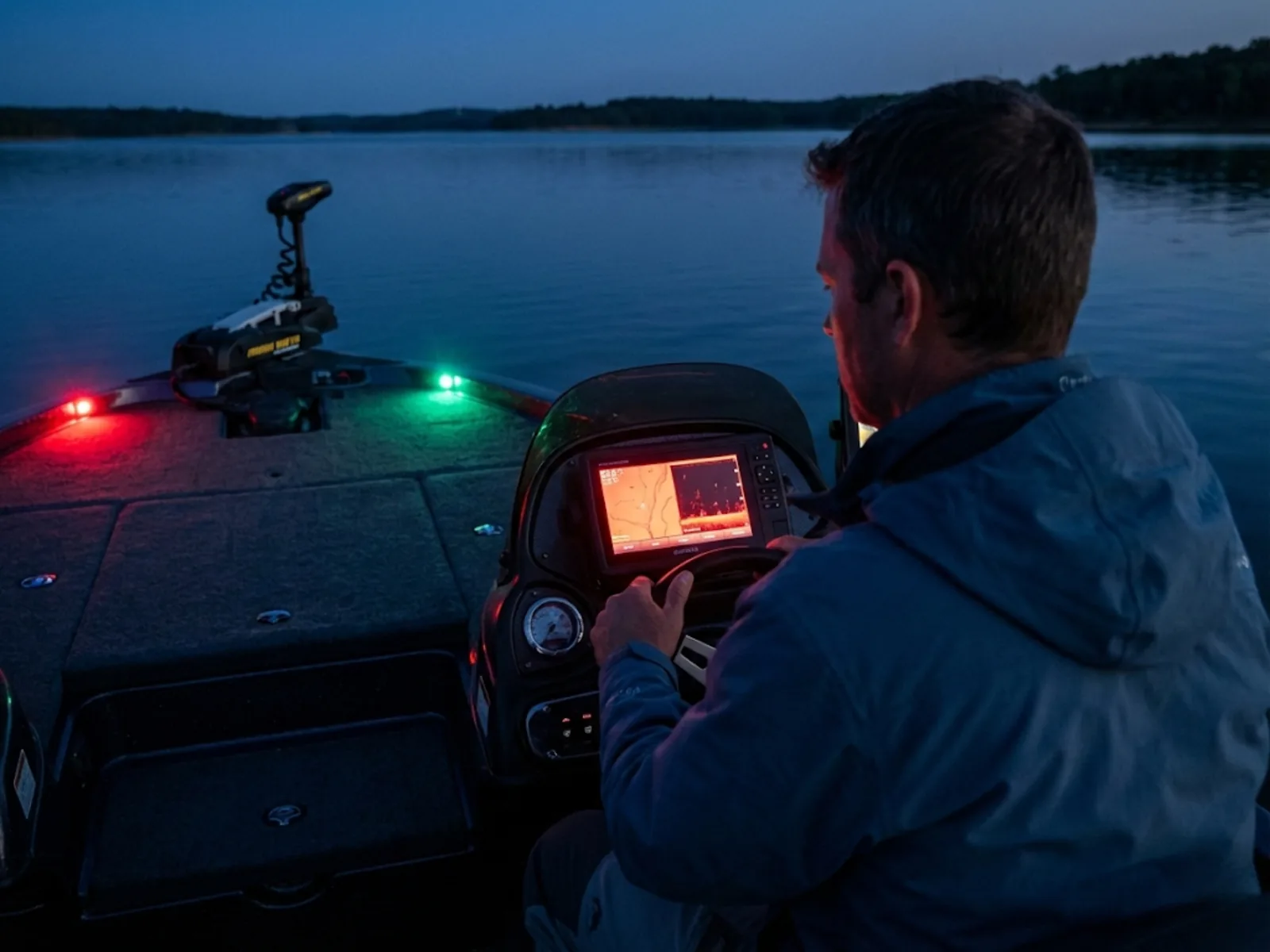
The trolling motor died at 2 a.m.—three miles from the ramp, in the middle of a reservoir with no cell signal. The headlamp batteries followed twenty minutes later. What started as a promising night fishing trip became a slow paddle through pitch darkness, using the boat lights as the only reference point for navigation.
After twenty years of nighttime fishing, I’ve learned that getting stranded isn’t about bad luck. It’s about predictable failures that happen when anglers treat dark water like daylight conditions. The good news: every common night fishing gear failure is preventable with the right systems.
Here’s the complete protocol for night fishing safety—from protecting your eyes to engineering battery runtime that won’t leave you stranded.
⚡ Quick Answer: Safe night fishing requires three things: 30 minutes of dark adaptation before you fish, a calculated power budget to prevent electrical stranding, and proper navigation lights for legal operation and collision avoidance. The #1 cause of getting stranded isn’t engine failure—it’s dead batteries from unmonitored trolling motors and electronics.
The Biology of Seeing in Darkness
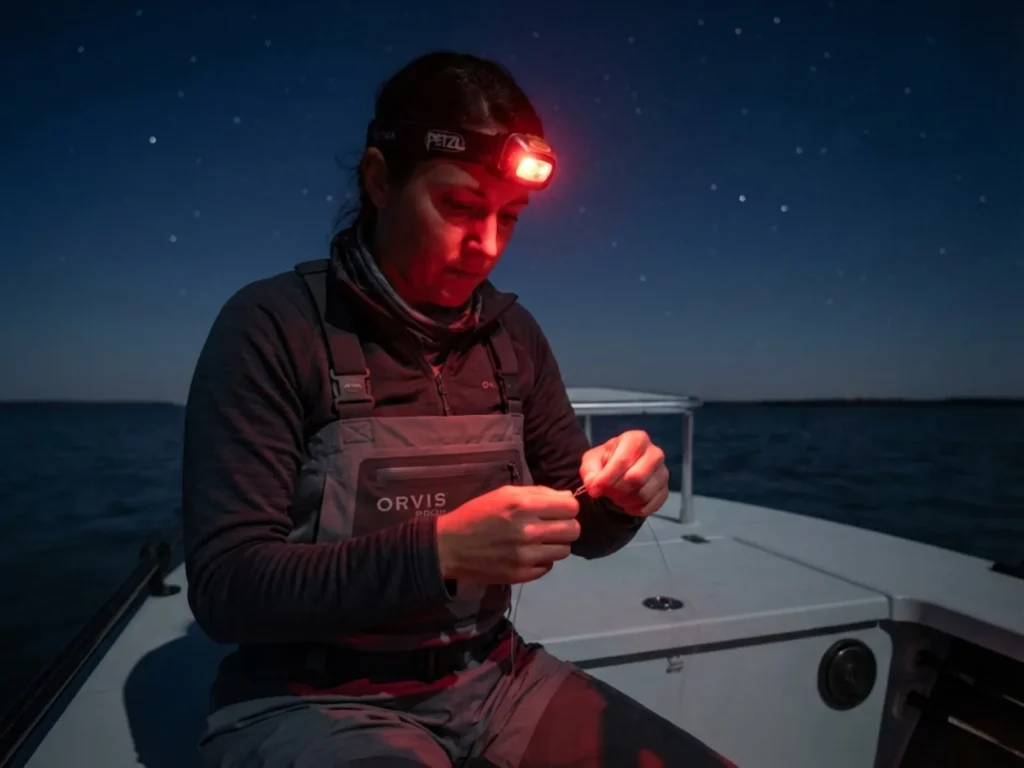
Your eyes are the first system that fails at night. Most anglers fishing after dark have no idea they’re operating half-blind for the first thirty minutes.
Dark Adaptation: The 30-Minute Rule
The human eye uses two separate systems for vision. In daylight, your cone cells handle color and detail. At nighttime, rod cells take over—but they need time to warm up.
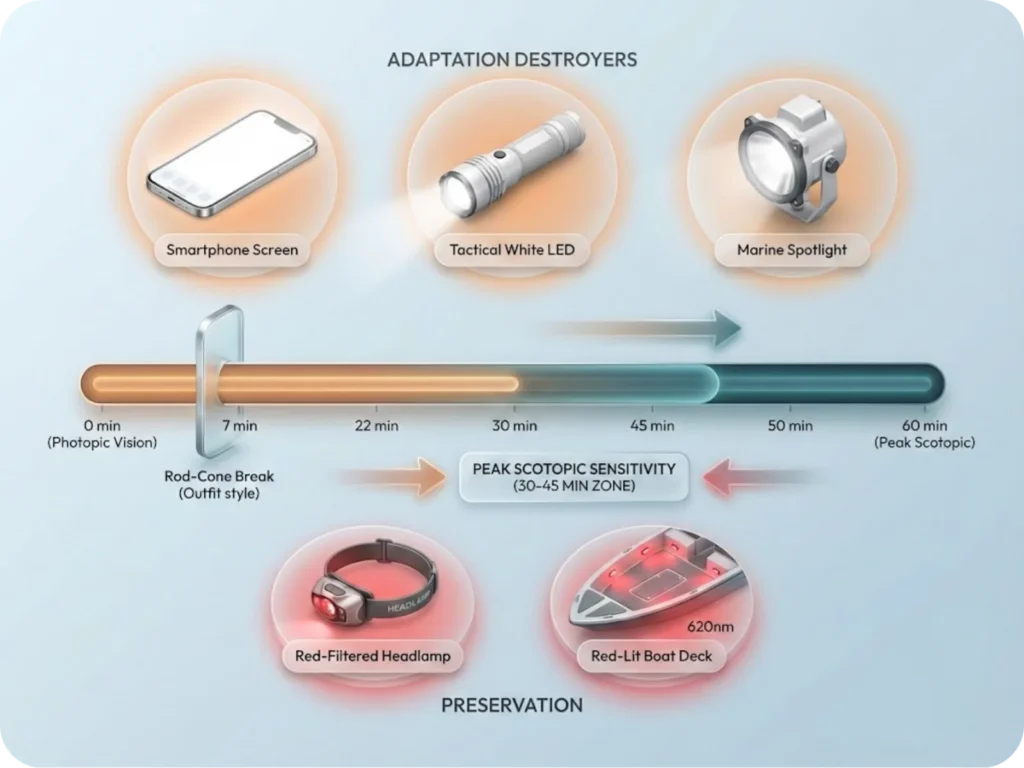
This process, called dark adaptation, requires the regeneration of rhodopsin (visual purple) in your rod cells. Your cones adapt within 5-10 minutes, but full night vision takes 30-45 minutes. During that window, you’re effectively blind to low-contrast hazards like unlit buoys, floating debris, and submerged timber.
Here’s what kills your progress: a single flash of bright white light—from a smartphone, a flashlight, or a passing boat’s spotlight—destroys your accumulated adaptation in seconds. That quick glance at your phone just reset a thirty-minute clock.
Pro tip: Start your dark adaptation on the drive to the ramp. Keep the truck headlights on low and avoid looking at your phone for the final 30 minutes before launch.
Night Myopia and Visual Illusions
Without distant focal points, your eyes naturally relax to a focus of about 1-2 meters. This night myopia makes distant hazards physically harder to detect, even with perfect daytime vision.
On open water, the lack of ground texture tricks your depth perception. Casts land on the bank when you thought you had twenty more feet. Boats run aground on shoals that appeared further away. The depth perception failure is real, and it catches experienced boaters every season.
There’s also a phenomenon called autokinesis: staring at a single stationary light against a dark background can make it appear to move. This creates confusion about the direction and speed of other vessels.
Strategic Vision Preservation
The fix is light discipline. Use only red-filtered light for task lighting on the boat deck. Red wavelengths (620-750nm) cause minimal bleaching of rhodopsin, preserving your accumulated night vision.
One caveat: red light makes red chart markings invisible, so cross-reference your navigation carefully. And wear UV-blocking sunglasses during the day—prolonged sun exposure actually slows your dark adaptation at night.
For more background on overall comprehensive fishing safety protocols, check our main safety guide.
Maritime Lighting Laws: What the Coast Guard Actually Requires
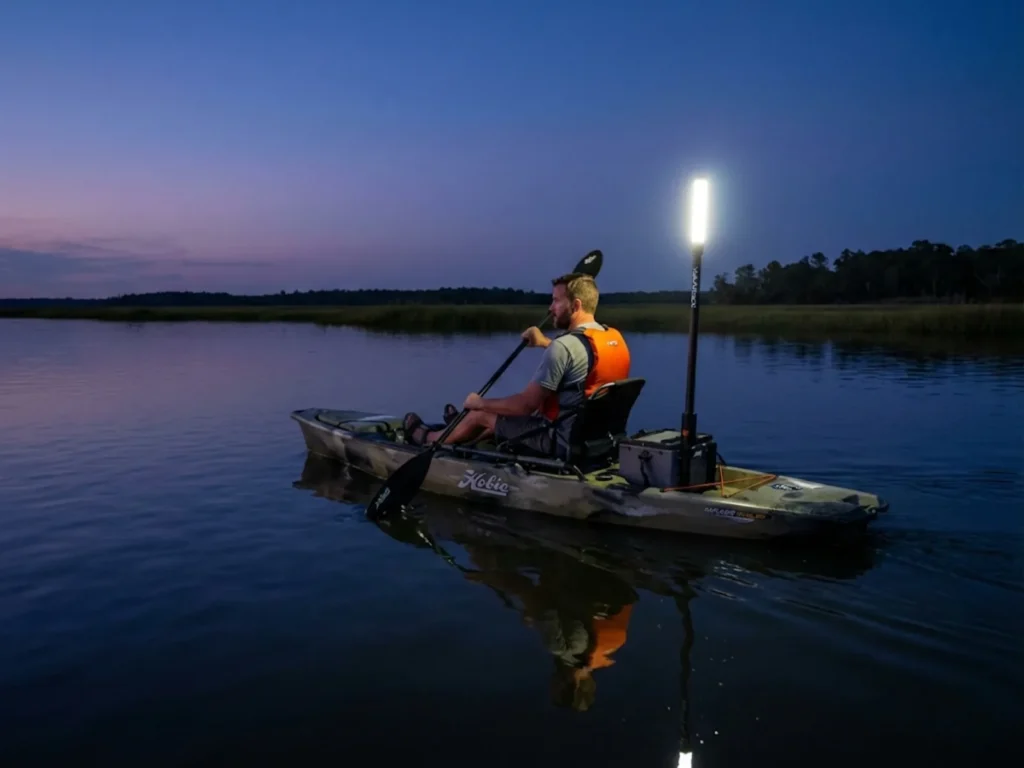
The US Coast Guard regulations for navigation lights aren’t suggestions. They’re the rules that keep you legal and alive.
Required Lights by Vessel Class
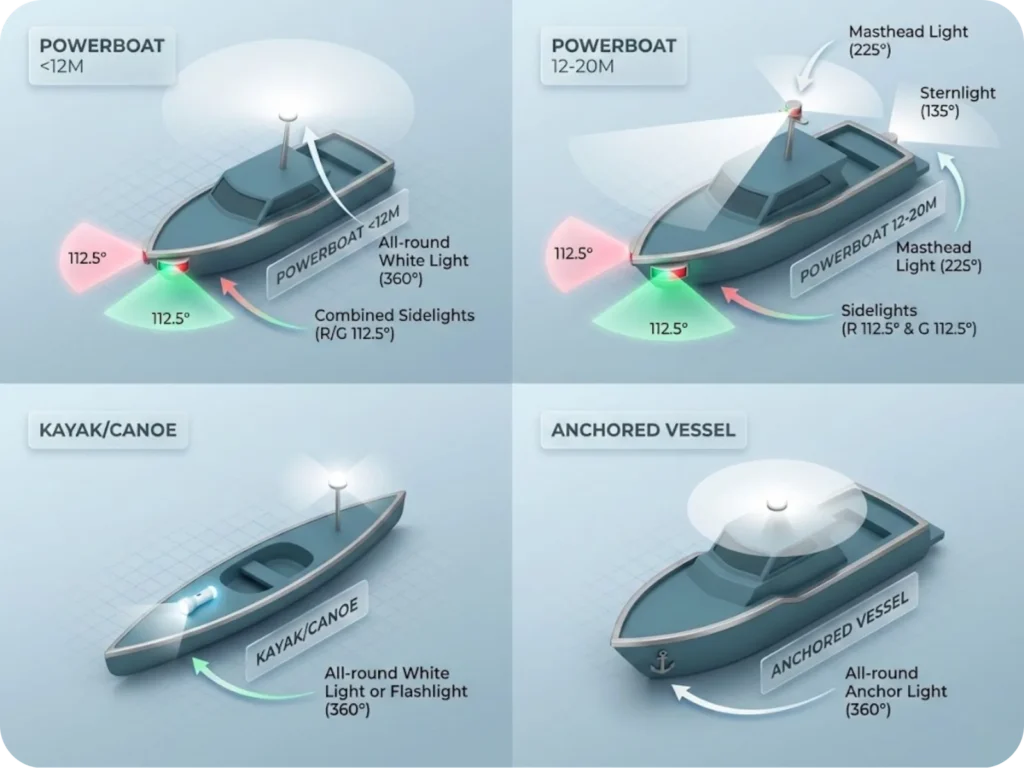
All vessels from sunset to sunrise must display proper lights per the Inland Navigation Rules. Here’s what you need based on your fishing boat size:
Power-driven vessels under 12 meters need sidelights (red/green, 112.5° arc) plus an all-round white light (360° arc, visible at 2 nautical miles). Boats 12-20 meters require sidelights, a stern light, and a masthead light.
Kayaks and canoes technically only need an electric torch or lantern with 360° visibility, displayed in time to prevent collision. But the legal minimum is tactically inadequate—powerboats can’t see low-profile paddlecraft using just a handheld flashlight.
Pro tip: Install a 360-degree white pole light like the YakAttack VISICarbon Pro that elevates above your seated head. It’s the difference between legal and actually visible.
For safe kayak anchor system setups for night operations, see our dedicated kayak guide.
Decoding Other Vessels’ Lights
When you’re out on dark water, other vessels communicate through their lights. Learning this language prevents collisions.
Seeing only a white light? You’re approaching from the stern (135° arc). You are the give-way vessel—alter your course. Seeing a red light on your starboard side means a vessel is crossing from the right. Red means stop—you must pass astern. Green on your port side means they’re crossing from your left, and you’re the stand-on vessel.
Don’t overthink it: when in doubt, stop and reassess. Misinterpreting a vessel’s aspect at night is a leading cause of collision.
Visual Distress Signals: Your Last Line
On coastal waters, the Great Lakes, and territorial seas, you need USCG-approved visual distress signals for night operations. According to the U.S. Coast Guard visual distress signal requirements, handheld red flares must burn for at least 2 minutes at 500 candela. Parachute flares reach 1,000 feet altitude and 30,000 candela—your long-range alert.
Electronic distress lights with SOS patterns eliminate fire hazards and run for hours instead of minutes. The smart approach is layered: electronic beacons for sustained signaling, pyrotechnics for initial long-range alert.
Power Engineering: Why Batteries Strand More Boats Than Engines
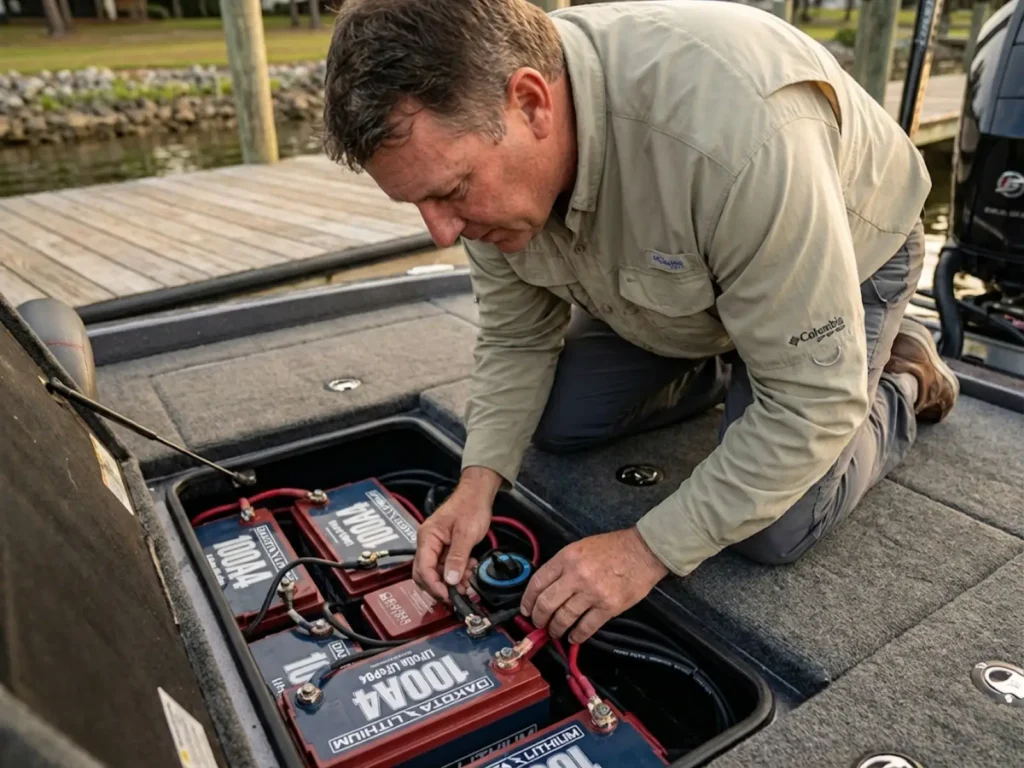
Engine failures get all the attention. But on modern fishing boat setups, electrical depletion causes far more strandings. Your rods and reels don’t run on batteries—but your trolling motor, chartplotter, live imaging sonar, and lights absolutely do.
Lead-Acid vs Lithium: The Numbers That Matter
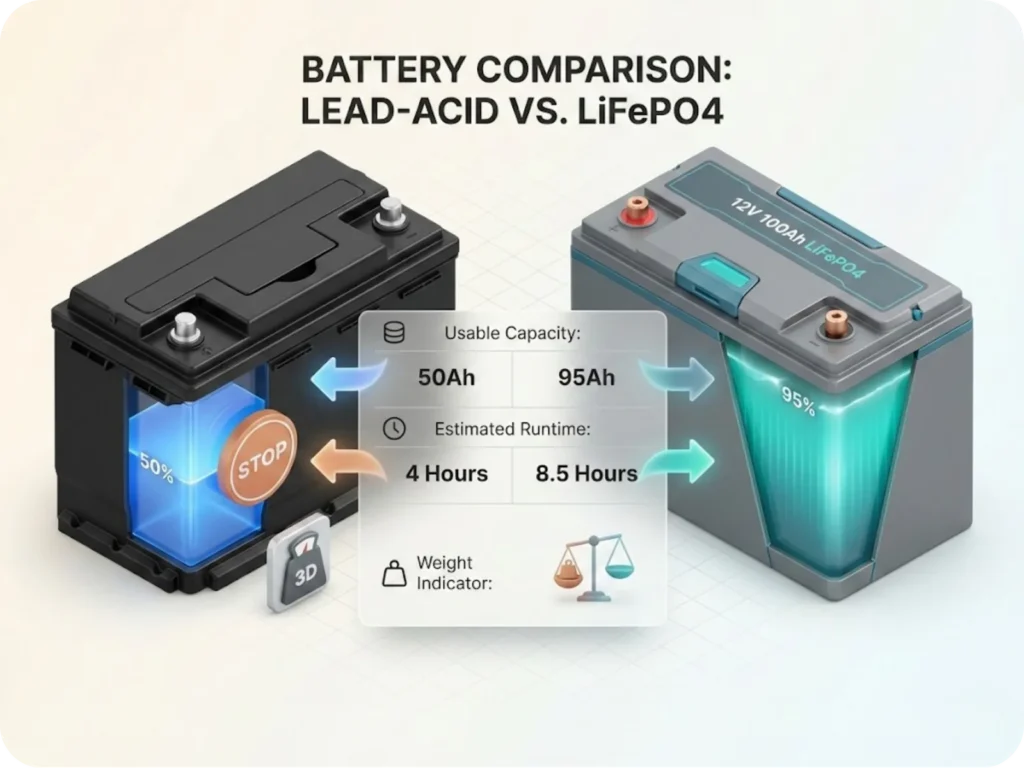
Traditional lead-acid batteries suffer from Peukert’s Effect: the faster you drain them, the less total capacity you get. Worse, draining below 50% depth-of-discharge causes permanent sulfation damage. A 100Ah AGM battery effectively delivers only 50Ah of usable power before you damage it.
LiFePO4 (lithium iron phosphate) batteries offer a flat voltage curve and 95-100% usable capacity without damage. A 100Ah lithium delivers nearly double the functional runtime of a 100Ah AGM.
The weight savings also improve hull performance when you’re limping back on a kicker motor with dead trolling batteries.
For detailed comparisons, see our trolling motor battery selection guide.
The Runtime Formula
Calculate your battery runtime before you leave the dock. The formula is simple: Runtime (hours) equals usable battery capacity divided by total system load.
Usable capacity uses an efficiency factor: 0.50 for lead-acid (you can only use half), 0.95 for lithium.
Example: A 24V trolling motor at 50% thrust draws about 20 amps continuously. With two 90Ah lead-acid batteries, your usable capacity is 45Ah—giving you about 2.25 hours before you’re stranded. The same motor with two 100Ah lithium batteries delivers 95Ah usable—nearly 5 hours of runtime.
Pro tip: Create a written load list for your boat. Multiply each device’s amp draw by planned hours of use, sum it, and compare against your usable capacity. This takes 10 minutes and prevents multi-hundred-dollar tow bills.
Component Load Analysis
Know what each piece of gear draws. Standard 7-9″ sonar units pull 0.8-1.5 amps. Large 12-16″ units with live imaging draw 3-5 amps continuously—the “black box” module is the culprit. UV blacklight strips run about 0.38 amps per foot. Submersible fish-attracting lights can pull 1.6 to over 10 amps depending on output.
The N.I.G.H.T. Pre-Departure Protocol
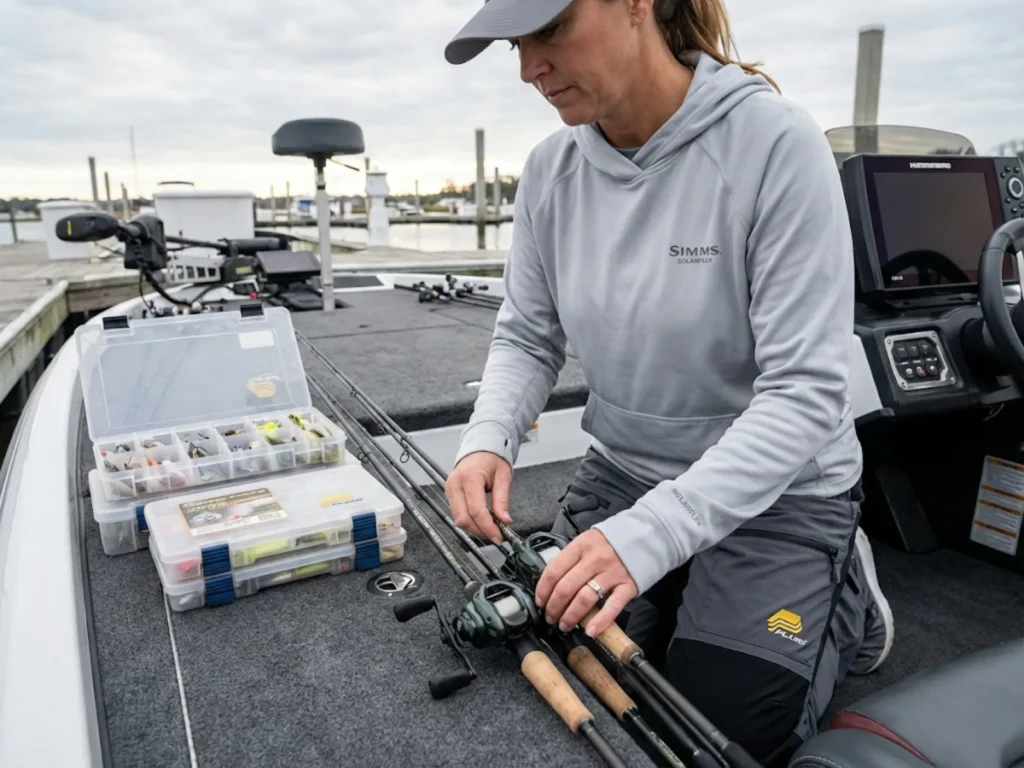
Every successful night fishing trip starts before you leave the dock. This checklist catches the failures before they become emergencies.
N: Notices and NOTAMs
Check weather forecasts for wind, precipitation, and lightning potential. Review solunar tables and tide charts. Verify local boating restrictions—dam releases, temporary no-wake zones. Screenshot your forecasts; cell signal may be unavailable when you need them.
For help reading cloud formations to predict storms, see our weather guide.
I: Illusions Briefing
Brief your fishing partner on the risks of spatial disorientation and false horizons. Explain that depth perception is severely compromised. Establish a “no sudden movements” protocol for passengers, especially during landing fish.
G: Ground/Deck Preparation
Enforce a clean deck policy—trip hazards are invisible at night. All loose gear stored or secured. Pre-rig all rods before launch; tying knots in darkness is frustrating at best, dangerous at worst.
Check all battery terminal connections. Thermal cycling loosens nuts over time, causing high-resistance failures. Verify your spare propeller, prop nut/pin, and wrench are aboard.
H: Human Factors
Establish a hydration plan. Dehydration accelerates fatigue, and fatigue leads to poor decisions. If fishing past midnight, discuss fatigue rotation—one person rests while the other maintains situational awareness.
T: Traffic and Terrain Analysis
Study charts for unlit markers, shoals, and submerged timber. Mark primary waypoints and a backup return route on your Garmin or Lowrance GPS before departing. Identify emergency pull-out points along your planned route.
For sustained equipment reliability, review our fishing gear maintenance protocols.
Wildlife Hazards: What’s Hunting While You’re Fishing
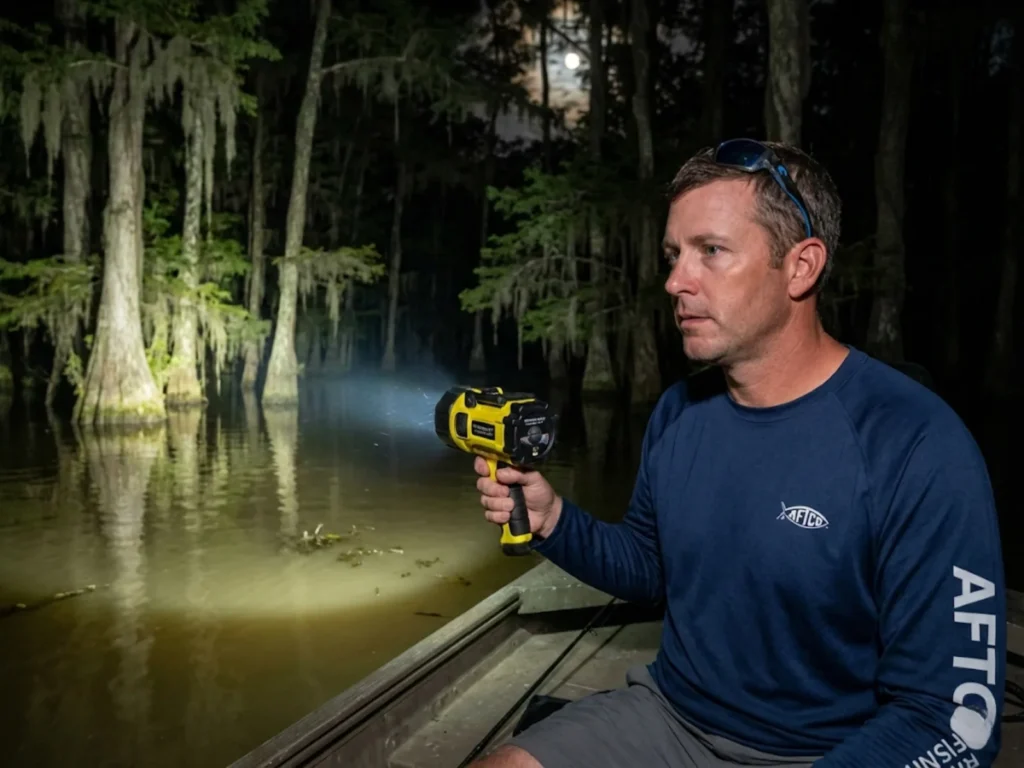
You’re not the only predator active at night. Understanding wildlife hazards keeps you safe in territory you’re sharing with apex hunters.
Alligators: The Southern Apex Predator
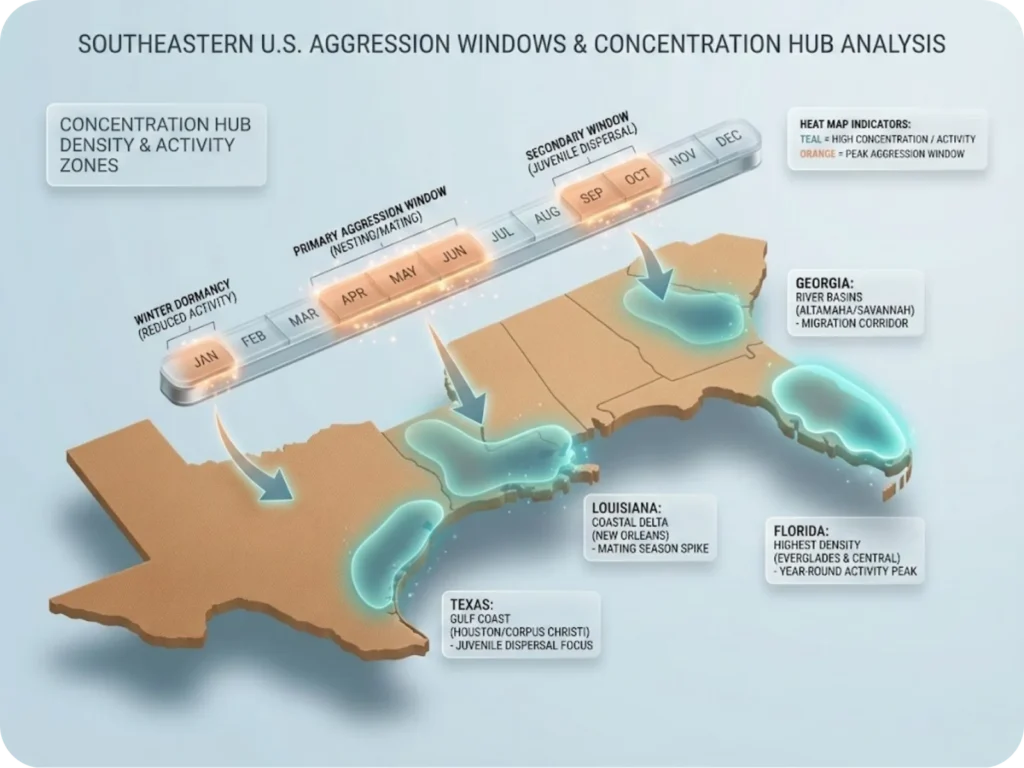
In Florida, Louisiana, and Texas, alligator behavior peaks after dark. Their tapetum lucidum creates red eyeshine when illuminated—scan with a spotlight regularly.
Aggression peaks during mating (May-June) and nesting/hatching (August-September). Maintain at least 60 feet of distance. Never feed alligators—this conditions them to associate boats with food.
Pro tip: The number of red “dots” you see with a spotlight in southern swamps is often startling. That awareness keeps you alert.
For related information on handling alligator gar safely, see our gar guide.
Beavers: The Underrated Threat
Beaver attacks aren’t common, but they’re real. Beavers are territorial and pose genuine risk to kayakers and waders in narrow creeks. The tail slap—often mistaken for a large fish jumping—is a warning signal. Near lodges or in confined waters, a cornered beaver will attack. Their teeth can sever arteries. Protocol: if you hear a tail slap, vacate the area.
Bats and Aerial Hazards
Bats frequently strike fishing line, drawn by insects around lights. This creates “false strikes” that mimic fish bites. Use high-visibility fluorescent line under UV blacklight—if the line lifts up, it’s a bat; if it pulls down, it’s a fish.
Turn off primary headlamps when not actively needed to reduce insect density. Thermacell repellers create a localized insect-free zone that also reduces bat activity.
Night Fishing Tactics: The Sensory Shift
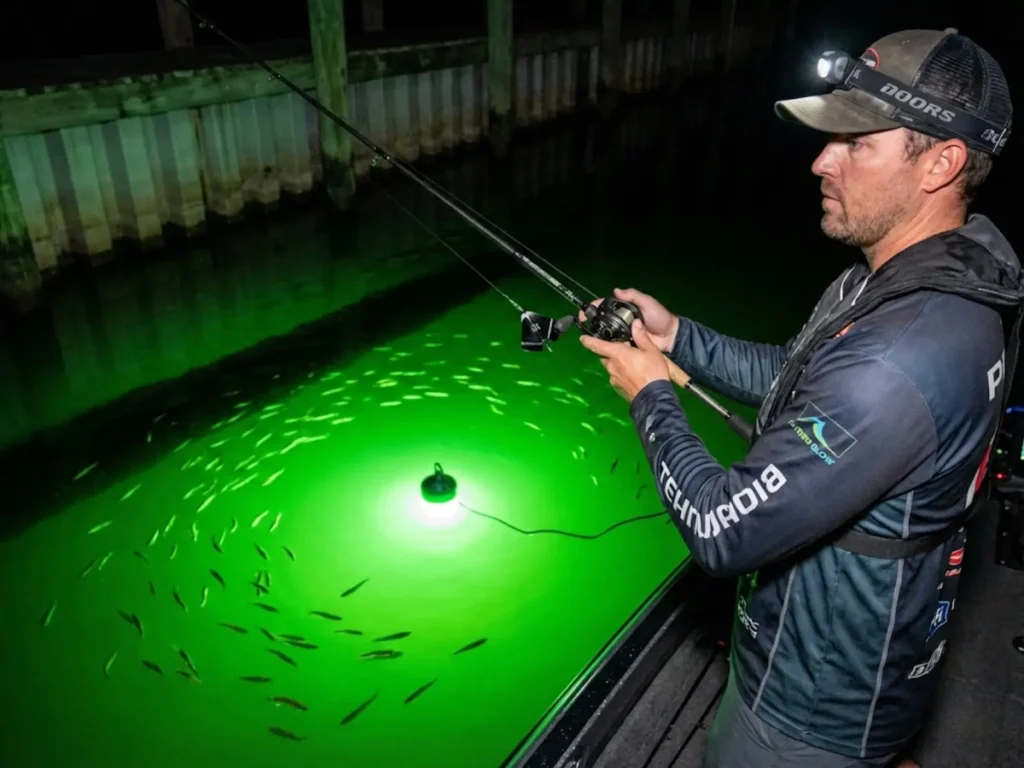
Predator fish don’t hunt by sight at night. They shift to lateral line detection and olfaction. Your lures need to work those senses.
Lure Selection: Contrast and Vibration
Fish hunt up against the moonlit surface. Dark-colored lures—black, purple, junebug—create high-contrast silhouettes. White or translucent lures allow light through, making them harder to detect.
Lures that displace significant water trigger the lateral line. Colorado blade spinnerbaits, chatterbaits, and rattling crankbaits let fish track prey without visual confirmation. Sound-based lures and vibration-based lures are your friends after dark.
For deeper understanding, see our guide on understanding the lateral line system.
Light Deployment: The Shadow Line Strategy
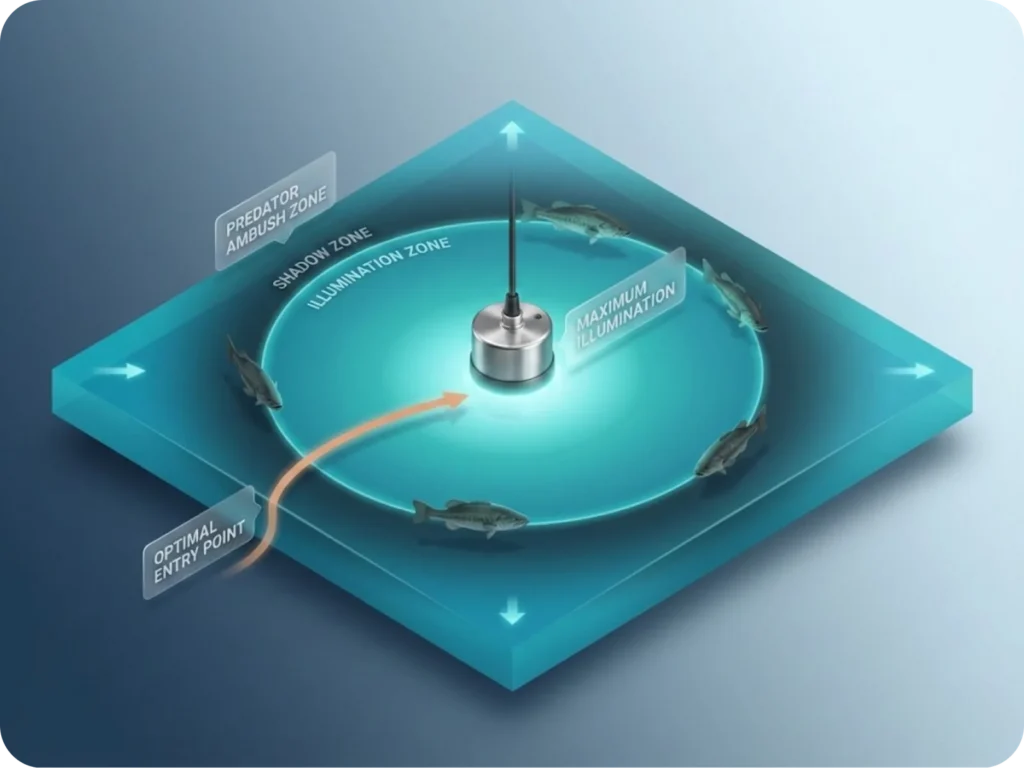
Submersible green lights (wavelength ~520-560nm) penetrate freshwater effectively and attract phototactic plankton. Baitfish follow the plankton; predator fish follow the baitfish.
But here’s what most night anglers miss: predators rarely hunt in the light zone. They lurk at the dark perimeter—the shadow line—to ambush disoriented prey. Cast through the lit zone into the darkness, not into the center of the light.
For comprehensive tactical approaches, see our complete night fishing tactics guide.
UV Lines and Bite Detection
Monofilament and certain fishing line are doped with phosphors that fluoresce under UV radiation. This allows visual bite detection without white light—preserving your night vision and reducing fish spooking.
This is particularly valuable for finesse techniques where detecting subtle takes is critical. Position UV strips to illuminate your line against the water, not directly into your face.
Conclusion
Night fishing demands the discipline of a mariner, not just the instincts of an angler. Protect your vision with the 30-minute adaptation protocol and red-light discipline. Engineer your power system for redundancy—lithium chemistry and a written load budget eliminate the #1 stranding cause. Master the language of navigation lights before you need them.
Run through the N.I.G.H.T. protocol before your next after-dark trip. The fifteen minutes of preparation often mean the difference between successful fishing trip stories and rescue stories.
FAQ
Do I need special lights to night fish legally?
Yes—federal law requires navigation lights on all vessels from sunset to sunrise. Power boats need red or green sidelights plus white stern and masthead lights. Kayaks legally need only a flashlight displayed in time to prevent collision, but a 360-degree pole light is strongly recommended for actual safety.
Is night fishing more dangerous than day fishing?
Statistically, yes. Coast Guard data shows that while nighttime boating volume is lower, incident severity is higher. Contributing factors include visual impairment, spatial disorientation, and fatigue. Proper safety equipment and protocols mitigate most risks.
What color lures work best at night?
Dark-colored lures (black, dark purple, junebug) create strong silhouettes against the moonlit surface. Fish hunting upward detect these outlines more readily than light-colored lures. Pair dark colors with sound-based lures like rattles and Colorado blades.
How do I keep my batteries from dying during a night trip?
Calculate your total system load and compare it against usable battery capacity. Lead-acid batteries provide only 50% usable capacity; lithium provides 95%. Build in a 30% safety margin, and carry a backup flashlight for critical systems like navigation lights.
Should I worry about alligators when night fishing?
In the southern U.S., absolutely. Alligators are most active at night. Use a spotlight to scan for red eyeshine, maintain 60+ feet distance, never approach nests, and never feed them. Most encounters are avoidable with awareness.
Risk Disclaimer: Fishing, boating, and all related outdoor activities involve inherent risks that
can lead to injury. The information provided on Master Fishing Mag is for educational and informational purposes
only. While we strive for accuracy, the information, techniques, and advice on gear and safety are not a substitute
for your own best judgment, local knowledge, and adherence to official regulations. Fishing regulations, including
seasons, size limits, and species restrictions, change frequently and vary by location. Always consult the latest
official regulations from your local fish and wildlife agency before heading out. Proper handling of hooks, knives,
and other sharp equipment is essential for safety. Furthermore, be aware of local fish consumption advisories. By
using this website, you agree that you are solely responsible for your own safety and for complying with all
applicable laws. Any reliance you place on our content is strictly at your own risk. Master Fishing Mag and its
authors will not be held liable for any injury, damage, or loss sustained in connection with the use of the
information herein.
Affiliate Disclosure: We are a participant in the Amazon Services LLC Associates Program, an
affiliate advertising program designed to provide a means for us to earn advertising fees by advertising and linking
to Amazon.com. As an Amazon Associate, we earn from qualifying purchases. We also participate in other affiliate
programs and may receive a commission on products purchased through our links, at no extra cost to you. Additional
terms are found in the terms of service.