

In this article
The sixty-pound alligator gar lay motionless alongside my boat—I thought the fight was over. I reached for my camera, and the next second I was dodging a thrashing snout lined with teeth that would have sliced my forearm open. That fish wasn’t done. He was just resting, gulping air through that ancient swim bladder, gathering strength for one more surge.
After two decades of guiding anglers on Texas waters, I’ve learned that these prehistoric predators demand respect from the moment they hit your line until they disappear back into the murk. Get it wrong, and you’ll end up with lacerations on your hands—or worse, a dead fish floating belly-up despite your best intentions.
Here’s the complete breakdown of how to control, handle, and release alligator gar safely—protecting yourself from injury and giving these remarkable fish the best chance at survival.
⚡ Quick Answer: Safe gar handling requires cut-resistant gloves, positioning your snare behind the pectoral fins (never in front), and knowing when to cut the line instead of extracting deep hooks. Keep the fish in the water whenever possible, support its weight properly, and be ready for surprise energy bursts even after the gar appears calm. Bronze hooks are recommended over stainless steel for catch-and-release fishing.
Understanding Alligator Gar: Why They Demand Special Handling
Anatomy 101: Teeth, Scales, and the Air-Breathing Advantage
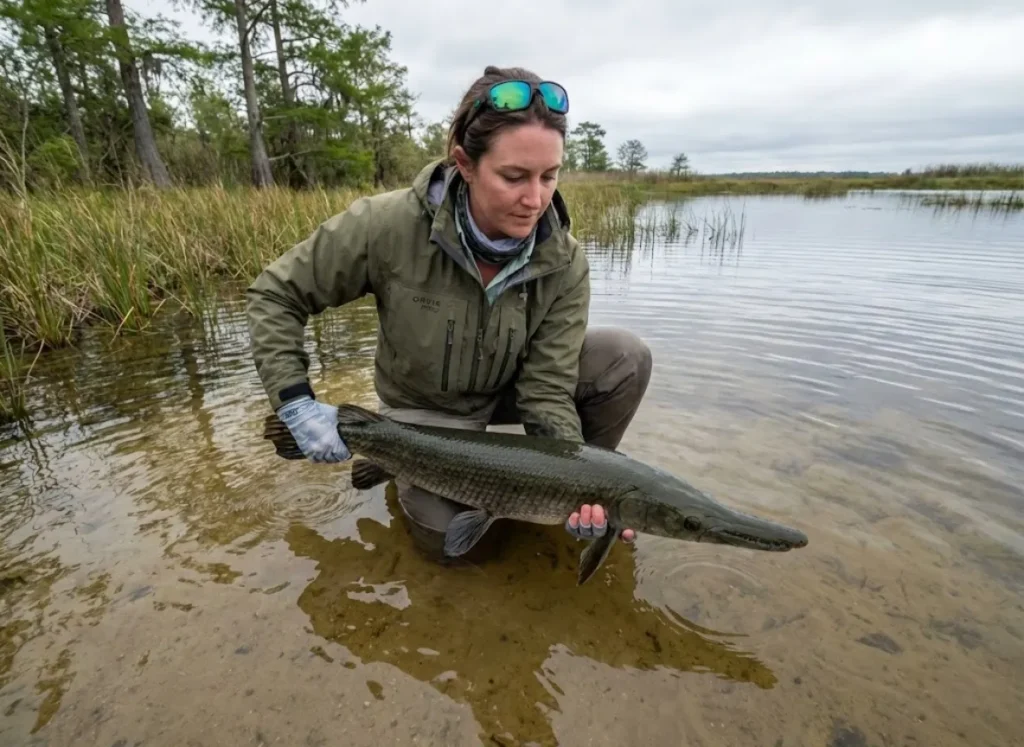
Alligator gar (Atractosteus spatula) are built unlike any other freshwater fish you’ll encounter. Their dual row of large, backward-facing teeth on the upper jaw isn’t designed for chewing—it’s designed for impaling prey and not letting go. Those sharp teeth protrude even when the mouth is closed, which is why a head thrash can drive them into exposed flesh before you realize what happened.
The ganoid scales covering their body are bony plates coated with an enamel-like substance. Think medieval armor. It protects the fish beautifully, but it also means you can’t just grab these fish anywhere like you would a bass.
What truly sets gar apart is their vascularized swim bladder—a primitive lung that allows them to gulp atmospheric oxygen. This air-breathing capability kicks in especially when water temperatures exceed 70°F. It’s why a gar can survive extended periods out of water, but it’s also why a fish lying calm beside your boat isn’t necessarily exhausted. He’s recharging. Understanding this adaptation is key to understanding proper fish holding techniques specific to this species.
Pro tip: A gar lying calm beside the boat isn’t exhausted—he’s oxygenating through his swim bladder and building energy for another surge. Keep your hands clear and stay ready.
Conservation Reality: Why Proper Release Matters More Than You Think
Here’s something most anglers don’t know: alligator gar populations are highly sensitive to exploitation. Research published in the Transactions of the American Fisheries Society found that a mere 7% exploitation rate caused significant population decline in model simulations.
These fish grow slowly and mature late—females may take 10-14 years before they can reproduce. A trophy gar might be over 20 years old. As Terry Smith, a veteran Coosa River guide, puts it: “A big gar might be over 20 years old, so we want these fish to live to be caught again.”
The species was historically persecuted and nearly eliminated from much of their range. People thought they threatened game fish populations. That turned out to be wrong. Now that we understand their ecological value, science-backed catch-and-release practices have become essential for gar conservation and maintaining healthy fish welfare in our waterways.
Essential Gear for Safe Gar Handling
Cut-Resistant Gloves: Your First Line of Defense
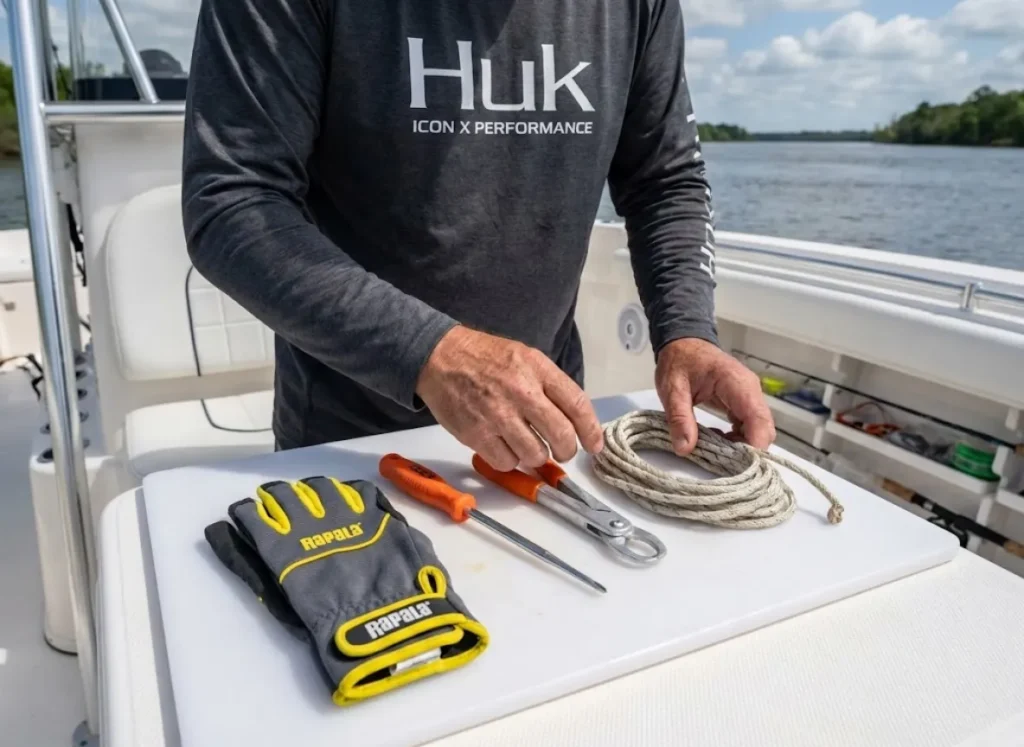
Non-negotiable. Thick protective gloves—specifically cut-resistant gloves—are the single most important piece of required equipment for handling any gar species. You need fish-handling gloves rated for serious protection.
The primary danger isn’t that a gar will bite you intentionally. As professional guide Dawson Hefner explains: “The primary danger from alligator gar isn’t that they’ll bite you intentionally—it’s that their front teeth protrude from the mouth, and if the fish thrashes its head and hits your leg, you will get cut.”
Lindy Legendary Fishing Tackle gloves are specifically recommended by professional guides who handle these fish daily. Rapala Fisherman’s Gloves also work well. But any quality cut-resistant fishing gloves rated for fish handling will do the job. Never—and I mean never—handle a gar bare-handed, regardless of size. Those teeth are proportionally just as sharp on a three-footer as they are on a trophy gator gar.
Hook Removal Tools: Pliers, Spreaders, and the GarJack
Beyond gloves, you’ll need tools that keep your fingers away from the danger zone. Quality needle-nose pliers with long reach are essential for hooks accessible in the mouth cavity. Combined with jaw spreaders or a thick stick mouth prop, you can access the hook without putting hands near teeth.
The GarJack deserves special mention. Developed by Georgia guide Jack Barnett, this specialized device features a notch that holds the gar’s snout in place while a wooden blade keeps the mouth open. It’s professional-grade gear that dramatically reduces handling time and risk to both angler and fish. The Baker Hookout tool provides additional leverage for stubborn hooks. For a comprehensive look at quality needle-nose pliers, check our gear guide.
Pro tip: Keep all your handling tools clipped to your vest or PFD before you hook up. Fumbling through a tackle box with a thrashing gar alongside is exactly when injuries happen.
Hook Selection: Why Bronze Beats Stainless for Catch-and-Release
Your hook choice before you even make a cast affects survival rates dramatically. According to TPWD gar fishing guidelines, use 3/0 or smaller hook sizes to reduce mortality when fish are deep-hooked. Larger hooks (4/0+) significantly increase mortality risk by causing internal organ damage.
Here’s the critical insight: bronze hooks and bronze wire rigging corrode quickly—within weeks—from water and stomach acid. For a deeply hooked gar, this means the fish can shed the hardware naturally over time. Stainless steel hooks persist for years, causing ongoing internal damage. Use non-stainless steel materials whenever possible for catch and release fishing.
The Snout-Grip and Snare Method: Step-by-Step Control
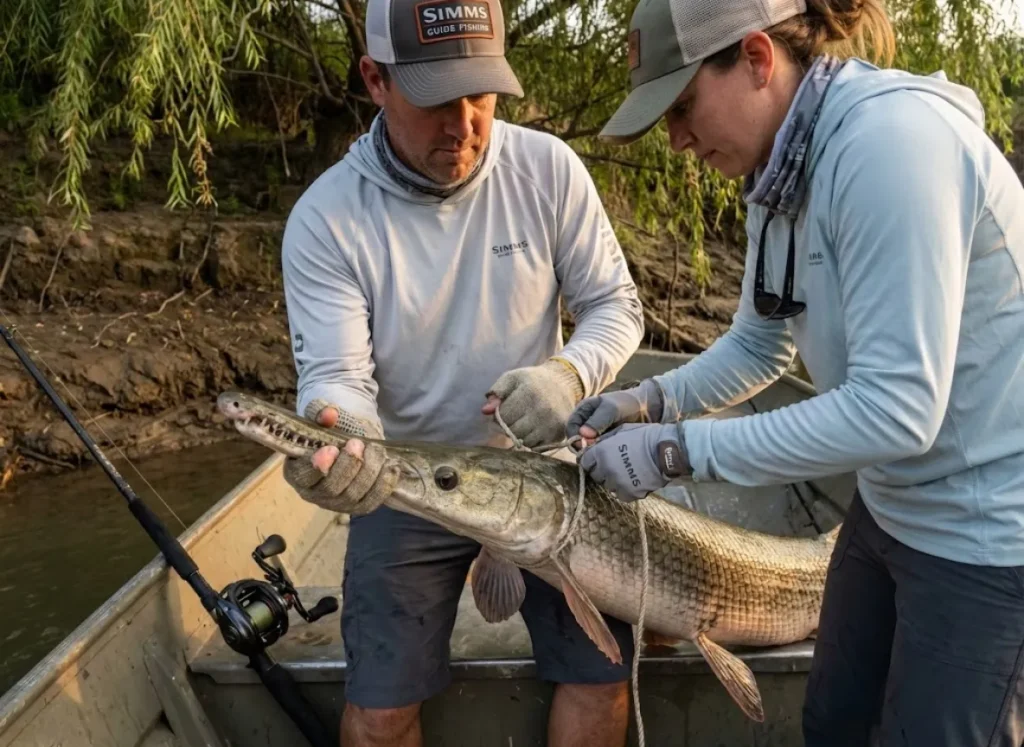
Approaching the Fish: Reading Gar Behavior
Wait for the gar to tire, but remember that stillness doesn’t equal exhaustion with these fish. Their air-breathing capability means they can rest, recharge, and surge repeatedly when you least expect it.
Use a large slip-float system to determine fish orientation in the water before attempting to land. This helps you set the hook when the gar faces away from you for better leverage and reduced deep-hooking risk. Watch for gill flaring—it indicates the fish is actively oxygenating and probably has another run left. Using hookset timing strategies properly can make the difference between a mouth-hook and a gut-hook.
Give the fish time to work the bait into the soft part of its throat before setting. This patience dramatically increases mouth-hooking probability over deep hooking.
The Snare Technique: Position Is Everything
The snare behind pectoral fins technique is where most gar anglers get it wrong—and it’s where the difference between a successful release and a dead fish often lies.
The lasso or snare slips over the fish’s head and tightens to control the gar for landing. The lasso position is absolutely critical. The rope must be positioned BEHIND the pectoral fins, not in front. Placing the rope in front crushes the gills and often proves fatal even if the fish swims away looking fine.
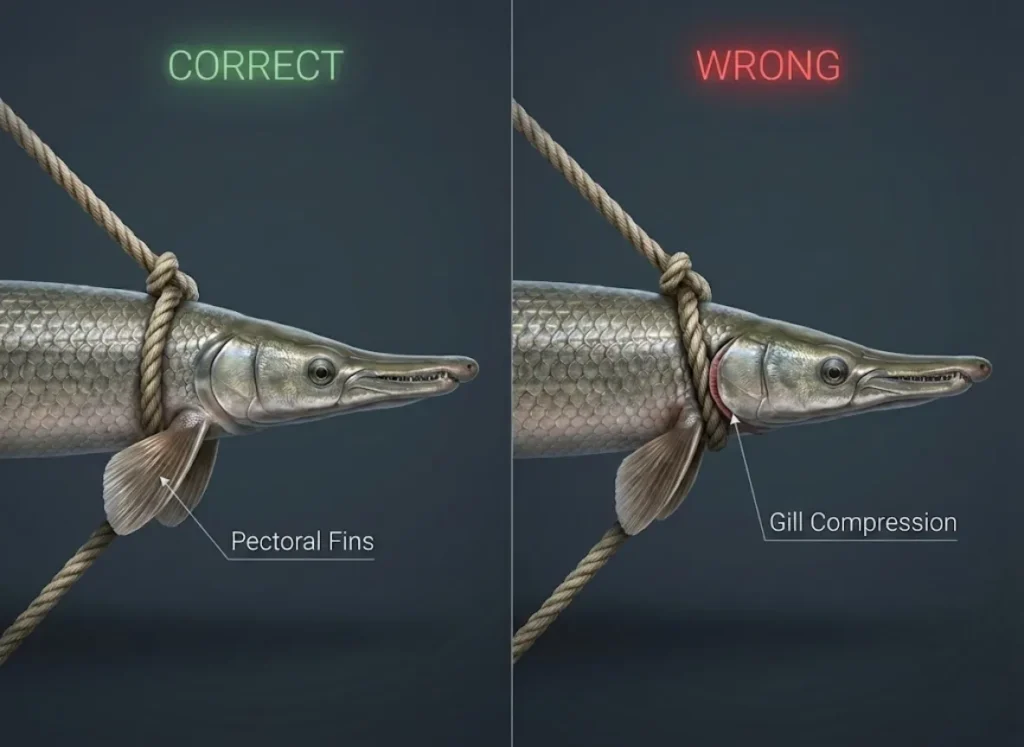
The pectoral fin position is your anatomical reference point. This single distinction separates expert handling from dangerous amateur attempts. Use 130-pound Dacron line for homemade snares—strong enough to control trophy gar, soft enough to avoid scale damage. Avoid nylon rope which can cause abrasion.
Securing the Snout: Gloved Hand Control
With the snare controlling the body, grab by snout firmly with your gloved hand—but grip behind the forward teeth, not in front of them. Those protruding points will puncture even heavy gloves during head thrashing behavior.
Apply firm, steady pressure. Gar respond to controlled restraint better than tentative handling. Keep your forearms and legs clear of the head’s thrashing radius—a tight grip on the snout keeps everything controlled. If using the GarJack, the notch holds the snout while the wooden blade props the mouth for hook removal.
Hook Removal: When to Pull and When to Cut
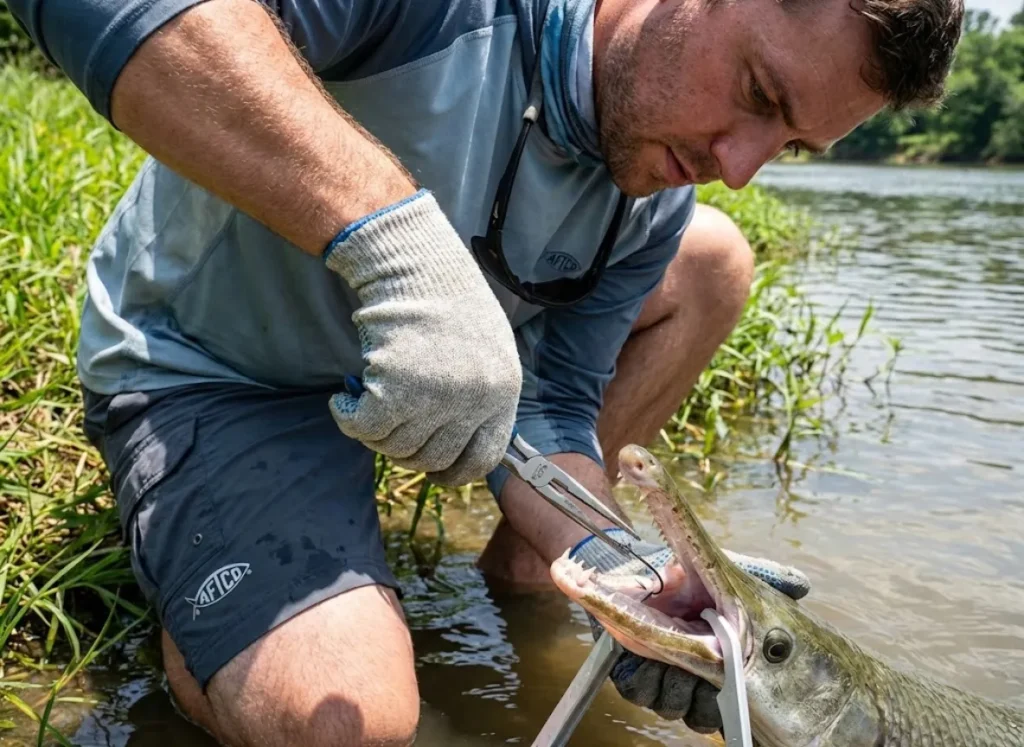
Mouth-Hooked Fish: Safe Extraction Protocol
When you’ve successfully hooked an alligator gar in the mouth, you can remove the hooks with your thick protective gloves and needle-nose pliers. Use jaw spreaders or a thick stick mouth prop to keep the mouth open during extraction.
Work quickly but deliberately—you need to minimize handling time. Rushed movements lead to hand placement errors. Inspect the mouth thoroughly for any rope fibers if you’re using rope lures—ALL debris must be removed. As In-Fisherman gar fishing techniques make clear: “Gar with clamped mouths (from rope fibers caught in teeth) likely die because they cannot expel the debris.”
This thread/rope fiber hazard is a silent killer that undermines otherwise successful releases.
Deep Hooks: The Cut-and-Release Decision
If the gar is hooked beyond the mouth cavity—in the esophagus, gullet, or stomach—do NOT attempt hook removal from gar. Research from Oklahoma State University documented specific injury patterns: “Alligator Gar hooked in the esophagus often experienced injuries to the heart or surrounding vasculature and those hooked in the stomach often sustained damage to internal organs.”
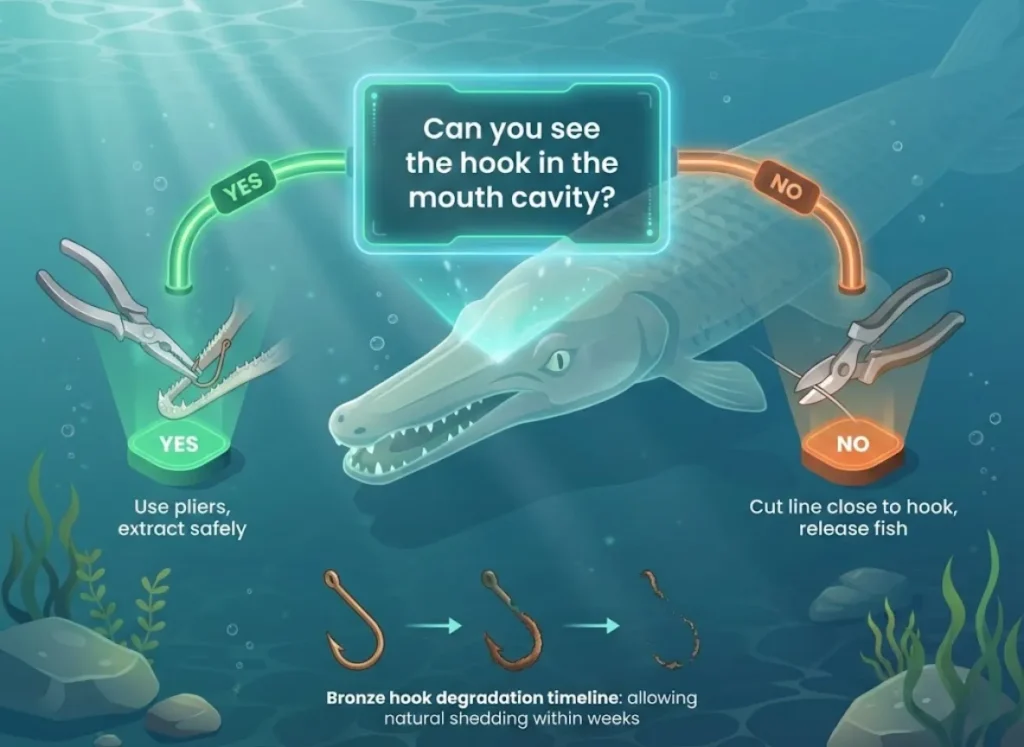
Cut the line as close to the hook as possible. The fish has dramatically better survival odds with embedded hardware than with extraction trauma. This is exactly why bronze hooks matter—they degrade within weeks, allowing natural shedding. The key message: cut the line not the hook when you can’t see the hardware.
The Rope Lure Alternative: Eliminating Deep Hooks Entirely
Hookless rope lure gar fishing represents a revolutionary approach for gar fishing safety. These specialized lures entangle in gar teeth without penetrating tissue, eliminating the deep hooking risk entirely and making catch and release best practices nearly 100% successful.
The trade-off is patience—rope lures require more time for the gar to work the bait and become entangled. But for dedicated conservation-minded anglers, the near-perfect release success rate is worth it. Just remember: all rope fibers MUST be removed before release. Carry a small comb or pick specifically for extracting fibers from gar teeth.
Landing and Release: Protecting Internal Organs
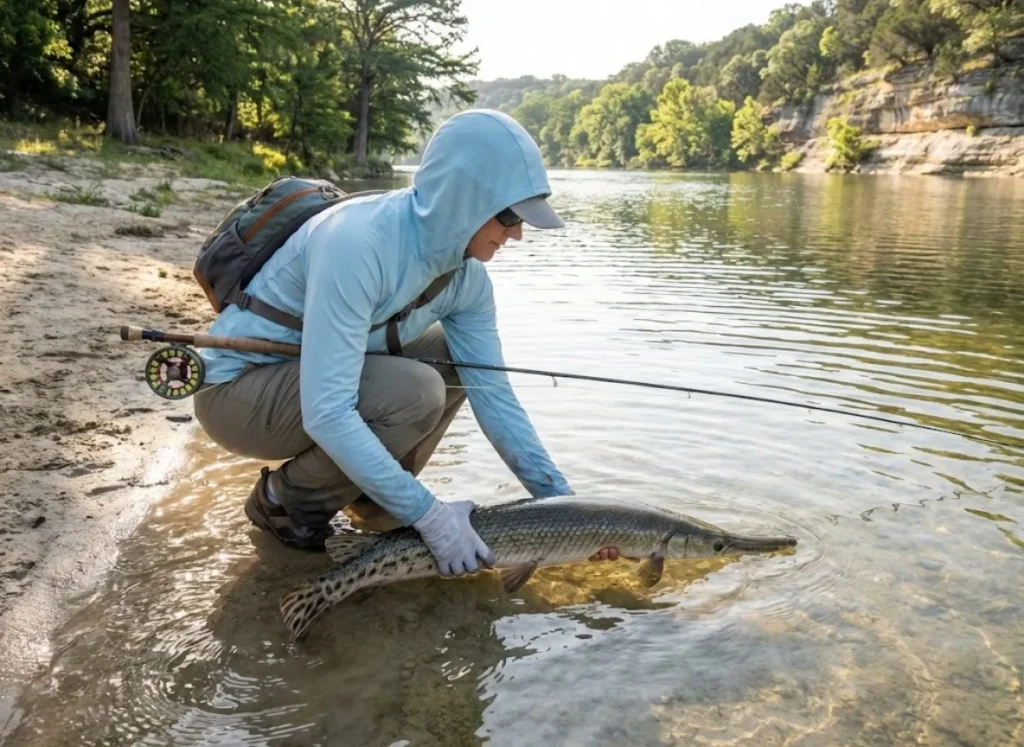
Shore Landing vs. Boat Landing: The Safer Choice
Texas Parks and Wildlife Department is clear on this: “If possible, it is always best to land fish on shore rather than in a boat.”
Shore landing allows the fish to remain supported on a level surface throughout handling. Boat landing risks the fish thrashing against gunwales, deck equipment, and hard surfaces. For trophy-sized gar exceeding 50 pounds, the importance of shore landing escalates as weight-related internal injury to gar risk increases.
When boat landing is unavoidable, keep gar in water alongside the boat whenever possible. This follows essential catch and release best practices for all large fish species.
The Gunwale Danger: Why Lifting Kills
TPWD official guidelines are explicit: “The use of lassos or snares to lift a fish over a boat gunnel may result in internal injury to a heavy fish like alligator gar.”
The internal organs of a big gar are suspended in the body cavity. When you lift a heavy fish by the snare alone, all that body weight concentrates on organ attachment points. Liver damage, swim bladder injury, and intestinal trauma may not be visible, but it causes delayed mortality days later. This applies to all gar over 20-30 pounds—the threshold where internal injury risk becomes significant. Understanding internal organ damage in fish helps explain why this seemingly simple mistake can be lethal.
If lifting is absolutely necessary, always support gar weight with your hands under the body. Never lift by the snare alone.
Minimizing Air Exposure: The 30-Second Rule
According to research cited by Texas Saltwater Fishing Magazine, survival rate for fish exposed to air for 30 seconds drops to 62%. At 60 seconds, mortality increases dramatically.
While gar tolerate air exposure better than most fish thanks to their gar air breathing capability, gill tissue still requires moisture. Extended exposure causes gill lamellae to collapse, impairing oxygen absorption when the fish returns to water. A gar appearing “fine” after extended air exposure may still suffer delayed mortality from slime coat protection breakdown and gill damage.
Minimize handling time. Keep photos quick. Keep gar in water for any prolonged handling and water support for heavy fish is critical.
Three Critical Mistakes That Kill Gar (And How to Avoid Them)
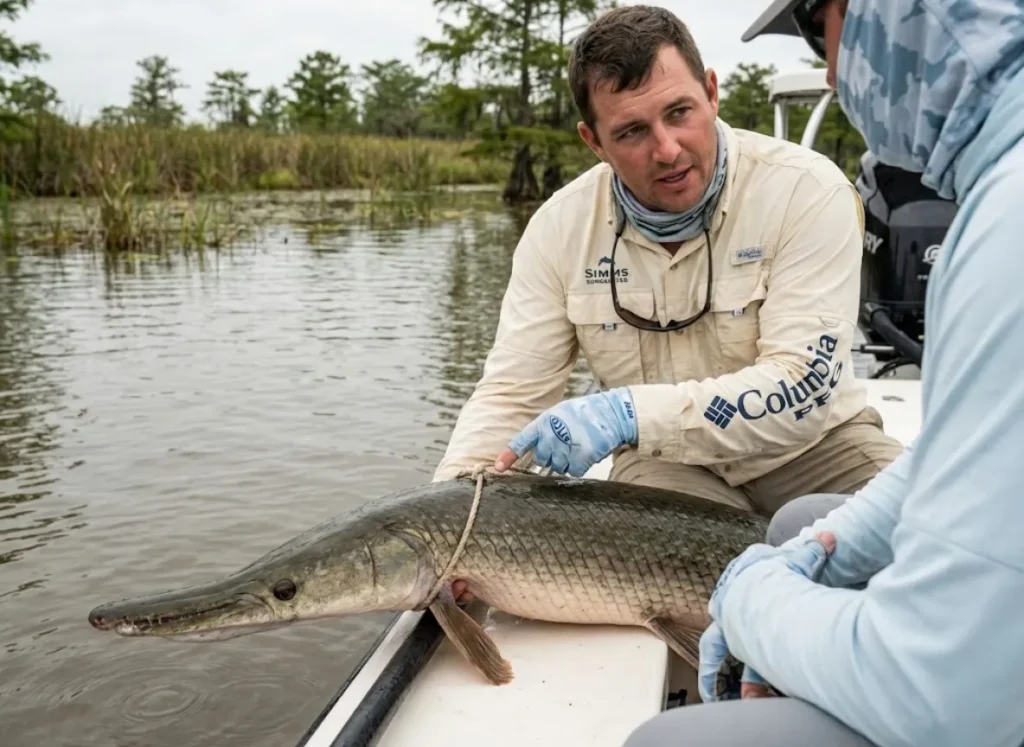
Mistake #1: Rope Position in Front of Pectoral Fins
This is the single most common rope position mistake I see on the water. Gar anglers slip the snare loop over the gar’s head and tighten it right in front of the pectoral fins—directly over the gills.
Even if that fish swims away, gill damage impairs oxygen absorption and causes delayed mortality. The correct position: slide the loop behind the pectoral fins where it contacts the muscular body without any gill contact. Visual confirmation: you should see the pectoral fins clearly in front of the rope, not hidden beneath it.
As one veteran guide told me: “I’ve been guiding for gar fishing for fifteen years, and the single biggest mistake I see anglers make is their rope position. Then they wonder why the fish dies after release.”
Mistake #2: Letting Your Guard Down After Landing
Gar can breathe air, so a fish lying calmly isn’t “done”—it’s resting and oxygenating through that primitive lung. Surprise energy bursts can occur 5-10 minutes after initial landing, catching anglers completely off guard. This is exactly when you need proper caution and security around the fish.
This counterintuitive safety issue causes most injuries. Anglers drop their vigilance when the fish appears exhausted. Keep hands and legs outside the thrashing radius until the fish is fully controlled and you’re ready to release. That powerful tail can break bones.
Pro tip: During the aerial phase when a hooked gar jumps, click into free-spool technique to allow slack. This prevents hooks from pulling out when the fish clears the water. Also, always let gar run—fighting them too hard causes exhaustion and increases mortality.
Mistake #3: Leaving Rope Fibers in Teeth
Gar cannot expel foreign material from their mouths due to their tooth structure. Trapped rope fibers prevent normal feeding, leading to infection and death. This damage pattern is rarely discussed—a silent killer that undermines otherwise successful releases and poor fish welfare.
After using rope lures, inspect teeth thoroughly and remove ALL fiber debris. Use a small comb, pick, or hemostats. Don’t rush this step. Take your time on the inspection—a two-minute check can mean the difference between a fish that survives and one that starves over the following weeks.
Conclusion
Three principles separate anglers who successfully release alligator gar from those who unknowingly kill them:
Position matters more than force. The snare behind pectoral fins—not in front—is the single technique distinction that determines whether a fish survives. Visual confirmation: pectoral fins visible in front of the rope, gills completely clear.
Cut deep hooks, don’t pull. Extraction attempts cause more damage than embedded bronze hooks that corrode and shed naturally within weeks. If you can’t see the hook in the mouth cavity, reach for your line cutters.
Respect the resting gar. That air-breathing capability means these fish recharge during apparent calm. Maintain vigilance and keep extremities clear of the thrashing radius until release.
The next time you feel that unmistakable thump of an alligator gar, you’ll be ready—not just to land the fish, but to release it in condition to grow another decade and fight another angler. That’s the legacy worth pursuing on these waters.
FAQ
Are gar dangerous to humans?
No—alligator gar pose no confirmed threat to humans. Texas Parks and Wildlife Department states there are no verified attacks on people despite their fearsome appearance. The danger is incidental: protruding teeth on a thrashing head can cause lacerations, but gar don’t bite aggressively or target humans.
Can you handle gar with bare hands?
Never handle gar without cut-resistant gloves. Even small gar have teeth proportionally as sharp as trophy specimens. The sharp teeth protrude when the mouth is closed, meaning any head thrashing can drive them into unprotected flesh.
What happens if you touch a gar?
Touching the gar’s body is generally safe—those ganoid scales protect the fish. But approaching the head or mouth without thick protective gloves risks serious lacerations during sudden thrashing. Always wear gar handling gloves and control the snout first.
How long can alligator gar survive out of water?
Alligator gar can survive extended periods out of water due to their air-breathing capability. However, gill tissue still requires moisture, and survival rates drop significantly after 30-60 seconds of air exposure. Keep gar in water whenever possible.
What tools do you need for safe gar handling?
Essential equipment includes fish-handling gloves (Lindy Legendary or similar), needle-nose pliers with long reach, a jaw spreader, quality snare or lasso (130-pound Dacron), and line cutters. Professional guides also use the GarJack device for safer snout control during hook removal.
Risk Disclaimer: Fishing, boating, and all related outdoor activities involve inherent risks that
can lead to injury. The information provided on Master Fishing Mag is for educational and informational purposes
only. While we strive for accuracy, the information, techniques, and advice on gear and safety are not a substitute
for your own best judgment, local knowledge, and adherence to official regulations. Fishing regulations, including
seasons, size limits, and species restrictions, change frequently and vary by location. Always consult the latest
official regulations from your local fish and wildlife agency before heading out. Proper handling of hooks, knives,
and other sharp equipment is essential for safety. Furthermore, be aware of local fish consumption advisories. By
using this website, you agree that you are solely responsible for your own safety and for complying with all
applicable laws. Any reliance you place on our content is strictly at your own risk. Master Fishing Mag and its
authors will not be held liable for any injury, damage, or loss sustained in connection with the use of the
information herein.
Affiliate Disclosure: We are a participant in the Amazon Services LLC Associates Program, an
affiliate advertising program designed to provide a means for us to earn advertising fees by advertising and linking
to Amazon.com. As an Amazon Associate, we earn from qualifying purchases. We also participate in other affiliate
programs and may receive a commission on products purchased through our links, at no extra cost to you. Additional
terms are found in the terms of service.