
In this article
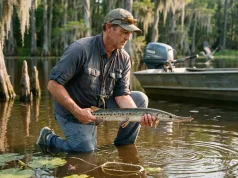
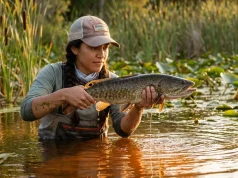
You caught a sheepshead. Except you didn’t. That silver hump-backed fish flopping in your net is a freshwater drum — and somewhere in Florida, an angler is calling a completely different species by the exact same name. I’ve watched this argument play out at boat ramps from Wisconsin to Louisiana, and both sides are always convinced they’re right.
Here’s the thing: they both are. The name “sheepshead” belongs to three separate fish depending on where you’re standing. This article sorts out which one you actually caught, explains the biology that makes drum one of the most underappreciated freshwater fish on the continent, and covers a few facts about them that might make you reconsider throwing the next one back.
Quick Answer: Freshwater drum (Aplodinotus grunniens) and sheepshead (Archosargus probatocephalus) are completely different species in different families. Drum are freshwater fish in the Sciaenidae family, while true sheepshead are saltwater porgies in the Sparidae family. The “sheepshead” nickname for drum is regional — mostly Midwest and Great Lakes states — and creates confusion with the actual saltwater fish.
What Freshwater Drum Actually Look Like
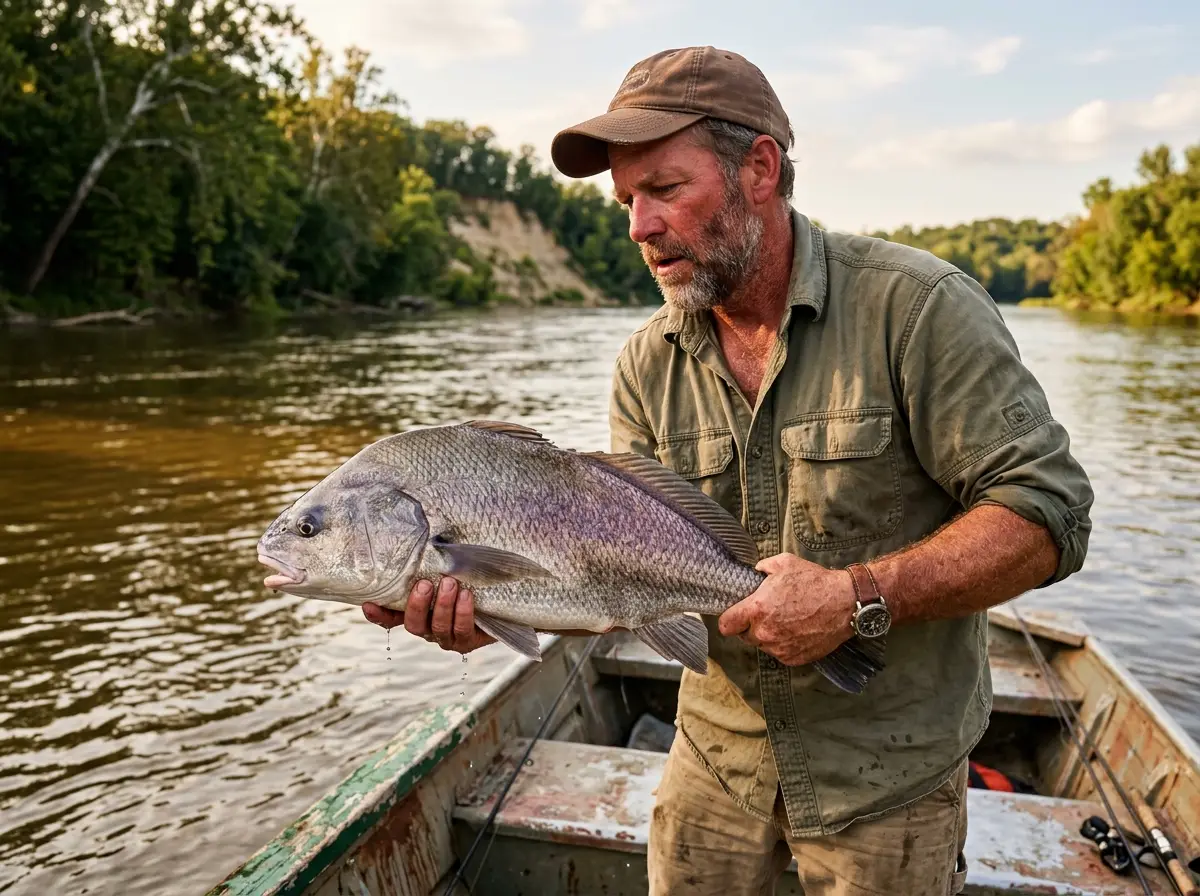
The first time someone hands you a freshwater drum, you know something about it is different. The fish is thick through the shoulders with a pronounced hump behind the head that makes it look like it’s been doing shrugs at the gym. The profile slopes steeply from that hump down to a relatively small, downturned mouth — a mouth built for the bottom, not for chasing bait near the surface.
The Hump, the Forehead, and the Color That Changes with Age
Young drum are pretty fish. They come out of the water bright silver with a metallic sheen that catches light the way a chrome spoon does. As they age and grow, that silver shifts toward bronze and gray, sometimes with a faint purple cast along the flanks that you only notice in certain light. The belly stays pale. A big drum pulled from a murky river looks like it’s been dipped in pewter.
The hump becomes more pronounced in older fish. A 3-pound drum has a visible shoulder; a 15-pound drum looks like a linebacker.
The Divided Dorsal and the Downturned Mouth
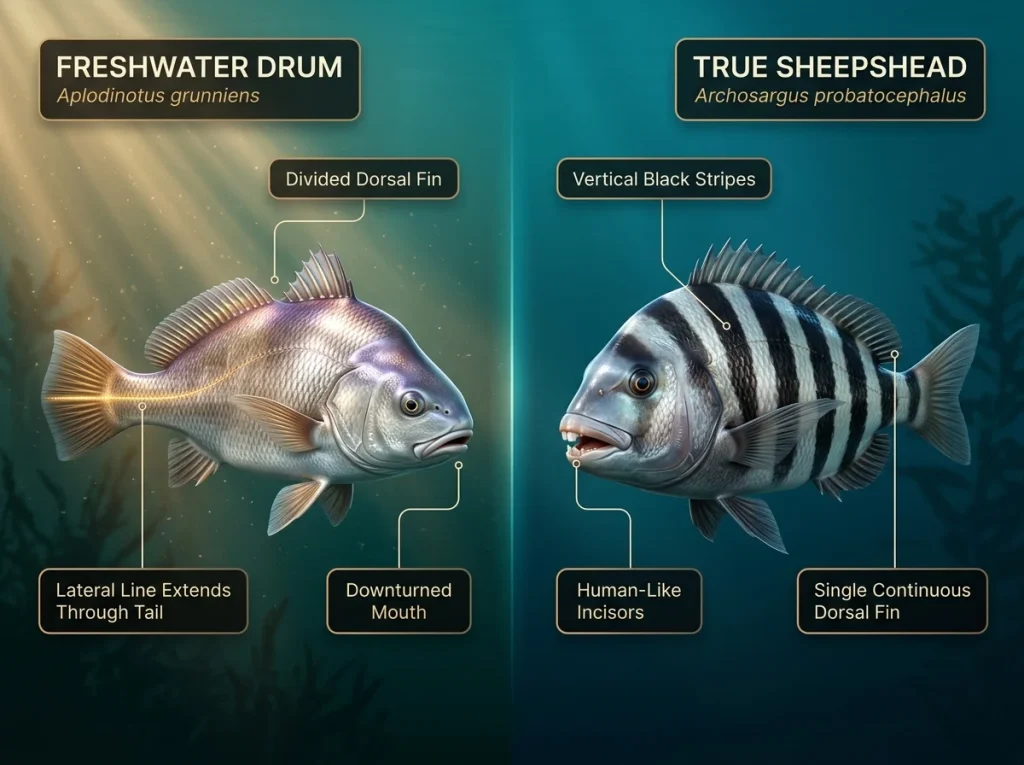
Two things jump out once you look past the hump. First, the dorsal fin is divided into two sections — a spiny front portion with about 10 spines and a soft rear portion with roughly 30 rays. This split dorsal is a family trait shared with red drum, another Sciaenidae member that lives its life in saltwater.
Second, the mouth sits low on the head, angled downward. Drum don’t chase — they root. That mouth tells you everything about how this fish feeds before you ever read a single study.
The Lateral Line Through the Tail (the ID Nobody Teaches)
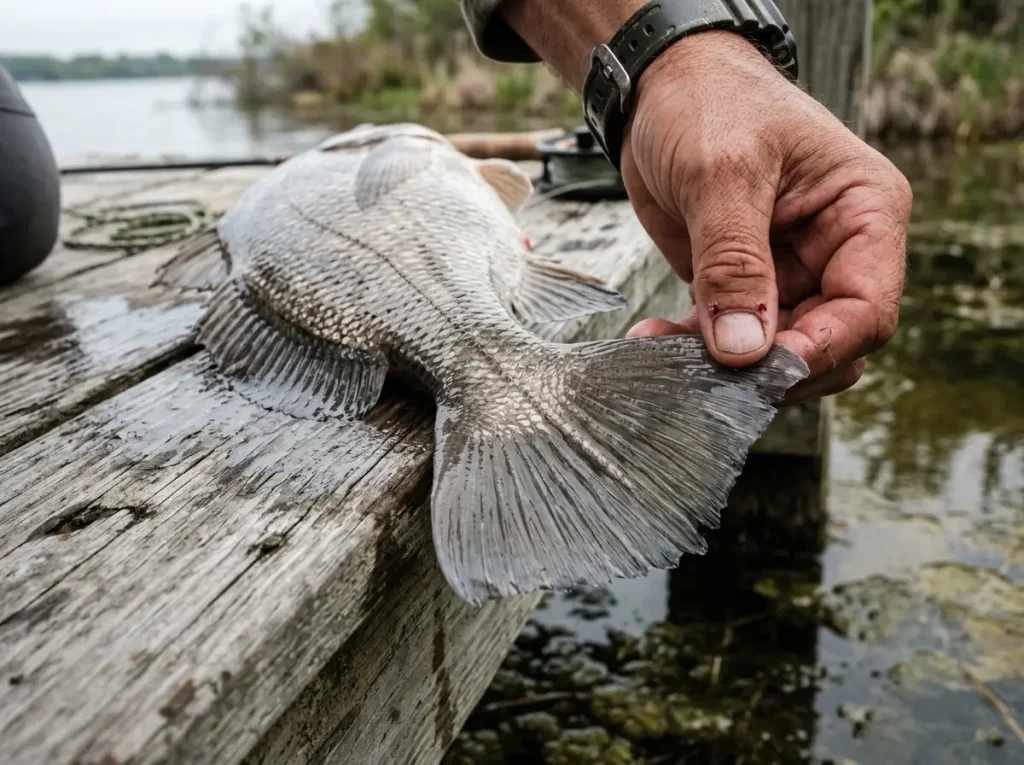
Here’s the one feature that ends every identification argument. The lateral line — that sensory ridge running along a fish’s side — extends completely through the tail fin in freshwater drum. Every other North American freshwater fish stops the lateral line at the base of the tail. Drum don’t.
Hold the fish up, fan the tail, and look. If the line keeps going through the fin itself, you have a drum. No exceptions. This is the single most reliable field ID marker for the species, as noted in the National Park Service’s species profile for freshwater drum, and almost nobody teaches it.
Pro tip: If you’re arguing with someone about whether a fish is a drum, skip the color, skip the hump, skip everything else — check the tail. The lateral line through the tail fin settles it in three seconds. No other freshwater fish has it.
Why They’re Called Sheepshead (And Seven Other Names)
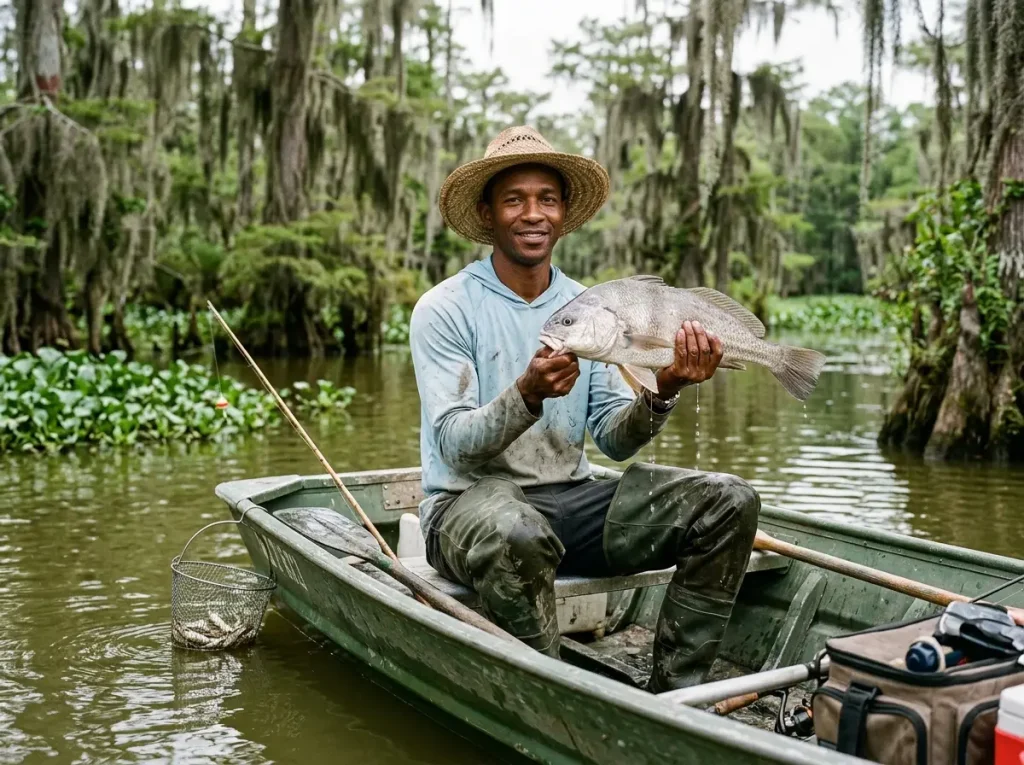
Ask a Minnesota angler what a sheepshead is and they’ll describe this exact fish. Ask a Florida angler and they’ll describe something that looks nothing like it. The name spread across two completely different parts of the country attached to two completely different species, and neither side knows the other exists.
The Sheepshead Name and How It Spread Inland
The nickname likely comes from the drum’s head profile — viewed from the front, the elongated snout and forehead vaguely resemble a sheep’s face. Inland anglers in the Great Lakes and upper Mississippi drainage who had never encountered the actual sheepshead — the saltwater porgy — saw that resemblance and the name stuck. It spread through the Midwest along the same rivers the fish live in, with no one checking whether the name was already taken.
Gaspergou: The Name That Actually Makes Sense
Down in Louisiana, the same fish goes by gaspergou — sometimes shortened to just “gou.” The word comes from the Cajun French casse-burgeau, which translates to “shell-breaker.” Of all the regional names this fish carries, the Cajun one is the most accurate. It tells you exactly what the fish does with those pharyngeal teeth. The Midwest named it for what it vaguely looks like. Louisiana named it for what it actually does.
The Full Regional Name Map
The list of regional names is long. Thunder pumper in the upper Midwest and Ontario — named for the drumming sound. Grunter, croaker, and bubbler across various states. Silver bass in some areas where anglers mistake the coloration for a bass relative. In Canada, some anglers call them “sunfish,” which creates yet another layer of confusion. The species has enough aliases to need a witness protection program.
The official name from species that go by multiple regional names across their range is Aplodinotus grunniens — the Latin grunniens meaning “grunting.” Even the scientific name is about the sound.
The Sound That Named Them: How Freshwater Drum Actually Drum
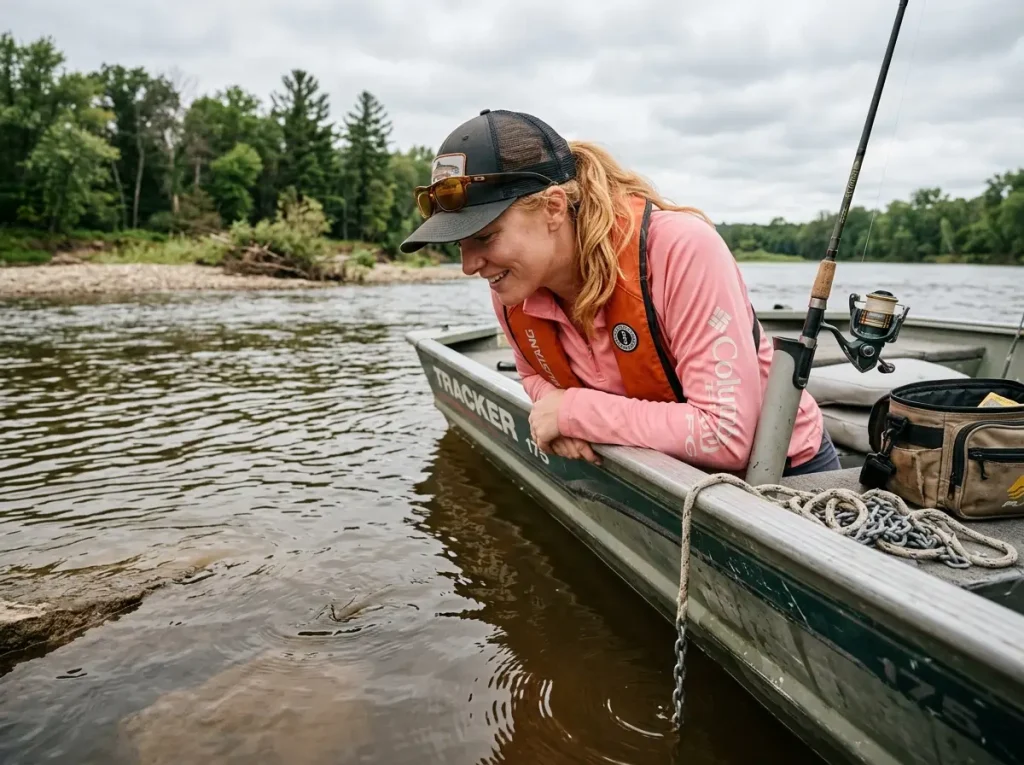
Most anglers first hear a drum before they know what’s making the noise. It’s a low-frequency thump or grind — like someone tapping the hull from below. The first time it happened to me in a jon boat on the Illinois River, I checked the trolling motor. It was the fish.
The Swim Bladder Mechanism
Male drum produce the sound by contracting specialized sonic muscles attached to the swim bladder. The vibration resonates through the fish and into the water as a low, repetitive drumming or grunting. Females don’t do it. This isn’t a stress response you hear when you put a catfish in a bucket — it’s an active, intentional vocalization tied to spawning behavior.
The drum’s swim bladder is one of the most developed of any freshwater fish. It functions both as a buoyancy organ and a sound chamber, and the fish can modulate the pitch and intensity.
When Drum Drum (and What It Means for Anglers)
Peak drumming happens when water temperatures hit 65–70°F, generally April through June depending on latitude. That’s spawning season. Males aggregate over shallow gravel and sand flats and start calling — and when a large group of drum are drumming in shallow water, you can hear it from the bank.
For anglers, the drumming is a location signal. If you hear that low thumping in spring near shallow gravel, you’re standing over a spawning aggregation. Drum also produce the sound under stress — which is why one in a livewell can startle you at 6 AM when you forgot you had it in there.
Pro tip: In spring, wade quietly along shallow gravel flats in rivers with known drum populations. If you feel or hear a low-frequency vibration through the water, you’ve found them. They concentrate predictably over hard bottom when the water warms past 65°F.
Other North American Fish That Make Sounds (And Why Drum Is Different)
Several North American fish produce sounds. Catfish rasp their pectoral fin spines. Some sunfish grunt. Like bowfin, another native freshwater fish with unusual behaviors most anglers dismiss, drum get grouped with “weird fish that make noise.”
The difference is scale and intent. Drum are among the loudest freshwater fish on the continent, the sound is specifically tied to reproductive communication, and the mechanism — muscles vibrating against a resonating swim bladder — is more sophisticated than anything else in freshwater. It’s closer to how saltwater croakers and spot operate, which makes sense. They’re in the same family.
Freshwater Drum Range and Habitat: Where You’re Likely to Find One
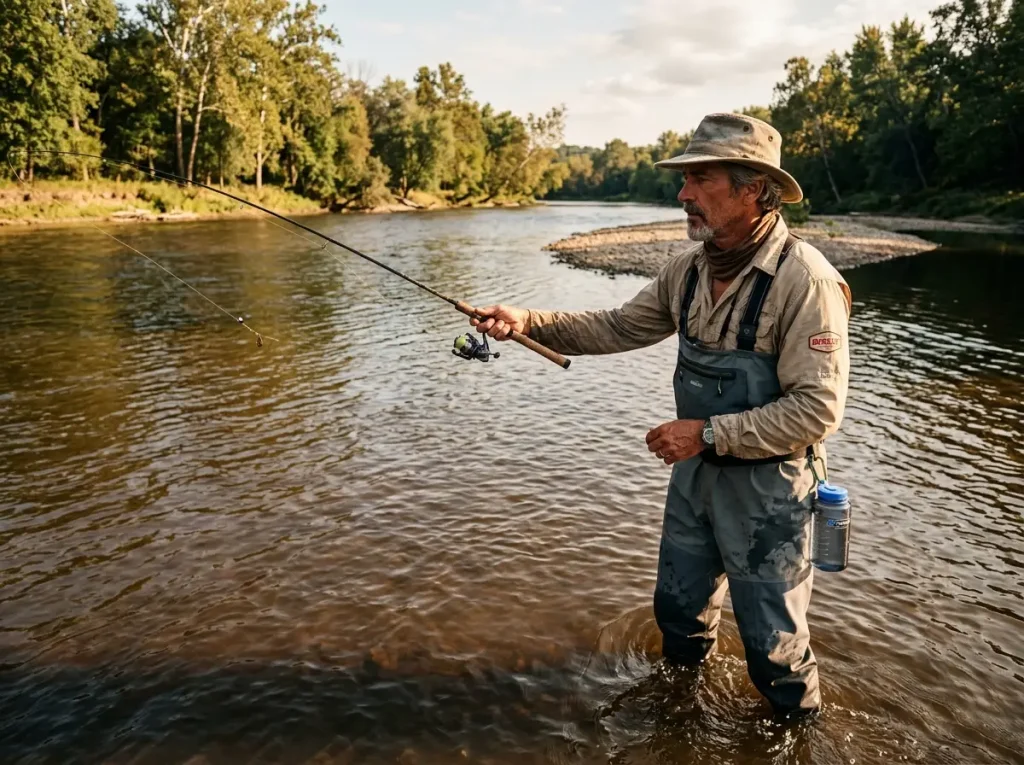
If you’ve fished any large Midwest or Great Lakes river system, you’ve been in drum water. You might not have known it. These fish are everywhere.
The Mississippi Drainage: Core Drum Country
The Mississippi River and its major tributaries — Ohio, Missouri, Arkansas, Red, Illinois — are the center of drum country. Large, slow-to-moderate rivers with sand or mud bottoms and deep channel pools are ideal habitat. Drum populations in the upper Mississippi can be remarkably dense, to the point where anglers targeting walleye or catfish catch drum as bycatch more often than they’d admit.
The species has documented range data from the USGS nonindigenous aquatic species database spanning 27-plus states, from Manitoba’s Hudson Bay drainage south through the U.S. and into Guatemala. That’s the widest latitudinal range of any freshwater fish in North America.
Great Lakes Populations and Expansion
Drum have established populations in Lakes Erie, Ontario, Huron, and Michigan. They showed up in Lake Superior records in the 1970s — relatively recent. In the Great Lakes, drum tend to concentrate near connecting rivers and areas with suitable bottom substrate. Cayuga Lake in New York holds abundant drum, though anglers rarely target them.
Seasonal Movement Patterns
Drum don’t make long migrations, but they shift predictably with temperature. Spring pushes them shallow — under 6 feet — over gravel and sand when the water hits 65°F for spawning. Summer heat drives them to deep channel edges, 20–40 feet, where the same river systems where walleye stage for their pre-spawn run also hold drum in the slower pools. Fall puts them at intermediate depths on active feed. Winter slows everything down.
What Freshwater Drum Eat (And Why Their Teeth Are Unusual)
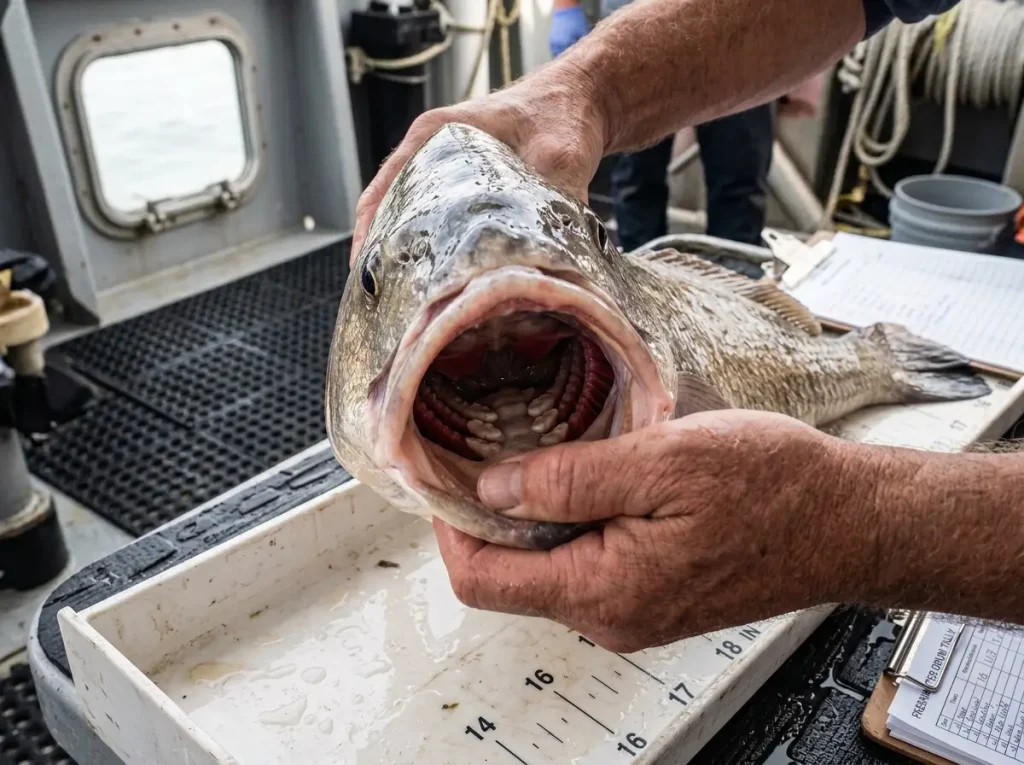
Drum are bottom feeders. Everyone knows that part. What most anglers don’t know is that these fish have a second set of teeth in their throat — and those teeth change form as the fish grows.
The Pharyngeal Tooth Progression
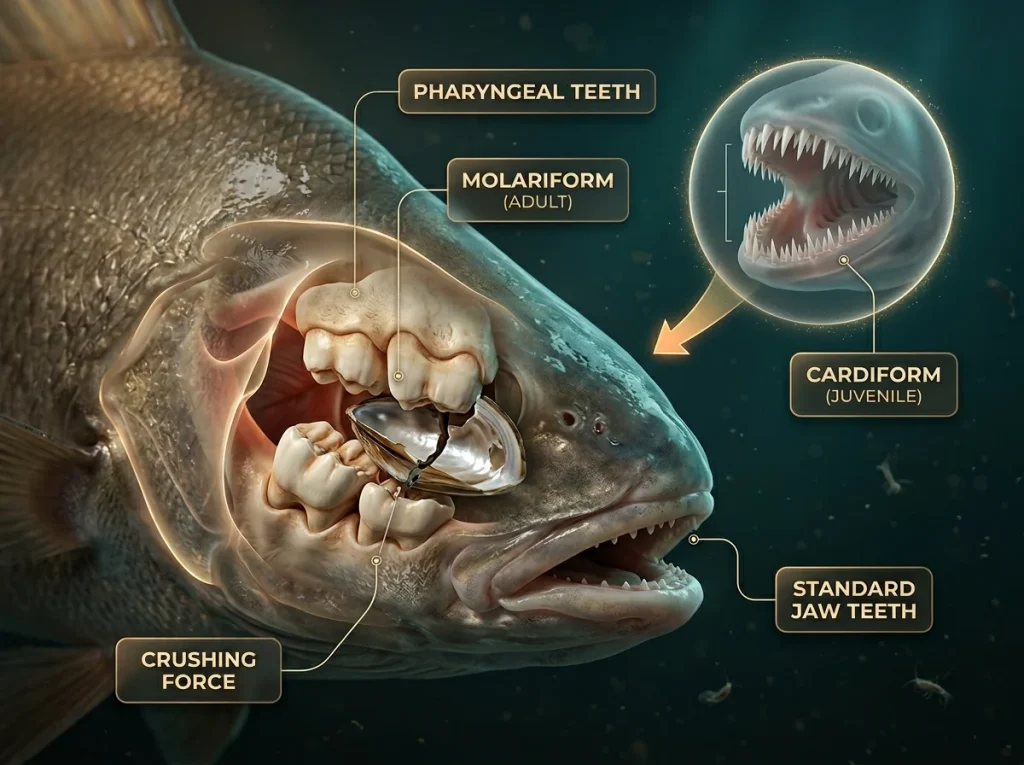
Young drum eat what most small fish eat: midge larvae, amphipods, tiny invertebrates. Their throat teeth at this stage are fine and pointed — cardiform teeth, standard issue. As the fish grows, those teeth transition to villiform — still small, but denser. Then, in fish over about 265mm (roughly 10 inches), the transformation completes: molariform teeth take over, flat crushing surfaces that comprise over 85% of the total tooth area, documented in USGS research on freshwater drum predation of zebra mussels.
Those molars are the reason a 15-inch drum can crack a mussel shell that would bounce off every other fish in the lake.
How Drum Actually Feed on the Bottom
Watch a drum feed and it looks methodical. The fish positions nose-down, uses that downturned mouth to root into the substrate, and works crayfish and invertebrate forage that drum and bass share in the same river systems off the bottom. When it picks up a mussel, the shell gets moved to the pharyngeal area and crushed. It’s not a violent strike — it’s a slow, deliberate process.
The extended lateral line helps drum locate prey in zero-visibility water. They feel vibrations from invertebrate movement through the substrate. Turbid water doesn’t slow them down. It’s actually where they thrive.
What This Means for Anglers Fishing for Drum
Bottom presentations win. Nightcrawlers, crayfish, and cut bait near structure on sand or mud are the starting lineup. Lead-head jigs with soft plastic grubs worked slowly across bottom structure produce well for anglers who target drum intentionally. Fast retrieves targeting the mid-column don’t connect — these fish aren’t built for it.
Pro tip: Work a jig with a slow drag-and-pause across sand or mud bottom, keeping contact with the substrate. Drum don’t chase — they intercept. A lure that stays on the bottom and moves like something crawling will outfish a fast retrieve every time with this species.
The Three-Way Sheepshead Name Mess (Which One Are You Looking At?)
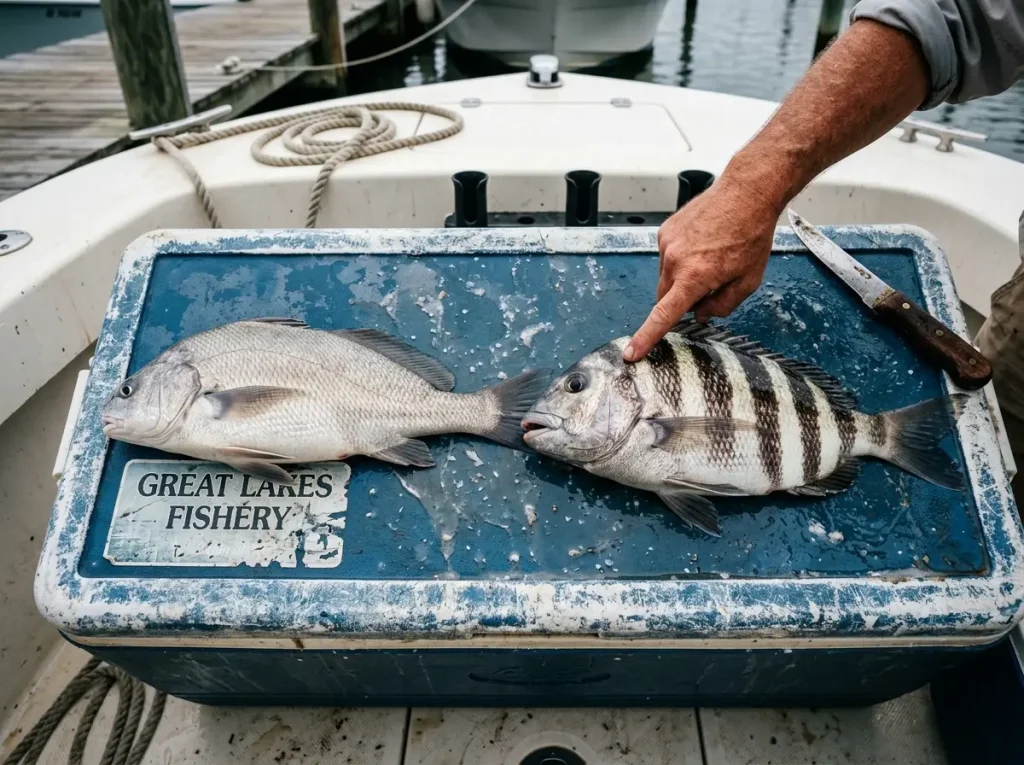
This is the section no one else writes. Every article about the sheepshead confusion treats it as a two-fish problem. It’s not. Three distinct species share this nickname in different parts of the country, and the overlap is where the real confusion lives.
Freshwater Drum vs. True Sheepshead: Different Families, Different Worlds
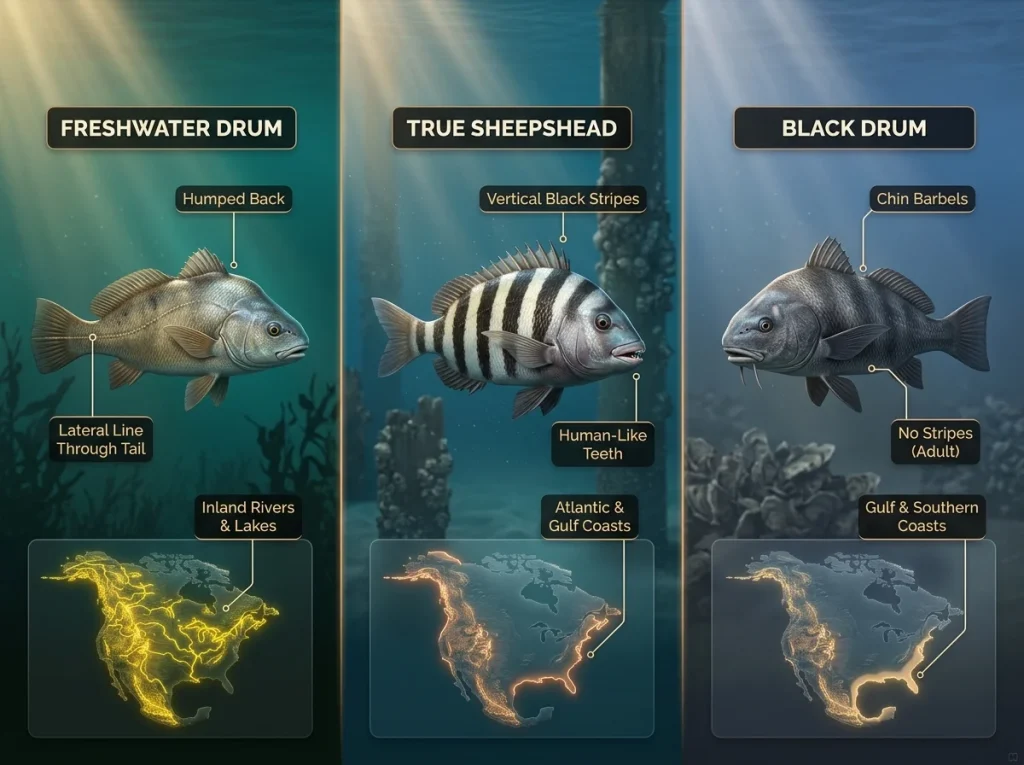
Freshwater drum (Aplodinotus grunniens) belongs to the Sciaenidae — the drum and croaker family. True sheepshead (Archosargus probatocephalus) belongs to the Sparidae — the porgy family. These families aren’t closely related. The shared name is a folk taxonomy accident.
True sheepshead are saltwater fish that live around hard structure — docks, piers, oyster reefs, bridge pilings along the Atlantic and Gulf coasts. They’re famous for their teeth, which look disturbingly human — flat incisors designed for crushing barnacles and crustaceans. They’re also famous for being incredibly difficult to hook because they steal bait with surgical precision. Anglers who catch the actual sheepshead around structure on the Gulf and Atlantic coasts know exactly how different the experience is from catching drum.
The two fish look nothing alike in person. Sheepshead wear 5–7 bold black vertical stripes on a white-silver frame. Drum have no stripes at all.
Black Drum: The Third Fish in the Mix
Here’s where it gets worse. Black drum (Pogonias cromis) is also called “sheepshead” in parts of Louisiana and some Gulf Coast fishing communities. Black drum are in the Sciaenidae — same family as freshwater drum, and the two are more closely related to each other than either is to true sheepshead.
Adult black drum are dark gray to black with no stripes and can exceed 100 pounds. But juveniles have vertical black bars on a lighter background — which makes young black drum look a lot like true sheepshead to anyone who doesn’t check the mouth. The tell: black drum have chin barbels (whiskers). True sheepshead have visible teeth. Freshwater drum have neither.
Red drum, another Sciaenidae family member that lives its life in saltwater, rounds out the drum family but at least has the decency to go by a distinct name.
The Quick ID Decision Tree
First question: freshwater or saltwater? If the catch came from a river or lake inland, it’s almost certainly freshwater drum. If it came from saltwater or brackish water, ask the next question: does it have bold vertical black stripes? Yes — true sheepshead. No stripes — does it have chin barbels? Yes — black drum. No barbels, no stripes, lateral line through the tail — freshwater drum that wandered into brackish water near the coast, which happens in a few southern river systems.
Lucky Stones, Endangered Mussels, and Why Drum Matter More Than Anyone Thinks
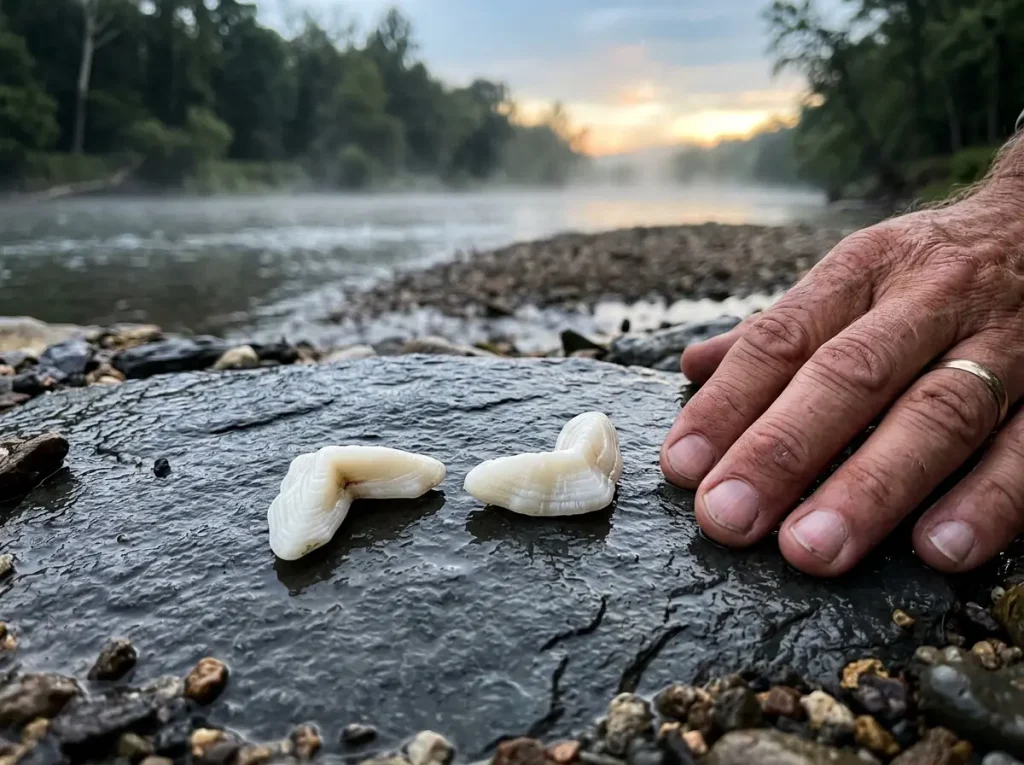
This is the part where the “trash fish” label falls apart. Freshwater drum are doing things in the ecosystem that no other fish in North America can do — and they’ve been doing it for longer than most anglers realize.
Lucky Stones: The Fish That Makes Its Own Jewelry
Inside every drum’s head are two otoliths — ear bones — that can exceed an inch in diameter. The left one forms a natural L-shape. The right forms a J. They’re made of calcium carbonate, smooth and ivory-white, and they look like someone carved and polished them. Nobody did. That’s just what the crystal structure produces.
Native Americans collected these lucky stones for thousands of years. They turned them into jewelry, used them as protective amulets, and traded them as currency. Archaeological excavations have recovered drum otoliths at sites in Utah and California — states where freshwater drum have never lived. Those stones traveled on trade routes hundreds of miles beyond the fish’s range. The fish stayed in the rivers. The lucky stones went everywhere.
A 72-Year-Old Fish Hiding in Your River
Those otoliths aren’t just jewelry. Researchers read the growth rings in drum otoliths the same way dendrochronologists read tree rings — each year deposits a visible annulus in the calcium carbonate. That technique confirmed a 72-year-old freshwater drum in Red Lake, Minnesota. That’s the oldest verified age for the species.
A 5-pound drum you pull from a river might be 10 years old. A 15-pound fish could be in its 20s. That “trash fish” someone tosses back without a second thought might have been swimming in that river since before they were born.
The Double-Duty Drum: Endangered Mussel Host and Invasive Mussel Predator
Freshwater drum are the only known fish host for the scaleshell mussel (Leptodea leptodon), a species listed as federally endangered since 2001. The scaleshell’s larvae — called glochidia — must attach to the gills of a freshwater drum to complete their life cycle. No other fish works. No drum population means no scaleshell reproduction. The mussel now exists in reliable numbers in only a handful of states, with Missouri as one of its last strongholds, as listed by the Missouri Department of Conservation as a host species for the federally endangered scaleshell mussel.
At the same time, drum are the only fish in North America with pharyngeal teeth capable of crushing zebra mussel (Dreissena polymorpha) shells — the invasive species that has devastated native mussel populations across the Great Lakes and Mississippi drainage. Large drum over 375mm feed heavily on zebra mussels where the two overlap.
The connection is hard to ignore. The same fish that hosts the endangered native mussel is also the only fish that can eat the invasive mussel threatening that native mussel’s habitat. Drum are doing double duty in a system where freshwater mussels and why the fish that host them matter to anglers isn’t a topic most people think about when they decide what to throw back.
Conclusion
Three things worth remembering the next time a drum hits your line.
First, that fish is a freshwater drum — “sheepshead” is a regional nickname shared with two completely different species in other parts of the country, and using it will start an argument with someone from the Gulf Coast who is just as right as you are.
Second, the lateral line through the tail is the one-second ID test. Check the tail fin. If the line keeps going, you’ve got a drum. No other freshwater fish does that.
Third, what you’re holding might be 20 years old, hosts an endangered species on its gills, eats an invasive species nothing else can crack, and leaves behind lucky stones that Native Americans traded across a continent. That’s a lot of ecological weight for a fish most anglers don’t bother learning about.
Next time you net one, check the tail, look at the otoliths if you keep it, and if you eat it — cut out the dark meat strip along the lateral line before cooking. The white meat underneath is better than its reputation.
Q1 Why is a freshwater drum called a sheepshead?
Inland anglers applied the name based on the drum’s head profile, which vaguely resembles a sheep’s face from the front. The nickname spread through the Midwest and Great Lakes where anglers had never seen the actual saltwater sheepshead, so nobody realized the name was already taken by a different species.
Q2 What is the difference between a freshwater drum and a sheepshead?
Freshwater drum (Aplodinotus grunniens) is a silvery freshwater fish in the Sciaenidae family with no stripes and a lateral line through its tail. True sheepshead (Archosargus probatocephalus) is a saltwater porgy in the Sparidae family with bold black vertical stripes and human-like front teeth. Different families, different habitats.
Q3 Is freshwater drum good to eat?
Yes, when prepared right. Remove the dark red meat along the lateral line before cooking — that strip tastes strong and muddy. The white meat on both sides is mild and flaky, similar to redfish, which is a close saltwater relative. Drum from clean, cold water taste noticeably better than fish from warm, turbid rivers.
Q4 How big do freshwater drum get?
Most drum caught by anglers weigh 2–10 pounds, but fish over 20 pounds are common in major river systems. The world record is 54 lbs 8 oz from Nickajack Lake, Tennessee. They also live far longer than most anglers expect — the oldest confirmed freshwater drum was 72 years old.
Q5 Do freshwater drum make noise?
Yes — males contract specialized muscles against their swim bladder to produce a deep drumming sound during spawning season. Females don’t drum. The sound is loud enough to hear through the hull of a boat, and the species’ Latin name grunniens means grunting.
Risk Disclaimer: Fishing, boating, and all related outdoor activities involve inherent risks that
can lead to injury. The information provided on Master Fishing Mag is for educational and informational purposes
only. While we strive for accuracy, the information, techniques, and advice on gear and safety are not a substitute
for your own best judgment, local knowledge, and adherence to official regulations. Fishing regulations, including
seasons, size limits, and species restrictions, change frequently and vary by location. Always consult the latest
official regulations from your local fish and wildlife agency before heading out. Proper handling of hooks, knives,
and other sharp equipment is essential for safety. Furthermore, be aware of local fish consumption advisories. By
using this website, you agree that you are solely responsible for your own safety and for complying with all
applicable laws. Any reliance you place on our content is strictly at your own risk. Master Fishing Mag and its
authors will not be held liable for any injury, damage, or loss sustained in connection with the use of the
information herein.
Affiliate Disclosure: We are a participant in the Amazon Services LLC Associates Program, an
affiliate advertising program designed to provide a means for us to earn advertising fees by advertising and linking
to Amazon.com. As an Amazon Associate, we earn from qualifying purchases. We also participate in other affiliate
programs and may receive a commission on products purchased through our links, at no extra cost to you. Additional
terms are found in the terms of service.