
In this article
The line was tight. The fiddler crab was on. The sheepshead was right there on the piling — I could see its shadow. I waited for the hit I thought was coming. After a minute I reeled in to check the bait. The crab was gone. Completely clean. The hook looked like it had never been in the water. Somewhere in that minute, a sheepshead had picked up the bait, felt nothing suspicious, and eaten it so efficiently that I missed the entire transaction.
Sheepshead are not difficult fish. They live on predictable structure, they eat predictable baits, and they hold in predictable positions. The part that trips up almost every new sheepshead angler is the bite — it’s not what you expect, and until you’ve felt it enough times to recognize it, you’ll lose fish to empty hooks and confusing non-events. This guide covers the structure, the baits, the rig that keeps you in the zone, and what the bite actually feels like when you get it right.
⚡ Quick Answer: Sheepshead hold tight to hard structure — pilings, jetties, rocky reefs — and feed on barnacles, fiddler crabs, and mollusks. The best approach is a knocker rig with a live fiddler crab, fished vertically alongside the structure with 10-15 lb braid and a fluorocarbon leader. The bite feels like a light tap-tap followed by slight weight — set firmly when the weight appears. Most missed fish come from setting too early on the first tap or not feeling the sequence at all.
Why Sheepshead Are Harder to Catch Than They Look
The fish with human teeth and a criminal record
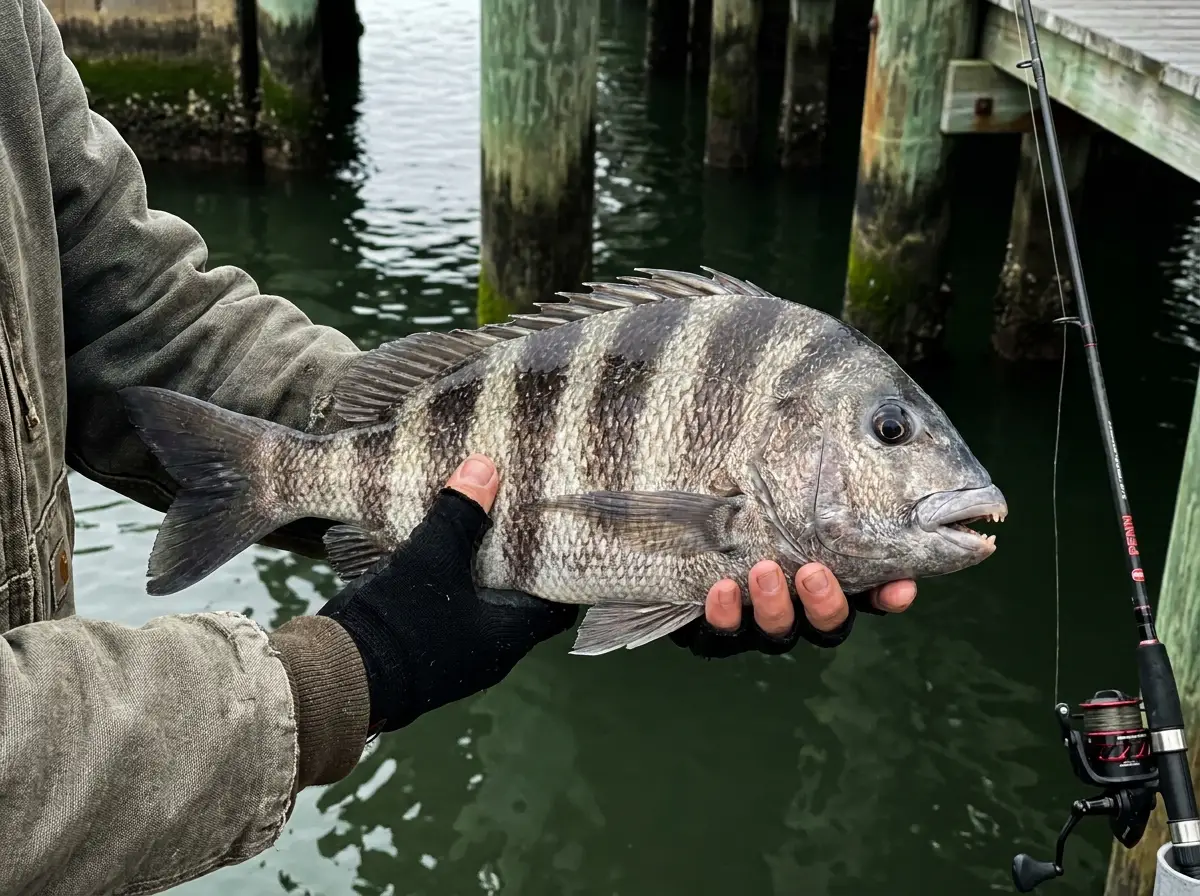
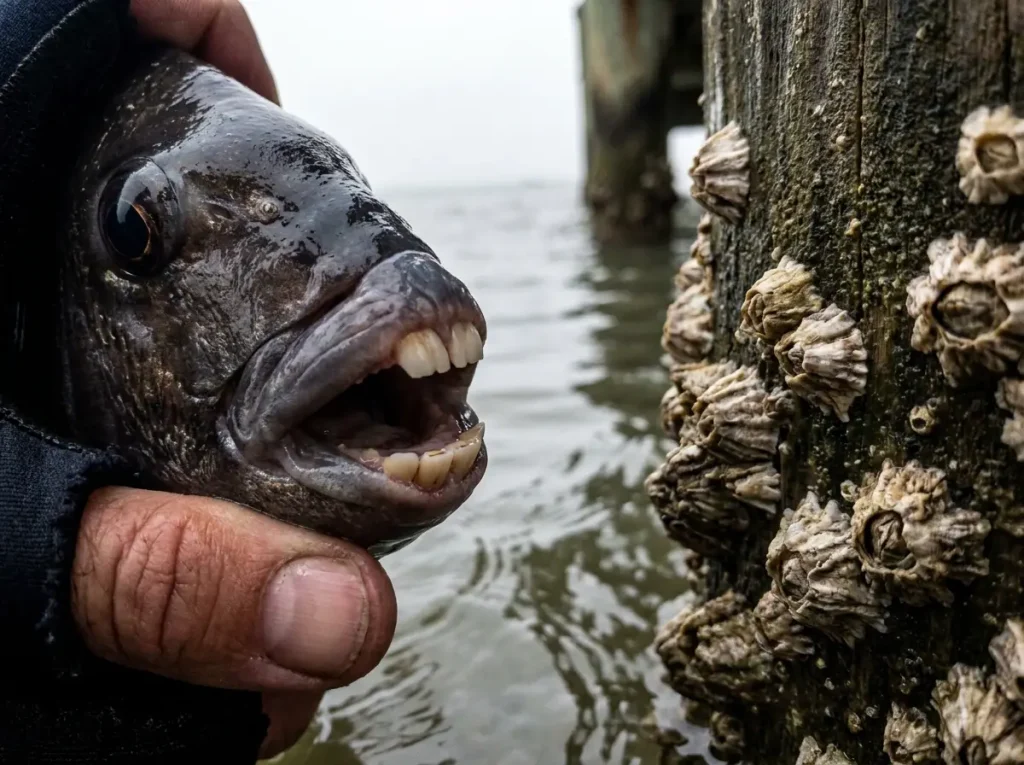
Sheepshead (Archosargus probatocephalus) are one of the most distinctive-looking fish in North American inshore waters. The five or six bold dark vertical bars on a silver-gray body have earned them the nickname “convict fish,” and the incisors at the front of their mouth — broad, flat, and spaced apart in a way that looks uncomfortably familiar — have made them the subject of genuinely startled photographs for generations of first-time catchers.
Those teeth aren’t just visually interesting. They’re functional equipment for a very specific feeding strategy. The front incisors are designed for clipping and scraping — sheepshead use them to pry barnacles off pilings and bite through oyster shells. Behind those incisors are rows of flat crushing molars that grind the shell fragments into digestible pieces. The whole system is designed to process hard-shelled invertebrates on hard structure, and that design is exactly why sheepshead are where they are and why they eat what they eat.
Understanding the feeding anatomy explains the bite. A sheepshead picking up a fiddler crab isn’t inhaling it like a bass — it’s grasping it carefully, testing for shell resistance, orienting it, then moving it to the crushing position. That process takes a few seconds and produces a very different line signal than a predatory strike.
The challenge that trips most anglers
Sheepshead are listed on almost every “easiest inshore fish” guide because they’re predictable and abundant. That reputation is partially deserved — they are where you expect them to be and they eat what you put in front of them. The catch is the bite detection. Fish that have spent their lives eating barnacles off concrete pilings are accustomed to mouthing hard objects carefully before committing. They know what should feel like food and what shouldn’t. A poorly rigged bait with too much hardware creates resistance that tells the fish something is wrong before you ever know the fish was there.
The angler who catches sheepshead consistently has usually put in the time to calibrate the bite. That calibration — learning what “tap-tap heavy” feels like in the hands — is the actual skill.
The Structures Sheepshead Hold On and Why
Hard structure with biological growth
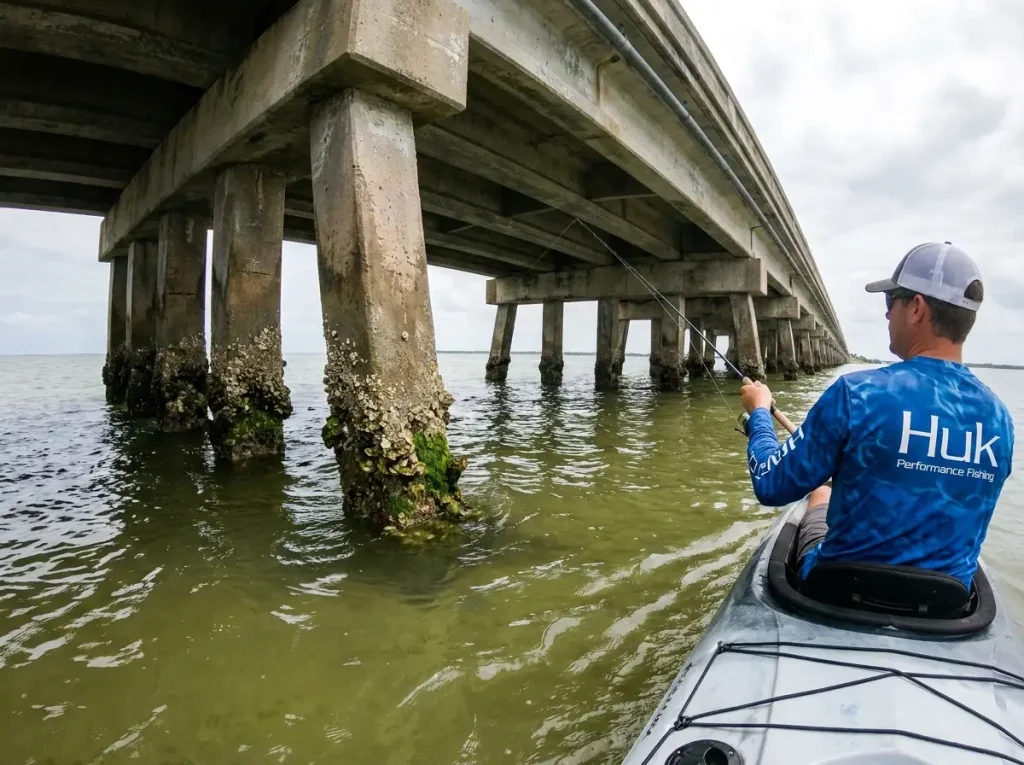
Sheepshead aren’t attracted to structure for cover the way bass use a dock. They’re attracted to structure for food. Any hard underwater surface that supports barnacle and mussel growth is a feeding station, and sheepshead work these surfaces the way a deer works a field edge — systematically, repeatedly, and often in predictable daily patterns.
The highest-value structures in descending productivity order are bridge pilings and piers, rock jetties and breakwaters, submerged rock and reef, dock pilings, and oyster beds. The common factor is hard substrate with biological encrustation. A wooden dock piling with mature barnacle growth is productive. A new concrete piling without growth is largely empty — sheepshead will move to adjacent older structure.
How sheepshead work a piling
Sheepshead on a piling are not sitting at the bottom waiting for food to fall. They work the piling vertically — cruising from the surface down to the substrate and back, grazing barnacles at different depths as they go. An angler fishing only on the bottom is fishing only a fraction of the productive zone. The fish might be at four feet while the bait sits at twelve.
This is why vertical fishing alongside the structure is the correct approach. The bait needs to be at the piling face, not three feet away from it. Current pushing a Carolina-rigged bait out from the structure means the bait is in the wrong place — the fish are on the barnacles, not in the open water column next to the barnacles.
Pro tip: Look at the waterline of the pilings you’re fishing. Heavy barnacle growth up to one or two feet above the current waterline means those pilings have been productive feeding stations long enough for substantial invertebrate colonization. Fresh-cut pilings or recently installed structures will hold fewer fish regardless of how well you present the bait.
Best Baits and Why Fiddler Crabs Win
The fiddler crab advantage
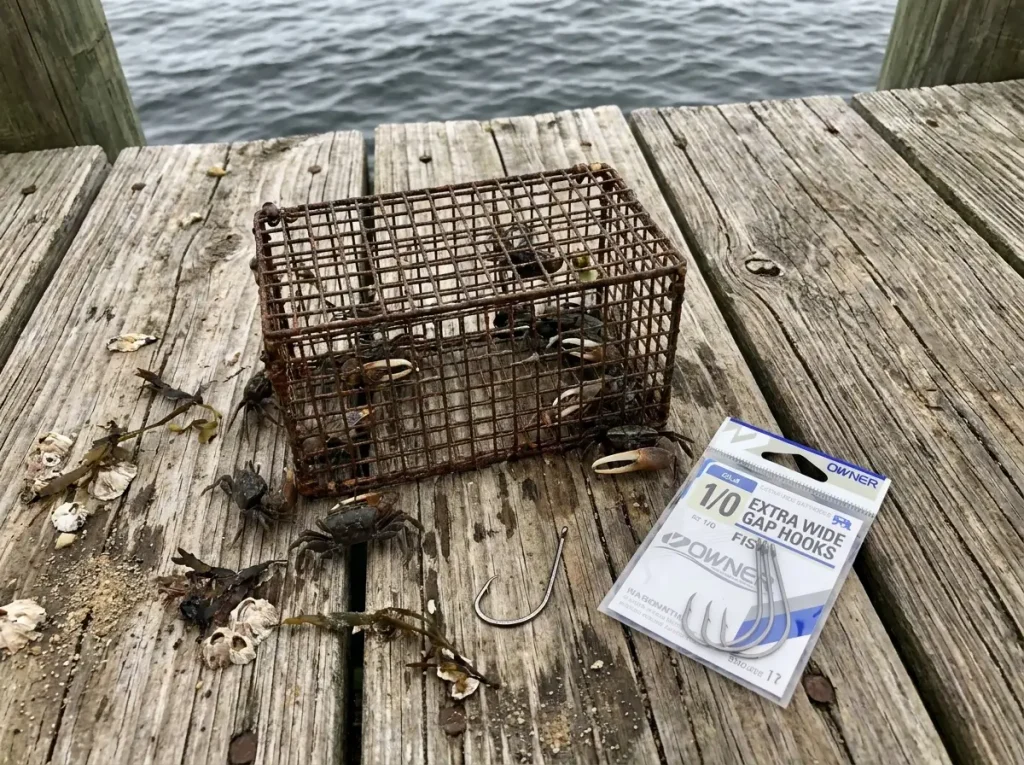
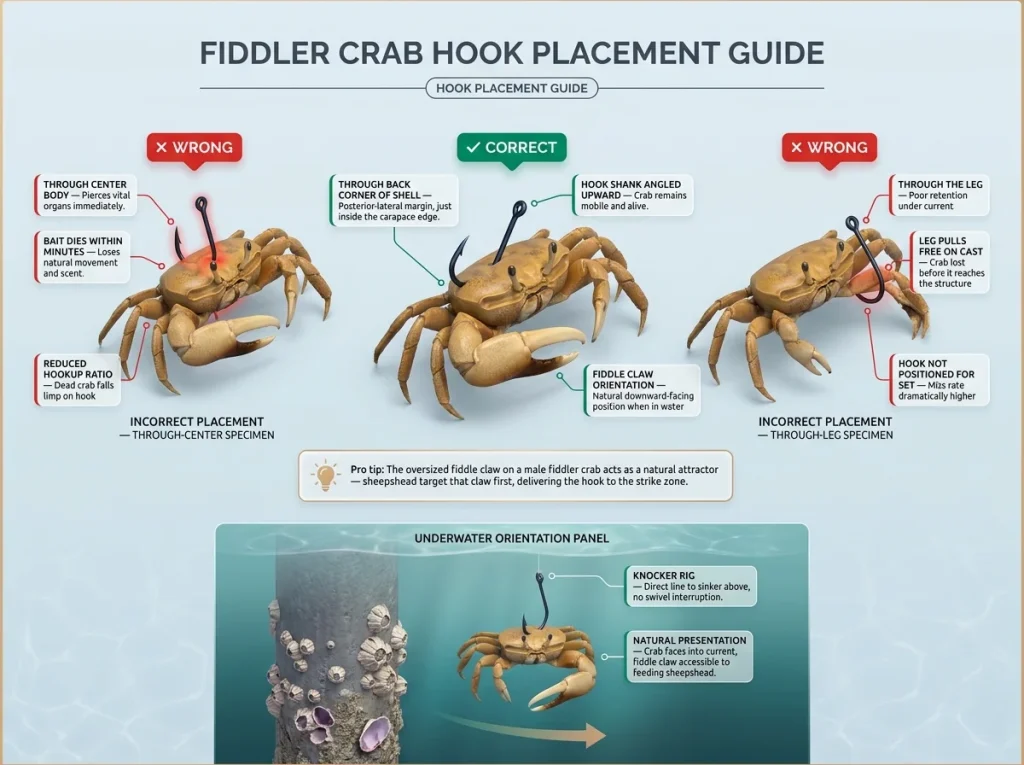
Fiddler crabs are the single most effective sheepshead bait. They’re small, they’re durable on the hook, they move naturally when live, and they match the exact profile of what sheepshead spend most of their time eating on structure. The oversized fiddle claw on male fiddler crabs makes them especially effective because sheepshead seem to target that claw specifically — the claw creates a natural entry point that puts the hook near the fish’s mouth.
Hook the fiddler crab through the back corner of the shell — the rear edge, just inside the point where the carapace meets the leg root. This holds the crab securely, keeps it alive long enough for several presentations, and allows it to remain mobile. Hooking through the center body hits vital organs and produces a dead, limp bait within minutes. Through the leg produces a lively crab but poor hook retention.
Other baits that work
Live shrimp is the second choice when fiddler crabs aren’t available, particularly effective in current when presented under a popping cork that floats the shrimp at piling depth. Thread a small hook through the tail horn so the shrimp faces forward and swims naturally.
Sand fleas (mole crabs) are excellent when fishing beach structure — jetties and piers adjacent to sandy beaches. They’re naturally abundant in that habitat, which makes them contextually the right bait. Oyster pieces, cut off the shell with a knife and presented fresh, produce sheepshead near oyster bars and reefs but are soft and come off the hook easily.
One bait worth trying that most guides skip: a small piece of barnacle scraped directly from the piling you’re fishing. Sheepshead that have been working that specific piling recognize that scent and texture. It’s a difficult bait to keep on the hook in current, but in a slack water situation it can be surprisingly effective.
Rigging for Maximum Structure Contact
The knocker rig and why it outperforms a Carolina rig
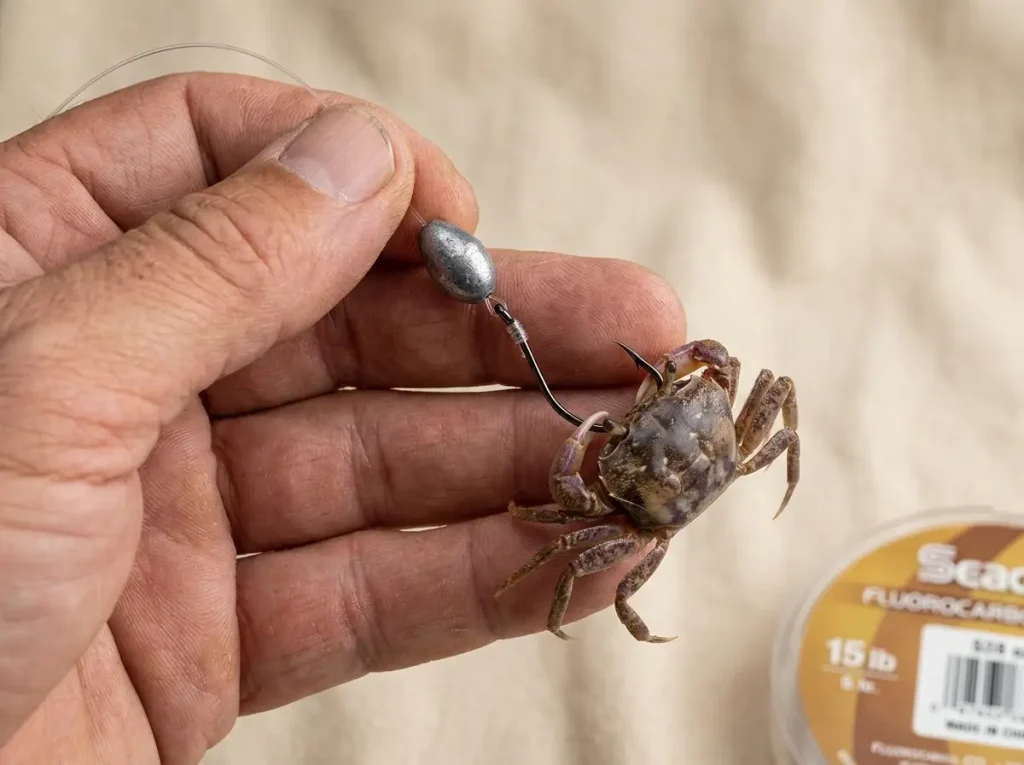
The knocker rig is the optimal sheepshead configuration for structure fishing: an egg sinker threaded directly onto the mainline or leader above the hook, with no swivel between the sinker and the hook eye. The sinker slides freely up and down the leader and rests against the hook eye when the rig is under tension.
The design advantage is direct: the weight keeps the bait pressed against the structure rather than floating away from it in current. When the line runs from your rod tip down to a piling face, the knocker rig hangs the bait right at the structure’s surface. A Carolina rig with a barrel swivel stop allows the sinker to sit on the bottom away from the piling while the hook floats out in the current — that’s not where the fish are.
The secondary advantage is bite sensitivity. With no swivel between the weight and the hook, any resistance at the hook transmits directly through the sinker to the line. The knocker rig is more sensitive than a Carolina rig for the same reason braid is more sensitive than mono — fewer interruptions in the signal chain.
Use a 3/8 oz egg sinker as the starting weight; adjust up to 1/2 oz in faster current to maintain contact with the structure without the rig swinging out.
Hook, leader, and line
Sheepshead have a relatively small mouth for their body size. A 1/0 or 2/0 octopus hook is the standard — wide gap for bite clearance, short shank that keeps the hook close to the bait. Going to a 3/0 or 4/0 is a common mistake that reduces hookup ratio significantly; the hook needs to fit in the space available between the sheepshead’s lips when it closes on the bait.
Use 10 to 15 pound braided mainline with a 20 pound fluorocarbon leader. The braid provides sensitivity; the fluorocarbon provides abrasion resistance against barnacle-covered structure and some visual concealment. Leader length of 18 to 24 inches is sufficient. You don’t need a long leader for sheepshead — the fish aren’t leader-shy, they’re bait-sensitive.
Pro tip: Fish the lightest sinker that keeps your bait against the structure. In still or slow water, a 1/4 oz egg sinker is enough. In moderate current, 3/8 oz. Heavy current calls for 1/2 to 3/4 oz. The goal is contact with the piling face — not anchoring on the bottom.
Reading the Sheepshead Bite — What You’re Actually Feeling
The three-stage bite sequence
The sheepshead bite has a consistent sequence once you know to look for it: tap-tap, then weight.
The first two taps are the fish mouthing the bait with its front teeth — testing it, orienting it, deciding whether to commit. These taps are light and fast, and they feel like the bait bumping a piling in current. Many anglers set the hook on this stage and come up empty, because the fish hasn’t committed yet. The hook is in the bait, not in the fish’s mouth.
After the testing taps, a committed sheepshead takes the bait fully and begins to move with it. That’s the weight — a subtle increase in line tension, heavier and steadier than the initial taps. Set on the weight, not the tap.
The firm upward sweep of a rod set — not a violent jerk — drives the hook through the sheepshead’s tough lip margin. The fish have hard mouths; a weak set doesn’t penetrate. But a violent jerk tears through soft tissue and loses the fish. Firm, decisive, and controlled.
Rod position and tactile contact
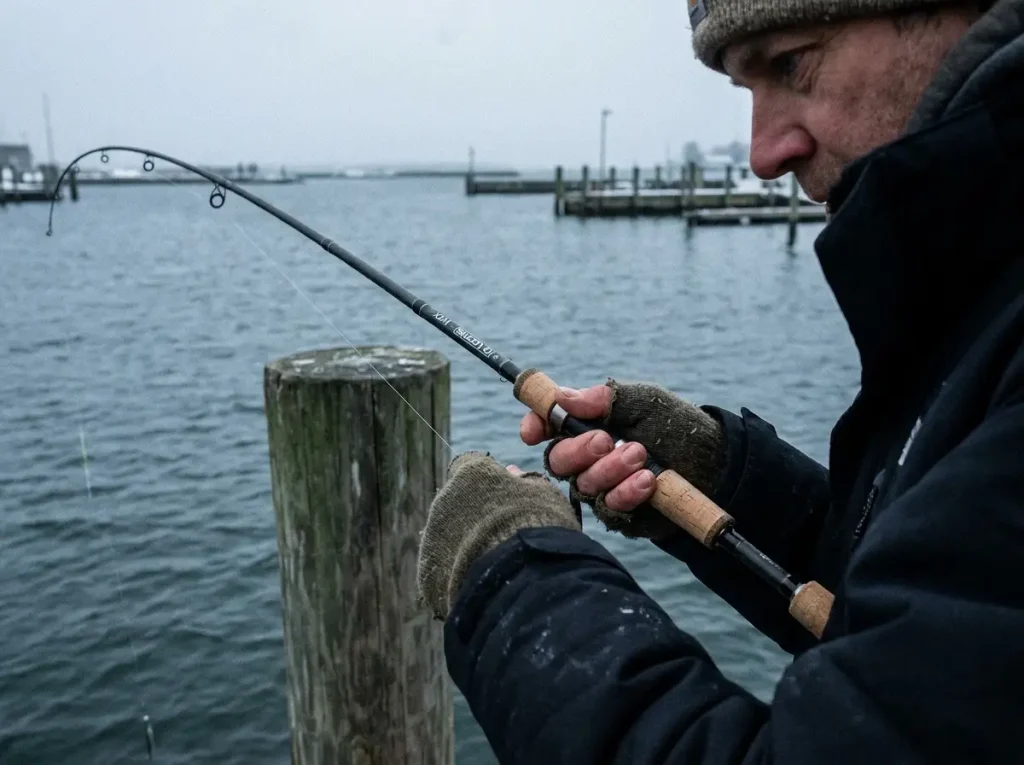
Hold the rod at roughly 10 o’clock from horizontal — not straight up, not horizontal. At that angle you maintain constant slight tension on the line, which keeps you in contact with the bait and transmits the tap sequence to your hand. Two fingers extended on the blank above the reel seat adds another sensory channel — you can feel vibration through the blank that doesn’t translate clearly through the grip.
Watch the line where it enters the water, not just your rod tip. When a sheepshead mouths a bait, the line sometimes moves before the rod tip registers anything. A slight jump or lateral twitch of the line at the water surface is often the first visible signal of a bite. Experienced sheepshead anglers read the line and the rod together.
The 7-foot rod that most guides recommend earns its length here: the extra reach lets you fish vertically at the piling face from a boat or kayak positioned several feet away, and the length amplifies small input signals into visible rod tip movement.
Approach, Positioning, and When to Fish Sheepshead
Up-current anchoring and vertical presentation
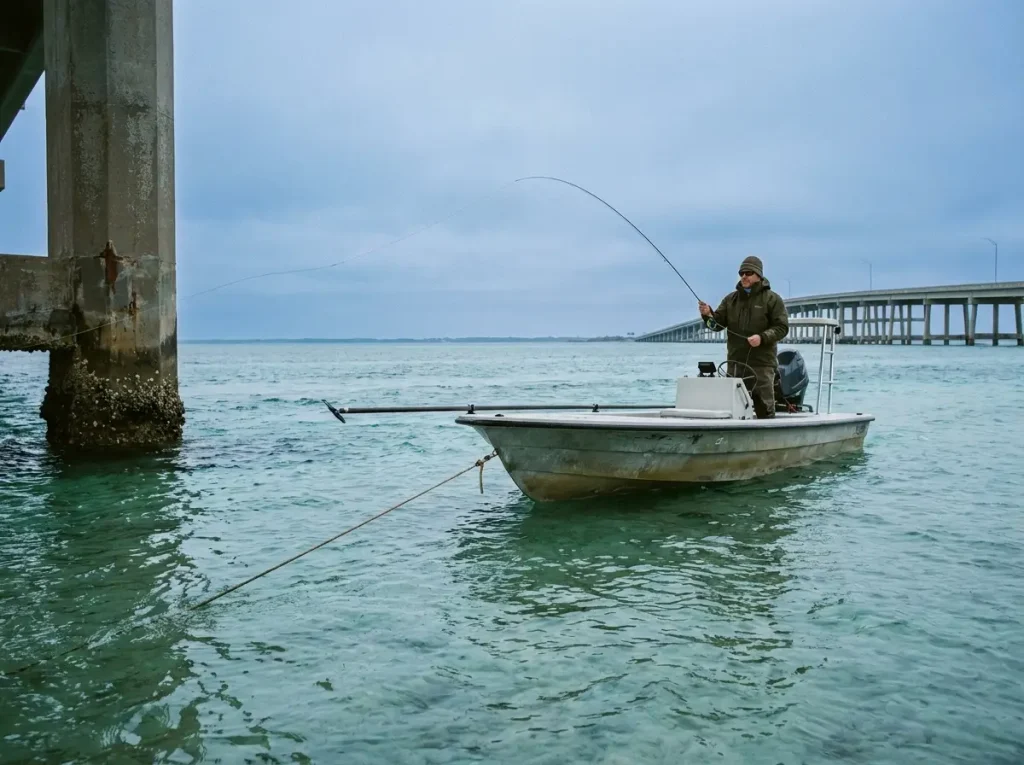
Position your boat or kayak up-current from the structure you want to fish, then let the current carry your presentation back to the piling face. This accomplishes two things: it puts your bait at the structure with the current — the direction sheepshead are oriented as they hold position — and it keeps your boat away from the piling so your shadow and hull don’t alert fish holding just below the surface.
The ideal distance is close enough that you can fish truly vertically alongside the piling — not at a 30-degree angle. An angled line drags the bait away from the structure the moment it hits current. Vertical keeps the bait in contact with the barnacle growth, which is where the fish are feeding.
In very still water with no current, a kayak is often more effective than a boat because you can maneuver silently to within arm’s reach of a piling and fish straight down.
Seasons and timing
Winter through early spring is the peak season across most of the sheepshead’s range. As water temperatures cool, sheepshead concentrate on inshore structure — bridge pilings, rock jetties, and piers become dense with fish that are feeding actively to maintain body heat in cooler water. On Florida’s Gulf coast, this window typically runs from November through April, with January and February being the most concentrated fishing.
The South Carolina DNR documents sheepshead spawning aggregations forming late winter through spring — the period when large fish are most densely concentrated on structure before moving offshore to spawn. This pre-spawn aggregation window, when fish are stacked and feeding in predictable numbers, is when most winter sheepshead anglers have their best outings.
Summer fishing remains productive on deeper structure — offshore reefs, rock piles, and wrecks where cool bottom water keeps sheepshead active even when surface temperatures rise. Inshore dock and piling fishing slows somewhat in midsummer but picks back up with the first fall cool fronts.
Pro tip: Incoming tide on a winter morning, fishing the shadow side of a bridge that faces the sun — water slightly warmer from the sun-warmed concrete — is the closest thing to a can’t-miss combination that exists in sheepshead fishing. The warm structure, the current, the concentrated baitfish position, and the incoming water temperature all add up at the same time.
Conclusion
Sheepshead don’t hide. They’re on the barnacle-covered structure you can see from the parking lot. The technique — vertical fishing with a knocker rig, fiddler crab on a small hook, braid mainline — is not complicated. The one piece that takes time to develop is the bite calibration: tap-tap, then weight, then set. That three-beat sequence is the whole game.
Three things to implement on your next trip: position up-current and fish truly vertical alongside the piling face; use a knocker rig with no swivel between the sinker and the hook; and hold your rod at 10 o’clock with two fingers on the blank. The first time you feel the tap-tap-weight sequence clearly and set on the weight, you’ll understand why experienced sheepshead anglers call this fish the most satisfying bite in inshore fishing.
FAQ
What is the best bait for sheepshead?
Live fiddler crabs are the most consistently effective sheepshead bait. Hook through the back corner of the shell with a 1 or 0 or 2 or 0 octopus hook. Live shrimp is a close second, particularly in current. Sand fleas work well near beach jetties. All of these baits match the invertebrates sheepshead naturally eat on structure.
What rig should I use for sheepshead around pilings?
The knocker rig — an egg sinker threaded directly on the leader above the hook with no swivel — is the best rig for piling fishing. The sliding sinker keeps your bait against the structure face rather than floating away in current, and the direct connection to the hook improves bite sensitivity. Use a 3 or 8 oz egg sinker in moderate current, 10-15 lb braid, and 20 lb fluorocarbon leader.
How do you feel a sheepshead bite?
The bite sequence is: tap-tap (the fish testing the bait), then a subtle increase in line weight (the fish committing). Set the hook on the weight, not the initial taps. Hold the rod at 10 o’clock and keep constant light tension on the line. Some bites show as a line twitch at the surface before the rod registers anything.
When is the best time to fish for sheepshead?
Winter through early spring is peak sheepshead season across most of the US range. Fish concentrate on inshore structure during cool weather, and the pre-spawn aggregation in January through March on the Gulf coast produces the densest fishing. Incoming tide on winter mornings, fishing bridge pilings and jetties, is the most consistently productive combination.
Why do sheepshead have human-like teeth?
Sheepshead have flat incisor teeth at the front of the jaw and rows of crushing molars behind them — a configuration adapted for prying barnacles off hard structure and crushing the shells of crabs, oysters, and mussels. The front teeth scrape and clip; the back teeth grind. The system is highly efficient for their invertebrate-heavy diet and explains why fiddler crabs and other hard-shelled baits are so effective.
Risk Disclaimer: Fishing, boating, and all related outdoor activities involve inherent risks that
can lead to injury. The information provided on Master Fishing Mag is for educational and informational purposes
only. While we strive for accuracy, the information, techniques, and advice on gear and safety are not a substitute
for your own best judgment, local knowledge, and adherence to official regulations. Fishing regulations, including
seasons, size limits, and species restrictions, change frequently and vary by location. Always consult the latest
official regulations from your local fish and wildlife agency before heading out. Proper handling of hooks, knives,
and other sharp equipment is essential for safety. Furthermore, be aware of local fish consumption advisories. By
using this website, you agree that you are solely responsible for your own safety and for complying with all
applicable laws. Any reliance you place on our content is strictly at your own risk. Master Fishing Mag and its
authors will not be held liable for any injury, damage, or loss sustained in connection with the use of the
information herein.
Affiliate Disclosure: We are a participant in the Amazon Services LLC Associates Program, an
affiliate advertising program designed to provide a means for us to earn advertising fees by advertising and linking
to Amazon.com. As an Amazon Associate, we earn from qualifying purchases. We also participate in other affiliate
programs and may receive a commission on products purchased through our links, at no extra cost to you. Additional
terms are found in the terms of service.