
In this article
The first time I watched a crappie guide work a spider rig, I counted eight poles fanned off the bow of his jon boat like antennae, lines disappearing straight down into 18 feet of water. He wasn’t holding any of them. He was watching rod tips and steering with one foot on the trolling motor pedal. Twenty minutes later he had a cooler half full of slabs. It looked like an operation — and it is, sort of. But the setup is simpler than it appears, and the technique is more forgiving than most people think. The hard part isn’t the fishing. It’s getting the rods, rigs, and speed dialed in before you leave the ramp.
This covers everything you need to run a multi-pole setup from scratch: rods, holders, terminal rigs, bait strategy, speed control, and the regulation trap nobody tells you about until it’s too late.
Quick Answer: Spider rigging is a slow-trolling technique where 6–8 long crappie rods fan from the bow of a boat, each running baits at different depths while the boat crawls forward at 0.3–0.5 mph. Staggered rod lengths prevent line crossing, and the slow speed triggers strikes from suspended crappie that won’t chase faster presentations.
What Spider Rigging Actually Is
The Bow-Forward Slow-Troll Concept
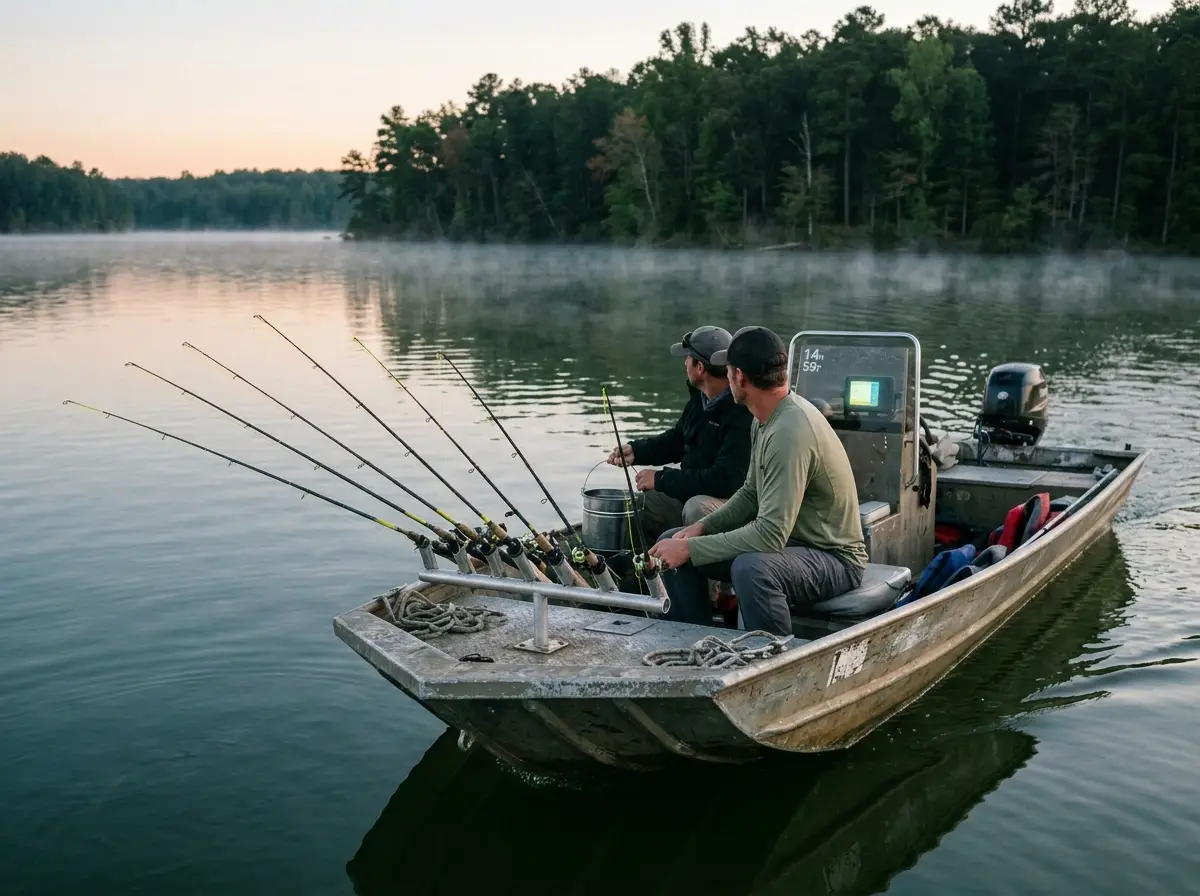
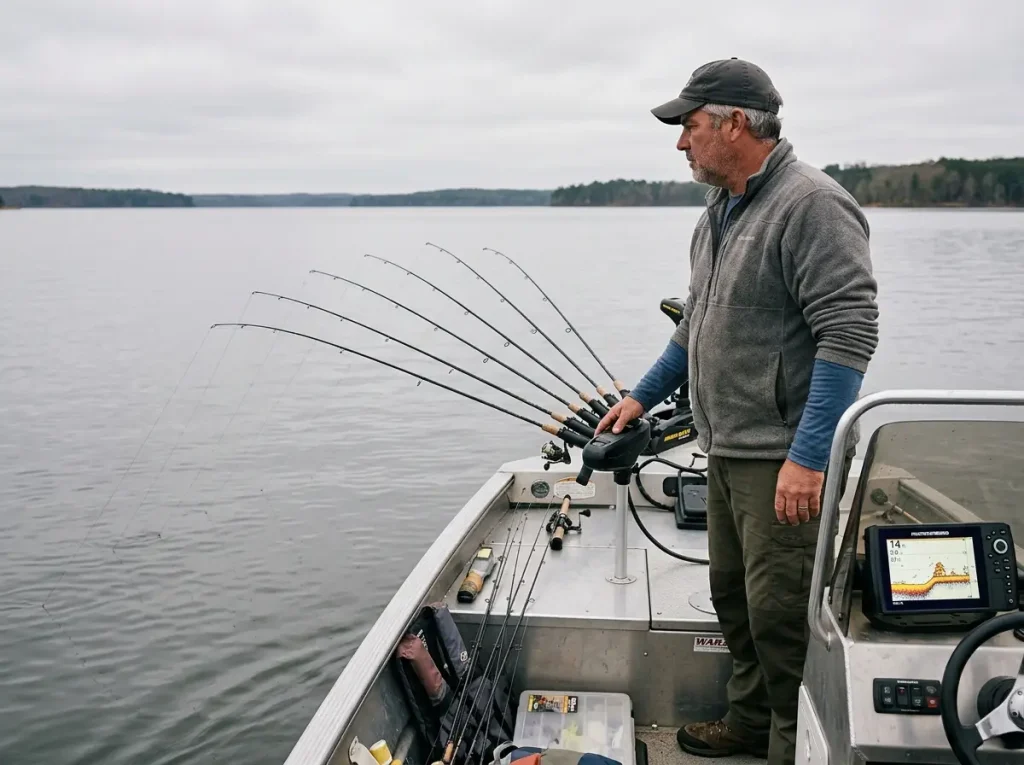
Spider rigging means mounting multiple rods — usually six to eight — in holders across the bow of your boat, fanning them out 180 degrees, and pushing forward with a bow-mount trolling motor at barely-walking speed. Each rod runs a bait at a slightly different depth and horizontal position, covering a wide swath of the water column in a single pass. The name comes from what the boat looks like from above: a floating spider with fiberglass legs pointing in every direction.
This isn’t casting and retrieving. You’re not holding anything. The rods sit in holders, the trolling motor does the work, and you watch tips for the slight dip that means a fish found your bait. It’s the most efficient way to cover open water for suspended crappie — the fish holding at a consistent depth between 10 and 25 feet without committing to any particular piece of structure.
Why Crappie Respond to a Moving Bait at 0.3 mph
Both white crappie (Pomoxis annularis) and black crappie (Pomoxis nigromaculatus) are ambush-oriented feeders. They don’t chase prey across open water the way stripers do. A bait moving at 0.3 mph looks like a minnow drifting through the zone — slow enough that the fish doesn’t register it as fleeing, fast enough that it triggers a reaction strike from a fish that’s been sitting in one spot waiting.
Go faster than 0.5 mph and you’ll notice the bites stop. The crappie isn’t spooked — it just doesn’t bother. That speed threshold is the whole reason slow trolling works. It puts bait in front of fish that wouldn’t move three feet to grab a stationary jig, but will open their mouths for something that drifts past at eye level. Black crappie’s preferred open-water habitat, according to the U.S. Fish & Wildlife Service, includes exactly the kind of still-water environments where spider rigging shines.
Spider Rigging vs. Strolling — Know the Difference
Strolling puts rods off the stern or sides with the motor pushing from behind. Spider rigging fans rods off the bow with a forward-push trolling motor. The distinction matters because a bow-push gives you direct control over where lines go — you’re driving into your spread, not dragging it behind you. Strolling works in tighter cover, but for open-water suspended fish, the bow-forward spider rig covers more horizontal space with better depth precision. If you’re new to both, understanding which crappie species you’re targeting changes how you approach the setup, because blacks and whites suspend at different depths during different seasons.
Building Your Multi-Pole Rod Setup
How Many Rods to Start With (and the Legal Limit Question)
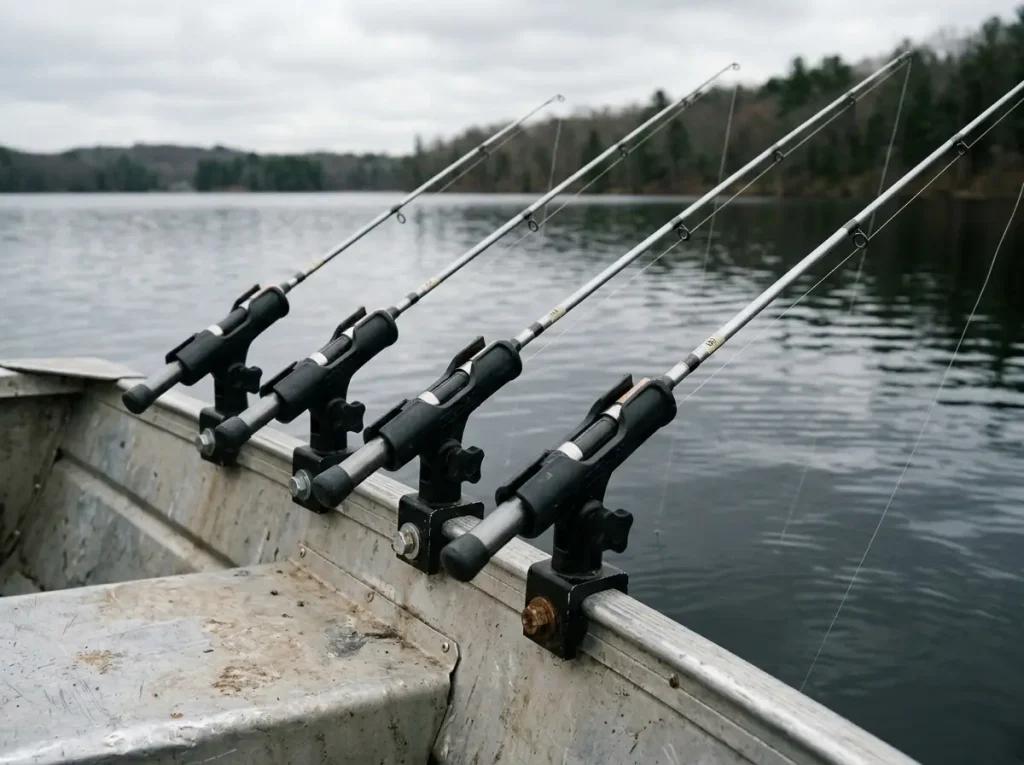
Start with six. That gives you enough coverage to find the pattern without creating the management headache that comes with eight or more rods in motion. Six rods managed cleanly will outcatch twelve rods in a tangled mess every time. Beyond eight, you need guide-level boat control and a second person to make it work solo is asking for a bad morning.
Most states allow 6–8 rods for spider rigging, but specific waters can restrict you to 2–3 poles. Missouri caps unlabeled poles at three. Alabama is unlimited on most lakes but not all of them. The full regulation breakdown is in the last section — read it before you rig up.
The Stagger Math — Why 2-Foot Tip Spacing Prevents Tangles
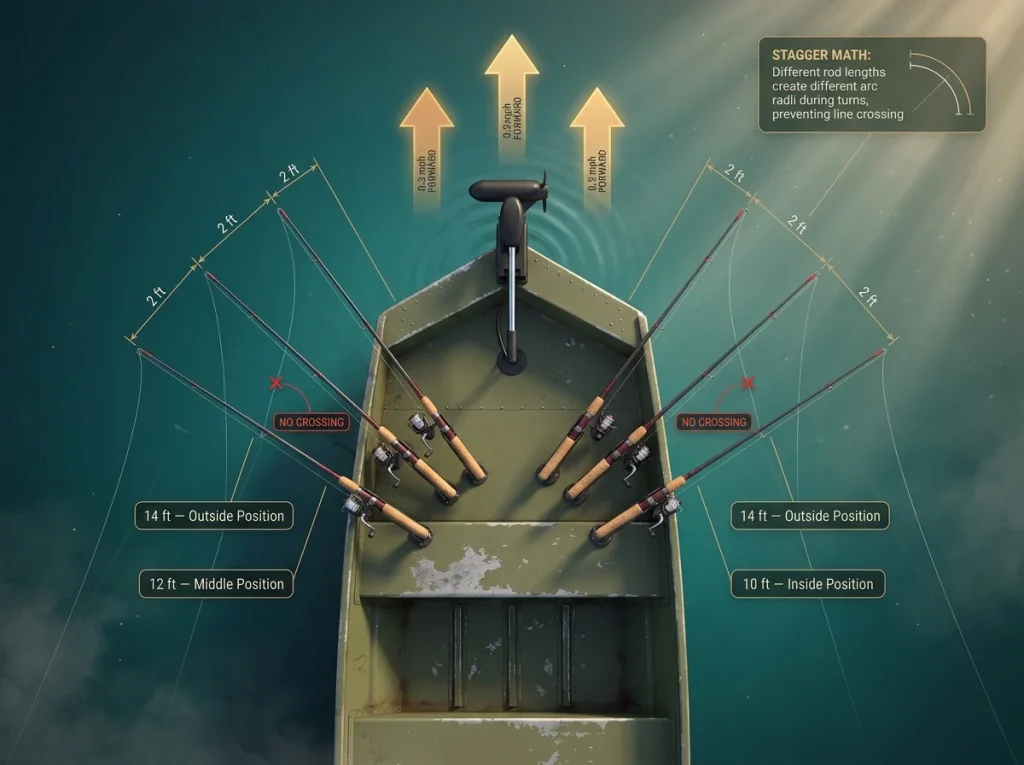
Here’s where most first-timers go wrong. They buy eight identical 10-foot rods, fan them out, and the first time they change direction every line crosses every other line. The fix is the rod stagger: different lengths at different positions. A 6-rod setup runs 10–12–14 foot rods from the inside out on each side of the bow, which creates about 2 feet of space between each rod tip.
That 2-foot gap is geometry, not preference. When the boat turns, each tip traces a different arc because it’s at a different radius from the pivot point. At the same length, all tips trace the same arc, and that’s where the bird’s nest starts. The B’n’M Capps & Coleman Trolling Rod ($40) in 14-foot fills the middle position perfectly — it’s fiberglass, light action, and designed specifically for the Capps & Coleman rig setup covered in the next section.
Pro tip: Buy rods in pairs of three lengths — two at 10 ft, two at 12 ft, two at 14 ft for a six-rod setup. Put the longest rods on the outside, shortest on the inside. Your first day on the water will tell you immediately if the spacing is working.
Rod Holder Systems — T-Bar, Tite-Lok, and Bow Mount Options
A T-bar holder is the entry point: a crossbar that bolts to the bow with six to eight individual rod slots. It’s simple and cheap. The limitation is that every rod sits at the same angle. The Tite-Lok Crappie Rod Holder Ball Mount Base ($30) solves that with an infinitely adjustable pivot ball per mount — you can angle each rod independently, which lets you fine-tune how deep each bait runs.
HiTek Stuff modular systems and the R100 Spyderlok Gen 2 are purpose-built spider rig rod holders with separate angle controls per rod. They cost more and they’re worth it if you’re running eight rods regularly. For six rods and weekend trips, individual Tite-Lok mounts on the gunwale get the job done without overcomplicating the bow.
Terminal Rigs That Actually Catch Slabs
The Capps & Coleman Double Minnow Rig
Thread a 1/2-ounce egg sinker onto your main line above a barrel swivel. From the swivel, tie a 6-inch dropper to an Aberdeen #2 hook — that’s your upper bait. Then tie a 24–30 inch leader to a second Aberdeen #2 below. Hook a live minnow through the upper lip on each. This is the Capps & Coleman rig, and it covers two depth zones per line simultaneously — one bait right at the sinker level, one trailing below where the leader swings naturally.
The long bottom leader is the part that matters. At 24–30 inches, the lower minnow has enough slack to swim on its own, which creates movement that crappie respond to at 0.3 mph. Cut that leader to 12 inches and you lose most of the action. Most anglers cut it too short the first time because it looks like it’ll tangle. It won’t — the sinker weight keeps the top section vertical.
Pro tip: Hooking live minnows correctly for the double rig makes the difference between a bait that swims for an hour and one that drowns in five minutes. Through the upper lip keeps the minnow upright at slow trolling speeds.
Double Jig Rig Configuration
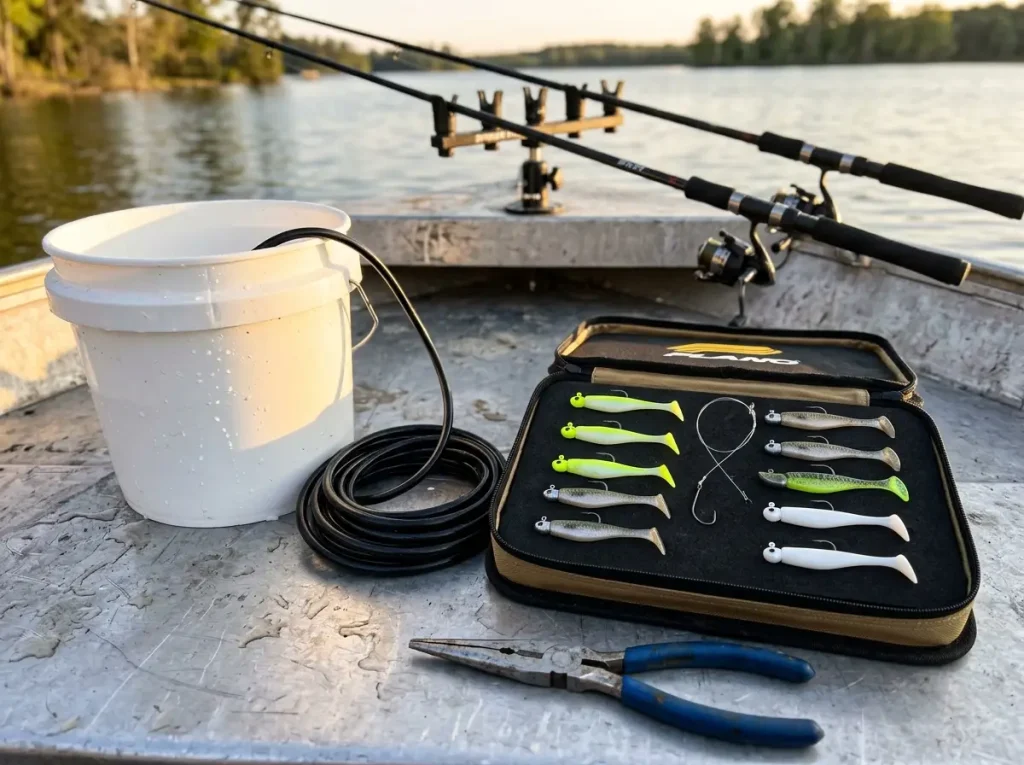
Same architecture — egg sinker, barrel swivel, upper dropper, lower leader — but replace the Aberdeen hooks with jig heads. Start with 1/32-ounce heads and adjust heavier if they’re riding above the target zone. The advantage of jigs: no bait tank, no dead minnows, and you can run different colors on different rods to pattern the bite faster.
Bobby Garland Baby Shad ($6 for 18) bodies in chartreuse/white on 1/32-ounce heads are the entry-level combination that consistently produces. Strike King Mr. Crappie Slab Slangers and the Blakemore Road Runner fill out the rotation when you need variety. Run four rods with jigs in different colors and two with minnows — let the fish tell you what they want.
The Streamlining Secret — Braid, Tungsten, and Ball-Bearing Swivels
This is the section most spider rigging guides leave out. Heavy monofilament at 0.3 mph creates enough water resistance to lift your jig 4–6 feet above its target depth. You’re fishing at 15 feet on the sonar but your bait is actually at 10. Crappie holding at 15 see nothing.
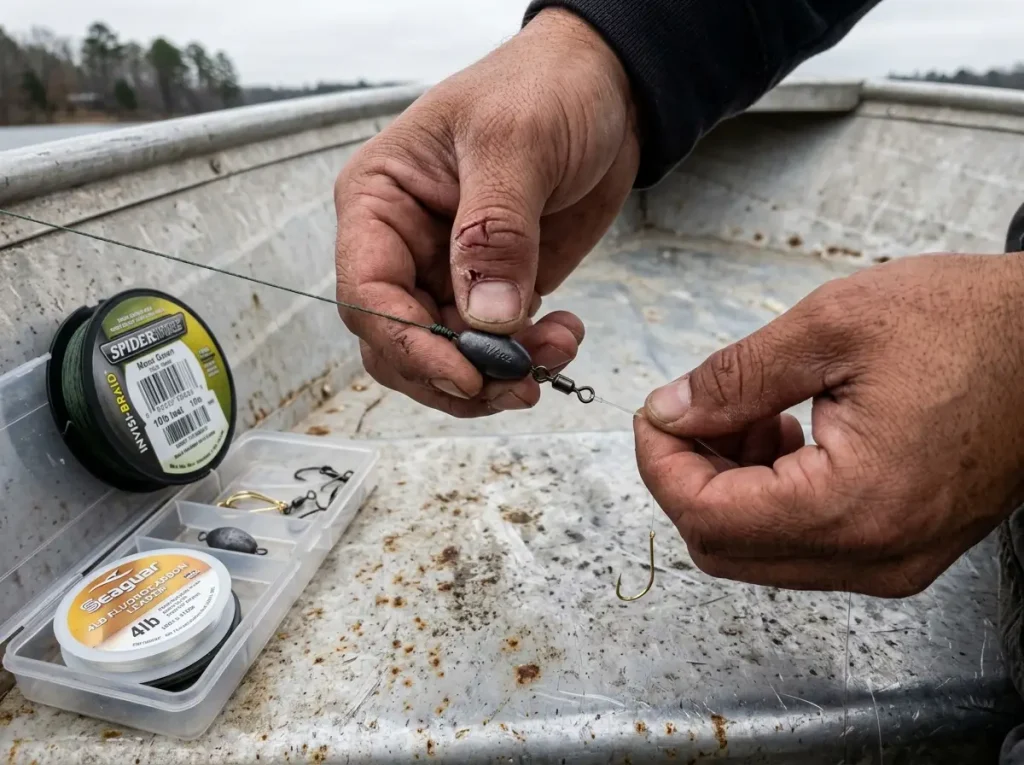
Switch your main line to SpiderWire Ultracast Invisi-Braid ($22) at 15-pound test. Braided line at that strength has roughly half the diameter of 15-pound mono. Less diameter means less surface area pushing against the water, which means your bait reaches — and stays at — the depth you set. The difference is measurable: the same 1/2-ounce weight on braid puts your jig 3–4 feet deeper than it would sit on mono at the same speed.
Replace lead egg sinkers with tungsten. Woo! Tungsten egg sinkers are the community standard for budget tungsten in crappie fishing. Tungsten is denser — same weight, smaller profile, and it slides over limbs and brush where lead sticks and snags. It also transmits vibration better, so you feel the faint tap of a crappie mouth closing on a jig at depth.
Swap your standard barrel swivel for a #2 ball-bearing swivel. At slow constant speed, a barrel swivel can seize under tension, letting line twist build until the entire rig starts spiraling. The ball-bearing version rotates freely under load. Tie a 4–6 pound fluorocarbon leader below the swivel — it breaks first at snags, which saves the tungsten and swivel.
Live Minnows vs. Jigs — Bait and Depth Strategy
When Live Minnows Are the Right Call
Below 55°F water temperature, live minnows outperform jigs consistently. Cold crappie are sluggish — they want the scent, vibration, and erratic movement of a real bait moving slowly past their face. A jig at 0.3 mph in 48-degree water looks like a chunk of plastic. A minnow at 0.3 mph looks like lunch.
Hook minnows through the eye socket for the Capps & Coleman rig — it keeps them upright at slow speeds. Through the back just ahead of the dorsal if you want more active swimming motion, but they die faster that way. Keep your minnow bucket aerated and out of direct sun. A dead minnow on a spider rig is just a sinker with a hook attached.
Jig Selection — Color, Size, and Rotation
Above 60°F, jigs take over. Crappie are more active, more willing to hit artificials, and jigs are easier to manage across eight rods — no bait tank, no re-hooking dead minnows mid-run. Start with natural shad and chart/white patterns. If neither produces in the first 30 minutes, rotate through darker colors — black/chartreuse, purple/pink, smoke/chart.
Keep the weight light: 1/32 to 1/16 ounce heads. With the streamlined line setup from the rig section, these light jigs reach the right depth without dragging heavy. The goal is the most natural fall and movement possible at minimal speed. If your jigs keep riding high even on braid, step up to 1/8 ounce — but check your speed first, because the problem is usually boat speed, not jig weight.
Using Electronics to Dial in Depth
Drop a marker buoy when you find a school on your fish finder. Check the depth where they’re holding — say 14 feet. Set your shallowest rod at 12 feet, deepest at 16, and stagger the rest between. Make a pass. Watch which rods fire. If every strike comes from the 14-foot rods, set all six rods to 14 and work that zone until the bite moves.
This is where tracking where crappie suspend through fall and winter matters. Crappie don’t stay at the same depth all day. A school that’s at 14 feet at dawn might push down to 20 by noon. Check the sonar every 30 minutes and adjust. The anglers who catch limits aren’t the ones with the best rigs — they’re the ones who notice when the depth shifts and adjust before they’ve been trolling empty water for an hour.
Pro tip: If you’re between spider rigging depth and shallow water, the bobber rig variant — a middle-ground option for shallower fish — puts a single bait at a fixed depth without the multi-pole commitment.
Trolling Speed and Boat Control
The 0.3–0.5 mph Target and How to Hold It
The number on your GPS matters less than the consistency. A steady 0.4 mph outperforms an erratic 0.3–0.7 mph every single time because crappie react to acceleration as much as to speed itself. If the trolling motor surges and your baits bounce up three feet, you just pulled every line out of the strike zone for five seconds.
Quality bow-mount trolling motors with GPS cruise or spot-lock hold speed within a tenth of a mph. Without that feature, you’re watching the GPS on your depth finder and feathering the foot pedal manually. Either works — the motor with GPS cruise just lets you focus on rod tips instead of speed.
In water below 50°F, lean toward 0.3 mph. Warmer water with actively feeding crappie can handle 0.5 to even 0.8 mph on some days. Two-time national crappie champions have gone on record recommending 0.8 as a starting point in summer. The fish will tell you — no bites means slow down.
Reading Your Lines — The 15-Degree Angle Rule
Forget the GPS for a second. Stand at the bow and look at where your lines enter the water. Straight down is perfect. A slight angle back — maybe 10–15 degrees from vertical — is fine. Lines trailing at 30 degrees or more means you’re moving too fast, and your baits are riding well above the depth you set.
This visual check works even in current where GPS speed doesn’t reflect the true speed of your bait relative to the water. The river doesn’t care what your GPS says. Your lines don’t lie. If they angle back past 15 degrees, slow down until they straighten. The adjustment is small — a tap of the foot pedal, a fraction of a mph.
The battery powering your trolling motor matters more than most anglers expect — a fading lead-acid battery delivers inconsistent speed all afternoon, while lithium holds voltage flat until it dies. That consistency translates directly to bait depth consistency.
Landing Fish From a Full Spider Rig Setup
Here’s where beginners lose fish and create bird’s nests at the same time. A crappie hits, the rod tip dips, and the natural instinct is to grab the rod and yank it straight up. Now the fish is dangling a foot below the tip, three feet beyond arm’s reach, and you’ve just crossed two other lines pulling it up.
The right move: pull line from the reel — don’t raise the rod. Feed slack until the fish is close enough to net or swing alongside the boat. If you have a second person, one stays on the trolling motor and the other nets the fish. For solo anglers, bump the motor speed slightly to straighten any lines the fish crossed during the run, then handle the hookup.
Pro tip: When two fish hit simultaneously — and it happens regularly — don’t panic. Leave both rods in the holders. Bump the motor speed slightly to tension the lines, then deal with one at a time. The rod holders are doing the work. Let them.
Regulations, Problem Conditions, and When to Switch Tactics
State Pole Limit Overview — Check Before You Launch
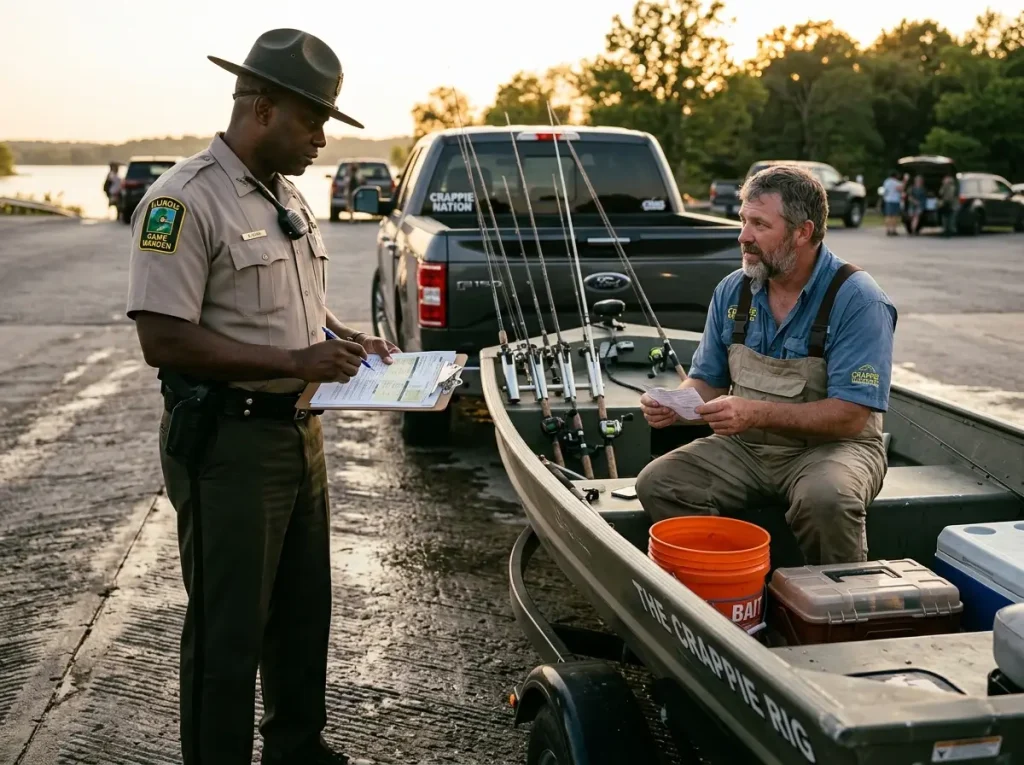
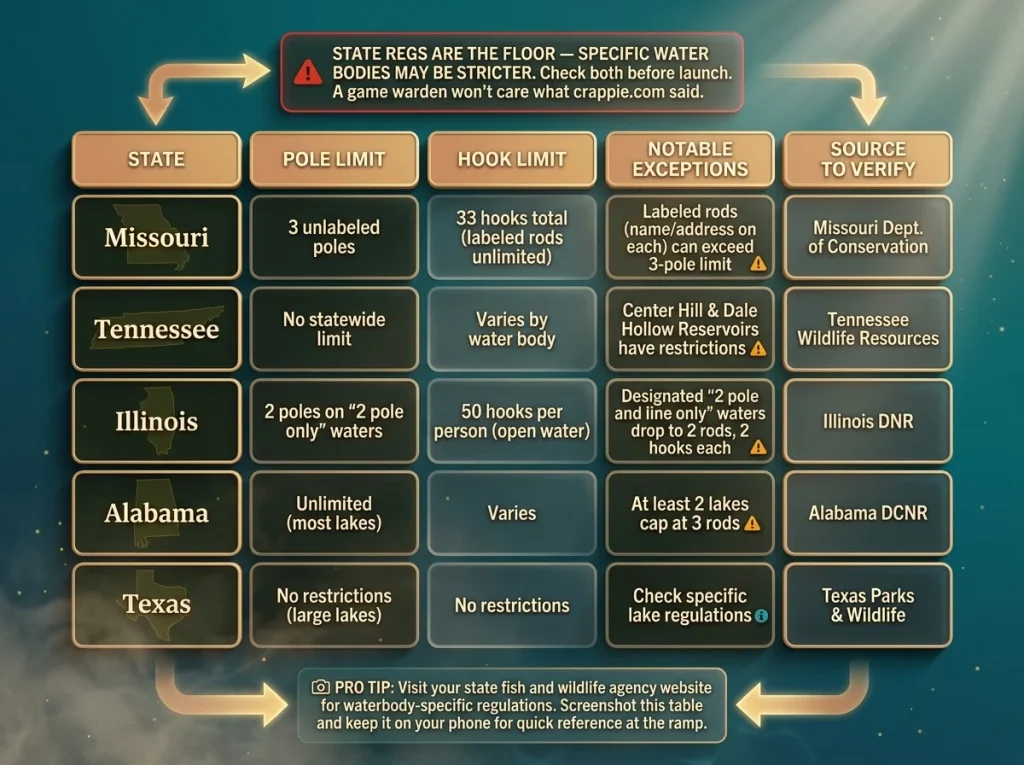
The “run 8 poles” advice you see everywhere is legal in some states and a citation in others. Missouri limits you to 3 unlabeled poles — though labeled rods (name and address on each) are allowed beyond that, up to a 33-hook total. Tennessee has no statewide limit, but Center Hill Reservoir and Dale Hollow Reservoir have their own restrictions. Illinois allows up to 50 hooks per person on open waters, but any water designated “2 pole and line only” drops you to two rods with two hooks each. Alabama is unlimited on most lakes, with at least two that cap you at three rods.
Texas has no pole restrictions on large lakes — a spider rigger’s paradise if you’ve got the boat space and the patience.
The consistent rule: state regs tell you the floor, and the specific water body may tell you something stricter. Check both before launch. Your state fish and wildlife agency website lists waterbody-specific regulations. A game warden won’t care that crappie.com said eight poles was fine.
When Spider Rigging Stops Working and Why
Wind above roughly 10 mph breaks the system. The trolling motor fights crosswind instead of holding a consistent forward track, baits drift sideways out of the fan pattern, and rod tips bounce from wave action so badly that you can’t distinguish a bite from chop. More weight is not the answer — repositioning to a wind-protected cove or switching to an anchored approach is.
River current is worse. At 0.3 mph trolling speed into a 0.2 mph current, your bait effectively moves at 0.5 mph relative to the bottom — too fast for cold-water crappie that are conditioned to slow-moving or stationary prey. Spider rigging is a still-water open-water technique. It was designed for reservoirs and lakes, not rivers.
Post-cold-front conditions shut down spider rigging fastest. Crappie abandon open-water suspension and push tight against timber, dock pilings, and brush. You can troll an empty water column all morning and never see a rod tip move. When the barometer crashes and the water temperature drops three degrees overnight, the fish aren’t where spider rigging puts your baits.
Switching to Vertical Jigging and Dock Shooting
When the spider rig isn’t producing, the fish haven’t left. They’ve relocated to structure. Anchor 20 yards off a marked brush pile or timber line, drop a jig straight down to the depth your sonar shows fish, and work it vertically. This is the opposite of spider rigging — precision instead of coverage, one rod instead of eight, patience instead of movement.
Switching to dock shooting when fish push into cover is the other move. Suspended crappie under docks during midday pressure are reachable with a skip-cast technique that puts a jig six feet under a low dock where no trolling rig can go. It’s a different skill set, but knowing when to abandon the spider rig for the dock rod is what separates a one-technique angler from a consistently productive one.
Understanding pre-spawn crappie positioning before water temperatures hit 60°F helps you time the seasonal window when spider rigging is at its absolute best — suspended fish staging in open water, not yet committed to shallow beds.
Conclusion
The spider rig rewards setup precision over rod count. Six rods with staggered lengths, streamlined braid rigs, and a clean Capps & Coleman configuration will consistently outproduce a tangled spread of twelve.
Braid, tungsten, and a ball-bearing swivel are the upgrades that actually move the needle — not more rods, not fancier jigs, not a bigger trolling motor. The rig streamlining cuts water drag, keeps baits at depth, and lets you feel the soft-mouthed tap that heavy mono buries completely.
Check your state’s pole limit for the specific water body before you rig up — not just the statewide default. Then start with six rods, run a test lap at 0.3 mph, and let the rod tips tell you what the fish want. The spider rig is patient work, and patience is what catches slabs.
Q1 How many rods can you legally use when spider rigging for crappie?
It depends entirely on your state and specific water body. Tennessee has no statewide limit, while Missouri caps unlabeled poles at three. Illinois allows up to 50 hooks per person on open waters. Always verify with your state fish and wildlife agency for the lake or reservoir you plan to fish.
Q2 What is the best trolling speed for spider rigging crappie?
Between 0.3 and 0.5 mph, with lines hanging at under a 15-degree angle from vertical. In cold water below 50°F, stay near 0.3. Warmer conditions with aggressive fish can handle up to 0.8 mph. Consistency matters more than the exact number.
Q3 What rod length is best for spider rigging crappie?
A staggered set — 10, 12, and 14 feet for a six-rod setup — gives the 2-foot tip spacing that prevents line crossing on turns. B’n’M makes rods specifically for spider rigging in the 12–16 foot range with the light action needed to detect crappie bites at slow speed.
Q4 What depth should you fish when spider rigging for crappie?
Use your fish finder to locate where crappie are suspending, then bracket that depth across your rods. Most spider rigging happens in 10–25 feet, but the sonar should confirm the zone. Set your shallowest rod 2 feet above the school and your deepest rod 2 feet below.
Risk Disclaimer: Fishing, boating, and all related outdoor activities involve inherent risks that
can lead to injury. The information provided on Master Fishing Mag is for educational and informational purposes
only. While we strive for accuracy, the information, techniques, and advice on gear and safety are not a substitute
for your own best judgment, local knowledge, and adherence to official regulations. Fishing regulations, including
seasons, size limits, and species restrictions, change frequently and vary by location. Always consult the latest
official regulations from your local fish and wildlife agency before heading out. Proper handling of hooks, knives,
and other sharp equipment is essential for safety. Furthermore, be aware of local fish consumption advisories. By
using this website, you agree that you are solely responsible for your own safety and for complying with all
applicable laws. Any reliance you place on our content is strictly at your own risk. Master Fishing Mag and its
authors will not be held liable for any injury, damage, or loss sustained in connection with the use of the
information herein.
Affiliate Disclosure: We are a participant in the Amazon Services LLC Associates Program, an
affiliate advertising program designed to provide a means for us to earn advertising fees by advertising and linking
to Amazon.com. As an Amazon Associate, we earn from qualifying purchases. We also participate in other affiliate
programs and may receive a commission on products purchased through our links, at no extra cost to you. Additional
terms are found in the terms of service.