
In this article
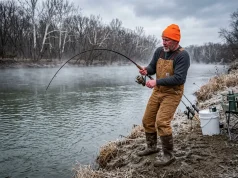
The ice had been off for three days. Every truck in the parking lot was pointed at the north bay. I watched them launch, line up, and start setting out crappie tubes in eight feet of water where they’d found fish in October. Then I turned my kayak south, toward a sheltered cove nobody had touched since November, and in the next two hours I pulled fourteen fat slabs out of a pencil reed edge in water barely deep enough to cover my ankles. The fish weren’t where everyone was looking. They never are, this early.
After years of guiding and fishing these northern lakes, I’ve learned that the gap between ice-out and bass spawn is one of the most consistently productive stretches of the fishing calendar — and one of the least understood. Pre-spawn panfish are feeding hard, they’re concentrated in predictable locations, and they’re almost always where the crowd isn’t.
This guide maps the exact water-temperature triggers, staging depths, locations, rigs, and presentations that produce oversized crappies, bluegills, and yellow perch in the gap between ice-out and the bass spawn — a seasonal window that rewards anyone willing to downsize their tackle and pay attention to a thermometer.
⚡ Quick Answer: Pre-spawn panfish become active starting at 40°F for yellow perch, 45–50°F for crappie, and 55–60°F for bluegill. Target south-facing bays, creek mouths, and pencil reed edges using a slipfloat rig with waxworms or small minnows on 4 lb monofilament. This window opens 2–4 weeks before bass move shallow to spawn — and most anglers miss it entirely.
Why the Pre-Bass-Spawn Window Is the Most Underrated Season
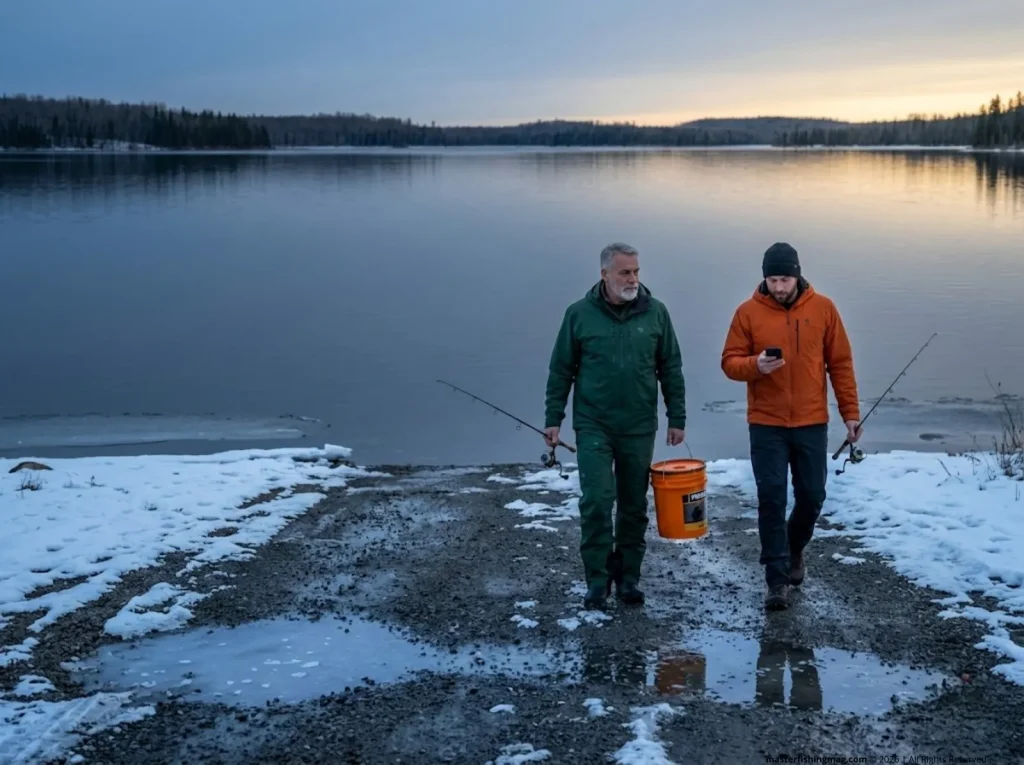
Most dedicated bass anglers are watching the calendar for the magic 58–60°F number when their target species crawl onto beds. That focus is understandable — it’s one of the most exciting windows in freshwater fishing. But it comes at a cost. While you’re waiting on bass, a completely different season is already running.
Pre-spawn panfish — crappies, bluegills, and perch — activate weeks earlier, when water temperatures are still cold enough to see your breath in the morning air. They’re not trickling in. They’re stacking up, feeding aggressively to fuel the energy demands of spawning, and gathering in precisely the locations that warm fastest. Brian “Bro” Brosdahl, one of the most respected panfish anglers in northern Minnesota, puts it plainly: “I catch some of the biggest crappies of the year right after ice-out.”
The Timing Gap Nobody Talks About
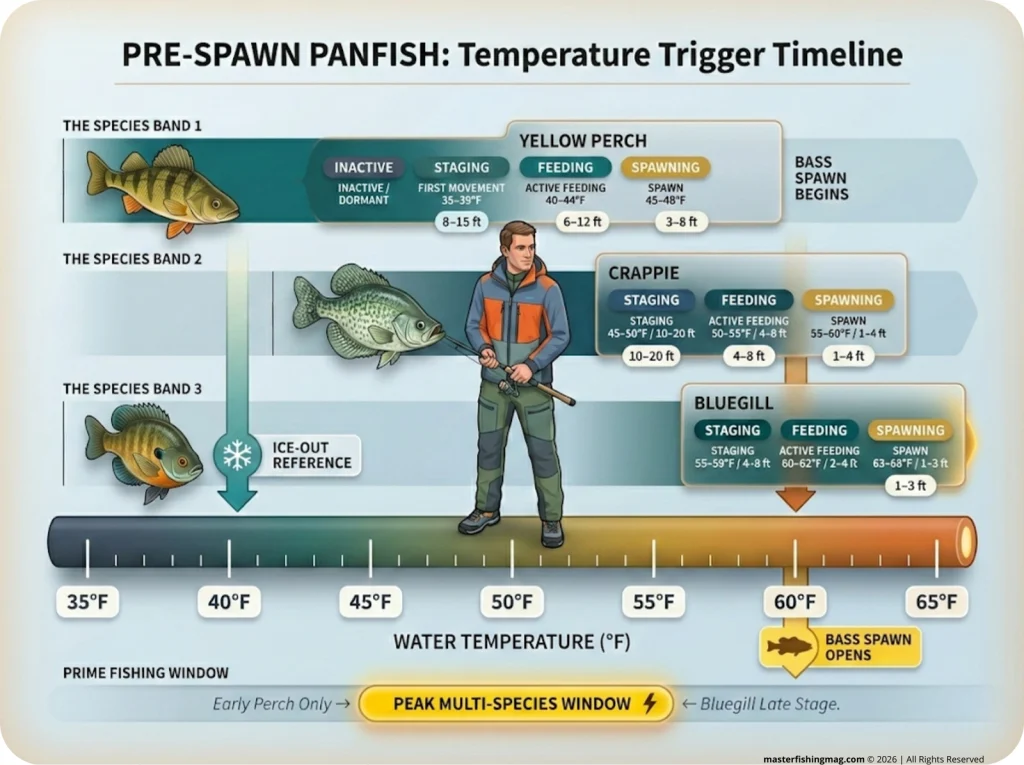
The window opens at 40°F ice-out and runs until water temperatures hit the low-60s°F, when panfish themselves begin spawning. Inside that range, you have 2–4 weeks — less in southern lakes, more in the upper Midwest — where crappie, perch, and bluegill are the most aggressive gamefish in the lake. Bass are largely inactive. Walleye may be finishing their own spawn. The panfish fishing calendar hands you this window free of charge, if you know where to look.
This is also a better situation for pre-spawn bass transition routes than most anglers realize. The south-facing bays, creek mouths, and depth transitions you learn chasing early spring panfish are the exact same features bass will use three weeks later when the water hits 60°F. You’re not just catching fish — you’re scouting the lake.
Why This Makes You a Better Bass Angler
Fishing ultralight tackle in cold water forces you to slow down, read structure, and present a bait with precision. You learn the lake’s thermal geometry: which bays warm first, where the inflows push warmth into shallow flats, which weed edges green up earliest. Every one of those details applies directly when bass gear comes out of the garage. The angler who spent three weeks chasing pre-spawn crappies in April knows exactly where the first bass beds will appear in May.
Water Temperature Triggers Every Panfish Angler Needs to Know
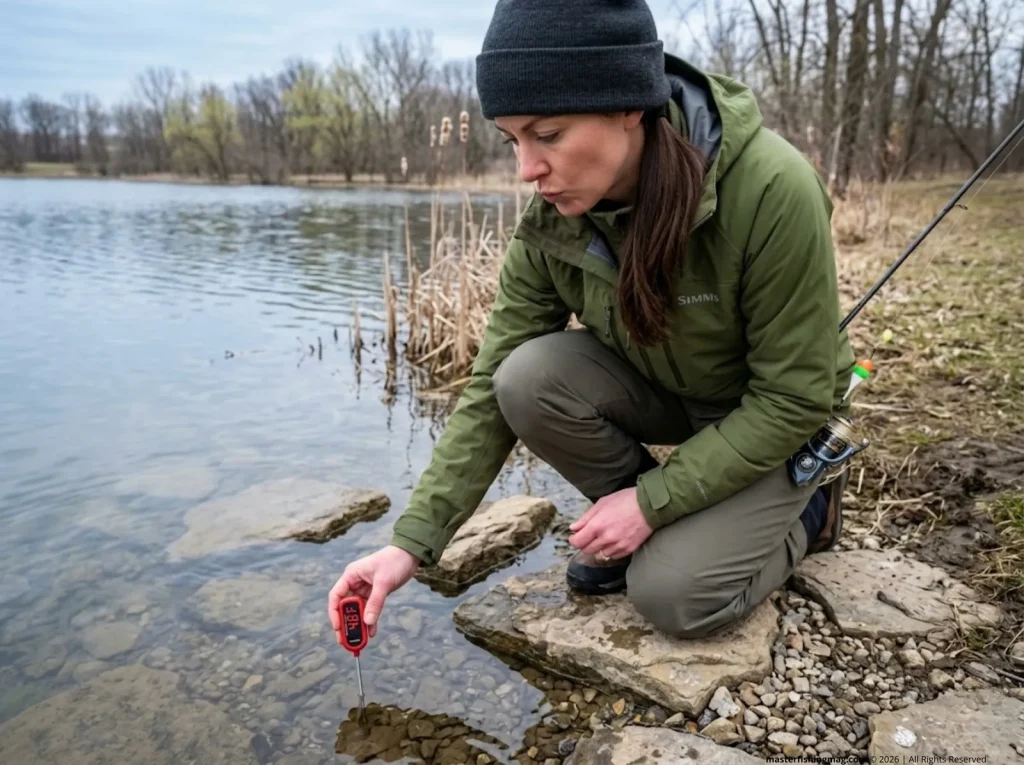
The single biggest mistake early-season panfish anglers make is using a fish finder’s surface temperature reading as their guide. Water stratifies fast in springtime. The surface can read 50°F while the reed edge six feet in is 54°F — and that 4-degree difference is the difference between empty water and a school of crappie. Understanding what surface temps actually tell you about fish depth will save you a lot of unproductive time on the water.
Pro tip: Carry a precision digital aquatic thermometer. Dip it into different areas of the same bay at the same depth. A 1–2°F difference between adjacent areas tells you exactly where fish have stacked.
Crappie: 45–55°F Is Your Money Range
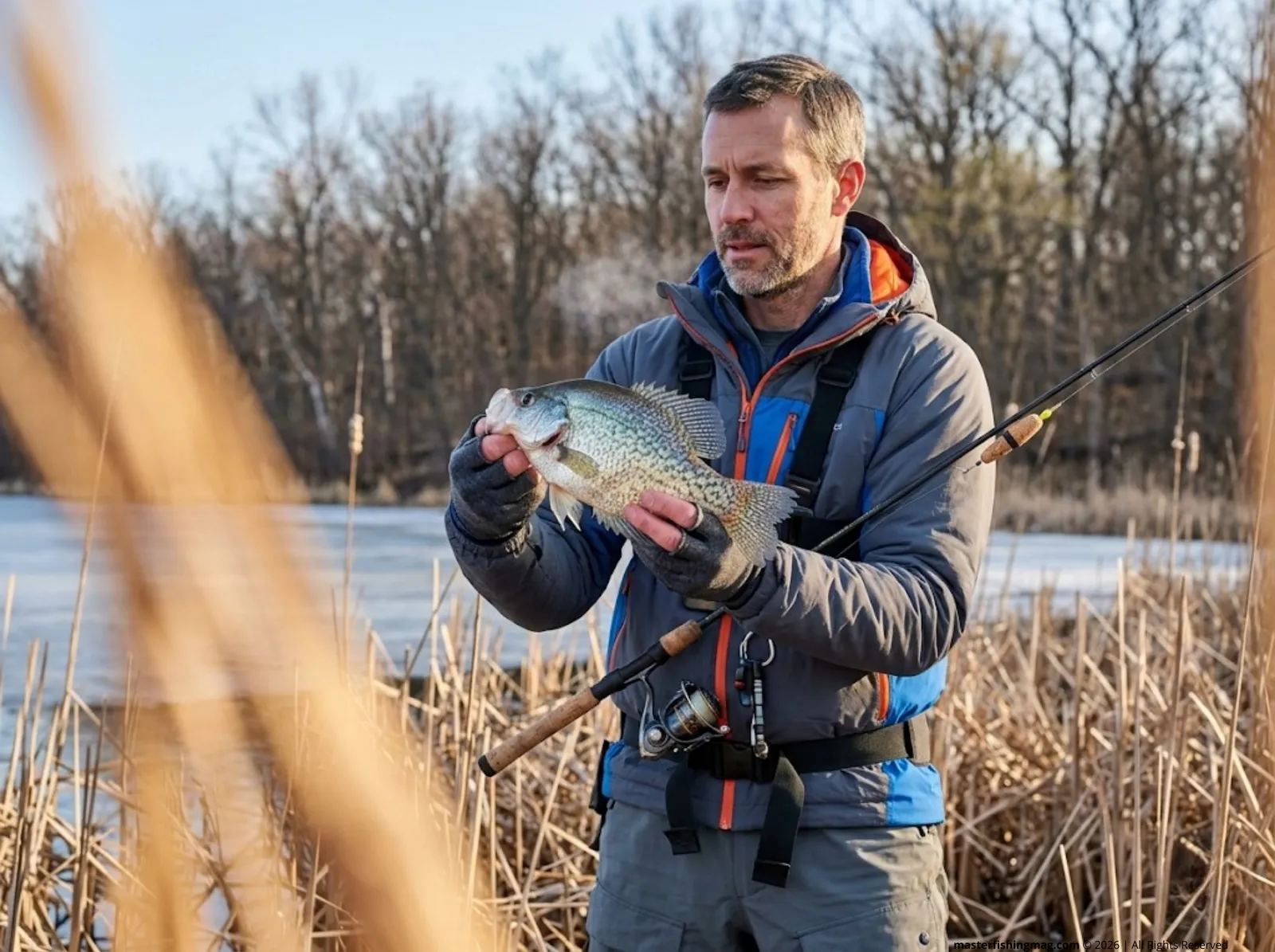
Pre-spawn crappies begin moving from winter holding depths when water approaches 50°F. At 45°F, they’re staging in mid-depth structure — think 10–20 ft staging near the edge of main-lake structure. At 50–55°F, they push into 4–8 feet near pencil reeds, bulrushes, and flooded timber. Chris Meitzner, a guide who’s spent years chasing early crappie minnow bites, describes it this way: shallow, warmer water is where they want to be, because increasing food intake ahead of spawning is the biological priority.
Nomadic crappie behavior is a critical factor in this window. Unlike bluegill, which tend to commit to a single area, crappies move daily — or even hourly — across emerging weed flats. You might find a school of fish in four feet of water on a reed edge at 7 AM and that same area empty at 10 AM when they’ve slid back to eight feet ahead of brightening sunlight. Mobility matters. If you’re running a small boat or fishing from a ponds bank, start in the warmest corner and work outward.
Bluegill: Low 60s°F Staging Shallows
Bluegill are the last panfish to commit shallow. They stage when water reaches the low-60s°F, initially over soft muddy bottoms and sandy transition zones in two to three feet. Large male bluegills arrive first — the biggest fish in the school are scouting bed sites before females move in. Target coontail and cabbage edges, submerged weed remnants from the previous year, and any sandy bottom near overhead cover.
The “big bluegill killer” presentation in this window is a small jig tipped with a waxworm, fished dead-still directly beneath a fixed float in less than four feet of water. These sunfish feed looking down in cold water — set your float so the bait hangs six to eight inches off bottom.
Yellow Perch: The Early Bird at 35–45°F
Yellow perch are the earliest panfish to activate. They can be caught in partially open-water fishing conditions at 35–39°F perch movement — sometimes literally through the last fringe ice on a warming bay, overlapping with late ice-fishing season. They spawn just before water hits 50°F, making them a legitimate February or early March target in southern parts of their range, and an April opportunity across the upper Midwest.
Target perch on sand, gravel, and rock bottoms that absorb heat faster than soft muck. Bigger lakes like the Minnesota DNR’s documented perch fisheries in Leech, Winnibigoshish, and Mille Lacs produce this early perch action reliably, but any lake with hard-bottom structure in 8–12 feet of water near a warming bay is worth investigating.
Where Pre-Spawn Panfish Hide (And Where They Don’t)
If you only remember one thing from this article, make it this: south-facing bays warm first, hold fish first, and produce first. A south-facing bay receives direct sunlight from ice-out onward, and that direct exposure can push water temps 3–5°F warmer than the north end of the same lake. Add even a small creek mouth flowing in from the south, and you’ve found the most reliable pre-spawn locations on any body of water.
Boat harbors are also underrated. The combination of shallow basin, dark bottom, and minimal water exchange means a harbor can run 1–2°F warmer than surrounding open water — enough to attract crappie weeks before anyone thinks to look there. Even predator birds like herons working a shoreline can tip you off to where baitfish and panfish are concentrated.
The Depth Progression: From Deep Staging to Shallow Feeding
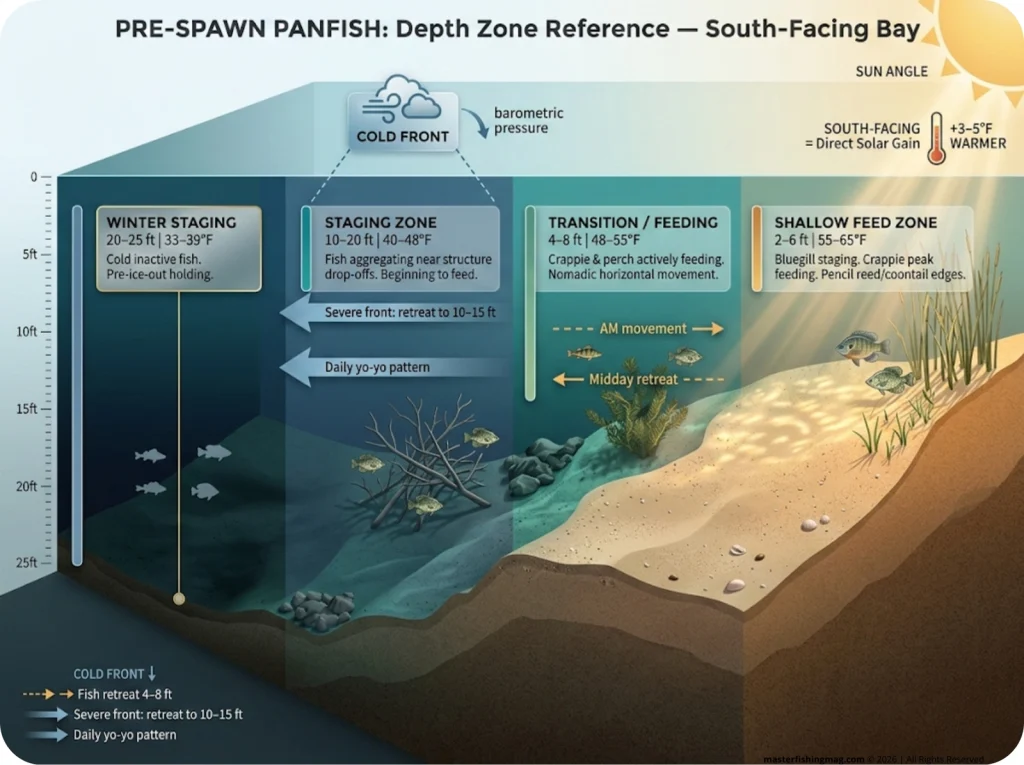
Pre-spawn staging follows a consistent depth progression. Fish winter in 15–25 feet of water. As temperatures climb, they migrate to staging areas at 8–15 feet — typically near the edge of main-basin structure or where a creek channel intersects a flat. From there, they push to 2–8 ft depth for active feeding when conditions are stable. Cold nights and cold fronts reverse this process temporarily.
The key insight is that this migration isn’t permanent. Fish yo-yo between depths daily based on light, pressure, and temperature. Morning low-light conditions pull fish shallow. Brightening midday sun drives them deeper. Cold front panfish behavior pushes them all the way back to staging depth. Your electronics aren’t just for finding marks — they’re for tracking which depth zone the fish have committed to on any given day.
Cover Types That Hold the Most Fish
Pencil reeds are the crappie angler’s main event in early spring. Their vertical structure lets crappie suspend at any depth within the reed bed, and the dense stalk base provides overhead cover that fish value in bright conditions. Cabbage and coontail are the bluegill magnet — even remnant clumps of dead emerging vegetation hold fish before new growth has appeared, because the decomposing material harbors the micro-invertebrates and insects that feed baitfish, which in turn feed panfish.
One cover type that gets overlooked: beaver-flooded fence rows and submerged brush in 8–15 feet of water. These cold-front magnets hold fish tight during pressure changes and produce some of the largest crappies of the season when fish slide off shallow cover after a front. If you know cold-water bank tactics that apply directly to early panfish, the same principle applies — fish don’t leave the area during fronts; they consolidate into the deepest available cover.
Rigs and Presentations That Catch Pre-Spawn Panfish
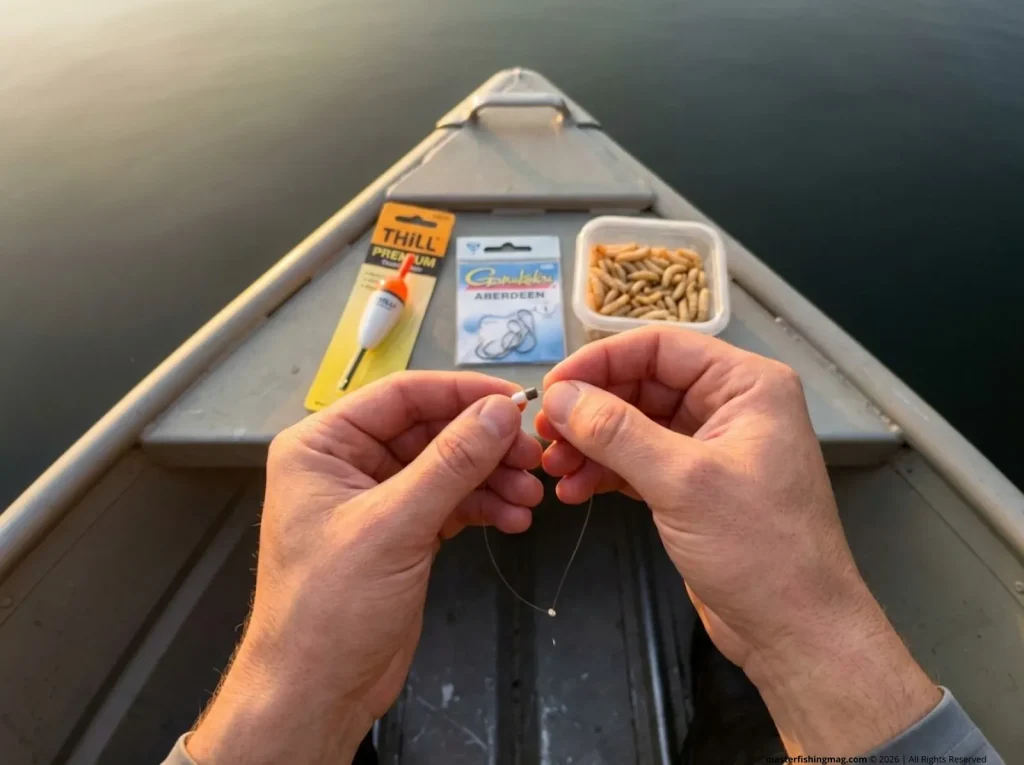
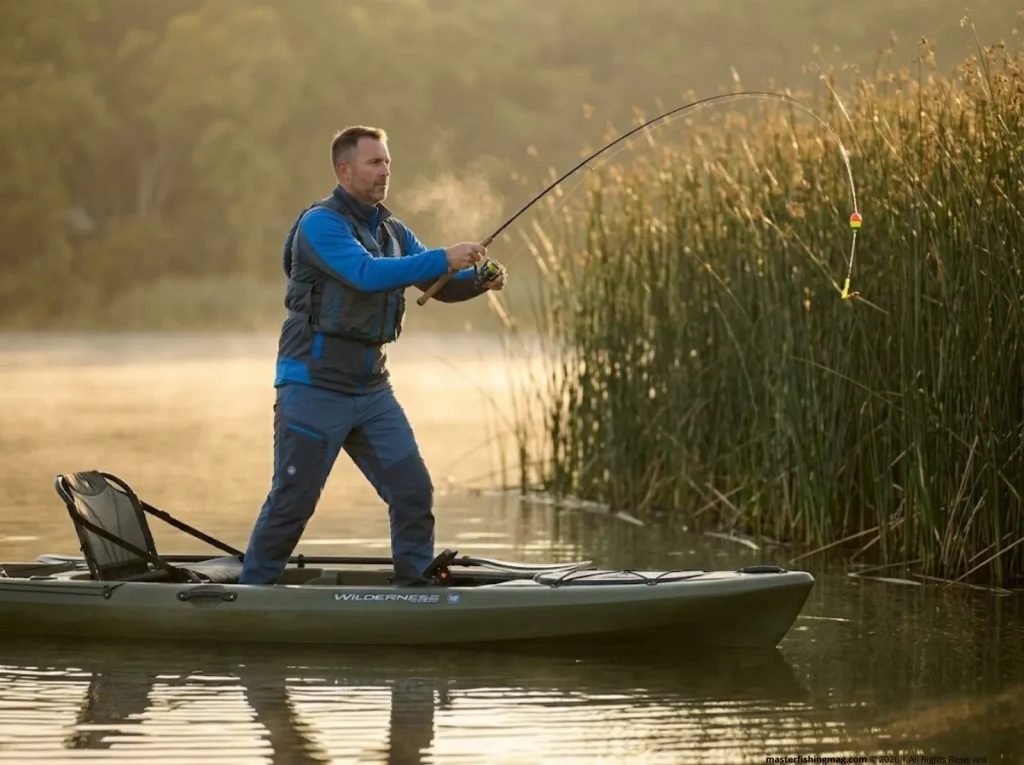
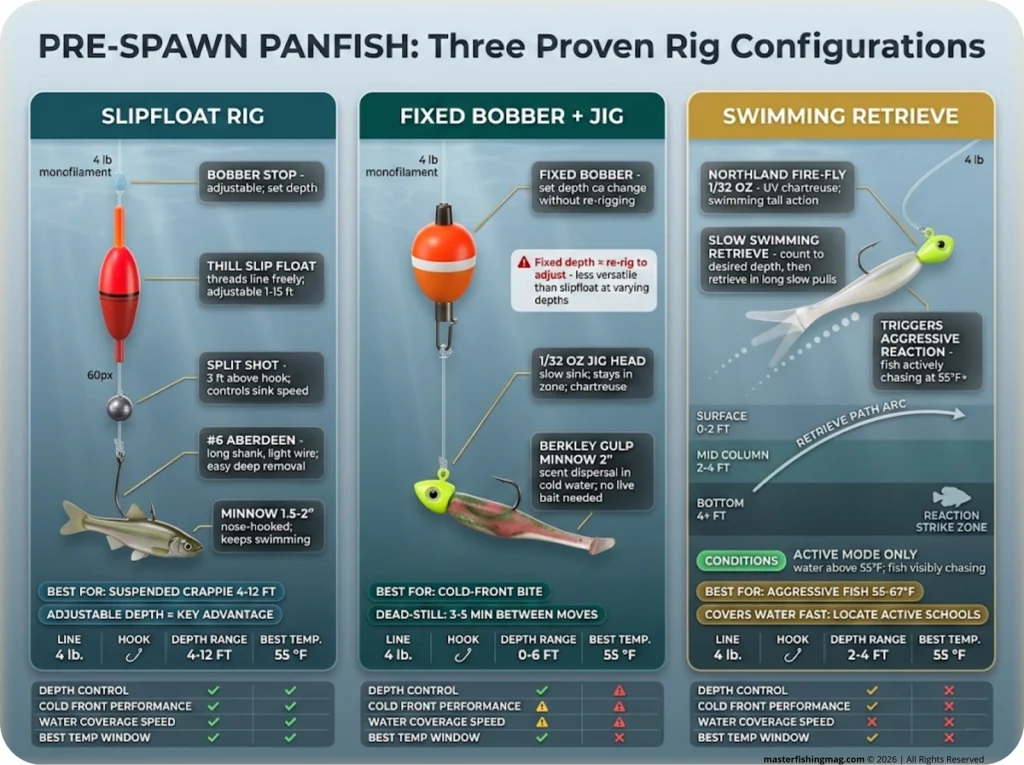
There’s no rig more versatile in this window than the slipfloat rig. A Thill Premium float threaded on 4 lb monofilament with a bobber stop, a small split shot, and a #6 Aberdeen hook lets you present bait at any depth from two to fifteen feet without recasting to adjust. When crappies are suspended at six feet one hour and four feet the next, that adjustability keeps you in the strike zone when a fixed float would leave you fishing empty water.
To rig it right: thread a Lindy bobber stop and bead, then the float, then pinch a split shot three feet above a Gamakatsu #6 Aberdeen hook. Lip-hook a live minnow (pushes the nose of the bait forward, keeps it swimming) or tail-hook a waxworm for a slow, spiraling fall. Set the bobber stop so the bait hangs 6–12 inches above where fish are marking on your electronics.
The Slipfloat Rig: Your Most Versatile Weapon
Brosdahl’s field observation on this is worth repeating verbatim: “Slipfloats are versatile — you can set them shallow to deep to stay on crappies, which can move around a lot.” That mobility is the entire point. Waxworms are the most effective cold-water bait in this setup from ice-out to about 50°F. They’re slow-sinking, scent-dispersing, and easy for cold, tight-lipped fish to inhale. Crappie minnows in the 1.5–2 inch range take over as temperatures climb above 50°F and fish become more aggressive.
Learn how to rig live minnows so they stay alive and wiggling — a dying minnow going belly-up under a float in cold water is a fast way to go fishless. Keep bait in an aerated bucket, nose-hook in the lower jaw only, and replace minnows every 20 minutes.
Pro tip: During cold fronts, strip off all flash and color. Go to a plain #8 Aberdeen hook with a single waxworm. No jig head, no colored float. The more invisible your presentation, the better when fish are tight-lipped.
Direct Jig and Swimming Retrieve for Aggressive Fish
When water temperature climbs above 55–67°F and fish are actively chasing, drop the float altogether for sections of water under four feet. A 1/32 oz Northland Fire-Fly jig tipped with a Berkley Gulp Minnow fished on a slow swimming retrieve covers water and triggers reaction strikes from fish that have moved beyond passive feeding. Two-dimensional bait presentation — vertical under a float versus horizontal swimming — are two different conversations with two different moods of fish. Know which one the fish are having today.
Cold Front Survival: When the Bite Shuts Down
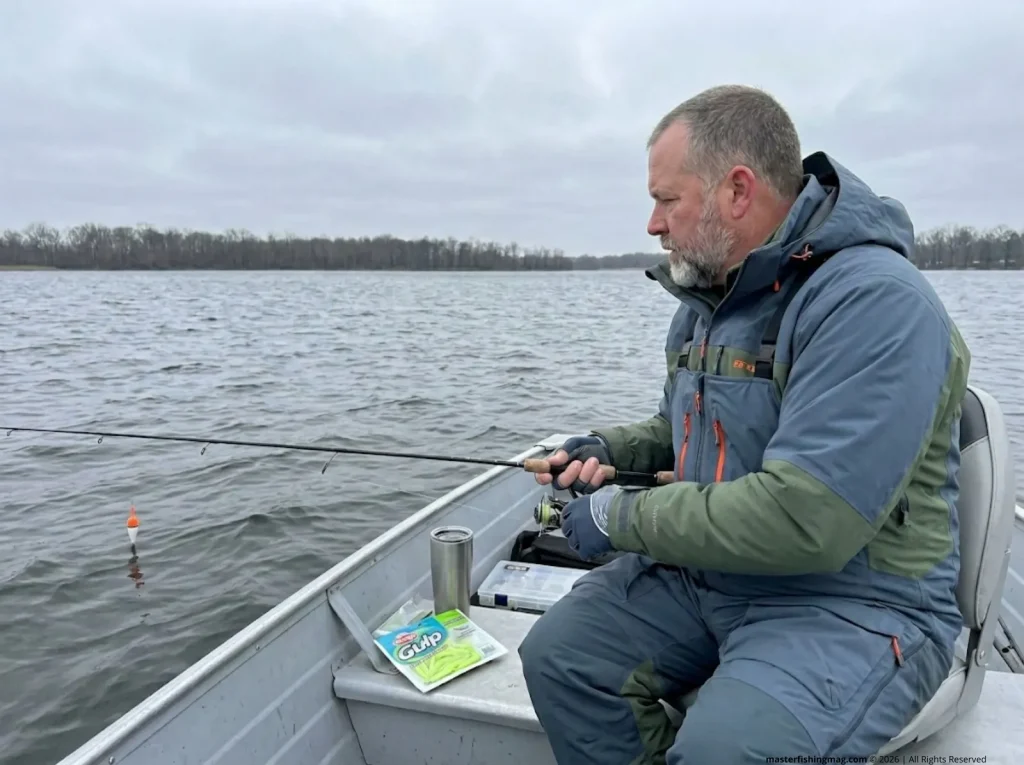
Cold fronts are the great leveler of early spring panfishing. A northwest front rolling through overnight can drop barometric pressure, push a 15-knot wind, and pull daytime temps back ten degrees. The fishing community’s instinct is to stay home. That’s a mistake.
Fish don’t disappear during cold fronts. They relocate. Brosdahl watched this pattern for decades on Minnesota lakes and describes it clearly: during cold fronts, fish might slip from shallow water out to six or ten feet, or even deeper, but they haven’t traveled far. They’re still in the same bay. They’ve just backed off one depth contour and pressed into the deepest available cover.
Where Fish Go During a Front
The move is predictable: out of two to four feet of open reed edge, into the deepest adjacent structure — a submerged brush pile, a flooded fence row, a steep drop at the end of a flat. 6–10 ft brushpiles that produced nothing for weeks suddenly hold fifteen crappie stacked like cordwood. Fire up your electronics and work methodically outward from where you caught fish yesterday. They’re close.
Presentation Adjustments That Still Trigger Strikes
Slow every single thing down. Dead-stick a slipfloat rig baited with a small Berkley Gulp Minnow — no waxworm, because the scent dispersal of Gulp keeps working even when the bait isn’t moving — and wait three to five minutes without moving the rod. If you see the float twitch at any point in those five minutes, lift slowly and you’ll feel the fish.
Size down. Go from a 1/32 oz jig to a 1/64 oz. Reduce the hook from #6 to #8. The difference in sink rate and weight in cold water matters. Fish that won’t hammer a normal presentation will inhale a near-weightless drop every time.
Pro tip: If the shallows go empty after a front, don’t pull off the spot — check the nearest brush pile or deeper edge, one contour line out. You’ll find the same school that was in two feet of water yesterday now sitting at eight feet, waiting for conditions to restabilize.
Gear That Matters (And Gear That Doesn’t)
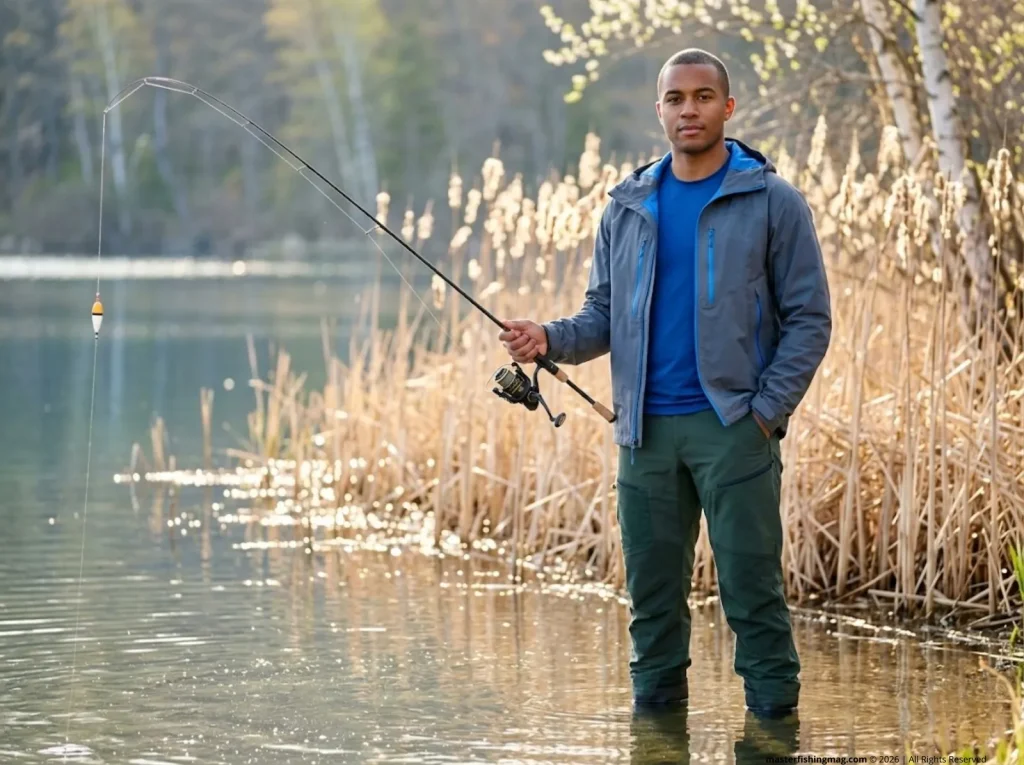
Let me be direct here: you do not need a $300 panfish series rod for this. What you need is a graphite blank that loads on four ounces of fish and transmits the soft bump of a crappie inhaling a waxworm. A 6.5–7 foot ultralight tackle rod in fast or extra-fast action with a sensitive tip does that job for $60–$80. The St. Croix Panfish Series is genuinely excellent. So is a reasonably high-end Ugly Stik Gold. You can evaluate our field-tested ultralight spinning combo picks before committing to a setup.
Rods, Reels, and Line
Pair that rod with a 1000–2000 size spinning reel with a smooth drag. A Pflueger President 25 runs around $50–60 and handles 4 lb mono all day without complaint. Do not use braided line as your main line for bobber rigs — it floats, resists the spool set needed for a slipfloat, and is unnecessary overkill for the loads involved. Straight 4 lb monofilament from spool to hook is everything you need.
2–6 lb line is the entire relevant range for this fishing. Heavier than 6 lb and the float sits wrong on the water. Lighter than 2 lb and you’ll lose fish in any vegetation cover.
Bait Selection by Water Temperature
From 35–50°F, waxworms are the unquestioned leader. They’re slow, they sink softly, and they release scent continuously. Leafworms work similarly. At 50–58°F, crappie minnows and minnows of all kinds outperform wax larvae because fish are fast enough to chase. Above 58°F, small Berkley Gulp! Minnows, Northland Bro Bling jigs, and Custom Jigs & Spins Rat Finkee tubes produce without the hassle of keeping live bait healthy.
Foam flies that require no floatant are an underused option when fish are keying on surface activity near reed edges — a 3-weight rod with a damsel nymph or small Impulse Helium Fly can produce memorable topwater bite sessions on warm, calm mornings.
Conservation: Why You Should Release the Big Ones
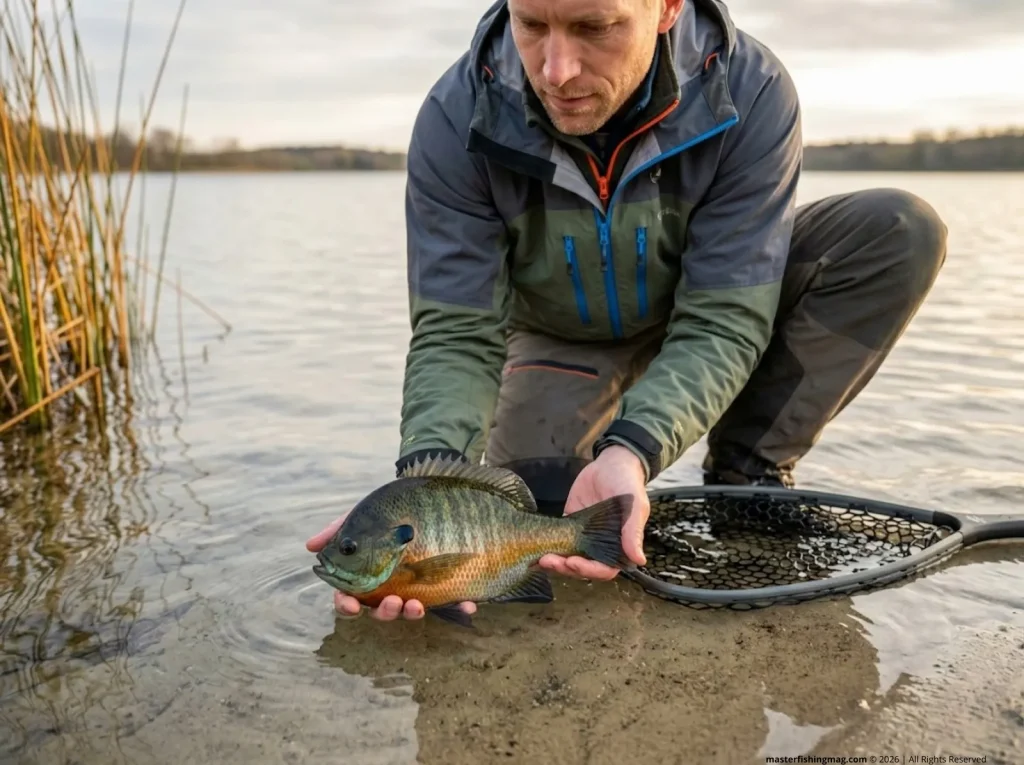
The conversation about sustainable angling during pre-spawn panfish season is one the outdoor media largely ignores — which is part of why fish populations in heavily pressured lakes trend toward smaller average sizes over time. Large male crappie, bluegill, and perch are disproportionately important to recruitment. They’re the first fish in, the longest on the bed, and the most effective egg guarders. The U.S. Fish and Wildlife Service recognizes freshwater fish population management as a long-term conservation priority, and that starts with individual angler choices at the water’s edge.
According to Wisconsin’s official panfish fishing seasons and regulations, panfish populations respond directly to harvest pressure. When large males are selectively removed during the pre-spawn and spawn, reproductive success drops and the lake’s average size class trends down over the following seasons.
The Male Guardian Problem
Release large males >8″ during the pre-spawn window. Keep your limit from the 6–7.5 inch range — these fish are sexually mature and have reproduced as broadcast spawners, making them a reasonable harvest choice — and put the big ones back. Catch-and-release mortality for panfish runs between 1–4% under normal temperature conditions (SEAFWA study), meaning almost every fish you release survives. That’s a favorable trade for the health of the fishery.
Handling for Survival
Wet your hands before touching any panfish. Their fish slime coat — the mucus layer that protects them from infection and keeps their body chemistry in balance — gets stripped on dry skin. A quick dunk of both hands before handling takes two seconds and matters. Use barbless hooks or crimp the barb on your Aberdeen hooks before fishing — cold-water panfish swallow deep in prespawn, and barbless removal takes a fraction of the time with zero tissue damage. You can read the detailed science behind what happens when you damage a fish’s slime coat if you want to understand exactly why this matters.
Pro tip: Keep a rubber-coated mesh net instead of string mesh — it protects the slime coat and prevents hook tangling. A $20 upgrade that pays for itself in healthy released fish.
Conclusion
Three things will catch you more fish before bass spawn opens than any lure or rod upgrade. First: know your water-temperature triggers. Perch move at 35–45°F, crappie at 45–55°F, bluegill at 55–65°F. A thermometer and a map of your lake’s south-facing bays are worth more than a full tackle box. Second: match your depth to the fish, not to where you caught them last week. The depth progression from staging to feeding to cold-front retreat is predictable and repeatable — follow it instead of fighting it. Third: release the large fish. Your lake’s panfish quality five years from now is a direct result of what goes back in the water today.
The next time the ice comes off and everyone heads north, turn south. Find the warm water. Get there with waxworms and a slipfloat. The slabs are already there. Most anglers haven’t figured that out yet, and until they do, that window belongs to you.
FAQ
What water temperature do panfish start biting in spring?
Yellow perch become active at 35–39°F, crappie begin moving at 45–50°F, and bluegill commit shallow at 55–60°F. These are movement triggers — actual spawning happens 5–10 degrees warmer for each species, so the best fishing falls between first movement and the spawn itself.
What is the best bait for early spring panfish?
Live waxworms under a slipfloat are the most consistent producer from ice-out through 50°F. Above 50°F, crappie minnow presentations match what fish are chasing naturally. Berkley Gulp! Minnows are a reliable backup at any temperature because the scent dispersal keeps working even when the bait is motionless.
Where do panfish go during a cold front in spring?
They slide from shallow south-facing bays and feeding zones (2–4 ft) back toward the nearest deep cover — brushpiles, flooded timber, or steep breaks in 6–10 feet. They don’t travel far. Check the same bay, one contour line deeper, and you’ll find them.
Can you catch panfish before bass start spawning?
Absolutely. Pre-spawn panfish are actively feeding 2–4 weeks before bass spawn. The early spring window from 40–55°F is one of the most productive panfish stretches of the entire year — and it happens before bass anglers are even thinking about their gamefish season.
Should I use electronics to find pre-spawn panfish?
Electronics are critical for locating tightly schooled staging fish in 8–15 feet during cold-front bites. In the shallows (2–6 ft), your eyes and a thermometer work better. Look for pencil reeds, creek inflows into south-facing bays, and any cover near a depth transition. The fish will be there before your transducer sees them.
Risk Disclaimer: Fishing, boating, and all related outdoor activities involve inherent risks that
can lead to injury. The information provided on Master Fishing Mag is for educational and informational purposes
only. While we strive for accuracy, the information, techniques, and advice on gear and safety are not a substitute
for your own best judgment, local knowledge, and adherence to official regulations. Fishing regulations, including
seasons, size limits, and species restrictions, change frequently and vary by location. Always consult the latest
official regulations from your local fish and wildlife agency before heading out. Proper handling of hooks, knives,
and other sharp equipment is essential for safety. Furthermore, be aware of local fish consumption advisories. By
using this website, you agree that you are solely responsible for your own safety and for complying with all
applicable laws. Any reliance you place on our content is strictly at your own risk. Master Fishing Mag and its
authors will not be held liable for any injury, damage, or loss sustained in connection with the use of the
information herein.
Affiliate Disclosure: We are a participant in the Amazon Services LLC Associates Program, an
affiliate advertising program designed to provide a means for us to earn advertising fees by advertising and linking
to Amazon.com. As an Amazon Associate, we earn from qualifying purchases. We also participate in other affiliate
programs and may receive a commission on products purchased through our links, at no extra cost to you. Additional
terms are found in the terms of service.