
In this article
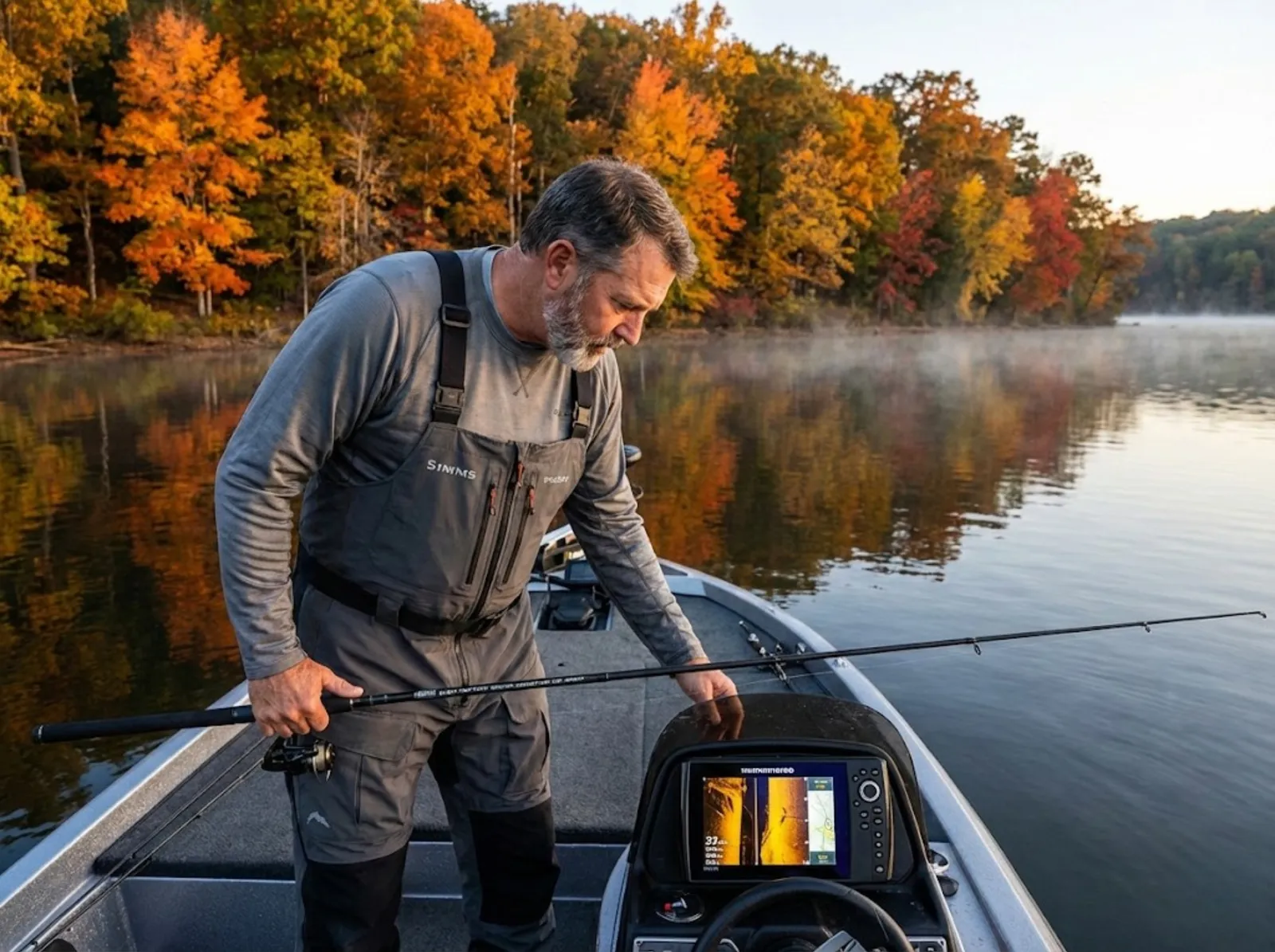
The graph on my Humminbird told me everything I needed to know, and none of it was good. October 14th, surface temp reading 58°F, and the school of crappie I’d been hammering all September had vanished from the 12-foot brush pile like they’d never existed. I spent three hours casting to dead water before the sonar finally pinged a cluster of marks suspended at 28 feet over the main lake basin. Same fish. Different zip code. The fall crappie transition had started, and I was a week late.
That’s what the fall slide does. It redistributes every crappie in the lake according to a temperature script that most anglers don’t bother reading. The fish aren’t random. Their vertical migration follows three predictable temperature triggers tied to thermocline breakdown, shad movements, and a metabolic slowdown that rewrites every tactic in your playbook. By the end of this piece, you’ll know exactly where crappie stop at each stage and how to follow them down instead of staring at empty sonar screens.
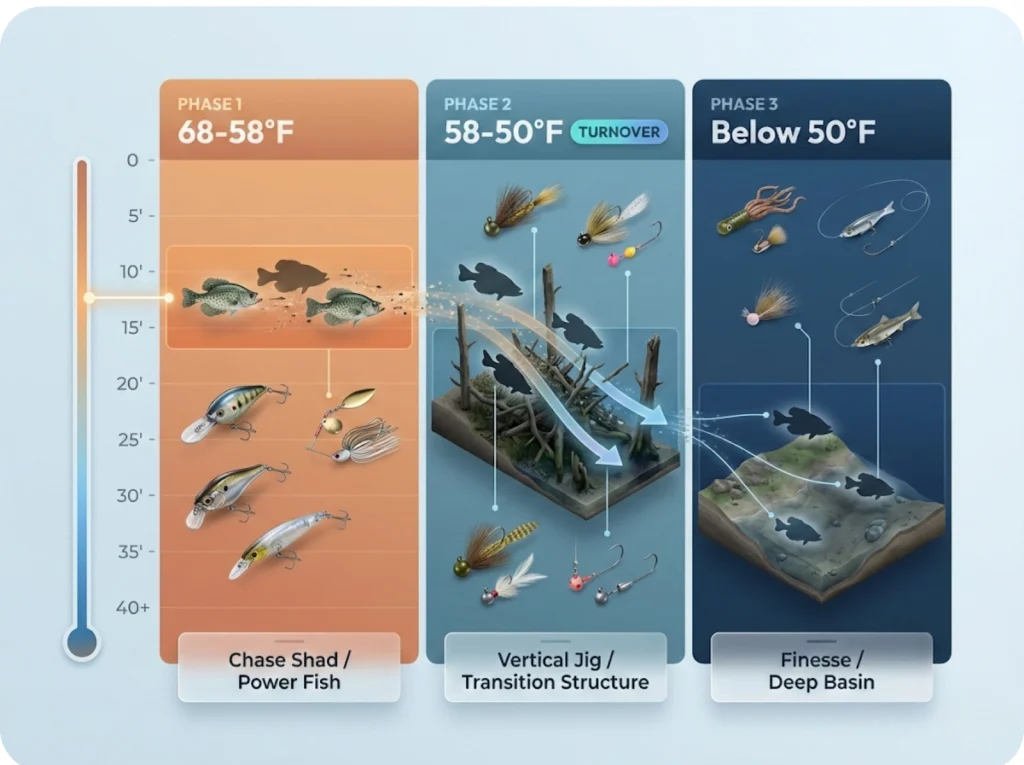
⚡ Quick Answer: Fall crappie change depth because cooling water destroys the thermocline that kept them shallow all summer, opening the entire water column. They follow a three-phase pattern: 10-15 feet when temps are 68-58°F (chase shad, power fish), 15-25 feet during turnover at 58-50°F (vertical jig transition structure), and 25-40+ feet below 50°F (finesse presentations in deep basins). Match your depth to the current water temperature and you’ll find them.
The Science Behind the Fall Slide
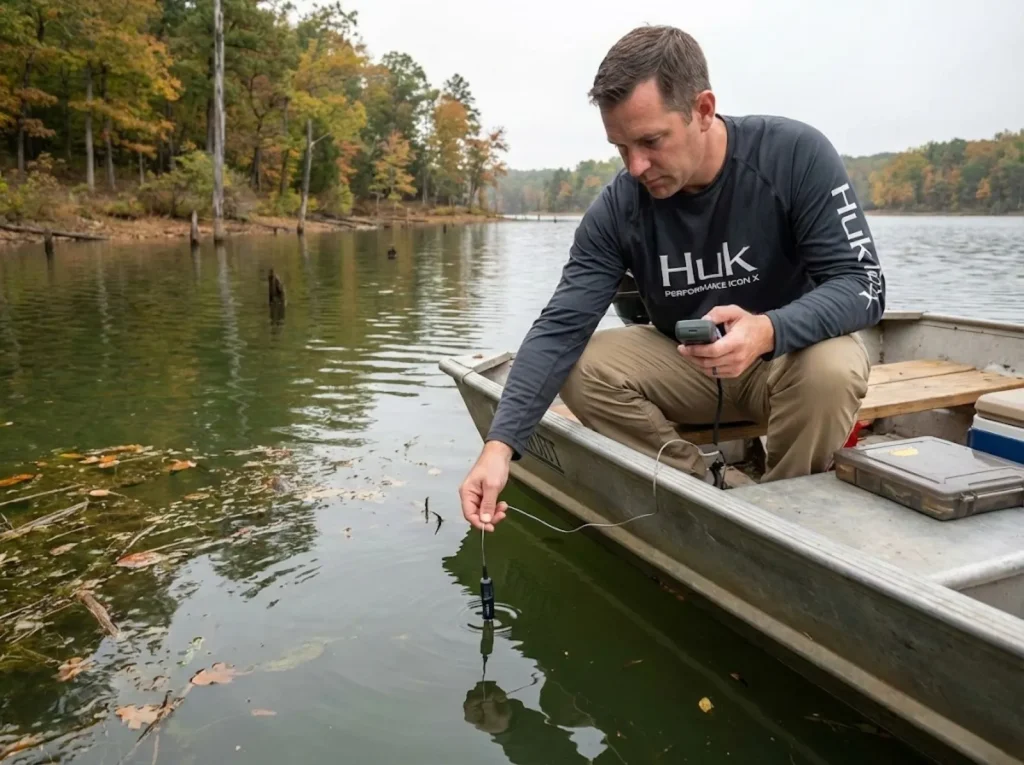
Why the Thermocline Matters More Than Surface Temps
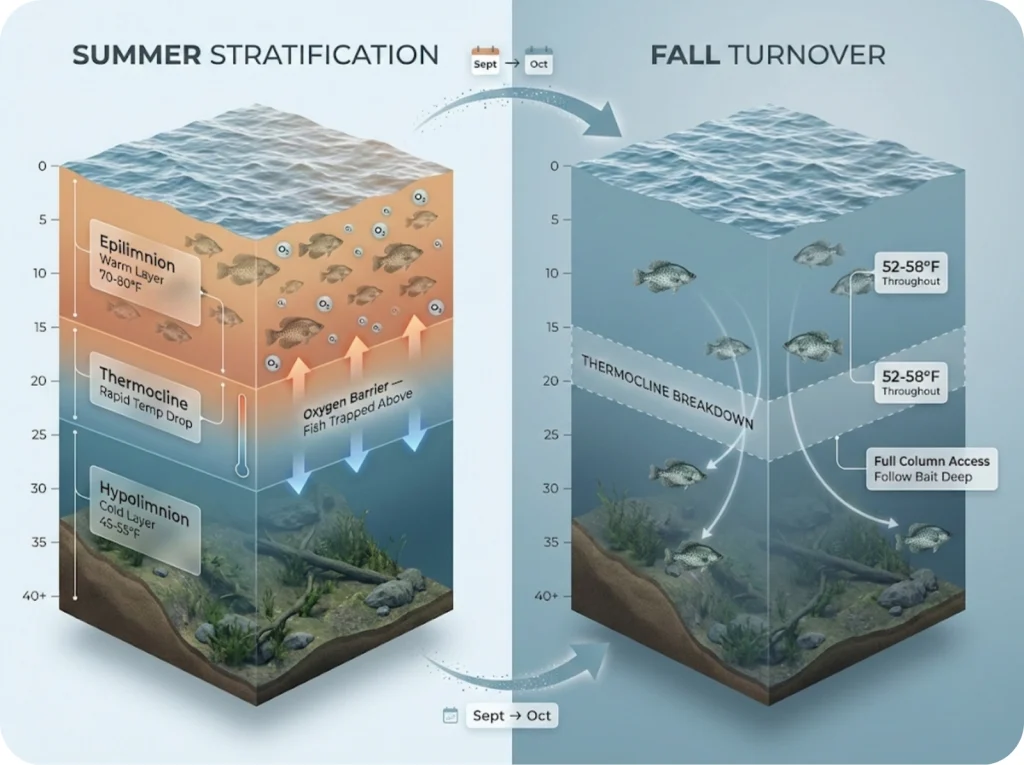
All summer long, your lake is stacked in layers. The warm surface water (the epilimnion) sits on top, a narrow band of rapid temperature change (the thermocline) acts as a ceiling in the middle, and the cold bottom layer (the hypolimnion) sits below it, mostly dead. Dead as in low oxygen levels, often below 2 mg/L. Crappie can’t live down there. So through June, July, and August, every fish in the lake is packed above that invisible barrier.
Then fall arrives and rewrites the rules. As surface water cools, it gets denser and sinks. Eventually, it matches the thermocline temperature and breaks through. This process is called lake turnover, and it does something remarkable: it equalizes temperature and oxygen from top to bottom. Those deep-water basins that were uninhabitable all summer suddenly become open real estate. The Clean Lakes Alliance’s turnover explanation lays out the density physics clearly.
Here’s the misconception most anglers carry: turnover is not one bad weekend. It’s a gradual biological reset that can take one to three weeks depending on lake size and wind exposure. If you want the full breakdown of how lake turnover actually works, we covered the density physics in a separate piece.
Pro tip: Turnover doesn’t follow a calendar. It follows temperature. Watch your 2D sonar display. When the thermocline line vanishes from the screen, turnover is underway and it’s time to shift your search deeper.
How Shad Migration Pulls Crappie Shallow First
Before crappie go deep, they actually go shallow. This trips up anglers every September. As water drops from the 70s into the 60s, threadfin and gizzard shad school in massive numbers and migrate from open-water basins into creek arms and shallow flats. Crappie are efficient ambush predators. They follow those bait fish relentlessly.
That early-fall shallow water bite is real and it’s aggressive. If you see shad dimpling the surface in the backs of creek arms, the crappie are right behind them. Pitch a 2.5-inch paddle tail into the commotion and hold on. This is the shallow phase, and it’s the window most anglers blow past because they assume fall means deep.
The Metabolic Slowdown Nobody Talks About
There’s a biological angle to the fall slide that gets ignored entirely. Fall isn’t just about repositioning. It’s a bulking-up period. Crappie must consume enough calories to survive winter and begin roe development for the spring spawn. At 68°F, their metabolism runs hot. They’ll chase aggressive baits and active retrieves without hesitation.
Below 50°F, everything changes. Cold metabolism drops their feeding rate significantly. They shift from aggressive hunters to opportunistic feeders that won’t chase anything requiring more energy than the meal provides. This is why slowing down isn’t just a tactical suggestion. It’s a biological requirement. Your bait needs to match the fish’s energy budget, and we covered how fish metabolism changes with water temperature in detail.
Pro tip: In late fall, if you think you’re presenting too slowly, slow down more. Hold the bait motionless in the strike zone for 10-15 seconds. Cold crappie won’t chase. They’ll only inhale something already sitting in their face.
The 68-50-45 Framework: Three Phases of the Fall Slide
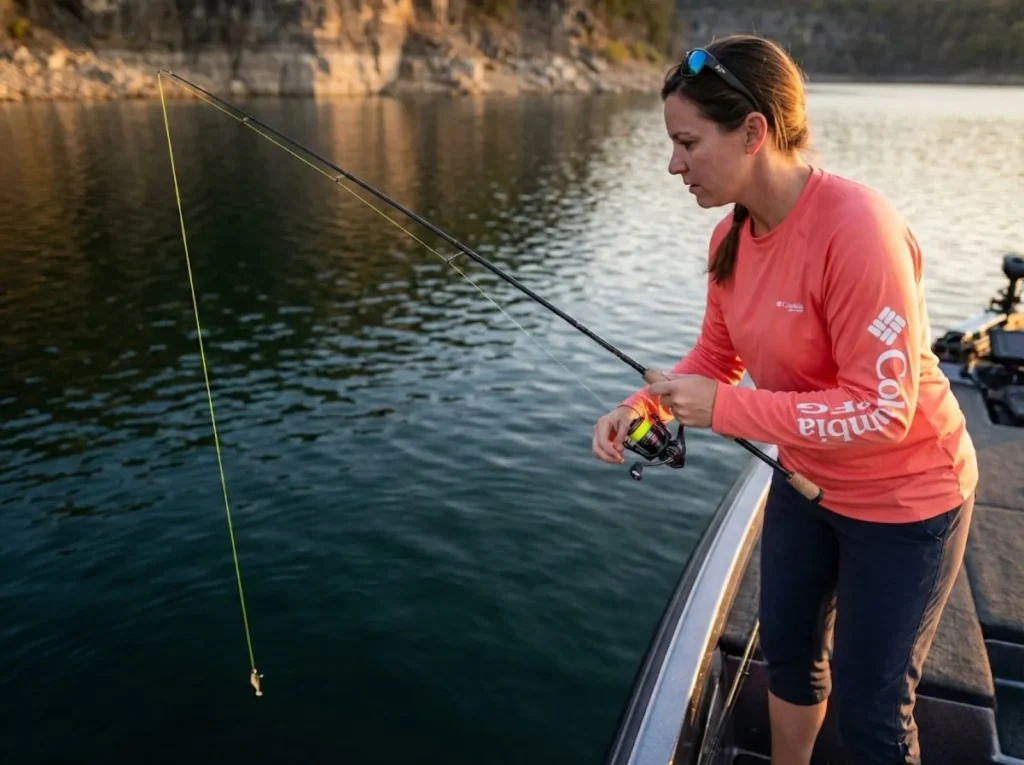
The 68-50-45 depth transition system is the simplest way to predict where crappie are sitting on any given fall day. Three water temperature thresholds. Three depth ranges. Three tactical approaches.
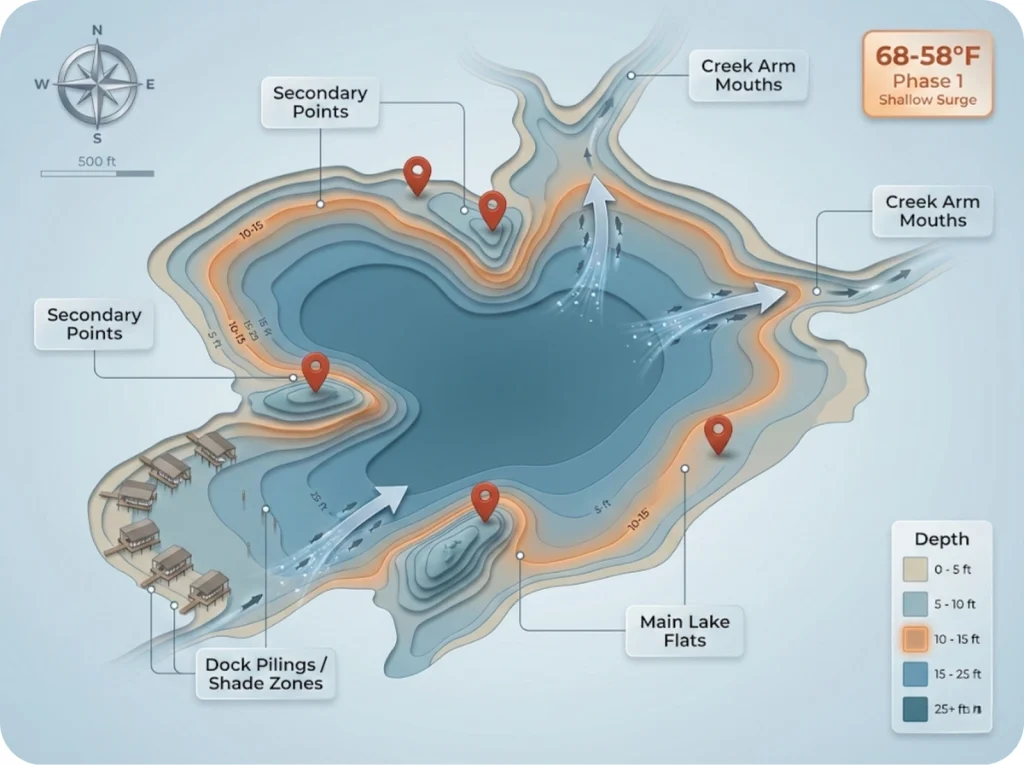
Phase 1: The Shallow Surge (68°F to 58°F)
At 68°F, crappie activity peaks. Metabolism is high, fish move aggressively, and the baitfish correlation with shad migration puts everything in shallow range. Primary locations during this phase include secondary points, main lake flats, the outer edges of boat docks, and the mouths of creek arms. Depth range: 10 to 15 feet.
This is horizontal fishing. Cover water. Cast 2.5 to 3-inch plastics to match maturing shad size. Speed is your friend when the water column is warm and the fish are chasing. If you’re running a spinning reel with 6-pound test, you’re in the right ballpark.
Pro tip: Don’t abandon docks during Phase 1. The shade underneath holds stable temperatures longer, and crappie stage along dock pilings as waypoints during the migration.
Phase 2: The Turnover Transition (58°F to 50°F)
This is the phase that breaks anglers. Lake turnover scatters fish throughout the water column at seemingly random depths. Crappie begin moving back out of creeks, stopping at transitional structure: channel bends, deep brush piles, submerged timber. Depth range: 15 to 25 feet.
The fish aren’t where they were last week, and they haven’t committed to deep basins yet. They’re in between. This is exactly why surface temps lie about actual fish depth during this chaotic window. Your gauge reads 55°F at the surface, but the crappie are sitting at a completely different temperature band 20 feet down.
Tactical shift: vertical jigging and tight-lining take over. Downsize baits to 2 inches or smaller. A Bobby Garland Baby Shad on a 1/16-ounce jig head is the workhorse presentation. Side imaging becomes your primary search tool for scanning large flats and channel edges for roaming pods.
Phase 3: The Basin Lock (Below 50°F to 45°F)
Migration complete. Crappie have settled into their wintering basins, and they’re not going anywhere. Primary locations: deep-water basins, river channel ledges, and deep structure near dams. Depth range: 25 to 40+ feet. In northern states, this arrives by late September and fish may hold at 30 to 50 feet until ice-up. In southern reservoirs like Lake Fork and Lake O’ the Pines, the transition stretches into December with crappie following a stair-step pattern dock-to-dock.
The fish are tightly schooled and stationary. Presentations must be painfully slow. Blade baits, spoons, and micro jigs that sink rapidly and produce a flutter mimicking dying shad are your best tools. Finesse fishing is the only game.
Pro tip: Once you find a school in Phase 3, mark a GPS waypoint immediately. These fish aren’t moving. You can return to the same spot for weeks.
Gear Physics: Matching Your Tackle to the Depth
Rod Length as a Mechanical Lever
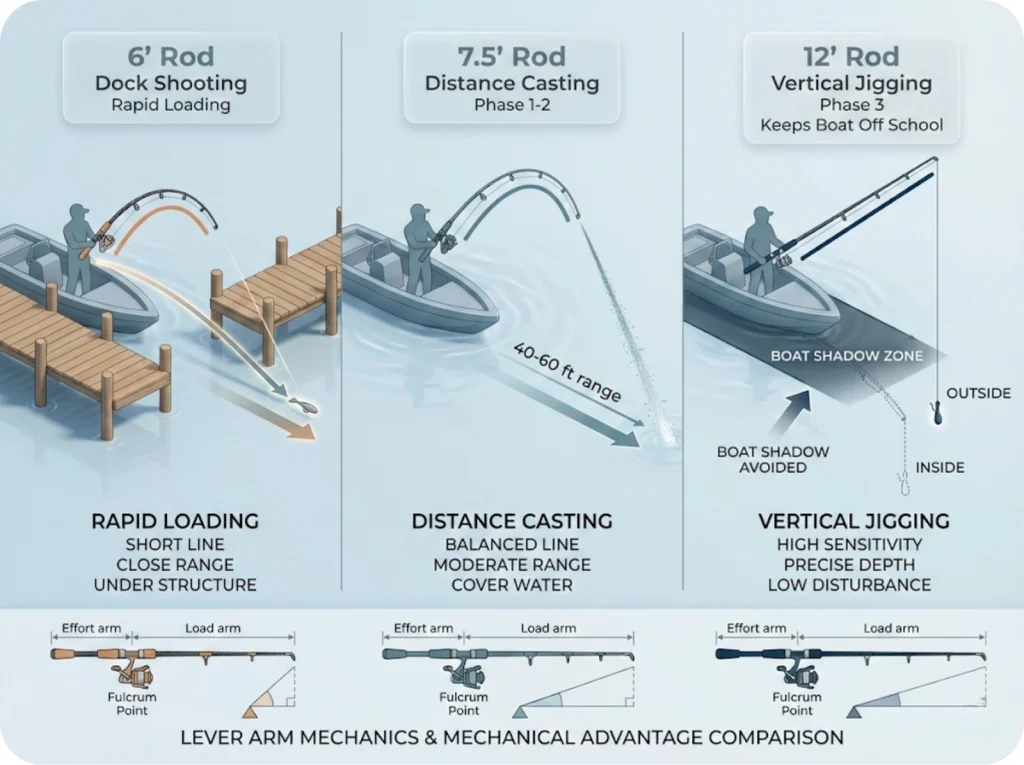
Your rod needs to change with the phase. Phase 1 dock shooting calls for 5’6″ to 6’6″ rods for rapid loading and skipping lures under low cover. Phase 1-2 open-water casting works best with 6’6″ to 7’6″ rods for distance and accuracy when searching for active schools.
Phase 3 vertical jigging demands a 10 to 12-foot pole. This isn’t preference. A long rod is a mechanical lever that keeps your boat shadow off the school while maintaining a short, sensitive line between rod tip and jig. An ACC Crappie Stix 10-footer or a BnM Sam Heaton Super Sensitive jigging pole are purpose-built for this work. We built a full guide on picking rod length based on where you fish that covers the lever mechanics directly.
Line Choices for Clearing Fall Water
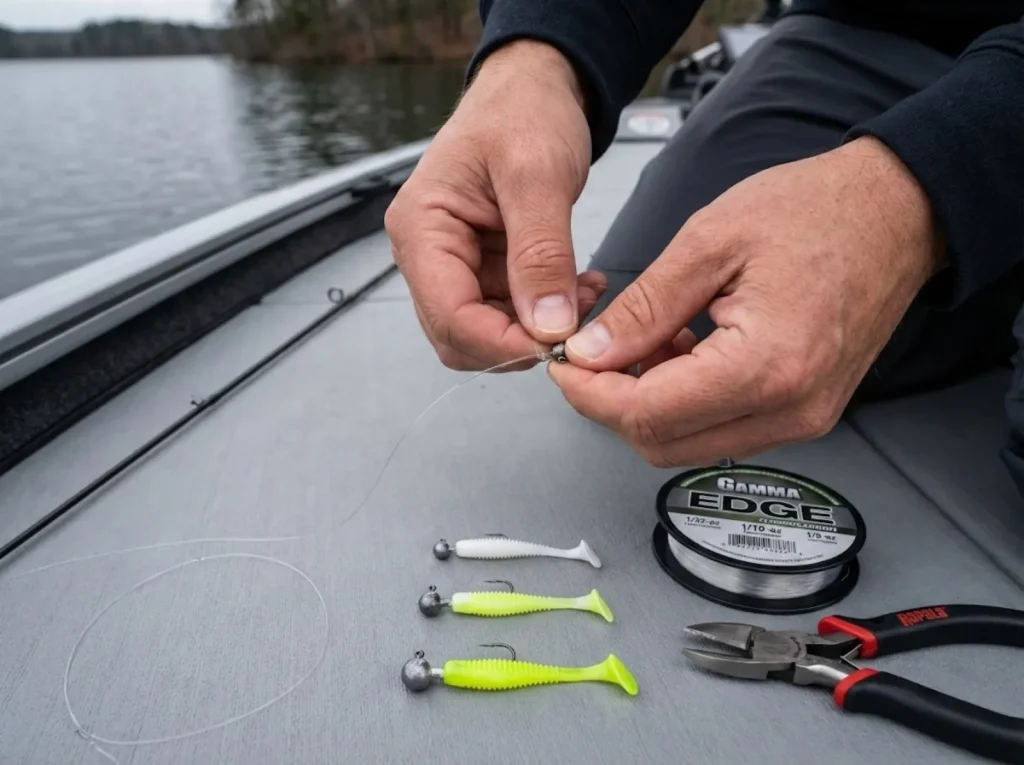
As fall water clears, line visibility becomes a factor. Heavy-diameter lines spook fish in transparent water, especially in Phase 3. Professional crappie anglers scale down to 4-pound or 6-pound test monofilament or fluorocarbon.
Fluorocarbon gets a lot of credit for being invisible, and its light-bending properties are closer to water than mono. But line diameter matters more than material. A 4-pound Gamma Edge fluorocarbon leader paired with a high-vis braided mainline like Sufix Nanobraid gives you the best combination: bite detection for the angler, stealth for the fish.
Sink Rate Math: Getting Your Jig to the Fish
A 1/32-ounce jig head sinks at roughly one foot per second. In 30 feet of water, that’s a 30-second countdown before your bait reaches the fish. That’s a lot of wasted time when you’re over an active school.
Late-fall efficiency upgrade: switch to 1/16-ounce or 1/8-ounce heads to cut sink time. Metal baits like blade baits and spoons sink rapidly and produce the flutter action that mimics dying shad, making them perfect for Phase 3 deep-water basins. Euro Tackle micro finesse plastics and Rapala Rippin’ Raps are both proven producers at depth.
Pro tip: Count your jig down. If your sonar shows fish at 22 feet and your 1/32-ounce jig falls at one foot per second, start your presentation at count 20. Don’t wait until you feel bottom. Overrunning the school pushes them.
Reading Electronics Through the Transition
2D Sonar and Side Imaging: Still the Foundation
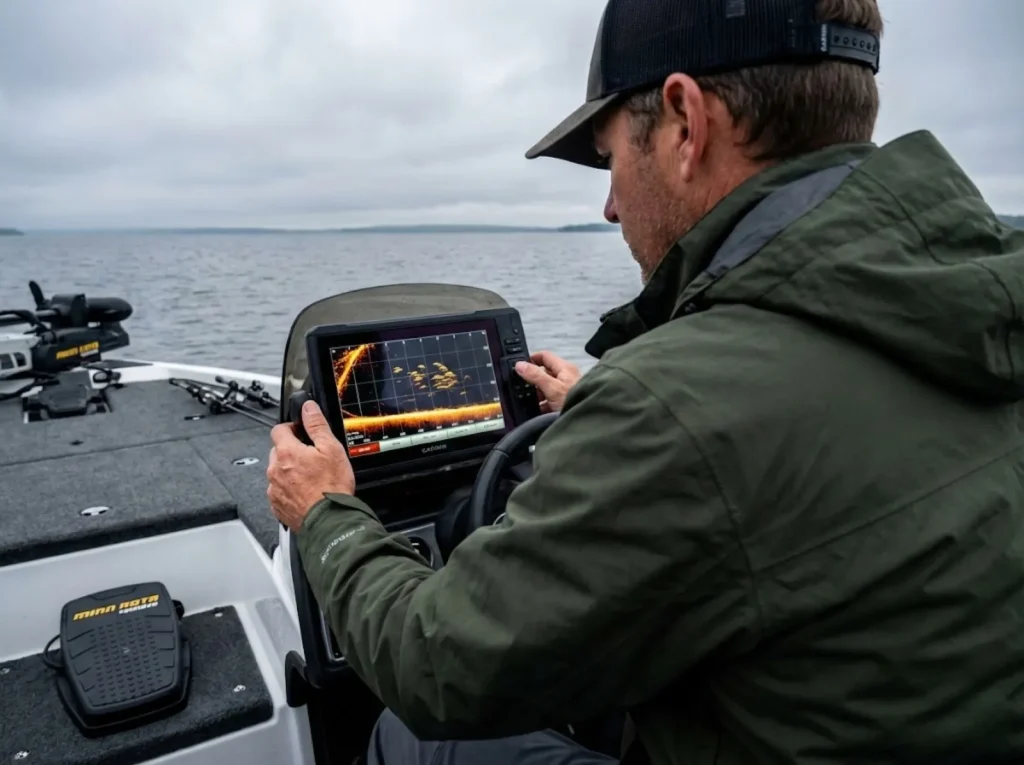
2D sonar remains the gold standard for vertical jigging. It gives you a direct view of your lure and the fish sitting beneath the transducer. Nothing else provides that real-time depth-matching feedback during Phase 3 presentations.
Side imaging is your primary search tool during Phase 2. When crappie scatter across transition structure after turnover, you need to scan large flats and channel edges efficiently. Side imaging covers hundreds of feet of water in a single pass, identifying brush piles, timber, and roaming pods that 2D alone would miss.
Forward Facing Sonar: Worth the Investment?
Forward facing sonar changed crappie fishing. Systems like Garmin LiveScope and Humminbird MEGA Live let you watch how fish react to your lure in real-time: color changes, speed adjustments, proximity. Research from the American Fisheries Society study on FFS catch rates indicates anglers using FFS can catch twice as many crappie by eliminating unproductive water.
Here’s the honest conversation nobody has. Entry-level FFS systems run $1,500 to $2,000. Premium setups push $2,500 to $4,000. The economic justification is time, not technology. Instead of blind-casting dead water for hours, you fish only active schools. But budget anglers can still find Phase 3 fish with traditional 2D sonar and GPS waypoints. The fish are stationary and tightly schooled. A Minn Kota Terrova on the bow and a 7-inch entry-level unit does 90 percent of what a premium display does for suspended crappie work, because target separation matters less when the school is packed into a 10-foot circle at the bottom of a basin.
Environmental Wild Cards: Moon, Wind, and Barometric Pressure
Moon Phase and the Full-Moon Lockjaw Effect
Moon phase correlation with crappie activity is real, especially in fall. A full moon gives crappie enough ambient light to feed all night, chasing shad to the surface in the dark. Result: daytime lethargy. The fish are already full when you show up at sunrise.
New moon is the opposite. Limited nocturnal feeding concentrates activity into major solunar daytime windows. This is your best shot at aggressive bites during any phase. We covered full moon lockjaw and how to beat it in detail, and the same principles apply directly to fall crappie.
Barometric Pressure: The Pre-Front Frenzy
Crappie are among the most pressure-sensitive freshwater species. A falling barometer before a cold front triggers aggressive feeding that can produce the best single-day catch of the entire fall season. This is the pre-front behavior window, and it’s gold.
Post-frontal conditions flip the script. High pressure and clear skies push crappie tight into the center of brush piles and timber. You have to put the bait on their nose or get nothing. The practical move: check a 48-hour weather forecast. If a front arrives Thursday, fish Wednesday afternoon. Understanding how cloud formations predict pressure changes gives you a visual heads-up before the barometer app even updates.
Wind as a Conveyor Belt
Sustained wind from one direction stirs up microorganisms, which attracts bait fish, which attracts crappie. It’s a chain reaction. Windblown points create pockets of cooler, oxygen-rich water that concentrate both shad and crappie into predictable zones.
Wind also accelerates surface cooling, which can push the Phase 1-to-Phase 2 fall transition faster than you expect. When wind holds from one direction for two or more days, fish the windblown side of every point and flat. The bait stacks there. The crappie follow.
Conservation: Why Deep Crappie Need Different Ethics
Barotrauma: The Invisible Kill
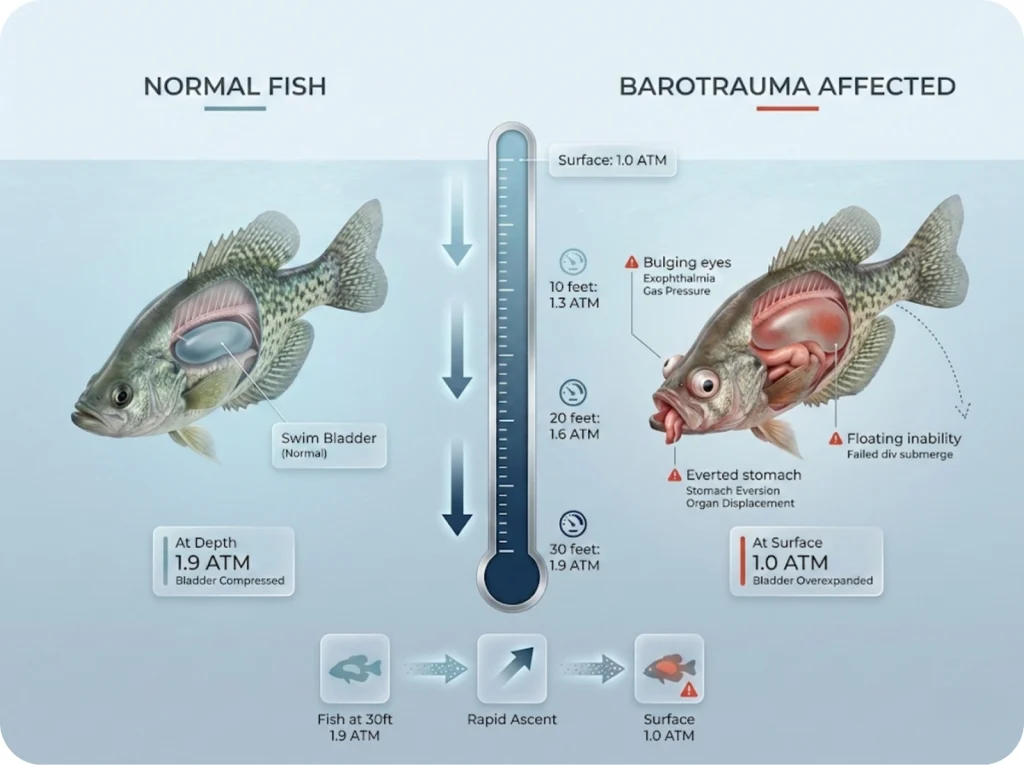
This is the part of fall crappie fishing that doesn’t get enough attention. When you pull a crappie rapidly from 25 to 30 feet, the gases in the swim bladder expand uncontrollably. That’s barotrauma. External symptoms include bulging eyes, stomach protruding from the mouth, and the inability to submerge after release. The fish floats. It dies. Even if it “swam away” when you let it go.
Catch-and-release from deep water carries high mortality. Some states recognize this. Texas requires mandatory harvest of crappie at Lake Fork and Lake O’ the Pines from December 1 through the end of February. You can verify these regulations through Texas Parks and Wildlife regulations for Lake O’ the Pines. For deeper reading on swim bladder mechanics and how depth affects pressure, we covered the science in a dedicated guide.
Selective Harvest: The Ethical Approach
Selective harvest means keeping legal-sized fish and stopping at your limit rather than catching and releasing dozens from deep water. The conservation math is simple: a fish you keep and eat has zero waste. A fish you release from 30 feet that dies from barotrauma is 100 percent waste.
This applies primarily to Phase 3 when fish sit at 25 to 40+ feet. Phase 1 and Phase 2 releases at shallower depths have much higher survival rates. Regional note: Florida crappie rarely reach depths where barotrauma is a concern because their shallow, warm lakes mean the fall migration often transitions directly into pre-spawn movement without the deep basin stage.
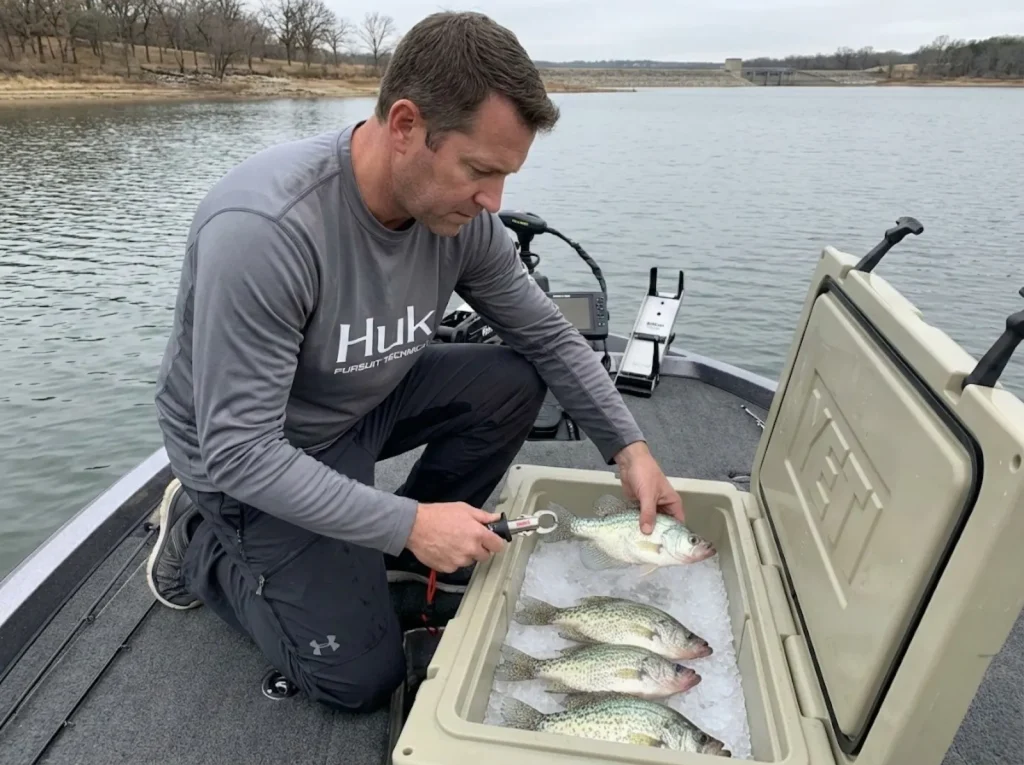
Pro tip: Carry a cooler with ice from the start when you’re fishing Phase 3 depths. Planning to harvest is better than stuffing fish in a dry bucket because you weren’t prepared.
Conclusion
Three things to carry with you next time the water cools. First, the fall crappie transition follows a predictable pattern. 68°F starts the shallow push, 50°F triggers the mid-depth transition, and 45°F locks fish into deep basins. Match your depth to the temperature and you’ll find the fish before they find you.
Second, each phase demands different tackle. Horizontal casting and aggressive baits in Phase 1. Vertical jigging with downsized plastics in Phase 2. Finesse presentations and metal baits in Phase 3. Fighting the phase instead of adapting is the fastest path to a skunk.
Third, deep-water crappie fishing carries a conservation cost. If you’re pulling fish from 25 feet or deeper, catch-and-release may be more harmful than keeping your limit. Fish responsibly. The resource depends on it.
Next time you feel the first cold front roll through and your crappie spots go quiet, don’t trailer the boat. Check your water temperature, consult the 68-50-45 framework, and follow the fish down. The slide is predictable. The only variable is whether you adjust with it.
FAQ
What depth do crappie move to in fall?
Fall crappie occupy three depth ranges tied to water temperature: 10-15 feet during early fall (68-58°F), 15-25 feet during mid-fall turnover (58-50°F), and 25-40+ feet once water drops below 50°F. The specific depth on any given day depends on your lake’s temperature reading at the thermocline, not the surface gauge.
Do crappie go deep or shallow in fall?
Both, and in that order. Crappie actually push shallow first, chasing shad into creek arms while water temps are in the 60s. The deep migration begins after turnover and continues until they settle in wintering basins below 50°F. Most anglers miss the shallow phase entirely.
What is the best bait for fall crappie fishing?
It changes by phase. Early fall: 2.5-3 inch paddle tail plastics with active retrieves to match the shad migration. Mid-fall: downsize to 2-inch or smaller jigs presented vertically. Late fall: blade baits, spoons, and micro jigs presented painfully slow near the bottom produce the most consistent crappie bite.
How do you find crappie in the fall when they’ve moved deep?
Side imaging is the fastest search tool for locating scattered schools during the turnover transition. Scan channel ledges, brush piles, and basin edges. Once you locate a school, switch to 2D sonar for vertical jigging and mark the GPS waypoint. In Phase 3, deep-basin crappie hold in the same spot for weeks.
Does barometric pressure affect fall crappie fishing?
Significantly. A falling barometer before a cold front triggers aggressive feeding. Post-frontal high pressure pushes crappie tight into the interior of brush piles and timber. Check a 48-hour forecast and time trips to pre-frontal conditions whenever possible.
Risk Disclaimer: Fishing, boating, and all related outdoor activities involve inherent risks that
can lead to injury. The information provided on Master Fishing Mag is for educational and informational purposes
only. While we strive for accuracy, the information, techniques, and advice on gear and safety are not a substitute
for your own best judgment, local knowledge, and adherence to official regulations. Fishing regulations, including
seasons, size limits, and species restrictions, change frequently and vary by location. Always consult the latest
official regulations from your local fish and wildlife agency before heading out. Proper handling of hooks, knives,
and other sharp equipment is essential for safety. Furthermore, be aware of local fish consumption advisories. By
using this website, you agree that you are solely responsible for your own safety and for complying with all
applicable laws. Any reliance you place on our content is strictly at your own risk. Master Fishing Mag and its
authors will not be held liable for any injury, damage, or loss sustained in connection with the use of the
information herein.
Affiliate Disclosure: We are a participant in the Amazon Services LLC Associates Program, an
affiliate advertising program designed to provide a means for us to earn advertising fees by advertising and linking
to Amazon.com. As an Amazon Associate, we earn from qualifying purchases. We also participate in other affiliate
programs and may receive a commission on products purchased through our links, at no extra cost to you. Additional
terms are found in the terms of service.