
In this article
The first thing you notice isn’t the lake—it’s that you can’t see the other side. Standing on the Clewiston dock at 5:30 a.m., staring across 730 square miles of black water and hydrilla, you start to understand why locals call it the Inland Sea. Your guide is already idling a Sterling 22 against the pilings, and he’s got a question before you step aboard: “You want to learn, or you want to catch?”
Your answer changes everything about the next eight hours. The techniques, the zones, even which bait hits the water first. And that simple question—instructional trip versus action trip—is the single most important decision you’ll make about fishing Lake Okeechobee, far more than which lure to tie on.
After years spent covering Florida bass fishing destinations, I can tell you this: the Big O punishes tourists who show up unprepared and rewards those who do their homework. Here’s exactly what that homework looks like.
⚡ Quick Answer: A full-day Lake Okeechobee fishing guide runs $400–$550, but your real cost lands closer to $650–$750 after live shiners ($80–$180/day), a Florida freshwater license ($17), and a 15–20% tip. Peak season is December through March during the spawn, when water temps hit 65–72°F. Always check USACE water levels before booking—below 12.0 feet NGVD, North Shore locks close and navigation gets dangerous.
What Makes Okeechobee Different From Every Other Bass Lake
The “Inland Sea” Problem—Size, Depth, and Why You’ll Get Lost
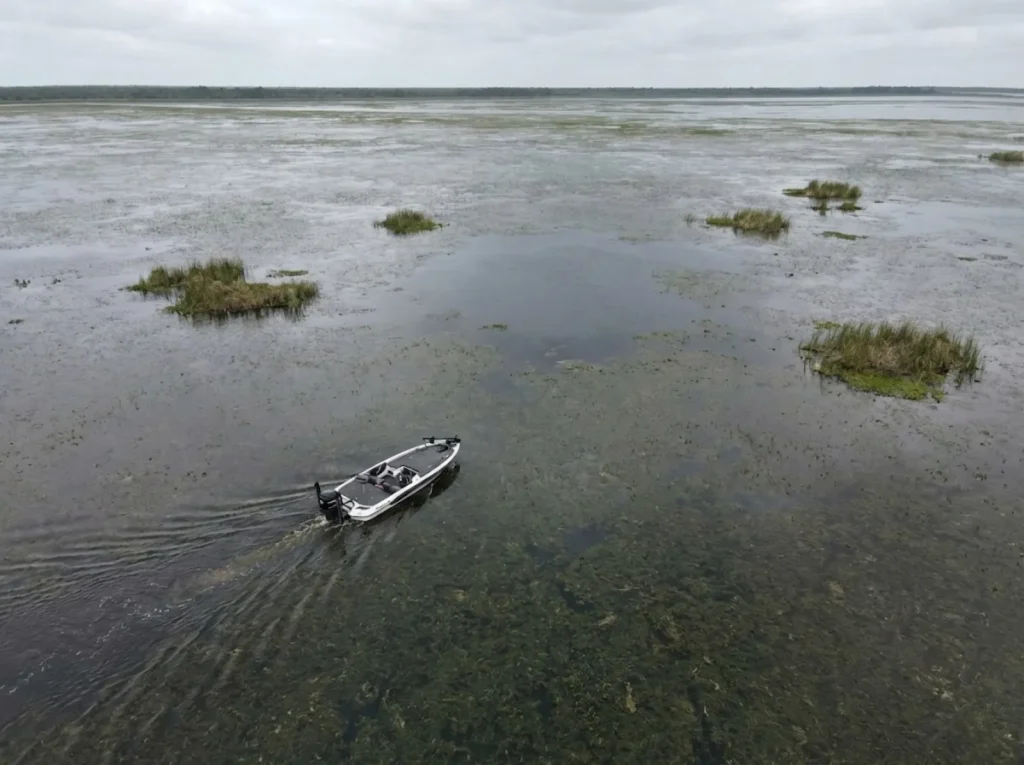
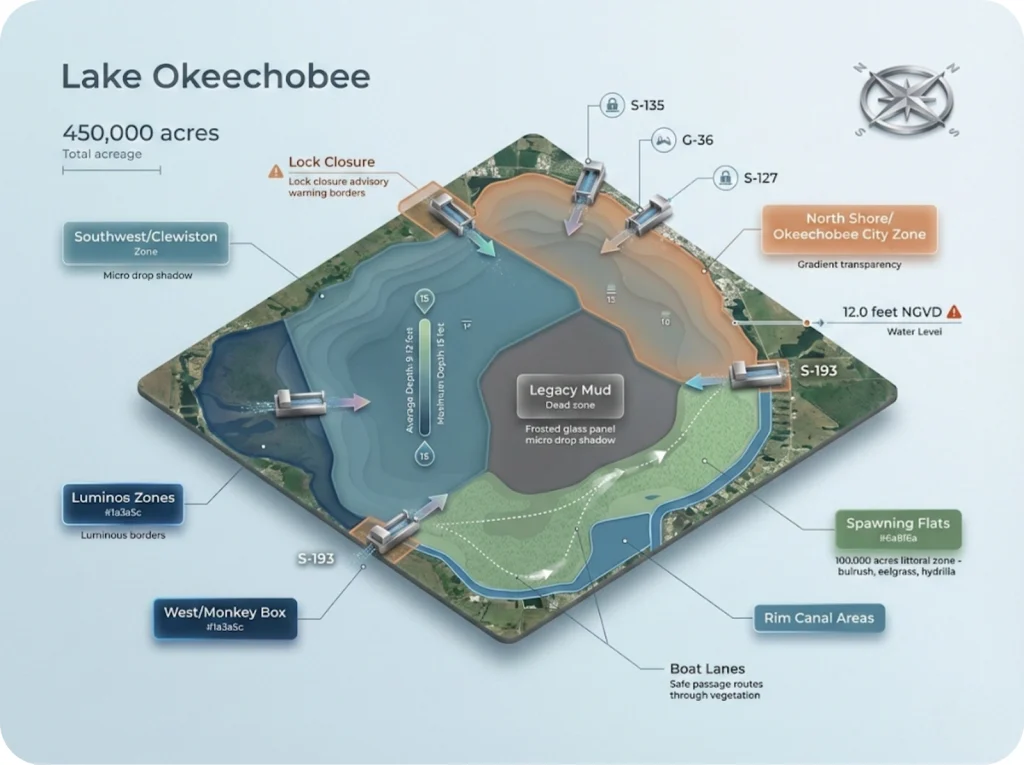
Lake Okeechobee covers roughly 450,000 acres, making it the largest lake entirely within a single U.S. state. But here’s the part that catches everyone off guard: the whole thing averages 9 to 12 feet deep, with a maximum around 15. It’s not a deep lake. It’s a giant shallow basin.
That shallow profile creates a massive littoral zone—about 100,000 acres of submerged vegetation where largemouth bass spawn, feed, and ambush prey. Bulrush, eelgrass, and hydrilla form the biological engine of the fishery. Without that vegetation, there are no bass. Period.
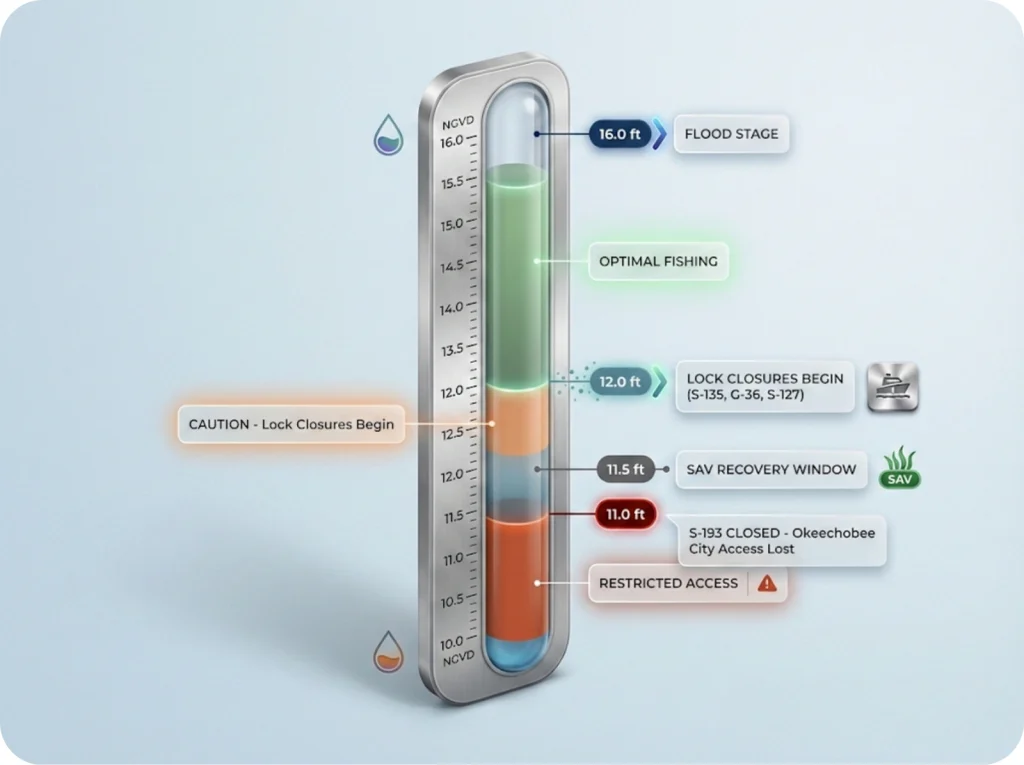
The problem for visiting anglers is navigation. Unmarked boat lanes snake through vegetation so thick that straying a few feet from the path can ground you on a limestone shelf. Below 12.0 feet NGVD, the South Florida Water Management District navigation advisories trigger closures of North Shore locks—S-135, G-36, and S-127—cutting off access from Okeechobee City entirely.
When conditions shift fast, understanding how water temperature changes interact with surface and depth readings isn’t optional on the Big O. It’s survival.
Pro tip: Before you book anything, check the USACE Lake Okeechobee water level page. If the number reads below 12.0 feet, call the guide directly and ask which launch point still has safe access. That one call saves you a wasted drive.
The Littoral Zone—Why 100,000 Acres of Grass Run the Show
The relationship between submerged aquatic vegetation (SAV) and bass fishing on Okeechobee is direct and measurable. A peer-reviewed habitat study on Lake Okeechobee bass populations found that SAV abundance correlates at over 90% with largemouth bass recruitment. No grass, no new fish.
SAV recovery requires at least 90 days below 12 feet NGVD for sunlight to reach the bottom and trigger regrowth. Meanwhile, roughly 50% of the central lake bottom is covered in Legacy Mud—soft organic sediment that resuspends with wind and shades out plant growth. When your guide talks about finding “clean water,” he doesn’t mean clear. He means tannic-stained but low-turbidity water, often tea-colored from organic matter, hiding behind dense filter-mats of vegetation.
The Zones—Southwest, North Shore, and the Monkey Box
Clewiston sits at the southwest gateway to Pelican Bay and Ritta Island—areas with year-round trophy bass potential. This is the self-proclaimed Bass Capital of the World, and the access point most fishing guides use as their default launch.
Okeechobee City on the north side opens up the Kissimmee River mouth, which fires up after heavy rains push current-driven bites. The western marsh—Harney Pond and The Monkey Box—is where the real spawning action lives. Hard-bottom indentations called stove pipes and stands of bulrush locals call buggy whips draw bedding bass every winter.
Wind direction dictates everything here. Strong North winds push cold, turbid water into the southern spawning flats, inducing lockjaw in bedding fish. The best guides are regionally versatile—willing to tow their boat to whichever access point has the cleanest water that day.
How to Match a Guide to Your Actual Fishing Goals
“Instructional” vs. “Action” Guides—Two Different Trips
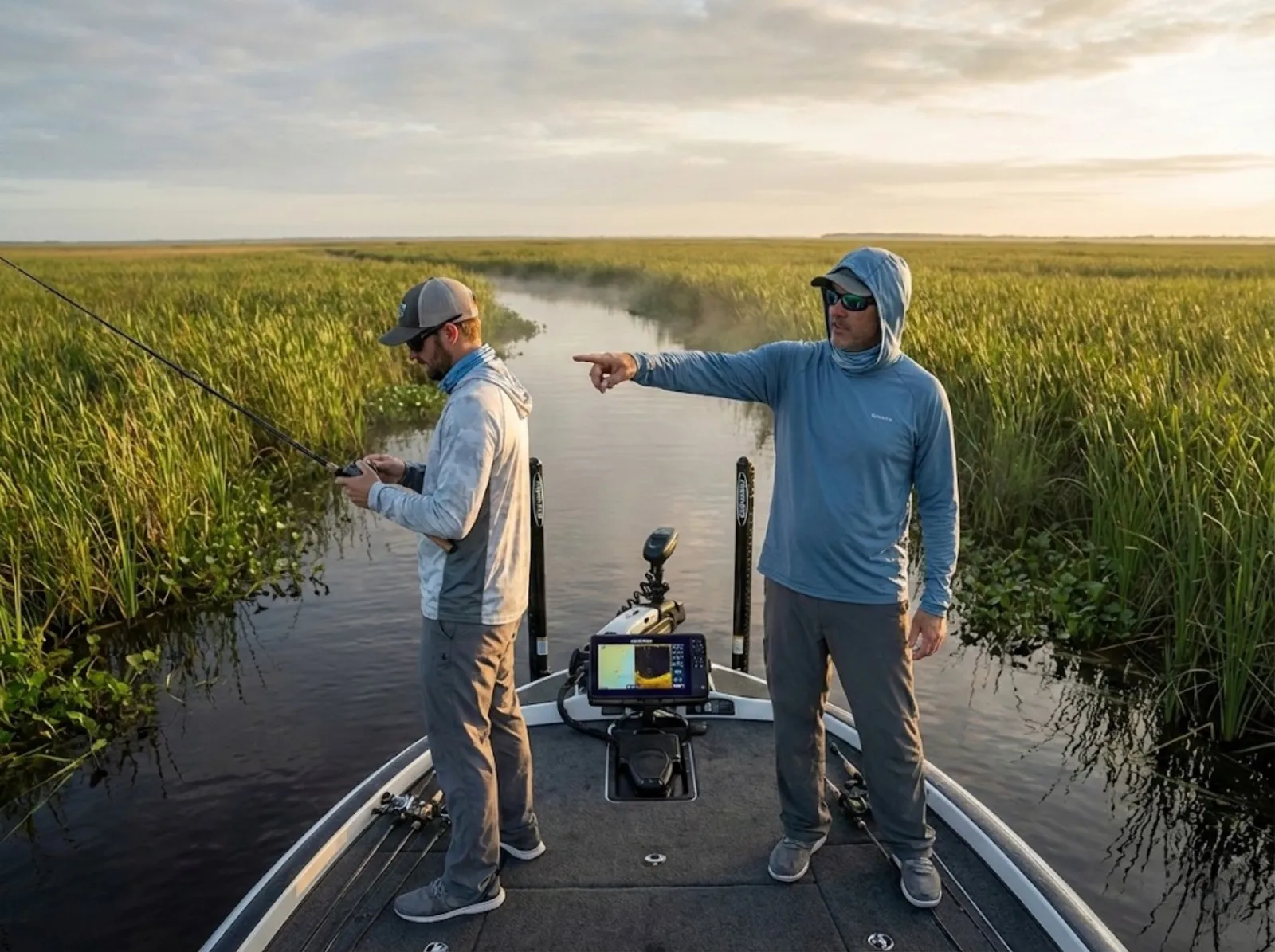
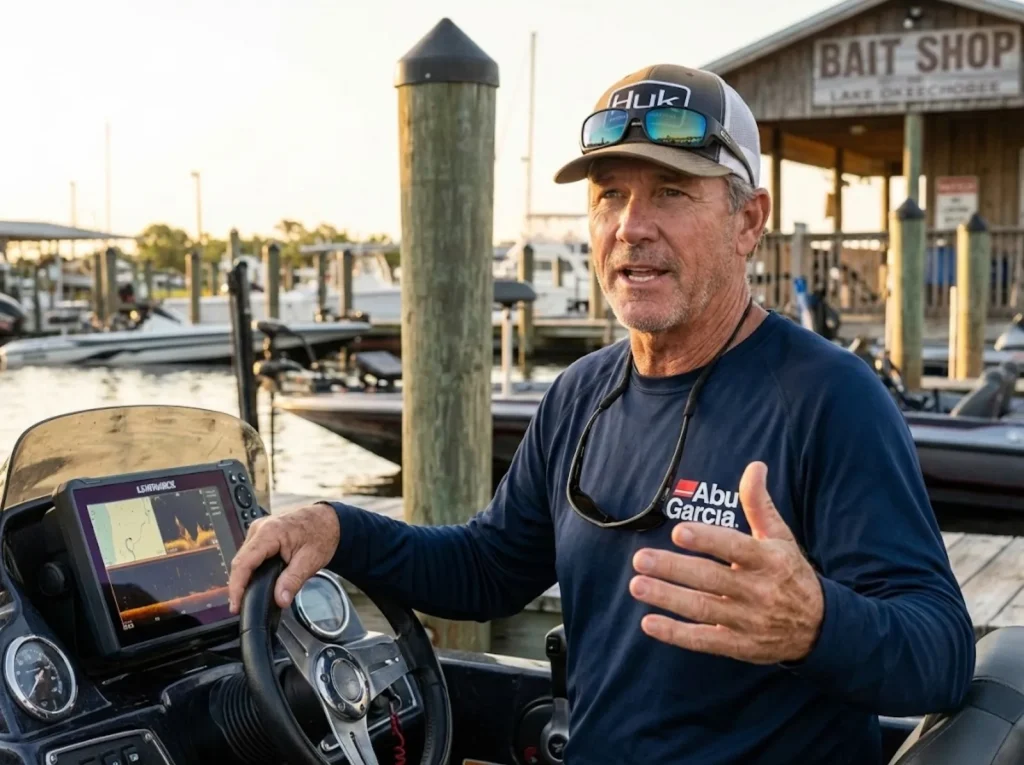
This is the decision most first-timers don’t even know they’re making. An instructional guide like Scott Martin Guide Services focuses on tournament tactics—pattern fishing, electronics mastery, flipping and pitching technique. You’ll catch fewer fish, but you’ll understand why they’re where they are.
An action guide like Shellen Guide Service or Captain Mike Carter prioritizes high catch volume, typically using live bait fishing with wild golden shiners. Families and beginners thrive on these trips because the bites are frequent, visual, and explosive.
The question to ask before booking: “What percentage of your trips use shiners versus artificials?” The answer tells you everything about that captain’s philosophy. If you’re looking to master the flipping and pitching fundamentals, an instructional guide is where you start.
The 5-Point Guide Evaluation Checklist
Every reputable Lake Okeechobee fishing guide carries a USCG license and insurance—that’s the non-negotiable baseline. Beyond that, look at equipment quality. Ask about the boat model (Sterling, Ranger, Nitro), the electronics on the console (Lowrance, specifically), and what rod brands they carry. Premium gear signals a serious operation.
Get the cancellation policy in writing. Most guides reschedule for dangerous conditions, but policies vary on wind-only days. The best captains will switch launch points between Clewiston, Belle Glade, and Okeechobee City based on that morning’s conditions.
One thing worth knowing: a guide who offers a “no-fish, no-pay” guarantee isn’t always your best option. That guarantee often means shiner-only trips designed for quantity. If you want instruction and experience, the guarantee can actually work against you.
The Service Models—Resorts, Indies, and Fleet Operations
Roland Martin Marina runs $550 for a full day—the legacy option with full resort amenities, dock access, and a large fleet. Scott Martin charges $475+ and focuses on tournament preparation and hands-on instruction, including his signature “Bass Classes.” Captain Nate Shellen at Shellen Guide Service operates independently at roughly $400 per full day, carrying the #1 Tripadvisor ranking and multi-generational local knowledge. Bass Online fills the fleet model at $475–$550, offering high availability and easy online booking across multiple Florida lakes.
The Hidden Costs Nobody Advertises
Live Shiners—The Most Expensive Bait Decision You’ll Make
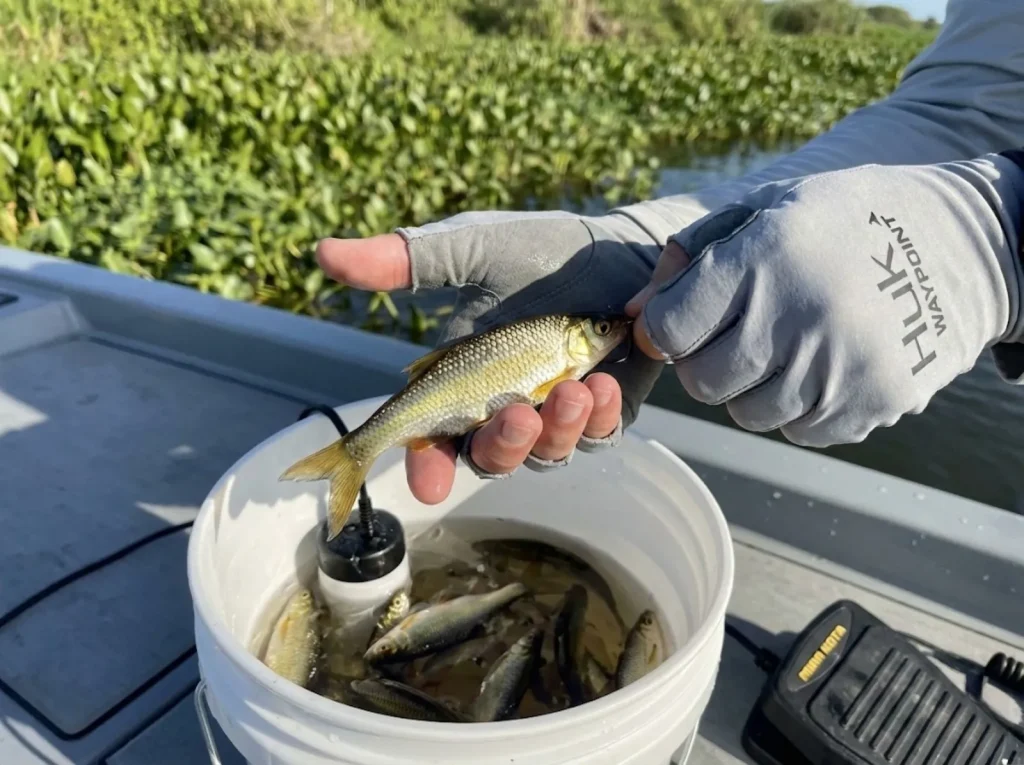
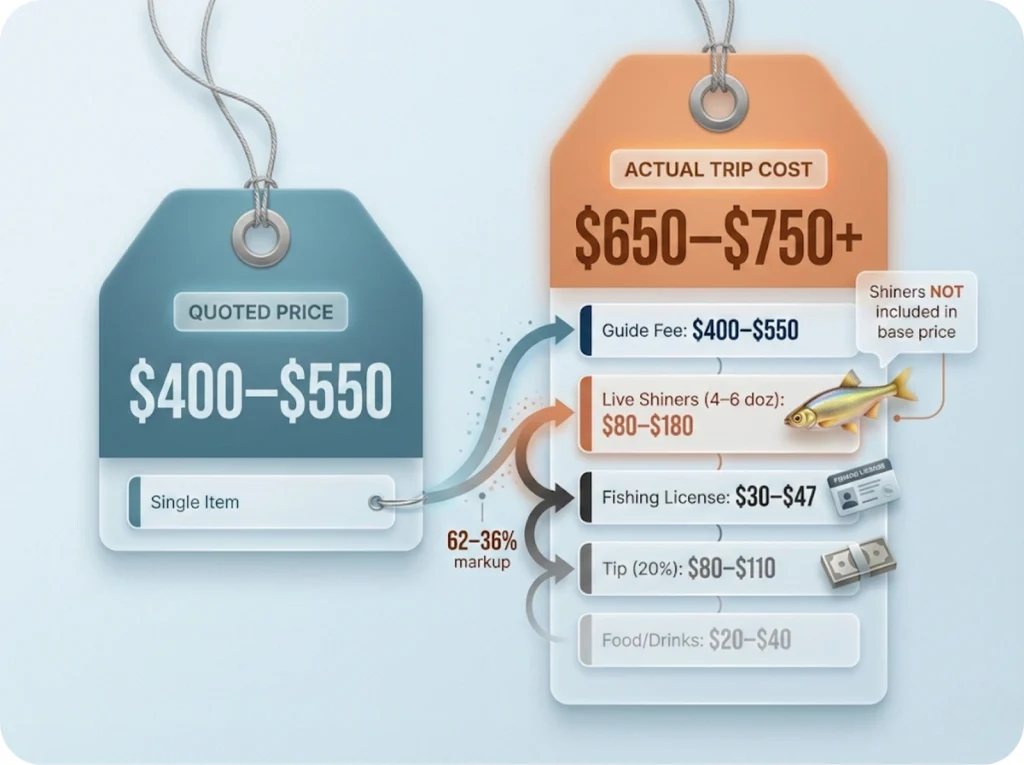
Here’s the number nobody puts on the booking page: wild golden shiners cost $20–$30 per dozen at the marina. A full day of fishing for two anglers burns through 4 to 6 dozen shiners. That’s an add-on of $80 to $180 on top of the quoted trip rate.
Shiners are rarely included in the base price, and this catches first-timers every single time. But here’s the trade-off that makes it worth considering: a successful shiner trip can produce 25–40 bass in just 4 hours, with frequent catches in the 6–8 lb range. Artificials teach you the lake. Shiners show you what the lake can produce.
Getting the most from live bait means understanding proper hook placement and rigging techniques before you step on the boat. Guides judge a client’s experience by how they handle the bait—tail-hooking a shiner so it swims away from the boat into the reeds where bass sit in ambush.
Licensing, Tipping, and the Other Line Items
Every angler aged 16–65 needs a valid Florida freshwater fishing license, even on a guided charter. The 3-day non-resident option costs $17.00 and is available through the GoOutdoorsFlorida app or by calling 888-FISH-FLORIDA. If you’re unfamiliar with marine protected area regulations and fishing rules, review them before your trip to avoid surprises at the dock.
Tipping runs 15–20% of the trip price. For a $450 full-day trip, budget $70–$100 in cash. The owner-operator tipping question comes up constantly on forums, and the consensus is clear: yes, always tip when the service is professional. If the captain went above and beyond—staying out extra hours, offering hands-on instruction, navigating a difficult weather window—25% is appropriate.
Pro tip: Tipping should reflect the guide’s effort, instruction, and safety decisions—not the fish count. Cold fronts, wind shifts, and water level drops are biological variables. Your guide didn’t cause them.
Water Levels, Wind, and the Biology That Decides Your Trip
Reading the NGVD—The Number Your Guide Checks Before Sunrise
The U.S. Army Corps of Engineers manages Lake Okeechobee water levels using a regulation schedule called LORS. Normal fluctuation runs between 12 and 16 feet NGVD throughout the year. That number sounds abstract until you learn what it controls.
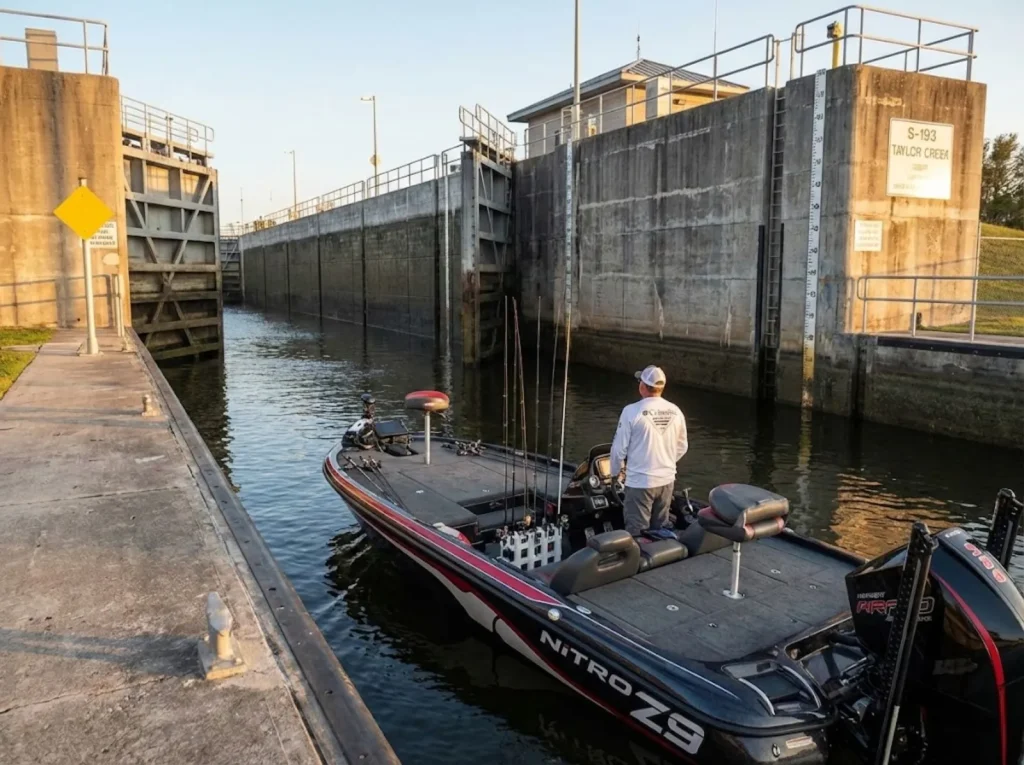
Below 12.0 feet, North Shore boat locks start closing. S-135 at J&S Fish Camp, G-36 at Henry Creek, and S-127 at Buckhead Ridge all shut down for safety. If levels drop to 11.0 feet, S-193 at Taylor Creek closes entirely—meaning access from Okeechobee City is effectively gone. The Lake Okeechobee ecosystem health report (SFWMD/FGCU) documents how these cycles affect everything from SAV recovery to bass recruitment patterns.
Low water is a double-edged sword. It concentrates fish into the rim canal and deeper cuts—a “honey barrel” effect where big catches are possible—but getting there without grounding the vessel requires a guide who reads the bottom by sight, not just by GPS.
Wind Direction—The Variable That Rewrites the Day
On a lake averaging 9–12 feet deep, wind physically moves water columns and resuspends Legacy Mud from the central bottom. Strong North winds push cold, turbid water into the southern spawning flats—exactly where the biggest bass bed during peak spawning season.
Guides read wind forecasts 24 hours ahead and pick zones on the leeward side where vegetative mats filter out turbidity. American Coots—the small black waterbirds you’ll see rafting in clusters—are a guide’s favorite biological signal. Where coots gather, healthy submerged grass grows below, and where grass grows, bass hold.
The Spawning Window—When December Through March Changes Everything
The spawn fires when water temps hit the 65–72°F range, typically December through March. Female bass move to the shallowest reaches of the marsh to bed on hard-bottom stove pipes and buggy whips. Full and new moon cycles in January and February trigger the largest waves of spawning fish.
As Elite Pro John Cox puts it: “During the heart of the spawn, when water temps are in that 65- to 72-degree range, it’s all day long.” This is the window that books guides out 2–3 months in advance. Understanding how water turbidity and clarity affect lure visibility helps you work with your guide to pick the right colors and presentations for the conditions on any given morning.
What You’ll Actually Do on the Water—Techniques and Gear
The Shiner Game—Live Bait Fishing Done Professionally
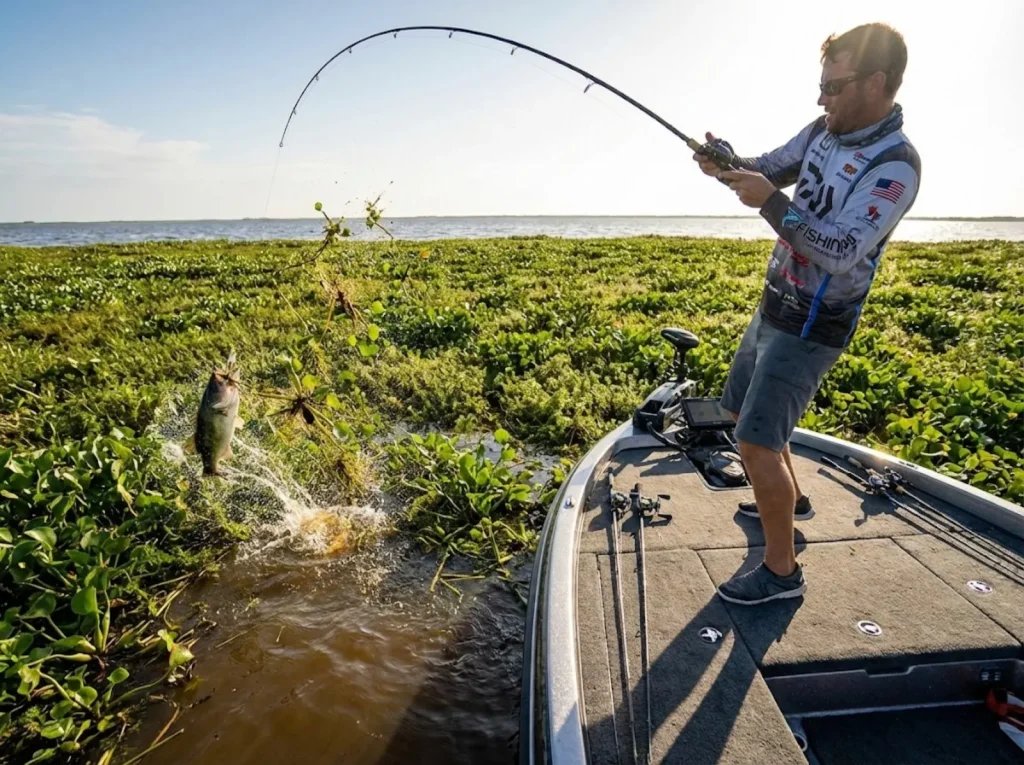
Live bait fishing on the Big O is not passive. Guides use popping corks—large floats that make a sharp “glunk” when pulled—to mimic surface feeding and draw bass toward the shiner. The bait is tail-hooked, forcing it to swim away from the boat and deeper into the heavy vegetation where bass wait.
The hookset is counterintuitive and trips up every beginner. Wait for the cork to stay submerged or for the line to “travel” before reeling tight and snapping upward. Premature hooksets are the #1 mistake on shiner trips. When you get the timing right, a good day produces 25–40 bass in 4 hours, with frequent 6–8 pounders rolling through the grass.
Heavy Cover Artificials—Punching and the Sasuteki Rig
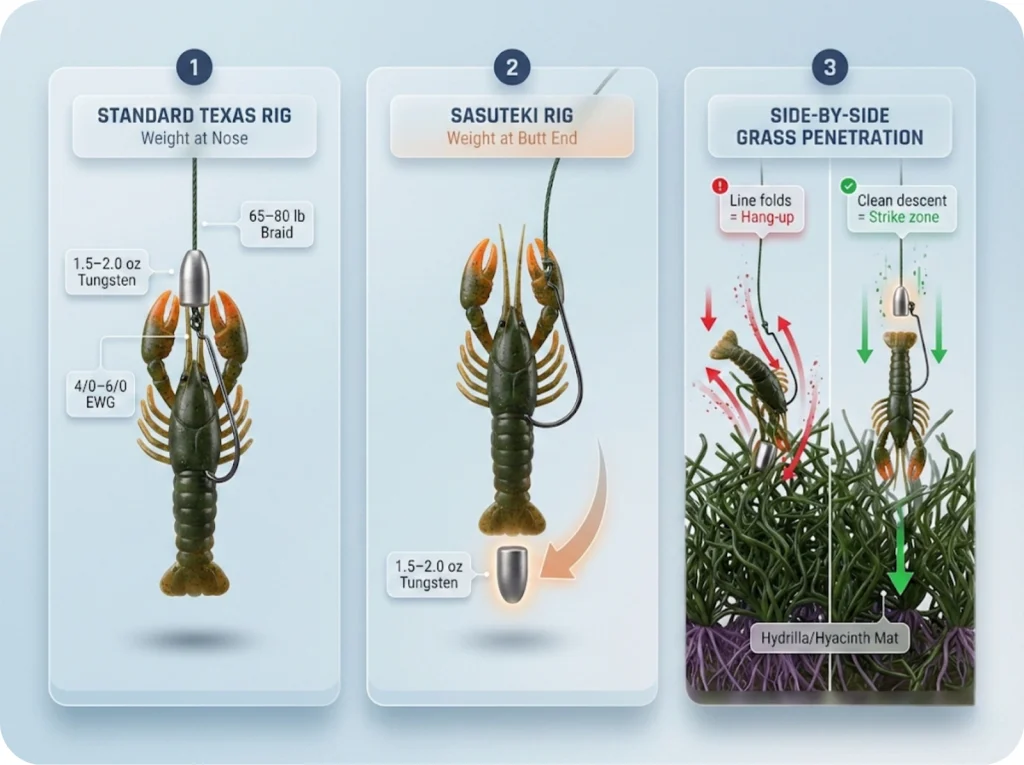
Punching is the signature Okeechobee technique. You’re using 1.5–2.0 oz tungsten weights to force soft-plastic creature baits through thick surface mats of hyacinth and hydrilla. This is heavyweight bass fishing—standard medium-light spinning gear won’t survive the first hookset against a trophy buried in a grass mat.
The required setup: 7’6″–7’11” heavy-action “flip sticks” (Fitzgerald or similar), high-speed baitcasting reels at 8.1:1 ratio (Shimano, Abu Garcia), 65–80 lb braided line, and EWG or straight-shank flipping hooks in 4/0–6/0. If you need a refresher on how to rig soft plastics weedless before your trip, that’s time well spent.
The Sasuteki Rig is worth knowing about. It’s a “backward” Texas rig that places the weight at the butt end of a crawfish plastic instead of the nose. This prevents the line from folding over the lure during descent, letting it slip through dense grass where a standard Texas rig hangs up. Most experienced guides carry both artificial and shiner setups, letting conditions dictate which approach fires on any given day.
Pro tip: Ask your guide to let you try both shiners and artificials during a full-day trip. Most captains will split the morning and afternoon between the two approaches, and you’ll walk away understanding why certain conditions favor each method.
Regulations, Records, and Keeping Your Trip Legal
Species-Specific Bag and Size Limits (2025–2026 Season)
According to FWC Lake Okeechobee species forecast and regulations, the current limits are straightforward but lake-specific. Largemouth bass: 5 fish daily, no minimum length, but only 1 may be 22 inches or longer. Black crappie (locals call them specks): 25 fish daily, minimum 10 inches. Panfish including bluegill, shellcracker, and warmouth: 50 daily. Butterfly Peacock Bass: 2 daily, only 1 over 17 inches.
These numbers differ from statewide Florida rules, so check the FWC freshwater fishing regulations page annually before your trip.
The TrophyCatch Program—Why You Should Release That Giant
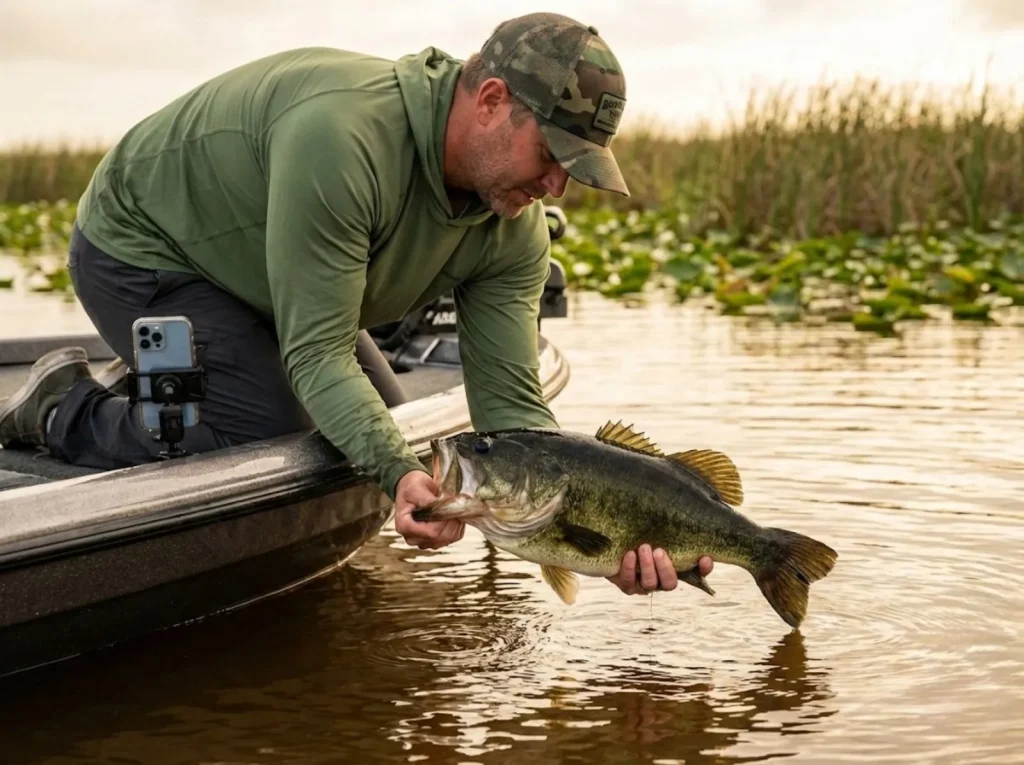
FWC’s TrophyCatch program rewards anglers who catch, document, and release bass over 8 lbs. Lake Okeechobee has produced 221 official TrophyCatch entries—193 “Lunker Club” fish (8+ lbs) and 28 “Trophy Club” specimens over 13 lbs. The uncertified lake record sits at 15 lbs 5 oz.
Participation is simple: photograph the fish on a certified scale, submit through the TrophyCatch app, and receive gear prizes plus conservation recognition. Knowing proper fish photo handling and quick release techniques makes the difference between a fish that swims off strong and one that floats belly-up an hour later. On a lake this productive, proper release isn’t just ethics—it’s protecting the fishery that makes the whole economy work.
Conclusion
Three things separate a good Lake Okeechobee fishing trip from a legendary one.
First, match the guide to your goals, not the price. The gap between an instructional captain and a shiner-trip specialist determines whether you’re learning the lake or just catching fish.
Second, read the water levels before you read the reviews. The NGVD number your guide checks at 4 a.m. matters more than any marketing photo on a website.
Third, budget for the real trip. When you add shiners, licensing, and a fair tip, a $450 charter becomes a $700 day. Know that going in, and you won’t flinch when the shiner bill hits the dock.
Check the USACE water level page the week before departure. Then call the guide—not the booking platform—and ask one question: “Based on current water, where are you launching?” The answer will tell you more about that captain than any review ever could.
FAQ
How much does a fishing guide cost on Lake Okeechobee?
Full-day (8-hour) rates range from $400 to $550 depending on the guide service. Add $80–$180 for live shiners, $17 for a 3-day non-resident license, and $70–$100 for the customary 15–20% tip.
What is the best time of year to fish Lake Okeechobee?
December through March during the spawning season, when water temperatures hit 65–72°F and trophy bass move into shallow vegetation to bed. January and February full and new moon phases produce the largest spawning waves.
Do I need a fishing license to fish with a guide in Florida?
Yes. Every angler aged 16–65 needs a valid Florida freshwater fishing license, even on a guided charter. The 3-day non-resident license costs $17.00 through the GoOutdoorsFlorida app or by calling 888-FISH-FLORIDA.
What kind of fish can you catch in Lake Okeechobee?
Florida Largemouth Bass is the primary target, with trophy potential exceeding 10 lbs. The lake also produces Black Crappie (specks), Bluegill, Shellcracker, Catfish, and Butterfly Peacock Bass throughout the year.
How big do bass get in Lake Okeechobee?
The uncertified lake record stands at 15 lbs 5 oz. FWC’s TrophyCatch program has recorded 221 entries from the lake, including 28 bass over 13 lbs. Catches in the 6–8 lb range are common during peak season with experienced fishing guides.
Risk Disclaimer: Fishing, boating, and all related outdoor activities involve inherent risks that
can lead to injury. The information provided on Master Fishing Mag is for educational and informational purposes
only. While we strive for accuracy, the information, techniques, and advice on gear and safety are not a substitute
for your own best judgment, local knowledge, and adherence to official regulations. Fishing regulations, including
seasons, size limits, and species restrictions, change frequently and vary by location. Always consult the latest
official regulations from your local fish and wildlife agency before heading out. Proper handling of hooks, knives,
and other sharp equipment is essential for safety. Furthermore, be aware of local fish consumption advisories. By
using this website, you agree that you are solely responsible for your own safety and for complying with all
applicable laws. Any reliance you place on our content is strictly at your own risk. Master Fishing Mag and its
authors will not be held liable for any injury, damage, or loss sustained in connection with the use of the
information herein.
Affiliate Disclosure: We are a participant in the Amazon Services LLC Associates Program, an
affiliate advertising program designed to provide a means for us to earn advertising fees by advertising and linking
to Amazon.com. As an Amazon Associate, we earn from qualifying purchases. We also participate in other affiliate
programs and may receive a commission on products purchased through our links, at no extra cost to you. Additional
terms are found in the terms of service.