
In this article
The laydown looked like a sunken spider web—branches jutting in every direction, a shadow underneath so dark you couldn’t see bottom. My jig swung forward, slipped through a gap no wider than my fist, and disappeared. One-Mississippi. The rod loaded. Four pounds of largemouth exploded out of the timber before I could blink.
After years of dissecting heavy cover on reservoirs across the Southeast, I can tell you this: flipping and pitching consistently produce my biggest bass. Not crankbaits. Not swimbaits. The fish buried deepest in the nastiest jungle eat a quiet jig dropped on their head. This guide walks you through the exact mechanics of each technique, the gear that handles brutal cover, and the situational reads that separate random casts from surgical strikes through heavy cover—step by step, from backyard drills to tournament-ready execution.
⚡ Quick Answer: Flipping uses a fixed line length with the reel engaged for ultra-short casts under 15 feet. Pitching uses the reel’s free-spool and a pendulum motion for targets 15–50 feet away. Both techniques deliver lures silently into heavy cover where bass hide. Master the mechanics, choose the right rod and line, and learn to read cover—and you’ll catch fish that 90% of anglers never reach.
Flipping vs Pitching vs Punching: What Each Technique Actually Does
Every beginner asks the same question: what’s the difference? It’s not subtle. These are three distinct mechanical systems, each built for a different type of cover and distance.
How Flipping Works (Fixed-Line Mechanics)
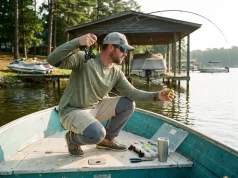
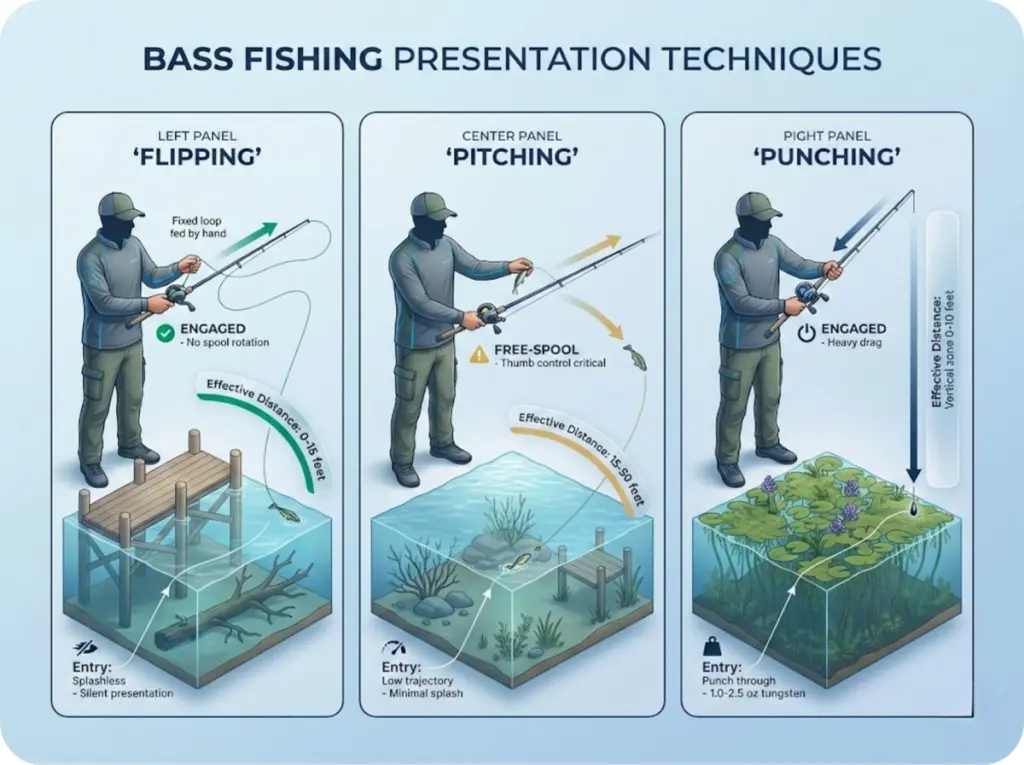
Flipping eliminates reel spool rotation entirely. Your reel stays engaged. The line length stays constant. You pull an arm’s length of line between the reel and the first guide with your non-dominant hand, swing the lure forward with a smooth rod lift, and feed the line back through the guides as the bait travels toward the target.
That’s it. No casting. No spool spinning. Dee Thomas pioneered this on the California Delta in the 1970s using 18-foot telescoping poles—what old-timers called “tule dipping.” Bassmaster regulations later capped rod lengths at 8 feet, which gave us the modern flipping stick.
The effective range tops out around 15 feet. Beyond that, accuracy tanks. The hallmark of a good flipper is the splashless entry—you lower your rod tip just before impact, absorbing momentum so the bait slips in without a sound.
Pro tip: Even a minor lure splash can spook a shallow bass. Treat every entry like you’re placing a jig on a sleeping fish’s nose. If you hear the lure hit water, you’re doing it wrong.
How Pitching Works (Pendulum Cast)
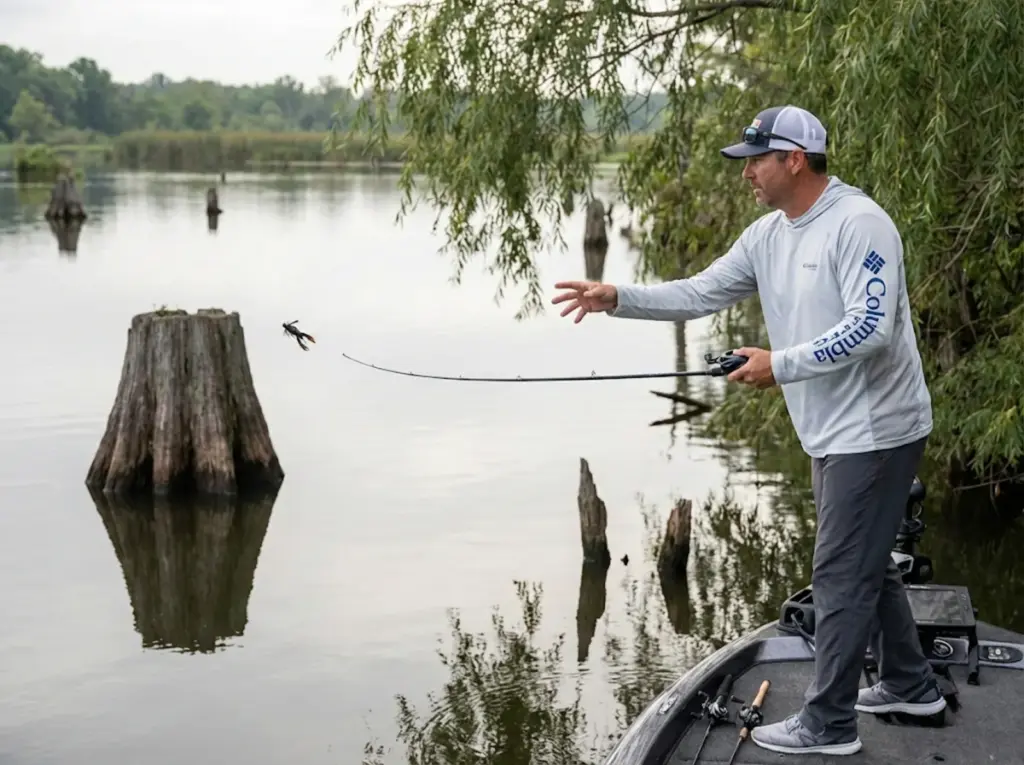
Pitching is your search-and-destroy tool for 15 to 50 feet. You hold the lure in your non-dominant hand, put the reel in free-spool, and release the bait as the rod tip flicks upward. The result is a low-trajectory pendulum cast that skims just above the surface.
Your thumb does the real work here. Thumb control on the spool is what separates clean presentations from bird’s nests. You feather the spool as the lure travels, regulating speed and ensuring a quiet landing. Mark Menendez takes it further—he turns the reel sideways during the pitch so the spool cover faces the water. This reduces level-wind friction and adds several feet to his range.
The low trajectory is the key advantage. Unlike an overhand cast that arcs high and slaps down, a well-executed pitch flies flat, minimizes wind interference, and enters the water on a whisper.
When Punching Changes the Game
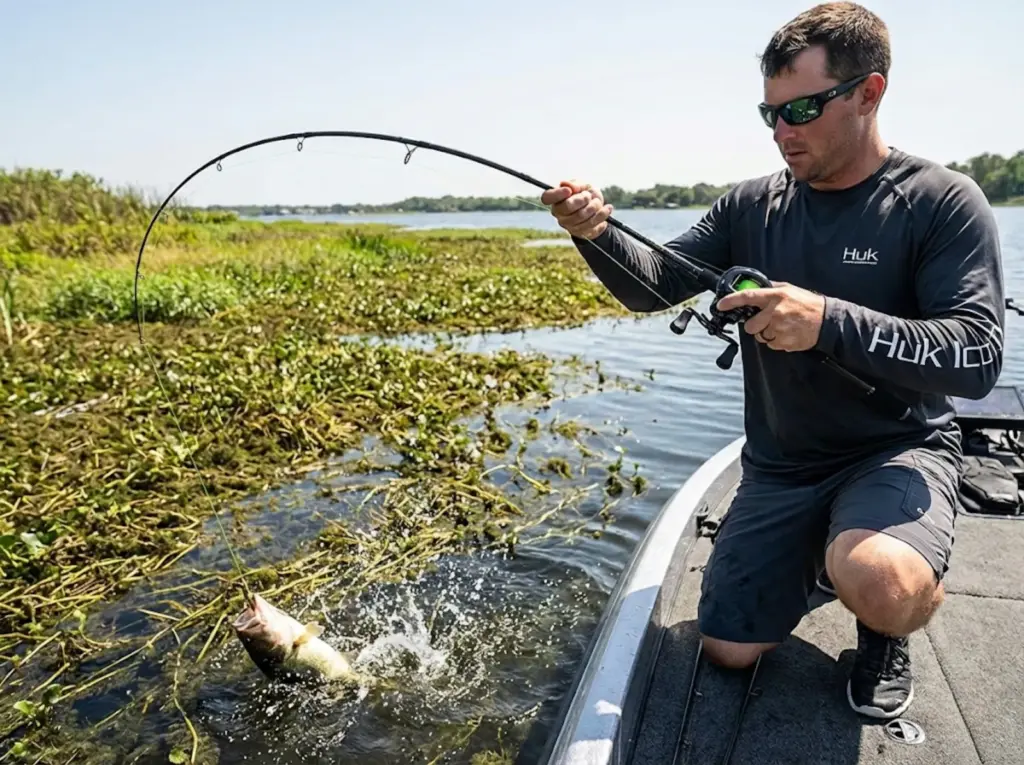
Punching is what happens when the cover is so thick that flipping and pitching can’t get through. Matted hydrilla, milfoil, and hyacinth create a floating canopy on the surface. Largemouth bass use submerged aquatic vegetation as cover to ambush prey and find shade—especially during the brutal summer months when these mats also trap cooler, oxygen-rich water.
To get through that canopy, you need mass. Professionals use tungsten weights from 1.0 to 2.5 ounces—far heavier than a standard flipping setup. The weight punches through the mat’s surface tension, and the lure drops vertically into the dark water below. Any horizontal movement hangs you in root systems.
Here’s a trick most anglers miss: once the lure is through, lift it back up until it ticks the underside of the mat—the “roof.” Shake it there. Bass suspended just inches below that canopy will crush it as a reaction strike. If you want the full breakdown on punching through matted vegetation, we’ve got a dedicated deep-dive on mat penetration.
The Gear That Survives Heavy Cover
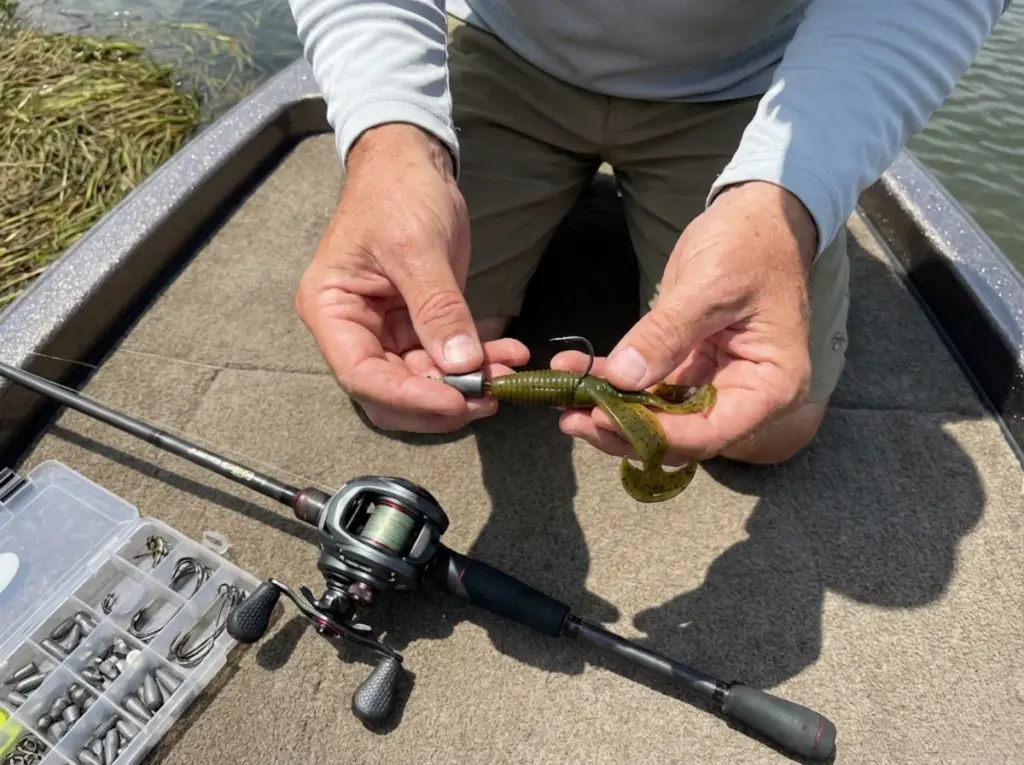
Heavy cover eats weak gear for breakfast. A guide I fished with in Florida once told me, “You don’t choose a flipping setup. The cover chooses it for you.” He was right. The rod, reel, and line configuration for close-quarters work is non-negotiable.
Rods: Length, Power, and the Action Debate
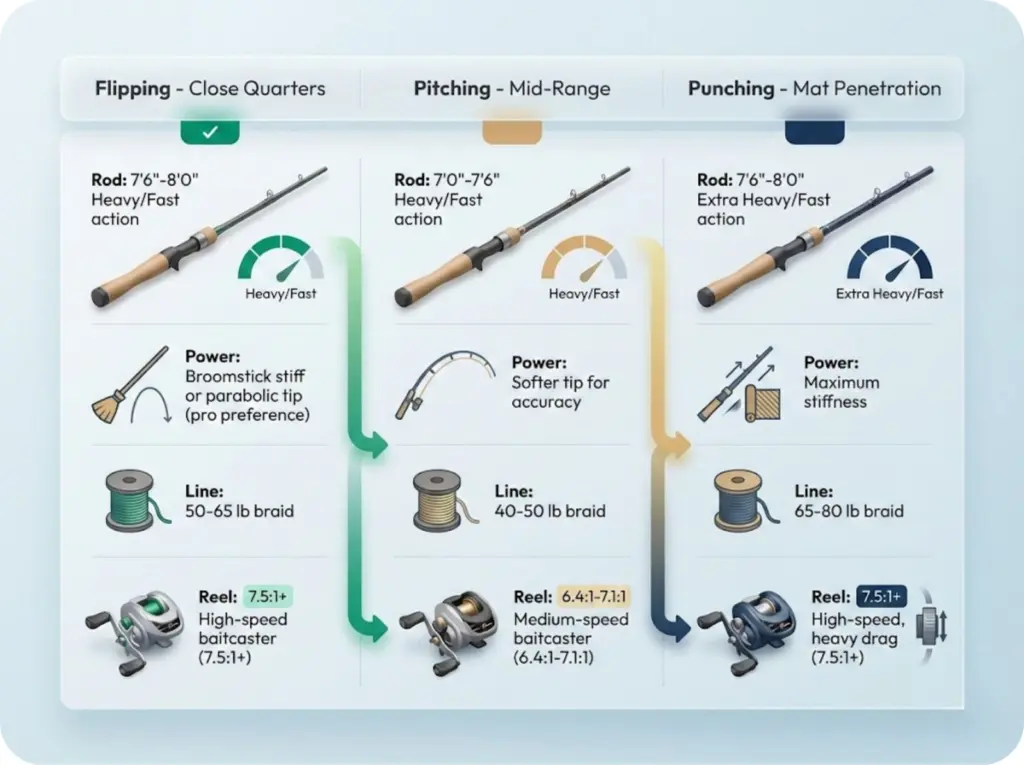
A flipping stick runs 7’6″ to 8’0″ in length. That extra reach isn’t about casting distance—it’s about leverage. A longer rod keeps your boat further from the fish and gives you a massive lever arm to horse bass straight up and out of timber.
Heavy power with fast action is baseline. But here’s where the experts disagree. Tommy Biffle prefers “broomstick” rods—so stiff they barely flex. Denny Brauer and Mark Menendez argue for a slightly softer, parabolic bend at the tip. Their logic: a softer tip improves pitching accuracy and prevents the hook from ripping free during a violent hookset. When you’re matching rod action and power to your technique, that tip flex decision changes how many fish make it to the boat.
For dedicated pitching, drop down to 7’0″ to 7’6″. You get better control on shorter casts without sacrificing hookset power.
Reels: Gear Ratios and Why Speed Matters
Your reel’s main job during flipping isn’t retrieval—it’s line recovery. When a bass hammers a jig on the fall and charges toward the boat, a slow reel means slack line and a missed hookset.
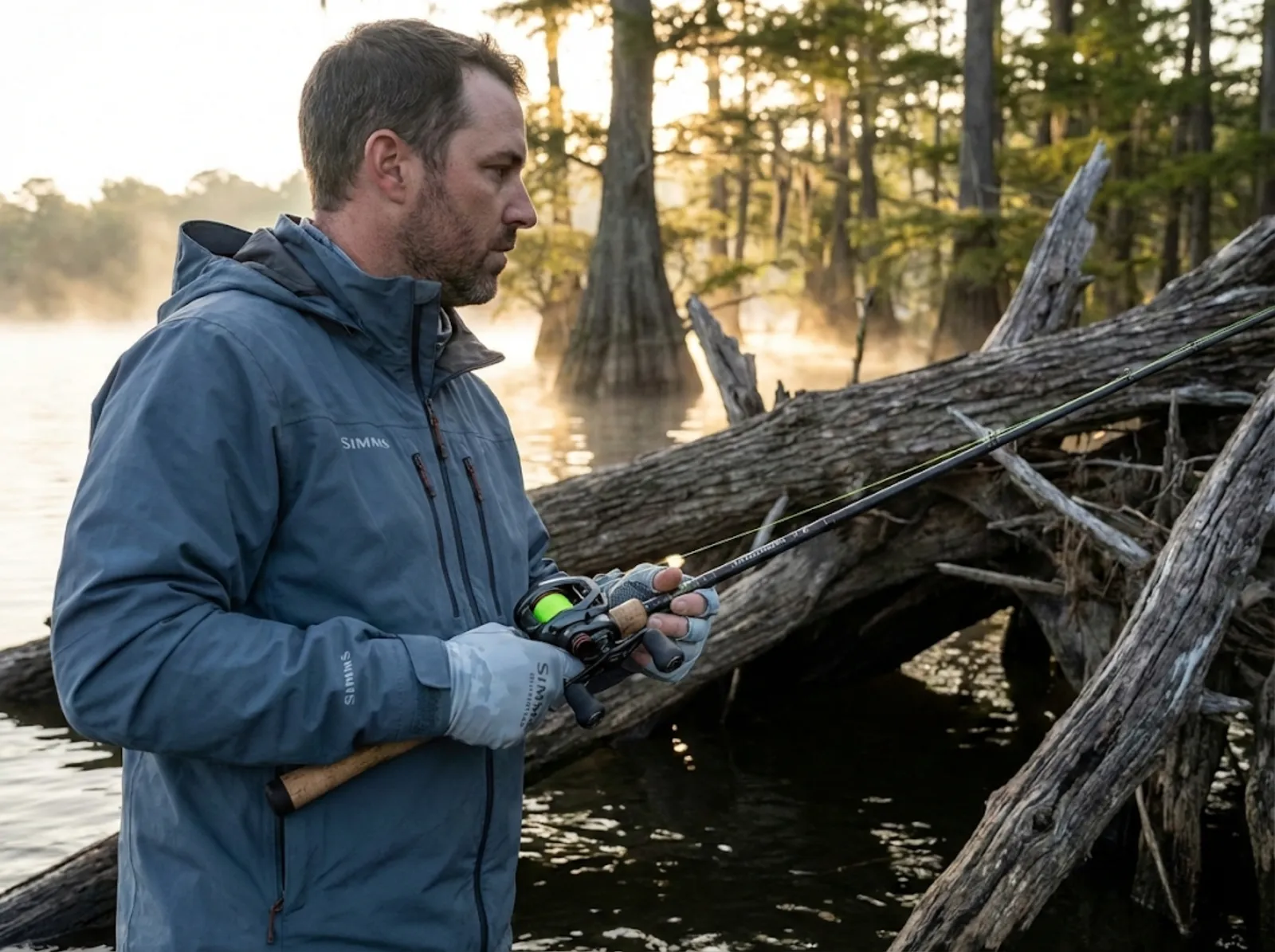
Standard flipping and pitching calls for a 7.2:1 gear ratio recovering about 30–32 inches per turn. For heavy cover and punching, step up to 8.3:1 at 34–37 inches per turn. Specialized reels like the Lew’s Pro Skip and Pitch feature shallow spools and tuned braking systems that minimize inertia—critical when your presentations are measured in feet, not yards.
Line Selection: Braid for Grass, Fluorocarbon for Wood
This one’s straightforward. Braided line (50–65lb test) is mandatory for vegetation. Zero stretch means instant hooksets, and braid’s texture literally saws through grass stems when a hooked fish pulls. You can horse a bass through a wall of hydrilla because the braided fishing line cuts the vegetation as you fight.
Fluorocarbon line (17–25lb test) wins around wood, docks, and rocks. Braid digs into soft wood and catches on metal dock pilings. Fluorocarbon’s slicker surface slides over obstacles without binding. It’s also harder for line-shy bass to spot in clear water because its refractive index sits closer to water itself.
For the heaviest punching situations—matted grass two feet thick—65 to 85lb braid with no leader handles the extreme abrasion. If you’re debating the line question more broadly, our breakdown on choosing between braid, fluorocarbon, and mono covers the engineering behind each polymer.
Terminal Tackle: Hooks, Weights, and the Snell Knot Advantage
This is where most anglers lose fish—not in the cast, but in the connection between line and hook.
Why Tungsten Beats Lead
Tungsten is denser than lead—meaning you get the same weight in a smaller package. A tungsten bullet weight slips through grass interstices more efficiently than a fat lead sinker. For standard flipping, 3/8 to 1/2 oz covers most situations. For punching, 1.5 to 2.5 oz does the heavy lifting.
Beyond size, tungsten transmits feel. You can read bottom composition—the difference between mud, rock, and shell—through a tungsten weight in ways lead deadens. That feedback tells you when you’ve found the hard-bottom transition where bass stage. For the complete rundown on weight types, check our guide on selecting the right fishing weight.
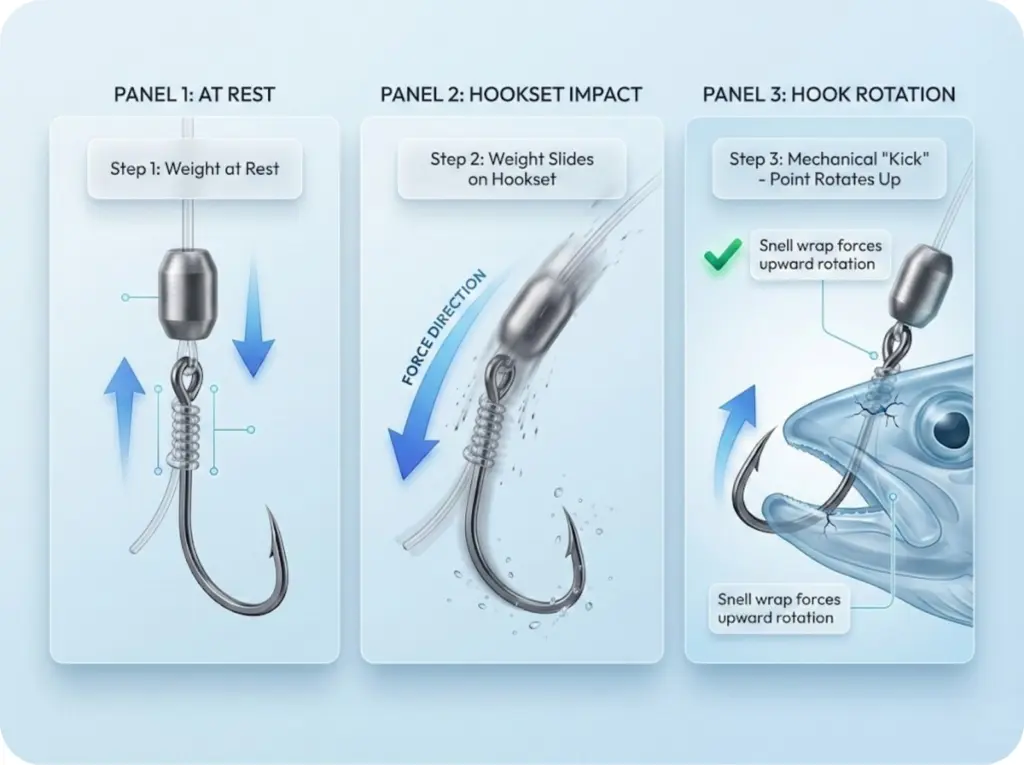
The Snell Knot’s Mechanical “Kick”
Here’s why your knot matters as much as your hook. A standard Palomar knot pulls a straight-shank hook straight backward on the hookset. The Snell knot wraps the line around the hook shank, and that changes everything.
When you set the hook, the tungsten weight slides down and impacts the hook eye. Because the line wraps the shank rather than threading through the eye, that impact forces the hook point to rotate—a mechanical “kick” that drives the point upward into the hard roof of the bass’s mouth. Experienced anglers report landing percentages jump dramatically in heavy cover when switching from Palomar to Snell. If you need a tutorial, our guide on tying the Snell knot correctly walks through it step by step.
Mike Iaconelli adds another edge: a slight 3-degree offset on the hook point. Even during a jarring hookset where the tungsten tries to blow the bait out of the fish’s mouth, that offset catches lip. Use wide-gap hooks with heavy-gauge Superline wire that resists bending under 65lb braid and an 8-foot lever arm.
Pro tip: Pair a Snell knot with a bobber stop above the tungsten weight to keep it pegged tight to the hook. This prevents the weight from separating during the punch and keeps your presentation compact through the mat.
Reading Cover Like a Pro: Where to Place Every Cast
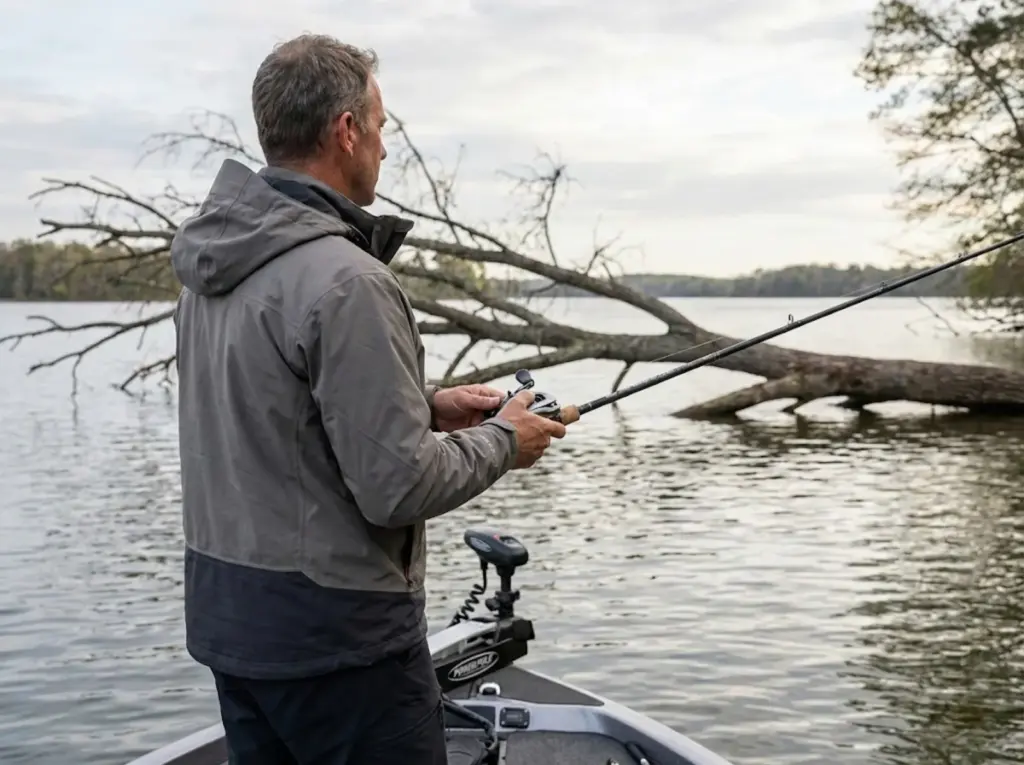
The difference between a guy who throws at a laydown tree and a guy who catches fish out of a laydown tree is simple: one reads the structure, the other doesn’t.
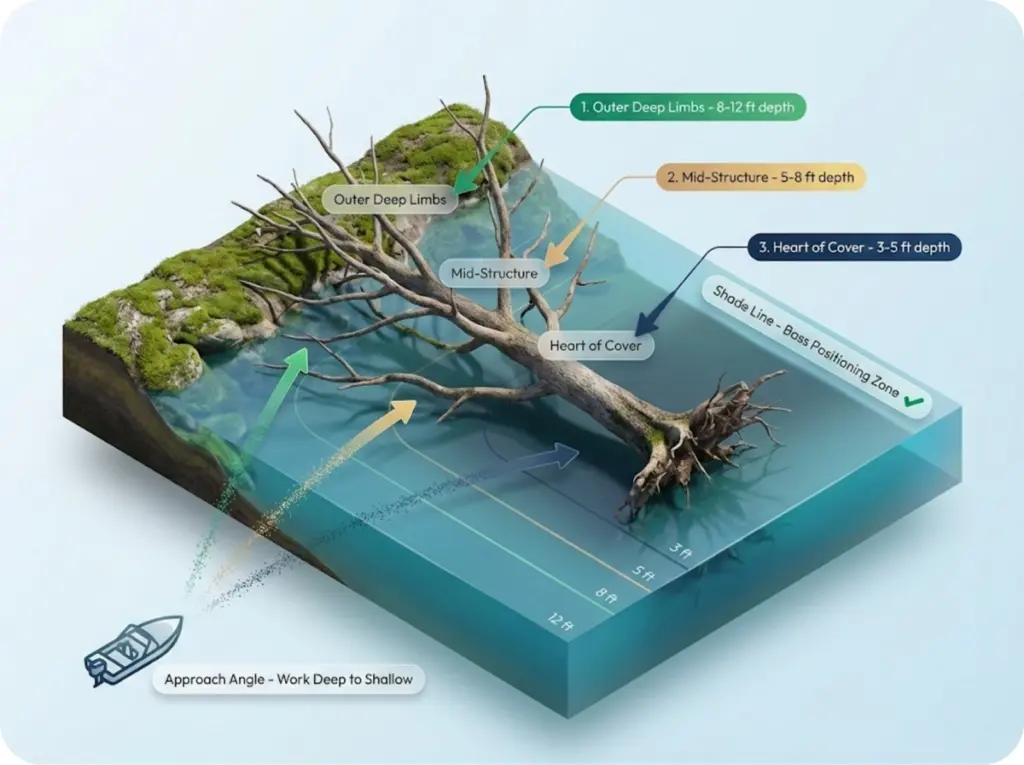
The Shade Positioning Principle
Bass are hardwired to seek shade. It’s not a preference—it’s biology. Even in stained water, a largemouth bass will orient to the shadow of a single branch. So the first question when you approach any piece of cover is: where’s the shade line?
Use the “Outside-In Strategy.” Your first pitch goes to the outer, deeper limbs. If you catch a fish on the outside, you can land it without blowing up the interior where bigger bass often sit. Work your way in progressively—outer limbs, mid-structure, heart of the cover.
An isolated laydown on a bare flat bank is gold. It attracts every bass moving through the area. A bank lined with hundreds of trees? That disperses the fish population and drops your odds dramatically. Target the oddballs—the one different piece of structure on an otherwise uniform bank.
Seasonal Staging and Water Temperature
Bass don’t sit in the same spots year-round. Where they position in cover rotates with water temperature.
During the pre-spawn (55–60°F), bass stage on the outer edges of cover. Slow your fall rate and try shaking a jig in place. As water hits spawn temperatures (60–70°F), they tuck into shallow isolated pockets—pinpoint flipping with maximum stealth wins here.
Summer above 80°F drives bass deep into the interior of matted vegetation where oxygen and shade converge. This is punching territory—1.5 to 2.5 oz tungsten weights to break through. In fall (65–55°F), bass transition toward creek channels, and reaction pitching with spinnerbaits or vibrating jigs becomes the play.
Wind-blown vegetation creates localized oxygen hot spots where lethargic summer bass suddenly become active. Pay attention to which side of the grass mat the wind pushes against—that’s where you want your jig.
Boat Positioning and Stealth Tactics
How you position the boat matters as much as where you cast. Shallow-water anchors like Power Poles and Talons lock your boat silently—no trolling motor hum, no electromagnetic signatures that spook wary bass in skinny water. Our comparison of shallow water anchors and Spot-Lock breaks down the technology differences.
Think about approach angle relative to what the bass are eating. If the primary forage is crawfish, position your boat in deep water and pitch shallow—mimicking a craw moving downhill. If they’re chasing baitfish like shad, position shallow and pitch deep. Match the natural movement of the prey.
When the wind picks up, keep your rod tip nearly touching the water surface during the fall. This minimizes the line exposed to wind, preventing the bow that pulls your lure off target. For a full breakdown on controlling your boat in heavy wind, we cover everything from drift socks to GPS anchoring.
Pro tip: Don’t fan-cast cover. Read the shade line, identify the highest-probability strike zone, and make three or four precise pitches. If nothing bites, move. Efficiency beats volume every time.
The Step-by-Step Practice System
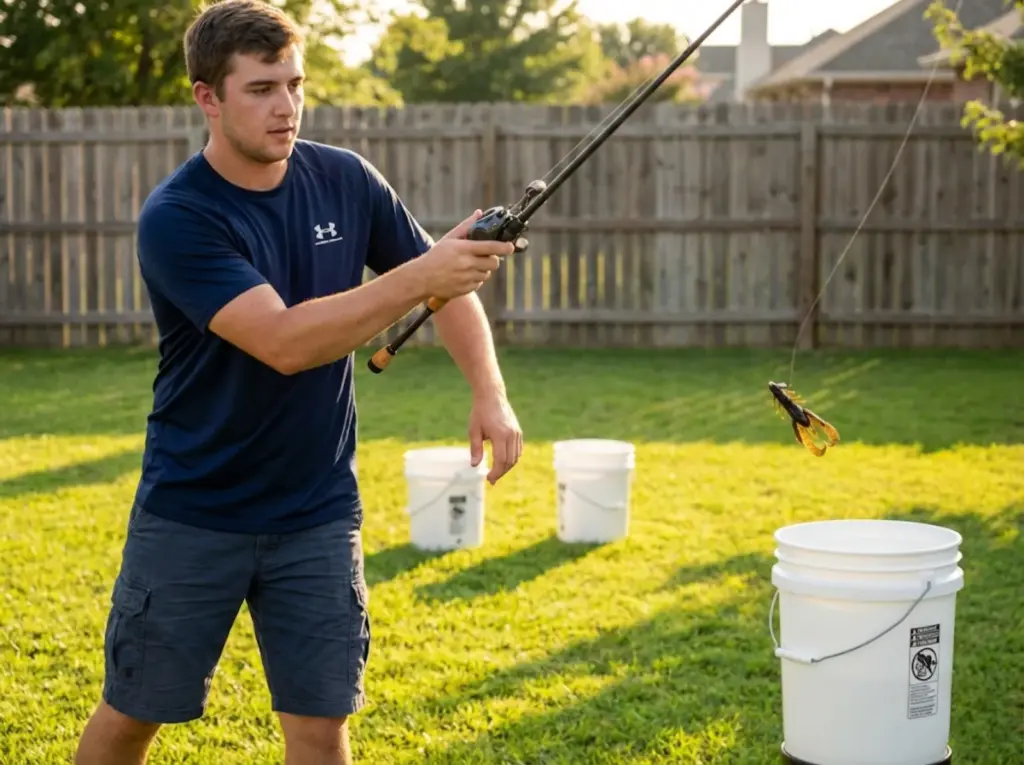
You can read about flipping all day. But until your hands do it on autopilot, it won’t produce fish when it counts. Here’s the progression that turns study into muscle memory.
Backyard Precision Drills
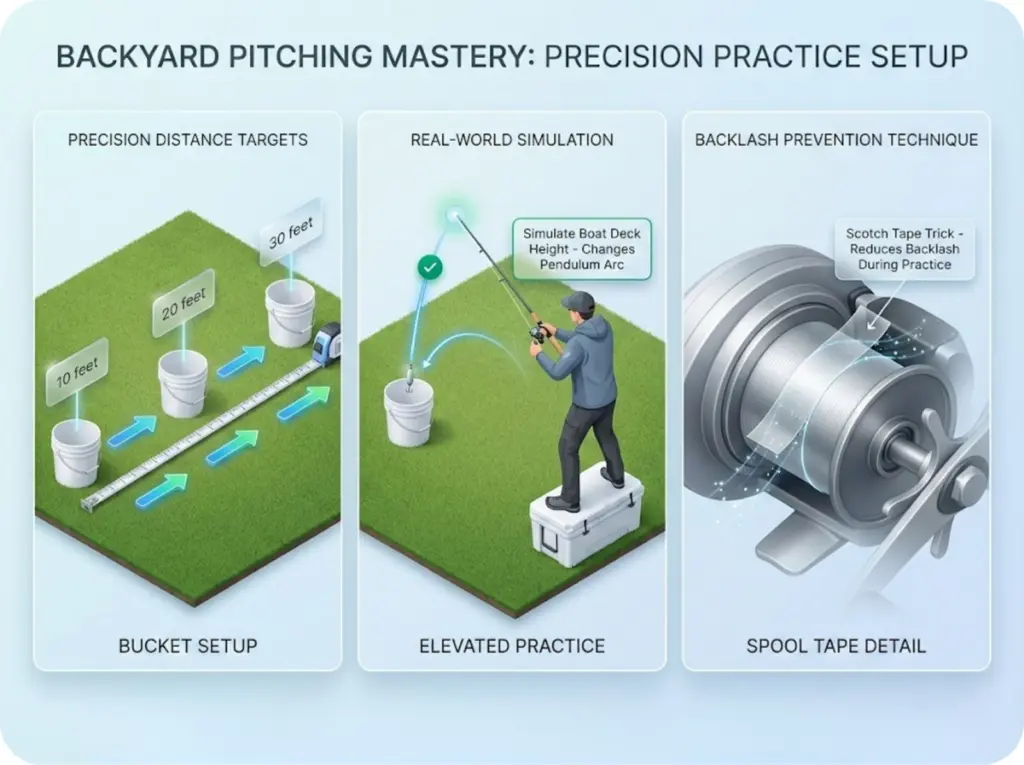
Set three buckets or bowls on your lawn at 10, 20, and 30 feet. Rig up your actual flipping setup—same rod, same reel, same weight you’ll fish. Stand on a cooler or a sturdy bench to simulate boat deck elevation. The pendulum arc changes with height, and if you practice from ground level, your first day on the boat will feel completely different.
Practice until every pitch drops silently into each bucket. If you hear contact, you’re not controlling the lure’s entry. Focus on lowering the rod tip at the last second to absorb momentum. This is the same principle as the splashless entry you’ll need on the water.
The Tape Trick for Beginners
Here’s a trick that saves hours of frustration. Make a 30-yard cast to get line off the reel, then stick a piece of scotch tape across the spool. Now practice your pitches. If you get a backlash—and you will—it can’t dig deep into the line. You peel the tape, the tangle is shallow, and you’re back to practice in seconds.
This single tip is the reason more beginners don’t give up on baitcasting reels before they ever get comfortable. Learn your baitcaster’s braking system inside out, then remove the tape once your thumb control is consistent.
Non-Dominant Hand Mastery
Mike Iaconelli stresses learning to flip and pitch with both hands. Why? Because cover falls on both sides of the boat. If you can only pitch right-handed, every target on your left side requires an awkward cross-body cast or a boat repositioning that costs time and spooks fish.
Start with simple backyard flips using your off-hand. It will feel terrible. That’s fine. After a week of ten-minute sessions, your non-dominant hand will start finding the bucket. Most bass anglers never develop this skill—which means it’s a genuine competitive edge in tournament scenarios where every second counts.
Advanced Situations: Night Fishing and the Pitch-Skip
Once flipping and pitching become second nature during the day, two advanced applications open up that most anglers never explore.
Flipping After Dark
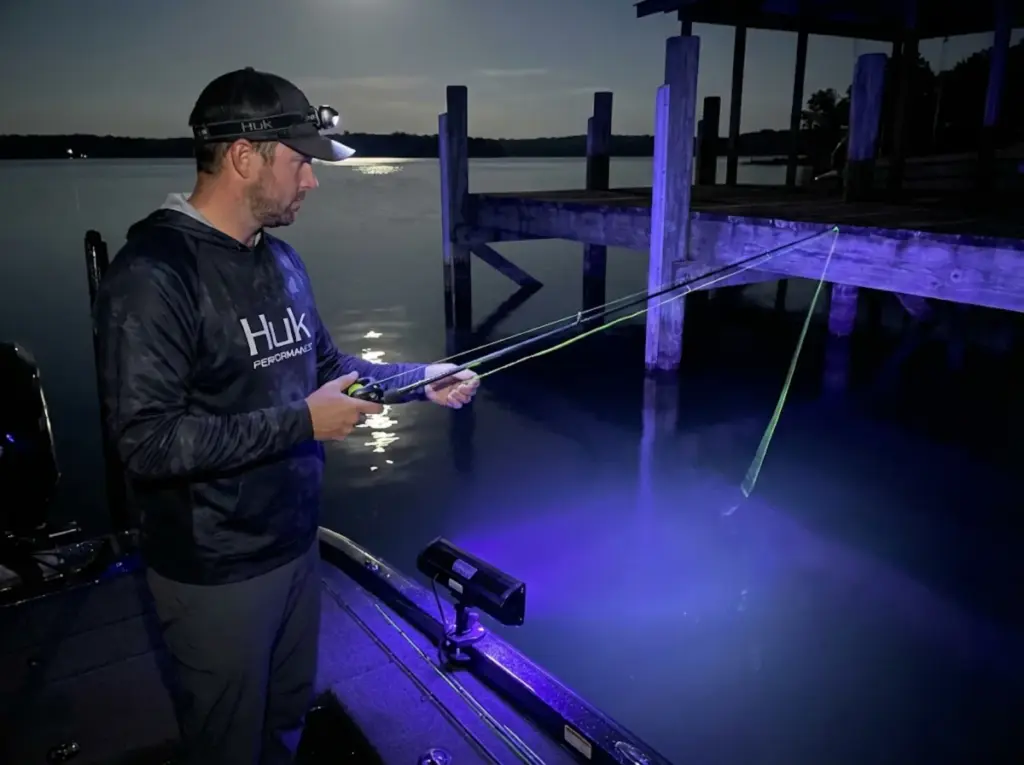
Clear-water lakes produce an exceptional pitching bite after dark, when bass push into shallow cover to feed without the pressure of boat traffic and sunlight. The challenge is obvious: you can’t see your line.
The solution is the blacklight system. Mount a UV blacklight on the bow and spool high-visibility fluorescent line. Under ultraviolet light, that line glows bright enough to watch for the subtle twitch or jump that signals a strike on the fall—bites you’d never feel with just your hands on semi-slack line. If you want the complete lowdown, our night fishing tactics and low-light strategies guide covers everything from lure selection to safety.
At night, bass rely heavily on their lateral line to detect movement rather than sight. Bulk up your lure profiles—use creature baits with wide appendages and jigs with internal rattles. Cody Huff recommends oversized trailers and rattling jigs for stronger acoustic signatures that bass can track in zero visibility.
The Pitch-Skip (Dock Specialist’s Move)
The pitch-skip technique is Mike Iaconelli’s answer to low-clearance docks. Instead of a standard underhand pitch, you fire a sidearm pitch that skips the lure across the surface like a stone—bouncing it under dock walkways and pontoons where overhead clearance is inches, not feet.
This demands a compact lure profile. Flat jigs and flush-rigged creature baits skip cleanly. Bulky trailers with flapping appendages catch water and kill the skip. You also need minimal braking on the reel—the lure has to spin freely off the spool to maintain its skip speed. Practice on open water first. A backlash under a dock is painful in multiple ways. For the dedicated technique breakdown, see our guide on skipping lures under docks.
Pro tip: When pitch-skipping, use a slightly shorter rod—7’0″ gives better sidearm control than an 8-foot flipping stick. And lower your stance. The closer your release point is to the water, the flatter the skip trajectory.
Conclusion
Three things decide whether flipping and pitching fill your livewell or just burn your time. First, the techniques are mechanically distinct—flipping is fixed line for ultra-short work, pitching is a pendulum cast for mid-range, and punching breaks through the thickest canopy. Stop using them interchangeably. Second, your terminal tackle matters as much as your rod. The Snell knot’s mechanical kick and the right tungsten weight turn missed hooksets into solid connections. Third, reading where bass stage inside cover—shade lines, seasonal depth, the outside-in approach—beats making twice as many blind casts every single time.
Set up a bucket in your backyard tonight. Ten minutes of deliberate practice with a 3/8 oz jig, dropping that bait silently into the target, will do more for your bass fishing than any rod or reel you can buy. The fish in the nastiest cover are waiting for someone patient enough to reach them.
FAQ
What is the difference between flipping and pitching in bass fishing?
Flipping uses a fixed line length with the reel engaged—you manually feed line through the guides for ultra-short presentations under 15 feet. Pitching puts the reel in free-spool and uses an underhand pendulum cast to cover targets from 15 to 50 feet with a quiet, low trajectory. Both deliver lures silently into heavy cover where bass hide.
What is the best rod length for flipping and pitching?
A 7’6 to 8’0 heavy-power fishing rod with fast action is standard for flipping. For pitching, 7’0 to 7’6 gives better control on shorter casts. Some anglers split the difference with a 7’6 all-rounder that handles both techniques.
Should I use braid or fluorocarbon for flipping heavy cover?
Use 50–65lb braided line for vegetation—it saws through grass stems and provides zero-stretch hooksets. Switch to 17–25lb fluorocarbon for wood, docks, and rocks where braid tends to dig in and snag on hard edges.
What is punching in bass fishing?
Punching is a heavy-duty adaptation of flipping that uses 1.0 to 2.5 oz tungsten weights to break through matted surface vegetation like hydrilla or milfoil. Bass stage under these mats for shade and dissolved oxygen, so punching reaches fish that standard flipping can’t touch.
How do I practice flipping and pitching at home?
Set buckets at 10, 20, and 30 feet in your backyard. Stand on a cooler to simulate boat deck height. Practice until the lure drops silently into each target. Use the scotch tape trick on the spool to prevent deep backlashes during the learning phase.
Risk Disclaimer: Fishing, boating, and all related outdoor activities involve inherent risks that
can lead to injury. The information provided on Master Fishing Mag is for educational and informational purposes
only. While we strive for accuracy, the information, techniques, and advice on gear and safety are not a substitute
for your own best judgment, local knowledge, and adherence to official regulations. Fishing regulations, including
seasons, size limits, and species restrictions, change frequently and vary by location. Always consult the latest
official regulations from your local fish and wildlife agency before heading out. Proper handling of hooks, knives,
and other sharp equipment is essential for safety. Furthermore, be aware of local fish consumption advisories. By
using this website, you agree that you are solely responsible for your own safety and for complying with all
applicable laws. Any reliance you place on our content is strictly at your own risk. Master Fishing Mag and its
authors will not be held liable for any injury, damage, or loss sustained in connection with the use of the
information herein.
Affiliate Disclosure: We are a participant in the Amazon Services LLC Associates Program, an
affiliate advertising program designed to provide a means for us to earn advertising fees by advertising and linking
to Amazon.com. As an Amazon Associate, we earn from qualifying purchases. We also participate in other affiliate
programs and may receive a commission on products purchased through our links, at no extra cost to you. Additional
terms are found in the terms of service.