
In this article
The 48-inch shadow showed up three feet behind my bucktail, tracking it through clear Wisconsin water like something locked on a heat signature. I watched it follow for what felt like a full minute. No rush. No aggression. Just cold, calculated assessment. Then it turned and vanished. No strike. No swirl. Just gone. That was somewhere around cast number four thousand.
After twenty years chasing muskellunge across the Great Lakes, the Chippewa River, and half a dozen flowages in between, I’ve learned one thing that separates anglers who land these trophy fish from those who spend their lives telling follow stories. Understanding why Esox masquinongy does what it does changes everything about how you fish for it.
This article maps every critical biological trait of the largest member of the Esocidae family directly to the tactics that exploit them. The jaw pores, the olfactory system, the coil-and-spring attack, the figure-8 response. Biology here isn’t background reading. It’s your playbook for turning the fish of 10,000 casts into the fish of far fewer.
⚡ Quick Answer: Muskellunge are solitary ambush predators with 6–9 sensory pores under each side of the jaw (versus 5 or fewer in northern pike), olfactory nares that detect amino acids in the water, and a unique coil-and-spring attack that favors slow-to-variable retrieves. Matching your lure selection and retrieve speed to these biological traits is what turns biology into bites.
Identifying Muskellunge vs. Northern Pike
The Jaw Pore Test That Settles Every Argument
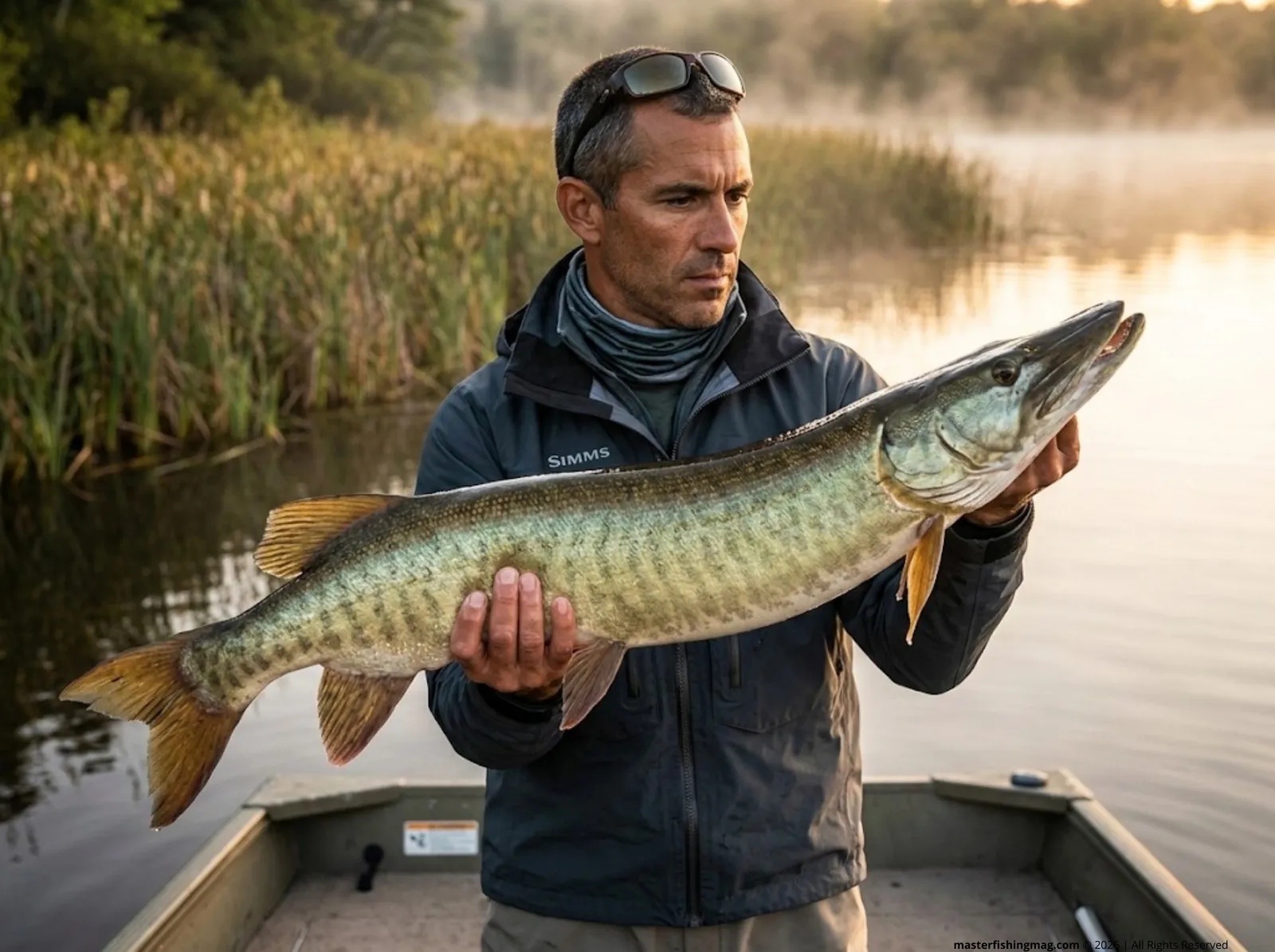
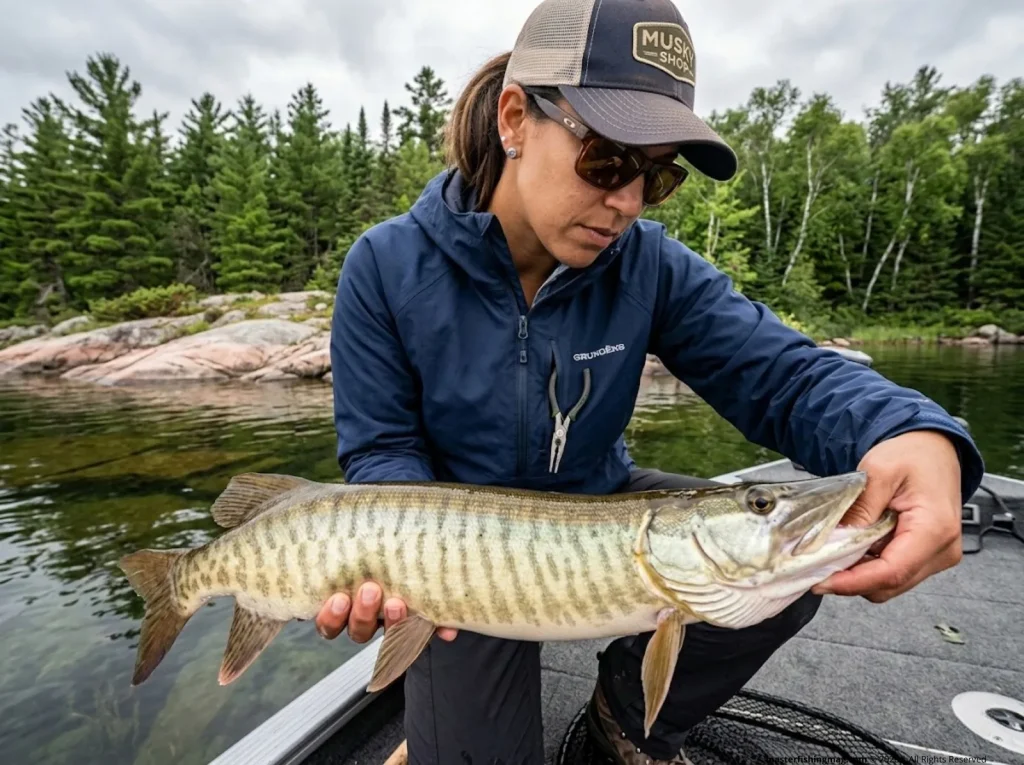
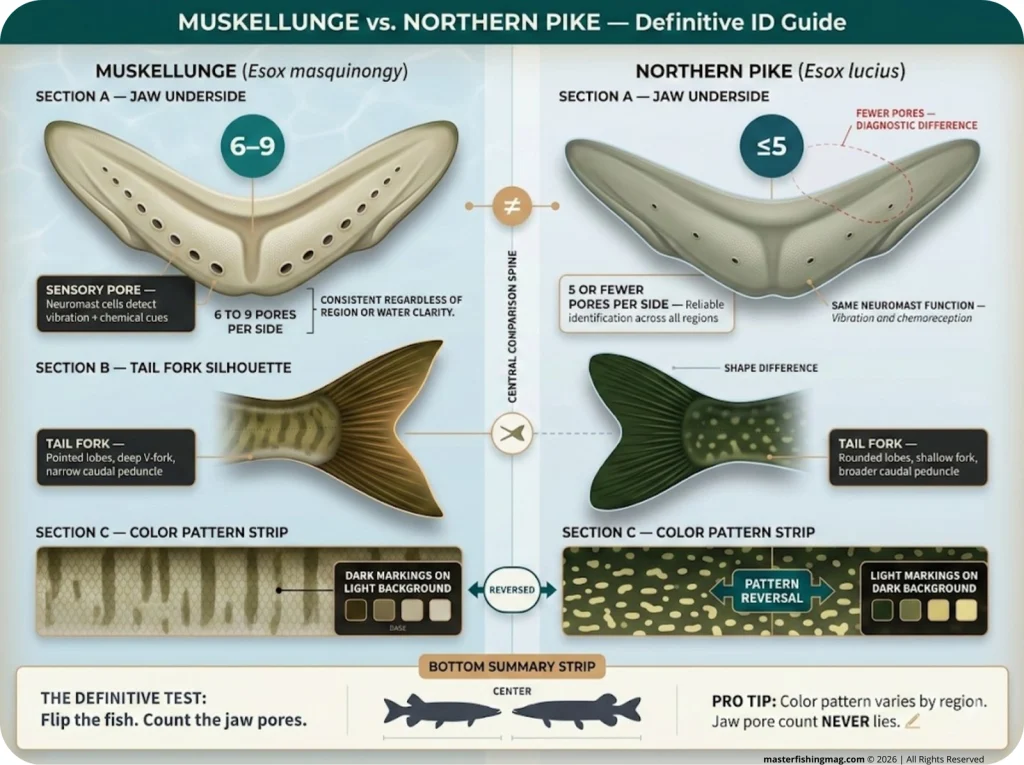
Forget the color debates. The single most reliable way to tell a muskellunge from a northern pike is flipping the fish over and counting the sensory pores on the underside of the jaw. Muskellunge carry six to nine pores on each side. Northern pike have five or fewer. That count doesn’t vary by region, by water clarity, or by the fish’s mood. It’s consistent.
What most anglers miss is that those pores aren’t cosmetic marks. They’re packed with neuromast cells that detect vibrations and chemical cues in the water column. According to the USGS species profile for Esox masquinongy, this pore count is the definitive morphological separator between the two species. Every other visual cue, including color pattern, is secondary.
Pro tip: Don’t rely on bars versus spots alone for identification. Some muskies in stained-water lakes show almost no visible markings at all. The jaw pore count never lies.
Color Patterns, Body Shape, and the Camouflage Confusion
The general rule works most of the time: muskellunge show dark vertical bars or spots on a lighter background, while pike display light markings on a darker body. Pattern reversal. But regional genetics throw curveballs. Three recognized camouflage patterns exist across the muskellunge range: barred, spotted, and clear (essentially unmarked). All the same species.
Body shape helps too. Muskellunge have a longer, more laterally compressed build with a flatter, wider snout than pike. The tail fork runs more pointed. But in the heat of the moment on the water, the jaw flip is faster and more reliable than any visual comparison.
Tiger Muskellunge — The Sterile Hybrid
Cross a female muskellunge with a male northern pike and you get a tiger muskellunge, a sterile hybrid with bold, irregular tiger-stripe barring more vivid than either parent. Because they can’t reproduce, fisheries managers stock them in waters where controlling populations matters, often smaller urban lakes where identifying tiger musky and other hybrids gets tricky for weekend anglers.
Tiger muskies grow faster than pure muskellunge in their first three years, making them popular in put-and-take fisheries management programs across several states.
Ambush Biology and the Coil-and-Spring Attack
How the Strike Actually Works
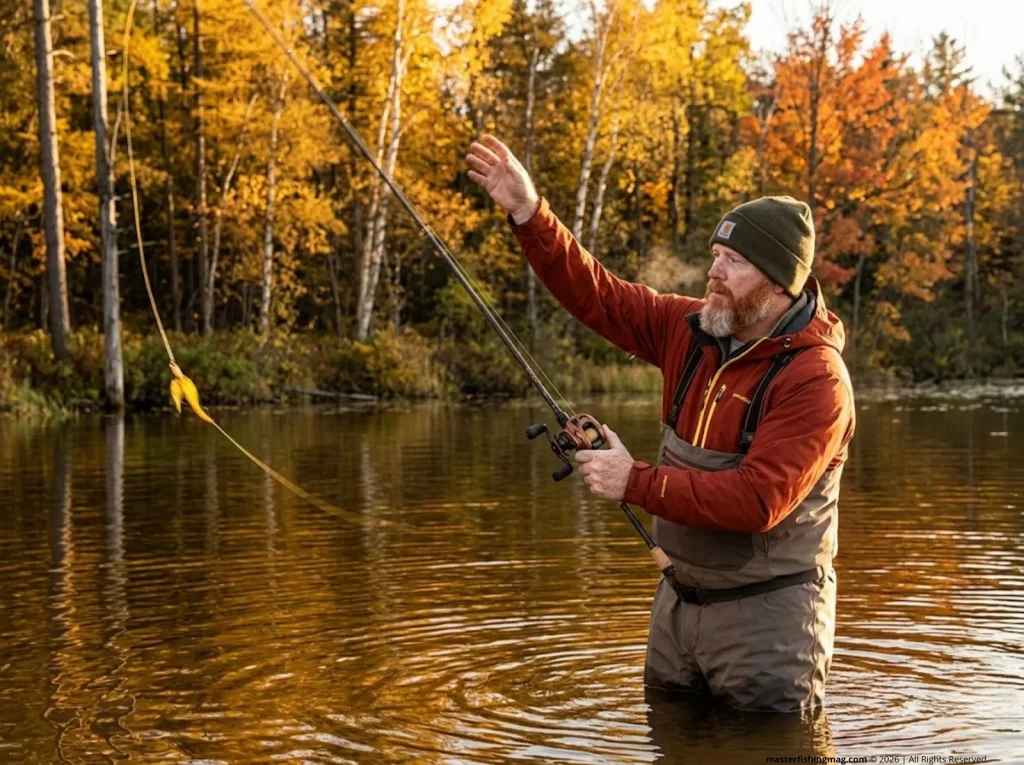
A muskellunge doesn’t chase down its prey the way a striped bass blitzes through baitfish schools. It’s a solitary hunter that waits near woody debris, rock structure, or aquatic vegetation, then executes a coil-and-spring attack. The body forms an S-curve, loads like a compressed spring, and fires in a single explosive burst.
Strike velocity can exceed ten body lengths per second. A 40-inch muskie covers thirty feet in under a second. The diet reflects that confidence: suckers, perch, cisco, and other forage fish up to two-thirds of the muskie’s own body length. According to the Wisconsin DNR muskellunge fact sheet, they can consume prey weighing up to twenty percent of their own body weight in a single feeding.
Why Slow Retrieves Outperform Fast Burns
Here’s where the biology directly dictates your tactics. That coil-and-spring attack requires the fish to be stationary or barely moving to load the S-curve. Fast retrieves force muskies into a pursuit they’re not built for. Variable speed with deliberate pauses gives the fish time to set up its striking position.
Water temperature matters here too. Below 50°F, the load-and-fire sequence slows down. Your retrieve should slow with it. A cold-blooded predatory fish runs on water temperature the way an engine runs on fuel. Cool the water, and everything downshifts.
Matching Lure Action to the Ambush Instinct
Bucktails succeed because the hair-skirt pulsation triggers the lateral line detection system that muskies use to assess prey at close range. The pulse mimics a struggling baitfish, which is a high-value signal for an ambush predator wired to exploit weakness.
Jerkbaits work for the same reason, from a different angle. The darting, erratic action simulates injured prey. Large-profile lures in the 10- to 12-inch range match the muskie’s preference for food up to two-thirds of its body length. Undersized presentations often get ignored entirely.
In stained water, prioritize vibration over color. Spinner-baits and rattling crank-baits exploit the lateral line more than visual patterns can.
Sensory Biology That Dictates Your Lure Choice
Jaw Pores and Vibration Detection in Low Visibility
Those jaw pores we counted earlier for identification? They’re also your best tactical clue for low-visibility fishing. Each pore houses neuromast cells that detect pressure waves and water displacement. When water clarity drops below two feet of visibility, those pores become the muskie’s primary prey detection system. Vision takes the back seat.
Research published in the Journal of Experimental Biology confirmed that the lateral line system plays a “critical role in the final capture of prey at the end of the strike.” That last six inches between assessment and attack is guided by vibration, not eyesight. In practice, this means switching to Colorado-blade spinner-baits, rattling plugs, and big musky baits with strong vibration profiles when the water turns dark.
Olfactory Nares and the Scent Trail Advantage
This is where most fishing content stops at surface level, and it’s the part that might matter most in tough conditions. Muskellunge possess olfactory nares capable of detecting specific amino acids and pheromone compounds in the water column. This isn’t a passive system. It’s an active hunting tool tied directly to pheromone detection and feeding triggers.
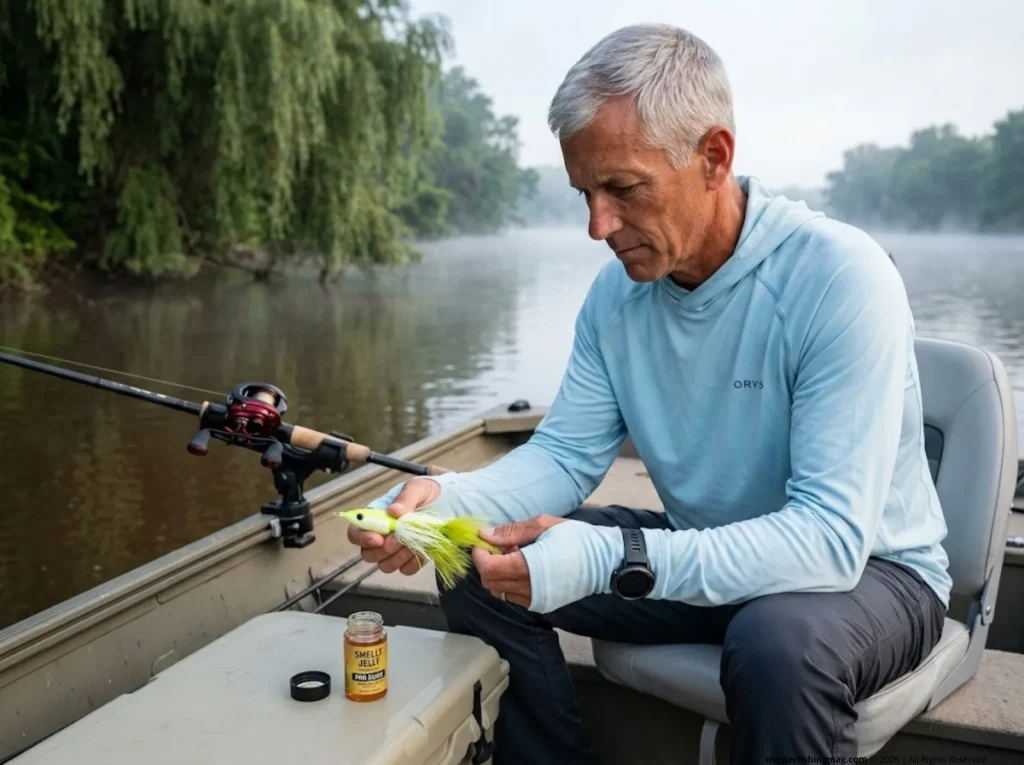
The practical application is straightforward: scented bucktails and soft plastic trailers with amino acid-based attractants outperform unscented versions in stained or turbid water. The difference isn’t marginal. Female muskie release pheromones during the spring spawn that attract males from significant distances, which explains why pre-spawn staging areas consistently produce concentrated groups of fish.
Pro tip: During fall turnover when visibility drops to inches, dip your bucktail tails in scent gel. The catch rate difference versus unscented is not subtle. Your nose won’t notice, but those six to nine sensory pores will.
Mobile Eyes and the Approach Angle Strategy
Muskellunge have mobile eyes positioned high on the head, giving them a strong upward field of vision. They track threats above while scanning for prey below. This means topwater and subsurface presentations running zero to four feet deep exploit that upward-facing visual field far better than deep jigs bounced along the bottom.
When you combine this with the olfactory and vibration data, a clearer picture of the ideal muskellunge fishing presentation emerges: large profile, strong vibration, scent-enhanced, and running in the upper water column.
Habitat, Seasonal Movement, and Where to Find Them
Structure Zones That Hold Muskellunge Year-Round
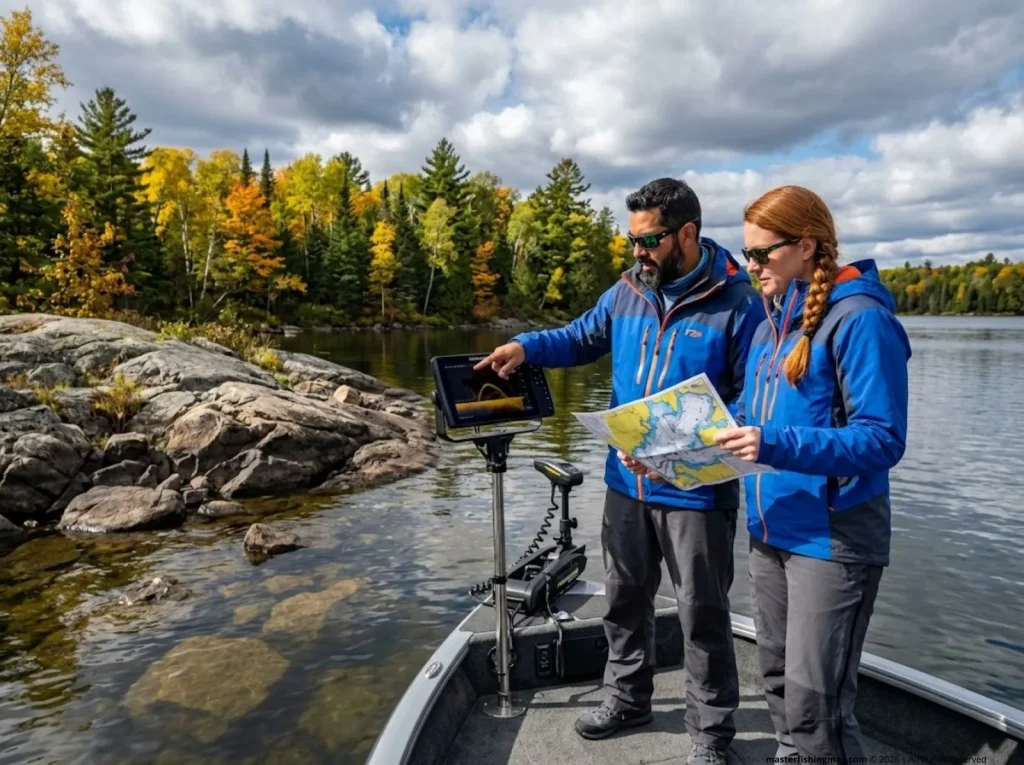
Muskellunge relate to ambush zones where cover meets deep-water access. Not just any weeds. Not just any rocks. The intersection of the two. Submerged timber along a sharp breakline. Cabbage weed beds that drop off into 15 feet of open water. Rocky points where current funnels forage fish past a waiting predatory fish with nowhere better to be.
Their home range is surprisingly compact for such a large freshwater fish. A muskie that sets up on a specific weed edge or fallen tree might hold that position for weeks, moving only to feed or respond to temperature shifts. Mark those spots. They pay off season after season.
Pro tip: The weed line itself isn’t the target. The edge where aquatic vegetation meets open water is where the coil-and-spring attack zone actually sits. Fish that transition, not the fish that park deep inside cover.
Seasonal Depth Shifts and Temperature Triggers
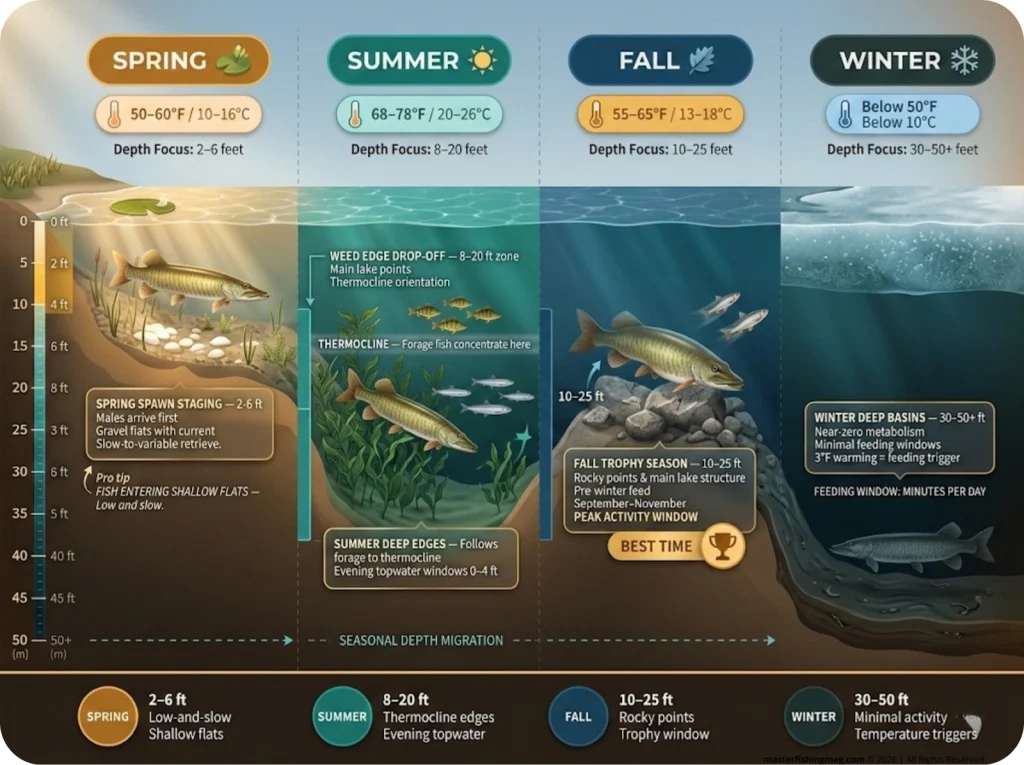
The seasonal patterns follow temperature with mechanical precision. During spring spawn at spawning water temperatures of 50 to 60°F, muskies push into shallow flats two to six feet deep, staging on riffle areas with current flow. Males arrive first and wait.
By summer, they’ve moved to main lake points and deep weed edges at eight to twenty feet, orienting to the thermocline and wherever forage fish schools concentrate. Fall, between 55 and 65°F, is trophy season. Muskellunge activity ramps up as these long-lived fish feed aggressively to build reserves before winter. The biggest fish of the year come between September and November.
Winter drops them deep, thirty to fifty-plus feet, where feeding windows shrink to minutes per day. A 3°F warming trend can trigger a feeding window worth planning your entire trip around. That’s where understanding the difference between surface temps and actual depth readings saves you from fishing dead water.
River Migration and Homing Behavior
According to the West Virginia DNR muskellunge ecology profile, muskellunge can travel fifty-plus river miles annually. That’s not a typo. These are semi-migratory fish in river systems like the Wisconsin River, Chippewa River, and French Broad River.
Radio telemetry confirms strong homing behavior. Individual fish return to the same basins, pools, and lakeshore structure year after year. If you catch or see a muskie in a specific spot, mark it. There’s a high probability that fish, or its territorial replacement, will occupy that station next season.
The Figure-8 and Boat-Side Tactics
Why the Figure-8 Works (Biological Mechanism)
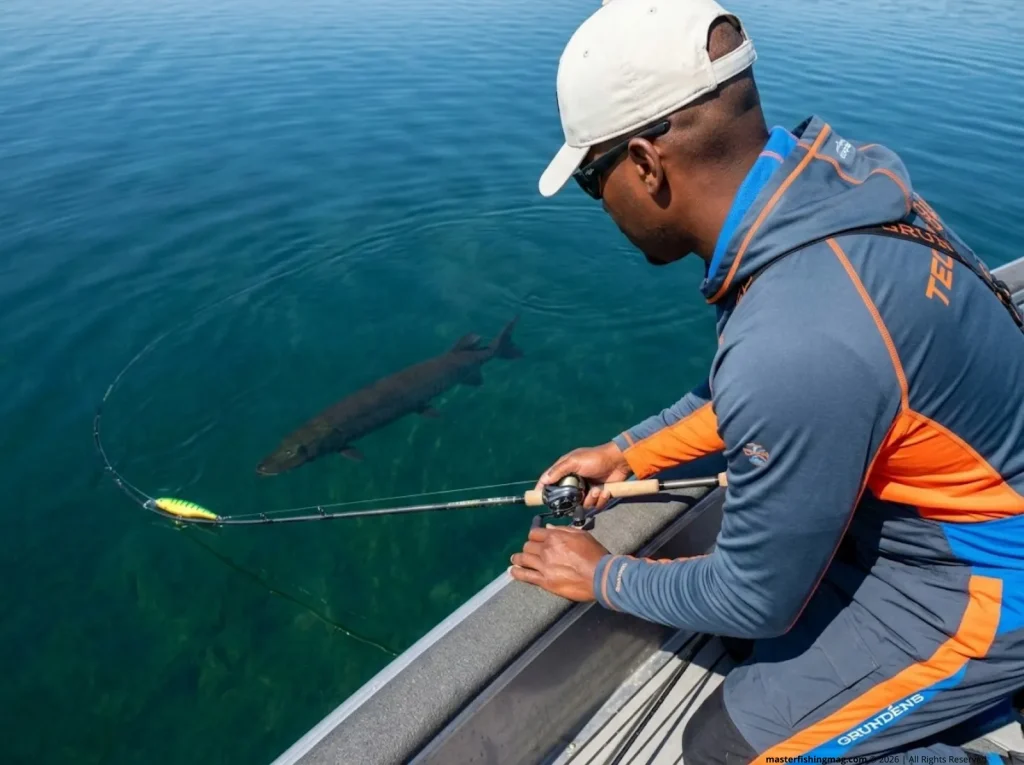
The figure-8 boat-side retrieve exists because of a biological reality that no other freshwater sportfish replicates so consistently: muskellunge follow lures to the boat without striking. They’re assessing. Those seven or more sensory pores and the lateral line are processing whether the prey is worth the energy expenditure.
The sudden direction change of a figure-8 disrupts that tracking and triggers a reaction strike. It’s not a trick. It’s exploiting the gap between sensory assessment and predatory commitment. The fish’s targeting system recalibrates mid-follow, and in that fraction of a second of confusion, the strike instinct overrides caution.
Executing the Perfect Figure-8 Step by Step
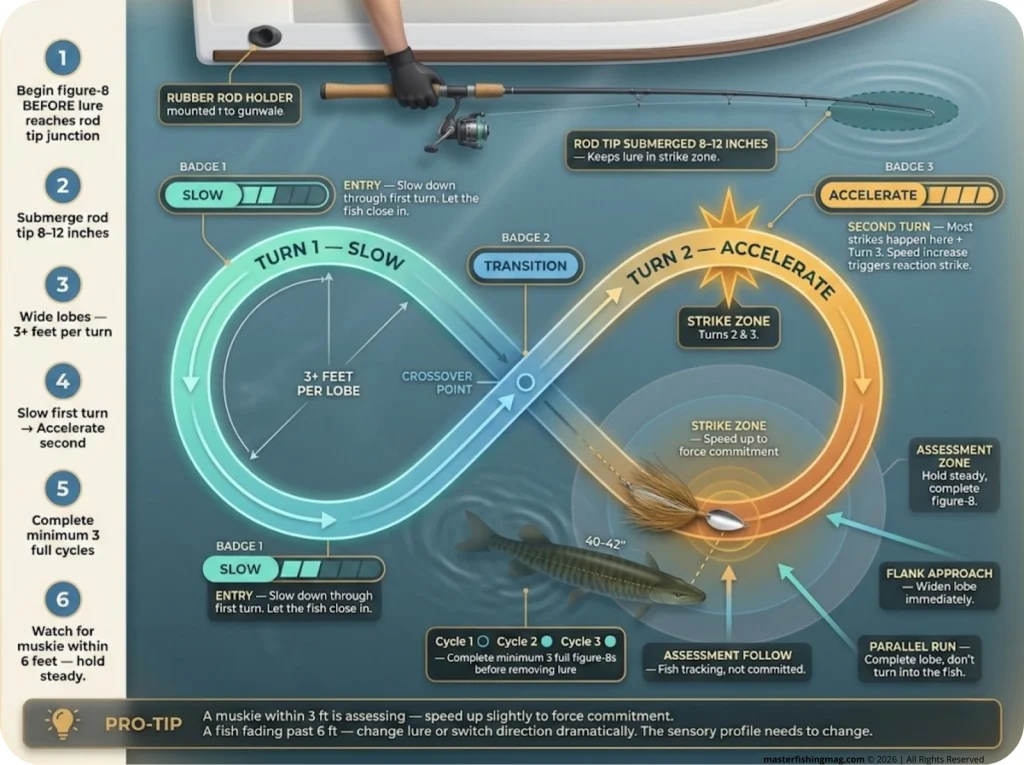
Start the figure-8 before the lure reaches the leader-to-fishing line junction. Most anglers begin too late. Submerge the rod tip six to twelve inches below the surface and make wide, sweeping turns. Each lobe of the “8” should span at least three feet. Tight loops spook fish.
Speed variation sells the deception. Slow the first turn, accelerate through the second. This mimics unsuspecting prey changing direction under duress. Complete at least three full cycles before pulling the lure out. Many strikes happen on turns two and three, after the fish has committed to staying engaged.
A muskie holding three feet or less behind your lure is in assessment mode. Speed up slightly to force commitment. A fish fading beyond six feet is losing interest. Change direction dramatically or switch lure types entirely. The sensory profile needs to change.
After the hookset, you’re holding a fish with razor-sharp teeth that demands proper handling to protect both angler and fish.
Conservation, Handling, and the Warm-Water Warning
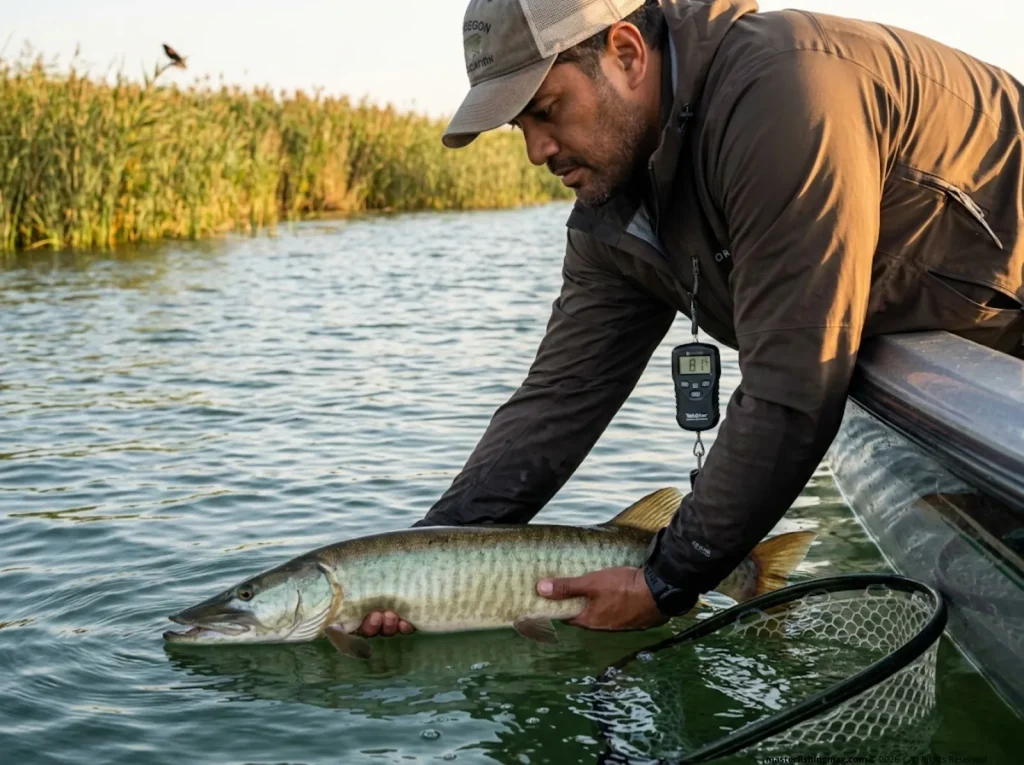
Catch-and-Release Mortality by Water Temperature
In cool clear water, catch and release mortality for muskellunge sits at zero to five percent. Handle them properly and they swim away strong. That changes fast when temperatures climb.
When water exceeds 84°F, catch-and-release mortality jumps to thirty-three percent or higher. The Virginia Department of Wildlife Resources documented this directly: three of seven captured fish caught in 2020 warm-water conditions died after release. That 84°F mark is the hard line. Above it, consider suspending muskie fishing entirely.
Air exposure compounds the thermal stress. Keep the fish in the water during hook removal and photos. Every second of air time at elevated temperatures adds to the probability of delayed mortality.
Pro tip: Carry a thermometer. If the surface reads 80°F, I’m done for the day. The fish’s survival isn’t worth the grip-and-grin. Thirty years from now, these trophy fisheries need healthy muskie populations more than I need one more photo.
Safe Handling for Razor-Sharp Teeth
Muskellunge teeth are angled inward, designed to grip prey and not release. Getting your fingers inside those jaws is a fast trip to the emergency room. Use long-nose pliers or jaw spreaders for every hook removal. No exceptions.
Support the fish horizontally with one hand under the belly and one cradling the tail. Vertical holds by the jaw stress the spine and internal organs of these torpedo-shaped fish. Rubberized nets preserve the fish slime coat, which acts as the first biological defense against infection after the stress of being caught.
The hold-your-breath rule applies: if you need to breathe, the fish does too. Keep photo sessions under fifteen seconds of air exposure.
Mercury Advisories and Consumption Limits
As top-level predators with lifespans reaching thirty years, muskellunge bioaccumulate mercury at concentrations well above most freshwater fish. Mercury advisories vary by state. Some say no restrictions for healthy adults. Others recommend one meal per month maximum. The EPA mercury guidelines for fish consumption provide the federal baseline, but always check your state’s specific advisory.
Pregnant women, children, and nursing mothers face stricter limits, often zero consumption recommended. Most serious trophy musky hunters practice widespread catch-and-release regardless of advisory levels. It’s the science behind why these waters carry catch-and-release designations that keeps self-sustaining muskie populations healthy for the next generation of anglers.
Conclusion
Three things separate the anglers who connect from those who collect follow stories.
First, count the jaw pores, not the spots. Those six to nine sensory pores per side are your definitive ID tool and your primary clue to how muskellunge detect prey in low visibility. Second, match your lure to their biology. Slow retrieves exploit the coil-and-spring attack. Scented bucktails exploit the olfactory nares. Wide figure-8 patterns exploit the gap between assessment and commitment. Third, respect the 84°F line. Warm-water mortality turns catch and release into catch and kill.
Next time a 50-inch muskie ghosts your lure and vanishes, you’ll know exactly what happened and exactly what to change. Biology isn’t background. It’s your edge.
FAQ
What is the difference between muskie and northern pike?
The most reliable test is counting the sensory pores on the underside of the jaw. Muskellunge have six to nine pores per side, while northern pike have five or fewer. Muskellunge also display dark markings on a light background, which is the reverse of pike’s light-on-dark pattern.
What do muskellunge eat?
Muskellunge eat fish up to two-thirds of their own body length, primarily suckers, perch, and cisco. They can consume prey weighing up to twenty percent of their body weight in a single feeding event. Smaller muskies also eat crayfish, frogs, and small fish.
How big do muskellunge get?
Typical adult muskies range from 28 to 48 inches and 15 to 36 pounds. The recognized world record is 67 pounds 8 ounces, caught by Cal Johnson in 1949. The IGFA record for length is 54.33 inches, caught in October 2024 from Mille Lacs Lake, Minnesota.
How do you catch a muskellunge?
Target ambush zones where cover meets deep-water access using large-profile lures in the 10- to 12-inch range. Use a slow-to-variable retrieve speed that matches their coil-and-spring attack biology. Always execute a complete figure-8 boat-side retrieve because many strikes happen during the direction change at the boat.
Is muskellunge safe to eat?
Muskellunge is edible but accumulates mercury as a top-level predator. Consumption advisories vary by state, and sensitive populations should follow stricter limits. Most dedicated muskie anglers practice complete catch and release regardless of local advisory levels.
Risk Disclaimer: Fishing, boating, and all related outdoor activities involve inherent risks that
can lead to injury. The information provided on Master Fishing Mag is for educational and informational purposes
only. While we strive for accuracy, the information, techniques, and advice on gear and safety are not a substitute
for your own best judgment, local knowledge, and adherence to official regulations. Fishing regulations, including
seasons, size limits, and species restrictions, change frequently and vary by location. Always consult the latest
official regulations from your local fish and wildlife agency before heading out. Proper handling of hooks, knives,
and other sharp equipment is essential for safety. Furthermore, be aware of local fish consumption advisories. By
using this website, you agree that you are solely responsible for your own safety and for complying with all
applicable laws. Any reliance you place on our content is strictly at your own risk. Master Fishing Mag and its
authors will not be held liable for any injury, damage, or loss sustained in connection with the use of the
information herein.
Affiliate Disclosure: We are a participant in the Amazon Services LLC Associates Program, an
affiliate advertising program designed to provide a means for us to earn advertising fees by advertising and linking
to Amazon.com. As an Amazon Associate, we earn from qualifying purchases. We also participate in other affiliate
programs and may receive a commission on products purchased through our links, at no extra cost to you. Additional
terms are found in the terms of service.