
In this article
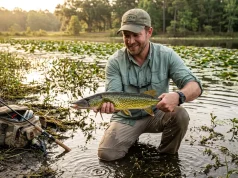
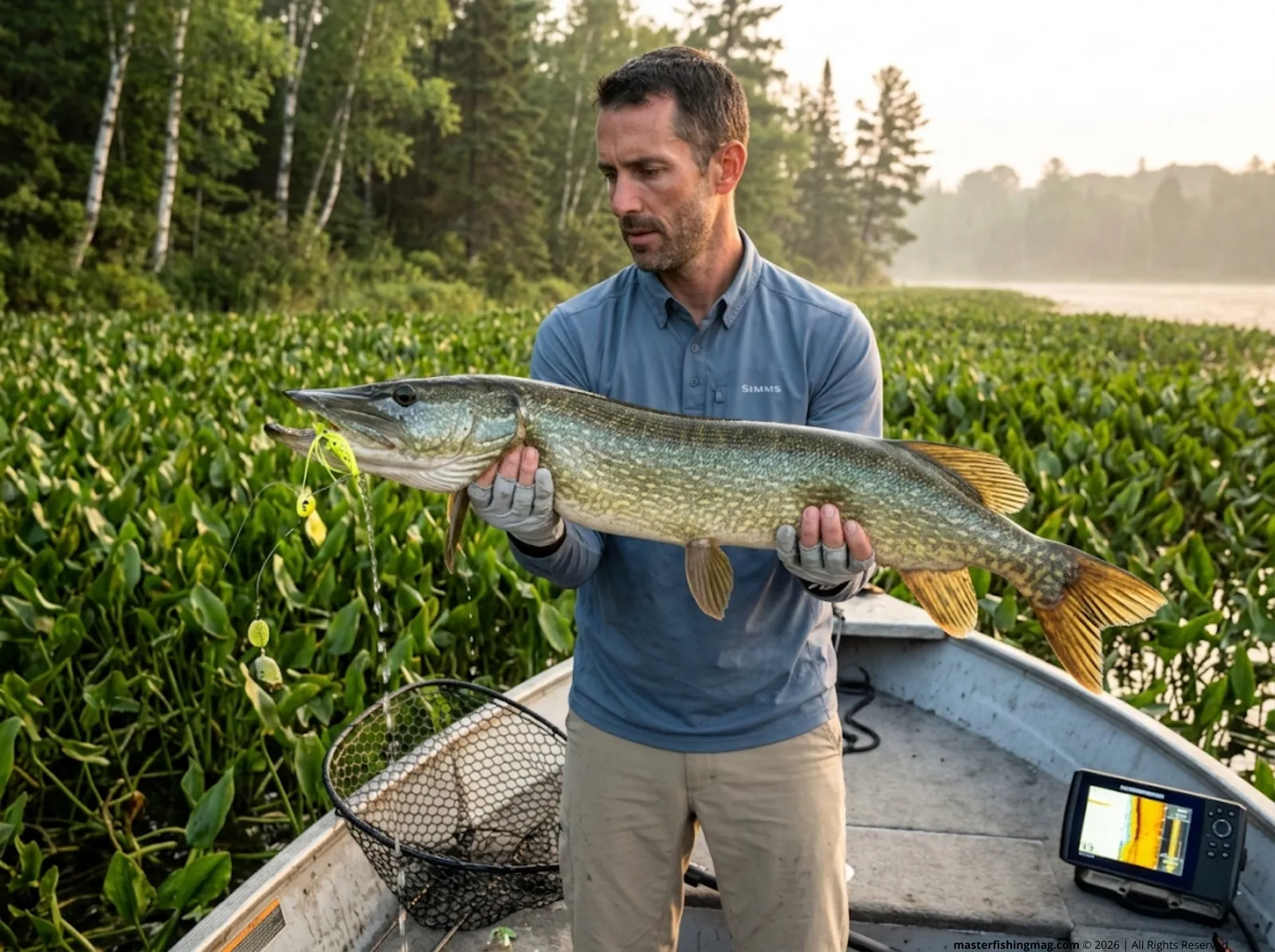
It was the third morning in a row I’d been told to move. The water was 73°F and every guide on the lake had already written off the shallows. “Fish are deep,” they said. “Big pike left the weeds two weeks ago.” Then a 40-inch hen blew up a topwater in four feet of water thirty yards from where we were anchored, and I started asking different questions.
Conventional wisdom on summer pike strategies is wrong more often than it’s right. The reality is more interesting — and more useful. Here’s what actually keeps trophy fish locked in the shallows, and how to make them eat when everyone else gives up.
⚡ Quick Answer: Big pike stay in shallow weeds all summer because dense cabbage beds (curly-leaf pondweed) produce dissolved oxygen, create cool shade pockets, and concentrate prey — all in one spot. Add springholes (groundwater upwellings) and you have cold-water refuges that hold trophy fish even when surrounding water tops 72°F. Target the deep weed edge at dawn and dusk with large spinnerbaits or topwaters, and you’ll find fish where other anglers stopped looking.
The Biology That Keeps Big Pike Shallow
Most anglers understand that pike prefer cooler water. What they don’t understand is that “shallow” and “warm” aren’t the same thing inside a healthy cabbage bed.
Pike thrive in the 55–60°F sweet spot — that’s when they feed hard and recover fast. Tagged fish data from Muskies Canada show a mean summer temperature of 71.8°F for tracked pike, which proves they tolerate warmer conditions than most people believe. The key word is tolerate. A pike idling motionless in the shade of a dense weed canopy burns a fraction of the energy of one actively chasing bait across an open flat. That energy equation matters — and it’s the same reason northern pike biology shapes every tactical decision you make on the water.
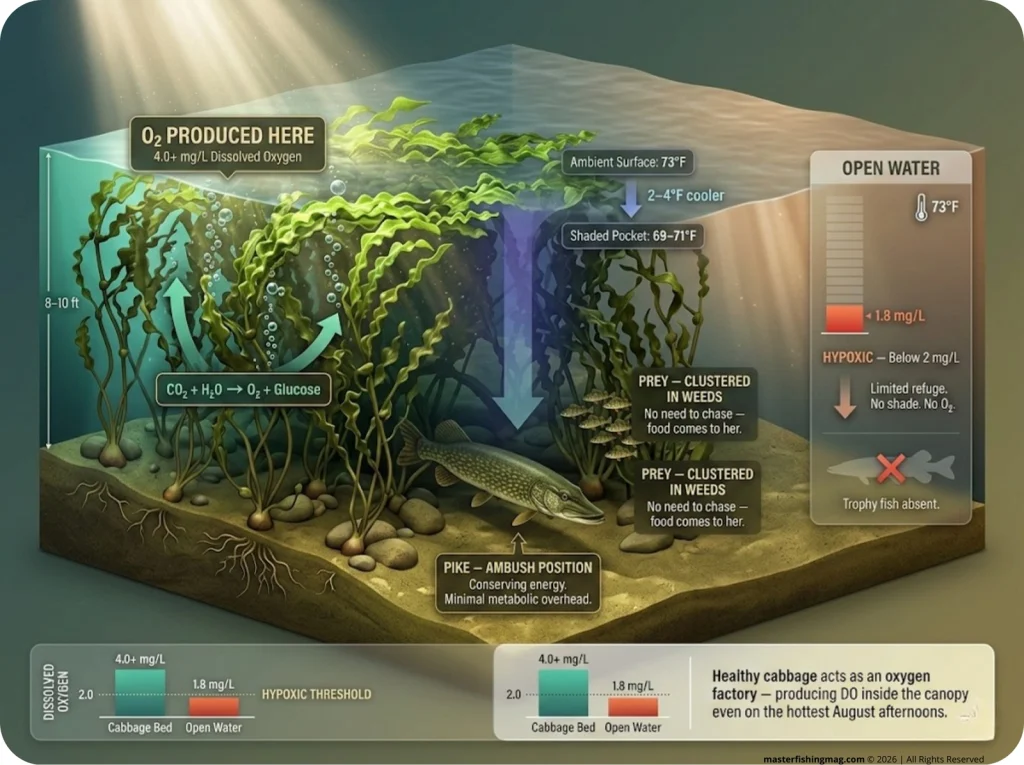
Here’s what nobody explains about curly-leaf pondweed: it photosynthesizes during daylight hours and produces dissolved oxygen right inside the canopy. While open water in summer can drop toward dangerously low levels — water is considered hypoxic below 2 mg/l — a healthy cabbage bed keeps the surrounding water above 4.0 mg/l. That means pike can breathe comfortably even on the hottest August afternoons. Understanding how dissolved oxygen levels dictate where predators hold is the key to cracking shallow summer pike. The cabbage isn’t just cover. It’s a life support system.
The prey equation seals the deal. Panfish, minnows, and young-of-year perch cluster in shallow vegetation for their own protection. A big pike doesn’t need to go anywhere — the food comes to her. And from mid-June until the weeds start dying off, guide Billy Rosner has watched dragonflies cruise just above the surface of Lake Vermilion’s cabbage flats — and pike feed on them like rising trout. Most anglers have never even seen this happen.
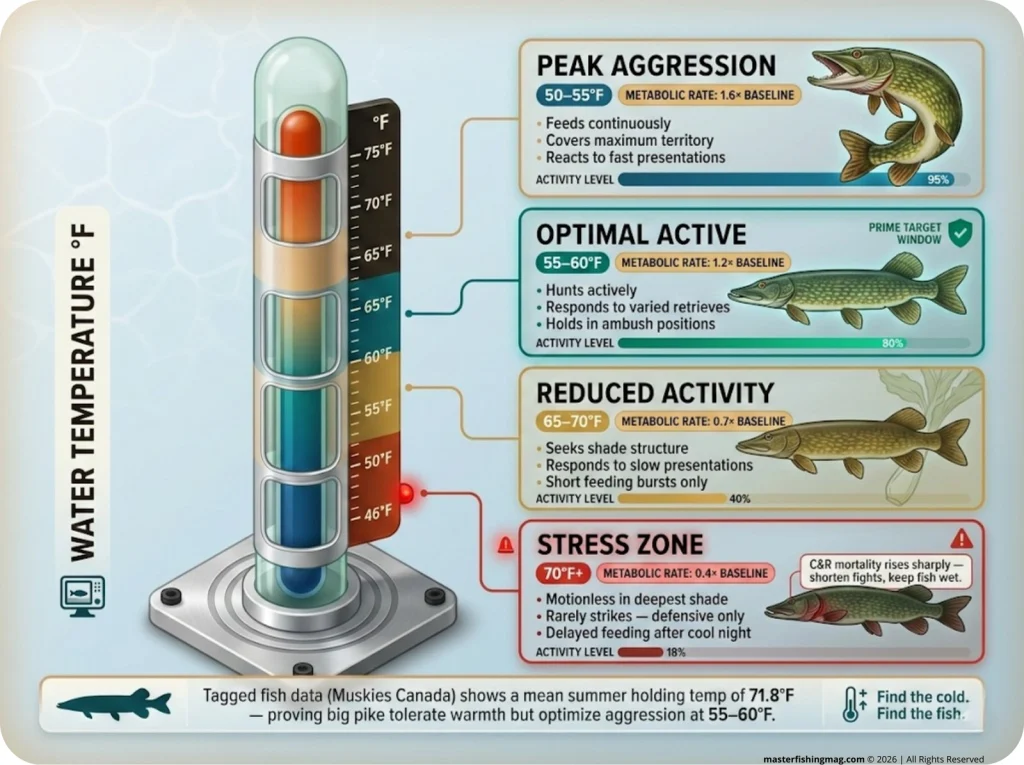
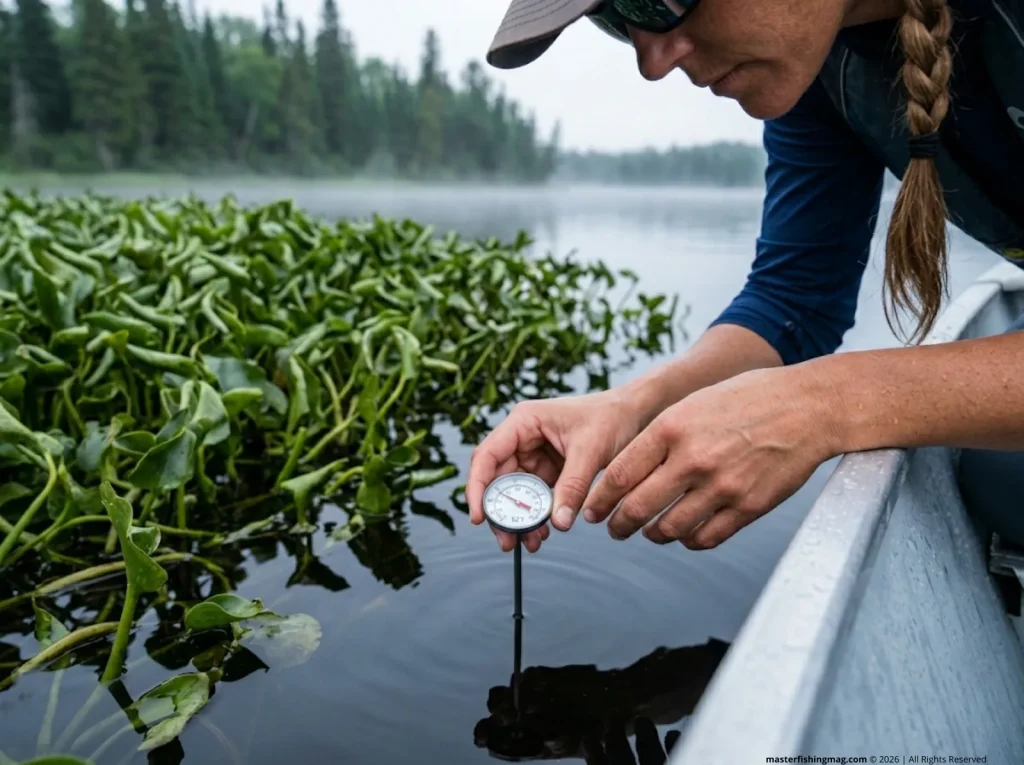
Pro tip: A direct-reading thermometer is the most underused tool in pike fishing. Dr. Bruce Carlson, a biologist who spent decades on northern pike, put it plainly: “Next to your rod and reel, a good thermometer often is your most valuable fishing tool.” Without knowing the temperature profile of your water, summer pike fishing is a guessing game.
Springholes and Cold-Water Pockets — The Hidden Structure
If cabbage beds are the base case for summer pike, springholes are the wildcard that explains everything else.
A springhole is a groundwater upwelling — cold water pushing up through the lake bottom from underground aquifers. The surrounding water might be 72°F. But right over that upwelling, you’ll find pockets holding 55–58°F. They’re invisible from the surface. And a single cold-water springhole the size of a living room can hold three or four gators — trophy pike over 40 inches — when the rest of the shallow flat is dead and holding nothing but hammer handles.
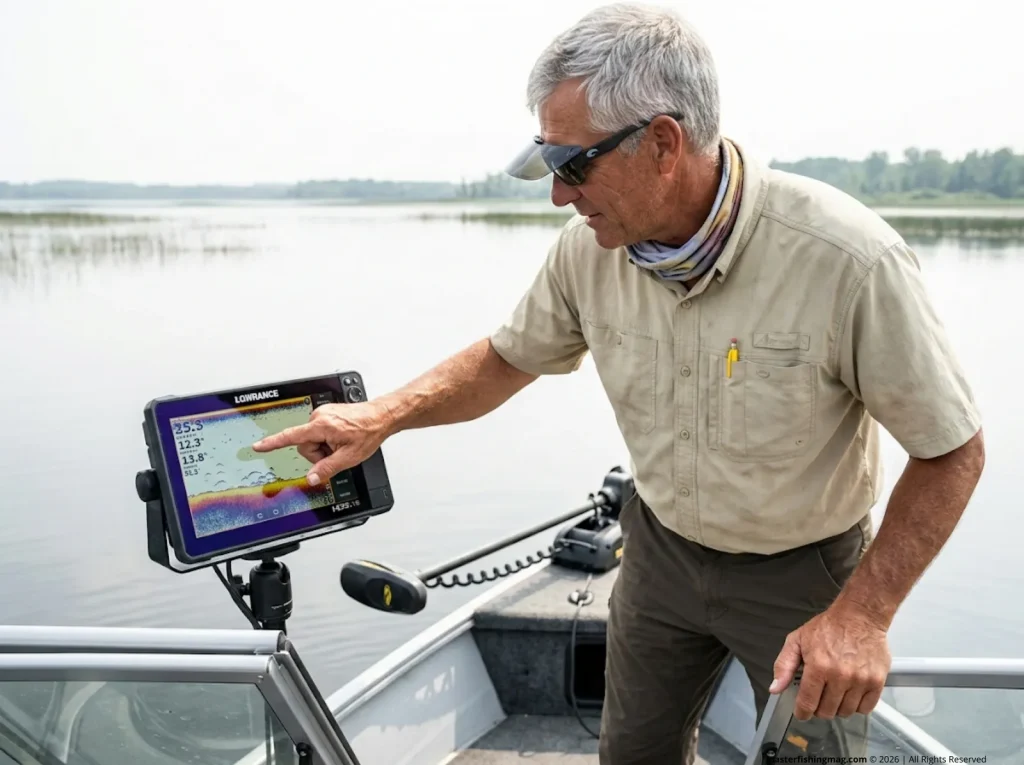
Detecting springholes used to require local knowledge passed down from generations of guides. Now you have three reliable methods. First, watch your sonar for sudden 3–5°F temperature drops as you slow-troll across what looks like a featureless flat — that temperature blip is a real feature. Second, look for steady micro-bubbles rising from the bottom in still, calm conditions; escaping groundwater gas creates a faint, persistent column. Third, watch for vegetation anomalies — plants over springholes grow taller, often greener, and sometimes in different species mixes because the mineral-rich cold water feeds them differently.
That’s why your surface temperature reading can’t tell the whole story on weedy lakes. Your surface reading might say 73°F across an entire flat, but your thermometer two feet off bottom over a springhole tells a completely different story.
Once you find one, mark it with a GPS waypoint immediately. The geology doesn’t change. That springhole pocket will produce in the same spot next June, the June after that, and for as long as you fish that lake.
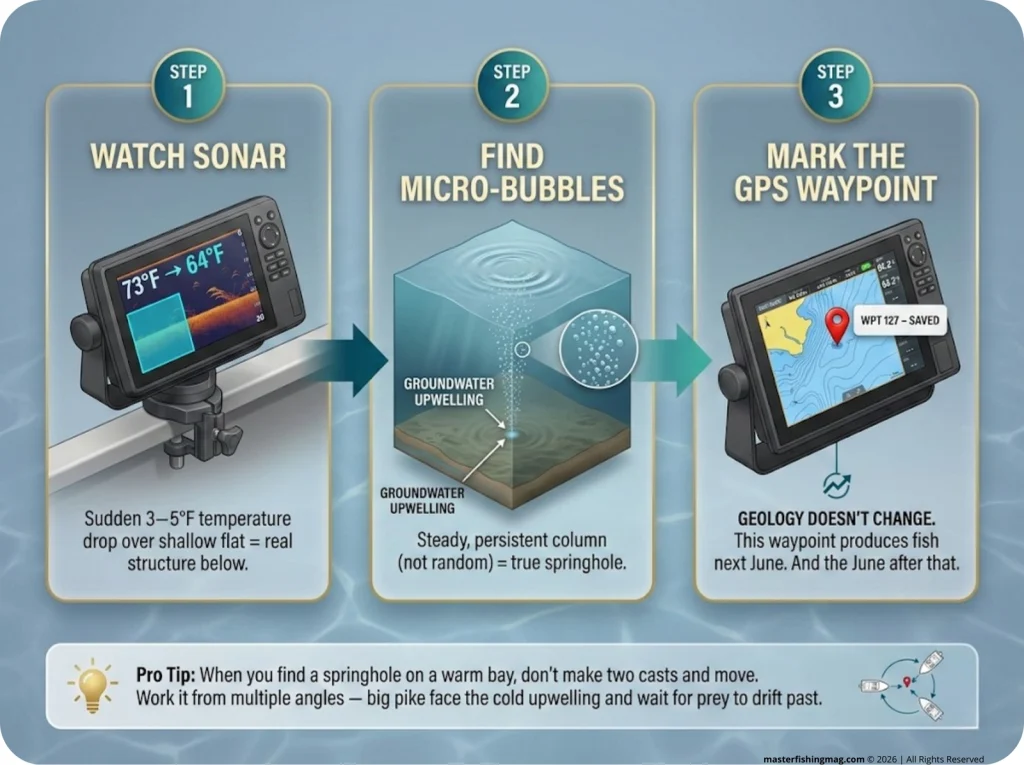
Pro tip: When you find a springhole on an otherwise warm, flat bay, don’t just make a few casts and move on. Work it slowly from multiple angles. Big pike use these pockets as staging areas — they face into the cold upwelling current and wait for prey to drift past. Slow presentations outperform fast ones here.
Five Retrieves That Trigger Shallow-Weed Pike
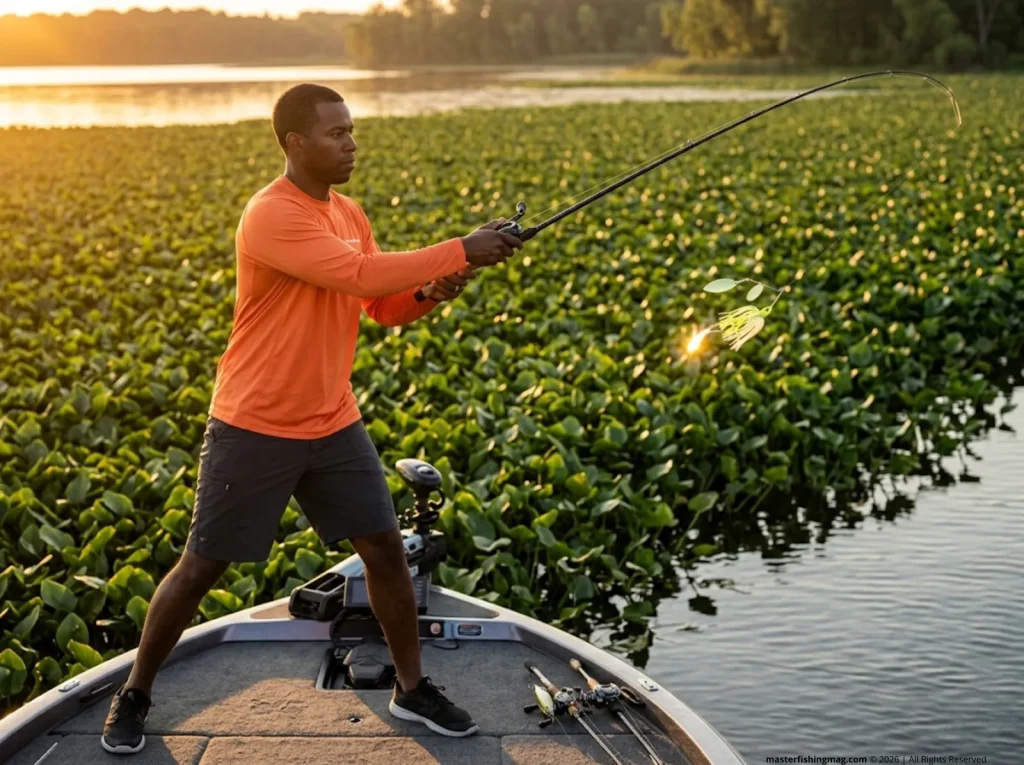
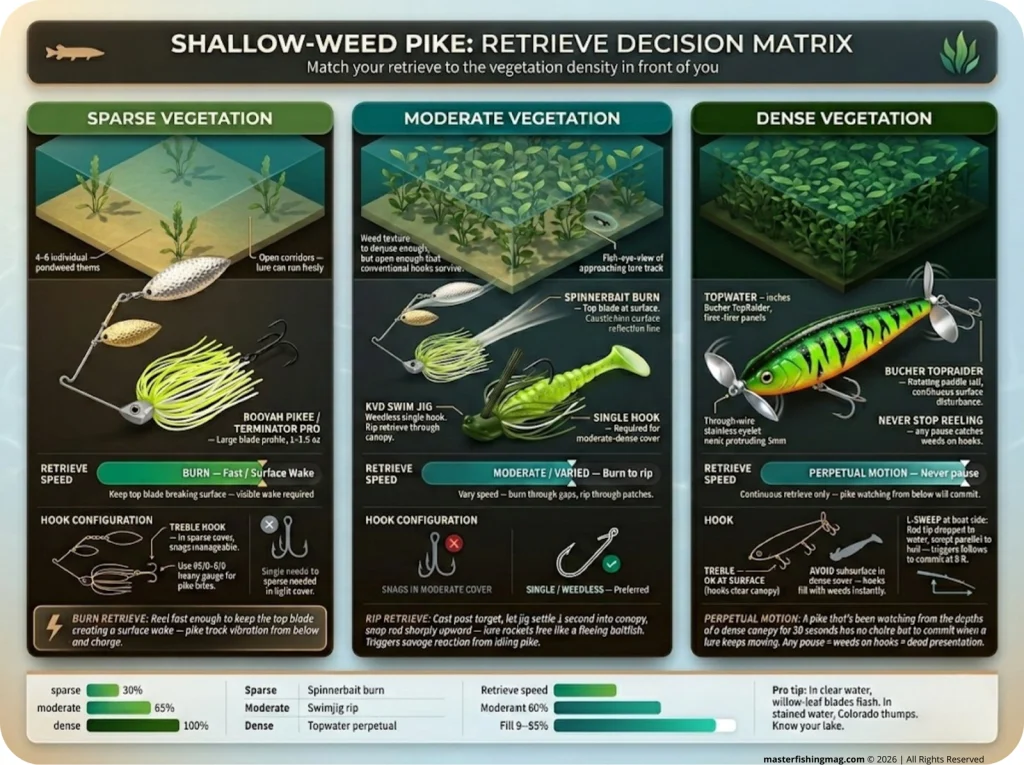
Getting bites from pike in dense vegetation comes down to matching your retrieve to the weed density in front of you. You’re not looking for a single technique — you’re building a rotation.
When the cabbage is moderate and you can see gaps in the canopy, a spinnerbait burn is hard to beat. Run a large-profile spinnerbait — the Booyah Pikee or Terminator Pro Series are built for this — just fast enough to keep the top blade breaking the surface and creating a visible wake. Matching blade type to water clarity determines whether you’re triggering a reaction strike from 15 feet away or just making noise. In clear water, a willow-leaf blade flashes. In stained water, a Colorado thumps. Know your lake.
In truly dense cabbage — a solid canopy where you can’t see bottom anywhere — switch to a topwater and go to a perpetual motion retrieve. Rosner’s choice, the Bucher TopRaider, has a rotating paddle tail that generates continuous vibration and surface disturbance. The key is to never stop reeling. Any pause over dense cabbage catches weeds on the hooks and kills the action. Keep it moving, and a pike that’s been watching from underneath will have no choice but to commit.
The rip retrieve through cabbage is the most explosive technique in shallow-weed summer pike fishing. Cast a Strike King KVD Swim Jig past your target, let it settle into the canopy for a second, then snap the rod upward sharply to rip it free to trigger strikes. That sudden burst of speed — lure shooting out of the weeds like a fleeing baitfish — is what triggers a savage reaction from an idling pike.
Guide Billy Rosner also describes an L-sweep maneuver at the boat side: when a pike is following your bait at eight feet, he drops his rod tip to the water and sweeps it parallel to the hull, sending the lure on a hard sideways dive. “The sudden change of direction and speed often triggers following fish to hit,” he says. Learn that move. You’ll catch fish at the boat that you would have otherwise lost.
For the deep cabbage edge at midday, a slow-roll is your best bet. Heavy spinnerbait, just fast enough to keep the blades turning, bumped along the transition from weed tops to open water at 10–15 feet. The Williams Wobler with prism-tape customization adds a flash pattern that nobody else is running. Pike that were ignoring a burn at noon will eat a slow-roll in the same spot.
Reading the Clock: When Shallow Pike Actually Bite
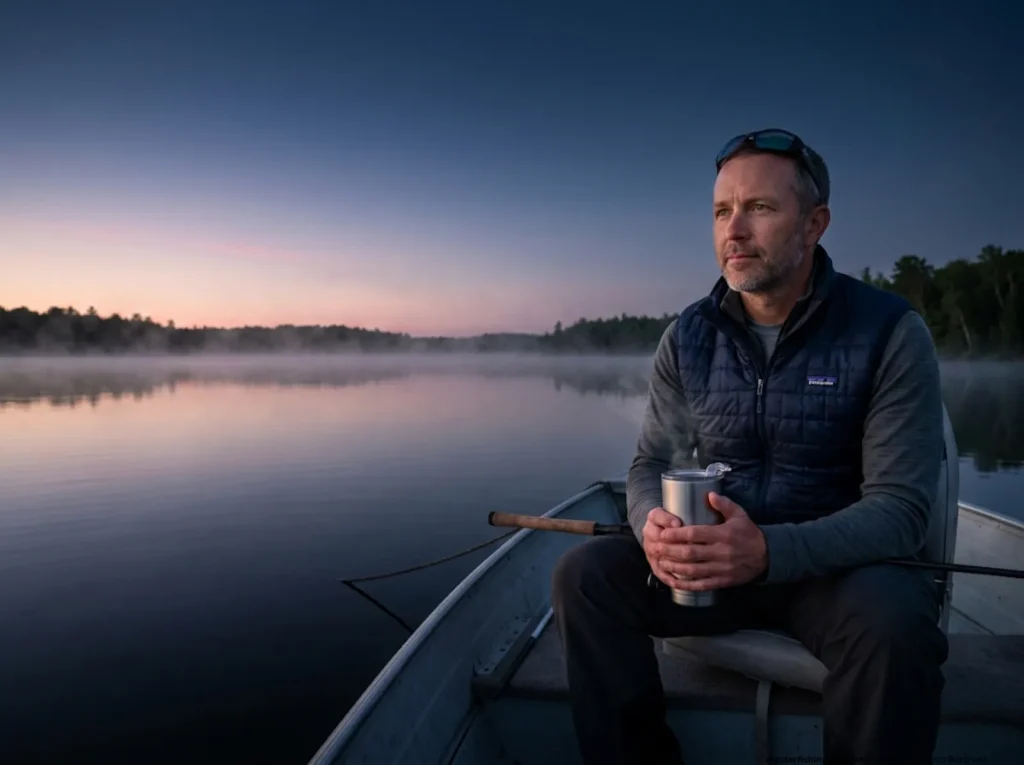
Temperature decides where pike are. Light level decides when they eat.
The twilight window — the first and last 90 minutes of legal light — is when shallow-weed pike are most vulnerable. Overnight, lake surface temperatures drop one to three degrees, which briefly pushes conditions back toward the 60s even on the warmest August nights. By pre-dawn, the water is at its coolest, pike metabolism is running at peak efficiency for the day, and prey fish that scattered during the night are compressed against the weed edges. The overlap creates a feeding window that is consistently the most productive period you’ll find.
Push through that window and fish mid-morning, and you’ll pick up stragglers. But the bite gets harder as the sun climbs. By midday, the most efficient thing a big pike can do is nothing — suspend motionless in the darkest, shadiest pocket of the cabbage and conserve energy. Understanding how water temperature controls fish metabolism and strike windows explains why your fast burn at noon produces half the bites of the same retrieve at 6 a.m.
Cold fronts shake things up in both directions. In the 24–48 hours before a front hits, falling barometric pressure triggers aggressive feeding behavior — sometimes the best shallow-water bites of summer happen to anglers who were supposed to go home that morning. After the front passes and the high pressure moves in, the exact opposite happens. Pike go lock-jaw. Give them 48 hours, and the bite resets.
Warm-Water Release: The Protocol Nobody Talks About
Every article you’ve read about summer shallow-water pike talks about catching them. Almost none of them talk about keeping them alive after you have.
Here’s the uncomfortable truth: catch-and-release mortality for northern pike runs 3–10% even in ideal conditions, according to Alaska Department of Fish and Game. When you add warm water to that equation — 70°F and above — that number climbs sharply. A fish that just burned through its oxygen reserves fighting a light-tackle angler for six minutes in 74°F water may swim off but die within 72 hours from delayed stress. You’ll never know. The fish doesn’t make it back to you.
The fix isn’t complicated, but it requires intention. Use heavy tackle specifically so you can shorten the fight, not because you need it to land the fish. Fifty-pound braid and a 7’3″ heavy rod let you bring a pike to the net in under two minutes. That difference matters enormously for the fish.
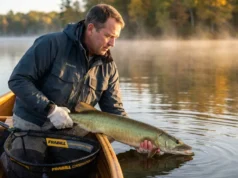
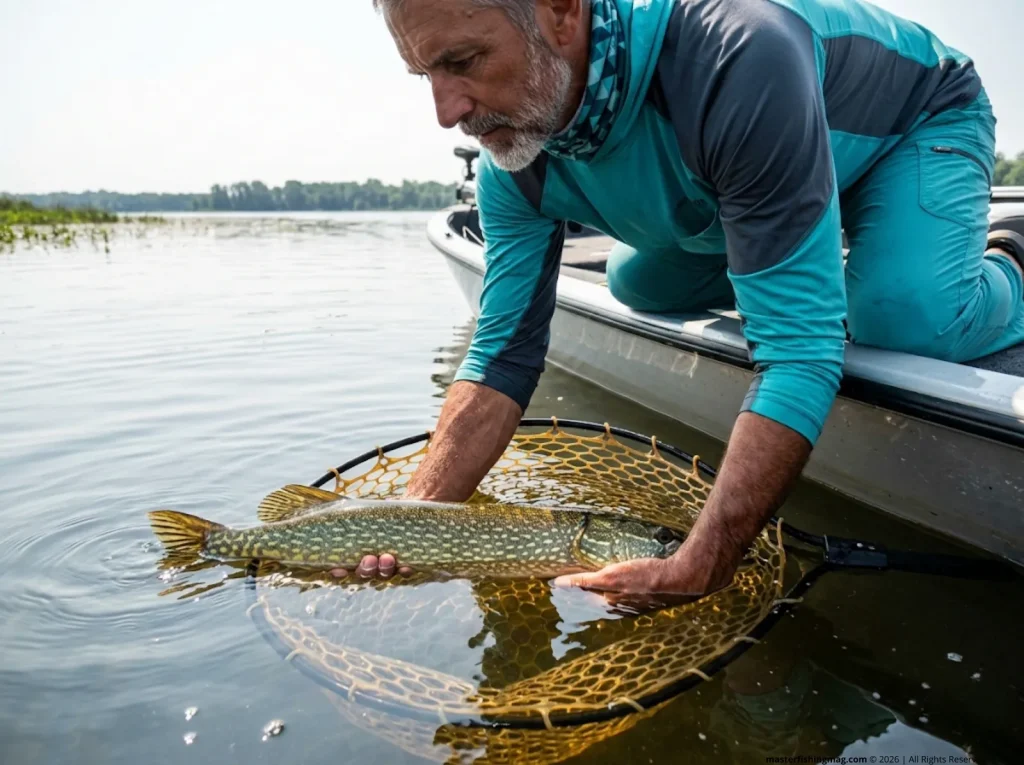
Once in the net, keep it in the water while you remove the hook — never lift it out for photos before it’s recovered. Refer to the complete guide to handling pike and musky safely before your first warm-water pike trip. Single hooks in summer are not optional; they unhook in seconds compared to trebles and dramatically reduce deep-hooking risk.
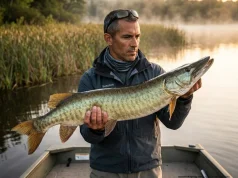
Hold the fish horizontally, both hands supporting it — one behind the gill plate, not inside it, one at the tail. Watch the gills. When they’re pumping steadily and the tail is pushing against your grip, lower the fish level with the surface and open your hands. If it rolls belly-up, right it and hold it again. No rush. A 40-inch pike that took 20 years to grow deserves 90 seconds of your patience at the boat side.
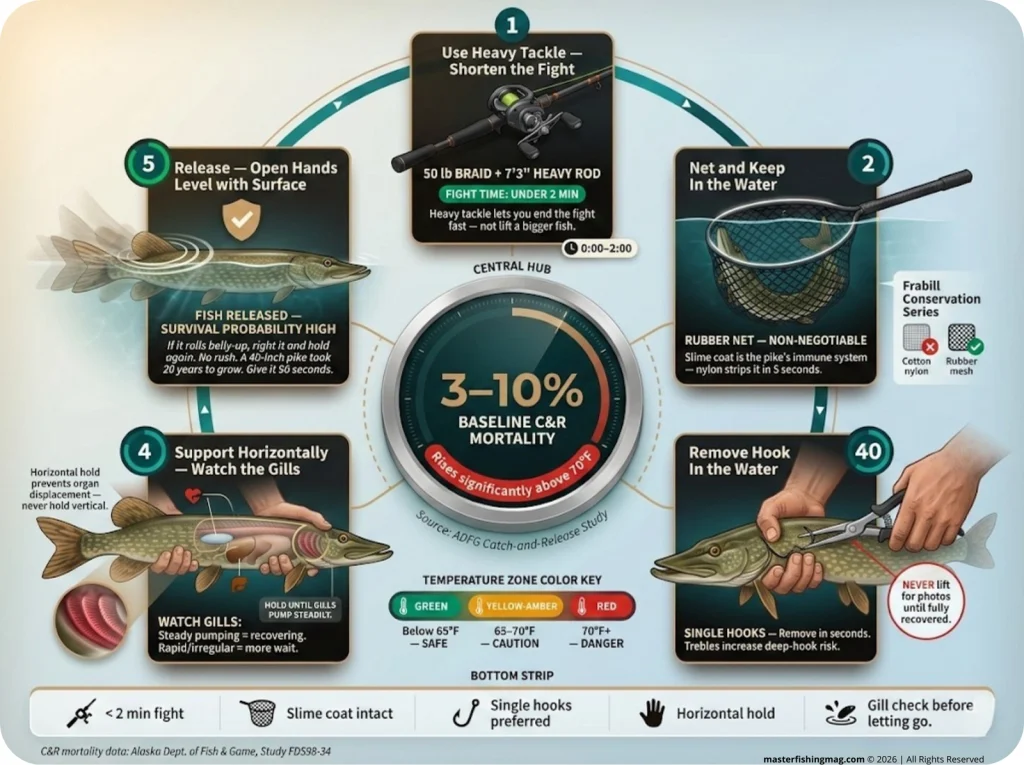
Pro tip: A rubber net is non-negotiable for summer pike release. The slime coat on a pike is its immune system — dry nylon mesh strips it in seconds. Frabill Conservation series rubber nets keep that protective layer intact, which directly increases the fish’s post-release survival chances.
Conclusion
Three things separate anglers who consistently catch big summer pike from those who don’t.
First, they understand that shallow does not mean warm — cabbage beds create oxygenated, shaded micro-habitats that function as cold refuges even when surface temps climb into the low 70s. Second, they find the cold water other anglers never look for. Springholes, deep weed edge shade pockets, and the brief pre-dawn temperature drops are not myths — they’re GPS coordinates waiting to be marked. Third, they release their fish correctly. Heavy tackle, fast fights, and in-water recovery are not optional courtesy — they’re the difference between a surviving fish and a statistic.
Next time someone tells you the big pike moved deep, grab your thermometer, idle across the nearest weed flat, and look for that temperature drop. The fish are still there. You just needed to know why.
FAQ
What water temperature is too warm to fish for pike?
Pike become stressed above 70°F and catch-and-release mortality climbs sharply above 75°F. If you fish in these conditions, shorten fight times with heavy tackle and keep the fish in the water during hook removal and recovery.
What lures work best for pike in thick weeds?
In dense vegetation, topwaters like the Bucher TopRaider and weedless soft plastics outperform everything else because they ride over the canopy. In moderate cabbage, burning a large spinnerbait over the weed tops produces the most explosive reactions.
Do big pike stay shallow all summer or move deep?
Both — it depends on the lake. On shallow, weedy natural lakes with springholes and healthy cabbage, trophy pike can hold shallow the entire summer. In deeper, clearer lakes with strong thermoclines, the biggest fish typically suspend deeper by mid-July.
What time of day is best for summer pike in shallow weeds?
The first and last 90 minutes of daylight are consistently the most productive. Overnight temperature drops push conditions briefly toward the pike’s preferred range, and prey fish compress against the weed edges at dawn.
How do you find springholes in a lake?
Use three methods: watch your sonar for sudden temperature drops over shallow flats, look for steady micro-bubble streams rising from the bottom in calm water, and note where vegetation grows taller or greener than the surrounding bed. Mark every springhole you find with a GPS waypoint — they produce year after year.
Risk Disclaimer: Fishing, boating, and all related outdoor activities involve inherent risks that
can lead to injury. The information provided on Master Fishing Mag is for educational and informational purposes
only. While we strive for accuracy, the information, techniques, and advice on gear and safety are not a substitute
for your own best judgment, local knowledge, and adherence to official regulations. Fishing regulations, including
seasons, size limits, and species restrictions, change frequently and vary by location. Always consult the latest
official regulations from your local fish and wildlife agency before heading out. Proper handling of hooks, knives,
and other sharp equipment is essential for safety. Furthermore, be aware of local fish consumption advisories. By
using this website, you agree that you are solely responsible for your own safety and for complying with all
applicable laws. Any reliance you place on our content is strictly at your own risk. Master Fishing Mag and its
authors will not be held liable for any injury, damage, or loss sustained in connection with the use of the
information herein.
Affiliate Disclosure: We are a participant in the Amazon Services LLC Associates Program, an
affiliate advertising program designed to provide a means for us to earn advertising fees by advertising and linking
to Amazon.com. As an Amazon Associate, we earn from qualifying purchases. We also participate in other affiliate
programs and may receive a commission on products purchased through our links, at no extra cost to you. Additional
terms are found in the terms of service.