
In this article
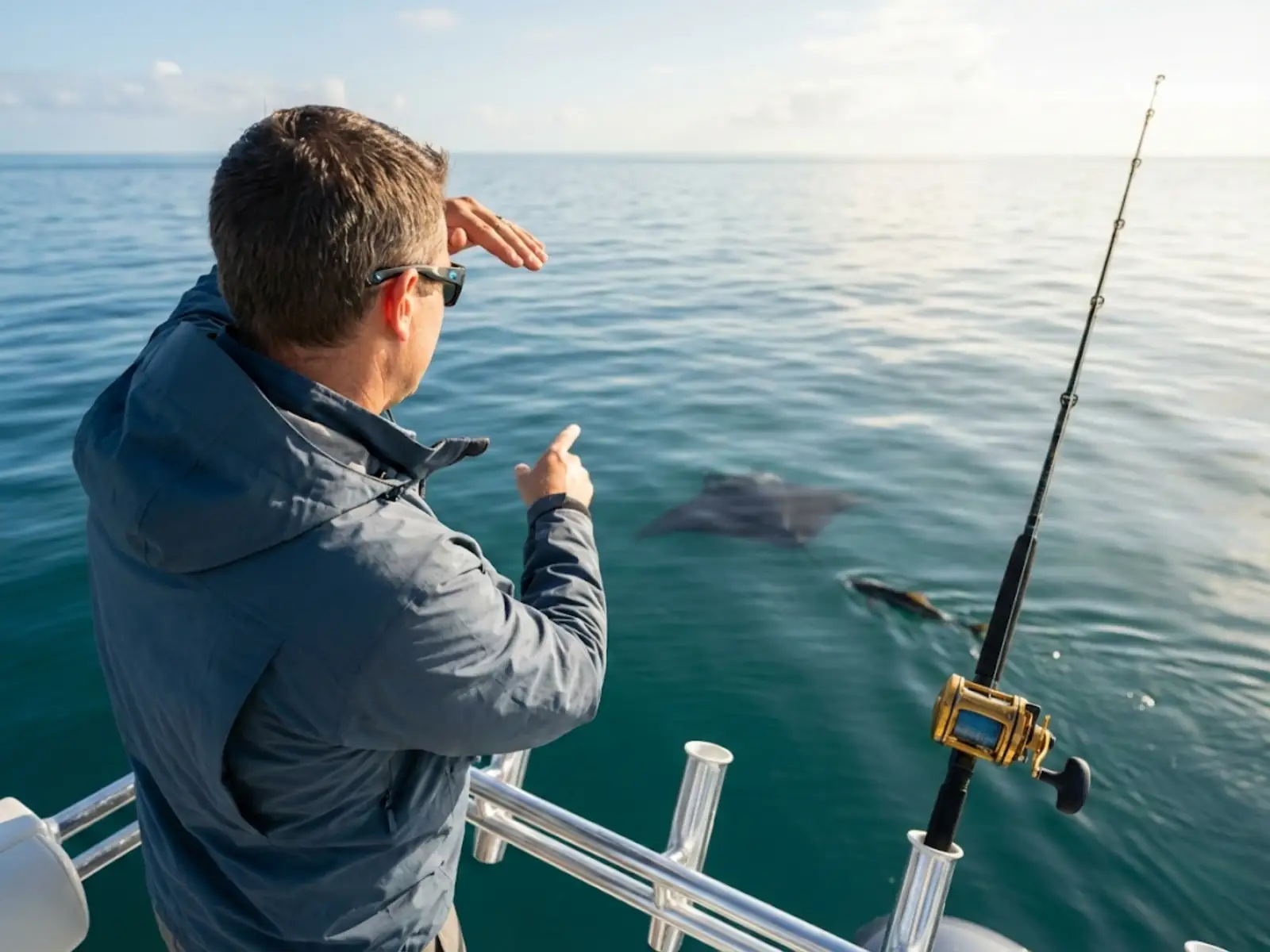
The tower captain’s voice crackles over the radio: “Ray at two o’clock, 200 yards.” You grab the rod, heart pounding, scanning the glare for that telltale dark shadow gliding just below the surface. Then you see it, not the ray, but the brown torpedo trailing behind it. The cobia. You’ve got maybe 30 seconds before it’s gone. This is the moment every piece of migration science has been building toward.
Understanding the hard science behind cobia migration, from satellite tagging data to thermal triggers to acoustic telemetry, transforms you from a lucky angler into a precision hunter who can predict the run, locate the fish, and execute the catch with repeatable success.
⚡ Quick Answer: Cobia migration is triggered when water temperatures reach 68-72°F, typically occurring March-June along the Atlantic coast and August-November in the Gulf. These fish follow specific bathymetric corridors (50-120 feet during migration, 15-40 feet when spawning) and associate with manta rays, sharks, and stingrays for foraging efficiency. Acoustic telemetry and satellite tagging reveal high site fidelity to artificial reefs and spawning estuaries, allowing anglers to predict movements with scientific precision rather than guesswork.
The Biological Foundation: Why Cobia Behave Differently
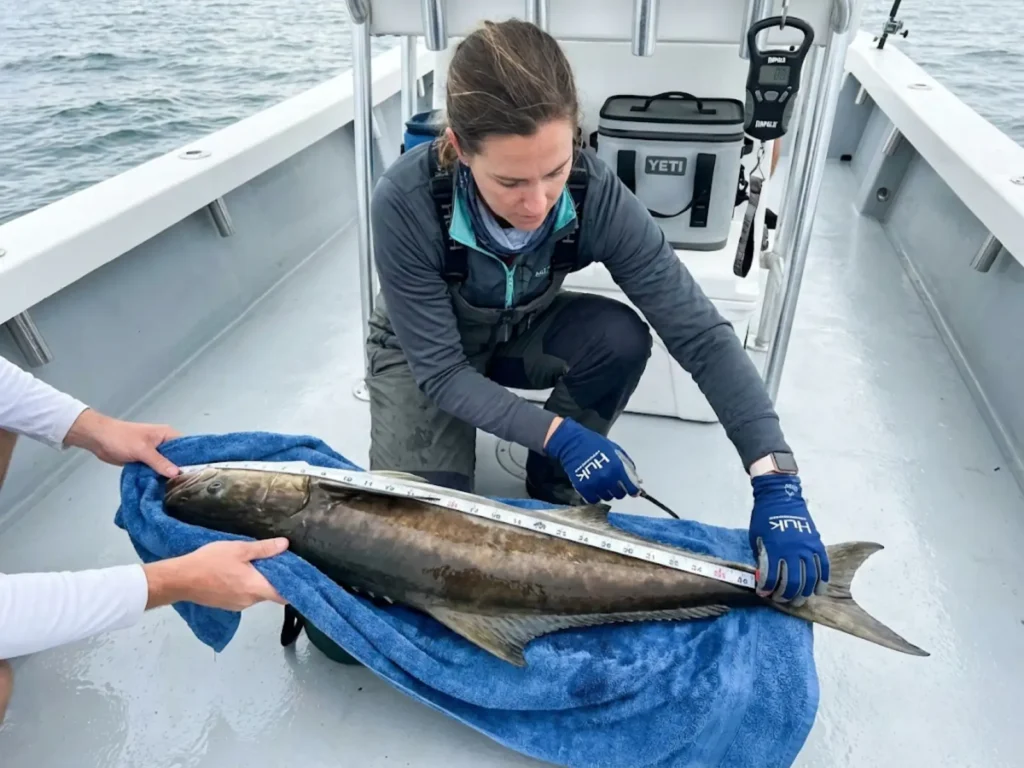
Cobia (Rachycentron canadum) are the sole species in the family Rachycentridae, evolutionarily isolated with unique traits that don’t align with jacks, mackerels, or any other familiar saltwater predator.
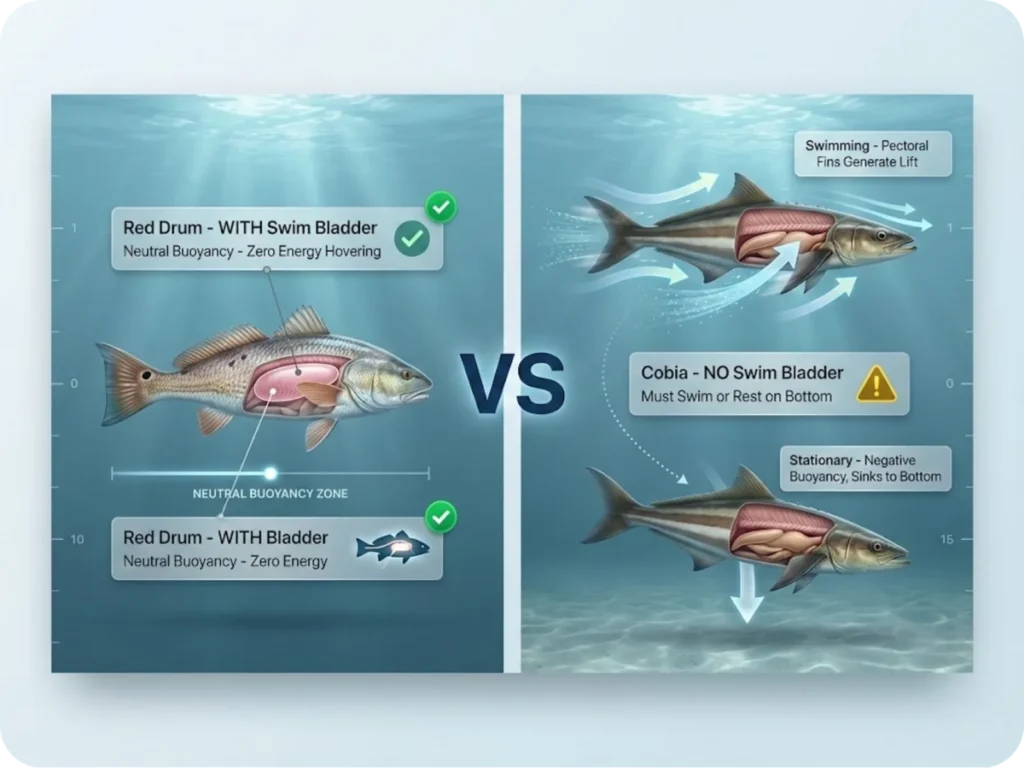
The single most important biological fact: cobia lack a swim bladder. In most pelagic fish, the swim bladder acts as a hydrostatic organ, allowing the fish to hover mid-water with zero energy expenditure. A striped bass can suspend motionless while scanning for prey. A cobia cannot.
Without that buoyancy control, cobia are negatively buoyant. If they stop swimming, they sink. This forces a bimodal behavior pattern: actively swimming (generating hydrodynamic lift) or resting on the bottom (conserving energy). There’s no middle ground.
When a cobia isn’t actively hunting or migrating, the most energy-efficient state is to settle on the substrate. A lure worked rapidly mid-water may be ignored not because the fish isn’t hungry, but because the metabolic cost of rising to chase it outweighs the potential caloric gain. Drop a jig that plummets to the bottom and kicks up sediment? That mimics prey entering the cobia’s resting zone, triggering a reaction strike.
The lack of a swim bladder grants one major advantage: immunity to barotrauma. Unlike snapper or grouper that suffer from expanding gases when brought rapidly to the surface, a cobia has no gas bladder to rupture. A fish hooked at 120 feet can fight with full ferocity all the way to the boat and, if released, can return immediately to the depths without venting or descending devices.
Sexual dimorphism in cobia is extreme. Females grow faster and reach much larger maximum sizes than males. A male cobia rarely exceeds 50 pounds, whereas females can top 100 pounds. These fish reach sexual maturity rapidly, males by age two, females by age three. This rapid growth means a 60-pound cobia is likely a young, prime spawner, not an old individual.
The diet tells you everything about lure selection. Cobia feed primarily on crustaceans, specifically portunid crabs, with an inferior mouth position and bands of villiform teeth designed for grasping and crushing. Lures should mimic crabs, eels, or baitfish flushed from the bottom.
Pro tip: When sight-fishing a resting cobia on the bottom, drop your jig directly on its nose rather than working it mid-water. You’re entering its energy-neutral zone where the strike costs minimal calories.
Stock Structure and Genetic Connectivity: Two Populations, Two Strategies
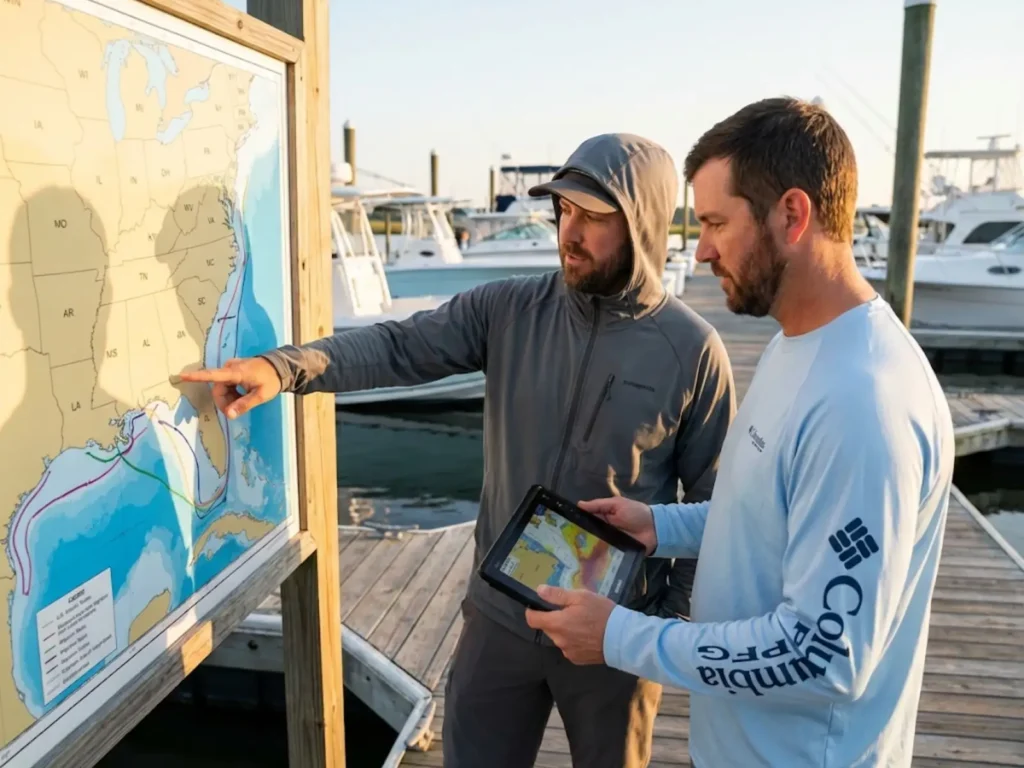
For decades, fisheries management operated under the assumption of a single, panmictic cobia population spanning the Gulf of Mexico and the U.S. South Atlantic. Modern genetic analysis and tagging studies dismantled that assumption. We now know there are two genetically distinct migratory groups: the Gulf Migratory Group and the Atlantic Migratory Group.
The Gulf Stock ranges from the Texas coast throughout the Gulf of Mexico and extends partially down the east coast of Florida. These fish follow a clockwise migration pattern, moving south and east in winter, north and west in spring. The Atlantic Stock runs from the Florida-Georgia border northward to New York, executing a distinct North-South seasonal migration driven by water temperature and spawning impulses.
This separation is biological, confirmed by microsatellite DNA analysis and tag-recapture data. An angler in Alabama is targeting a different population than an angler in Virginia, subject to different recruitment pulses and environmental stressors. Bag limits reflect this: the Gulf allows one cobia per person, while Atlantic regulations vary by state.
The geographic boundary between these stocks isn’t a hard line but a fluid transition zone along the east coast of Florida, from St. Lucie Inlet north to Cape Canaveral. In this region, anglers may encounter individuals from both genetic stocks, particularly during winter months.
The rapid growth and early maturity of cobia suggest a population that can rebound quickly, yet the genetic data reveals high site fidelity. Distinct genetic sub-groupings have been identified within the Atlantic stock, suggesting that fish spawning in Port Royal Sound, South Carolina may be genetically distinct from those spawning in Chesapeake Bay. This “fine-scale” population structure means local depletion is a real risk.
Like striped bass and other migratory gamefish stock structure, cobia populations are managed as separate units based on genetic and tagging data. Understanding which stock you’re targeting helps you predict timing, tactics, and conservation priorities.
Migration Science: Acoustic Telemetry and Satellite Tracking
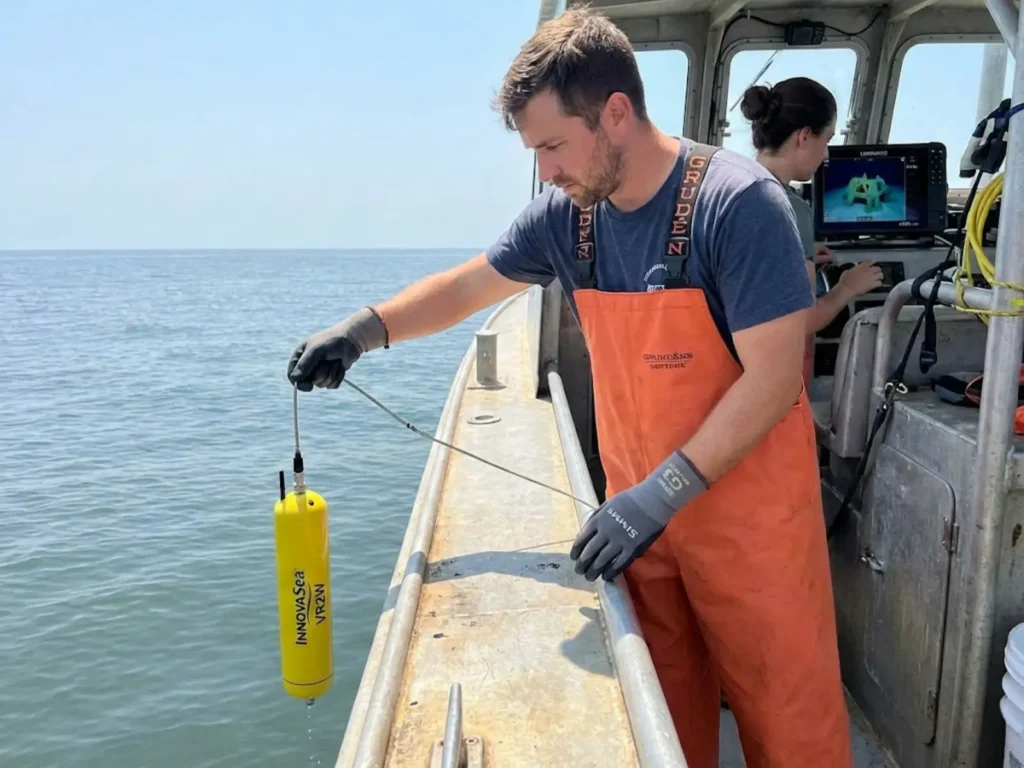
The biggest leap in understanding cobia behavior came from acoustic telemetry. This technology allows researchers to track individual fish with high spatiotemporal resolution.
Acoustic tags emit coded ultrasonic “pings” every 60 to 120 seconds. These pings are detected by VR2W or VR2Tx receivers moored to the ocean floor. When a tagged cobia swims within range (approximately 300-800 meters depending on sea state), the receiver logs the unique ID of the fish, the date, and the time.
No single agency can track a fish from Florida to Virginia. Instead, researchers rely on cooperative networks like the Florida Atlantic Coast Telemetry (FACT) and the Atlantic Cooperative Telemetry (ACT) arrays. This data-sharing system means a cobia tagged by SCDNR in Hilton Head can be detected by a US Navy receiver in Norfolk or a Smithsonian receiver in Florida. The same acoustic principles that power sonar geometry and fish finder technology enable researchers to track cobia across hundreds of miles.
One of the most instructive examples is the “CCA Triangle” project in South Carolina. Funded by the Coastal Conservation Association and Sea Hunt Boat Company, this project deployed acoustic receivers on three specific artificial reefs: 4KI, Edisto 60, and Edisto Offshore. The data confirmed high site fidelity to artificial structure. Cobia didn’t merely pass by these reefs. They lingered, moving between these specific reefs, treating them as waypoints on their migratory highway.
For the angler, this validates the strategy of “reef hopping.” If a cobia isn’t present on one specific wreck, it’s highly probable it’s on a nearby structure.
Pop-up satellite archival tags (PSATs) reveal even more. Unlike acoustic tags which require a nearby receiver, PSATs record temperature, depth, and light intensity, popping off the fish at a pre-programmed time to transmit data to the Argos satellite system. This data has shown that cobia frequently use the continental shelf break and can dive to depths exceeding 200 meters (656 feet). This behavior is often thermally driven. During cold snaps or in winter, cobia retreat to the thermal stability of the Gulf Stream or deep shelf waters.
Telemetry has also challenged the notion that all cobia migrate south for winter. Research by Dr. Sean Powers in the Gulf and findings in North Carolina suggest the presence of “resident” contingents, groups of fish that overwinter offshore in their respective regions rather than migrating to the Florida Keys.
Pro tip: If a reef isn’t producing during the spring run, don’t abandon the area. Check nearby structures within 5-10 miles. Telemetry shows cobia navigate a mental map of high-relief features, moving between them as they migrate.
Environmental Drivers: Temperature, Depth, and Water Quality
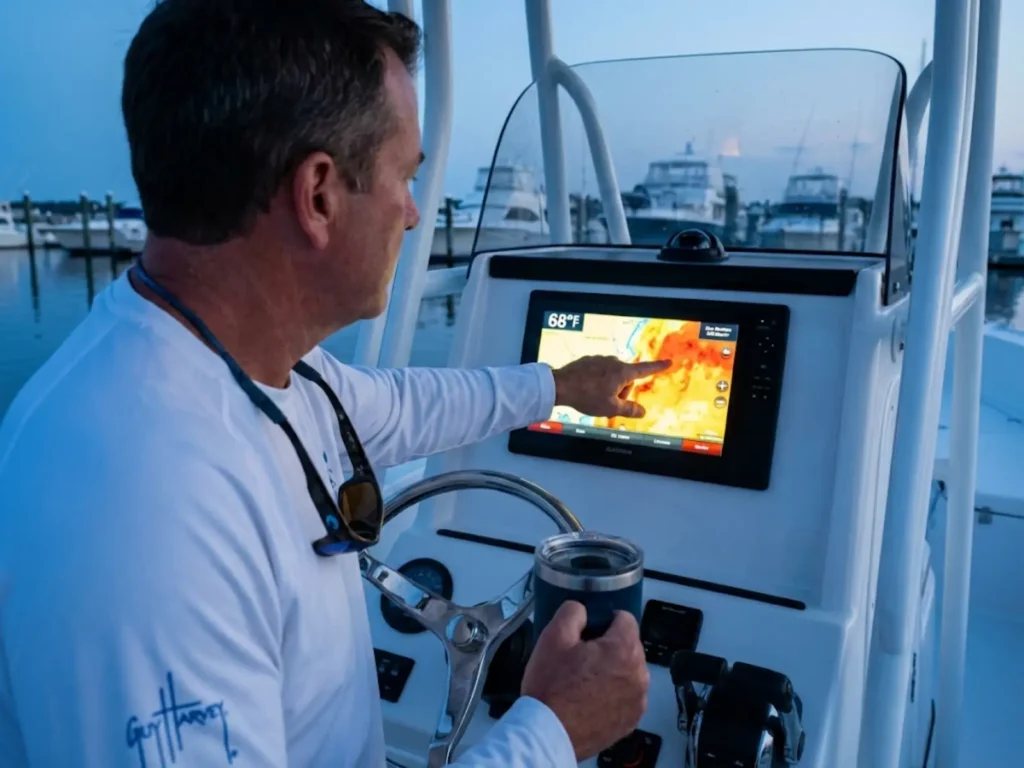
Cobia are poikilotherms. Their body temperature matches the water. Their metabolic enzymes function optimally within a specific thermal range. Extensive analysis of catch data and telemetry detections has identified a “Magic Zone” for cobia activity.
The arrival threshold is 67-68°F. The migration front is typically characterized by water temperatures reaching this mark. As the 68°F isotherm moves north along the coast in spring, the cobia move with it. Anglers can track this using sea surface temperature (SST) charts provided by services like SatFish or NOAA. Understanding thermocline dynamics and fish positioning helps explain why cobia move vertically when surface temperatures exceed their comfort zone.
Peak activity occurs between 70-73°F. The highest density of fish and the most aggressive feeding behaviors are observed when water temperatures are in the low 70s. This is the prime window for sight fishing. The thermal ceiling sits above 75°F. As water temperatures exceed this mark, cobia tend to move deeper to find cooler water or accelerate their migration northward.
This thermal constraint is the single most reliable predictor of the spring run. If the water off Daytona Beach is 66°F, the fish are likely south. If it hits 69°F, the run is on.
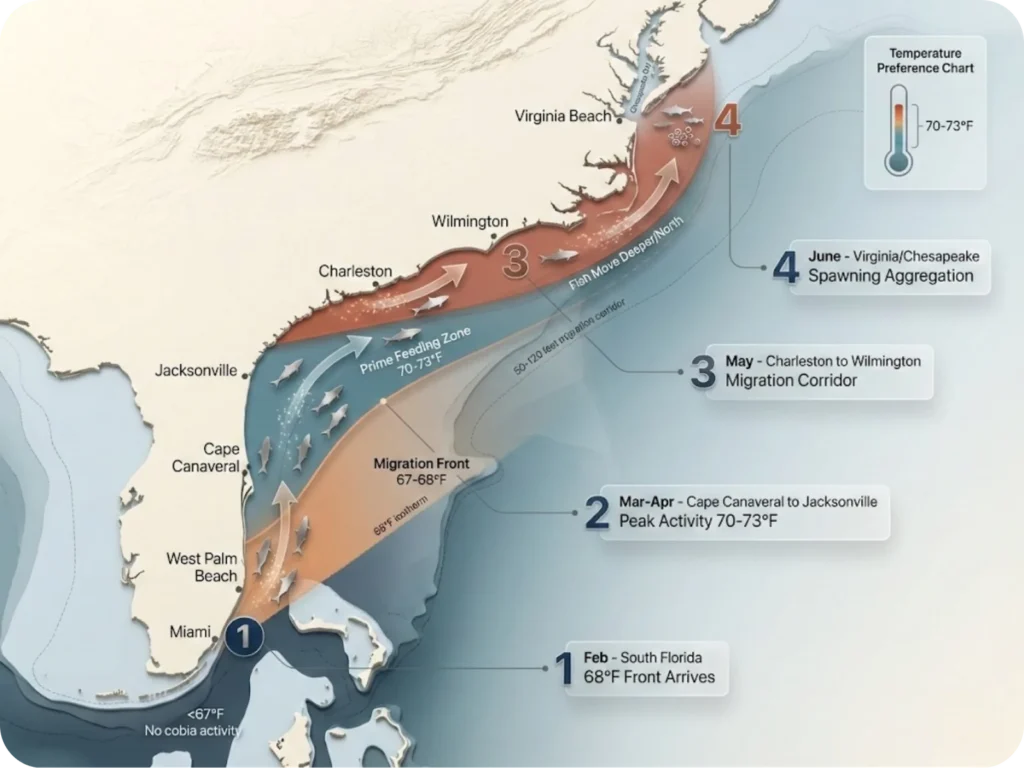
Cobia migration is spatially constrained by depth. They don’t scatter across the entire ocean but follow specific bathymetric corridors. Satellite data suggests a strong preference for the depth band between 50-120 feet during migration. During the spawning season, cobia move into shallower waters, often patrolling the beaches and entering sounds in depths of 15-40 feet.
Water clarity and biological productivity also play a role. Cobia prefer “blue to green” inshore water with chlorophyll concentrations between 0.5-5 mg/m³. They’re often found on the color change, the distinct line where dirty inshore water meets cleaner offshore water. This edge concentrates bait, which in turn concentrates predators.
Pro tip: Use satellite sea surface temperature mapping to track the 68°F isotherm’s northward progression. When it reaches your home waters, the run is imminent within 7-10 days.
The Commensal Complex: Rays, Sharks, and Host Associations
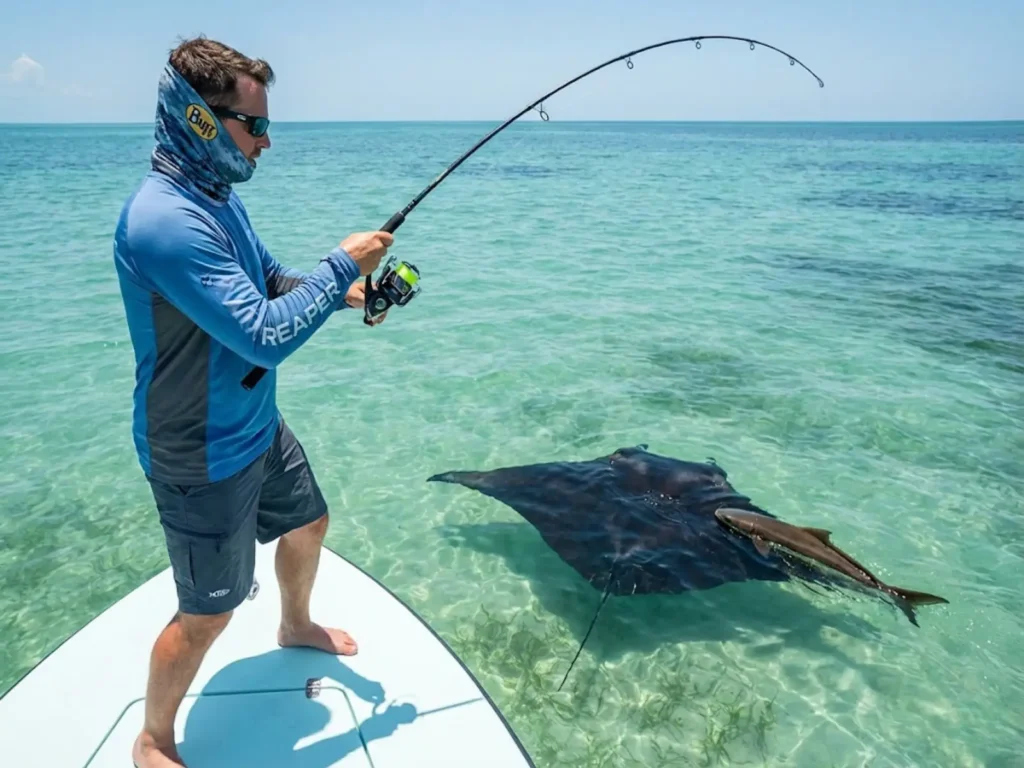
Perhaps the most famous behavioral trait of the cobia is its commensal relationship with large marine animals. For the angler, recognizing the host is often more important than spotting the cobia itself.
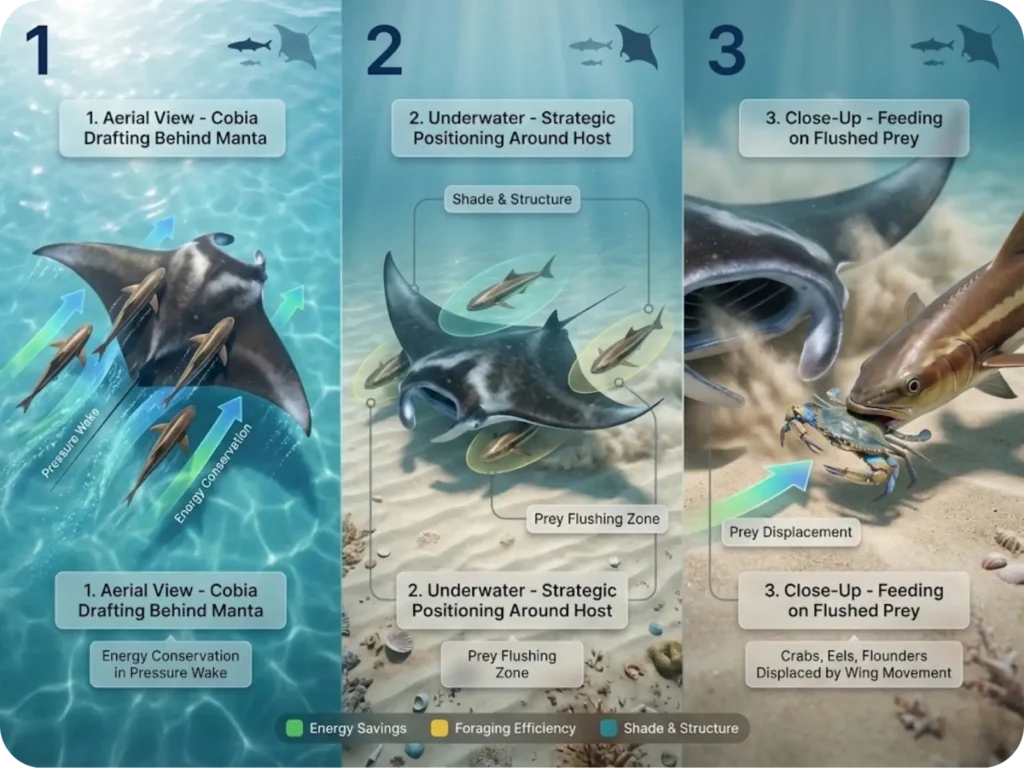
In Florida and the South Atlantic, the spring cobia migration is inextricably linked to the migration of the giant manta ray (Mobula birostris). Cobia associate with mantas for two reasons: shade and structure in a barren environment, and foraging efficiency. The massive wings of the manta ray disturb the substrate as they swim, flushing out crabs, eels, and flounders. The cobia, positioned around the ray, easily pick off this displaced prey.
It’s also hypothesized that cobia “draft” off the manta rays, using the pressure wake created by the ray’s large body to reduce their own swimming energy costs. This is a major adaptation for a fish without a swim bladder. While targeting cobia around rays, remember stingray safety and handling protocols if wading shallow water where southern stingrays bury in sand.
Cobia are frequently observed shadowing large sharks, including bull sharks, tiger sharks, and lemon sharks, as well as southern stingrays. Drone studies have documented cobia following southern stingrays for over 90 percent of observed periods, actively consuming prey flushed by the ray. Research on predator-predator commensalism confirms this behavior through detailed observation.
While sharks provide food for cobia, they also predate upon them. A hooked cobia that was shadowing a bull shark is in immediate danger of being eaten. This is the “tax man” problem. Anglers must employ heavy drag settings and quick maneuvering to separate the cobia from the shark once hooked. When fishing a shark-cobia pair, the lure must be presented aggressively. The cobia is in a competitive feeding mode. A large, erratic lure mimicking a wounded fish flushed by the shark often triggers a strike where a subtle presentation might fail.
The Florida Manta Project and other conservation groups have highlighted the risks recreational angling poses to mantas. Casting heavy jigs with treble hooks at rays can lead to foul-hooking the protected species. Best practices dictate casting away from the ray’s body or wingtips, aiming instead for the area behind or under the ray where the cobia are drafting. If a ray is hooked, the line should be cut as close to the hook as possible to prevent trailing gear that can cause injury. The recreational cobia fishing and manta ray conservation study documents these concerns and provides guidance for ethical angling.
Pro tip: When fishing a shark-cobia pair, use large, erratic lures with a wounded baitfish profile. The cobia is in competitive feeding mode and will strike aggressively where subtle presentations fail.
Regional Case Studies: Timing and Tactics by Coast
The application of migration science varies by geography. A tactic that works in the Florida Keys in February may fail in Virginia in July.
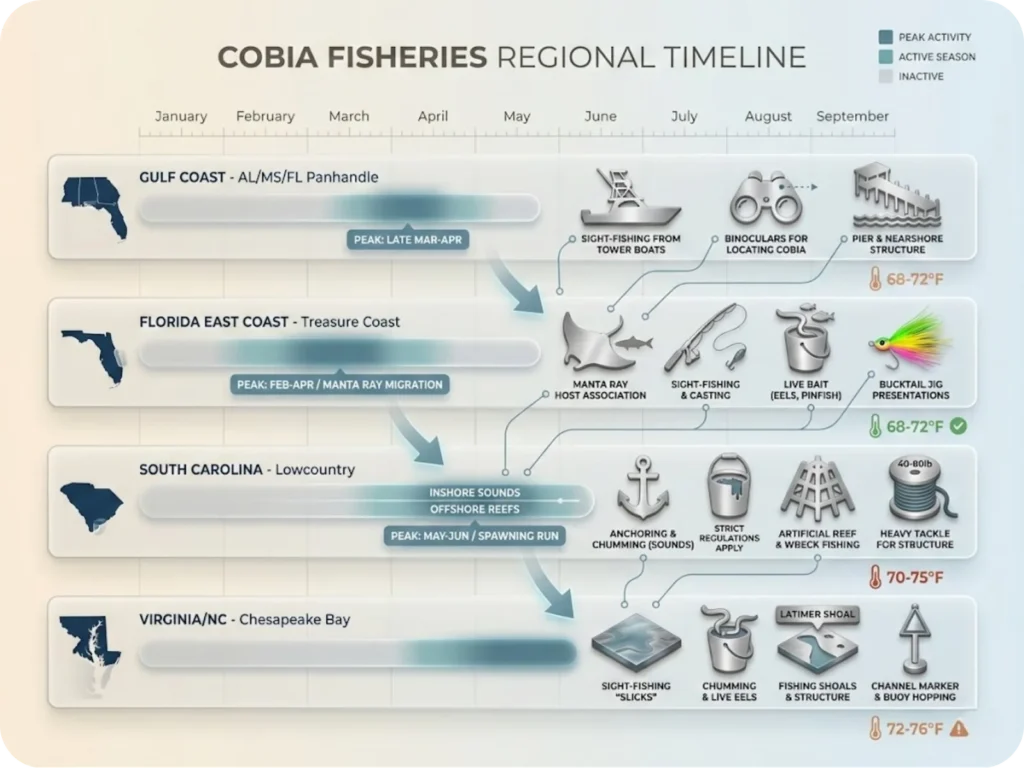
Gulf Coast (Alabama, Mississippi, Florida Panhandle):
Late March through April, though Dr. Sean Powers’ research shows the run has become “less distinct.” Tower boats patrol the “second bar,” captains scanning from 20 feet up for brown shapes against emerald water. Pier reports from Gulf Shores, Destin, and Pensacola help time trips. The tower boat technique aligns with broader Gulf of Mexico inshore fishing tactics for spotting surface gamefish.
Florida East Coast (Treasure Coast):
February through April, driven by manta ray movement. Water at 68-72°F triggers the run. Sight-fishing dominates in 20-40 feet. Locate manta wingtips breaking the surface, cast live eels, pinfish, or bucktail jigs (green, yellow, orange, pink) ahead of the ray’s path.
South Carolina (Lowcountry):
May through June brings a split fishery: inshore spawning run into Port Royal and St. Helena Sounds, plus an offshore run on artificial reefs like the CCA Triangle structures. Sound fishing uses anchoring and chumming (strict regulations apply). Offshore is a bottom game with live pinfish and menhaden on 40-80lb braid to winch fish from structure.
North Carolina and Virginia:
June through September. Fish enter Chesapeake Bay or pass Cape Hatteras. Sight-fish on “slicks”—calm, oily surface patches from baitfish being crushed below. Chumming with live eels on shoals like Latimer Shoal draws cobia from structure. Fish spawn in the lower Bay near the mouth and channel edges.
Angling Applications: Translating Science to Catches
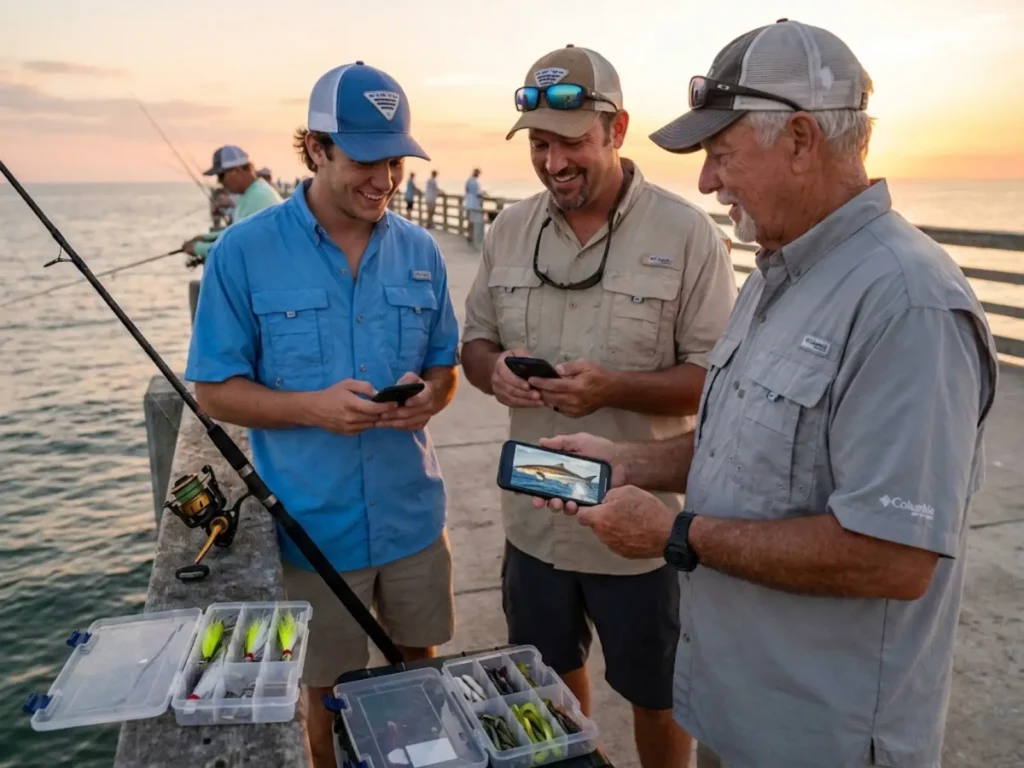
Because cobia lack a swim bladder and feed on benthic crustaceans, the most effective lure sinks. Floating plugs or suspending jerkbaits stay out of the cobia’s energy-neutral zone—the bottom.
The bucktail jig is the gold standard. Its dense lead head reaches the bottom quickly where resting cobia lie, and the hair creates a pulsing profile that mimics crabs and squid. Snap it violently off the bottom to trigger a reaction, then let it free-fall. That puff of sand upon impact often seals the deal.
Soft plastic eel imitations (Hogy, RonZ) mimic the sinusoidal swimming motion of natural prey. These work higher in the water column for cruising fish actively searching for food.
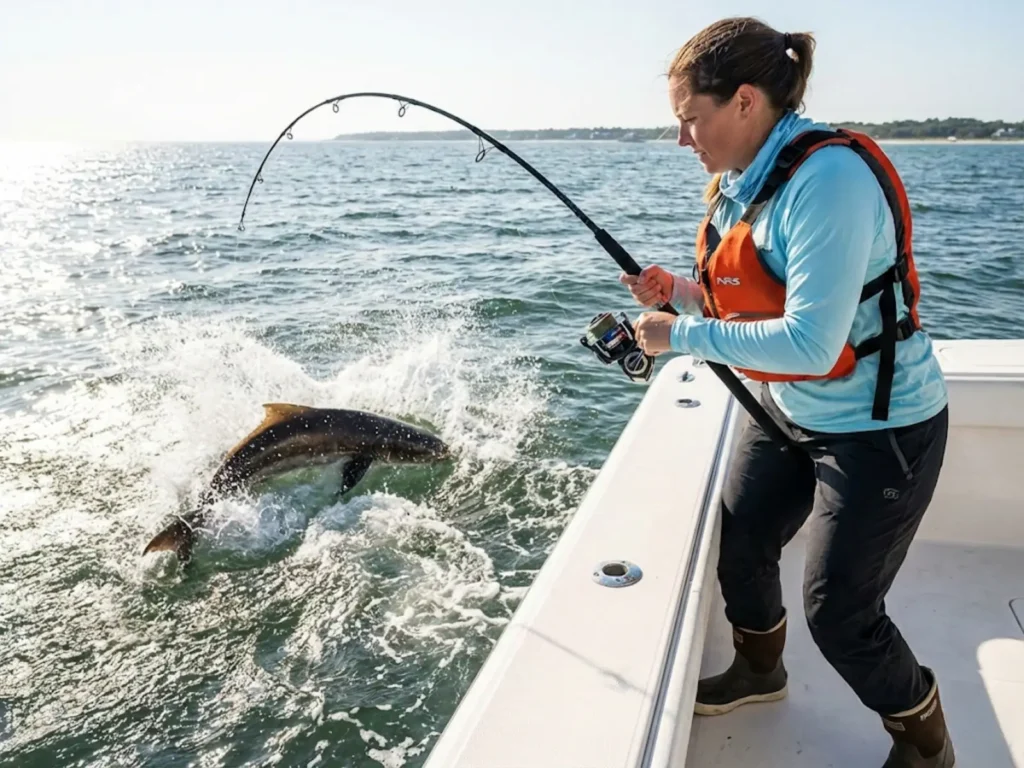
Cobia behavior when hooked is notorious. They often swim toward the boat initially, then explode into violent, crocodile-like death rolls near the surface. This rolling twists and weakens monofilament instantly. A high-quality ball-bearing swivel is non-negotiable to absorb the rotational torque. The death roll challenge requires mastery of fighting big fish with proper rod angle and drag to prevent hook pulls or leader failure.
A long leader is your insurance policy: 4-6 feet of fluorocarbon in the 50-80lb test range. This protects against the fish’s teeth, rough skin, sharp dorsal spines, and the structure they’ll try to wrap around.
Successful sight fishing requires high-quality polarized lenses—copper or rose base for inshore contrast—to spot the brown back against green water or the dark shape of a ray. Never cast directly at a cruising cobia. This mimics a predator attacking, not prey fleeing, and will spook the fish. Cast across the fish’s path or land well ahead, allowing the lure to sink naturally into the strike zone.
Pro tip: When a hooked cobia starts its death roll near the boat, resist the urge to pull hard. Maintain steady pressure and let the rod absorb the torque. Yanking during the roll often pulls the hook or breaks the leader.
Conservation and Ethical Angling
The high site fidelity revealed by telemetry means local populations can be depleted. The rapid growth rates mean a 60-pound fish is likely a young, prime spawner, not an old individual. Trophy fish are reproductively critical.
Best practices for release: Support the body horizontally. Never hold a heavy cobia vertically by the jaw—their internal anatomy isn’t designed to support their weight out of water, and you can cause internal organ damage that kills the fish days later. When bait fishing, non-offset circle hooks drastically reduce gut-hooking. Minimize air exposure to 30 seconds maximum for photos. Mastering proper fish handling and release techniques ensures your released cobia survives to spawn.
Anglers are the eyes and ears of science. Reporting tagged fish (tag color, ID number, location, date) provides data points that fuel management models. The SCDNR cobia tagging program and reporting protocols rely on angler participation to track movements and survival rates.
Immunity to barotrauma means cobia can be released from deep water without venting or descending devices. No swim bladder to rupture means the fish can return to depth immediately.
Pro tip: If you’re targeting cobia during spawning season in known spawning estuaries like Port Royal Sound or Chesapeake Bay, consider a “one and done” approach. Keep one legal fish for the table, release all others, especially large females.
Conclusion
The science is clear: cobia are not random wanderers. They are predictable creatures governed by thermal triggers, bathymetric corridors, and commensal instincts. The 68°F isotherm marks the migration front. The 50 to 120-foot depth band is the highway. The manta ray is the dinner bell. Armed with satellite tagging data, acoustic telemetry insights, and genetic stock knowledge, you’re no longer guessing. You’re calculating. Track the SST charts, scout the reefs, watch for the rays, and when that brown torpedo appears in your sight line, you’ll know exactly why it’s there and exactly how to make the cast count.
FAQ
What water temperature triggers cobia migration?
Cobia migration begins when water temperatures reach 67-68°F, with peak activity occurring between 70-73°F. Track sea surface temperature (SST) charts to predict when the 68°F isotherm will reach your home waters. The run typically follows within 7-10 days.
Why do cobia follow manta rays?
Cobia follow manta rays for two reasons: the ray’s wings disturb the substrate while swimming, flushing out crabs, eels, and flounders that cobia feed on, and the cobia can draft in the pressure wake created by the ray’s large body to reduce swimming energy costs. This is particularly important for a fish without a swim bladder.
What’s the difference between Gulf and Atlantic cobia stocks?
Genetic analysis and tagging studies confirm two distinct migratory groups: the Gulf Migratory Group (Texas to east Florida, clockwise migration) and the Atlantic Migratory Group (Florida-Georgia border to New York, North-South migration). They have different migration timing, bag limits, and management regulations.
How deep do cobia dive during migration?
Pop-up satellite archival tags reveal cobia frequently dive to depths exceeding 200 meters (656 feet), using the continental shelf break and deep Gulf Stream waters. During migration, they prefer the 50-120 foot depth band, but move vertically to deeper, warmer water during cold snaps.
What’s the best lure for cobia?
Bucktail jigs (2-4 oz) are the gold standard because their dense lead heads sink quickly to the bottom where cobia rest, and the pulsing hair mimics crabs and squid. Soft plastic eel imitations are also highly effective, mimicking the sinusoidal swimming motion of natural prey. Floating or suspending lures are often ignored because they stay out of the cobia’s bottom-oriented feeding zone.
Risk Disclaimer: Fishing, boating, and all related outdoor activities involve inherent risks that
can lead to injury. The information provided on Master Fishing Mag is for educational and informational purposes
only. While we strive for accuracy, the information, techniques, and advice on gear and safety are not a substitute
for your own best judgment, local knowledge, and adherence to official regulations. Fishing regulations, including
seasons, size limits, and species restrictions, change frequently and vary by location. Always consult the latest
official regulations from your local fish and wildlife agency before heading out. Proper handling of hooks, knives,
and other sharp equipment is essential for safety. Furthermore, be aware of local fish consumption advisories. By
using this website, you agree that you are solely responsible for your own safety and for complying with all
applicable laws. Any reliance you place on our content is strictly at your own risk. Master Fishing Mag and its
authors will not be held liable for any injury, damage, or loss sustained in connection with the use of the
information herein.
Affiliate Disclosure: We are a participant in the Amazon Services LLC Associates Program, an
affiliate advertising program designed to provide a means for us to earn advertising fees by advertising and linking
to Amazon.com. As an Amazon Associate, we earn from qualifying purchases. We also participate in other affiliate
programs and may receive a commission on products purchased through our links, at no extra cost to you. Additional
terms are found in the terms of service.