

In this article
A stingray strike doesn’t announce itself. You won’t see a splash or hear a warning growl. Instead, it happens in a split second: a violent explosion of sand under your boot, followed instantly by sharp, deep pain in your ankle or calf.
For a wading angler, the day changes instantly. One moment, you are stalking a redfish; the next, you are managing a serious injury, often miles from the dock. I have seen both experienced guides and excited beginners end up in agony because they relied on luck rather than understanding how these animals work.
Safety on the flats isn’t just about shuffling your feet. It’s about having a real safety protocol guide. You need to understand marine biology, how the substrate type you walk on changes things, and exactly what to do if things go wrong during your coastal recreation.
What Makes Stingrays Such a Stealthy Hazard in Shallow Water?
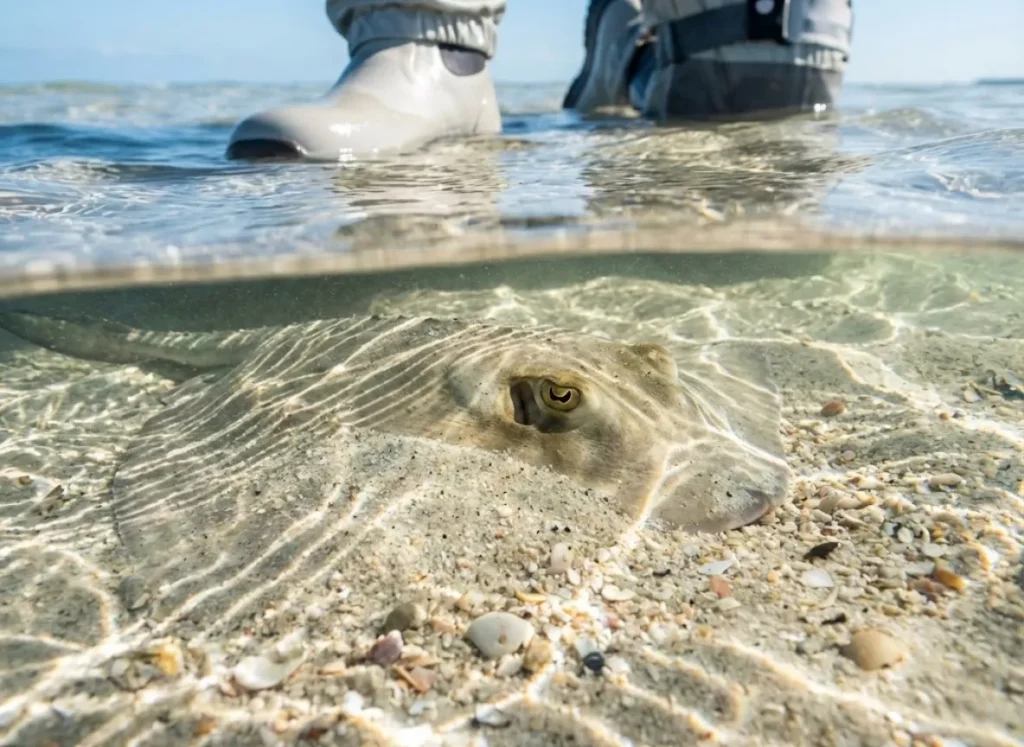
Stingrays hang out in the exact same spots we like to fish. They are driven by the same needs as the fish we target: comfortable water temperature and safety from predators. This overlap is why we bump into them so often.
How do stingrays use the sediment for camouflage and defense?
Stingrays, especially the Round stingray found near San Diego and La Jolla, or the larger Florida stingray populations along the Gulf Coast and Port Mansfield, live right on the bottom. They use the sand to control their body temperature and hide from sharks. To do this, they wiggle their flat wings to cover themselves completely in sediment.
When they are hidden like this, the only things sticking out are their eyes and the small breathing holes behind them, called spiracles. This makes them almost impossible to see, even in clear water. While identifying the physics of glare helps you spot swimming fish, it rarely helps you pick out a buried ray from the bottom. This hiding behavior is most common in the shallow surf and flats where the water is warm—exactly where we like to wade.
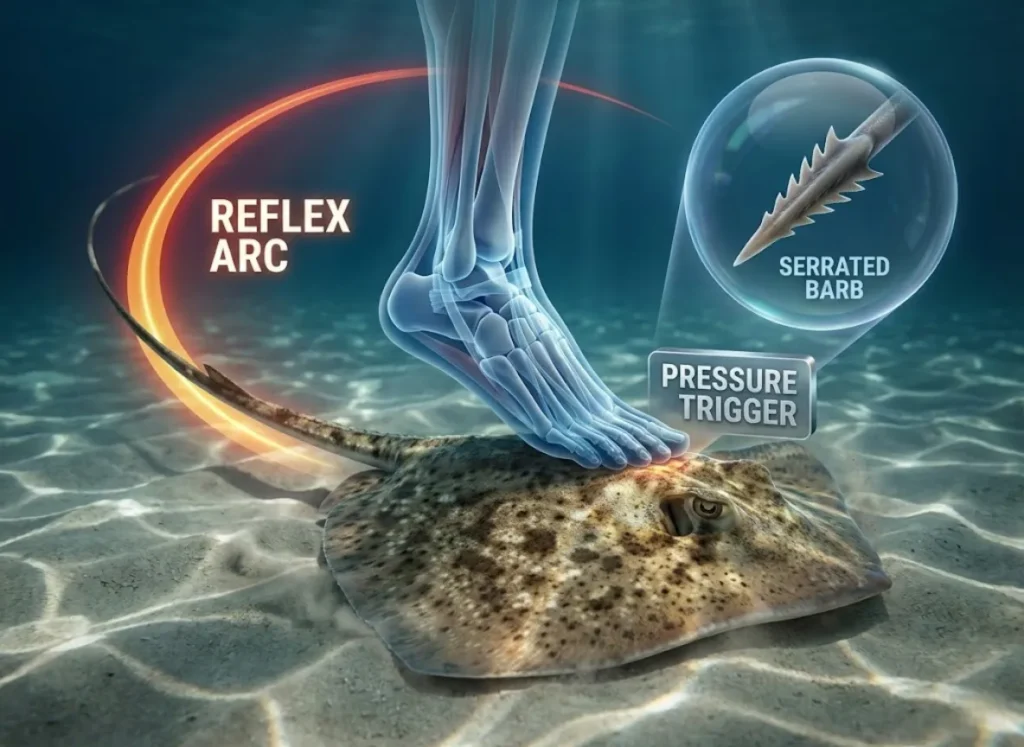
The “strike” isn’t an attack. It is a reflex. It happens when you step on the ray’s main body disc. The pressure triggers the tail to whip up and forward, driving the barbed stinger into whatever is pinning the ray down.
The barb acts like a serrated knife. As described in this anatomical review of stingray envenomation mechanisms, the spine has backward-facing teeth, like a Christmas tree. These venomous spinal blades let the barb go in easily, but they tear tissue when it comes out. Because the spine is brittle, the tip often breaks off inside the puncture wound, which complicates medical treatment and increases the risk of infection.
Why Is the “Stingray Shuffle” the Gold Standard for Avoidance?
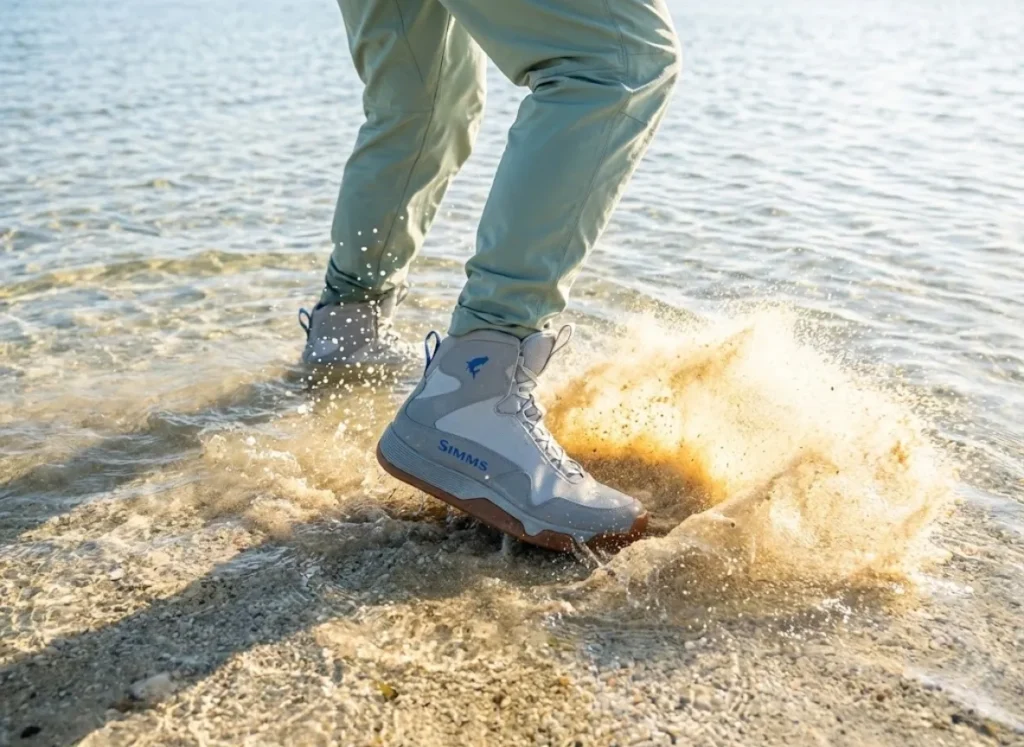
The “stingray shuffle” (sometimes called the “stingray stomp“) is your first line of defense, but it isn’t magic. It works because of sound waves, and there are specific ground conditions where it stops working entirely.
How does sliding your feet actually communicate with the ray?
The shuffle is simple: you slide your feet along the bottom without lifting them. This keeps you in constant contact with the ground. This sliding motion creates a low-frequency vibration that travels through the sand.
Stingrays have vibrational sensors on their undersides specifically designed to feel this. As explained in this study on the sensitivity of the stingray lateral line system, they can detect these vibrations from a distance using their lateral line. The shaking from your sliding foot acts like a “proximity alarm.” It warns the ray you are coming, causing it to swim away before you step on it.
Pro-Tip: Don’t just drag your feet; kick the sand slightly. You are trying to send a shockwave, not just move quietly. The goal is to be “loud” underwater.
This works best on hard-packed sand, which carries the vibration well. If you understand how the fish lateral line system works, you realize the shuffle is a form of communication. You are telling the animal to move. Sliding also prevents you from pinning the ray. If you slide into one, you usually nudge its side. This startles it, but it rarely triggers the whip-like strike that comes from stepping directly on top of it.
When does the shuffle fail and leave you vulnerable?
Physics changes when you move from hard sand to soft mud. In the marsh or back-lakes, the soft muck absorbs the energy of your steps.
According to technical data regarding the attenuation of shear waves in marine sediments, thick mud (low substrate density) kills the vibration rapidly. This shrinks your “warning radius.” In these spots, the ray might not feel you until you are practically standing on top of it.
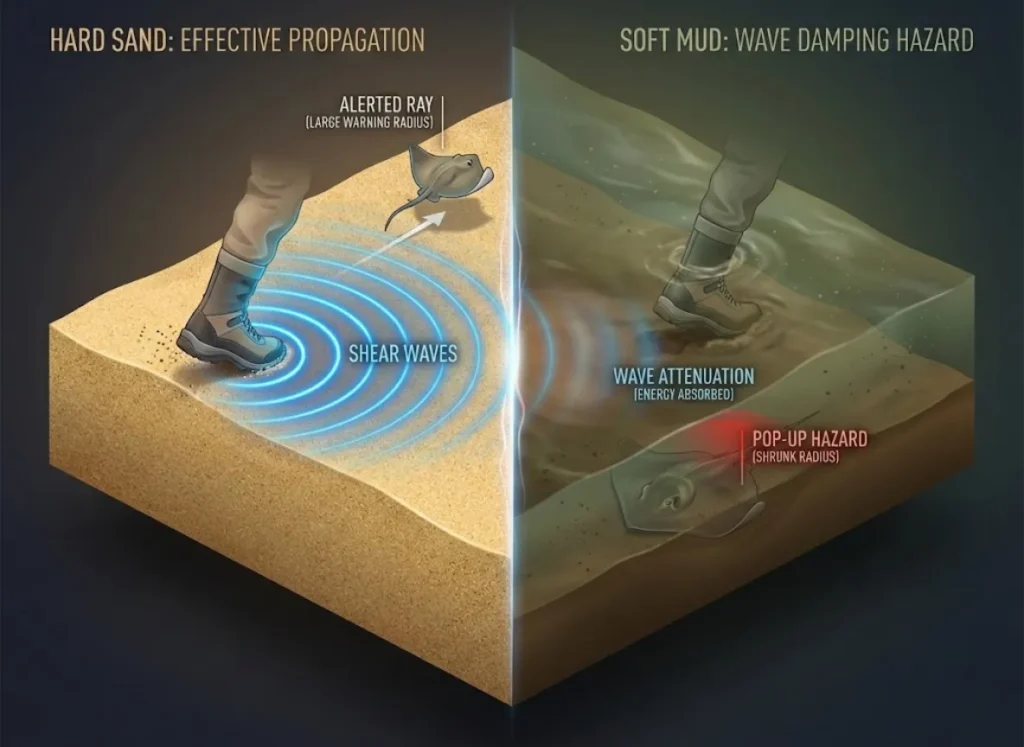
To make matters worse, these areas often have dirty or murky water, so you can’t see the bottom. This creates a “Pop-Up” hazard. Your foot slides under the wing of a buried ray instead of bumping the edge. Lifting a ray from underneath can panic the animal. If it feels trapped by your leg, it may strike.
In these dangerous zones, you have to slow down. While standard tactics for fishing from shore usually rely on being quiet, safety here requires noise. You must deliberately plow through the mud to make enough disturbance to alert the ray. Some anglers even poke rays with rod point ahead of them in extreme visibility conditions. Because the shuffle isn’t perfect here, your gear becomes your main protection.
What Gear Actually Stops a Stingray Barb?
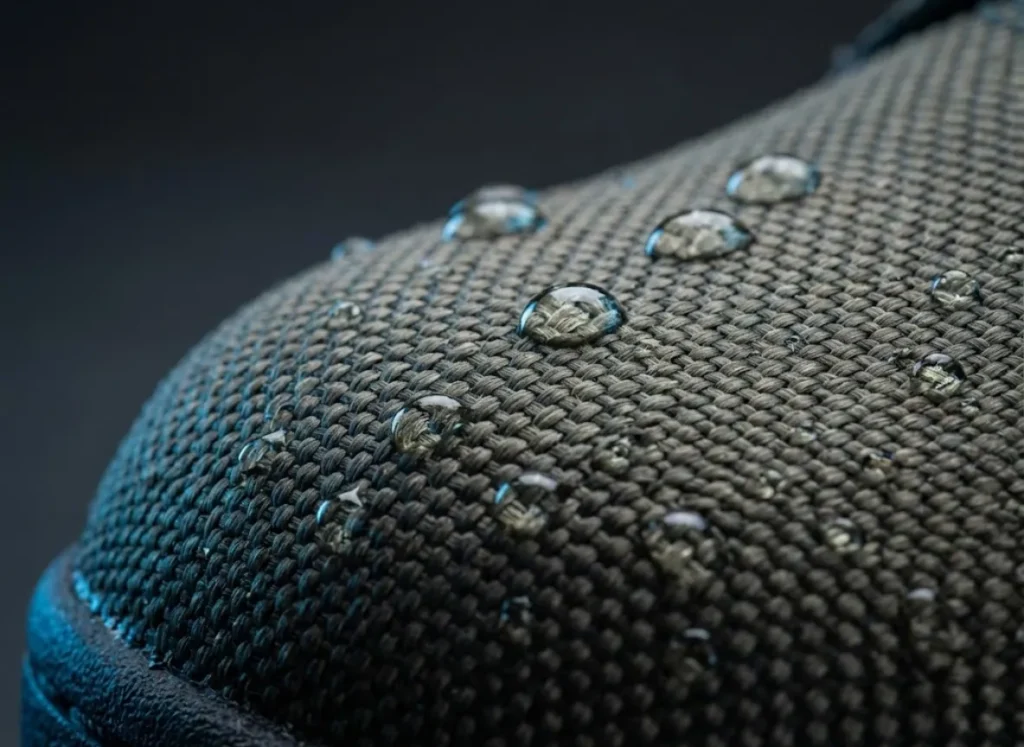
When you can’t rely on the shuffle, you rely on your boots. But not all boots are equal. We need to look at the difference between standard rubber boots (which give false security) and specialized wade fishing protection.
Why do standard rubber wading boots often fail against strikes?
Regular foot waders, like hiking-style Simms Tributary boots or neoprene booties, rely on thickness for protection. While thick rubber might stop a glancing blow, it is not rated to stop a direct hit from a large Southern Stingray.
The strike puts all the force on the barb’s needle-sharp tip. Analysis of the penetration mechanics of serrated spines shows how easily that tip punches through rubber and synthetic leather. Also, many hiking-style boots leave your ankle and calf exposed. This is exactly where larger rays tend to hit.
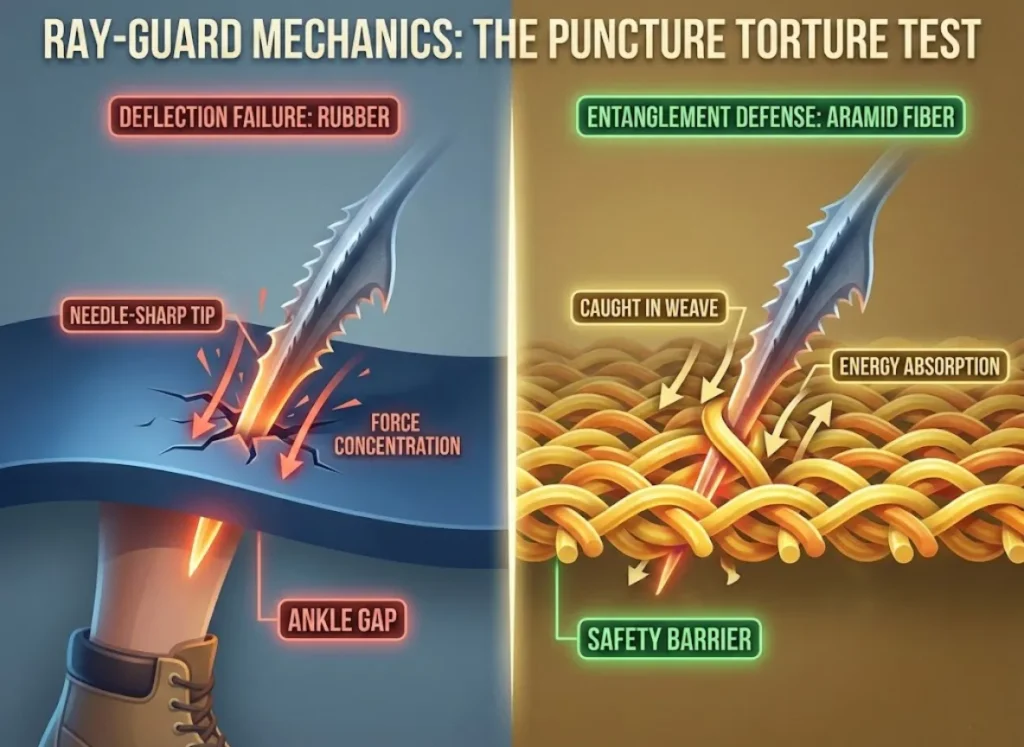
Plastic Ray-Guard shields can help, but they often have an “ankle gap.” A barb can slide between the boot and the guard, hitting soft skin. We often talk about stress-testing fly fishing waders for leaks, but we rarely put our gear through a gear torture test for puncture resistance until it’s too late.
How do engineered aramid fabrics provide superior protection?
Modern stingray protection uses layers of tightly woven fibers, similar to Kevlar. Brands like Bart’s Armor, Foreverlast, and Dragonskin booties don’t just try to block the barb; they trap it.
The tight weave catches the serrations on the spine. As the barb tries to push through, the fibers grab those “Christmas tree” teeth. This spreads out the energy and stops the barb from going deeper. This technology allows for boots that cover your whole foot and calf without being heavy or stiff.
For wade fishermen focusing on inshore wade fishing in the Gulf, where big rays are common, buying rated footwear is the only real safety net. A pair of Dragonskin stingray proof boots costs more than a pair of sneakers, but it is much cheaper than an emergency room visit.
How Should You Manage a Stingray Injury in the Field?
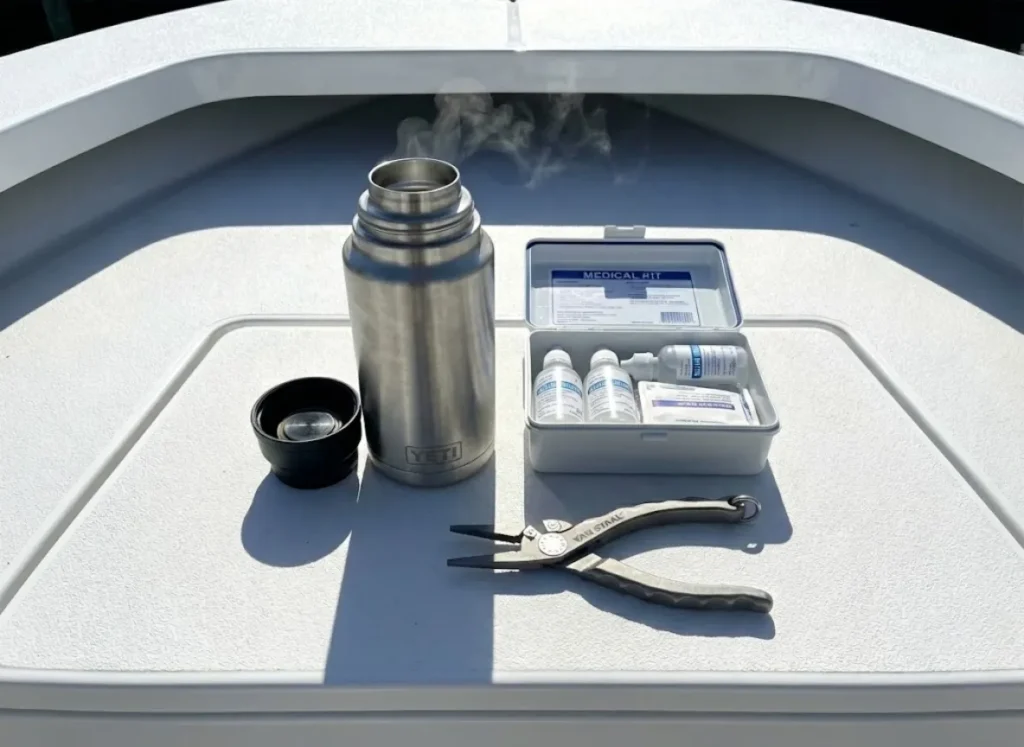
Even with armor and the shuffle, accidents happen. If a stingray barb gets through, you need to focus on two things: killing the pain with heat and cleaning the wound to stop infection. This is the core of immediate reactive protocols.
Why is hot water the only effective treatment for the venom?
Stingray venom is a mix of venomous proteins that causes intense pain. However, this is a thermolabile venom, meaning these proteins are sensitive to heat. They fall apart, or denatures toxins, when they get hot enough.
The best treatment is Hot Water Immersion. As confirmed by studies on the bioactive properties of stingray venom, the water needs to be roughly 110°F–115°F (42°C – 45°C). The soak duration should be 30 to 90 minutes. The relief is usually instant as the venom breaks down.

Do not use ice. Ice closes up your blood vessels, trapping the venom in one spot and causing more damage to the flesh. Also, forget the old myths about Adolph’s meat tenderizer (papain) or urine. They don’t work because they can’t get deep enough into the wound to reach the venom.
Pro-Tip: Carry a thermos of hot water on your boat or kayak. If you are wading far from the vessel, this immediate access to heat can save you an hour of excruciating pain during the transport back to land.
If you are stuck on a boat without a thermos, some anglers use the outboard’s cooling system tell-tale stream (pee stream) as a source of warm water for remote first aid. However, be very careful of engine outflow burn risk and contaminant risk from exhaust.
When you are following fishing safety tips, always test the water temperature with a hand or uninjured foot first. The venom can make the wound numb, so the injured person might not feel if the water is boiling hot, leading to severe burns on top of the stingray sting.
Why is the secondary infection risk often deadlier than the venom?
Stingrays live in warm water that is full of bacteria, specifically Vibrio vulnificus. A sting is essentially a deep injection of this bacteria past your skin’s defenses.
Recent health advisories on Vibrio vulnificus warn that these infections can turn into “flesh-eating disease” (necrotic tissue) within 24 to 48 hours. You must flush the wound immediately with fresh water or sterile saline to wash out the bacteria.
When dealing with gear or pulling a barb out of a boot, make sure you are using the best fishing pliers that are clean. Never seal the wound with superglue or liquid bandage. Puncture wounds need to stay open to drain so bacteria doesn’t get trapped inside. If you have liver disease or a weak immune system, you are at high risk and need to get to a hospital immediately for antibiotics and a tetanus booster.
Conclusion
Survival on the flats comes down to preventative measures. The stingray shuffle works by using sound waves to warn the ray, but remember that soft mud kills those waves. When the bottom gets soft or the water gets dark, you can’t rely on the shuffle alone—you need puncture-resistant boots.
If you do get hit, ignore the myths. Don’t use ice. Heat water to roughly 113°F to stop the venom, and scrub the wound to fight the bacteria. Before your next trip, check your boots and throw a thermos of hot water in your bag. It makes the difference between a ruined trip and a safe return.
FAQ – Frequently Asked Questions about Stingray Safety
Does meat tenderizer actually help with a stingray sting?
No. Adolph’s meat tenderizer (papain) generally doesn’t work because it can’t soak deep enough into the puncture wound to reach the venom. It can also cause chemical burns on the open flesh.
Can a stingray barb go through rubber wading boots?
Yes. A large ray can drive its serrated barb right through standard rubber or leather boots. For real protection, you need boots lined with special tough fabrics, like woven aramid found in Dragonskin or Bart’s Armor.
Is a stingray injury fatal?
Deaths from the venom itself are very rare. Fatalities usually happen if the barb hits a vital organ (like the chest) or if the wound gets infected later. Untreated infections can be life-threatening in just a few days. You can consult WebPoisonControl for immediate guidance, but go to the ER.
Should I remove the barb if it breaks off in my leg?
If the barb is barely in and loose, you can pull it out to stop more venom from entering. However, if it is deep or there are barb fragments, leave it for a doctor. If the barb is in the chest, stomach, or neck, never pull it out, as it might be plugging a hole in an artery or cause cardiovascular effects.
Risk Disclaimer: Fishing, boating, and all related outdoor activities involve inherent risks that
can lead to injury. The information provided on Master Fishing Mag is for educational and informational purposes
only. While we strive for accuracy, the information, techniques, and advice on gear and safety are not a substitute
for your own best judgment, local knowledge, and adherence to official regulations. Fishing regulations, including
seasons, size limits, and species restrictions, change frequently and vary by location. Always consult the latest
official regulations from your local fish and wildlife agency before heading out. Proper handling of hooks, knives,
and other sharp equipment is essential for safety. Furthermore, be aware of local fish consumption advisories. By
using this website, you agree that you are solely responsible for your own safety and for complying with all
applicable laws. Any reliance you place on our content is strictly at your own risk. Master Fishing Mag and its
authors will not be held liable for any injury, damage, or loss sustained in connection with the use of the
information herein.
Affiliate Disclosure: We are a participant in the Amazon Services LLC Associates Program, an
affiliate advertising program designed to provide a means for us to earn advertising fees by advertising and linking
to Amazon.com. As an Amazon Associate, we earn from qualifying purchases. We also participate in other affiliate
programs and may receive a commission on products purchased through our links, at no extra cost to you. Additional
terms are found in the terms of service.