
In this article
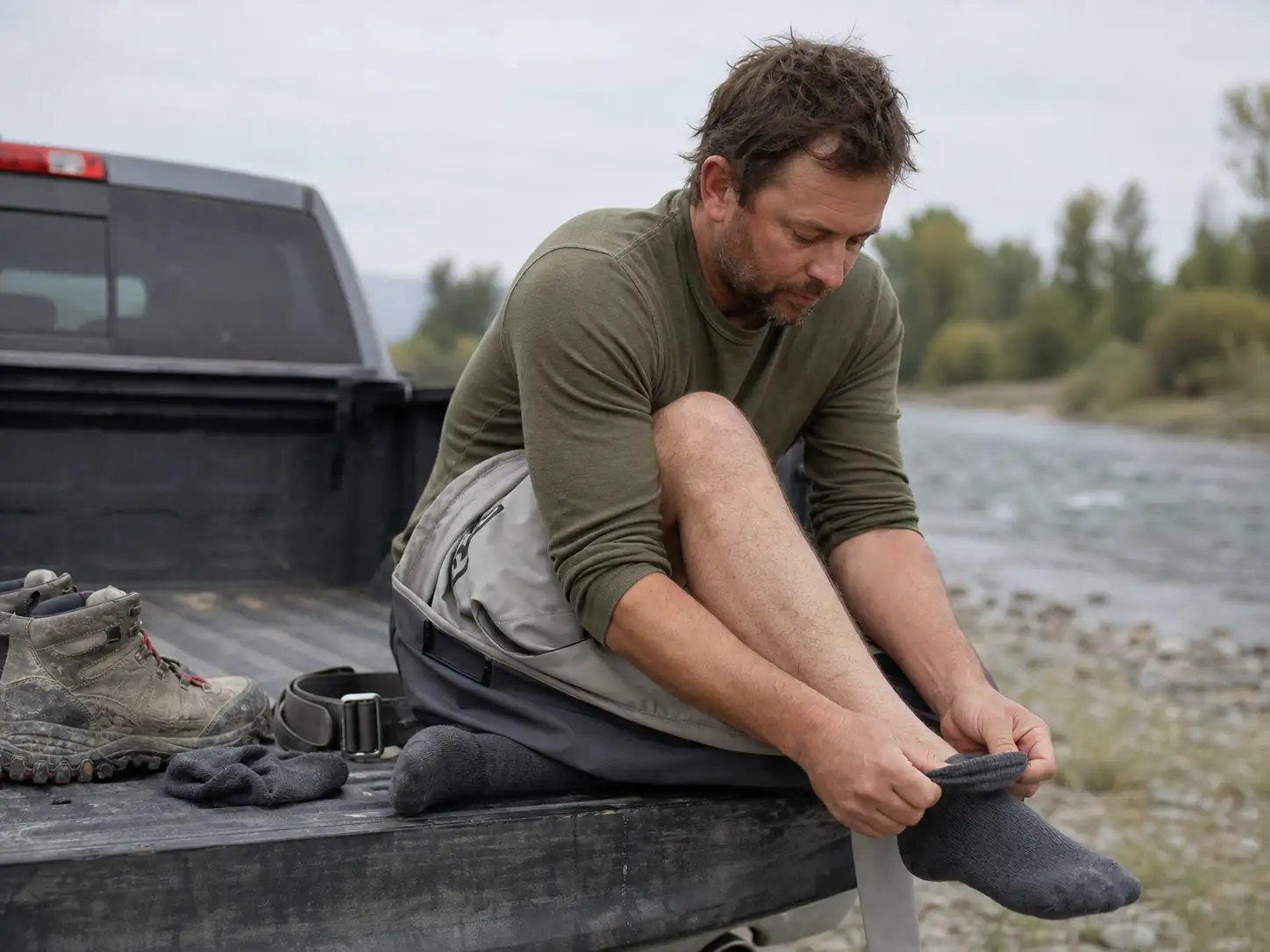
Four hours into a wade, you sit on the tailgate, pull the boot off, and the neoprene bootie comes out genuinely swampy. No leak, no cold water down the collar. That water is yours, and it has been marinating against your skin since about hour two.
Ask any fly shop that fits waders for a living and you get the same two pieces of advice on repeat: the sock matters more than people think, and almost nobody sizes their boots around it. This is what makes a sock work inside a sealed wader boot, how to pick weight and height for the water you fish, and what to buy at each tier.
Why Your Feet Get Soaked Inside Waders (It Isn’t the Water)
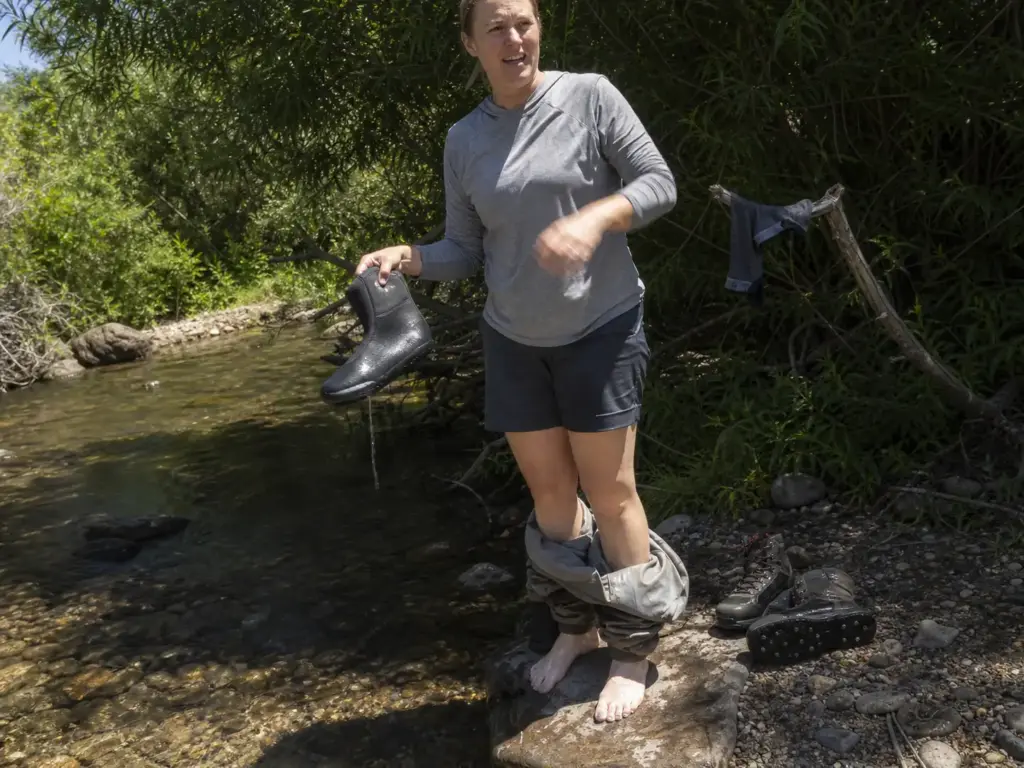
Most anglers with wet feet go looking for a pinhole. They flip the waders inside out under a lamp, run the alcohol test, find nothing, and conclude the seams are shot. The seams are usually fine. A stockingfoot wader bootie is a sealed rubber bag around your foot, and whatever your foot produces in there stays in there unless a fabric physically moves it somewhere else.
That movement has a mechanism. Moisture wicking works through capillary action: the fiber surface carries microscopic channels that pull liquid sweat off your skin and spread it toward the fabric’s outer surface, where it can evaporate. Synthetic fibers get engineered specifically for this, with noncircular cross-sections (triangular, cross-shaped, channeled) that maximize the capillary pull. That is why a good synthetic blend dries on the drive home while cotton is still damp the next morning.
Cotton does the exact opposite job. It absorbs and holds, so the moisture parks against your skin, and inside a sealed bootie there is nowhere for it to evaporate to. A cotton athletic sock becomes a wet compress strapped to your foot for the length of the float. Anglers call it dead cotton for a reason.
Neoprene fails differently. Neoprene waders and neoprene wading socks have zero wicking capacity by design, because the material’s job is to be a closed-cell barrier. Wear a neoprene sock over bare feet and the sweat has no fabric to travel through and no air to evaporate into, so it sits. Feet come out pruny by hour three and the smell announces itself before the boot is fully off. If you are still deciding at the wader level, it is worth knowing whether neoprene or breathable waders make sense for your water temperature before you blame the sock.
So the sock, not the wader, decides how your feet feel at the end of the day. It is the only layer in the stack whose entire job is moving water in a direction. And constantly wet feet are not purely a comfort complaint: trench foot can set in at water temperatures as high as 60°F, according to the CDC, which is a mild October afternoon, not an ice-fishing emergency.
Merino Wool vs Synthetic for Fishing Socks
Both materials work. They fail in opposite directions, and which failure you can live with depends on whether you are out for four hours or four days.
How merino handles moisture differently
Wool runs on the same merino-versus-synthetic logic that governs your base layers, applied to the part of you standing in the river. Merino wool absorbs up to 30% of its own weight in moisture before it feels damp, holding that water in the fiber core rather than on the surface touching your skin. Wool is hygroscopic: hydrophilic amino acid groups in the keratin structure grab moisture vapor and lock it in the fiber cortex before it becomes liquid sweat against your foot.
The honest version: wool is hiding the moisture, not eliminating it. Once genuinely saturated it dries slower than synthetic and stays heavier. On a one-day wade that never matters. On day three with no laundry, it does.
Where synthetic wins
Speed. A polyester or nylon liner dries in a fraction of the time, which is what you want from the layer touching skin. Engineered fibers like Coolmax exist specifically for this job, using channeled cross-sections built for moisture management rather than warmth. Synthetic also takes abrasion better inside a boot that grinds, and it costs less. What it loses, it loses badly.
The odor question nobody explains properly
Every sock label says “anti-odor” without saying why. Merino’s keratin structure binds and neutralizes the volatile compounds that sweat-feeding bacteria produce, and lanolin, the natural wax still in the fiber, carries its own antibacterial properties.
Wool is not masking the smell. It traps the molecules and coats itself in a grease that discourages the bacteria in the first place. Three days in wool will not clear the truck cab on the drive home. Three days in synthetic will.
Material only gets you so far. The habit that undoes it is stuffing wet socks into a dry bag at the takeout and finding them there the next morning. Sealed and damp overnight is a bacteria incubator, and they will not have dried either. Hang them anywhere with air moving.
On a multi-day trip, pack one more pair of socks than days you plan to fish, and rotate them wet-to-drying rather than washing anything. A sock that got 12 hours of open air beats a sock you rinsed in river water at 9pm and rolled up damp.
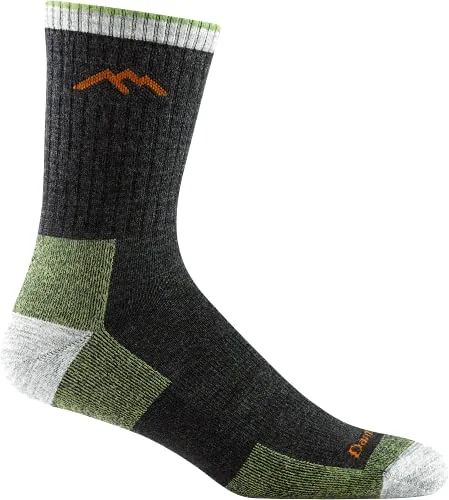
At 61-63% merino with nylon and a little Lycra, the 1466 sits where most anglers need to be: enough wool to handle odor and damp, enough nylon to survive the inside of a wading boot. Pure merino socks exist and they shred.
For the same material family from a different brand, the Smartwool Men’s Hike Medium Crew Socks cover the same midweight merino territory with a different fit through the arch. Some feet get along better with one brand’s last than the other’s, and there is no way to know which until you wear both.
Sock Weight and Height by Season
Most people own one sock weight and wear it in July and in January. That is two different problems getting the same wrong answer, and it is why the same angler complains about swampy feet in August and numb toes in December.
Lightweight for wet wading and summer boat days
A lightweight sock takes up almost no boot volume and dries fast, which is the whole assignment in warm water. Thin merino still beats a bare foot in a wading shoe, because bare skin against wet mesh is how you sand a hot spot into your heel by lunch.
Midweight for shoulder season and general wading
If you buy exactly one pair of fishing socks, buy a midweight sock. It gives real cushion under the footbed without eating the volume your boot needs for the neoprene bootie, and it covers water from late spring through the first cold snap. Merino is thermoregulating enough to make that range work: the same sock that keeps a foot from overheating in May still holds warmth in October.
Midweight is also where saturation starts to matter. A loaded sock stops moving vapor efficiently, the same way a jacket stops breathing when the face fabric is soaked: the same wetted-out problem that shows up in breathable outerwear, three layers lower.
Heavyweight and over-the-calf for cold water
Cold water changes the sock and the height. Over-the-calf height runs above the boot line so insulation continues up the leg under your waders instead of stopping at the ankle. The Simms Men’s Merino Wool Thermal OTC comes in at 81% merino / 18% nylon / 1% spandex, built specifically for under-waders use on the days you question your judgment.
That spec combination is where most “warm” socks fall down. Plenty of heavyweight socks carry only a modest wool percentage. Plenty of high-merino socks stop at crew height. You want both in the same sock, and surprisingly few deliver it.
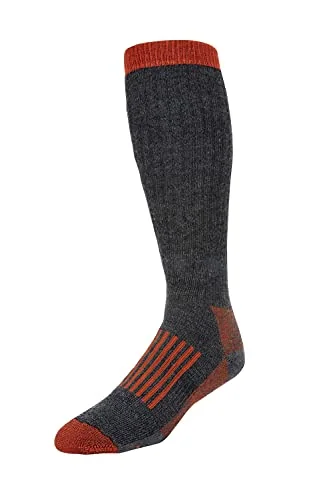
Now the part that ruins winter trips: thicker is not automatically warmer. Stack a heavyweight sock into boots that were already snug and you compress the foot, and compression cuts the circulation that delivers heat to your toes in the first place.
The cruel detail is that cold feet from restricted circulation feel exactly like cold feet from thin insulation. The fix is the opposite one, so anglers reach for a thicker sock, make it worse, and conclude their boots are junk.
Sock Thickness Eats Boot Volume (Size for the Stack, Not the Foot)
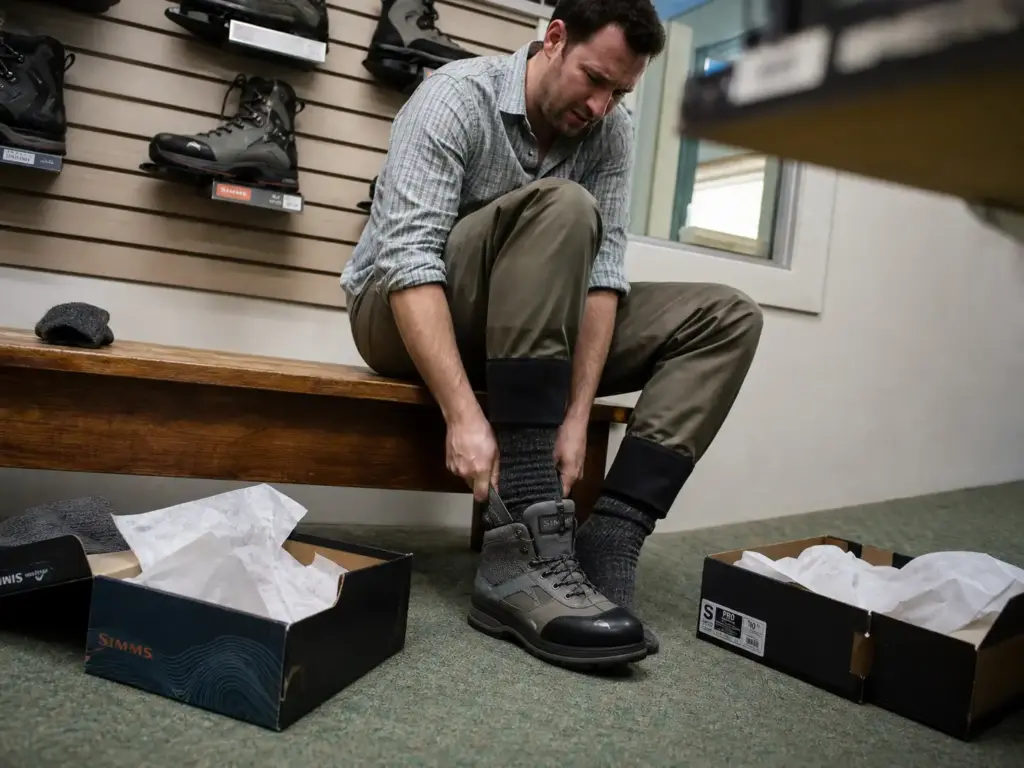
This is the mistake that costs a whole season, and it happens at the register. Someone tries on wading boots in the shop in their street socks, or in bare feet, finds a pair that fits beautifully, and buys it. Everything after that is a compromise.
Why bare-foot sizing fails
Fly shops recommend sizing wading boots up specifically to leave room for two things at once: the neoprene bootie on the wader and a light-to-medium sock layer underneath it. That is not one allowance, it is two. A 3.5mm bootie plus a midweight merino sock is a meaningful amount of material wrapped around a foot that fit the boot exactly.
Get it wrong and the failure mode is specific. The heel lifts a few millimeters on every single step, which nobody notices in the parking lot and everybody notices at hour four. That is a slow-motion blister factory, working on you all day whether you are moving between runs or standing in one seam. On steep gravel descents the toes jam forward into the front of the boot; on flat water the heel floats. Neither announces itself until the damage is done.
How to size it right
Bring the socks you actually fish in when you buy boots or waders. Not the pair in your gym bag. The exact socks, and if you run a liner underneath, bring the liner too. Fit day should include the whole stack, because the stack is what you will be standing in.
The community shorthand is “sizing up,” a half to a full size over street shoe size, and that range exists because it depends on how much sock you run. A lightweight summer sock and a heavyweight OTC need different allowances. The other half of the equation is sizing the bootie itself correctly, because an oversized bootie eats the same volume you were saving for the sock.
Test the fit by standing on a slope, not on a flat shop floor. Point your toes downhill on a ramp or a stair edge with the full stack on and laces tight. If the heel lifts there, it will lift on every rock you climb out on, and no lacing pattern fixes a boot that is simply too big or too small around the stack.
The circulation ceiling
There is a point where adding sock makes your feet colder, and it arrives sooner than people expect in a boot already sized tight. Snug is the goal. Compressed is the failure, and the line between them is not obvious from the inside.
A useful check: if your foot feels held rather than squeezed, you are fine. If your toes go tingly within the first 20 minutes of standing in cold water, back off a layer instead of adding one. A slightly thinner sock with good circulation beats a maximally thick sock cutting off feeling, in every water temperature.
And once you know the sock stack you’re fitting around, the sole choice is the next decision.
The Liner Sock Under Neoprene Trick
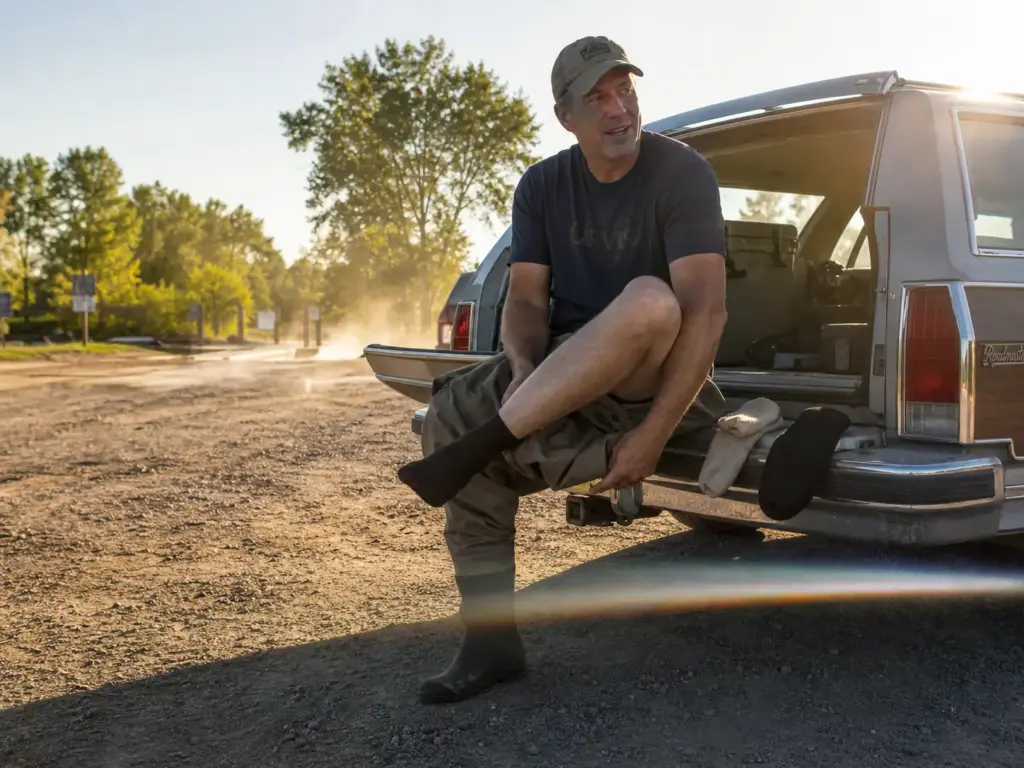
The fix for swampy neoprene is not a better neoprene sock. It is what goes underneath it, and it is the single highest-return change most wading anglers can make to how their feet feel at the takeout.
Why one thick sock does both jobs badly
Wicking and cushioning are two different mechanical jobs. Wicking wants thin fabric in tight contact with skin, fibers engineered to move water sideways fast. Cushioning wants loft, air, and terry loops under the footbed. One sock trying to do both compromises on both, and inside a sealed bootie the compromise shows up on the wicking side first.
How the two-sock system works
The layer order is the whole technique. Against skin goes a thin 100% synthetic liner sock, poly or nylon with a bit of spandex, whose only job is moving sweat off skin fast. Over that goes a midweight or heavyweight merino-nylon blend for cushioning and warmth. Both live inside the neoprene wading sock or bootie, which is the outer shell, not a sock in the wicking sense at all.
If you fish stockingfoot waders, where the neoprene bootie is part of the wader itself, the bootie is already there and you are just adding two layers underneath. If you run separate neoprene socks, the Simms Men’s Guide Guard Neoprene Wading Socks are the outer half of this setup: 3.5mm abrasion-resistant neoprene, anatomical left and right shaping, fold-down gravel guard.
The difference is not subtle. Bare foot in neoprene for four hours comes out swampy. The same four hours with a liner and an outer sock comes out no worse than damp. Same wade, same water temperature, same boots. This is the same liner-layer logic anglers use for their hands under nitrile or neoprene gloves, and it works for the same reason.
Add the liner before you buy boots, not after. Two layers plus a bootie is a different volume than one layer plus a bootie, and discovering that in November with boots you already own means choosing between warm feet and a boot that closes. If your boots are already sized tight, run the liner and drop the outer sock to midweight instead of stacking both heavy.
The funk cycle and what merino does about it
Anglers have their own word for what builds up inside sealed neoprene over a season: the funk cycle. Sweat goes in, bacteria feed on it, the neoprene never dries between trips, and by August the bootie itself smells regardless of what sock you put in it that morning.
The part most people miss is that merino protects the bootie, not just your foot. Wool between skin and neoprene intercepts the sweat before it soaks into the rubber, so the odor never gets a foothold in the layer you cannot wash properly. That is the difference between waders you can store in the garage and waders you store in the garage because you have to.
Once the bootie itself has gone, no sock rescues it, which is why the between-trip habit matters more than the product. Hang waders upside down so the legs drain and air reaches the feet, and give them long enough to dry inside before they go back in the bag. A bootie that goes into storage still damp is a bootie that stays damp, because there is no airflow inside a folded wader leg and a rubber foot has nowhere to breathe. The socks that came out of it get the same treatment: hung, separated, not balled up.
None of that is difficult. It is just the step that gets skipped at 9pm at the end of a long day, and skipping it forty times over a season is how a wader that cost real money starts announcing itself from the back of the truck.
Wet Wading, Boat Days and Waders Need Different Socks
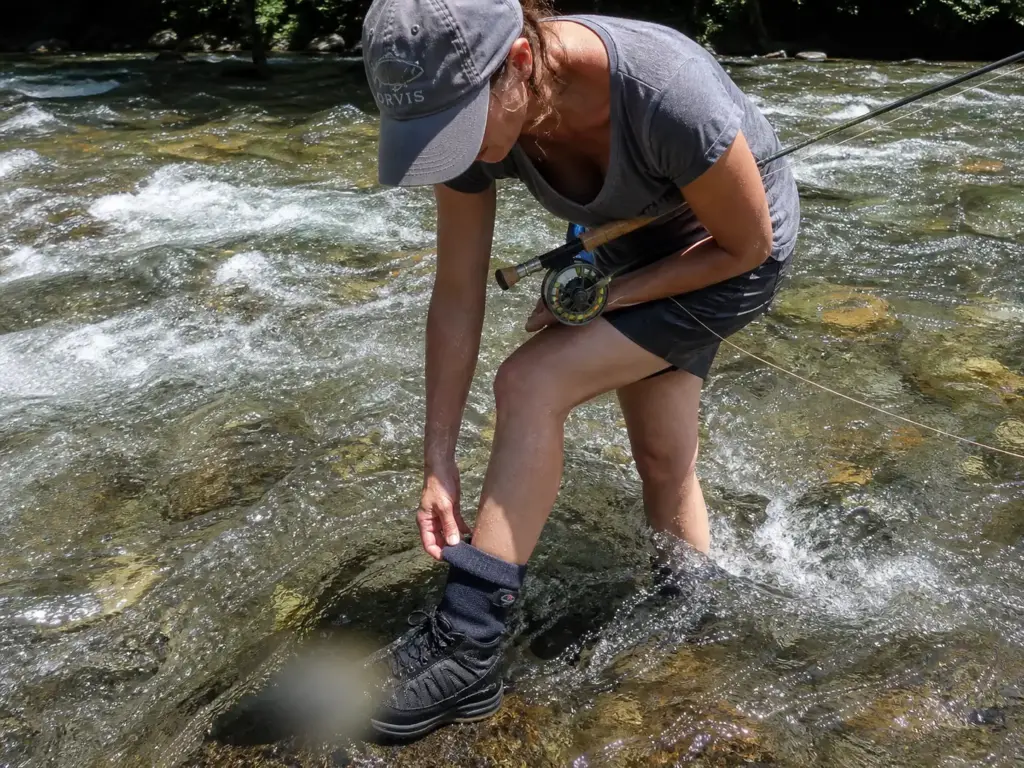
“Fishing socks” is three separate problems wearing one name, and the sock that solves one of them is often the wrong answer for the other two.
Wet wading, where the sock is the only barrier
Wet wading means no wader system at all: boots straight into the water, socks fully submerged for hours. The sock takes abrasion directly from grit and from the boot’s interior, and it never gets a chance to dry while you are fishing.
Neoprene wet-wading socks exist for exactly this, and the feature that matters is the gravel guard, the fold-over cuff that seals around the boot top so sand and pea gravel cannot work down inside. Without it, every step in a gravel run loads your boot with abrasive, and by the third hour you are walking on sandpaper. The Simms Flyweight Neoprene Wet Wading Sock is built for this job, gravel guard integrated, with silicone grip to stop the cuff creeping down your calf.
Wet wading cold water is a different conversation from an August tailwater, and wading in cold water carries its own set of precautions that have nothing to do with what is on your feet.
Boat days, where the enemy is sweat and not immersion
On a boat, nothing is submerging. The problem is a deck boot with no airflow sitting in the sun on fiberglass that runs considerably hotter than the air around it. Feet sweat, the shoe holds it, and by mid-afternoon you have a wader-boot problem without the wader. Lightweight or midweight merino handles it, and height is preference: crew keeps grit off your ankle at the ramp, ankle height stays cooler.
In waders, where the whole system is sealed
This is the case the liner-sock section already answered, and the one needing the most deliberate setup. Sealed bootie, two layers underneath, boots sized to accommodate all of it. Every element depends on the others, which is why a great sock dropped into badly sized boots fixes nothing.
A Merino Sock That Doesn’t Cost Wading-Boot Money
Every roundup on this keyword sends you to the same three premium brands and stops. The premium names are the ones with affiliate programs and shop shelf space, so the budget tier goes unmentioned as if it did not exist. It does exist, and it is real merino.
The Minus33 Merino Wool Crew Hiking Sock runs 66-75% merino with a full cushioned bottom and a seamless toe, putting its wool content in the same range as socks costing considerably more. That distinction matters, because plenty of budget “merino blend” socks carry a token amount of wool in a mostly acrylic sock, dressed up in earth tones.
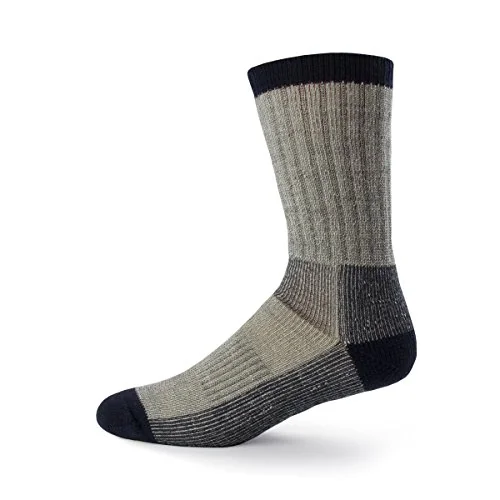
What the premium tier is actually selling is not simply more wool. It is durability warranties that replace socks free for life, seam construction that survives more wash cycles, and brand-specific lasts refined over decades of fit complaints. Whether that is worth the difference depends on whether you fish a handful of days a year or most weekends.
One caveat on budget merino: it sells fast and restocks are inconsistent. Check stock rather than assuming it will be there next month, and if your size is gone, wait rather than dropping to an acrylic blend that feels like a plastic bag by hour three.
If you only insist on one spec at any price, insist on the seamless toe. A raised toe seam is a ridge of thread sitting directly on top of your toes, and inside a wading boot it has nowhere to move. On dry land you would never notice it.
Six hours of wet, swollen feet pressing that ridge against the inside of a boot is precisely where blisters start, and it is the failure that gets blamed on the boot every time. The wool percentage decides how comfortable the sock feels. The toe seam decides whether you are still walking normally on the drive home.
The other thing worth checking at this tier is the cuff. A budget sock with a weak ribbed top starts sliding down inside your bootie somewhere around hour two, and once the heel of the sock is halfway under your arch you are wading on a wrinkle. There is no fixing it without stripping off the boot, the bootie, and the wader leg on a gravel bar. Hold the cuff and stretch it: if it snaps back with real tension, it will stay put.
Whatever you spend, the seamless toe is the spec worth insisting on at any price, for the same reason letter sizing on gloves tells you almost nothing about how gear performs on the water: the construction detail beats the label every time.
Cold Water Wading Is Its Own Problem
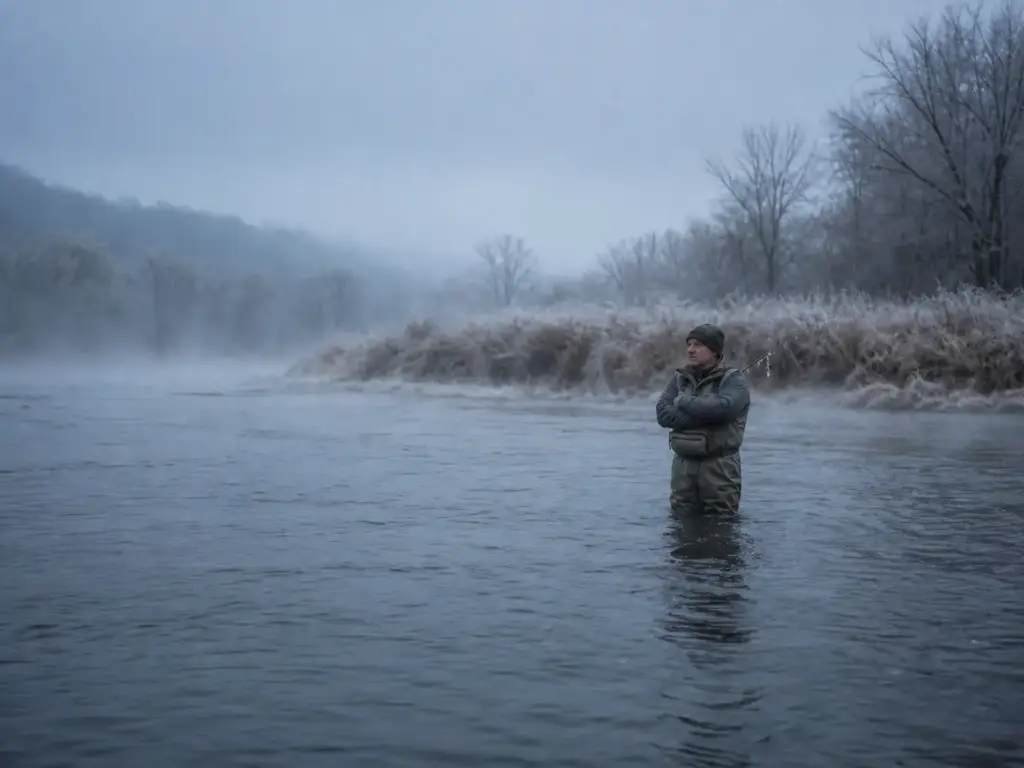
Everyone treats cold feet as a comfort complaint, something you tough out until the bite turns on. In moving water, wet feet are the first place your heat leaves, and the numbers move faster than most anglers expect.
Start with the one that surprises people. Trench foot, properly called immersion foot, can develop at water and boot temperatures as high as 60°F if your feet stay constantly wet. It does not require freezing water or an ice shack. It requires wet, cold enough, and long enough, which describes an ordinary October afternoon standing in a tailwater with a boot full of your own sweat. Anglers file it under ice fishing and then get it in the fall.
The second number sets the stakes higher. Immersion hypothermia can develop in any water below 70°F, which is most trout water in most seasons. If you go in, the first thing that hits is cold shock and the fast loss of dexterity that follows, as documented by the National Center for Cold Water Safety: uncontrolled hyperventilation typically within 2 to 3 minutes of immersion, with meaningful loss of grip strength arriving in the 20 to 30 minute window. That is the window where you cannot work a wading belt buckle or grab a rope.
The connection to your sock drawer is direct. Feet and hands shed heat first, and wet, poorly insulated feet start that clock earlier than dry ones. You do not feel it as an emergency. You feel it as being cold and slightly slow, right up until it matters.
For genuinely cold water the system answer is all three pieces at once: over-the-calf merino, a thin synthetic liner underneath, and boots sized so nothing in that stack is compressed. Miss one and the other two underperform.
It is worth understanding why each piece is load-bearing rather than treating the list as a shopping order. The liner keeps sweat off skin, and skin that stays dry loses heat far slower than skin with a film of moisture evaporating off it, which is the same physics that makes a damp shirt feel cold in a breeze. The over-the-calf merino carries insulation above the boot line, where the major circulation running close to the surface of your lower leg would otherwise be sitting against thin wader fabric in moving water. And the boot sizing protects the circulation that supplies heat to everything downstream. Get the first two right, then crush the stack into a boot half a size too small, and you have built an expensive way to have cold feet.
The order matters on the bank, too. Put the liner on with dry hands before you pull the waders up, because trying to smooth a wrinkled liner sock through a wader leg with numb fingers at the truck in December is how most people give up and fish with a fold under their arch all morning.
Keep a dry spare pair in the truck and change at lunch on cold days. It sounds fussy until you do it once. Fifteen minutes of dry socks resets your feet for the entire afternoon, and it is the closest thing to a free extra hour of fishing in November.
Now the anti-sell, because this is where gear articles usually oversell. No sock prevents hypothermia. Merino buys you comfortable hours and delays the point where cold starts affecting your decisions.
It does not replace judgment about when the water is too high, the wading too committing, or the day too far gone to keep pushing. Get out early and warm up; the fish will still be there. Socks are one piece of a much larger kit, and it is worth understanding how the rest of your fishing apparel system fits together before you go build a cold-water setup around one good pair.
The Short Version
Three things carry the whole article. The water soaking your feet inside waders is almost always your own sweat, and the sock is the only layer whose job is moving it out. Size your boots around the entire stack, sock plus neoprene bootie, because bare-foot sizing is what produces heel lift and blisters you will blame on the boot for a season. And a thin synthetic liner under a merino outer sock beats one thick sock trying to do both jobs, especially inside sealed neoprene.
Go pull the socks you fished in last time out of the bag right now and read the tag. If they say cotton, that is the entire problem, and it is the cheapest fix on this list by a wide margin.
Frequently Asked Questions
01What type of sock is best for wicking moisture?
Merino wool and engineered synthetics both wick well, and they fail in opposite directions. Merino holds moisture inside the fiber so the surface against your skin stays dry-feeling and it resists odor for days. Synthetic moves moisture faster and dries quicker but smells within a day. For fishing, a merino-nylon blend handles most conditions.
02Do moisture-wicking socks actually work?
Yes, and the mechanism is measurable rather than marketing. Wicking fabrics use capillary action through engineered fiber channels to pull sweat off skin toward the fabric’s outer surface, where it evaporates. The catch is that a sealed neoprene wader bootie limits evaporation, so a wicking sock buys comfortable hours rather than dry feet indefinitely.
03What are the best fishing socks?
It depends on how you fish, which is why one answer never covers it. Midweight merino crew socks handle boat days and general wading, heavyweight over-the-calf merino is the cold-water answer, and a neoprene wet-wading sock with a gravel guard is what you want with no waders at all.
04Can you wear regular socks with waders?
You can, but cotton athletic socks are the one category to avoid completely. Cotton absorbs and holds moisture against your skin, and inside a sealed bootie it has nowhere to evaporate. Any wool or synthetic hiking sock works far better, even before you buy anything fishing-specific.
05How do I stop my feet from smelling after wading?
Merino wool socks are the single biggest fix, because wool’s keratin structure binds the volatile compounds that odor-causing bacteria produce. Beyond material, the habit that matters is drying. Socks and booties left balled up in a wet bag never dry and breed bacteria, so hang both after every trip.
Risk Disclaimer: Fishing, boating, and all related outdoor activities involve inherent risks that
can lead to injury. The information provided on Master Fishing Mag is for educational and informational purposes
only. While we strive for accuracy, the information, techniques, and advice on gear and safety are not a substitute
for your own best judgment, local knowledge, and adherence to official regulations. Fishing regulations, including
seasons, size limits, and species restrictions, change frequently and vary by location. Always consult the latest
official regulations from your local fish and wildlife agency before heading out. Proper handling of hooks, knives,
and other sharp equipment is essential for safety. Furthermore, be aware of local fish consumption advisories. By
using this website, you agree that you are solely responsible for your own safety and for complying with all
applicable laws. Any reliance you place on our content is strictly at your own risk. Master Fishing Mag and its
authors will not be held liable for any injury, damage, or loss sustained in connection with the use of the
information herein.
Affiliate Disclosure: We are a participant in the Amazon Services LLC Associates Program, an
affiliate advertising program designed to provide a means for us to earn advertising fees by advertising and linking
to Amazon.com. As an Amazon Associate, we earn from qualifying purchases. We also participate in other affiliate
programs and may receive a commission on products purchased through our links, at no extra cost to you. Additional
terms are found in the terms of service.