
In this article
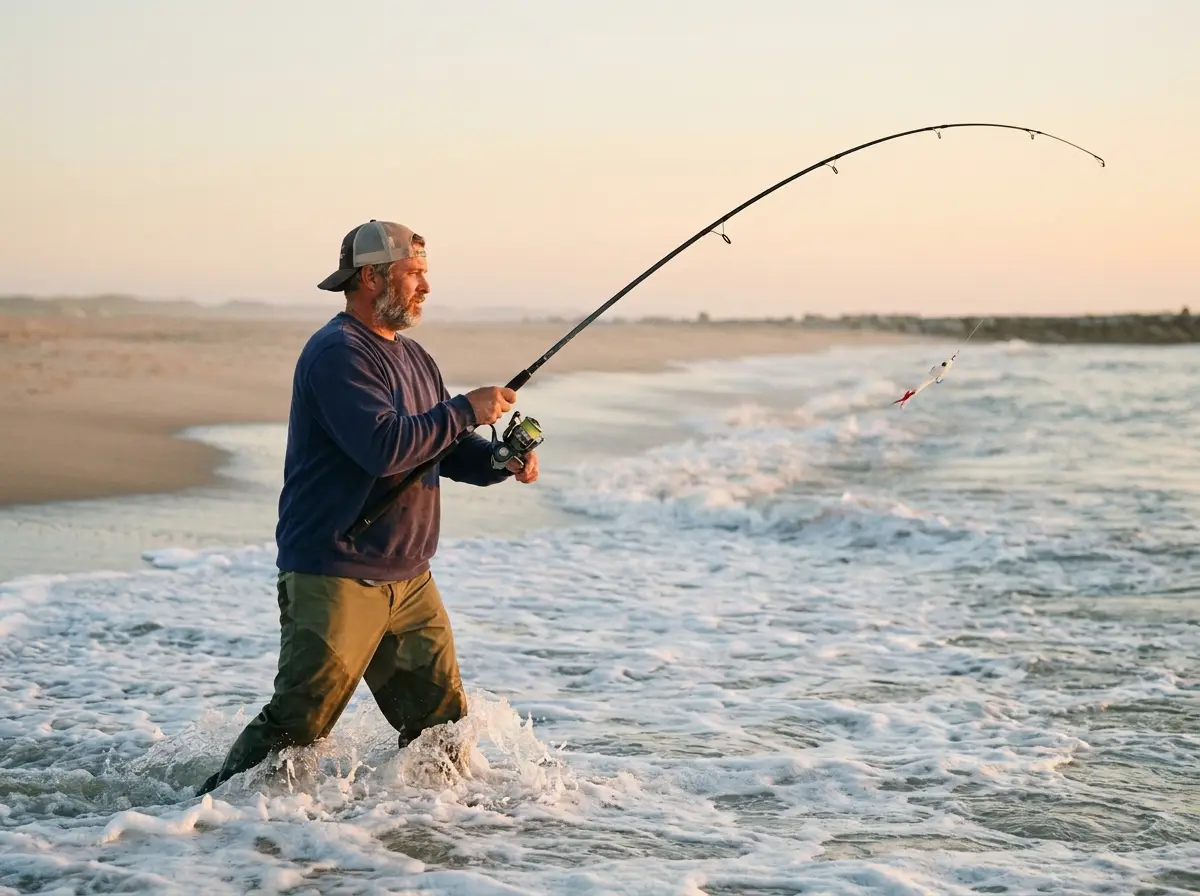
I watched a guy launch a 4-ounce plug halfway to Portugal last October at Island Beach State Park. Beautiful cast. He did it about forty times. Meanwhile, a quiet old-timer twenty yards down the beach was tight on his third striper of the evening — casting maybe 40 feet into the first wave break. That’s the thing about striped bass from the surf: the fish you want is almost always closer than you think. After years of fishing the wash zone from New Jersey to Montauk, here’s what actually puts stripers on the sand — and why most of the advice out there gets the details wrong.
Quick Answer: Here’s how to catch striped bass from the surf:
- Scout the beach at low tide to find sandbars, cuts, and troughs
- Fish the incoming tide at dawn, dusk, or after dark
- Cast to the first wave break — not beyond it
- Match your bait or lure to the local forage (bunker, sand eels, clams)
- Use a 10–11ft surf rod with 20–30lb braid and a fluorocarbon leader
- Work lures slow and keep bait fresh — swap every 20 minutes
How Striped Bass Use the Surf Zone to Feed
Why the Wash Zone Is a Feeding Lane
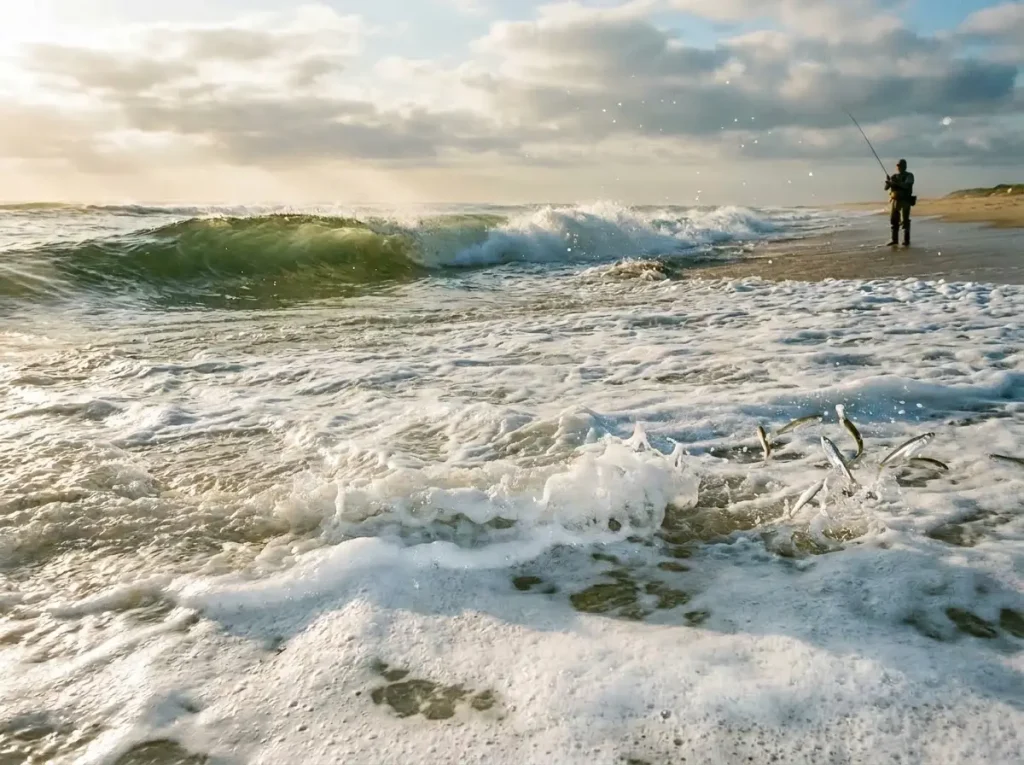
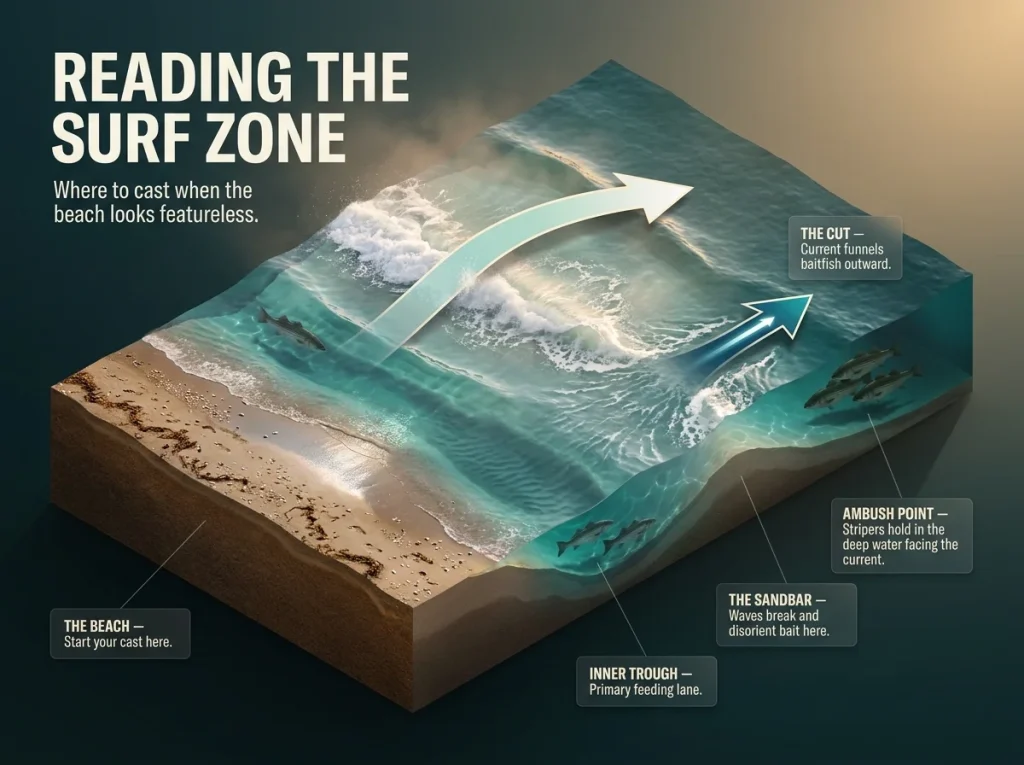
Stripers don’t cruise open water looking for a fight. They park themselves where the ocean does the work for them. When waves break over a sandbar, the turbulence disorients baitfish, tumbles sand fleas out of the substrate, and pushes menhaden into tight pockets where they can’t escape. That’s the feeding lane — and it’s usually within the first 50 feet of shore.
The first trough between the beach and the outer bar is where most of the action happens. Water funnels through cuts in the bar, creating current seams that act like a conveyor belt of food. Stripers position themselves along the edges of these troughs and pick off whatever tumbles past. If you’re casting beyond the outer bar, you’re throwing over their heads.
How Structure Concentrates Fish
Jetties, rock piles, rivermouths, and bridge pilings all create the same effect — they break current and concentrate bait. But natural structure changes with every storm. A cut that produced fish last month might be filled in now. That’s why the anglers who consistently catch stripers from the surf aren’t the ones with the best gear — they’re the ones who walk the beach more than anyone else.
Pro tip: Fish don’t care about the sandbar itself — they care about the edge. The transition from shallow bar to deep trough is where 80% of surf-caught stripers come from. Focus your casts along that seam, not on top of the bar or in the middle of the trough.
Reading Current Flow in Real Time
Watch the water for five minutes before you make a single cast. Foam lines on the surface show you exactly where current seams run. Debris drifting parallel to shore tells you the tidal current direction and speed. A spot where foam collects in a swirling pattern usually marks a cut or depression — that’s your first target.
Reading the Beach Before You Cast
Low-Tide Reconnaissance
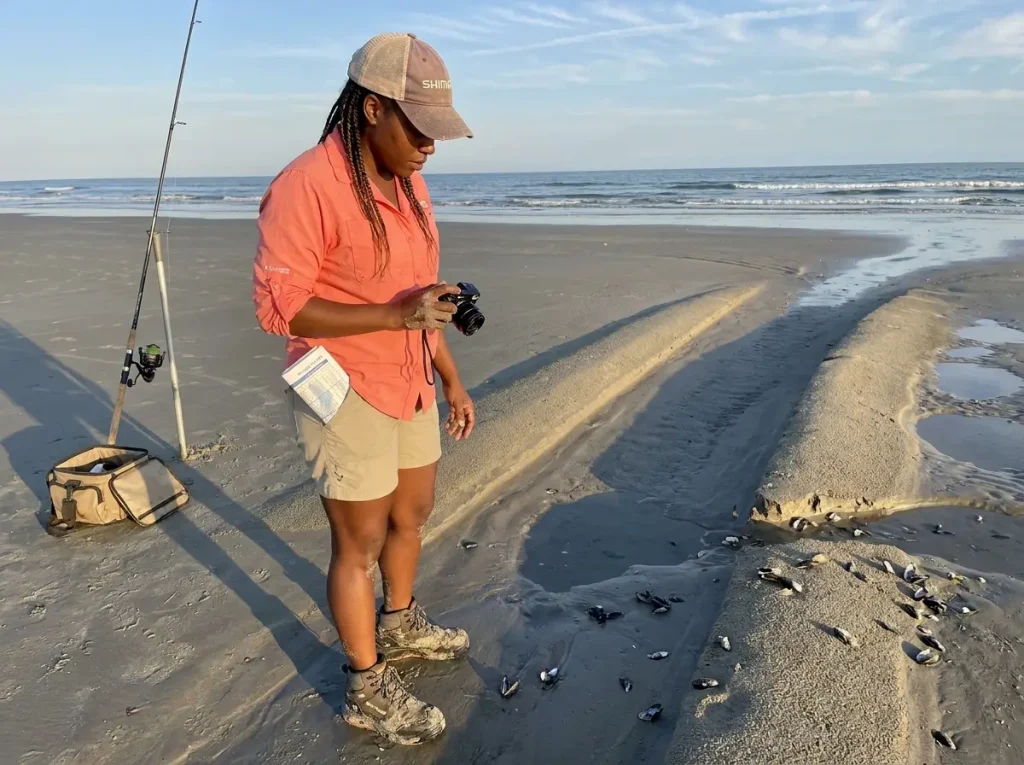
The single best thing you can do for your striper fishing has nothing to do with tackle. Walk the beach at dead low tide — preferably during a spring tide when the water drops as far as it goes. Bring your phone. Photograph every feature: the dark patches where troughs run deep, the light-colored shallow bars, the cuts where water drains through the bar system. That mental map is your edge when you show up at dawn with a rod in your hand.
A couple from Virginia taught a young angler at Island Beach State Park a version of this lesson. They came every fall for two weeks and targeted the exposed tip of a sandbar where waves uncovered sand fleas. They caught 24 stripers in a week. Most people walked right past that same bar without recognizing it.
What to Look for at Each Tide Stage
At low tide, you see the bones of the beach — bars, cuts, depressions. At mid-incoming, watch where whitewater appears first as waves hit the shallow spots. At high tide, your targets are invisible, but the foam lines and current seams still telegraph where structure sits below.
The cuts through sandbars are the highest-value targets. Water funnels through these gaps during every tidal change, and stripers stack up at the downstream edge like trout holding behind a boulder in a river.
Identifying Productive Beaches
Not every beach fishes equally. Steep-dropping beaches with hard sand produce less structure than gently sloping ones with soft sand that forms complex bar systems. River mouths and inlet-adjacent beaches pull more bait — and more stripers — than open stretches of featureless shoreline. If you’re new to an area, start near inlets and points where current is visible from the parking lot.
Pro tip: Google Earth satellite view on a clear day shows sandbar structure surprisingly well for many East Coast beaches. Compare it to what you see at low tide and you’ll start recognizing productive spots before you even get your boots wet.
Timing Your Sessions Around Tides and Light
The Dawn and Dusk Windows
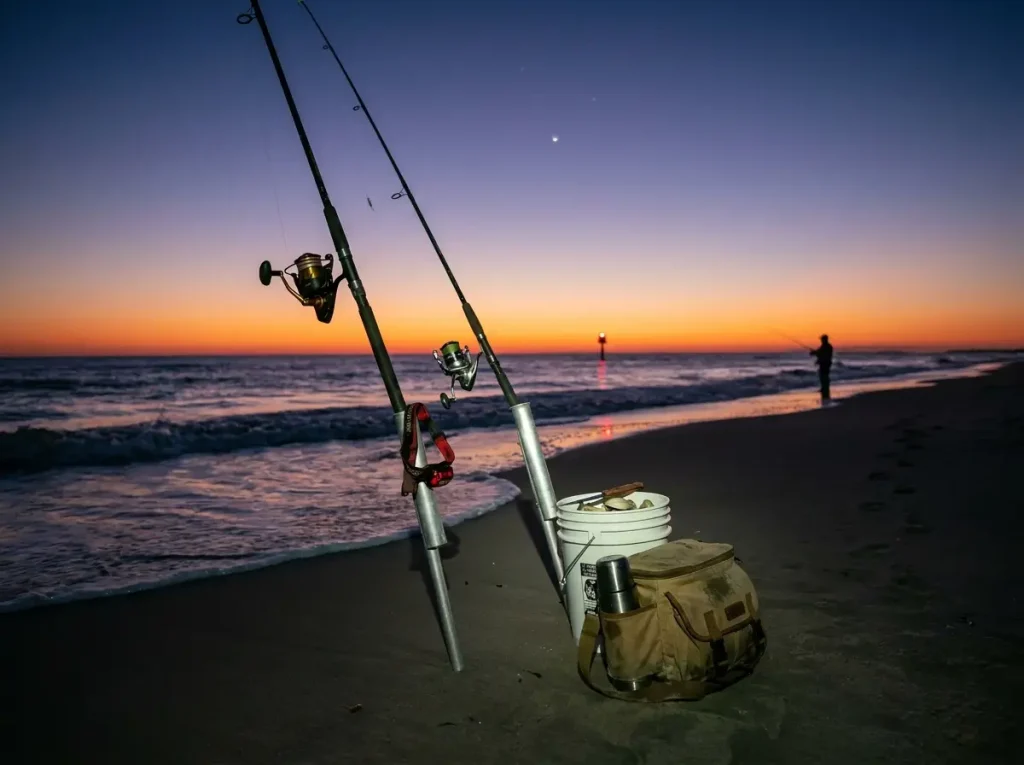
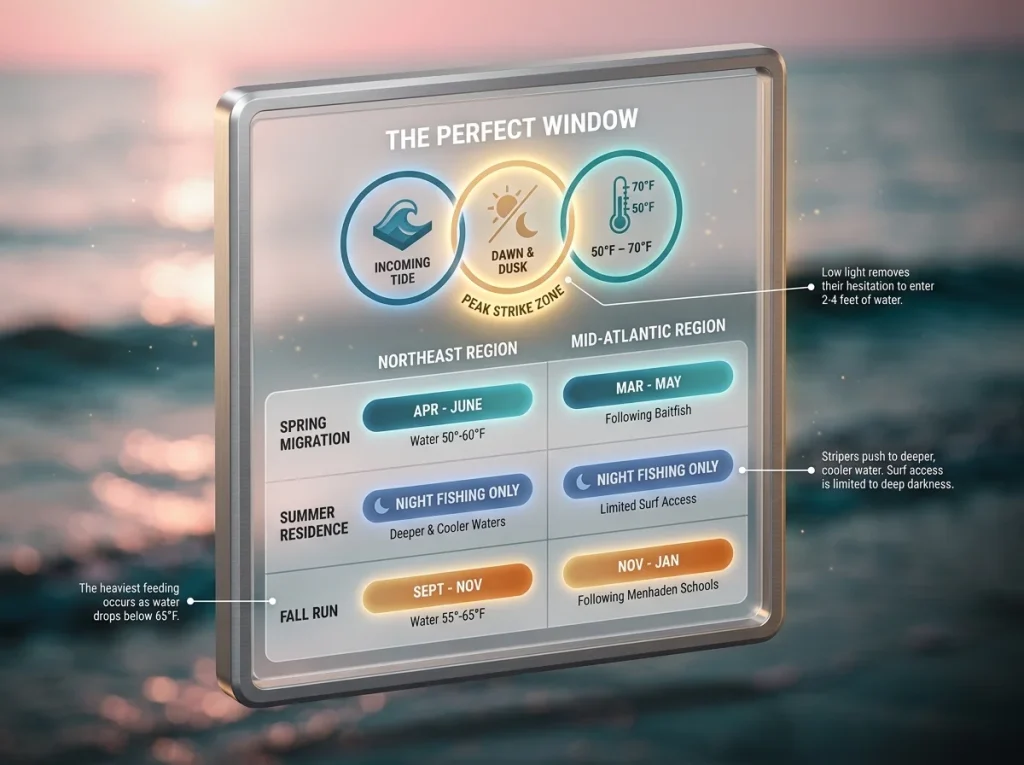
Stripers push into shallower water to feed during low-light periods. The half hour before sunrise through the first hour of daylight is consistently the best window for surfcasters. Dusk runs a close second. During these transitions, fish that spent the day in deeper water move onto the bars and into the troughs where you can reach them.
Why Tide Matters More Than Time of Day
A moving tide beats a perfect sunrise every time. The incoming tide is generally preferred because it pushes cleaner water and higher oxygen levels toward shore, carrying bait with it. But the outgoing tide has its own advantage — water draining through cuts and off bars creates concentrated flow that traps baitfish. The worst time to fish is dead slack, when nothing is moving.
If you can line up an incoming tide with first light, you’ve got the best conditions the surf offers. Check a tide chart that shows velocity, not just height — peak current flow is when stripers feed hardest.
Seasonal Patterns That Shift Everything
Water temperature drives the entire game. Stripers feed most actively between 50°F and 70°F. Below 50°F, their metabolism slows and they want easy meals — slow-presented bait outperforms lures. Above 70°F, they push deeper and offshore where you can’t reach them from the beach.
The fall run — September through November in the Northeast, November through January in the Mid-Atlantic — is prime time for surf fishing. Migrating stripers stack up along the coast following schools of menhaden and other baitfish, and they feed aggressively before the long haul south. Spring offers a second window as fish push back north, though the action is typically less concentrated.
Surf Fishing Gear That Actually Matters
Rod and Reel Selection
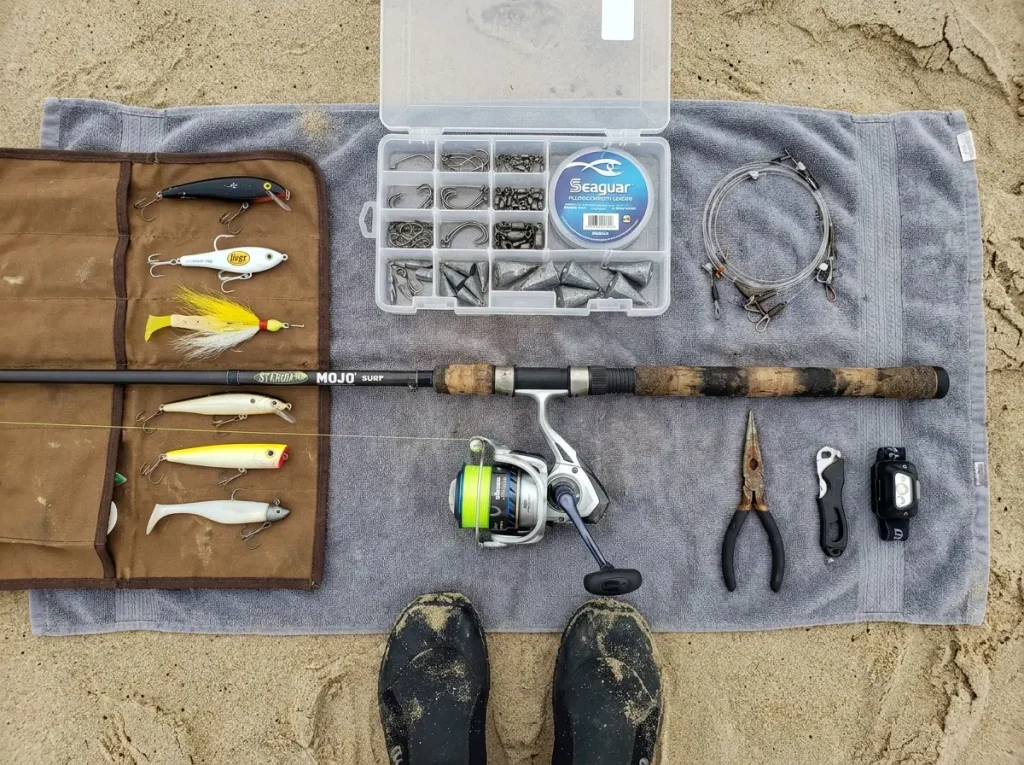
A 10 to 11-foot medium-heavy surf rod paired with a 5000–6000 size spinning reel covers 90% of situations. You need the length to cast over breaking waves and the backbone to handle lures up to 4 ounces. Moderate-fast action gives you casting distance without sacrificing hookset authority.
For reels, prioritize a sealed or water-resistant drag system. Salt spray and sand destroy exposed drag washers in a season. Penn Battle III, Shimano Stradic SW, and Daiwa BG are all proven in the surf — none of them costs what a Van Staal does, and they all catch the same fish.
Line and Leader Setup
Spool with 20 to 30-pound braided line — it casts farther, transmits strikes better, and cuts through current more efficiently than mono. Tie a 3 to 4-foot fluorocarbon leader in 30 to 40-pound test using an FG knot or slim beauty knot. The fluorocarbon handles abrasion from rocks and shells, and it’s less visible to line-shy fish in clear water.
For bait fishing, a fishfinder rig — sliding sinker above a swivel with an 18-inch leader to a circle hook — lets the fish pick up the bait and run without feeling resistance. For lure fishing, tie direct to a snap swivel or loop knot.
What You Actually Need on the Beach
A plug bag worn across your chest keeps lures accessible when you’re walking and casting. Sand spikes hold bait rods while you work lures. A quality headlamp with a red-light mode is non-negotiable for dawn, dusk, and night sessions. Everything else — rod belts, wader accessories, specialized pliers — is convenience, not necessity.
Pro tip: Carry a spare pre-tied leader in a ziplock in your plug bag. When a striper saws through your fluorocarbon on a gill plate, you lose thirty seconds instead of fifteen minutes retying in the dark.
Best Baits and Lures for Striped Bass in the Surf
Natural Baits That Produce
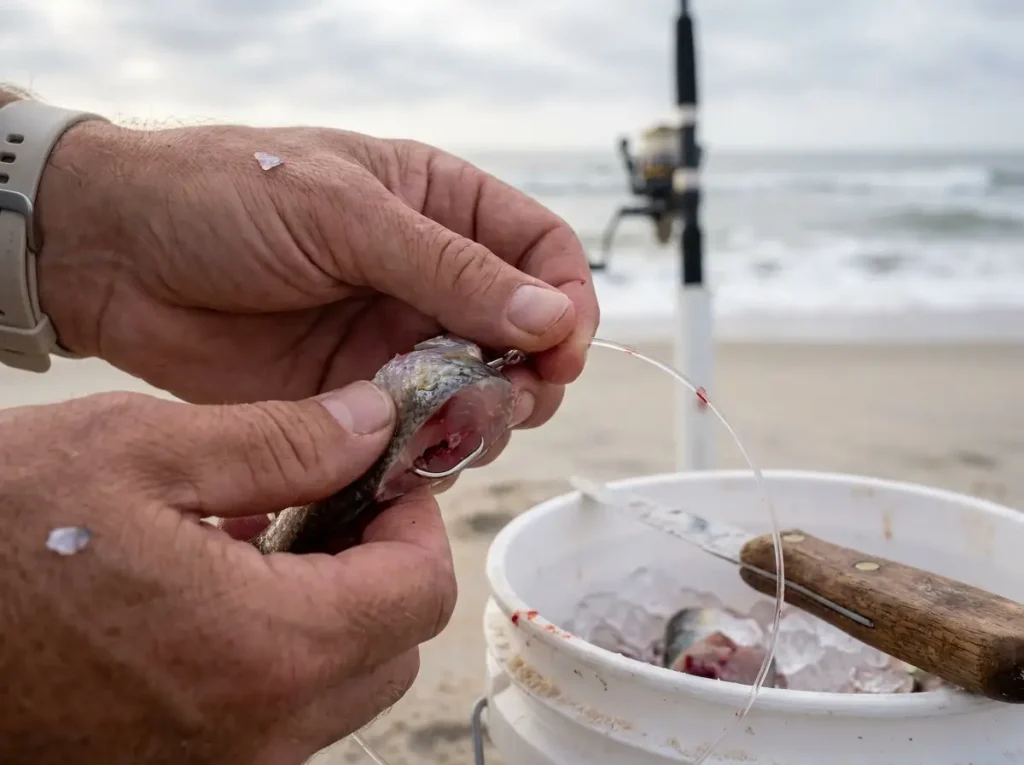
Fresh bunker chunks are the single most reliable bait along the entire striper coast. Cut a menhaden into three sections — head, body, tail — and fish the head or body section on a 7/0 or 8/0 circle hook. Circle hooks are now required by the ASMFC when fishing with bait for stripers, and they dramatically reduce gut-hooking.
Clams fished on a high-low rig work well over sandy bottoms where sand fleas and other invertebrates attract fish. Sandworms are a staple in New England. Live eels are arguably the deadliest surf bait for large stripers — a 10-inch eel hooked through the lips and cast into a rip current catches fish that ignore everything else.
One critical detail most guides skip: bait loses its scent trail after about 20 minutes in the water. The oil and amino acids that attract stripers wash out. If you haven’t had a bite in 20 minutes, reel in and put fresh bait on. The five minutes spent rebaiting is worth more than an hour of soaking dead bait.
Lures for Covering Water
When stripers are actively feeding — or when you want to cover water instead of sitting and waiting — lures let you search efficiently.
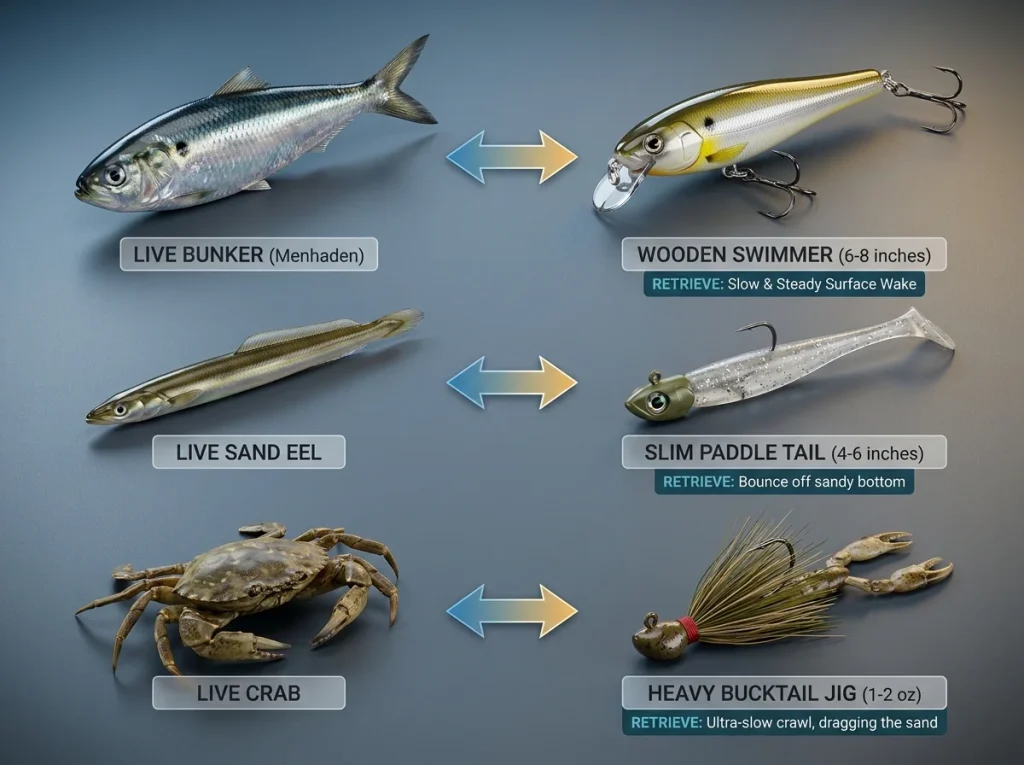
Bucktail jigs (3/4 to 1-1/2 ounce) with pork rind or Gulp trailers are the oldest and still one of the most effective striper lures from the surf. Bounce them along the bottom in the trough or swim them through the wave break. Swimming plugs like the Daiwa SP Minnow and Bomber Long A imitate baitfish profiles and work with a slow, steady retrieve. Pencil poppers and metal lip swimmers are topwater options for feeding blitzes.
Diamond jigs and Hogy epoxy jigs (2 to 3 ounces) cast like missiles and work well when you need distance in windy conditions or when stripers are holding just beyond the outer bar.
Matching the Forage
This is where most surf fishing guides go generic, and it’s the detail that separates okay sessions from great ones. Pay attention to what’s actually in the water. If bunker are running and you can see them flipping on the surface, throw bunker chunks or a plug that matches their 6 to 8-inch profile. If sand eels are the primary forage, downsize to a slim 4-inch paddle tail on a jighead. During crab hatches in spring, a slow-crawled bucktail dragging bottom outperforms a fast-moving plug ten to one.
Night Fishing the Surf for Trophy Stripers
Why the Biggest Fish Come After Dark
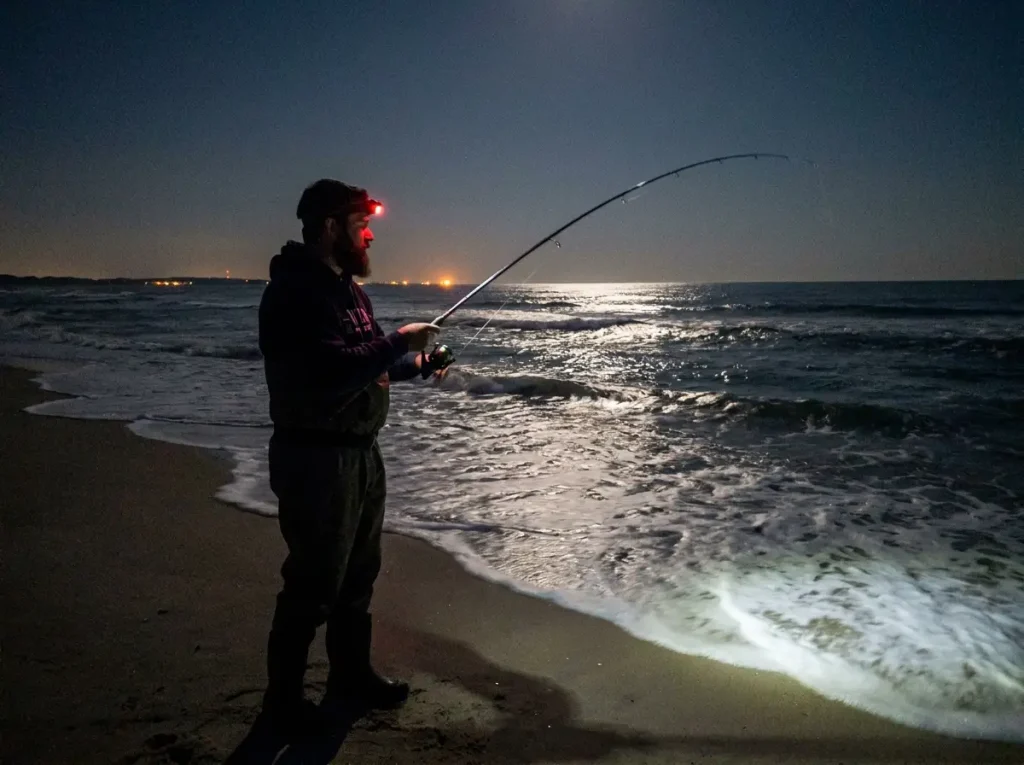
The largest striped bass — fish over 30 inches that spend daylight in deeper water — move into the surf zone after sunset. The darkness gives them cover to hunt aggressively in water that’s only 2 to 4 feet deep. If your goal is a trophy-class striper from the beach, you need to fish when most people are home watching TV.
This is the biggest gap in most surf fishing guides. They’ll tell you to fish at night but never explain how to actually do it effectively. Night surf fishing is a different game than dawn patrol, and it rewards a completely different set of skills.
Scouting for After-Dark Success
Everything starts during the day. Walk the beach at extreme low tide and study every piece of structure — bars, cuts, troughs, rock transitions. Photograph them. Sketch a rough map in a notebook. When you return at 10pm, you need to know exactly where to wade and where to cast without being able to see any of it.
Identify your entry and exit points during daylight. Mark a landmark like a specific house or streetlight that you can spot from the water at night. Getting turned around on a dark beach wastes time and creates a safety problem, especially if the tide has risen behind you.
Technique Adjustments for Darkness
Slow everything down. Stripers hunt differently at night — they ambush from behind structure rather than chasing bait in open water. A plug crawled so slowly you can barely feel the wobble is exactly right. One turn of the reel handle every second or two gives most swimming plugs the subtle action that draws strikes in the dark.
Dark-colored plugs — black, dark purple, “blurple” — outperform bright colors at night. Sounds counterintuitive, but fish looking up see your lure silhouetted against whatever ambient light hits the surface. A dark plug creates a stronger contrast than a white or chartreuse one.
Use your ears more than your eyes. On a calm night, you can hear stripers crashing on bait from 100 yards away. That sound tells you exactly where to cast. Stand still, keep quiet, and let the fish tell you where they are.
Pro tip: Use a red-light headlamp and keep it off unless you’re tying a knot or unhooking a fish. White light kills your night vision for 20 minutes and flashes across the water surface, spooking every striper within 50 feet. Clip your headlamp to your collar where you can shield it with your chin, not to your forehead where it broadcasts like a lighthouse.
Landing and Releasing Striped Bass in Heavy Surf
Using Wave Energy Instead of Fighting It
Most lost fish in the surf happen in the last 20 feet. You’ve fought the fish through the waves, it’s close, and then a breaker rolls it sideways and pops the hook. The fix is simple — stop fighting the water and use it.
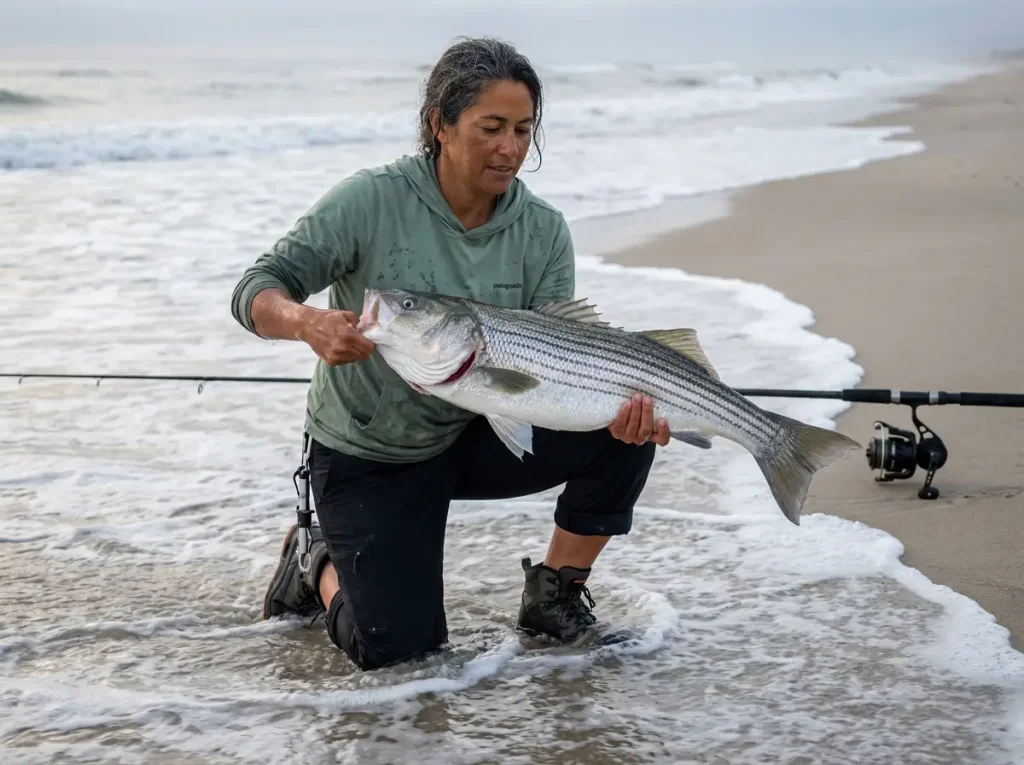
When a striper is close enough to see in the wash, wait for an incoming wave. As the wave surges toward the beach, reel fast and let the water carry the fish onto wet sand. Don’t drag the fish up the beach — just let the wave do the work. When the water recedes, the fish is lying on wet sand where you can control it.
Proper Handling for Healthy Releases
Current regulations in most Atlantic states enforce a 28 to 31-inch slot limit with a one-fish daily bag. That means most stripers you catch are going back. How you handle the release matters.
Wet your hands before touching the fish — dry hands strip the protective slime coat. Support the fish horizontally with one hand under the belly and one gripping the tail wrist. Never hold a striper vertically by the jaw — the weight damages internal organs.
If the fish needs reviving, hold it in knee-deep water with its nose pointed into the current. Wait until it kicks away under its own power. A fish that rolls over when you let go isn’t ready — hold it longer. Rushed releases are the leading cause of post-release mortality, which contributes significantly to the overall fishing pressure that ASMFC is trying to reduce.
Pro tip: Barbless hooks or crimped barbs make releases faster and safer for both you and the fish. A circle hook that pops out in three seconds beats a barbed J-hook that requires pliers and a headlamp while waves are washing over your boots.
Conclusion
Catching striped bass from the surf comes down to three things: knowing where the fish hold, being there when conditions push them into range, and keeping your presentation in the right zone — which is almost always closer than you think. Learn to read the beach at low tide, time your sessions around moving water and low light, and pay attention to what the local forage is doing. The rest — the gear, the specific lure, the perfect cast — matters less than putting yourself in the right 20 feet of water at the right time. Get out there, walk the beach before you fish it, and stop casting past the fish.
Q1 What is the best bait for striped bass in the surf?
Fresh-cut bunker (menhaden) chunks on a circle hook are the most reliable bait across the entire striper coast. Swap your bait every 20 minutes because the scent oils wash out quickly in moving water. Clams, sandworms, and live eels all produce depending on your region and the active forage.
Q2 What time of day is best to surf fish for striped bass?
The half hour before sunrise through the first hour of daylight is consistently the top window. Dusk and full darkness are close seconds, with the biggest fish often coming after dark. A moving tide during any of these windows beats a slack tide at the perfect time of day.
Q3 What size hooks for striped bass surf fishing?
Use 7/0 to 8/0 circle hooks for bait fishing — circle hooks are required by ASMFC regulations when using natural bait for stripers. For lure fishing, the treble hooks that come stock on most plugs in sizes 2/0 to 4/0 work fine. Match hook size to bait size, not to the fish.
Q4 Can you catch striped bass from the beach during the day?
Yes, but your best shots are early morning and late afternoon when light is low. Overcast days extend the feeding window. Focus on structure — jetties, rivermouths, deep troughs — where fish feel secure enough to feed in brighter conditions. Downsize your lures and slow your retrieve compared to low-light sessions.
Q5 What pound test line for surf fishing striped bass?
Run 20 to 30-pound braided line as your main line with a 30 to 40-pound fluorocarbon leader of 3 to 4 feet. The braid gives you casting distance and sensitivity, and the fluorocarbon handles abrasion from rocks, shells, and gill plates. Heavier braid (30lb) is better for rocky structure or heavy surf conditions.
Risk Disclaimer: Fishing, boating, and all related outdoor activities involve inherent risks that
can lead to injury. The information provided on Master Fishing Mag is for educational and informational purposes
only. While we strive for accuracy, the information, techniques, and advice on gear and safety are not a substitute
for your own best judgment, local knowledge, and adherence to official regulations. Fishing regulations, including
seasons, size limits, and species restrictions, change frequently and vary by location. Always consult the latest
official regulations from your local fish and wildlife agency before heading out. Proper handling of hooks, knives,
and other sharp equipment is essential for safety. Furthermore, be aware of local fish consumption advisories. By
using this website, you agree that you are solely responsible for your own safety and for complying with all
applicable laws. Any reliance you place on our content is strictly at your own risk. Master Fishing Mag and its
authors will not be held liable for any injury, damage, or loss sustained in connection with the use of the
information herein.
Affiliate Disclosure: We are a participant in the Amazon Services LLC Associates Program, an
affiliate advertising program designed to provide a means for us to earn advertising fees by advertising and linking
to Amazon.com. As an Amazon Associate, we earn from qualifying purchases. We also participate in other affiliate
programs and may receive a commission on products purchased through our links, at no extra cost to you. Additional
terms are found in the terms of service.