
In this article
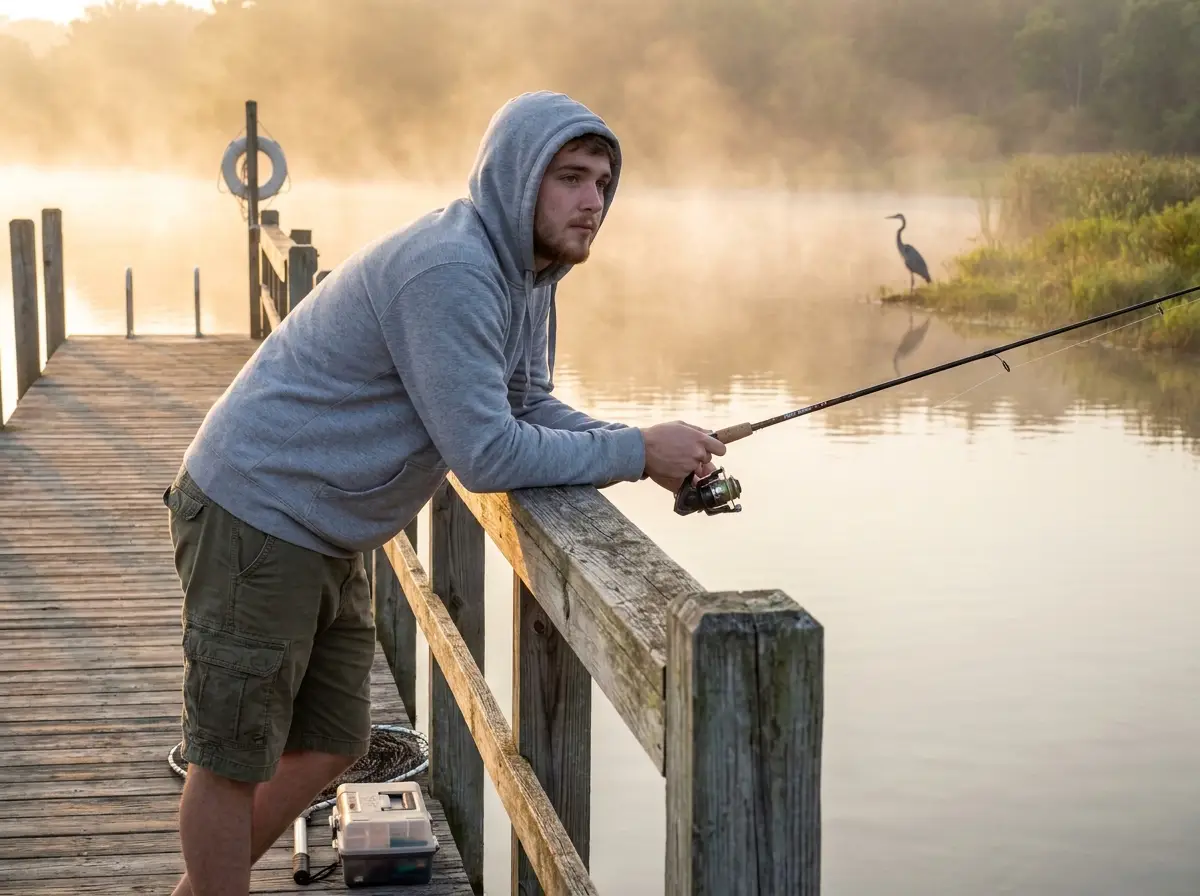
Six hours. Four spots. Every lure in the box. Not one fish. If that sounds familiar, the problem probably wasn’t your technique or your equipment — it was where and when you were fishing. Fish aren’t randomly distributed across the water, and they don’t feed all the time. Once you understand the logic behind where fish hold and when they bite, the whole puzzle starts to make sense.
I’ve guided beginners and fished alongside them enough times to see the pattern clearly: new anglers fish the wrong places at the wrong times, and no amount of tackle improvement fixes that. This guide covers how fish actually think and behave — the biology and the practical field application — so your next trip starts with understanding, not hope.
⚡ Quick Answer: Fish are almost never “randomly” in a spot. They hold where food comes to them (current seams, structure edges) and retreat when conditions are poor (post-front, high sun, midday heat). Fish are most active during the 90 minutes around sunrise and sunset, when water temperatures are in their preferred range, and when barometric pressure is stable or falling. Learn to read those conditions before you pick up a rod.
The Three Things Every Fish Needs
Food, safety, and comfortable water
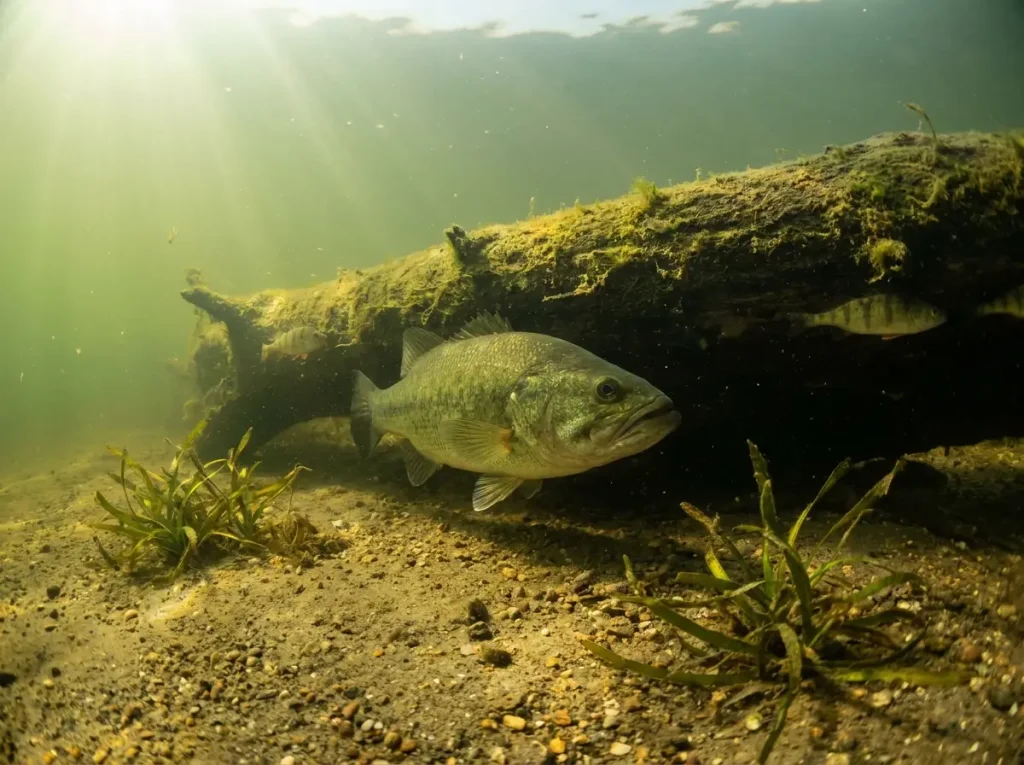
Every fish in every body of water is solving the same basic equation: find food efficiently, avoid being eaten, and stay in water that feels right for their metabolism. That’s it. Every location decision a fish makes traces back to one of those three drivers.
Food doesn’t mean a fish goes looking for it randomly — it means a fish positions itself where food comes to it. In rivers, that means positions near current that deliver insects, baitfish, and invertebrates. In lakes, it means the transition zones where baitfish school and forage concentrates. A fish in a good feeding position expends minimal energy and intercepts maximum food. That’s the deal.
Safety means cover — overhead shelter, shadow, structure that breaks up a predator’s sightline. Even apex predators like large bass and pike prefer positions with a margin for safety. A big bass in five feet of water near a submerged log isn’t there by accident — the log gives it ambush opportunity and an escape route simultaneously.
Comfortable water is about temperature. Fish are cold-blooded, meaning their body temperature matches their environment. An active largemouth bass at 72°F water is a slow, energy-deprived bass at 48°F. Each species has a target temperature range where metabolism runs efficiently and appetite is strong. Outside that range, fish become sluggish, move less, and feed less.
The energy budget that explains everything
Here’s the piece most beginner guides skip: fish don’t feed where food exists. They feed where the energy return on feeding exceeds the energy cost of getting it. A trout holding behind a mid-current boulder isn’t lazy — it’s holding in a low-energy pocket where the current delivers food directly to it without requiring effort. The moment you understand the energy equation, you stop trying to guess where fish are and start reading water logically.
A fish won’t hold in a high-current position unless the food density there justifies the energy expenditure. A fish won’t move far to chase a lure if the water is cold and its metabolism is running at half speed. Every “why is nothing biting” situation has an answer in the energy budget.
How Fish Sense the World
The lateral line — what no textbook adequately explains
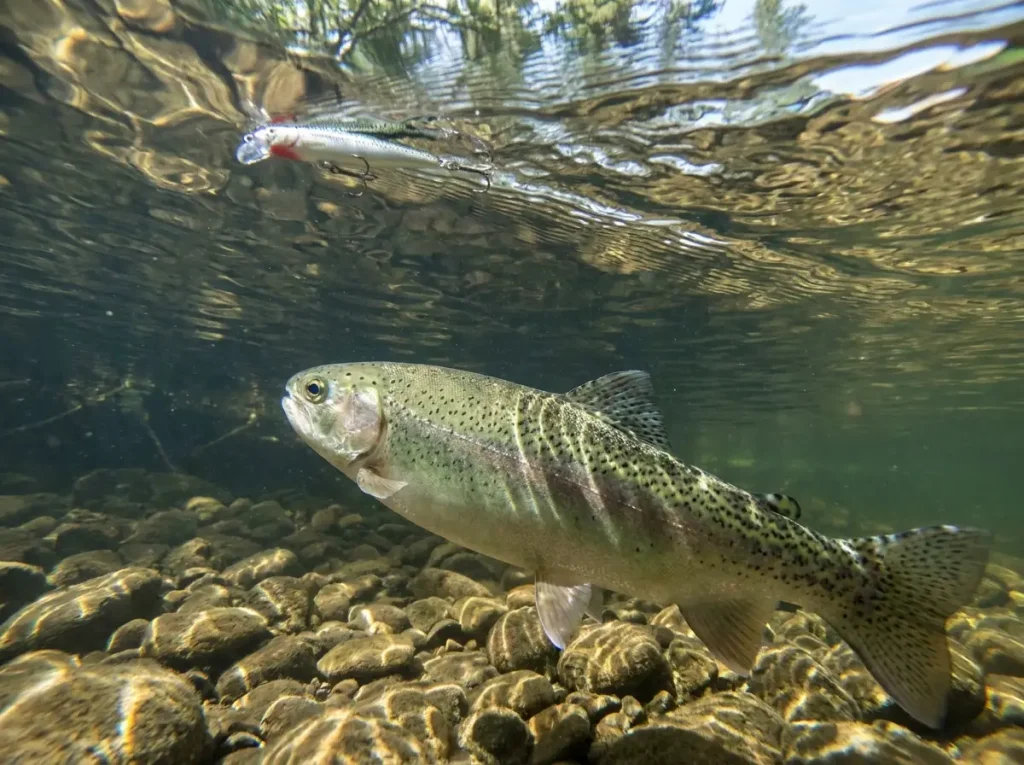
Fish have a sense humans don’t: the lateral line — a row of sensory organs running along each side of the body from head to tail. These organs detect pressure changes and vibrations in the water, allowing fish to “feel” the movement of other fish, prey, and predators from surprising distances.
In practical terms, this means: your lure’s action is creating a pressure wave that fish can detect before they see it. The wobble of a crankbait, the tail kick of a swimbait, the thump of a jig — these are all signals a fish’s lateral line reads in the water column. This is why lure speed, action, and retrieve pattern matter so much. Different baits produce different pressure signatures, and fish key in on specific signatures based on what they’re currently chasing.
It also means that you — wading, paddling, or walking the bank — create pressure waves too. Heavy footsteps on a bank transmit vibration through the ground into the water. A kayak slapping a wave creates a pressure pulse. Fish detect these and respond by going quiet or moving off. The angler who catches fish consistently has usually learned to move quietly before they learned anything else.
Vision — how far, in what conditions
Fish vision is adapted for their environment. Most freshwater fish see well in the horizontal plane and have excellent color vision in clear, well-lit conditions. In turbid or dark water, they rely more on the lateral line and smell. In low light, many species have a reflective layer in the eye (tapetum lucidum) that amplifies available light, making them effective feeders at dawn, dusk, and on dark overcast days — the feeding windows anglers love for this reason.
Fish can see above the water surface within a cone of roughly 97 degrees (Snell’s window). An angler standing upright on a bank is visible to fish at significant distances — one reason stealthy, crouching approaches consistently produce more fish on clear water.
Smell and taste — the underestimated senses
Many fish species have a highly developed sense of smell. Catfish can detect trace chemicals in water at almost incomprehensibly low concentrations. Bass can smell the scent trails left by baitfish. This is why scent-treated soft plastics and natural baits produce in situations where visual triggers alone wouldn’t.
Pro tip: If you handle sunscreen, bug spray, or gasoline before touching your lures or bait, you’re introducing a chemical signal that fish associate with threat or non-food. Rinse your hands in the water before rigging if you’re fishing scent-sensitive situations.
Where Fish Hold and Why
Structure vs. cover — they’re not the same
Structure is the physical shape of the underwater environment — a drop-off, a point, a channel edge, a submerged hump. These are permanent features that funnel fish movement and create predictable holding areas regardless of what’s growing or sitting on them.
Cover is what’s on the structure — weeds, rocks, logs, docks, brush. Cover provides concealment and shade. Fish use both, but differently. Bass use structure as a highway system — they move along channel edges and depth changes — and cover as stopping points, ambush positions, and thermal refuges.
Understanding the difference matters because fishing cover without structure often means fishing incidental fish, not concentrated populations. A dock in 20 feet of water over a flat bottom holds fewer fish than a dock at the edge of a depth change dropping from 8 to 15 feet.
Current seams — the most important concept for river fishing
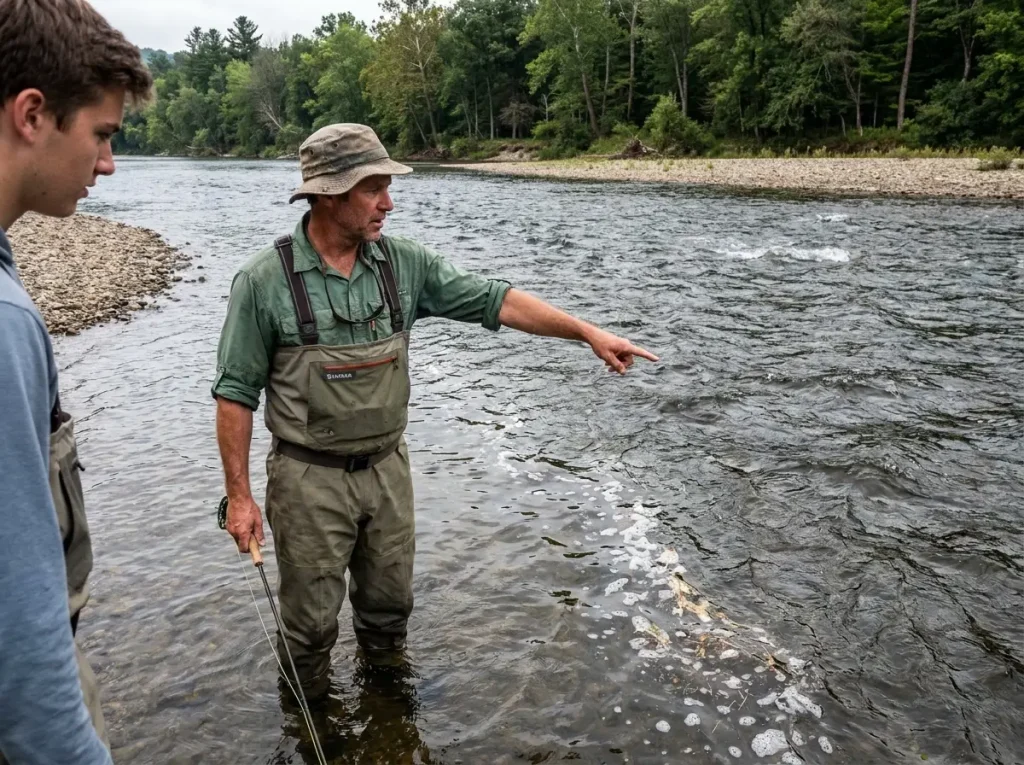
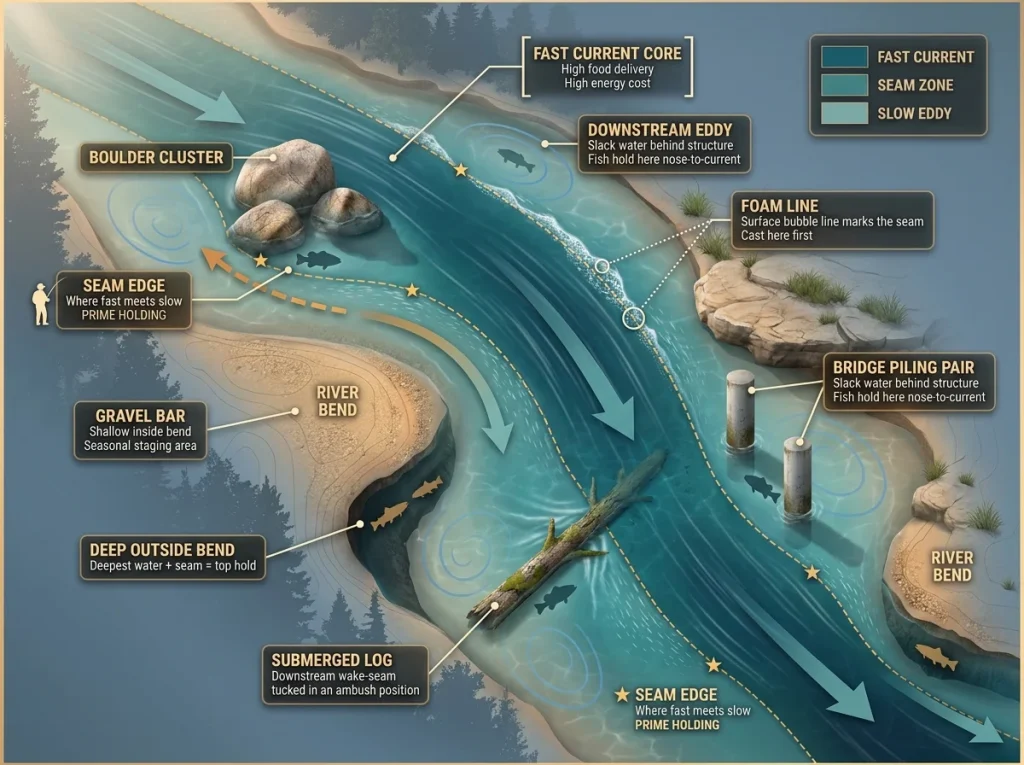
In rivers, the most productive holding position is the current seam — the interface between fast water and slow water. Fast current delivers food; slow water requires less energy to hold position. A fish positioned right at the seam edge gets the best of both: food delivered by the current, rest provided by the adjacent slack water.
Seams form behind any object that breaks current — rocks, logs, bridge pilings, points of land, river bends. The foam line or bubble line that often forms on a river surface marks a seam reliably. If you can identify the foam line, you can identify where fish are holding. Cast to let your bait or lure enter the fast water and drift or swing through the seam edge — that’s where the hit comes.
Pro tip: New river anglers cast too far. The seam directly across from where you’re standing, or the one behind the closest boulder, will often hold more fish than the one you’re lobbing casts to across the river. Start close and work outward.
Water Temperature and Feeding Activity
The preferred temperature ranges that control everything
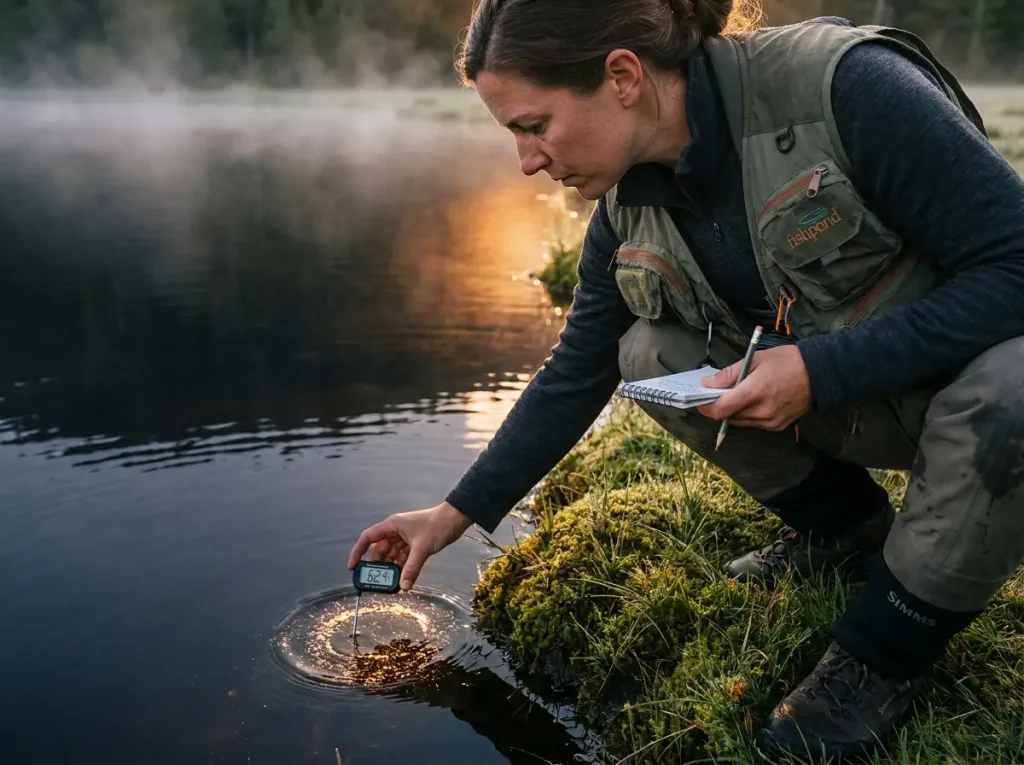
Every species has a metabolic sweet spot — the water temperature range where their body runs most efficiently and their appetite is strongest. Here are the practical reference ranges:
| Fish Activity and Feeding Temperature Ranges | ||
|---|---|---|
| Species | Active Feeding Range | Peak Activity |
| Largemouth bass | 60–80°F | 65–75°F |
| Rainbow trout | 50–65°F | 55–62°F |
| Panfish / bluegill | 65–80°F | 68–75°F |
| Walleye | 55–70°F | 60–68°F |
| Catfish | 75–90°F | 80–85°F |
Outside these ranges, fish are still present but their metabolism slows significantly. A bass in 50°F water moves slowly, eats infrequently, and requires a slow, deliberate presentation to trigger a bite. The same bass in 70°F water is aggressive, territorial, and will chase a fast-moving lure. Same fish, completely different behavior — entirely driven by water temperature.
How temperature drives location by season
In spring, warming surface water draws fish shallow. Bass move onto flats and points to spawn when temperatures hit the low 60s°F. Trout become active and aggressive as snowmelt rivers warm toward their preferred range.
In summer, heat pushes fish deep or into thermally stable zones — the thermocline in lakes (the layer where warm surface water meets colder deep water) creates a temperature barrier that concentrates fish at a predictable depth. Midday in summer often means fishing deeper than you think.
In fall, cooling water triggers aggressive pre-winter feeding across almost all species. The bass you couldn’t catch all August starts crushing crankbaits in October. Fall is when new anglers can have their best days, because active fish in the right temperature range don’t require technical presentations.
Our overview of how weather fronts change fish behavior goes deeper on the day-to-day variation if you want more granular guidance.
Daily Feeding Windows
Why early morning and evening produce more fish
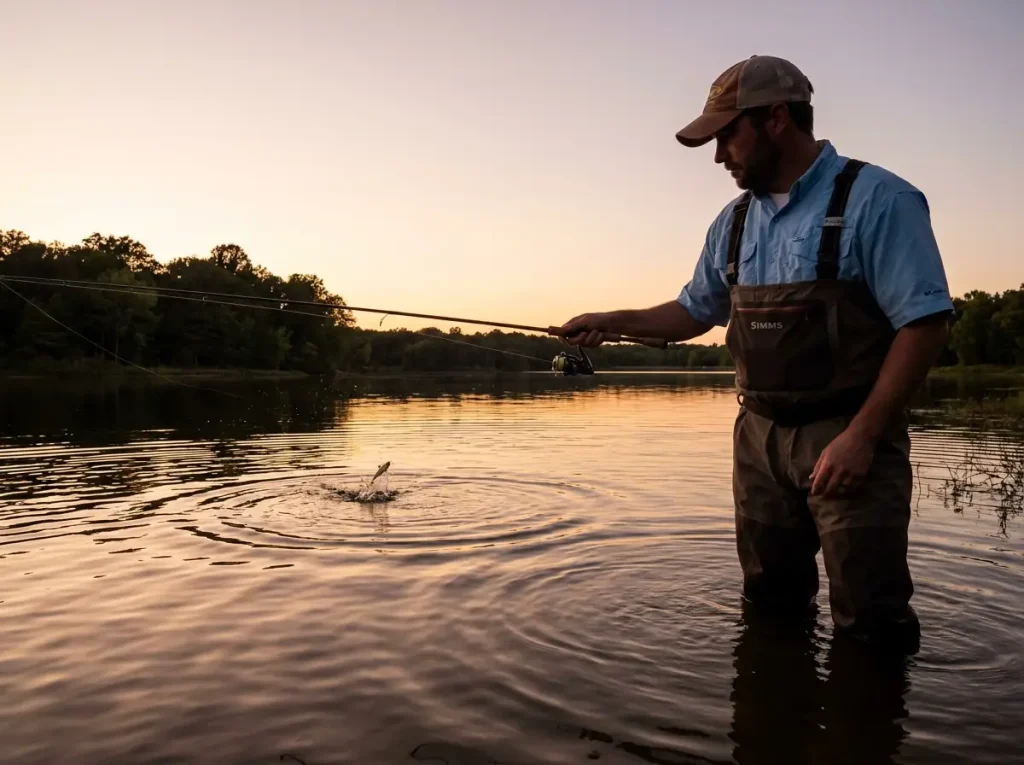
The two best times to fish are the 90 minutes around sunrise and the 90 minutes around sunset — and this isn’t tradition, it’s biology. During low-light periods, two things happen simultaneously: predatory fish (bass, walleye, trout) have a visual advantage over their prey because their eyes amplify low light better than baitfish do, and water temperatures are often in or approaching the optimal range after cooling overnight or warming through the afternoon.
Midday on a bright summer day is the hardest time to catch fish in most warm-water fisheries. High sun penetrates clear water deeply, pushing fish into cover, deep water, or heavy shade. Light-sensitive fish — walleye especially — retreat from bright conditions. Panfish drop below the thermocline. Bass suspend in deep cover and won’t chase lures aggressively.
The anglers consistently making catches on full-sun summer days are fishing specific micro-environments: deep shade under docks, the shadow line of a bridge, thick weed edges that block light penetration.
Barometric pressure — the off-water forecasting tool
Barometric pressure — the weight of the atmosphere — affects fish behavior through its influence on the swim bladder, the gas-filled organ fish use to maintain buoyancy. As pressure drops (a storm front approaching), fish may experience slight discomfort as their swim bladder expands, triggering aggressive feeding before conditions change. As pressure rises after a storm passes, fish need 24-48 hours to stabilize before feeding normalizes.
The practical rule: fish hard during the 12-24 hours before a front arrives (falling barometer = feeding activity). Expect slow fishing in the 24 hours after a front passes. Stable high pressure between fronts produces consistent but unhurried feeding.
Check the forecast before you go. A falling barometer on a Wednesday afternoon might be the best fishing of your week.
Seasonal Behavior at a Glance
Spring — shallow, aggressive, spawning-driven
Spring is the most dramatic behavioral shift of the year. As water temperatures climb through the 50s°F, bass move from wintering depth onto shallow flats and points — first to feed aggressively, then to spawn when temperatures hit 60-65°F. Male bass guard nests aggressively and will strike lures out of territorial response even when not hungry. Trout become accessible near shore as streams warm.
This is the best season for new anglers to build confidence — fish are shallower and more aggressive than at any other time of year. The fishing is genuinely easier.
Summer — deep, thermal, structure-oriented
Fish move deep in the heat of summer, following the thermocline. Learn to identify depth breaks on a map or fish finder — the spot where the lake bottom drops from shallow to deep often marks the thermocline depth, and that’s where fish suspend in summer. Fish structure edges: the ledge at 15 feet, the channel swing at 20 feet.
Dawn and dusk are the productive windows. Midday is typically dead time in the sun belt.
Fall — the second spring
Cooling water triggers aggressive feeding as fish build energy reserves before winter. Bass stack on points and channel bends chasing shad. The crankbait, swim jig, and spinnerbait all produce because fish are covering water in search of bait. This is when deep water bass tactics transition to shallower, more active fishing.
Winter — slow, deliberate, depth-focused
Fish are present but slow. The most effective winter presentations are slow-moving, bottom-oriented, and in the deeper, more thermally stable parts of the water. Dropping a blade bait or jigging spoon directly on suspended fish on a fish finder is more productive than covering water. Patience is more productive than persistence.
How Fish Get Spooked — and How to Avoid It
What happens when a fish is spooked
A spooked fish doesn’t just stop biting — it often moves. And it tells nearby fish there’s a problem. In a small clear stream, one angler wading aggressively through a pool can put every fish in 50 yards on high alert for the next 20 minutes. In a lake, a boat running shallow over a flat can scatter fish that were actively feeding.
A spooked fish goes into alert mode: it holds still, moves tight to cover, stops eating, and watches. It will not resume normal feeding activity until the perceived threat has passed. In a small stream, that’s 10-20 minutes minimum. In clear water with an obvious threat (shadow falling across the pool, heavy footsteps), it can be longer.
The approach habits that change everything
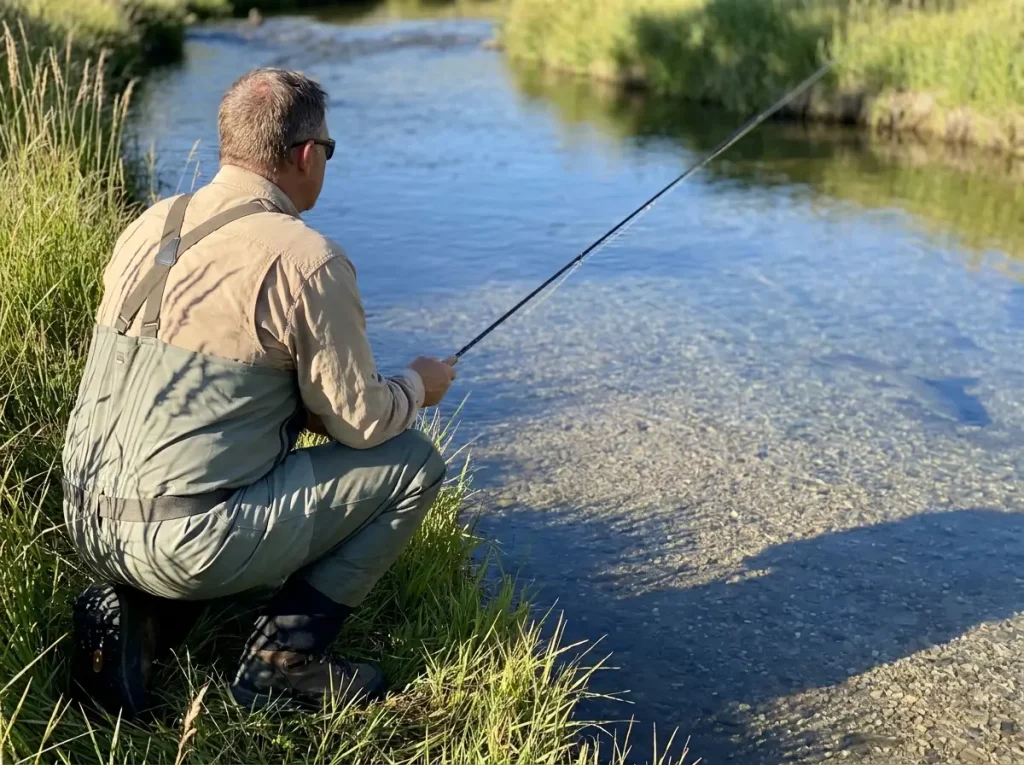
New anglers underestimate how easily they’re detected. Move slowly on the bank and in the water. Keep your shadow off the fishing area — approach from angles where sunlight is behind you. Crouch low when approaching clear, shallow water. Wade slowly enough that you don’t create significant pressure waves ahead of you.
The angler who spends five minutes observing a pool from a distance before making a cast — watching for rises, noting current seams, planning the approach — will consistently outfish the angler who walks up and starts casting. Observation costs nothing and it tells you exactly where to put your first cast.
Pro tip: On small clear streams, the water within ten feet of your feet often holds better fish than the pool you’re casting across. New anglers ignore the near water and cast far. The veteran casts near first and works outward systematically.
Conclusion
Understanding fish behavior is the skill that multiplies the value of every other skill you develop. Know where fish hold — current seams, structure edges, thermal layers. Know when they feed — the low-light windows, falling barometer, the temperature sweet spots. And approach quietly enough that the fish don’t know you’re there before your lure arrives.
Three things to put into practice on your next trip: check the water temperature before you fish and adjust your expectations based on where it falls in the species’ preferred range, identify the current seams and structure edges before you cast a single time, and get to the water at dawn or stay through dusk. Those three habits will put more fish in your hands than any tackle upgrade.
FAQ
What are the basic behaviors of fish?
Fish behavior is driven by three needs: finding food efficiently, avoiding predators, and staying in water that matches their preferred temperature range. Every position a fish holds in a lake or river traces back to one of those three drives — usually all three at once.
What time of day are fish most active?
Most freshwater fish are most active during the 90 minutes around sunrise and sunset. Low light gives predatory fish a visual advantage, and temperatures are often in the optimal range during these windows. Midday under bright sun is typically the slowest period, especially in summer.
How does water temperature affect fish behavior?
Fish are cold-blooded — their metabolism runs at the waters speed. Within their preferred temperature range, fish feed actively and move freely. Outside it (too cold or too warm), they become sluggish, move less, eat less, and require slower, more deliberate presentations to trigger a strike.
Where do fish go in hot weather?
In hot summer weather, fish seek the deepest thermally stable water available, shade under docks and bridges, or deep weed cover. In lakes, they often suspend at the thermocline depth. Activity concentrates in the early morning and evening windows when water cools and light drops.
How can you tell if fish are feeding?
Look for surface activity — rises, boils, or bait fish breaking the surface in panic. Watch birds: herons and osprey watching a specific area mean fish are present. On rivers, rising fish leave rings. On lakes, schooling activity creates visible surface disturbances. Stable falling barometric pressure before a front is a reliable indicator of feeding activity across most species.
Risk Disclaimer: Fishing, boating, and all related outdoor activities involve inherent risks that
can lead to injury. The information provided on Master Fishing Mag is for educational and informational purposes
only. While we strive for accuracy, the information, techniques, and advice on gear and safety are not a substitute
for your own best judgment, local knowledge, and adherence to official regulations. Fishing regulations, including
seasons, size limits, and species restrictions, change frequently and vary by location. Always consult the latest
official regulations from your local fish and wildlife agency before heading out. Proper handling of hooks, knives,
and other sharp equipment is essential for safety. Furthermore, be aware of local fish consumption advisories. By
using this website, you agree that you are solely responsible for your own safety and for complying with all
applicable laws. Any reliance you place on our content is strictly at your own risk. Master Fishing Mag and its
authors will not be held liable for any injury, damage, or loss sustained in connection with the use of the
information herein.
Affiliate Disclosure: We are a participant in the Amazon Services LLC Associates Program, an
affiliate advertising program designed to provide a means for us to earn advertising fees by advertising and linking
to Amazon.com. As an Amazon Associate, we earn from qualifying purchases. We also participate in other affiliate
programs and may receive a commission on products purchased through our links, at no extra cost to you. Additional
terms are found in the terms of service.