
In this article
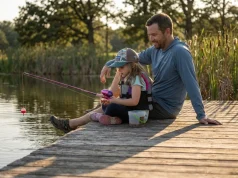
The kid’s face crumpled the moment the bass slipped off the hook and splashed back into the murky water. Three hours of waiting, one bite, zero fish. Her dad stood there, helpless, wondering what he’d done wrong. Across America, this scene plays out 16.6 million times every year—the exact number of anglers who quit the sport, frustrated and fishless.
After guiding hundreds of beginners through their first seasons on the water, I’ve seen every common beginner fishing mistakes in the book. The good news? A 23% annual churn rate in recreational angling isn’t caused by bad luck. It’s caused by a handful of predictable, fixable errors that sabotage new anglers before they develop real skills. Fix these problems, and the frustration ends.
Here’s exactly how to stop struggling and start catching.
⚡ Quick Answer: Most beginners fail because of gear mismatch (wrong rod/reel combo), poor timing (fishing during inactive periods), and weak knots that snap under pressure. A medium-action spinning combo with properly set drag, fished at dawn or dusk near visible structure, with a solid Palomar knot connecting your lure, solves 80% of beginner problems immediately.
The Gear Problem: Why Your Equipment Is Fighting Against You
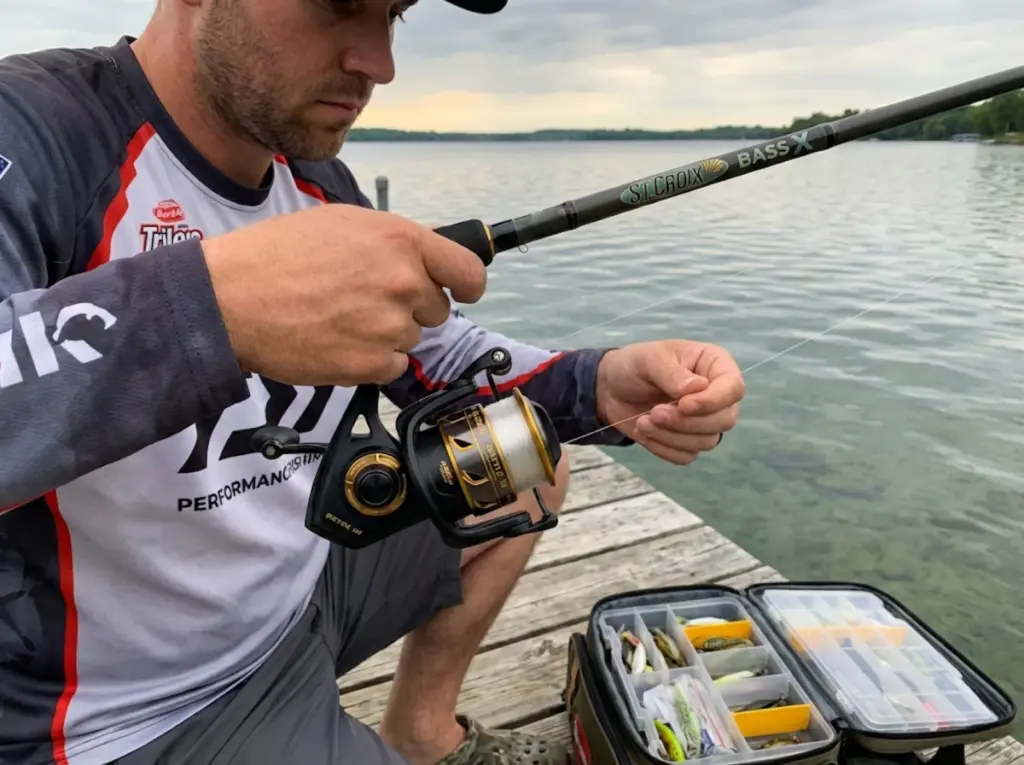
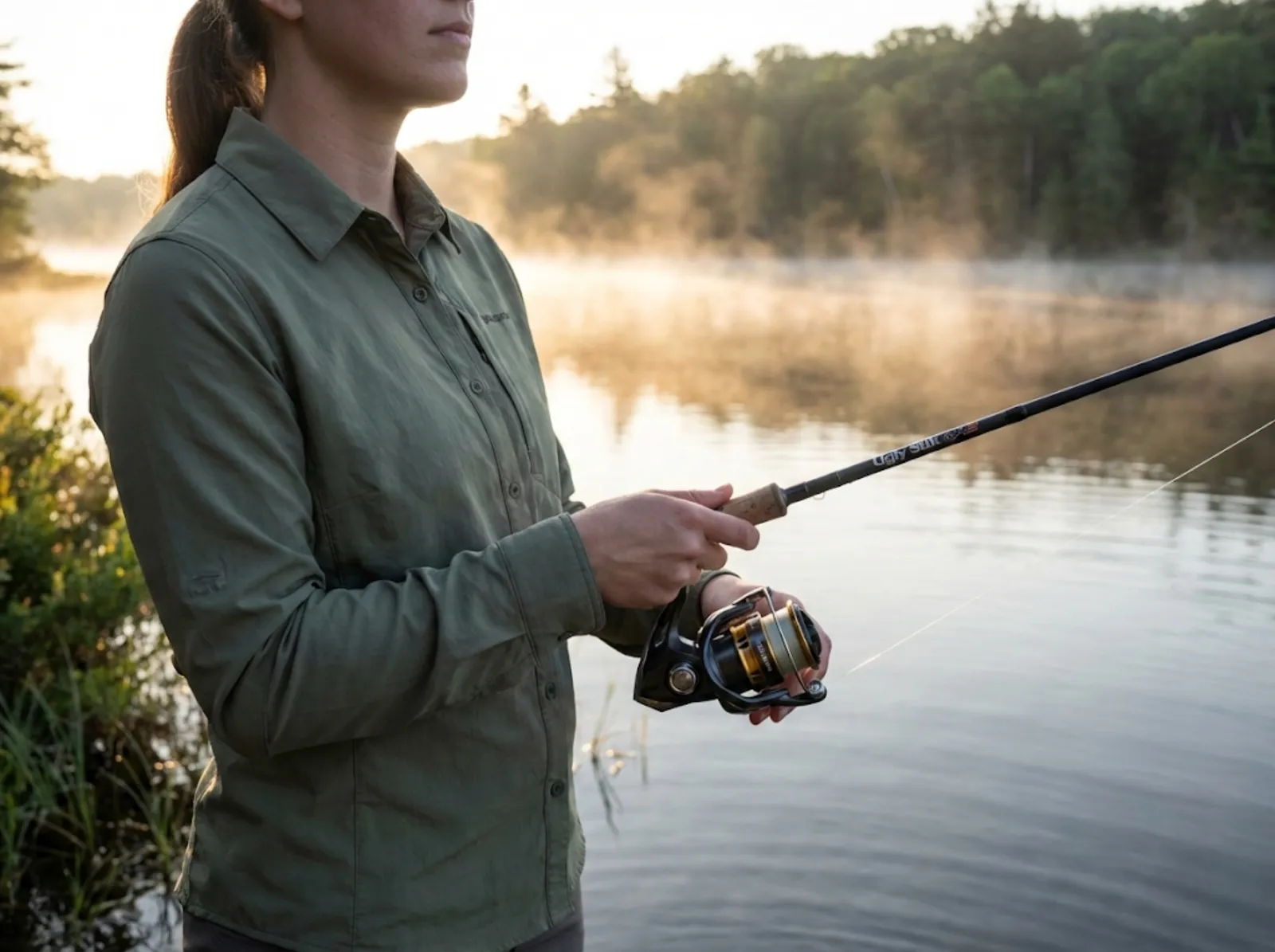
Your tackle should work for you, not against you. When your rod and reel don’t match your target species, even basic tasks like casting and detecting bites become frustrating battles.
Matching Your Rod to Your Target Species
A medium-heavy rod in the 6’6″ to 7′ range handles 90% of freshwater species beginners encounter—bass, panfish, catfish, and trout. That’s your sweet spot. The $14.8 billion tackle market overwhelms new anglers with options, but quality combos exist at $50-$150 price points that will last for years.
Rod action determines where the blank bends. Fast action bends near the tip for sensitivity. Slow action bends through the whole rod for forgiveness. Beginners want medium action—it does a bit of everything without punishing mistakes.
Stay away from what guides call “Disney-branded junk.” Those cartoon character fishing reels with inconsistent drag and rough gears create mechanical resistance that makes casting difficult even for experienced anglers. Give a kid a real ultralight spinning combo, and their success rate doubles because the gear actually works. The U.S. Fish & Wildlife Service starter gear recommendations confirm that matched tackle dramatically improves beginner outcomes.
For a breakdown of exactly what to buy without overspending, see our complete beginner gear checklist.
Understanding Drag Settings (The 20-30% Rule)
The drag system is a friction brake that lets a fish pull line without snapping it. Beginners commit the “lock-down” error—cranking that knob to maximum—and wonder why their line breaks on every solid strike.
Here’s your rule: set fishing reel drag to 20-30% of your fishing line‘s rated strength. For 10 lb test, that means 2-3 lbs of resistance. Test it by hooking something solid and pulling. Line should release smoothly with firm pressure, not freeze solid until it snaps.
Pro tip: The sound of a screaming drag isn’t failure—it’s the system working exactly as designed. Let the fish run.
If you’ve never heard your drag click, it’s probably too tight. Learn the details of calibrating drag with or without a scale to get this dialed in.
Why Line Type Matters More Than You Think
Monofilament line is forgiving for beginners. It stretches 2-9% under load, absorbing hookset mistakes and cushioning sudden shocks. It floats, making it great for topwater presentations.
Fluorocarbon line sinks and becomes nearly invisible underwater—ideal for clear water and spooky fish. But it has more memory and stiffness, which frustrates new anglers with coiling and casting problems.
Braided line has zero stretch. Excellent for sensitivity and hook setting power, but punishing for beginners who yank too hard. Start with mono, graduate to braid later.
One sneaky problem: overfilling spinning reels. Those coils falling off the spool into a bird’s nest? You left too little lip showing. Keep 1/8″ of spool edge visible. For a complete breakdown, check our braid vs fluoro vs mono decision matrix.
Reading Water: Why 90% of Fish Live in 10% of the Lake
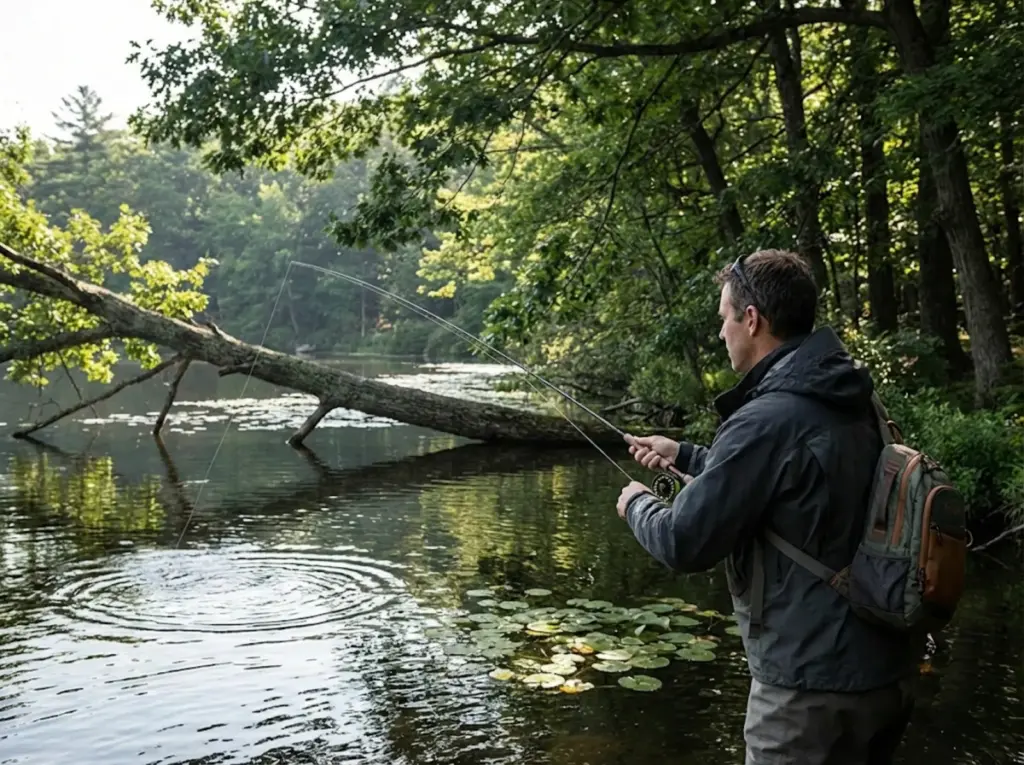
Beginners cast to the center of ponds and lakes, assuming deep water equals more fish. Wrong. Predatory species are ambush hunters that stack up where conditions change.
The Structure vs. Cover Distinction
Structure means permanent bottom features—points, humps, channels, drop-offs. Cover means objects fish hide around—docks, vegetation, rocks, fallen trees. Both attract fish because they provide ambush points and shade.
The 90/10 rule applies everywhere: 90% of fish occupy 10% of available water. Your job is finding that 10%. Look for “edges” where conditions change—weed lines, dock shadows, depth transitions.
Fish position on the shaded or current-protected side of structure to conserve energy. That bass isn’t cruising open water. She’s tucked against a shoreline log, waiting for a baitfish to swim past. The South Carolina DNR fishing guide breaks down how predators relate to structure in detail.
Learn the art of reading lake contour maps for structure and you’ll outfish anyone casting blind.
Timing Your Trips Around Fish Behavior
Fish are cold-blooded. Their metabolism and activity track directly with water temperature. Dawn and dusk are feeding windows because dissolved oxygen peaks and low light favors predator ambush.
Fishing the mid-day lull (10am-3pm in summer) puts you on water when fish are least active. You’re working three times as hard for one-third the bites. Overcast days extend the window—fish feel safer leaving cover when the sun isn’t blazing.
Learn about morning vs. evening fishing for beginners to understand which window works best for your target species.
Pro tip: Check your fishing app barometer before loading the car. A dropping pressure reading is worth more than any lure choice.
Weather Reading Basics
Barometric pressure drops before storms trigger aggressive feeding. Fish sense the change coming and stack calories. A stable high-pressure system (1020+ mb) often means tough fishing—everything gets lethargic.
Wind direction matters too. In spring, a south wind warms water and activates fish. A cold north wind can shut down activity completely. Rain increases dissolved oxygen and often triggers feeding, as long as the water doesn’t turn into chocolate milk.
The Knot Failures Nobody Talks About
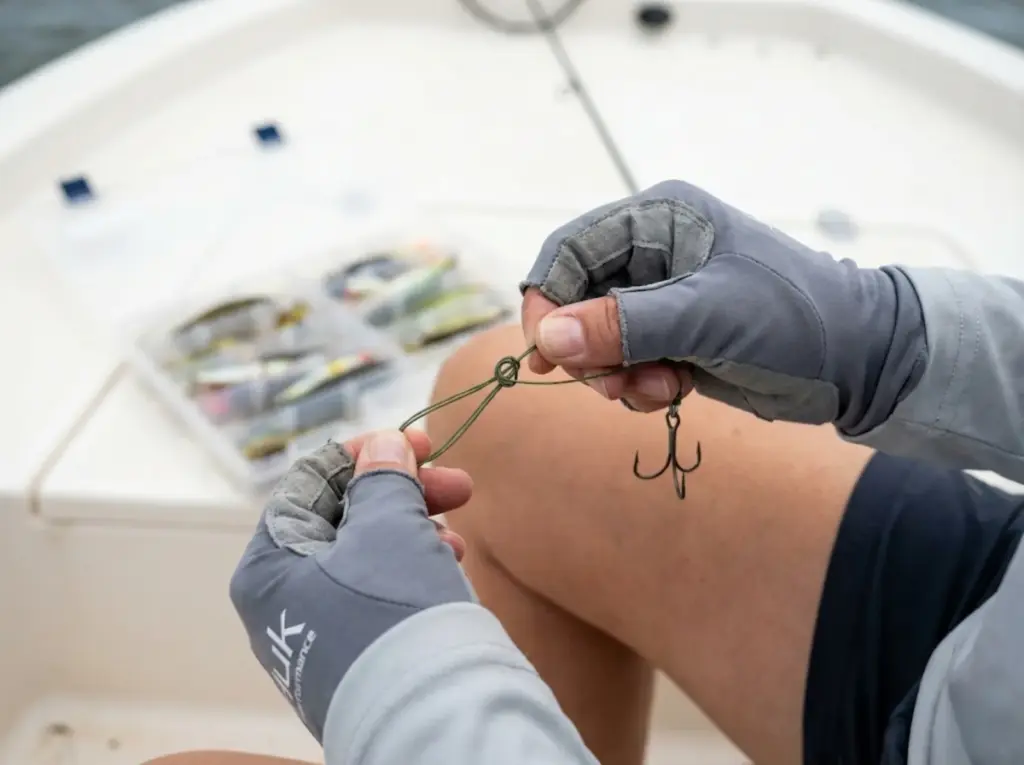
Lost the trophy fish of a lifetime? Before blaming bad luck, check your knot. Knot failure—not line breakage—causes most lost fish for beginners.
The Three Knots Every Beginner Must Know
These three knots cover 95% of situations:
The Improved Clinch Knot (85-90% strength) is your foundational line-to-lure connection for monofilament and fluorocarbon. Easy to tie, reliable for lines under 30 lb test.
The Palomar Knot (95-100% strength) is the king for braided line. It doubles line through the eyelet for maximum security. Simple to tie, nearly impossible to fail when done correctly.
The Surgeon’s Knot (90% strength) joins two lines of different diameters—perfect for adding a fluorocarbon leader to your mono mainline.
The Vermont Fish & Wildlife knot guide confirms these as the essential foundations. Learn them cold before adding complexity. Our complete fishing knot field guide shows step-by-step instructions.
The Lubrication Secret That Saves Your Knots
Here’s information that could save your personal best fish: friction during knot cinching generates heat. That heat weakens monofilament and fluorocarbon at the connection point.
Lubricating knots with water or saliva before tightening allows coils to slide into place without heat damage. This single step preserves 10-15% more knot strength—the difference between landing and losing a big fish.
Pull knots tight slowly and steadily. Jerking creates stress points. Trim tag ends to 1/8″ to prevent snagging debris, but leave enough material to prevent slippage.
Checking Your Knots Before Every Cast
Run your fingernail along the knot before casting. Any roughness or curling “pig tail” indicates a potential failure point. Retie immediately.
Retie after catching any fish—the stress of a fight weakens knot integrity. Retie after snagging and pulling free—sudden shock loads create invisible damage. Your knot tied fine this morning might be compromised by afternoon.
Pro tip: The five seconds it takes to retie costs nothing. The fish of a lifetime is gone forever.
Presentation Mistakes That Spook Fish
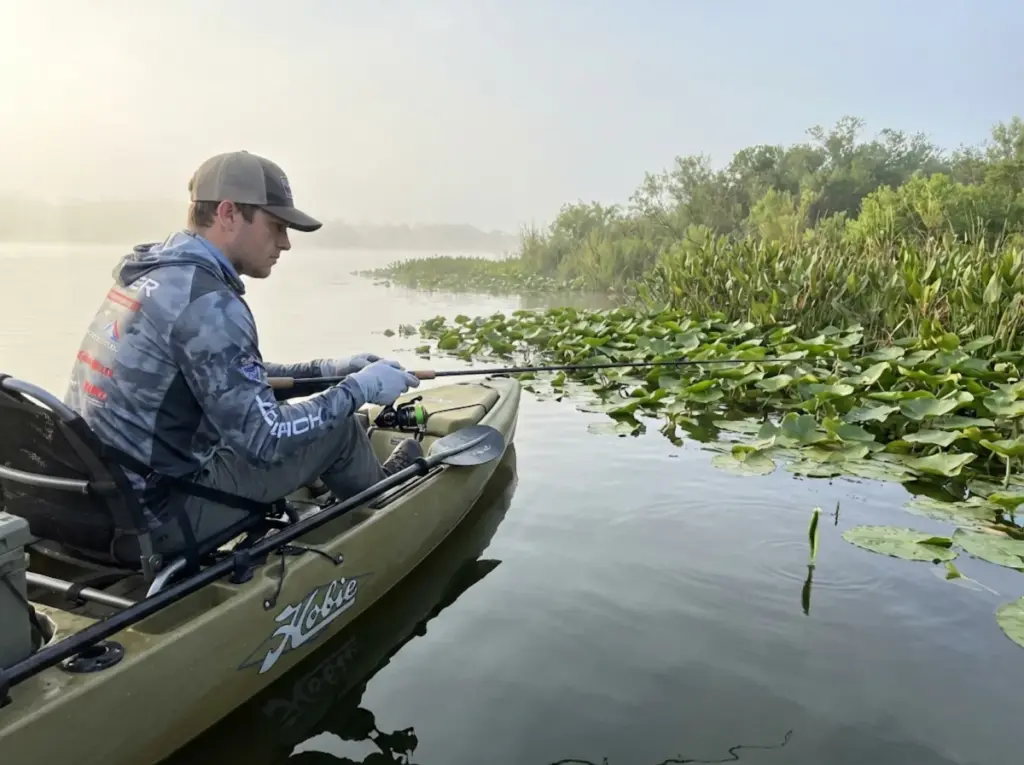
Your lure selection matters far less than how you present it. The psychological urge to “do something” leads beginners to retrieve too fast. Slow down.
Slow Down: Let the Lure Do the Work
“Mindless retrieving”—casting and reeling at constant speed—is the hallmark of the frustrated beginner. Bass and other predators often strike during pauses or changes in cadence, not during steady motion.
“Dead sticking”—letting a soft plastic sit motionless on the bottom—triggers strikes from cautious fish spooked by aggressive presentations. Think “dying baitfish,” not “fleeing baitfish.” Injured prey is easier to catch.
Match retrieve speed to water temperature. Cold water means slower metabolism, which means slower presentations. Learn how water temperature affects fish metabolism to dial in your cadence.
The “Bomb the Blowup” Error
When a fish strikes and misses (a “blowup”), beginners instinctively cast directly on top of the disturbance. This spooks the fish rather than triggering a follow-up strike.
Correct technique: cast past the blowup zone and work your lure back through it. The fish that missed often repositions to ambush again. Give her a second chance, not a scare. Wait 10-30 seconds before the next cast to let things calm down. This is one of those simple mistakes that costs beginners dozens of fish every season.
Casting Accuracy vs. Distance
Beginners focus on casting far. Experienced anglers focus on casting accurate. Landing a lure within 6 inches of structure—dock piling, weed edge, fallen tree—produces far more strikes than long casts to open water.
Overpowering the cast causes backlashes on baitcasters and loose coils on spinning reels. Practice smooth, controlled acceleration rather than jerky power. Casting technique beats brute force every time.
Learn the physics of casting accuracy to place your lure exactly where fish live.
Tackle Maintenance: The Invisible Skill
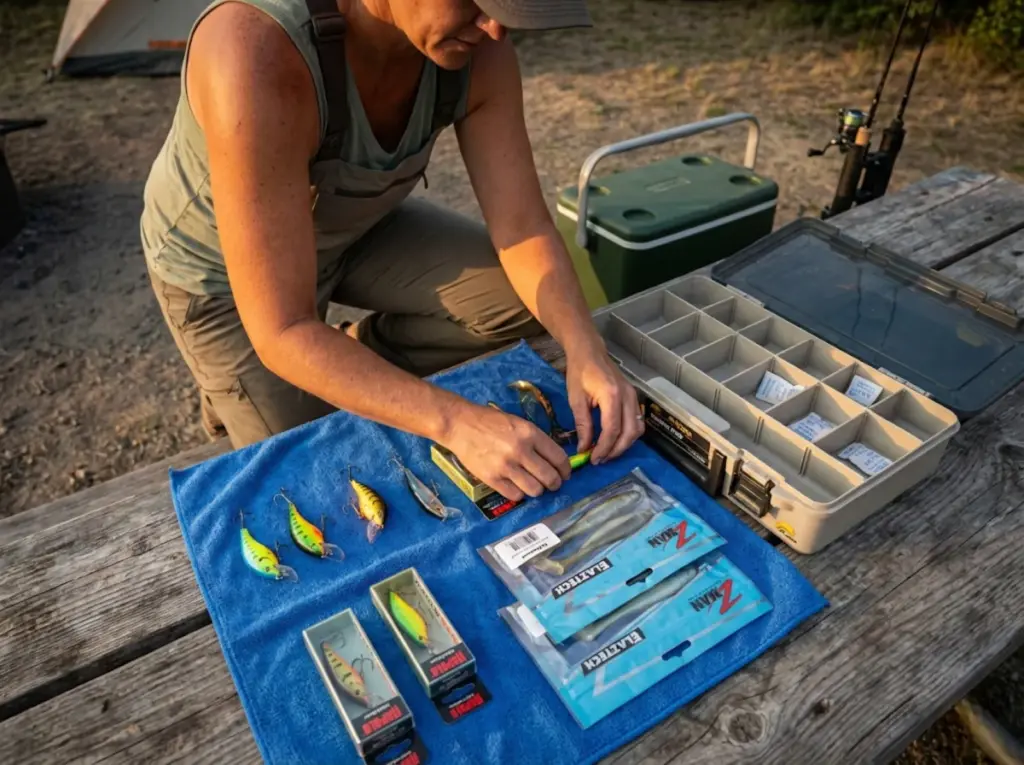
Gear maintenance separates anglers who buy new tackle every season from those whose equipment lasts a decade. A few simple habits prevent the “rust plague” that destroys terminal tackle.
The “Rust Plague” and How to Prevent It
Putting wet lures directly into a sealed tackle box creates a micro-environment that accelerates oxidation. Rusty hooks can destroy an entire inventory of hooks, swivels, and snaps in a single season.
Allow lures and terminal tackle to air-dry on a dashboard or in a breathable bag pocket before storage. Adding silica packets (the ones from shoeboxes) to tackle trays absorbs moisture and prevents rust. Saltwater fishing requires a freshwater rinse of all tackle after every outing.
Our 3-tier gear care protocol breaks down exactly how to maintain equipment for maximum lifespan.
Chemical Incompatibility in Your Tackle Box
Here’s a mistake that costs $20-50 per season: Z-Man baits (made with ElaZtech material) stored with standard plastisol soft plastics causes a chemical reaction that creates melted baits. You’ll open your tackle box to find fused, ruined lures.
Keep chemically incompatible baits in their original packaging or separate containers. Color bleeding between soft plastics is common too—store by color family to prevent dye transfer.
Hook and Rod Guide Protection
Never use rod guides as hook keepers—the ceramic inserts chip, then shred your line on every cast. Sharp hooks penetrate fish mouths with less force. Dull hooks are the silent killer of hookup ratios.
Check sharpness by dragging the point across a fingernail. It should catch, not slide. Replace or sharpen before every trip. Learn the details of hook sharpening geometry to maintain razor-sharp points.
The Etiquette Nobody Taught You
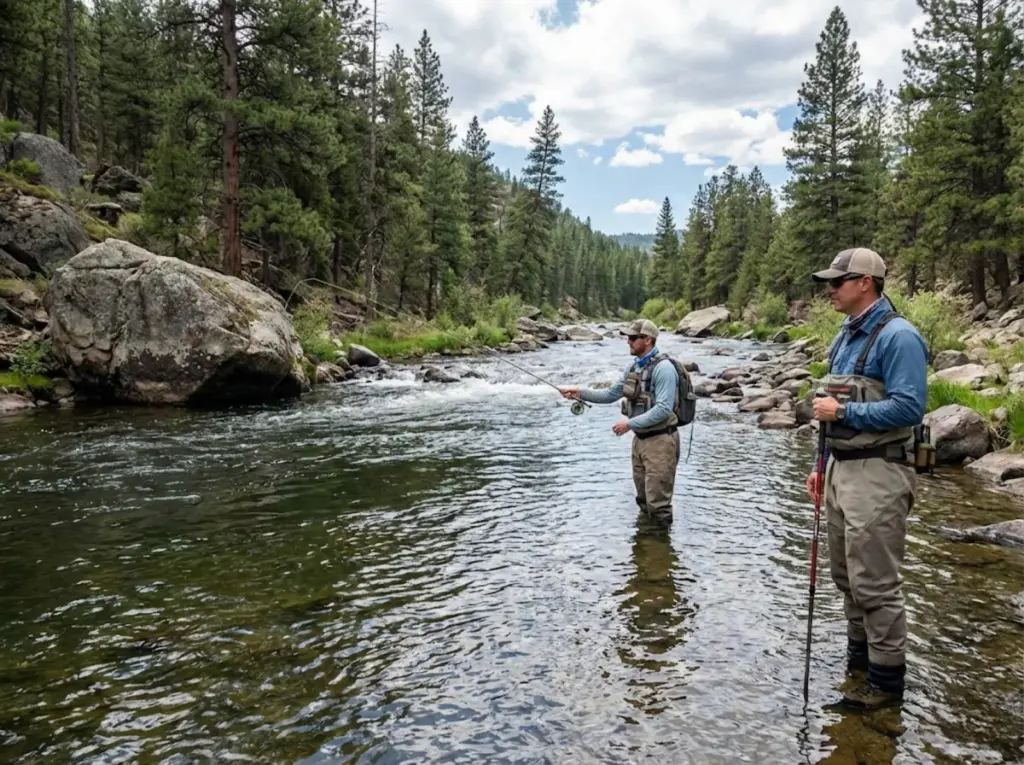
As participation hits record highs, social friction at fishing spots drives people away from the sport. Learning the unwritten rules prevents conflict and keeps access available.
River Right-of-Way: High Holing and Low Holing
“High holing” means entering water directly upstream of another angler—this spooks fish before they can reach them. “Low holing” means positioning downstream and intercepting fish the upstream angler is working toward. Both are major transgressions that create conflict on crowded waters like the Margaree River or Montana streams.
Ask “which way are you working?” and leave a significant gap. When in doubt, give other anglers at least 50 yards of space in moving water. The Idaho Fish and Game angler etiquette guidelines explain spacing and right-of-way in detail.
Shore and Pier Spacing
First-come-first-served is the absolute rule on public shores and piers. If an angler is fishing with rods in sand spikes, stay 30-50 yards away to prevent line tangles. Casting over another angler’s line is a fast way to make enemies.
Pack out all trash—and pick up one extra piece left by others. Never share precise GPS coordinates of productive fishing spots on social media. That’s called “spot burning,” and the fishing community frowns on it hard.
For more on this, check out the 3C code for sharing water to fish alongside others without friction.
Catch-and-Release Best Practices
Wet hands before handling fish—dry hands strip protective mucus coating. Keep fish in water when possible. Air exposure under 60 seconds dramatically improves survival.
Support fish horizontally. Vertical holds by jaw stress the spine and internal organs. Use barbless hooks or crimp barbs for faster, less damaging releases. The NOAA catch-and-release guidelines detail best practices for fish handling and catch-and-release that maximize post-release survival.
Conclusion
Three changes transform your results on the water:
Match your gear to your target species and set drag to 20-30% of line strength. Most lost fish are equipment failures, not bad luck.
Fish the 10% where structure and cover meet, during dawn and dusk when conditions favor predator ambush. The center of the lake is empty.
Slow your presentation and master three essential knots. These tactical basics outweigh any lure selection choice you’ll ever make.
The 16.6 million anglers who quit fishing this year didn’t fail because they lacked skill. They failed because nobody showed them these fundamentals. Take one tip from this guide on your next fishing trip. Land one fish you would have lost. That’s how frustration ends and the addiction begins.
FAQ
What is the single biggest mistake beginner fishermen make?
Using mismatched fishing equipment that fights against them. A medium-action spinning combo with properly set drag eliminates most mechanical problems beginners face. Once the equipment works for you instead of against you, skill development accelerates.
How do I know if my drag is set correctly?
Hook your lure to something solid and pull. Line should release smoothly at about 20-30% of its rated breaking strength. If you’ve never felt your drag click, it’s probably too tight.
Why do I keep losing fish right at the boat or shore?
Fish make powerful last-second runs when they see the threat of landing. If your drag is too tight, this surge snaps the line. If your knots are weak, the stress of lifting exposes the failure point. Loosen drag and retie knots before critical moments.
What’s the best time of day to go fishing as a beginner?
Dawn and dusk. Dissolved oxygen peaks, light levels favor predator ambush, and fish actively feed during these windows. The mid-day lull (10am-3pm in summer) puts you on water during minimum activity periods.
How can I tell where fish are hiding if I can’t see them?
Look for edges where conditions change—weed lines, dock shadows, drop-offs, points. The 90/10 rule applies: 90% of fish occupy 10% of the water. Find structure and cover, and you find fish.
Risk Disclaimer: Fishing, boating, and all related outdoor activities involve inherent risks that
can lead to injury. The information provided on Master Fishing Mag is for educational and informational purposes
only. While we strive for accuracy, the information, techniques, and advice on gear and safety are not a substitute
for your own best judgment, local knowledge, and adherence to official regulations. Fishing regulations, including
seasons, size limits, and species restrictions, change frequently and vary by location. Always consult the latest
official regulations from your local fish and wildlife agency before heading out. Proper handling of hooks, knives,
and other sharp equipment is essential for safety. Furthermore, be aware of local fish consumption advisories. By
using this website, you agree that you are solely responsible for your own safety and for complying with all
applicable laws. Any reliance you place on our content is strictly at your own risk. Master Fishing Mag and its
authors will not be held liable for any injury, damage, or loss sustained in connection with the use of the
information herein.
Affiliate Disclosure: We are a participant in the Amazon Services LLC Associates Program, an
affiliate advertising program designed to provide a means for us to earn advertising fees by advertising and linking
to Amazon.com. As an Amazon Associate, we earn from qualifying purchases. We also participate in other affiliate
programs and may receive a commission on products purchased through our links, at no extra cost to you. Additional
terms are found in the terms of service.