
In this article
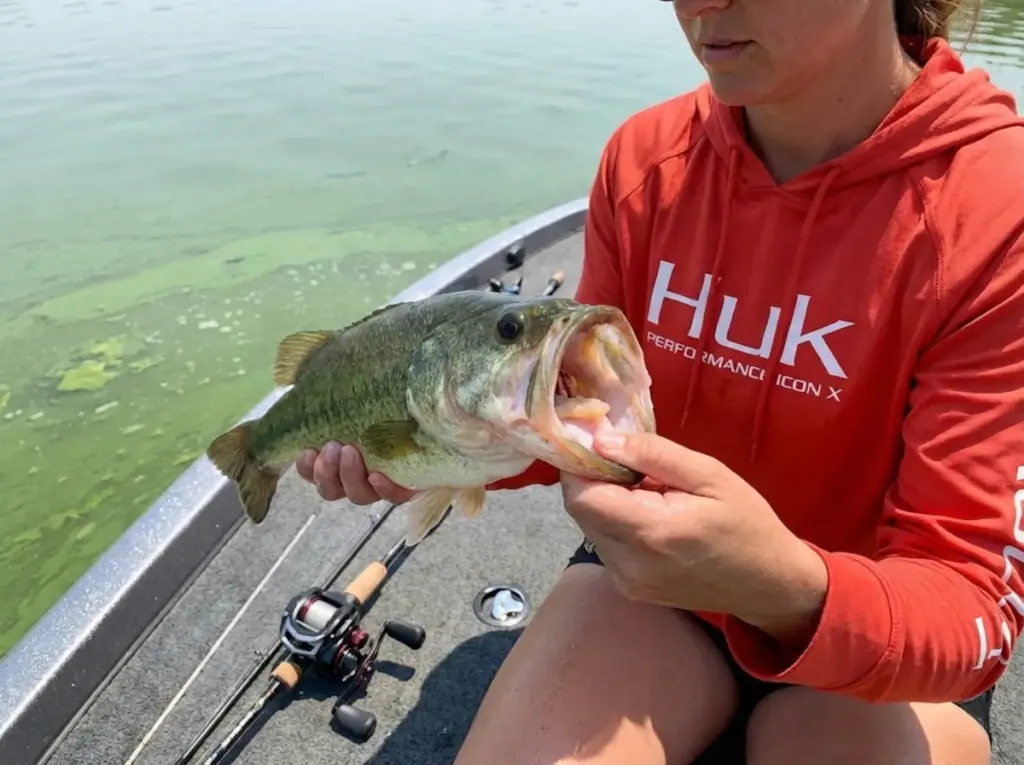
The bass slammed my spinnerbait hard—but the fight lasted exactly three seconds. The fish rolled, flashed its belly, and went limp in water that felt like bathwater. My surface temp read 91°F. That fish wasn’t feeding; it was gasping. And I was the idiot who made it expend its last energy reserves on a lure it couldn’t metabolize.
After two decades on the water, I’ve seen this pattern more times than I can count in waters impacted by thermal pollution. The strikes are aggressive, the fights are pathetically short, and the fish often die even when you release them carefully. Understanding why—and more importantly, knowing when to leave the rod in the truck—separates ethical anglers from the ones who kill fish without realizing it.
Here’s what’s actually happening beneath the surface when water temperatures climb, and how to adjust your tactics accordingly.
⚡ Quick Answer: Thermal pollution forces fish into metabolic overdrive while simultaneously reducing available oxygen. This creates paradoxical “bold” behavior (aggressive strikes, surface activity) that looks like feeding but is actually distress. Fish in thermally polluted water burn energy reserves they can’t replace, suffer cognitive impairment, and face high delayed mortality even after release. Use temperature monitoring tools, target thermal refugia, slow your presentations dramatically, and sometimes the ethical choice is simply not to fish.
The Metabolic Engine Running on Empty
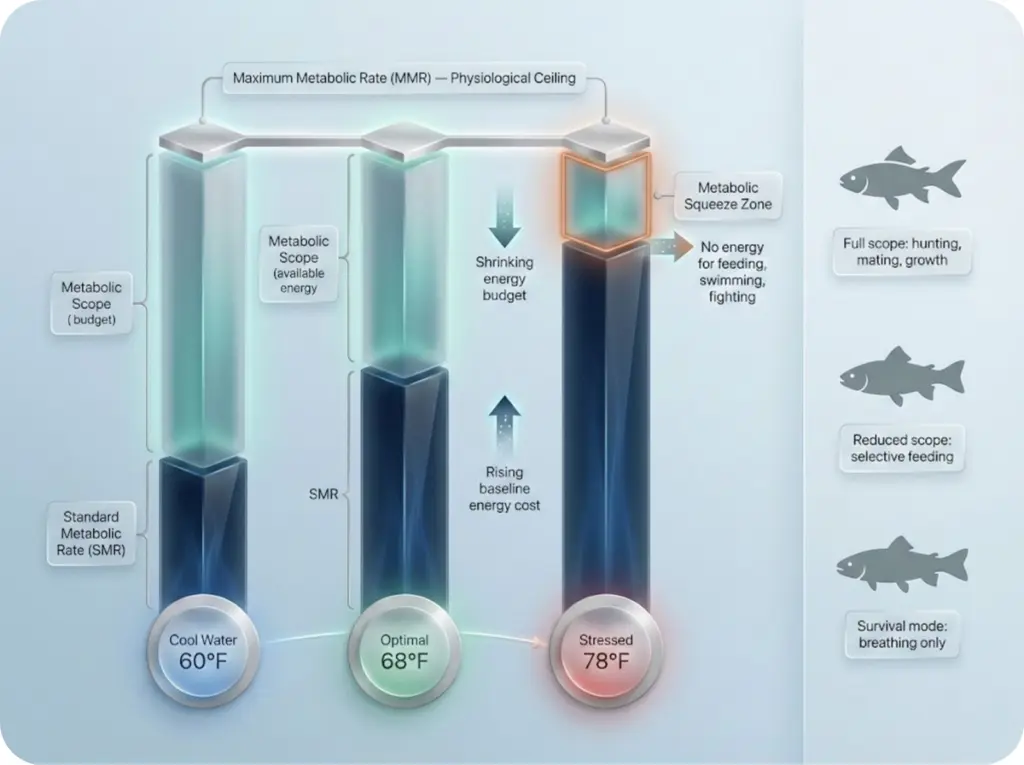
The Standard Metabolic Rate (SMR) of any fish roughly doubles for every 10°C rise in water temperature—a principle scientists call the Q10 effect. This energy drain occurs before the fish swims, hunts, or fights your lure. Think of it as paying maximum rent just to stay alive, with nothing left for groceries.
The Q10 Effect—Why Heat Doubles Energy Demands
The Oxygen and Capacity Limitation of Thermal Tolerance theory (OCLTT) explains what happens when temperatures spike. Every fish has a Maximum Metabolic Rate (MMR)—the ceiling of what their body can produce. The gap between that ceiling and their resting SMR is called Metabolic Scope. That scope is the energy budget for everything non-essential: swimming, feeding, mating, fighting your crankbait.
When water heats up, SMR climbs toward the ceiling. The scope compresses. At some point, there’s literally no energy left for anything except breathing. This is why thermally stressed fish hit your lure with apparent aggression but surrender almost instantly. They burned their last reserves on a reflex action their body can’t afford.
Even digestion becomes impossible. The Specific Dynamic Action (SDA)—the metabolic cost of processing food—requires energy that simply doesn’t exist when scope is compressed. A fish can eat but cannot digest. It starves with a full stomach.
Pro tip: Use large, slow-moving silhouettes for thermally stressed fish. Their hearts are at 100% capacity; they won’t chase a fast burner.
The Oxygen Squeeze—Dissolved Oxygen Crashes When Temps Rise
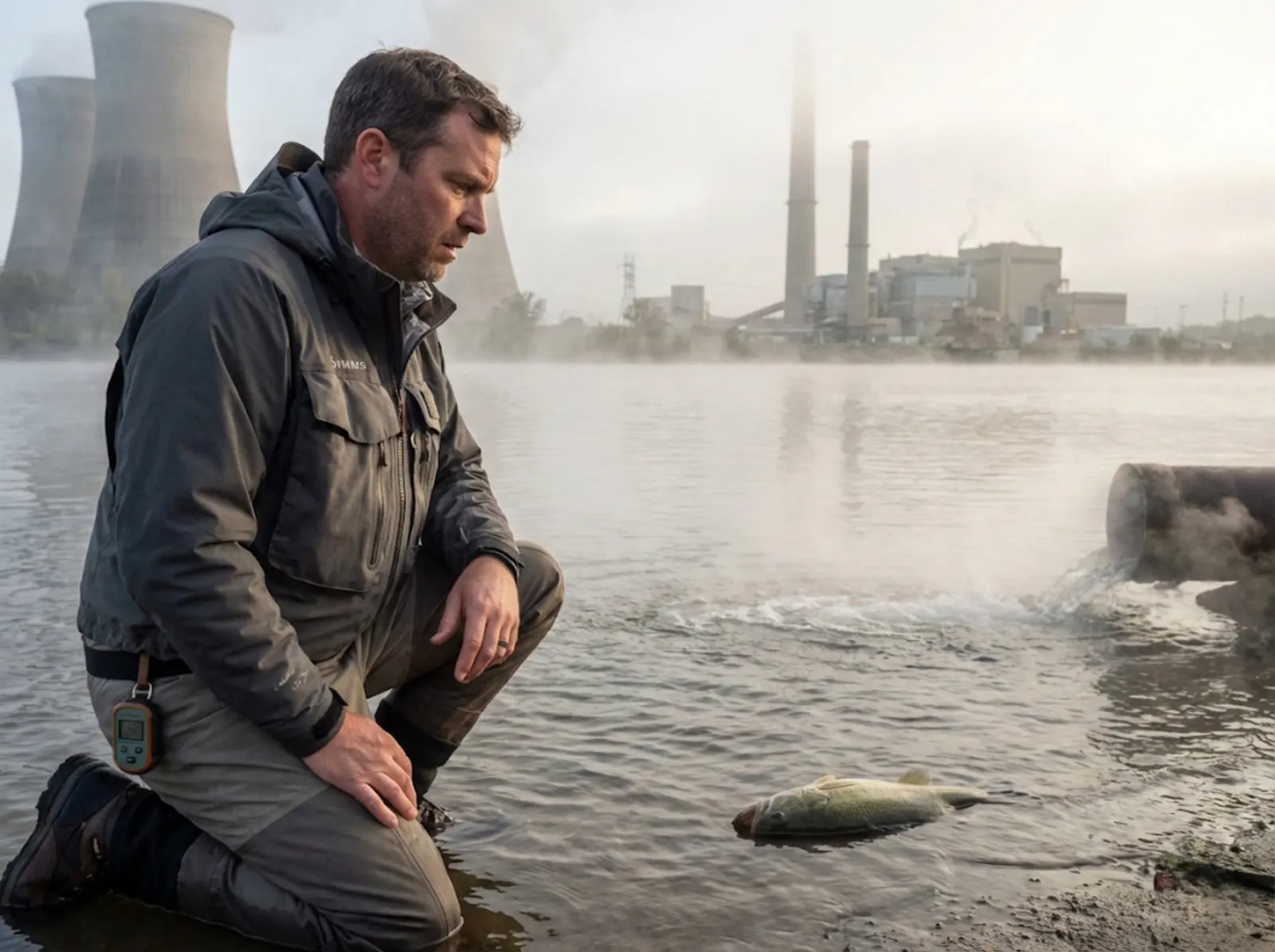
Water temperature and dissolved oxygen are inversely proportional. Hot water holds less oxygen. A single nuclear plant can discharge up to 2.5 billion gallons of water heated 20°F above ambient daily. Fish in those discharge plumes face a double hit: higher metabolic demand and less available oxygen to meet it.
Striped bass are textbook examples of the “habitat squeeze.” They need at least 5 mg/L dissolved oxygen and avoid water temperatures above 84°F. When both thresholds close in, they’re trapped in a narrow band where survival is barely possible. Anglers fishing those “hot bites” often mistake desperation for enthusiasm.
The phrase “soup water” in angling communities describes this perfectly: warm, oxygen-depleted, and deadly despite looking productive. Tournament anglers managing livewell thermal stress management understand this squeeze intimately—it’s why ice additions and aerated systems matter so much during summer events.
According to EPA nutrient pollution research, tourism loses approximately $1 billion annually due to water bodies affected by nutrient and thermal pollution. That number only grows as discharge plumes expand and summers get hotter.
Behavioral Syndrome Disruption—The “Drunk Fish” Effect
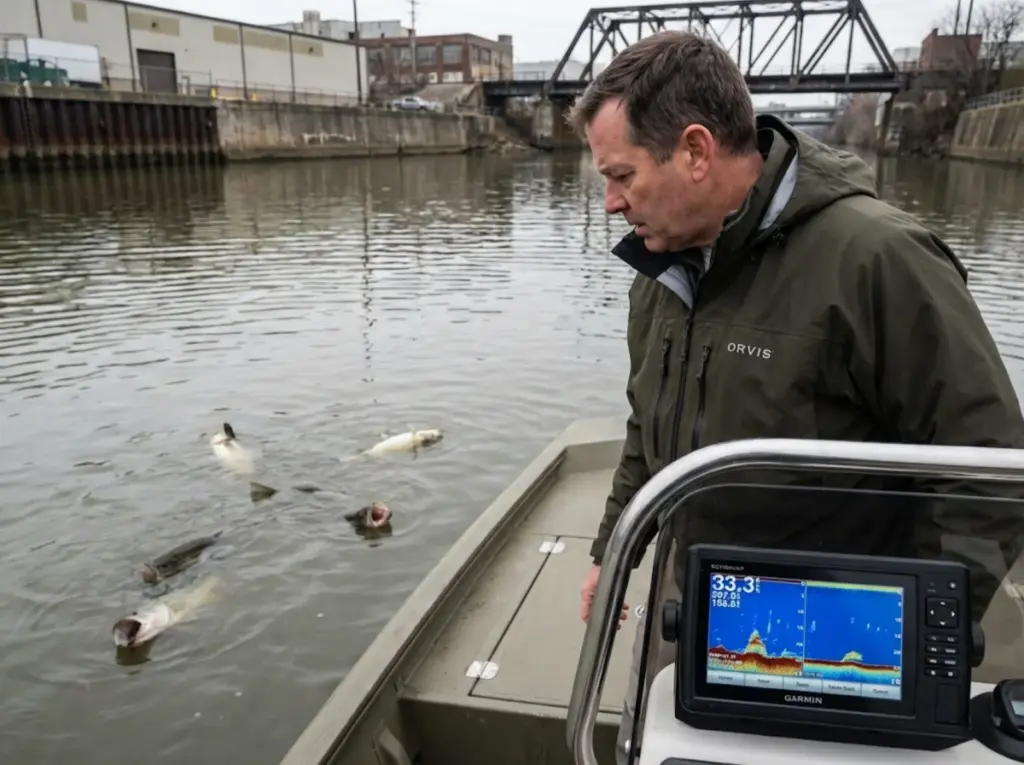
Heat doesn’t just slow fish down—it reconfigures their personalities. Research from Sapienza University of Rome showed that Zebrafish exposed to elevated temperatures (34°C vs. 26°C) demonstrated dramatically increased boldness and vertical exploration. They spent more time in the “danger zones” of the water column where predators typically strike.
Why Stressed Fish Act “Bold” But Can’t Hunt
This behavioral shift is part of what scientists call a behavioral syndrome—where boldness, aggression, and exploration are correlated traits. The heat-stressed zebrafish showed higher “mirror biting” aggression but lower sociability. They stopped shoaling, losing the collective protection of the group.
For anglers, this creates a trap. Thermally stressed fish may strike aggressively out of pure territorial reflex, not feeding drive. You might think you’ve found active fish. But they lack the metabolic capacity to sustain the fight. Short explosive runs followed by immediate surrender are the telltale sign. Understanding striped bass behavioral triggers helps distinguish genuine feeding from distress responses.
The common mistake: “Thinking fish are ‘active’ because they’re jumping; often they are gasping for surface oxygen (ASR) or trying to dislodge parasites that thrive in warmer water.”
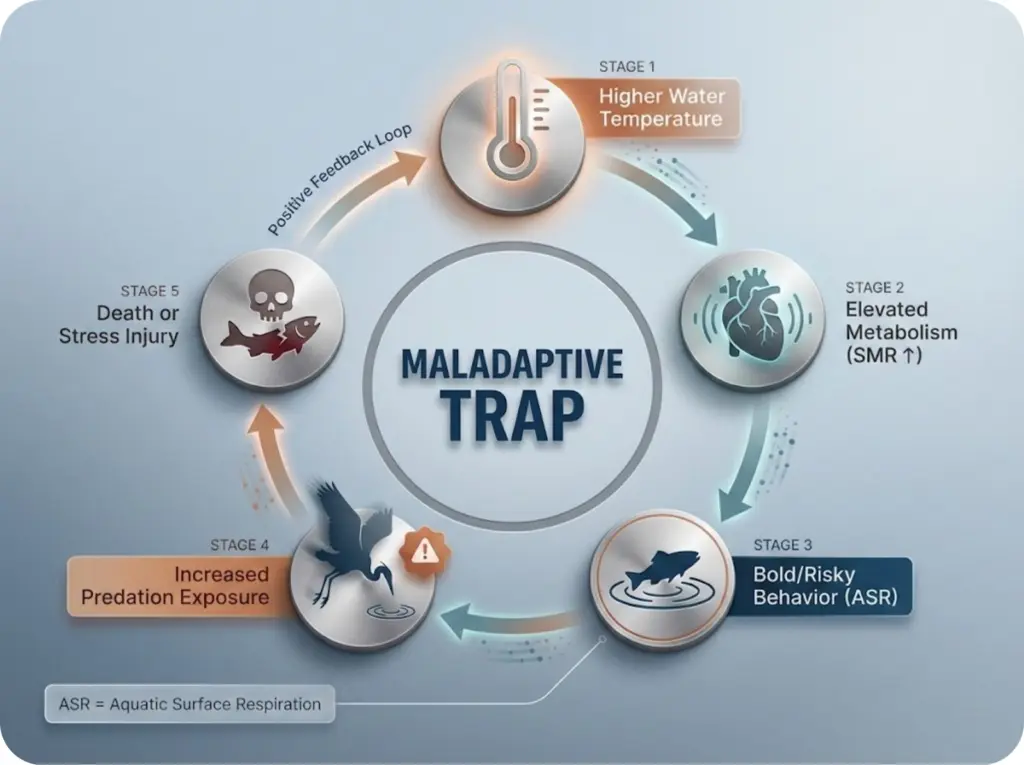
Aquatic Surface Respiration—The Maladaptive Trap
Aquatic Surface Respiration (ASR) is a distress behavior where fish ventilate at the air-water interface, accessing the slightly more oxygen-rich surface film. It looks like topwater feeding activity. It’s actually desperation.
The problem: ASR increases predation vulnerability. Herons, kingfishers, and other avian predators pick off fish gasping at the surface. This creates what researchers describe as a positive feedback loop—a maladaptive trap where the survival tactic increases mortality risk. Higher temp → higher metabolism → bold/risky behavior → increased predation exposure.
The 2010 Florida freeze that turned the Indian River Lagoon into a “tilapia graveyard” demonstrated the opposite extreme: cold shock mortality. When power plant discharges stop during maintenance, thermally dependent fish face sudden temperature drops they can’t survive.
Cognitive Meltdown—When Fish Forget How to Survive
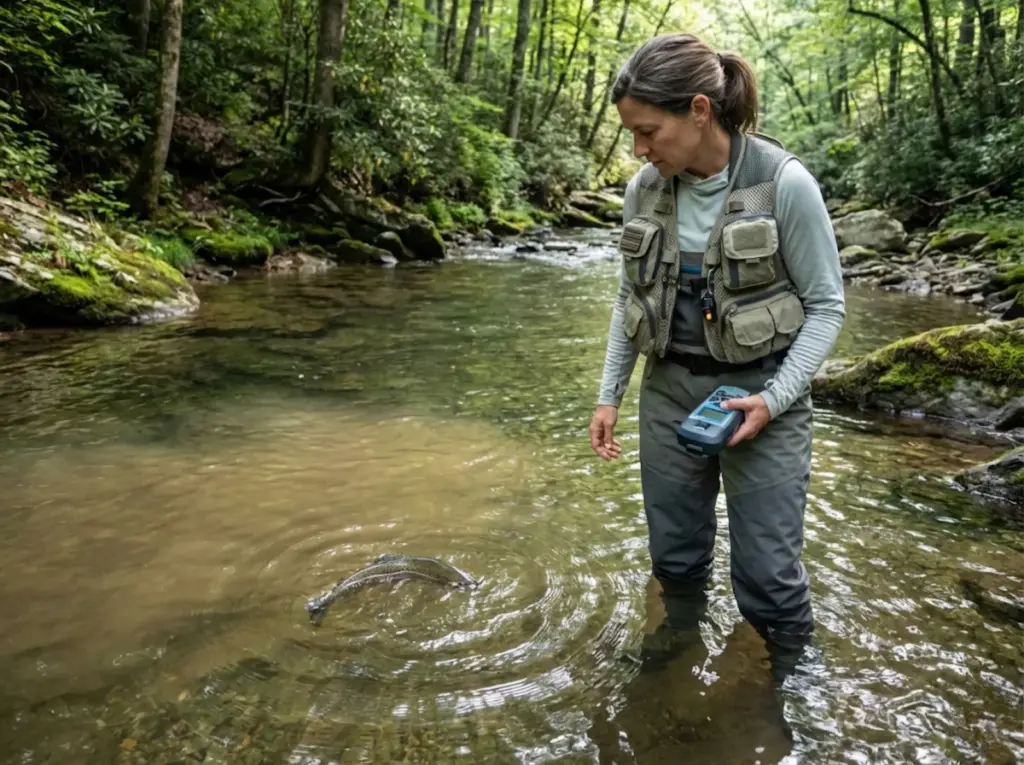
Perhaps the most alarming behavioral change is cognitive impairment. Studies on Spiny Chromis Damselfish demonstrated that a temperature increase of just 2°C severely hampered spatial learning and memory. Fish trained to associate specific cues with rewards forgot those associations much faster in warmer water.
Memory Loss and Spatial Confusion
This isn’t abstract neuroscience—it has practical consequences. Fish in thermally polluted areas may struggle to find traditional spawning grounds or remember where thermal refugia are located during heat events. They appear “aimless” rather than purposeful, wandering without clear direction.
For anglers, this explains why fish near discharge zones often seem confused, unpredictable, or positioned in locations that make no biological sense. Understanding finding thermal refugia on sonar helps you locate the fish that have successfully navigated to cooler pockets.
Pollutant Synergy—The Pharmaceutical Zombie Effect
Thermal stress doesn’t act alone. In Wastewater Effluent Dominant (WED) systems, higher water temperatures increase gill ventilation rates, accelerating the kinetic uptake of contaminants. Research on Round Goby found high concentrations of pharmaceuticals like fluoxetine and oxazepam in brain tissue of fish near warm urban outfalls.
Affected fish show “zombie-like” behavior: fewer aggressive acts, slower exploration, impaired predator avoidance. The multi-stressor interactions between thermal pollution and chemical contamination create compound impairment that neither stressor would produce alone.
Pro tip: If fishing near urban outfalls during warm months, focus on the cooler edges of the plume where fresh inflow creates mixing. The center of the discharge is often both thermally lethal AND chemically contaminated.
Species Winners and Losers—The Mitochondrial Divide
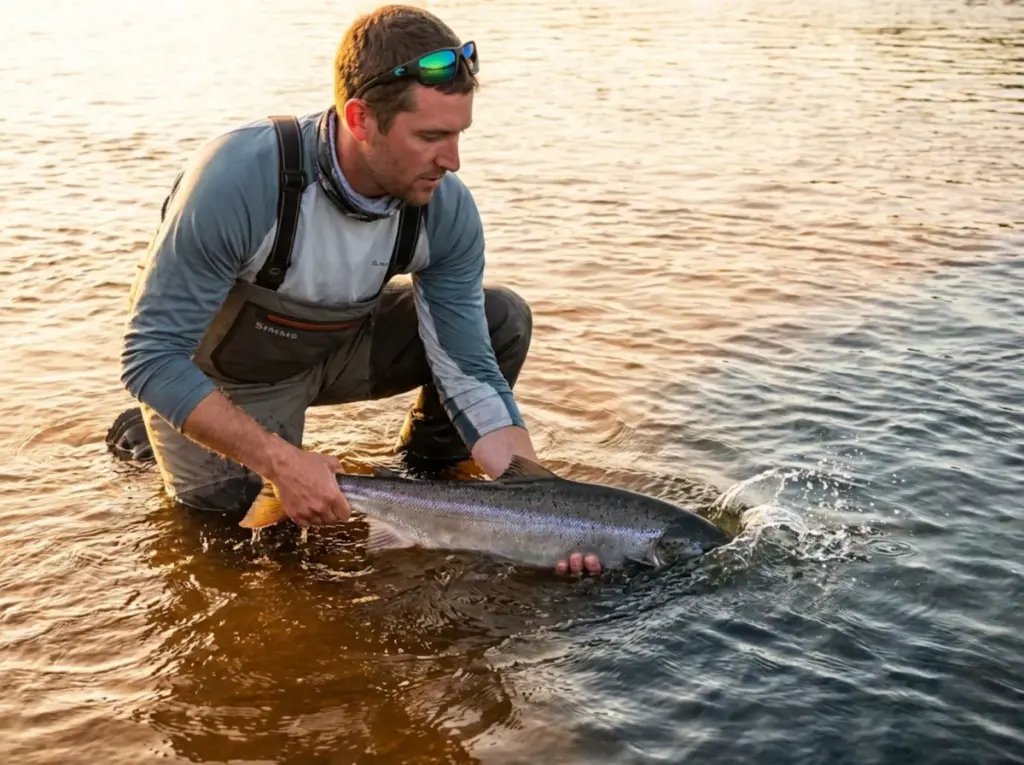
Not all fish respond to thermal stress equally. Research by Dr. Kurt Gamperl at Memorial University identified the molecular mechanism: mitochondrial heart muscle efficiency. Some species adapt; others collapse.
Atlantic Salmon—The Heat-Adapted Survivor
Atlantic Salmon mitochondria demonstrate remarkable plasticity. When acclimatized to warmer water, their heart muscle mitochondria actually become MORE efficient at processing oxygen. Acclimatized salmon can survive temperatures up to 23°C even with moderately low oxygen levels.
This explains why eurythermal species—those with wide thermal tolerance (Goldfish, Carp, Bass)—dominate warming waters. They’re physiologically equipped to handle the new normal. Mortality for Atlantic Salmon still increases by 10% for every degree Celsius above 18°C during catch-and-release, but they CAN survive heat waves that kill more sensitive species.
Arctic Char—The Cold-Water Casualty
Arctic Char mitochondria tell the opposite story. When exposed to warm water, their heart muscle becomes LESS efficient. They’re essentially suffocating at the cellular level even if water oxygen levels are technically adequate. This stenothermal vulnerability—narrow thermal tolerance—dooms them as waters warm.
By 2100, coldwater habitat is projected to decline by 50%, largely confined to high-relief mountainous areas. Understanding the decline of brook trout thermal refugia provides context for why some historically productive waters now fish poorly regardless of pressure.
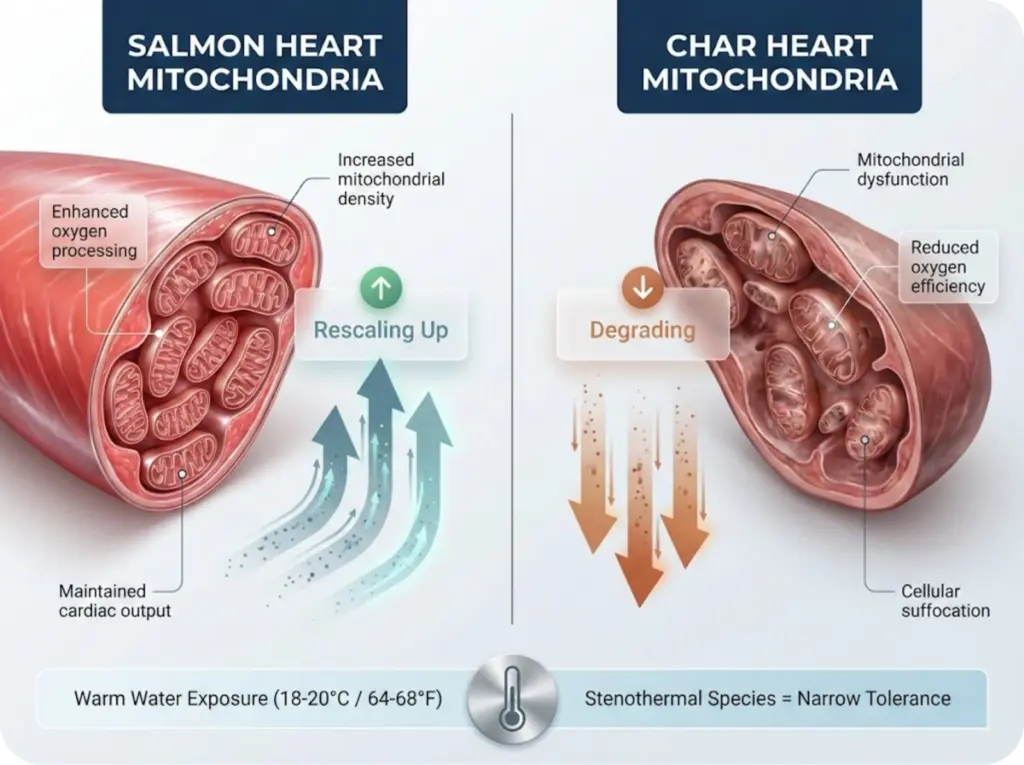
Research published in Frontiers in Marine Science confirms that thermal history shapes stress tolerance sensitivity—fish populations with generational exposure to variable temperatures develop better resilience than those from thermally stable environments.
Tactical Adjustments for Thermally Stressed Waters
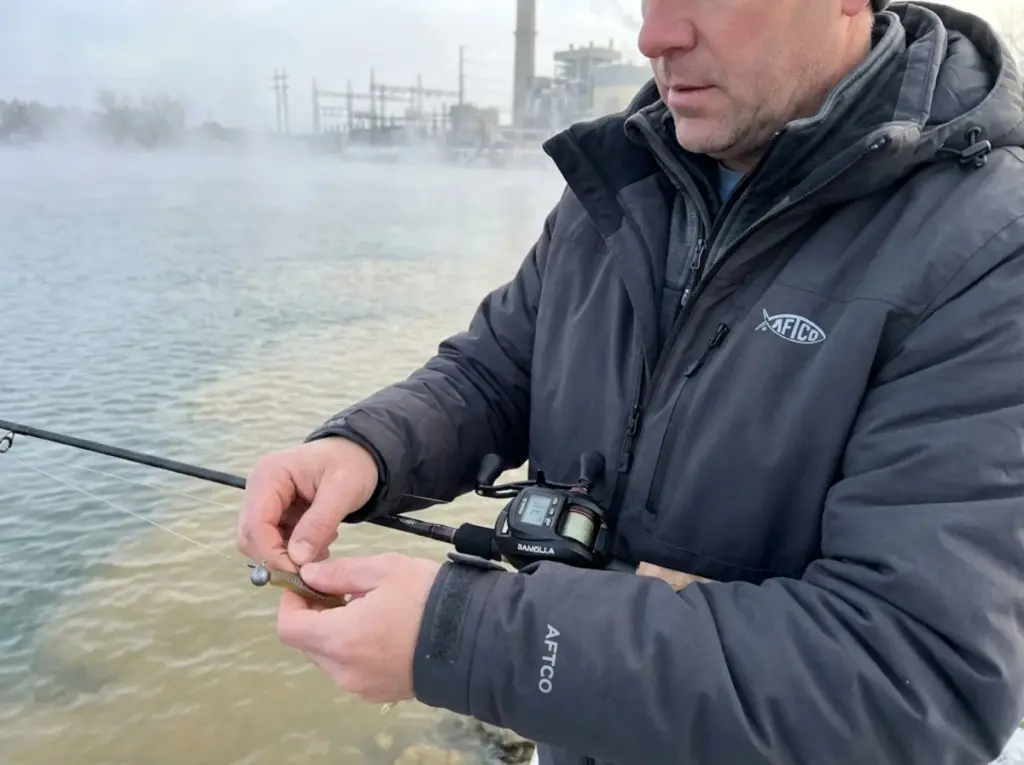
Knowledge without application is useless. Here’s how to translate thermal biology into changed tactics.
Finding the “Seam”—Thermal Edge Positioning
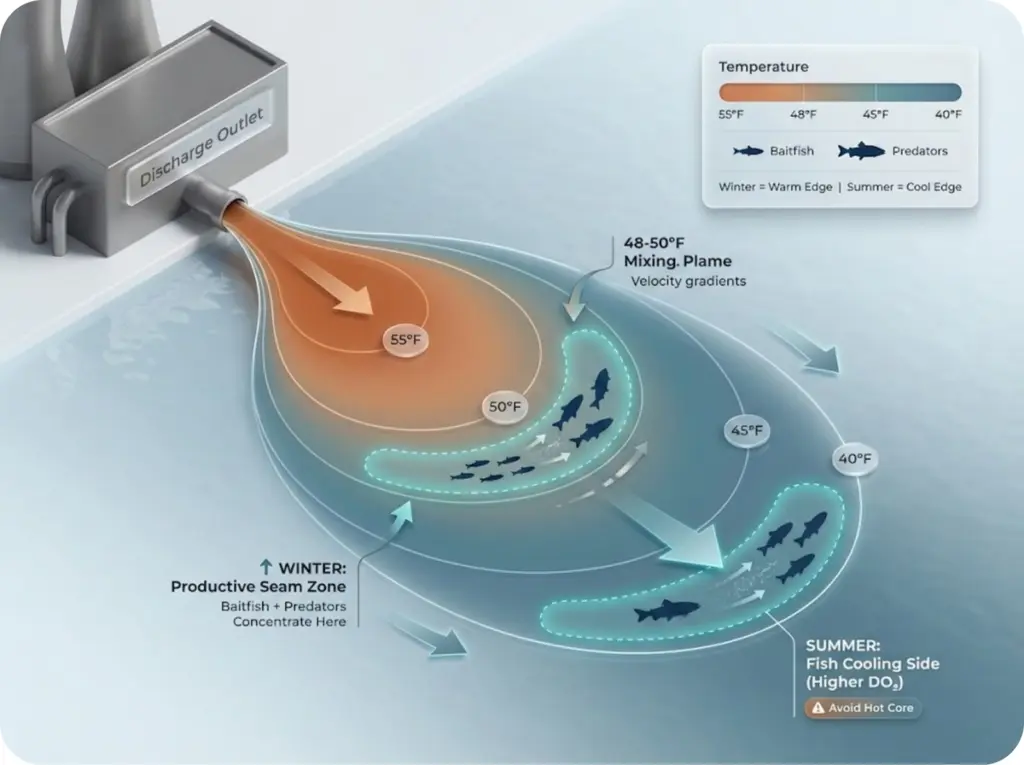
In winter, focus on the “seams” where 55°F discharge water meets 40°F lake water. Baitfish congregate for the thermal edge, and predators follow. The SAMOLLA Electronic Reel provides ±0.1°C accuracy with built-in LCD thermal sensors. Budget-conscious anglers can use the Fishpond Riverkeeper digital thermometer or Vexilar Deptherm mechanical gauge.
In summer, the same seams can be death traps. Fish the COOLING side where dissolved oxygen is higher. The visible boundary between discharge and ambient water often marks the difference between productive fishing and stressed fish that die after release.
Winter power plant fishing tactics detail the seasonal approach—what works in January kills fish in August.
Slowdown Presentation—Matching Lethargic Metabolism
The Metabolic Squeeze means fish cannot chase fast lures. Use “Deadsticking” techniques or ultra-slow jigging to match their lethargic pace. Scent becomes more important as fish vision and reaction time decline in algae-thick, warm water—use scent-infused soft plastics to trigger strikes.
Adjust drag settings DOWN. Extended fights in warm water produce lactic acidosis that the heart cannot clear in low-oxygen conditions. Short, controlled fights reduce delayed mortality. If the fish surrenders immediately, it’s not a compliment to your hookset—it’s a sign of physiological collapse.
The Ethical Decision—When NOT to Fish
When temps exceed 77°F for trout, the “flight” response generates lethal lactic acid levels. Even successful releases result in dead fish due to delayed mortality. Recognize Loss of Equilibrium (LOE) signs: thrashing, collisions with the bank, inability to right itself after release.
The NOAA dissolved oxygen and fish behavior guidelines establish clear thresholds for when fish can no longer survive in stressed conditions. Sometimes the right call is to leave the reel in the truck.
Pro tip: If you’re releasing fish that don’t swim away immediately, or that “belly up” within seconds of release, stop fishing that spot. You’re killing fish, not practicing catch-and-release.
Citizen Science—Becoming Part of the Solution
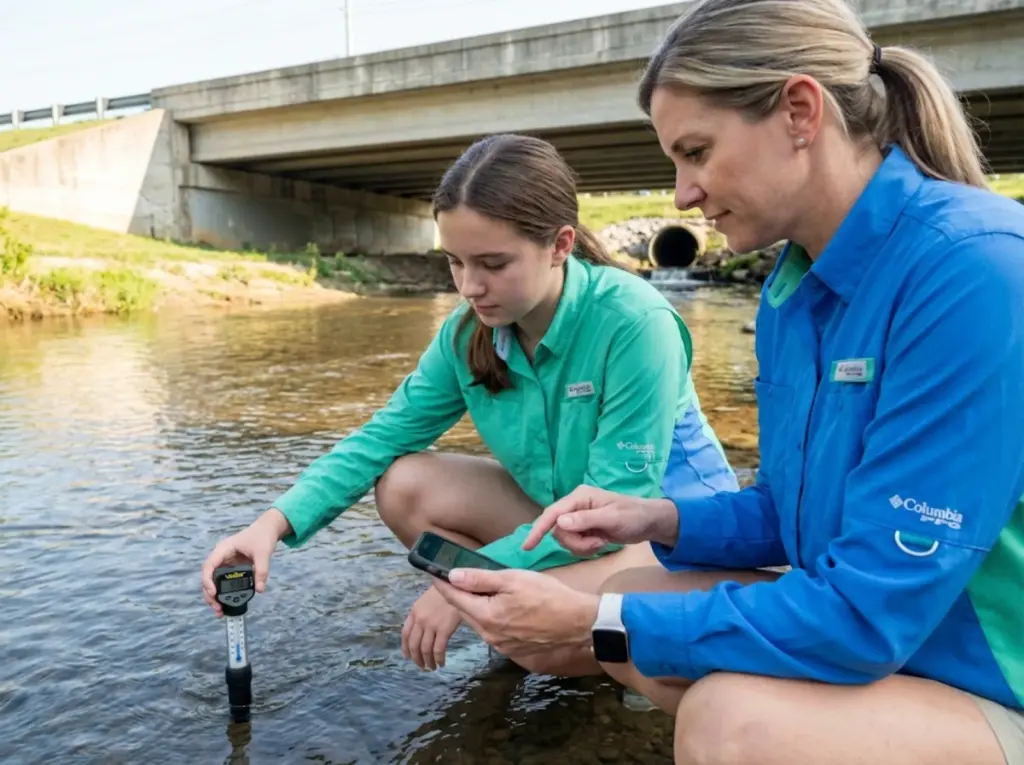
Anglers occupy a unique position. We’re on the water regularly, noticing changes before official monitoring catches up. That presence carries responsibility.
Low-Cost Monitoring Tools
Citizen Science Atmospheric Sensors (Arduino/BME-280 based) and low-cost digital thermometers enable community data collection. The Fishpond Riverkeeper provides simple submersible readings for under $20. Report thermal anomalies to EPA or local DNRs—your observations help identify emerging “hot spots” before fish populations crash.
The Tournament Angler’s Responsibility
Livewell temperature spikes compound stress on bass caught in already-warm water. The “Urban Heat Island” effect means summer rain on hot asphalt creates “thermal pulses” lethal to urban creek fish populations. Understanding hook location mortality science complements thermal awareness—together they form comprehensive catch-and-release ethics.
Tournament anglers can advocate for adjusted weigh-in protocols during heat events. Conservation-minded organizations are already implementing ice additions, aerated livewells, and postponed weigh-ins when ambient temperatures spike.
Conclusion
That “aggressive” strike in hot water isn’t feeding behavior—it’s a fish burning metabolic reserves it can’t replace on a reflex action it can’t afford. The Q10 effect, oxygen squeeze, and compressed metabolic scope explain the desperate behavior that looks active but delivers dead fish.
Species survival in warming waters comes down to mitochondrial efficiency. Atlantic Salmon and bass adapt. Arctic Char and brook trout collapse. The thermal map of fishable waters looks different every decade and will be unrecognizable by 2100.
Next time your surface temp reads above 80°F, ask yourself: am I targeting fish, or exploiting animals in distress? The thermometer is your conservation conscience—use it before casting.
FAQ
How does thermal pollution affect fish behavior?
Thermal pollution increases fish metabolic rates exponentially while reducing available oxygen, forcing behavioral changes including paradoxical boldness, surface gasping (ASR), and loss of schooling behavior. These aren’t signs of active feeding—they’re distress responses that often precede mortality.
At what temperature do fish start behaving strangely?
Species-specific thresholds vary: trout show stress above 68°F, bass above 84°F, and striped bass face lethal conditions above 84°F combined with DO below 5 mg/L. Behavioral changes like increased aggression and reduced sociability appear 2-4°C before lethal thresholds.
Why do fish near power plants seem more active?
Fish near thermal discharges often exhibit Aquatic Surface Respiration (ASR), which looks like surface feeding but is actually oxygen-seeking desperation. The behavioral syndrome disruption from thermal stress also increases boldness—but this reflects neurological impairment, not genuine feeding activity.
Can fish adapt to thermally polluted water over time?
Some species demonstrate mitochondrial plasticity allowing acclimatization (Atlantic Salmon, bass), while others lack this capacity (Arctic Char, brook trout) and face cellular suffocation even in technically adequate oxygen levels. Population-level adaptation is possible but requires generations under thermal selection pressure.
Is it ethical to fish in thermally polluted water?
It depends entirely on temperature and species. Above 77°F for coldwater species, even released fish die from lactic acidosis-induced delayed mortality. Ethical anglers monitor water temps, target thermally tolerant species during heat events, fish thermal seams strategically, or choose not to fish when conditions indicate high mortality risk.
Risk Disclaimer: Fishing, boating, and all related outdoor activities involve inherent risks that
can lead to injury. The information provided on Master Fishing Mag is for educational and informational purposes
only. While we strive for accuracy, the information, techniques, and advice on gear and safety are not a substitute
for your own best judgment, local knowledge, and adherence to official regulations. Fishing regulations, including
seasons, size limits, and species restrictions, change frequently and vary by location. Always consult the latest
official regulations from your local fish and wildlife agency before heading out. Proper handling of hooks, knives,
and other sharp equipment is essential for safety. Furthermore, be aware of local fish consumption advisories. By
using this website, you agree that you are solely responsible for your own safety and for complying with all
applicable laws. Any reliance you place on our content is strictly at your own risk. Master Fishing Mag and its
authors will not be held liable for any injury, damage, or loss sustained in connection with the use of the
information herein.
Affiliate Disclosure: We are a participant in the Amazon Services LLC Associates Program, an
affiliate advertising program designed to provide a means for us to earn advertising fees by advertising and linking
to Amazon.com. As an Amazon Associate, we earn from qualifying purchases. We also participate in other affiliate
programs and may receive a commission on products purchased through our links, at no extra cost to you. Additional
terms are found in the terms of service.