In this article
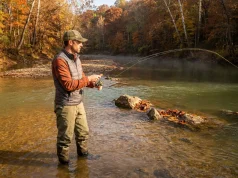
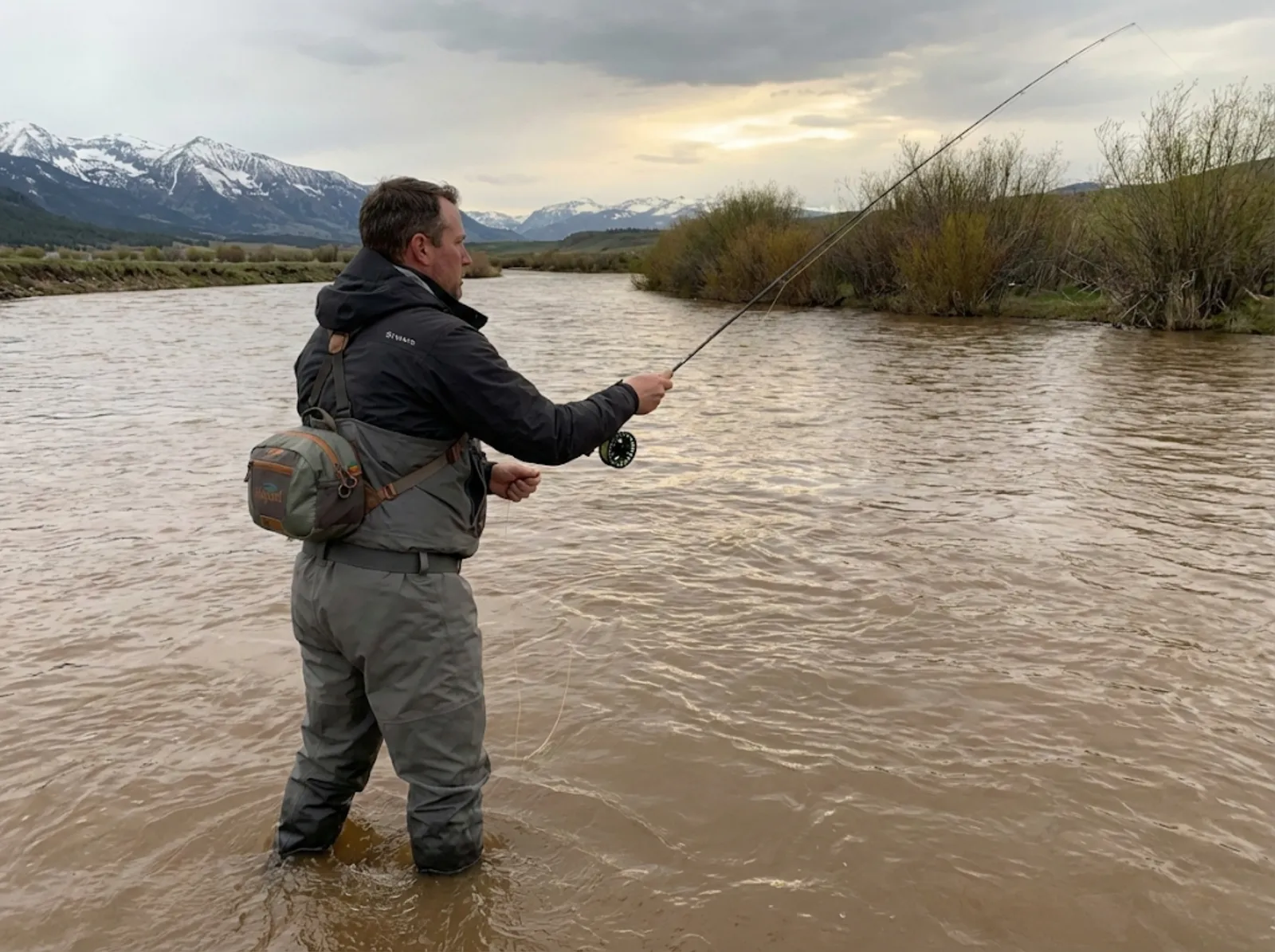
The chocolate milk poured off the mountain all morning—visibility dropped to six inches by noon, and every angler on the river packed up except one. That lone fisherman landed three browns over 18 inches before dark, fishing water everyone else had abandoned.
After two decades chasing trout through Western runoffs, I’ve learned this simple truth: the fish don’t leave during high water. They relocate. And if you know where to look, how to rig, and when to stay cautious, spring runoff can deliver some of the best fishing of the year with almost no competition.
Here’s exactly how to find fish in muddy water conditions—and stay safe doing it.
⚡ Quick Answer: Fish soft-water breaks during runoff—edges, eddies, flooded side channels, and inside bends where current slows. Use heavy tungsten rigs with large, dark flies (San Juan Worms, Pat’s Rubber Legs, Woolly Buggers in size 4–8). Apply the 6-inch visibility rule: if you can’t see your hand at 6 inches depth, fish rely on lateral line detection, so prioritize vibration and contrast over natural imitation.
Reading High Water: Where Trout Actually Hold
Most anglers assume high muddy water means the fish have vanished. They haven’t. They’ve just moved to places where survival costs less energy.
Soft-Water Breaks: The Energy Conservation Zones
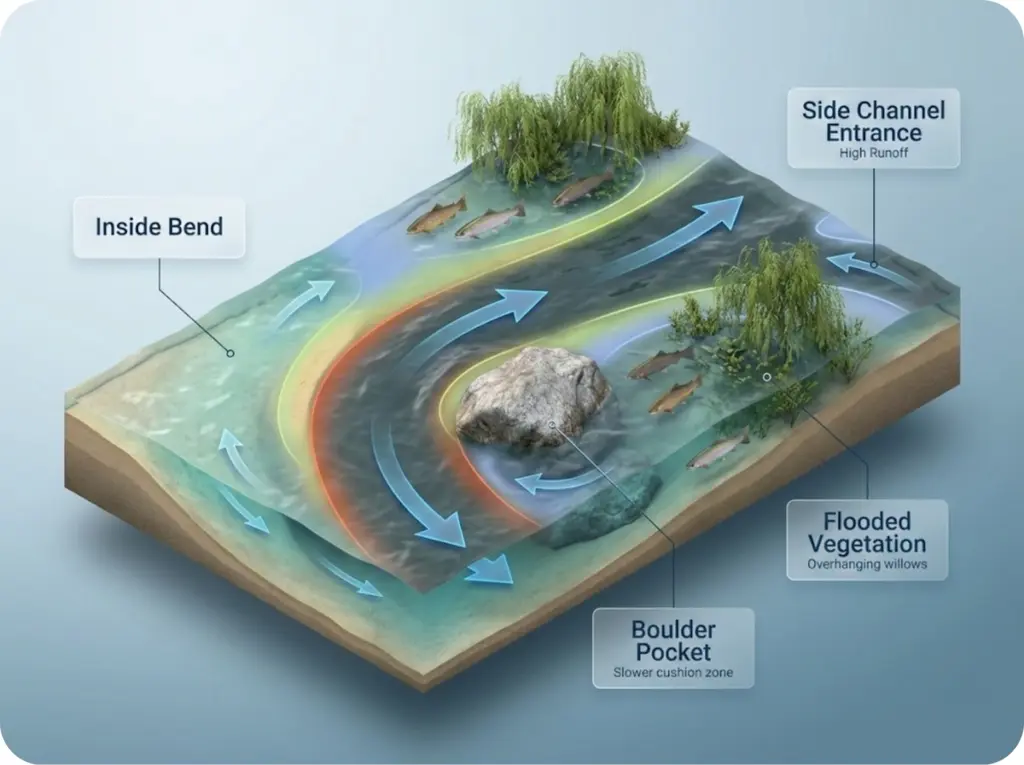
Trout are cold-blooded. They can’t sustain position in a raging main channel without burning more calories than they take in. That’s why they stack up in what Landon Mayer calls soft-water breaks—any physical feature that slows current velocity.
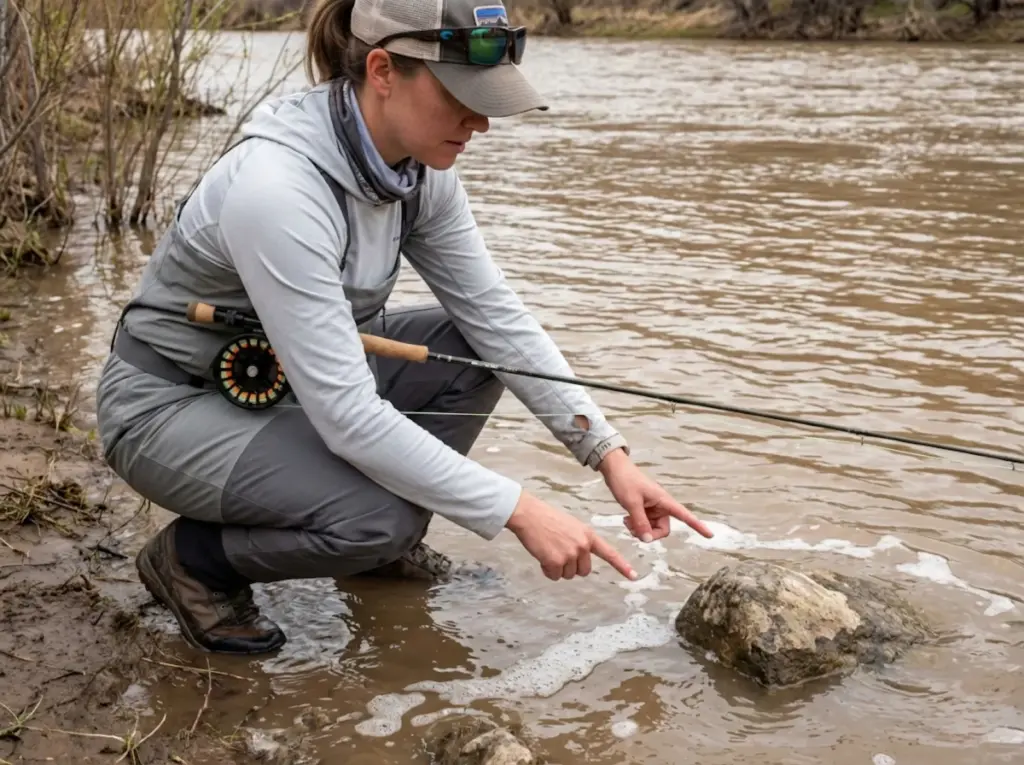
Look for boulders, log jams, inside bends, flooded vegetation, and bridge pilings. A pocket of slack water three feet across behind a rock can hold multiple fish. The key identifier is foam lines: that visible seam between fast and slow water marks exactly where rivers concentrate drifting food.
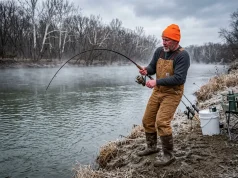
Fish face upstream but tuck into positions where the current delivers meals without requiring constant swimming. Your best casts during runoff fishing are often just 10 feet from the bank, not out into the chaos.
Pro tip: The fish are at your feet, not in the raging center. Some of my biggest runoff browns came from casting parallel to the bank, not across the heavy water.
The Side Channel Advantage
Those side channels that run bone-dry in August become prime refugia when the main stem blows out. Flooded banks and backwater eddies offer reduced velocity, concentrated food, warmer water temperatures, and escape cover from predators.
USGS data shows some side channels carry 30–50% less flow than the main river during peak snowmelt. Mark these locations on GPS during low water conditions—they’re invisible once the banks flood, but if you know where they are, you’ll fish water nobody else considers.
The window is short. Once flows drop, fish migrate back to the main stem within 48–72 hours.
Reading the Hydrograph: When Conditions Improve
Smart anglers check real-time streamflow data from USGS before they leave the house. What you’re looking for is the “falling limb” of the hydrograph—the downward slope after peak flow. That signals clearing water within 12–24 hours.
The transition from chocolate milk water to “steelhead green” (1–3 feet visibility) is the magic window. Fish feed aggressively, pressure is low, and the conditions favor your big, flashy patterns.
Monitor overnight low temperatures at nearby SNOTEL stations. Cold nights reduce snowmelt input, which tends to clear rivers by mid-morning. There’s also the “thirsty soil” effect: exceptionally dry prior autumns absorb up to 50% of snowmelt, meaning high snowpack doesn’t always guarantee a blowout.
Understanding how fish respond to rapid water level changes gives you a tactical edge when flows fluctuate daily.
Rigging for Runoff: Anchor Rigs and Heavy Nymphs
Standard dry-dropper rig setups won’t cut it when the water column looks like coffee. You need weight, contrast, and vibration to get your flies noticed.
The Anchor Rig Formula
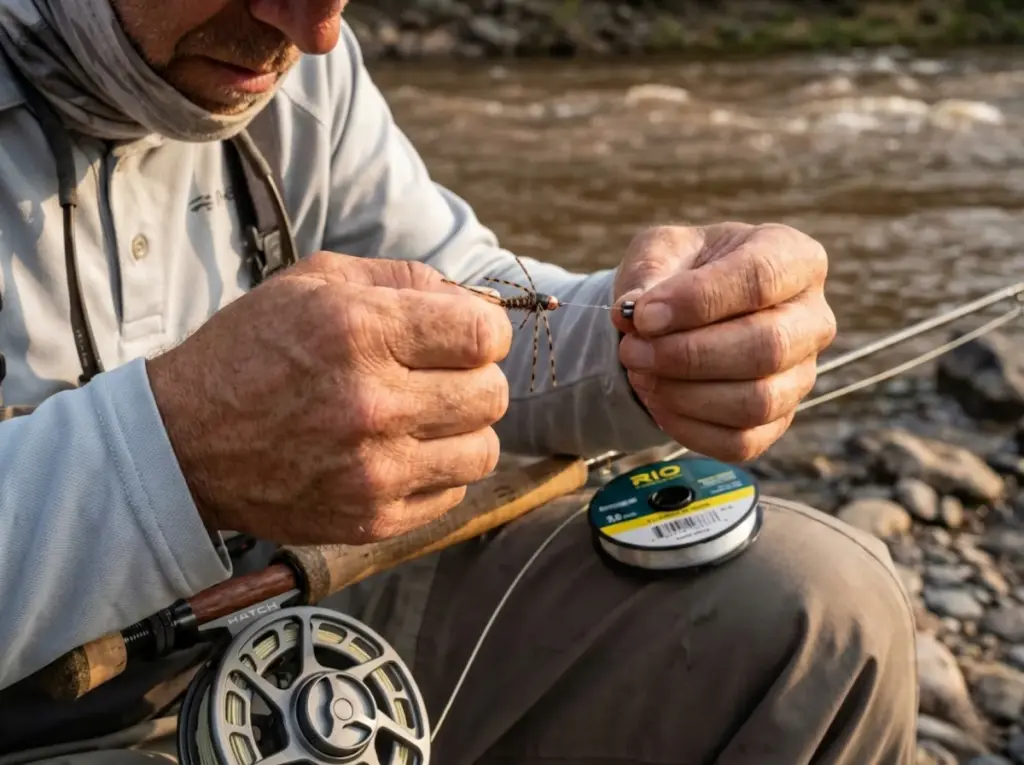
Landon Mayer’s anchor rig is the go-to setup for high water nymphing. Start with a 9-foot 2X or 3X tapered leader. Add 2–3 feet of 3X fluorocarbon tippet for a total length of 10–14 feet.
Your primary fly—the “anchor”—is a heavy tungsten beadhead jig-style nymph that sinks the whole rig fast. Place split shot 8–12 inches above the point fly, not directly on the knot. Set your indicator at 1.5× water depth—runoff requires fishing tighter to the bottom than normal conditions.
Here’s the counterintuitive part: forget expensive fluorocarbon for invisibility. Fish can’t see your fishing line in murky water anyway. Prioritize breaking strength over stealth. Fish 2X or 3X tippet confidently.
Pro tip: I lose two dozen flies a day during runoff—fishing tight to structure means sacrificing tackle. Tie heavy patterns and accept the losses.
Fly Selection: Big, Dark, and Flashy
Size up 2–4 hooks from what you’d normally throw. Patterns in size 8–4 replace your typical 14–12. Dark colors create silhouette contrast that fish detect even in zero visibility: black, purple, brown, olive.
Rubber legs add motion and vibration that trout sense via their lateral line. Top producers include San Juan Worm, Pat’s Rubber Legs, Woolly Bugger (#6 black), Girdle Bug, and Mop Fly. Don’t overlook crane flies (leatherjackets)—these 1–2 inch larvae get scoured from banks during high flows and represent a massive calorie hit.
UV-reactive materials in chartreuse and hot pink increase visibility in turbidity conditions. There’s a reason guides repeat: “If it ain’t chartreuse, it ain’t no use.”
Understanding how turbidity affects lure visibility helps you match colors to clarity.
Streamer Tactics: Dead-Drift and Swing
Large articulated streamers like Sex Dungeon and Sculpzilla trigger lateral line strikes in opaque water. Cast upstream, dead-drift through soft-water breaks, then strip on the swing as current straightens the line.
The “Pyzer Pause” is a cold-water secret: an extended 5–10 second pause in your retrieve triggers strikes from lethargic fish that won’t chase a fast-moving fly. Work with 6wt or 7wt rods using sink-tip lines for depth control.
Keep casts short—20–30 feet max. Longer casts lose contact and miss subtle takes in heavy current.
The 6-Inch Rule: When to Fish and When to Stay Home
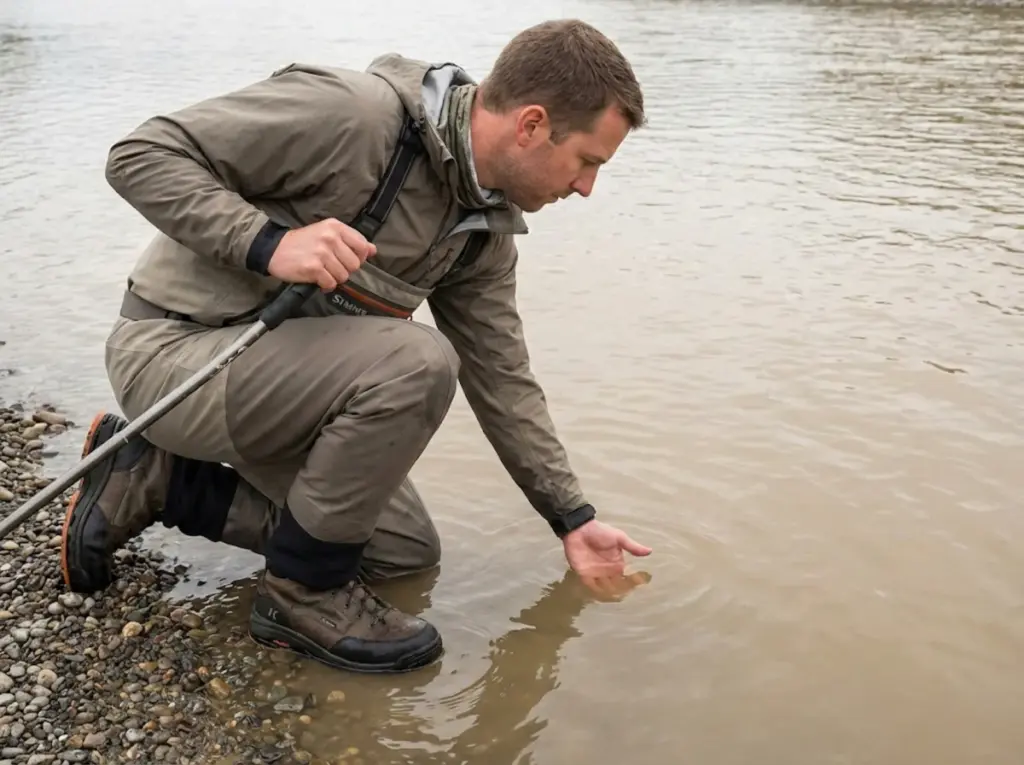
There’s muddy water, and then there’s unfishable. Here’s how to tell the difference.
The Hand Test
Submerge your hand 6 inches underwater. If you can’t see it, visibility is too low for effective visual predation—trout rely almost exclusively on their lateral line system at this point.
Does that mean you should pack up? Not necessarily. It means you adjust tactics. Maximum contrast, maximum vibration, and presentations that put flies directly in the strike zone become essential.
Chocolate milk conditions (2–3 inches visibility) are the threshold where most anglers leave. But the fish are still feeding. The transition to steelhead green (1–3 feet visibility) represents the optimal window: fish are aggressive, but competition is minimal because everyone else went home.
Learning the muddy water protocol for post-rain rivers applies the same principles to fishing after rain events.
Reading the Color Line
Where muddy tributary water meets cleaner main stem water, a visible color line forms. Fish stack on the clean side, ambushing food washing out of the dirty zone.
Position yourself to cast INTO the muddy water and strip OUT toward the clean zone. This is where predators sit—feeding lanes with easy strikes against disoriented prey. Color lines shift with water level changes, so relocate throughout the day as conditions evolve.
Wading Safety: The Rule of 8
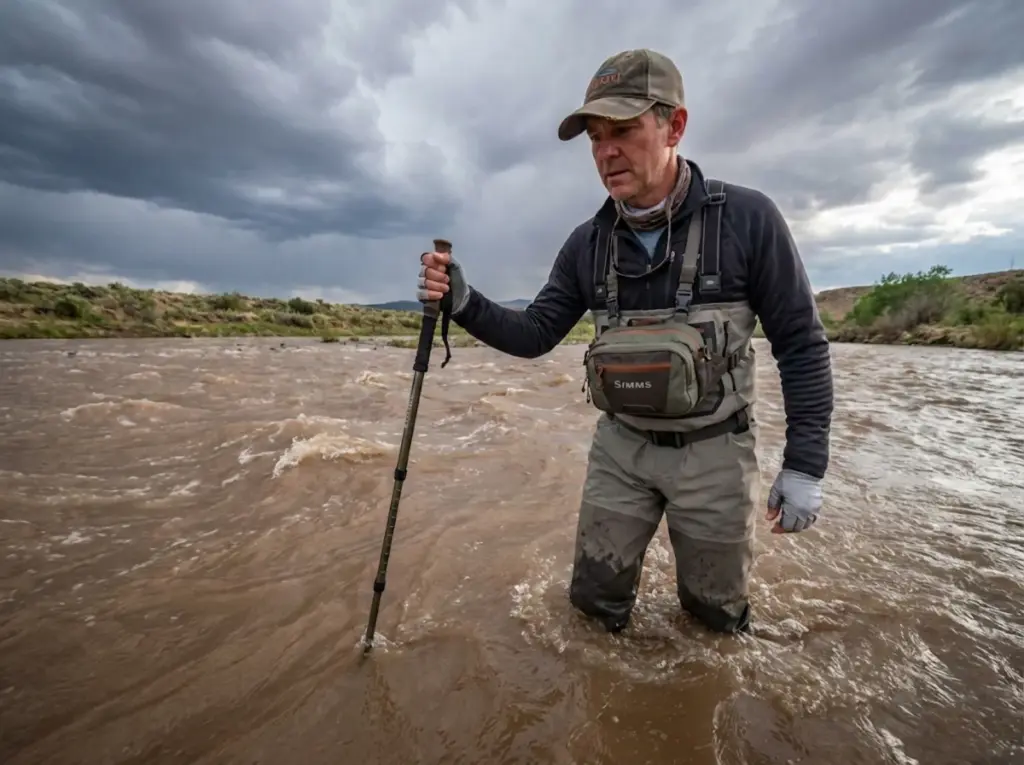
Runoff fishing is productive. It’s also dangerous. The difference between a good trip and a survival situation comes down to respecting the math.
The Depth × Velocity Formula
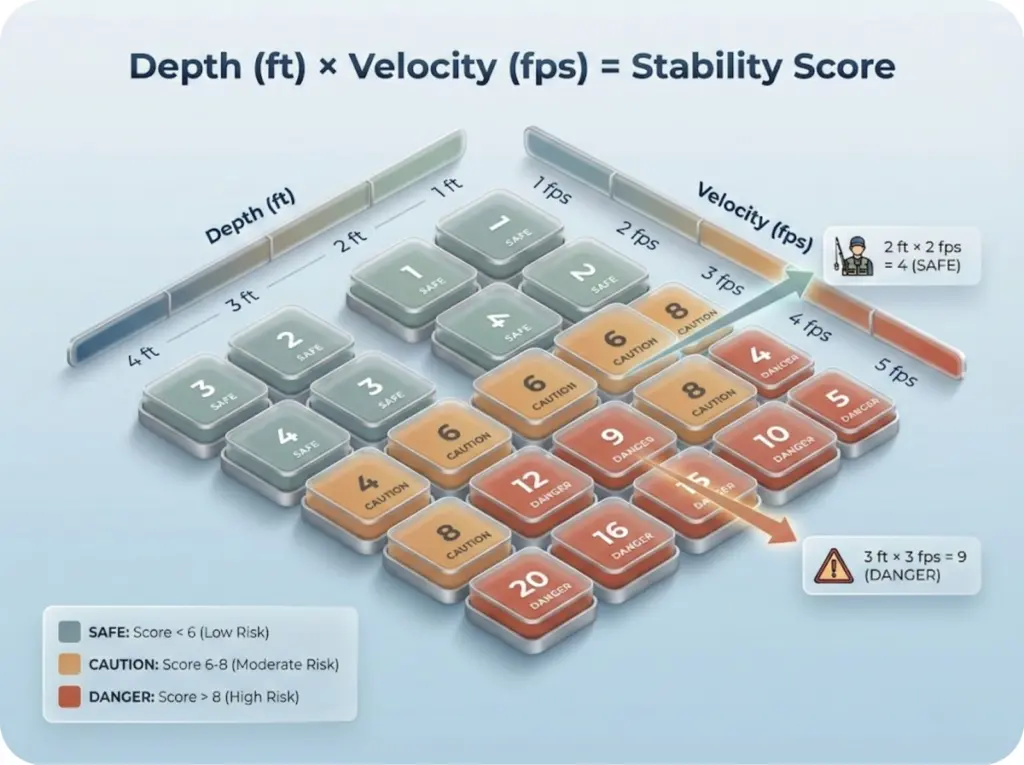
The Rule of 8 provides a precise safety threshold: if Depth (feet) × Velocity (feet per second) exceeds 8, the water is unstable for wading.
Example A: 4 feet deep × 1.5 fps = 6 (stable).
Example B: 2 feet deep × 5 fps = 10 (unstable).
That second scenario—shallow but fast—catches people off guard. Ankle-deep water moving at a sprint can knock you off your feet faster than thigh-deep flow barely moving.
“Walking speed current” (roughly 3 fps) is the maximum most anglers can safely wade in thigh-deep water. Always maintain three-point contact: two feet plus wading staff. Move only one point while anchoring the other two.
⚠️ SAFETY WARNING: Water temperature during runoff typically runs 40–50°F. A fall triggers immediate “gasp reflex”—involuntary inhalation that can lead to drowning. Wear a cinched wading belt and consider an inflatable PFD.
Understanding why a wading belt could save your life is essential reading before you step into high water.
Swift Water Rescue Position
If you fall, roll onto your back immediately with feet pointed downstream. Use your feet to push off obstacles—never try to stand in moving current until you reach slack water.
Attempting to stand causes “foot entrapment.” The current pins you underwater against whatever your foot catches. Float to an eddy or shallow bank before attempting to stand.
A cinched wading belt reduces water entry into your waders and prevents the “sea anchor effect” that makes swimming nearly impossible. Refer to cold water safety guidelines from the National Park Service for survival protocols.
Gear Maintenance: Protecting Your Equipment in High-Silt Water
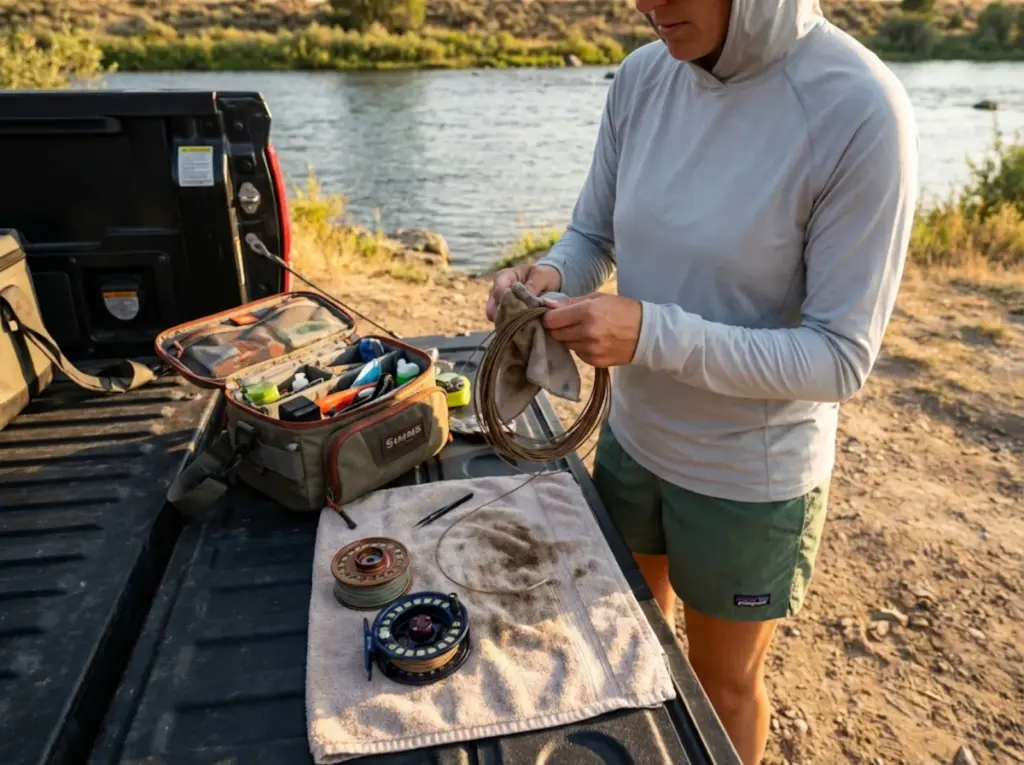
Runoff water is basically liquid sandpaper. Fine sand and silt chew through gear faster than a full season of normal use.
Fly Line Care
Silt embeds in your fly line coating, causing floating lines to sink and reducing casting distance. Clean lines daily with fresh water and a soft cloth during heavy water periods. Store under tension to prevent coil memory compounding abrasion damage.
The particles you can’t see are the ones destroying your investment. A 5-minute wipe-down at the truck prevents hundreds in replacement costs.
Reel Protection
Sand particles penetrate even “sealed” drag systems through the spool arbor. Never lay your reel directly on muddy banks—use a stripping basket or hang it from your vest.
Flush reels with fresh water after each session. Disassemble and lubricate drags weekly during peak runoff. Here’s a counterintuitive truth: affordable click-and-pawl reels often handle silt better than expensive sealed systems.
Rod and Ferrule Maintenance
Grit in ferrules causes sections to seize—or worse, “blow out” the female end during a heavy cast. Apply ferrule wax before each session during runoff season.
Wipe down guide rings. Silt buildup increases fishing line friction and reduces casting distance. Check stripping guides for scoring from contaminated line passing through at speed.
Following the 3-phase protocol for post-trip gear cleaning extends equipment life significantly.
Ethical Angling: Mind the Redd
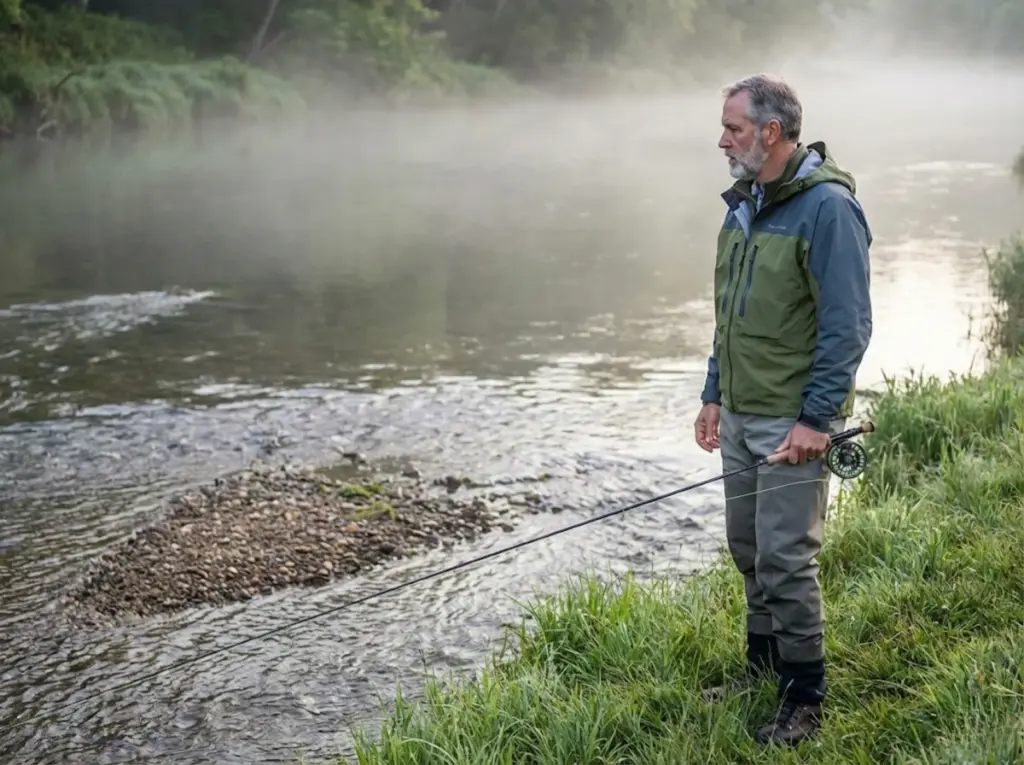
Spring runoff overlaps with spawning season for rainbow trout and cutthroat trout across Western rivers. Conservation-minded anglers fish smart.
Spawning Overlap Windows
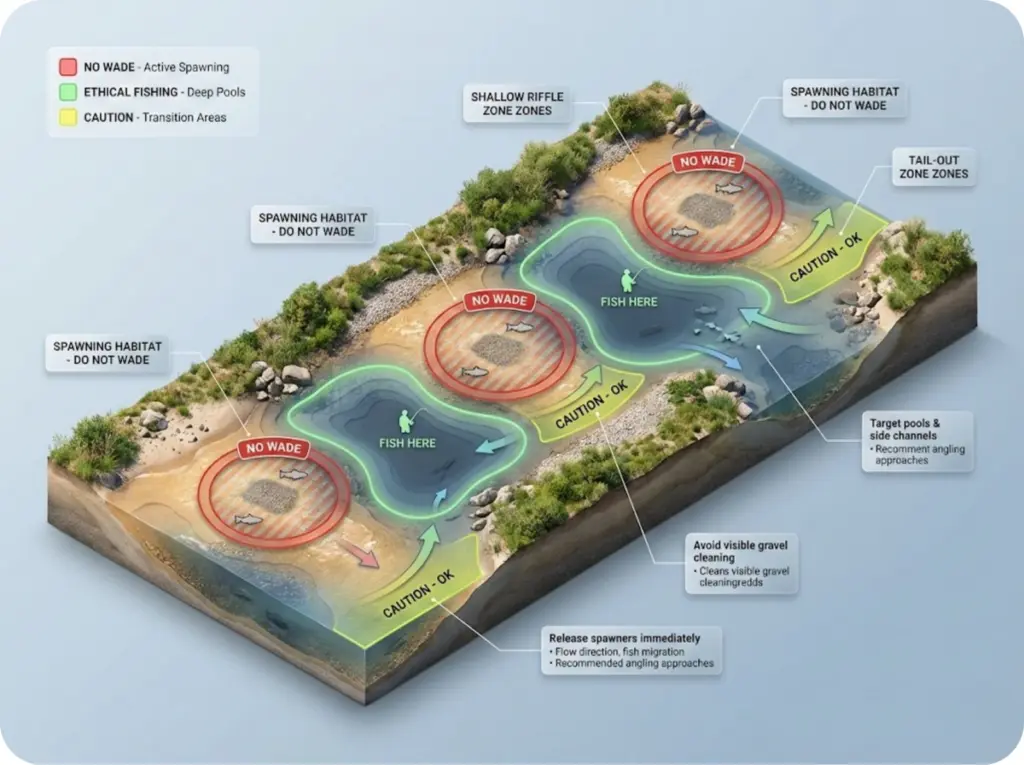
Rainbow and Cutthroat spawn February through May—directly overlapping runoff. Brown trout eggs laid in fall are still developing in redds during spring. Female browns produce 4,000–12,000 eggs per cycle. A single trampled redd destroys an entire year’s reproduction.
Redds appear as bright, clean gravel patches in otherwise silted substrate. Once you know what to look for, they’re obvious—even in stained water.
Ethical Fishing Zones
Avoid wading through shallow riffles with visible gravel cleaning. Target the pools between riffles where non-spawning fish and “egg-eaters” congregate.
Side channels often hold actively feeding fish that have left spawning areas. If you hook a fish with distended belly or visible spawning coloration, release immediately without photos. High flows already stress redds through sediment burial—ethical anglers don’t compound damage with wading pressure.
Refer to fish conservation programs from U.S. Fish & Wildlife Service for additional guidance on protecting native trout populations.
Conclusion
Spring runoff isn’t the dead season most anglers assume. It’s one of the most productive windows if you understand three principles.
First, fish relocate to soft-water breaks rather than disappear. Banks, eddies, and side channels hold stacked fish that everyone else ignores. Second, heavy rigs and dark flies trigger lateral line strikes in zero-visibility conditions—size up, add weight, and embrace chartreuse. Third, safety protocols are non-negotiable. The Rule of 8, wading belts, and three-point contact keep you fishing instead of swimming.
The next time chocolate water pours off the mountain and everyone else packs up, stay an extra hour. Fish the inside bends. Swing a black Woolly Bugger through the foam line. Let the crowd leave.
The trophy browns holding tight to the bank don’t care about clarity—and now neither should you.
FAQ
Is it good to fish during spring runoff?
Yes—runoff concentrates fish in predictable locations like edges, eddies, and side channels while providing constant stained-water cover that reduces spookiness. Many guides consider it one of the best windows for aggressive takes, with the added benefit of minimal angling pressure.
What flies work best in muddy water?
Large, dark patterns with movement: San Juan Worms, Pat’s Rubber Legs, Woolly Buggers (#6 black), and Mop Flies. Size up 2–4 hook sizes from normal and prioritize rubber legs, UV materials, and tungsten weight to get down fast and trigger lateral line strikes.
How do you read water during runoff?
Focus on soft-water breaks—any feature that slows current velocity. Look for foam lines marking the seam between fast and slow water, inside bends, boulder pockets, flooded vegetation, and side channels. Fish face upstream but position where food delivery doesn’t require constant swimming effort.
When does runoff end?
Monitor the USGS hydrograph for your river. When flow enters the falling limb and clarity transitions from chocolate milk to steelhead green (1–3 feet visibility), runoff is ending. Overnight low temperatures at SNOTEL sites predict next-day clearing: cold nights mean clearer mornings.
Can you wade during runoff?
Sometimes—but use the Rule of 8 safety threshold: Depth (feet) × Velocity (fps) must be less than 8. Always wear a cinched wading belt, use a wading staff for three-point contact, and never wade alone. If water temperature is below 50°F, consider an inflatable PFD to protect against cold water shock.
Risk Disclaimer: Fishing, boating, and all related outdoor activities involve inherent risks that
can lead to injury. The information provided on Master Fishing Mag is for educational and informational purposes
only. While we strive for accuracy, the information, techniques, and advice on gear and safety are not a substitute
for your own best judgment, local knowledge, and adherence to official regulations. Fishing regulations, including
seasons, size limits, and species restrictions, change frequently and vary by location. Always consult the latest
official regulations from your local fish and wildlife agency before heading out. Proper handling of hooks, knives,
and other sharp equipment is essential for safety. Furthermore, be aware of local fish consumption advisories. By
using this website, you agree that you are solely responsible for your own safety and for complying with all
applicable laws. Any reliance you place on our content is strictly at your own risk. Master Fishing Mag and its
authors will not be held liable for any injury, damage, or loss sustained in connection with the use of the
information herein.
Affiliate Disclosure: We are a participant in the Amazon Services LLC Associates Program, an
affiliate advertising program designed to provide a means for us to earn advertising fees by advertising and linking
to Amazon.com. As an Amazon Associate, we earn from qualifying purchases. We also participate in other affiliate
programs and may receive a commission on products purchased through our links, at no extra cost to you. Additional
terms are found in the terms of service.