
In this article
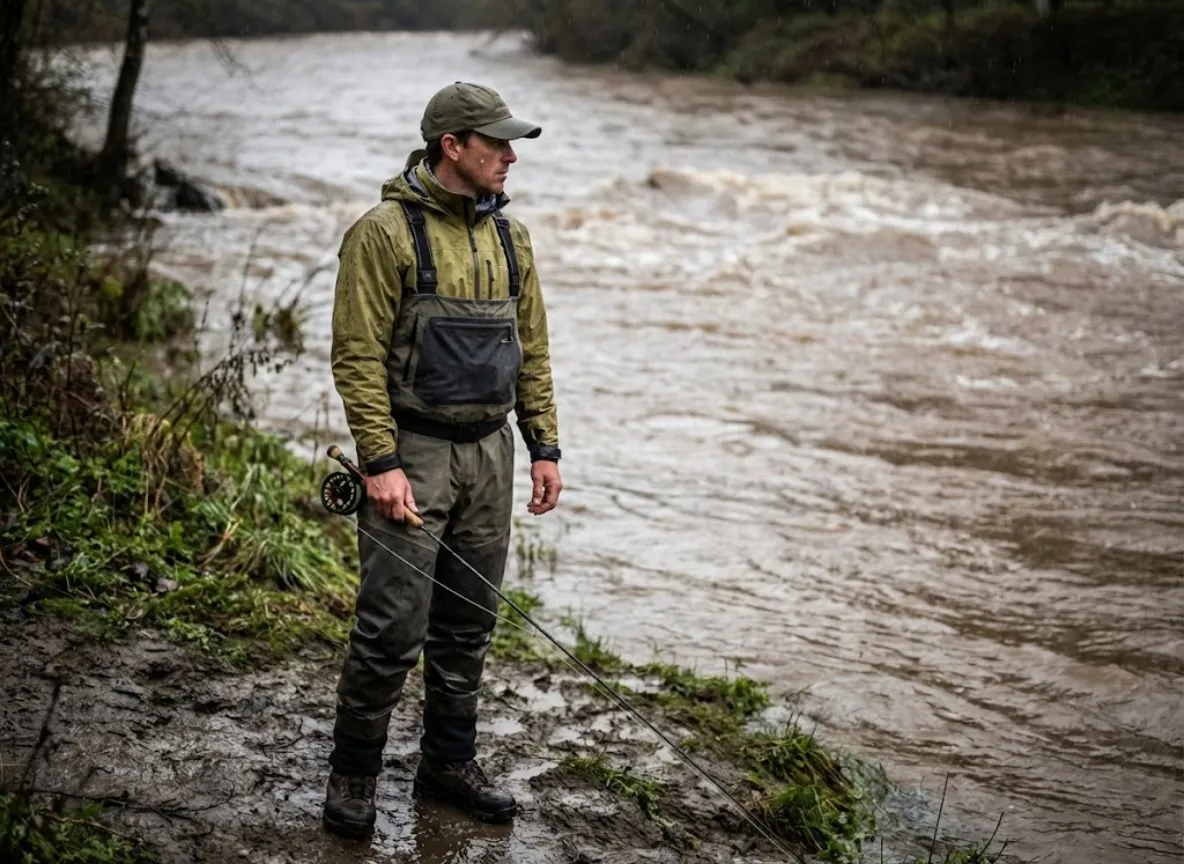
The river looks like chocolate milk. You stand on the bank, and the lazy, clear seam you fished yesterday is gone. It has been replaced by a churning, opaque torrent dragging timber and topsoil downstream. Most anglers take one look at this “blown out” water, shake their heads, and drive home.
They are wrong.
This chaos isn’t a stop sign; it is a dinner bell. I have spent decades wading rising rivers, and I can tell you that the heavy rain hasn’t ruined the fishing. It has simply concentrated the biomass and simplified the game for those who understand the physics of the post-rain river protocol. This isn’t about luck; it is about adopting an adaptive angler framework. We must understand how Cubic Feet Per Second (CFS), turbidity, and water chemistry dictate fish location. We are going to break down how to exploit the biological shift from visual hunting to lateral line sensing, identify the productive current breaks, and apply the non-negotiable “Rule of 10” for safety.
What happens to a river when it rains? (The Hydrology)
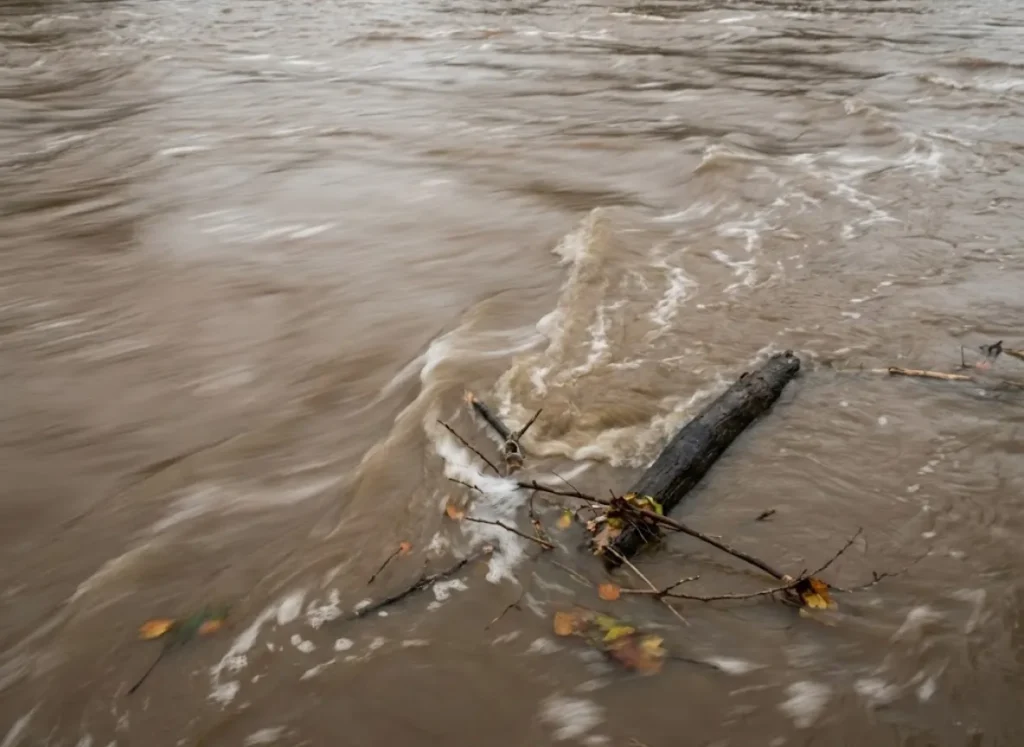
This section deconstructs the physical changes in the riverine environment to help you diagnose the “stage” of the flood and predict fish behavior.
How do I read a hydrograph to distinguish the “Rising Limb” from the “Falling Limb”?
You must distinguish between the chaos of increasing flow and the stabilization of decreasing flow; the “Falling Limb” is your target window.
The “Rising Limb” is the initial phase where discharge, measured in CFS, increases rapidly. Debris mobilizes, and water expands into terrestrial vegetation. This is often the hardest time to fish due to instability and floating hazards. The “Peak” represents the maximum discharge, often coinciding with the highest turbidity and the most dangerous wading conditions.
The magic happens on the “Falling Limb.” This is the stabilization phase where velocity drops, sediment begins to settle (sand first, then silt), and fish move from bank refuges back to predictable structure. Rain creates a system-wide reset that can trigger feeding frenzies once the flow stabilizes.
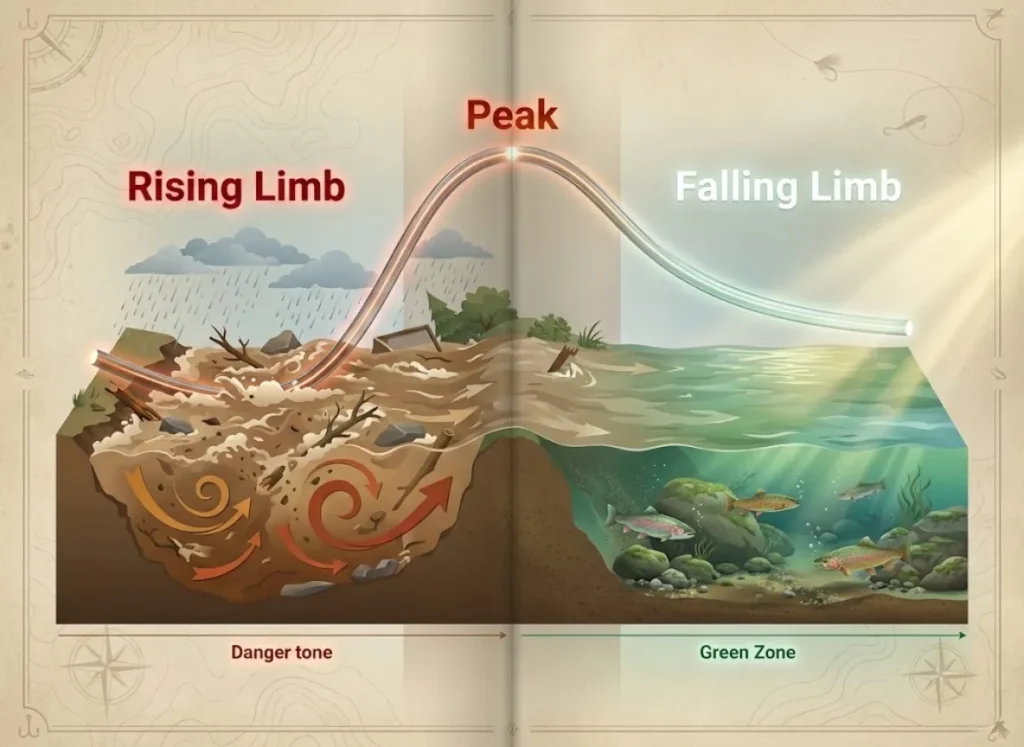
Understanding “Lag Time” is critical. A river may not peak until 12-24 hours after the rain stops. The USGS flow charts you see online may lag behind reality. Additionally, the “Hysteresis Effect” often means water clears faster than the level drops. This creates a prime window where water is high but visibility is improving—the “Green Zone.”
To do this safely, you need to be proficient at interpreting gage height and streamflow values. Knowing the difference between “Action Stage” and “Flood Stage” tells you if the river is merely stained water or dangerously out of its banks. Once you have the USGS data monitoring dialed in, you can apply your field guide to reading a river to locate the physical features that match the flow data.
How does “turbidity” fundamentally change the physics of light underwater?
Turbidity drastically reduces the “Reaction Distance” of a predator by scattering light via suspended particles like clay and silt.
As light enters muddy water, short wavelengths (blue/violet) scatter first. This creates a “background noise” of grey or brown haze that obscures visual details. Long wavelengths (red/orange) are absorbed rapidly. That red lure that looks vibrant in the boat turns into a dark, low-contrast grey just inches below the surface in high turbidity.
Pro-Tip: If you cannot see your wading boots in knee-deep water, the fish cannot see color nuances either. Switch to solid black or fluorescent chartreuse immediately.
This optical shift forces a move from “Matching the Hatch” (color realism) to “Maximizing Contrast” (silhouette and fluorescence). You can gauge this by checking the “Secchi Depth”—the depth at which a white object disappears. If visibility is 0-6 inches, you need vibration and thumping. If it is over a foot, flash becomes viable again.
The type of sediment matters, too. The EPA outlines how suspended materials scatter light, noting that “glacial flour” creates a milky turquoise stain, while organic topsoil creates chocolate milk clarity. Unlike the gin clear waters of summer or clear water lakes, organic turbidity means contrasting dark silhouettes are the only things a predator can reliably target.
Where do fish go during high water? (The Biological Response)
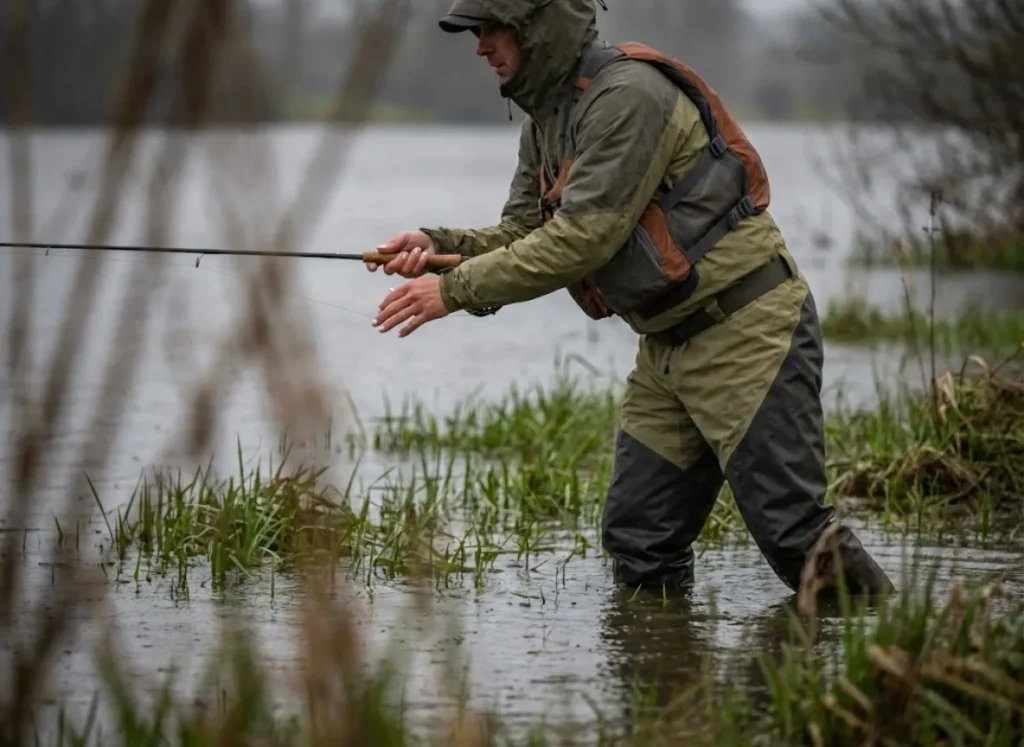
This section explains the physiological and behavioral adaptations fish undergo, shifting the focus from “where they usually live” to “where they survive the flood.”
Why do fish migrate from the main channel to “Shear Zones” and banks?
Fish migrate to “Shear Zones” and banks because the energy cost of swimming in the main current exceeds the calorie intake from drifting food.
The “Shear Zone” is the turbulent interface between the fast main current and the slow eddy water. This is where biomass (food) is trapped and where predators hold. To utilize this, fish execute an “Up and In” migration. They push tight to the banks where friction slows the water and flooded vegetation provides cover.
Research into the effects of shear environments on fish demonstrates that fish hold in the low-velocity eddy while facing upstream into the high-velocity shear. This minimizes energy expenditure while maximizing prey encounter rates.
The “Inside Bend” of a river becomes a major holding area. The centrifugal force of the current scours the outside bend, leaving a slower, sediment-depositing zone on the inside. In extreme flood conditions, general fishing in current strategies shift; fish may move into flooded terrestrial grass, sitting in water barely deep enough to cover their dorsal fins to escape the raging channel. This bank-hugging behavior is common in high flow scenarios.
How does the “Sensory Handover” shift reliance from vision to the lateral line?
When visibility drops below reaction distance, the fish’s brain prioritizes input from the lateral line over the visual cortex to locate prey.
The lateral line is a system of tactile sense organs (neuromasts) that allows fish to detect pressure gradients and particle motion. They are effectively “touching” objects at a distance. This biological reality dictates that your lure choice must shift from “visual realism” to “hydrodynamic displacement.” You need loud lures and significant displacement.
Predators can detect the specific “Wake Signature” of a prey item based on the vortex trail it leaves. The “Weberian Apparatus” in species like catfish and Minnows amplifies sound waves, linking the swim bladder to the inner ear. This makes them hyper-sensitive to high-frequency rattles.
Studies on the functional diversity of the lateral line system confirm that successful hunting in opaque water relies on mechanoreception. This is similar to the sensory adaptation required for a night fishing guide, where vibration is the primary trigger. A silent lure in mud is essentially invisible.
What is the “Worm Flush” phenomenon and how does it trigger feeding?
The “Worm Flush” occurs when saturated soil forces terrestrial invertebrates like earthworms to surface, washing them into the river and creating a massive calorie subsidy.
This mechanical force of runoff washes terrestrial drift into the flow. It creates a temporary runoff buffet that is often 50% higher than baseline levels. Predatory fish, especially brown trout and largemouth bass, patrol the bank lines specifically to intercept this protein, including nightcrawlers, red worms, ants, and beetles.
Ecologists have documented these terrestrial invertebrate subsidies to streams, noting that in wet seasons, they can override aquatic insect hatches as the dominant food source. This validates the tactic of casting parallel to the bank rather than perpendicular to it. You want to keep your lure in the “terrestrial subsidy zone.”
The acoustic cue of a lure landing with a “plop” mimics the sound of a falling organism. This often triggers an immediate reaction strike. This approach mirrors the tactics for mastering shore fishing, where anglers are naturally positioned to exploit this near-bank zone.
What is the tactical protocol for fishing muddy water? (The Strategy)
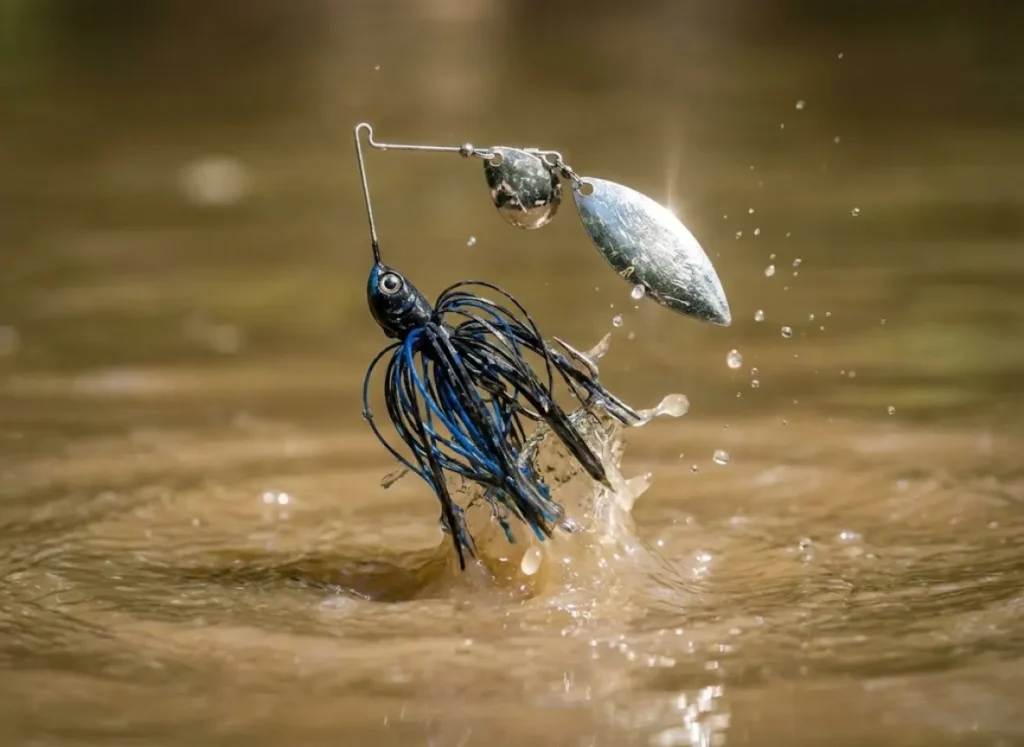
This section translates the science into actionable steps, detailing exactly where to cast and how to present the lure.
How do I identify and fish a “Shear Zone” with precision?
Identify visible “seams” on the surface where fast, rippled water meets slow, flat water, and cast upstream into the current, drifting into the seam.
Do not cast directly into the stagnant center of the eddy. You must place your lure upstream into the fast current and allow it to drift naturally into the shear line. The strike almost always occurs at the moment the lure crosses the velocity barrier, mimicking a stunned baitfish tumbling out of the current.
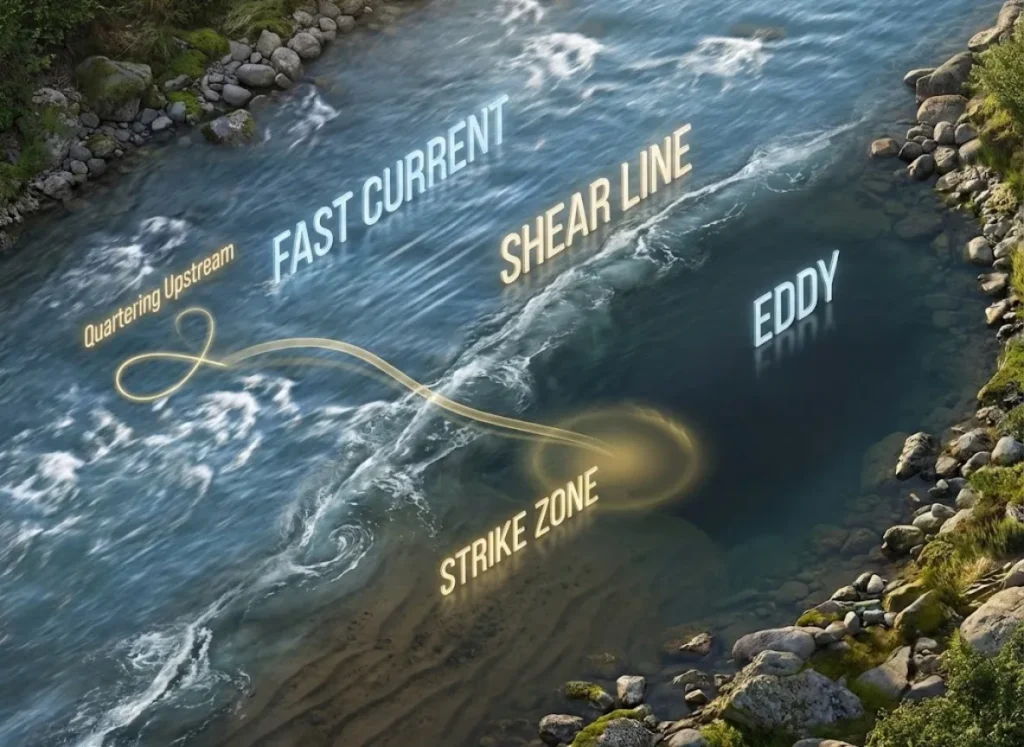
Use a “Quartering Upstream” cast to maintain a tight line. A downstream cast often results in the current pushing the lure to the surface too quickly. In high turbidity, the “Strike Window” is reduced to inches. You must make repetitive casts to the same piece of cover.
Agencies responsible for monitoring river flow and stage note that flow rates create distinct hydrodynamics. Focus on mud lines—boundaries where a clear feeder creek or tributary meets the muddy main river. These offer predators a visual ambush point. Hitting these precise spots requires a solid baitcaster casting blueprint to ensure you aren’t snagging trees on the opposite bank.
Which lure profiles and colors maximize the “Signal-to-Noise” ratio?
You must prioritize lures with high acoustic output (displacement) and maximum visual contrast (silhouette). Referencing a visibility vs lure selection matrix can simplify this choice.
Acoustic Output: Use lures with high displacement to stimulate the lateral line. Spinnerbaits with a Double Colorado blade or a turtle-back blade (like a War Eagle) provide maximum thump. Chatterbaits (specifically ZMan JackHammers) offer violent vibration.
Visual Contrast: Abandon natural patterns. Use Solid Blue/Black for maximum silhouette against the downwelling light. Fluorescent Chartreuse or Orange works well for UV visibility in low light.
Deflection: Use squarebill crankbaits that deflect erratically off cover. The sudden change in direction triggers a reaction strike. Rattling crankbaits like a War Pig or lipless crankbaits excel here.
The Muddy Water Lure Selector
Ranking lures by effectiveness in low-visibility conditions based on Acoustic Output (AO), Visual Contrast (VC), Displacement (DV), and Snag Resistance (SR).
Best Application: Searching large areas of shallow, woody cover.
Acoustic Output
9/10
Visual Contrast
8/10
Displacement
10/10
Snag Resistance
9/10
Best Application: High-intensity searching in grass or open banks.
Acoustic Output
10/10
Visual Contrast
8/10
Displacement
9/10
Snag Resistance
7/10
Best Application: Low light or overcast conditions in shallow water.
Acoustic Output
9/10
Visual Contrast
9/10
Displacement
8/10
Snag Resistance
6/10
Best Application: Deflecting off rocks/stumps in medium depth (2-5ft).
Acoustic Output
8/10
Visual Contrast
7/10
Displacement
8/10
Snag Resistance
8/10
Best Application: Precision pitching to specific targets when fish are inactive.
Acoustic Output
4/10
Visual Contrast
9/10
Displacement
5/10
Snag Resistance
9/10
Best Application: Avoid in heavy mud unless water is clearing (>1ft vis).
Acoustic Output
3/10
Visual Contrast
6/10
Displacement
6/10
Snag Resistance
5/10
Tungsten weights and glass rattles produce higher frequency sounds than lead or plastic. This “Click” factor helps cut through the low-frequency background noise of turbulent water. Applying Pro-Cure scent, like crawfish or anise, adds a third sensory layer.
State agencies provide helpful fishing tips for changing conditions, validating that clear water rules do not apply here. Avoid finesse. This is not the time for subtle drop-shots. You need “angry,” bulky profile baits like a PowerWorm or ZMan Diezel MinnowZ. For specific product recommendations, look for high-displacement options among the best lures for largemouth bass.
Is it safe to fish a rising river? (The Safety Framework)
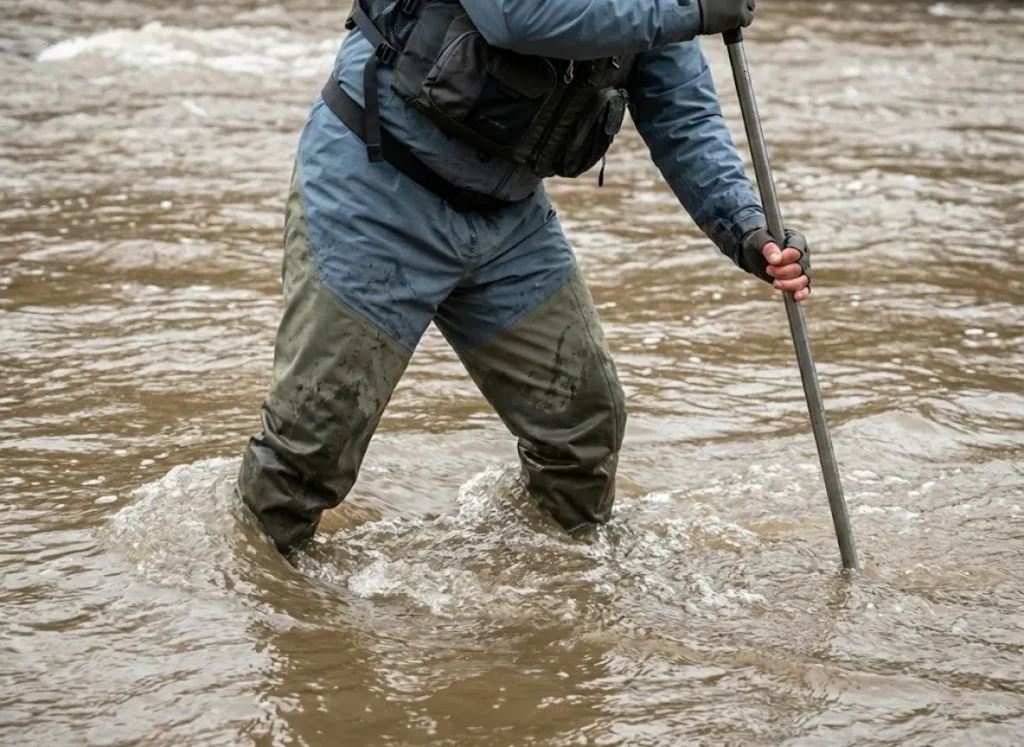
This section provides a non-negotiable risk assessment protocol to prevent accidents in deceptively powerful currents.
How do I calculate wading safety using the “Rule of 10”?
If the Depth (feet) x Velocity (feet per second) equals or exceeds 10, the water is unsafe to wade.
For example, water that is 2.5 feet deep flowing at 4 feet per second gives a Risk Factor of 10. Do not enter. Always use a wading staff and wear a PFD (Personal Flotation Device) when fishing runoff. The bottom composition may have changed, creating new scour holes or loose gravel.
Pro-Tip: Identify a “Reference Rock” or stick on the bank immediately upon arrival. Check it every 15 minutes. If it disappears, the water is rising—get out.
Be aware of “Strainers”—fallen trees that allow water to pass through but trap anglers. Never wade upstream of a strainer. Rising water can also cut off your return path. What was a dry gravel bar 30 minutes ago can become an island.
While often discussed in the context of monitoring estuaries and water safety, these principles apply to all moving water. If the water is approaching “Action Stage,” stay on the bank. No fish is worth hydraulic entrapment. For a complete list of gear, consult the definitive guide to fishing safety.
Conclusion
The river rewards those who respect it and punishes those who underestimate it. By adhering to the Muddy Water Protocol, you turn a washed-out weekend into a trophy opportunity.
Remember the core tenets:
- The Hydrograph Rule: Fish the “Falling Limb” for the best balance of active feeding and fishable clarity.
- The Physics of Contrast: In mud, Black (silhouette) and Chartreuse (fluorescence) outperform natural colors.
- The Lateral Line Advantage: Use lures that “thump” (Colorado blade spinnerbaits, Chatterbaits) to target the fish’s mechanoreception.
- Location Precision: Abandon the main channel; target the shear zones, inside bends, and bank-side terrestrial subsidy zones.
Next time the forecast calls for heavy rain, don’t cancel your plans. Check the go/no-go gauge, grab your dark spinnerbaits, and head to the river. Share your best muddy water catch in the comments below.
FAQ – Frequently Asked Questions
Is fishing good after rain in a river?
Yes, but timing optimization is everything. The Falling Limb of the hydrograph (after the water peaks and starts to drop) is often the most productive time. Fish are concentrated in predictable shear zones and are actively feeding on terrestrial food that has washed into the system.
What lures work best in muddy river water?
You need lures that generate strong vibration and high contrast. A blue or black Chatterbait or a firetiger spinnerbait with a large Colorado blade are top choices. The goal is to help fish find the lure using their lateral line (vibration) first, and then their eyes (silhouette) second.
How do you find fish in a flooded river?
Stop fishing the middle. Look for current breaks near the banks, inside bends, and the mouths of feeder creeks where the water is slower. Fish will move Up and In to shallow water to escape the heavy flow and conserve energy.
Do fish bite while the water is rising?
It is generally difficult. During the Rising Limb, fish are relocating, and debris warnings should be heeded. However, predatory fish like smallmouth bass will push tight to the banks to ambush worms and bugs washing into the water, so bank fishing can still yield results if you stay safe.
Risk Disclaimer: Fishing, boating, and all related outdoor activities involve inherent risks that
can lead to injury. The information provided on Master Fishing Mag is for educational and informational purposes
only. While we strive for accuracy, the information, techniques, and advice on gear and safety are not a substitute
for your own best judgment, local knowledge, and adherence to official regulations. Fishing regulations, including
seasons, size limits, and species restrictions, change frequently and vary by location. Always consult the latest
official regulations from your local fish and wildlife agency before heading out. Proper handling of hooks, knives,
and other sharp equipment is essential for safety. Furthermore, be aware of local fish consumption advisories. By
using this website, you agree that you are solely responsible for your own safety and for complying with all
applicable laws. Any reliance you place on our content is strictly at your own risk. Master Fishing Mag and its
authors will not be held liable for any injury, damage, or loss sustained in connection with the use of the
information herein.
Affiliate Disclosure: We are a participant in the Amazon Services LLC Associates Program, an
affiliate advertising program designed to provide a means for us to earn advertising fees by advertising and linking
to Amazon.com. As an Amazon Associate, we earn from qualifying purchases. We also participate in other affiliate
programs and may receive a commission on products purchased through our links, at no extra cost to you. Additional
terms are found in the terms of service.