
In this article
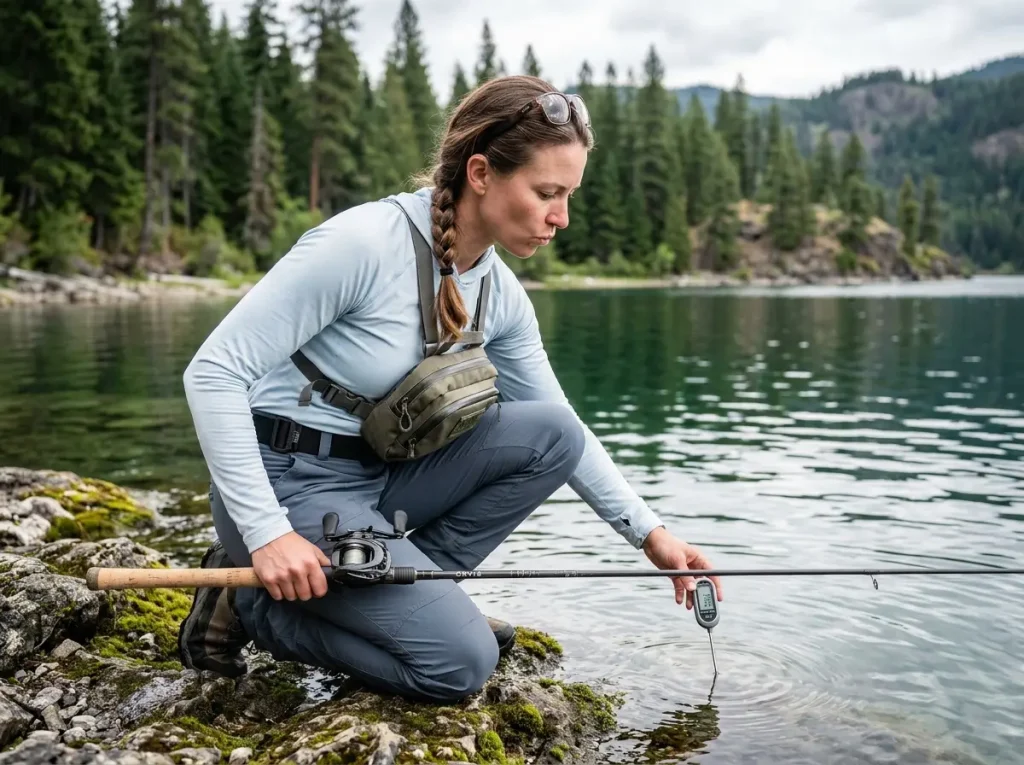
It was 7 a.m. on a dead-flat April lake, barometer sitting at 29.45 and still dropping. The crappie were supposed to be on beds — every angler at the launch said so, half of them with buckets already rigged. After four hours working shallow brush piles, I had nothing to show for it. The beds were empty. The fish had gone deep six hours earlier and weren’t coming back until the glass climbed again. I was fishing the textbook, not the physics.
That morning taught me more about fish spawning triggers than any guide ever had. Not because I caught fish — I didn’t — but because I finally understood why the beds were vacant when all the textbook conditions said otherwise. Water temperature was right. Daylight hours were right. The barometer was dropping, and nobody at the ramp had thought to check it.
Photoperiod and temperature are the starting conditions for spawning. They open the door. But four secondary triggers — the ones most seasonal guides never mention — determine whether that door actually stays open on any given morning.
⚡ Quick Answer: Fish spawn based on a layered system of triggers, not a single condition. Temperature and daylight hours set the seasonal window, but barometric stability, ionic conductivity (water chemistry changes from rainfall), substrate roughness (Manning’s n), and hormonal aggression state determine whether spawning actually executes on a given day. A falling barometer can empty beds that were full six hours earlier. A drought year changes conductivity enough to delay the spawn even when temperatures are perfect. Understanding these four mechanisms tells you when the spawn actually fires — not just when it could.
| Environmental Fishing Triggers & Angler Implications | |||
|---|---|---|---|
| Trigger | Threshold | Species Examples | Angler Implication |
| Water Temperature | 55–75°F window | Bass, Crappie, Walleye | Table setter, not the event |
| Barometric Pressure | Stable 29.70–30.40 inHg | Crappie, Bass | Abandonment zone above 30.50 |
| Ionic Conductivity | Drop below 80 µS/cm | White Perch, Cichlids | The rain event signal |
| Manning’s n (Substrate) | 0.035–0.050 coarse gravel | Trout, Salmon, Walleye | Site selector, not just habitat |
| Vomerine Strike Reflex | 11-KT hormonal surge | Smallmouth Bass, Snappers | Why they hit but don’t eat |
The System Running the Show: Why Spawning Is Not a Calendar Event
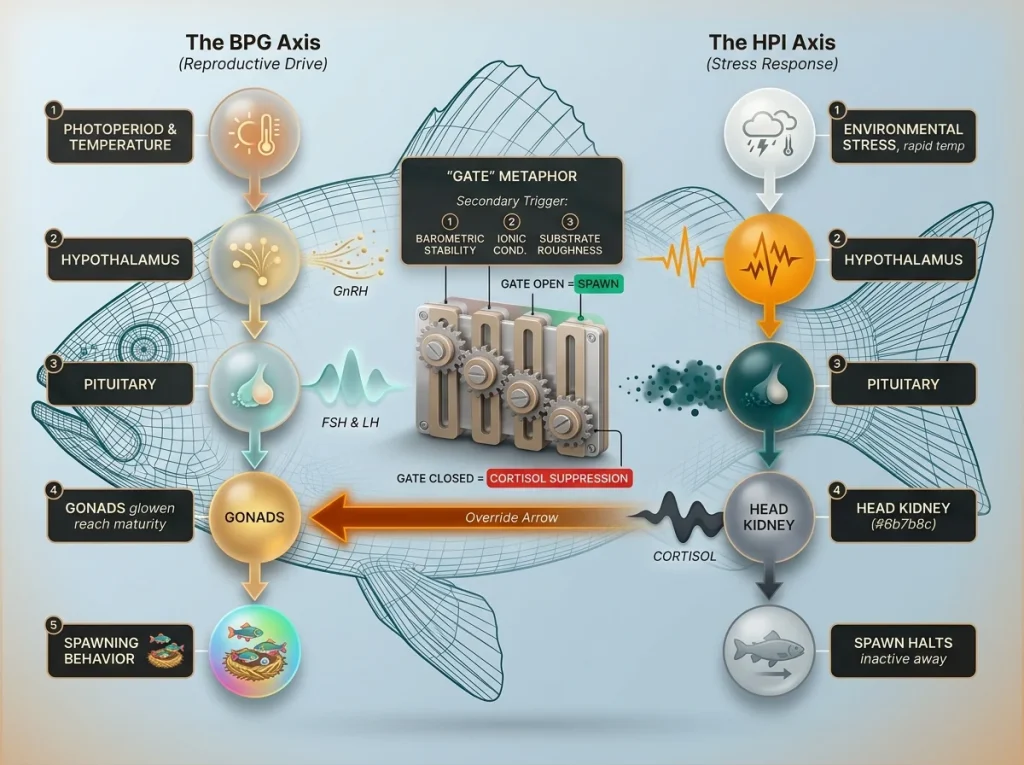
Most anglers know the brain-pituitary-gonadal (BPG) system by its results, not by its name. Here’s the short version: the hypothalamus releases a hormone called GnRH, which signals the pituitary to release FSH and LH — the hormones that actually drive gonadal development. Researchers have found three distinct types of GnRH operating in fish brains: one in the preoptic area governing reproductive hormone release, one in the midbrain with functions still being mapped, and one in the olfactory bulbs acting as a neuromodulator. The whole cascade is precise and deeply sensitive to environmental disruption.
Temperature acts as the “door opener.” For most temperate species, gonadal development starts in winter and requires a specific thermal increase to reach final maturation — largemouth bass in the 62–75°F range, smallmouth closer to 55–65°F, salmonids and trout operating at a much colder 40–55°F. Fish reproduction in a warming world: hormonal vulnerability points documents this thermal vulnerability extensively. But temperature alone doesn’t synchronize the spawn — and that’s the point most guides miss.
Running parallel to the BPG system is the fish’s stress-response architecture — the hypothalamic-pituitary-interrenal axis. When conditions go wrong, this system releases cortisol from cells in the head kidney. That cortisol actively suppresses GnRH. The spawn doesn’t just slow down; it stops. A sudden 2°F drop can halt an active spawn within hours. A cold front that kills the morning bite doesn’t just reduce activity — it physically shuts down the reproductive gate through cortisol suppression. And how water temperature directly governs fish metabolic scope explains why thermal instability reaches into the reproductive system itself, not just surface behavior.
That stress-response pathway is why the four secondary triggers matter. They’re not add-ons to the spawn equation. They’re the lock.
Trigger 1: The Barometric Gate
Here’s the mechanism nobody explains at the ramp: barometric pressure changes the internal physics of every fish in the water column.
The swim bladder maintains neutral buoyancy by holding gas at a pressure that matches the surrounding water. When the barometer drops, surface pressure decreases, and that gas expands — causing physical discomfort that overrides almost every other behavioral drive, including the urge to spawn. To understand the full scope of this, the full science of barometric pressure on fish behavior lays out the mechanism clearly. When the barometer falls, the gas inside the swim bladder expands as surrounding pressure drops — the same principle that makes sealed containers bulge at altitude. Fish have to compensate by moving deeper, or by slowly reabsorbing that expanding gas. Either way, the spawn stops.
The late Dr. Loren Hill spent years studying crappie (Pomoxis spp.) behavior in relation to pressure changes, and his data is specific enough to be operationally useful: fish abandon shallow spawning grounds as pressure falls, enter a dormant recovery state for six to eight hours, and return to the shallows only when the barometer stabilizes and begins to climb. That six-to-eight-hour dormancy is the detail competitors reduce to a single bullet about “fish biting before storms.” The recovery timeline is the part that changes how you plan your morning.
The thresholds that matter: stable readings between 29.70 and 30.40 inHg mean active nesting in the shallows. Extremely high readings above 30.50 inHg drive nest abandonment and deep suspension. A rapidly falling reading below 29.60 inHg produces a brief pre-front feeding surge followed by a deep retreat. Adult, sexually mature fish — the ones guarding primary beds — are more pressure-sensitive than juveniles because of larger swim bladder volumes and the physical pressure of developed gonads. That’s why small fish may still bite while the spawning population has already left.
Hill’s research also carries a marine implication worth noting: if pressure forces a female to spawn at a “critical depth,” the eggs she deposits may sink out of the productive water column entirely — a recruitment failure that shows up in population data years later but can’t be seen from a boat. EPA dissolved oxygen data and its interaction with pressure in early-morning spawning events adds another layer: dissolved oxygen hits its lowest point just before dawn as photosynthesis has been offline all night, which compounds barometric stress on eggs deposited in calm, warm water.
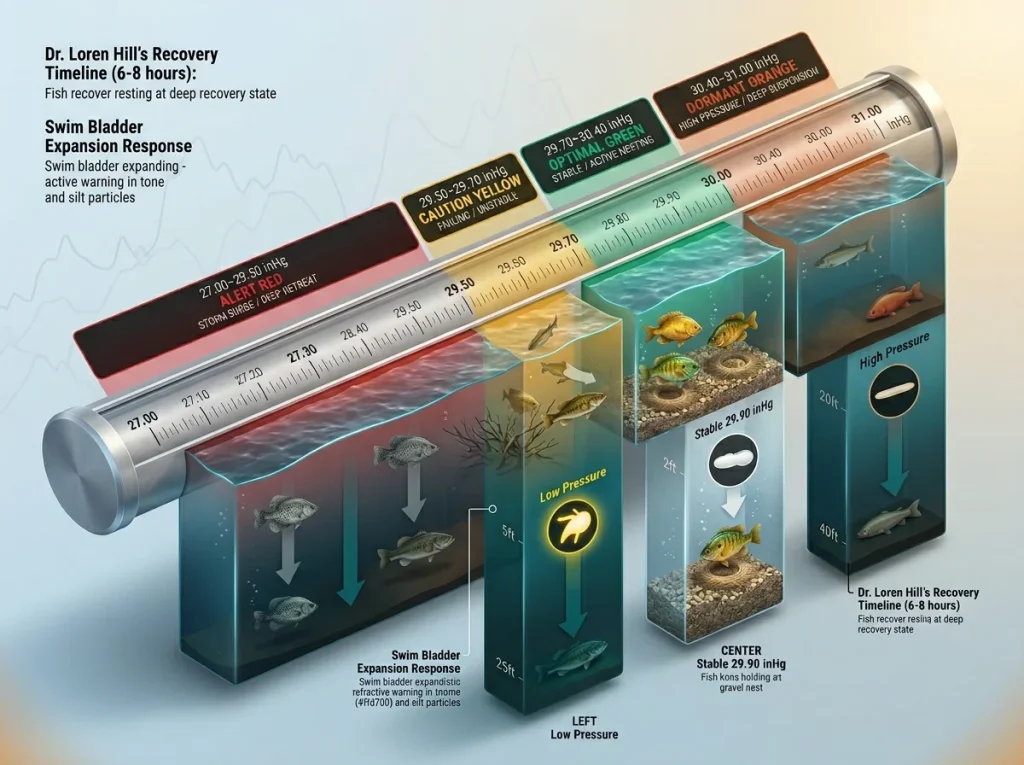
Pro-Tip: Check the barometric trend, not just the reading. A stable 29.90 inHg for 12+ hours is a green light. A reading that’s been falling since midnight explains empty beds regardless of what the thermometer says. Most fishing apps show trend arrows — use them before you launch, not when you’re already on the water.
Trigger 2: Ionic Conductivity and the Rainwater Signal
This one is almost entirely absent from angling content, which means understanding it puts you ahead of most guides with twenty years on the water.
Electrical conductivity measures how well water carries a current — a direct function of dissolved inorganic solids like calcium, magnesium, and sodium. During dry conditions, evaporation and low flow concentrate those ions, pushing conductivity high. When significant rain arrives, it dilutes the water rapidly, driving conductivity down and shifting pH toward neutral. For many species, that dilution event is a biological starting gun.
Research on white perch (Morone americana) in the Hudson River demonstrates that egg abundance is tied nonlinearly to conductivity levels. High-discharge events that drop conductivity drive migrations from estuarine to freshwater spawning grounds. The USGS instream flow characterization and habitat suitability in the Upper Salmon River Basin documents equivalent conductivity-flow relationships for salmonids, showing how the chemistry of the water — not just its temperature — determines spawning site selection.
Expert aquarists who breed neotropical species use this mechanism deliberately. The “rainwater trigger” protocol works by first gradually lowering water level over two to three weeks to mimic drought, then rapidly refilling with aged rainwater or reverse-osmosis water. Three signals fire simultaneously: thermal shock from the cooler water, ionic dilution dropping conductivity from above 150 µS/cm to below 80 µS/cm, and a pH shift toward neutral. All three together mimic the onset of wet season — the same cascade that fires mass spawning events in the Amazon and in Hudson River tributaries.
The practical angling application: after a sustained, heavy rain event is consistently when river perch and bass stage hard and early. That first major dilution after drought conditions is a starting gun — not every rain, but the first significant rain after a dry period. Same lake, same temperature, fires completely differently in a drought year versus a wet spring.
High conductivity above 500 µS/cm measurably reduces hatching success and egg survival in salmon, pike, and perch by creating osmotic stress on the egg membrane. Spawning water chemistry requirements are significantly more stringent than adult survival ranges: pH must sit between 6.5 and 8.0 (versus adult tolerance of 5.0 to 9.0), and dissolved oxygen must stay above 5.0–6.5 mg/L (versus adult survival above 3.0 mg/L). How dissolved oxygen levels dictate where fish can feed and spawn covers precisely why this narrower window at the egg stage creates the recruitment bottleneck that most population models miss.
Pro-Tip: If you’re tracking spring patterns on the same river year over year, note whether it’s a drought year or a wet spring. Conductivity differences between those two scenarios — even at identical temperatures — explain why the spawn fires two weeks earlier some years and never seems to get going in others. A dry winter followed by a sudden April rain event is a pattern worth putting in your logbook.
Trigger 3: Manning’s n — The Hydraulic Blueprint Fish Are Searching For
Fish don’t pick spawning sites visually. They pick them hydraulically.
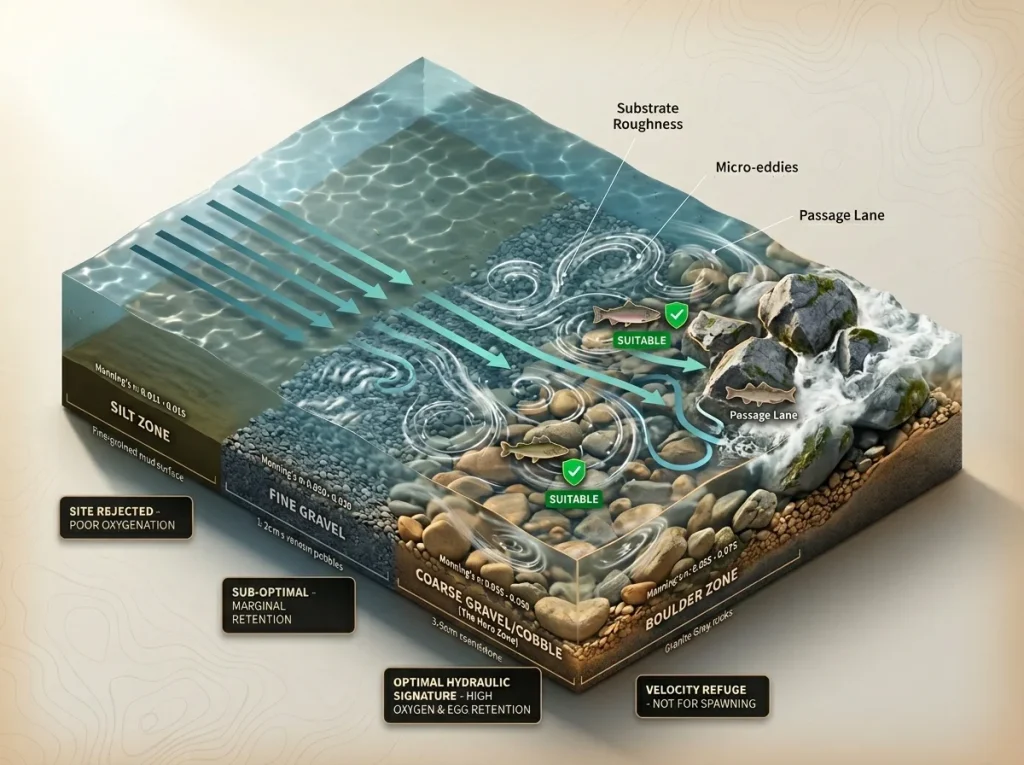
Manning’s n is an engineering roughness coefficient that represents the frictional resistance of a channel bed. In river management and fisheries science, it’s the variable that determines how water moves across a given substrate — and lithophilic spawners like salmon, trout, and walleye have very specific Manning’s n requirements. The USGS hydraulic modeling of spawning habitat suitability in salmonid rivers maps this precisely: coarse gravel and cobble — the substrate salmonids prefer — corresponds to Manning’s n values of 0.035 to 0.050. That roughness creates micro-eddies and low-velocity zones where eggs can settle without being swept away. Smooth silts — Manning’s n of 0.011 to 0.015 — produce poor egg retention and low oxygen flow no matter how perfect the water temperature is.
Walleye spawning in the Maumee River occurs specifically in zones where the combination of depth, velocity, and substrate roughness creates a high habitat suitability score. The model is multiplicative — if any single variable scores zero, the entire zone scores zero for spawning suitability. That’s why fish bypass apparently ideal gravel when the current across it is too uniform. The roughness isn’t just about texture; it’s about the hydraulic signature the substrate creates in the water flowing over it.
Salmonids actively modify that signature when they dig redds. By loosening gravel and removing fine silts, they increase local roughness, improve oxygenation, and create the permeability eggs need to survive. But there’s a cost: that looser gravel is more mobile than the surrounding streambed. Scour during a flood event typically reaches 15–20 cm below the original bed elevation in chum salmon redd egg pockets. A flood that hits that depth loses the entire clutch. Fish are selecting for hydraulic stability — enough roughness to keep eggs oxygenated, enough bed armor to prevent deep scour.
Boulder and rock zones (Manning’s n 0.055–0.075) create high-velocity refuge and primary passage lanes, but eggs don’t hold there either. How current seam hydraulics determine where fish hold and why explains the broader hydrodynamic principles that connect bed roughness to the velocity gradients fish actually use for positioning and spawning.
On river systems, don’t just look for gravel — look for gravel with structure upstream. A boulder or root snag that breaks current creates the micro-velocity reduction and turbulence that salmonids and walleye need to hold eggs. That upstream structure is selecting the spawning site as much as the gravel itself.
Trigger 4: The Vomerine Strike Reflex — Why Spawning Fish Hit Without Feeding
The short strike near a spawning bed is one of the most misunderstood events in fishing. Guides call it “finicky fish” or “they’re not really biting.” The biology says something different.
Vomerine teeth sit on the vomer bone in the center of the roof of the mouth. During spawning, a hormone called 11-ketotestosterone (11-KT) spikes in males, driving intense territorial and nest-guarding behavior. These males aren’t eating. They’re defending. The strike isn’t a feeding response — it’s a “pinch” or “butt” response, using the palate to physically remove an intruder from the nest territory. The cubera snapper vomerine tooth anatomy and spawning aggregation behavior page from the Florida Museum of Natural History shows how the vomerine patch shape itself varies by species and maps directly to behavioral profile.
In females, estradiol and maturation hormones govern the final stages of egg development. The fish is physiologically committed to reproduction, not feeding. Both sexes are running on hormonal systems that have nothing to do with prey-capture circuitry. Bioenergetics modeling of nest-guarding smallmouth bass shows parental care increases standard metabolic rate by up to 210% in high-predator-density environments — yet these males consume very few prey items during that period. They’re burning enormous energy just guarding the nest.
The vomerine strike reflex changes the entire presentation strategy. Slow lures that invade the territory outperform fast lures that mimic fleeing prey. The fish doesn’t need to think a crankbait is a shad — it needs to perceive your lure as a threat that won’t leave. That’s why how the lateral line system processes lure vibration as an intruder signal matters here: the lateral line is detecting your presentation as a physical presence in the territory, and the vomerine reflex fires in response to that sensory input, not to the visual cue of matching the hatch.
Patch shape varies: cubera snapper carry a triangular vomerine patch and are aggressive aggregate spawners vulnerable to overfishing. Gray snapper have an anchor-shaped patch and hold cautious estuarine territories. Channel catfish use a rectangular/broad patch, with guarding males showing visible scrapes and body abrasions from the physical contact involved in nest defense.
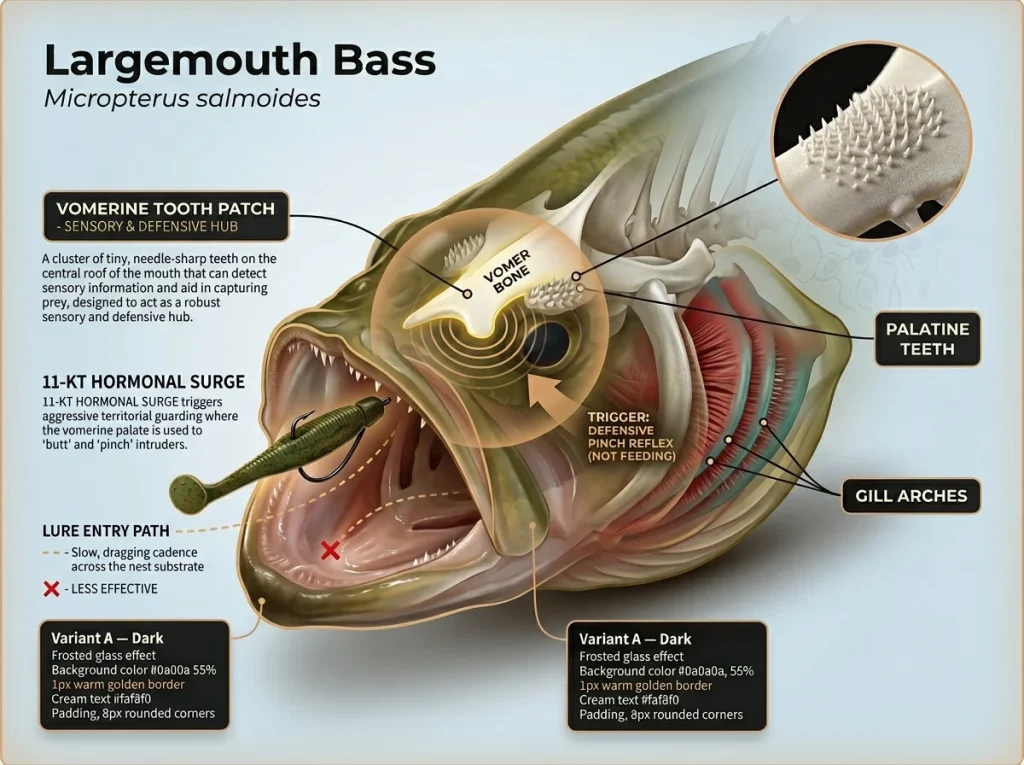
Pro-Tip: When bed fishing, slow your presentation to match an intruder that won’t leave — not prey that’s trying to escape. The fish isn’t hungry. It’s angry. That’s a different set of neurons firing, and it responds to a completely different cadence than a feeding presentation. A Texas-rigged soft plastic dragged slowly across the flat beats a fast-moving crankbait every time during active bed guarding.
The Trigger Hierarchy: How All Four Conditions Stack
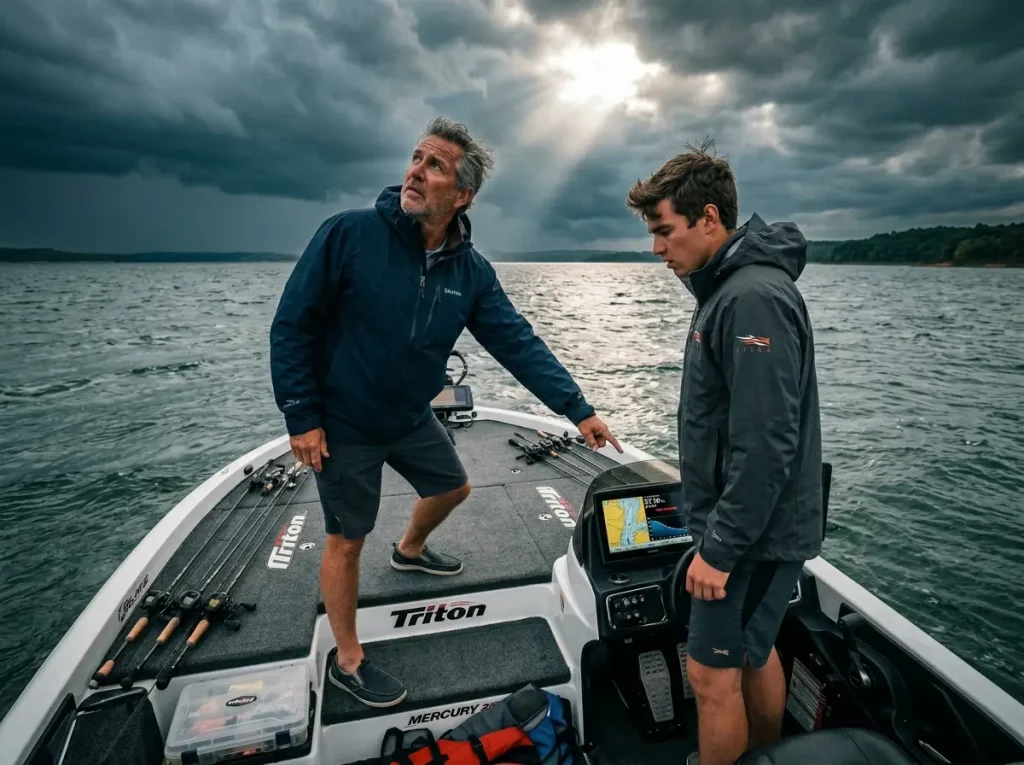
The four triggers don’t operate independently. They form a sequential system — and if any link breaks, the whole chain fails.
When the System Works: Reading Ideal Conditions in the Field
Think of it this way. Photoperiod is the alarm clock — it initiates GnRH production weeks before spawning, independent of everything else. Temperature is the door that permits gonadal maturation. But the four secondary triggers — barometric stability, ionic conductivity, Manning’s n substrate quality, and hormonal state — are the lock that determines whether that door actually opens on a given morning.
When any secondary trigger fails — a falling barometer, drought-level conductivity, silt-covered substrate — cortisol elevation functionally closes the reproductive gate even when temperature and daylight hours are optimal. The most predictable spring bass spawn I’ve tracked happened during a five-day stable high-pressure window, after a significant rain event dropped a reservoir’s conductivity, on a gravel flat with downed timber upstream. All four secondary triggers aligned. That’s why the beds were packed full that week — not because April showed up on the calendar.
You can track a lot of this from your truck before you ever back the trailer down the ramp. Pull barometric trend data for the previous 24 hours. Check whether there’s been significant recent rain. Cross-reference it with the pre-spawn bass transition routes that fish use before committing to beds — those staging corridors are where you want to be during unstable pressure windows anyway.
When the System Fails: Climate and Human Disruption
Hudson River white perch have shifted their spawning hotspots upriver by several kilometers since 1980, driven by changing discharge and conductivity patterns from altered hydrology. Thermal stress and hormonal disruption of spawning recruitment in teleost populations documents this shift directly — a real-world example of how secondary trigger disruption plays out at the population level over decades.
Populations blocked by dams spawn in suboptimal Manning’s n conditions — silt-covered substrates with wrong velocity ratios — producing poor egg retention and recruitment failure that doesn’t show up in adult population surveys for years. Road salt and industrial runoff create prolonged conductivity spikes in native stream systems, disrupting the ionic dilution signal that migratory species depend on. “Heat waves” during the sexually labile period cause skewed sex ratios via cortisol-driven hormonal changes that convert genetic females to phenotypic males. The adult population can look healthy from the surface while its reproductive phenology is silently failing.
How cold fronts drive hour-by-hour fish behavioral shifts covers what frontal passage does to the acute end of this system — the short-term behavioral version of what chronic climate disruption is doing at the population level over years.
Conservation Implications: Fishing the Spawn Without Destroying It
The Metabolic Cost of the Spawn
The spawn is the most energetically expensive event in a fish’s annual cycle. A nest-guarding male smallmouth is burning up to 210% of his standard metabolic rate just to hold position and defend. When you hook that fish, fight it, and release it, you’re adding three simultaneous physiological stressors to a system already at maximum load: 11-KT-driven territorial aggression, peak metabolic expenditure, and the cortisol response from the fight itself. Read the cortisol clock and why post-spawn fish die hours after release — the fish that swims away is not necessarily the fish that survives.
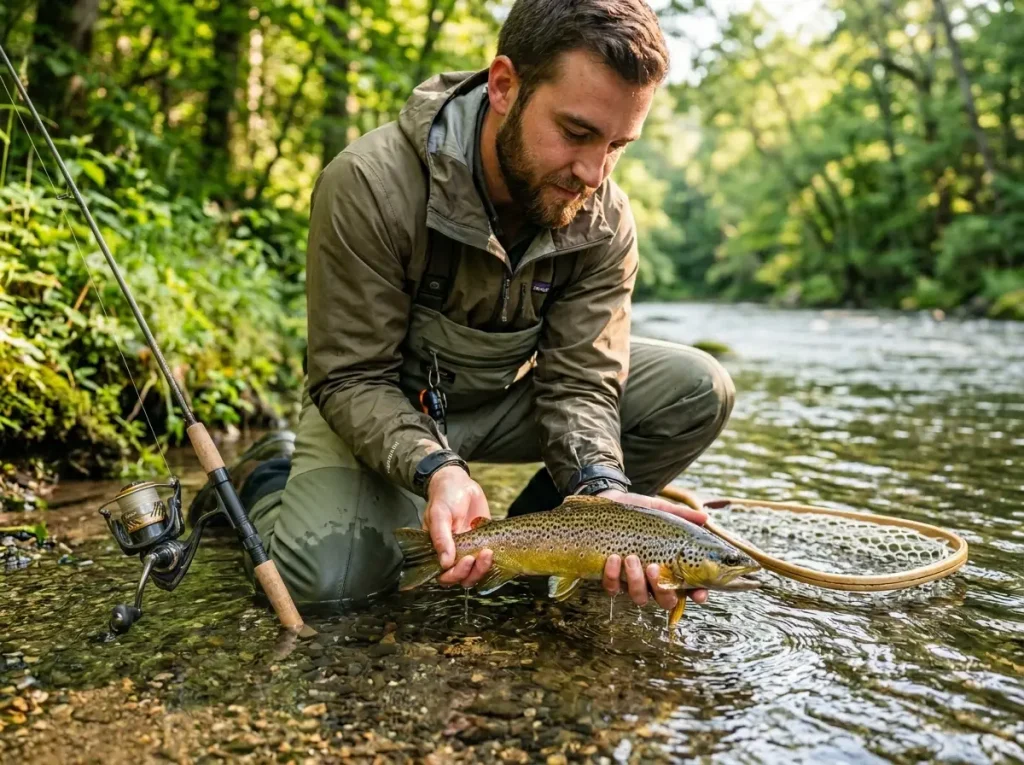
Water temperature during the spawn (often 62–75°F for bass) is warm enough to reduce dissolved oxygen levels and accelerate lactic acid buildup. Holding a spawning fish out of the water for photos is disproportionately hazardous compared to cold-water capture — not because anglers mean to harm it, but because the biology of the moment makes the fish far more vulnerable than it looks.
Pro-Tip: If you’re fishing active beds, limit handling to under 10 seconds, keep the fish horizontal, and wet your hands before any contact with the slime coat. The male that guards the bed longest is the male that saves the most eggs — and saves the year’s recruitment for the water you’re fishing.
The Ethical Case for Knowing Before You Go
Understanding the barometric gate lets you verify whether fish are actually on beds before targeting them. A falling barometer at dawn is a signal to fish staging areas, not beds. Understanding the vomerine reflex lets you distinguish a territorial strike from a feeding strike — and recognize when you’re repeatedly pulling a guardian male off a nest rather than landing a trophy.
The most productive conservation decision during the spawn is to fish primary staging routes — the pre-spawn transition zones — rather than active beds. Research on post-release stress from active-bed fishing is clear enough that several state fisheries managers are now advocating for seasonal restrictions. The fish haven’t changed. Our understanding of the biology has. If that understanding doesn’t change how we fish, we’re wasting the knowledge.
Conclusion
Three things worth carrying off the water after reading this.
Temperature opens the door — it doesn’t determine whether spawning happens today. The barometer, water chemistry, substrate hydraulics, and hormonal state of the fish stack on top of that temperature window to determine whether spawning actually fires on a given morning. A warm week in April isn’t a guarantee. It’s the prerequisite.
A falling barometer empties the beds. Dr. Hill’s data is specific: crappie abandon shallow spawning grounds within hours of pressure drops, stay dormant for six to eight hours, and return only when the barometer climbs again. Fish the staging areas during front windows, not the beds during the fall.
The fish hitting your lure near the beds is angry, not hungry. The vomerine reflex and 11-KT hormonal surge mean the territorial strike demands a different presentation — slow and invasive, not fast and fleeing — and demands a faster, gentler release than a standard feeding catch.
Before your next spring trip, pull barometric pressure data for the 24-hour window before you launch. Cross-reference it with recent rainfall that might have dropped conductivity. If both line up — stable pressure, significant recent rain, water temperatures in the species-specific threshold — you’re looking at a genuine spawning window. If only temperature is right, you’re fishing hope, not biological forecasting.
FAQ
What temperature do fish spawn at?
Temperature thresholds vary by species: largemouth bass typically initiate spawning between 62–75°F, smallmouth bass between 55–65°F, crappie between 57–65°F, and salmonids and trout between 40–55°F depending on species. Temperature is a necessary but not sufficient trigger — barometric stability, substrate type, and photoperiod must align simultaneously for consistent spawning activity.
Does the moon affect spawning?
The moon phase is a secondary modulating factor, not a primary spawning trigger. Solunar theory and gravitational influence on tidal flow can affect conductivity gradients in estuarine systems, and solunar periods correlate loosely with increased activity windows. Barometric pressure, thermal stability, and substrate conditions exert stronger influence on whether fish stay on beds on any given day than lunar phase alone.
Can you catch fish on spawning beds without harming them?
Yes, but the risk window is narrow and technique-dependent. Fish caught during active bed-guarding are under maximum metabolic and hormonal stress. Post-release stress increases significantly when water temperature is above 70°F and handling time exceeds 15–20 seconds. Keep the fish horizontal, wet your hands, and return it within 10 seconds if possible. Targeting pre-spawn staging areas is a better option — the fish are aggressive and feeding, but not yet in the physiologically vulnerable nest-guarding phase.
How do I tell if a fish has already spawned?
In females, a post-spawn fish typically shows a slightly sunken or softened abdomen where the egg mass was deposited. In males, look for visible scrapes, abrasions, or color changes on the body — particularly in bass and catfish, which defend beds with direct physical contact against intruders. Behavioral cues include reduced territorial aggression near the bed and willingness to move off the nest without circling back.
Why do fish abandon spawning beds so suddenly?
The most common causes are barometric drops — fish respond to pressure change within hours, retreating to depth as swim bladder discomfort overrides the nesting drive — acute thermal drops, and boat traffic that elevates stress hormones in nest-guarding fish. Dr. Hill’s research quantified it specifically for crappie: once the barometer begins falling, fish leave the shallows within hours and don’t return until it stabilizes and climbs again. The mechanism is physiology, not preference.
Risk Disclaimer: Fishing, boating, and all related outdoor activities involve inherent risks that
can lead to injury. The information provided on Master Fishing Mag is for educational and informational purposes
only. While we strive for accuracy, the information, techniques, and advice on gear and safety are not a substitute
for your own best judgment, local knowledge, and adherence to official regulations. Fishing regulations, including
seasons, size limits, and species restrictions, change frequently and vary by location. Always consult the latest
official regulations from your local fish and wildlife agency before heading out. Proper handling of hooks, knives,
and other sharp equipment is essential for safety. Furthermore, be aware of local fish consumption advisories. By
using this website, you agree that you are solely responsible for your own safety and for complying with all
applicable laws. Any reliance you place on our content is strictly at your own risk. Master Fishing Mag and its
authors will not be held liable for any injury, damage, or loss sustained in connection with the use of the
information herein.
Affiliate Disclosure: We are a participant in the Amazon Services LLC Associates Program, an
affiliate advertising program designed to provide a means for us to earn advertising fees by advertising and linking
to Amazon.com. As an Amazon Associate, we earn from qualifying purchases. We also participate in other affiliate
programs and may receive a commission on products purchased through our links, at no extra cost to you. Additional
terms are found in the terms of service.