

In this article
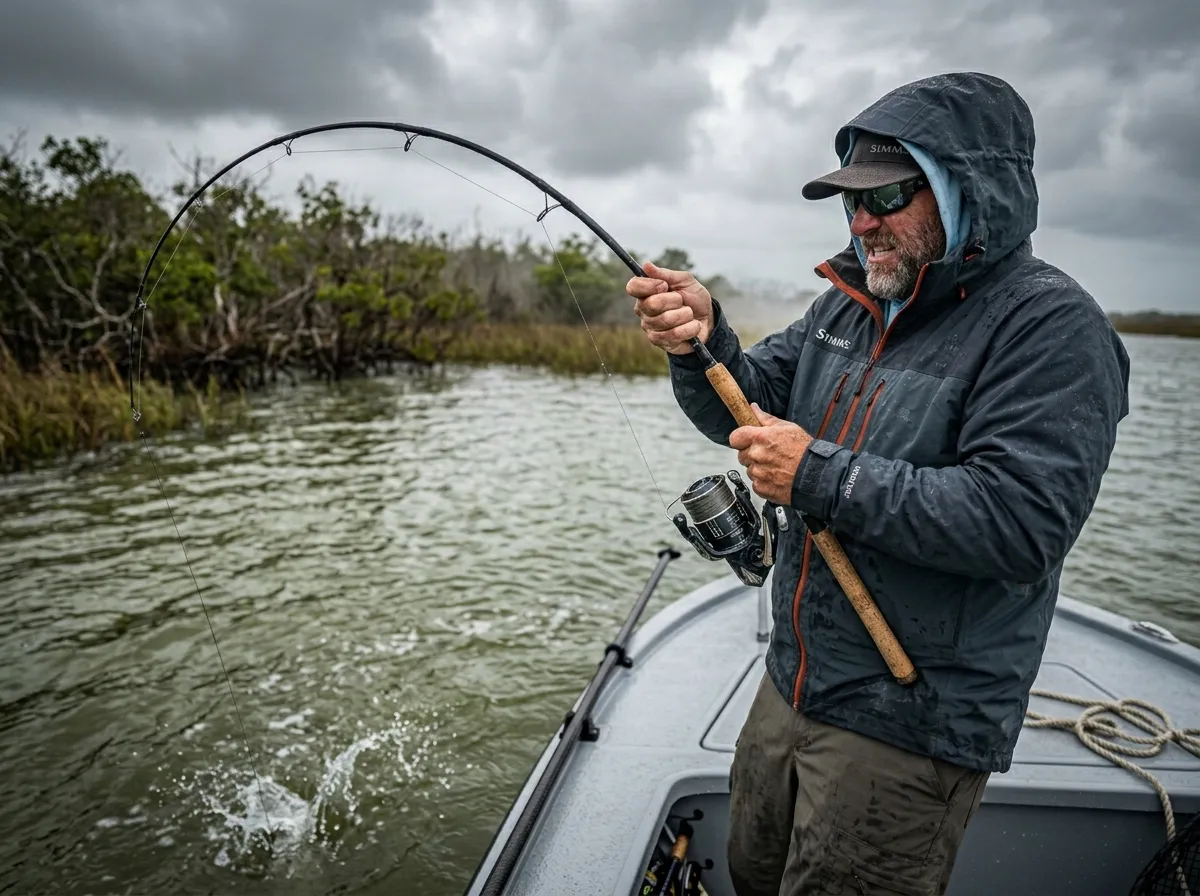
The bait had barely touched the bottom when the rod loaded up like a dock piling hit by a tug. No tap — no telegraphed nibble — just a slow, inexorable weight that bent the blank into a full fighting arc. Three hundred yards of hard-current bottom later, I was standing over a 52-pound black drum with a hook that looked like someone had squeezed it in a vise. The shank had gone from round to nearly flat oval. I hadn’t lost the fish. But the hook had failed. It took me two more crushed hooks over the following season before I understood: I wasn’t fighting a fish. I was fighting an engineering problem.
The black drum (Pogonias cromis) is one of the few inshore fish that can physically destroy your terminal tackle without you realizing it’s happening. Understanding how that’s possible — the anatomy behind the crush, the molecular structure of the teeth, the timing of the bite — changes how you rig, how you wait, and how you set the hook.
⚡ Quick Answer: The black drum generates up to 11,000 Newtons of crushing force using a second set of jaws located deep in its throat — not the visible oral jaws. When you feel the first “thump,” the fish is still in the inspection phase. The real crush happens 3 to 5 seconds later, once the bait reaches the pharyngeal mill. Wait for the rod to load slowly and line to move off laterally, then reel with steady pressure. Never swing. Use 3X to 4X strong hooks with a 10/0 non-offset circle, 60 to 80 lb fluorocarbon leader, and inspect your leader at the bottom 24 inches after every fish.
| Drum Fish Species Comparison | ||||
|---|---|---|---|---|
| Species | Max Bite Force | Force-to-Weight Ratio | Pharyngeal Teeth Type | Primary Prey |
| Pogonias cromis (Black Drum) | ~11,000 N | 300–600 N/kg | Molariform (crushing) | Oysters, clams, blue crabs |
| Sciaenops ocellatus (Red Drum) | Lower (no crushing plates) | Lower | Cardiform (gripping) | Fish, shrimp, crabs |
| Aplodinotus grunniens (Freshwater Drum) | High (comparable to black drum) | 300–500 N/kg | Molariform (crushing) | Zebra mussels, mollusks |
The Pharyngeal Mill — How Drum Generate 11,000 Newtons
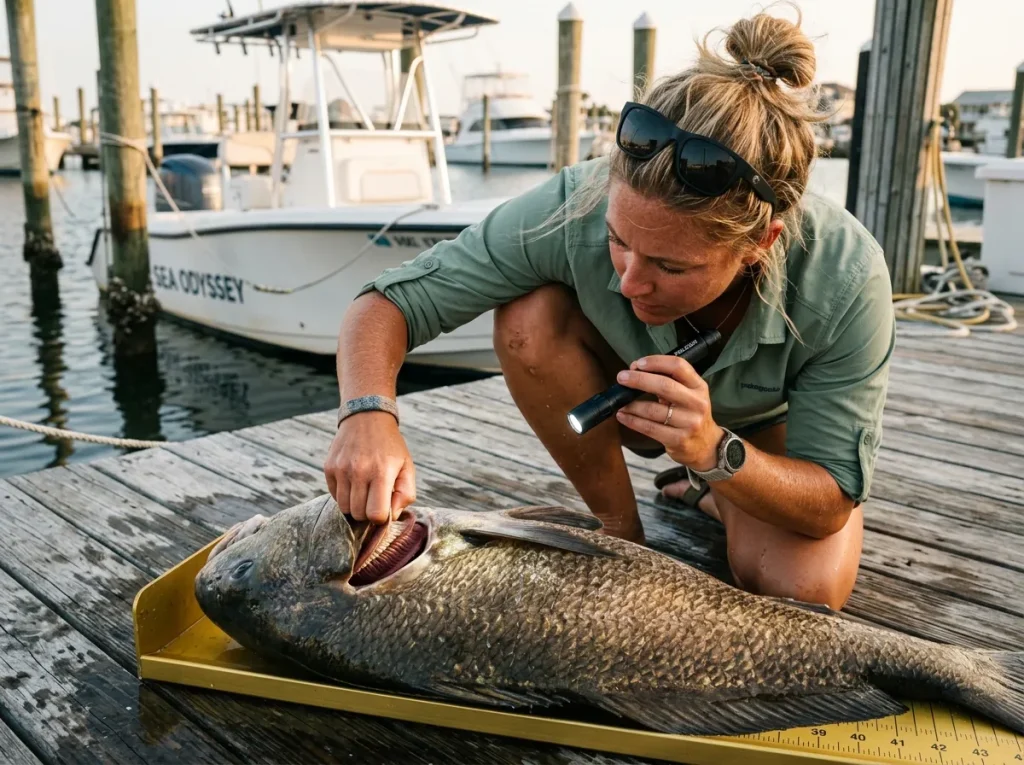
Here’s where most drum anglers are working with an incomplete picture. The oral jaw — the part you see when you lip the fish — is toothless. It’s designed to inhale, not crush. The actual crushing apparatus sits behind the last gill arch, deep inside the branchial chamber. It’s called the pharyngeal mill, and it’s a second independent jaw system that operates entirely separately from the oral mandibles.
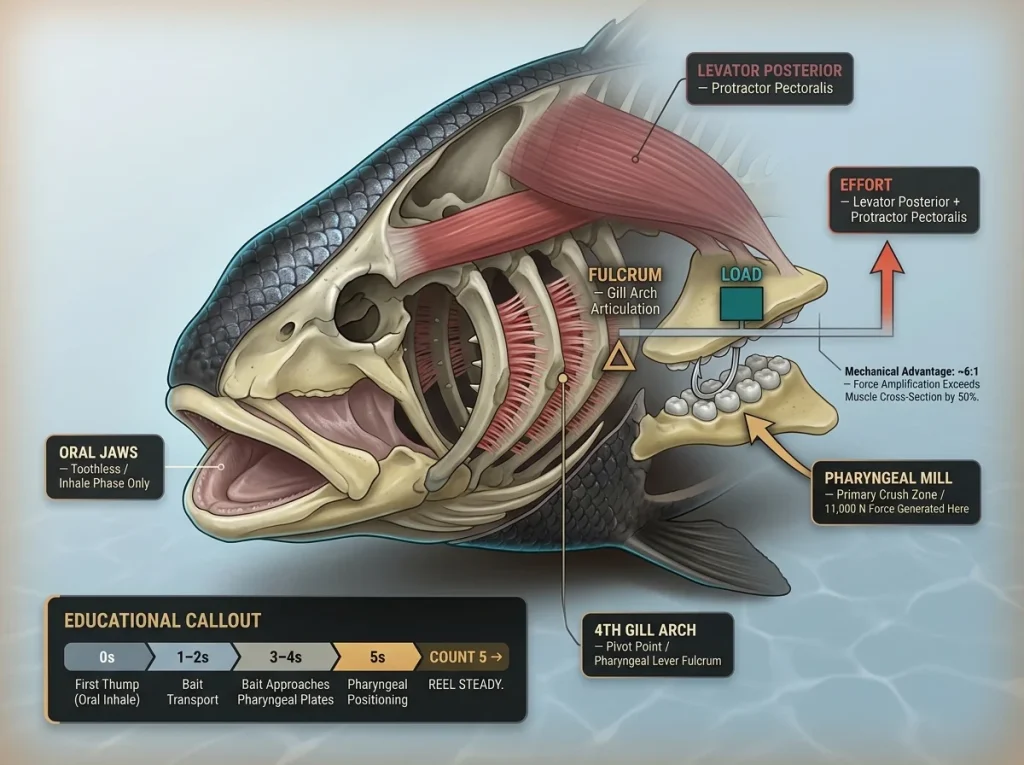
The architecture is a second-class lever — same geometry as a nutcracker or wheelbarrow — where the load sits between the pivot and the muscular effort. That geometry maximizes compressive force at the cost of speed. The levator posterior and protractor pectoralis muscles drive it, with the protractor pectoralis originating on the neurocranium and transmitting force along the pectoral girdle through ventral bony struts. Research found that measured bite force exceeds what the muscle cross-section alone should produce by roughly 50%, which points to disparity between muscle strength and measured bite force in Pogonias cromis — novel force-amplifying linkages that we’re still mapping.
By the way, pharyngeal teeth are not unique to drum — the redear sunfish uses the same crushing adaptation, which tells you something about how successful this design has been across evolutionary time. The black drum just took it further than almost anything else in freshwater or saltwater.
The Second-Class Lever — Why the Crush Is Slow
The second-class lever configuration produces a grinding, sustained squeeze — not a snap. For a 60-kilogram bull drum, that translates to roughly 1,100 kilograms of compressive force on a surface the size of an oyster shell, or your hook shank. Think about that for a second: a mid-size car’s weight concentrated on something smaller than your fist.
The slow nature of this crush is exactly why the five-count rule exists. When a drum picks up your bait, it uses the oral jaws to inhale it. The “thump” you feel on the rod is that initial contact — not the crush event. Over the next 3 to 6 seconds, the bait moves rearward through the branchial chamber toward the pharyngeal plates. Swinging the rod during that transport phase means you’re pulling the hook against an open pharyngeal girdle — you get a slide-off. Waiting until the drum begins to move, then applying steady reel pressure, means the hook is past the plates and has a chance to find the corner of the mouth.
In 20 years of drum fishing, the single most common error I see from good anglers — anglers who know how to fish — is striking at the first thump. That’s not a bite. That’s reconnaissance.
Where the Crush Zone Actually Is
The bait must travel through the branchial chamber before the pharyngeal plates engage. During that transport time, the hook is floating in the transit zone — not anchored to any tissue. A sharp sweep during transport pulls the hook against the closed girdle. A steady reel-pressure after the fish begins to move lets the circle hook do its job.
Pro Tip: The bite that counts is when the rod loads slowly and the line begins moving off laterally. That’s the drum positioning with the bait. That is your cue to reel — not swing.
Material Science — The Zinc-Doped Enameloid That Blunts Your Hook
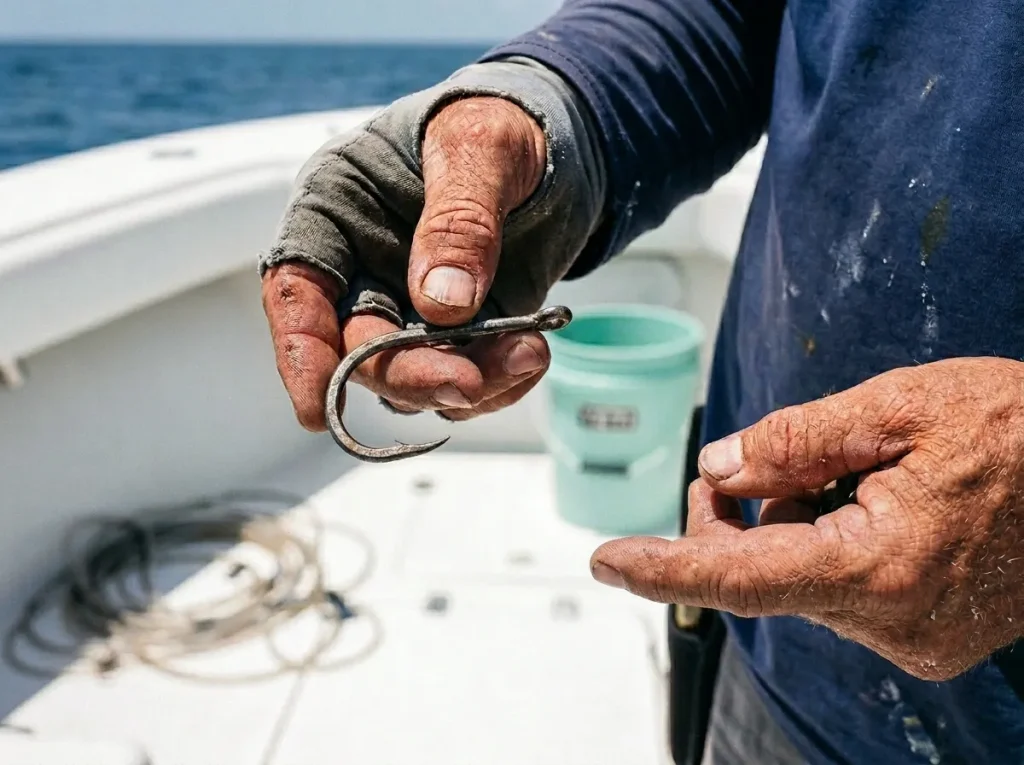
I had a 2/0 Aberdeen straighten on a 28-pound drum once. Not bend. Straighten. When I recovered it, the wire cross-section had gone from round to oval. The fish had pressed it flat. That’s not the fish overcoming hook strength by pulling hard — that’s a material interaction, and it’s one that most anglers never think about.
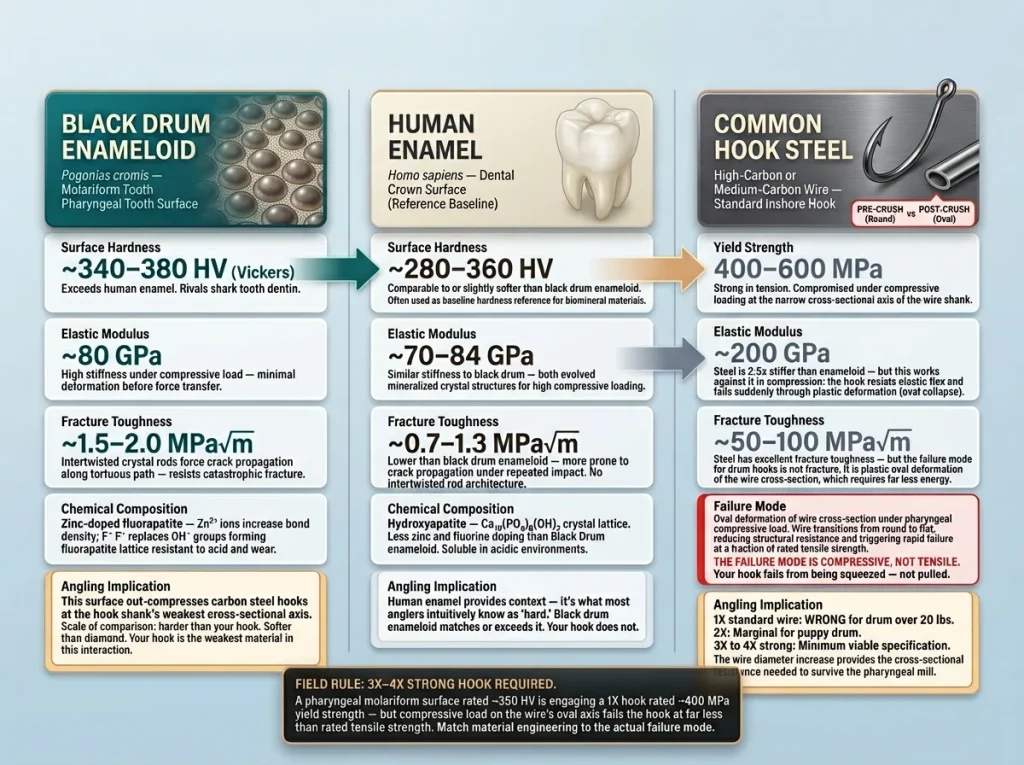
The outer enameloid layer of drum molariform teeth is hardened at the molecular level through selective chemical modification, as documented in zinc and fluorine doping in black drum enameloid structural research. Zinc ions increase bond density in the apatite crystal lattice. Fluorine replaces hydroxyl groups to form fluorapatite, which resists both acid degradation and mechanical wear. The crystal axes of these apatite structures are preferentially aligned along the primary bite-force direction — the material is engineered to be stiffest exactly where the compressive load is highest.
The practical result: when you run a light-wire hook between those molariform plates, you’re putting common carbon steel up against a material with hardness that exceeds human enamel and rivals some shark tooth compositions. The hook isn’t being pulled past its tensile strength — it’s being compressed through its weakest structural axis. That’s why it ovals. Understanding wire gauge and gap specifications that matter when your hook enters a pharyngeal mill puts the selection decision in the right frame: it’s not about sensitivity or penetration speed. It’s about surviving a compressive event.
The Hardness Numbers — What They Mean for Your Hook
Standard hook steels have yield strengths in the 400 to 600 MPa range. That’s a respectable number in tension. The problem is drum teeth apply compressive stress at an angle that exploits the hook wire’s weakest cross-sectional axis. Light-wire hooks (1X, standard wire) are wrong for drum over 20 pounds. They will deform. 3X to 4X strong hooks provide meaningful resistance by increasing the wire diameter and thus the resistance against oval deformation.
Pro Tip: Run your thumb across the point of any hook that’s had a drum interaction, even if you felt nothing unusual during the fight. Blunting is the first sign of pharyngeal plate contact. A blunted point loses penetration on the next hook-set.
Why Drum Teeth Don’t Break
The inner enameloid has a layered crystal arrangement — intertwisted rods with intentional misorientation that forces any developing crack along a tortuous path, dissipating fracture energy instead of allowing a clean break. The teeth have no true roots; they’re supported by a circular bony rim that allows the tooth-bone interface to absorb impact loads. The bony toothplate itself is porous and functions as a structural shock absorber at the jaw level. This is why a drum can process millions of kilograms of shell material through a lifetime without losing dental function.
Ontogenetic Shifts — Juvenile Diet to Adult Crusher

The first time I switched from fresh-cut shrimp to a whole mud crab, I got crushed in under 10 minutes on a flat I’d been dragging bait across for three hours without contact. The drum was there the whole time. I was presenting the wrong food for its anatomy.
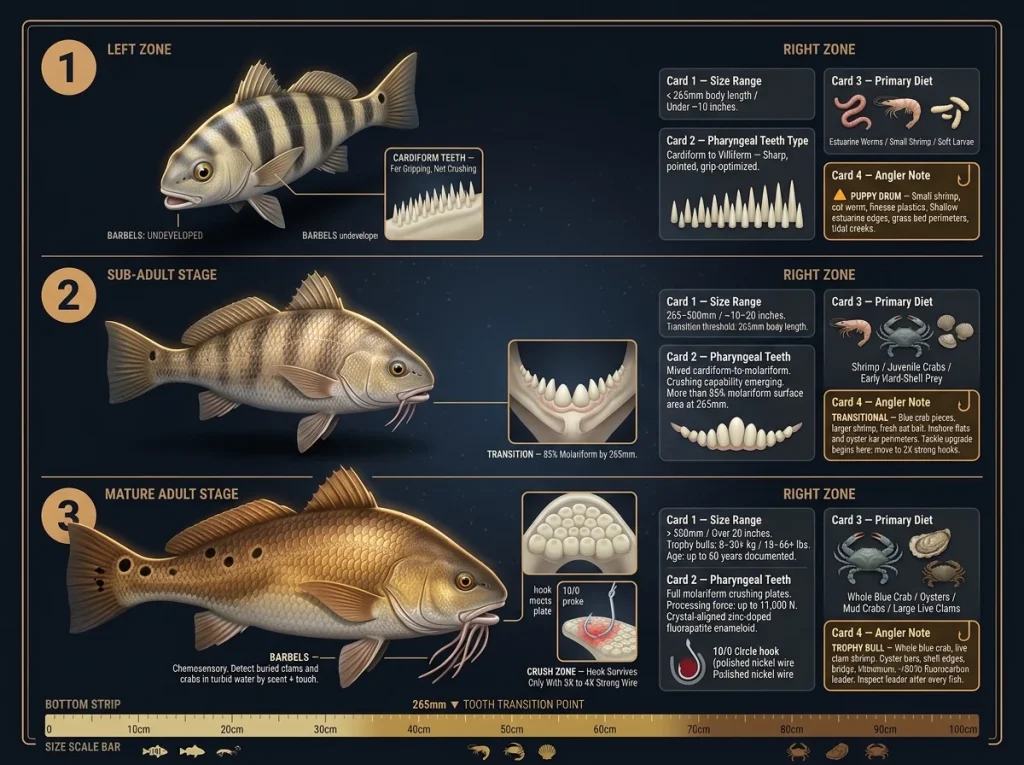
Molariform teeth replace cardiform teeth during maturation — this is not a subtle shift, it’s a complete functional redesign. Juvenile drum have sharp, pointed cardiform or villiform teeth suited for gripping worms, small shrimp, and larvae. As they grow, those teeth progressively give way to broad, flat molariform grinding plates. In freshwater drum (Aplodinotus grunniens), freshwater drum pharyngeal teeth development and molariform transition research documented that this transition accelerates around 265mm body length, and by the time a drum reaches that size class, molariform teeth comprise more than 85% of the pharyngeal surface area.
For the saltwater angler chasing trophy black drum: a large bull drum is physically optimized for hard-shelled prey. It’s not choosing shrimp over crab — it literally can no longer process soft-bodied prey as efficiently as a juvenile can. The submandibular barbels — those fleshy whiskers under the chin — are chemosensory organs that allow a mature drum to detect buried clams and crabs in turbid, low-visibility water by feel and scent. And the same anatomy that produces the famous “Lucky Stone” otoliths also tells you something about how long a drum has been refining its crushing technique — those otolith structures reveal the fish’s age and growth history.
What Juvenile Drum Eat (And Why It Matters for Bait Selection)
Puppy drum and trophy bull drum are functionally different predators. That’s not a metaphor — it’s anatomy.
Juveniles rely primarily on visual and chemosensory detection to find prey, with no barbel probing. Suitable prey at this stage: estuarine worms, small shrimp, dipteran larvae — soft-bodied items that require gripping, not crushing. Location matters too: juveniles hold in shallower estuarine edges, grass bed perimeters, and tidal creeks where that soft prey lives.
Baits that work on puppy drum — small shrimp, cut worm, finesse plastics imitating invertebrates — are the wrong call once you’re targeting fish over 15 pounds. The fish’s anatomy has moved on. Your presentation needs to keep up. Whole blue crab, large live clam, or ripe shrimp that’s been in the sun long enough to throw a serious scent plume — that’s what a mature drum is hunting.
Reading Drum Noodles as a Locating System
A mature drum feeds head-down, rooting buried mollusks with its snout. This creates small craters in the substrate — anglers call them drum noodles. Fresh noodles have soft edges, disturbed sediment, and sometimes shell debris mixed in. A field of fresh noodles means a feeding school passed through recently, and drum return to productive benthic structure on subsequent tides. Mark them at low tide. Come back on the next flood.
Current direction determines where the school is now relative to where the noodles are. If the tide is pushing north and the noodles are on a south-facing shell edge, that school has already moved upcurrent. Work ahead of the trail, not behind it.
Terminal Tackle Engineering — Surviving the Crush Zone
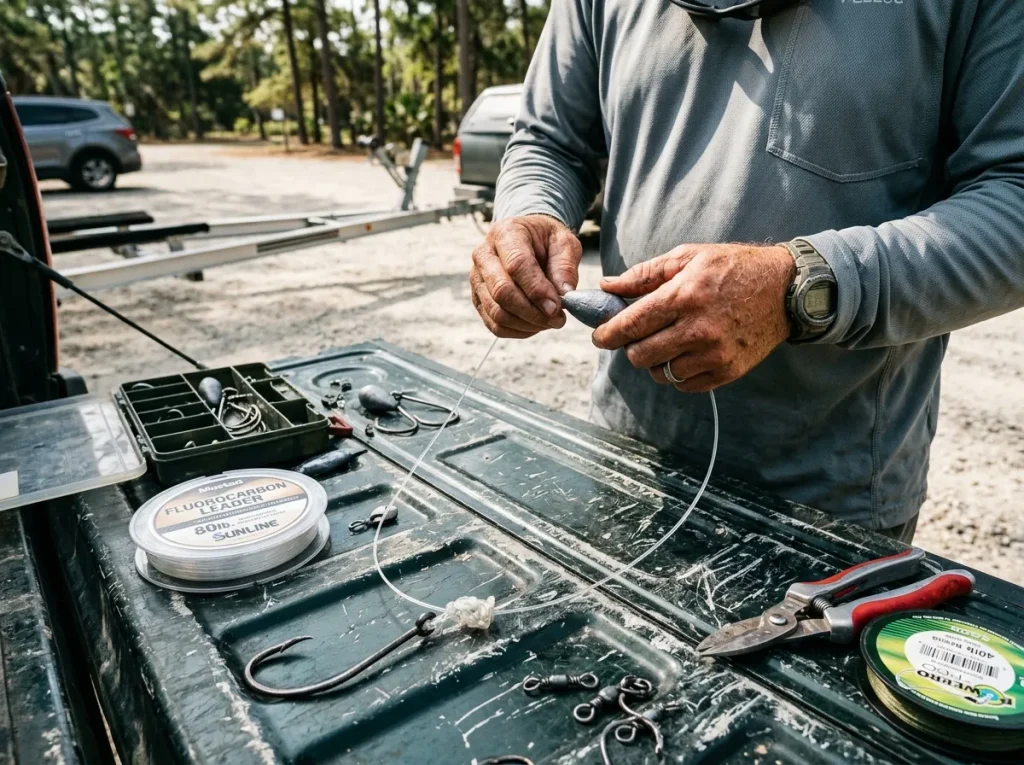
Most inshore tackle is designed for tensile stress — the pull of a running fish. Bite force increases with body weight in drum, and the compressive failure mode is fundamentally different from anything most anglers have planned for. A 30-pound drum applying pharyngeal pressure is not a tensile force problem. It’s a squeeze problem. Your hook selection, leader choice, and hook-set mechanics need to account for that.
Texas Parks and Wildlife documented black drum feeding behavior and harvest regulations and their data confirms what field anglers already know: this species feeds by active benthic rooting, using scent and tactile detection in low-visibility conditions, which explains why scent-heavy natural bait consistently outperforms artificials.
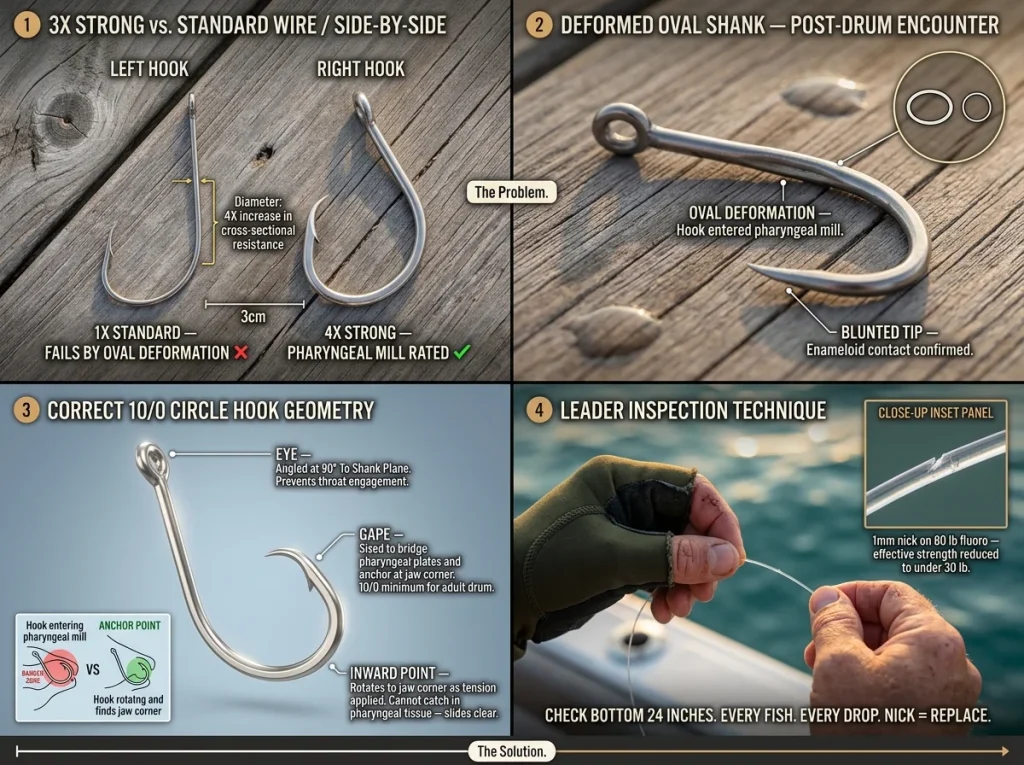
For circle hook selection, the mechanical case goes beyond conservation — the mechanical case for circle hooks goes beyond conservation — it is structural engineering for surviving a pharyngeal mill. The inward-facing point and angled eye cause the hook to slide out of throat tissue and rotate to the jaw corner as tension is applied. For adult drum, a 10/0 non-offset Mustad Demon is the minimum I run. The gape has to physically bridge the pharyngeal plates and find tissue outside the crush zone. Anything smaller sits flat between the plates and never anchors.
Hook Metallurgy — Wire Gauge and the Compressive Problem
Light-wire hooks fail by oval deformation, not by straightening like a cartoon. The wire cross-section changes from round to flat, reducing the structural resistance and triggering rapid failure under load. After every drum you land, check the shank geometry. If it’s gone oval, that hook was in the pharyngeal mill.
Standard field recommendation: 3X to 4X strong for drum over 20 pounds, no exceptions. 2X strong is marginally acceptable for puppy drum under 10 pounds. Standard wire is wrong for this fish at any size that’s worth targeting. This is not a preference — it’s physics.
Circle Hook Geometry and the Five-Count Rule
The five-count rule matches the fish’s biology. It takes a drum 3 to 6 seconds to transport bait from the oral jaw to pharyngeal positioning. If you sweep the rod before that transport is complete, you’re pulling against the closed jaw assembly — at best a slide-off, at worst a crush-off that takes your leader with it. If you wait — count five, then reel with steady pressure — the circle hook does its mechanical rotation, finds the corner of the mouth, and you have connection outside the crush zone.
Pro Tip: After a drum interaction, run thumb and forefinger along the bottom 24 inches of your leader. Any nick — any groove you can feel with a fingernail — means that section has been structurally compromised. Replace it before the next drop. A 1mm surface cut on 80 lb fluorocarbon can reduce effective strength to well under 30 lb.
Leader Science — Fluorocarbon, Monofilament, and the Crush-Off
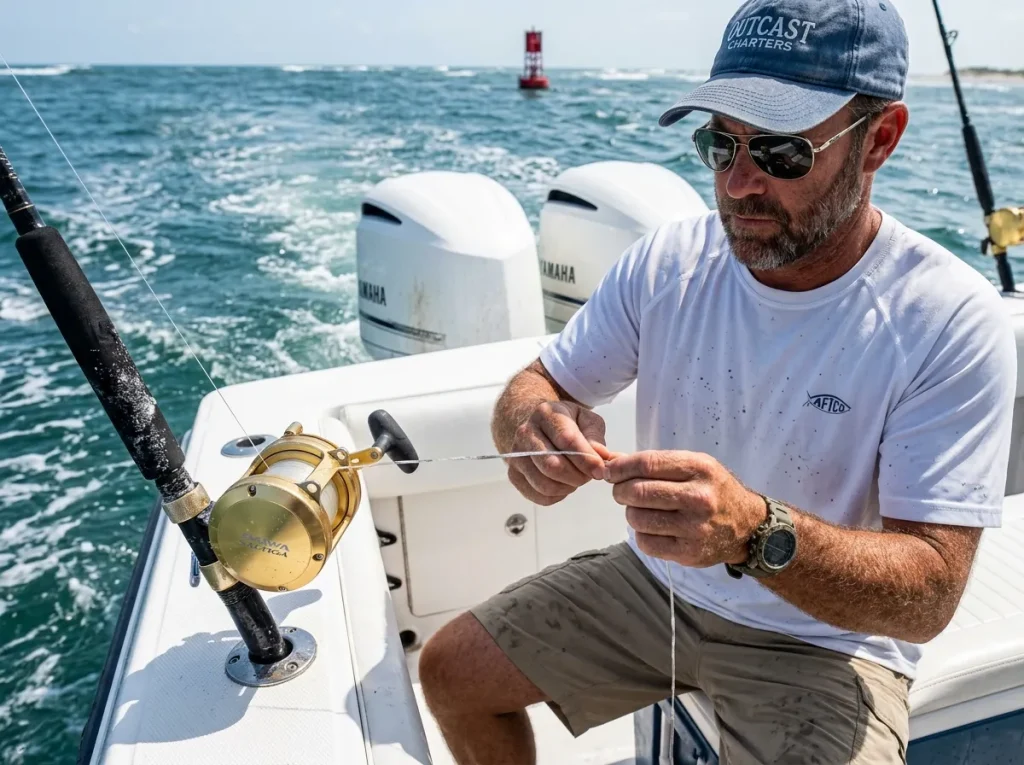
Before you choose a drum leader, understand what you’re actually preparing for. Consult the line engineering decision matrix that should precede every drum leader selection — because the relevant failure mode for drum is not tensile. A drum leader doesn’t break from being pulled past its rated strength. It fails because pharyngeal teeth act like a high-grit mineral surface dragging across your leader during the fight.
A crush-off happens when the lower pharyngeal jaw closes on your leader mid-fight. The leader is simultaneously abraded on the surface, compressed in cross-section, and sometimes nicked at an oblique angle if a tooth edge contacts it. None of those effects register as a tensile break. The line simply has less material to fail at than you think, and when you pressure the fish on the next run, it goes.
Understanding the Crush-Off
The polymer chains in your leader are being severed or the cross-section is being reduced to the point where subsequent load breaks it at a fraction of rated strength. This is why a 3mm nick in 80 lb fluorocarbon can fail under the run of a 30-pound fish. The rated strength assumes an intact, round cross-section. A compressed, nicked section has neither.
Prevention comes down to three things: heavy leader diameter (60 to 80 lb as a baseline for adult drum), inspection after every fish, and a short heavy-mono shock tippet at the terminal end when fishing oyster bars or bridge pilings where structural abrasion adds to pharyngeal wear.
Fluorocarbon vs. Monofilament — The Right Call
Open water, murky estuary, sandy bottom: 60 to 80 lb fluorocarbon. Harder surface, lower stretch (which helps detect the mouthing phase), and invisibility is less relevant in turbid water anyway.
Oyster bars, bridge pilings, rocky substrate: 60 to 100 lb monofilament. Nylon resists sharp structural edges better than fluorocarbon in high-friction scenarios. Fluoro’s advantage is surface hardness against the teeth; mono’s advantage is flexibility against sharp angles. When you’re fishing around structure, you may face both failure modes, which is why some anglers run fluoro mainline with a short heavy-mono bite tippet at the terminal end.
Conservation — Barotrauma, The Bull Release, and the Anti-Sell
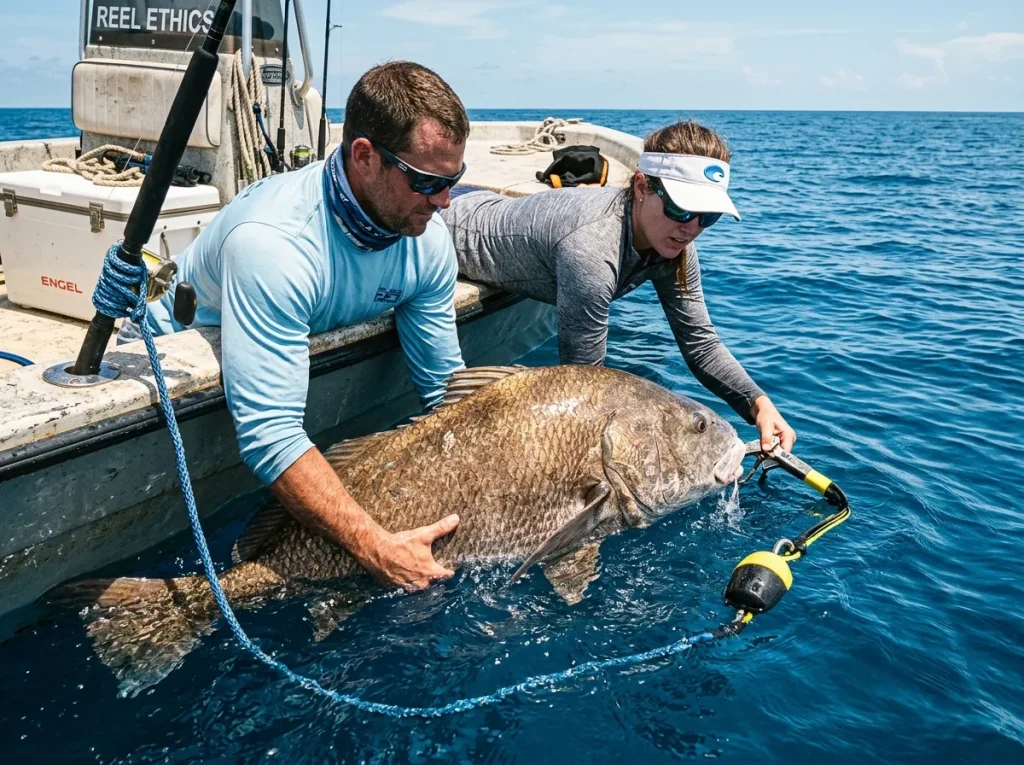
A 55-pound drum took more than 20 years to grow. I’ve released every bull I’ve ever caught. Not because a regulation required it — because the fish earned it. There’s a different kind of respect for an animal when you understand the physics of what it just did to your tackle for the last 20 minutes.
Black drum are long-lived — documented ages reach 60 years. They’re slow-growing and reach sexual maturity at 4 to 5 years, which makes large spawner-class bulls critical to population structure. There’s also a culinary argument for releasing them: fish over 27 inches commonly harbor Poecilancistrium caryophyllum — the “spaghetti worm” tapeworm larvae visible as thin white threads in the flesh. Harmless when cooked, but present in virtually all trophy specimens. Bull drum are poor table fare and irreplaceable as breeders.
Managing Barotrauma in Deep-Water Drum
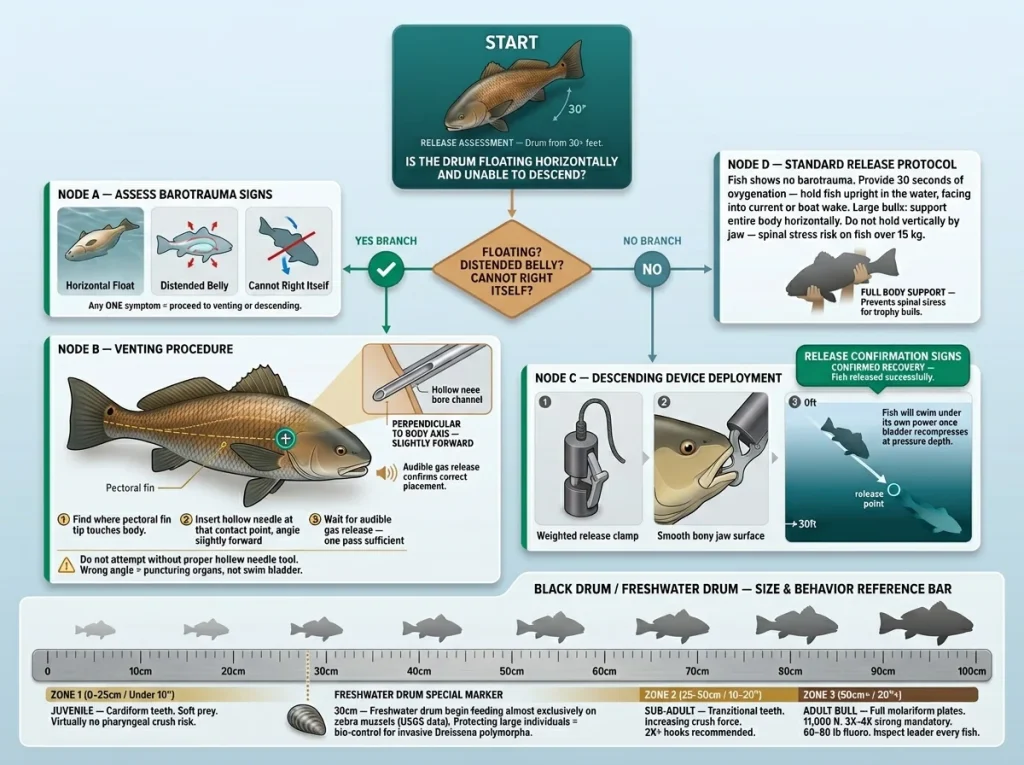
When drum come up from 30 feet or more, rapid pressure reduction causes swim bladder expansion. A drum with barotrauma cannot self-descend — it will float and deteriorate at the surface if released there. Watch for horizontal floating, a distended belly, and inability to orient downward.
Venting: insert a hollow needle at the point where the tip of the pectoral fin touches the body, angled perpendicular to the body and slightly forward. You’ll hear audible gas release when the needle is positioned correctly. Alternatively, a weighted descending device is the most effective tool when a drum shows barotrauma symptoms after a deep-water fight — grip the jaw, lower the fish to 30+ feet, and release when the bladder recompresses naturally. The drum will swim off under its own power.
Large bulls need horizontal body support during unhooking. Their mass causes spinal stress when held vertically by the jaw. Get someone to support the body.
The Ecological Role — Drum as Zebra Mussel Control
This is the piece that doesn’t get enough attention. Freshwater drum (Aplodinotus grunniens) are one of the very few native North American freshwater predators capable of eating invasive zebra mussels (Dreissena polymorpha). USGS research on freshwater drum predation of zebra mussels in western Lake Erie documented that drum over approximately 30 cm feed almost exclusively on zebra mussels, with predation increasing as fish size increases. That’s why protecting large mature freshwater drum populations has ecosystem-level value beyond sport fishery management — they’re one of the only biological mechanisms we have against a species that has already caused billions in infrastructure and ecological damage.
On the saltwater side, the black drum population in Texas bays alone processes an estimated million kilograms of shell material annually, contributing to nutrient cycling and benthic habitat structure. Durophagy at this scale reshapes the sea floor in measurable ways. That’s not a metaphor about the circle of life — it’s a measurable ecological function that disappears when spawner-class fish disappear.
Three Takeaways Before Your Next Drum Rod Hits the Water
The thump is not the bite. The initial rod activity is the oral jaw inhaling your bait. The pharyngeal crush comes 3 to 5 seconds later. Count five. Then reel with steady pressure.
Your hook is in a material science problem. The black drum’s zinc-doped, crystal-aligned enameloid is built to crush oysters — and it will oval a light-wire hook the same way. Run 3X to 4X strong hooks. Inspect the shank geometry after every fish.
Check your leader at the bottom 24 inches after every drum. A crush-off is not a tensile break. It’s a compressive and abrasion failure at a nick you can feel with your fingernail before the next cast. Catch it before the fish does.
The next time you feel that weight load up on the rod and the current seems to stop — don’t swing. Count to five. Let the fish do what its anatomy is designed to do. Understanding why you’re counting — the second-class lever, the pharyngeal transport, the five-second window between inhale and crush — changes the patience from a guess into a plan.
FAQ
Do drum fish have teeth you can see when you look in their mouth?
No — the visible oral jaw of a drum is toothless. The pharyngeal jaws and all the crushing dentition sit behind the last gill arch, deep inside the branchial chamber. This is why anglers can handle a drum’s mouth without injury, and why they often don’t realize the crushing mechanism exists until they recover a deformed hook.
What is the bite force of a black drum?
A large 60-kilogram black drum generates an estimated bite force of approximately 11,000 Newtons at the pharyngeal jaw. Scaled to body weight, this represents roughly 300 to 600 N/kg — which puts the black drum among the most powerful crushers in the teleost lineage relative to body size, comparable to much larger species when adjusted for mass.
What are the rocks found in a drum’s head?
Those are otoliths — dense calcium carbonate structures in the inner ear used for balance and hearing. Sometimes called Lucky Stones, they’re a byproduct of the drum’s unusually large auditory system, the same anatomy that produces the drumming or knocking sound that gives the species its name. Fisheries biologists read annual growth rings in otoliths to age fish accurately.
Why do large black drum have worms in their flesh?
Large black drum commonly host larvae of Poecilancistrium caryophyllum, visible as thin white threads — the spaghetti worm — in the flesh. They’re harmless to humans when the fish is cooked, but present in virtually all trophy specimens over about 27 inches. It’s a key reason to practice catch-and-release on bull drum: they’re poor table fare and irreplaceable as long-lived spawners.
Can freshwater drum eat zebra mussels?
Yes — freshwater drum are one of the very few native North American freshwater fish capable of consuming invasive zebra mussels. USGS data from western Lake Erie shows drum above roughly 30 cm begin feeding almost exclusively on them, with predation rates increasing as fish grow. Protecting large freshwater drum populations has documented value for bio-mineralization cycling and invasive species management.
Risk Disclaimer: Fishing, boating, and all related outdoor activities involve inherent risks that
can lead to injury. The information provided on Master Fishing Mag is for educational and informational purposes
only. While we strive for accuracy, the information, techniques, and advice on gear and safety are not a substitute
for your own best judgment, local knowledge, and adherence to official regulations. Fishing regulations, including
seasons, size limits, and species restrictions, change frequently and vary by location. Always consult the latest
official regulations from your local fish and wildlife agency before heading out. Proper handling of hooks, knives,
and other sharp equipment is essential for safety. Furthermore, be aware of local fish consumption advisories. By
using this website, you agree that you are solely responsible for your own safety and for complying with all
applicable laws. Any reliance you place on our content is strictly at your own risk. Master Fishing Mag and its
authors will not be held liable for any injury, damage, or loss sustained in connection with the use of the
information herein.
Affiliate Disclosure: We are a participant in the Amazon Services LLC Associates Program, an
affiliate advertising program designed to provide a means for us to earn advertising fees by advertising and linking
to Amazon.com. As an Amazon Associate, we earn from qualifying purchases. We also participate in other affiliate
programs and may receive a commission on products purchased through our links, at no extra cost to you. Additional
terms are found in the terms of service.