


In this article
Walk down the aisle of any big outdoor store, and you’ll see thousands of lures promising to be the loudest bait in the water. Packaging screams about high-pitch rattles and “sonic attraction.”
But here is the hard truth: most of those lures are designed to catch your wallet, not the fish.
If you look at the actual biology of a Largemouth Bass or a Striped Bass, you realize they live in a completely different sound world than we do. There is a huge gap between what anglers buy and what fish actually hear.
To fix this, we need to look inside the skull of your catch. As someone who has spent years fishing and helping with fisheries research, I’ve learned that the science of success isn’t about making more noise. It’s about making the right noise.
The secret lies in the otoliths. These are ear stones (or earstones) found inside the fish’s head. They explain why a deep “thud” works better than a high “hiss,” and they also act as biological chronometers that record the fish’s history. Here is how to understand this advanced angling intelligence.
What Are Otoliths and How Do They Function?
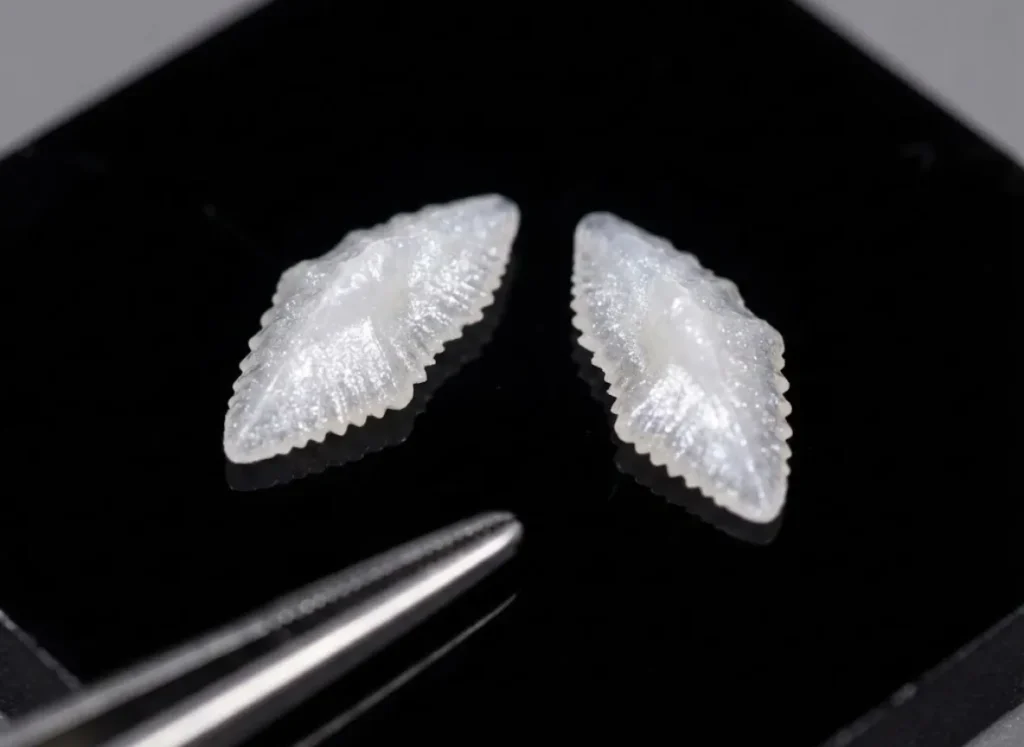
Fish live in water, which is about 800 times denser than air. They don’t have outer ears like humans do. Instead, they rely on an inner ear system located right behind their eyes.
This system is filled with fluid and holds three special stones called otolith organs.
Otoliths are small calcified structures in the inner ear of a fish. They are made of calcium carbonate, which is essentially rock, and they sit on top of a bed of sensitive hair cells. While there are three types—the Sagitta (or sagittae), Lapillus, and Asteriscus—the most important one for hearing in bass and perch is usually the Sagitta.
Scientific research on the development of the semicircular canals and otolithic organs explains how these calcium carbonate structures form, but for fishing, you only need to understand one thing about their physical properties: density.
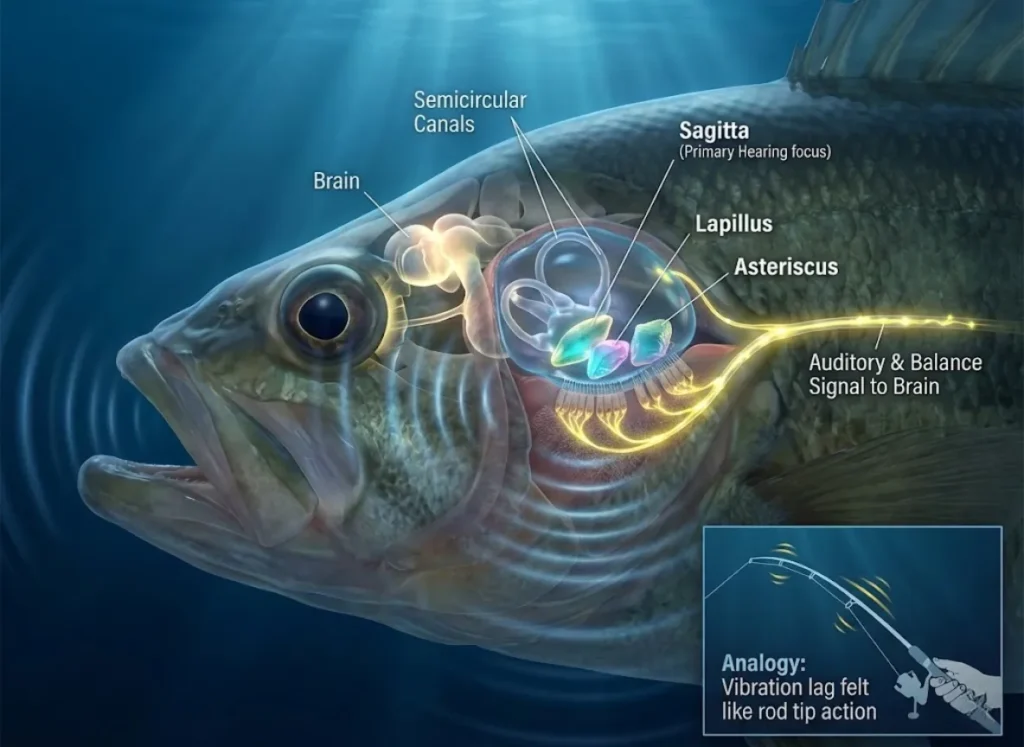
The ear stone is much heavier than the fish’s brain or flesh. When a sound wave moves through the water, it shakes the fish. Because the stone is heavy, it lags behind the rest of the body.
This movement rubs against the sensitive hairs, sending a signal to the brain that says, “I hear something.” This process is essential for hearing, equilibrium, and orientation in the water column.
Think of it like the anatomy of a fishing rod. When the tip vibrates, you feel it in the handle. In a vertebrate fish, when the water vibrates, the heavy stone helps them feel it.
How do “Hearing Generalists” differ from “Specialists”?
Not all bony fish species (Osteichthyes) hear the same way. We can split them into two main groups based on their sensory biology.
First, you have Hearing Generalists. This group includes Largemouth Bass, Trout, Salmon, and Snapper. Their inner ear is isolated. It doesn’t connect to their swim bladder.
Because of this, they mostly hear low hearing frequencies, usually between 100 Hz and 600 Hz.
If you throw a lure with a glass rattle that makes a high-pitched shriek, a bass barely hears the tone. They mostly just use vibration detection to feel the water moving.
Second, you have Hearing Specialists. This group includes Catfish, Carp, and Shad.
These fish have a bridge of small bones called the Weberian Apparatus. It connects their gas-filled swim bladder directly to their inner ear. The bladder acts like a microphone, boosting the sound.
This allows them to hear high sounds, all the way up to 3,000 Hz or more.
A thesis on the morphological correlates of auditory sensitivity confirms this huge difference. A lure that sounds loud to you might be totally silent to a largemouth bass (Micropterus salmoides), but deafening to a catfish.
How Does Otolith Biology Dictate Lure Selection?
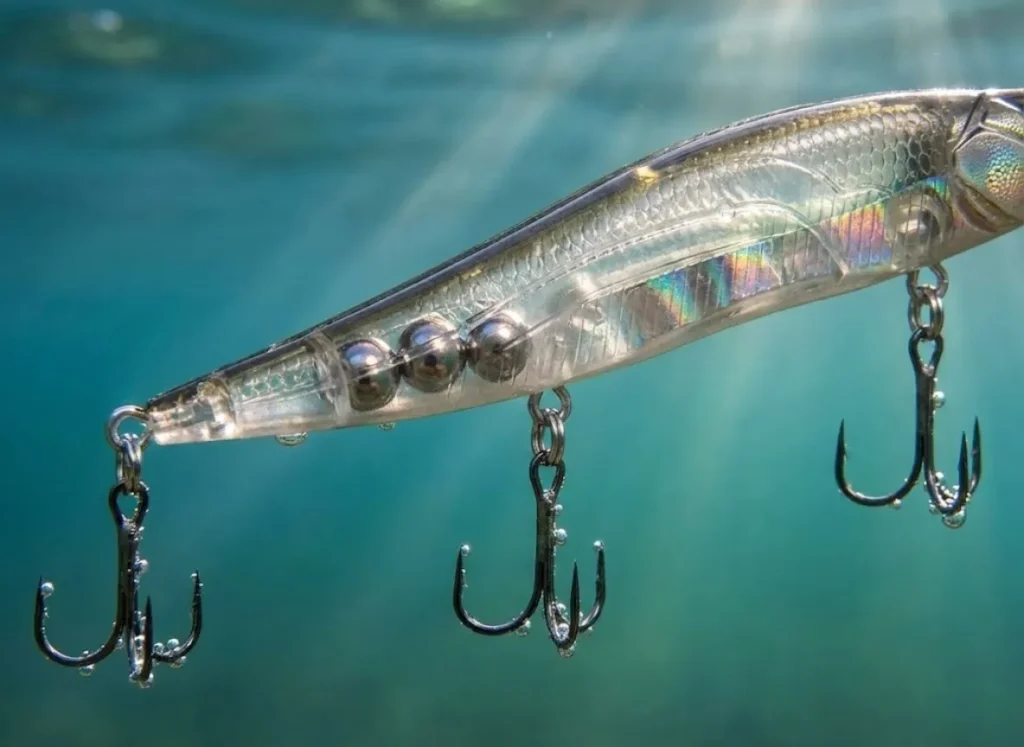
Once you accept that fish behavior is ruled by biological limits, you can stop buying lures just because they are loud. You can start choosing them based on what the fish can actually detect.
We call this the “Biological Acoustic Match” (BAM).
What is the “Biological Acoustic Match” (BAM)?
BAM is a simple way to grade your otoliths & gear strategy. You ask one question: Does this lure make a sound the fish is built to hear?
If a bass hears best between 100 and 600 Hz, a lure making a 2,000 Hz noise is a waste of energy.
This explains why “silent” lures often work so well. Anglers know that a balsa wood crankbait with no rattles catches wild fish. But it isn’t truly silent.
The wood wobbles wide and hard. This pushes a lot of water, creating a deep, low-frequency vibrate that hits the lateral line and ear stones like a drum.
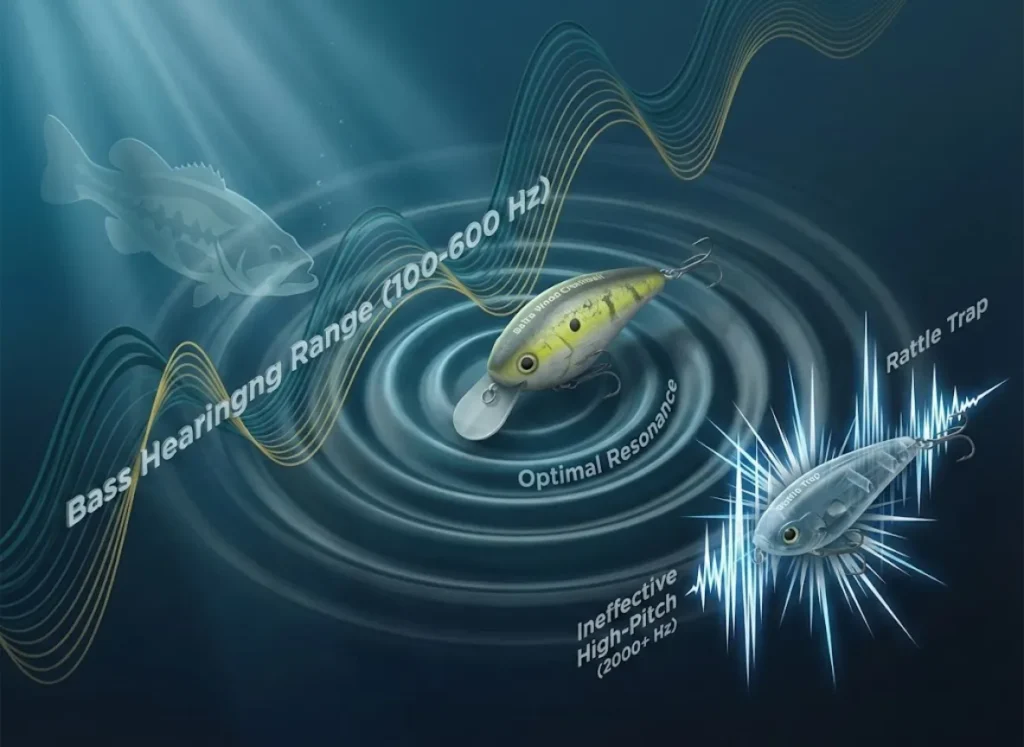
Many plastic rattle traps fail this test because they try to be high-pitched and loud. However, data from the IGFA on hearing in the underwater world shows that predators like bass are tuned to low tones.
To catch more fish, look for resonance. Dense materials like tungsten or lead create deep waves that travel further underwater than steel or glass bb’s.
Pro-Tip: When fishing waters where everyone else is throwing loud baits, switch to “silent” crankbaits. The fish can still feel them, but the lack of unnatural rattling often tricks wary bass that are tired of the noise.
Why are “One Knocker” lures superior for Bass?
For Largemouth Bass, the “One Knocker” style lure is often the best choice.
These lures use a single, large weight inside the body. It bangs against the walls, making a deep “thud.” This usually happens in the 200 Hz – 600 Hz range.
This is the exact sweet spot for a bass’s hearing.
Sound travels fast in water—about 1,500 meters per second. Low sounds keep their energy longer over distance than high sounds. This means a One Knocker calls fish from further away.
Studies on hearing capacities and otolith size suggest that larger otolith size is tuned to these deep sounds.
In muddy or choppy water, this “thud” sounds like natural food. It mimics a crawfish crunching or a baitfish drumming. Standard “BB” rattles often just sound like background noise.
When you choose One Knocker lipless cranks, you are finally speaking the fish’s language.
Why Are Otoliths the “Gold Standard” for Aging Fish?
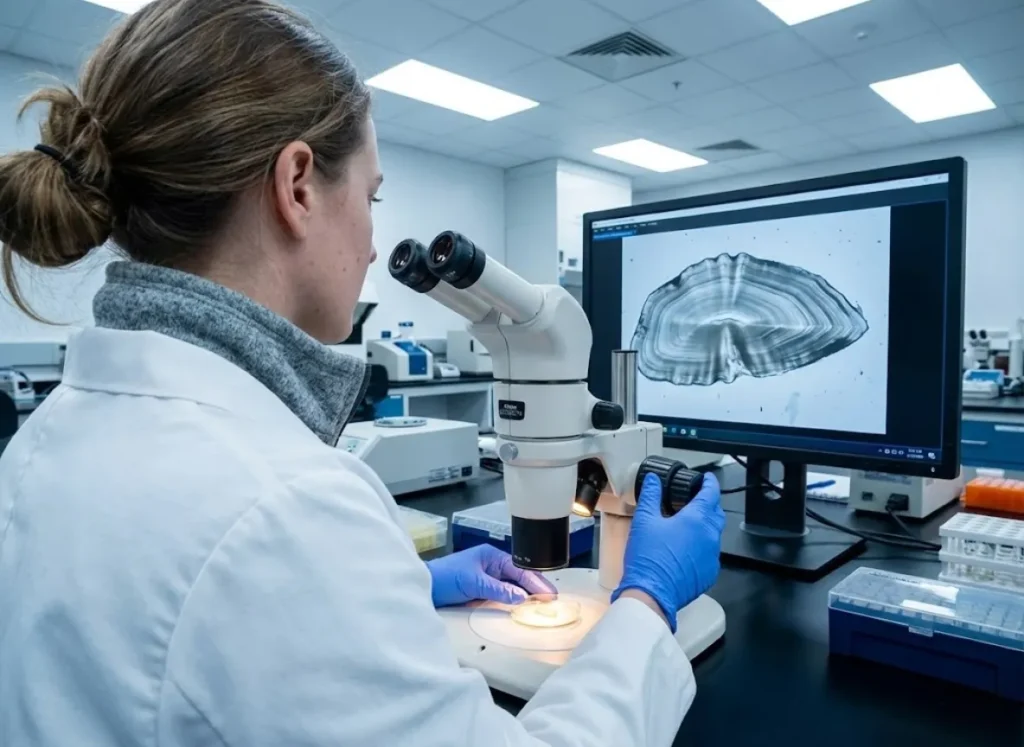
Otoliths—fish ear bones—grow with the fish, helping us catch them, but they also tell us a story after the catch. This field of study is called sclerochronology.
For a long time, people relied on scale reading to guess fish ages. We now know that for big, old fish specimens, scales are often wrong.
Why are scales unreliable compared to otoliths?
Fisheries biologists don’t rely on scales for older fish anymore. The problem is a process called resorption.
When a fish gets stressed—maybe from spawning, senescence (aging), or not finding enough food—its body needs calcium. It will actually steal calcium from its own scales. This effectively “erases” the growth rings.
This creates a major problem known as Lee’s Phenomenon. It makes ancient fish, like Bigmouth Buffalo fish, look much younger than they actually are.
Also, when a fish gets really big, it stops growing longer. The scale rings get crowded on the edge until you can’t tell them apart.
Otoliths are different. They are inert. Once the body builds the stone, it never takes the material back.
The stone acts like a permanent diary that records life history. It keeps getting thicker even if the fish stops getting longer. A comparison of the utility of scales and whole otoliths proves that for trophy potential and management, reading the stones is the only option.
How do biologists read the rings to determine age?
Aging otoliths is a lot like counting tree rings.
The otolith grows by adding layers around a core or nucleus. In the summer, when the fish growth is fast, it adds a white, calcium-heavy layer known as the opaque zone. In the winter, when growth slows down, it adds a clear, protein-heavy layer called the translucent zone.
One white layer plus one clear layer equals one annulus (or last annulus), representing one year of life.
To see this clearly, scientists use a methodology called sectioning. They use a small saw for grinding or cutting a thin slice right through the center of the stone. Sometimes polishing is needed to see the details.
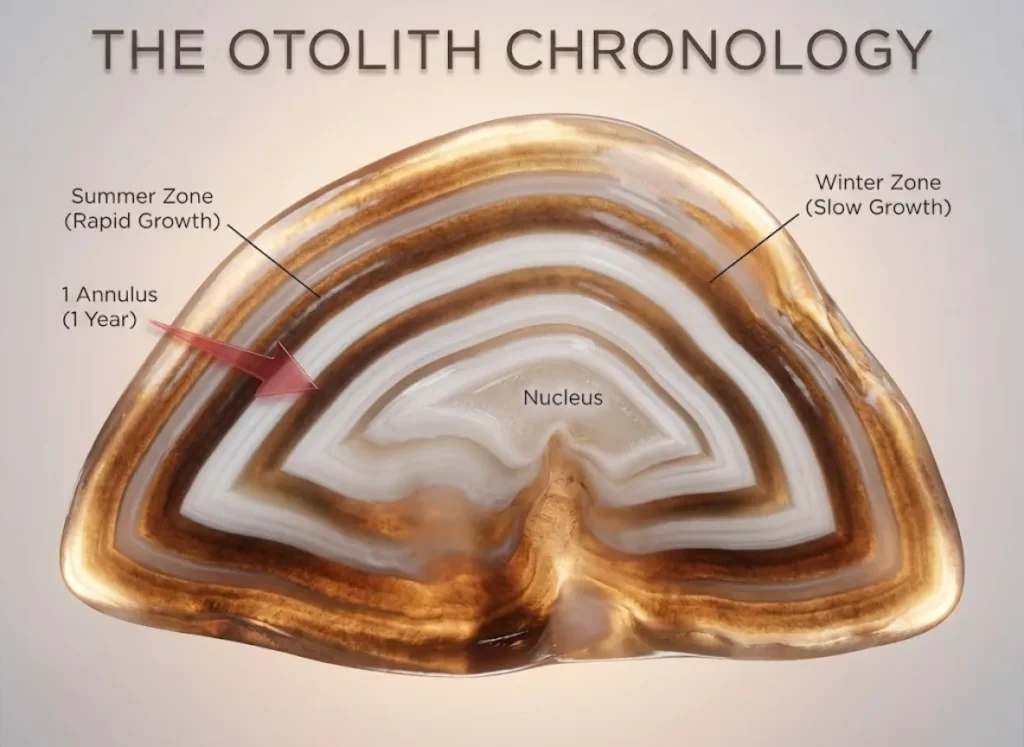
Then, they “burn” or toast the slice. The protein rings from winter turn brown or black. The summer rings stay white. This creates a tree-ring-like growth pattern that is easy to read via microscopic imagery.
NOAA Fisheries explains this in their guide on age determination for managed and assessed coastal pelagic species. This accuracy helps biologists match successful spawning years with weather patterns, creating precise datasets for fisheries analysis.
Biologists can even look at daily growth rings in young fish to find the exact hatch date. They can also analyze otolith chemistry variability, like strontium isotope levels, to trace migration pathways between salt and fresh water.
How Can Anglers Extract Otoliths for Citizen Science?
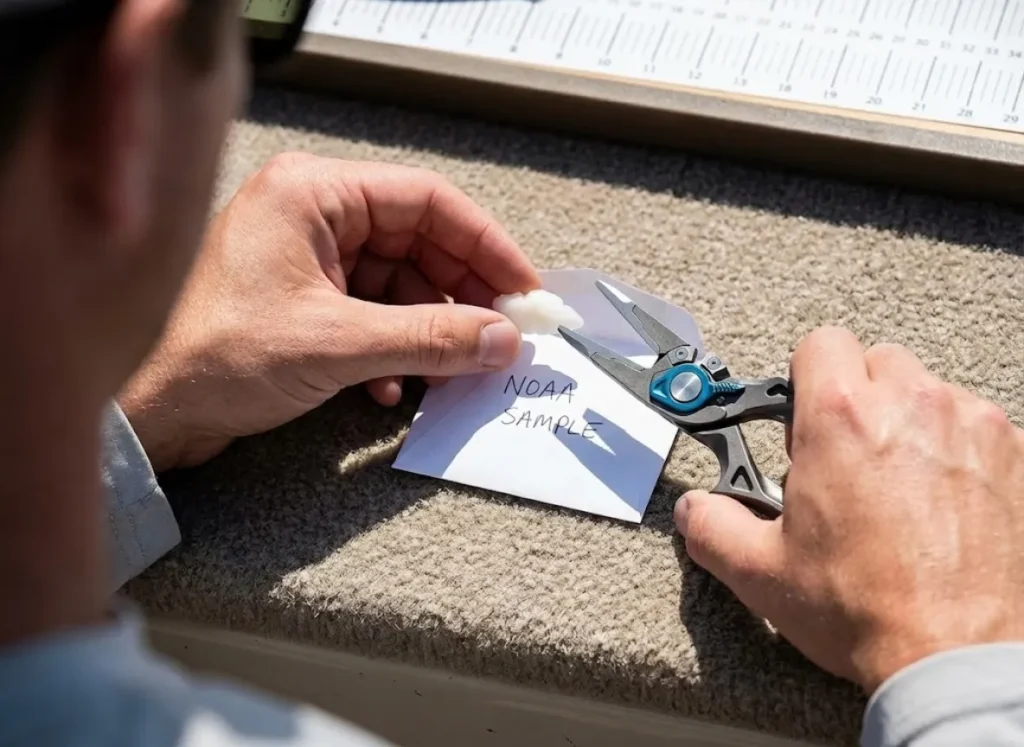
You don’t need to be a fish research biologist to help. Many state wildlife agencies, like Florida FWC, Fisheries and Oceans Canada, or the Outdoor Illinois Journal, ask anglers to donate samples of otoliths from the fish they keep.
What is the procedure for removing otoliths?
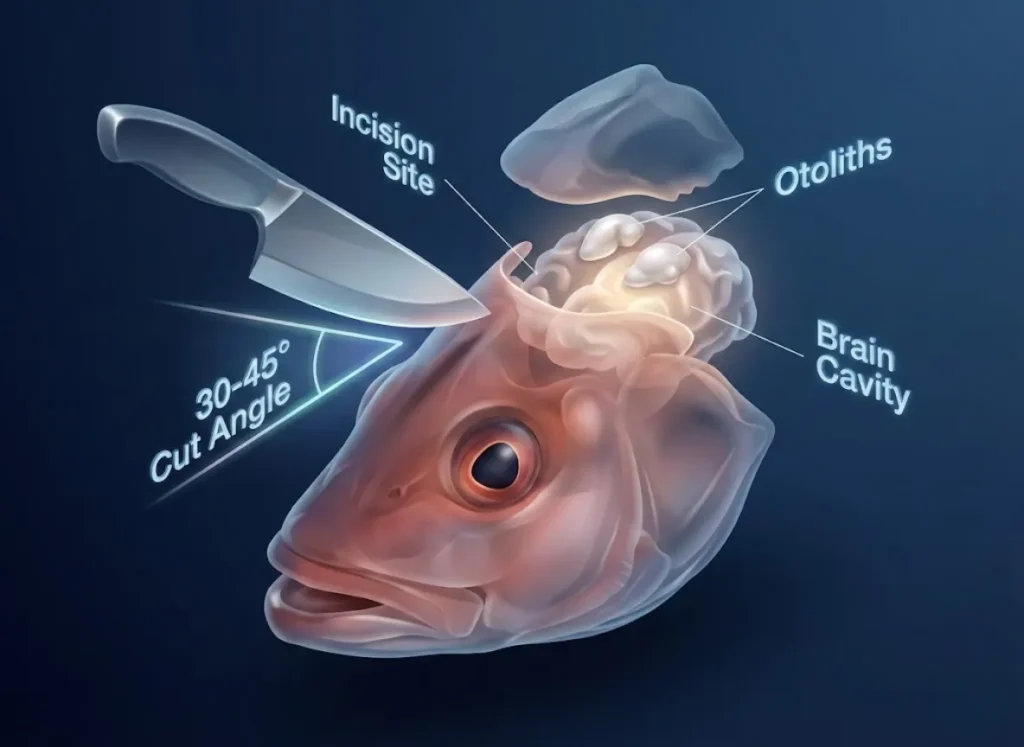
This is a lethal aging method, so it is only for fish you intend to harvest. The easiest way to do this in the field is called the “Open Hatch” method. You need a sharp, stiff knife and some tweezers.
- Make a cut across the top of the fish’s head, right behind the eyes.
- Angle your knife back about 30 or 45 degrees. Push down through the skull until it feels easier to cut.
- Pull the top of the skull backward to show the brain cavity.
- Move the brain aside. Underneath, and a little toward the back, you will see two capsules. The white intact otoliths are floating inside.
If you are mounting the fish, you can’t cut the head. Instead, you use the “Gill Arch” method. You go in through the gill cover and crack the bone from underneath. This keeps the outside of the fish looking perfect.
Once you have the whole otoliths, wipe them off and let them air-dry. Put them in paper envelopes. Do not use plastic bags, as they can trap moisture and cause mold.
For a visual field removal guide, check out this page on otoliths removal and ageing. Always use proper fish handling and be careful with knives on a wet boat.
Pro-Tip: If you send otoliths to a state program, write the location, date, and total length of the fish on the envelope right away. Without that info, the stones are useless to the fish ecologist.
How does your data contribute to fisheries management?
Citizen science is huge for fisheries management and preventing overfishing. Agencies use the stones you send in to calculate mortality rates. They also track fish recruitment, which basically means how many babies are surviving to become adults.
This data also checks if stocking is working. Genetic markers in the stones can tell the difference between Florida Strain bass and Northern strains. If a fish stock is struggling, managers know to stop wasting money.
Articles on using citizen science to inform fisheries management show that angler data directly changes the rules. If otolith examinations show mostly young fish, they might lower the bag limit to let them grow. By helping out, you are supporting conservation efforts that keep fish stocks healthy for years to come.
Wrap Up
Next time you buy a lure, ignore the flashy packaging. Think about the heavy stone inside the bass’s head.
Remember that low-frequency “thuds” match their biological function much better than high-frequency rattles.
And if you decide to keep a fish for dinner, don’t just fillet it—check the “black box.” Scales can be tricky, but otoliths always tell the truth about biological aging. By cutting them out and sending them to your local agency, you become an active guardian of the sport.
Contact your local Fish & Wildlife department to see if they need samples.
FAQ – Frequently Asked Questions
Can you tell a fish’s age without killing it?
Yes, you can read scales or spines (fin rays). However, these non-lethal methods are not very accurate for big, older fish. Scales can erode when the fish is stressed, which erases part of their history. This makes the fish look younger than it really is.
Do all fish have otoliths?
No. Only bony fishes (Osteichthyes) possess ear stones. Cartilaginous fishes—like sharks, rays, skates, and lampreys—don’t have these hard stones. Instead, they use tiny, sand-like grains called otoconia to help them hear and balance.
Why are otoliths different shapes?
The otolith shape depends on the species. Biologists can often tell what kind of fish it is just by looking at the stone, even if it was found inside another fish’s stomach. Hearing specialists like Carp usually have small, complex stones, while Bass, Cod, Walleye Pollock, and Pacific Halibut have unique shapes that identify them instantly.
Can bass hear glass rattles?
Not very well. Glass rattles usually make high sounds (over 3,000 Hz) that are too high for a Largemouth Bass to hear. The bass probably just feels the vibration of the lure moving through the water, rather than hearing the rattle itself.
Risk Disclaimer: Fishing, boating, and all related outdoor activities involve inherent risks that
can lead to injury. The information provided on Master Fishing Mag is for educational and informational purposes
only. While we strive for accuracy, the information, techniques, and advice on gear and safety are not a substitute
for your own best judgment, local knowledge, and adherence to official regulations. Fishing regulations, including
seasons, size limits, and species restrictions, change frequently and vary by location. Always consult the latest
official regulations from your local fish and wildlife agency before heading out. Proper handling of hooks, knives,
and other sharp equipment is essential for safety. Furthermore, be aware of local fish consumption advisories. By
using this website, you agree that you are solely responsible for your own safety and for complying with all
applicable laws. Any reliance you place on our content is strictly at your own risk. Master Fishing Mag and its
authors will not be held liable for any injury, damage, or loss sustained in connection with the use of the
information herein.
Affiliate Disclosure: We are a participant in the Amazon Services LLC Associates Program, an
affiliate advertising program designed to provide a means for us to earn advertising fees by advertising and linking
to Amazon.com. As an Amazon Associate, we earn from qualifying purchases. We also participate in other affiliate
programs and may receive a commission on products purchased through our links, at no extra cost to you. Additional
terms are found in the terms of service.