
In this article
You stand in the aisle of the tackle shop, surrounded by walls of plastic and steel, and the language on the packages reads like a cipher. Terms like “drag coefficient,” “thermocline,” and “fast action” act as gatekeepers, separating the successful angler from the frustrated novice. This confusion on land translates to failure on the water; a misunderstanding of “drag” snaps your fishing line, and a misinterpretation of “structure” leaves you casting into empty water.
I have spent decades on the water, and I remember staring at those same packages, unsure why one hook curved left while another looked like a torture device. This dossier is not a dictionary to be memorized, but a field manual to be used by fishing enthusiasts. It dismantles the common fishing terms and jargon of the sport into functional mechanics, transforming the vocabulary of fishing into the instinct of the angler.
What constitutes the “Engine” of your setup?
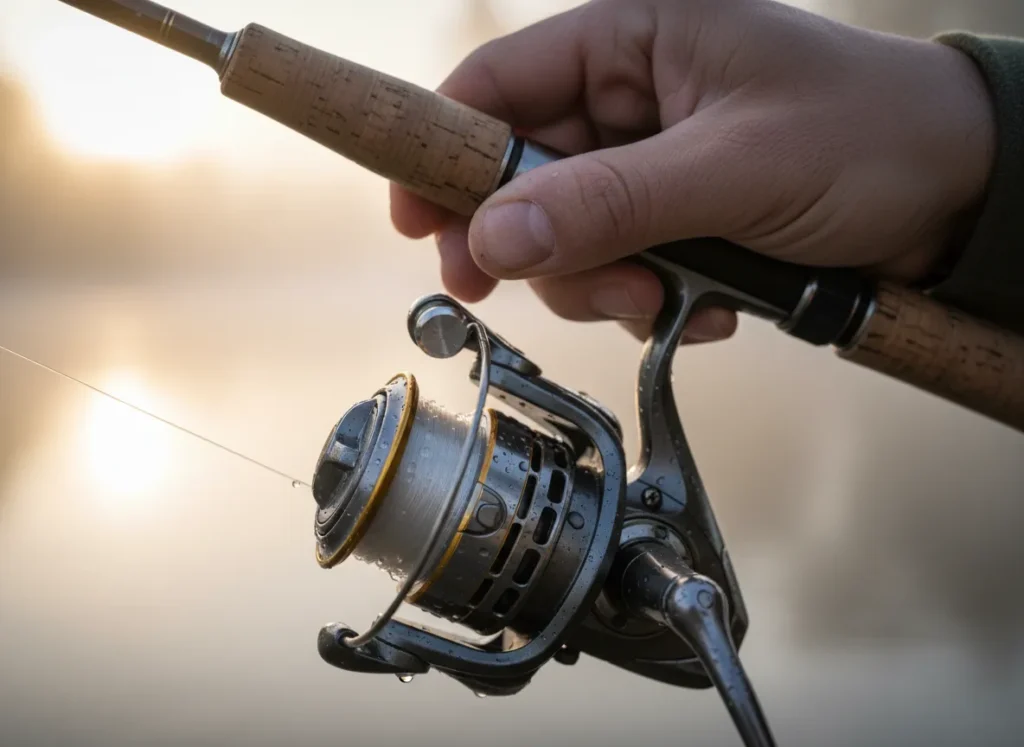
This section deconstructs the primary mechanical tools—the rod and the reel—clarifying the physics that govern their selection and operation.
Why is the distinction between a “Rod” and a “Pole” critical?
The distinction is mechanical, not semantic; a “Rod” is a sophisticated lever system designed for line management, whereas a “Pole” is a fixed-line tool.
The terms are not interchangeable. A “Pole” (like a cane pole or Tenkara) allows line to be tied directly to the rod tip, lacking a reel seat or guides. A “Fishing Rod” is engineered with a Reel Seat (to hold the reel) and Guides (ceramic rings) to manage line under tension. Using the correct terminology immediately signals competence; referring to a casting rod as a “pole” is the most common verbal “tell” of an inexperienced angler.
Fishing Gear Comparison
Rod vs. Pole vs. Cane: Choosing the right tool
Technical Features
Mechanism: Sophisticated lever system equipped with a Reel Seat and Guides (ceramic rings) to manage line under tension.
Materials: Typically Graphite (sensitive/brittle) or Fiberglass (durable/heavy).
Primary Uses
General Angling: Designed for casting long distances, reeling in fish, and managing line drag mechanically.
Versatility: Suitable for varied environments and techniques requiring complex line management.
Pros & Cons
Pros: Superior line control, high sensitivity to vibrations, mechanical advantage.
Cons: Fragile “Tip Top” guides; requires maintenance (checking inserts); technically more complex.
Technical Features
Fixed-Line: Line is tied directly to the rod tip (no reel seat or guides).
Design: Typically telescopic and extremely lightweight for portability.
Primary Uses
Precision Fishing: Used for delicate presentations where line length is fixed, such as mountain streams (Tenkara style).
Pros & Cons
Pros: Extremely lightweight, simple setup, direct connection to fish.
Cons: Cannot reel in line; range is strictly limited to the length of the pole and line.
Technical Features
Construction: Simple natural or composite pole without distinct “Action” technology.
Anatomy: No reel seat or guides; line is tied directly to the tip.
Primary Uses
Basic Fishing: Ideal for casual angling, bank fishing, or specialized close-range techniques due to its simplicity.
Pros & Cons
Pros: High accessibility, very low cost, simplest learning curve.
Cons: “Tell” of an inexperienced angler (if confused with a rod); very limited range and fight control.
To properly maintain your fishing gear, you must start by mastering the parts of a fishing rod. The anatomy includes the Blank (the main shaft), the Ferrule (joint connection in multi-part fishing rod models), and the rod butt or Butt/Handle (cork or EVA grip).
Understanding materials is also vital. Graphite offers sensitivity (vibration transmission) but is brittle, while Fiberglass (like in the Ugly Stik GX2) offers durability but is heavier. The Tip Top guide is the most fragile component; identifying broken ceramic inserts here is crucial to preventing line abrasion.
Pro-Tip: Always check your guides with a cotton swab. If the cotton snags on the ceramic ring, you have a microscopic crack that will slice your line under pressure.
How do Rod Power and Action dictate performance?
Rod Action defines where the rod bends, while Rod Power defines the force required to induce that bend.
Action dictates the speed of the rod’s recovery. A Fast Action rod bends only at the tip, providing quick energy transfer for set the hook maneuvers. Moderate Action rods bend near the middle (parabolic), acting as a shock absorber to keep fish pinned on treble hooks. Power ranges from Ultra-Light (for Panfish or ice fishing) to Heavy (for Pike, Musky, or boat fishing in weeds). According to the Kentucky Department of Fish & Wildlife, understanding these distinct physical properties is essential for predicting how a rod performs under load.
Beginners often mismatch action and lure. Use Fast Action for single hooks (Jigs, Worms) that require a piercing “snap” set. Use Moderate Action for moving baits (Crankbaits) to prevent ripping the hooks out of the fish’s mouth during the fight.
For most freshwater beginners, decoding rod power and action leads to a “Goldilocks” setup: a Medium Power, Fast Action rod, offering versatility across multiple fishing techniques.
What are the essential components of a Spinning Reel?
A spinning reel is an open-faced mechanical winch consisting of a fixed spool, a bail, and a drag system.
While fly reels serve a different purpose in dry-fly fishing, the Spinning Reel (Open Face) is the standard starter tool. It features a fixed Spool and a wire Bail that flips up to cast and down to retrieve. The Drag mechanism is the critical safety valve; it is a friction brake that allows the spool to rotate backward when a fish pulls harder than the line’s breaking strength. Proper drag setting involves tightening the Drag Knob until resistance is felt, ideally set to 25-30% of the pound test rating.
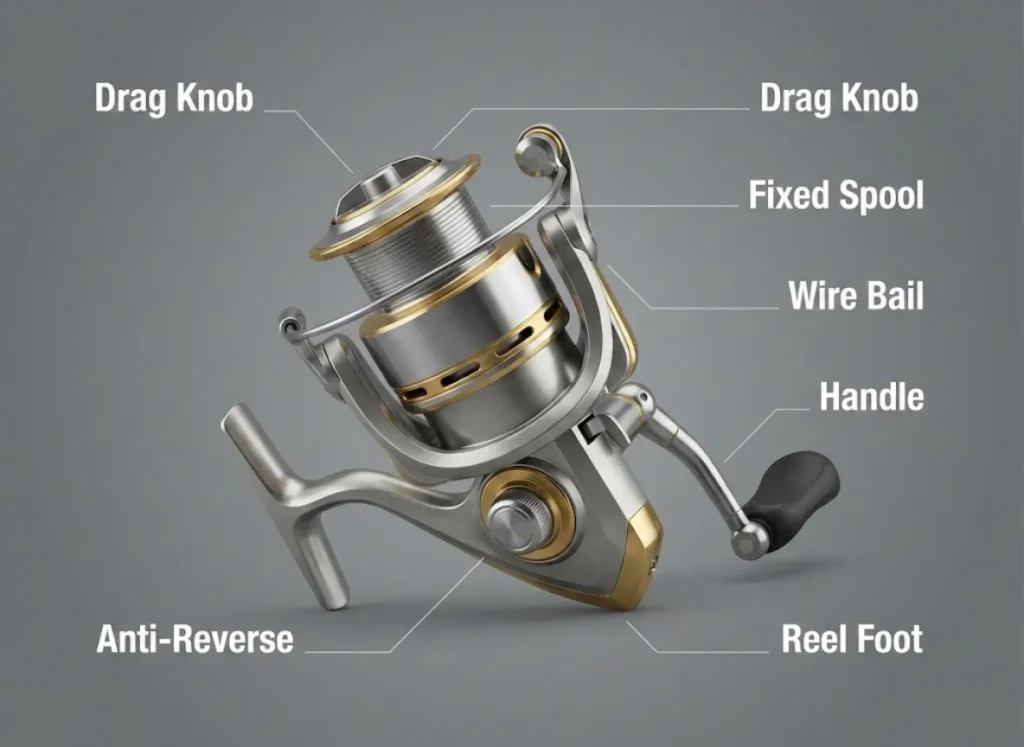
The Anti-Reverse Switch is a common pitfall; if accidentally disengaged, the handle spins backward, leading to massive tangles. Gear Ratio (e.g., 6.2:1) determines speed; it measures how many times the spool rotates per single turn of the handle.
For baitcasting reels (advanced) or conventional reels used in offshore applications, the defining failure is the “Bird’s Nest” (Backlash), caused when the spool spins faster than the line exits. Before hitting the water, you must learn to calibrate exact drag settings to ensure the reel gives line before the knot breaks.
How do you connect the angler to the fish?
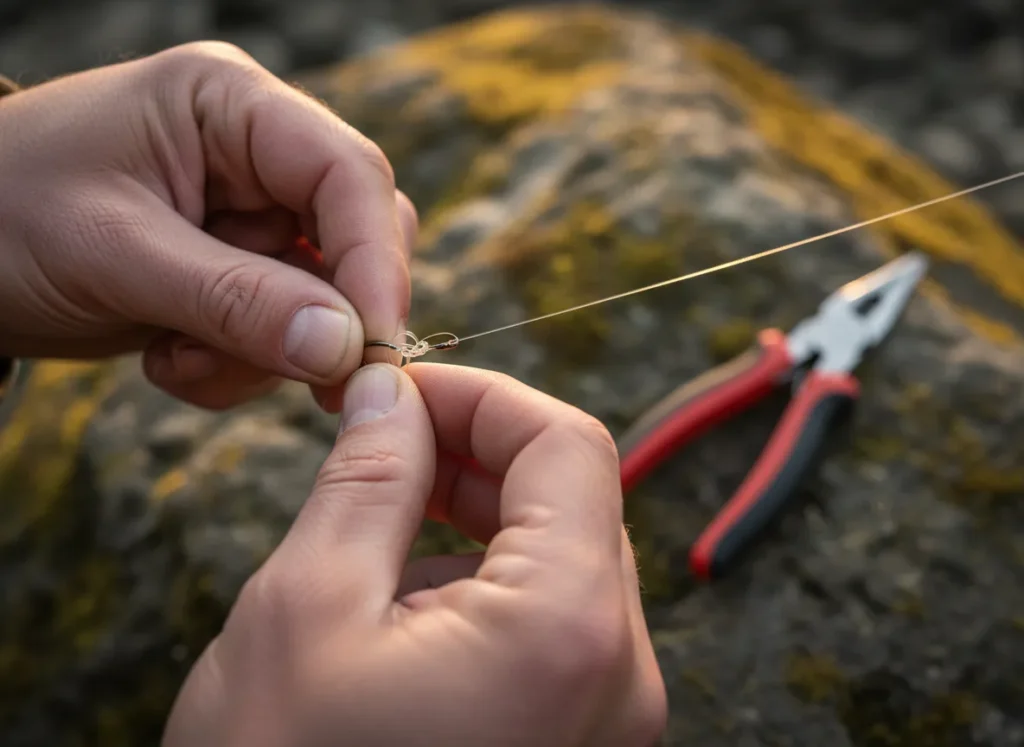
This section covers the “Connection” phase, detailing the distinct properties of fishing lines and the Terminal Tackle hardware at the business end of the rig.
Which fishing line type suits your environment?
Line selection depends on three variables: stretch, visibility, and buoyancy.
Monofilament (Mono) is the beginner standard; it floats, has high stretch (shock absorption), and is easy to knot, though it degrades in UV light. Braid is made of woven fibers offering zero stretch and high strength-to-diameter ratio, providing maximum sensitivity for feeling bites in deep water. Fluorocarbon is dense and invisible underwater (refractive index close to water), making it the ideal choice for leader material in clear water.
To complete the rig, terminal tackle is often required: a swivel to prevent line twist, a snap for quick lure changes, a sinker or split shot to add weight, or perhaps a bobber or float to suspend the bait.
Backing is the practice of using cheap mono under expensive braid to prevent the braid from slipping on the spool arbor (“ghost drag”). Line choice dictates the hook set: Braid requires a lighter set due to zero stretch, while Mono requires a harder sweep to overcome elasticity.
Line Memory refers to the line’s tendency to retain the coiled shape of the spool, a common issue with old monofilament fishing line that causes tangles. For a deeper analysis, look at the data-driven showdown of braid vs fluorocarbon vs monofilament to match the material to your specific waters.
How does hook geometry affect catch rates and conservation?
The anatomy of a hook determines whether you snare the fish or gut-hook it.
The J-Hook is the traditional shape requiring a violent “Snap” hook set to drive the hook point and barb into the fish’s mouth. The Circle Hook features a point curved back toward the hook shank; it is designed to slide out of the gullet and hook the fish in the corner of the jaw. The Gap (or Gape) is the distance between the point and the shank; wide gap hooks (EWG) are required for bulky soft plastic baits to ensure hook exposure.
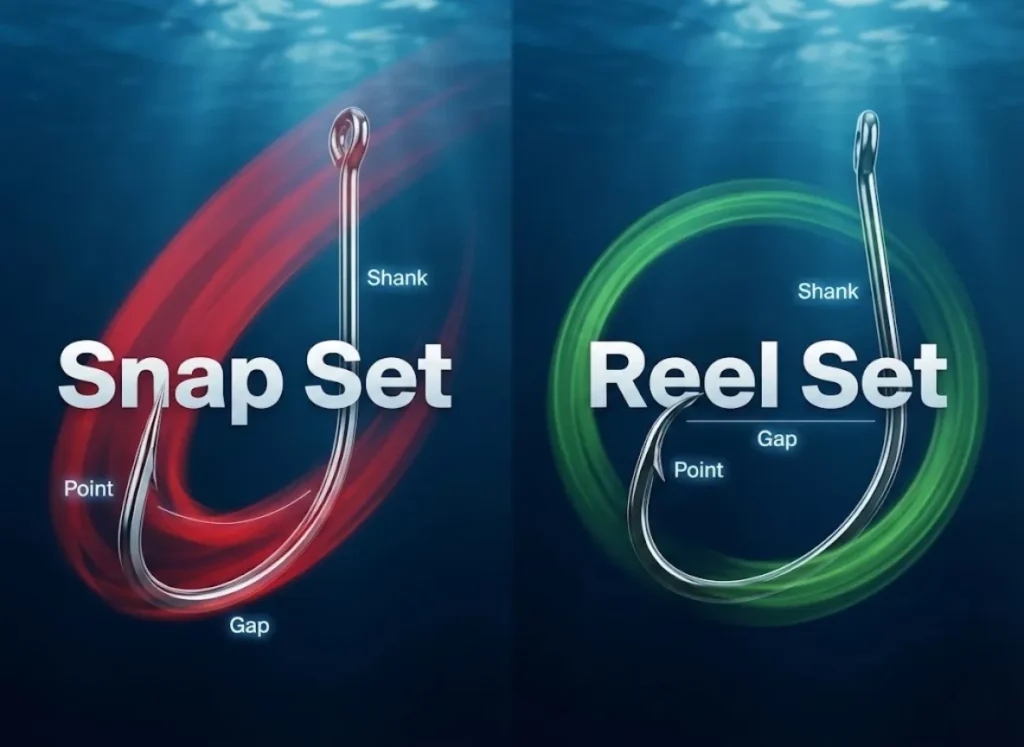
MANDATORY TECHNIQUE: Never “set” a Circle Hook; simply reel tight (The Reel Set) to allow the mechanics to work. Studies by the Massachusetts Division of Marine Fisheries indicate that using circle hooks can reduce deep-hooking mortality significantly.
Treble Hooks (three points) are common on lures like a crankbait or plug; they offer higher hook-up ratios but cause more damage to the fish. Barbless hooks (crimped barbs) are often mandated in conservation waters to facilitate faster, less damaging release. Understanding the science behind fishing hook sizes ensures you match the gap of the hook to the size of the bait, not just the size of the fish.
How does understanding aquatic dynamics improve success?
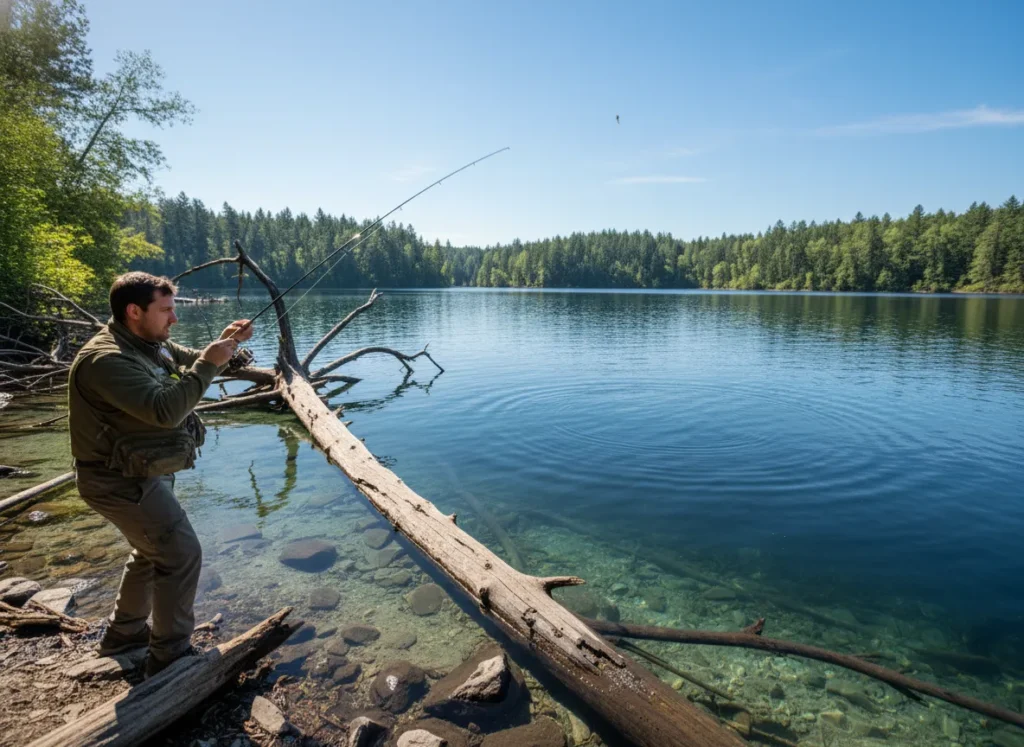
Moving beyond gear, we must focus on “reading the water,” decoding the environmental terms that describe where fish live and how they behave.
What is the difference between “Structure” and “Cover”?
Structure is the geological shape of the bottom, while Cover refers to the physical objects resting upon it.
Structure refers to the permanent geological shape of the bottom, such as drop-offs, ledges, creek channels, and points. Cover refers to the physical objects that exist on top of the structure, such as submerged trees (laydowns), weed beds, docks, or rock piles. The classic analogy: Structure is the terrain (the hill), and Cover is the furniture (the house on the hill).
Fish use Structure as a “highway” for travel between deep and shallow water, while they use Cover as an “ambush point” for feeding. Successful boat anglers look for the “Spot on the Spot”: a piece of isolated Cover located on a prime piece of Structure (e.g., a stump on a drop-off).
Transition Zones (edges) where two types of cover meet (e.g., weed line meeting rock) are high-probability target areas. Applying a proven, data-backed method that turns any lake into a roadmap relies entirely on distinguishing these two features.
How do biological features like the Lateral Line and Thermocline function?
The Thermocline is an invisible barrier of temperature, while the Lateral Line is the fish’s radar system.
The Thermocline is a distinct layer in the water column separating warm surface water from cold deep water. According to NOAA, this transition layer is critical because below it, oxygen levels often drop to near zero in summer. Identifying the thermocline prevents “fishing dead water”; casting below this depth in late summer is often futile as fish cannot survive there.
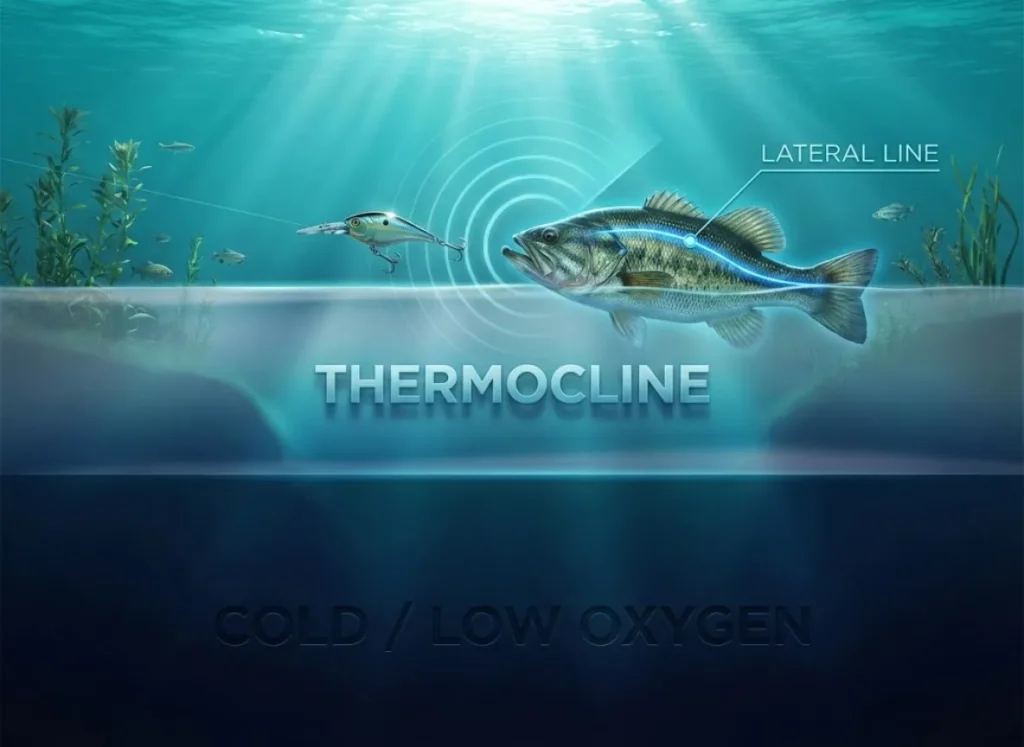
The Lateral Line is a sensory organ running down the fish’s flank that detects vibration and pressure changes (“touch at a distance”). High-vibration lures (Spinnerbaits, Crankbaits, or a bladed Jig) trigger the Lateral Line, allowing fish to track prey in zero-visibility muddy water.
Barotrauma occurs when fish are reeled up quickly from depths greater than 30ft, causing the Swim Bladder to expand and the stomach to protrude. Ethical anglers must recognize this condition and know the protocols for fixing barotrauma in fish using descending devices, rather than releasing them to float and die.
What language defines the angling community?
This section covers the “Culture” layer, explaining the fishing slang and etiquette that signify belonging and ethical stewardship.
How do slang terms like “Skunked” and “Bird’s Nest” describe the experience?
Slang in fishing serves as shorthand for shared triumphs, failures, and conservation ethics.
“Angler” is the inclusive, proper term for anyone fishing with a rod and reel, regardless of skill level. “Skunked” is the universal term for catching zero fish on a fishing trip, a common experience that builds resilience. “Honey Hole” refers to a highly productive, often secret spot that anglers protect fiercely.
“Lunker” (or Hawg/Toad) denotes an exceptionally big fish, usually a Largemouth Bass; a “PB” stands for Personal Best. “Keeper” implies a fish meets the legal size and bag limit for harvest, but “Catch-and-Release” is the dominant ethos for sport fish conservation.
“Bird’s Nest” is the slang for a baitcaster backlash; admitting to one is a rite of passage for learning anglers. Learning how to cast a baitcaster eventually turns these tangles into pinpoint accuracy, but the learning curve is part of the journey.
Conclusion
We have covered the hardware, the physics, and the language. A “Rod” is a sophisticated tool for line management, not a simple stick. Drag is not just a brake; it is a safety valve that protects your line’s tensile strength. You now know that Structure is the geology of the lake, while Cover is the furniture upon it, and that Circle hooks require a patient “Reel Set” to function ethically.
The language of fishing is learned best with a line in the water. Visit your local tackle shop, use these terms to ask the right questions, and get your first rig wet.
FAQ – Frequently Asked Questions about Fishing Terminology
What is the difference between a bait and a lure?
Bait usually refers to organic or live baitfish (worms, minnows, shrimp, or cut bait) used to attract fish via scent and taste. A fishing lure (or Artificial) refers to man-made objects (plastic, metal, wood) designed to mimic prey through movement and vibration, such as a spoon, plug, or spinner.
What does test mean on fishing line?
Test (or Pound Test) refers to the tensile strength of the line. 10lb test means the line can hold up to 10 pounds of dead weight before breaking. It does not mean you can only catch 10lb fish, as drag and water buoyancy allow you to land much heavier catches.
Why do I need a leader line?
A Leader is a short section of tougher or invisible line (like Fluorocarbon) attached to the main line. It acts as a fuse, breaking first if snagged to save your expensive main line, and prevents fish from seeing the connection or biting through it. In fly fishing, this tapers down to a fine tippet.
What is a backlash on a reel?
Also known as a Bird’s Nest, this occurs on baitcasting reels when the spool spins faster than the line exits, causing a severe tangle. It is typically caused by poor thumb control or improper brake settings during the cast.
Risk Disclaimer: Fishing, boating, and all related outdoor activities involve inherent risks that
can lead to injury. The information provided on Master Fishing Mag is for educational and informational purposes
only. While we strive for accuracy, the information, techniques, and advice on gear and safety are not a substitute
for your own best judgment, local knowledge, and adherence to official regulations. Fishing regulations, including
seasons, size limits, and species restrictions, change frequently and vary by location. Always consult the latest
official regulations from your local fish and wildlife agency before heading out. Proper handling of hooks, knives,
and other sharp equipment is essential for safety. Furthermore, be aware of local fish consumption advisories. By
using this website, you agree that you are solely responsible for your own safety and for complying with all
applicable laws. Any reliance you place on our content is strictly at your own risk. Master Fishing Mag and its
authors will not be held liable for any injury, damage, or loss sustained in connection with the use of the
information herein.
Affiliate Disclosure: We are a participant in the Amazon Services LLC Associates Program, an
affiliate advertising program designed to provide a means for us to earn advertising fees by advertising and linking
to Amazon.com. As an Amazon Associate, we earn from qualifying purchases. We also participate in other affiliate
programs and may receive a commission on products purchased through our links, at no extra cost to you. Additional
terms are found in the terms of service.